1. Introduction
1.1. Global Context
Energy security underpins socioeconomic development and remains a central objective of energy policy worldwide [
1]. Although fossil fuels have historically dominated electricity supply, their finite availability, price volatility, and role as the primary source of greenhouse gas (GHG) emissions increasingly constrain sustainable development pathways [
2]. The power sector alone accounts for approximately 41% of global CO
2 emissions, placing electricity systems at the core of climate-mitigation strategies [
3]. Consequently, improving energy efficiency and accelerating the deployment of renewable energy have become essential for achieving long-term sustainability and emissions-reduction targets [
4].
1.2. Egypt’s Energy System, Policy Commitments
Egypt occupies a strategic position within the Middle East and North Africa (MENA) region and has committed to international emissions-reduction efforts under the Kyoto Protocol [
5]. Empirical evidence confirms the mitigation potential of renewable energy in the region: Rahman et al. [
6] estimate that a 1% increase in renewable energy consumption in MENA reduces emissions by 0.13%. Consistent with this evidence, Egypt’s Integrated Sustainable Energy Strategy targets 42.7% renewable electricity generation by 2035, following an interim target of 20% in 2022 [
7]. Despite these ambitions, renewable energy accounted for only around 10% of installed capacity in 2023, revealing a persistent implementation gap [
8].
By 2023, Egypt’s installed electricity capacity reached approximately 57,761 MW, of which nearly 90% was supplied by thermal power plants, with the remainder coming from hydro, wind, and solar resources [
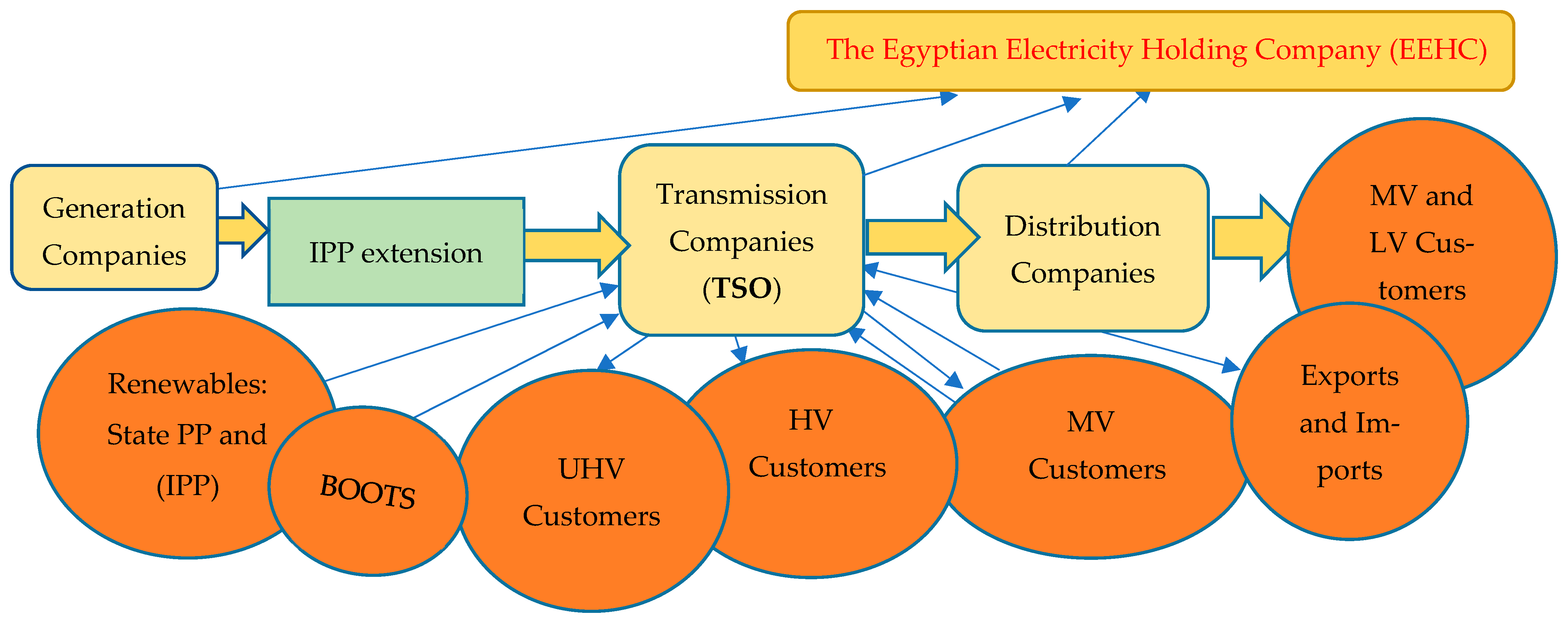
8]. The electricity sector in Egypt remains largely vertically integrated under the Egyptian Electricity Holding Company (EEHC), which oversees generation, transmission, and distribution (
Figure 1). Supply shortages during 2010–2015—driven by fuel constraints, rapid demand growth, and aging infrastructure—exposed structural vulnerabilities and highlighted the need for greater operational flexibility. Although Electricity Law No. 87/2015 initiated market reforms, fossil fuels continue to dominate the generation mix, constraining both flexibility and environmental performance [
9,
10].
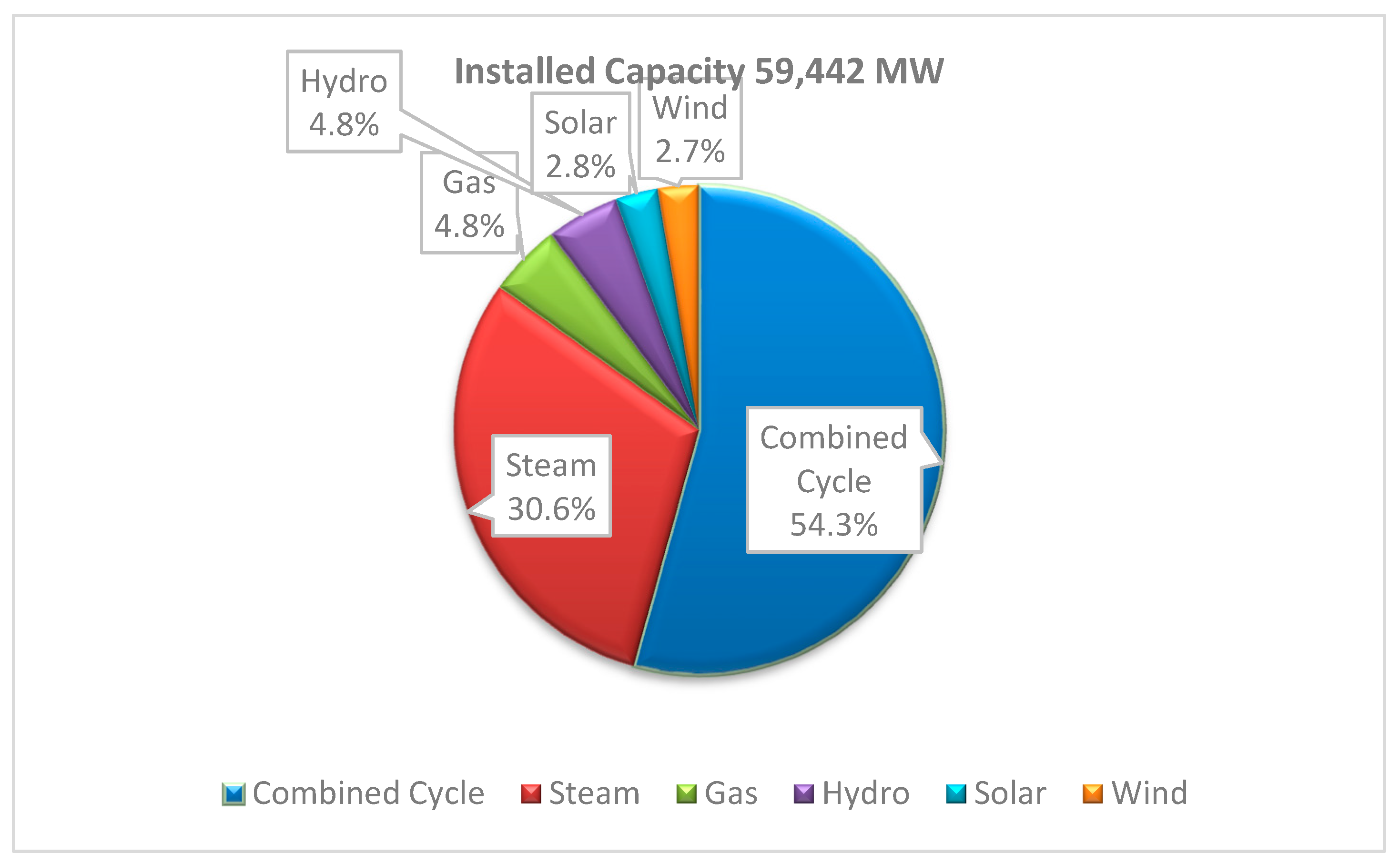
The installed capacity structure further reflects this dependence (
Figure 2): combined-cycle units account for 54.3%, steam plants for 30.6%, and gas turbines for 4.8%, while hydro, solar PV, and wind together remain around 11% [
8]. From a reliability perspective, Egypt continues to apply a deterministic reserve policy based on a fixed 15% margin above peak demand under the N-1 criterion, with system frequency maintained between 49.6 and 50.4 Hz [
11]. Such static reserve rules fail to reflect the stochastic variability of wind and solar generation, leading to reserve over-procurement during stable periods and insufficient coverage during steep ramps. This imbalance increases fuel consumption, emissions, and operating costs while limiting renewable utilization, underscoring the need to transition toward dynamic, forecast-based reserve allocation.
To enhance system flexibility, Egypt is pursuing both regional interconnection and domestic storage initiatives. The country participates actively in the Eastern Africa Power Pool (EAPP) to facilitate reserve sharing and frequency support [
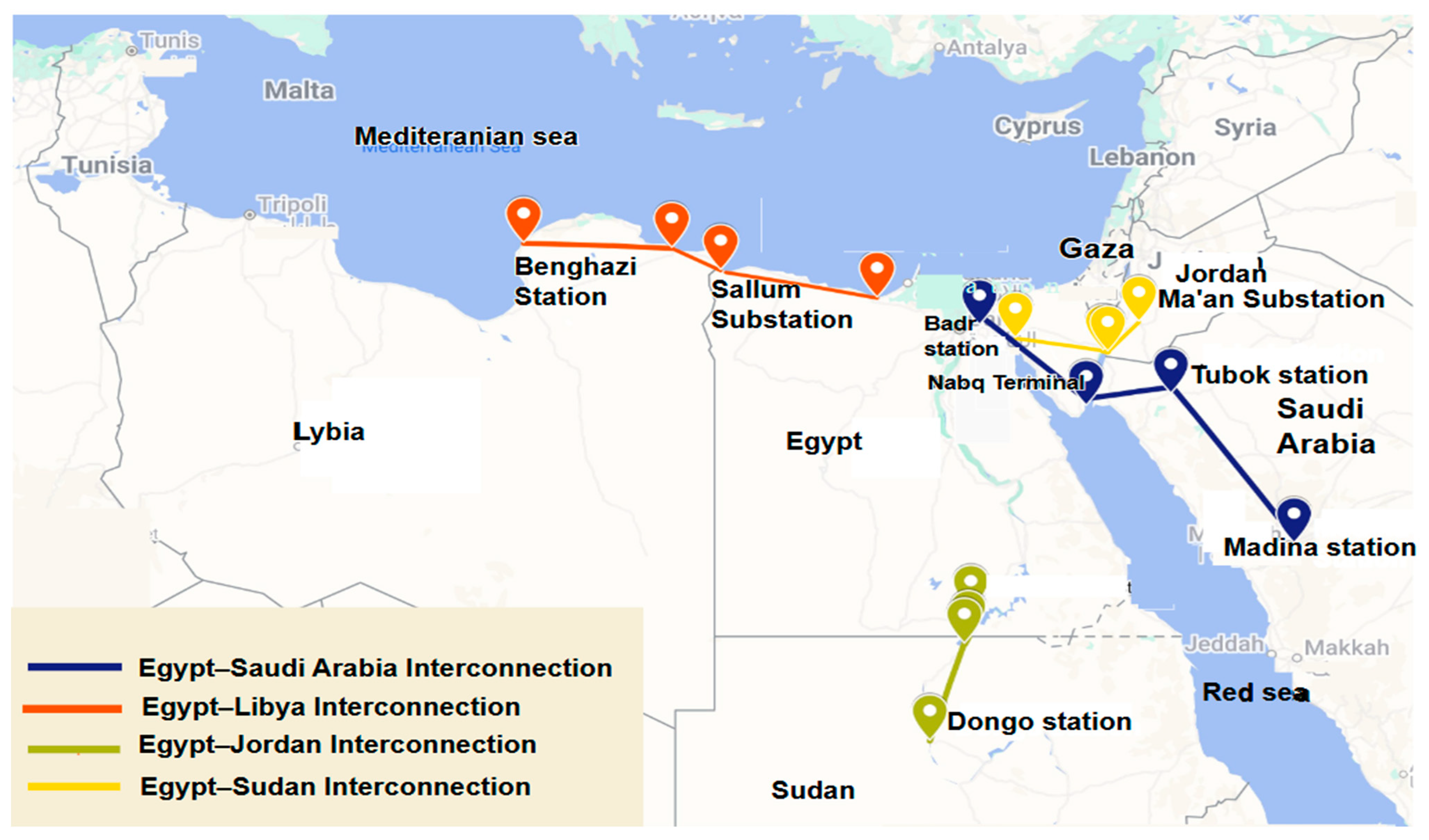
12]. Existing and planned interconnections include Egypt–Jordan, Egypt–Libya, Egypt–Sudan, and the 3-GW HVDC link with Saudi Arabia, alongside the proposed 2-GW Euro–Africa Interconnector linking Africa and Europe [
13,
14,
15]. Despite this physical expansion, cross-border electricity exchanges remain dominated by rigid bilateral contracts, limiting real-time flexibility and least-cost dispatch. At the domestic level, Egypt has launched a 1500-MWh battery energy storage system (BESS) program at Benban and Zafarana, signaling a strategic shift toward fast, non-fuel-based balancing resources.
1.3. Renewable Energy Potential and Integration Constraints
Global experience shows that variable renewable energy (VRE), primarily wind and solar, has accounted for more than 70% of new renewable capacity additions over the past decade [
16]. Egypt possesses exceptional renewable resources, including high solar irradiation (2000–3200 kWh/m
2 annually) and strong wind potential, particularly along the Gulf of Suez corridor [
17,
18,
19,
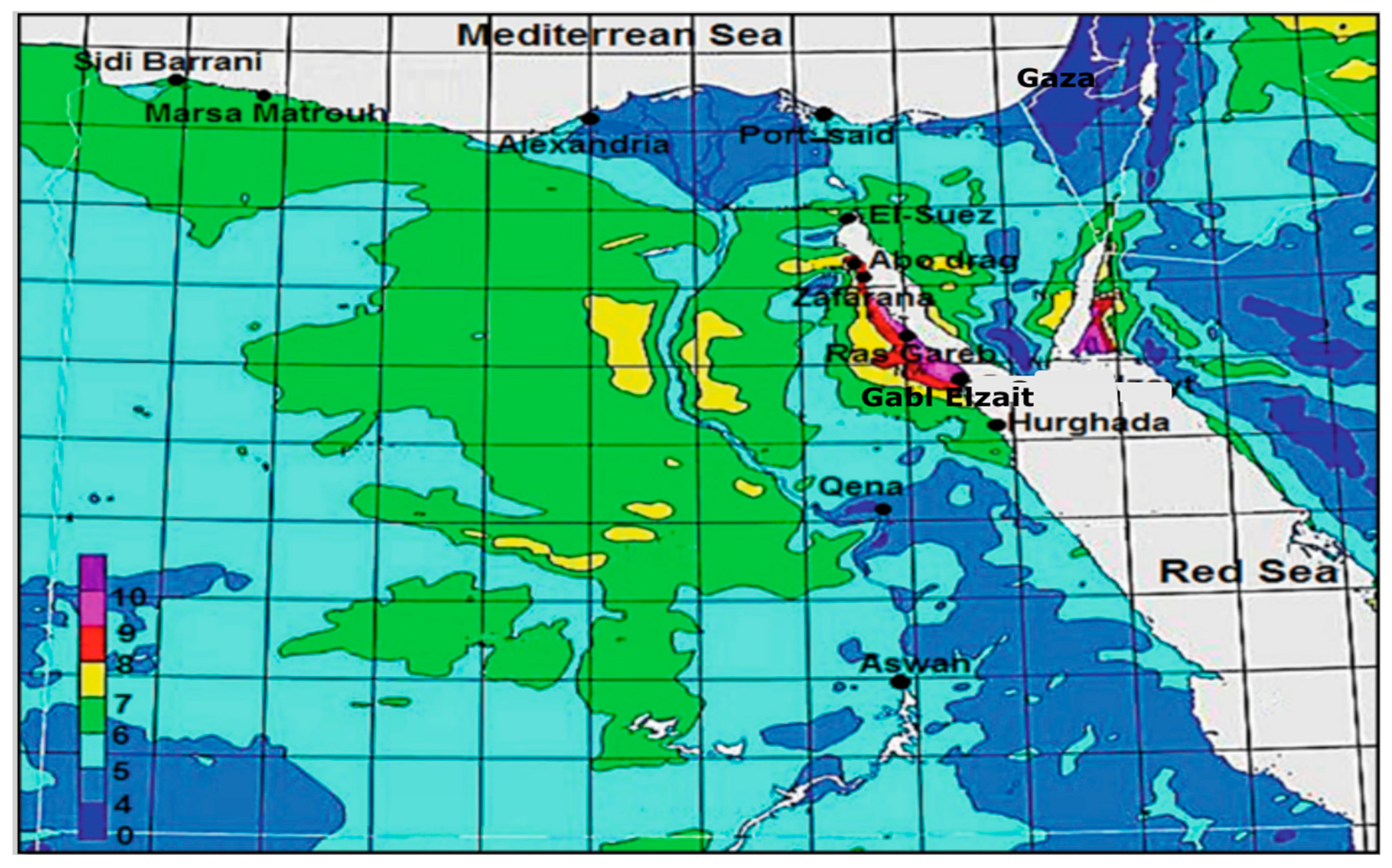
20]. Large-scale projects such as the 1650-MW Benban Solar Park and wind developments in Gabal El-Zeit and Ras Gharib illustrate this potential (
Figure 3) [
21]. Despite favorable resource conditions and expanding installed capacity, renewable energy still represents a modest share of Egypt’s electricity mix. This discrepancy reflects regulatory barriers, grid integration challenges, and operational inefficiencies rather than resource scarcity. Addressing these constraints requires improvements in dispatch mechanisms, reserve design, and coordinated transmission planning.
1.4. Operational Challenges Under High VRE Penetration
The inherent variability and limited predictability of wind and solar generation fundamentally alter power system operation. VRE fluctuations reshape net load profiles by lowering minimum demand levels and increasing both the frequency and magnitude of ramps. These dynamics force thermal units to operate near their minimum stable limits, intensifying cycling, reducing efficiency, and accelerating mechanical wear [
22,
23,
24]. Empirical studies demonstrate that the interaction between VRE availability, load correlation, and system flexibility critically determines integration outcomes [
25,
26]. Consequently, traditional static reserve approaches are increasingly inadequate for power systems undergoing rapid renewable expansion, such as Egypt.
1.5. Flexibility as a System-Level Requirement
Power system flexibility, i.e., the ability to respond effectively to net load variability and uncertainty, has become essential for maintaining reliability in renewable-dominated grids [
27]. Key flexibility sources include dispatchable generation, energy storage, and interconnections [
28]. While thermal and hydropower plants provide baseline flexibility, fast-responding resources such as BESS offer critical support for frequency regulation and ramping [
29,
30,
31]. At the regional scale, interconnections exploit geographic and temporal diversity, reducing renewable curtailment and the need for extensive storage deployment [
32,
33,
34,
35]. Importantly, the value of these resources depends on their coordinated deployment through dynamic reserves, sub-hourly dispatch, and economically dispatched cross-border exchanges—dimensions that remain insufficiently integrated in existing analyses of Egypt’s power system.
1.6. Research Gap and Contribution
Despite growing recognition of the importance of operational flexibility, most existing studies—particularly in the Egyptian context—assess flexibility options such as storage or interconnection in isolation and rely predominantly on long-term capacity-expansion models. These approaches often overlook short-term operational constraints, dynamic reserve requirements, and institutional dispatch mechanisms.
This study addresses these limitations by developing an Egypt-specific PLEXOS Short-Term Scheduling and Projected Assessment of System Adequacy (PASA) framework that integrates three complementary flexibility mechanisms: dynamic reserve sizing with reserve-scarcity pricing (VoRS), five-minute economic dispatch, and economically dispatched regional interconnections enabling up to 8000 MW of cross-border transmission, complemented by fast-response Li-ion BESS.
Relative to recent Egyptian PLEXOS-based studies, this framework delivers clear quantitative advances. Hamdi et al. [
36] enhance operational realism by validating long-term planning outcomes through hourly unit commitment and economic dispatch to 2040, with flexibility primarily provided by pumped-hydropower storage and conventional thermal units. Their results show that 69.5% renewable generation can be accommodated, with curtailment reduced to approximately 1.2%, but they do not quantify reliability metrics such as Loss-of-Load Probability (LOLP) and remain constrained by hourly dispatch resolution and implicit reserve assumptions. El-Sayed et al. [
37] adopt a long-term planning perspective to 2050, projecting extensive deployment of flexibility assets—including 21 GW of pumped-storage hydropower, 15 GW of hydrogen electrolyzers, and large-scale battery systems—under an 80% renewable target. While their framework quantifies capacity requirements, it does not report short-term operational metrics or evaluate BESS–interconnection interactions, limiting assessment of real-time system adequacy.
In contrast, this study evaluates short-term system operation under high-stress renewable conditions, with renewables representing 50% of installed capacity and supplying up to 82% of total electricity generation under least-cost economic dispatch and integrated flexibility. The proposed framework eliminates loss-of-load risk, reduces renewable curtailment by more than 15 TWh annually, lowers total system costs by approximately 45%, and cuts CO2 emissions by about 40%. These results demonstrate that coordinated operational and regional flexibility delivers superior reliability and economic performance.
By bridging operational planning and renewable-integration analysis, this study provides country-specific, policy-relevant evidence that integrated flexibility—combining dynamic reserves, sub-hourly dispatch, and market-based interconnection, complemented by fast-response Li-ion BESS—can accelerate renewable integration while strengthening system adequacy. The proposed framework is directly applicable to Egypt and offers a replicable blueprint for other emerging power systems pursuing high renewable penetration.
The remainder of this paper is organized as follows.
Section 2 reviews the literature on operational reserves, dispatch granularity, interconnection, and energy storage in renewable-dominated power systems, with emphasis on Egypt and the MENA region.
Section 3 describes the PLEXOS-based modeling framework, data inputs, and scenario design.
Section 4 presents and discusses the results, evaluating generation mix evolution, reliability, curtailment, emissions, and system costs under alternative flexibility configurations.
Section 5 concludes conclusion with key policy insights and institutional implications for Egypt and regional power system integration.
3. Methodology
3.1. Analytical Framework and Scenario Design
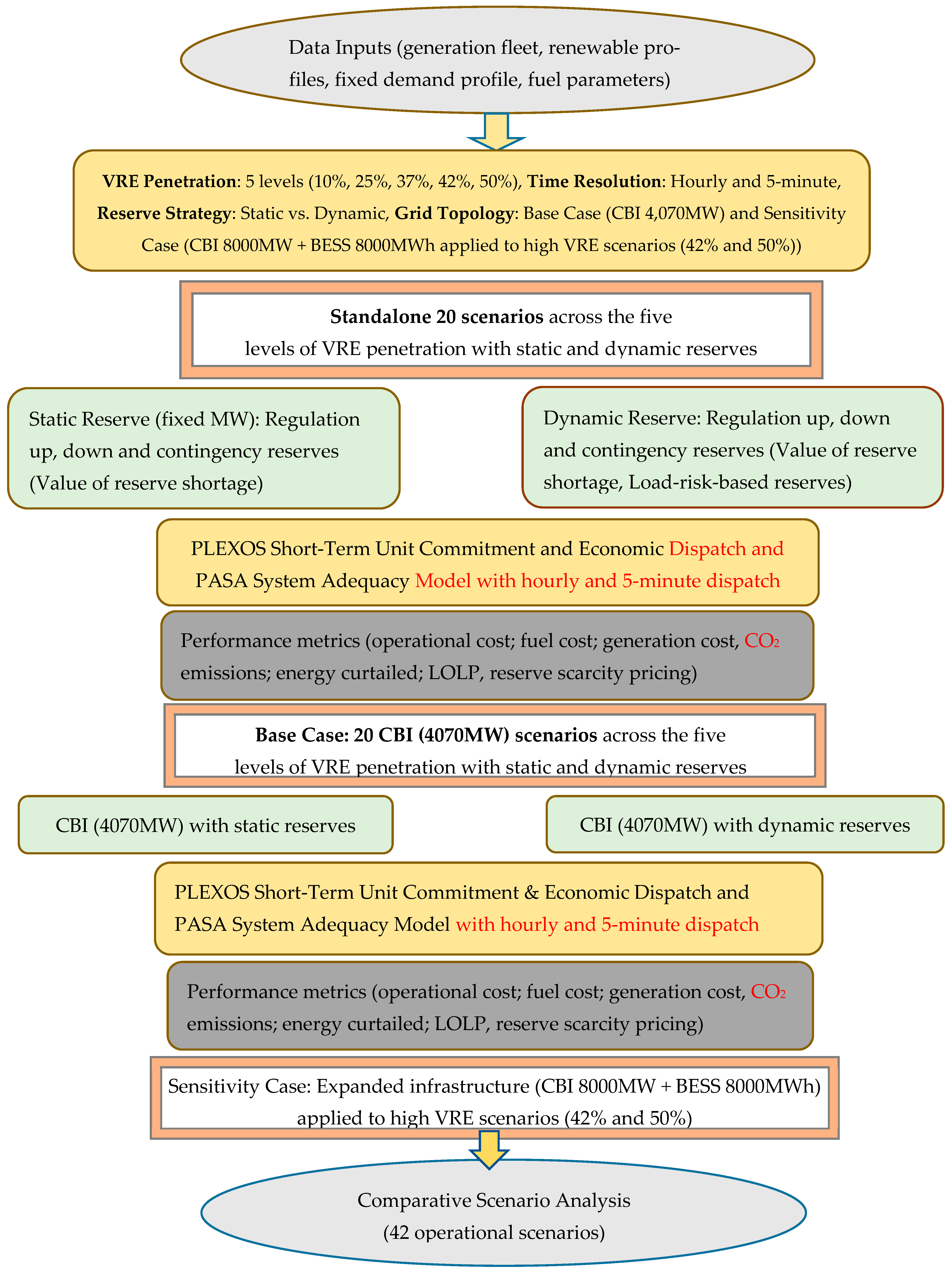
This study evaluates the short-term operational adequacy and economic performance of the Egyptian power system under increasing levels of renewable penetration using the PLEXOS Short-Term (ST) operational model coupled with the Projected Assessment of System Adequacy (PASA) module. A comparative, scenario-based framework is employed to isolate the individual and combined impacts of dispatch resolution, reserve formulation, regional interconnection, and BESS on system reliability, cost, and flexibility. Scenarios are constructed by systematically varying four controlled dimensions:
Institutional configuration (standalone operation)
- ○
Static versus dynamic reserve formulation
- ○
Hourly versus five-minute dispatch resolution
Spatial and temporal flexibility (interconnected operation)
- ○
Existing and ongoing regional interconnection capacity (4070 MW)
- ○
Future configuration with 8000 MW of CBI combined with 8000 MWh of BESS
Renewable penetration level
- ○
10%, 25%, 37%, 42%, and 50% of annual electricity generation
Reserve-sizing methodology
- ○
Deterministic static reserves
- ○
Probabilistic dynamic reserves
Cross-border power exchanges are optimized exclusively from the Egyptian system perspective using normalized fuel costs and technical constraints. The framework intentionally excludes joint optimization, market-based bidding, and coordinated market clearing across countries. Consequently, all efficiency gains arise purely from least-cost economic dispatch rather than bidding or strategic trading behavior.
Figure 5 presents the modeling framework, and
Table 3 summarizes the complete scenario matrix.
3.2. Data Collection and System Representation
This section describes the datasets used to represent the Egyptian power system in the PLEXOS simulation framework. Data collection is organized by system components, ensuring transparency, internal consistency, and reproducibility. All inputs correspond to 2023, which is selected as the reference-operating year due to the availability of verified system statistics.
3.2.1. Generation Fleet
This study models Egypt’s electricity system using 2023 as the reference year.
The generation fleet is derived from the EEHC Annual Report 2022–2023 [
8], totaling 57,761 MW of installed capacity (
Table 4).
3.2.2. Electricity Demand Assumptions
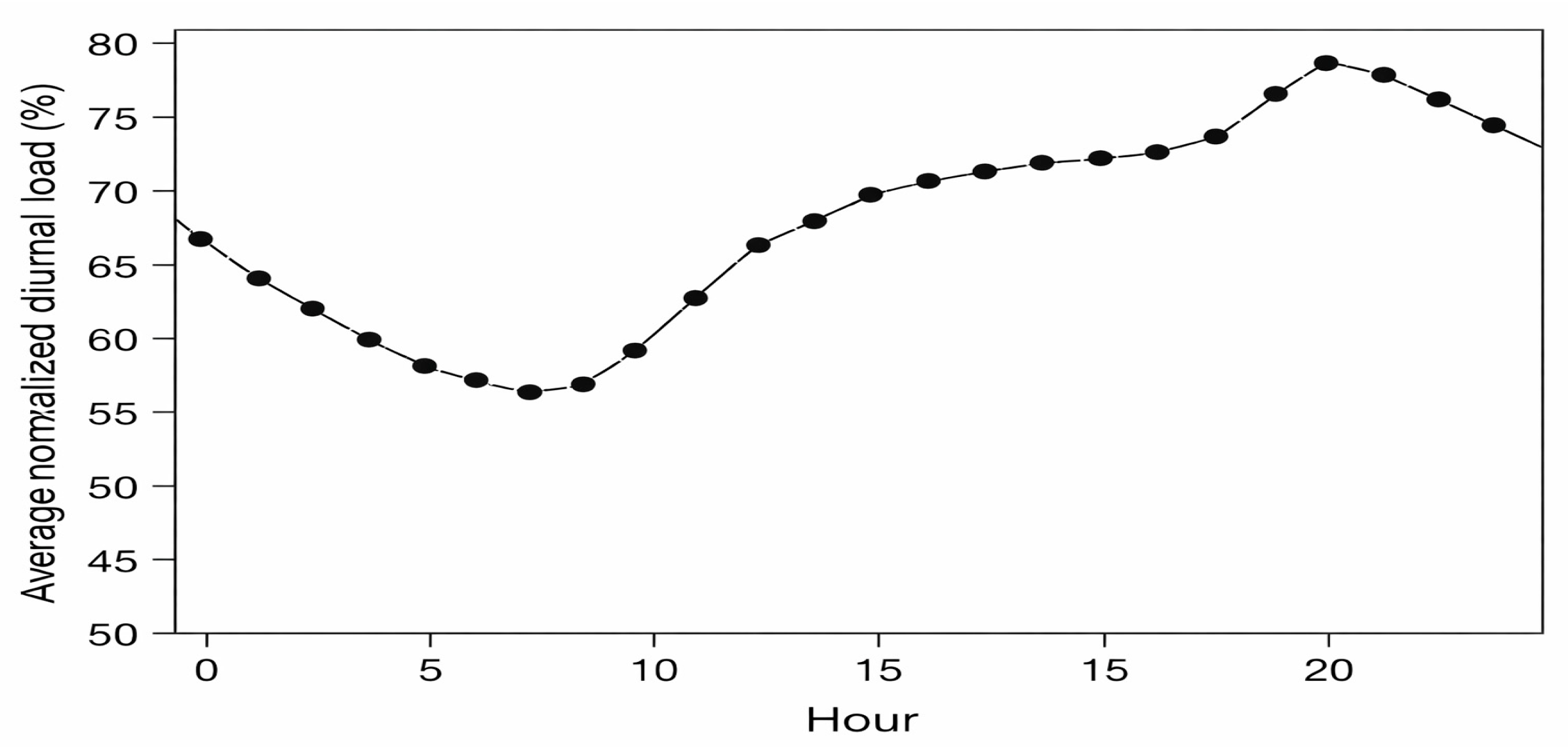
A fixed demand profile is applied across all scenarios to isolate the operational impacts of renewable penetration and flexibility mechanisms. Total annual consumption is 234,424 GWh, with a peak load of 35,000 MW.
Egypt’s diurnal load profile peaks during evening hours, when solar output is zero, resulting in negligible solar capacity credit and heightened ramping requirements for thermal units [
36].
Figure 6 illustrates the diurnal load pattern.
3.2.3. Renewable Resource Profiles
Hourly renewable generation profiles are generated using the NREL System Advisor Model (SAM) [
87] and capture both diurnal and seasonal variability.
Wind: Profiles from the Gulf of Suez, West Sohag, West Aswan, and Gabal El-Zeit reflect location-dependent generation patterns with substantial night-time output;
Solar photovoltaic (PV) and concentrated solar power (CSP): Profiles from Aswan exhibit pronounced daytime generation peaks with zero nocturnal output, consistent with regional solar irradiance characteristics and;
Hydropower is modeled in two categories. The High Dam (2100 MW) operates as a flexible peaking resource subject to seasonal energy constraints, while other Nile dams are represented as a continuous 723 MW baseload resource due to their limited storage capability [
88].
3.2.4. Renewable Penetration Scenarios
Five renewable penetration levels are modeled. Hydropower capacity is held constant at 2832 MW, while solar PV, wind, and CSP capacities are adjusted to meet target shares (
Table 5).
3.3. PLEXOS Modeling Framework
PLEXOS is an optimization-based production cost and market simulation tool capable of solving unit commitment (UC) and economic dispatch (ED) simultaneously [
89]. The objective function minimizes total system cost:
UC refers to a class of optimization problems that determine the scheduling of generating units to minimize operational costs while ensuring system reliability.
ED, by contrast, focuses on dispatching the most efficient generating units available to meet demand at the lowest possible cost.
The optimization minimizes total system cost subject to constraints on generation capacity, ramping limits, reserves, and network flows. The general objective function can be summarized as:
where
denotes fuel costs,
startup costs,
reserve provision costs,
emission penalties, and
revenues from power exports.
To ensure the robustness and realism of the model, technical parameters for conventional generators are summarized in
Table 6 and
Table 7, based on the methodology reported in [
24,
90].
3.4. Chronological Integrity and Reliability Constraint
Simulations are conducted over a full-year horizon using both hourly and five-minute dispatch, with full chronological integrity preserved. Reliability is governed by Forced Outage Rate (FOR), Maintenance Rate, and Mean Time to Repair (MTTR), with technology-specific parameters applied consistently across scenarios.
Steam plants assumed FOR = 3–6%, Maintenance = 5–7%, and MTTR = 96–154 h due to age and unit size, significantly influencing adequacy under high VRE without flexibility.
Gas and CCGT units used FOR = 2–3%, Maintenance = 3%, and MTTR = 24–72 h.
Renewables and hydro were modeled with very low outage rates and short repair times (3–24 h) [
91].
All scenarios are evaluated using PLEXOS ST + PASA, with international reliability constrained standard to LOLP ≤ 0.1.
3.5. Fuel Prices and Emission Rates
Natural gas is priced at USD 4.00/MMBTU, based on Egyptian regulatory disclosures. Emission factors for CO
2, NO
x, and SO
2 are sourced from standard inventories [
92,
93] (
Table 8).
Emissions are calculated endogenously by PLEXOS based on simulated fuel burn, allowing emissions to vary dynamically with dispatch outcomes rather than imposed exogenously.
3.6. Dynamic vs. Static Reserve Modeling
3.6.1. Dynamic Operating-Reserve Framework
Dynamic reserves are sized probabilistically based on forecast uncertainty using Load-Risk thresholds and Value of Reserve Service (VoRS). Three reserve products are modeled: Regulation Up, Regulation Down, and Contingency Spinning (
Table 9). Parameters are consistent with international best practice [
44,
94].
3.6.2. Static Reserve Configuration (Baseline)
Static reserves follow deterministic Egyptian practice based on N-1 with 10% margin [
11], with fixed MW requirements and higher VoRS to reflect inefficiency under uncertainty.
Holding reserve parameters constant across scenarios ensures that performance differences arise solely from reserve sizing methodology.
By locking the time parameter between static and dynamic regulations and contingency, any differences in cost, curtailment or reliability between the static and dynamic cases can be solely attributed to the difference in sizing methodology. All scenarios, encompassing both the static and dynamic reserve provisions (whether standalone or regionally interconnected), are tested under a unified simulation regime that employs hourly and 5 min economic dispatch.
3.7. Interconnection Modeling Framework: Justifying Economic Dispatch and Addressing Market Distortions in MENA Power Systems
Cross-border exchanges are optimized from the Egyptian system perspective based on normalized marginal costs and technical constraints, without joint optimization, market-based bidding, or coordinated market clearing across countries. Any operational performed efficiency due to economic dispatch not strategic trading behavior.
Large-scale integration of VRE requires a commensurate expansion of system flexibility. This study evaluates regional electricity interconnection as a core flexibility mechanism, focusing on Egypt’s interconnections with Saudi Arabia, Jordan, Libya, and Sudan. The objective is to quantify how least-cost ED of CBI affects system reliability, reserve adequacy, renewable curtailment, emissions, and total operating cost under renewable penetration levels of up to 50%.
3.7.1. Economic Dispatch vs. Bilateral Contracts
Cross-border electricity trade in the MENA region is currently dominated by fixed bilateral contracts, which prescribe predetermined import and export volumes independent of real-time system conditions. Such arrangements limit the ability of interconnections to respond to short-term variability and system stress.
In contrast, this study adopts a least-cost ED framework, allowing cross-border power flows to adjust dynamically based on marginal generation costs. This approach enables:
System-wide cost minimization, as power flows follow lowest marginal-cost resources;
Improved renewable utilization, by exporting surplus Egyptian renewable generation instead of curtailing it;
Temporal diversity gains, exploiting asynchronous load peaks across countries.
This framework reflects a flexibility-oriented market design.
3.7.2. Market Distortion and the Fuel-Subsidy Challenge
Applying economic dispatch in the MENA context presents a critical challenge: fuel price distortions caused by heavy subsidies in hydrocarbon-producing countries. In Saudi Arabia and Libya, administratively set natural gas prices are often far below international opportunity costs [
95,
96,
97,
98].
Initial simulations using subsidized fuel prices produced unphysical dispatch outcomes, including distorted power flows and artificial price spikes. These results confirmed that the model was responding to political price signals rather than economic fundamentals, undermining the validity of least-cost dispatch outcomes.
3.7.3. Fuel Price Normalization Strategy
To restore economic realism, the study applies a fuel price normalization approach based on opportunity cost pricing, valuing fuel at the cost of foregone export revenue rather than regulated domestic tariffs. This adjustment in
Table 10 ensures that cross-border exchanges reflect true marginal costs and credible trade incentives.
This normalization is a methodological correction and essential for meaningful assessment of regional economic dispatch.
3.7.4. Simulation Parameters and Scope
The study employs a total of 20 scenarios to thoroughly test the interconnected environment: ten using hourly dispatch and ten using five-minute dispatch under identical reserve rules (dynamic and static). The study tests five levels of VRE penetration (10%, 25%, 37%, 42%, and 50%) across both dispatch intervals.
Each connected country is represented in the PLEXOS model as a node with associated generation and typical load profiles as in
Table 11, respecting the following interconnection capacities and system demands:
To reduce computational complexity and focus the analysis on cross-border dynamics and Egypt’s internal flexibility mechanisms, Egypt’s internal transmission network is modeled as a copper plate, assuming unconstrained internal transfer capability to isolate the impact of the regional interconnection.
The operational and economic consistency of the economic dispatch framework is subsequently evaluated through reliability, curtailment, cost, and emissions outcomes presented in results and discussion (
Section 4), highlighting its potential as a scalable and repeatable pathway for transitioning from rigid bilateral contracts toward economically dispatched interconnection in the MENA region.
3.8. Battery Energy Storage System (BESS)
For high-renewable scenarios (42% and 50%), utility-scale Li-ion BESS is introduced at the Egypt node. A portfolio of 400 MWh × 20 units is selected to balance reliability, curtailment recovery, and cost efficiency under N-4 contingency severe conditions, demonstrating a robust and scalable pathway under geopolitical risk to lose the four interconnection lines, high renewable variability and limited forecast accuracy.
BESS operation is co-optimized with CBI 8000 MW and dynamic reserves under five-minute dispatch. The battery sizing and operational performance were evaluated using the PLEXOS Short-Term (STS) and dispatch model and validated through the PASA.
Table 12 shows technical parameters of the BESS Portfolio based on literature [
99,
100].
3.9. Model Validation and Internal Consistency
Model accuracy and internal consistency were verified through three complementary validation tests applied to the 2023 base-year scenario (10% VRE, static reserves, isolated hourly dispatch).
The PLEXOS base-year simulation was benchmarked against Egypt’s official electricity statistics reported by IRENA [
101]. Total system generation was reproduced with a deviation of +6.2% (model: 243,894 GWh vs. actual: 229,619 GWh), well within acceptable accuracy limits for national-scale power system studies. Renewable generation closely matched reported values, with an error of +3.6% (28,046 GWh vs. 27,070 GWh), while hydropower output differed by only −5.4% from IRENA’s reported 15,056 GWh. These deviations confirm that the base model reliably captures Egypt’s generation mix and operating structure.
CO
2 emissions were calculated endogenously by PLEXOS based on unit commitment and dispatch outcomes. The model produced 79 Mt CO
2, compared with 89 Mt reported by IRENA [
102] (−11.24%) and 85 Mt from IEA visual estimates [
103] (−7.06%). Errors within the 7–11% range across independent sources indicate strong consistency in representing Egypt’s thermal dispatch and emissions intensity.
Simulated renewable capacity factors align closely with empirical performance ranges reported in the literature. The modeled PV capacity factor for Aswan (Benban) is 31.91%, within the reported range of 26–38.9% for utility-scale PV installations in Egypt [
104,
105,
106]. Wind capacity factors of 49.32% for the Gulf of Suez and 52.74% for the Lekela West Bakr project are consistent with documented operational and feasibility ranges of 45–55% for modern wind farms in this corridor [
107,
108,
109]. For CSP, the modeled capacity factor of 64.88% for Kuraymat aligns with literature reporting 45–90%, depending on thermal storage and solar resource conditions [
107].
Overall, the close agreement between modeled and reported generation, emissions, and technology-specific capacity factors confirms the robustness and credibility of the PLEXOS base-year calibration, providing a reliable foundation for the subsequent high-renewable operational scenarios.
4. Results and Discussion
4.1. Electricity Supply Mix Under Alternative Flexibility Configurations
Hourly static dispatch without CBI;
5 min dynamic dispatch without CBI and;
5 min dynamic dispatch with CBI 4070 MW.
The three configurations were evaluated under increasing VRE penetration levels (10% to 50%).
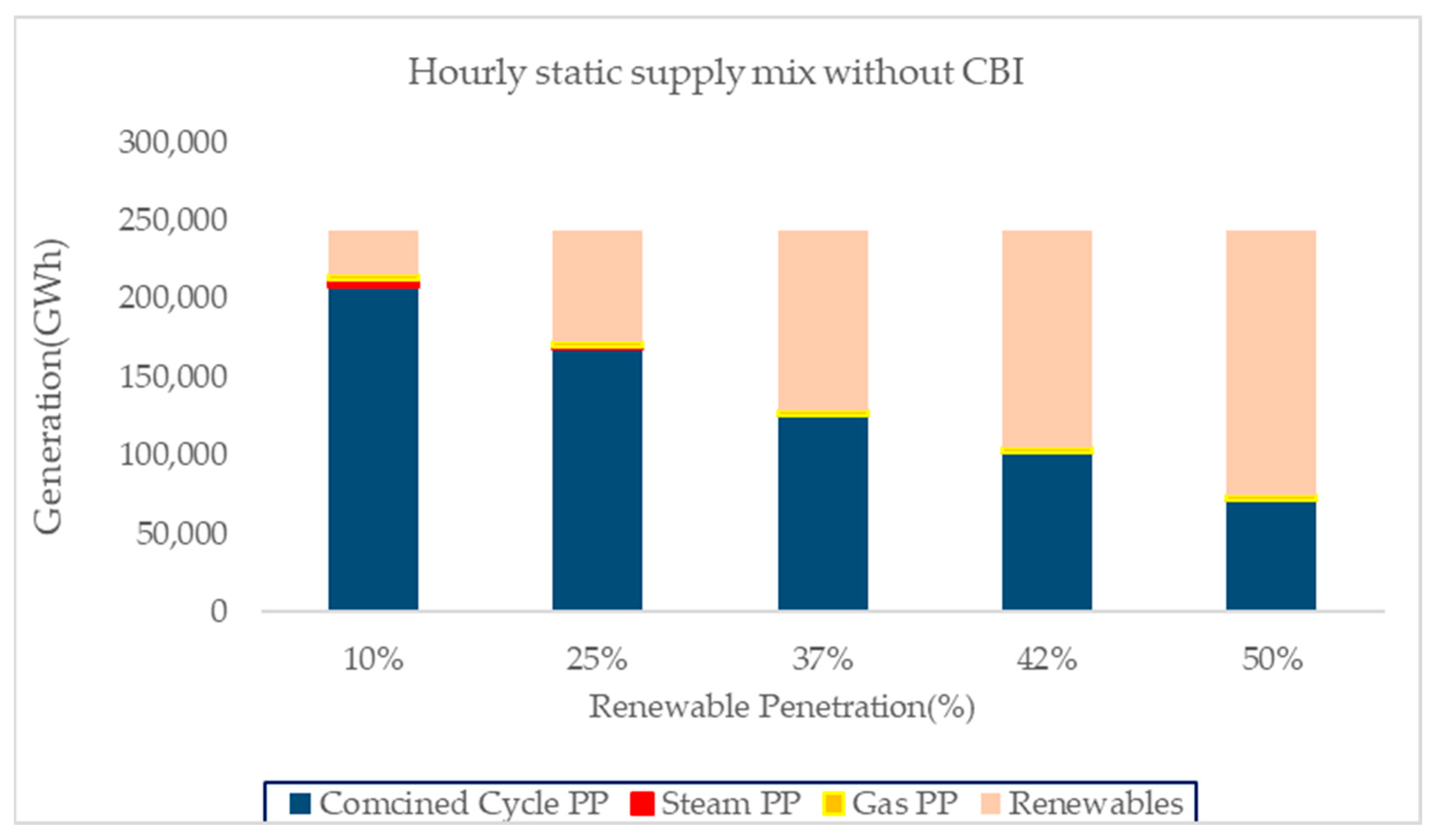
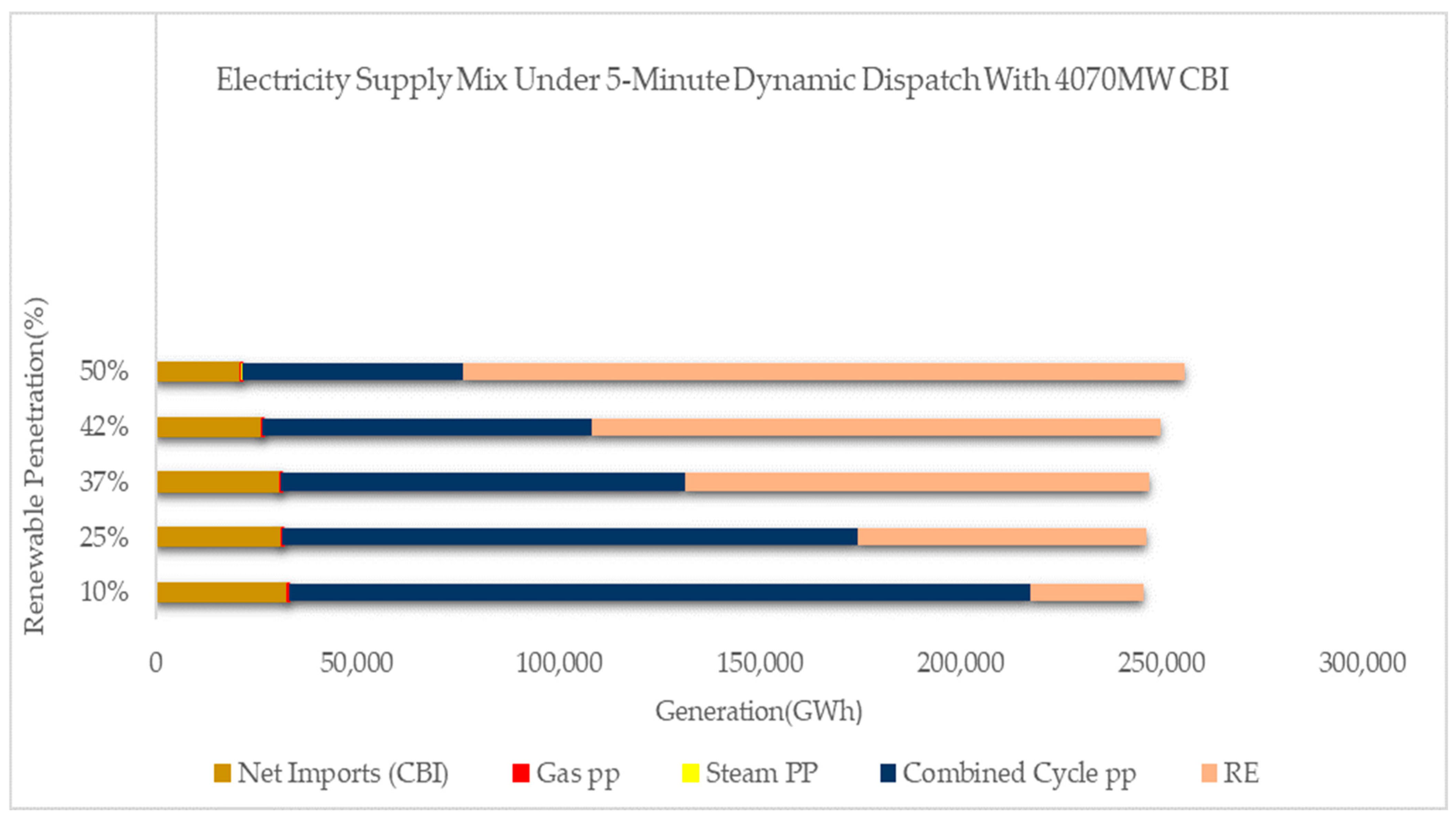
Total annual generation remains constant across scenarios, reflecting fixed demand assumptions. However, significant structural shifts emerge in the composition of the generation mix. These shifts become clearer when analyzing technology-specific generation trends rather than aggregate stacked bars, which are dominated by combined-cycle output.
Figure 7 illustrates the generation mix under hourly static dispatch without cross-border interconnection. As renewable penetration rises from 10% to 50%, renewable output grows from 28,046 GWh to 169,581 GWh. Despite this increase, combined-cycle power plants remain the primary generation source, declining modestly from 207,400 GWh at 10% to 70,621 GWh at 50%.
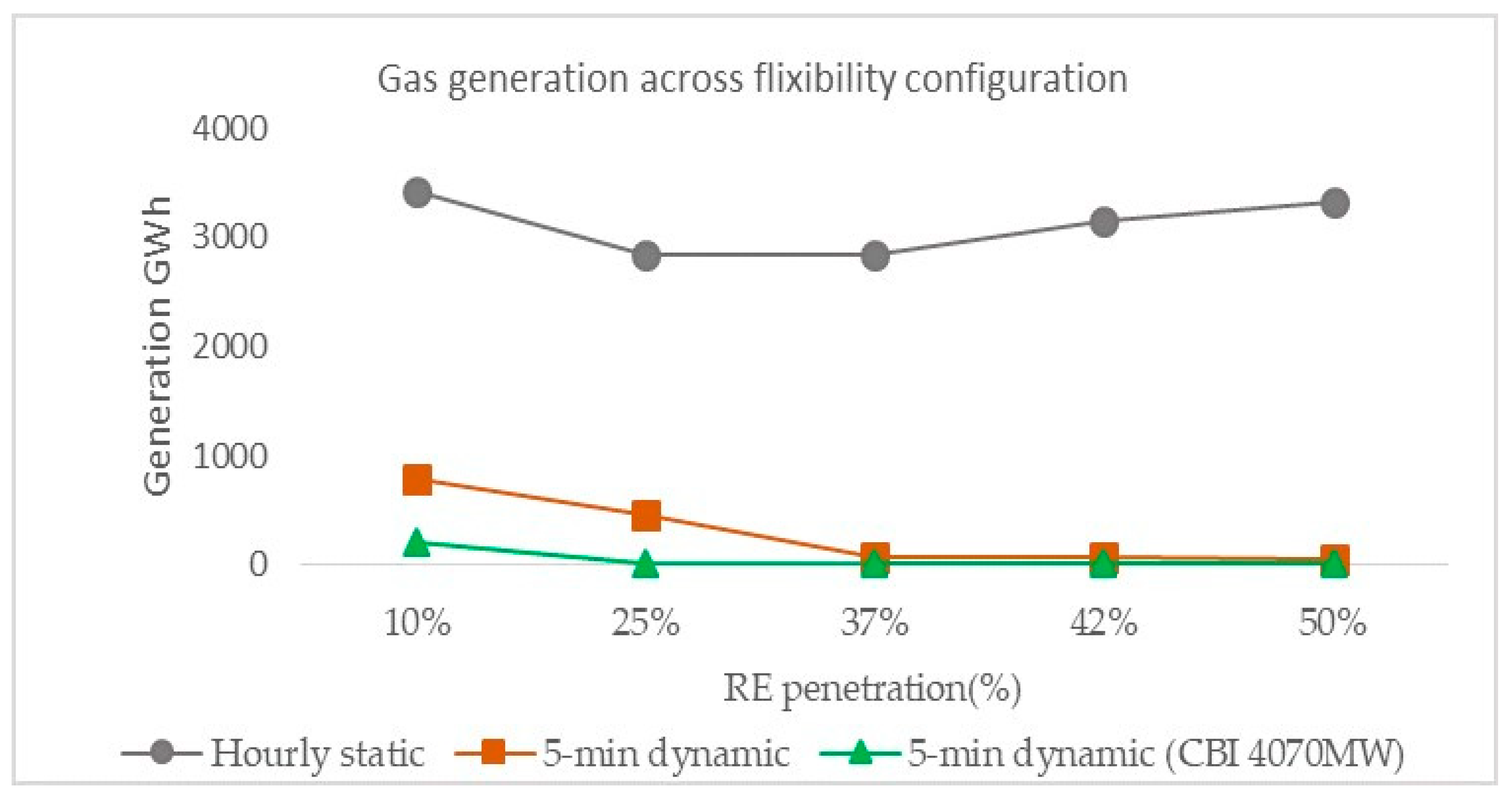
Steam and gas-fired plants continue to supply meaningful generation—over 3300 GWh of gas turbines, generation persists at 50% renewable penetration. This reflects rigid thermal scheduling, where hourly dispatch constraints prevent full displacement of inflexible units.
The consistent total height of the bars confirms unchanged energy demand, while the limited shift in internal composition underscores the system’s inability to fully exploit renewable resources under coarse temporal resolution.
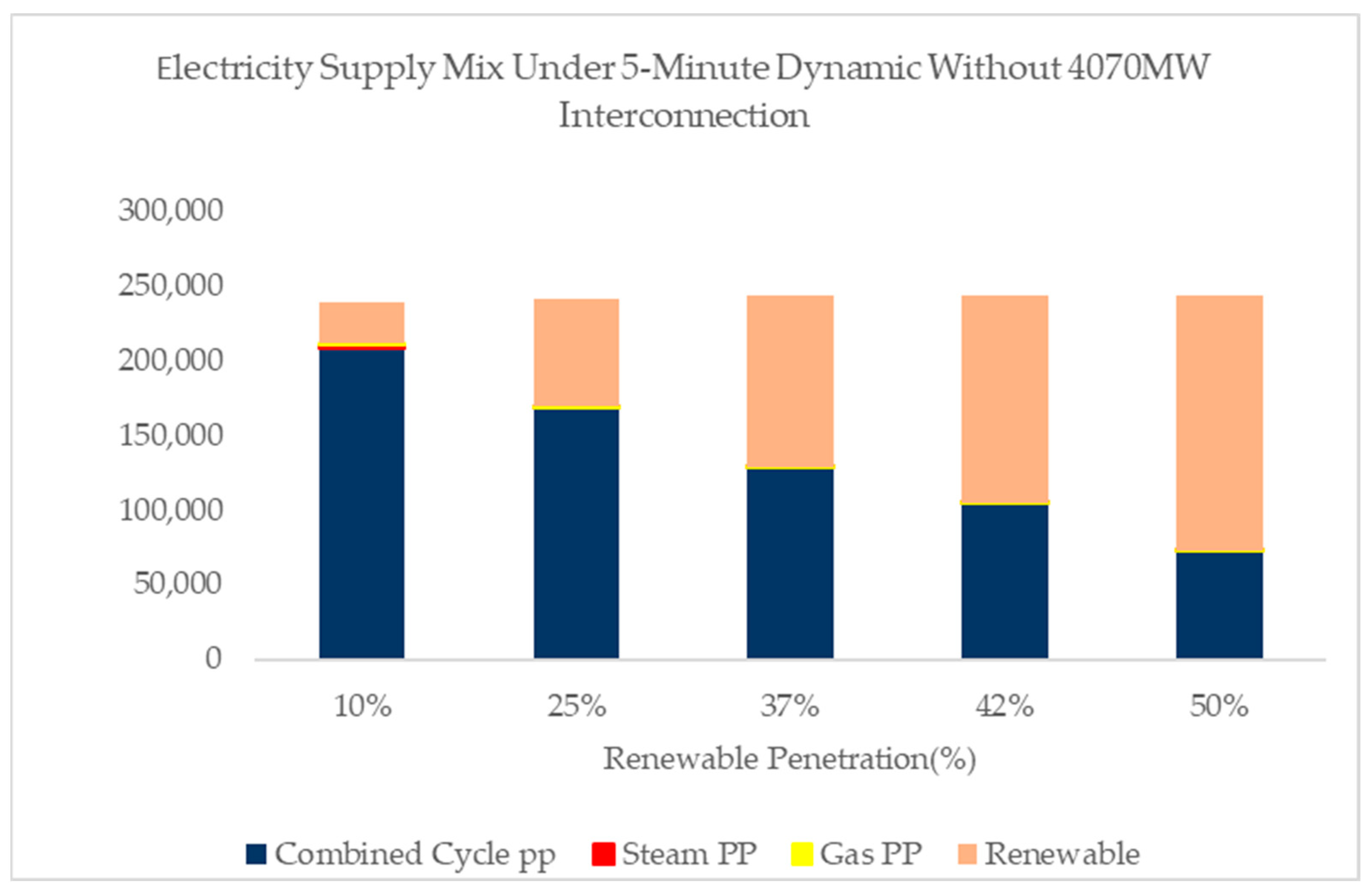
Transitioning to five-minute dynamic dispatch without interconnection (
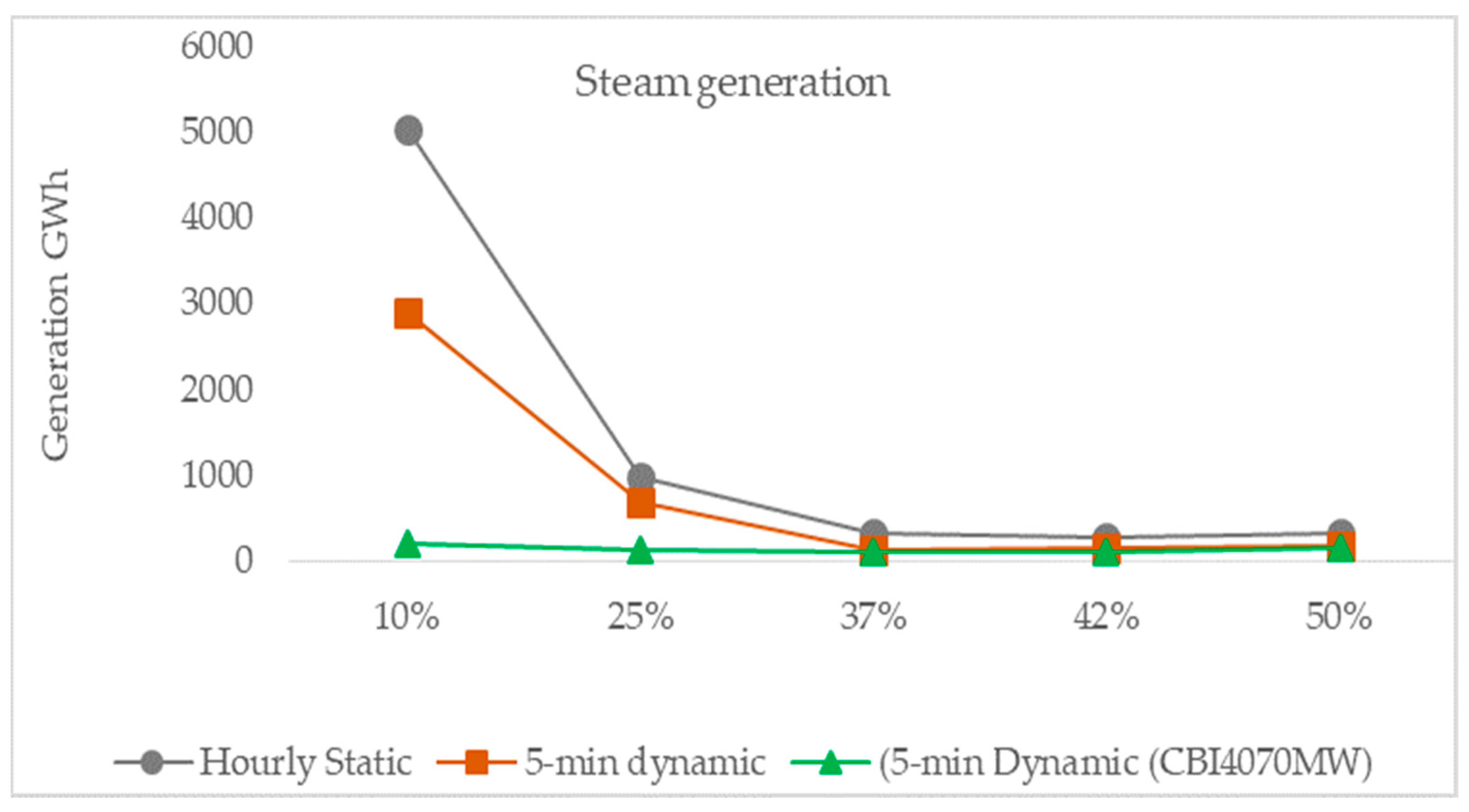
Figure 8) significantly alters system operation. At 50% VRE, renewable generation rises to 171,087 GWh, while steam generation collapses from 2894 to 167 GWh and gas turbine from 796 to 51 GWh, respectively. Combined-cycle plants shift from baseload to a flexible balancing role, reflecting improved responsiveness to renewable variability even without infrastructure expansion.
Figure 9 presents the electricity supply mix under dynamic dispatch coupled with a 4070 MW cross-border interconnection. This scenario exhibits the most pronounced structural change. At 50% renewable penetration, renewable generation peaks at 179,621 GWh, while combined-cycle output declines to just 54,861 GWh—the lowest among all.
Steam and gas generation become negligible. Net imports provide a visible contribution at lower renewable penetration levels and decline as domestic renewable output increases, highlighting the role of interconnection as a flexibility buffer rather than a persistent energy source. The interplay of fine temporal resolution and spatial flexibility significantly improves the system’s ability to integrate renewables while minimizing reliance on thermal generation.
4.2. Evolution of Fossil Generation Across Flexibility Measures
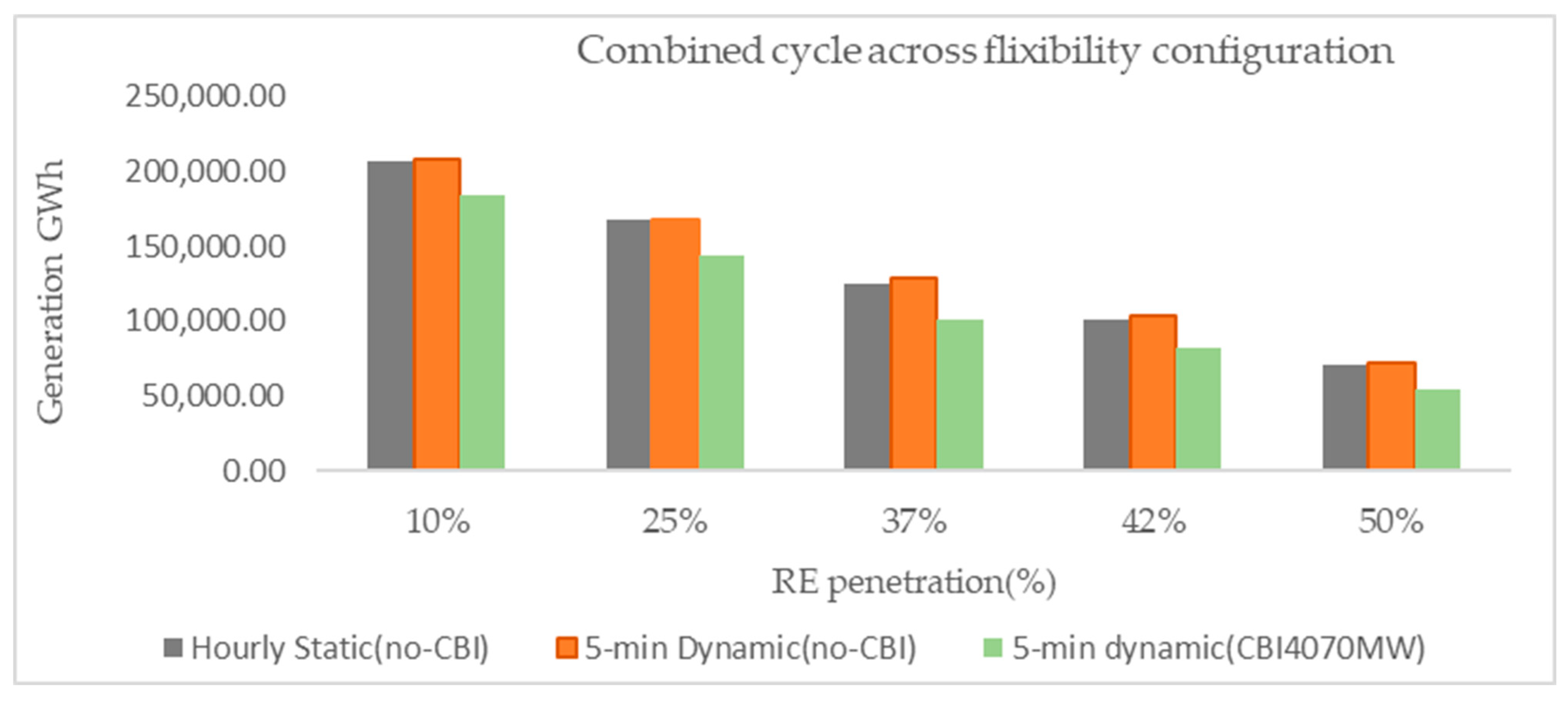
Figure 10 shows a consistent decline in combined-cycle generation as both temporal and spatial flexibility improves. Under the most flexible configuration, combined-cycle output falls by approximately 23–30% across all renewable penetration levels relative to hourly static dispatch.
Figure 10.
Combined-cycle generation across flexibility configurations.
Figure 10.
Combined-cycle generation across flexibility configurations.
As renewable penetration increases, the system becomes progressively less dependent on fossil-based baseload. Under the most flexible configuration, combined-cycle units shift from continuous operation to a more responsive role—providing backup only when needed and ramping efficiently to balance variable renewables.
Figure 11.
Steam turbine generation across flexibility configurations (GWh).
Figure 11.
Steam turbine generation across flexibility configurations (GWh).
Steam generation becomes nearly negligible under five-minute dispatch with interconnection, reflecting its poor economic performance in highly variable systems. Gas turbines, traditionally used for peaking, are almost entirely displaced (<20 GWh at 50% VRE), indicate that fast dispatch and regional coordination substantially reduce reliance on costly peaking resources.
Policy implication
Decarbonization requires both operational reform and physical infrastructure. Dispatch granularity, reserve design, and interconnection are as critical as renewable capacity expansion in reducing fossil generation.
Figure 12.
Gas turbine generation across flexibility configurations (GWh).
Figure 12.
Gas turbine generation across flexibility configurations (GWh).
4.3. Net Imports and Renewable Utilization
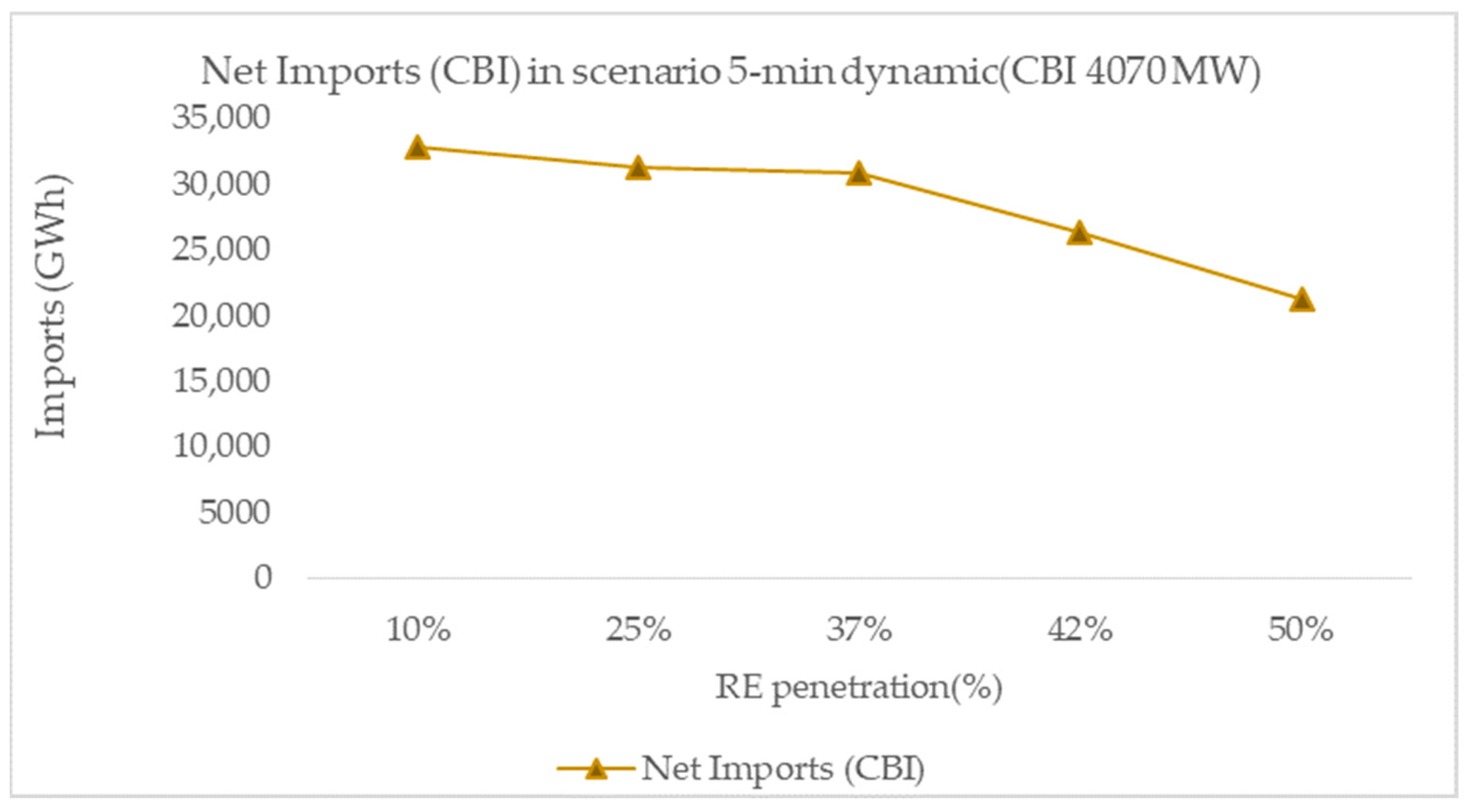
Figure 13 illustrates the role of net imports in the 5 min dynamic dispatch scenario with 4070 MW cross-border interconnection.
Figure 13.
Evolution of net imports as renewable penetration increases under five-minute dynamic dispatch with CBI.
Figure 13.
Evolution of net imports as renewable penetration increases under five-minute dynamic dispatch with CBI.
At 10% renewable penetration, imports reach 32,799 GWh, offering valuable balancing support. As domestic renewable output rises, imports decline steadily to 21,206 GWh at 50% penetration.
This trend confirms that interconnection operates as a temporal and spatial flexibility resource rather than a base energy supplier. In the early stages of renewable deployment, imports help absorb demand shocks and variability. At higher penetration levels, domestic renewable output increasingly meets system demand, reducing reliance on cross-border exchanges under a benchmark economic dispatch framework.
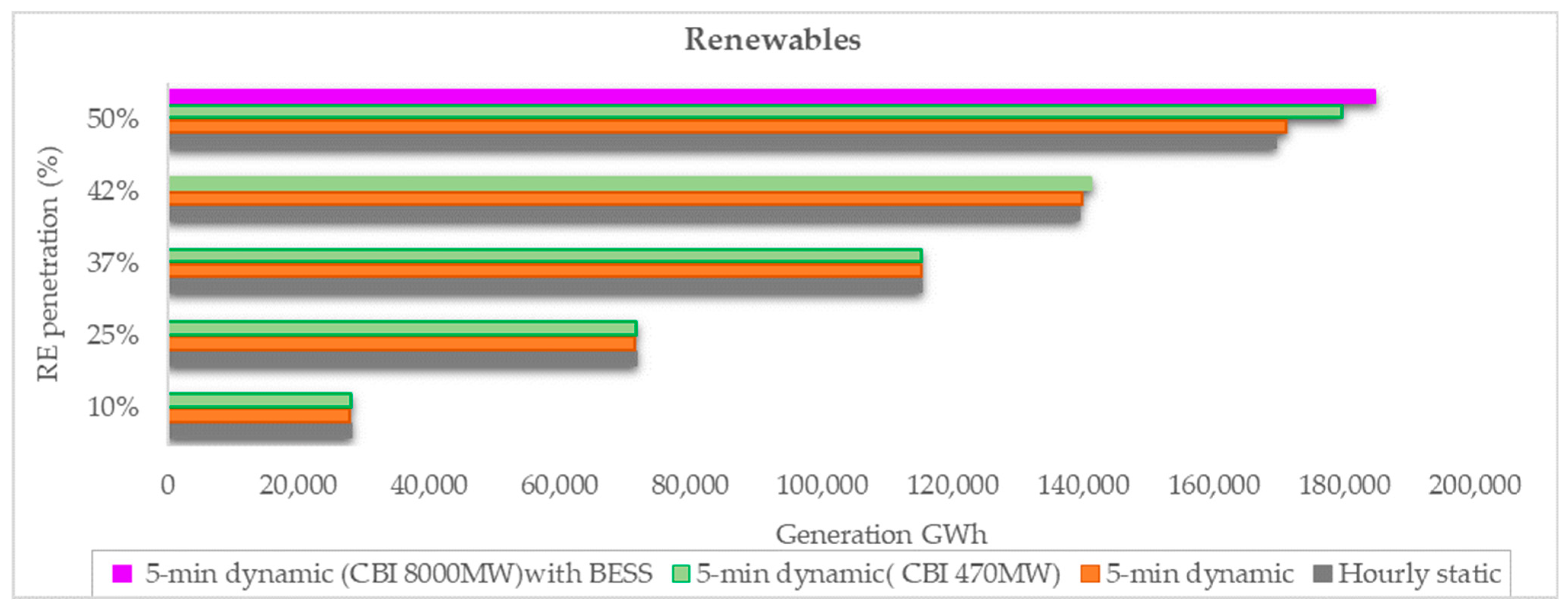
Figure 14 further demonstrates that renewable utilization improves systematically with increased flexibility. Moving from hourly static to five-minute dispatch reduces curtailment across all penetration levels, while interconnection amplifies these gains by enabling surplus renewable exports. The benefits of interconnection become most pronounced beyond 37–42% VRE, where internal balancing capability becomes binding.
Figure 14.
Comparison of renewable energy generation under different dispatch resolutions and interconnection capacities.
Figure 14.
Comparison of renewable energy generation under different dispatch resolutions and interconnection capacities.
Figure 13 and
Figure 14 are obtained under a benchmark least-cost economic dispatch framework, not a fully coupled regional electricity market. Cross-border exchanges are optimized from the Egyptian system perspective based on normalized marginal costs and technical constraints, without joint optimization, market-based bidding, or coordinated market clearing across countries. The observed decline in net imports with increasing renewable penetration, together with the rise in renewable generation under higher interconnection capacities, therefore reflects the operational efficiency gains of economic dispatch under fuel price normalization, rather than outcomes driven by regional market coupling or strategic trading behavior.
Policy implication
These results demonstrate that significant renewable integration gains can be achieved through economic dispatch and fuel price normalization alone, even prior to full regional market coupling.
Cross-border interconnections should be treated as strategic investments in system flexibility. Their role is not merely to exchange bulk power but to enable variable renewables through regional balancing. Policymakers must ensure interconnection capacity planning is integrated into national VRE targets and supported by regional coordination frameworks.
4.4. System Adequacy and Reliability
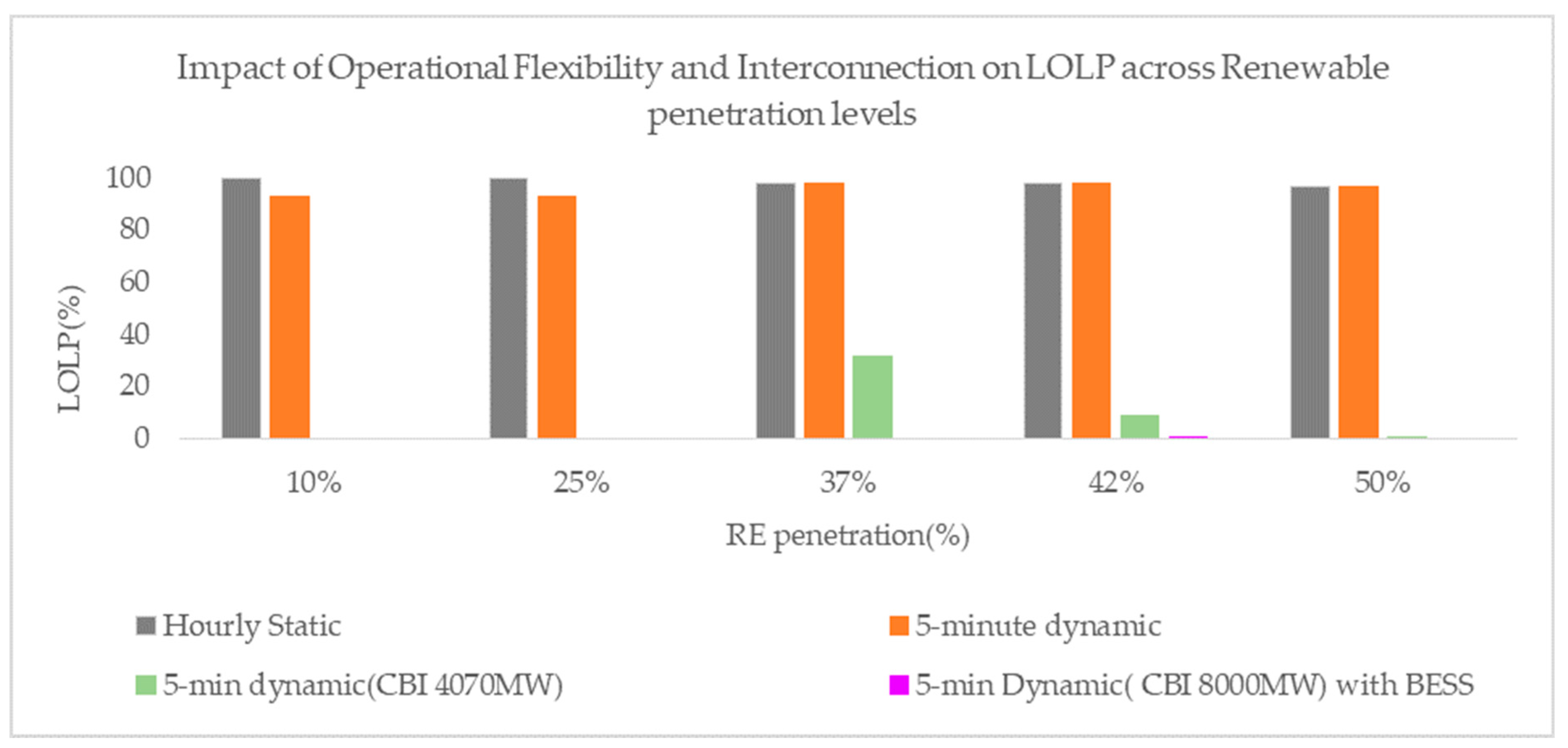
Figure 15 shows system reliability using Loss-of-Load Probability (LOLP). Under static reserves without interconnection, LOLP remains critically high (>96%) across all renewable penetration levels, confirming structural inadequacy under deterministic reserve rules. Introducing dynamic reserves alone yields modest improvement and fails to prevent severe adequacy risks at higher renewable shares.
A step change occurs when dynamic reserves are combined with interconnection. LOLP falls to zero at low penetration levels and declines sharply at higher levels, reaching 0.29% at 50% VRE with 4070 MW interconnection. Expanding interconnection to 8000 MW and adding 8000 MWh BESS fully eliminates adequacy risks, reducing LOLP to 0% at 50% renewable penetration. These results confirm that reliability at high renewable penetration requires coordinated deployment of operational, spatial, and temporal flexibility.
Policy implication: Achieving high renewable penetration requires parallel investment in operational reforms (dynamic reserves), cross-border interconnection, and energy storage, rather than relying on generation expansion alone.
4.5. Renewable Curtailment
Curtailment is a key indicator of system inefficiency and inflexibility.
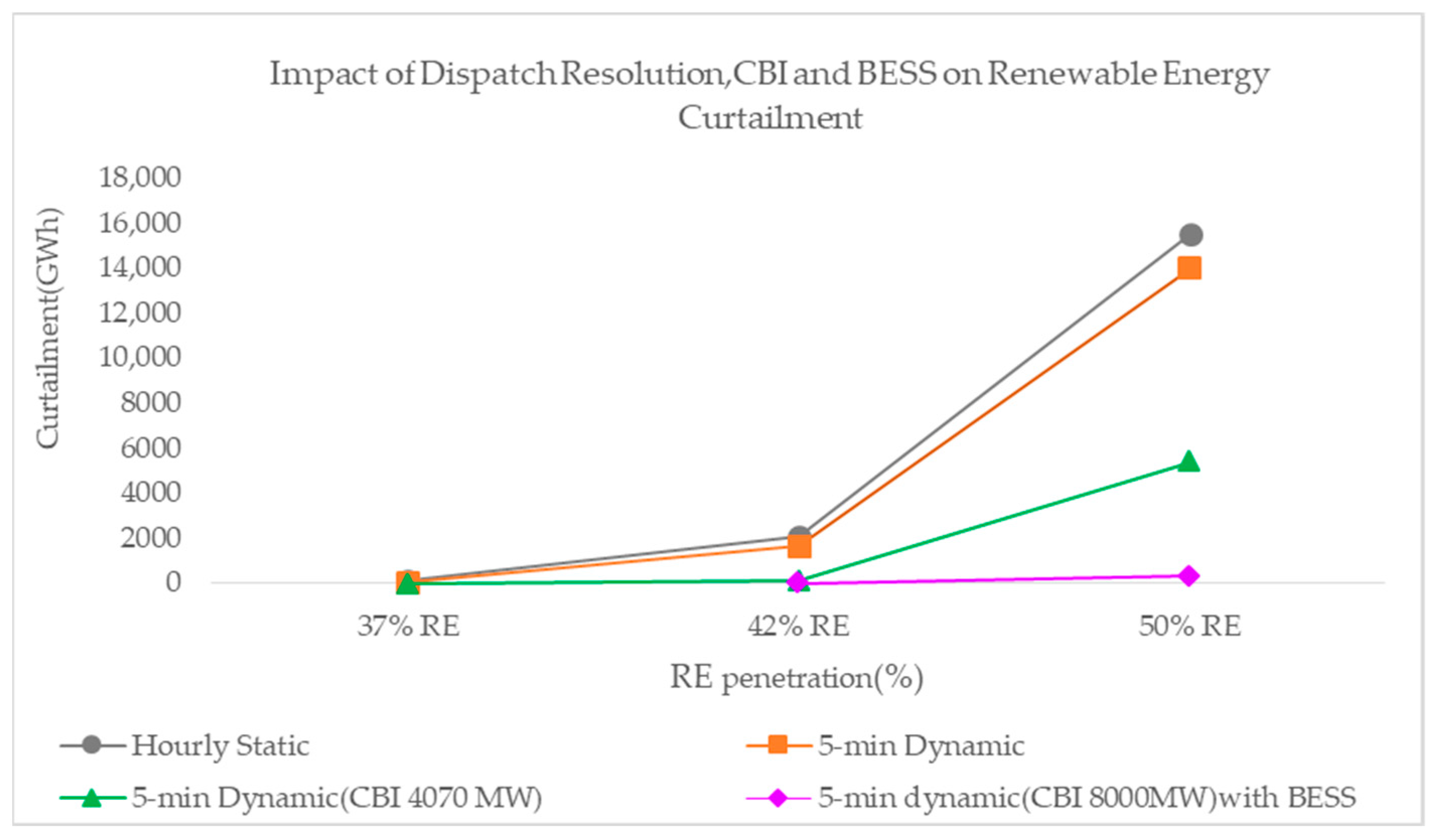
Figure 16 compares renewable energy curtailment under three renewable penetration levels (37%, 42%, and 50%) across four operational configurations: hourly static dispatch without interconnection, five-minute dynamic dispatch without interconnection, five-minute dynamic dispatch with 4070 MW interconnection, and five-minute dynamic dispatch with 8000 MW interconnection complemented by 8000 MWh BESS.
At 37% renewable penetration, curtailment under hourly static dispatch without interconnection reaches 96.9 GWh, which is reduced to 56.0 GWh under five-minute dynamic dispatch, reflecting the benefit of higher temporal resolution in tracking short-term renewable variability and reducing intra-hour imbalance. When 4070 MW of interconnection is enabled, curtailment is fully eliminated (0 GWh), as surplus renewable generation can be economically exported to neighboring systems instead of being curtailed.
At 42% renewable penetration, curtailment rises sharply to 2095.1 GWh under hourly static dispatch and remains high at 1670.3 GWh even with five-minute dispatch alone, indicating that temporal flexibility is no longer sufficient once renewable output exceeds the system’s internal absorption capability under fixed demand. Introducing 4070 MW of interconnection reduces curtailment dramatically to 87.2 GWh (≈96% reduction) by providing spatial balancing through cross-border exchanges.
At 50% renewable penetration, curtailment becomes severe in the absence of spatial and temporal flexibility, reaching 15,495.8 GWh under hourly static dispatch and 13,994.1 GWh under five-minute dispatch, reflecting saturation of internal balancing resources and network constraints. With 4070 MW interconnection, curtailment is reduced to 5391.2 GWh, as export capability partially alleviates surplus conditions but remains capacity limited. The combined deployment of 8000 MW interconnection and BESS further reduces curtailment to just 288.2 GWh, corresponding to 98% reduction relative to the hourly static case, because spatial flexibility handles sustained excess generation while storage resolves residual short-duration mismatches.
Policy Implications
Beyond moderate renewable penetration, dispatch reform alone is insufficient. Spatial flexibility (interconnection) and storage are essential to prevent large-scale curtailment.
4.6. Carbon Emissions
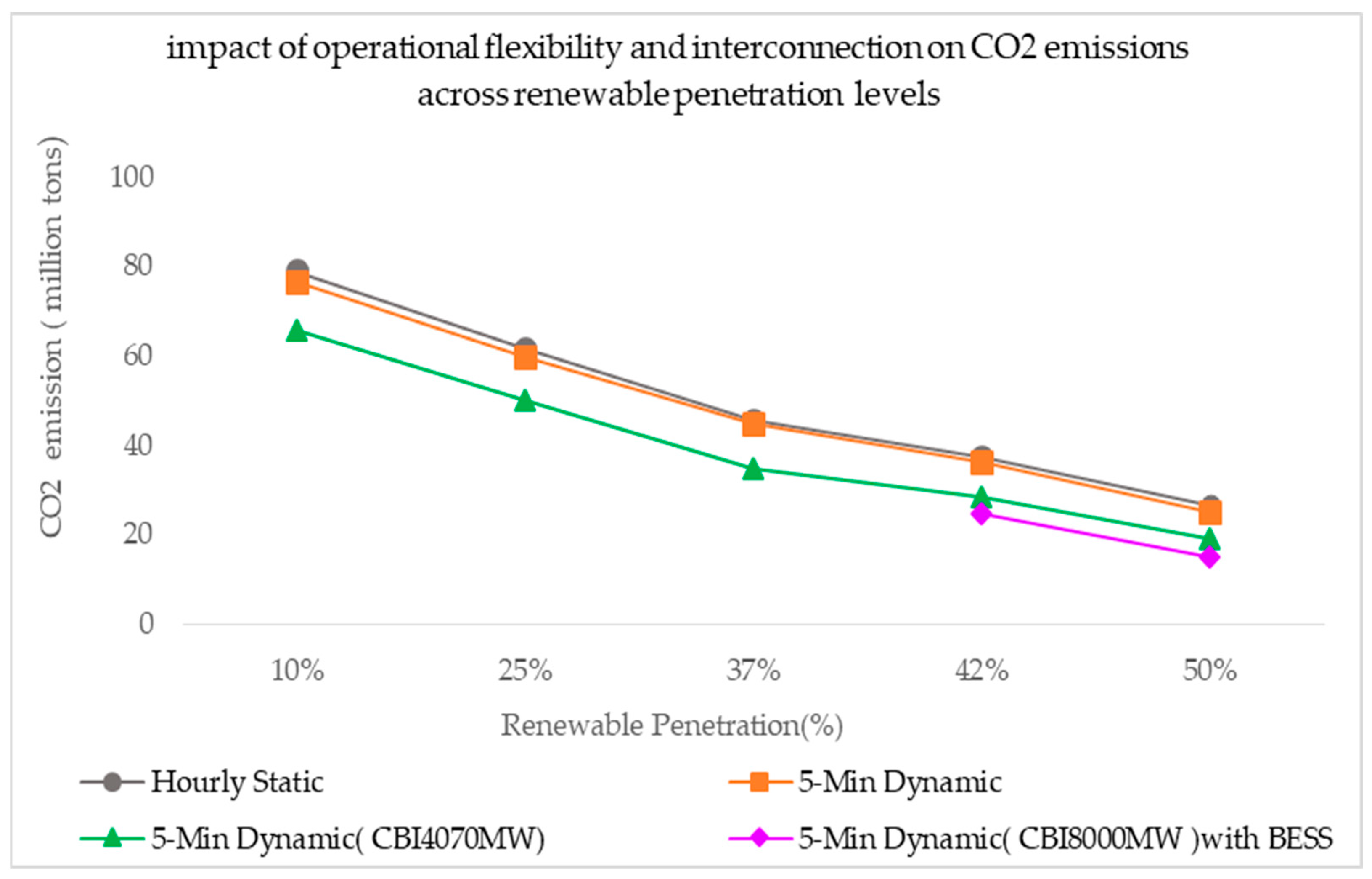
Figure 17 illustrates the impact of operational flexibility measures and cross-border interconnection on CO
2 emissions across increasing renewable energy penetration levels (10–50%). Across all scenarios, CO
2 emissions decline steadily as renewable penetration increases, reflecting the direct displacement of fossil-fuel-based generation. Under hourly static dispatch, emissions decrease from 78.93 million tons at 10% VRE to 26.66 million tons at 50% RE, indicating that renewable expansion alone delivers substantial decarbonization benefits. However, the rate of emissions reduction differs significantly across operational configurations.
At 50% VRE, emissions fall from 26.66 Mt under hourly static dispatch to 25.19 Mt with five-minute dispatch. Introducing 4070 MW interconnection reduces emissions further to 18.97 Mt (≈28% reduction). Expanding interconnection to 8000 MW with BESS lowers emissions to 15.05 Mt, corresponding to a 40% reduction relative to the hourly static baseline.
Policy implication: While renewable expansion is the primary driver of emissions reduction, achieving deep decarbonization beyond 40–50% renewable penetration requires complementary investments in dispatch reform, cross-border interconnection, and energy storage to fully displace fossil-fuel-based balancing generation.
4.7. Reserve Scarcity Pricing
Reserve scarcity pricing reflects the marginal value of additional reserve capacity.
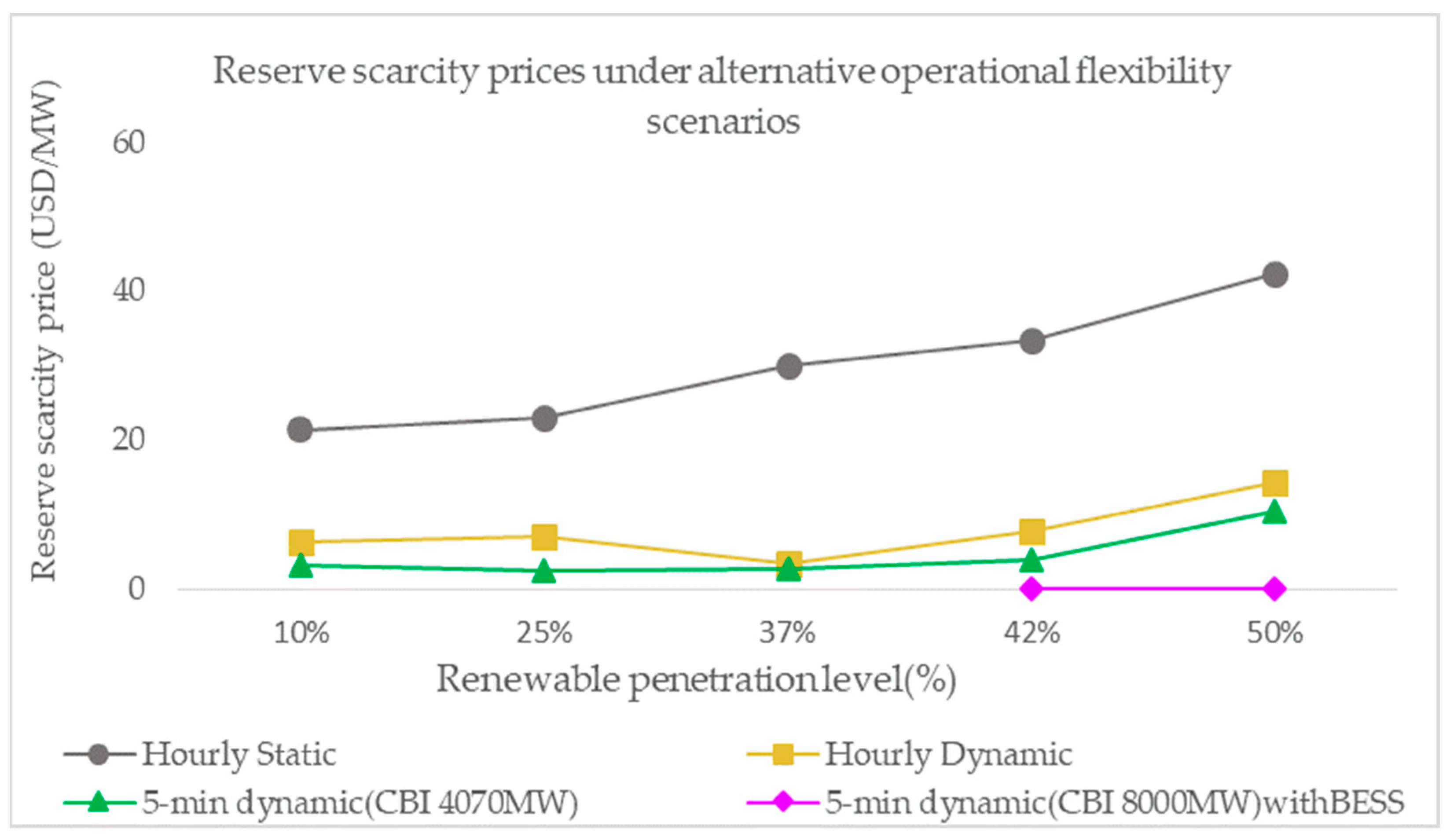
Figure 18 shows how reserve scarcity prices evolve across renewable penetration levels (10–50%) under alternative operational flexibility configurations, where reserve scarcity prices are determined by the Value of Reserve (VoR) as a reliability signal within the system operator’s optimization, rather than representing market-clearing prices or bidding outcomes.
Under hourly static operation, scarcity prices rise sharply with renewable penetration, reaching USD 42.33/MW at 50% VRE. Dynamic reserves reduce scarcity at low and moderate penetration but become insufficient at high variability levels. Combining interconnection with five-minute dispatch keeps scarcity prices low across all scenarios. With expanded interconnection and BESS, scarcity prices fall to near zero, indicating that reserve adequacy is fully secured.
From a policy perspective, these findings suggest that shadow prices from operational models can inform future reserve-pricing mechanisms, guiding the transition toward a more transparent and efficiency-based electricity market.
4.8. Economic Outcomes Across Operational Flexibility Measures
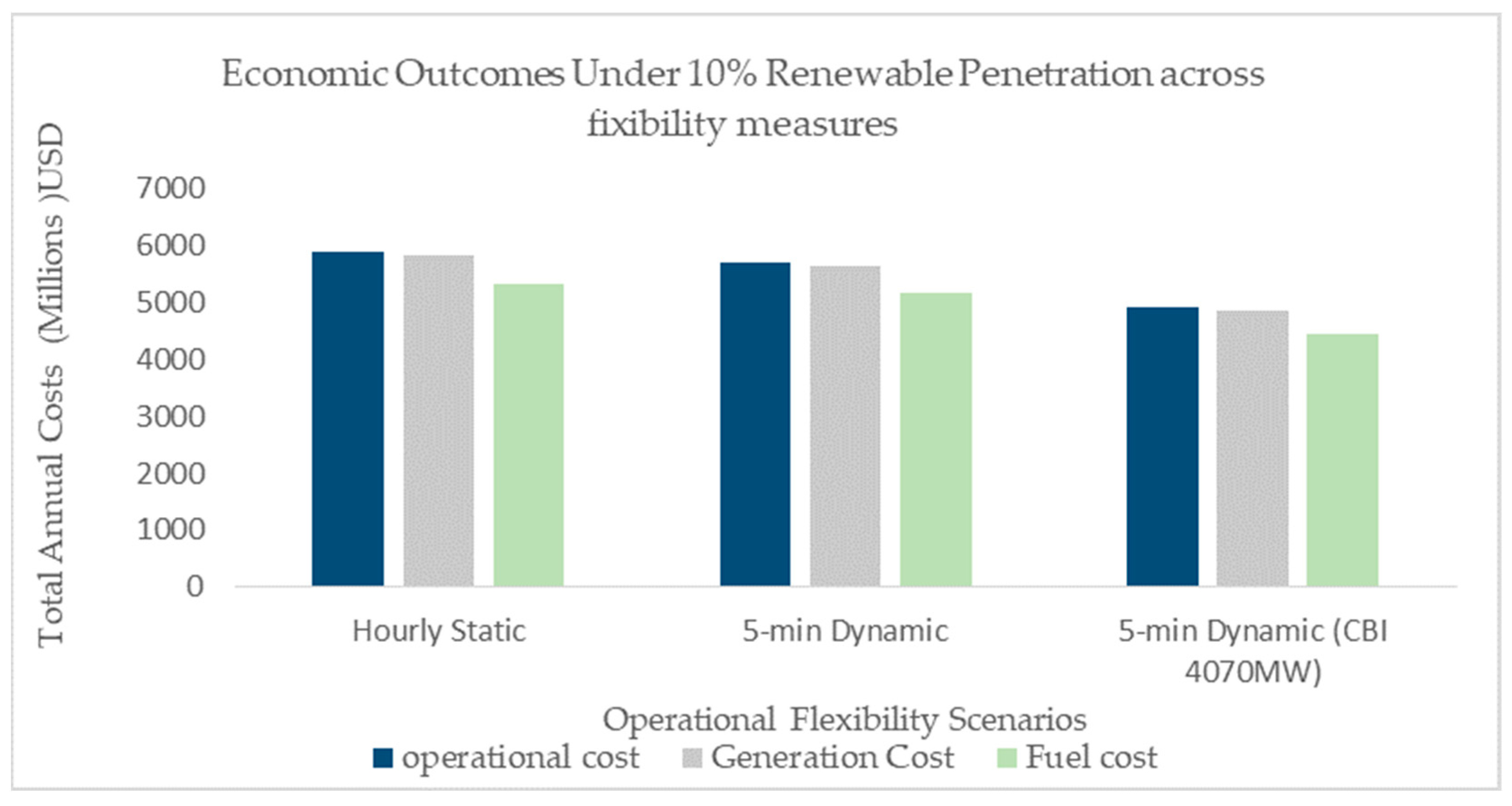
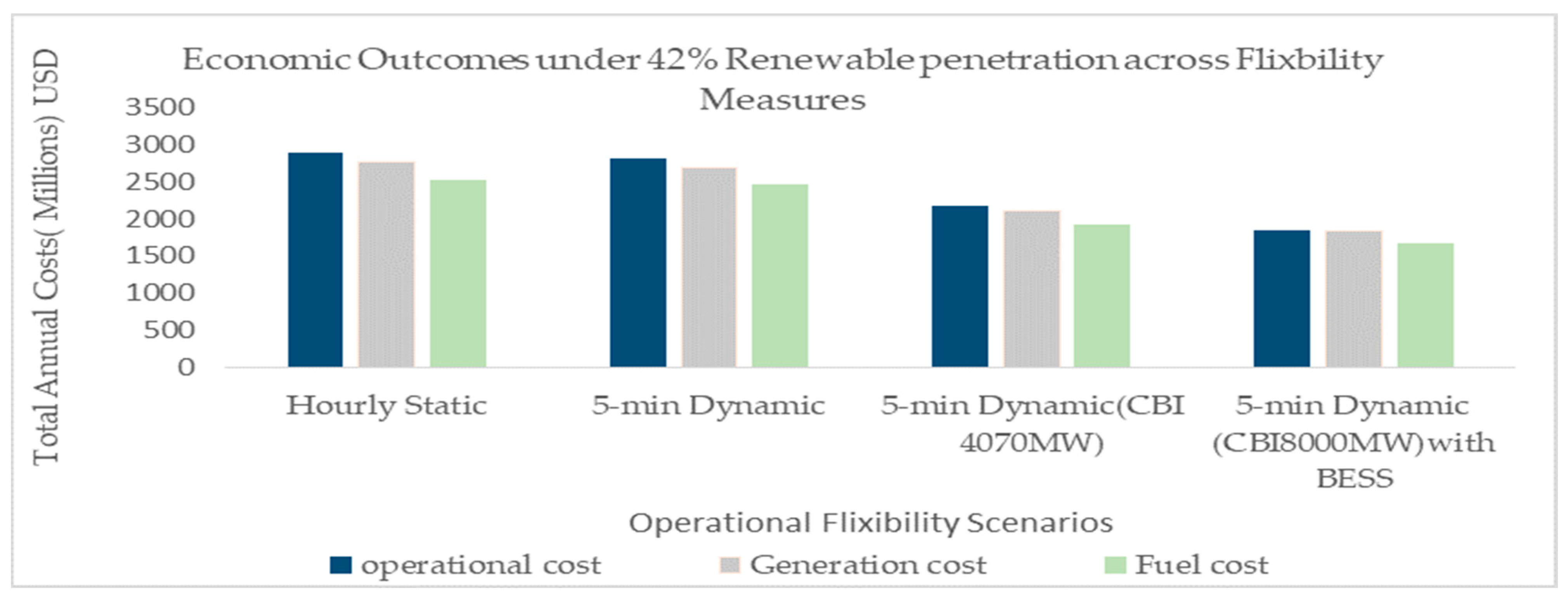
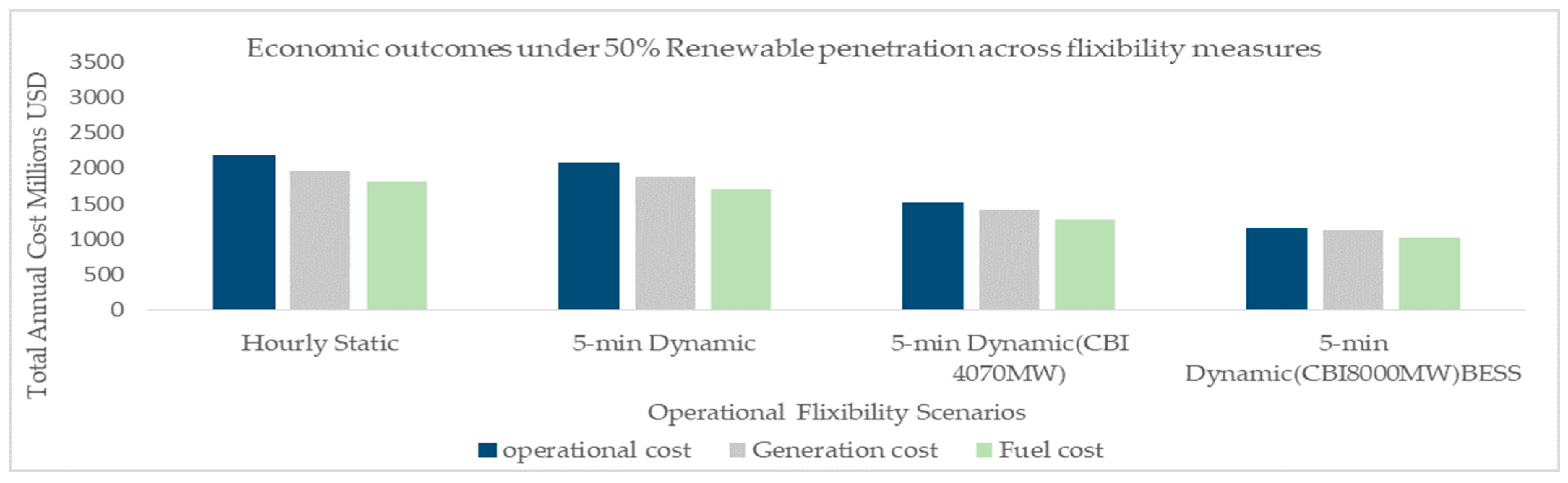
Figure 19,
Figure 20 and
Figure 21 compare total operational costs, generation costs, and fuel costs under alternative operational flexibility configurations at 10%, 42%, and 50% renewable penetration. All results are derived from PLEXOS economic dispatch, in which energy and reserves are co-optimized to minimize total system costs subject to operational constraints.
Interpretation
Low Renewable Penetration (10%)
At 10% VRE, the system remains largely dominated by thermal generation, and flexibility measures deliver modest but measurable cost reductions. Transitioning from hourly static dispatch to five-minute dynamic dispatch reduces total operational costs from approximately USD 5.90 billion to USD 5.72 billion, driven mainly by lower fuel consumption and improved thermal unit commitment.
Introducing 4070 MW of interconnection under five-minute dispatch further reduces total operational costs to about USD 4.93 billion, with fuel costs falling from USD 5.35 billion to USD 4.44 billion. At this low renewable share, the economic benefit of interconnection is driven primarily by fuel substitution and access to lower-cost regional generation, rather than by renewable integration or curtailment avoidance.
Intermediate Renewable Penetration (42%)
At 42% VRE, the system enters a regime where flexibility becomes a dominant cost driver. While five-minute dispatch alone yields only a limited reduction in total operational cost (from USD 2.90 billion to USD 2.82 billion), the introduction of 4070 MW interconnection produces a much larger effect, lowering total operational costs to approximately USD 2.17 billion.
Expanding interconnection to 8000 MW and complementing it with BESS further reduces costs to about USD 1.85 billion, corresponding to a ~36% reduction relative to the hourly static baseline. These savings are primarily driven by substantial reductions in fuel costs (from USD 2.53 billion to USD 1.67 billion) as renewable curtailment is minimized and reliance on fossil-fuel-based balancing generation declines.
High Renewable Penetration (50%)
At 50% VRE,
Figure 21 shows that the economic value of flexibility becomes even more pronounced. Five-minute dispatch alone reduces total operational costs marginally (from USD 2.18 billion to USD 2.08 billion), indicating that temporal flexibility by itself is insufficient at very high renewable shares.
By contrast, enabling 4070 MW interconnection lowers total operational costs to approximately USD 1.51 billion, while the combined deployment of 8000 MW interconnection and BESS reduces costs further to around USD 1.14 billion. This represents a ~48% reduction compared to the hourly static case. Fuel costs decline sharply—from USD 1.81 billion to USD 1.02 billion—reflecting deep displacement of thermal generation through renewable utilization and regional balancing.
Policy Implication
Crucially, the magnitude of cost savings increases nonlinearly with renewable penetration, confirming that flexibility investments become economically essential—not optional—beyond moderate renewable shares.Fuel costs exhibit the largest relative decline, confirming that flexibility primarily reduces fossil generation and inefficient thermal operation.
These findings clearly demonstrate that flexibility is not a cost burden but a cost-mitigation tool. As renewable shares increase, so too does the economic penalty of inflexibility. Grid modernization—via faster dispatch, dynamic reserves, regional coordination and BESS—is essential to achieving least-cost decarbonization.
Operational Savings as a Financing Signal for Flexibility Investments
Although this study focuses on short-term operational performance not long-term investment economics, the magnitude of the observed savings at 50% renewable penetration provides a strong economic signal for investment. Under 5 min dynamic dispatch with 8000 MW interconnection and BESS, annual fuel savings of approximately USD 800 million are achieved, alongside total system cost reductions exceeding USD 1.0 billion per year. These recurring operational savings indicate that investments in interconnection and storage could be largely self-financed through avoided fuel consumption and improved dispatch efficiency, implying high effective annual returns and short payback periods.
4.9. Electricity Exports Under Hourly Dynamic Dispatch Across Renewable Penetration Levels
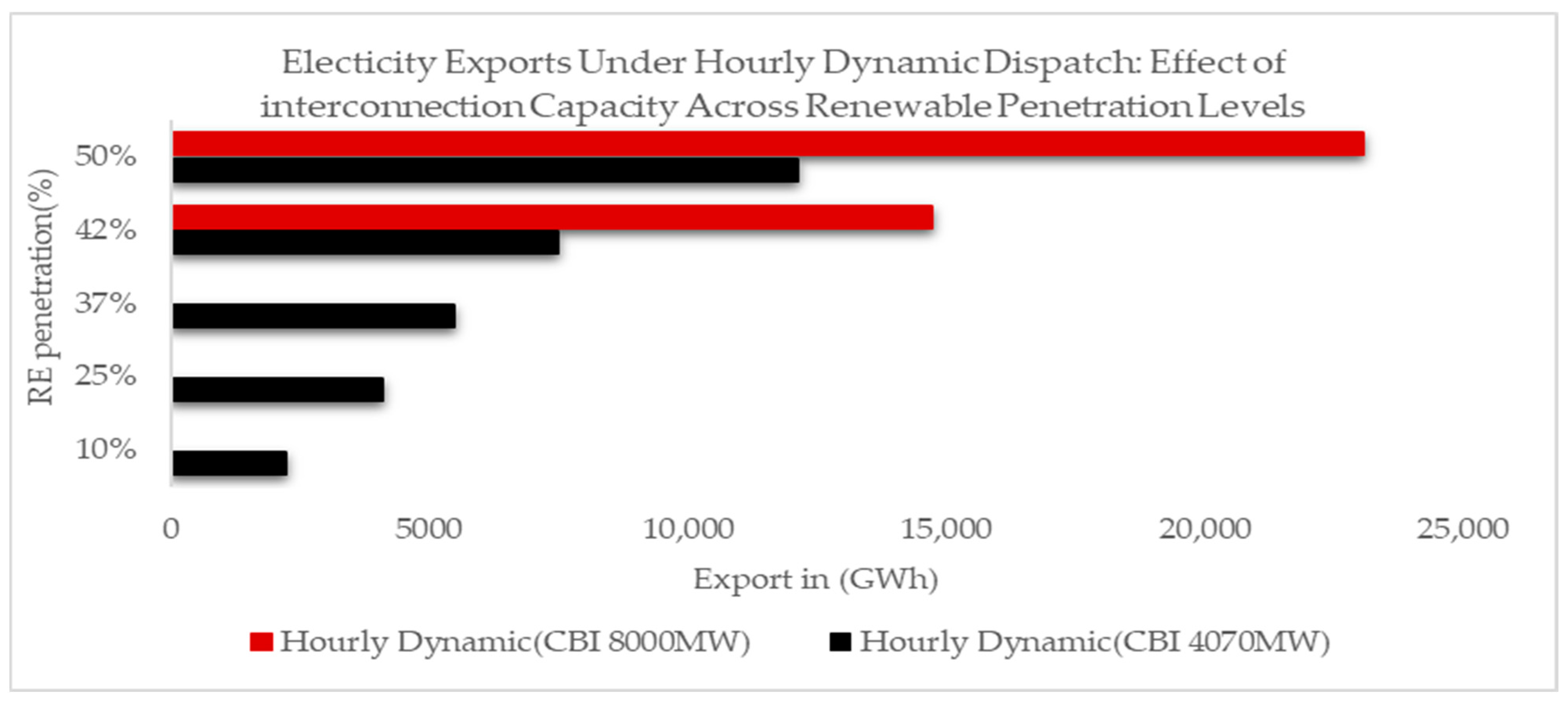
Figure 22 illustrates how electricity exports from Egypt evolve under hourly dynamic dispatch as renewable penetration increases, comparing two interconnection capacities (4070 MW and 8000 MW).
Figure 22 shows that electricity exports rise sharply beyond 37% VRE, doubling at 50% VRE when interconnection expands from 4070 MW to 8000 MW. This confirms that even without a fully coupled regional market, expanding interconnection capacity and adopting economic dispatch enables Egypt to manage renewable surpluses efficiently under fixed demand, reducing curtailment and supporting higher renewable targets.
4.10. The Robust Basis for Policy-Relevant Insights (Results to 50% Renewable Energy Scenario)
At this high penetration level, the system exhibits maximum variability and flexibility requirements, including steep net load ramps, elevated curtailment risk, and heightened sensitivity to reserve formulation and dispatch resolution. Consequently, the performance differences between hourly and five-minute dispatch, as well as the system-wide benefits of dynamic reserves, cross-border interconnection, and battery energy storage systems (BESS), are most clearly revealed. the analysis emphasizes the upper bound of system stress and flexibility value, providing a robust basis for policy-relevant insights applicable to Egypt’s medium- and long-term decarbonization pathway. The quantitative results reported in
Table 13.
Policy implication:
Operational reform is as important as infrastructure investment.
Dynamic reserves, five-minute dispatch, interconnection, and BESS are complementary—not substitutes to reach high renewable integration.
High renewable penetration without flexibility leads to curtailment, high costs, and reliability failure.
Economic dispatch of interconnections provides a near-term pathway toward regional coordination in MENA.
5. Conclusions
5.1. Summary of Findings
This study developed an integrated short-term operational framework for Egypt’s power system using the PLEXOS STP and PASA modules to co-optimize unit commitment, economic dispatch, and reserves under rising VRE penetration. The framework jointly evaluated dynamic reserve allocation, five-minute dispatch, regional economic dispatch through interconnections, and utility-scale battery energy storage systems (BESS) across 40 scenarios with renewable penetration ranging from 10% to 50%.
The results demonstrate that operational reforms alone already deliver substantial efficiency gains, but the combined deployment of operational and structural flexibility yields transformative outcomes. Under the integrated flexibility configuration—dynamic reserves, five-minute dispatch, 8000 MW of interconnection capacity, and 8000 MWh of BESS—total system costs were reduced by more than 45%, Loss-of-Load Probability (LOLP) was fully eliminated, and renewable curtailment declined by up to 98%. At the 50% VRE target, these measures enabled renewables to supply approximately 82% of Egypt’s total electricity generation, confirming that deep renewable integration is technically feasible without compromising system reliability.
However, the analysis also shows that operational measures alone are insufficient to sustain long-term adequacy at high renewable shares. Continued expansion of interconnections-based ED, storage capacity, and—eventually—flexible demand participation is required. Sustainable reliability therefore depends on aligning short-term operational innovation with long-term physical and institutional investments.
For Egypt’s vertically regulated electricity sector under EEHC, the findings provide actionable guidance for gradual market reform. Internal operational reforms—particularly dynamic reserve sizing and transparent valuation of flexibility—can act as low-risk entry points toward future market-based mechanisms. At the regional level, although MENA interconnections currently operate through bilateral contracts rather than coordinated economic dispatch, the results highlight the significant economic and environmental benefits of progressing toward regionally coordinated economic dispatch supported by enhanced data transparency and institutional cooperation.
5.2. Institutional Integration Between the TSO and Market Governance for Dynamic Operation Under Hourly and Five-Minute Dispatch
The transition from hourly dispatch with static reserves to dynamic operation—including hourly and five-minute dispatch—represents a major institutional and operational shift, especially for power systems with rising VRE penetration. Successful implementation depends on a clear separation of roles and strong coordination between the Transmission System Operator (TSO) and the market regulator to ensure reliability while unlocking operational flexibility.
- 1.
Role of the TSO (EETC/National Load Dispatch Center)
The Egyptian TSO holds full responsibility for real-time system security under dynamic operation. Its core functions include centralized short-term forecasting of demand and VRE, translating uncertainty into risk-based dynamic reserve requirements, and executing co-optimized unit commitment and economic dispatch at hourly and five-minute intervals. The TSO also performs continuous real-time balancing, operates BESS as integrated security and flexibility assets, manages cross-border interconnection flows within security limits, and enforces and updates the Grid Code to accommodate sub-hourly dispatch, dynamic reserves, and storage integration.
- 2.
Role of the Market Regulator (Egypt ERA)
Egypt ERA provides market governance and regulatory oversight without intervening in real-time operations. Its responsibilities include approving forecasting and reserve-sizing methodologies, setting rules for sub-hourly dispatch and ancillary services, defining scarcity pricing and reserve valuation frameworks, protecting consumers, and ratifying Grid Code updates in coordination with the TSO.
- 3.
Regional Coordination and Prospects for Economic Dispatch Integration
In this study, regional economic dispatch is proposed as a forward-looking coordination mechanism instead of current bilateral contract. Under such a system, national TSOs retain operational sovereignty but progressively coordinate dispatch and interconnection usage to improve overall efficiency. Harmonized technical standards, transparent capacity allocation, shared operational data, and coordinated congestion management enable surplus renewable energy from one country to be exported to neighboring systems, reducing curtailment and lowering total system costs while enhancing regional reliability.
- 4.
The Mediterranean Transmission System Operators (Med-TSO) platform provides a regional technical framework to support future integration. Med-TSO does not engage in real-time dispatch or market operations but facilitates grid-code harmonization, data exchange, and long-term interconnection planning among member TSOs, including Egypt.
5.3. Policy Implications
The following policy directions emerge from the findings:
- 1.
Launch a Dynamic Reserve Procurement Pilot within EEHC
Initiate a pilot project under EEHC to test probabilistic reserve management, replacing static N-1margins with condition-based dynamic requirements. This will build institutional experience and empirically validate modeled cost and reliability gains.
- 2.
Integrate Flexibility Valuation and Transparency Mechanisms
Mandate publication of reserve and frequency-response “shadow prices” to enhance transparency and prepare for gradual ancillary-service market development across Egypt and the wider MENA region.
- 3.
Enable Curtailment Avoidance and Flexibility Compensation
Introduce compensation mechanisms for storage and flexible demand operators that absorb renewable curtailment or provide reserves, aligning incentives with decarbonization goals.
- 4.
Promote Structural Flexibility Investments
Redirect operational savings toward capital investments in BESS, interconnection upgrades, and demand response, addressing the structural reliability gap observed in standalone high-VRE scenarios.
- 5.
Advance Regional Market Coupling Frameworks
Egypt should collaborate with MENA partners to move from bilateral interconnection agreements toward transparent, economically dispatched regional markets, unlocking further cost and emission benefits.
5.4. Limitation
While this study adopts a regional economic dispatch framework in PLEXOS STS based ED and PASA modeling—representing Egypt’s interconnections with Libya, Jordan, Sudan, and Saudi Arabia through load and generation nodes and normalized fuel price assumptions—the analysis remains primarily Egypt-centric. Cross-border exchanges were modeled from Egypt’s operational and flexibility perspective. This approach reflects Egypt’s position as the focal point of the analysis rather than a fully coupled regional market simulation. Key limitations include:
Simplified Interconnection Representation: Cross-border links are modeled as controllable transfer capacities, not full AC power-flow networks; hence, loop flows, voltage constraints, and internal congestion within neighboring systems are not captured.
Regional Market Coupling: Fully coupled multi-country dispatch—covering joint reserve procurement, coordinated congestion management, market participant behavior, bidding strategies, market power abuse, interest games and broader institutional dynamics fall outside the study’s scope.
Demand-Side Exclusion: Demand response and consumer-side flexibility, including behind-the-meter storage, are not considered.
CAPEX and Long-Term Planning: The assessment focuses on OPEX and dispatch efficiency. Excluding long-term investment decisions.
Technology Scope: Storage modeling is limited to Li-ion BESS. Long-duration storage options (e.g., pumped hydro, CAES) are not evaluated and merit future investigation.
These constraints reflect deliberate modeling choices aligned with the study’s objective: to quantify the operational and flexibility value of dynamic reserves, shorter dispatch intervals, Li-ion BESS, and interconnection for Egypt across multiple renewable penetration levels. The analysis emphasizes that institutional reforms are as critical as structural reforms in de-risking the transition to high renewable penetration while maintaining system reliability, rather than delivering a comprehensive long-term investment or market-coupling assessment.
5.5. Future Research Directions
Building on these findings, future work should expand the current framework by addressing the following:
- 1.
Regional Market Coupling and Design
Extend the model to multi-country co-optimization of energy and reserves to quantitatively evaluate full market coupling in the MENA region.
- 2.
Reserve Pricing and Economic Evaluation
Integrate market-based reserve pricing and comprehensive cost benefit analysis to assess the financial viability of flexibility reforms under different stages of market liberalization.
- 3.
Dynamic Demand Modeling
Extend the framework to include demand response, consumer participation, and consumer-side energy storage, enabling endogenous supply, demand, and storage interactions.
- 4.
Data Transparency and Regional Coordination
Develop a MENA-wide data transparency platform to harmonize operational data and support coordinated cross-border planning and dispatch.
- 5.
Long-Term Transmission and Generation Planning
Link short-term dispatch outcomes with long-term transmission and generation expansion planning and investment optimization.
- 6.
Integrated Sustainability Metrics
Combine operational results with environmental, social, and equity indicators—including emissions reduction, energy access, and employment impacts—to support holistic energy transition strategies in Egypt and the wider MENA region.