Article

A Multi-Objective Optimization Method and System for Energy Internet Topology Based on Self-Adaptive-NSGA-III


1
School of Computer and Electronic Information, Guangxi University, Nanning 530004, China
2
Guangxi Key Laboratory of Multimedia Communications and Network Technology, Guangxi University, Nanning 530004, China
3
School of Electrical Engineering, Guangxi University, Nanning 530004, China
*
Author to whom correspondence should be addressed.
Energies 2026, 19(1), 108; https://doi.org/10.3390/en19010108 (registering DOI)
Submission received: 20 November 2025 / Revised: 14 December 2025 / Accepted: 20 December 2025 / Published: 25 December 2025

Abstract

The fourth industrial revolution, driven by the Energy Internet (EI), is having a profound impact on economic development and way of life. With the growth of EI networks, the integration of numerous energy devices poses challenges across different domains. To address this, we propose a self-adaptive NSGA-III algorithm (SA-NSGA-III) for multi-objective optimization of the EI topology, accounting for connectivity, robustness, and operational efficiency. We construct an initial scale-free topology based on real-world EI characteristics and optimize it while preserving its scale-free nature. The method incorporates an adaptive dynamic reference point generation strategy and an adaptive population selection mechanism. Experimental results demonstrate that SA-NSGA-III achieves a 29.5% fitness improvement, outperforming other multi-objective optimization algorithms in both optimization performance and convergence efficiency across various network scales and densities.

1. Introduction

The Energy Internet, as an innovative energy system that integrates multiple forms of energy and advanced information technology, focuses on building a reliable, stable, and efficient energy network to meet growing demand and address the challenges of the energy transition [1]. The network topology, as the foundational structure of a network, plays a critical role in aspects such as performance, robustness, and energy consumption [2]. Optimizing the EI topology not only improves network efficiency but also enhances its robustness against attacks and its adaptability to dynamic changes. As a result, in the past decade, significant research has been conducted on the characteristics of various network topologies.
In the theory of complex networks [3], scale-free networks, which have received significant attention because of their distinctive characteristics. A scale-free network is a homogeneous network in which the degree of the node follows a power-law distribution, with most nodes having low connectivity and a few nodes having extremely high connectivity, all exhibiting homogeneity [4]. The small-world model is primarily used in heterogeneous topology networks [5]. In EI networks, nodes generally have similar communication ranges and equal bandwidth utilization rates. Therefore, applying the scale-free model to the EI network is more suitable. Although the scale-free network structure is resistant to random attacks, it is highly vulnerable to malicious attacks [6]. A simple solution to this problem is to add links, but additional connections significantly increase costs. Hence, in this study, we focus on optimizing the network topology without changing the initial node degree distribution of the network.
The construction and management of EI face several challenges. One is the emergence of peer-to-peer power trading systems (P2P), which, while allowing users to exchange energy through P2P mechanisms and improving energy efficiency, also impose real-time connectivity and reliability requirements on the EI network, necessitating real-time updates and uninterrupted operation of the trading system [7]. Second, the construction of the EI integrates smart grids, and the digital and informational era of smart grids faces the risk of network attacks that could cause grid failure or paralysis [8]. To address the challenges of renewable energy integration and system robustness, recent research has focused on planning hybrid microgrid interconnections, and Liang et al. demonstrated significant cost savings and enhanced reliability in hybrid AC/DC microgrid clusters [9]. Furthermore, the smart grid involves vast amounts of user power-consumption data and device operational data, which impose robustness requirements on EI [10]. Third, EI integrates various energy networks, including electricity, heat, and natural gas systems. Switching between different energy networks requires EI to provide flexibility as a key characteristic. Therefore, the network must have good operational efficiency to reduce transmission losses and respond quickly to user demands [11].
In light of the challenges facing the EI, this study evaluates the quality of the EI topology using network connectivity, robustness, and operational efficiency as evaluation criteria. Network connectivity can be defined through various methods. Typically, the more connections between network nodes, the more evenly the node degrees are distributed, and the tighter the connections, the better the network connectivity. The robustness of the network is generally assessed by the degree of structural impact under various types of network attack. The smaller the impact of an attack, the higher the robustness of the network. Network operational efficiency is typically defined by factors such as information transmission speed, transmission efficiency, and operational energy consumption. The three factors, network connectivity, robustness, and operational efficiency, are not entirely mutually exclusive and exhibit a complex interrelationship. The complexity and diversity of the Energy Internet require the simultaneous consideration of multiple optimization objectives during the network topology design process.
Therefore, this paper proposes a multiobjective optimization method for the EI topology based on an adaptive multiobjective strategy implemented with the NSGA-III algorithm. To validate this method, we present a network topology optimization scheme based on free edges for multi-objective optimization of EI topology. The main contributions of this paper are as follows.
  • An adaptive dynamic reference point generation method is proposed. It can adaptively control individual evolution based on the population’s iteration status and progress, balancing global and local search capabilities. This method is suitable for multi-objective optimization of the EI topology.
  • We design a scale-free network topology optimization method suitable for the NSGA-III algorithm, which can effectively apply to various network topology optimization scenarios while maintaining the degree of node and preserving the scale-free nature of the network topology.
  • We validate the advantages of the proposed improved algorithm and the adaptive reference generation method. A large number of experimental results show that the proposed algorithm achieves better fitness gains across the three selected optimization objectives compared to the current schemes.
The structure of this paper is as follows. In Section 2, we discuss related work. In Section 3, we present the preliminary preparation for topology optimization. Then, in Section 4, we detail the algorithm proposed in this study. The topology optimization results are presented in Section 5. Finally, Section 6 provides a conclusion of the paper.

2. Related Work

2.1. Single Objective Optimization

In recent years, significant progress has been achieved in improving the robustness of scale-free network topologies, driven by the rapid development of the Internet of Things (IoT) and the increasing frequency of network attacks. Herrmann et al. [12] proposed a Hill Climbing Algorithm (HCA) that transforms the network into an onion-like structure by rewiring its edges. Buesser et al. [13] proposed a Simulated Annealing Algorithm (SAA), which mitigates the multimodal phenomenon employing a probabilistic edge-rewiring strategy. Ref. [14] introduced a heuristic optimization algorithm that focuses on edge classification without relying on the overall network structure, improving network robustness by adjusting the quantity and configuration of edges of each type. Ref. [15] proposed a novel memetic algorithm that integrates global and local search mechanisms. Ref. [16] introduced a new multi-agent coevolutionary framework that uses non-deterministic strategies to expand multidirectional exploration, enabling reinforcement learning agents to escape local optima. Ref. [17] proposed an intelligent topology robustness optimization algorithm based on deep reinforcement learning, which improves the network’s resistance to attacks by learning evolutionary features of IoT topologies through the integration of graph convolutional networks and policy networks.
While the aforementioned studies have made notable progress in enhancing the robustness of network topologies and addressing diverse challenges during the optimization process, they remain confined to single-objective optimization, overlooking the inherent complexity and multifaceted demands of real-world networks.

2.2. MOEA/D Algorithms

Owing to its distinctive decomposition strategy, the MOEA/D algorithm has garnered significant attention in multiobjective optimization, as it decomposes complex multiobjective problems into simpler single-objective subproblems and performs cooperative optimization, thereby markedly improving efficiency. The study [18] introduced an improved MOEA/D algorithm that integrates generalized subproblem-dependent problem heuristics to optimize node deployment and power allocation in wireless sensor networks. Fan et al. developed a multi-objective deep belief ensemble network based on MOEA/D, where the algorithm is employed to select parameters of the prediction model, allowing accurate forecasting of power load in smart grids [19]. Wang et al. proposed a computationally efficient multi-objective optimization algorithm leveraging the structural characteristics of complex networks. A novel parallel fitness evaluation approach guided by grid attribute parameters was designed, and a heterogeneous input surrogate ensemble was constructed using graph embedding to estimate multiple robustness metrics. However, the evaluation process remains computationally intensive, particularly for large-scale networks [20]. Ref. [21] presented a clustering-based method combining a multi-objective evolutionary algorithm driven by decomposition with bare-bones particle swarm optimization. By introducing a clustering-based selection mechanism in the target space, it balances solution compactness and diversity, making it suitable for highly overlapping datasets, whereas its limitation lies in the simplistic parameter configuration, with only two cluster centers, which may reduce effectiveness for complex cluster shapes.
The MOEA/D algorithm encounters efficiency bottlenecks when applied to large-scale or highly complex problems. Moreover, the algorithm exhibits inconsistent performance in various categories of multiobjective problems, and its complex parameter tuning poses challenges, particularly in high-dimensional optimization tasks.

2.3. MOPSO Algorithms

The MOPSO algorithm has been extensively utilized in the field of multiobjective optimization due to its powerful global search capability and straightforward implementation. Hu et al. [22] proposed an enhanced MOPSO-based fuzzy graph clustering algorithm that improves clustering accuracy and convergence speed by incorporating instance frequency-weighted regularization and problem decomposition. It effectively addresses imbalanced node membership distributions, but it incurs high computational complexity and requires careful tuning of the particle population size. Wang et al. [23] proposed a novel EEG-based framework for the recognition of Alzheimer’s disease that utilizes an improved multi-objective particle swarm optimization algorithm (MOPSO-GDM) for the selection of features. By combining the phase synchronization index (PSI) with complex network theory, the method extracts 14 topological features from brain networks, significantly enhancing classification performance. However, its effectiveness in optimizing high-dimensional spaces still requires further investigation. Ref. [24] introduced a multiobjective particle swarm optimization algorithm based on network centrality to solve transmission optimization problems in complex networks. This method optimizes edge-weight allocation to maximize network capacity and minimize average hop count, using network centrality theory to improve the initial solution quality and to explore the search space. Nevertheless, it has a high computational cost. Ref. [25] proposed a particle swarm optimization algorithm with an adaptive complex network topology and a fitness-distance correlation framework. It constructs neighborhood topology using scale-free and small-world networks based on population dispersion analysis, guiding particles toward optimal solutions while introducing a random drift strategy to avoid premature convergence. Nonetheless, the algorithm has high time complexity.
MOPSO demonstrates limited performance in high-dimensional multiobjective optimization tasks, primarily due to its high computational cost, susceptibility to local optima, and lack of adaptive mechanisms to capture problem correlations, which restricts its ability to effectively integrate local and global information.

2.4. NSGA Algorithms

As a classical algorithm in the field of multi-objective optimization, the NSGA algorithm stands out due to its efficient non-dominated sorting and elitism strategies. Ref. [26] proposed a binary multi-objective bonobo optimization algorithm for wireless mesh network topology planning, which effectively balances exploration and exploitation in discrete space by integrating the NSGA-II framework and crowding distance technique. Ref. [27] presented an NSGA-III-based non-grid mesh topology optimization algorithm for laser intersatellite link design in large-scale low-Earth orbit satellite constellations. By integrating laser terminal visibility analysis and an integer linear programming model, the method optimizes delay, hop count, and link load, significantly enhancing communication performance and load balancing. Yu et al. proposed a hierarchical retention-based adaptive evolutionary algorithm built on NSGA-II to address multiobjective network optimization problems. By incorporating random and heuristic initialization methods, a neighborhood refinement mechanism, and a hierarchical elitism strategy, the algorithm effectively optimizes five objectives: node resource usage, link frequency slot count, node load disparity, service unreliability, and propagation delay [28]. Xiong et al. proposed an NSGA-II-based resource optimization approach for multimodal power networks. By constructing a resource optimization model and employing indirect encoding along with preprocessing techniques, the method effectively addressed network resource allocation issues, although at the cost of increased initial runtime and memory consumption [29].
In general, the NSGA algorithm exhibits superior convergence and solution diversity in multiobjective optimization tasks. By effectively balancing conflicting objectives and leveraging its non-dominated sorting and elitism strategies, it maintains a prominent position in the domain of multi-objective optimization.

3. Preliminary Preparation

3.1. Scale-Free Network

In this study, we used the BA model to construct a scale-free network. The BA model starts by building an initial network with m 0 nodes, where the initial nodes are randomly generated based on the distance of communication and are fully connected. At each step, a new node is added to the network, and the newly added node connects to m existing nodes in the network. The connected nodes must be within the communication range of the new node, and the condition m < m 0 must be satisfied. The connection target nodes are selected according to a preferential attachment rule, where the probability of choosing an existing node is proportional to its current degree. The process of adding new nodes and connecting them is repeated until the network reaches the desired size. Due to the preferential attachment mechanism, nodes that join the network earlier and have accumulated more connections are more likely to obtain additional connections, thus forming the scale-free network structure. In a scale-free network, the degree distribution of the nodes follows a power law distribution, i.e., P ( k ) k η , where k represents the degree of the node and η is a constant.
The EI topology generated based on the scale-free rule is considered as an undirected graph G = ( V , E ) , where V represents the set of nodes in the EI and E represents the set of edges. We define the communication distance between the nodes as r, and D = E / V represents the edge density of the network.
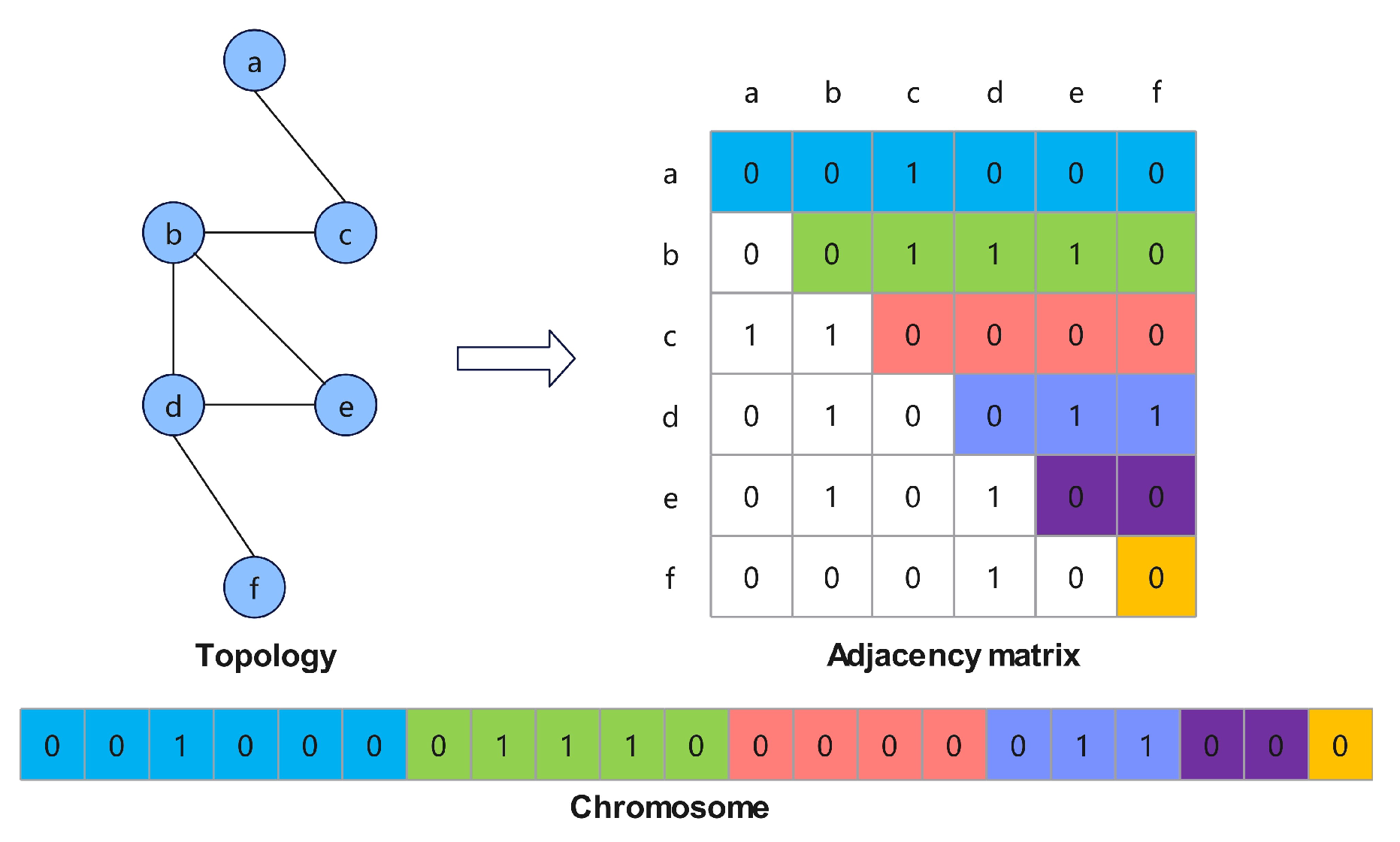
For the given scale-free topology of the EI, we first convert the adjacency matrix of the topology into a binary encoded chromosome. As shown in Figure 1, the topology consisting of six nodes is converted to a chromosome. The adjacency matrix of the topology is a binary matrix. Although it is possible to directly convert this adjacency matrix into a chromosome, this approach would waste storage space and increase the algorithm’s computational complexity for large networks. The adjacency matrix is a symmetric matrix, and its upper triangular matrix can fully represent the connections between nodes in the network. We converted the upper triangular matrix into a chromosome, as depicted in Figure 1. By shortening the length of the chromosome, we save computational memory and improve the efficiency of the genetic algorithm.

3.2. Optimization Based on Free Edges

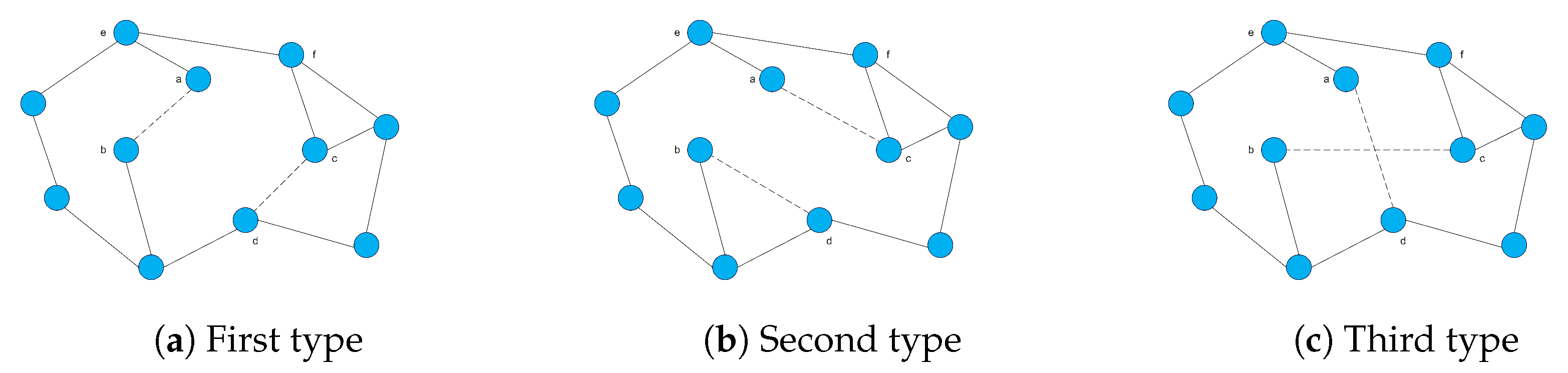
We choose to use graph theory to optimize the network topology, which transforms the network topology optimization problem into a combinatorial problem over the connections between topology nodes. In a network with N nodes, the possible number of edges in the topology is N ( N 1 ) 2 . As the number of nodes increases, the number of possible topologies grows exponentially. Since there are two possibilities (connected or disconnected) for the edge between any two nodes in the topology, a network with N nodes has 2 N ( N 1 ) 2 possible edge configurations [30]. This vast search space makes exhaustive enumeration impractical for large values of N. Taking into account the characteristics of real EI, the nodes in the network are homogeneous, and any two distinct nodes within the communication range can establish or disconnect a connection [31]. To maintain the node degrees unchanged during topology optimization, after establishing a connection between two nodes, each node must correspondingly disconnect one of its existing edges. Therefore, in this study, we propose a topology optimization method based on free edges. For any two edges e a b , e c d , if they satisfy the following three conditions, we consider them as a pair of free edges:
1:
The four nodes a, b, c, and d of the edges e a b and e c d are all within the communication range r of each other;
2:
The two edges e a b and e c d do not share any common nodes.
3:
Apart from a pair of free edges, the four nodes do not have additional edges that connect to each other.
As shown in Figure 2, the edge pair e a b , e c d is a free edge pair according to the definition; whereas the edge pair e a e , e c f does not meet the exchange, because during edge transformation, because the latter may result in overlaps between newly transformed edges and existing edges during edge transformations. By performing edge exchanges through the combination transformations of free edge pairs, the node degrees remain unchanged between different combinations, which improves exploration efficiency and reduces computational overhead compared to direct edge transformations.

4. Algorithm Design

4.1. Population Initialization

For the original scale-free network topology of EI, we apply random perturbations to the initial network to enhance the diversity of the initial population, under the condition that the degree distribution of the node remains unchanged and network connectivity is preserved. A certain number of randomly selected nodes in the initial network have their edges disconnected or created, and the perturbed individuals are stored as new individuals in the population.

4.2. Objective Function Definition

4.2.1. Algebraic Connectivity

In this study, we use algebraic connectivity as the objective connectivity function to optimize the EI topology. Algebraic connectivity is a measure of graph connectivity, defined as the second-smallest eigenvalue of the Laplacian matrix of the graph, denoted as λ 2 . The Laplacian matrix L is a symmetric matrix of the undirected graph G, and its eigenvalues are non-negative [32]. These eigenvalues are arranged in ascending order as follows:
0 = λ 1 λ 2 λ 3 λ n
Here, λ 2 is the second smallest eigenvalue of the Laplacian matrix. A value of λ 2 > 0 indicates that the network is connected, while λ 2 = 0 indicates that the network is disconnected. The higher the value of λ 2 , the more redundant paths exist in the network, which allows it to better resist disconnection caused by node or edge deletions, thus indicating stronger connectivity. At the same time, algebraic connectivity reflects the robustness of the network. A higher algebraic connectivity indicates that the network is more resistant to node or edge removal and can maintain connectivity in the presence of faults or attacks.

4.2.2. Robustness

In the High-Degree Adaptive (HAD) attack strategy, all nodes in the network are ranked based on their degree. In each round of attack, the node with the highest degree and the edges connected to it are removed. To assess network robustness under the HAD attack, Schneider et al. [33] proposed R as a metric, defined as the number of nodes remaining in the largest connected subgraph of the residual topology after each attack. Specifically, it is defined by Formula (2):
R = 1 N + 1 k = 1 N M C S ( k ) N
where M C S ( k ) is defined as the number of nodes remaining in the largest connected subgraph of the topology after k attacks, N is the total number of nodes in the topology, and 1 / ( N + 1 ) is a normalization factor used to compare networks of different sizes and edge densities. As we know, a fully connected network has the highest tolerance to network attacks. After the network is attacked and the corresponding faulty nodes and edges are removed, the fully connected network formed by the remaining nodes is the largest connected subgraph. In the scale-free EI topology, due to the constraints of node communication distance and the power-law distribution of node degrees, a fully connected network cannot be used, so the R ranges from 0 to 0.5. The larger R, the higher the robustness of the scale-free network topology. In this study, we use R as the objective function for the robustness of the network topology.
While both the algebraic connectivity λ 2 and the robustness metric R reflect the resilience of the network, they focus on different dimensions. λ 2 is a spectral measure based on the Laplace matrix, which reflects the overall structural rigidity and connection rigidity of the network; R is for functional survival under specific attacks. In some special topologies such as onion-like structure, small world network, and scale-free network, a high l a m b d a 2 does not necessarily guarantee a high R value for a particular intelligent attack. Therefore, in order to comprehensively evaluate the survival of EI in complex environments, this paper chooses to optimize these two objectives at the same time to seek the best balance between theoretical structural stability and practical attack resistance.

4.2.3. Smallest Average Path Length

In complex networks, the average path length can serve as an indicator of network operating efficiency. A shorter average path length means more efficient information transmission and greater network efficiency [34]. Hence, in this study, we use the average shortest path length as the objective function for network operating efficiency. The average shortest path length refers to the average of the shortest path lengths between all pairs of nodes in the network topology, as defined by Formula (3):
L a v g = 1 N ( N 1 ) i = 1 N j i N d i j
where d i j is the shortest path length from node N i to node N j .

4.2.4. Fitness Value

In this study, the fitness function is defined as the weighted sum of the values of the three objective functions mentioned above, as defined by Equation (4):
F ( j ) = α λ 2 ( j ) + β R ( j ) + γ L avg ( j )
where F ( j ) is the fitness of the individual j, λ 2 ( j ) , R ( j ) , and L avg ( j ) represent algebraic connectivity, robustness, and the average shortest path of the individual j, and α , β , and γ are constants. In this study, α and β are positive constants, and γ is negative.

4.3. Genetic Operation

In this study, we use an annealing strategy to dynamically adjust the genetic operation factor P m , which acts as a control factor for genetic operations. When P m P c , a mutation is performed; when P m > P c , a crossover is performed. P m is defined by Formula (5):
P m = ϵ ( 1 + cos ( π × g 1 4 × ( G 1 ) )
where ϵ is a constant between 0 and 1, g represents the current iteration number, and G represents the total number of iterations.
Using this control factor, during the early stages of iteration, when g is small, P m is high, leading to a higher probability of mutation. This increases the diversity of the population, improves global search capabilities, and helps avoid local optima. In later iterations, the probability of mutation decreases, and the probability of crossover increases to stabilize convergence.
In the mutation operation, we assume that G f is the parent individual and assume G s as the offspring individual. First, an individual is selected as the G f in the iterative current population using the tournament selection method. Based on the free edge pair rule, we find its set of free edge pairs and iterate over the existing edges of G f , filtering edge pairs that contain four node groups. For each edge group, we check whether it satisfies the connectivity condition and generate a list of unconnected candidate edges. For example, if the edges e uv and e wx form a group of four nodes {u, v, w, x}, the candidate edges are the non-connected valid edges within the four nodes. Then, the number of mutation operations is determined, and an upper limit for the number of edge transformation operations is set to avoid excessive operations. This is defined in Formulas (6) and (7):
N u m o p s = min ( U , 200 )
U = ( 0.4 + 0.3 × K ) × N u m e d g e
Here, N u m ops refers to the number of mutation operations, N u m edge refers to the set of pairs of free edges of G f , and K = g G denotes the progress of the iteration, where g is the current iteration number, and G is the total number of iterations. In the early stages of the iteration, the values of K and U are small, ensuring that computational space is saved when the probability of mutation is high. In later stages, as K increases, U increases, helping to search for the best convergence region when mutation probability is low.
According to Algorithm 1, suppose that is the parent, and that e ab and e cd are the free edge groups selected in the G f . First, the original edges e ab and e cd are removed. Then, one type of free edge pair is selected from the candidate edge list, and new candidate edges are added to the original nodes, ensuring that the total number of edges and node degrees remain unchanged. After the operation, the node degrees and connectivity of the topology are checked. If the operation causes the network to disconnect, the topology is repaired by adding edges to connect nodes outside of the largest connected component until the network is restored. This process is repeated until the count of mutation operations is reached. The degrees of the nodes in the network topology remain unchanged before and after the mutation.
Algorithm 1 Mutation Operation
1:
Input: Parental individual G f , Evolutionary progress K, free edge pair set E f , candidate edge set E c , number of mutation operations N u m m t
2:
Output: Offspring individuals G s
3:
for  i = 1 to N u m m t  do
4:
      In E f , randomly select n sets of edges to be transformed as C m o
5:
      for  x = 1 to n do
6:
          Perform the edge set transformation operation on G s
7:
          Remove the original edge set C x
8:
          Select a combination type of edge set from
9:
          Add the selected edge set to G s
10:
      end for
11:
end for
In the crossover operation, we design the crossover algorithm as follows. Let G f 1 and G f 2 represent the first and second parents, and G s 1 and G s 2 represent the first and second offspring individuals. First, two individuals are randomly selected from the population as parents. The sets of free edge pairs of the selected parents are found according to the free edge pair rule. The matching edge pairs of the selected parent and mother are mapped using a hash table, and the matched edge sets are labeled as exchangeable edge groups. The crossover operation is then performed as defined in the Algorithm 2.
The number of crossover operations is determined, and a lower limit for the number of edge transformation operations is set. Then, perform the crossover transformation on G f 1 and G f 2 . N pairs of exchangeable edge groups are randomly selected. For G f 1 , the selected edge groups are removed and replaced by the corresponding edge groups of G f 2 , resulting in G s 1 . Similarly, this is done for G s 2 . The generated offspring are pre-evaluated, and if their fitness is better than that of the original parents, they are retained. After the operation, G f 1 and G f 2 are compared, and the offspring with the higher fitness is chosen.
After the mutation and crossover operations have been completed, the generated individuals are merged with the original population and await further selection.
Algorithm 2 Crossover Operation
1:
Input: Parental individual 1 G f 1 , Parental individual 2 G f 2 , Evolutionary progress K, free edge pair sets E f 1 , free edge pair sets E f 2 , number of mutation operations N u m c p
2:
Output: Offspring individual G s
3:
for each node group in G f 1  do
4:
    Extract a node group composed of four nodes as the key
5:
    store the edge group in the list corresponding to that key
6:
    Initialize G s 1 as a copy of G f 1 ;
7:
end for
8:
for each node group in G f 2  do
9:
      Extract a node group consisting of four nodes as the key
10:
    initialize G s 2 as a copy of G f 2
11:
    if The mapping of G f 1 contains the same key then
12:
        Pair the corresponding edge groups of G f 1 and G f 2 and add them to the matching list C c o
13:
    end if
14:
end for
15:
for  y = 1 To N u m c o  do
16:
    Check the consistency of the E f 1 , and if they are inconsistent, skip them
17:
    Randomly select a portion of the edge group structure from E f 1 as C c o 1 and apply it to G s 1
18:
    Evaluate the fitness of the new structure, and if the fitness improves, keep it
19:
    Check the consistency of the E f 2 , and if they are inconsistent, skip them
20:
    Randomly select a portion of the edge group structure from E f 2 as C c o 2 and apply it to G s 2
21:
    Evaluate the fitness of the new structure, and if the fitness improves, keep it
22:
    Compare the fitness of the two offspring;
23:
    Select the offspring with higher fitness value as G s
24:
end for

4.4. Non-Dominated Sort

The goal of non-dominated sorting is to divide the population individuals into multiple fronts based on dominance relationships such that the first front contains all non-dominated solutions, the second front contains solutions dominated only by the first front, and so on.
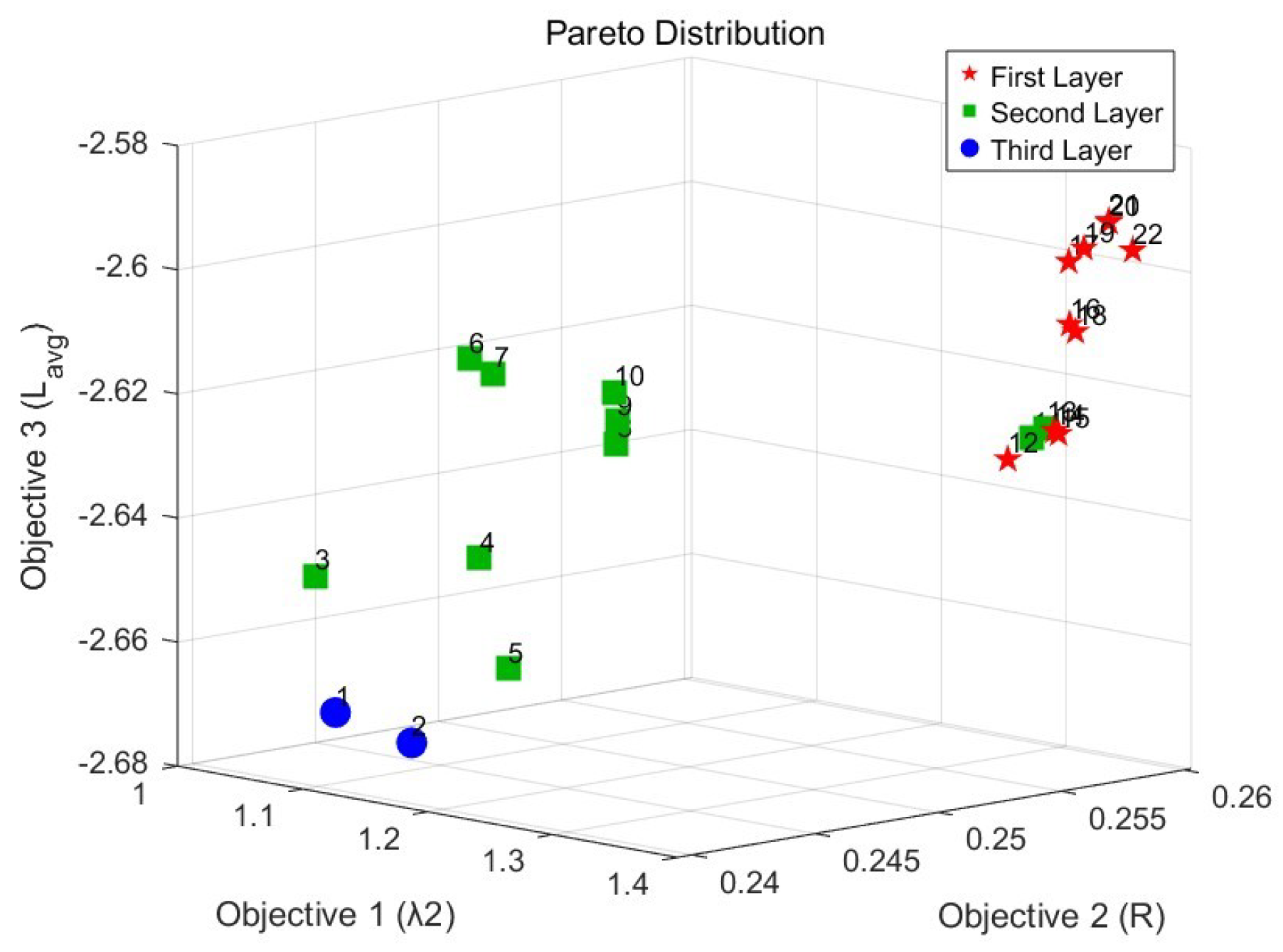
For any two individuals G x and G y , whose objective values are ( λ 2 x , R x , L a v g x ) and ( λ 2 y , R y , L a v g y ) , respectively, if the conditions λ 2 x λ 2 y , R 2 x R 2 y and L a v g x L a v g y hold, and at least one of them satisfies ‘<’, then we consider the individual G x to dominate the individual G y , or G y to be dominated by G x , denoted as x y .
Based on the dominance principle described above, we loop through all individuals, comparing them in pairs. As shown in the figure, individuals that are not dominated by any other individual are placed on the first front and will not be compared further. Dominated individuals are retained for future comparison iterations. This process is repeated, dividing the population into different levels of fronts, with higher-quality individuals in smaller fronts and lower-quality individuals in larger fronts. Afterwards, we need to select M individuals from these fronts. Whenever a new front is generated, we calculate the total number of individuals in the existing fronts and continue sorting until the total number of sorted individuals exceeds or equals the population size M. Figure 3 illustrates an example of non-dominated sorting of individuals.

4.5. Selection of Individuals in the Last Front

If the total number of individuals in the first K fronts is less than M, and the total number of individuals in the (K+1)-th front is greater than M, we should select individuals from the (K+1)-th front to ensure the number of selected individuals reaches M.

4.5.1. Dynamic Reference Point

By introducing reference points, the objective space is divided into multiple regions, with each reference point corresponding to one region. This helps the algorithm explore and select more precisely within the target space. The dynamic reference point can adaptively adjust the positions and number of reference points based on the characteristics of the optimization problem and the distribution of the population. In this study, we propose an adaptive dynamic reference point generation and selection strategy, and reference points r i are generated according to the following process.
(1) Set the density factor of the reference point. The density factor controls the number of reference points, and it is dynamically adjusted by calculating the standard deviation F σ of the target space, combined with the population diversity indicator d i v . This can be defined using the following Formulas (8)–(10):
F σ i = s t d ( F , i )
d i v = m e a n ( F σ i ) max ( F σ i ) + e p s
ρ = 1.0 + ( 1 d i v ) × 1.0
Based on this density factor control, during early iterations or when the set of solutions is widely distributed, the value of d i v is high and close to 1, and ρ tends to 1.0. At this stage, the number of reference points decreases, the search density is reduced, and the algorithm focuses more on global exploration to avoid premature convergence. The population is widely distributed in the target space, covering more potential Pareto front regions.
In later iterations or when the set of solutions tends to converge, the value of d i v is low and close to 0, and ρ tends towards 2.0. At this stage, the reference point density increases, improving the local search capability. The set of solutions is refined in critical areas.
(2) Based on biased Dirichlet sampling. The dimension of the objective function is m = 3 , and the number of reference points is set to N r e f = 10 m ρ . First, generate the uniform distribution base vector, with the probability density function given as follows:
p ( u ) k = 1 m u k δ 1 , k = 1 m u k = 1
Here δ is the exponent parameter, set to 0.7 in this study, which concentrates the sampling points more in the center region. The standard NSGA-III is designed for uniform distribution on the Pareto front. However, in practical applications of the EI, decision-makers often have a stronger preference for network security. Therefore, this document adopts a preference-based strategy, and we set the bias direction vector to w = [ 0.6 , 1.5 , 0.2 ] , where the weight corresponding to the robustness target is significantly higher than the algebraic connectivity and the average path length. The bias intensity ϕ ( 0 , 0.6 ) is random, and the initial reference point r i can be represented as follows:
r i = n o r m ( u i + ϕ w )
Here n o r m refers to the normalization operation, ensuring that r i = 1 .
(3) Selection of the reference point. After generating the initial reference points, to prevent excessive reference point density from increasing computational complexity and causing the solution set to become sparse, we need to filter the reference points. Traditional reference point selection relies on crowding distance or random elimination, which is ineffective at resolving the issue of solution set clustering due to highly similar reference points. In this paper, we introduce a cosine-similarity penalty mechanism to quantify directional similarity between reference points and to dynamically eliminate redundant reference points. The specific steps are as follows:
For the set of generated reference points, the cosine similarity between two reference points r i and r j is calculated as follows:
S i j = r i · r j r i · r j
Set the similarity threshold to S t h r e s h o l d = 0.8 , and if S i j > S t h r e s h o l d , the reference points are considered highly similar. A fitness penalty is applied to similar reference points, reducing their selection probability. The penalty Formula (14) is as follows:
F ( r i ) = F ( r i ) · ( 1 τ · S i j )
where τ [ 0.05 , 0.2 ] is the dynamic penalty coefficient, initially set to a higher value to expand the distribution area of the reference point and later reduced to enhance convergence.
After each iteration, remove the top 10% of the reference points with the highest similarity and supplement the reference points with newly generated solutions to maintain a constant number of reference points. At the same time, adjust S t h r e s h o l d based on the entropy value of the solution set as a diversity indicator for the population. If the entropy value exceeds the threshold, decrease S t h r e s h o l d to strengthen the selection process; otherwise, relax it.

4.5.2. Normalization

In multiobjective optimization, the dimensionality and value ranges of different objective functions may vary significantly, and directly comparing and selecting them might exaggerate or ignore the dominance of certain objective functions. Therefore, normalization is crucial for ensuring that all objective functions are compared on the same scale.
(1) Find the ideal and extreme points. The ideal point is the minimum value of each objective function in different directions, denoted as z i d e a l = [ m i n λ 2 , m i n R , m i n ( L a v g ) ] . The extreme point is the maximum value point of each objective function after normalization, where each point has a significantly high value in one direction and relatively smaller values in the other two directions. It can be determined by maximizing the weighted objective direction, with the weights W k = d i a g ( 1 / σ k ) , ( k = 1 , 2 , 3 ) being the standard deviation of each objective. Divide the target values by the weights to obtain ( λ 2 x W 1 , R x W 2 , L a v g x W 3 ) , ( x = 1 , 2 , , N ) . Then select the maximum value to generate z e x t = [ m a x ( λ 2 x W 1 , R x W 2 , L a v g x W 3 ) , ( x = 1 , 2 , 3 , , N ) ] as the extreme point.
(2) Calculate the hyperplane intercepts. Based on the extreme points z 1 e x t , z 2 e x t , and z 3 e x t , we can construct a hyperplane whose normal vector n is determined by the cross product of the extreme point vectors (15):
n = ( z 2 e x t z 1 e x t ) × ( z 3 e x t z 1 e x t )
The hyperplane equation can be represented as n · ( f z 1 e x t ) = 0 . The intercepts d j along each axis are calculated analytically from the plane Equation (16):
d j = n · z 1 e x t n j + ϵ , j = 1 , 2 , 3
where ϵ is a very small quantity to avoid division by zero errors. n j is the value of the normal vector n in the intercept direction. Specifically (17):
d λ = n · z 1 e x t n λ + ϵ d R = n · z 1 e x t n λ + ϵ d L = n · z 1 e x t n λ + ϵ
If the intercepts have non-positive values, such as when the extreme points are collinear, and the normal vector n becomes the zero vector, causing the hyperplane to degenerate into a line and the intercept calculation formula to fail, then the objective range normalization (18) is applied as follows:
f ˜ j = f j z i d e a l Δ j , Δ j = m a x ( F : , j ) z j i d e a l
The truncation operation f ˜ j m a x ( 0 , m i n ( 1 , f ˜ j ) ) ensures numerical stability.
(3) The normalized objective values of an individual j are given by the following (19):
λ ˜ j = λ j z j i d e a l d λ z j i d e a l R ˜ j = R j z j i d e a l d R z j i d e a l L ˜ j = L j z j i d e a l d L z j i d e a l

4.6. Reference Point Association and Selection Mechanism

After normalization, for each individual, we need to associate them with a reference point for selection. Let the normalized objective value of the individual be f ˜ i , and the reference point be r j , then the association distance (20) is calculated as follows:
d i j = 1 f ˜ i · r j f ˜ i · r ˜ j
Each individual is associated with the reference point corresponding to the minimum distance, forming a reference point-individual mapping. During selection, to avoid the algorithm getting trapped in a local optimum and to ensure population diversity, we use the following dynamic sparse selection strategy:
(1) Reference point crowding statistics: After the individual is associated with the reference point, the number of individuals associated with each reference point is recorded.
(2) Sparse selection: Starting from the reference point with the fewest associated individuals, i.e., the sparsest reference point, the individual with the largest crowding distance is selected. The crowding distance is calculated using the following Formula (21):
C r o w D i s t ( x i ) = k = 1 3 w k · f k i + 1 f k i 1 f k m a x f k m i n
where w k = [ 0.2 , 0.7 , 0.1 ] is the weight to calculate the crowding distance, which emphasizes the robustness objective. f k i + 1 is the k-th objective value of the (i+1)-th individual, and f k m a x and f k m i n are the maximum and minimum values of the k-th objective, respectively. If a reference point has no associated individuals, it is marked as “saturated” and skipped to the next reference point.
(3) Hierarchical filling: The population is filled according to the non-dominated sorting front levels, from high to low, until the population reaches the target size. If the number of individuals on a front exceeds the remaining capacity, the population is filled and selected for that front using the mechanism described above.

5. Experimental Design and Analysis of Results

This section presents the parameter settings for SA-NSGA-III and compares them with those of other methods. The algorithm is implemented in MATLAB R2024b, and the experiments were carried out on a personal laptop with an AMD Ryzen 7 6800H CPU (3.20 GHz) and 16GB of RAM, running Windows 11.

5.1. Parameter Settings

The topological environment parameters and the NSGA-III parameters are shown in Table 1. We performed experiments across different topology scales to demonstrate the algorithm’s adaptability. The network nodes were randomly distributed in a square area S with a side length of 500 m, a communication range of r = 250 m, network sizes N = [ 100 , 200 , 300 , 400 , 500 ] , and edge densities D = [ 2 , 3 , 4 , 5 ] , covering both sparse and dense network scenarios. The medium set of ϵ was determined by empirical tuning to maintain adequate mutation-driven exploration without disrupting convergence stability, especially given the combinatorial complexity introduced by the free-edge transformation method. The high crossover threshold P c aligns with the scale-free topology constraint, while the crossover promotes the structured inheritance of beneficial topological patterns.
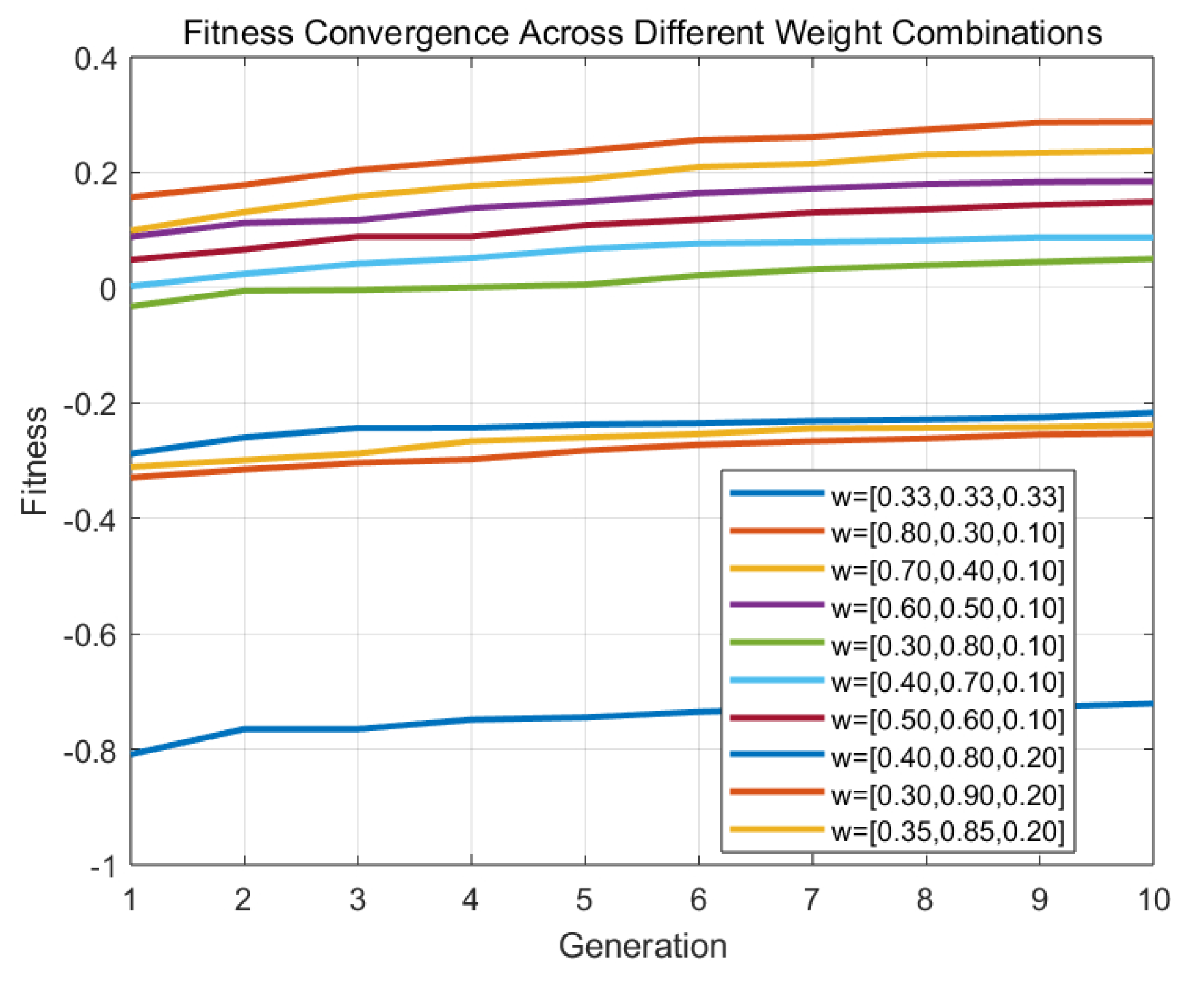
In this study, the weight scheme ( α , β , γ ) is selected based on empirical analysis of optimization performance. As shown in Figure 4, the weight combination ( α , β , γ ) that yielded the maximum increase rate in fitness value during the initial optimization phase, which we found to be a reliable indicator to achieve a well-balanced and high-quality Pareto front.
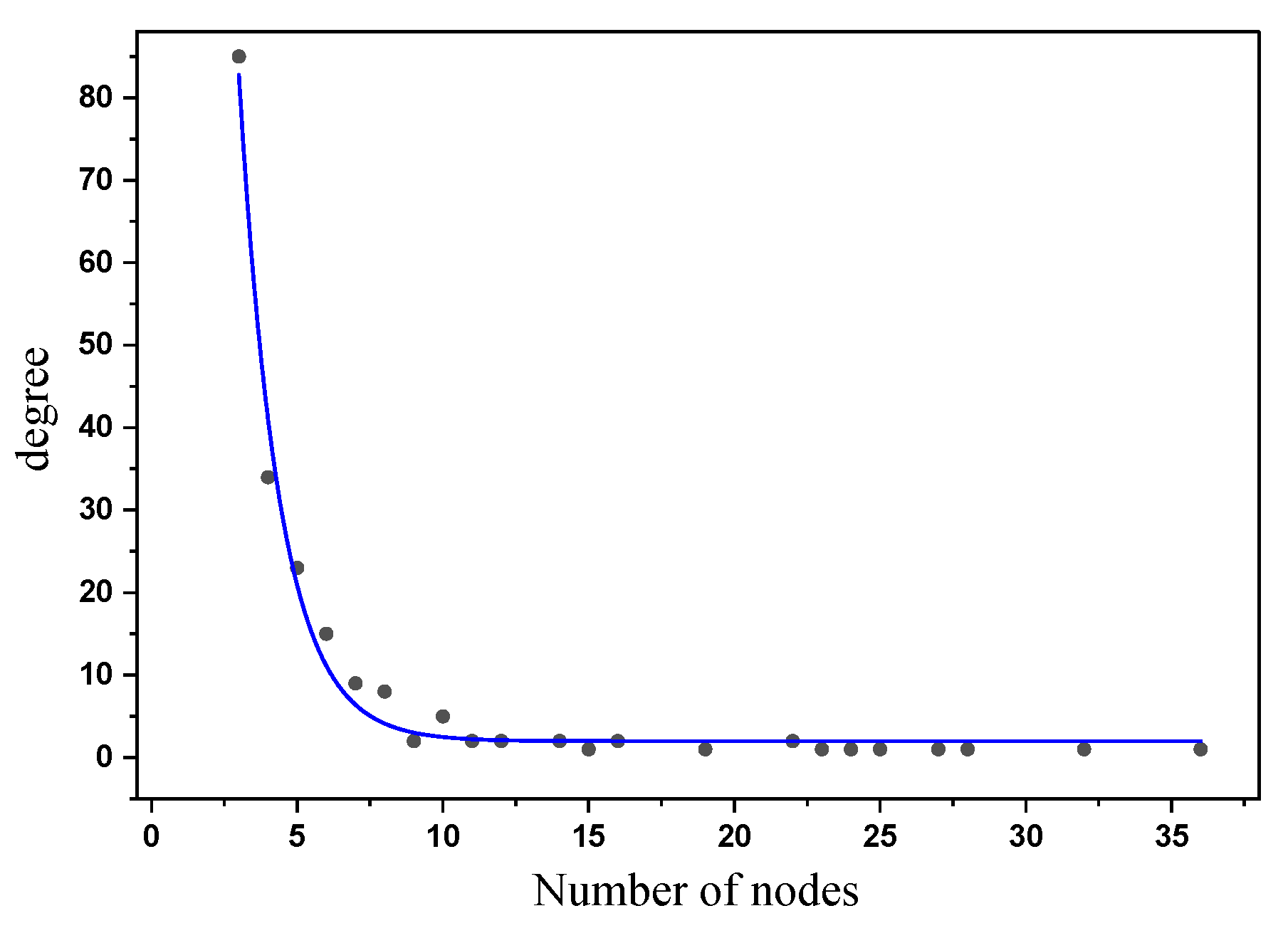
In Section 2, we describe the method for generating the initial scale-free network topology. The degree distribution of the generated network topology is shown in the Figure 5. The topology was generated in a 500 m × 500 m square area, with a network size of 200 and a density of 3. It can be observed that a few nodes have large degrees, while the majority of nodes have smaller degrees, following a power-law distribution. This indicates that the initial topology is scale-free. This is consistent with the actual topology of energy internet networks, confirming that the scale-free network generated can effectively simulate the topological characteristics of energy internet networks.

5.2. Optimization at Different Network Densities

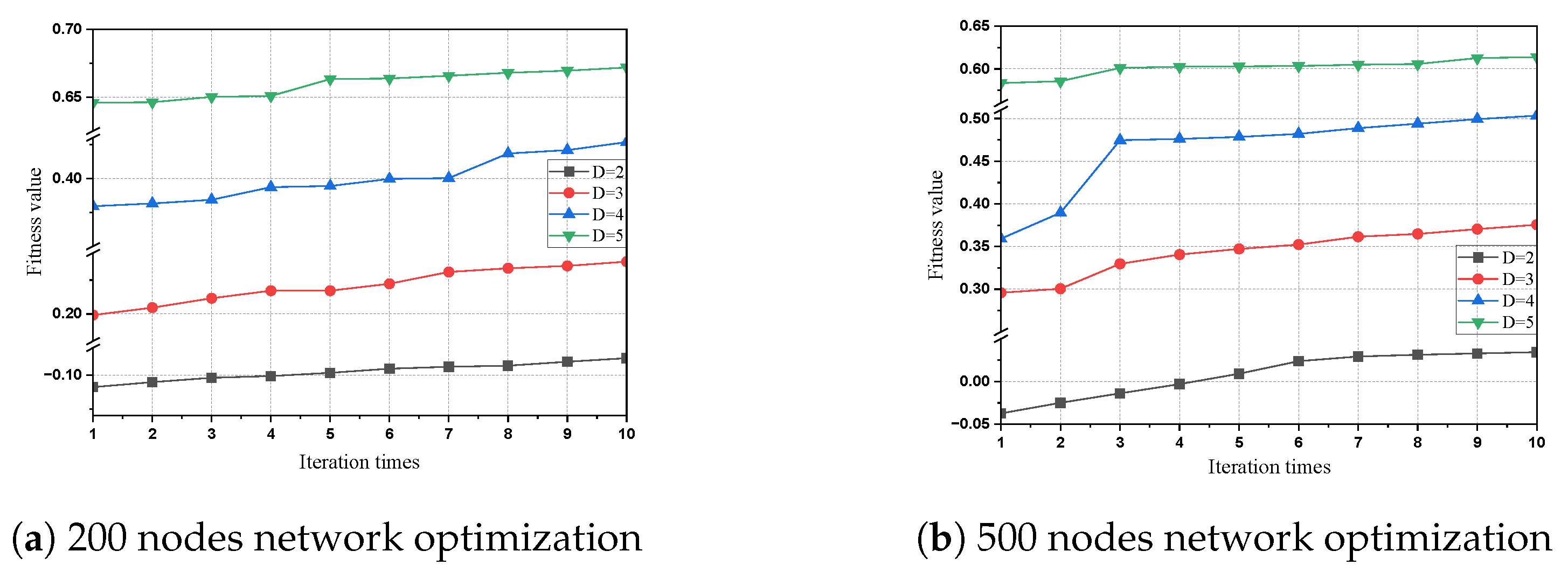
We performed experiments on topologies with densities varying from D = 2 to D = 5 , and different network sizes, N = 100 and N = 200 , with a total of 100 iterations. Higher-density networks were observed to retain more connected nodes after an attack compared to lower-density networks and demonstrated greater topological robustness.
Figure 6a shows the optimization results for the 200-node topology using SA-NSGA-III. After six iterations of SA-NSGA-III, the fitness values for different densities stabilized. In higher density scenarios (Figure 6b), the optimization amplitude of the network topology fitness value was smaller, the maximum optimization amplitude occurring at D = 4 , with 0.1441 amplification, resulting in a relative gain of 40.1%. Except for D = 5 where the optimization efficiency was the lowest, other network densities showed a good optimization efficiency.
The experiment was repeated in a topology with 500 nodes, and the results are shown in Figure 6b. The experiment indicates that SA-NSGA-III exhibits optimization effects across networks of varying densities. However, compared to the 200-node network, optimization efficiency is lower for networks of varying densities. This phenomenon can be attributed to the deployment of more nodes and edges in the same area, increasing the number of communication nodes that a single node may interact with, which poses a challenge for the algorithm.

5.3. Comparison Between the Initial Topology and the Optimized Topology

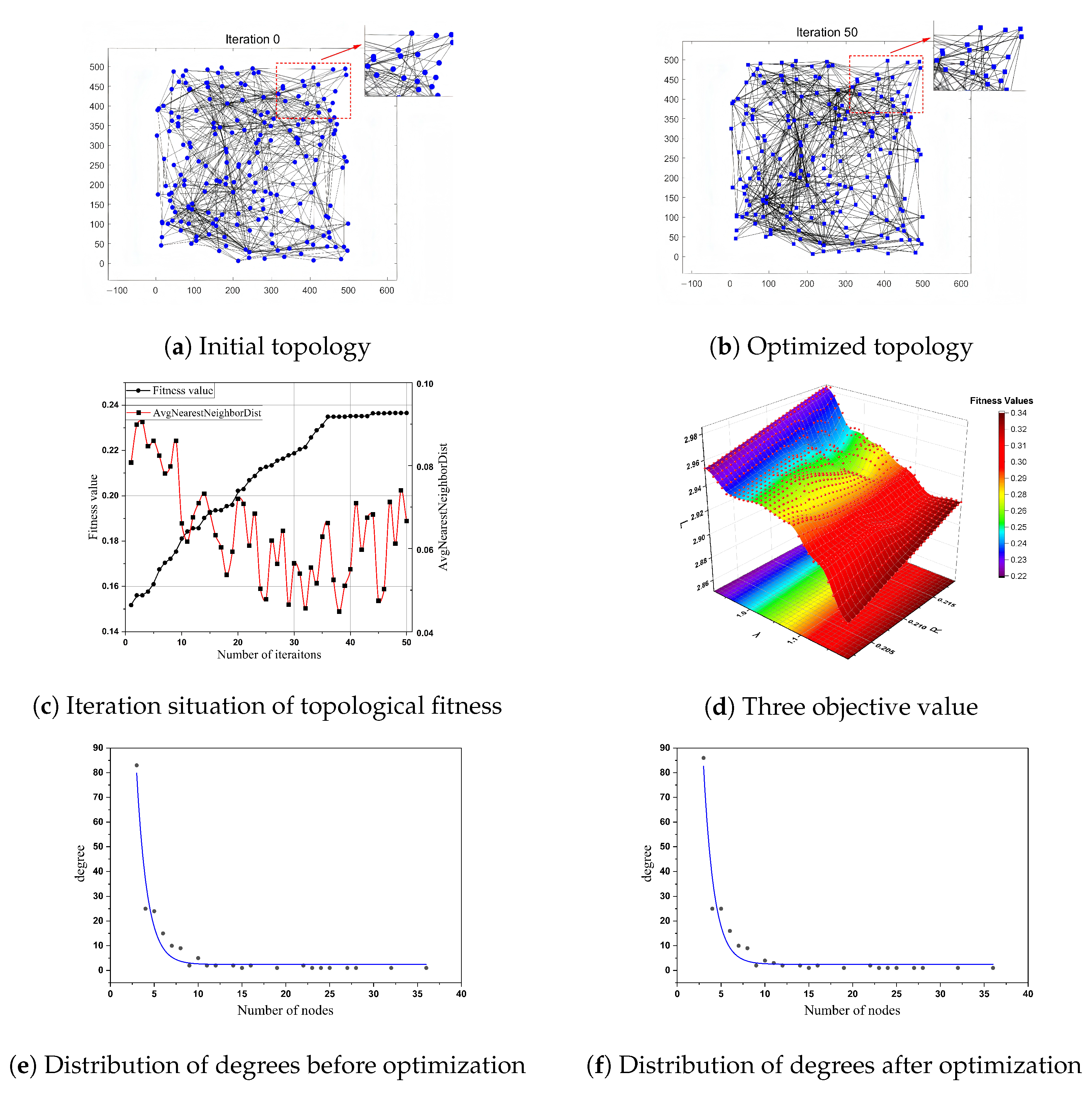
This section compares the features of the initial topology with those of the optimized topology. The experiment was carried out on network topologies with N = 100 , D = 3 , and the number of iterations was set to 50.
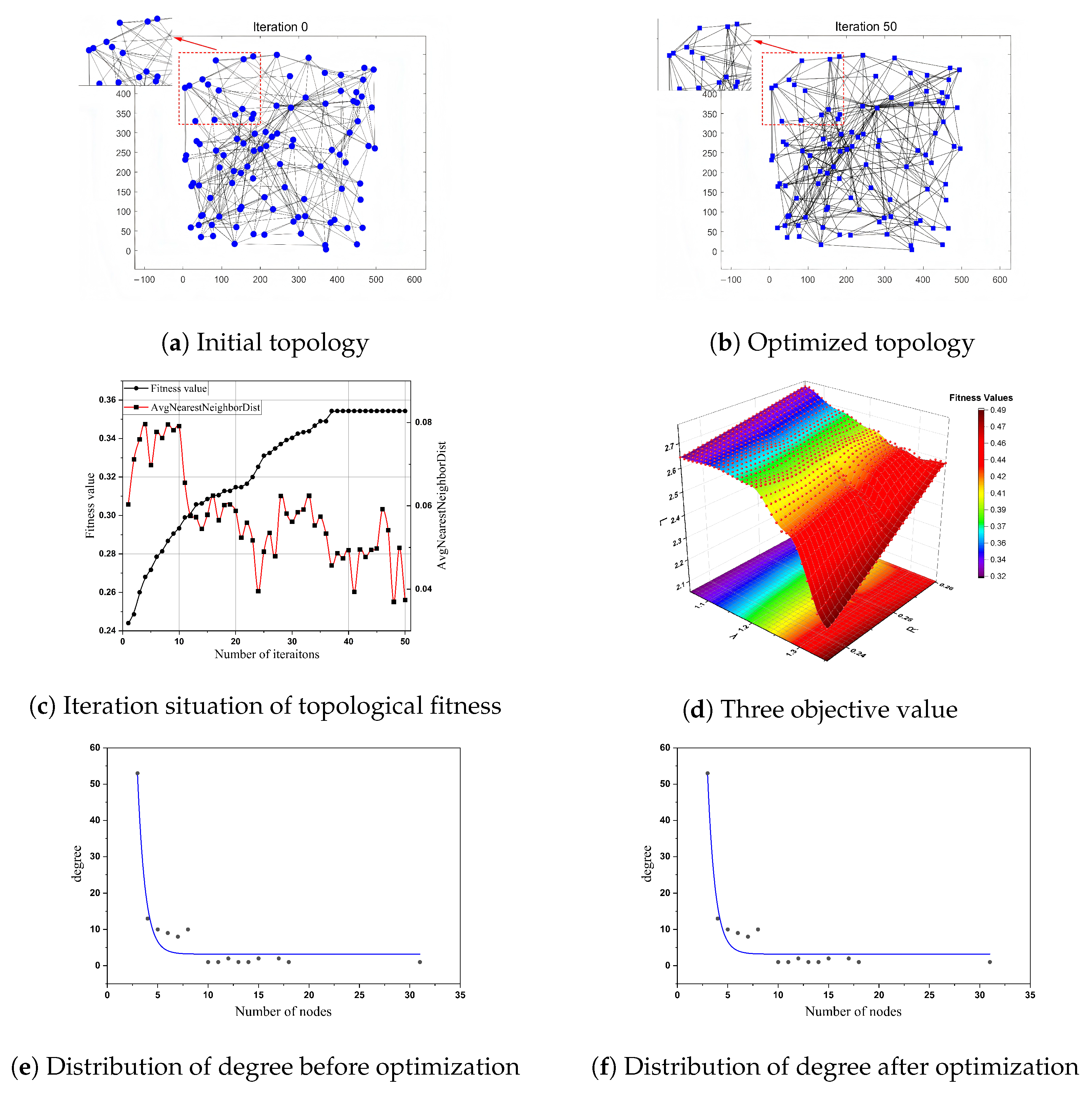
Figure 7 illustrates the topology optimization for the nodes. Figure 7a shows the initial network topology, Figure 7b displays the optimized topology. As shown in Figure 7c, the fitness value continuously increases during iterations and eventually stabilizes near its maximum value, reaching a stable convergence after 37 iterations. The adaptation value improved from 0.244 to 0.354, with an increase of approximately 45.08%. To further verify the ability of SA-NSGA-III to avoid local optima, we tracked the average nearest-neighbor distance (ANN) of the population in the objective space as a diversity metric (Figure 7c). The results show that during the 50 generations of optimization, diversity slowly decreased, with an overall decay rate of only 38%, and multiple instances of diversity recovery occurred throughout the process, indicating that the adaptive mechanism can dynamically adjust the search direction and effectively maintain a wide population distribution. Figure 7d presents the relationship between the three objective function values and the adaptation value, illustrating that while algebraic connectivity and robustness improved during optimization, the average path length decreased only marginally. Specifically, algebraic connectivity increased from 0.86 to 1.35, robustness improved from 0.23 to 0.26, and the average shortest path reduced from 2.69 to 2.59. In denser networks (e.g., D = 5 ), the Pareto front tends to favor robustness and connectivity over path length reduction, while in sparser networks ( D = 2 ), efficiency gains are more achievable at the expense of robustness. This suggests that in scale-free topologies, enhancing structural robustness may partially align with improving connectivity, but operational efficiency gains are limited under degree-preserving constraints. In addition, as shown in Figure 7e,f, the algorithm rearranges the topology while maintaining the power law.
Figure 8 shows the topology optimization results for 200 nodes. As seen in Figure 8a,b, although the degrees of the node remain unchanged after optimization, the edges of the topology tend to be more densely connected in the direction of the original topology, while becoming sparser in other directions. Throughout the optimization process Figure 8c, diversity remained at a relatively high level, and the rapid convergence commonly seen in traditional multi-objective algorithms did not occur, providing quantitative evidence of the algorithm’s ability to avoid local optima. Compared to the optimization effect for the 100-node topology, the fitness value is smaller here. This is because, as the number of nodes increases, the algebraic connectivity λ 2 and the robustness R of the initial topology decrease, while the average shortest path L a v g increases. Similarly, the fitness value reaches convergence after approximately 37 iterations. The degrees of the node before Figure 8e,f topology optimization maintain the power law well.

5.4. Comparison of Different Algorithms

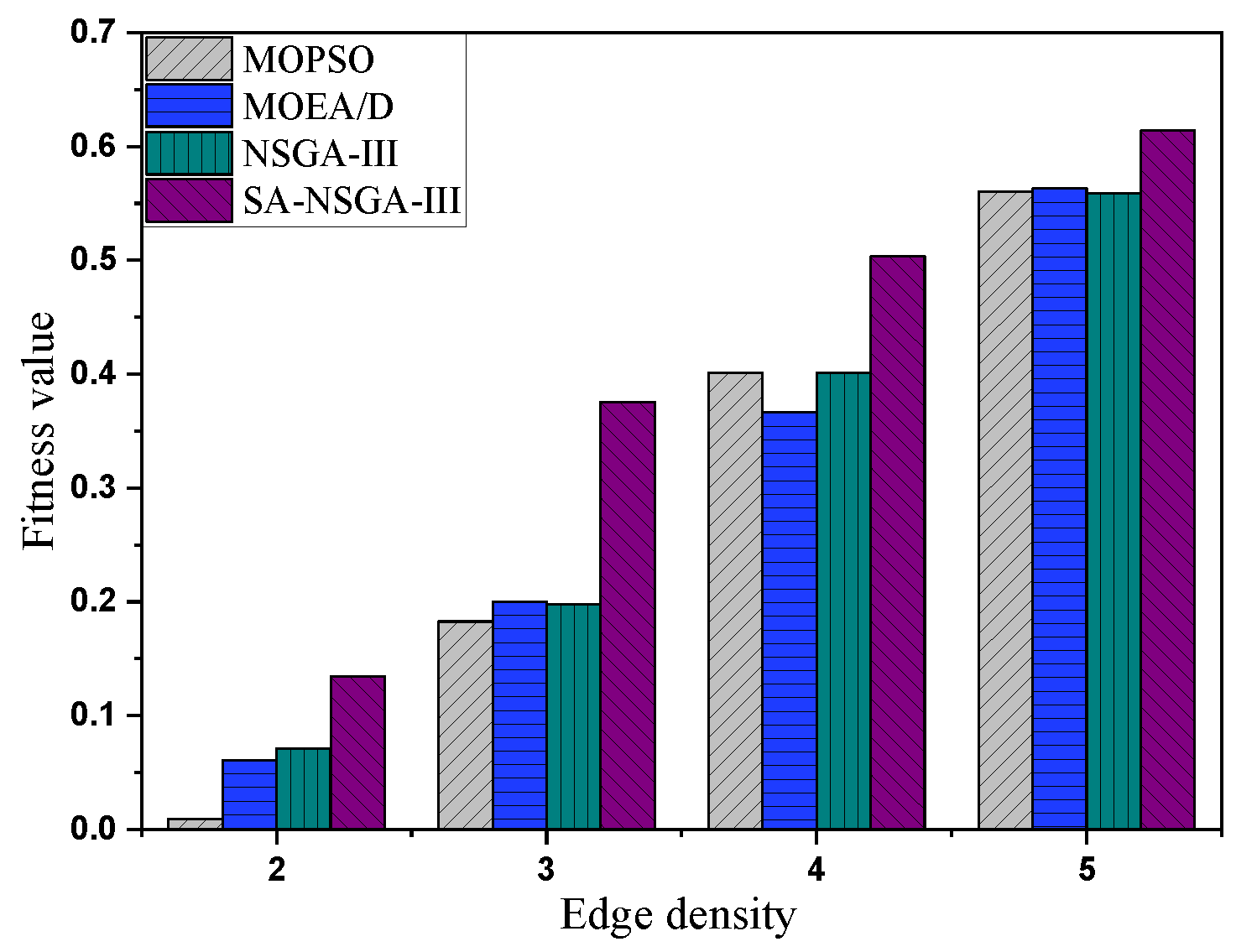
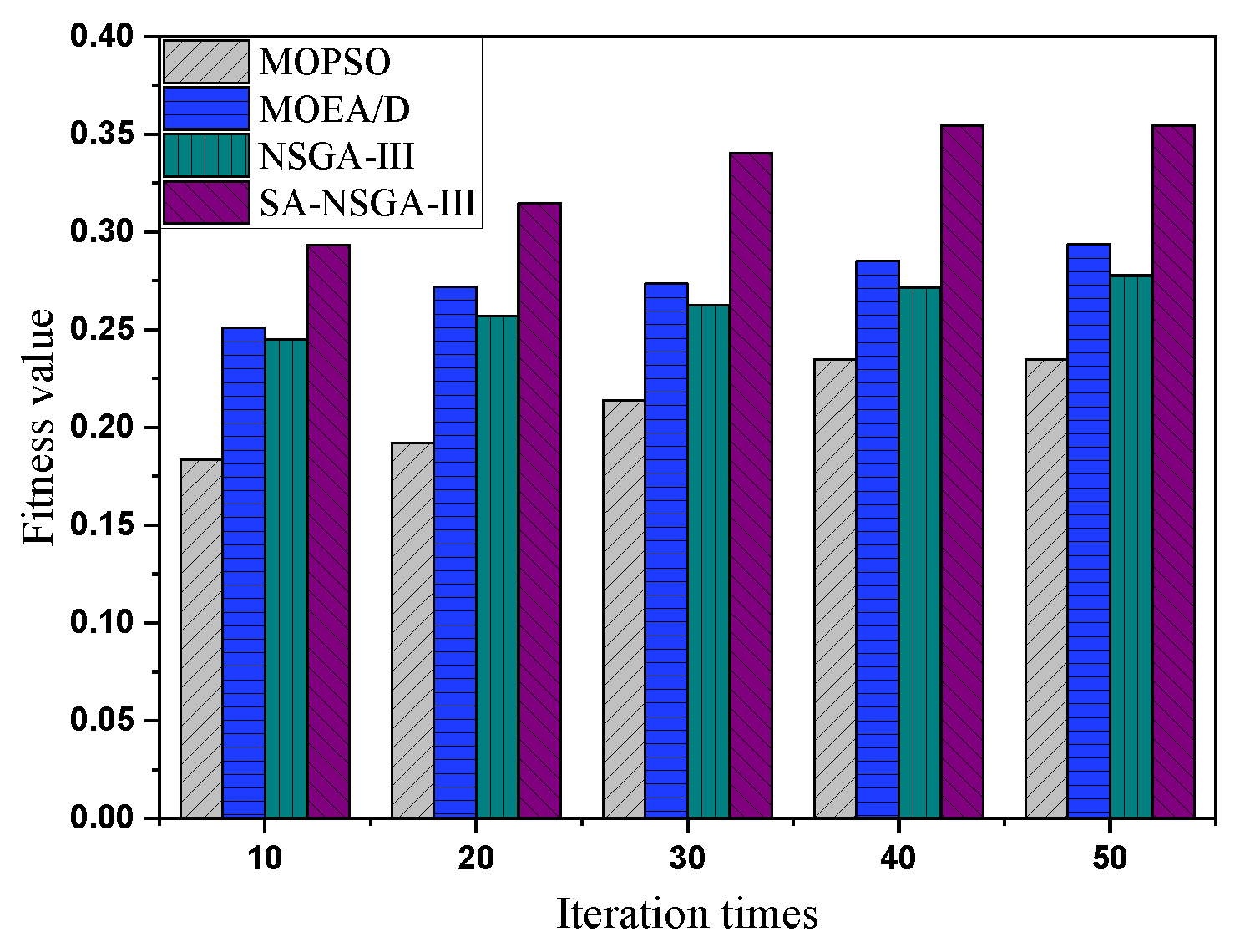
In this section, we compare the SA-NSGA-III algorithm with NSGA-III, MOEA/D, and MOPSO, and conduct experiments across various network node sizes, edge densities, and iteration counts. The parameters for the topology are as follows: network node sizes N = [ 100 , 200 , 300 , 400 , 500 ] , network edge densities D = [ 2 , 3 , 4 , 5 ] , and iteration counts G = [ 10 , 20 , 30 , 40 , 50 ] .
For the NSGA-III algorithm, the Das and Dennis reference point generation method is used, with crossover and mutation probabilities set to 0.8 and 0.2, respectively, and the other settings are consistent with SA-NSGA-III. The MOEA/D algorithm follows the configurations outlined in [21], and the MOPSO algorithm follows the settings of [25]. All algorithms use a topology-optimization method based on free-edge transformations.
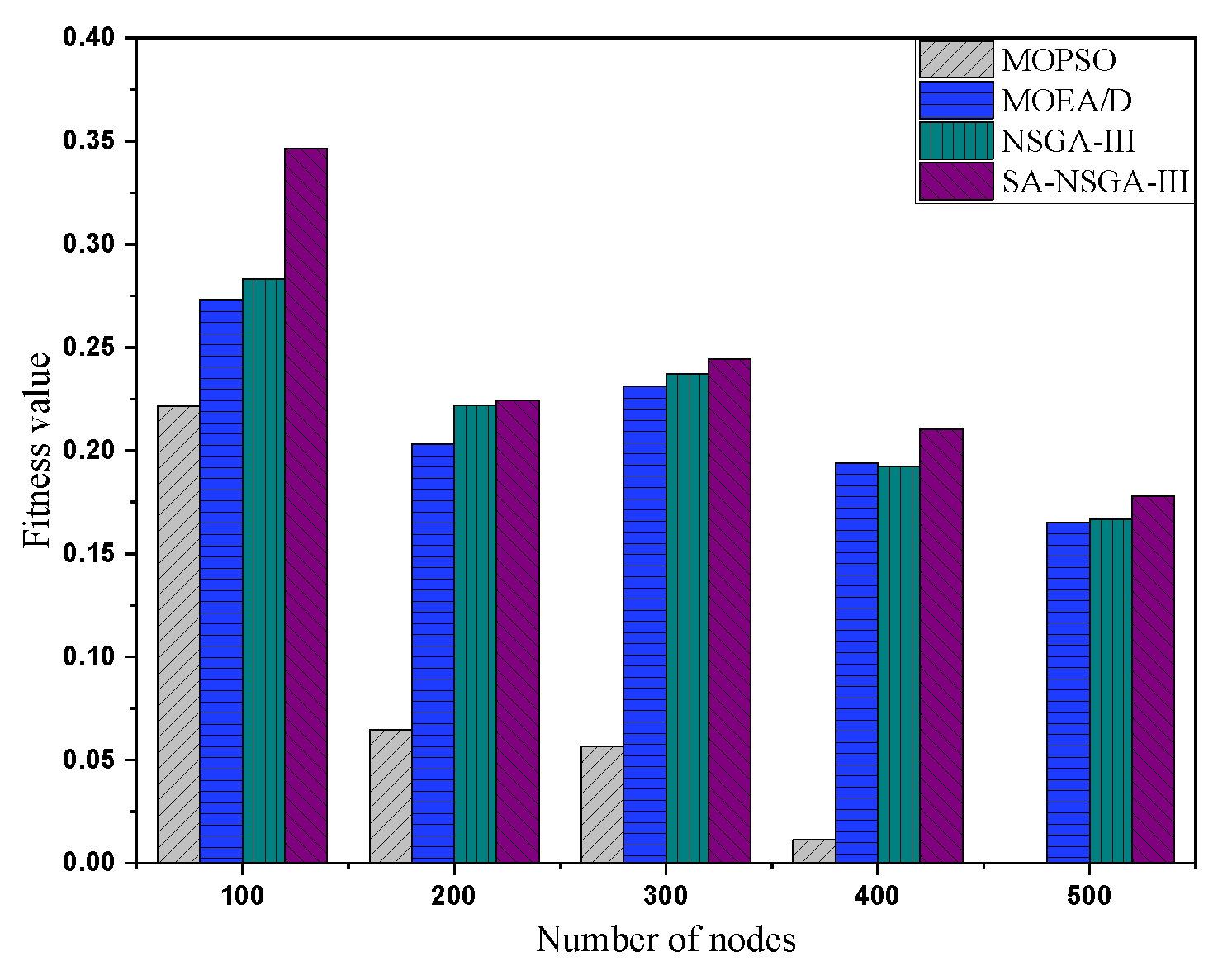
Figure 9 presents a comparison of the four algorithms in different network node sizes, with N = [ 100 , 200 , 300 , 400 , 500 ] , network edge density D = 2 , and iteration count G = 10 . The data shift method was used in the figure to facilitate a more direct comparison of the adaptation values. In Figure 9, it can be seen that as the number of network nodes increases, the adaptation values for the four algorithms decrease, indicating a decrease in overall network performance. Despite this trend, SA-NSGA-III consistently outperforms the other three algorithms in terms of network optimization, demonstrating its applicability to networks of varying sizes.
Figure 10 presents a comparison of the four algorithms at different edge densities, with N = 100 , D = [ 2 , 3 , 4 , 5 ] , and G = 10 . As shown in Figure 10, as the edge density increases, both the initial and optimized fitness values for the four algorithms increase, suggesting an improvement in the overall performance of the network. The increased edge density expands the solution space, which can typically lead algorithms to local optima. However, the proposed algorithm can avoid this by employing adaptive adjustment strategies, effectively escaping local optima.
Figure 11 shows the comparison of four algorithms under different iteration counts, with N = 100 , D = 3 , and G = [ 10 , 20 , 30 , 40 , 50 ] . The proposed algorithm demonstrates the best fitness value for topology in various iteration counts. As seen in the figure, the proposed algorithm not only ensures faster convergence but also achieves superior optimization results. With the introduction of an adaptive reference point generation and selection mechanism, SA-NSGA-III avoids local optima and continuously expands the search space for global exploration. In later stages, the algorithm quickly narrows the search space and converges, a strategy that enhances the discovery of better solutions. Thus, the difference in fitness values between the proposed algorithm and the other three algorithms increases with more iterations.
To evaluate the computational cost of the algorithms, we analyze the time complexity of each algorithm on a scale of N = 100 , and the comparison results are shown in Table 2. Since the SA-NSGA-III algorithm uses free edges as the operation target during genetic transformations, its time complexity in crossover and mutation operations is higher by a polynomial order compared to NSGA-III and MOEA/D. When the number of nodes N is relatively small, although the computational overhead increases, the total time required to reach the same fitness value is comparable to that of the other algorithms due to its faster convergence. However, when the number of nodes exceeds 500 or the edge density increases, the time complexity of the SA-NSGA-III algorithm increases significantly. Future work will focus on optimizing data structures to reduce time complexity.

5.5. Comparison of Different Reference Point Generation Methods

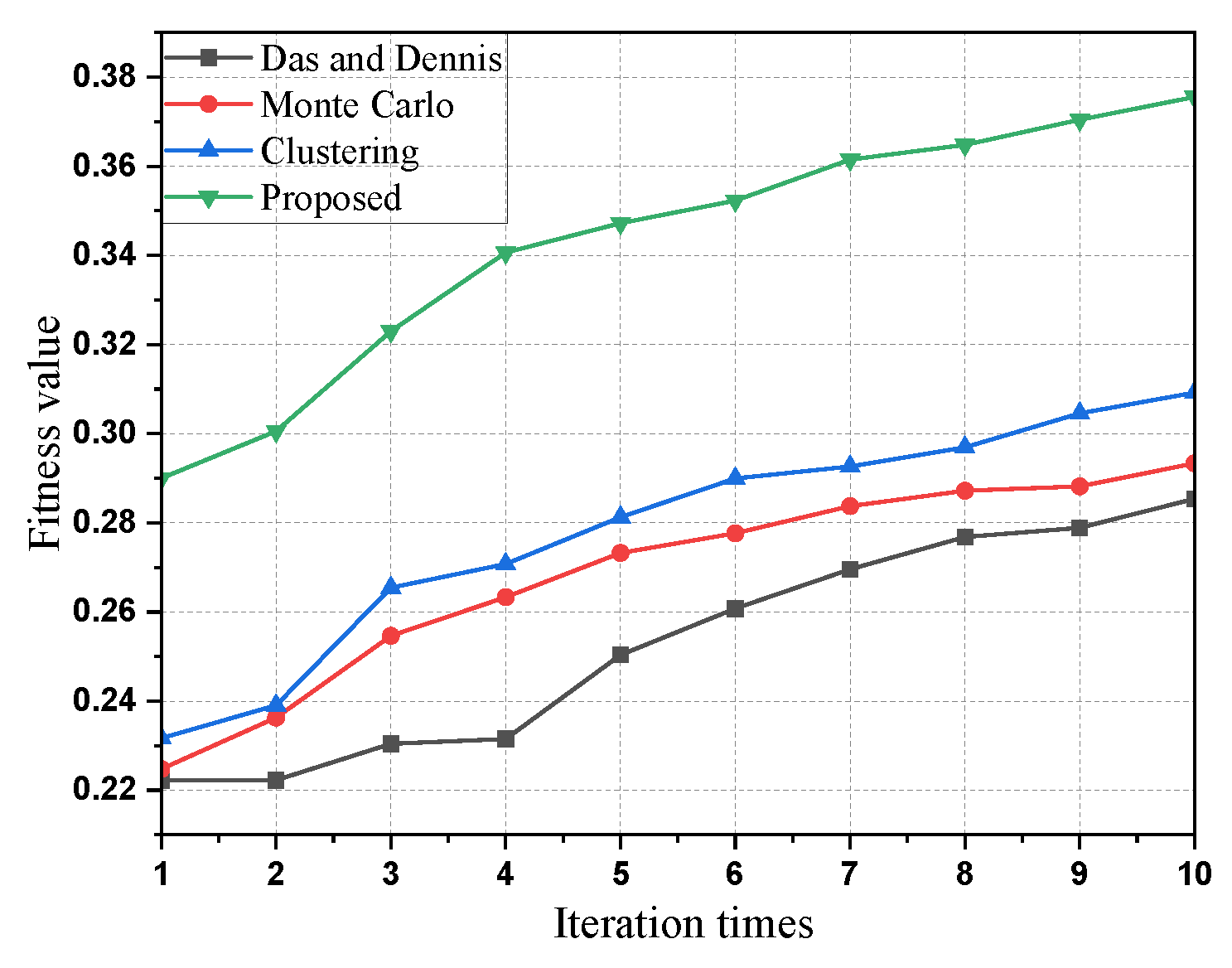
In this section, we compare the adaptive reference point generation method proposed in this paper with three other reference point generation methods. The experiment is conducted on a network topology with N = 200 and D = 3 , with 50 iterations. The three selected reference point generation methods are the Monte Carlo reference point generation method, the cluster reference point generation method, and the Das and Dennis reference point generation method.
As shown in Figure 12, the adaptive reference point generation method proposed in this paper demonstrates a better optimization effect from the first iteration of topology optimization and outperforms the other three reference point generation methods throughout the experiment. The overall optimization is also the largest, with a relative increase of 29.5%. It can be seen that the adaptive reference point generation method proposed in this paper has a better applicability in this study.

6. Conclusions

This paper addresses the multi-objective optimization problem of the energy Internet topology and presents the SA-NSGA-III algorithm. By designing an adaptive dynamic reference-point generation method and a gene-operation control factor based on annealing strategies, the algorithm effectively balances global and local search capabilities, enabling multidirectional exploration and avoiding local optima. Furthermore, we introduce a reference-point selection method based on the cosine-similarity penalty to further enhance the ability to explore the solution space. Finally, the performance of SA-NSGA-III is compared with that of MOEA/D, MOPSO, and NSGA-III. Experimental results indicate that the SA-NSGA-III algorithm exhibits superior optimization performance across different network densities and scales, achieving higher fitness values and faster convergence compared to other multiobjective optimization algorithms. Furthermore, the proposed adaptive reference point generation method has been shown to consistently outperform other reference point generation methods throughout the entire iteration process, confirming its effectiveness in optimizing the energy Internet topology.
However, during population crossover and mutation processes, SA-NSGA-III may experience memory resource limitations. In these operations, each individual maintains its own distinct topology environment, allowing parallel interactions without interference from other individuals. As a result, the memory usage of SA-NSGA-III scales proportionally to the overall size, and memory resources become particularly constrained when optimizing topologies with thousands of nodes. In future work, we plan to optimize the representation of the topology structure or improve the crossover and mutation operators to achieve faster and more efficient operations, or simplify the topology by partitioning it into fixed combinations to prevent environments with a large number of topology nodes.
Additionally, while the proposed method demonstrates promising optimization performance in synthetic networks, its applicability in real-world Energy Internet topologies must be further validated under geographical, economic, and node-heterogeneity constraints. Geographical factors such as terrain and infrastructure corridors could be integrated through Geographic-Information-System-enhanced free edge exchange rules; economic considerations may be incorporated by introducing total investment and operational costs as an additional optimization objective; and node heterogeneity (e.g., generation, storage, load) could be addressed by assigning type-specific weights and connection compatibility constraints. Future work will focus on developing a constraint-aware topology optimization module to bridge the gap between simulation-based validation and practical engineering deployment.

Author Contributions

C.W.: writing—original draft, investigation, formal analysis, software, methodology, data curation. Y.L.: writing—review and editing, supervision, investigation. X.G.: visualization, investigation. Z.Z.: writing—review, data curation. W.G.: resources, supervision, project administration. J.C.: data curation, supervision. T.Q.: writing—review and editing, supervision, funding acquisition, conceptualization. All authors have read and agreed to the published version of the manuscript.

Funding

This work was supported by the Guangxi Key Research and Development Plan Project under Grant No. AB23026037 and Grant No. AB24010274 and the Guangxi Science and Technology Base and Talent Special Project under Grant No. AD25069071.

Data Availability Statement

The raw data supporting the conclusions of this article will be made available by the authors on request.

Conflicts of Interest

The authors declare that they have no known competing financial interests or personal relationships that could have appeared to influence the work reported in this paper.

References

  1. Xue, Z.; Xu, Y.; Han, Y.; Gao, F.; Jiang, W.; Zhu, Y.; Li, K.; Guo, Q.; Sun, J. Energy internet: A novel green roadmap for meeting the global energy demand. In Proceedings of the 2021 IEEE 5th Conference on Energy Internet and Energy System Integration (EI2), Taiyuan, China, 22–24 October 2021; pp. 3855–3860. [Google Scholar]
  2. Fencl, T.; Burget, P.; Bilek, J. Network topology design. Control Eng. Pract. 2011, 19, 1287–1296. [Google Scholar] [CrossRef]
  3. Strogatz, S.H. Exploring complex networks. Nature 2001, 410, 268–276. [Google Scholar] [CrossRef]
  4. Qiu, T.; Zhao, A.; Xia, F.; Si, W.; Wu, D.O. ROSE: Robustness strategy for scale-free wireless sensor networks. IEEE/ACM Trans. Netw. 2017, 25, 2944–2959. [Google Scholar] [CrossRef]
  5. Luo, D.; Qiu, T.; Deonauth, N.; Zhao, A. A small world model for improving robustness of heterogeneous networks. In Proceedings of the 2015 IEEE Global Conference on Signal and Information Processing (GlobalSIP), Orlando, FL, USA, 14–16 December 2015; pp. 849–852. [Google Scholar]
  6. Li, R.H.; Yu, J.X.; Huang, X.; Cheng, H.; Shang, Z. Measuring robustness of complex networks under MVC attack. In Proceedings of the 21st ACM international Conference on Information and Knowledge Management, Maui, HI, USA, 29 October–2 November 2012; pp. 1512–1516. [Google Scholar]
  7. Hebal, S.; Harous, S.; Mechta, D. Energy routing challenges and protocols in energy internet: A survey. J. Electr. Eng. Technol. 2021, 16, 3197–3212. [Google Scholar] [CrossRef]
  8. Yan, M.; Guan, S.; Guo, W.; Chen, J.; Zheng, H.; Qin, T. Deployment and adaptive optimization strategies for B5G heterogeneous edge base station microgrid using K-means and MPC. Tsinghua Sci. Technol. 2025. [Google Scholar] [CrossRef]
  9. Liang, Z.; Chung, C.; Wang, Q.; Chen, H.; Yang, H.; Wu, C. Fortifying Renewable-Dominant Hybrid Microgrids: A Bi-Directional Converter Based Interconnection Planning Approach. Engineering 2025, 51, 130–143. [Google Scholar] [CrossRef]
  10. Ghiasi, M.; Wang, Z.; Mehrandezh, M.; Jalilian, S.; Ghadimi, N. Evolution of smart grids towards the Internet of energy: Concept and essential components for deep decarbonisation. IET Smart Grid 2023, 6, 86–102. [Google Scholar] [CrossRef]
  11. Hussain, H.M.; Narayanan, A.; Nardelli, P.H.; Yang, Y. What is energy internet? Concepts, technologies, and future directions. IEEE Access 2020, 8, 183127–183145. [Google Scholar] [CrossRef]
  12. Herrmann, H.J.; Schneider, C.M.; Moreira, A.A.; Andrade, J.S.; Havlin, S. Onion-like network topology enhances robustness against malicious attacks. J. Stat. Mech. Theory Exp. 2011, 2011, P01027. [Google Scholar] [CrossRef]
  13. Buesser, P.; Daolio, F.; Tomassini, M. Optimizing the robustness of scale-free networks with simulated annealing. In Proceedings of the International Conference on Adaptive and Natural Computing Algorithms, Ljubljana, Slovenia, 14–16 April 2011; pp. 167–176. [Google Scholar]
  14. Rong, L.; Liu, J. A heuristic algorithm for enhancing the robustness of scale-free networks based on edge classification. Phys. A Stat. Mech. Its Appl. 2018, 503, 503–515. [Google Scholar] [CrossRef]
  15. Zhou, M.; Liu, J. A memetic algorithm for enhancing the robustness of scale-free networks against malicious attacks. Phys. A Stat. Mech. Its Appl. 2014, 410, 131–143. [Google Scholar] [CrossRef]
  16. Qiu, T.; Yang, X.; Chen, N.; Zhang, S.; Min, G.; Wu, D.O. A self-adaptive robustness optimization method with evolutionary multi-agent for IoT topology. IEEE/ACM Trans. Netw. 2023, 32, 1346–1361. [Google Scholar] [CrossRef]
  17. Peng, Y.; Liu, C.; Liu, S.; Liu, Y.; Wu, Y. SmartTRO: Optimizing topology robustness for Internet of Things via deep reinforcement learning with graph convolutional networks. Comput. Netw. 2022, 218, 109385. [Google Scholar] [CrossRef]
  18. Konstantinidis, A.; Yang, K. Multi-objective energy-efficient dense deployment in wireless sensor networks using a hybrid problem-specific MOEA/D. Appl. Soft Comput. 2011, 11, 4117–4134. [Google Scholar] [CrossRef]
  19. Fan, C.; Ding, C.; Xiao, L.; Cheng, F.; Ai, Z. Deep belief ensemble network based on MOEA/D for short-term load forecasting. Nonlinear Dyn. 2021, 105, 2405–2430. [Google Scholar] [CrossRef]
  20. Wang, S.; Liu, J.; Jin, Y. A computationally efficient evolutionary algorithm for multiobjective network robustness optimization. IEEE Trans. Evol. Comput. 2021, 25, 419–432. [Google Scholar] [CrossRef]
  21. Lai, D.T.C.; Sato, Y. An empirical study of cluster-based MOEA/D bare bones PSO for data clustering. Algorithms 2021, 14, 338. [Google Scholar] [CrossRef]
  22. Hu, L.; Yang, Y.; Tang, Z.; He, Y.; Luo, X. FCAN-MOPSO: An improved fuzzy-based graph clustering algorithm for complex networks with multiobjective particle swarm optimization. IEEE Trans. Fuzzy Syst. 2023, 31, 3470–3484. [Google Scholar] [CrossRef]
  23. Wang, R.; Wang, H.; Shi, L.; Han, C.; He, Q.; Che, Y.; Luo, L. A novel framework of MOPSO-GDM in recognition of Alzheimer’s EEG-based functional network. Front. Aging Neurosci. 2023, 15, 1160534. [Google Scholar] [CrossRef] [PubMed]
  24. Wu, J.; Pu, C.; Ding, S.; Cao, G.; Xia, C.; Pardalos, P.M. Multi-objective optimization of transport processes on complex networks. IEEE Trans. Netw. Sci. Eng. 2022, 10, 780–794. [Google Scholar] [CrossRef]
  25. Li, W.; Sun, B.; Huang, Y.; Mahmoodi, S. Adaptive complex network topology with fitness distance correlation framework for particle swarm optimization. Int. J. Intell. Syst. 2022, 37, 5217–5247. [Google Scholar] [CrossRef]
  26. Taleb, S.M.; Baiche, K.; Meraihi, Y.; Yahia, S.; Mirjalili, S.; Ramdane-Cherif, A. A binary multi-objective approach for solving the WMNs topology planning problem. Peer-to-Peer Netw. Appl. 2025, 18, 1–24. [Google Scholar] [CrossRef]
  27. Han, K.; Xu, B.; Guo, S.; Gong, W.; Chatzinotas, S.; Maity, I.; Zhang, Q.; Ren, Q. Non-grid-mesh topology design for megaleo constellations: An algorithm based on nsga-iii. IEEE Trans. Commun. 2024, 72, 2881–2896. [Google Scholar] [CrossRef]
  28. Yu, Q.; Yang, F.; Song, W.; Ying, C. A Hierarchical Reservation Adaptive Evolutionary Algorithm Based on NSGA-II for Multiobjective Optimization of Networks. In Proceedings of the 2023 9th International Conference on Computer and Communications (ICCC), Chengdu, China, 8–11 December 2023; pp. 2269–2274. [Google Scholar]
  29. Xiong, A.; Tong, Y.; Guo, S.; Wang, Y.; Shao, S.; Mei, L. An Optimal Allocation Method of Power Multimodal Network Resources Based on NSGA-II. Wirel. Commun. Mob. Comput. 2021, 2021, 9632277. [Google Scholar] [CrossRef]
  30. Chen, N.; Qiu, T.; Si, W.; Wu, D.O. DAiMo: Motif Density Enhances Topology Robustness for Highly Dynamic Scale-free IoT. IEEE Trans. Mob. Comput. 2024, 24, 2360–2375. [Google Scholar] [CrossRef]
  31. Ming, Y.; Yang, J.; Cao, J.; Zhou, Z.; Xing, C. Distributed energy sharing in energy internet through distributed averaging. Tsinghua Sci. Technol. 2018, 23, 233–242. [Google Scholar] [CrossRef]
  32. Liu, Y.; Trappe, W. Topology adaptation for robust ad hoc cyberphysical networks under puncture-style attacks. Tsinghua Sci. Technol. 2015, 20, 364–375. [Google Scholar] [CrossRef]
  33. Schneider, C.M.; Moreira, A.A.; Andrade, J.S., Jr.; Havlin, S.; Herrmann, H.J. Mitigation of malicious attacks on networks. Proc. Natl. Acad. Sci. USA 2011, 108, 3838–3841. [Google Scholar] [CrossRef] [PubMed]
  34. Shimizu, N.; Mori, R. Average shortest path length of graphs of diameter 3. In Proceedings of the 2016 Tenth IEEE/ACM International Symposium on Networks-on-Chip (NOCS), Nara, Japan, 31 August–2 September 2016; pp. 1–6. [Google Scholar]
Figure 1. Conversion of the adjacency matrix to the chromosome.
Energies 19 00108 g001
Figure 2. Three types of free edges.
Energies 19 00108 g002
Figure 3. An example of non-dominated sorting of individuals.
Energies 19 00108 g003
Figure 4. Comparison between different weights.
Energies 19 00108 g004
Figure 5. Distribution of degrees.
Energies 19 00108 g005
Figure 6. Different-sized network optimization.
Energies 19 00108 g006
Figure 7. Hundred nodes optimization.
Energies 19 00108 g007
Figure 8. 200 nodes optimization.
Energies 19 00108 g008
Figure 9. Comparison under different network node numbers.
Energies 19 00108 g009
Figure 10. Comparison under different network edge densities.
Energies 19 00108 g010
Figure 11. Comparison under different number of iterations.
Energies 19 00108 g011
Figure 12. Comparison of different reference point generation methods.
Energies 19 00108 g012
Table 1. Parameter setting.
ParametersValueParametersValue
S × S 500 × 500  (m2) α 0.3
D 2 , 3 , 4 , 5 β 0.8
r250 m γ 0.1
N 100 , 200 , 300 , 400 , 500 ϵ 0.45
G 10 , 20 , 30 , 40 , 50 P c 0.8
M50
Table 2. Computational cost comparison.
AlgorithmTime Complexity
S A - N S G A - I I I O ( G · D · N 4 )
N S G A - I I I O ( G · D · N 3 )
M O E A / D O ( G · D · N 3 )
M O P S O O ( G · D · N 2 · l o g N )
Disclaimer/Publisher’s Note: The statements, opinions and data contained in all publications are solely those of the individual author(s) and contributor(s) and not of MDPI and/or the editor(s). MDPI and/or the editor(s) disclaim responsibility for any injury to people or property resulting from any ideas, methods, instructions or products referred to in the content.