Early-Stage Fault Diagnosis for Batteries Based on Expansion Force Prediction

Abstract
1. Introduction
- (1)
- The performance and safety of lithium-ion batteries are affected by many factors, which need to be considered in the research and controlled in the experiment in order to accurately evaluate the relationship between expansion and safety. A large number of experimental designs and complex experimental conditions are required.
- (2)
- The expansion mechanism of lithium-ion batteries is very complex, and is related to many factors, such as the chemical reaction inside the battery, ion diffusion, the deformation of electrode materials, and so on. At present, the understanding of the lithium-ion battery expansion mechanism is not completely clear.
- (3)
- The safety assessment of lithium-ion batteries needs to consider many aspects, including battery behavior under overcharge, over-discharge, high temperature, short circuit, and other conditions. When studying the relationship between lithium-ion battery expansion and safety, it is necessary to comprehensively consider many factors and evaluate the overall safety of the battery.
- (1)
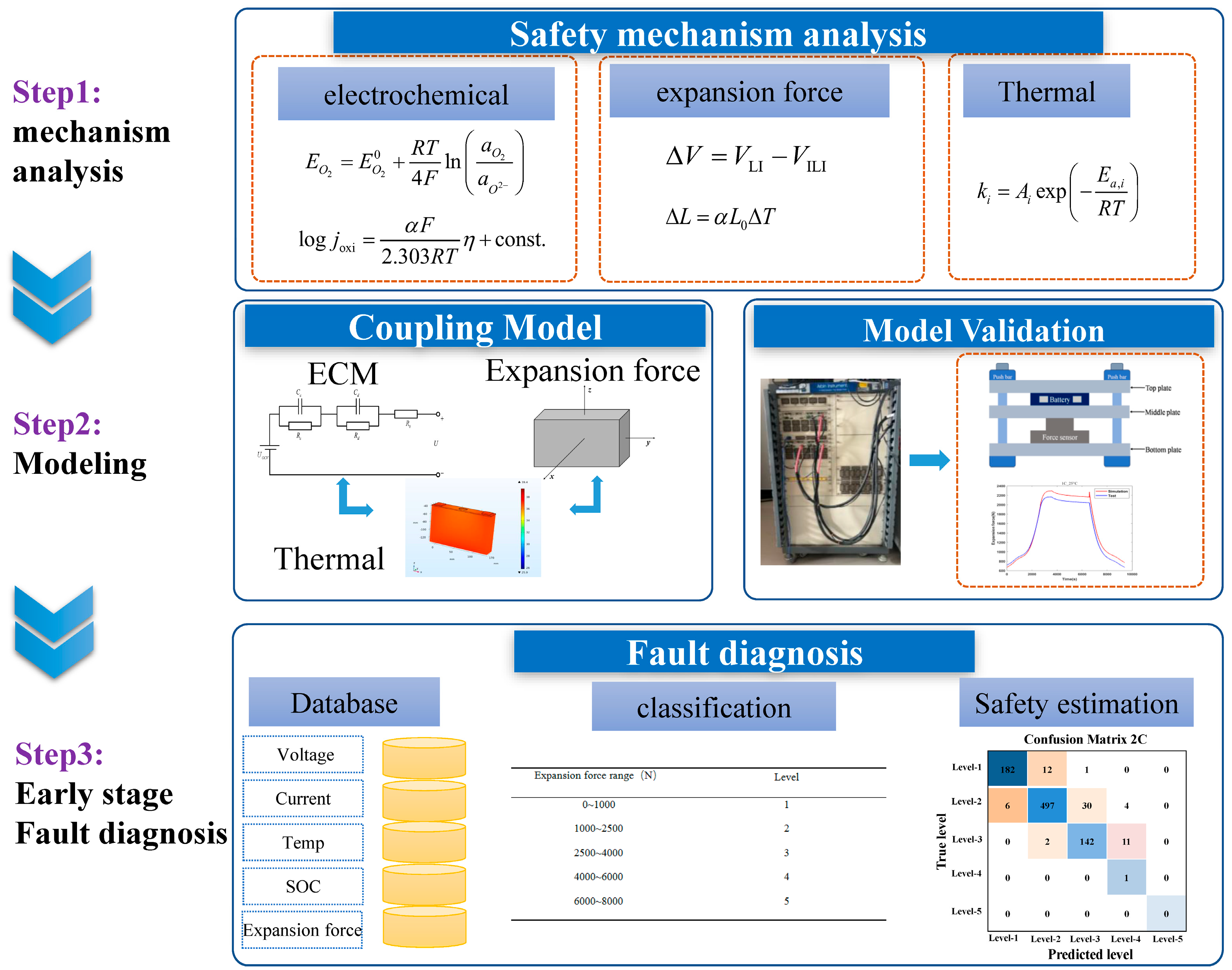
- This paper analyzes the research progress in the fields of electrical–thermal modeling, mechanical properties, and early warning at home and abroad, points out the problems of insufficient coupling of current models and limited early warning methods, and puts forward the research framework covering experimental research, multi-physical field modeling and early warning method development. The research results can provide theoretical support for the safety design of battery cells and systems.
- (2)
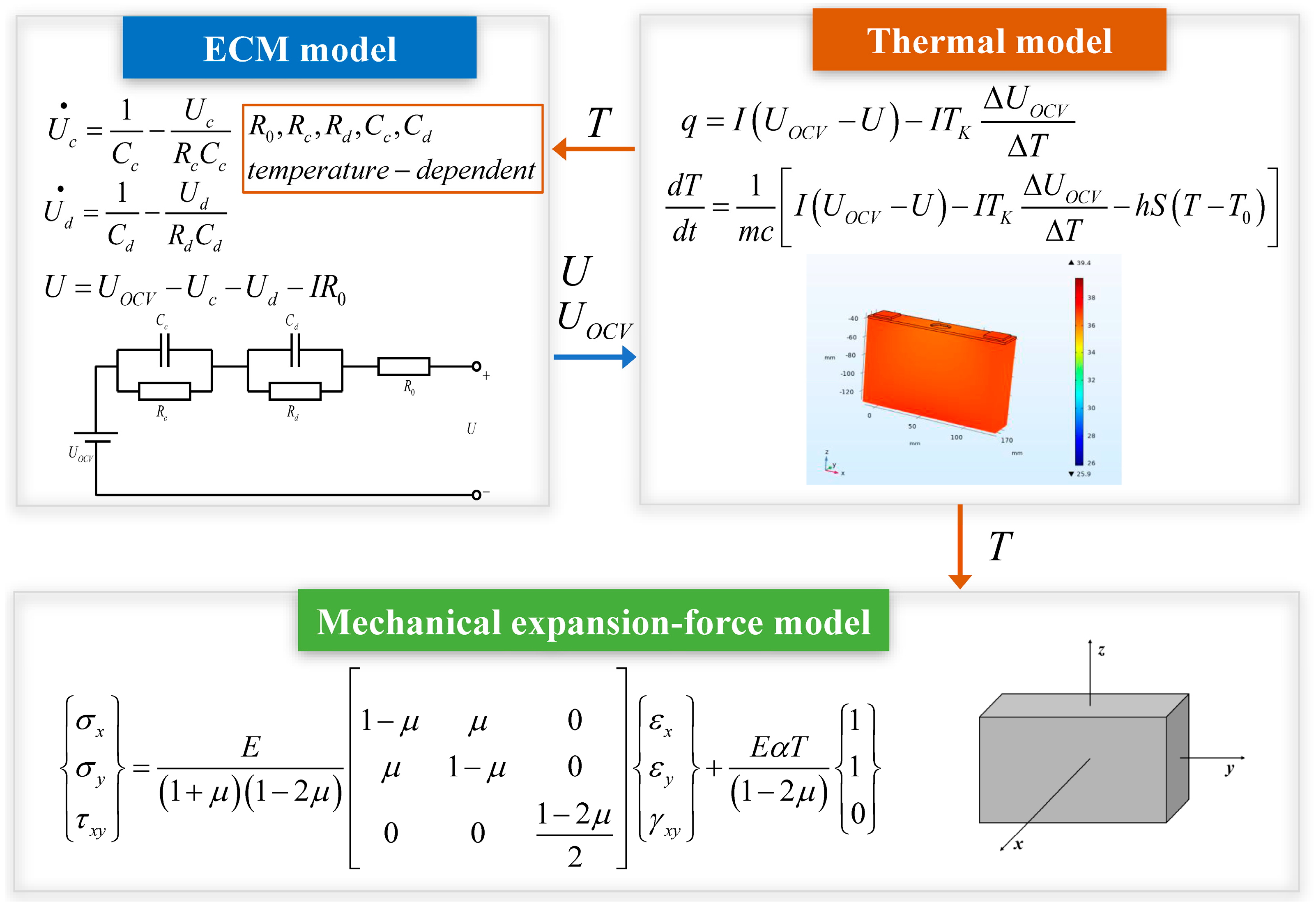
- The influence of electrical performance, thermal performance, and mechanical performance on battery safety was analyzed from the perspective of the mechanism. A multi-physical field coupling model integrating a thermal model and elastic mechanics model was established, and the distribution laws of the expansion force and thermal coupling effect of the battery under different working conditions were discussed.
- (3)
- The multi-dimensional data such as expansion force, temperature, voltage, current, and SOC are established to build the database, and a safety classification method based on the expansion force is proposed. The method is used to classify the safety level of the expansion force and realize the early warning of battery safety.
2. Methodology
2.1. Eelectrochemical and Safety
2.2. Thermal and Safety
2.3. Expansion Force and Safety
3. ECM-Thermal-Expansion Force Coupling Model
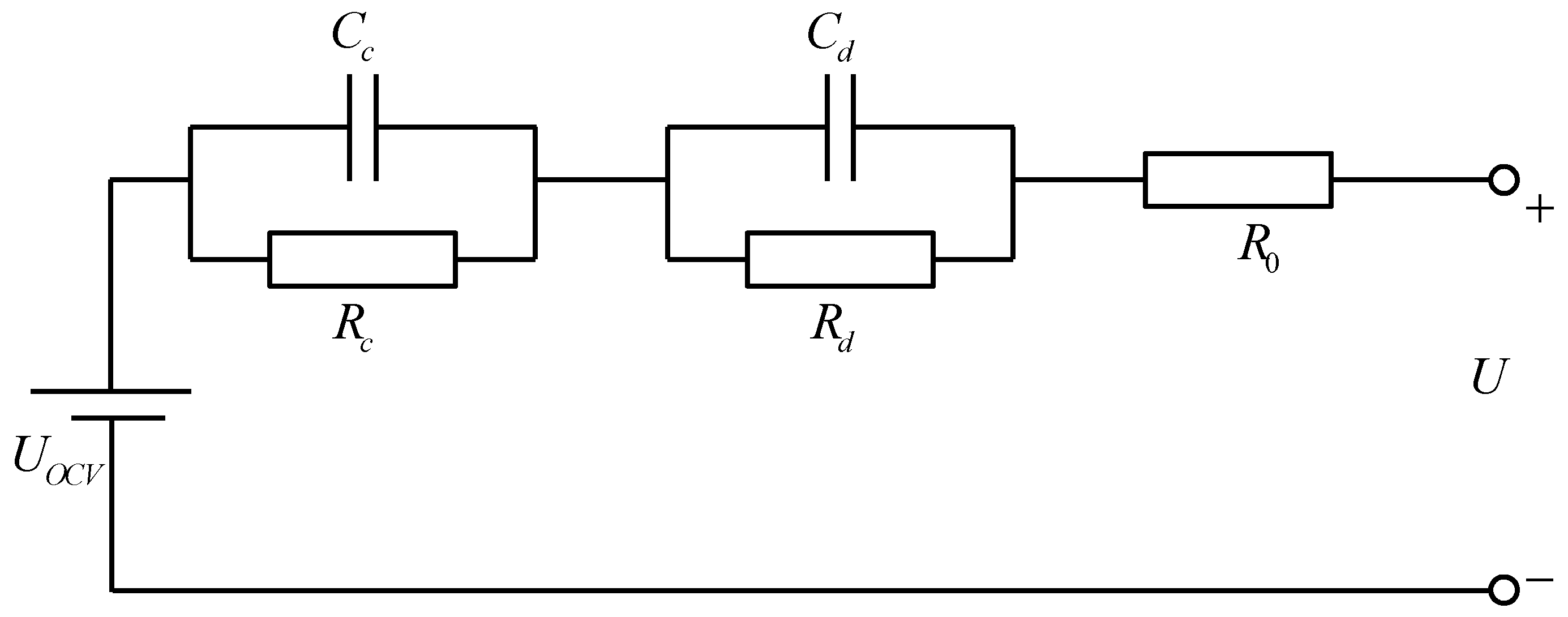
3.1. ECM Modeling
3.2. Thermal Modeling
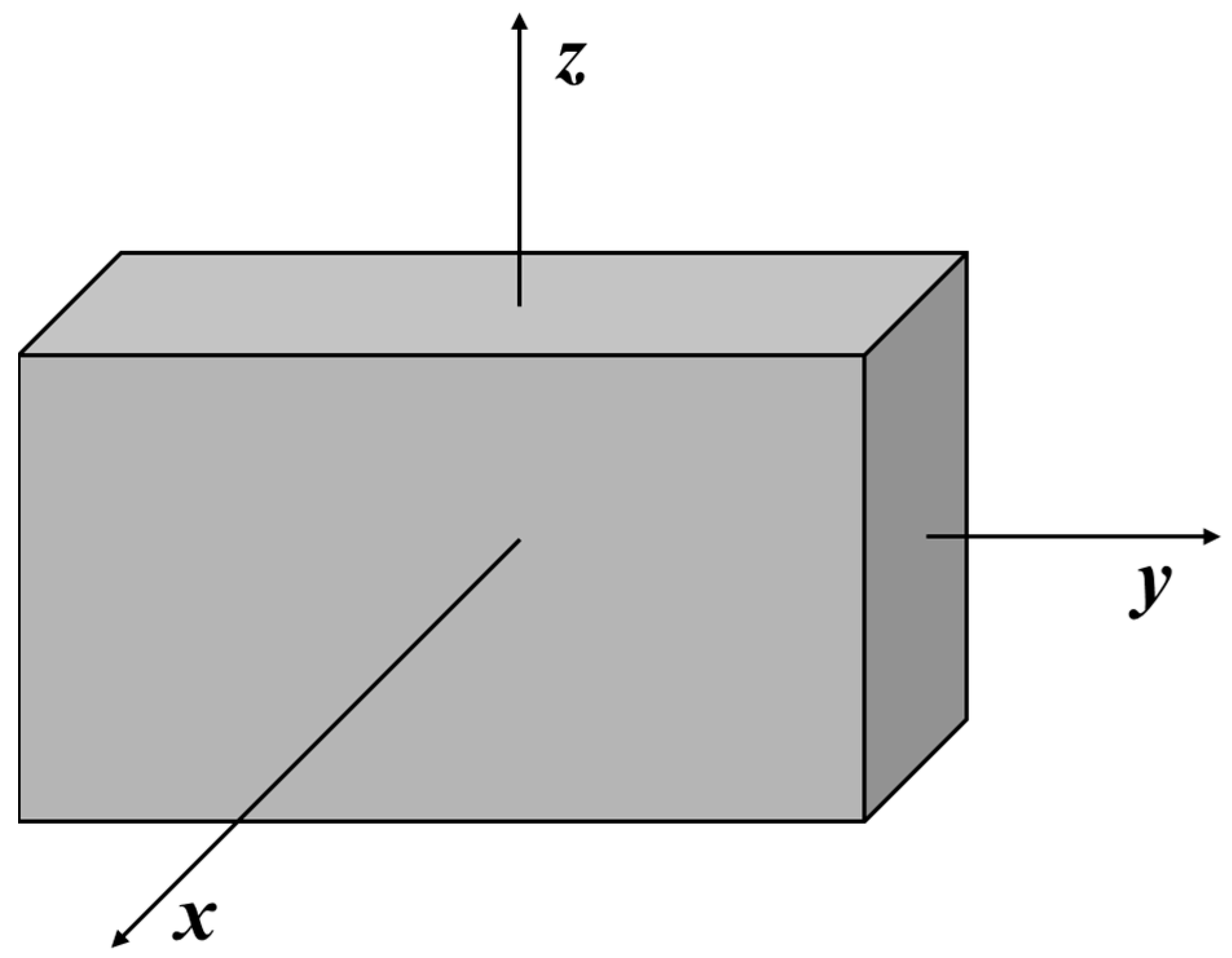
3.3. Expansion Force Modeling
3.4. ECM-Thermal-Expansion Force Coupling
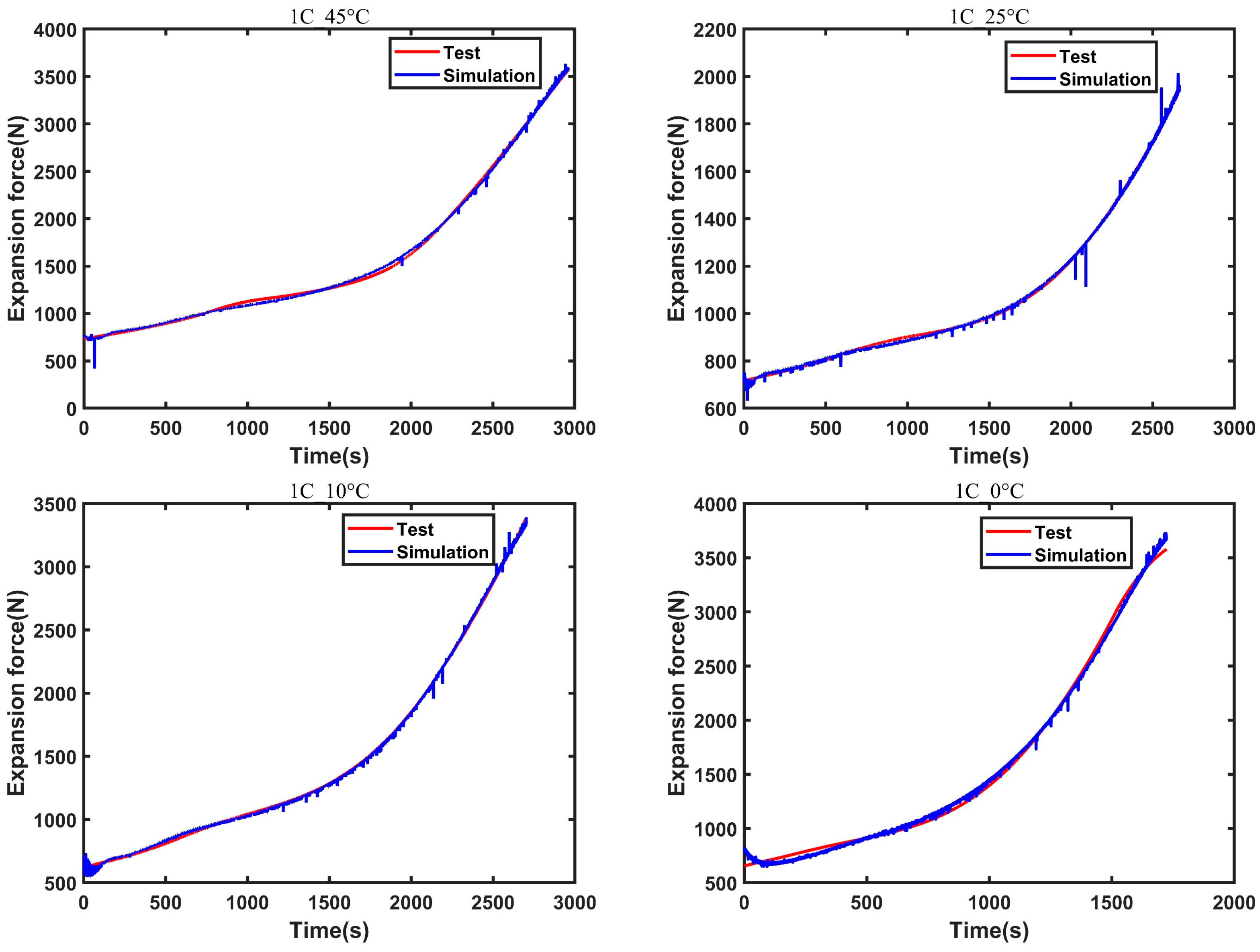
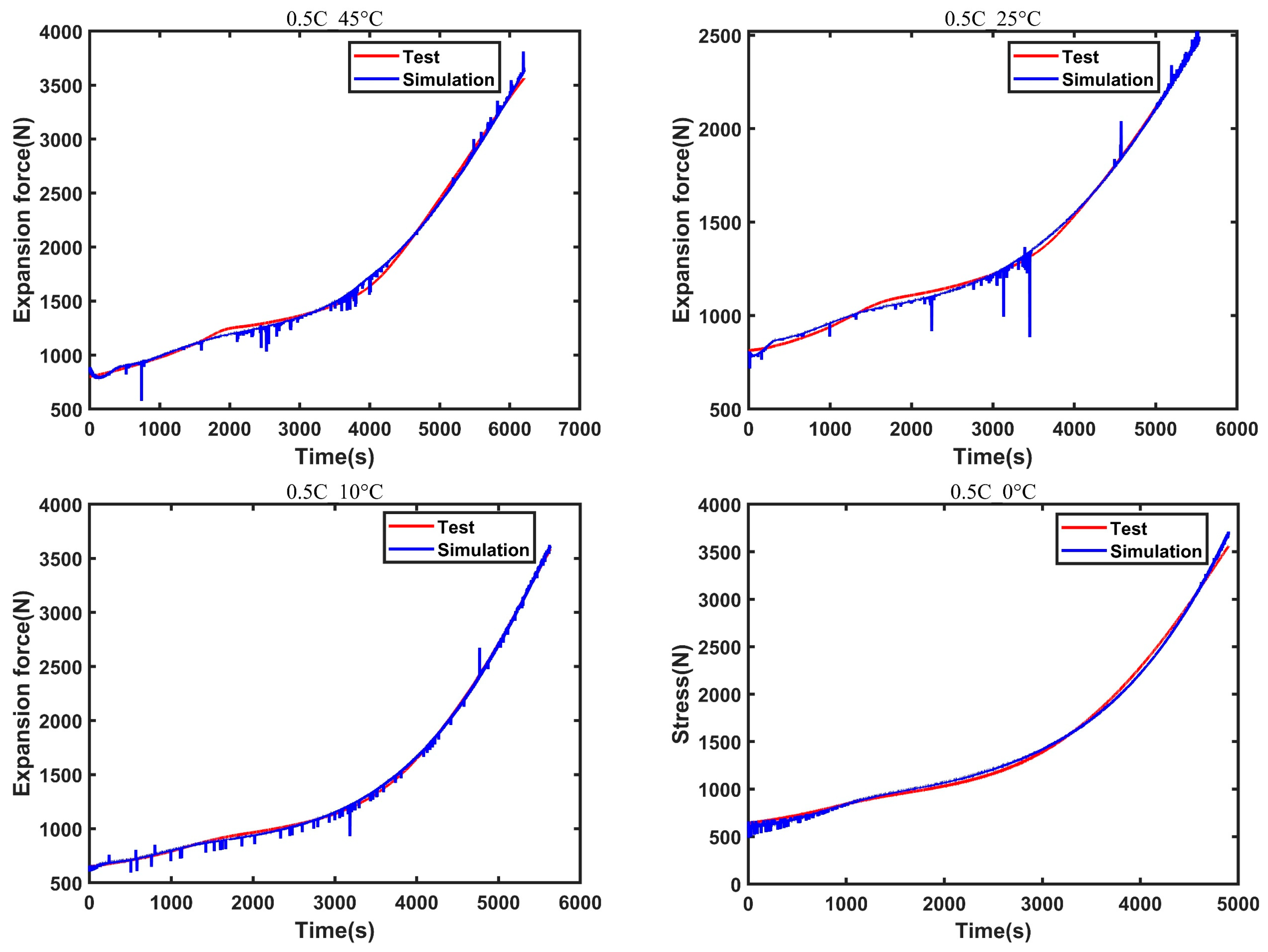
3.5. Model Validation
4. Fault Diagnosis Method
4.1. Database Construction
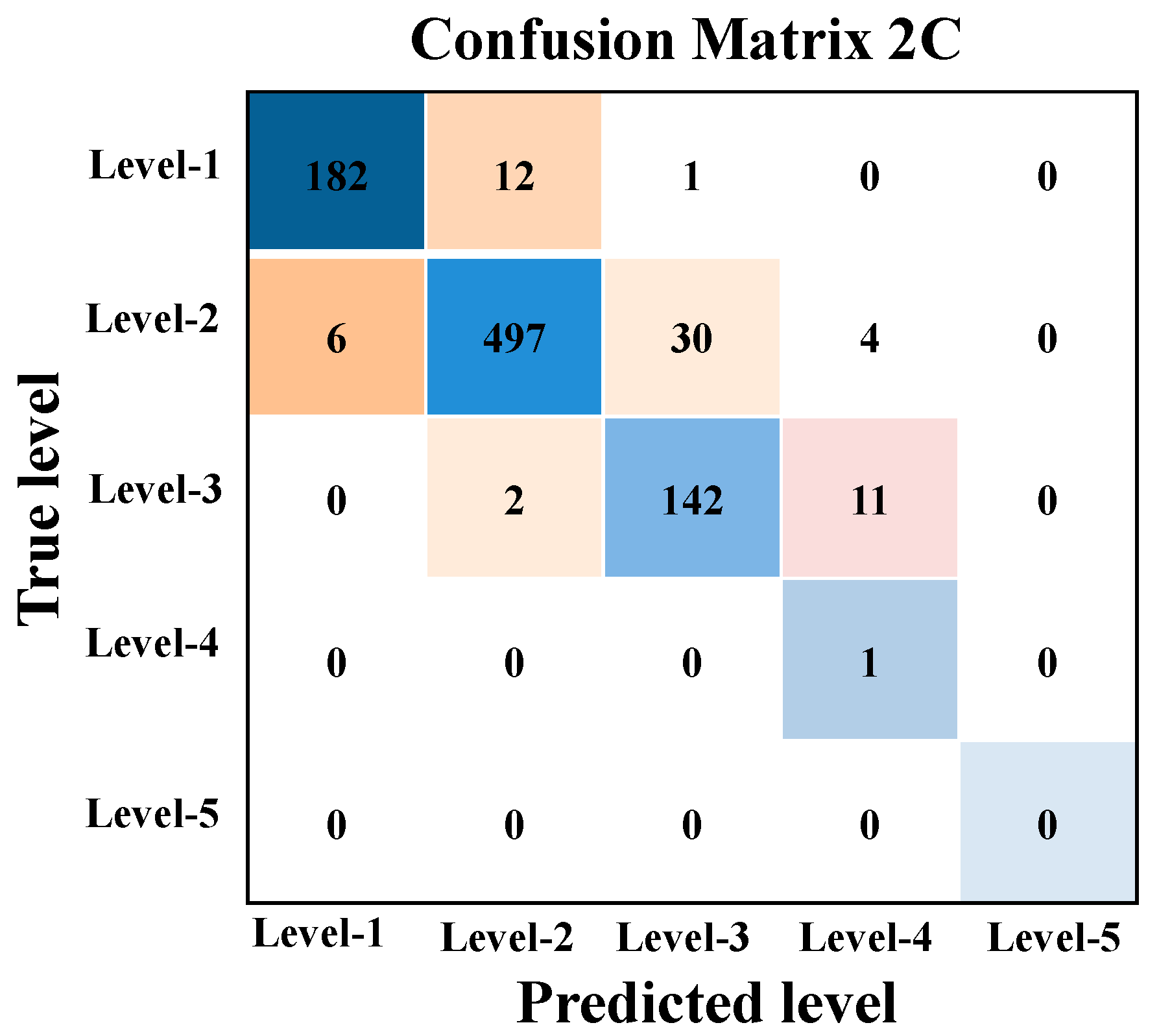
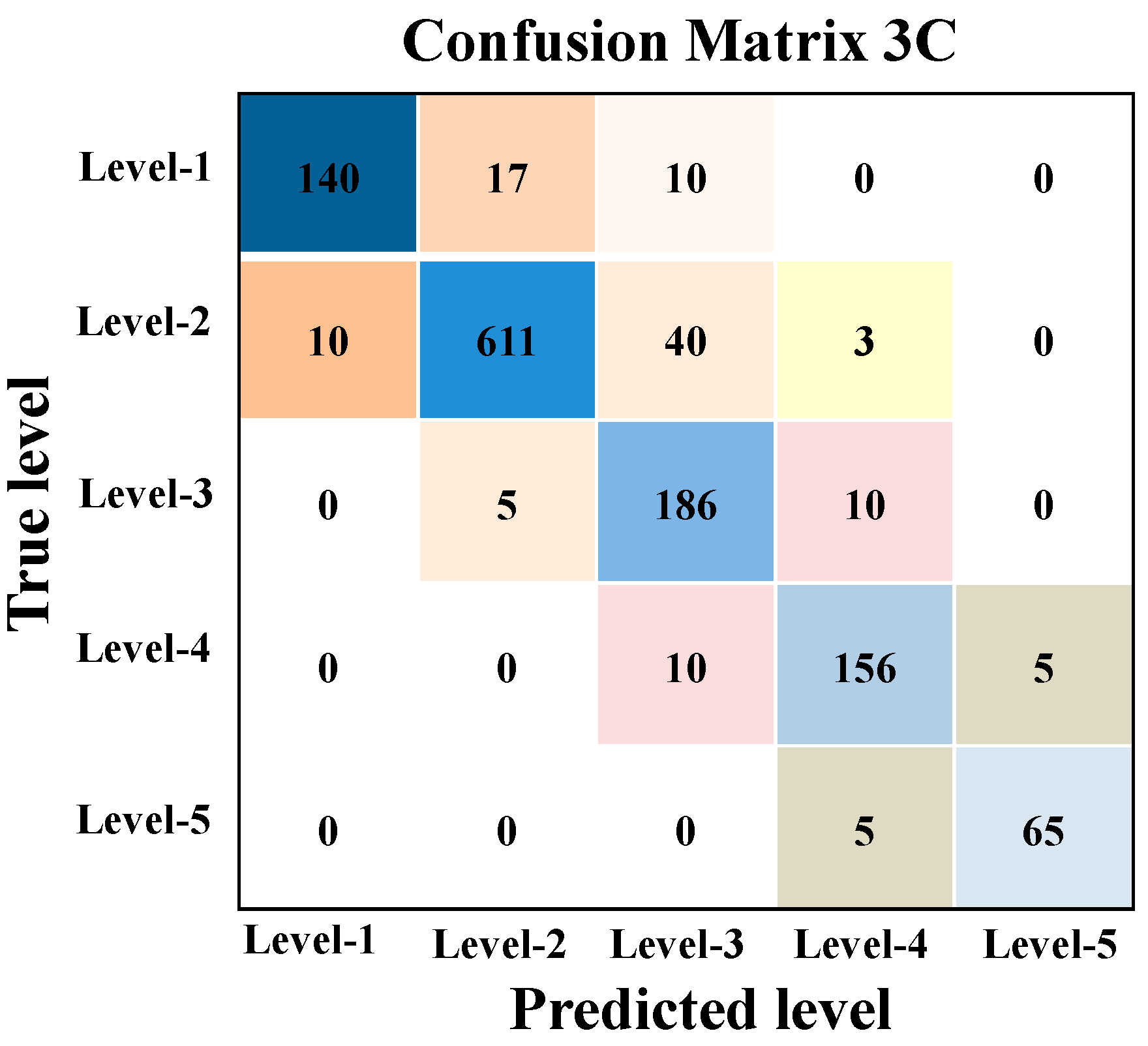
4.2. Data Preprocessing and Safety Classification
4.3. Expansion Force Prediction Method
4.4. Early-Stage Fault Diagnosis
5. Conclusions
- (1)
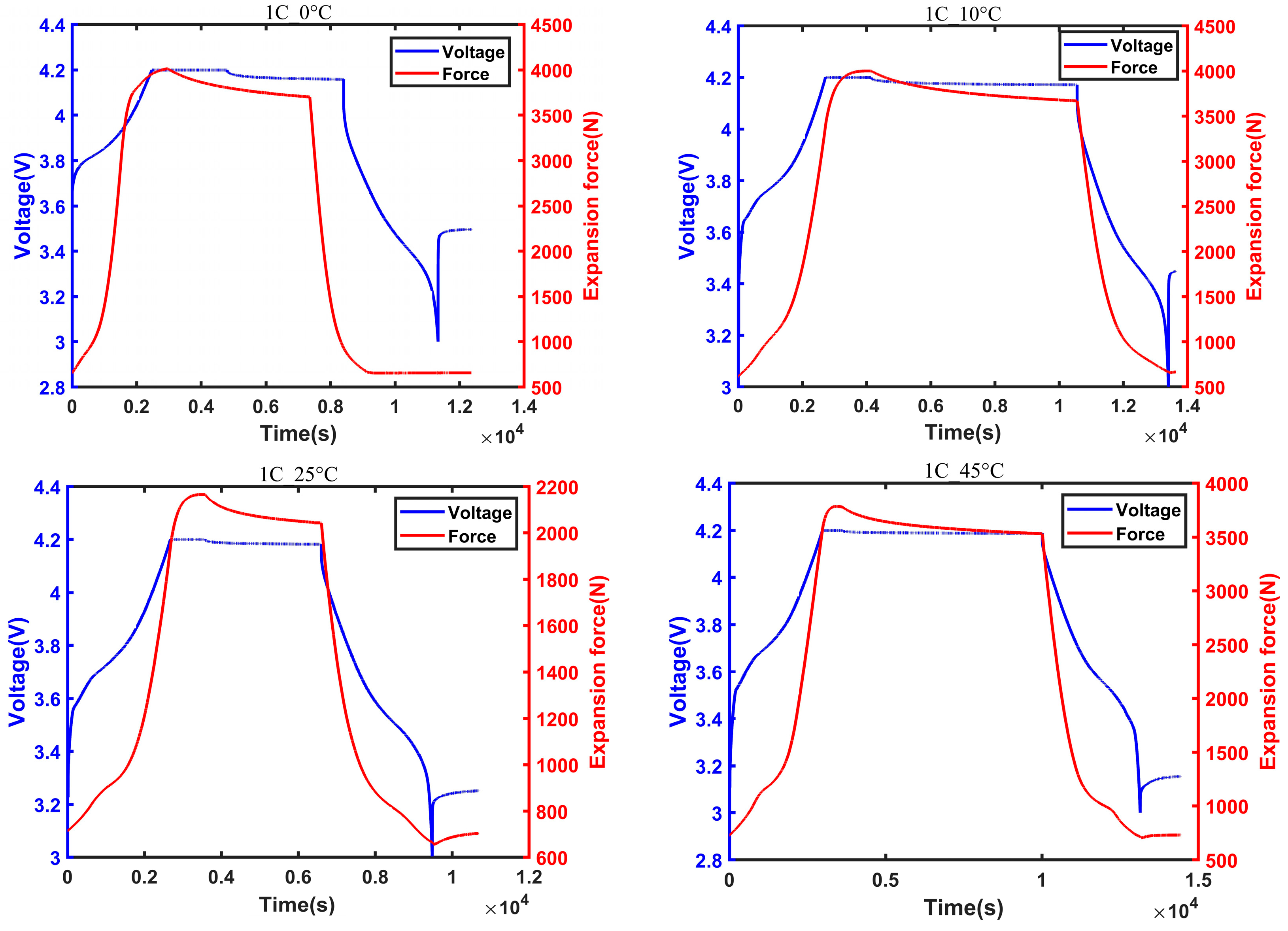
- The evolution law between charging and discharging performance and the expansion force of lithium batteries was revealed through systematic testing.
- (2)
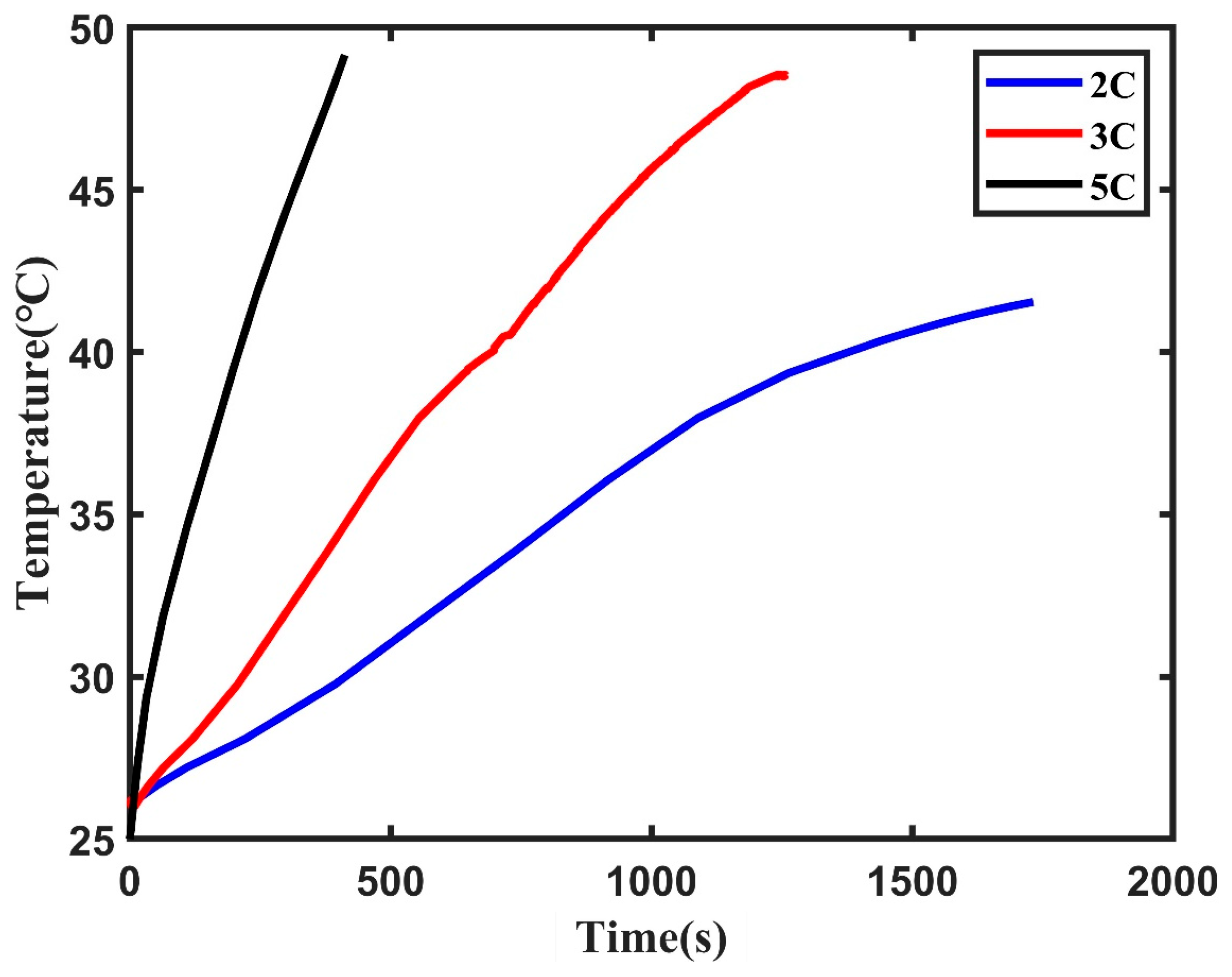
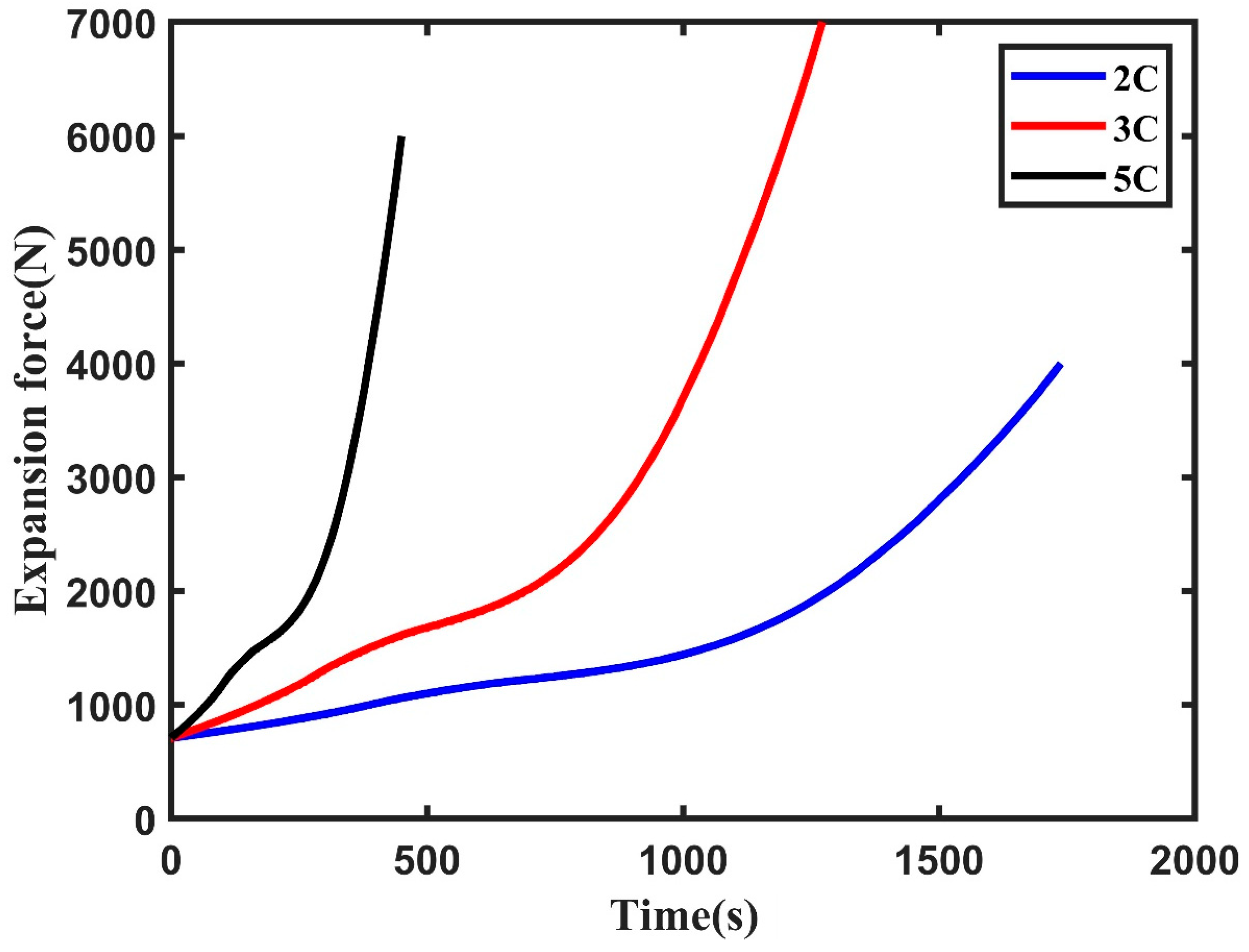
- The study established an electrical–thermal–mechanical coupling model for lithium-ion battery cells. Based on the model, simulation tests were conducted near the safety boundary conditions to achieve high rate charging scenarios, and the evolution mechanism between surface temperature, expansion force, and charge–discharge rate was revealed from the simulation level.
- (3)
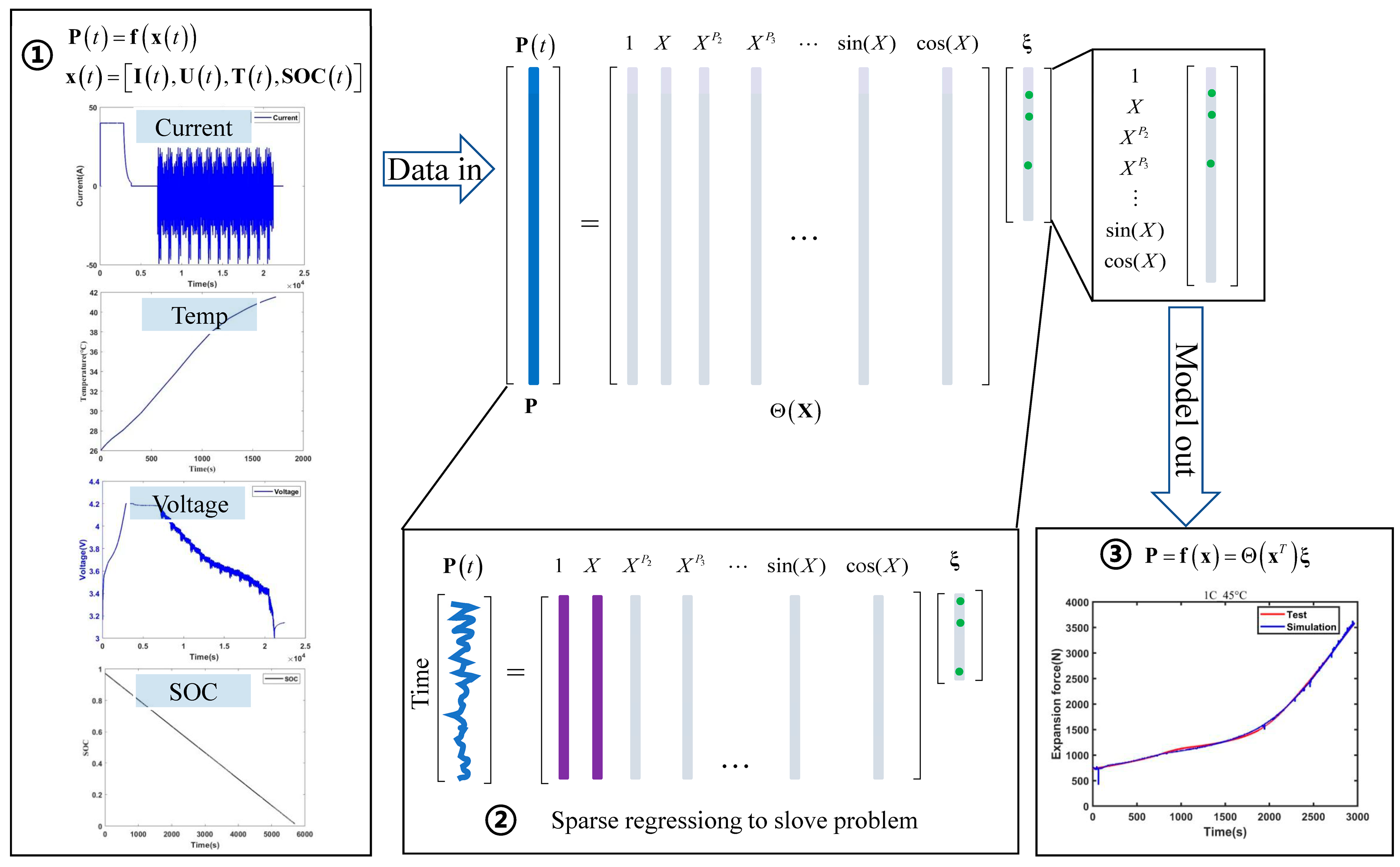
- A multi-parameter estimation algorithm and security level assessment method have been proposed by selecting five core monitoring indicators, namely current, voltage, temperature, expansion force, and SOC, and innovatively using expansion force as the main judgment basis.
Author Contributions
Funding
Data Availability Statement
Conflicts of Interest
References
- Sarkar, S.; Swamy, D.; Amin, M.T.; Amin, M.T.; El-Halwagi, M.; Khan, F. Safer operating areas (SOA) of cylindrical lithium-ion battery—A probabilistic approach. Process Saf. Environ. Prot. 2024, 190, 708–725. [Google Scholar] [CrossRef]
- Wang, Q.; Ping, P.; Zhao, X.; Chu, G.; Sun, J.; Chen, C. Thermal runaway caused fire explosion of lithium ion battery. J. Power Sources 2012, 208, 210–224. [Google Scholar] [CrossRef]
- He, T.F.; Gadkari, S.; Wang, Z.R.; Mao, N.; Cai, Q. An investigation on thermal runaway behaviour of a cylindrical lithium-ion battery under different states of charge based on thermal tests and a three-dimensional thermal runaway model. J. Clean. Prod. 2023, 388, 135980. [Google Scholar] [CrossRef]
- Zhang, Y.; Cheng, S.Y.; Mei, W.X.; Jiang, L.H.; Jia, Z.Z.; Cheng, Z.X.; Sun, J.H.; Wang, Q.S. Understanding of thermal runaway mechanism of LiFePO4 battery in-depth by three-level analysis. Appl. Energy 2023, 336, 120695. [Google Scholar] [CrossRef]
- Doyle, M.; Fuller, T.F.; Newman, J. Modeling of galvanostatic charge and discharge of the lithium/polymer/insertion cell. J. Electrochem. Soc. 1993, 140, 1526–1533. [Google Scholar] [CrossRef]
- Kim, G.H.; Pesaran, A.; Spotnitz, R. A three-dimensional thermal abuse model for lithium-ion cells. J. Power Sources 2007, 170, 476–489. [Google Scholar] [CrossRef]
- Santhanagopalan, S.; Guo, Q.; Ramadass, P. Review of models for predicting the cycling performance of lithium ion batteries. J. Power Sources 2006, 156, 620–628. [Google Scholar] [CrossRef]
- Sun, Y.K.; Yuan, Y.B.; Lu, L.G.; Han, X.B.; Kong, X.D.; Wang, H.W.; Ouyang, M.G.; Gao, P.L.; Zheng, H.X.; Wang, K.M. A comprehensive research on internal short circuits caused by copper particle contaminants on cathode in lithium-ion batteries. eTransportation 2022, 13, 100183. [Google Scholar] [CrossRef]
- Fang, W.; Ramadass, P.; Zhang, Z.J. Study of internal short in a Li-ion cell-II. Numerical investigation using a 3D electrochemical-thermal model. J. Power Sources 2014, 248, 1090–1098. [Google Scholar] [CrossRef]
- Hatchard, T.D.; MacNeil, D.D.; Basu, A.; Dahn, J.R. Thermal model of cylindrical and prismatic lithium-ion cells. J. Electrochem. Soc. 2001, 148, A755–A761. [Google Scholar] [CrossRef]
- Guo, G.F.; Long, B.; Zhou, S.Q.; Xu, P.; Cao, B.G. Three-dimensional thermal finite element modeling of lithium-ion battery in thermal abuse application. J. Power Sources 2010, 195, 2393–2398. [Google Scholar] [CrossRef]
- Wu, H.; Chen, S.Q.; Jin, C.Y.; Zheng, Y.J. Dimensionless normalized concentration based thermal-electric regression model for the thermal runaway of lithium-ion batteries. J. Power. Sources 2022, 521, 230958. [Google Scholar] [CrossRef]
- Chen, W.C.; Wang, Y.W.; Shu, C.M. Adiabatic calorimetry test of the reaction kinetics and self-heating model for 18650 Li-ion cells in various states of charge. J. Power Sources 2016, 318, 200–209. [Google Scholar] [CrossRef]
- Kong, D.P.; Wang, G.Q.; Ping, P. A coupled conjugate heat transfer and CFD model for the thermal runaway evolution and jet fire of 18,650 lithium-ion battery under thermal abuse. eTransportation 2022, 12, 100157. [Google Scholar] [CrossRef]
- Ping, P.; Wang, Q.S.; Wen, J. Modelling electro-thermal response of lithium-ion batteries from normal to abuse conditions. Appl. Energy 2017, 205, 1327–1344. [Google Scholar] [CrossRef]
- Kondo, H.; Baba, N.; Makimura, Y. Model validation and simulation study on the thermal abuse behavior of LiNi0.8Co0.15Al0.05O2-based batteries. J. Power Sources 2020, 448, 227464. [Google Scholar] [CrossRef]
- Jia, Z.Z.; Qin, P.; Li, Z.; Wei, Z.S.; Jin, K.Q.; Jiang, L.H.; Wang, Q.S. Analysis of gas release during the process of thermal runaway of lithium-ion batteries with three different cathode materials. J. Electrochem. Soc. 2022, 50, 104302. [Google Scholar] [CrossRef]
- Chen, S.; Gao, Z.; Sun, T. Safety challenges and safety measures of Li-ion batteries. Energy Sci. Eng. 2021, 9, 1647–1672. [Google Scholar] [CrossRef]
- Sirengo, K.; Babu, A.; Brennan, B.; Pillai, S.C. Ionic liquid electrolytes for sodium-ion batteries to control thermal runaway. J. Energy Chem. 2023, 81, 321–338. [Google Scholar] [CrossRef]
- Li, W.; Zhu, J.E.; Xia, Y.; Gorji, M.B.; Wierzbicki, T. Data-driven safety envelope of lithium-ion batteries for electric vehicles. Joule 2019, 3, 2703–2715. [Google Scholar] [CrossRef]
- Cortés, M.C.; Nsir, N.; Koltermann, L. M5Use: An Optimization Framework for the Multi-Use Operation Scheduling of Large-Scale Battery Storage Systems. In Proceedings of the 2024 IEEE PES Innovative Smart Grid Technologies Europe (ISGT EUROPE), Dubrovnik, Croatia, 14–17 October 2024; IEEE: Piscataway, NJ, USA, 2024; pp. 1–5. [Google Scholar] [CrossRef]
- Ji, C.W.; Zhang, Z.Z.; Wang, B.; Zhang, S.Q.; Liu, Y.Y. Study on thermal runaway warning method of lithium-ion battery. J. Loss Prev. Process Ind. 2022, 78, 104785. [Google Scholar] [CrossRef]
- Jia, Y.; Li, J.; Yao, W. Precise and fast safety risk classification of lithium-ion batteries based on machine learning methodology. J. Power Sources 2022, 548, 232064. [Google Scholar] [CrossRef]
- Wang, X.Y.; Mi, Y.Z.; Zhao, Z.H.; Cai, J.W.; Yang, D.H.; Tu, F.F.; Jiang, Y.Y.; Xiang, J.Y.; Mi, S.R.; Wang, R.B. Investigating the Thermal Runaway Behavior and Early Warning Characteristics of Lithium-Ion Batteries by Simulation. J. Electron. Mater. 2024, 53, 7367–7379. [Google Scholar] [CrossRef]
- Chen, Y.; Kang, Y.; Wang, L. A review of lithium-ion battery safety concerns: The issues, strategies, and testing standards. J. Energy Chem. 2021, 59, 83–99. [Google Scholar] [CrossRef]
- Lai, T.R.; Zhao, H.; Song, Y.Z.; Wang, L.; Wang, Y.D.; He, X.M. Mechanism and control strategies of lithium-ion battery safety: A review. Small Methods 2025, 9, 2400029. [Google Scholar] [CrossRef]
- Wang, Y.; Ren, D.S.; Feng, X.N.; Wang, L.; Ouyang, M.G. Thermal runaway modeling of large format high-nickel/silicon-graphite lithium-ion batteries based on reaction sequence and kinetics. Appl. Energy 2022, 306, 117943. [Google Scholar] [CrossRef]
- Hogrefe, C.; Waldmann, T.; Hölzle, M.; Wohlfahrt-Mehrens, M. Direct observation of internal short circuits by lithium dendrites in cross-sectional lithium-ion in situ full cells. J. Power Sources 2023, 556, 232391. [Google Scholar] [CrossRef]
- Xiong, R.; Sun, W.; Yu, Q.Q.; Sun, F.C.; Sun, F. Research progress, challenges and prospects of fault diagnosis on battery system of electric vehicles. Appl. Energy 2020, 279, 115855. [Google Scholar] [CrossRef]
- Arguello, M.E.; Derksen, J. Three-dimensional experimental-scale phase-field modeling of dendrite formation in rechargeable lithium-metal batteries. J. Energy Storage 2023, 62, 106854. [Google Scholar] [CrossRef]
- Khan, A.; Naqvi, I.H.; Bhargava, C. Safety and reliability analysis of lithium-ion batteries with real-time health monitoring. Renew. Sustain. Energy Rev. 2025, 212, 115408. [Google Scholar] [CrossRef]
- Cabrera-Castillo, E.; Niedermeier, F.; Jossen, A. Calculation of the state of safety (SOS) for lithium ion batteries. J. Power Sources 2016, 324, 509–520. [Google Scholar] [CrossRef]
- Xiong, R.; Kim, J.; Shen, W.; Lv, C.; Li, H.; Zhu, X.; Zhao, W.; Gao, B.; Guo, H.; Zhang, C.; et al. Key technologies for electric vehicles. Green Energy Intell. Transp. 2022, 1, 100041. [Google Scholar] [CrossRef]
- Chen, L.; Zeng, S.H.; Li, J.H.; Li, K.J.; Wu, W.X. Safety assessment of overcharged batteries and a novel passive warning method based on relaxation expansion force. J. Energy Chem. 2025, 105, 595–607. [Google Scholar] [CrossRef]
- Yang, J. Research on the Safety Warning Technology of Lithium-Ion Battery Based on Expansion Force. Master’s Thesis, Chongqing University of Technology, Chongqing, China, 2024. [Google Scholar] [CrossRef]
- Naozuka, G.T.; Rocha, H.L.; Silva, R.S.; Almeida, R.C. SINDy-SA framework: enhancing nonlinear system identification with sensitivity analysis. Nonlinear Dyn. 2022, 110, 2589–2609. [Google Scholar] [CrossRef]
- Kandezy, R.S.; Jiang, J.H.; Wu, D. On SINDy Approach to Measure-Based Detection of Nonlinear Energy Flows in Power Grids with High Penetration Inverter-Based Renewables. Energies 2024, 17, 711. [Google Scholar] [CrossRef]


| SOC | OCV (V) | R0/Ω | R1/Ω | τ1/Ω | R2/Ω | τ2/Ω |
|---|---|---|---|---|---|---|
| 1 | 4.1829 | 0.001081 | 0.000158 | 5.021341 | 0.000297 | 82.23048 |
| 0.95 | 4.1163 | 0.001094 | 0.000156 | 4.866847 | 0.000298 | 78.82343 |
| 0.9 | 4.0555 | 0.001106 | 0.000155 | 4.712353 | 0.000299 | 75.41638 |
| 0.85 | 3.9986 | 0.001116 | 0.00016 | 4.990518 | 0.000297 | 75.86599 |
| 0.8 | 3.9449 | 0.001128 | 0.00016 | 5.04003 | 0.000299 | 75.39546 |
| 0.75 | 3.8938 | 0.001146 | 0.000159 | 4.995256 | 0.000308 | 74.97147 |
| 0.7 | 3.8461 | 0.001163 | 0.000161 | 4.927039 | 0.000304 | 75.18536 |
| 0.65 | 3.801 | 0.001176 | 0.000164 | 5.204565 | 0.000301 | 78.26622 |
| 0.6 | 3.7456 | 0.001196 | 0.000165 | 5.366052 | 0.00028 | 77.31309 |
| 0.55 | 3.7028 | 0.001214 | 0.000147 | 5.165138 | 0.000252 | 67.93488 |
| 0.5 | 3.6745 | 0.001233 | 0.00014 | 5.072755 | 0.000238 | 60.10544 |
| 0.45 | 3.6528 | 0.001256 | 0.000135 | 5.068357 | 0.000235 | 57.85831 |
| 0.4 | 3.6353 | 0.001281 | 0.000133 | 5.045888 | 0.00024 | 57.58777 |
| 0.35 | 3.6199 | 0.001305 | 0.000135 | 5.367482 | 0.000241 | 60.87374 |
| 0.3 | 3.6024 | 0.00133 | 0.000139 | 5.433208 | 0.000239 | 60.44693 |
| 0.25 | 3.5702 | 0.001359 | 0.000141 | 5.735522 | 0.000253 | 69.79126 |
| 0.2 | 3.5424 | 0.001391 | 0.000143 | 5.582792 | 0.000272 | 72.51261 |
| 0.15 | 3.5091 | 0.001429 | 0.000156 | 6.092303 | 0.000279 | 81.0445 |
| 0.1 | 3.4692 | 0.001478 | 0.00017 | 5.729504 | 0.000281 | 78.29128 |
| 0.05 | 3.439 | 0.001539 | 0.000205 | 5.461715 | 0.000394 | 98.92885 |
| 0 | 3.1413 | 0.0016 | 0.00024 | 5.193926 | 0.000507 | 119.5664 |
| m (kg) | c (/J/(kg.)) | h (W/(m2·K)) | T0 (K) | S (m2) | a (1/K) | E (Pa) | μ |
|---|---|---|---|---|---|---|---|
| 0.972 | 385 | 2 | 298.15 | 0.0414 | 7E-5 | 3.2E9 | 0.35 |
| Expansion Force Range (N) | Level |
|---|---|
| 0~1000 | 1 |
| 1000~2500 | 2 |
| 2500~4000 | 3 |
| 4000~6000 | 4 |
| 6000~8000 | 5 |
| Rate | Level 1 | Level 2 | Level 3 | Level 4 | Level 5 |
|---|---|---|---|---|---|
| 2C | 195 | 519 | 155 | 1 | 0 |
| 3C | 167 | 664 | 201 | 171 | 70 |
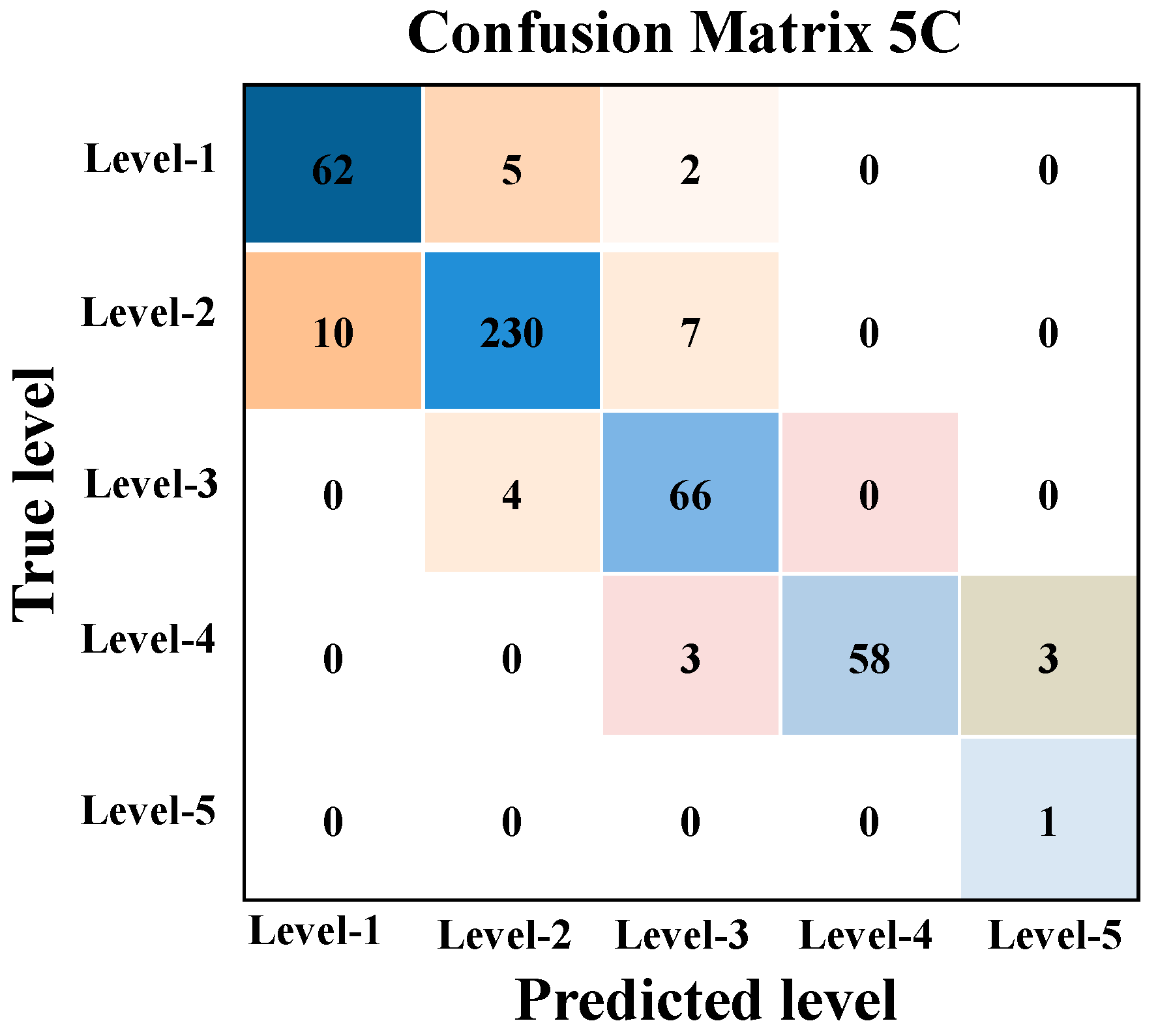
| 5C | 69 | 247 | 70 | 64 | 1 |
Disclaimer/Publisher’s Note: The statements, opinions and data contained in all publications are solely those of the individual author(s) and contributor(s) and not of MDPI and/or the editor(s). MDPI and/or the editor(s) disclaim responsibility for any injury to people or property resulting from any ideas, methods, instructions or products referred to in the content. |
© 2025 by the authors. Licensee MDPI, Basel, Switzerland. This article is an open access article distributed under the terms and conditions of the Creative Commons Attribution (CC BY) license (https://creativecommons.org/licenses/by/4.0/).
Share and Cite
Wang, L.; Li, Y.; Tian, Y.; Wu, J.; Ma, C.; Wang, L.; Liao, C. Early-Stage Fault Diagnosis for Batteries Based on Expansion Force Prediction. Energies 2025, 18, 6619. https://doi.org/10.3390/en18246619
Wang L, Li Y, Tian Y, Wu J, Ma C, Wang L, Liao C. Early-Stage Fault Diagnosis for Batteries Based on Expansion Force Prediction. Energies. 2025; 18(24):6619. https://doi.org/10.3390/en18246619
Chicago/Turabian StyleWang, Liye, Yong Li, Yuxin Tian, Jinlong Wu, Chunxiao Ma, Lifang Wang, and Chenglin Liao. 2025. "Early-Stage Fault Diagnosis for Batteries Based on Expansion Force Prediction" Energies 18, no. 24: 6619. https://doi.org/10.3390/en18246619
APA StyleWang, L., Li, Y., Tian, Y., Wu, J., Ma, C., Wang, L., & Liao, C. (2025). Early-Stage Fault Diagnosis for Batteries Based on Expansion Force Prediction. Energies, 18(24), 6619. https://doi.org/10.3390/en18246619