Article

Assessment of Decarbonization Scenarios for the Portuguese Road Sector

by
João Salvador
1,
Gonçalo O. Duarte
1,2,* and
Patrícia C. Baptista
2
1
ISEL—Instituto Superior de Engenharia de Lisboa, Polytechnic University of Lisbon, 1959-007 Lisboa, Portugal
2
IN+, Center for Innovation, Technology and Policy Research—Instituto Superior Técnico, Universidade de Lisboa, 1049-001 Lisboa, Portugal
*
Author to whom correspondence should be addressed.
Energies 2025, 18(24), 6587; https://doi.org/10.3390/en18246587
Submission received: 10 November 2025 / Revised: 1 December 2025 / Accepted: 11 December 2025 / Published: 17 December 2025

Abstract

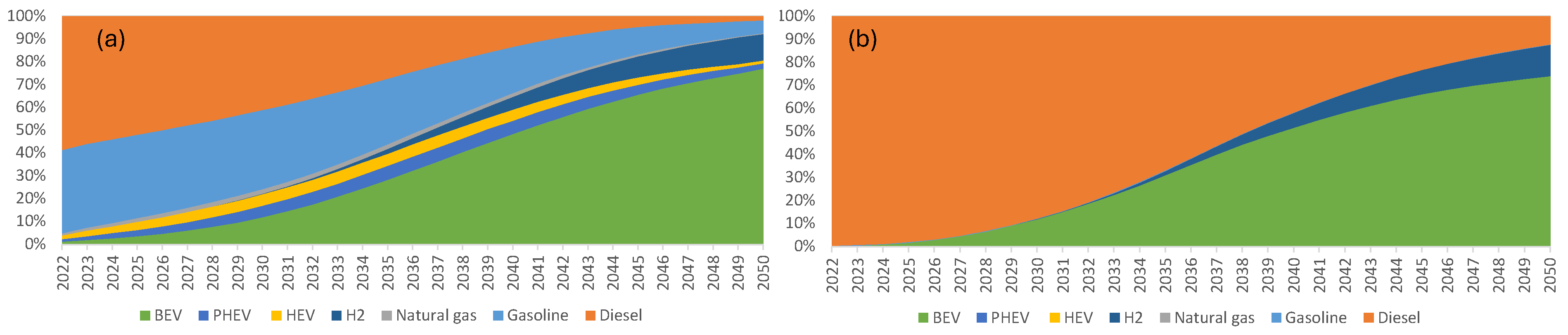
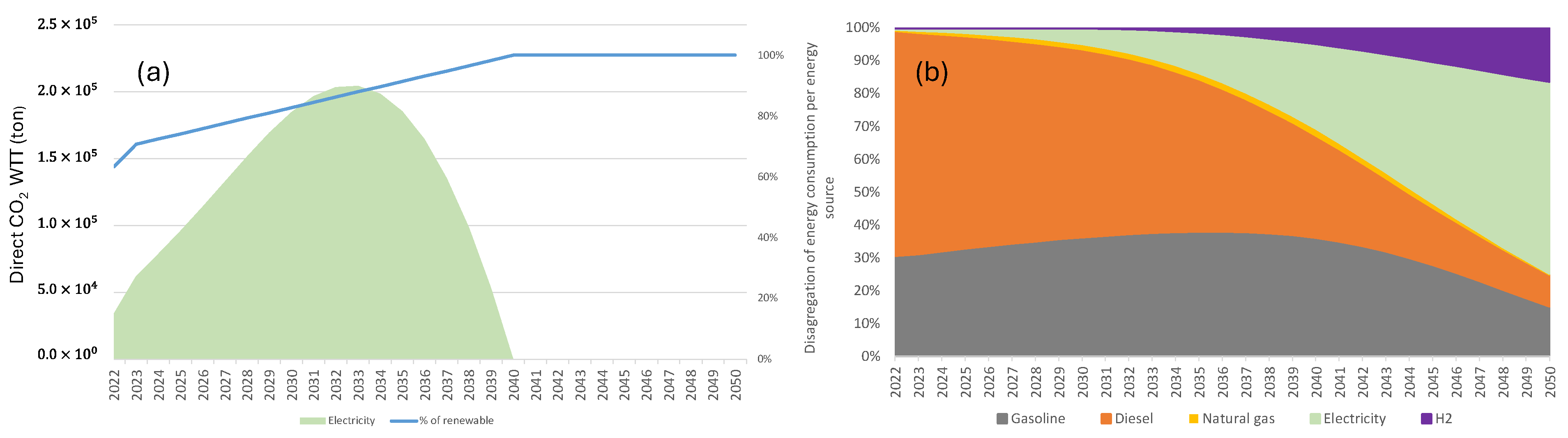
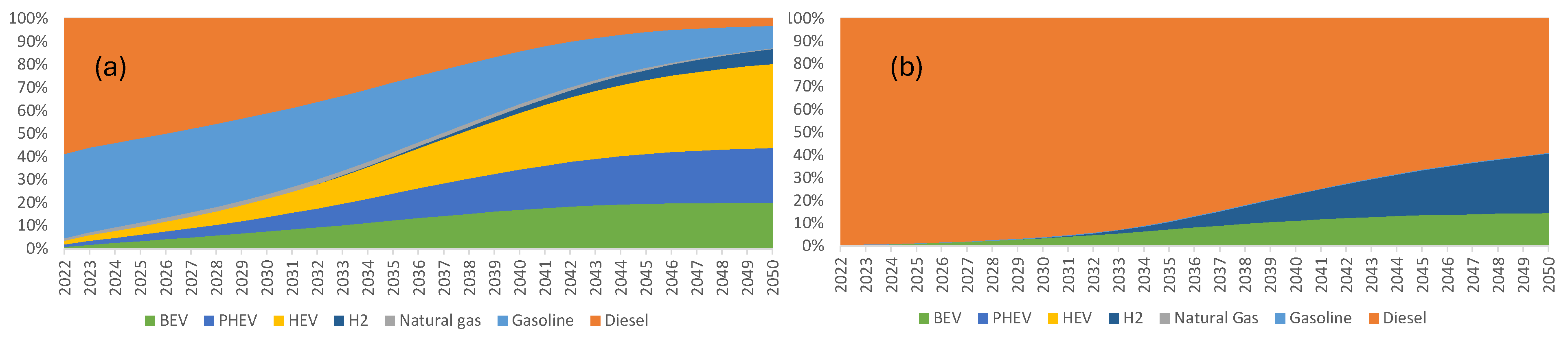
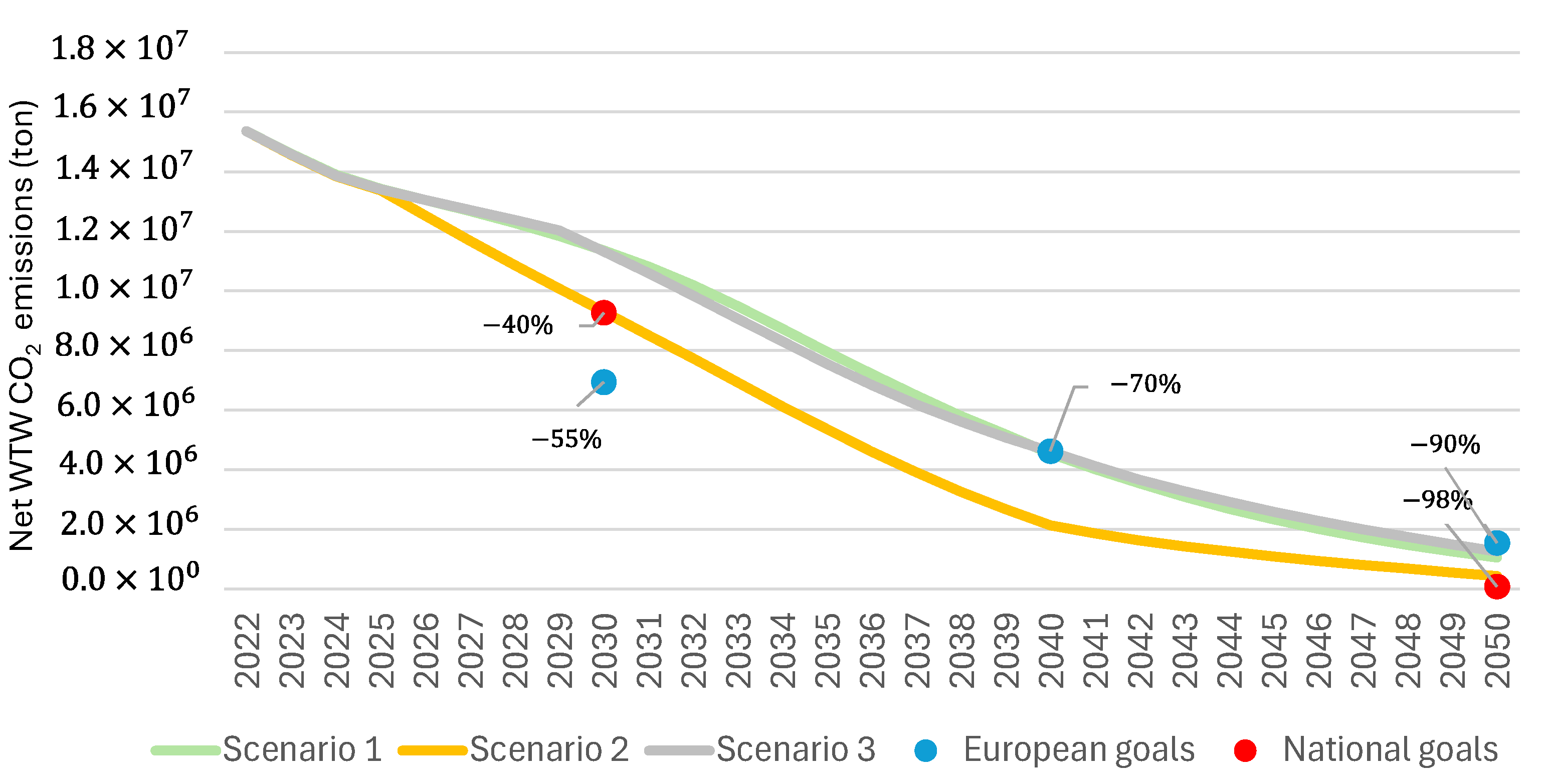
This study presents a scenario-based modeling framework to evaluate potential decarbonization pathways for Portugal’s road transport sector. The model simulates the evolution of a light-duty vehicle (LDV) fleet under varying degrees of electrification and biofuel integration, accounting for energy consumption, CO2 emissions and market shares of alternative propulsion technologies. Coupled with projected energy mix trajectories, the framework estimates final energy demand and well-to-wheel (WTW) emissions for each scenario, benchmarking outcomes against national and European climate targets. A key structural limitation identified is the long vehicle survival rate—averaging 14 years—which constrains fleet renewal and delays the transition to full electrification. Diesel-powered light commercial vehicles exhibit even slower replacement dynamics, rendering the Portuguese targets of full electrification by 2030 highly improbable without targeted scrappage and incentive programs. Scenario analysis indicates that even with accelerated electric vehicle (EV) uptake, battery electric vehicles (BEVs) would comprise only 12% of the fleet by 2030 and 77% by 2050. Electrification scenario raises electricity demand fortyfold by 2050, stressing generation and infrastructure. Scenarios that consider diversification of energy sources reduce this strain but require triple electricity for large-scale green hydrogen and synthetic fuel production.
Keywords: road transport decarbonization; scenario-based modeling; electric mobility; alternative fuels road transport decarbonization; scenario-based modeling; electric mobility; alternative fuels