Article

Stability Analysis of a Multi-Machine Parallel Microgrid Using a Time-Domain Method

School of Electrical and Control Engineering, North University of China, Taiyuan 030051, China
*
Author to whom correspondence should be addressed.
Energies 2025, 18(24), 6562; https://doi.org/10.3390/en18246562
Submission received: 19 October 2025 / Revised: 2 December 2025 / Accepted: 10 December 2025 / Published: 16 December 2025

Abstract

Current microgrid research primarily focuses on radial topologies and their control strategies, while exploration of the time-domain dynamic behavior of closed-loop controlled microgrids remains relatively insufficient. This research gap makes it difficult to directly observe and deeply analyze the evolution mechanisms of critical phenomena, such as oscillations and instability, when they occur. Therefore, conducting time-domain analysis on closed-loop structures is crucial for revealing system instability mechanisms and ensuring their safe and stable operation. This paper establishes a state-space model for a closed-loop microgrid structure composed of multiple parallel inverters and conducts time-domain stability analysis under grid-connected operation. First, a mathematical model of the closed-loop microgrid system is constructed using state-space equations. Subsequently, time-domain analysis of small-signal stability is performed on the model. By varying key parameters such as the droop coefficient, the influence patterns on system stability are investigated. The results indicate that the droop control coefficient and LC filter parameters exert the most significant impact on system dynamic characteristics. Simulation experiments validate the correctness and effectiveness of the theoretical model. Finally, the time-domain characteristics of this model were further analyzed and validated through simulations. Results demonstrate that the system maintains robust stability under disturbances even in grid-connected mode.

1. Introduction

In recent years, the problem of environmental pollution caused by traditional fossil fuels has become more and more serious and has become a major issue in today’s world economic development. Renewable energy based on wind energy and solar energy provides an effective solution to the current problems [1,2]. The combination of innovation in small distributed generation systems and the technological advancements of power electronic systems has given rise to the concept of future network technologies, such as microgrids. With the advancement of global energy transformation and the ‘dual carbon’ goal, microgrids have become an important part of the new power system due to their flexibility, low-carbon nature, and reliability. Many forms of distributed generation, such as fuel cells, photovoltaic power generation, and micro turbines, are connected to the grid through power electronic converters [3]. The microgrid can operate in grid-connected mode or stand-alone mode. However, the uncertainty of renewable energy generation has brought a series of problems to the safe and stable operation of microgrids [4,5]. There are a large number of power electronic converters in the microgrid. The increase in various micro-sources will significantly affect the characteristics of the microgrid, and the microgrid exhibits nonlinear characteristics such as low inertia, low damping, and strong time-variability [6]. These problems make the system more prone to oscillation instability [7]. Even if each subunit is stable on its own, the interaction between the subunits will cause stability problems in the system [8]. Therefore, it is necessary to model and analyze the stability of the microgrid.
In the research of microgrids, how to ensure the power quality and system stability in both grid-connected and islanded operation modes has always been one of the key technical challenges. Whether operating in parallel with the main network or independently, there will be some possible problems that can lead to system instability.
In power system networks, voltage and frequency are the two most critical operational parameters [9]. One of the most fundamental and valuable operational modes of a microgrid is islanded operation. In this mode, the microgrid disconnects from the main grid (macrogrid) and operates independently, relying entirely on its internal distributed energy resources—such as photovoltaics, wind turbines, battery energy storage systems, and diesel generators—to provide continuous and reliable power to a local area [10,11]. When the system is unstable, it is often difficult for the system to maintain the stability of voltage and frequency independently [12,13,14]. Compared with radial microgrids, closed-loop microgrids can significantly mitigate these issues. In the event of a line fault, power can be supplied from the opposite end through the closed-loop path without interrupting critical loads. Furthermore, when a grid-forming control strategy is adopted, the stability and operational reliability of the microgrid can be substantially enhanced.
Grid-Forming Control (GFM) is an advanced control strategy for power electronic converters that enables them to emulate the operational behavior of traditional synchronous generators, thereby autonomously establishing and maintaining grid voltage and frequency. Droop control is one of the most widely used methods in grid-connected inverter control. It emulates the active power-frequency (P–f) and reactive power-voltage (Q–V) droop characteristics of synchronous generators [15]. In power systems with a high penetration of renewable energy, grid-forming inverters—which operate without relying on grid synchronization signals—can autonomously regulate the voltage and frequency. This capability significantly enhances the system stability and resilience to disturbances and helps mitigate stability challenges resulting from weakened grid strength [16,17].
The application in a weak grid environment poses a unique challenge to the stability of grid-connected inverters. A weak grid has the characteristics of low short-circuit capacity and low inertia. Therefore, it is necessary to explore strategies to improve the stability and performance of inverters in this challenging environment [18,19].
In [20], a three-degree-of-freedom rotating pendulum dynamic model integrated with an electromagnetic energy harvesting device was systematically constructed, establishing a comprehensive theoretical framework. However, this work lacked effective validation and practical application of the proposed methods. To address this limitation, the study in [21] focused on verifying the methodology and advancing its engineering applications. While employing the same theoretical approaches—Lagrangian equations and the method of multiple scales—it particularly emphasized validating the high consistency between analytical and numerical solutions, thereby providing a mature methodological reference for analyzing the dynamic behavior and stability of complex systems. Nevertheless, with the continuous increase in renewable energy penetration, modern power systems are progressively evolving into “quasi-dynamic systems” dominated by a large number of power electronic inverters. Ref. [22] estimates the interaction and stability of grid-connected inverters equipped with LC filters. The resonance and oscillation characteristics of multiple inverters are analyzed through simulation. An interactive admittance model is proposed to effectively characterize these interactions in relation to the physical network admittance. Frequency-domain stability analysis of the microgrid model enables early prediction of oscillatory instability and facilitates stability assessment at specific frequency points. However, this paper does not examine time-domain characteristics; as a result, the impact of specific parameters on system stability remains unclear. In practical applications, system stability may be vulnerable to variations in these parameters. In [23], a comprehensive dynamic model of the network is established, with each module represented in state-space form and integrated into the overall system. Sensitivity analysis is conducted on the full network model to evaluate the influence of key parameters on system stability. However, this study is restricted to the dynamic model of a radial network, which is prone to instability in the event of sudden circuit breakages. Although closed-loop networks provide higher power supply reliability and improved stability, they also introduce greater operational and analytical complexity. In [24], a steady-state analysis is carried out for a microgrid system consisting of multiple inverters operating under droop control, and a state-space model is developed to examine the impact of droop coefficients on system stability. The study focuses exclusively on radial microgrid configurations and does not investigate closed-loop microgrids under droop control. Although employing multiple droop-controlled inverters in a closed-loop microgrid can enhance operational stability in practice, it also increases structural and control complexity.
Based on existing research, this paper addresses the challenges of modeling and stability analysis for complex microgrid system structures, with a specific focus on the adaptability of modeling methods and configurations. To overcome the limitations of conventional approaches in handling complex topologies, this paper proposes the application of the state-space method to model loop-structured microgrids composed of multiple parallel inverters. A systematic small-signal stability analysis is conducted, along with a dedicated investigation into the time-domain characteristics of the looped microgrid system. The core strength of the proposed method lies in its ability to reveal underlying mechanisms and its strong generalization capability. By integrating eigenvalue analysis and parameter sensitivity analysis, this study not only identifies key factors influencing system stability but also clearly elucidates the intrinsic mechanisms through which various parameters affect stability and ranks their sensitivity. This provides direct guidance for the optimized design of system parameters. To comprehensively validate stability, the research introduces small-disturbance tests and time-domain analysis during grid-connected operation, establishing a complete verification framework that spans from the frequency domain to the time domain and from theoretical analysis to simulation. Simulation results confirm that the developed model accurately and efficiently characterizes the stability behavior of the system. To demonstrate the general applicability of the proposed method, the modeling and analysis framework was successfully extended to radial microgrids. Comparative experiments show that the method maintains analytical accuracy across different network structures, overcoming the structural limitations of traditional approaches and proving its potential as a universal tool for microgrid stability analysis.
Finally, this work systematically summarizes the quantitative influence of parameter variations on stability and designs simulation experiments to analyze the time-domain characteristics of the system under small disturbances. The results verify the system’s capability to suppress daily small load disturbances, thereby validating the rationality and feasibility of the system design from a dynamic performance perspective. The research outcomes provide a theoretically sound and practically viable solution for both academic research and engineering practice in the stability analysis and design of complex microgrids.

2. Materials and Methods

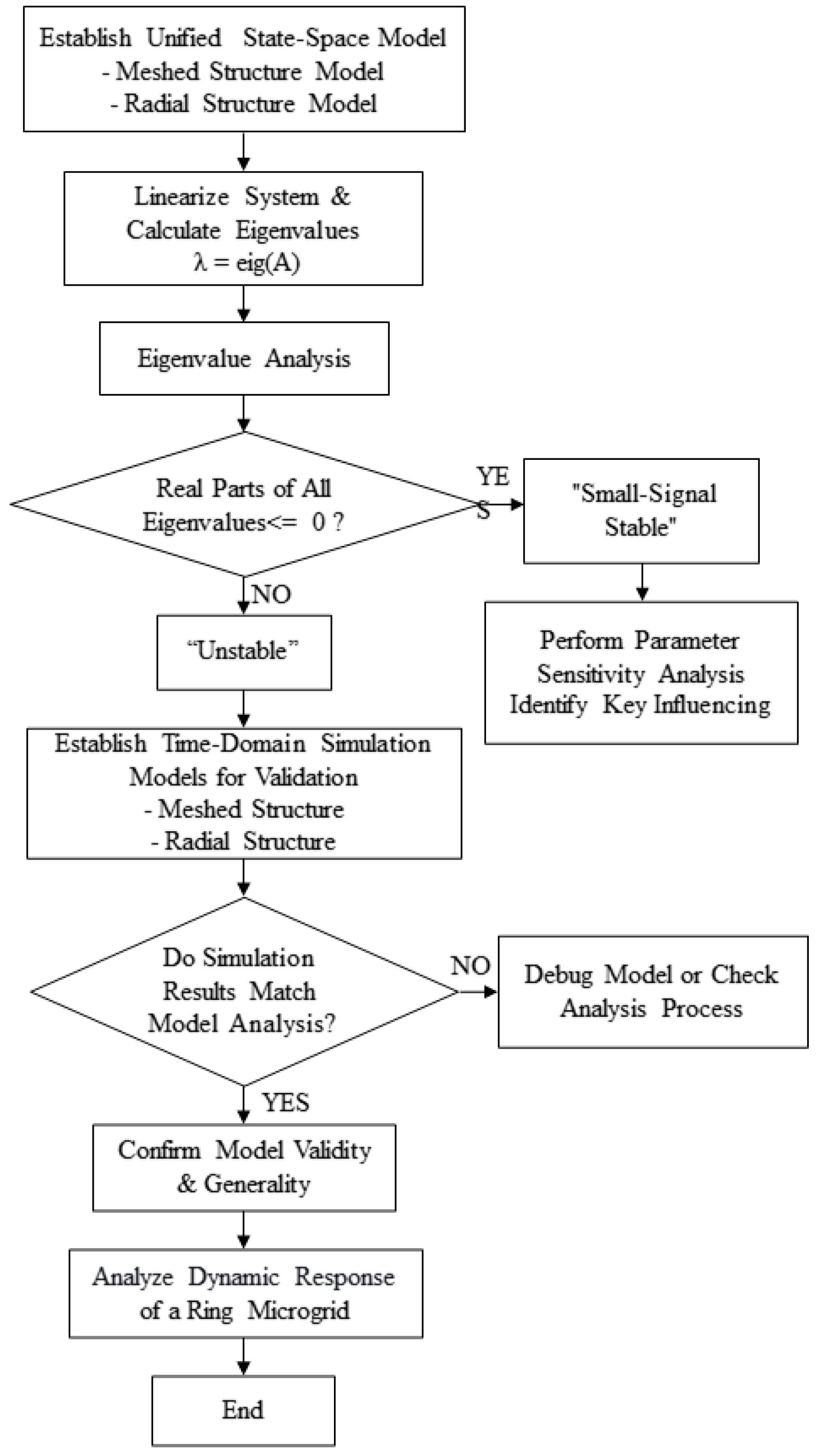
This paper aims to propose a universal stability analysis framework applicable to multiple microgrid structures, followed by a small-signal stability analysis specifically for meshed-structure microgrids. First, a unified state-space modeling approach is established to verify the applicability and generality of the proposed method across different microgrid topologies. On this basis, the influence of multi-parameter variations on the stability of the meshed-structure microgrid system is systematically evaluated, and time-domain stability analysis is further conducted. The overall research procedure is illustrated in Figure 1.
This section presents the methodology employed in this study, which comprises two main components: mathematical modeling and stability analysis. For the mathematical modeling part, we develop models for two typical microgrid topologies—radial and meshed structures—and systematically elucidate the differences and interconnections in their modeling approaches, thereby laying a theoretical foundation for subsequent analysis. In terms of stability analysis, the eigenvalue method is adopted to assess the small-signal stability of the system, while parameter sensitivity analysis is conducted to identify key factors influencing system stability.

2.1. Model of Microgrid

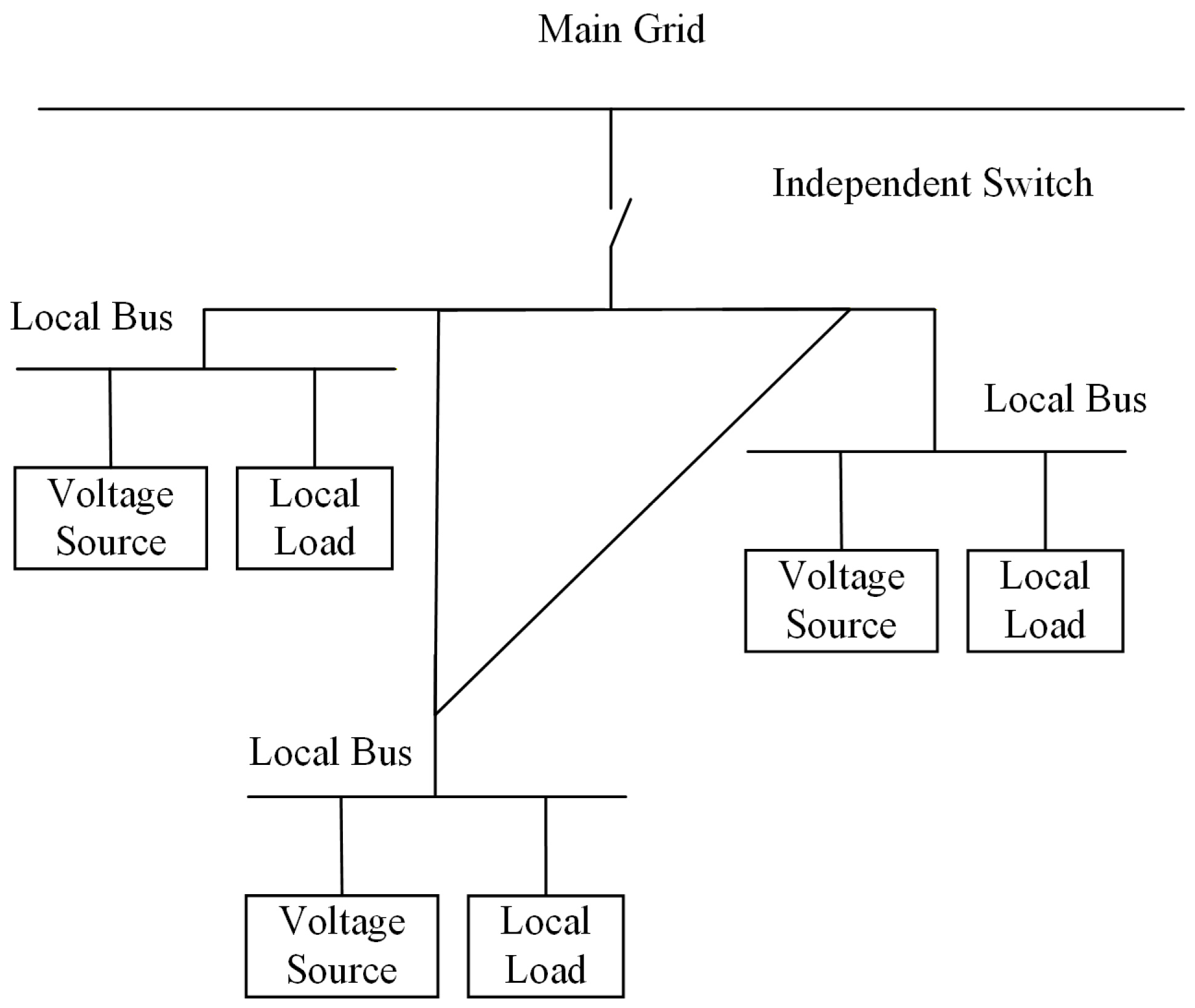
Presently, most distributed power sources with power electronic interfaces for renewable energy generation employ three-phase inverters. Therefore, this paper focuses on a microgrid system based on three-phase inverter technology [25,26], as illustrated in Figure 2.
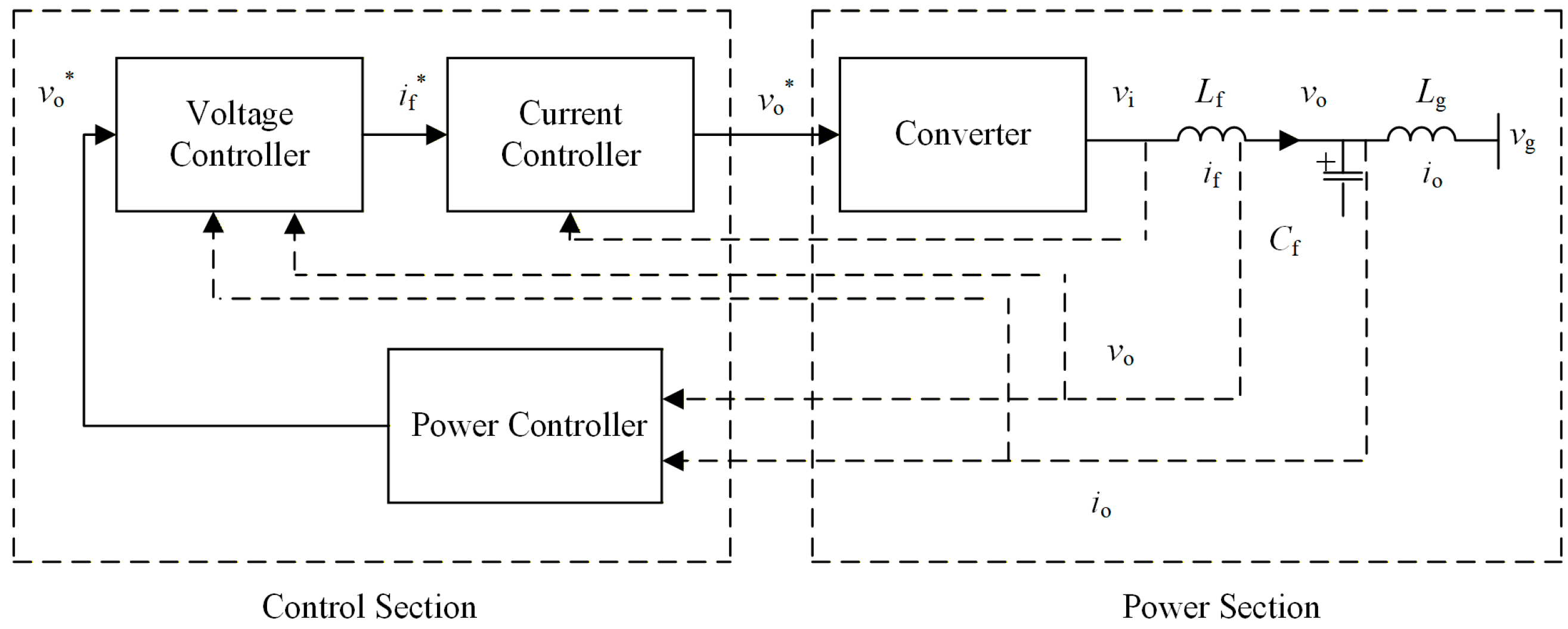
The modeling method proposed in this paper divides the whole system into three sub-modules: inverter, network, and load. Each inverter is modeled in its own reference frame, and the rotation frequency of the microgrid system is determined by the rotation frequency of one of the selected inverters. The inverter model includes a droop power controller model, output filter model, LC filter model, and voltage and current controller model. The modules shown in Figure 3 will be explained in the following sections [27].
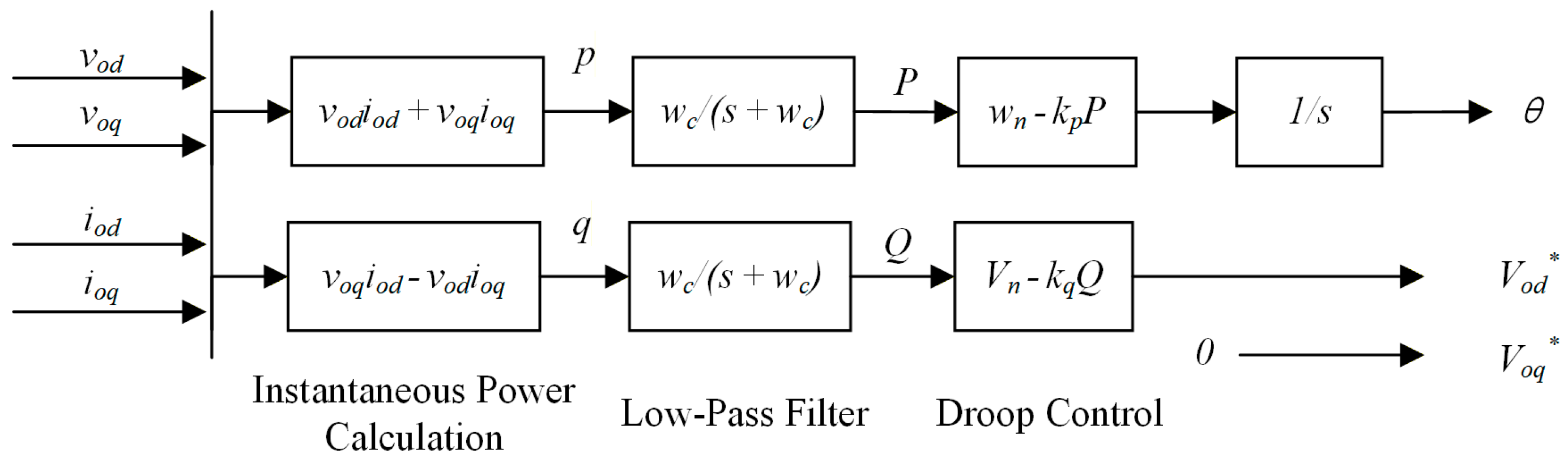
The basic idea of droop control is to simulate the working characteristics of synchronous generators: by reducing the frequency of the output voltage to meet the increase in active power in the load, and by reducing the amplitude of the output voltage to meet the increase in reactive power in the load, the power control loop diagram is shown in Figure 4.
Based on the established meshed-structure microgrid model, this paper conducts a comparative study with radial-structure microgrids, validating the universality of the proposed modeling method for different network topologies. The detailed research process and corresponding results will be elaborated in the subsequent sections.

2.1.1. Modeling of a Single Inverter

By integrating the state models of each part, the overall small signal model of the droop control inverter can be obtained as follows.
Δ x ˙ i n v = A i n v Δ x i n v + B i n v Δ v g d q + B ω c o m Δ ω c o m
Δ ω Δ i o d q = C i n v ω C i n v c Δ x i n v
where
x i n v = δ P Q φ d q γ d q i f d q v o d q i o d q T
A i n v = A p 0 0 B p B v 1 C p v 0 0 B v 2 B c 1 C p v D v 1 B c 1 C v 0 B c 1 D v 2 + B c 2 B L C L 1 C p v D v 1 D c 1 B L C L 1 D c 1 C v B L C L 1 C v A L C L + B L C L 1 D c 1 D v 2 + D c 2
B i n v = 0 0 0 B L C L 2 , B ω c o m = B P ω c o m 0 0 0
C i n v ω = C P ω 0 0 0
C i n v c = 0 0 0 0 0 I
To connect the inverter to the whole system, the output variables need to be converted to the common reference frame. In this case, the output variable of the inverter is expressed as the output current of the vector, and the small signal output current on the common reference frame can be obtained by using the transformation formula, such as Park.
Δ i o D Q = T S Δ i o d q + T C Δ δ
T S = cos δ 0 sin δ 0 sin δ 0 cos δ 0
T C = I o d sin δ 0 I o q cos δ 0 I o d cos δ 0 I o q sin δ 0
Similarly, the input signal of the inverter model is the bus voltage represented on the common reference frame. The bus voltage can be converted into a separate inverter reference frame using inverse transformation, which is given by the following formula:
Δ v g d q = T S 1 Δ v g D Q + T v 1 Δ δ
T S 1 = V g D sin δ 0 + V g Q cos δ 0 V g D cos δ 0 V g Q sin δ 0
Each independent inverter model has 13 states, 3 inputs, and 2 outputs (except for the inverter with a common reference frame, which has 3 outputs).
Δ x ˙ i n v = A i n v i Δ x i n v + B i n v i Δ v g D Q + B i ω c o m Δ ω c o m Δ ω i Δ i o D Q i = C i n v ω i C i n v c i Δ x i n v
A i n v = A p i 0 0 B p i B v 1 i C p v i 0 0 B v 2 i B c 1 i C p v i D v 1 i B c 1 i C v i 0 B c 1 i D v 2 i + B c 2 i B L C L 1 i C p v i D v 1 i D c 1 i + B L C L 2 i B x B L C L 1 i D c 1 i C v i B L C L 1 i C v i A L C L i + B L C L 1 i D c 1 i D v 2 i + D c 2 i
C i n v ω i = C P ω 0 0 0
C i n v c = T c i 0 0 0 0 0 0 T s i
B x = T v 1 0 0

2.1.2. The Combined Model of All Inverters

The small-signal state-space model of the inverter in the common rotating coordinate system can be obtained via Equations (18) to (19).
Δ x ˙ i n v i = A i n v i Δ x i n v i + B i n v i Δ v g D Q i + B 1 ω c o m C i n v ω i Δ ω c o m
Δ i o D Q = C i n v c i Δ x i n v i
The rotational coordinate system selected for inverter 1 is regarded as the common rotational coordinate system. This enables the derivation of the state equations for the microgrid inverter network system, comprising all droop-controlled inverter units, as shown in Equation (20).
Δ X ˙ I N V = A I N V Δ X I N V + B I N V Δ v g D Q Δ i o D Q = C I N V c Δ X I N V
where
Δ X I N V = Δ x i n v 1 Δ x i n v 2 Δ x i n v 3
Δ i o D Q = Δ i o D Q 1 Δ i o D Q 2 Δ i o D Q 3
A I N V = A i n v 1 + B 1 ω c o m C i n v ω 1 0 0 B 1 ω c o m C i n v ω 1 A i n v 2 0 B 1 ω c o m C i n v ω 1 0 A i n v 3
B I N V = B i n v 1 0 0 0 B i n v 2 0 0 0 B i n v 3
C I N V = C i n v 1 0 0 0 C i n v 2 0 0 0 C i n v 3

2.1.3. Network Bus Model

The small-signal model of the busbar line network at nodes i and i + 1 in the system may be expressed as given in Equation (26).
Δ i ˙ l i n e D Q i = A N E T i Δ i l i n e D Q i + B 1 N E T i Δ v g D Q + B 2 N E T i Δ ω c o m
A N E T i = R l i n e i L l i n e i ω 0 ω 0 R l i n e i L l i n e i
B 2 N E T i = l l i n e Q i l l i n e D i
B 1 N E T = B 1 N E T 1 B 1 N E T 2 B 1 N E T 3 , B 2 N E T = B 2 N E T 1 B 2 N E T 2 B 2 N E T 3
A N E T = A N E T 1 0 0 0 A N E T 2 0 0 0 A N E T 3
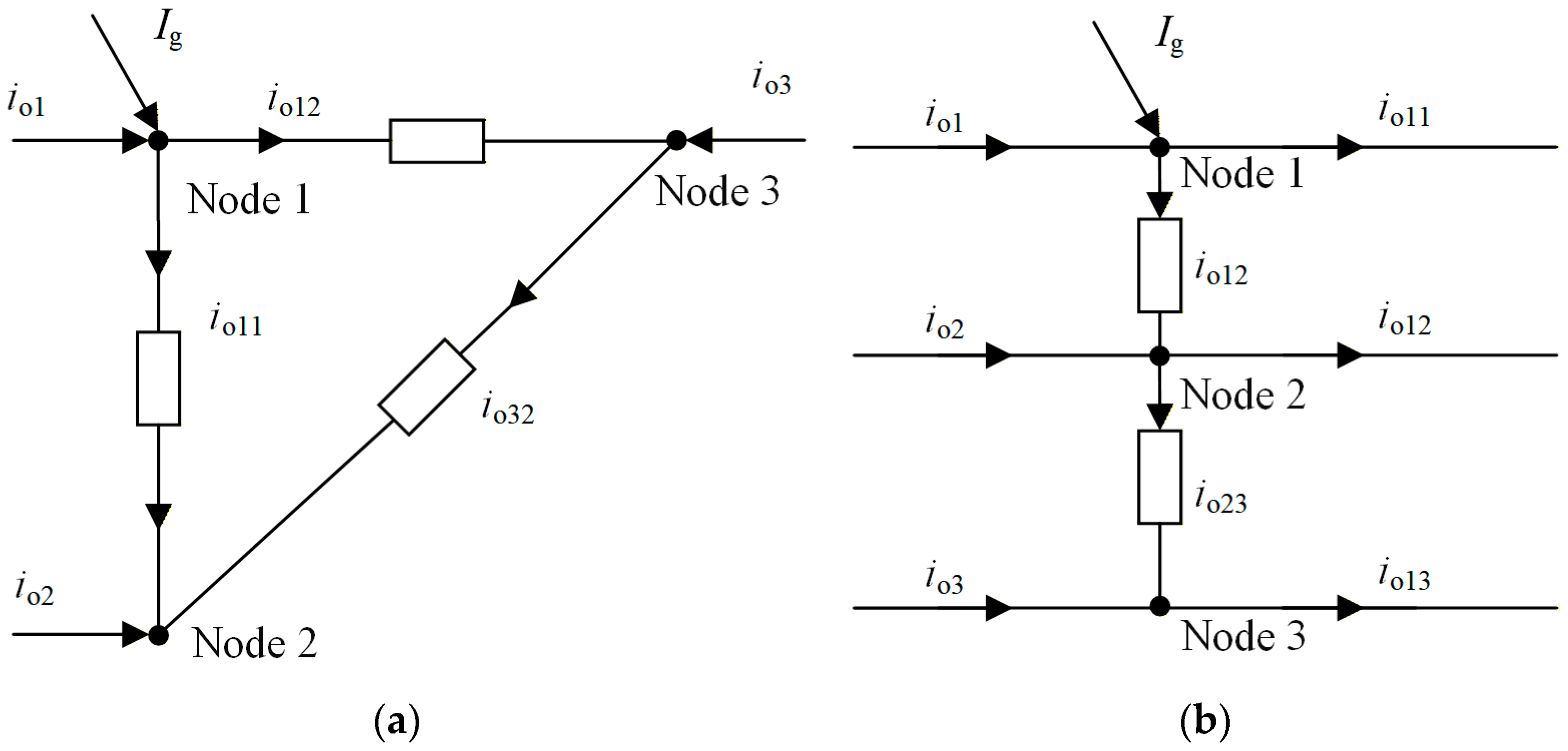
The modeling procedures for radial and meshed microgrids are largely similar, with the primary differences stemming from their structural configurations. In a radial structure, inverters are connected pairwise through a single bus in an adjacent manner—for example, the i-th inverter is not directly connected to the (i + 2)-th inverter. In contrast, in a meshed structure, any two inverters can be interconnected; for instance, the i-th inverter may connect not only to the (i + 1)-th but also directly to the (i + 2)-th inverter.
Furthermore, in a meshed configuration, the number of buses equals the number of inverters, and the greater diversity in line connections allows for more flexible mathematical modeling. Even for the same system, the state-space equations may take multiple forms. Additionally, the matrix dimensions of the line models differ between the two structures: the number of line loads in a meshed microgrid equals the number of inverters (i.e., three), whereas in a radial microgrid, it is one less than the number of inverters (i.e., two).
Therefore, when constructing the model, it is essential to clarify the connectivity and sequencing of the inverters and to build the corresponding line mathematical model using the following formulas.

2.1.4. Load Model

The RL load small signal model at the i-th node of the system can be expressed in the following (31).
Δ i ˙ l o a d D Q i = A N E T i Δ i l o a d D Q i + B 1 L O A D i Δ v g D Q + B 2 L O A D i Δ ω c o m
A L O A D i = R l o a d i L l o a d i ω 0 ω 0 R l o a d i L l o a d i
B 2 L O A D i = l l o a d Q i l l o a d D i
B 1 L O A D = B 1 l o a d 1 B 1 l o a d 2 B 1 l o a d 3 , B 2 L O A D = B 2 l o a d 1 B 2 l o a d 2 B 2 l o a d 3
A L O A D = A L O A D 1 0 0 0 A L O A D 2 0 0 0 A L O A D 3
The state-space formulation based on the load model can also be developed using Equation (31). In a meshed topology, each inverter and its local load form an independent unit. Consequently, the modeling methodology and approach are fundamentally the same for both microgrid structures, with the key distinction lying in the flexibility of the model formulation.

2.1.5. A Complete Microgrid Model

The complete microgrid consists of multiple inverters, closed-loop circuit line loads, and local loads of each inverter. The state equation and its small-signal state model can be constructed by combining the models of each subsystem, so the small-signal model of the microgrid system in the common rotating coordinate system is obtained.
Δ X ˙ I N V Δ i ˙ l i n e D Q Δ i ˙ l o a d D Q = A M G Δ X I N V Δ i l i n e D Q Δ i l o a d D Q + B M G Δ v g D Q Δ i o D Q = C M G Δ X I N V Δ i l i n e D Q Δ i l o a d D Q
Even though radial and meshed microgrids share an identical topological shape, the dimensions of their line load matrices differ, leading to a distinct dimensionality in their overall system models.

2.2. Stability Analysis

Eigenvalue analysis is a key means of studying the stability of linearized systems and essentially depends on the distribution characteristics of the system state matrix’s eigenvalues in the complex plane. According to the theory of linear systems, the stability of a system can be strictly determined by the sign of the real part of an eigenvalue: if all the eigenvalues have negative real parts and lie the left-half plane, the system is asymptotically stable at the equilibrium point; conversely, if at least one of the eigenvalues has a positive real part, the system is unstable. When the real part of an eigenvalue is zero and its algebraic and geometric multiplicities are equal, the system is in a critical stable state. In practical applications, however, it is generally considered that the system is not robust. Furthermore, the absolute value of the real part of the eigenvalue reflects the attenuation rate of the corresponding mode, and the imaginary part determines the oscillation frequency. Notably, the dominant eigenvalue closest to the imaginary axis plays a pivotal role in the transient response performance of the system. Based on the fifty-one-dimensional microgrid system model that has been established, this paper provides a comprehensive analysis of the system’s stability and dynamic characteristics by solving for all the eigenvalues according to the aforementioned distribution rules.
Sensitivity analysis utilizes sensitivity indices to evaluate system stability and is widely used in both conventional power systems and microgrids. In the context of eigenvalue analysis, the sensitivity of eigenvalues to variations in system parameters is examined to quantify their impact on state variables. This information, combined with eigenvalue data, facilitates the rational selection of key controller parameters, such as the power droop coefficient.

3. Results and Discussion

Based on the above analysis, the following simulation verification is conducted.

3.1. Stability Analysis

3.1.1. Eigenvalue Analysis

The eigenvalue analysis method, which extracts key stability indices—such as oscillation frequency, amplitude, and damping ratio—by solving the eigenvalues of the system state matrix, is widely employed in small-signal stability analysis of microgrids due to its conceptual clarity and rigorous criteria [28].
The dimension of the ring-structured microgrid system model is determined by the three parts: the inverter section, the busbar line section, and the load section. In this paper, the microgrid composed of three parallel inverters is taken as the research object. The model dimension of a single inverter is 13, corresponding to thirteen state variables. Therefore, the dimension of the subsystem composed of the three inverters is 39. On this basis, the overall dimension of the system is fifty-one-dimensional, corresponding to 51 eigenvalues. However, the dimensionality of the radial microgrid system model is 49.
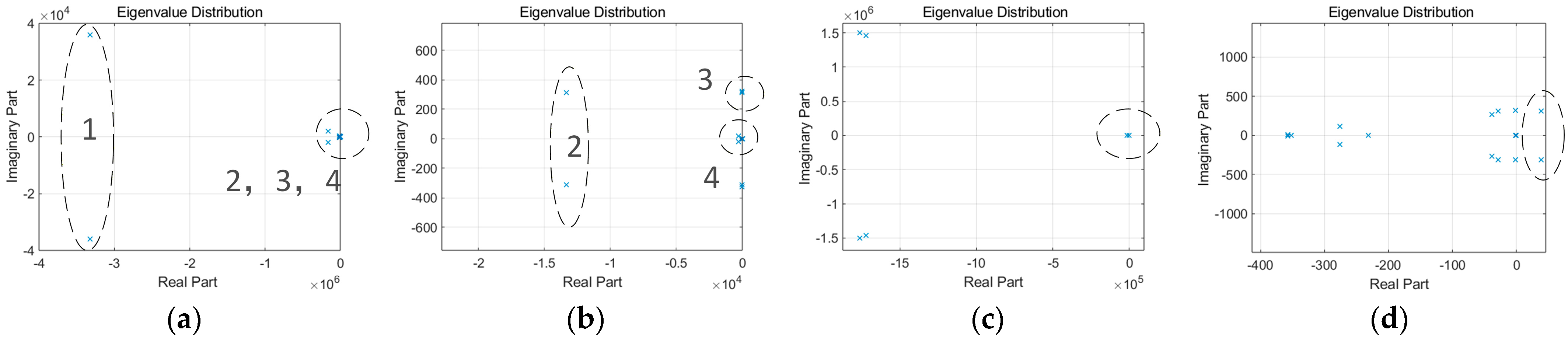
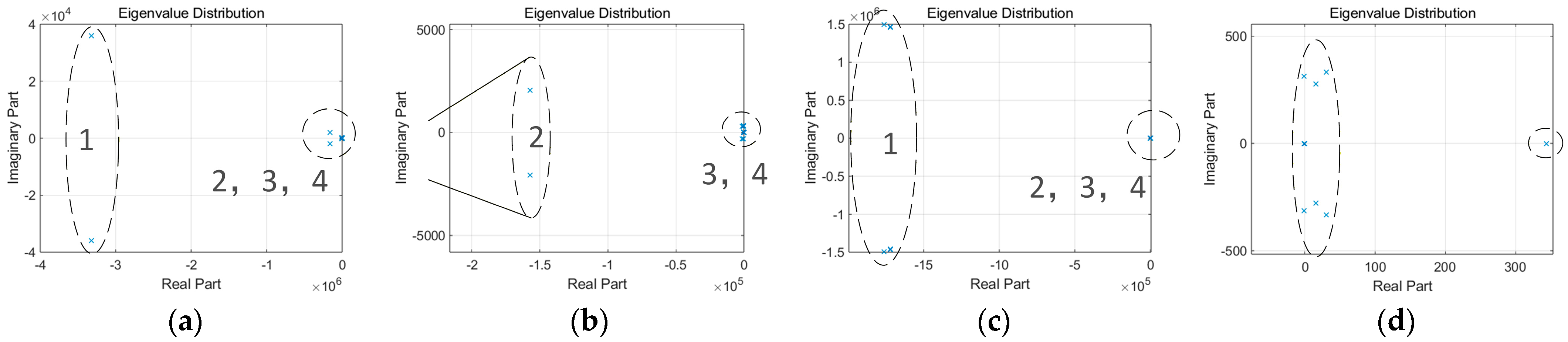
Based on the data in Table 1, simulations were performed for the two structural systems, and their operating data at the steady-state working point were obtained (results are shown in Table 2). Figure 5 and Figure 6 show the eigenvalue distributions of the state equations for the microgrid experimental system, calculated using MATLAB 2024a. As shown in the figures, all eigenvalues are located in the left half of the complex plane. According to linear system stability theory [29], this indicates that the microgrid experimental system is stable at the given operating point.
After adjusting the key parameters according to the pattern observed in Table 3, these settings were applied to the simulation system. New simulation results were obtained and incorporated into the mathematical model for computation, yielding the new eigenvalue distribution shown in Figure 6 and Figure 7. The figure indicates that the system eigenvalues have shifted overall to the right, with some eigenvalues migrating into the right-half plane. According to eigenvalue analysis theory, this distribution confirms that the system has become unstable.

3.1.2. Sensitivity Analysis

This study primarily focuses on sensitivity analysis for ring microgrids. Figure 6 shows the distribution of all 51 eigenvalues of the system under the initial conditions specified in Table 1. It can be observed that these eigenvalues exhibit a wide range of frequency components, which can be grouped into four distinct clusters.
The further the real part deviates from the imaginary axis, the faster the system’s decay rate becomes, enabling quicker stabilization; conversely, the further the imaginary part deviates from the real axis, the higher the system’s oscillation frequency becomes. As observed in Figure 6, the high-frequency mode labeled ‘1’ corresponds to the state variables of the inverter’s LC filter, exhibiting substantial real and imaginary components. During stable system operation, this mode exerts limited influence on overall stability. However, improper parameter design may induce high-frequency oscillations or resonances, thereby indirectly jeopardizing the system’s stable functioning. As can be seen from Figure 6, dual voltage-current control determines the stability at medium and high frequencies. Unlike droop control, it does not directly render the system unstable, but rather determines the magnitude of the system’s stability margin. It plays a crucial role in the local stability of the system, such as in the case of droop control numbers ‘2’ and ‘3’. Droop control governs low-frequency oscillations. An improperly set droop coefficient causes the dominant system eigenvalue to approach the imaginary axis or even enter the right-half plane, thereby triggering low-frequency oscillations or voltage instability. Consequently, droop control represents the most sensitive element in system stability. As indicated by number ‘4’, this mode lies closest to both the imaginary and real axes, rendering it most sensitive to parameter variations.
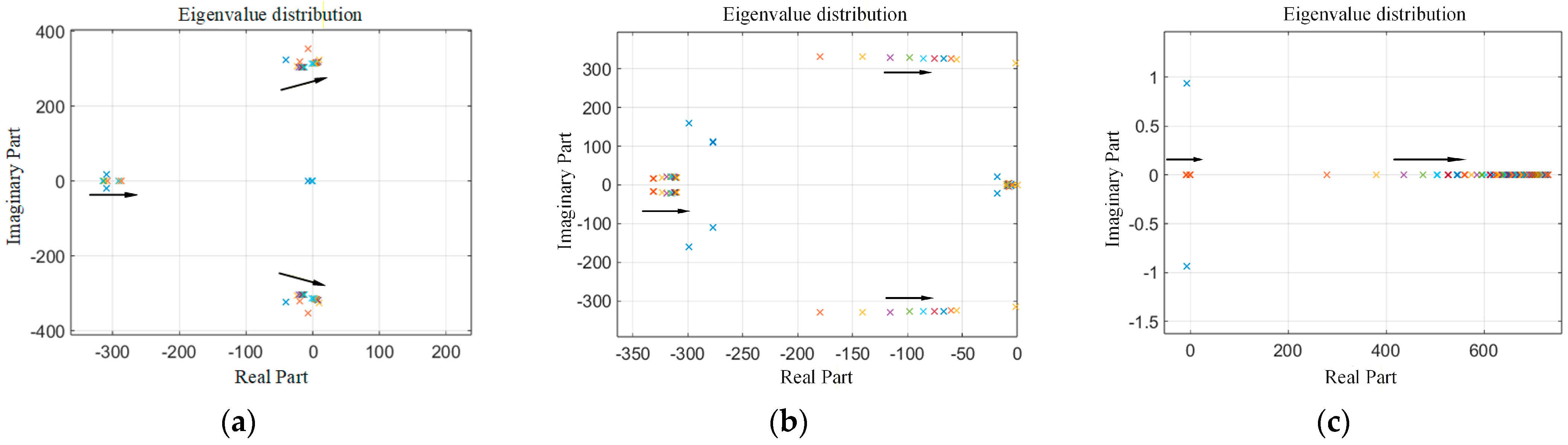
The distribution of parameter variations shown in Figure 8 indicates that changes in the LC filter parameters (Lf, Cf) and grid-side inductance Lg exert the most significant influence on system stability, potentially causing the system to transition from a stable to an unstable state. These parameters also exert a substantial effect on the oscillation frequency, and droop controller parameters play a pivotal role in system stability. The findings in Figure 8 further validate theoretical analysis: compared to power droop gain, the voltage and current loops primarily influence high-frequency characteristics within the system, while LC filter parameters predominantly affect low-frequency gain. Assessing eigenvalue displacement within identical parameter variation ranges reveals that the droop controller exhibits the highest sensitivity, followed by the LC filter. To better evaluate the impact of the three parameters on system stability, the relevant experimental results are consolidated in Table 4.

3.1.3. Verification of the Model

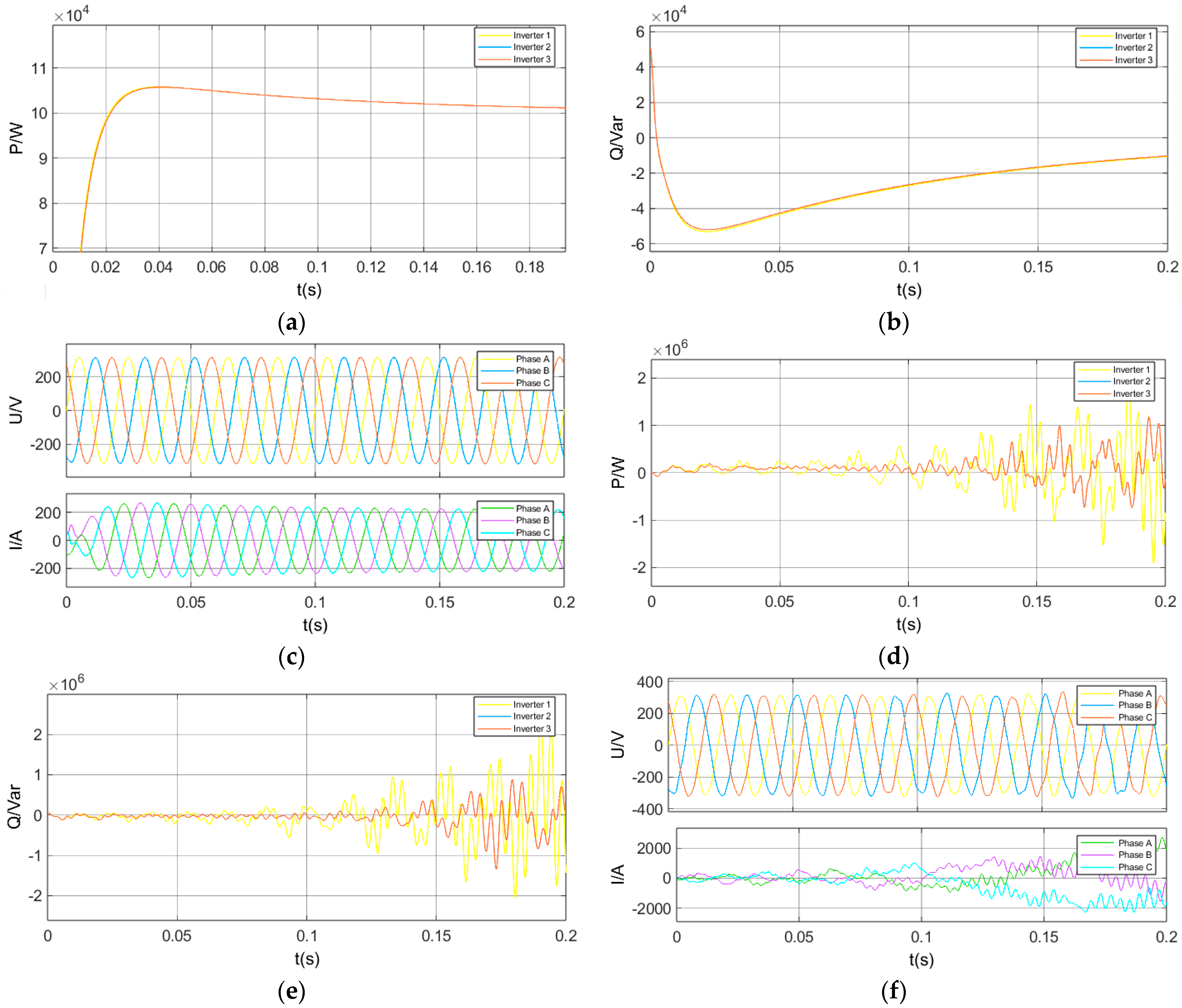
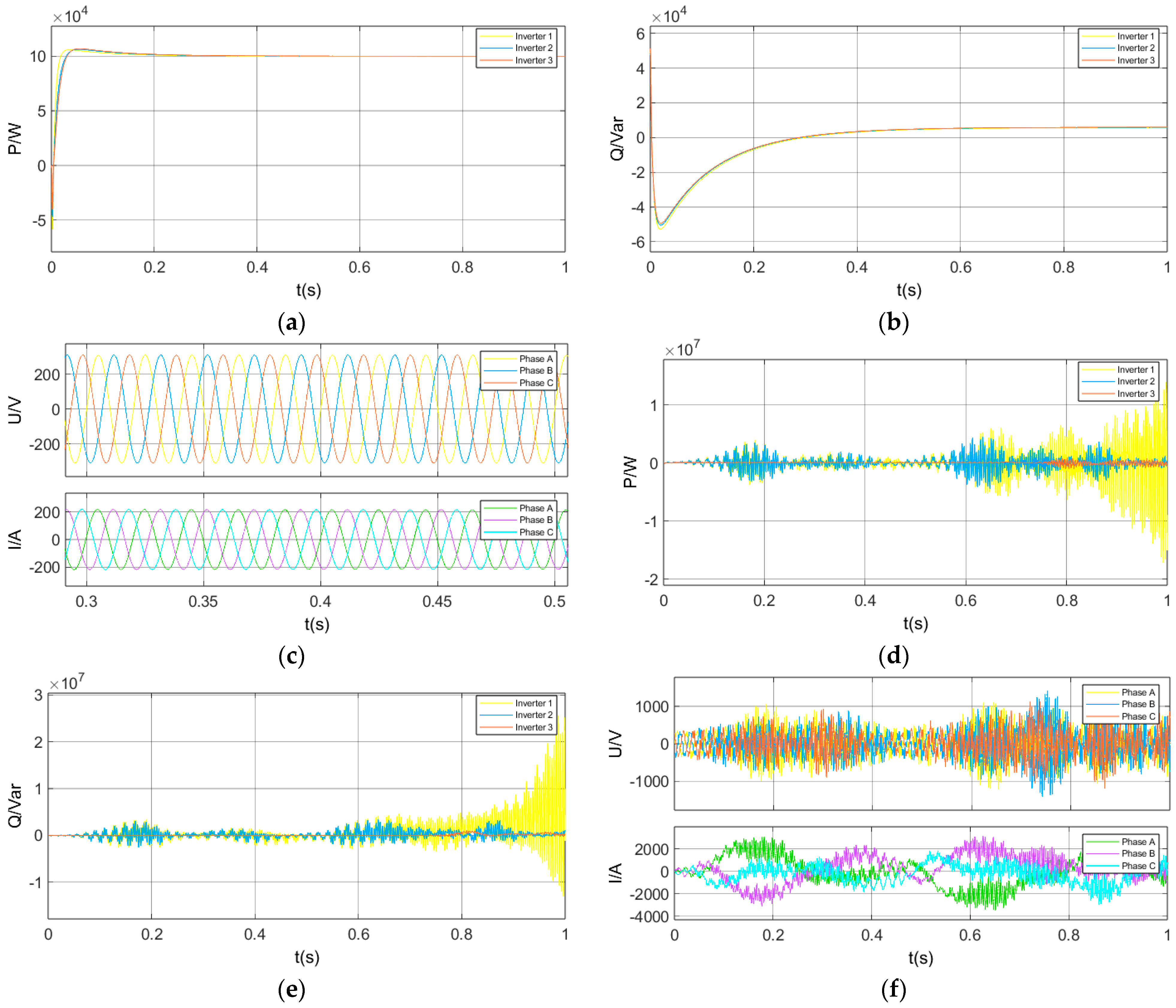
Figure 9 and Figure 10 show the Simulink simulation results for the meshed and radial microgrids, with their parameters corresponding to those in Table 2 and Table 3, respectively.
Based on the simulation results in Figure 9 and Figure 10, combined with previous research findings, it can be concluded that when using the parameters from Table 1 and Table 2, all eigenvalues of the mathematical model are distributed in the left half-plane, indicating system stability. The stable waveforms in Figure 9a,b, obtained using Table 1 parameters, are consistent with the stability prediction of the theoretical model, thereby achieving mutual validation between the theoretical and simulation models. When parameters causing system instability are applied, eigenvalues appear in the right half-plane while the simulation waveforms exhibit instability, further demonstrating the effectiveness of this stability assessment method.
Similarly, Figure 10 presents simulation results for a radial-structured microgrid. By applying the same analytical method used for the mesh structure, mutual confirmation between the theoretical model and simulation results is again achieved, proving the method’s applicability to radial-structured microgrids. These results demonstrate that the proposed stability analysis method possesses good versatility across different network configurations.
Thus, the established state-space model enables a rapid and precise assessment of system stability. Furthermore, the results serve to verify that the method is effective for stability analysis in both mesh-structured and radial-structured microgrids, confirming its suitability for the two configurations.

3.2. Time-Domain Stability Analysis

3.2.1. Case 1: A 5% Step Increase in the Active Power Command in Droop Control

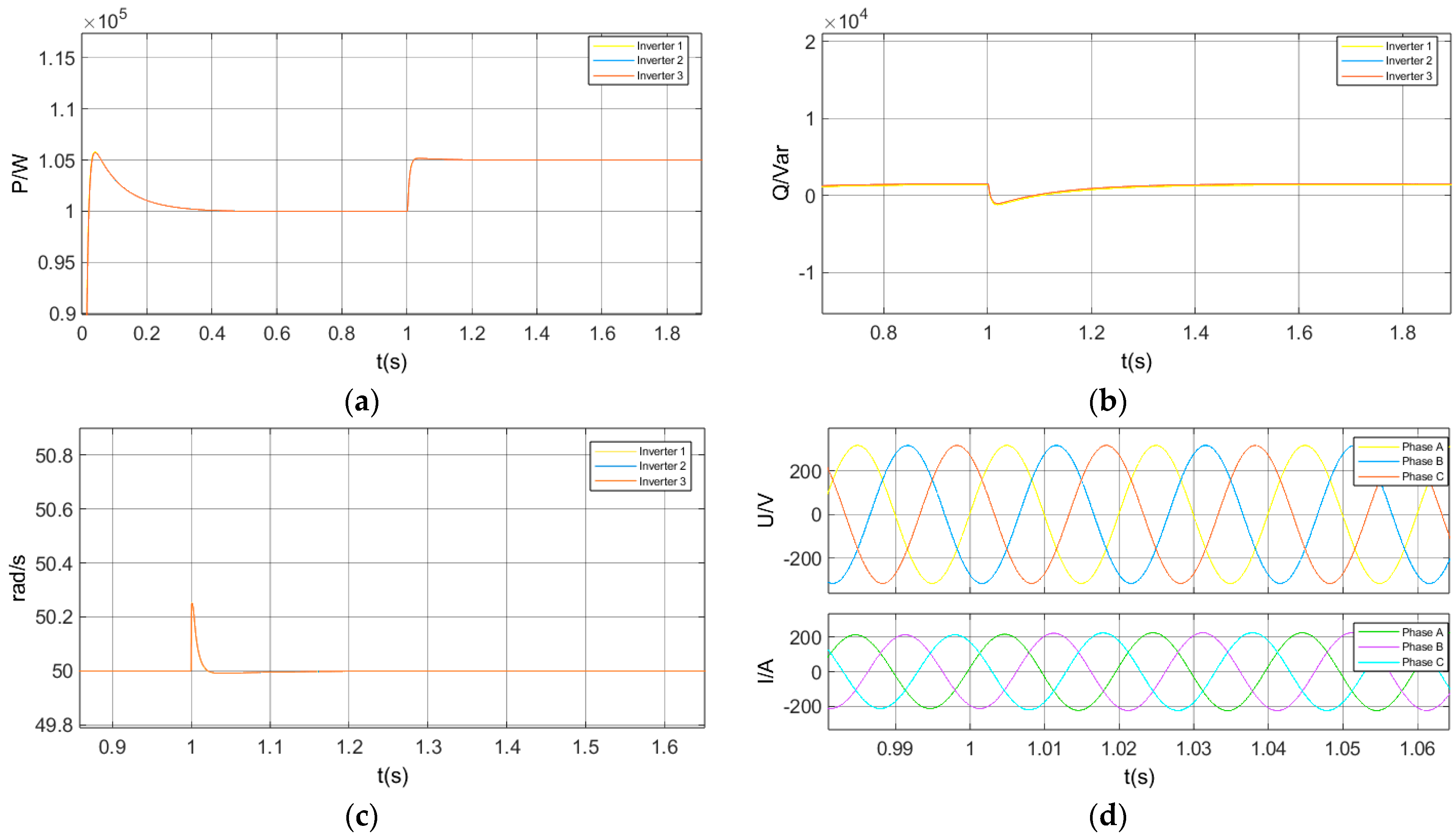
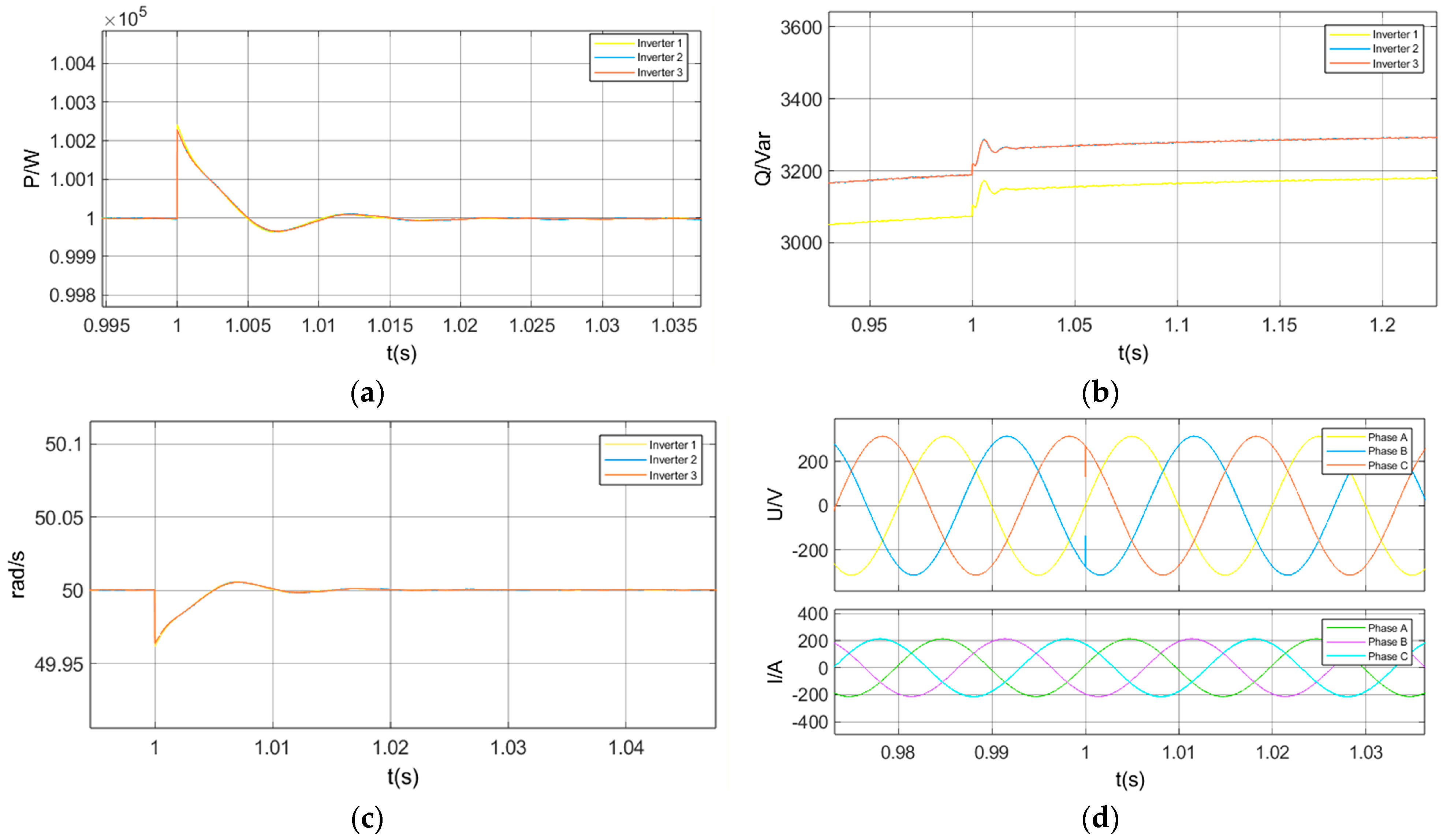
In grid-connected mode, a step disturbance signal with an amplitude of 5% of the rated active power is applied at t = 0.5 s. The system dynamic response simulation results are shown in Figure 11. The specific analysis is as follows:
Figure 11a illustrates the variation in the system’s active power. As can be observed, the active power exhibits an abrupt increase of 5% at t = 0.5 s. This step change occurs because the command value (P0) is subjected to a step increase, whereas the inverter’s output active power (P) does not respond instantaneously, thereby creating a transient power difference. This difference serves as an additional input to the droop controller, ultimately leading to an increase in the inverter’s output power.
Figure 11b shows the variation in the system reactive power. It can be observed that the reactive power remains essentially unchanged. The inverter’s reactive output is mainly determined by the reactive power command and is independent of active power, so it stays constant. During the transient, a slight dip occurs, but with grid support, it ultimately stabilizes and returns to the initial value. The occurrence of negative reactive power values in Figure 11b is a normal physical phenomenon. This is because during the transient of the step increase in active power command, the inverter’s adjustment of output voltage phase and amplitude for maintaining system stability causes significant power coupling. This coupling effect leads to an initial dip in inductive reactive power (Q > 0), briefly bringing it into the capacitive region (Q < 0). The system then establishes a new steady state within 1 to 2 s, after which the reactive power returns to normal.
Figure 11c shows the variation in the system frequency. A brief frequency step can be observed. According to the droop relationship between active power and frequency, power variations cause frequency fluctuations. During dynamic regulation, the phase-locked loop (PLL) and dual-loop controller inside the inverter slightly increase the phase and frequency of the output voltage, resulting in a temporary frequency rise. Due to the strong frequency support provided by the grid in grid-connected mode, the inverter frequency resynchronizes with the grid frequency in steady state and eventually returns to its initial value.
Figure 11d displays the system output voltage and current waveforms. The output voltage remains constant. Based on the control relationship between reactive power and voltage, its steady-state value matches the initial value. The output current increases accordingly. Under the conditions of constant voltage, a 5% increase in active power, and unchanged reactive power, the current amplitude rises in accordance with the apparent power relationship.

3.2.2. Case 2: A 5% Step Decrease in the Reactive Power Command in Droop Control

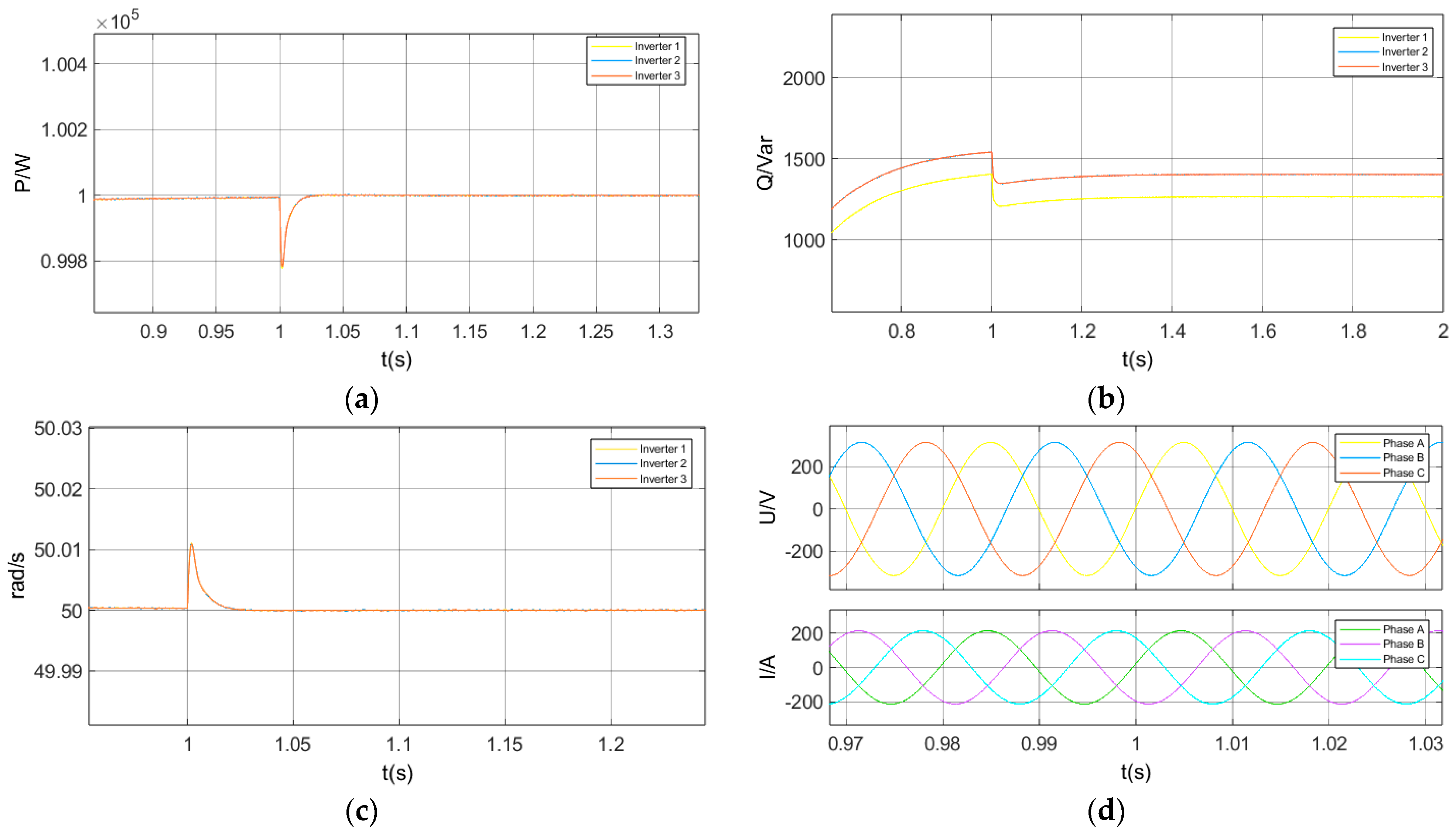
In grid-connected mode, a step disturbance with an amplitude of −5% of the rated reactive power is applied at t = 0.5 s. The system dynamic response simulation results are shown in Figure 12 with the following specific analysis:
Figure 12a shows the variation in the system’s active power, while Figure 12c shows the change in system frequency. Within the range of small steady-state disturbances, the P–f loop and Q–V loop can be considered decoupled. Therefore, changes in reactive power have little effect on active power. At the same time, the grid frequency is clamped to its rated value. According to the active power–frequency control relationship, the frequency remains essentially constant during disturbances, with any transient fluctuations being negligible.
Figure 12b illustrates the variation in the system’s reactive power. At t = 0.5 s, a sudden drop of approximately 5% occurs. This response is triggered by a step decrease in the reactive power setpoint Q0. Since the actual reactive power output Q of the inverter cannot respond instantaneously, an instantaneous power deviation arises. This deviation is then fed back into the control system, prompting the inverter to reduce its reactive power output.
Figure 12d displays the waveforms of the system’s output voltage and current.
Output voltage: Based on the reactive power–voltage control relationship, the inverter control attempts to reduce the output voltage magnitude. However, in grid-connected mode, the grid provides strong voltage support, effectively locking the voltage at the point of common coupling to the grid level. Therefore, the output voltage generally remains stable. Output current: With the voltage essentially unchanged, reactive power reduced by 5%, and active power held constant, the current amplitude should decrease accordingly according to the apparent power relationship. The waveform trend in the figure aligns with this expectation. Although the reduction is not very pronounced, using a cursor measurement tool reveals that the current decreases by approximately 1–2 amperes.

3.2.3. Case 3: A 5% Step Increase in the Active Power Load at the PCC in Droop Control

In grid-connected mode, when a step disturbance with an amplitude of 5% of the power load is applied at the PCC point at t = 0.6 s, the system dynamic response simulation results are shown in Figure 13. The specific analysis is as follows:
Figure 13a,c illustrate the variation in active power and frequency in the system, respectively. At t = 0.6 s, the active power demand at the PCC suddenly increases by 5%. To meet this sudden demand, the system draws on its inertia, resulting in a very small and rapid frequency drop. Based on the power-frequency droop characteristic, the local inverters then increase their active power output to counteract this frequency decline. This action reduces both the magnitude and the rate of the frequency drop, thereby helping to prevent false tripping of protection devices. Simultaneously, the main grid, with its substantial inertia and robust speed regulation system, begins injecting additional active power into the PCC. This injection strongly pulls the system frequency back toward and subsequently maintains it at the rated value. At this stage, the overall active power stabilizes at a level higher than its initial value. By using the cursor measurement tool, it can be observed that this net increase is primarily attributable to the additional active power supplied by the main grid.
Figure 13b shows the variation in reactive power in the system. Similarly to the active power profile, the reactive power curve exhibits a step increase at t = 1 s and then stabilizes at a higher level, indicating an increased reactive power demand in the system. The Q-V droop control loop automatically enhances the reactive power output to support the voltage, while the main grid also provides voltage support. The fact that the reactive power does not return to its initial value indicates that the three inverters collectively share the additional reactive load.
Figure 13d displays the system output voltage and current curves. The voltage experiences a very slight dip but quickly recovers and stabilizes. According to the relationship between power, voltage, and current, the increase in active power corresponds to a proportional rise in current, as shown in Figure 13.
The simulation results in Figure 11, Figure 12 and Figure 13 reveal the system’s dynamic response to a small disturbance: after transient oscillations, all observed variables converge to new steady-state values. Notably, these steady-state values are determined by the system operation mode and the specific components affected by the disturbance. In summary, the system demonstrates the ability to maintain stable operation following a minor disturbance.
In summary, the impacts on various system parameters under the three aforementioned scenarios are consolidated in Table 5. The table delineates the dynamic response characteristics of active power, reactive power, frequency, voltage, and current under typical small-disturbance conditions in grid-connected mode. The results demonstrate that the system maintains stability after being subjected to different types of small disturbances, validating the capability of the proposed ring structure to withstand such perturbations.

4. Conclusions

This paper presents a systematic investigation into the stability of closed-loop microgrids, spanning theoretical modeling to simulation verification. By establishing an accurate state-space model supplemented with eigenvalue analysis and parameter sensitivity analysis, it thoroughly reveals the key modes and dominant factors influencing system stability. The research confirms that droop control coefficients and LC filter parameters exert the most significant influence on system dynamics, providing clear theoretical foundations and design guidance for optimizing microgrid controller parameters. Additionally, the validity of the mathematical model was verified through simulation experiments. Further time-domain simulation analyses were conducted, and multiple simulation experiments investigated the dynamic characteristics of the closed-loop structured microgrid under grid-connected operation. The experiments demonstrated that the time-domain approach can clearly reveal the system’s dynamic behavior. Furthermore, stability analysis under grid-connected conditions was performed after introducing minor perturbations to the rated power and load power components, confirming that such slight disturbances do not compromise system stability in this mode.
However, faults in power systems (e.g., short circuits, generator tripping, and sudden load changes) constitute large disturbances, rendering small-signal stability analysis based on linearized models inadequate. The introduction of the Lyapunov direct method is essential to accurately assess transient stability under such conditions. Furthermore, the practical applicability of these theoretical studies in engineering remains to be fully investigated. Therefore, future work will focus on the following aspects:
(1)
Investigate the transient stability of systems under large disturbances using Lyapunov’s direct method. This involves constructing an appropriate Lyapunov function, designing an algorithm for stability region estimation, and evaluating its practical value in engineering applications.
(2)
Examine the feasibility of applying small-signal stability analysis methods in engineering. The focus includes developing system models, studying and applying model order reduction techniques, and establishing a closed-loop process for model validation using field measurements.

Author Contributions

Conceptualization, B.C. and Y.R.; methodology, B.C.; validation, B.C. and Y.R.; investigation, B.C. and Y.R.; data curation, B.C. and Y.R.; writing—original draft preparation, B.C.; writing—review and editing, B.C. and Y.R.; visualization, B.C. and Y.R. All authors have read and agreed to the published version of the manuscript.

Funding

This study is not funded by external funding.

Data Availability Statement

The original contributions presented in this study are included in the article. Further inquiries can be directed to the corresponding author.

Conflicts of Interest

The authors declare no conflict of interest.

References

  1. Arefifar, S.A.; Ordonez, M.; Mohamed, Y. Energy management in multi-microgrid systems—Development and assessment. In Proceedings of the 2017 IEEE Power & Energy Society General Meeting, Chicago, IL, USA, 17 July 2017; pp. 910–922. [Google Scholar]
  2. Hossein, F.; Fotuhi-Firuzabad, M.; Moeini-Aghtaie, M. Enhancing Power System Resilience Through Hierarchical Outage Management in Multi-Microgrids. IEEE Trans. Smart Grid. 2016, 7, 2869–2879. [Google Scholar] [CrossRef]
  3. Meng, T.; Lin, Z.; Wan, Y.; Shamash, A. An Output Regulation Approach to Distributed Voltage Regulation of Multiple Coupled Distributed Generation Units in DC Microgrids. In Proceedings of the 2022 American Control Conference (ACC), Atlanta, GA, USA, 8–10 June 2022; pp. 4534–4539. [Google Scholar]
  4. Dong, Z.; Zhao, J.; Wen, F.; Xue, Y. From smart grid to energy Internet: Basic concept and research framework. Autom. Electr. Power Syst. 2014, 38, 1–11. [Google Scholar] [CrossRef]
  5. Ma, Z.; Zhou, X.; Shang, Y.; Sheng, W. Exploring the Concept, Key Technologies, and Development Model of Energy Internet. Power Syst. Technol. 2015, 39, 3014–3022. [Google Scholar]
  6. de la Cruz, J.; Wu, Y.; Candelo-Becerra, J.E.; Vásquez, J.C.; Guerrero, J.M. Review of Networked Microgrid Protection: Architectures, Challenges, Solutions, and Future Trends. CSEE J. Power Energy Syst. 2024, 10, 448–467. [Google Scholar] [CrossRef]
  7. Sui, X.; Tang, Y.; He, H.; Wen, J. Energy-Storage-Based Low-Frequency Oscillation Damping Control Using Particle Swarm Optimization and Heuristic Dynamic Programming. IEEE Trans. Power Syst. 2014, 29, 2539–2548. [Google Scholar] [CrossRef]
  8. Zeng, Z.; Zhao, R.; Lv, Z.; Ma, L. Impedance Reshaping of Grid-tied Inverters to Damp the Series and Parallel Harmonic Resonances of Photovoltaic Systems. Proc. CSEE 2014, 34, 4547–4558. [Google Scholar] [CrossRef]
  9. Li, J.; Lü, Z.; Wu, Z.; Liu, H.; Yang, S. Adaptive switching strategy of AC/DC hybrid microgrid operating mode based on the power electronic transformer. Electr. Power Autom. Equip. 2020, 40, 126–131+138. [Google Scholar]
  10. Sun, Z.; Yang, Z.; Wang, Y.; Xu, H. A Hybrid Islanding Detection Method for Distributed Multi-inverter Systems. Proc. CSEE 2016, 36, 3590–3597+3378. [Google Scholar]
  11. Gu, X.; Yuan, X.; Zheng, H.; Xiong, W. Review of AC/DC hybrid microgrid stability analysis and its enhancement measures. Distrib. Util. 2025, 42, 8–20. [Google Scholar]
  12. Guerrero, J.M.; Chandorkar, M.; Lee, T.L.; Loh, P.C. Advanced Control Architectures for Intelligent Microgrids—Part I: Decentralized and Hierarchical Control. IEEE Trans. Ind. Electron. 2013, 60, 1254–1262. [Google Scholar] [CrossRef]
  13. Xu, Y.; Fang, N. Control strategy research and simulation analysis of an independent optical storage microgrid based on voltage stabilizing control. Power Syst. Prot. Control. 2020, 48, 67–74. [Google Scholar]
  14. Feng, W.; Sun, K.; Guan, Y.; Josep, M.G.; Xiao, X. An Active Harmonic Grid-Connecting Current Suppression Strategy for Hierarchical Control-Based Microgrid. Trans. China Electrotech. Soc. 2018, 33, 1400–1409. [Google Scholar]
  15. Li, M.; Zhang, X.; Fu, X.; Geng, H.; Zhao, W. Stability Studies on PV Grid-connected Inverters under Weak Grid: A Review. Chin. J. Electr. Eng. 2024, 10, 1–19. [Google Scholar] [CrossRef]
  16. Lopes, J.P.; Moreira, C.L.; Madureira, A.G. Defining control strategies for Micro Grids islanded operation. IEEE Trans. Power Syst. 2006, 21, 916–924. [Google Scholar] [CrossRef]
  17. Liu, X.; Zhang, G.; Pei, W.; Zhu, E.; Zhang, X. Current status and development trends of grid-type converters. Acta Energiae Solaris Sin. 2024, 45, 101–111. [Google Scholar]
  18. Huang, X.; Shao, Y.; Gong, Y.; Liu, D.; Zhu, X.; Luo, J. Control technology for grid-forming energy storage under unbalanced working conditions of weak current networks. Therm. Power Gener. 2024, 53, 59–67. [Google Scholar]
  19. Wu, Y.; Xiao, S. Static Voltage Stability Analysis of New Energy Islanded Microgrids Supported by Grid-forming Energy Storage. Power Syst. Technol. 2025. [Google Scholar] [CrossRef]
  20. Amer, T.; Wahba, A.; Abolila, A.; Galal, A.A. Optimizing stability and characteristics of a vibrating rigid body pendulum with energy harvesting device. J. Low Freq. Noise Vib. Act. Control. 2025, 44, 893–937. [Google Scholar] [CrossRef]
  21. Amer, T.; Arab, A.; Galal, A. On the influence of an energy harvesting device on a dynamical system. J. Low Freq. Noise Vib. Act. Control. 2024, 43, 669–705. [Google Scholar] [CrossRef]
  22. Lu, M.; Yang, Y.; Johnson, B.; Blaabjerg, F. An Interaction-Admittance Model for Multi-Inverter Grid-Connected Systems. IEEE Trans. Power Electron. 2019, 34, 7542–7557. [Google Scholar] [CrossRef]
  23. Pogaku, N.; Prodanovic, M.; Green, T.C. Modeling, Analysis, and Testing of Autonomous Operation of an Inverter-Based Microgrid. IEEE Trans. Power Electron. 2007, 22, 613–625. [Google Scholar] [CrossRef]
  24. Shi, J.; Zheng, Z.; Ai, Q. Modeling of DC micro-grid and stability analysis. Electr. Power Autom. Equip. 2010, 30, 86–90. [Google Scholar]
  25. He, J.; Yun, W.L. An Enhanced Microgrid Load Demand Sharing Strategy. IEEE Trans. Power Electron. 2012, 27, 3984–3995. [Google Scholar] [CrossRef]
  26. Wang, S.; Su, J.; Yang, X.; Du, Y. A review of the small signal stability of the microgrid. Electr. Eng. 2016, 11, 39–45. [Google Scholar]
  27. Liu, H.; Bao, M.; Lu, S.; Duan, Q.; Shentu, L.; Huang, Y. Coordinated operation method of the distribution network and multiple microgrids considering network reconfiguration. Electr. Power Autom. Equip. 2025, 45, 114–121. [Google Scholar]
  28. Xiang, Y.; Fu, M.; Zhang, A.; Dou, X.; Jiao, Y.; Yang, Y. Small signal stability analysis of AC/DC hybrid microgrid under isolated island operation. Electr. Power Constr. 2017, 38, 96–105. [Google Scholar]
  29. Zheng, J.; Li, X.; Wang, Y.; Zhu, S.; Wang, X.; Zhu, H. Small-signal stability analysis of a microgrid switching to islanded mode. Autom. Electr. Power Syst. 2012, 36, 25–32. [Google Scholar]
Figure 1. Flowchart or schematic.
Energies 18 06562 g001
Figure 2. Schematic diagram of micro-grid structure based on the inverter.
Energies 18 06562 g002
Figure 3. Control block diagram of droop control inverter.
Energies 18 06562 g003
Figure 4. Power control loop diagram.
Energies 18 06562 g004
Figure 5. Network Connection Diagram for Two Types of Microgrid Systems. (a) Network connection diagram for a ring-structured microgrid system; (b) Network connection diagram for a radial-structured microgrid system.
Energies 18 06562 g005
Figure 6. Eigenvalue Distribution of a State-Space Model for Ring-Structured Microgrid. (a) Overall View of Eigenvalues under Steady-State Conditions; (b) Zoomed-in View of Local Eigenvalues under Steady-State Conditions; (c) Overall View of Eigenvalues under Unsteady-State Conditions; (d) Zoomed-in View of Local Eigenvalues under Unsteady-State Conditions. The blue × in the diagram represents the eigenvalues.
Energies 18 06562 g006
Figure 7. Eigenvalue Distribution of a State-Space Model for Radial-Structured Microgrid. (a) Overall View of Eigenvalues under Steady-State Conditions; (b) Zoomed-in View of Local Eigenvalues under Steady-State Conditions; (c) Overall View of Eigenvalues under Unsteady-State Conditions; (d) Zoomed-in View of Local Eigenvalues under Unsteady-State Conditions. The blue × in the diagram represents the eigenvalues.
Energies 18 06562 g007
Figure 8. Changes in eigenvalues with LC parameters, voltage, and current loop coefficient and droop coefficient. (a) Changes in eigenvalues with LC parameters; (b) changes in eigenvalues with voltage and current loop coefficient; and (c) changes in eigenvalues with droop coefficient. The differently coloured “×” marks in the figure indicate the positions of eigenvalues corresponding to parameter variations, while the arrow directions denote the trajectory of eigenvalue shifts as the parameter progressively increases.
Energies 18 06562 g008
Figure 9. Simulated waveforms of active power, reactive power, voltage, and current output from the ring-structured microgrid structure under stable and unstable operating conditions. (a) Waveform of Output Active Power under Stable Conditions; (b) Waveform of Output Reactive Power under Stable Conditions; (c) Waveforms of Output Voltage and Current under Stable Conditions; (d) Waveform of Output Active Power under Unstable Conditions; (e) Waveform of Output Reactive Power under Unstable Conditions; (f) Waveforms of Output Voltage and Current under Unstable Conditions.
Energies 18 06562 g009
Figure 10. Simulated waveforms of active power, reactive power, voltage, and current output from radial microgrids under stable and unstable operating conditions. (a) Waveform of Output Active Power under Stable Conditions; (b) Waveform of Output Reactive Power under Stable Conditions; (c) Waveforms of Output Voltage and Current under Stable Conditions; (d) Waveform of Output Active Power under Unstable Conditions; (e) Waveform of Output Reactive Power under Unstable Conditions; (f) Waveforms of Output Voltage and Current under Unstable Conditions.
Energies 18 06562 g010
Figure 11. System Response to a 5% Increase in Active Power Command. (a) Waveform of Output Active Power; (b) Waveform of Output Reactive Power; (c) Waveform of Output Frequency; (d) Waveforms of Output Voltage and Current.
Energies 18 06562 g011
Figure 12. System Response to a 5% Decrease in Reactive Power Command. (a) Waveform of Output Active Power; (b) Waveform of Output Reactive Power; (c) Waveform of Output Frequency; (d) Waveforms of Output Voltage and Current.
Energies 18 06562 g012
Figure 13. System Response to a 5% Step Increase in Power Load. (a) Waveform of Output Active Power; (b) Waveform of Output Reactive Power; (c) Waveform of Output Frequency; (d) Waveforms of Output Voltage and Current.
Energies 18 06562 g013
Table 1. Main parameters of the closed-loop microgrid system.
Classification of Parameters Parameter SymbolBase Value
System Base ParametersRated Capacity, S (kVA)50
Rated Line-to-Line Voltage, V (V)380
Rated Frequency, f (Hz)50
Inverter UnitDC-Link Voltage, V_dc (V)220
LC FilterInverter-Side Inductance, L1 (H)3 × 10⁻³
Filter Capacitance, Cf (F)20 × 10−6
Droop ControlActive Power-Frequency Droop Coefficient, m (rad/W×s)3.14 × 10−4
Reactive Power-Voltage Droop Coefficient, n (V/Var)1 × 10−3
Other parametersGrid-Side Inductance, L2 (H)7 × 10⁻³
Line inductance, Lline (H)3 × 10⁻⁵
Line resistance, Rline (Ω)4 × 10⁻⁵
Table 2. System stability parameter values.
Number of Inverters (i = 1, 2, 3)Steady-State Operating Point Data for Ring-Structure MicrogridsSteady-State Operating Point Data for Radial Microgrids
Steady-state angular frequency ( ω 0 /rad·s−1)314.16214314.16226
The phase difference relative to the common rotating coordinate system ( δ i/rad)(0, 0.0066, −5.59 × 10⁻⁸)(0, −4.647 × 10⁻⁵, 3.106 × 10⁻⁵)
Output voltage in common rotating coordinate system (VgDi, VgQi)/V(214.95, −13.11)
(214.89, −12.95)
(−214.94, −13.13)
(308.45, −33.56)
(308.22, −33.59)
(308.11, −33.60)
Inverter output voltage (Vodi, Voqi)/V(214.89, −12.95)
(−214.93, −13.09)
(214.86, −12.92)
(310.36, 0.159)
(310.18, 0.146)
(310.11, 0.141)
Inverter output current (Iodi, Ioqi)/A(214.89, −12.95)
(−214.95, −13.11)
(214.83, −12.91)
(214.79, −12.15)
(214.91, −12.54)
(214.96, −12.72)
Inverter-side current (Ifdi, Ifqi)/A(215.15, 84.31)
(214.99, 84.49)
(215.07, 84.22)
(214.78, 85.36)
(214.85, 84.86)
(214.91, −84.81)
Inverter local load current (IloadDi, IloadQi)/A(0.0772, −0.01)
(0.0767, −0.01)
(0.0767, −0.01)
(0.07118, −0.2517)
(0.7112, −0.2516)
(0.7110, −0.2516)
Line current (IlineDi, IlineQi)/A(215.34, 0.031)
(0, 0)
(215.35, 0.032)
(429.167, 0.032)
(214.617, 0.033)
Table 3. Changes in parameters.
ParametersKpcKpv
Stable Condition953
Unstable Condition0.9530
Table 4. The Effect of Parameter Variations on System Stability.
Varying Parameter Variation Amount Steady-State Result
Controller Gain Kp+0 Stable
+10Unstable
Controller Gain Km+0Stable
+1 × 10⁻³Unstable
Filter Parameter L+0Stable
+10.6 × 10⁻³Unstable
Table 5. Effects of Small Disturbances under Grid-Connected Mode.
Operating ConditionActive Power (P)Reactive Power (Q)Frequency (f)Voltage and Current (V&C)
+5% Step in Rated Active PowerIncreasesRemains unchangedRises then recoversSlightly increases
–5% Step in Rated Reactive PowerRemains unchangedDecreasesRemains unchangedRemains unchanged
+5% Step in Power LoadRemains unchangedIncreasesRemains unchangedRemains unchanged
Disclaimer/Publisher’s Note: The statements, opinions and data contained in all publications are solely those of the individual author(s) and contributor(s) and not of MDPI and/or the editor(s). MDPI and/or the editor(s) disclaim responsibility for any injury to people or property resulting from any ideas, methods, instructions or products referred to in the content.