Review

Renewable Hydrogen from Biohybrid Systems: A Bibliometric Review of Technological Trends and Applications in the Energy Transition


by
Antonio Zuorro
1,*,
Roberto Lavecchia
1,
Jefferson E. Contreras-Ropero
2,
Janet B. García-Martínez
2 and
Andrés F. Barajas-Solano
2,*
1
Department of Chemical Engineering, Materials, and Environment, Sapienza University, Via Eudossiana 18, 00184 Roma, Italy
2
Department of Environmental Sciences, Universidad Francisco de Paula Santander, Av. Gran Colombia No. 12E-96, Cúcuta 540003, Colombia
*
Authors to whom correspondence should be addressed.
Energies 2025, 18(24), 6563; https://doi.org/10.3390/en18246563
Submission received: 17 November 2025 / Revised: 7 December 2025 / Accepted: 13 December 2025 / Published: 16 December 2025
(This article belongs to the Section A5: Hydrogen Energy)

Abstract

Global dependence on fossil fuels generates severe environmental and socioeconomic impacts, driving the urgent search for sustainable energy alternatives. In response to this global challenge, this research conducts a bibliometric analysis of hydrogen production via biohybrid systems, using publications indexed in Scopus from 2005 to 2025 and analyzed with VOSviewer. The results revealed a significant increase in research output since 2015, driven primarily by interdisciplinary developments in biotechnology, nanotechnology, and bioelectrochemistry, as well as by international sustainability policies. Four main research approaches were identified: bio-assisted photocatalysis, bio-electrochemical systems, dark fermentation, and enhanced artificial photosynthesis with nanomaterials. Despite the progress achieved, significant limitations remain in energy efficiency, operational costs, and the oxygen sensitivity of key enzymes. The study emphasizes that interdisciplinary collaboration is crucial to overcoming these barriers, highlighting priority areas for future research to strengthen the potential of biohybrid hydrogen as a viable and sustainable solution in the global energy transition.

1. Introduction

Although fossil fuels still account for more than 80% of the world’s energy consumption [1], humanity is in an energy crisis marked by an over-reliance on them. Not only is this heavy reliance threatening to drain the world of its nonrenewable resources, but it is also impacting the environment and contributing to significant and worrying health problems. About three-quarters of anthropogenic carbon dioxide (CO2) emissions come from the large-scale combustion of coal, oil, and natural gas, thus contributing to global warming and extreme climatic events [2]. These conditions require lessening dependence on petroleum and shifting to sustainable energy resources to ensure long-term development [3].
In parallel, energy-intensive sectors such as steel, chemicals, shipping, and long-distance transport are difficult to decarbonize using only direct electrification, which reinforces the search for high-energy-density and low-carbon energy carriers capable of coupling power, heat, and molecular fuels in integrated energy systems [4].
Hydrogen is a clean energy carrier with excellent versatility and high energy content per unit mass. At the point of use, its combustion predominantly produces water as the main product, with no direct CO2 emissions; however, the overall climate impact of hydrogen depends on the production pathway that supplies it, which can be associated with very different life-cycle greenhouse-gas emissions profiles [5,6]. Most industrial hydrogen is now called “grey hydrogen,” produced from natural gas or other hydrocarbons via steam reforming or similar processes without capturing the carbon emissions. Such a traditional approach emits high levels of CO2 (about 9–12 kg per kg of H2 produced). Grey hydrogen is the most prevalent and cost-effective form of hydrogen, despite being the dirtiest [7], with global production exceeding 55 million tonnes annually. As an interim solution, “blue hydrogen” refers to hydrogen derived from hydrocarbons processed with carbon capture, utilization, and storage (CCUS) technologies to lower net emissions [8]. Although the blue approach partially mitigates environmental impact, it faces considerable economic and technical challenges, including high costs and the extensive infrastructure required to capture and store CO2 at a large scale [7]. On the other hand, “green hydrogen” denotes hydrogen produced through carbon emission-free processes, typically via water electrolysis powered by renewable electricity (solar, wind, etc.) [9]. This renewable hydrogen is a high-purity energy vector and is the most promising environmentally, as its production and usage cycle can be practically carbon-neutral [10].
In parallel with these manufactured routes, increasing attention has recently been directed to so-called “white” or natural hydrogen, i.e., molecular hydrogen generated in situ by geological processes and accumulated in subsurface reservoirs. Unlike grey, blue, or green hydrogen, white hydrogen is extracted rather than synthesized, using drilling and gas-handling infrastructure similar to that employed for natural gas. Early assessments and pilot projects suggest that natural hydrogen may provide low-carbon and potentially low-cost hydrogen in regions with favorable geology, but its global distribution, economically recoverable volumes, and long-term deliverability remain highly uncertain; therefore, natural hydrogen is currently regarded as a promising yet still emerging complement to engineered green hydrogen pathways rather than a near-term replacement [11].
Nevertheless, green hydrogen remains the most expensive option due to the high cost of renewable electricity and the capital required for electrolyzers, limiting its widespread adoption in the short term [12]. Even so, global trends indicate a move toward promoting green hydrogen as a key component of a sustainable energy system aligned with decarbonization and climate change mitigation [8]. Recent prospective analyses highlight that reducing the levelized cost of green hydrogen will require not only cheaper renewable electricity and electrolyzer deployment at scale, but also alternative production routes that valorize waste streams or integrate hydrogen generation with other environmental services [13]. Given the urgency for clean energy sources, innovative routes are being explored to produce green hydrogen efficiently. One such approach is biological hydrogen production, which is emerging as a complementary alternative to conventional electrolysis [14].
Using photosynthetic organisms, such as microalgae and cyanobacteria, to produce solar energy and water-based hydrogen is sustainable. These microalgae and cyanobacteria are biochemical “mini factories”; they harbor highly specialized natural catalysts that can synthesize a large variety of molecules, including lipids [15,16], colorants [17,18], and specialized proteins and carbohydrates [19,20]. In the case of hydrogen, these microorganisms possess the Photosystem II (PSII) on their thylakoid membranes—as well as hydrogenase enzymes that allow them to split the water molecule (H2O) with light energy and excrete molecular hydrogen (H2) [21]. Under suitable conditions, these microorganisms can directly convert solar energy into chemical energy stored as hydrogen, completing the cycle with oxygen as the only coproduct [22]. However, although the concept of hydrogen production via microalgae and cyanobacteria is promising, significant challenges remain in scaling up and matching the efficiency of industrial processes. Natural photobiological pathways (such as biophotolysis or direct photo-biological water splitting) yield relatively low amounts of hydrogen under normal conditions, as H2 evolution is a transient phenomenon in algal metabolism and highly sensitive to oxygen [23]. Reported solar-to-hydrogen conversion efficiencies are typically well below 1–2% under unconstrained conditions, and hydrogenase activity is rapidly inhibited at oxygen concentrations in the micromolar range, which severely limits continuous operation at scale [24,25].
Additionally, channeling the photosynthetic machinery toward hydrogen production competes with other essential metabolic processes (e.g., CO2 fixation, nitrogen assimilation), imposing both thermodynamic and physiological limitations [23]. For instance, the direct biophotolysis of green microalgae (where electrons from photosynthesis are directly directed to hydrogenase) occurs only under conditions of sulfur deprivation or other stresses that reduce oxygenic photosynthesis, and even then, the H2 production rate is temporally limited. Photofermentation (using organic matter produced by algae to enable photosynthetic bacteria to produce H2) and dark fermentation of algal biomass can continuously generate hydrogen. Still, these processes involve additional steps and result in incomplete substrate conversion [14]. The search for solutions to overcome the natural limitations of biological hydrogen production has led to the development of biohybrid systems. These systems integrate biological components (microalgae, cyanobacteria, or enzymes derived from them) with artificial materials or devices (semiconductor nanoparticles, electrodes, synthetic catalysts) to enhance energy conversion efficiency and the rate of hydrogen production [26]. The fundamental concept behind a biohybrid system combines the best of both worlds: living systems’ highly selective and self-regenerating catalytic capabilities with the robustness and energy transformation efficiency of inorganic materials. A representative example is the incorporation of photoactive nanomaterials (such as cadmium sulfide (CdS) nanoparticles, titanium dioxide (TiO2), or metal oxides) into microbial cells capable of producing hydrogen. These photocatalysts absorb light and generate high-energy electrons (photoelectrons) that can be transferred to the cell’s biochemical pathways to boost the hydrogen evolution reaction [27]. Other architectures include cell–electrode and enzyme–electrode assemblies that couple photosynthetic or redox enzymes with conductive supports, enabling higher current densities and facilitating integration with electrochemical reactors [28].
Despite this rapid experimental progress, the knowledge base on biohybrid hydrogen production is highly fragmented across subfields such as photocatalytic nanomaterials, microbial electrochemical systems, and metabolic engineering, and is dispersed over multiple application contexts ranging from wastewater treatment to solar fuels [28]. As a result, it is difficult to assess, in a systematic way, how research priorities have shifted over time, which technological configurations have attracted the greatest attention, and where persistent knowledge gaps remain. Bibliometric methods provide a quantitative, reproducible framework to address these questions by mapping publication dynamics, collaboration patterns, and conceptual structures derived from keyword co-occurrence networks [29]. Accordingly, the present study performs a bibliometric analysis to examine the evolution and trends in scientific output on hydrogen generation via biohybrid systems. It analyzes temporal trends in publication volume and impact, explores the geographical and institutional distribution of research efforts, and uses keyword co-occurrence networks to identify dominant themes, emerging topics, and underexplored niches. By linking these bibliometric patterns with the underlying technological approaches (such as bioassisted photocatalysis, bioelectrochemical systems, and enzyme-based architectures) and with the targeted applications, this work aims to move beyond a purely descriptive overview and to extract insight into the maturity level, bottlenecks, and future opportunities of biohybrid hydrogen production within the broader landscape of low-carbon hydrogen technologies.

2. Materials and Methods

Bibliometric Analysis

To examine the development of research on hydrogen production through biohybrid systems, a bibliometric analysis was conducted using the Scopus database. Scopus was selected because it offers broad coverage of journals in energy, chemistry, materials science, and engineering and provides structured metadata for affiliations, author keywords, and cited references. Recent comparative studies show that Scopus and Web of Science (WoS) yield highly correlated citation patterns, while Scopus generally indexes a broader set of journals and document types, especially in engineering and applied sciences, making it a suitable single source for science-mapping in emerging technological fields [30]. The search was performed using the advanced search interface in Scopus. The following query was applied to titles, abstracts, and author keywords (TITLE-ABS-KEY):
“hybrid bio-inorganic system” OR “microalgae nanomaterials hydrogen production” OR “bio-nano hybrid photosynthesis” OR “biohybrid artificial photo-synthesis” OR “biohybrid artificial photosynthesis” OR “nanomaterial-assisted photosynthesis” OR “microalgae biohybrid system”.
The publication years were restricted to 2005–2025, without language restrictions. This window was chosen because systematic work on biohybrid and semi-artificial photosynthetic systems for hydrogen production began to consolidate after 2005; earlier records are sparse and conceptually heterogeneous and would distort temporal trend analyses in such a specialized topic. At the time of data collection, indexing for 2025 in Scopus was still incomplete, as reflected by the low number of records in the most recent months. Consequently, 2025 publications are shown in descriptive figures but explicitly treated as a partial year; trend analyses and statistical tests are based on the fully indexed period 2005–2024, without any projection of future values.
The initial search, without restrictions on document type, retrieved 266 records (N0). A stepwise filtering protocol was then applied, following recent methodological recommendations for rigorous bibliometric studies [31,32]. First, the time window was limited to 2005–2025 as described above. Second, only peer-reviewed research and review articles were retained, excluding conference papers, reviews, book chapters, editorials, notes, and errata, which reduced the set to 259 documents (N1). Restricting the corpus to original research is recommended because different document types exhibit distinct citation and keyword behaviours; in particular, review articles and conference proceedings tend to concentrate generic or preliminary terms, which can bias co-occurrence networks toward secondary syntheses instead of the core body of empirical evidence. Recent guidelines emphasize the importance of defining a homogeneous document set to obtain interpretable performance indicators and science-mapping results [33].
Third, the titles, abstracts, and keywords of the 259 records were screened to remove publications that did not address hydrogen production or energy conversion in biohybrid or semi-artificial photosynthetic systems (e.g., biohybrid platforms focused exclusively on biosensing or biomedical imaging). This relevance screening yielded a final dataset of 206 research articles (N2), which constituted the basis for all subsequent analyses. This multi-stage refinement ensured that the corpus represents a coherent and comparable set of studies genuinely centred on hydrogen generation via biohybrid systems.
The complete bibliographic information for these 206 articles (authors, affiliations, source titles, abstracts, author keywords, and cited references) was exported from Scopus in CSV format and pre-processed prior to network construction. Variants of author and institution names were harmonized (for example, different spellings of the same university), and journal titles were standardized from abbreviated to full forms. A thesaurus file was created for VOSviewer (Version 1.6.19) to merge synonymous and closely related terms—for instance, “biohybrid system”, “bio-hybrid system”, and “biohybridization”; “hydrogen production” and “H2 production”; “microbial fuel cell” and “microbial electrochemical cell”. The use of thesaurus-based cleaning and term consolidation follows current best practices for improving the robustness of bibliometric networks [34].
Keyword co-occurrence networks were generated with VOSviewer using author keywords plus index keywords as the units of analysis. The minimum occurrence threshold for inclusion in the map was set at five occurrences. Several thresholds (3, 5, and 10) were tested: values below five produced overly dense graphs dominated by weakly connected, idiosyncratic terms, whereas thresholds of five or more eliminated specialized but conceptually important topics, fragmenting the representation of biohybrid approaches. A threshold of five occurrences has been adopted in recent VOSviewer-based co-occurrence studies as a practical compromise between inclusiveness and noise reduction, especially for medium-sized datasets [35,36]. Furthermore, broader methodological discussions emphasize that there is no universal optimal threshold; instead, the cut-off should be tuned to dataset size and research objectives, as performed here [37].
The association-strength normalization method and fractional counting were applied in VOSviewer to construct the co-occurrence network. Clusters of related keywords were identified using the default VOS clustering algorithm. In the visualizations, node size reflects the frequency of keyword occurrence, link thickness indicates the strength of co-occurrence between term pairs, and colour denotes cluster membership. Overlay maps based on average publication year and average citation impact were also generated to highlight emerging research fronts and highly cited themes.
Key Elements of the Bibliometric Analysis:
  • Construction of the Keyword Co-occurrence Network: A co-occurrence network was designed to identify the most frequent terms and their interrelationships within the study field. Key nodes such as “hydrogen production,” “biohybrid system,” and “nanomaterials” were highlighted, reflecting their significance in the research. VOSviewer was used to visualize these connections and to measure the centrality and frequency of terms based on established bibliometric approaches.
  • Geographical Distribution Analysis of Research: The territorial distribution of scientific output was examined by identifying the countries and institutions with the most publications. These contributions were graphically represented, and the factors influencing each region’s research capacity were analyzed using comparable bibliometric methodologies.
  • Temporal Evolution of Publications: The publication trajectory was examined to detect changes in scientific activity. Time-series analyses were employed to assess the number of publications per year and identify factors driving increases or decreases in academic output.

3. Evolution and Trends in Hydrogen Production Using Bio-Hybrids

3.1. Growth in Scientific Production

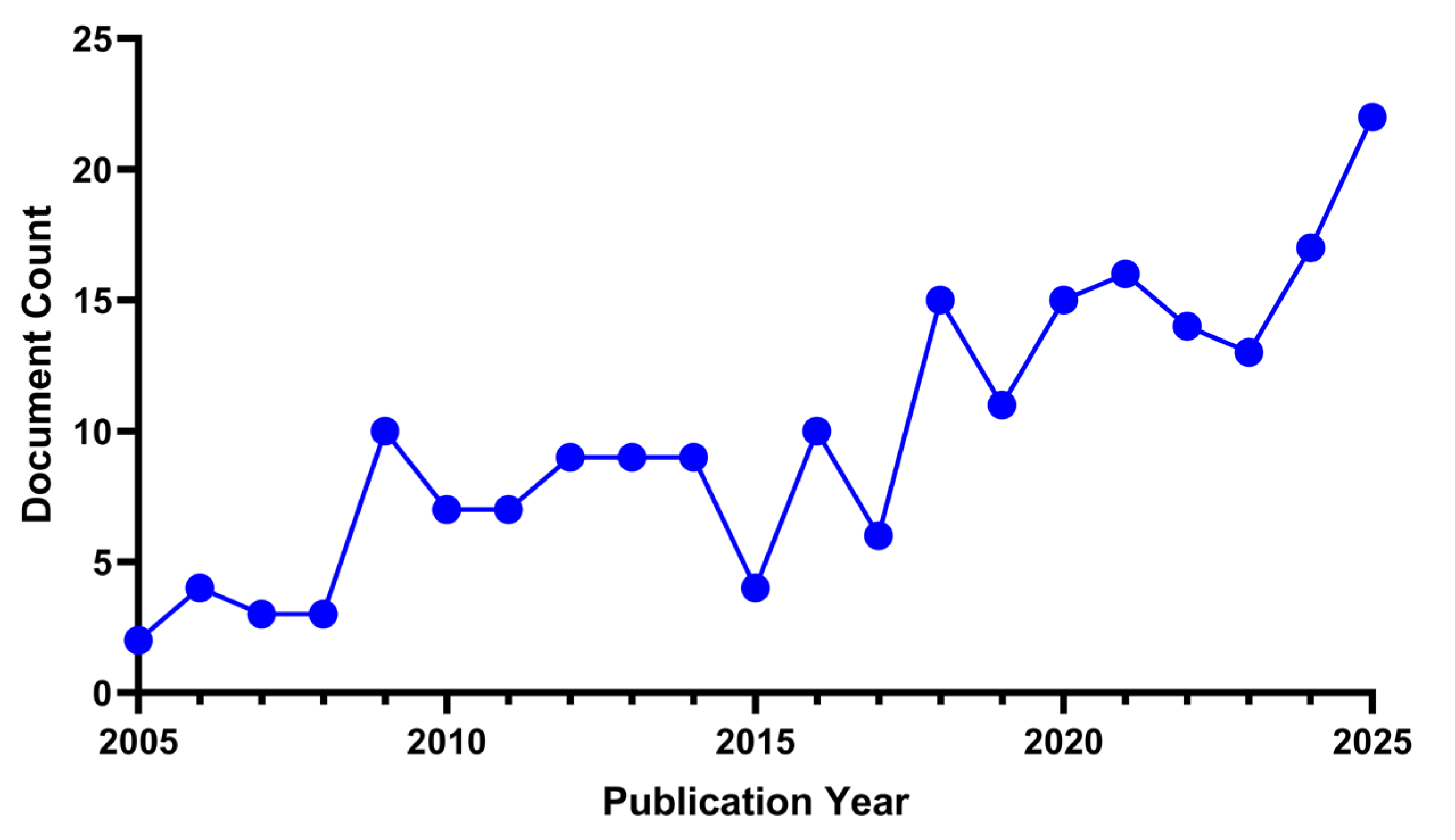
The analysis of scientific production in bio-hybridization and hydrogen production traces a developmental trajectory that reflects the academic community’s interest and reveals the influence of technological, political, and economic factors in consolidating the field [38]. Over the 2005–2025 period, the trend shown in Figure 1 evidences a sustained, though non-linear, increase in annual publications, consistent with the global surge of interest in green-hydrogen technologies that has been reported in recent bibliometric overviews on renewable hydrogen and power-to-X systems [39,40]. In fully indexed years (2005–2024), document counts increase from 2 to 17 publications, which corresponds to a compound annual growth rate of approximately 11–12%, clearly above the ~4% average growth reported for global scientific output in large-scale bibliometric analyses of publication databases [41,42]. From 2005 to 2025, document counts rose from 2 to 16 publications per year, suggesting an evolution from an exploratory phase toward disciplinary consolidation. This acceleration is consistent with recent bibliometric reviews on green hydrogen and hydrogen technologies, which also describe sharp post-2010 growth and thematic diversification in related areas [43]. However, this growth is not homogeneous and exhibits distinct phases whose inflection points can be associated with technological breakthroughs, changes in research investment, and the implementation of specific scientific and energy policies.
During the initial phase (2005–2010), scientific production was low and fluctuating, with annual outputs between 2 and 10 publications and a maximum of 10 in 2009. The increase from 2 to 10 documents over this short interval reflects a rapid but unstable growth pattern, typical of nascent research fronts in which few groups explore highly specialized topics with limited coordination. Similar exploratory dynamics have been reported in early stages of hydrogen–energy and green-hydrogen research, where small communities produced irregular but progressively more visible outputs before the topic was consolidated as a strategic line of energy research [43]. This behaviour indicates that bio-hybridization and hydrogen production were emerging fields characterized by a limited number of active research groups and technological infrastructure still under development. The evolution of scientific disciplines in renewable energies typically follows a pattern in which early advances depend mainly on access to funding and specialized equipment, thereby explaining the slow take-off of scientific production during this stage [44]. In these years, most contributions focused on proof-of-concept demonstrations of semi-artificial photosynthesis, isolated case studies in microbial fuel cells, or exploratory use of nanomaterials with photosynthetic organisms, without yet forming a clearly articulated research front—an exploratory pattern also described in early bibliometric mappings of hydrogen technologies.
From 2011 onward, academic output increased steadily, with values between 6 and 10 publications per year and a more pronounced acceleration from 2016 onward. If the 2011–2018 interval is considered, the number of documents rises from 7 to 15, which corresponds to an average growth rate of about 11–12% per year—comparable to the acceleration observed in broader hydrogen-production research during the same period, where bibliometric analyses report marked year-on-year increases in publication volume and expansion of international collaboration networks [43,45]. This “expansion phase” (2011–2019) is characterized by the progressive convergence of three lines that had previously evolved in parallel—photocatalytic nanomaterials, bioelectrochemical systems, and metabolic engineering—so that biohybrid hydrogen production begins to appear as a distinct topic in journal scopes and special issues. In this period, the annual number of documents rose from 7 in 2011 to 15 in 2018. This surge coincides with advances in developing new hybrid materials, applying synthetic biology tools, and improving the efficiency of photobiological hydrogen conversion systems. Integrating nanomaterials with photosynthetic systems has enabled the optimization of energy conversion, thereby encouraging the expansion of research in this area [46]. Concurrently, the growth in scientific production during this period aligns with increased international funding for green-hydrogen projects driven by global decarbonization and energy-transition policies. Bibliometric studies have demonstrated that investment in infrastructure and governmental support for scientific research is key to expanding an academic field [47]. The emergence of national hydrogen roadmaps and dedicated funding programs in Europe, Asia, and North America—recurrently highlighted in policy-oriented analyses available through platforms such as [39]—has contributed to stabilizing research groups and transforming isolated studies into more systematic research programs.
A third stage, beginning around 2018 and extending through 2024, corresponds to a “maturity phase” in which annual production remains consistently above 11 documents, with local maxima of 15 publications in 2018 and 2020, 16 in 2021, and a global maximum of 17 in 2024. In this interval, growth in annual output slows to around 2% per year, a pattern that mirrors the plateau of high productivity described for other green-hydrogen subfields once they reach thematic saturation and begin to emphasize optimization and deployment rather than mere feasibility [48,49]. The sustained high levels during 2018–2024 indicate that research in bio-hybridization has reached a phase of maturity, in which the volume of scientific production tends to stabilize around a high baseline due to the progressive saturation of the most-explored research areas. In technological fields, a surge in publications is often followed by a phase of stabilization or gentle decline as academic interest shifts toward industrial applications and specific technological developments [50]. In this context, the coexistence of studies on new biohybrid architectures with reports on pilot-scale operation and techno-economic constraints suggests that the field is transitioning from the exploration of feasibility to the optimization and integration of viable configurations within broader hydrogen-economy scenarios [50].
In contrast to the earlier version of the dataset, the updated curve does not show an abrupt collapse in 2025 but rather a slight decrease from 17 to 16 documents relative to 2024. Because data for 2025 were collected while the year was still in progress, this value should be regarded as provisional and interpreted mainly in descriptive terms. When considered together with the 2018–2024 plateau, the provisional 2025 output reinforces the view that the period 2018–2025 is characterized by a stable but dynamic research front, in which incremental innovations and pilot-scale demonstrations coexist with exploratory work on new biohybrid configurations [50]. Under this reading, the stabilization of annual output reflects not a loss of interest but a partial reallocation of research effort toward translational activities—such as integration with energy-storage infrastructures and assessment of system-level performance—which, as emphasized in recent green-hydrogen reviews, are less publication-intensive yet crucial for the technological deployment of hydrogen technologies [45].

3.2. Geographic Distribution and International Collaborations

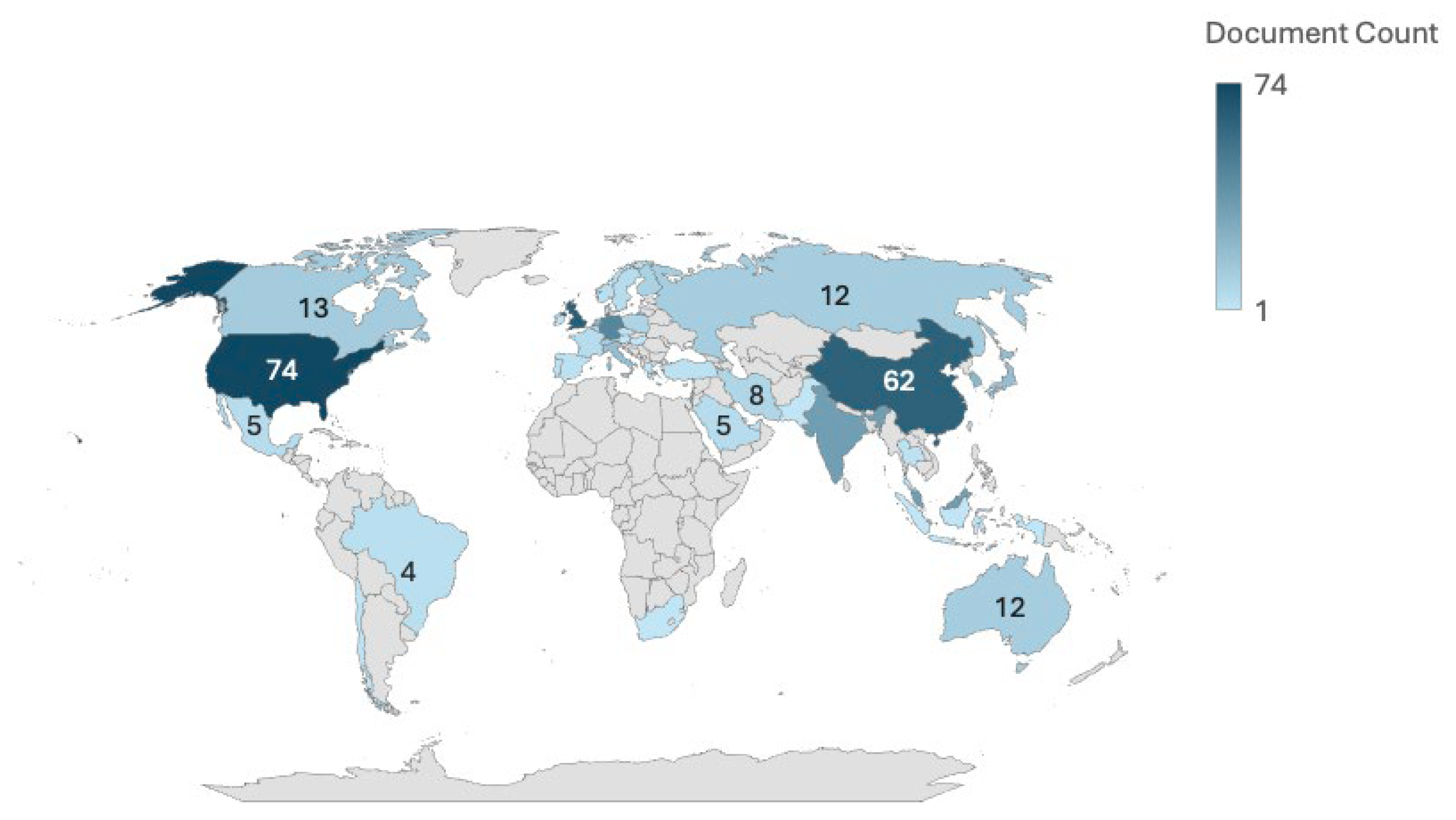
The analysis of scientific output in bio-hybridization and hydrogen production illustrates a clearly asymmetric global pattern that reflects where scientific interest is concentrated and, at the same time, mirrors broader technological, political, and economic asymmetries that condition the consolidation of the field (Figure 2) [38]. The US ranks first in scientific output, with 74 publications, followed by the UK (64), China (62), and Germany (45). These countries are implementing strategies to facilitate the assimilation of biohybrid technologies into their energy transitions through university programmes and research in specialized centres funded by governments and industrial partners [38]. Similar hierarchies have been reported in broader bibliometric mappings of hydrogen and renewable-energy research, where high-income economies with large R&D budgets and dedicated hydrogen strategies concentrate most publications and occupy central positions in collaboration networks, while middle-income countries occupy more peripheral or specialized positions [43,51]. These studies relate the geographic concentration of output to cumulative advantages in public funding, large-scale experimental infrastructure and the presence of specialized research centres [52].
In the United States, some of the most significant advances in bio-photoelectrochemical cells and the optimization of biological catalysts can be attributed to a dense network of universities and national laboratories (such as the Massachusetts Institute of Technology (MIT), Stanford University, and Arizona State University) supported by agencies including the Department of Energy (DOE) and the National Science Foundation (NSF). Long-term federal programmes on artificial photosynthesis, bioelectrochemical systems, and nanostructured catalysts have funded large research consortia, reinforcing the role of these institutions as central “hubs” that connect academic, industrial, and governmental actors [53]. Recent bibliometric studies on green hydrogen identify US institutions among the most central nodes in international co-authorship networks and underline the strong coupling between public investment and high-impact research output in this field [54].
In contrast, the United Kingdom has oriented a substantial share of its output toward applied bioelectrochemistry and artificial photosynthesis, developing advanced energy-conversion systems through institutions such as the University of Cambridge (38 publications) and the University of Bristol. Its sustained investment in nanotechnology and bioelectronic interfaces has supported the implementation of highly efficient hybrid systems, consolidating its position as a key actor in the optimization of biohybrid architectures [55]. This profile aligns with broader UK strategies that prioritize high-value-added, knowledge-intensive technologies, in which hydrogen and advanced materials are defined as strategic sectors for economic growth and exportable innovation [56]. Consequently, the UK contribution is especially visible in clusters related to electrode design, charge transfer, and nano–bio interfaces rather than in bulk biomass conversion [57].
China’s contribution, with 62 papers, reflects a different trajectory. National programmes in renewable energy and hydrogen have emphasized building domestic technological capacity and large-scale experimental infrastructure, which is consistent with the prominent role of institutions such as the Chinese Academy of Sciences in developing nanomaterial-assisted artificial photosynthesis and biophotocatalytic systems [58]. Scientometric analyses of green-hydrogen and energy research show that China combines very high publication volumes with collaboration patterns that are more strongly oriented toward national partners than those observed for Western countries, despite growing international links [54]. This configuration has been interpreted as a “productivity core” anchored in domestic funding structures, where rapid capacity building and technology testing are driven by state-led hydrogen roadmaps and large industrial actors, while international co-authorship plays a comparatively smaller role in knowledge production [59]. In our dataset, this helps interpret China’s position as a core producer that is somewhat less dependent on international collaboration, which may accelerate local technological learning but can also slow the global diffusion of specific process designs or materials if results remain concentrated in national circuits [54].
Germany, with 45 publications, occupies a central position in Europe. A significant portion of this output originates from institutions with a strong tradition in biochemistry and electrochemistry, such as Ruhr University Bochum, which has played a leading role in fundamental studies on hydrogenases and nitrogenases and in the design of advanced bioelectrochemical systems. The development of industrially oriented models grounded in these data has been supported by organizations such as the Deutsche Forschungsgemeinschaft (DFG) and the Fraunhofer Society [60]. At the national level, Germany has combined long-standing basic research funding with targeted hydrogen initiatives and import strategies that seek to link laboratory-scale innovation with pilot- and demonstration-scale projects in collaboration with industry and partner countries [61]. This combination of basic enzymology and applied engineering is reflected in the country’s profile within the field, where German groups tend to link highly cited fundamental references with more recent work on materials and reactor engineering, acting as conceptual and technological “bridges” in international networks [61].
The growth in India and Malaysia, each with 34 publications, is largely driven by their interest in exploiting agricultural waste and biomass for biohydrogen production. In particular, the University of Malaya, with 25 publications, has been a key player in developing optimization strategies in dark fermentation, increasing energy yield and reducing production costs [62]. Numerous reviews and regional assessments document that South and Southeast Asia possess substantial technical potential for producing biohydrogen and other biofuels from agro-industrial residues such as rice straw, sugarcane bagasse and palm-oil mill effluent, and that policy pressure to improve waste management has stimulated research on valorising these streams rather than relying on high-purity reagents [63]. This pattern is coherent with the broader literature on biohydrogen from agro-industrial residues in South and Southeast Asia, where abundant biomass and strong environmental regulations on waste disposal have favoured research lines based on dark fermentation and integrated waste-to-energy schemes [64].
Similarly, the Netherlands (24 publications) and South Korea (23) have focused their research on implementing biohybrid materials to enhance solar energy conversion into hydrogen, contributing to the diversification of available technologies in the sector [65]. Both countries have adopted national hydrogen strategies that emphasize export-oriented clean-tech solutions and large-scale demonstration projects: the Netherlands aims to become a key European hub for offshore-wind-based hydrogen production and export [66]. whereas South Korea’s Hydrogen Economy Roadmap and Green New Deal programmes allocate substantial public and private investment to hydrogen technologies as a pillar of industrial competitiveness [67]. These policy frameworks help explain why both countries combine strong materials science with pilot-scale demonstrations and why their institutions appear as well-connected nodes in the international collaboration network [54].
Regarding other nations with fewer publications, Italy and Japan (19 each) have explored integrating advanced photovoltaic systems with biohydrogen production, while Israel (15) and Canada (13) have concentrated on stabilizing biological catalysts and improving conversion efficiency. Australia and Russia, with 12 publications each, have addressed optimization strategies for biohydrogen production from wastewater, whereas Singapore and Switzerland (11 each) have worked on bioreactors adapted to specific climatic and urban conditions. Several reviews on hydrogen generation from wastewater and real-world waste streams highlight the importance of these niche applications for linking hydrogen production with local environmental management challenges [68]. In the cases of Finland and Taiwan (10 publications each), their research has focused on hydrogen production from lignocellulosic sources and the implementation of bioelectrochemical cells [65]. Together, these countries form an intermediate “semiperipheral” band: their publication volumes are lower than those of the core group, but they often specialize in niche topics (e.g., cold-climate reactors, wastewater-based systems, or specific nanomaterials) that occupy peripheral yet structurally important positions in the collaboration network, a pattern repeatedly described in scientometric analyses of renewable-energy technologies and scientific co-authorship networks [69].
Other countries with even lower publication volumes still play a non-trivial role in diversifying biohydrogen production strategies. With five publications each, France, Mexico, and Saudi Arabia have begun integrating hybrid hydrogen-generation processes into broader bioenergy and circular-economy agendas. Brazil, Denmark, and Norway have explored agricultural waste as a substrate for biohydrogen production, in line with their strong bioeconomy and renewable-energy policies, while Spain, Portugal, and Thailand have started incorporating biohydrogen into their sustainable energy strategies, although their scientific output remains limited [70]. From an interpretive standpoint, these contributions suggest that the global research system on biohybrid hydrogen exhibits a typical core–semiperiphery–periphery structure, in which a small group of countries defines much of the research agenda and the main methodological frameworks, whereas a wider set of emerging and peripheral actors tests context-specific applications [71,72].

3.3. Co-Occurrence Analysis and Thematic Clustering in Biohybrid Hydrogen Production Systems

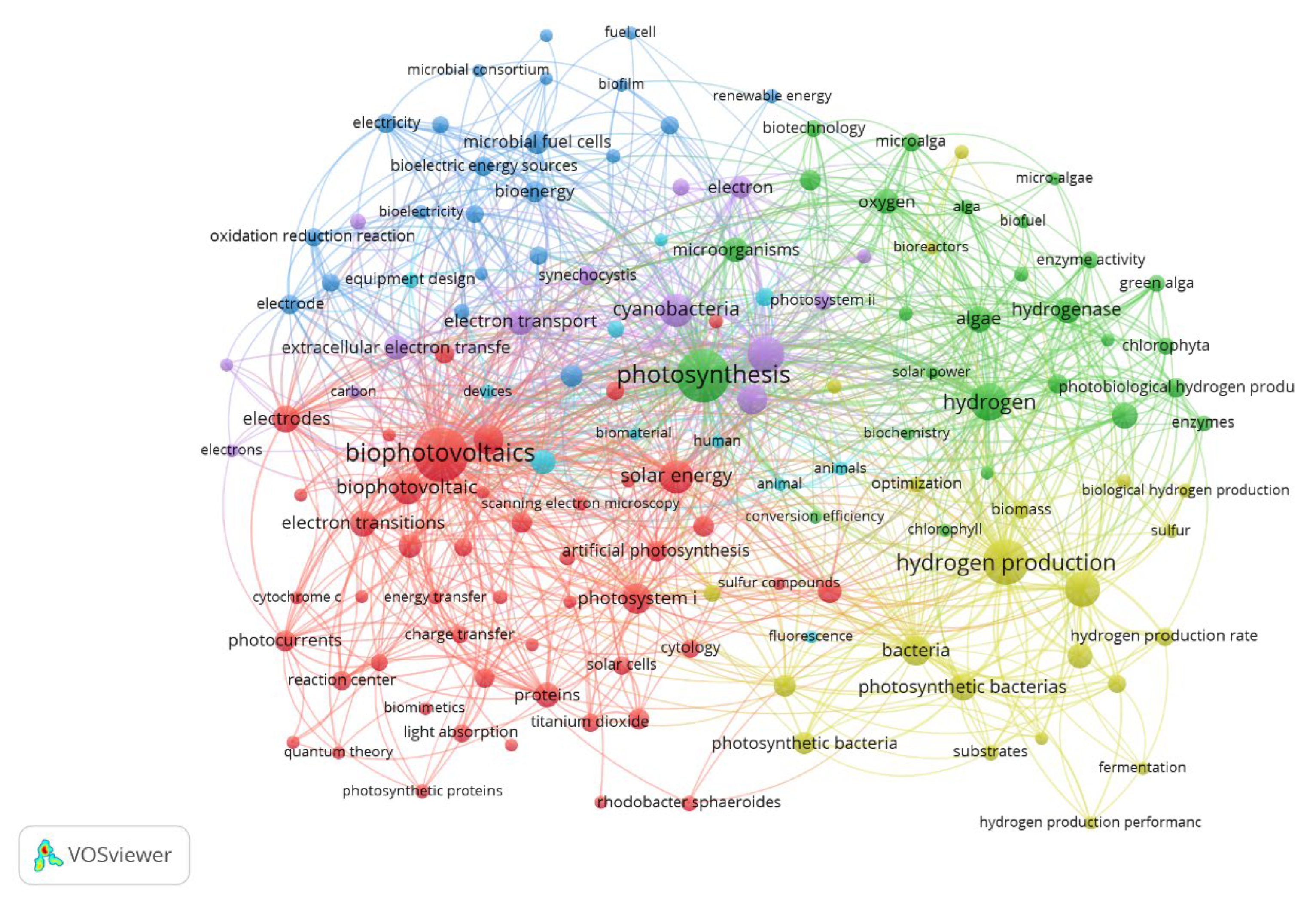
The co-occurrence analysis of index and author keywords reveals the predominance of photosynthesis in the semantic network, confirming its role as the conceptual anchor of biohybrid hydrogen research (Figure 3). The photosynthesis node displays a high degree and betweenness centrality, linking terms associated with biological hydrogen production, biophotovoltaics, microbial fuel cells, and artificial photosynthesis. This configuration matches previous VOSviewer-based maps of biohydrogen and artificial photosynthesis, where keywords related to natural photosystems systematically occupy central positions connecting biochemical, materials-science, and engineering vocabularies [73] and similar bibliometric landscapes for microalgal biohydrogen and green-hydrogen technologies [74]. The overall topology, therefore, indicates that the field is organized around a photosynthesis-centred core from which several specialized technological trajectories radiate, rather than around purely electrochemical or catalytic concepts. Four major clusters can be distinguished, each corresponding to a partially different strategy for coupling light harvesting, charge transfer and catalytic hydrogen formation.
Green cluster. This cluster is oriented toward hydrogen and biofuel production and is dominated by terms such as hydrogenase, bioreactors and metabolic engineering. Recent reviews on photobiological and fermentative biohydrogen production show that enzyme stability, oxygen sensitivity and competing metabolic pathways continue to be key bottlenecks for practical deployment [75]. Consistent with these findings, the co-occurrence structure highlights strategies aimed at protecting or redesigning catalytic machinery: encapsulation of hydrogenases in nanostructured matrices to enhance activity and lifetime in continuous reactors [76], metabolic engineering of photosynthetic microorganisms to redirect fluxes toward hydrogen production [77], and, more recently, protein-engineering approaches to obtain oxygen-tolerant [NiFe] and [FeFe] hydrogenases [78,79]. The prominence of enzyme- and reactor-centred terms, together with the very low frequency of keywords related to “techno-economic analysis”, “scale-up” or “life cycle assessment”, indicates that most contributions in this cluster still prioritize overcoming intrinsic biological constraints over system-level optimization. This imbalance is striking when compared with the broader green-hydrogen literature, where techno-economic assessment and LCA have become standard tools for evaluating production routes [80].
Purple cluster. This cluster is associated with biophotovoltaics and electron–transfer optimization and is structured around terms such as biophotovoltaics, electron transport, charge transfer, electrodes and quantum dots. The dense connectivity between these nodes reflects a shared design problem: how to engineer fast and directional electron flow across soft–hard interfaces without compromising biological integrity. Experimental work on biohybrid photosystem-based electrodes demonstrates that coupling photosystem I or whole thylakoid membranes to semiconductor or conjugated-polymer scaffolds can substantially enhance light harvesting and photoinduced charge separation [81] and more recent perspectives highlight conjugated organic semiconductors as promising alternatives to traditional metal oxides in these architectures [82]. The co-occurrence of terms associated with interfacial engineering and energy-level alignment, together with the relative scarcity of keywords such as durability, lifetime, or module-scale device, suggests that long-term stability and outdoor validation of biophotovoltaic systems remain underdeveloped topics despite their importance for real-world deployment.
Red cluster. Centred on extracellular electron transfer, this cluster links strongly with microbial fuel cells, bioelectricity, anode materials and biofilms. The network structure indicates that bioelectrochemical approaches to hydrogen are framed predominantly as “electron logistics” problems—how to extract, route and harvest electrons from electrogenic microorganisms—rather than as direct hydrogen-generation problems. This is coherent with recent bibliometric analyses of microbial fuel cell research, which identify electron transfer, performance and anode as the most frequent and central keywords, whereas hydrogen recovery appears much less prominently [83,84]. Experimental studies confirm that combining conductive nanomaterials with electroactive biofilms or tailoring anode microstructure can dramatically increase current densities and coulombic efficiencies [85]. However, the relative invisibility of terms such as gas upgrading, hydrogen separation, or grid integration within this cluster again underscores the limited attention devoted so far to integrating bioelectrochemical hydrogen into larger energy-system architectures.
Yellow cluster. This cluster groups terms related to artificial photosynthesis and photoactive materials, including titanium dioxide, photosystem I, nanomaterials and solar cells. The prominence of semiconductor chemistry and light-harvesting components reflects a research agenda strongly oriented toward maximizing photon-to-electron conversion efficiencies, often inspired by advances in purely inorganic photocatalysis and photoelectrochemical water-splitting [86]. Recent work on bioinspired and biohybrid artificial photosynthetic systems shows that integrating photosystems with metal-oxide or molecular catalysts can significantly improve charge separation and catalytic turnover [87] and high-resolution structural studies of PSI–metal nanoparticle hybrids are beginning to reveal the design principles of efficient solar-fuel catalysts [88,89]. At the same time, the near absence of keywords related to critical raw materials, resource scarcity, or environmental assessment indicates that the sustainability implications of nanomaterial selection—central in current debates on large-scale hydrogen technologies [55]—are still marginal within the conceptual space of biohybrid solar-fuel research.
Overall, the co-occurrence network not only maps the main technological trajectories in biohybrid hydrogen production but also reveals asymmetric attention to different stages of the innovation chain: strong emphasis on biochemical and interfacial mechanisms, limited integration of economic, environmental and systems-level considerations, and a still incipient presence of modelling and AI-related concepts, which becomes even more evident when analyzing the temporal evolution of keywords.

3.4. Evolution of Knowledge in Biohybrid Systems for Solar Fuels and Hydrogen: Temporal Dynamics and External Influences

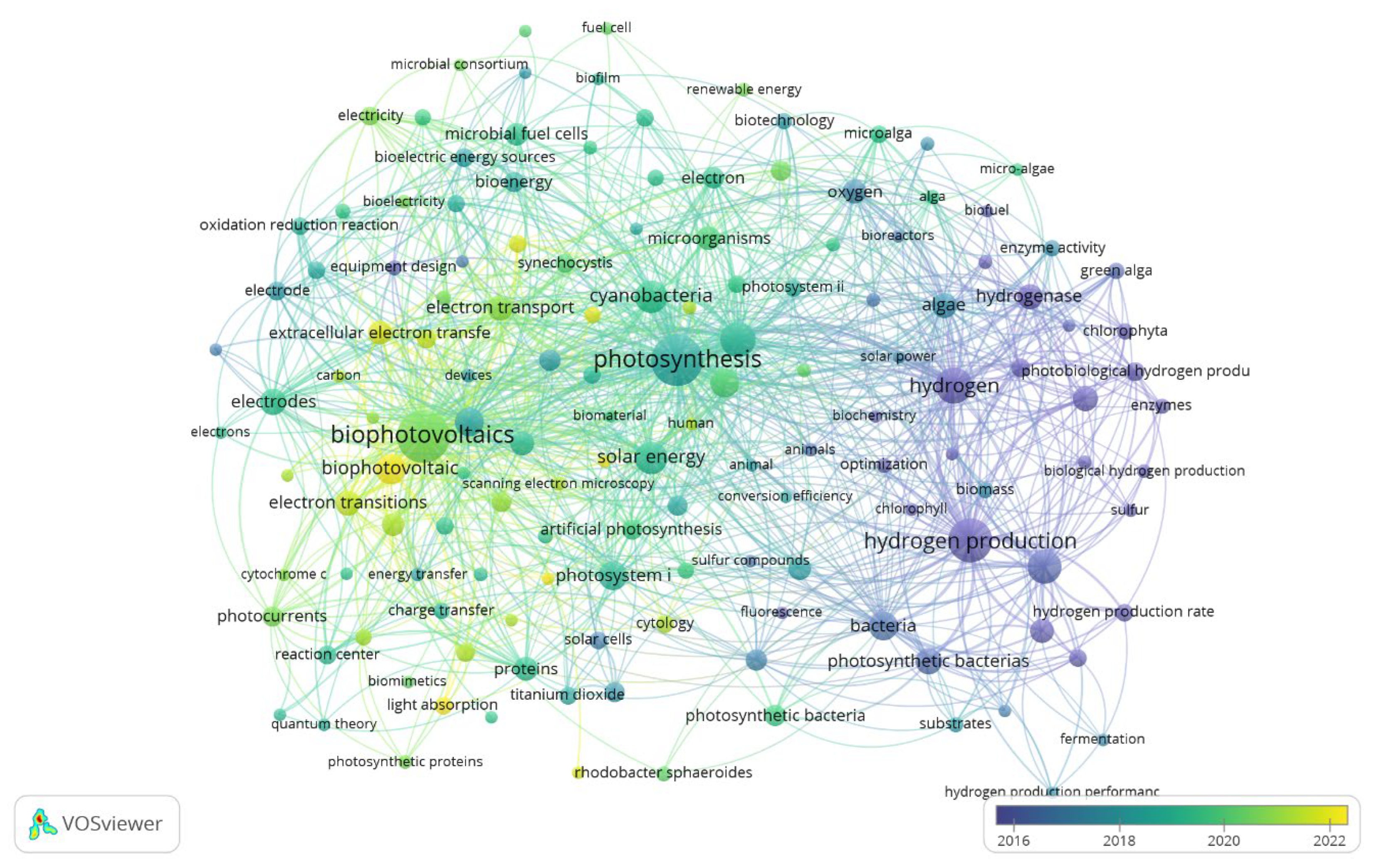
The evolution of knowledge in biohybrid systems for solar fuels and hydrogen, visualized through the VOSviewer overlay map (Figure 4), exhibits a clear temporal structuring of research topics. In this representation, node colour encodes the average publication year of each keyword (from yellow for earlier to dark blue for more recent terms), node size is proportional to occurrence frequency and link thickness reflects co-occurrence strength. This follows standard VOSviewer methodology for temporal overlays, where colour gradients reveal emerging and declining topics within a single network [90] and is consistent with other bibliometric applications of overlay maps in energy and environmental research [91].
In the earliest part of the overlay (average years around 2016–2018), the most central and relatively older nodes correspond to the characterization of natural photosystems and fundamental photobiology: terms such as photosystem I, reaction centre, electron transport, cyanobacteria and solar energy appear in yellow-green tones. This pattern indicates that the field initially concentrated on understanding the mechanisms of light harvesting and charge separation in native biological systems, a prerequisite for identifying viable interfaces with synthetic components [81]. Similar early-stage emphases on photosynthetic fundamentals are reported in bibliometric analyses of microalgal hydrogen production and artificial photosynthesis [74]. At the same time, terms such as biophotovoltaics and extracellular electron transfer already appear connected to these cores, suggesting that some research groups were beginning to explore device-oriented architectures—bioelectrochemical cells, biophotovoltaic devices and semiartificial photosynthetic systems—on top of the photobiological knowledge base [43].
As time progresses (average years ~2019–2020), the overlay shows a displacement of high-weight nodes toward more applied concepts such as bioreactors, hydrogen production, bioelectricity and optimization. This shift reflects an agenda change from elucidating isolated biochemical processes to designing and scaling integrated systems capable of sustained hydrogen generation. The increasing co-occurrence of enzymes, metabolic engineering and synthetic biology indicates the adoption of systems- and synthetic-biology toolkits to redirect metabolic fluxes toward hydrogen formation and mitigate intrinsic limitations such as oxygen sensitivity, competing carbon–fixation pathways, or low catalytic turnover [92]. Reviews on hydrogenase-driven photobiological hydrogen production corroborate this transition, highlighting protein engineering, expression of non-native hydrogenases and re-wiring of photosynthetic electron flow as central strategies for achieving industrially relevant rates [93]. Concurrently, stronger links between nanomaterials, titanium dioxide and quantum dots confirm that inorganic components evolved from simple light-harvesting enhancers to essential elements for charge separation and long-term stability in biohybrid architectures [87]. High-resolution structural and spectroscopic studies on PSI–metal nanoparticle hybrids and related semiartificial systems [88,89] exemplify this trend by linking nanoscale design rules to macroscopic solar-fuel performance.
The temporal clustering of these terms is consistent with external drivers in the energy system. The period 2018–2022 coincides with the approval and early implementation of major policy frameworks—such as the European Green Deal and its Hydrogen Strategy [94] and the US Inflation Reduction Act substantially increased funding for green hydrogen and related enabling technologies. Recent bibliometric and techno-economic studies in adjacent hydrogen domains show that such policy shocks are followed by accelerations and reorientations in publication activity, with a growing share of papers focusing on system integration, cost metrics and feasibility [80]. In Figure 4, the emergence of terms such as efficiency, biomass and photobiological hydrogen production in the more recent colour range aligns with this external context, signalling a gradual reorientation of biohybrid research toward pre-industrial and demonstrative stages [95].
From an interpretative perspective, the overlay also shows that different technological trajectories within biohybrid hydrogen production have evolved at distinct paces. Keywords associated with bioelectrochemical systems and bioelectricity display later average years and tighter interconnections, indicating that this line has gained momentum more recently—likely due to its compatibility with intermittent renewable electricity and the possibility of physically separating H2 and O2 in microbial electrolysis or hybrid MFC configurations [85]. Bibliometric assessments of microbial fuel cell research report similar temporal patterns, with a surge of publications on anode materials, scale-up and wastewater applications after 2015 [83,91]. In contrast, several terms linked to purely photobiological routes appear in older colour ranges and show weaker recent growth, suggesting that these concepts have reached a plateau in fundamental understanding and are being progressively embedded within hybrid electro-photobiological designs [47].
Finally, the absence—or very low frequency—of certain concepts in the overlay map is also informative. Terms explicitly associated with techno-economic analysis, life-cycle assessment, or machine learning/AI-assisted design either do not surpass the minimum occurrence threshold or appear with marginal connections, despite their rapidly growing importance in the wider green-hydrogen literature. Recent studies combine process simulation, TEA and optimization to benchmark hydrogen production routes and explore geographical variability in costs [80,96], while machine-learning approaches are increasingly used to forecast hydrogen prices or guide catalyst discovery [97]. This under-representation reveals a structural gap between the experimental development of biohybrid systems and their quantitative evaluation in terms of cost, environmental performance and computational optimization. they also indicate that biohybrid hydrogen research remains predominantly laboratory-centred, with integrative systems-level and data-driven approaches still at an incipient stage compared with other areas of green-hydrogen science.

3.5. Co-Citation Network Analysis in Biohybrid Systems for Hydrogen Production: Structural Patterns and Knowledge Evolution

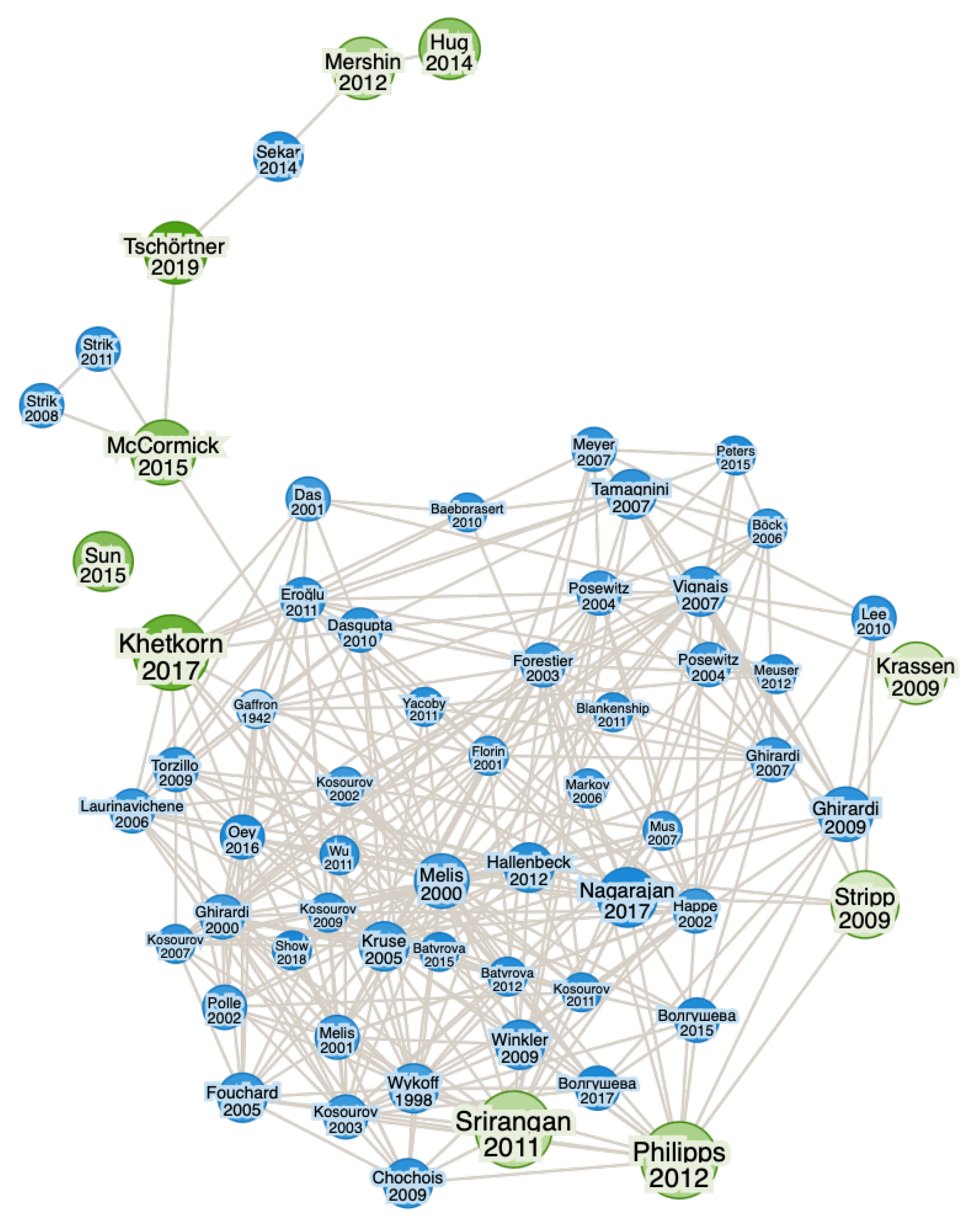
The co-citation network (Figure 5) reveals how a relatively small set of seminal articles has structured knowledge on biohybrid hydrogen production and how newer contributions are progressively extending this foundation into adjacent technological domains. In the dense central core of the map, highly connected nodes such as Melis [98], Kosourov [99] and Kruse [100] correspond to the first systematic demonstrations of photobiological hydrogen generation in green microalgae under sulfur-deprivation or related stress conditions, which established the conceptual link between photosynthetic regulation, hydrogenase activation and sustained H2 evolution. These works are repeatedly co-cited with classic studies on algal physiology and light-conversion efficiency, which explains their high degree and their role as a common point of reference for later improvements in reactor design and process engineering.
Around this nucleus, the network shows a cluster of strongly interlinked reviews and methodological papers—including Srirangan et al. [101] and Nagarajan et al. [102]—that synthesize advances in dark, photo-fermentative and photobiological routes and compare their yields, substrates and process constraints across microorganisms and reactor configurations [11]. Their position in the map, simultaneously connected to early algal studies and to more recent work on metabolic engineering, indicates that these articles function as “conceptual hubs”: they codify the state of the art, make cross-technology comparisons explicit and, in doing so, orient subsequent research agendas toward issues such as electron-flow bottlenecks, cofactor balancing and scalability.
The co-citation structure also highlights a set of nodes associated with the molecular biochemistry of hydrogenases, notably the contributions of Krassen [103], Stripp [104] and Philipps [105]. These papers dissect oxygen sensitivity, active-site dynamics and electron–transfer pathways in [FeFe] and [NiFe] hydrogenases and explore semi-artificial architectures in which purified enzymes are wired to electrodes or light absorbers. Their strong interconnection with the algal core indicates that the photobiological route and hydrogenase biochemistry have co-evolved as mutually reinforcing lines of inquiry: the former providing the cellular context, the latter clarifying the catalytic and stability limits that must be overcome for industrial operation. The prominence of these nodes is consistent with the recurrent appearance, in the co-occurrence and thematic analyses, of terms such as “oxygen sensitivity”, “enzyme stability” and “electron transport”, showing how mechanistic constraints have shaped the entire research field.
At the same time, the upper-left region of the network contains more peripheral yet structurally important nodes associated with biophotovoltaics and living solar cells, such as McCormick et al. [106], Mershin et al. [107] and Tschörtner et al. [108]. These works explore the direct harvesting of photosynthetic electrons in bio-photoelectrochemical devices and discuss materials, architectures and performance metrics for long-term power generation using cyanobacteria, algae, or thylakoid membranes. Their relatively lower connectivity compared to the central algal–hydrogenase cluster reflects their emergence as a younger research front; however, their links to both photosynthetic physiology papers and electrochemical engineering studies indicate that they act as bridges between biological energy conversion and device-scale optimization. The co-citation of these articles with methodological and review papers on bioelectrochemical systems suggests that, in the last decade, the field has begun to converge around hybrid configurations that integrate hydrogen production, extracellular electron transfer and electricity generation within the same conceptual framework.
Another pattern revealed by the map is the presence of small satellite clusters in which recent authors—for example, Khetkorn [109], Sun [110] or Oey [111]—are co-cited with both early microalgal work and process-engineering studies. These groups tend to focus on improving light utilization, nutrient management and genetic control of photosynthetic organisms, often in tandem with reactor-scale analyses or techno-economic considerations. Their peripheral but connected position suggests that they are consolidating specialized niches—such as outdoor cultivation, biomass valorization, or two-stage processes coupling biomass production and hydrogen release—that draw heavily on the conceptual core but are already oriented toward application in specific climatic or industrial contexts.
From a bibliometric perspective, the contrast between the dense central core and the more weakly connected periphery indicates a mature yet expanding field. The central cluster aggregates highly co-cited works that define the canonical knowledge base on algal hydrogen production and hydrogenase function; their high degree and strong mutual links are typical of “intellectual bases” identified in co-citation studies of other technological domains [112]. In contrast, the peripheral nodes with high betweenness—such as the biophotovoltaic and semi-artificial photosynthesis articles—behave as “bridging” references that connect otherwise separate subfields (photosynthesis research, materials science, electrochemistry). This structural role helps explain why, in the thematic evolution analysis, terms associated with nanomaterials, quantum dots and bioelectrochemical devices appear later in time but rapidly gain centrality: their emergence is supported by a co-citation backbone that already links photosynthetic biology with device engineering.
The geographic patterns discussed in Section 3.2 are consistent with this structure. Many of the foundational and bridging articles in the co-citation network originate from research groups in the United States, Germany and the United Kingdom—countries that dominate the publication map and host leading centres in photosynthesis, hydrogenase biochemistry and bioelectrochemistry [11]. Likewise, the peripheral clusters associated with biophotovoltaics and hybrid devices are strongly connected to authors based in Germany and the UK, reflecting institutional investments in nanomaterials and artificial photosynthesis that were also evident in the country-level analysis. This overlap between structural roles in the co-citation network and national research profiles suggests that the global leadership of a few countries is not only quantitative (number of articles) but also qualitative in terms of their capacity to generate widely shared conceptual frameworks and cross-disciplinary bridges.

3.6. Overview of the Most Influential Literature on Biohybrid Systems for Renewable Hydrogen

At the core of the co-citation network on biohybrid systems for renewable hydrogen lies a set of experimental and review contributions that articulate the transition from basic photobiology to hybrid energy-conversion devices. These works have established the four main research lines identified in this field—artificial photosynthesis, bioassisted photocatalysis, bioelectrochemical systems, and enzymatic methods—and have acted as interdisciplinary bridges within the knowledge network. For instance, pioneering studies such as [99,113] constitute the central conceptual core: they demonstrated the feasibility of enhanced artificial photosynthesis in microalgae, achieving sustained molecular hydrogen (H2) production through sulfur deprivation in Chlamydomonas to overcome oxygen inhibition. These findings underpinned the pathway of direct water photolysis using Photosystem II (PSII) and [Fe-Fe] hydrogenase, and validated nutrient deprivation (especially sulfur) as an effective strategy to activate biophotonic hydrogen production. Indeed, later studies indicate that sulfur deprivation is the most practical biological method—compared with other nutrient limitations (N, P, Mg)—for generating photosynthetic hydrogen [114].
These contributions laid the foundations of hybrid artificial photosynthesis, inspiring efforts to emulate and surpass natural efficiency with synthetic components. A notable advance in this direction was the incorporation of nanomaterials as artificial antennae: [115] showed that semiconductor quantum dots coupled to bacterial photosynthetic reaction centres can increase the excitation rate in the photosystem by nearly threefold, extending light harvesting beyond natural pigments. This bio-nano approach enhanced solar energy conversion while preserving biological selectivity, exemplifying the synergy between photobiology and nanotechnology. Likewise, integrative reviews such as [101] articulated biochemical and genetic strategies to overcome thermodynamic bottlenecks in microalgae (low solar capture efficiency, enzymatic sensitivity to O2), thereby consolidating a bridge to synthetic biotechnology. Thanks to these contributions, the community was able to define efficiency targets and identify the most promising photobiological routes (direct and indirect photolysis versus photoassisted fermentation) for the development of improved artificial photosynthesis devices.
From a mechanistic standpoint, these advances can be organized into three main bio-photolytic routes: direct photolysis, in which microalgae use light energy to split water molecules and produce H2 simultaneously with oxygen (O2); indirect photolysis, which temporally decouples both processes by first accumulating carbohydrates that are subsequently fermented under anoxic conditions; and photofermentation, where photoheterotrophic bacteria degrade organic substrates via nitrogenases under illumination, [23,116,117]. Each route starts from different feedstocks (water and carbon dioxide, CO2, in photolysis; organic biomass in fermentation) and generates gas mixtures of H2 with O2 and/or CO2 that require downstream capture and purification. In parallel, modern biohybrid systems have incorporated catalysts, electrodes, and photoelectrochemical configurations that enhance energy-conversion efficiency beyond the physiological limits of microalgae and cyanobacteria [118].
Pilot-scale operation, in turn, demands a well-structured sequence of stages—cultivation, microbial conditioning, gas capture, and separation—within which residual media such as wastewater or CO2-rich industrial streams have been explored to reduce costs and link H2 production with effluent treatment [119].
In bioassisted photocatalysis, where inorganic semiconductors are coupled with biological catalysts, seminal articles have opened a highly interdisciplinary subfield. An early milestone is represented by the bioinorganic systems of King and co-workers, who coupled purified hydrogenase enzymes with CdS/CdTe nanoparticles to achieve photocatalytic H2 production [120,121]. These semi-artificial assemblies achieved high quantum efficiencies for solar conversion, leveraging the strong absorption of nanocrystals and the high catalytic activity of the enzymes. However, they also revealed critical limitations: the O2-sensitive nature of [Fe-Fe] hydrogenases and the instability of isolated enzymes reduced practical yields [122]. To address these gaps, more recent studies have introduced biochemical innovations that integrate the components in situ. For example, ref. [123] reported a biohybrid photocatalytic system based on genetically modified Escherichia coli engineered to (1) display metal-chelating proteins on their surface and (2) biosynthesize CdS nanocrystals attached to the cell envelope. Through this strategy of cellular “self-photosensitization”, combined with biomimetic silica encapsulation that protects biocatalysis, the authors achieved continuous photocatalytic H2 production for 96 h under aerobic conditions. This result is particularly critical: it overcame the oxygen intolerance barrier that had previously constrained bioinorganic systems, demonstrating that hydrogenase activity can be maintained in the presence of air thanks to matrix protection and controlled cell self-aggregation.
Similarly, ref. [124] extended the concept of bioassisted photocatalysis to new microorganisms and products by showing that a non-photosynthetic methanogenic archaeon (Methanosarcina barkeri), coupled with CdS nanoparticles, can fix CO2 into methane (CH4) using light. This methanogen–CdS biohybrid system achieved quantum efficiencies (~0.34%) comparable to those of natural photosynthetic systems, evidencing efficient transfer of photoinduced electrons via membrane proteins (hydrogenases and cytochromes) of the microorganism. These disruptive findings not only diversify the energy vectors obtainable (H2, CH4, etc.) but also highlight the role of nano-bio interfaces (nanowires, quantum dots, semiconductors) in improving electron transfer and solar-spectrum utilization in biohybrid platforms.
Another group of foundational works has driven the integration of bioelectrochemical systems into the domain of renewable hydrogen. These systems exploit biological components coupled to electrodes to conduct or extract electrons from redox reactions, enabling, for example, electrically assisted H2 generation. In the co-citation network, studies such as [104,125] occupy linking positions between pioneering photosynthetic research and the most recent trends in bioelectrochemistry, providing detailed insights into the catalytic mechanism and O2 vulnerability of algal [Fe-Fe] hydrogenase—information that has been crucial for the design of more efficient bioelectrodes. In parallel, ref. [126] demonstrated that nitrogen deprivation in Chlamydomonas activates alternative metabolic pathways for photosynthetic H2 production, thus expanding physiological manipulation strategies beyond sulfur limitation. These and other contributions [107,120,127] have been essential in connecting traditional photosynthetic biology with modern electrochemical approaches.
A concrete example is the immobilization of photosynthetic complexes or enzymes on electrodes to create biohybrid photoelectrochemical cells. Ref. [128] summarized key advances in this area, emphasizing that oriented immobilization of PSII on conductive surfaces allows the direct extraction of photogenerated currents from water splitting. In such semi-artificial configurations, electrons released from H2O by PSII are captured by the electrode and redirected to H2-evolving reactions at a biological or chemical cathode, eliminating intermediate steps of the natural photosynthetic chain. This has led to solar-to-fuel conversion efficiencies exceeding 10%, far above the <1% typically observed in intact microalgae. Moreover, the modularity of photoelectrochemical systems enables flexible coupling of different catalysts (enzymatic or synthetic), thereby enhancing the potential for simultaneous or sequential production of multiple solar fuels [129].
From an energy-transition perspective, bioelectrochemical systems offer the advantage of storing intermittent renewable electricity in the form of hydrogen. Developments in microbial electrolysis cells show that it is feasible to use surplus wind or solar power to drive electrochemical bioreactors that generate H2 with the aid of microbial biocatalysts, thereby linking the bibliometric findings on bioelectrochemistry clusters to concrete opportunities for technological deployment [130].
Conversely, purely enzymatic and biochemical methods constitute a complementary line of research in which the achievements of the most cited articles have also been decisive. This category encompasses both dark fermentative processes and in vitro systems with isolated enzymes. Several critical analyses, for example, ref. [5] stressed that no single biological method was economically competitive at that time, but outlined routes to enhance the application potential of algae and cyanobacteria through metabolic and process engineering. A consensus emerging from these studies is that dark fermentation of biomass (using anaerobic microbial consortia) can achieve more stable and higher H2 yields in the absence of light compared with direct photoproduction. Indeed, it has been noted that fermentative pathways can operate continuously and utilize organic wastes, albeit at the expense of lower overall energy efficiency due to additional intermediate steps.
Several fundamental works on biohydrogen fermentation [62,131] have been widely cited for identifying the most productive bacterial strains and the optimal conditions for H2 production from organic substrates. In parallel, other researchers have explored in vitro enzymatic methods, such as systems composed of purified oxidoreductase enzymes supplied with regenerable cofactors that release hydrogen from sugars in cell-free reactors. Although these enzymatic systems still face challenges related to stability and cost, they represent an engineering approach to overcoming the inherent limitations of cellular physiology.
It is worth highlighting that many seminal articles have motivated the search for more robust hydrogenases and the design of oxygen-tolerant variants. Knowledge of the active sites and electron–transfer pathways in [Fe-Fe] and [Ni-Fe] hydrogenases—derived in part from studies such as [104,125], has guided molecular biology efforts to modify enzymatic active sites and improve their compatibility under aerobic conditions. Likewise, encapsulation strategies in nanostructured bioreactors (e.g., embedding hydrogenases or H2-producing cells within polymeric matrices, sol-gels, or viral capsids) have emerged, building on these fundamental insights into enzyme stability. Taken together, enzymatic methods—whether intra- or extracellular—have benefited substantially from the critical contributions of the most cited works, which identified bottlenecks (catalytic activity, oxygen inhibition, slow kinetics) and proposed solutions (protein engineering, synthetic cofactors, coupling to photocatalysts) to drive hydrogen production toward more competitive performance parameters.
From a technological application standpoint, the three process families described—bioassisted photocatalysis, bioelectrochemistry, and dark fermentation—constitute complementary nodes along the laboratory-to-industry continuum (Table 1). While photocatalytic and electrochemical configurations exploit solar radiation or renewable electrical currents directly to generate high-purity H2, dark fermentation stands out for its operational robustness and its ability to valorize organic waste within circular-economy schemes [116,132,133]. This diversity of approaches underscores the need for a systematic comparison that synthesizes operating principles, advantages, and limitations of each route, thereby facilitating the selection of biohybrid strategies according to specific requirements of efficiency, safety, and scalability.

3.7. Future Perspectives

The science-mapping results of this study indicate that research on biohybrid hydrogen has reached a maturity plateau in terms of publication volume, while remaining far from technological consolidation. The co-occurrence and co-citation networks reveal a field organized around four main trajectories—enhanced artificial photosynthesis, bioassisted photocatalysis, bioelectrochemical systems, and fermentative/enzymatic routes—anchored in a relatively small set of classic photobiological papers, and surrounded by more recent nodes on nano–bio interfaces and bioelectrochemical devices. Future work must therefore move from adding further proof-of-concept studies to closing the mechanistic, system-level and economic gaps that currently prevent deployment.
At the mechanistic and materials level, the centrality of keywords related to photosystems, hydrogenases and nanomaterials, together with the persistent emphasis on oxygen sensitivity and enzyme instability, points to a first set of priorities. Advances in protein engineering and synthetic biology should be directed toward oxygen-tolerant hydrogenases and redox partners explicitly designed for operation in biohybrid architectures, rather than only in idealized in vitro conditions. In parallel, the strong presence of semiconductor-related terms and the almost complete absence of concepts such as resource criticality or environmental burden suggest that material selection must be reframed, shifting from highly efficient but toxic or scarce compounds (e.g., Cd-based photocatalysts) toward earth-abundant, low-toxicity semiconductors compatible with long-term operation and regulatory constraints. Mechanistic studies that couple spectroscopic and electrochemical characterization with durability tests under realistic stresses (light–dark cycles, fluctuating O2, real wastewater matrices) are essential to define design rules for robust nano–bio interfaces.
The comparative analysis of bioassisted photocatalysis, bioelectrochemistry and dark fermentation also shows that these lines occupy complementary positions along the lab-to-industry continuum, but have rarely been evaluated on a common basis. Dark fermentation is closer to technological readiness and naturally suited to circular-economy schemes based on agro-industrial or municipal residues, whereas photocatalytic and bioelectrochemical routes excel in purity and direct coupling to solar or electrical inputs but face stability and cost barriers. Future work should therefore prioritize system-level studies that benchmark these routes using homogeneous metrics—solar-to-fuel efficiency, hydrogen purity, productivity per unit area or reactor volume, levelized cost of hydrogen, and technology readiness level—rather than isolated laboratory yields. In this context, the emergence of geological “white hydrogen” as a potentially low-cost, low-carbon resource adds a critical comparative dimension: even if natural hydrogen becomes competitive for large centralized supply, biohybrid systems may still play a key role in decentralized niches where hydrogen generation is co-designed with wastewater treatment, CO2 capture, or waste valorization. Prospective techno-economic and life-cycle assessments should explicitly include scenarios with white hydrogen availability, in order to clarify where biohybrids remain advantageous as local, multifunctional solutions instead of bulk commodity competitors.
A third frontier, only weakly represented in the keyword overlay, involves digital, mathematical and AI-based tools. While the bibliometric landscape is dominated by experimental terms, there is scant explicit use of modelling, multiscale simulation, or machine learning. Given the complexity of biohybrid architectures, future research should integrate kinetic, transport and reactor models capable of linking enzyme-level phenomena with reactor performance and cost indicators. At the same time, curated datasets from biohybrid experiments—reporting not only maximum H2 rates, but also operating conditions, material properties and failure modes—could enable machine-learning approaches for catalyst and process optimization, from predicting optimal nanomaterial compositions to designing microbial consortia or control strategies for intermittently powered reactors. This, however, requires a cultural shift toward standardized reporting and open data, which is largely absent from the current co-occurrence structure.
The co-citation map and the geographic analysis also highlight the need to embed biohybrid hydrogen within broader policy, safety and governance discussions. The strong role of institutions in a small group of high-income countries, together with the emergence of peripheral nodes in regions rich in biomass or solar resources, suggests that future research agendas should be articulated through international consortia that connect mechanistic “hubs” with implementation sites in the Global South. In parallel, the repeated but superficial mention of industrial safety in the literature indicates that hydrogen flammability, gas-separation reliability and regulatory compliance must be treated as primary design constraints rather than afterthoughts. Dedicated studies combining process safety analysis, hazard identification and sensor/containment design for biohybrid reactors—especially when they involve genetically modified organisms or engineered nanomaterials—are required to make these technologies acceptable for large-scale deployment.
Finally, the methodological limitations identified in this bibliometric study point toward an agenda for future evidence synthesis. Subsequent analyses should integrate multiple databases and patents, apply dynamic citation and altmetric indicators, and explicitly link science-mapping results with techno-economic and environmental data. On this basis, a pragmatic research and deployment agenda for biohybrid hydrogen would: prioritize the engineering of oxygen-tolerant catalytic machinery and biocompatible semiconductors; develop standardized performance and reporting metrics that enable robust cross-comparison of biohybrid routes and with electrolysis; implement pilot projects in waste-rich, off-grid or industrial symbiosis contexts where the multifunctionality of biohybrids adds unique value; couple experimental programs with modelling, TEA/LCA and AI-driven optimization; and (foster governance frameworks and cooperation schemes that align safety, regulation and investment with the specific advantages and limitations revealed by the bibliometric patterns of this field.

4. Conclusions

The bibliometric analysis indicates that research on biohybrid systems has evolved from fundamental studies to advanced technological applications, driven primarily by the urgent need to reduce global energy dependency and mitigate environmental impacts. This evolution has fostered essential multidisciplinary collaborations among biology, nanotechnology, and bioelectrochemistry, significantly enhancing the sector’s technological capabilities. Despite notable advances, critical technical challenges continue to hinder widespread adoption. The oxygen sensitivity of hydrogenases, the low photoconversion efficiency, and the high operational costs necessitate targeted solutions that can be achieved through advanced genetic engineering, the strategic synthesis and application of nanomaterials, and the development of optimized hybrid processes to improve yields and reduce expenses.
The recent decline in the rate of scientific publications suggests either a phase of technological maturity or an emerging transition toward industrial application. Consequently, it is imperative to develop clear protocols and methodologies that facilitate technology transfer and ensure these systems are effectively integrated into existing energy infrastructures. The sustainability and positive environmental impact of biohybrid hydrogen depend on scientific advances and viable economic and regulatory frameworks. Establishing robust financial models, adaptable regulatory frameworks, and clear international standards is essential to incentivize industrial investments, strengthen practical implementation, and maximize global positive impact. Finally, it is crucial to encourage interdisciplinary and international collaborations to accelerate innovation and ensure the successful and sustainable integration of biohybrid systems into the global energy market. These actions will significantly contribute to meeting international targets for emission reduction and decarbonization.

Author Contributions

Conceptualization, A.Z., A.F.B.-S. and J.E.C.-R.; methodology, A.Z., J.B.G.-M. and J.E.C.-R.; software, R.L., A.Z. and J.E.C.-R.; validation, A.Z. and A.F.B.-S.; formal analysis, A.Z. and J.E.C.-R.; investigation, J.B.G.-M. and J.E.C.-R.; resources, A.Z. and A.F.B.-S.; data curation, A.Z. and R.L.; writing—original draft preparation, A.Z. and J.E.C.-R.; writing—review and editing, J.B.G.-M. and A.F.B.-S.; visualization, A.F.B.-S., A.Z. and J.E.C.-R.; supervision, A.Z. and J.E.C.-R.; project administration, R.L. and A.F.B.-S.; funding acquisition, A.Z. and A.F.B.-S. All authors have read and agreed to the published version of the manuscript.

Funding

This study received financial support through grants from Sapienza University for Academic Mid Projects 2021 (Grant No. RM12117A8B58023A). Also, funding was received by NeWater project through WATER4ALL Partnership. Additionally, funding was provided by Universidad Francisco de Paula Santander (Colombia) (FINU 001-2025), the Ministry of Science and Technology of Colombia, and the Colombian Institute of Educational Credit and Technical Studies Abroad (MINCIENCIAS-ICETEX) under the project titled “FOTOLIX” with the ID 2023-0686.

Data Availability Statement

Data are contained within the article.

Acknowledgments

We would like to express our sincere gratitude to Sapienza University of Rome and Universidad Francisco de Paula Santander (Colombia) for providing the equipment for this research. We also thank the Colombian Ministry of Science, Technology, and Innovation, MINCIENCIAS for supporting national Ph.D. Doctorates through the Francisco José de Caldas scholarship program.

Conflicts of Interest

The authors declare no conflict of interest.

References

  1. Gani, A. Fossil Fuel Energy and Environmental Performance in an Extended STIRPAT Model. J. Clean. Prod. 2021, 297, 126526. [Google Scholar] [CrossRef]
  2. Lelieveld, J.; Klingmüller, K.; Pozzer, A.; Burnett, R.T.; Haines, A.; Ramanathan, V. Effects of Fossil Fuel and Total Anthropogenic Emission Removal on Public Health and Climate. Proc. Natl. Acad. Sci. USA 2019, 116, 7192–7197. [Google Scholar] [CrossRef] [PubMed]
  3. Gong, C.; Singh, A.; Singh, P.; Singh, A. Anaerobic Digestion of Agri-Food Wastes for Generating Biofuels. Indian J. Microbiol. 2021, 61, 427–440. [Google Scholar] [CrossRef]
  4. Hossain Bhuiyan, M.M.; Siddique, Z. Hydrogen as an Alternative Fuel: A Comprehensive Review of Challenges and Opportunities in Production, Storage, and Transportation. Int. J. Hydrogen Energy 2025, 102, 1026–1044. [Google Scholar] [CrossRef]
  5. Guzmán-Hernández, T.J.; Obando-Ulloa, J.M.; Álvarez de Eulate, X.; Ilundain-López, R.; Juan-Pérez, P.; Castro-Badilla, G. Evaluación de Sistemas Térmicos y Fotovoltaicos Solares en Tres Plantas Procesadoras de Leche de la Región Huetar Norte, Costa Rica. Rev. Tecnol. Marcha 2020, 33, 37–46. [Google Scholar] [CrossRef]
  6. Dewangan, K.K.; Gopan, G.; Pattanayak, S. Overview of Hydrogen Production Processes: Health and Environmental Impact. Environ. Prog. Sustain. Energy 2025, e70229. [Google Scholar] [CrossRef]
  7. Łosiewicz, B. Technology for Green Hydrogen Production: Desk Analysis. Energies 2024, 17, 4514. [Google Scholar] [CrossRef]
  8. Hermesmann, M.; Müller, T.E. Green, Turquoise, Blue, or Grey? Environmentally Friendly Hydrogen Production in Transforming Energy Systems. Prog. Energy Combust. Sci. 2022, 90, 100996. [Google Scholar] [CrossRef]
  9. Rolo, I.; Costa, V.A.F.; Brito, F.P. Hydrogen-Based Energy Systems: Current Technology Development Status, Opportunities and Challenges. Energies 2023, 17, 180. [Google Scholar] [CrossRef]
  10. Ishaq, H.; Dincer, I.; Crawford, C. A Review on Hydrogen Production and Utilization: Challenges and Opportunities. Int. J. Hydrogen Energy 2022, 47, 26238–26264. [Google Scholar] [CrossRef]
  11. Blay-Roger, R.; Bach, W.; Bobadilla, L.F.; Reina, T.R.; Odriozola, J.A.; Amils, R.; Blay, V. Natural Hydrogen in the Energy Transition: Fundamentals, Promise, and Enigmas. Renew. Sustain. Energy Rev. 2024, 189, 113888. [Google Scholar] [CrossRef]
  12. Green-Hydrogen-Market-Size-Share-Trends-Analysis. Available online: https://www.gii.tw/report/grvi1588623-green-hydrogen-market-size-share-trends-analysis.html (accessed on 9 December 2025).
  13. Abbasian Hamedani, E.; Alenabi, S.A.; Talebi, S. Hydrogen as an Energy Source: A Review of Production Technologies and Challenges of Fuel Cell Vehicles. Energy Rep. 2024, 12, 3778–3794. [Google Scholar] [CrossRef]
  14. Li, S.; Li, F.; Zhu, X.; Liao, Q.; Chang, J.-S.; Ho, S.-H. Biohydrogen Production from Microalgae for Environmental Sustainability. Chemosphere 2022, 291, 132717. [Google Scholar] [CrossRef] [PubMed]
  15. Mehariya, S.; Fratini, F.; Lavecchia, R.; Zuorro, A. Green Extraction of Value-Added Compounds Form Microalgae: A Short Review on Natural Deep Eutectic Solvents (NaDES) and Related Pre-Treatments. J. Environ. Chem. Eng. 2021, 9, 105989. [Google Scholar] [CrossRef]
  16. Zuorro, A.; Miglietta, S.; Familiari, G.; Lavecchia, R. Enhanced Lipid Recovery from Nannochloropsis Microalgae by Treatment with Optimized Cell Wall Degrading Enzyme Mixtures. Bioresour. Technol. 2016, 212, 35–41. [Google Scholar] [CrossRef] [PubMed]
  17. Vergel-Suarez, A.H.; García-Martínez, J.B.; López-Barrera, G.L.; Barajas-Solano, A.F.; Zuorro, A. Impact of Biomass Drying Process on the Extraction Efficiency of C-Phycoerythrin. BioTech 2023, 12, 30. [Google Scholar] [CrossRef]
  18. Vergel-Suarez, A.H.; García-Martínez, J.B.; López-Barrera, G.L.; Urbina-Suarez, N.A.; Barajas-Solano, A.F. Influence of Critical Parameters on the Extraction of Concentrated C-PE from Thermotolerant Cyanobacteria. BioTech 2024, 13, 21. [Google Scholar] [CrossRef]
  19. Barajas-Solano, A.F.; Gonzalez-Delgado, A.D.; Kafarov, V. Effect of Thermal Pre-Treatment on Fermentable Sugar Production of Chlorella Vulgaris. Chem. Eng. Trans. 2014, 37, 655–660. [Google Scholar] [CrossRef]
  20. García-Martínez, J.B.; Sanchez-Tobos, L.P.; Carvajal-Albarracín, N.A.; Barajas-Solano, A.F.; Barajas-Ferreira, C.; Kafarov, V.; Zuorro, A. The Circular Economy Approach to Improving CNP Ratio in Inland Fishery Wastewater for Increasing Algal Biomass Production. Water 2022, 14, 749. [Google Scholar] [CrossRef]
  21. Touloupakis, E.; Faraloni, C.; Silva Benavides, A.M.; Torzillo, G. Recent Achievements in Microalgal Photobiological Hydrogen Production. Energies 2021, 14, 7170. [Google Scholar] [CrossRef]
  22. Vij, R.K.; Subramanian, D.; Pandian, S.; Krishna, S. A Review of Different Technologies to Produce Fuel from Microalgal Feedstock. Environ. Technol. Innov. 2021, 22, 101389. [Google Scholar] [CrossRef]
  23. Zhang, J.; Xue, D.; Wang, C.; Fang, D.; Cao, L.; Gong, C. Genetic Engineering for Biohydrogen Production from Microalgae. iScience 2023, 26, 107255. [Google Scholar] [CrossRef]
  24. Jiao, H.; Tsigkou, K.; Elsamahy, T.; Pispas, K.; Sun, J.; Manthos, G.; Schagerl, M.; Sventzouri, E.; Al-Tohamy, R.; Kornaros, M.; et al. Recent Advances in Sustainable Hydrogen Production from Microalgae: Mechanisms, Challenges, and Future Perspectives. Ecotoxicol. Environ. Saf. 2024, 270, 115908. [Google Scholar] [CrossRef]
  25. Zarei, Z.; Malekshahi, P.; Morowvat, M.H.; Trzcinski, A.P. A Review of Bioreactor Configurations for Hydrogen Production by Cyanobacteria and Microalgae. Int. J. Hydrogen Energy 2024, 49, 472–495. [Google Scholar] [CrossRef]
  26. Fernandes, V.d.O.; Camargo-Santos, D.; Zorzal-Almeida, S. Microalgas e Cianobactérias Continentais no Estado do Espírito Santo: Passado, Presente e Futuro. Oecologia Aust. 2022, 26, 213–226. [Google Scholar] [CrossRef]
  27. Wang, Y.; Liu, Y.; Bai, L.; Wang, J.; Zhao, N.; Cui, D.; Zhao, M. Low-Toxicity Self-Photosensitized Biohybrid Systems for Enhanced Light-Driven H2 Production. Int. J. Mol. Sci. 2024, 25, 3085. [Google Scholar] [CrossRef] [PubMed]
  28. Xiong, W.; Peng, Y.; Ma, W.; Xu, X.; Zhao, Y.; Wu, J.; Tang, R. Microalgae–Material Hybrid for Enhanced Photosynthetic Energy Conversion: A Promising Path towards Carbon Neutrality. Natl. Sci. Rev. 2023, 10, nwad200. [Google Scholar] [CrossRef]
  29. Klarin, A. How to Conduct a Bibliometric Content Analysis: Guidelines and Contributions of Content Co-occurrence or Co-word Literature Reviews. Int. J. Consum. Stud. 2024, 48, e13031. [Google Scholar] [CrossRef]
  30. Pranckutė, R. Web of Science (WoS) and Scopus: The Titans of Bibliographic Information in Today’s Academic World. Publications 2021, 9, 12. [Google Scholar] [CrossRef]
  31. Öztürk, O.; Kocaman, R.; Kanbach, D.K. How to Design Bibliometric Research: An Overview and a Framework Proposal. Rev. Manag. Sci. 2024, 18, 3333–3361. [Google Scholar] [CrossRef]
  32. Lim, W.M.; Kumar, S.; Donthu, N. How to Combine and Clean Bibliometric Data and Use Bibliometric Tools Synergistically: Guidelines Using Metaverse Research. J. Bus. Res. 2024, 182, 114760. [Google Scholar] [CrossRef]
  33. Marzi, G.; Balzano, M.; Caputo, A.; Pellegrini, M.M. Guidelines for Bibliometric-Systematic Literature Reviews: 10 Steps to Combine Analysis, Synthesis and Theory Development. Int. J. Manag. Rev. 2025, 27, 81–103. [Google Scholar] [CrossRef]
  34. Nowakowska, M. A Comprehensive Approach to Preprocessing Data for Bibliometric Analysis. Scientometrics 2025, 130, 5191–5225. [Google Scholar] [CrossRef]
  35. Narcis, R.; Viorel, C.; Andrei Constantin, T. Bibliometric Analysis with Vosviewer: Research Trends in Sport Management Within European Football. Discobolul—Phys. Educ. Sport Kinetother. J. 2024, 63, 245–263. [Google Scholar] [CrossRef]
  36. Turatto, F.; Mazzalai, E.; Pagano, F.; Migliara, G.; Villari, P.; De Vito, C. A Systematic Review and Bibliometric Analysis of the Scientific Literature on the Early Phase of COVID-19 in Italy. Front. Public Health 2021, 9, 666669. [Google Scholar] [CrossRef]
  37. Narong, D.K.; Hallinger, P. A Keyword Co-Occurrence Analysis of Research on Service Learning: Conceptual Foci and Emerging Research Trends. Educ. Sci. 2023, 13, 339. [Google Scholar] [CrossRef]
  38. Cader, J.; Koneczna, R.; Olczak, P. The Impact of Economic, Energy, and Environmental Factors on the Development of the Hydrogen Economy. Energies 2021, 14, 4811. [Google Scholar] [CrossRef]
  39. Snousy, M.G.; Abouelmagd, A.R.; Alexakis, D.E.; Helmy, H.M.; Moustafa, Y.M.; Negm, A.; Weiss, E.; Weiss, R.; Ismail, E.; Sakr, S.M.; et al. Dark Fermentative Biohydrogen Production: Bibliometric Trends, Techno-Economic Insights, Emerging Challenges, and Sustainable Pathways. Int. J. Hydrogen Energy 2025, 186, 152042. [Google Scholar] [CrossRef]
  40. Osman, S.H.; Mat Yatim, N.S.; Jehan Elham, O.S.; Shaari, N.; Zakaria, Z. Three Decades of Hydrogen Energy Research: A Bibliometric Analysis on the Evolution of Green Hydrogen Technologies. Sustain. Energy Fuels 2025, 9, 3182–3202. [Google Scholar] [CrossRef]
  41. Bornmann, L.; Haunschild, R.; Mutz, R. Growth Rates of Modern Science: A Latent Piecewise Growth Curve Approach to Model Publication Numbers from Established and New Literature Databases. Humanit. Soc. Sci. Commun. 2021, 8, 224. [Google Scholar] [CrossRef]
  42. Bornmann, L.; Mutz, R. Growth Rates of Modern Science: A Bibliometric Analysis Based on the Number of Publications and Cited References. J. Assoc. Inf. Sci. Technol. 2015, 66, 2215–2222. [Google Scholar] [CrossRef]
  43. Camargo, L.; Comas, D.; Escorcia, Y.C.; Alviz-Meza, A.; Carrillo Caballero, G.; Portnoy, I. Bibliometric Analysis of Global Trends around Hydrogen Production Based on the Scopus Database in the Period 2011–2021. Energies 2022, 16, 87. [Google Scholar] [CrossRef]
  44. Turpo-Gebera, O.; Limaymanta, C.H.; Sanz-Casado, E. Producción Científica y Tecnológica de Perú en el Contexto Sudamericano: Un Análisis Cienciométrico. Prof. Inf. 2021, 30. [Google Scholar] [CrossRef]
  45. Fernández-Arias, P.; Antón-Sancho, Á.; Lampropoulos, G.; Vergara, D. On Green Hydrogen Generation Technologies: A Bibliometric Review. Appl. Sci. 2024, 14, 2524. [Google Scholar] [CrossRef]
  46. Zhang, Y.; You, L.; Deng, P.; Jiang, X.; Hsu, H.-H. Self-Assembled Biohybrid: A Living Material To Bridge the Functions between Electronics and Multilevel Biological Modules/Systems. ACS Appl. Mater. Interfaces 2022, 14, 32289–32298. [Google Scholar] [CrossRef]
  47. Zhang, Y.; Yu, Q.; Li, J. Bioenergy Research under Climate Change: A Bibliometric Analysis from a Country Perspective. Environ. Sci. Pollut. Res. 2021, 28, 26427–26440. [Google Scholar] [CrossRef]
  48. Odoi-Yorke, F.; Agyekum, E.B.; Tahir, M.; Abbey, A.A.; Jangir, P.; Rashid, F.L.; Togun, H.; Mbasso, W.F. Review of the Trends, Evolution, and Future Research Directions of Green Hydrogen Production from Wastewaters—Systematic and Bibliometric Approach. Energy Convers. Manag. X 2025, 25, 100822. [Google Scholar] [CrossRef]
  49. Alazaiza, M.Y.D.; Al-Yazeedi, A.-A.; Al Wahaibi, T.; Mjalli, F.; Abubakar, A.; El Hameed, M.A.; Siddique, M.J. Global Research Trends in Catalysis for Green Hydrogen Production from Wastewater: A Bibliometric Study (2010–2024). Catalysts 2025, 15, 915. [Google Scholar] [CrossRef]
  50. Zhang, Y.; Chen, J.; Wu, H.; Li, L.; Yang, X.; Lai, K.; Bao, J.; Xie, K.; Yu, Y. Hydrogen Regulates Mitochondrial Quality to Protect Glial Cells and Alleviates Sepsis-Associated Encephalopathy by Nrf2/YY1 Complex Promoting HO-1 Expression. Int. Immunopharmacol. 2023, 118, 110009. [Google Scholar] [CrossRef]
  51. Roucham, B.; Zaghdoud, O. Mapping Green Hydrogen and Renewable Energy Research in Extended BRICS (Brazil, Russia, India, China, South Africa and Others): A Bibliometric Approach with a Future Agenda. Hydrogen 2025, 6, 33. [Google Scholar] [CrossRef]
  52. Kuzmin, E.; Vlasov, M.; Strielkowski, W.; Faminskaya, M.; Kharchenko, K. Digitalization of the Energy Sector in Its Transition towards Renewable Energy: A Role of ICT and Human Capital. Energy Strategy Rev. 2024, 53, 101418. [Google Scholar] [CrossRef]
  53. Jabbari, B.; Jalilnejad, E.; Ghasemzadeh, K.; Iulianelli, A. Recent Progresses in Application of Membrane Bioreactors in Production of Biohydrogen. Membranes 2019, 9, 100. [Google Scholar] [CrossRef] [PubMed]
  54. Rodríguez-Aburto, C.; Poma-García, J.; Montaño-Pisfil, J.; Morcillo-Valdivia, P.; Oyanguren-Ramirez, F.; Santos-Mejia, C.; Rodriguez-Flores, R.; Virú-Vasquez, P.; Pilco-Nuñez, A. Bibliometric Analysis of Global Publications on Management, Trends, Energy, and the Innovation Impact of Green Hydrogen Production. Sustainability 2024, 16, 11048. [Google Scholar] [CrossRef]
  55. Umunnawuike, C.; Mahat, S.Q.A.; Ridzuan, N.; Gbonhinbor, J.; Agi, A. Biohydrogen Production: A Review of Current Trends and Future Prospects. In Proceedings of the SPE Nigeria Annual International Conference and Exhibition, Lagos, Nigeria, 5 August 2024. [Google Scholar]
  56. GOV UK. UK Hydrogen Strategy; Dandy Booksellers Ltd.: London, UK, 2021; ISBN 9781528626705. [Google Scholar]
  57. International Energy Agency. The Netherlands 2020—Energy Policy Review. Available online: https://iea.blob.core.windows.net/assets/93f03b36-64a9-4366-9d5f-0261d73d68b3/The_Netherlands_2020_Energy_Policy_Review.pdf (accessed on 6 December 2025).
  58. Guo, H.; Teng, Z.; Han, H.; Li, T. Biohydrogen Production from Saline Wastewater: An Overview. Clean. Energy Sci. Technol. 2024, 2, 210. [Google Scholar] [CrossRef]
  59. Wei, S.; Liu, Y.; Xiao, S.; Wu, P. Hydrogen Policy Evolution in China and Globally: A Spatial and Thematic Comparison. Renew. Sustain. Energy Rev. 2025, 224, 116087. [Google Scholar] [CrossRef]
  60. Xuan, J.; He, L.; Wen, W.; Feng, Y. Hydrogenase and Nitrogenase: Key Catalysts in Biohydrogen Production. Molecules 2023, 28, 1392. [Google Scholar] [CrossRef]
  61. BMWK. Import Strategy for Hydrogen and Hydrogen Derivatives. Available online: https://www.bundeswirtschaftsministerium.de/Redaktion/EN/Publikationen/Energie/importstrategy-hydrogen.pdf?__blob=publicationFile&v=7 (accessed on 7 December 2025).
  62. Ahmad, W.; Samara, F. Biohydrogen Production from Waste Materials: Mini-Review. Trends Ecol. Indoor Environ. Eng. 2023, 1, 16–23. [Google Scholar] [CrossRef]
  63. Agyekum, E.B.; Odoi-Yorke, F. Review of over Two Decades of Research on Dark and Photo Fermentation for Biohydrogen Production—A Combination of Traditional, Systematic, and Bibliometric Approaches. Int. J. Hydrogen Energy 2024, 91, 1149–1169. [Google Scholar] [CrossRef]
  64. Artiyasa, M.; Mardiyana, D.; Islami, L.A. Bibliometric Green and Hidrogen. BIO Web Conf. 2024, 148, 02032. [Google Scholar] [CrossRef]
  65. Usman, M.; Kavitha, S.; Kannah, Y.; Yogalakshmi, K.N.; Sivashanmugam, P.; Bhatnagar, A.; Kumar, G. A Critical Review on Limitations and Enhancement Strategies Associated with Biohydrogen Production. Int. J. Hydrogen Energy 2021, 46, 16565–16590. [Google Scholar] [CrossRef]
  66. Chen, P.S.-L.; Fan, H.; Enshaei, H.; Zhang, W.; Shi, W.; Abdussamie, N.; Miwa, T.; Qu, Z.; Yang, Z. A Review on Ports’ Readiness to Facilitate International Hydrogen Trade. Int. J. Hydrogen Energy 2023, 48, 17351–17369. [Google Scholar] [CrossRef]
  67. Shin, J.-E. Hydrogen Technology Development and Policy Status by Value Chain in South Korea. Energies 2022, 15, 8983. [Google Scholar] [CrossRef]
  68. Abawalo, M.; Pikoń, K.; Landrat, M.; Ścierski, W. Hydrogen Production from Biowaste: A Systematic Review of Conversion Technologies, Environmental Impacts, and Future Perspectives. Energies 2025, 18, 4520. [Google Scholar] [CrossRef]
  69. Islam, A.K.M.K.; Dunlop, P.S.M.; Hewitt, N.J.; Lenihan, R.; Brandoni, C. Bio-Hydrogen Production from Wastewater: A Comparative Study of Low Energy Intensive Production Processes. Clean Technol. 2021, 3, 156–182. [Google Scholar] [CrossRef]
  70. Kanwal, F.; Torriero, A.A.J. Biohydrogen—A Green Fuel for Sustainable Energy Solutions. Energies 2022, 15, 7783. [Google Scholar] [CrossRef]
  71. Dong, F.; Shi, L.; Ding, X.; Li, Y.; Shi, Y. Study on China’s Renewable Energy Policy Reform and Improved Design of Renewable Portfolio Standard. Energies 2019, 12, 2147. [Google Scholar] [CrossRef]
  72. Nordensvard, J.; Zhou, Y.; Zhang, X. Innovation Core, Innovation Semi-Periphery and Technology Transfer: The Case of Wind Energy Patents. Energy Policy 2018, 120, 213–227. [Google Scholar] [CrossRef]
  73. Umunnawuike, C.; Mahat, S.Q.A.; Nwaichi, P.I.; Money, B.; Agi, A. Biohydrogen Production for Sustainable Energy Transition: A Bibliometric and Systematic Review of the Reaction Mechanisms, Challenges, Knowledge Gaps and Emerging Trends. Biomass Bioenergy 2024, 188, 107345. [Google Scholar] [CrossRef]
  74. Arimbrathodi, S.P.; Javed, M.A.; Hamouda, M.A.; Aly Hassan, A.; Ahmed, M.E. BioH2 Production Using Microalgae: Highlights on Recent Advancements from a Bibliometric Analysis. Water 2023, 15, 185. [Google Scholar] [CrossRef]
  75. Faraloni, C.; Torzillo, G.; Balestra, F.; Moia, I.C.; Zampieri, R.M.; Jiménez-Conejo, N.; Touloupakis, E. Advances and Challenges in Biohydrogen Production by Photosynthetic Microorganisms. Energies 2025, 18, 2319. [Google Scholar] [CrossRef]
  76. Kefalew, T.; Tilinti, B.; Betemariyam, M. The Potential of Biogas Technology in Fuelwood Saving and Carbon Emission Reduction in Central Rift Valley, Ethiopia. Heliyon 2021, 7, e07971. [Google Scholar] [CrossRef]
  77. Marie, M.; Yirga, F.; Alemu, G.; Azadi, H. Status of Energy Utilization and Factors Affecting Rural Households’ Adoption of Biogas Technology in North-Western Ethiopia. Heliyon 2021, 7, e06487. [Google Scholar] [CrossRef]
  78. Greening, C.; Kropp, A.; Vincent, K.; Grinter, R. Developing High-Affinity, Oxygen-Insensitive [NiFe]-Hydrogenases as Biocatalysts for Energy Conversion. Biochem. Soc. Trans. 2023, 51, 1921–1933. [Google Scholar] [CrossRef]
  79. Li, Q.; Shao, Z.; Zou, Q.; Pan, Q.; Zhao, Y.; Feng, Y.; Wang, W.; Wang, R.; Ge, T. An Atmospheric Water Harvesting System Based on the “Optimal Harvesting Window” Design for Worldwide Water Production. Sci. Bull. 2024, 69, 1437–1447. [Google Scholar] [CrossRef]
  80. Bagheri, B.; Kumagai, H.; Hashimoto, M.; Sugiyama, M. Techno-Economic Assessment of Green Hydrogen Production in Australia Using Off-Grid Hybrid Resources of Solar and Wind. Energies 2025, 18, 3285. [Google Scholar] [CrossRef]
  81. Luo, B.; Khan, A.A.; Ali, M.A.S.; Yu, J. An Evaluation of Influencing Factors and Public Attitudes for the Adoption of Biogas System in Rural Communities to Overcome Energy Crisis: A Case Study of Pakistan. Sci. Total Environ. 2021, 778, 146208. [Google Scholar] [CrossRef] [PubMed]
  82. Yang, Y.; Liu, L.-N.; Tian, H.; Cooper, A.I.; Sprick, R.S. Making the Connections: Physical and Electric Interactions in Biohybrid Photosynthetic Systems. Energy Environ. Sci. 2023, 16, 4305–4319. [Google Scholar] [CrossRef] [PubMed]
  83. Bose, D.; Bhattacharya, R.; Mukherjee, A. Bibliometric Analysis of Research Trends in Microbial Fuel Cells for Wastewater Treatment. Biochem. Eng. J. 2024, 202, 109155. [Google Scholar] [CrossRef]
  84. Vishwanathan, A.S. Microbial Fuel Cells: A Comprehensive Review for Beginners. 3 Biotech 2021, 11, 248. [Google Scholar] [CrossRef]
  85. Yonoff, R.E.; Ochoa, G.V.; Cardenas-Escorcia, Y.; Silva-Ortega, J.I.; Meriño-Stand, L. Research Trends in Proton Exchange Membrane Fuel Cells during 2008–2018: A Bibliometric Analysis. Heliyon 2019, 5, e01724. [Google Scholar] [CrossRef] [PubMed]
  86. Nabgan, W.; Nabgan, B.; Jalil, A.A.; Ikram, M.; Hussain, I.; Bahari, M.B.; Tran, T.V.; Alhassan, M.; Owgi, A.H.K.; Parashuram, L.; et al. A Bibliometric Examination and State-of-the-Art Overview of Hydrogen Generation from Photoelectrochemical Water Splitting. Int. J. Hydrogen Energy 2024, 52, 358–380. [Google Scholar] [CrossRef]
  87. Guseva Canu, I.; Plys, E.; Velarde Crézé, C.; Fito, C.; Hopf, N.B.; Progiou, A.; Riganti, C.; Sauvain, J.-J.; Squillacioti, G.; Suarez, G.; et al. A Harmonized Protocol for an International Multicenter Prospective Study of Nanotechnology Workers: The NanoExplore Cohort. Nanotoxicology 2023, 17, 1–19. [Google Scholar] [CrossRef]
  88. Ye, J.; Gu, W.; Hu, J.; Chen, L.; Yang, C.; Gao, J.; Zhou, S. Toward Next-Generation Semiartificial Photosynthesis: Multidisciplinary Engineering of Biohybrid Systems. Chem. Rev. 2025. [Google Scholar] [CrossRef]
  89. Gisriel, C.J.; Malavath, T.; Qiu, T.; Menzel, J.P.; Batista, V.S.; Brudvig, G.W.; Utschig, L.M. Structure of a Biohybrid Photosystem I-Platinum Nanoparticle Solar Fuel Catalyst. Nat. Commun. 2024, 15, 9519. [Google Scholar] [CrossRef]
  90. Waltman, L.; Van Eck, N.J.; Noyons, E.C. A Unified Approach to Mapping and Clustering of Bibliometric Networks. J. Informetr. 2010, 4, 629–635. [Google Scholar] [CrossRef]
  91. Rojas-Flores, S.; Ramirez-Asis, E.; Delgado-Caramutti, J.; Nazario-Naveda, R.; Gallozzo-Cardenas, M.; Diaz, F.; Delfin-Narcizo, D. An Analysis of Global Trends from 1990 to 2022 of Microbial Fuel Cells: A Bibliometric Analysis. Sustainability 2023, 15, 3651. [Google Scholar] [CrossRef]
  92. Wu, W.-T.; Li, L.-A.; Tsou, T.-C.; Wang, S.-L.; Lee, H.-L.; Shih, T.-S.; Liou, S.-H. Longitudinal Follow-up of Health Effects among Workers Handling Engineered Nanomaterials: A Panel Study. Environ. Health 2019, 18, 107. [Google Scholar] [CrossRef] [PubMed]
  93. Schumann, C.; Fernández Méndez, J.; Berggren, G.; Lindblad, P. Novel Concepts and Engineering Strategies for Heterologous Expression of Efficient Hydrogenases in Photosynthetic Microorganisms. Front. Microbiol. 2023, 14, 1179607. [Google Scholar] [CrossRef]
  94. Committee and the Committee of the Regions. A Hydrogen Strategy for a Climate-Neutral Europe. Available online: https://ec.europa.eu/commission/presscorner/api/files/attachment/865942/EU_Hydrogen_Strategy.pdf (accessed on 7 December 2025).
  95. Shan, B.; Broza, Y.Y.; Li, W.; Wang, Y.; Wu, S.; Liu, Z.; Wang, J.; Gui, S.; Wang, L.; Zhang, Z.; et al. Multiplexed Nanomaterial-Based Sensor Array for Detection of COVID-19 in Exhaled Breath. ACS Nano 2020, 14, 12125–12132. [Google Scholar] [CrossRef]
  96. Gulay, E.D.; Ozgur Colpan, C.; Ezan, M.A. Techno-Economic Assessment of Green Hydrogen Production in Izmir: Evaluating Electrolyzer Technologies, Modularization Strategies, and Renewable Energy Integration. Energy Convers. Manag. 2025, 333, 119797. [Google Scholar] [CrossRef]
  97. Yu, R.; Chen, Q.; Li, W.; Yu, X.; Zhong, Q. Decorating Cu2O with Ni-Doped Metal Organic Frameworks as Efficient Photocathodes for Solar Water Splitting. Int. J. Hydrogen Energy 2023, 48, 17065–17073. [Google Scholar] [CrossRef]
  98. Melis, A. Green Algae as Fuel Factores. Green. Chem. 2000, 2, G35–G41. [Google Scholar] [CrossRef]
  99. Kosourov, S.; Tsygankov, A.; Seibert, M.; Ghirardi, M.L. Sustained Hydrogen Photoproduction by Chlamydomonas reinhardtii: Effects of Culture Parameters. Biotechnol. Bioeng. 2002, 78, 731–740. [Google Scholar] [CrossRef] [PubMed]
  100. Kruse, O.; Rupprecht, J.; Mussgnug, J.H.; Dismukes, G.C.; Hankamer, B. Photosynthesis: A Blueprint for Solar Energy Capture and Biohydrogen Production Technologies. Photochem. Photobiol. Sci. 2005, 4, 957–970. [Google Scholar] [CrossRef]
  101. Srirangan, K.; Pyne, M.E.; Perry Chou, C. Biochemical and Genetic Engineering Strategies to Enhance Hydrogen Production in Photosynthetic Algae and Cyanobacteria. Bioresour. Technol. 2011, 102, 8589–8604. [Google Scholar] [CrossRef]
  102. Nagarajan, D.; Lee, D.-J.; Kondo, A.; Chang, J.-S. Recent Insights into Biohydrogen Production by Microalgae—From Biophotolysis to Dark Fermentation. Bioresour. Technol. 2017, 227, 373–387. [Google Scholar] [CrossRef]
  103. Krassen, H.; Schwarze, A.; Friedrich, B.; Ataka, K.; Lenz, O.; Heberle, J. Photosynthetic Hydrogen Production by a Hybrid Complex of Photosystem I and [NiFe]-Hydrogenase. ACS Nano 2009, 3, 4055–4061. [Google Scholar] [CrossRef]
  104. Stripp, S.T.; Goldet, G.; Brandmayr, C.; Sanganas, O.; Vincent, K.A.; Haumann, M.; Armstrong, F.A.; Happe, T.; Buchanan, B.B. How Oxygen Attacks [FeFe] Hydrogenases from Photosynthetic Organisms. Proc. Natl. Acad. Sci. USA 2009, 106, 17331–17336. [Google Scholar] [CrossRef]
  105. Philipps, G.; Happe, T.; Hemschemeier, A. Nitrogen Deprivation Results in Photosynthetic Hydrogen Production in Chlamydomonas Reinhardtii. Planta 2012, 235, 729–745. [Google Scholar] [CrossRef] [PubMed]
  106. McCormick, A.J.; Bombelli, P.; Bradley, R.W.; Thorne, R.; Wenzel, T.; Howe, C.J. Biophotovoltaics: Oxygenic Photosynthetic Organisms in the World of Bioelectrochemical Systems. Energy Environ. Sci. 2015, 8, 1092–1109. [Google Scholar] [CrossRef]
  107. Mershin, A.; Matsumoto, K.; Kaiser, L.; Yu, D.; Vaughn, M.; Nazeeruddin, M.K.; Bruce, B.D.; Graetzel, M.; Zhang, S. Self-Assembled Photosystem-I Biophotovoltaics on Nanostructured TiO2 and ZnO. Sci. Rep. 2012, 2, 234. [Google Scholar] [CrossRef]
  108. Tschörtner, J.; Lai, B.; Krömer, J.O. Biophotovoltaics: Green Power Generation from Sunlight and Water. Front Microbiol 2019, 10. [Google Scholar] [CrossRef]
  109. Khetkorn, W.; Rastogi, R.P.; Incharoensakdi, A.; Lindblad, P.; Madamwar, D.; Pandey, A.; Larroche, C. Microalgal Hydrogen Production—A Review. Bioresour. Technol. 2017, 243, 1194–1206. [Google Scholar] [CrossRef]
  110. Sun, M.; Lv, Y.; Liu, Y. A New Hydrogen-Producing Strain and Its Characterization of Hydrogen Production. Appl. Biochem. Biotechnol. 2015, 177, 1676–1689. [Google Scholar] [CrossRef]
  111. Oey, M.; Sawyer, A.L.; Ross, I.L.; Hankamer, B. Challenges and Opportunities for Hydrogen Production from Microalgae. Plant Biotechnol. J. 2016, 14, 1487–1499. [Google Scholar] [CrossRef] [PubMed]
  112. Katz, B.J. An Overview of Hydrogen in the Subsurface. Unconv. Resour. 2025, 8, 100245. [Google Scholar] [CrossRef]
  113. Posewitz, M.C.; Smolinski, S.L.; Kanakagiri, S.; Melis, A.; Seibert, M.; Ghirardi, M.L. Hydrogen Photoproduction Is Attenuated by Disruption of an Isoamylase Gene in Chlamydomonas reinhardtii. Plant Cell 2004, 16, 2151–2163. [Google Scholar] [CrossRef] [PubMed]
  114. Su, Y.; Cestellos-Blanco, S.; Kim, J.M.; Shen, Y.X.; Kong, Q.; Lu, D.; Liu, C.; Zhang, H.; Cao, Y.; Yang, P. Close-Packed Nanowire-Bacteria Hybrids for Efficient Solar-Driven CO2 Fixation. Joule 2020, 4, 800–811. [Google Scholar] [CrossRef]
  115. Nabiev, I.; Rakovich, A.; Sukhanova, A.; Lukashev, E.; Zagidullin, V.; Pachenko, V.; Rakovich, Y.P.; Donegan, J.F.; Rubin, A.B.; Govorov, A.O. Fluorescent Quantum Dots as Artificial Antennas for Enhanced Light Harvesting and Energy Transfer to Photosynthetic Reaction Centers. Angew. Chem.-Int. Ed. 2010, 49, 7217–7221. [Google Scholar] [CrossRef]
  116. Dalena, F.; Senatore, A.; Tursi, A.; Basile, A. Bioenergy Production from Second- and Third-Generation Feedstocks. In Bioenergy Systems for the Future; Elsevier: Amsterdam, The Netherlands, 2017; pp. 559–599. [Google Scholar]
  117. Anwar, M.; Lou, S.; Chen, L.; Li, H.; Hu, Z. Recent Advancement and Strategy on Bio-Hydrogen Production from Photosynthetic Microalgae. Bioresour. Technol. 2019, 292, 121972. [Google Scholar] [CrossRef]
  118. Zheng, T.; Li, A.; Han, J.; Wang, X. Biohybrid Molecule-Based Photocatalysts for Water Splitting Hydrogen Evolution. Chempluschem 2023, 88, e202200424. [Google Scholar] [CrossRef]
  119. Novoveská, L.; Nielsen, S.L.; Eroldoğan, O.T.; Haznedaroglu, B.Z.; Rinkevich, B.; Fazi, S.; Robbens, J.; Vasquez, M.; Einarsson, H. Overview and Challenges of Large-Scale Cultivation of Photosynthetic Microalgae and Cyanobacteria. Mar. Drugs 2023, 21, 445. [Google Scholar] [CrossRef] [PubMed]
  120. Zeng, Z.; Mabe, T.; Zhang, W.; Bagra, B.; Ji, Z.; Yin, Z.; Allado, K.; Wei, J. Plasmon–Exciton Coupling in Photosystem I Based Biohybrid Photoelectrochemical Cells. ACS Appl. Bio Mater. 2018, 1, 802–807. [Google Scholar] [CrossRef]
  121. King, P.W. Designing Interfaces of Hydrogenase–Nanomaterial Hybrids for Efficient Solar Conversion. Biochim. Biophys. Acta (BBA)—Bioenerg. 2013, 1827, 949–957. [Google Scholar] [CrossRef] [PubMed]
  122. Yadav, S.; Haas, R.; Boydas, E.B.; Roemelt, M.; Happe, T.; Apfel, U.-P.; Stripp, S.T. Oxygen Sensitivity of [FeFe]-Hydrogenase: A Comparative Study of Active Site Mimics inside vs. Outside the Enzyme. Phys. Chem. Chem. Phys. 2024, 26, 19105–19116. [Google Scholar] [CrossRef]
  123. Wei, W.; Sun, P.; Li, Z.; Song, K.; Su, W.; Wang, B.; Liu, Y.; Zhao, J. A Surface-Display Biohybrid Approach to Light-Driven Hydrogen Production in Air. Sci. Adv. 2018, 4, eaap9253. [Google Scholar] [CrossRef]
  124. Ye, J.; Yu, J.; Zhang, Y.; Chen, M.; Liu, X.; Zhou, S.; He, Z. Light-Driven Carbon Dioxide Reduction to Methane by Methanosarcina Barkeri-CdS Biohybrid. Appl. Catal. B 2019, 257, 117916. [Google Scholar] [CrossRef]
  125. Stripp, S.T.; Happe, T. How Algae Produce Hydrogen—News from the Photosynthetic Hydrogenase. Dalton Trans. 2009, 45, 9960–9969. [Google Scholar] [CrossRef] [PubMed]
  126. Wang, S.; Huang, H.; Kahnt, J.; Mueller, A.P.; Köpke, M.; Thauer, R.K. NADP-Specific Electron-Bifurcating [FeFe]-Hydrogenase in a Functional Complex with Formate Dehydrogenase in Clostridium Autoethanogenum Grown on CO. J. Bacteriol. 2013, 195, 4373–4386. [Google Scholar] [CrossRef]
  127. Voloshin, R.A.; Kreslavski, V.D.; Zharmukhamedov, S.K.; Bedbenov, V.S.; Ramakrishna, S.; Allakhverdiev, S.I. Photoelectrochemical Cells Based on Photosynthetic Systems: A Review. Biofuel Res. J. 2015, 2, 227–235. [Google Scholar] [CrossRef]
  128. Zhang, C.; Li, Y.; Shuai, D.; Shen, Y.; Xiong, W.; Wang, L. Graphitic Carbon Nitride (g-C3N4)-Based Photocatalysts for Water Disinfection and Microbial Control: A Review. Chemosphere 2019, 214, 462–479. [Google Scholar] [CrossRef]
  129. Zhang, J.Z.; Reisner, E. Advancing Photosystem II Photoelectrochemistry for Semi-Artificial Photosynthesis. Nat. Rev. Chem. 2020, 4, 6–21. [Google Scholar] [CrossRef]
  130. Ampelli, C.; Giusi, D.; Miceli, M.; Merdzhanova, T.; Smirnov, V.; Chime, U.; Astakhov, O.; Martín, A.J.; Veenstra, F.L.P.; Pineda, F.A.G.; et al. An Artificial Leaf Device Built with Earth-Abundant Materials for Combined H2 Production and Storage as Formate with Efficiency > 10%. Energy Environ. Sci. 2023, 16, 1644–1661. [Google Scholar] [CrossRef]
  131. Kapdan, I.K.; Kargi, F. Bio-Hydrogen Production from Waste Materials. Enzym. Microb. Technol. 2006, 38, 569–582. [Google Scholar] [CrossRef]
  132. Lorenzi, M.; Gamache, M.T.; Redman, H.J.; Land, H.; Senger, M.; Berggren, G. Light-Driven [FeFe] Hydrogenase Based H2 Production in E. Coli: A Model Reaction for Exploring E. coli Based Semiartificial Photosynthetic Systems. ACS Sustain. Chem. Eng. 2022, 10, 10760–10767. [Google Scholar] [CrossRef] [PubMed]
  133. Forastier, M.E.; Zalocar, Y.; Andrinolo, D.; Domitrovic, H.A. Presencia y Toxicidad de Microcystis aeruginosa (Cianobacteria) en el Río Paraná, Aguas Abajo de la Represa Yacyretá (Argentina). Rev. Biol. Trop. 2016, 64, 203. [Google Scholar] [CrossRef]
  134. Linz, D.; Partridge, C.G.; Hassett, M.C.; Sienkiewicz, N.; Tyrrell, K.; Henderson, A.; Tardani, R.; Lu, J.; Steinman, A.D.; Vesper, S. Changes in Cyanobacterial Phytoplankton Communities in Lake-Water Mesocosms Treated with Either Glucose or Hydrogen Peroxide. Microorganisms 2024, 12, 1925. [Google Scholar] [CrossRef]
  135. Wang, M.; Wang, R.; Xie, T.Y.; Janssen, P.H.; Sun, X.Z.; Beauchemin, K.A.; Tan, Z.L.; Gao, M. Shifts in Rumen Fermentation and Microbiota Are Associated with Dissolved Ruminal Hydrogen Concentrations in Lactating Dairy Cows Fed Different Types of Carbohydrates. J. Nutr. 2016, 146, 1714–1721. [Google Scholar] [CrossRef] [PubMed]
Figure 1. Evolution of Scientific Production on Biohybrid Systems for Hydrogen Production (2005–2025).
Energies 18 06563 g001
Figure 2. Global Distribution of Scientific Production on Biohybridization for Hydrogen Production.
Energies 18 06563 g002
Figure 3. Co-occurrence Map in Research on Biohybrids for Hydrogen Production.
Energies 18 06563 g003
Figure 4. Temporal Dynamics of Research in Biohybridization and Hydrogen Production.
Energies 18 06563 g004
Figure 5. Co-Citation Map of Key References in Biohybrids for Hydrogen Production.
Energies 18 06563 g005
Table 1. Comparative Analysis of Biohybrid Processes for Hydrogen Production.
ProcessPrincipleAdvantagesLimitationsReferences
Bioassisted
Photocatalysis
Microalgae or enzymes coupled with a photocatalytic semiconductor under illumination.
photoexcited electrons reduce H+ to H2
with biological assistance.
Enhanced solar energy
utilization thanks to
the catalyst.
Requires a locally anaerobic
environment due to the oxygen
sensitivity of hydrogenases.
[134]
Selectivity and potential
self-repair provided by
biological components.
Complex bio-inorganic
integration, risk of toxicity
(e.g., CdS).
Experimental-phase technology
with uncertain
long-term stability.
BioelectrochemistryMicrobial electrochemical cells in which microalgae or bacteria generate an electrical current
(via photoanode or fermentation) that, at a separate cathode, produces H2 with
a small external voltage.
Physical separation of
H2 and O2,
reducing explosive risks.
Requires an external
power supply that is lower than
conventional electrolysis.
[135]
It can utilize organic waste
and renewable electricity.
Low current densities
limit production rates.
Produces high-purity
hydrogen (>90%).
High material costs
and challenges
in industrial scaling.
Dark FermentationAnaerobic bacteria decompose biomass (e.g., microalgal sugars) to generate H2, CO2, and acids in the absence of light.Continuous operation (24/7)
without dependence on light.
Limited yield: only a fraction of the energy is retained in the products. [133]
Technologically viable
and easily scalable.
Requires biomass pretreatment to improve digestibility.
Enables the valorization of
organic waste.
Biogas H2 is mixed with CO2 (40–60%), increasing separation costs
Disclaimer/Publisher’s Note: The statements, opinions and data contained in all publications are solely those of the individual author(s) and contributor(s) and not of MDPI and/or the editor(s). MDPI and/or the editor(s) disclaim responsibility for any injury to people or property resulting from any ideas, methods, instructions or products referred to in the content.