


Abstract
Lignocellulosic biomass wastes are renewable carbon resources that can be available for conversion into biofuels. There is a growing interest in utilizing a broader range of alternative biomass feedstocks such as agri-crop residues aside from the traditional forest-origin wood residues for fuel pellet production. However, crop residues typically have low and inconsistent fuel quality. This paper investigated the effectiveness of the combined steam explosion and water leaching pretreatment techniques to upgrade the fuel properties of wheat straw. The experimental treatments involved auto-catalyzed steam explosion and acid-catalyzed steam with and without subsequent water leaching. Using steam explosion catalyzed by dilute H2SO4 at a low concentration of 0.5 wt%, results showed the highest ash, Si, and Ca removal efficiencies of 82.2%, 91.1%, and 74.3%, respectively. Moreover, there was significant improvement in fuel quality in terms of fuel ratio (0.34) and calorific value HHV (21.9 MJ/kg), as well as a pronounced increase in the comprehensive combustibility index at the devolatization stage, indicating better combustion characteristics. Overall, the results demonstrate that with adequate pretreatment, the quality of agri-pellets derived from wheat straw could potentially be on par with wood pellets that are utilized for heat and power generation and residential heating. To mitigate the dry matter loss due to steam explosion, future studies shall consider using the process effluent to produce biofuel.
1. Introduction
Lignocellulosic biomass is an abundant, carbon-neutral resource composed of cellulose, hemicellulose, and lignin, and it plays an important role in global low-carbon energy strategies [1]. In recent years, rapid growth of the global fuel pellet market amidst a shortage of traditional forest-origin wood residues has led to a growing interest in a broader range of alternative biomass feedstocks, particularly straw (agri-crop residues), for pellet (solid biofuel) production [2,3,4]. An update on the large amount of available and accessible crop residues in various provinces in Canada is provided in a recent study [5]. Partial harvesting of straw from cereal crops (mainly wheat, corn, barley) and oilseed crops (canola) is the management of choice to avoid their excessive removal that can degrade the long-term productive capacity of soil resources [5,6]. However, one key barrier that hinders the acceptance of crop residues as alternative feedstock for making high-quality pellets is its low and inconsistent quality. While ash in the form of entrained soil can be minimized by using best practices during field collection of residues, biogenic ash is more difficult to remove. The higher biogenic ash content of crop residues (5–20%), as compared to debarked forest residues (2–3% or less), can restrict the use of thermochemical conversion processes [7,8]. The key ash-forming inorganic elements typically include the alkali and alkaline earth metals (AAEMs: potassium K, sodium Na, calcium Ca, magnesium Mg) and the non-metallic elements (mainly chlorine Cl and sulfur S). Moreover, cereal crop residues have high ash content primarily due to their high silicon (Si) content as insoluble Si-complexes are formed in the plant tissues, promoting the strength of the cell walls [9]. For the thermochemical conversion processes that include combustion, gasification, and pyrolysis, high ash content is the primary cause of melting point reduction, leading to severe slagging, agglomeration, clogging, and lower ash-melting temperature. In addition, AAEMs may react with Si-containing compounds to form low-melting silicates and react with sulfur to form alkali sulfates, which decrease ash fusion temperatures and aggravate the equipment fouling problem. High ash content will also lead to reduced fuel calorific value, catalyst poisoning, as well as lower yield and quality of the desired products [10,11,12].
Pretreatment methods to improve the physicochemical and fuel properties include ash removal, blending, drying, and densification [13]. Pelletization for densifying biomass is a well-established method to produce solid fuel with a high and uniform quality. Though blending of forest residues with crop residues could achieve the desired quality of pellets in terms of ash content, fuel calorific value, and mechanical durability [14], high-quality sawmill residues may not be readily available in a region where crop residues are abundant; hence, other methods are required for pretreatment of the low-quality biomass. Recent studies show that hydrothermal treatment can effectively overcome structural recalcitrance of LCB, enable controlled decomposition of biomass components, and improve its suitability for producing fuels and value-added products. These advances highlight the importance of optimized pretreatment pathways for enhancing biomass utilization efficiency and supporting sustainable energy development [1].
Previous work has explored different types of techniques to target the biogenic ash in the biomass and reduce the ash content along with its inorganic constituents. Total ash removal efficiency depends on the elemental removal efficiencies. The use of various types of solvents, which include distilled water, mineral acids, organic acids, chelating agents, deep eutectic solvent, pyrolytic liquid, and low-temperature steam, to remove the water-soluble and insoluble elements from crop residues, forest-origin residues, and energy crop biomass by leaching (washing) has been widely studied at a range of operating conditions (leaching temperature and duration, mass ratio of solvent-to-biomass) (for instance [15,16,17,18,19,20,21,22]).
Silica typically constitutes more than 50 wt% of ash in the straws from cereal crops. Water leaching was found to be highly effective for the readily water-soluble elements (K and Cl), but there was no substantial effect on Si removal even under higher temperature and long duration in previous studies. In this regard, an earlier study had suggested that the removal of Si-complexes in the various parts of corn stover may require physical and chemical disruption of the tissue structure [23]. Aside from the use of liquid hot water, hot-compressed water, and low-temperature steam, hydrothermal treatment of LCB can also be performed in the form of autohydrolysis and steam explosion. Many studies have been conducted on steam explosion to modify the morphology and improve the physicochemical characteristics of LCB to produce biofuel or other bioproducts in advanced bioenergy processes [24,25]. However, few studies have used the steam explosion technique to enhance ash removal from LCB. The utilization of straw for particleboard manufacturing was investigated in one study. The wheat straw was pretreated with high-pressure steam for a short period followed by sudden decompression to disrupt the cell wall structure while mineral matters are removed into the slurry by steam release, and significant reduction in Si content and ash content was reported [26]. Another study reported steam explosion of corn stover in the presence of dilute sulfuric acid, and the liquid fraction (slurry) was subsequently used in anaerobic digestion [27]. In a recent study, steam explosion of straw presoaked with dilute acetic acid led to reduction in ash content to below 2% db; the steam-exploded biomass was then processed to make pellets and value-added chemicals [28]. However, the mass yield of the solid biomass that reflects the extent of dry matter loss primarily due to hydrolysis of hemicellulose after steam explosion was not reported in these studies [26,27,28].
The effects of steam explosion, followed by water leaching pretreatment under room temperature, on the fuel properties of straw have not been investigated in the literature. At present, the allowable ash content of 3% db and 1% db (dry basis) for utility grade and premium grade wood pellets, respectively, is lower than the 6% db specified for non-woody pellets (agri-pellets) in the international (ISO) standard [29]. In this regard, many previous studies presented the biomass pretreatment results in terms of the removal efficiencies of ash and the key elements, yet very few (for instance [30]) have made comparisons of the final ash content with the allowable ash content specified in the fuel quality standards. This paper aims to assess the effectiveness of the combined steam explosion and water leaching techniques for biomass pretreatment through a range of performance indicators that include improvement in the various fuel properties (HHV, fuel ratio, ash content, Si content) as well as the pyrolysis characteristics and combustion characteristics of the de-ashed wheat straw. Furthermore, since pretreating the crop residues is to make the quality of agri-pellets on par with wood pellets, the target ash content is set for the potentially more stringent standard if both types of fuel pellets are to be utilized for the same purpose, such as power and heat production.
2. Materials and Methods
2.1. Materials
Wheat straw was collected from a farm in Alberta, Canada. The sample was milled by a grinder (Model SM100, Retsch Inc., Newtown, PA, USA) equipped with a 3.2 mm screen, dried at 105 °C for 24 h in the oven, and stored in sealed containers until use.
2.2. Experimental Treatments
This study involves six experimental treatments, as listed in Table 1. Wheat straw used for the auto-catalyzed steam explosion test was soaked in water with a liquid-to-biomass ratio of 5:1 (w/w). As for the acid-catalyzed steam explosion test, 200 g (dry mass) of wheat straw was soaked in 0.5 wt% dilute sulfuric acid (H2SO4) with the same liquid-to-biomass ratio of 5:1 (w/w). Thus, wheat straw used in the auto- and acid-catalyzed steam explosion experiments had the same moisture content of ~80% after presoaking in water or dilute H2SO4, respectively. For both types of steam explosion, the presoaked biomass was stored in a sealed bucket at room temperature for 12 h prior to steam treatment.
Table 1.
Experimental treatments.
In this preliminary investigation of using the acid-catalyzed steam explosion pretreatment technique, we selected a dilute H2SO4 concentration. Previous studies [27,31,32] have applied this method on wheat straw and corn stover with the aim to increase the yield of sugar for subsequent bioconversion, albeit not for pellet production purposes. The researchers used low acid levels (e.g., 0.5–0.9 wt%) to achieve effective structural disruption while avoiding excessive cellulose degradation. Our results confirmed that using 0.5 wt% H2SO4 was sufficient to substantially enhance Si, Ca, and ash removal and to significantly improve the fuel properties of wheat straw. A mild acid dosage is also more eco-friendly and helps preserve more dry mass after pretreatment, which is important because further loss of cellulose would ultimately affect the mass yield and the practicality of producing straw-derived solid biofuel.
The steam explosion test was conducted under operating conditions of (200 °C, 5 min) with a working pressure of 1.6 MPa in a 2 L steam gun (Stake Tech, Norvall, ON, Canada). The slurry and the solid sample were separated by vacuum filtration after steam explosion. The solid sample was then washed with ~5 L of water. Subsequently, water leaching test was applied to the solid fraction of the steam-exploded biomass to determine if steam treatment has been effective in substantially increasing the removal efficiency of Si and hence the ash removal efficiency. Deionized water was used in the test under operating conditions of (25 °C, 12 h) and water-to-biomass ratio of 20:1. The test was performed in three replicates. After leaching, all samples were separated by vacuum filtration and dried in the oven at 105 °C for 24 h before they were placed in the sealed bags for further analysis.
2.3. Fuel and Physicochemical Properties of Biomass Samples
The fuel and physicochemical properties of the biomass samples were measured through ultimate analysis and proximate analysis, X-ray fluorescence (XRF), Scanning electron microscopy (SEM), and X-ray diffraction (XRD). Ultimate analysis was conducted using an elemental analyzer (Model Vario EL II, Elementar, Langenselbold, Germany). Proximate analysis was performed in accordance with American Standard for Testing and Methods [33,34]. HHV (higher heating value) of the sample was determined using the oxygen bomb calorimeter (Model Parr 6100, Moline, IL, USA). The inorganic constituents of biomass were determined by XRF with a thin window Ag anode X-ray tube at a maximum voltage of 50 kV (Model Epsilon 1, Malvern Panalytical, Malvern, UK). Spectrum recording and evaluation were performed using the PANalytical Epsilon 1 software that can analyze 70 elements. Each sample was tested three times to minimize the error.
Analysis of the samples by SEM (Model S4700, Hitachi, Ibaraki, Japan) is to detect the morphology changes of the fibers after steam explosion. The samples were mounted on the top of the specimen stubs and coated with gold under vacuum. Photographs were then taken at 10–20 kV accelerating voltage. All samples were dried at 40 °C for 48 h before this test. Structural analysis of the samples was performed to determine the crystal structure using XRD (Model D8-Advance, Bruker, Karlsruhe, Germany) with cobalt radiation at the rate of 1 °/min and 0.01° increments. The operating voltage and electric current were 40 kV and 50 mA, respectively. 2θ (5–65°) was obtained and compared to XRD data obtained with Cu standard in the literature. The crystallinity index (CrI) was calculated using the method outlined in [35].
The mass yield of the treated sample was calculated from the dry mass of the sample before and after each treatment, and it represents the extent of dry matter loss associated with the treatment. Ash removal efficiency, η (%), was calculated based on the change in the mass of ash (Equation (1)), and elemental removal efficiency, ηe (%), was calculated based on the change in the mass of an individual element (Equation (2)) to explore the effect of each single treatment (L-WS, S-WS, AS-WS) and each combined treatment (SL-WS, ASL-WS). Thus,
where Mi and Mf are the initial and final dry mass of the samples, Ai and Af are the initial and final ash content of the samples (% db), and Xii and Xif are the %db of an individual element (i) in the ash before and after each treatment, respectively.
2.4. Thermogravimetric Analysis
Analysis for pyrolysis and combustion characteristics were conducted using a thermogravimetric analyzer (TGA Model Q550, TA Instruments, New Castle, DE, USA). The pyrolysis test was performed under nitrogen environment and replicated three times. Each run used ~5 mg of sample, and it was heated at a constant heating rate of 20 °C/min from room temperature to 800 °C. The devolatilization index (Di), which indicates the differences in volatile matter content between the treated and untreated samples, was then calculated. Details of the calculation method can be found in [36].
The combustion test was performed under air atmosphere (oxidative environment) and replicated three times. Each run used ~5 mg of sample, and it was heated at a constant heating rate of 20 °C/min from room temperature to 950 °C. Several indicator-temperatures may be used to describe the combustion characteristics. The ignition temperature Ti is defined as the temperature at which α = 2% is achieved during the combustion stage of the entire process. The burnout temperature Tb is defined as the temperature at which α = 98% is achieved during the combustion stage or the entire process. The peak temperature Tp of the DTG curve corresponds to the point where the rate of weight loss due to combustion is at maximum. Rmax is the maximum decomposition rate, which corresponds to the highest value in the DTG curves. Rmean is the mean decomposition rate, which is the average conversion rate from Ti to Tb. ΔT0.5 is the half-peak width of the DTG curves, namely the temperature difference between the two temperatures at Rmax by a factor of 0.5.
During the degradation process, the conversion fraction may be calculated as the change in mass of the sample at time t:
where is the initial mass, is the final mass, is the mass at temperature T.
Reactivity of the biomass was determined using the ignition index Di and the burnout index Db:
Higher values of the ignition index and burnout index would imply higher biomass reactivity.
The comprehensive combustibility index, S, is a function of the heating rate used in the TGA test, the DTG curve at its peak, as well as Ti and Tb. Greater values of this parameter are indicative of better combustion characteristics:
where β is the heating rate.
3. Results and Discussion
3.1. Fuel and Physicochemical Properties of Treated Samples
3.1.1. Ultimate and Proximate Analysis
Results of the ultimate analysis and proximate analysis are displayed in Table 2. The auto-catalyzed and acid-catalyzed steam explosion pretreatments (S-WS and AS-WS) led to lower volatile matter content (VM), higher fixed carbon content (FC), higher carbon content (C), and lower oxygen content (O).
Table 2.
Ultimate analysis, proximate analysis, and HHV of untreated and treated samples (dry basis).
The C, H, and O contents play crucial roles in determining the suitability of biomass as a solid biofuel. Fuels with a high oxygen content generally exhibit lower energy density since the functional groups (such as hydroxyl, carboxyl, and carbonyl groups) carry less chemical energy per unit mass as compared to carbon–carbon or carbon–hydrogen bonds. A high O/C molar ratio is also associated with reduced flame temperature, leading to incomplete combustion and greater particulate emissions [22]. Conversely, fuels with a low oxygen content due to decarboxylation and dehydration reactions during pretreatment would have improved thermal stability, higher fixed carbon content, and greater HHV. A low O/C molar ratio also leads to improved char formation, cleaner combustion behavior, and reduced greenhouse gas emissions per unit of energy released.
The decrease in oxygen content could be explained by the decarboxylation reactions from volatile components that contain hemicellulose and partially depolymerized cellulose [37]. The increase in carbon content is relative to the decrease in oxygen content. When compared to the untreated wheat straw (WS), the acid-catalyzed (AS-WS) treatment condition led to an increase in the FC content from 14.8% to 24.1% db while the VM content decreased from 80 to 72.3% db, thus resulting in a significant rise in the fuel ratio (FC:VM) from 0.19 to 0.34. However, under the auto-catalyzed (S-WS) treatment condition, the fuel ratio had a smaller increase from 0.19 to 0.26. In general, a higher fuel ratio implies less greenhouse gas emission during combustion.
The resulting reduction in the molar ratios of H/C and O/C, along with increase in the lignin content, contributed to enhancement of the HHV (higher heating value) of the samples from 18.0 MJ/kg db (WS) to 20.0 (S-WS) and 21.6 MJ/kg (AS-WS). A previous work has reported a 5–6% increase in HHV for steam-exploded wheat straw and barley straw due to reduced ash content [38], and that the lignin component of woody biomass also contributed to greater HHV [39]. As for ash removal, only the AS-WS treatment could achieve a final ash content of 1.49% db that meets the more stringent allowable limit of 3% db as specified in the ISO standard.
3.1.2. XRF Analysis
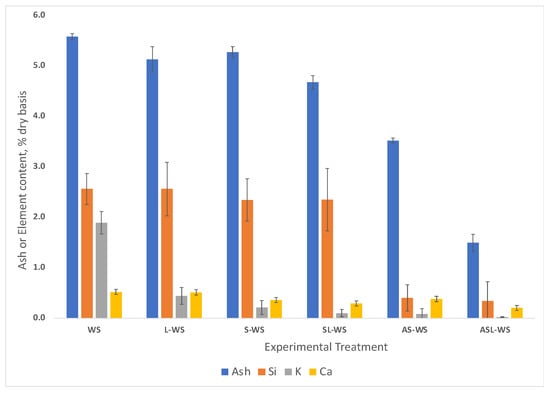
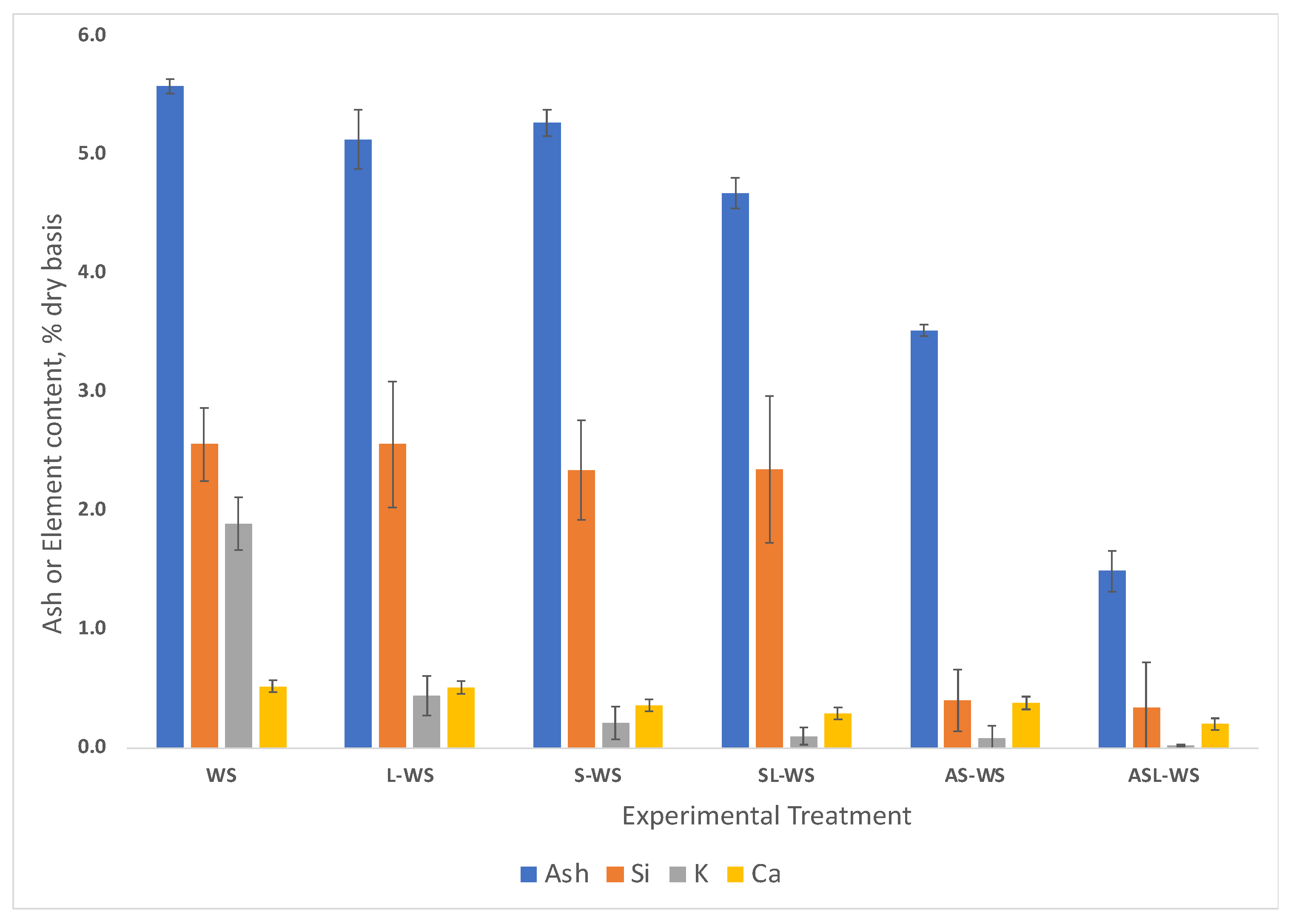
Results from the XRF analysis of several major inorganic elements in the untreated and treated wheat straw samples are shown in Figure 1 along with the measured ash contents. Steam pretreatment and leaching were both effective at removing the readily soluble potassium (K) and chlorine (Cl) from wheat straw. As for the removal of calcium (Ca), water leaching of wheat straw (L-WS) was ineffective, but when wheat straw was subject to auto-catalyzed or acid-catalyzed steam explosion (SL-WS, ASL-WS), the effectiveness of water leaching improved.
Figure 1.
Results of XRF and ash content measurements for all samples. The experimental treatments are described in Table 1.
As shown in Table 3, the change in mass yield due to water leaching (WS vs. L-WS; S-WS vs. SL-WS; AS-WS vs. ASL-WS) was small as compared to the change in mass yield due to steam explosion (WS vs. S-WS; WS vs. AS-WS), implying that water leaching operated under room temperature of 25 °C in the experiment had little effect on the extent of dry matter loss. This aligns with findings by other researchers that most of the dry matter loss from crop residues and woody biomass during water leaching came from the water-soluble inorganic elements (K and Cl), while the loss in organic matter (primarily hemicellulose) was found to be minimal, ranging from 0.9 to 3.6% [40]. In contrast, both steam explosion methods led to about 30% reduction in the mass yield, and AS-WS did not cause much more dry matter loss as compared to S-WS. Moreover, mass balance calculations reveal that only 12% of the dry matter loss was due to the inorganic elements; hence, the bulk of mass loss may be attributed to hemicellulose.
Table 3.
Mass yield (Ym, %), ash removal efficiency (η, %), and elemental removal efficiencies (ηe, %) for Si, Ca, and K.
The ash removal and elemental removal efficiencies depend on the mass yield (Mf /Mi) according to Equations (1) and (2). As illustrated in Table 3 and Figure 1, water leaching alone (L-WS) or following auto-catalyzed steam explosion (SL-WS) had little effect on ash removal. Nevertheless, after acid-catalyzed steam explosion was applied, the effectiveness of water leaching had a pronounced improvement as the ash content dropped from 3.52% db (AS-WS) to 1.49%db (ASL-WS).
Results of elemental removal efficiencies are also shown in Table 3 for the elements Si, Ca, and K. The elemental removal efficiencies were calculated using the average values of the elemental contents as determined by XRF analysis (Figure 1). When mass yield was taken into consideration, the removal efficiencies of ash, as well as the key inorganic elements, Si and Ca, for the ASL-WS treatment were substantially greater at 82.2%, 91.1%, and 74.3% as compared to 13.1%, 5.6%, and 3.5%, respectively, when treatment was performed using water leaching alone (L-WS). By comparison, wheat straw treated with auto-catalyzed steam explosion and followed by water leaching (SL-WS) gave rise to lower ash, Si, and Ca removal efficiencies at 40.8%, 35.7%, and 60.5%, respectively. It shall be noted that, after steam explosion of the wheat straw, water leaching can be performed at room temperature (25 °C) rather than higher temperatures up to 90 °C, thus saving energy consumption for water leaching.
During acid-catalyzed steam explosion, dilute sulfuric acid promotes the hydrolysis of hemicellulose by protonating glycosidic bonds, which accelerates their cleavage and converts hemicellulose into soluble sugars and organic acids such as acetic acid [41]. The acetic acid further intensifies autohydrolysis reactions, making the breakdown of amorphous carbohydrate structures even more efficient [25]. The acidic environment also weakens the crystalline cellulose structure by inducing partial chain scission, increasing the surface area and porosity. Importantly, acid pretreatment disrupts the silicon–oxygen–carbon linkages that anchor Si-rich complexes within the plant cell wall, causing these complexes to degrade into more soluble forms [9]. This mechanistic change would greatly enhance the mobility and hence removal of Si, Ca, and other inorganic species during subsequent water leaching.
As expected, L-WS was not effective for removing Si and Ca that are bound in the plant tissues, but it was highly effective for K. For the treatments with steam explosion but no subsequent water leaching, AS-WS led to a high Si removal efficiency of 89.7% but a lower Ca removal efficiency of 47.4%. Yet, Ca removal efficiency was raised to 74.3% after water leaching was applied to the AS-WS sample. By comparison, wheat straw that was treated by auto-catalyzed steam explosion (S-WS) had much lower Si removal efficiency (33.7%), while Ca removal efficiency increased from 46.1% to 60.5% with subsequent water leaching. The reasons for the differences in the Si removal efficiency vs. Ca removal efficiency could be postulated as follows. After the sudden decompression that occurs during steam explosion, breakdown of the Si complexes that are bound in the cell wall would cause the release of Si directly into the soluble liquid from the condensed steam. However, Ca that is bound in the cell wall and exists in the form of metallic salt could remain on the surface of the biomass particles after steam explosion, until it is dissolved in solution through subsequent water leaching.
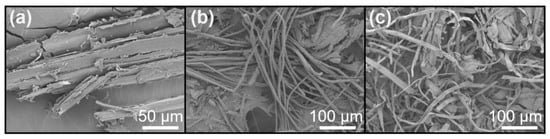
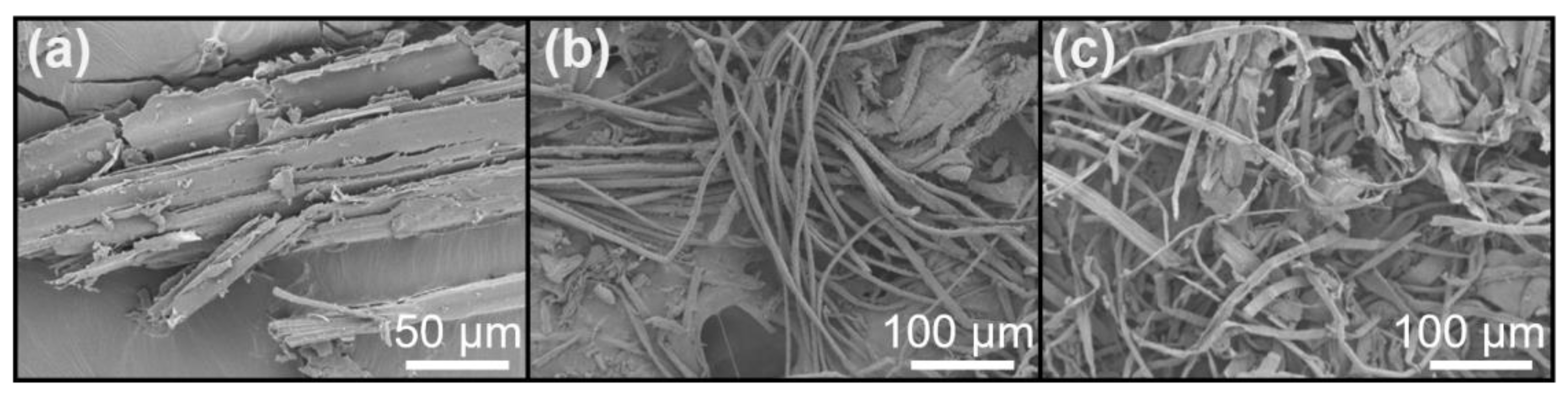
The complex and recalcitrant cell wall structure are due to hemicellulose, cellulose, and lignin that are rigidly formed in the biomass. The SEM images (Figure 2) show that steam explosion (S-WS and AS-WS) obviously opened the intricate structure of biomass, rendering the fibers more accessible. Thus, the degradation reactions during pyrolysis and combustion could have improved the heat and mass transfer efficiencies. The chemical compositional analysis of untreated and treated wheat straw (Table 4) shows that as the hemicellulose content of straw decreased significantly from 21.7% (WS) to 9.1% (AS-WS), both the cellulose content and the lignin content increased for the AS-WS treatment. These results support the notion that the mass loss of steam-pretreated biomass was mainly due to degradation of the reactive components in hemicellulose.
Figure 2.
SEM of WS (a), S-WS (b), and AS-WS (c) experimental treatments.
Table 4.
Chemical composition of WS, S-WS and AS-WS samples.
While fuel pellets are made from the solid fraction of the steam-exploded biomass, the problem regarding larger extent of organic matter loss to the process effluent (liquid fraction) could be mitigated by utilizing this waste stream generated from steam explosion. For instance, one study suggested platform chemicals in the process effluent can be utilized to make value-added chemicals and bioproducts [27]. In another case, the process effluent was used in anaerobic digestion to produce biogas, and the methane yield was found to be higher as compared to steam treatment without catalyzed by sulfuric acid [25].
The substantial removal of Si can mitigate ash melting and agglomeration problems, thereby reducing particulate matter (PM) emission and improving combustion stability [6]. A lower Ca content further reduces the formation of alkaline earth mineral particulates [9]. Thus, a solid biofuel with changes in the inorganic element contents revealed by the XRF analysis would have reduced environmental impact when it is utilized in large-scale combustion.
3.2. Structural Analysis—XRD Spectroscopy
XRD is specifically used to measure the change in the content of crystalline cellulose and determine if the auto- and acid- catalyzed steam explosion will break the crystalline cellulose, as this is closely related to the decomposition characteristics during pyrolysis and combustion.
The calculated values of CrI exhibit different trends, as shown in Table 5 for the treated samples. After water leaching (L-WS), the CrI almost remains unchanged at 41.5%, indicating that water leaching had minimum effect on the crystallinity of wheat straw. In contrast, auto-catalyzed steam pretreatment (S-WS) led to an increase in the CrI to 43.4%. This is in line with previous studies on steam pretreatment of cotton and mustard stalks, where the decomposition of amorphous hemicellulose was shown to increase the relative content of crystalline cellulose [41]. Yet, with acid-catalyzed steam pretreatment (AS-WS), the CrI decreased to 37%, which is 11 and 15% less than WS and S-WS, respectively. This observation could be due to the partial destruction of crystalline cellulose by the more severe reaction conditions in the presence of acid catalyst [42].
Table 5.
Pyrolysis characteristics and crystallinity index of all samples.
The combined findings of substantial decrease in hemicellulose content (Table 4), changes in crystallinity measured by XRD (Table 5), and the morphological disruption revealed by SEM (Figure 2) would collectively mirror the typical characteristic patterns that are documented in the literature pertinent to FTIR studies and provide consistent evidence of the underlying chemical modifications.
3.3. DTG and Analytical Pyrolysis Performance Analysis
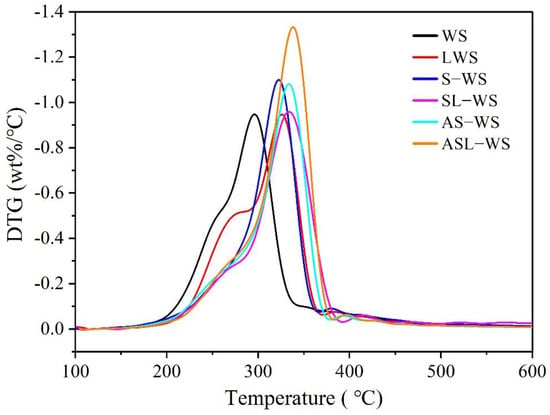
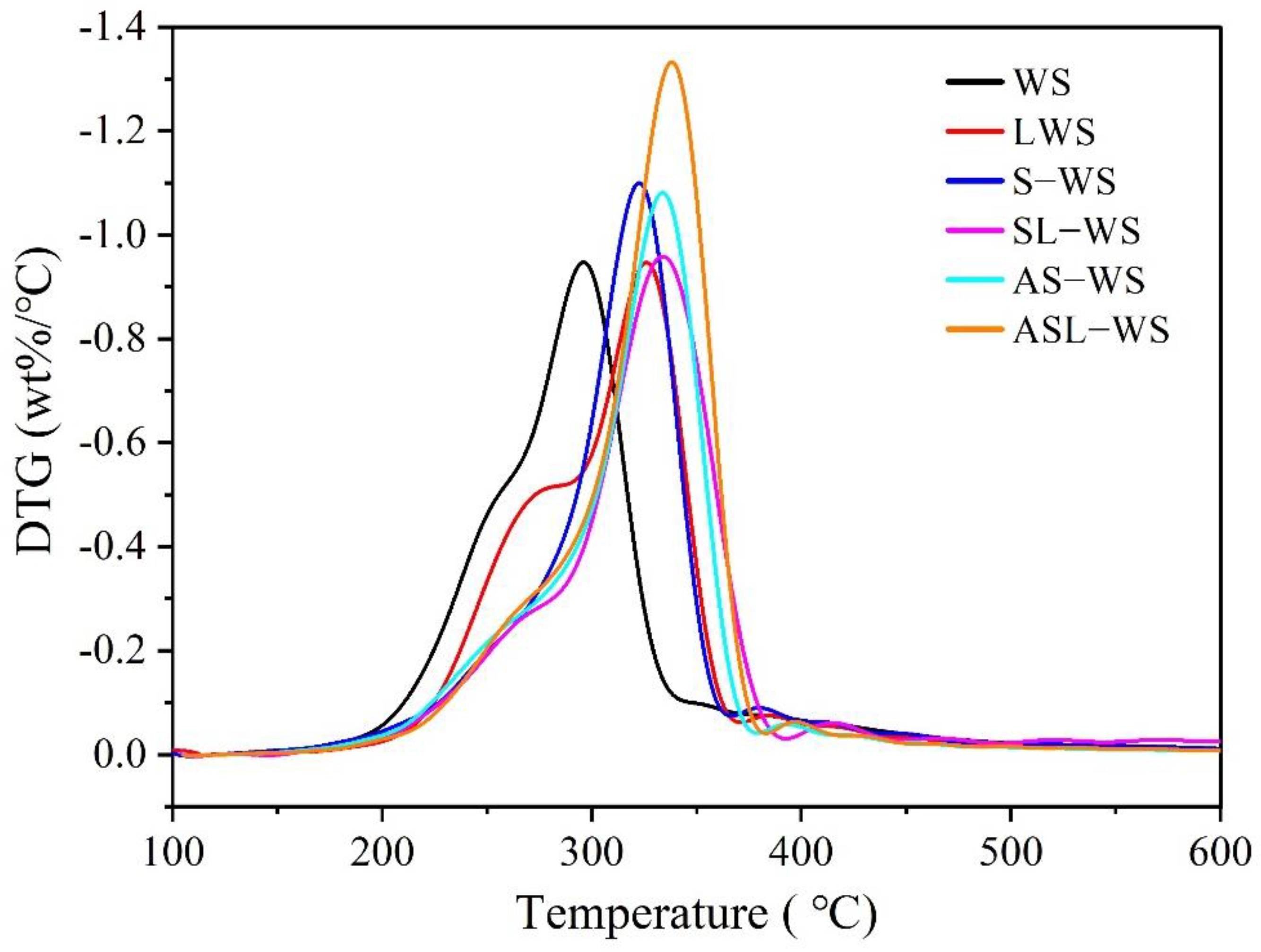
Figure 3 shows the derivative thermogravimetric (DTG) curves of all samples, which are derived from the TG curves that represent the percent mass loss of the sample based on its initial mass. Pretreatments with both water leaching and steam explosion had significant influence on the pyrolysis behavior of wheat straw. There exists a temperature that corresponds to its maximum loss rate after each of the pretreatments with water leaching and steam explosion.
Figure 3.
DTG pyrolysis profiles of all samples.
The DTG curves that are relevant to the pretreatments shift to the right side. For instance, after steam pretreatment the decomposition peak of S-WS shifted towards a higher-temperature region (326 °C) than WS (298 °C), probably because part of amorphous cellulose with lower thermal stability degraded more readily during steam explosion, leading to a reduction in the reactivity of the cellulose. For the S-WS and SL-WS samples, the hemicellulose decomposition peak merged with the cellulose decomposition peak. During steam treatment, the organic acids generated from the acetyl groups in the hemicellulose would promote the autohydrolysis reaction, which leads to the cleavage of glycosidic bonds and the solubilization of hemicellulose.
According to the data obtained from TGA, the remaining residue (char) yield of the untreated and water leached WS was 24% and 21%, respectively. This means the minerals on the surface of the biomass particles were easier to remove by water leaching, as compared to the minerals bound in the biomass structure. The kinetic shift (shift in the DTG curve) indicates that volatile matter is being released at higher temperature for L-WS, which may result from the large removal of potassium by water leaching, thus weakening the catalytic effects of the alkaline metals on the release of volatiles during the pyrolysis process.
Table 5 also shows that the intensity of the temperature peak is higher for biomass with a higher cellulose content. The devolatilization index Di represents the degree of difficulty with the pyrolysis reaction. It can be seen from Table 5 that Di has no change after water leaching (L-WS), but it increases significantly after steam explosion (S-WS and AS-WS). The decomposition rates (Rmax) of AS-WS and ASL-WS were the highest among all samples.
3.4. DTG and Analytical Combustion Performance Analysis
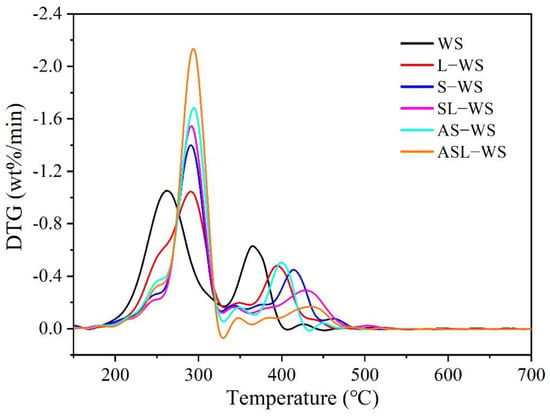
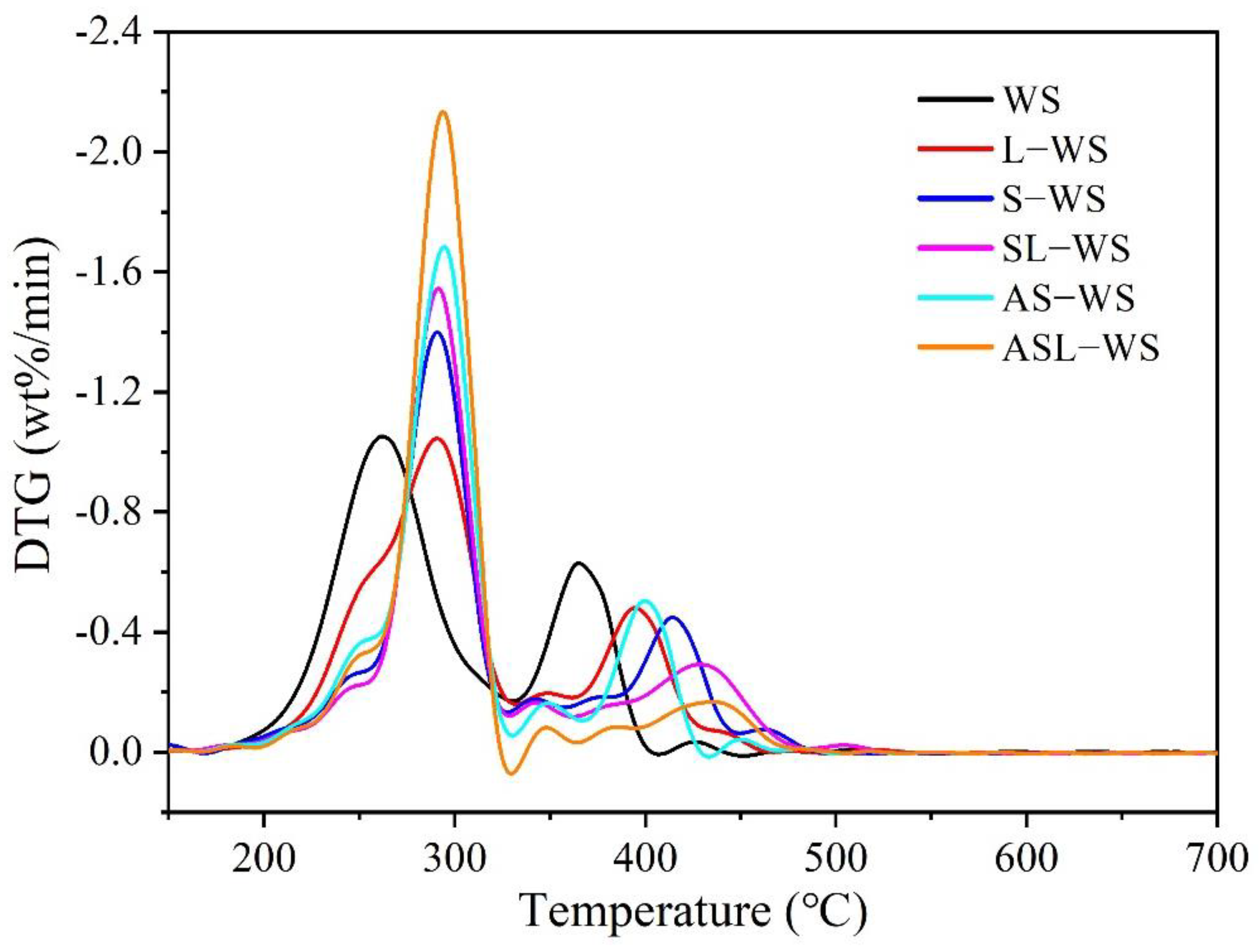
Figure 4 shows the DTG curves of all samples. There is an obvious kinetic shift for both the devolatilization stage and the char combustion stage in all profiles. During the devolatilization stage, the DTG peaks of all treated samples shifted to higher temperatures within the same temperature range, which could be attributed to the intense decomposition of hemicellulose and cellulose in the presence of air.
Figure 4.
DTG combustion profiles of all samples.
Values associated with the combustion characteristic parameters are listed in Table 6. The ignition temperature Ti corresponds to the point where the DTG burning profile undergoes a sudden rise and peak temperature Tp corresponds to the point where the rate of weight loss due to combustion is at maximum.
Table 6.
Combustion characteristic indices of all samples during the devolatilization stage and the combustion stage—ignition index (Di), burnout index (Db), and comprehensive combustibility index (S).
During the devolatilization stage (Table 6), the mass loss of WS, L-WS, S-WS, SL-WS, AS-WS, and ASL-WS was 70.0, 72.3, 69.4, 71.2, 75.2, and 85.7%, indicating a large percentage of weight change had occurred prior to the combustion stage in the overall combustion process. L-WS had the lowest Rmax of 19.5 wt%/min, whereas ASL-WS had the highest Rmax of 43.1 wt%/min. Since the peak intensity is directly proportional to reactivity, the cellulose component of ASL-WS could react in a much easier and faster way. Acid-catalyzed steam explosion changed the composition and structure of wheat straw, as well as decreased the volatile matter content, rendering the samples much easier to decompose. The ignition temperature (Ti) increased after different treatments of the biomass for both the devolatilization and combustion stages. Since Ti depends on the early release of the volatiles and the rate of heat release by volatiles’ combustion, WS with the greatest volatile matter (VM) content (Table 2) had the lowest Ti.
Calculations using Equation (6) show that S, the comprehensive combustibility index, ranges from 0.26 × 10⁻⁶ min−2 °C−3 for WS to 0.69 × 10⁻⁶ min−2 °C−3 for ASL-WS, while S-WS and AS-WS have values in between, suggesting that ASL-WS burned in the most vigorous manner along with the fastest burnout of the char [43]. Comparison was made between these S values and those presented in the literature. A study of the combustion characteristics of pellet fuel derived from woody biomass species (pine, fir, willow, and poplar) and reported values of S that vary from 0.006 to 0.023 × 10⁻⁶ min−2 K−3 (or, 0.04–0.18 × 10⁻⁶ min−2 °C−3) along with 241–271 °C for Ti and 311–419 °C for Tb [44]. In our study, Ti ranged from 231 to 270 °C and Tb was 320–325 °C during the devolatilization stage. Another study that investigated the combustion performance of bio-oils derived from the pyrolysis of pine wood reported values of S ranging from 2.37 to 11.6 min−2 °C−3, which has the same order of magnitude as No. 6 fuel oil [45]. Since larger values of S would indicate a better fuel combustion performance, wheat straw (a solid biofuel) pretreated with acid-catalyzed steam explosion and followed by water leaching had a better combustion performance than some woody biomass species, though not as good as bio-oil (a liquid biofuel).
During the combustion stage (Table 6), Rmax of the treated samples were smaller, varying from 10 to 50% of the Rmax values that are pertinent to the devolatilization stage. In addition, the Di, Db, and S values of all treated samples (except for ASL-WS) are 3–10 times bigger at the devolatilization stage vs. the combustion stage, and this is even more so for ASL-WS, with Di, Db, and S that are 30–50 times bigger. The value of S associated with S-WS increased by almost 50% vs. WS at the devolatilization stage, and with AS-WS, it doubled. Thus, the value of S due to the combined pretreatment technique of steam explosion followed by water leaching (ASL-WS) is 2.5 times that of the control (WS). This is significant since a much greater comprehensive combustibility index along with reduced volatile matter content both imply better combustion performance of a power plant boiler in terms of biomass reactivity, heat transfer efficiency, and the degree of complete combustion.
A decrease in the volatile matter content (Table 2) would account for the reduction in char reactivity for the steam explosion treatments (S-WS and AS-WS). For the water leaching treatments, the reduction in alkali metal content and especially potassium (Figure 1) was the main reason for the reduction in the char reactivity; hence, L-WS, SL-WS, and ASL-WS were less reactive overall as compared to WS, S-WS, and AS-WS. In this respect, Matsumoto et al. [46] has reported the reactivity of char to alkali metal content of biomass.
4. Conclusions
This paper investigated the effectiveness of the combined steam explosion and water leaching pretreatment techniques to upgrade the fuel properties of wheat straw for pellet production. The experimental treatments involved auto-catalyzed steam explosion and acid-catalyzed steam explosion with and without subsequent water leaching.
Although pelletization was not conducted as part of this study, the pretreatment technique that provides the most favorable fuel properties for pellet production can be identified from the results. Among all treatments, the acid-catalyzed steam explosion using low concentration (0.5 wt%) of dilute H2SO4 and followed by water leaching had the best performance. The removal efficiencies of ash as well as the key inorganic elements, Si and Ca, were substantially greater at 82.2%, 91.1%, and 74.3%, respectively. In this regard, water leaching at room temperature subsequent to steam explosion was found to be particularly effective for enhancing the Ca removal efficiency. Results also indicated significant improvement in the fuel properties in terms of ash content (1.49% db), fuel ratio (0.34), and calorific value HHV (21.9 MJ/kg) of the treated biomass, as well as a pronounced increase in the comprehensive combustibility index at the devolatization stage, which implies better combustion characteristics. Based on common industrial practice and previously reported optimal ranges for densification of cereal crop residues, pellets produced from ASL-WS-pretreated material are expected to perform well under standard operating conditions (compression pressure, die temperature, biomass moisture content) during densification.
Overall, the study demonstrated that the fuel properties of wheat straw can be substantially improved for the production of agri-pellets, and the quality of agri-pellets could potentially be on par with wood pellets and meeting ISO 17225-2 standard specifications [29].
Author Contributions
Y.Y.: Conceptualization, investigation, methodology, writing—original draft, writing—review and editing. J.W.: Investigation, writing—review and editing. S.S.: writing—review and editing, supervision, resources. J.S.: Writing—review and editing, supervision. A.L.: Conceptualization, writing—review and editing, supervision, validation, resources. All authors have read and agreed to the published version of the manuscript.
Funding
This research was supported by the Biomass Canada Cluster (BMC), funded through Agriculture and Agri-Food Canada’s AgriScience program (funding #BMC-5). The funder was not involved in the study design, collection, analysis, interpretation of data, the writing of this article, or the decision to submit it for publication.
Data Availability Statement
The raw data supporting the conclusions of this article will be made available by the authors on request.
Acknowledgments
The support from the Biomass Canada Cluster is much appreciated. The graduate support from the Natural Sciences and Engineering Research Council of Canada (NSERC) is also gratefully acknowledged.
Conflicts of Interest
The authors declare no conflicts of interest. The funders had no role in the design of the study; in the collection, analyses, or interpretation of data; in the writing of the manuscript; or in the decision to publish the results.
References
- Wang, C.; Zhang, W.; Qiu, X.; Xu, C. Hydrothermal Treatment of Lignocellulosic Biomass Towards Low-carbon Development: Production of High-value-added Bioproducts. EnergyChem 2024, 6, 00133. [Google Scholar] [CrossRef] [Scilit]
- Langholtz, M.H. Chapter 1: Background and Introduction. In 2023 Billion-Ton Report; Langholtz, M.H., Ed.; Oak Ridge National Laboratory: Oak Ridge, TN, USA, 2024. [Google Scholar]
- Mostafa, M.E.; Hu, S.; Wang, Y.; Su, S.; Hu, X.; Elsayed, S.A.; Xiang, J. The Significance of Pelletization Operating Conditions: An Analysis of Physical and Mechanical Characteristics as well as Energy Consumption of Biomass Pellets. Renew. Sustain. Energy Rev. 2019, 105, 332–348. [Google Scholar] [CrossRef] [Scilit]
- ElMekawy, A.; Diels, L.; De Wever, H.; Pant, D. Valorization of Cereal Based Biorefinery Byproducts: Reality and expectations. Environ. Sci. Technol. 2013, 47, 9014−9027. [Google Scholar] [CrossRef] [Scilit] [PubMed]
- Zheng, Y.; Qiu, F. Bioenergy in the Canadian Prairies: Assessment of Accessible Biomass from Agri-crop Residues and Identification of Potential Biorefinery Sites. Biomass Bioenergy 2020, 140, 105669. [Google Scholar] [CrossRef] [Scilit]
- Passoth, V.; Sandgren, M. Biofuel Production from Straw Hydrolysates: Current Achievements and Perspectives. Appl. Microbiol. Biotechnol. 2019, 103, 5105–5116. [Google Scholar] [CrossRef] [Scilit]
- Vassilev, S.V.; Vassileva, C.G.; Song, Y.C.; Li, W.Y.; Feng, J. Ash Contents and Ash-forming Elements of Biomass and their Significance for Solid Biofuel Combustion. Fuel 2017, 208, 377–409. [Google Scholar] [CrossRef] [Scilit]
- Li, C.; Aston, J.E.; Lacey, J.A.; Thompson, V.S.; Thompson, D.N. Impact of Feedstock Quality and Variation on Biochemical and Thermochemical Conversion. Renew. Sustain. Energy Rev. 2016, 65, 525–536. [Google Scholar] [CrossRef] [Scilit]
- Guerriero, G.; Hausman, J.F.; Legay, S. Silicon and the Plant Extracellular Matrix. Front. Plant Sci. 2016, 7, 463. [Google Scholar] [CrossRef] [Scilit]
- Hupa, M.; Karlstrom Vainio, E. Biomass Combustion Technology Development—It is All About Chemical Details. Proc. Combust. Inst. 2017, 36, 113–134. [Google Scholar] [CrossRef] [Scilit]
- Ma, Z.; Tian, X.; Liao, H.; Guo, Y.; Cheng, F. Improvement of Fly Ash Fusion Characteristics by Adding Metallurgical Slag at High Temperature for Production of Continuous Fiber. J. Clean Prod. 2018, 171, 464–481. [Google Scholar] [CrossRef] [Scilit]
- Du, S.; Yang, H.; Qian, K.; Wang, X.; Chen, H. Fusion and Transformation Properties of the Inorganic Components in Biomass Ash. Fuel 2014, 117, 1281–1287. [Google Scholar] [CrossRef] [Scilit]
- Bhatia, S.K.; Jagtap, S.S.; Bedekar, A.A.; Bhatia, R.K.; Patel, A.K.; Pant, D.; Banu, J.R.; Rao, C.V.; Kim, Y.G.; Yang, Y.H. Recent Developments in Pretreatment Technologies on Lignocellulosic Biomass: Effect of Key Parameters, Technological Improvements, and Challenges. Bioresour. Technol. 2020, 300, 122724. [Google Scholar] [CrossRef] [Scilit]
- Stasiak, M.; Molenda, M.; Bańda, M.; Wiącek, J.; Parafiniuk, P.; Gondek, E. Mechanical Combustion Properties Sawdust-straw Pellets Blended in Different Proportions. Fuel Process. Technol. 2017, 156, 366–375. [Google Scholar] [CrossRef] [Scilit]
- Yu, Y.; Thy, P.; Wang, L.; Anderson, S.N.; VanderGheynst, J.S.; Upadhyaya, S.K.; Jenkins, B.M. Influence of Leaching Pretreatment on Fuel Properties of Biomass. Fuel Process. Technol. 2014, 128, 43–53. [Google Scholar] [CrossRef] [Scilit]
- Edmunds, C.W.; Hamilton, C.; Kim, K.; Chmely, S.C.; Labbé, N. Using a Chelating Agent to Generate Low Ash Bioenergy Feedstock. Biomass Bioenergy 2017, 96, 12–18. [Google Scholar] [CrossRef] [Scilit]
- Cui, H.; Turn, S.Q.; Morgan, T.; Li, D. Processing Freshly Harvested Banagrass to Improve Fuel Qualities: Effects of Operating Parameters. Biomass Bioenergy 2017, 105, 310–319. [Google Scholar] [CrossRef] [Scilit]
- Abelha, P.; Mourão Vilela, C.; Nanou, P.; Carbo, M.; Janssen, A.; Leiser, S. Combustion Improvements of Upgraded Biomass by Washing and Torrefaction. Fuel 2019, 253, 1018–1033. [Google Scholar] [CrossRef] [Scilit]
- Bandara, Y.W.; Gamage, P.; Gunarathne, D.S. Hot Water Washing of Rice Husk for Ash Removal: The Effect of Washing Temperature, Washing Time and Particle Size. Renew. Energy 2020, 153, 646–652. [Google Scholar] [CrossRef] [Scilit]
- Singhal, A.; Konttinen, J.; Joronen, T. Effect of different Washing Parameters on the Fuel Properties and Elemental Composition of Wheat Straw in Water-washing Pre-treatment. Part 2: Effect of Washing Temperature and Solid-to-liquid Ratio. Fuel 2021, 292, 1220209. [Google Scholar] [CrossRef] [Scilit]
- Bamisaye, A.; Ige, A.R.; Adegoke, K.A.; Adegoke, I.A.; Bamidele, M.O.; Adeleke, O.; Idowu, M.A.; Nobanathi, W.M. H2SO4-treated and Raw Watermelon Waste Bio-briquettes: Comparative, Eco-friendly and Machine Learning Studies. Fuel 2024, 358, 129936. [Google Scholar] [CrossRef] [Scilit]
- Yu, Y.; Wan, Z.; Smith, M.D.; Mohan, M.; Sokhansanj, S.; Lau, A.; Smith, J.C.; Rojas, O.J. Macroscale Properties and Atomic-scale Mechanisms of Ash Removal in Low-temperature Hydrothermal Carbonization. Chem. Eng. J. 2024, 500, 156913. [Google Scholar] [CrossRef] [Scilit]
- Lacey, J.A.; Emerson, R.M.; Thompson, D.N.; Westover, T.L. Ash Reduction Strategies in Corn Stover Facilitated by Anatomical and Size Fractionation. Biomass Bioenergy 2016, 90, 173–180. [Google Scholar] [CrossRef] [Scilit]
- Ruiz, H.A.; Sganzerla, W.G.; Larnaudie, V.; Veersma, R.J.; van Erven, G.; Shiva; Ríos-González, L.J.; Rodríguez-Jasso, R.M.; Rosero-Chasoy, G.; Ferrari, M.D.; et al. Advances in Process Design, Techno-economic Assessment and Environmental Aspects for Hydrothermal Pretreatment in the Fractionation of Biomass under Biorefinery Concept. Bioresour. Technol. 2023, 369, 128469. [Google Scholar] [CrossRef] [Scilit]
- Yu, Y.; Wu, J.; Ren, X.; Lau, A.; Rezaei, H.; Takada, M.; Bi, X.; Sokhansanj, S. Steam Explosion of Lignocellulosic Biomass for Multiple Advanced Bioenergy Processes: A review. Renew. Sustain. Energy Rev. 2022, 154, 111871. [Google Scholar] [CrossRef] [Scilit]
- Han, G.; Deng, J.; Zhang, S.; Bicho, P.; Wu, Q. Effect of Steam Explosion Treatment on Characteristics of Wheat Straw. Ind. Crops Prod. 2010, 31, 28–33. [Google Scholar] [CrossRef] [Scilit]
- Bondesson, P.M.; Galbe, M.; Zacchi, G. Ethanol and Biogas Production after Steam Pretreatment of Corn Stover with or without the Addition of Sulphuric Acid. Biotechnol. Biofuels 2013, 6, 11. [Google Scholar] [CrossRef] [Scilit]
- Tanase-Opedal, M.; Ghoreishi, S.; Hermundsgård, D.H.; Barth, T.; Moe, S.T.; Brusletto, R. Steam Explosion of Lignocellulosic Residues for Co-production of Value-added Chemicals and High-quality Pellets. Biomass Bioenergy 2024, 181, 107037. [Google Scholar] [CrossRef] [Scilit]
- ISO 17225-2/6; Solid biofuels—Fuel Specifications and Classes—Part 2: Graded Woody Pellets and Part 6: Graded Non-Woody Pellets. International Standards Organization: Geneva, Switzerland, 2014.
- García, R.; Gil, M.V.; Rubiera, F.; Pevida, C. Pelletization of Wood and Alternative Residual Biomass Blends for Producing Industrial Quality Pellets. Fuel 2019, 251, 739–753. [Google Scholar] [CrossRef] [Scilit]
- Ballesteros, I.; Negro, M.J.; Olivia, J.M.; Cabanas, A.; Manzanares, P.; Ballesteros, B. Ethanol Production from Steam Explosion Pretreated Wheat Straw. Appl. Biochem. Biotechnol. 2006, 129–132, 496–508. [Google Scholar] [CrossRef] [Scilit] [PubMed]
- Fang, H.; Deng, J.; Zhang, X. Steam Explosion with a Refiner. Bioresources 2011, 6, 4468–4480. [Google Scholar] [CrossRef] [Scilit]
- ASTM D3174-04; Standard Test Method for Ash in the Analysis Sample of Coal and Coke from Coal. ASTM International: West Conshohocken, PA, USA, 2004.
- ASTM D3175-89; Standard Test Method for Volatile Matter in the Analysis Sample of Coal and Coke. ASTM International: West Conshohocken, PA, USA, 1989.
- Shi, S.; Guan, W.; Blersch, D.; Li, J. Improving the Enzymatic Digestibility of Alkaline-Pretreated Lignocellulosic Biomass using polyDADMAC. Ind. Crops Prod. 2021, 162, 113244. [Google Scholar] [CrossRef] [Scilit]
- Yu, Y.; Wang, G.; Bai, X.; Liu, J.; Wang, D.; Wang, Z. Combined Different Dehydration Pretreatments and Torrefaction to Upgrade Fuel Properties of Hybrid Pennisetum (Pennisetum americanum × P. purpureum). Bioresour. Technol. 2018, 263, 541–547. [Google Scholar] [CrossRef] [Scilit]
- Yue, Y.; Singh, H.; Singh, B.; Mani, S. Torrefaction of Sorghum Biomass to Improve Fuel Properties. Bioresour. Technol. 2017, 232, 372–379. [Google Scholar] [CrossRef] [Scilit] [PubMed]
- Adapa, P.; Tabil, L.; Schoenau, G.; Opoku, A. Pelleting Characteristics of Selected Biomass with and without Steam Explosion Pretreatment. Int. J. Agric. Biol. Eng. 2010, 3, 62–79. [Google Scholar] [CrossRef]
- Tang, Y.; Chandra, R.P.; Sokhansanj, S.; Saddler, J.N. Influence of Steam Explosion Processes on the Durability and Enzymatic Digestibility of Wood Pellets. Fuel 2018, 211, 87–94. [Google Scholar] [CrossRef] [Scilit]
- Long, J.; Deng, L.; Che, D. Analysis on Organic Compounds in Water Leachate from Biomass. Renew. Energy 2020, 155, 1070–1078. [Google Scholar] [CrossRef] [Scilit]
- Kapoor, M.; Raj, T.; Vijayaraj, M.; Chopra, A.; Gupta, R.P.; Tuli, D.K.; Kumar, R. Structural features of dilute acid, steam exploded, and alkali pretreated mustard stalk and their impact on enzymatic hydrolysis. Carbohydr. Polym. 2015, 124, 265–273. [Google Scholar] [CrossRef] [Scilit]
- Zhang, X.; Yuan, Q.; Cheng, G. Deconstruction of corncob by steam explosion pretreatment: Correlations between sugar conversion and recalcitrant structures. Carbohydr. Polym. 2017, 156, 351–356. [Google Scholar] [CrossRef] [Scilit]
- Xie, Z.; Ma, X. The thermal behaviour of the co-combustion between paper sludge and rice straw. Bioresour. Technol. 2013, 146, 611–618. [Google Scholar] [CrossRef] [Scilit]
- Jia, G. Combustion characteristics and kinetic analysis of biomass pellet fuel using thermogravimetric analysis. Processes 2021, 9, 868. [Google Scholar] [CrossRef] [Scilit]
- Ren, X.; Meng, J.; Moore, A.M.; Chang, J.; Gou, J.; Park, S. Thermogravimetric investigation on the degradation properties and combustion performance of bio-oils. Bioresour. Technol. 2014, 152, 267–274. [Google Scholar] [CrossRef] [Scilit] [PubMed]
- Matsumoto, K.; Takeno, K.; Ichinose, T.; Ogi, T.; Nakanishi, M. Gasification reaction kinetics on biomass char obtained as a by-product of gasification in an entrained-flow gasifier with steam and oxygen at 900–1000 °C. Fuel 2009, 88, 5. [Google Scholar] [CrossRef] [Scilit]

Disclaimer/Publisher’s Note: The statements, opinions and data contained in all publications are solely those of the individual author(s) and contributor(s) and not of MDPI and/or the editor(s). MDPI and/or the editor(s) disclaim responsibility for any injury to people or property resulting from any ideas, methods, instructions or products referred to in the content. |
© 2025 by the authors. Licensee MDPI, Basel, Switzerland. This article is an open access article distributed under the terms and conditions of the Creative Commons Attribution (CC BY) license (https://creativecommons.org/licenses/by/4.0/).