1. Introduction
Agrivoltaic (APV) systems maximize land use efficiency by simultaneously performing agricultural production and photovoltaic power generation on the same land [
1]. The global APV market is projected to grow from USD 4.59 billion in 2024 to USD 13.88 billion by 2034, with a compound annual growth rate (CAGR) of 11.7% [
2]. In the Republic of Korea, as of 2022, 62 APV facilities have been installed, most of which were established for research and demonstration purposes [
3].
For successful implementation of APV systems, maintaining agricultural productivity while achieving economically viable electricity generation is essential [
4]. This requires clear performance evaluation metrics and design optimization methodologies to minimize risks for both farmers and solar developers and ensure project success [
5]. Policymakers also demand legal standards and assessment frameworks that can distinguish APV projects from conventional ground-mounted PV systems [
6].
Previous studies have addressed these needs by evaluating APV systems through irradiance simulation and crop yield prediction models. Berrian et al. [
7] developed a comprehensive tool integrating crop and PV modeling to assess land productivity of single-axis tracking bifacial APV systems in Germany. Their study derived relationships between tracker row pitch and land productivity and identified differences according to crop shade tolerance. Katsikogiannis et al. [
8] proposed a synergistic design approach for integrating bifacial PV modules with agriculture. By applying bifacial PV module designs optimized for blueberry cultivation, they improved land productivity by 50%, while electricity generation decreased by 33%. Mouhib et al. [
9] investigated the performance of APV systems integrating bifacial PV modules with three olive varieties in southern Spain. Their analysis of various configurations of bifacial PV module installation height and tilt angle achieved a land equivalent ratio (LER) of 171%.
Various design parameters affect APV system performance. Kwon et al. [
10] quantitatively analyzed how design variables—including PV module installation height, ground coverage ratio (GCR), tilt angle, azimuth angle, and installation type—influence irradiance beneath the modules. They found that as module installation height increased from 1 m to 3 m, the standard deviation of under-module irradiance decreased from 27.6% to 12.1%, improving uniformity. Additionally, when GCR increased from 30% to 50%, the standard deviation rose from 10.7% to 14.3%, indicating reduced uniformity. Single-axis tracking systems exhibited 1.2% higher under-module irradiance and 6.6% lower standard deviation than dual-axis systems, demonstrating superior uniformity.
However, many existing studies have evaluated APV systems under specific time points or simplified conditions. In particular, they often adopt a limited approach that indirectly estimates crop yield solely through empirical relationships between photosynthetically active radiation (PAR) and photosynthetic rates, rather than using comprehensive crop growth models. Katsikogiannis et al. [
8] estimated seasonal variation using only solar-noon PAR data from one clear day and one cloudy day. Mouhib et al. [
9] assumed that light-response curves derived under specific conditions remain constant over time, failing to account for temporal variations in environmental factors such as temperature, precipitation, and soil conditions. Although Kwon et al. [
10] identified the effects of various design parameters by focusing on ground irradiance beneath PV modules, their study did not extend to actual crop yield prediction. Thus, previous studies have been limited in their ability to comprehensively consider the diverse environmental factors that affect crop growth.
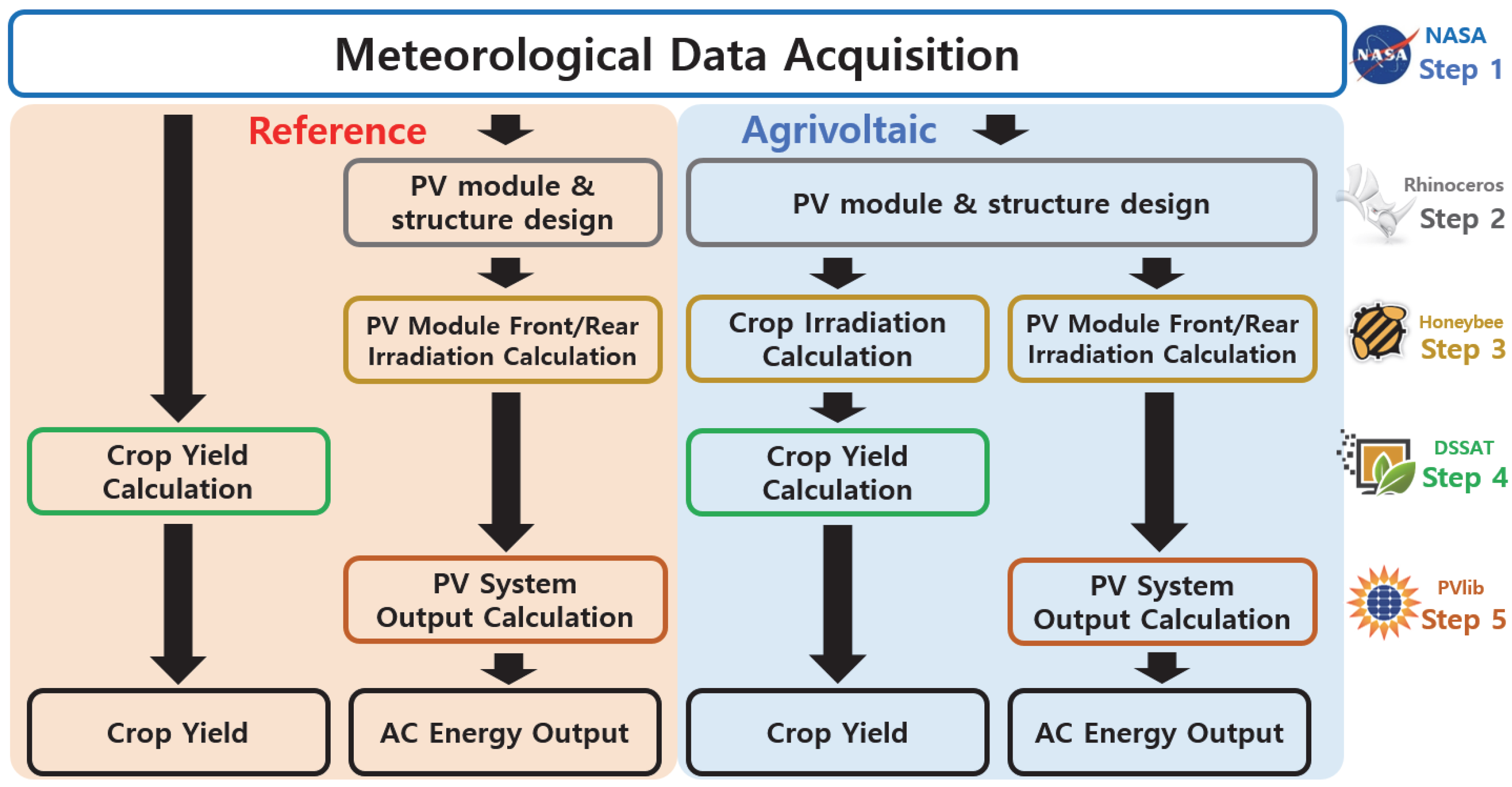
Therefore, this study proposes a comprehensive assessment method that integrates crop yield and electricity generation simulation models for APV systems. First, a virtual model identical to the physical system is created through 3D modeling of bifacial PV modules and supporting structures. Ray-tracing methods are applied to calculate irradiance reaching the ground beneath bifacial PV modules as well as the front and rear surfaces of the modules. Based on the calculated under-module irradiance, a crop yield prediction model is implemented by linking crop type and soil condition data. An electricity generation prediction model is implemented by applying the calculated front and rear module irradiance along with meteorological conditions.
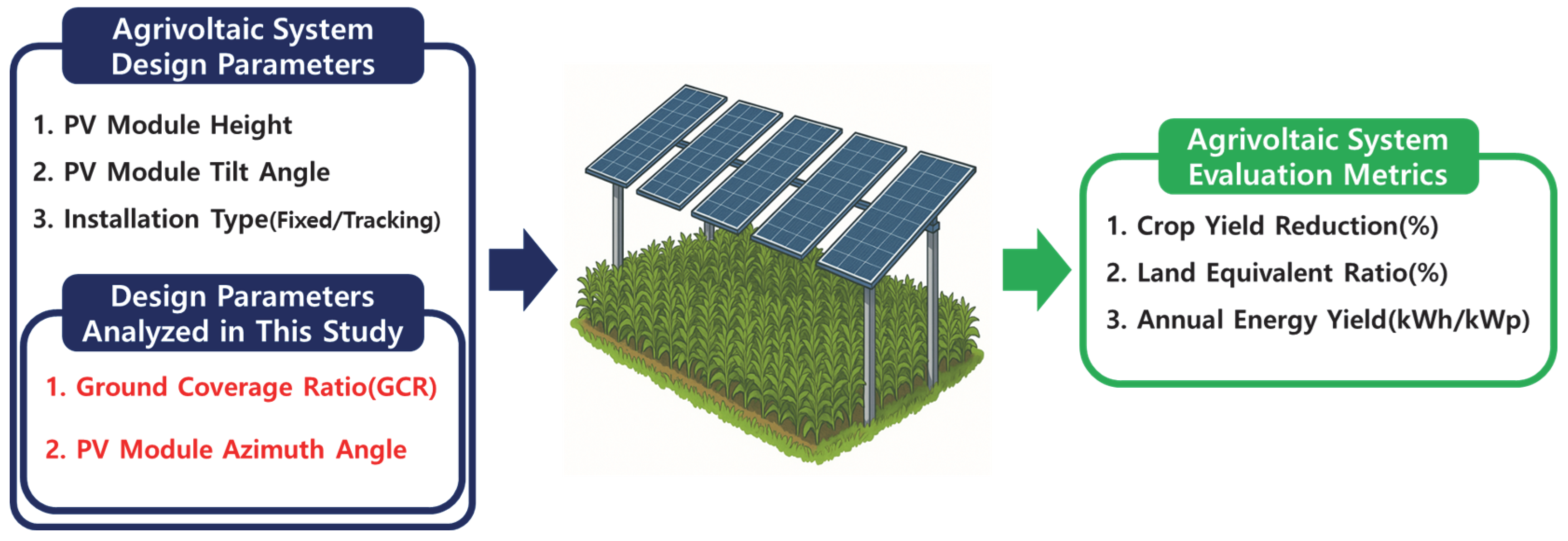
Figure 1 shows the major design parameters of APV systems and the design variables and performance evaluation metrics analyzed in this study. Key design parameters generally considered in APV system design include module height, module tilt angle, and installation type (fixed or tracking).
Among these various design parameters, this study selected GCR and PV array azimuth as key design variables. GCR quantitatively represents the proportion of farmland area occupied by PV modules and determines crop growth and yield affected by module shading, as well as electricity generation from bifacial PV systems. The PV array azimuth is a dependent variable that is set to match the farmland orientation to accommodate agricultural machinery operation, such as tractors. For comprehensive performance evaluation of APV systems, CYR, LER, and annual energy yield were employed as primary evaluation metrics.
3. Simulation Setup and Analysis
3.1. Simulation Scenario Design
To analyze how design parameters of APV systems affect crop yield and electricity generation through the framework proposed in this study, simulation scenarios were configured. Simulations were set up by categorizing design variables into fixed and variable parameters, and system performance under various conditions was quantitatively analyzed through combinations of the variable parameters.
3.1.1. Fixed Design Parameter Configuration
The target region was selected as Gochang, Jeollabuk-do, one of the representative rice cultivation regions in the Republic of Korea. Meteorological data from the NASA POWER database for the year 2023 were used, and simulations were performed at hourly intervals from 1 January to 31 December 2023. According to national rice production statistics, the nationwide paddy rice yield in 2023 (523 kg per 10a) was very close to the recent 10-year average for 2014–2023 (approximately 522 kg per 10a), and 2023 was therefore regarded as a representative year for recent climate and yield conditions [
22].
The farmland for analysis was configured as a 23 m × 23 m square. The bifacial PV module used was the Hanwha Q CELLS Q.PEAK DUO MS-G10.d/BGT 240 Wp bifacial half-cell module (Hanwha Q CELLS GmbH, Bitterfeld-Wolfen, Germany; 1.72 m × 0.71 m × 0.03 m). The module installation height was set at 3.5 m from the ground, considering both the findings of Kwon et al. [
10] that uniformity of under-module irradiance is secured above 3 m and the minimum clearance required for operating agricultural machinery such as tractors. The tilt angle was set at 15°, typical of conventional APV systems. The supporting structures for the modules consisted of cylindrical columns with a diameter of 10 cm, and the farmland was assumed to have flat ground. Inverters with a rated capacity of 2.5 kW were used, configured appropriately for each GCR considering the DC/AC ratio of the system.
Table 1 and
Table 2 present the electrical specifications of the bifacial PV module and inverter used, respectively.
Ground albedo was set at 20%, and module reflectance was set at 3% to reflect anti-reflective coating (ARC). A ground albedo of 20% is a commonly adopted value in APV simulation studies [
1,
5,
7]. Annual crop height irradiance was simulated using the annual irradiance recipe in Honeybee, which constructs a climate-based sky matrix from hourly NASA POWER data (global horizontal, direct normal, and diffuse horizontal irradiance) converted into an EPW weather file for Gochang. The Radiance ray-tracing parameters were set to an ambient bounce of 2, ambient divisions of 5000, ambient super-samples of 1, and an ambient limit weight of 2 × 10
−5, providing a compromise between accuracy and computational cost; trial runs with higher ambient divisions changed annual plane-of-array irradiance by less than 1%, so these settings were adopted for all simulations. The ground surface was modeled as a Lambertian reflector with a fixed reflectance of 0.20, and seasonal variations in paddy-field albedo were not explicitly represented. To analyze irradiance on the ground beneath the modules, 8684 virtual sensors were placed at 25 cm intervals corresponding to the transplanting row spacing.
To align the crop growth calendar and leaf area index (LAI) dynamics with local practices in Gochang, Jeollabuk-do, the genetic coefficients (P1, P5) of the DSSAT-CERES-Rice model were calibrated. The calibration resulted in panicle initiation on 26 June, heading on 31 July, grain filling initiation on 7 August, and harvest on 19 September. LAI reached its maximum value of 3.8 just before heading and then decreased during the grain filling period. Soil properties and crop management conditions were inputted based on the Heuktoram [
23] and Nongsaro [
24] databases.
Table 3 presents the soil and crop management conditions used in the crop yield simulation.
3.1.2. Variable Design Parameter Configuration
GCR (ground coverage ratio) is the ratio of the area occupied by PV modules to the total farmland area and is a key design parameter of APV systems. In domestic APV system design in the Republic of Korea, GCR is conventionally set around 30% [
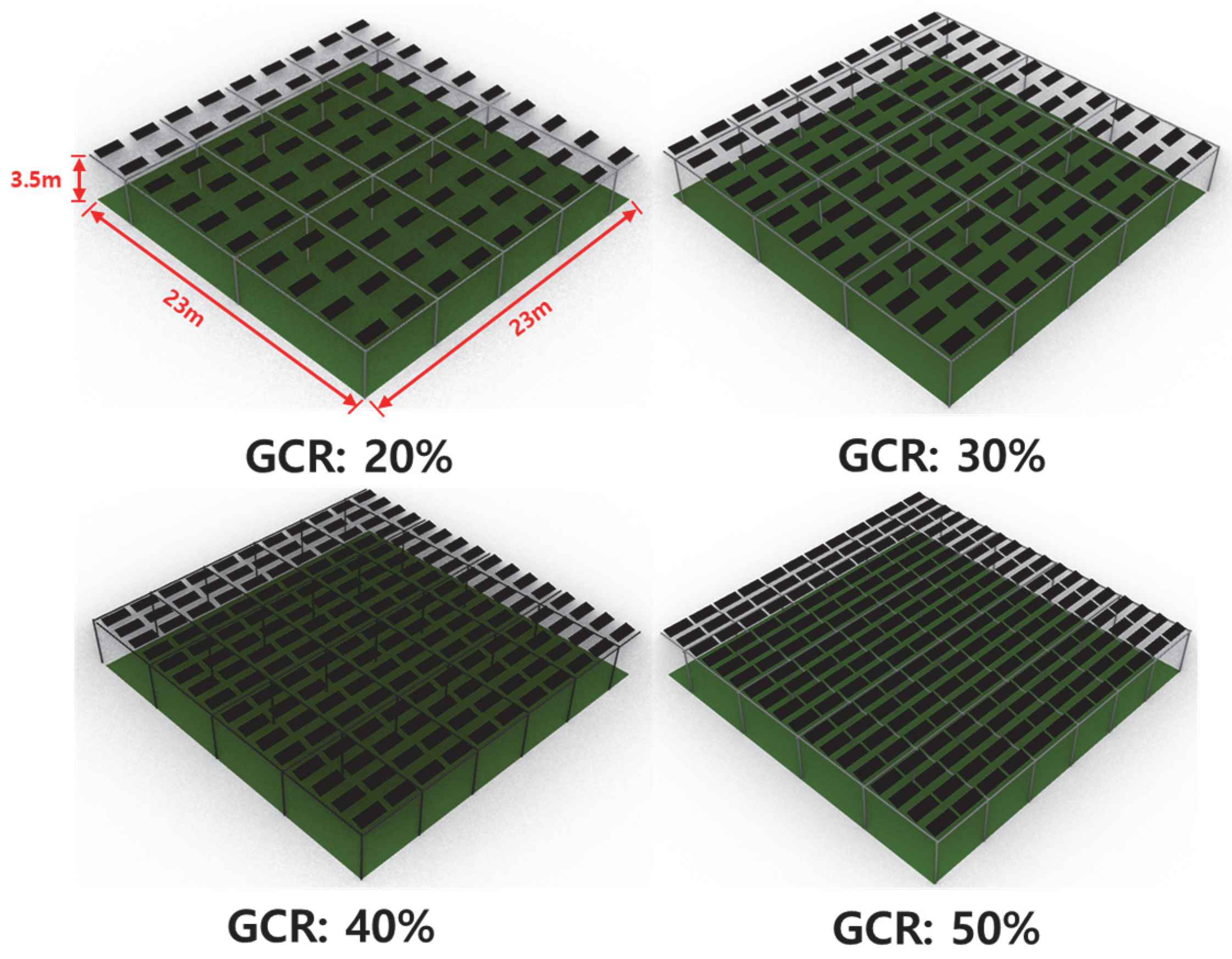
24]. In this study, GCR varied in four levels from 20% to 50% at 10% intervals. To increase GCR, the number of modules was increased from 90 to 216. As shown in
Table 4, as GCR increases, module row pitch decreases from 2.43 m to 1.29 m, column pitch decreases from 2.61 m to 1.90 m, and total system capacity increases from 21.6 kWp to 51.8 kWp.
GCR can be expressed as in Equation (7), and
Figure 3 shows the 3D models of the APV system configured at four GCR levels from 20% to 50%.
Three PV array azimuth conditions were applied: 45° southwest, south, and 30° southeast. This accounts for cases where the actual farmland orientation does not align with due south and reflects the practical constraint of needing to align module installation direction with farmland orientation for the convenience of agricultural machinery operation.
Through combinations of these variable design parameters, a total of 12 simulation scenarios were configured. For each scenario, crop yield and electricity generation were calculated to quantitatively analyze the effects of GCR and PV array azimuth on APV system performance.
Table 5 presents the fixed and variable design parameters used in the simulations.
3.2. Reference System Configuration
An appropriate reference baseline is necessary to quantitatively evaluate the performance of APV systems. In this study, open-field crop yield and electricity generation from a conventional ground-mounted PV system were calculated as reference baselines for computing CYR and LER, respectively.
Open-field crop yield was obtained by omitting Stages 2 and 3 (3D modeling and irradiance simulation) of the framework proposed in this study and simulating under the same meteorological and soil conditions using DSSAT. This approach yielded rice crop yield under pure agricultural conditions without shading effects from PV modules, providing a reference value for comparison with crop yield under the APV system.
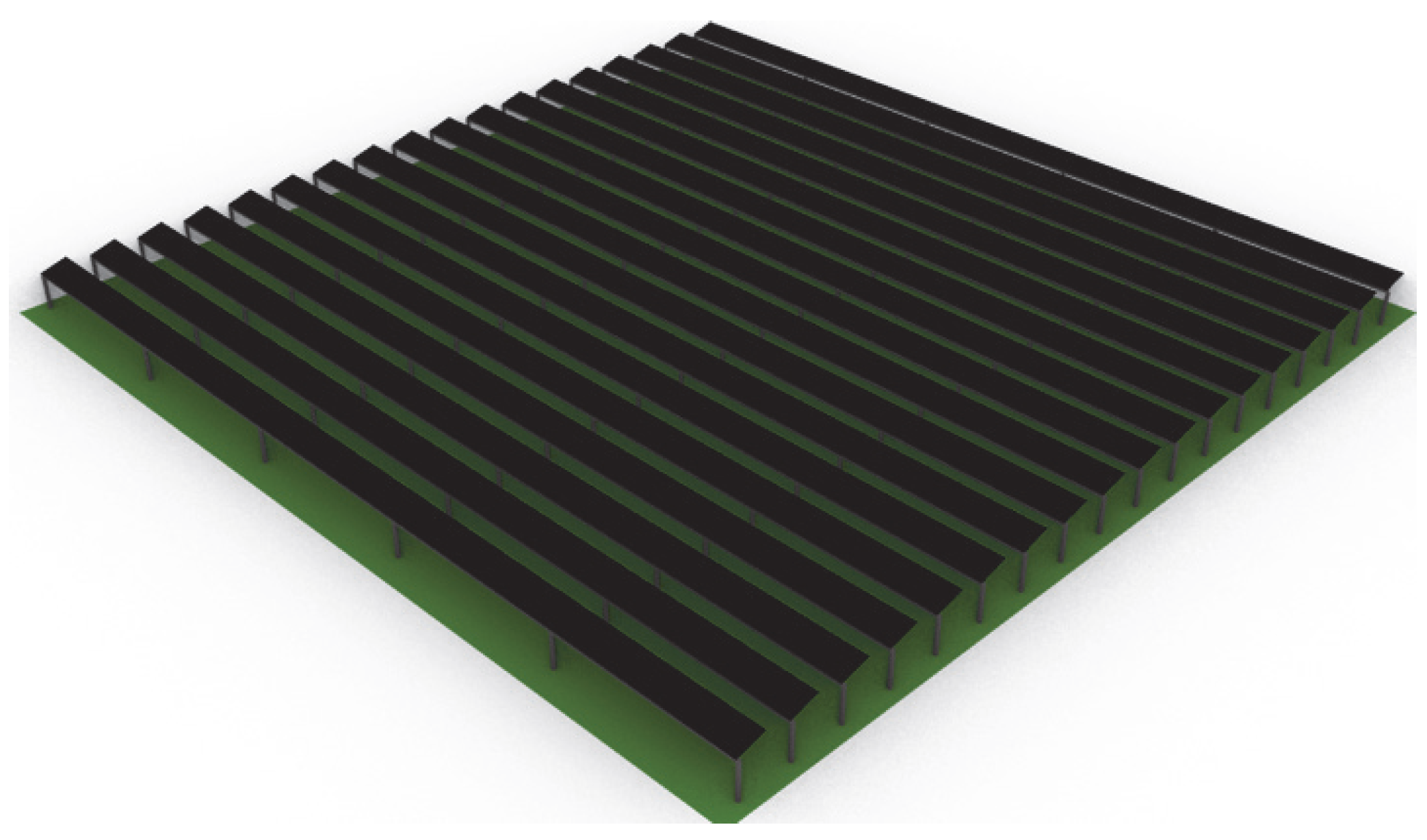
Electricity generation from the reference conventional ground-mounted PV system was also calculated using the same framework. The modules used were 240 Wp (identical to those in the APV system) with a tilt angle of 15° and oriented due south. The system comprised a total of 234 modules, with row pitch set at 1.25 m, considering shadow length during 09:00–16:00 hours on the winter solstice. This configuration secured the reference performance of a conventional ground-mounted PV system for comparison with the electricity generation of the APV system.
Figure 4 shows the 3D model of the reference conventional ground-mounted PV system, and
Table 6 presents the system configuration and simulation input parameters.
3.3. Analysis of Crop Irradiance Distribution Characteristics
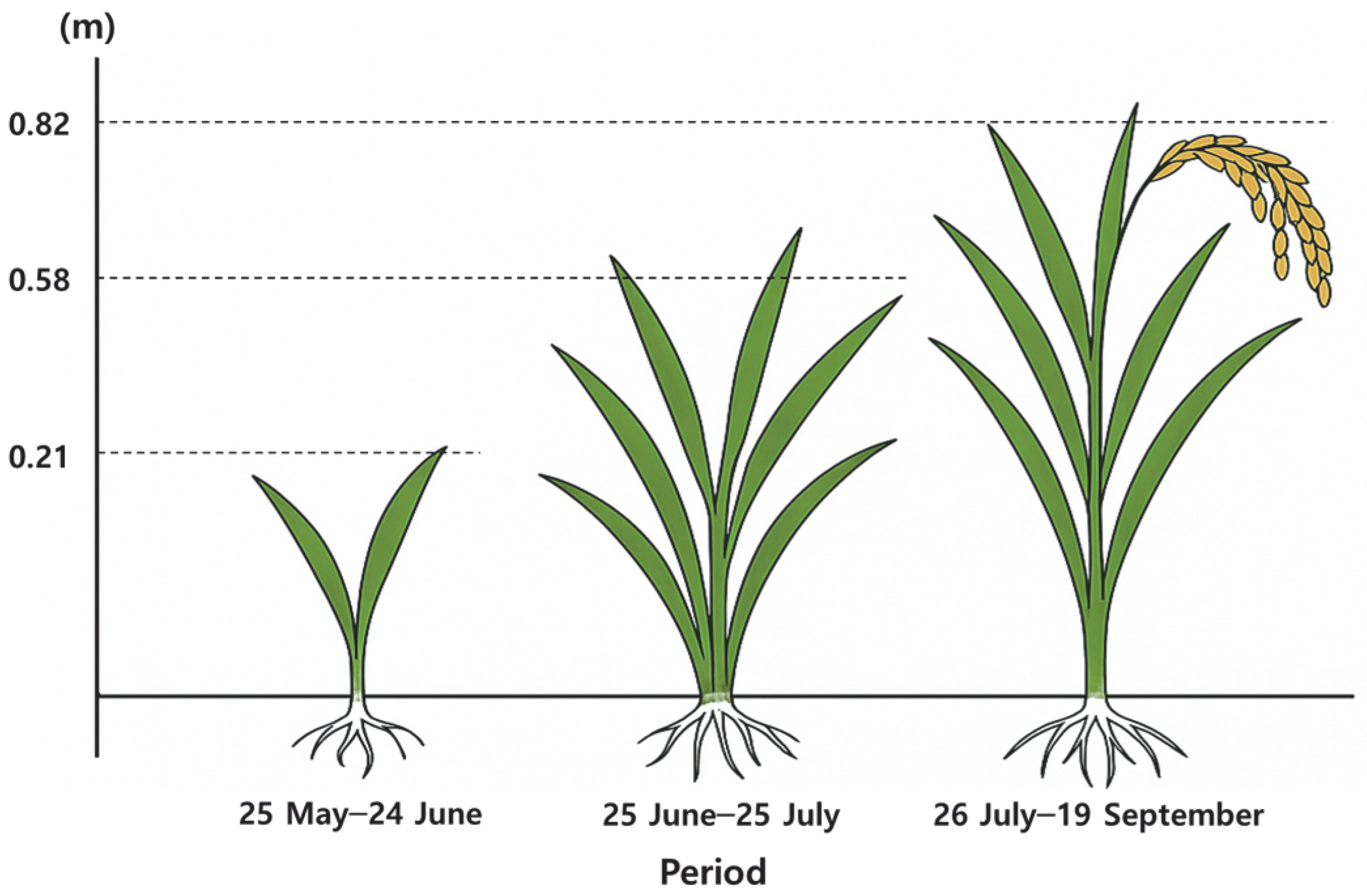
To analyze the spatial distribution characteristics of irradiance reaching crops beneath the APV system, irradiance simulations were performed considering height changes in rice plants across growth stages. Since rice plant height changes continuously during the growth process, the growing period was divided into five stages, with crop height reflected for each period in the simulations. From 1 January to 24 May 2023, during the pre-transplanting period, crop height was set at 0 m; from 25 May to 24 June, this was set at 0.21 m; from 25 June to 25 July, it was set at 0.58 m; from 26 July to 19 September, it was set at 0.82 m; and from 20 September to 31 December, after harvest, it was set again at 0 m. These height values were set based on rice crop height data at 30/60/90 days after transplanting [
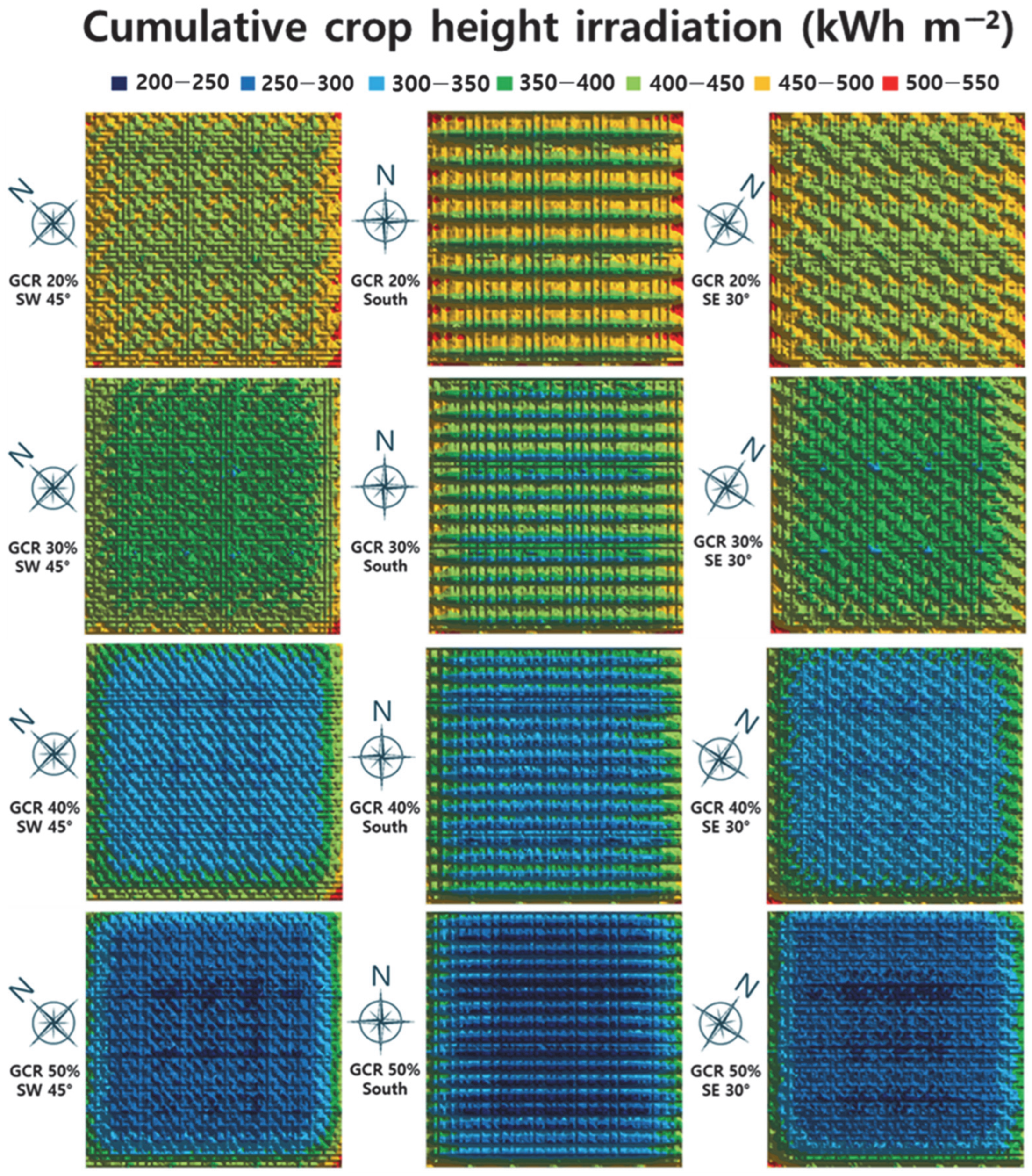
25]. Irradiance during the main growing period from 25 May to 19 September was accumulated and divided into seven bins to quantitatively analyze the spatial distribution.
Figure 5 shows crop height by growth period, and
Table 7 presents the ground-plane heights used in the simulation model accounting for crop height.
Simulations were performed for a total of 12 scenarios combining four GCR levels and three azimuth angles. Cumulative irradiation during the growing period was calculated at each virtual sensor.
Figure 6 shows the cumulative crop irradiation simulation results by GCR and azimuth, divided into seven bins in 50 kWh m
−2 intervals.
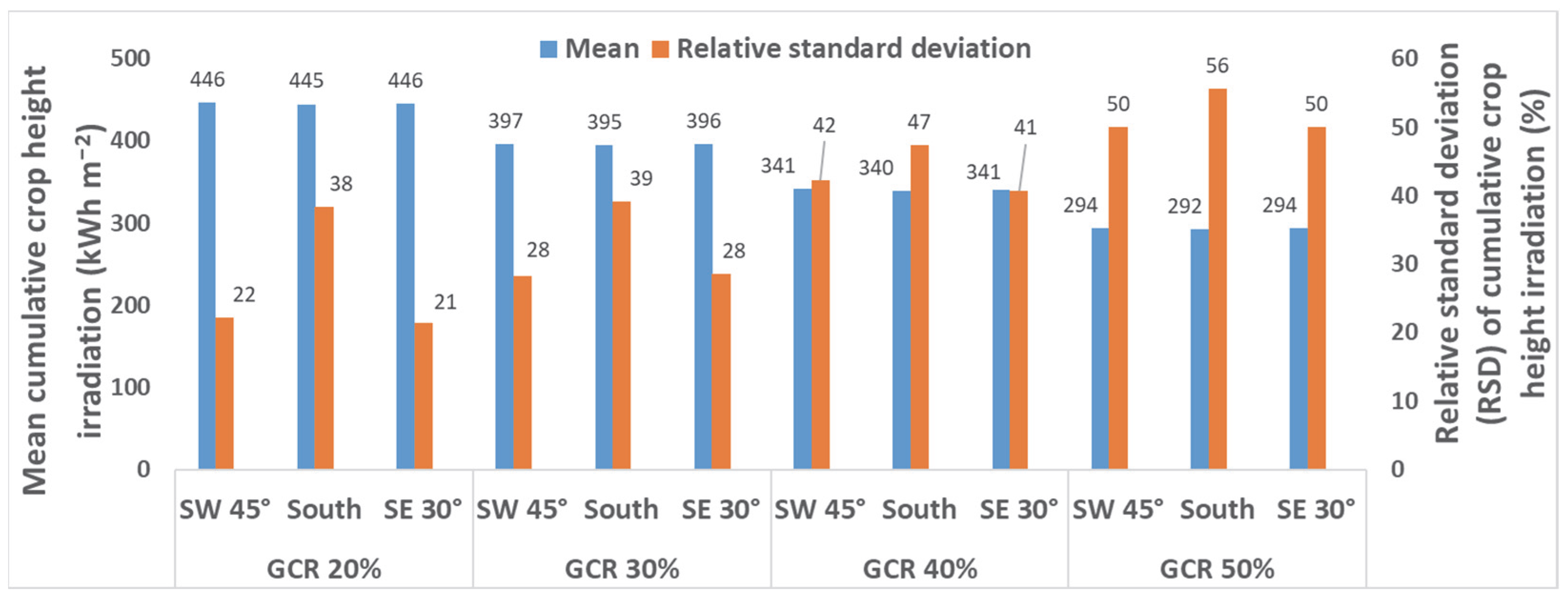
Analysis of irradiance distribution by GCR revealed a decreasing trend in mean cumulative irradiation across the farmland as GCR increased. At GCR 20%, mean cumulative irradiation was measured at 445–446 kWh m−2 regardless of PV array azimuth. As GCR increased to 30%, it decreased to 395–397 kWh m−2; at 40%, it decreased to 340–341 kWh m−2; and at 50%, it decreased to 292–294 kWh m−2, showing a sequential decline. Under the same GCR condition, when the PV array changed from due south to southeast or southwest, the difference in mean irradiation was minimal, within 1 kWh m−2.
In contrast, the relative standard deviation, which indicates irradiation uniformity, showed a distinct increasing trend with increasing GCR. At GCR 20%, the relative standard deviation for due south orientation was 38.4%, whereas 30° southeast and 45° southwest orientations showed lower values of 21.5% and 22.2%, respectively. This trend was consistently observed across all GCR conditions. At GCR 50%, the relative standard deviation was 55.7% for due south and 50.0% for both 30° southeast and 45° southwest, confirming that irradiation distribution non-uniformity intensified as GCR increased.
Figure 7 shows the mean cumulative crop irradiation and relative standard deviation by GCR and azimuth.
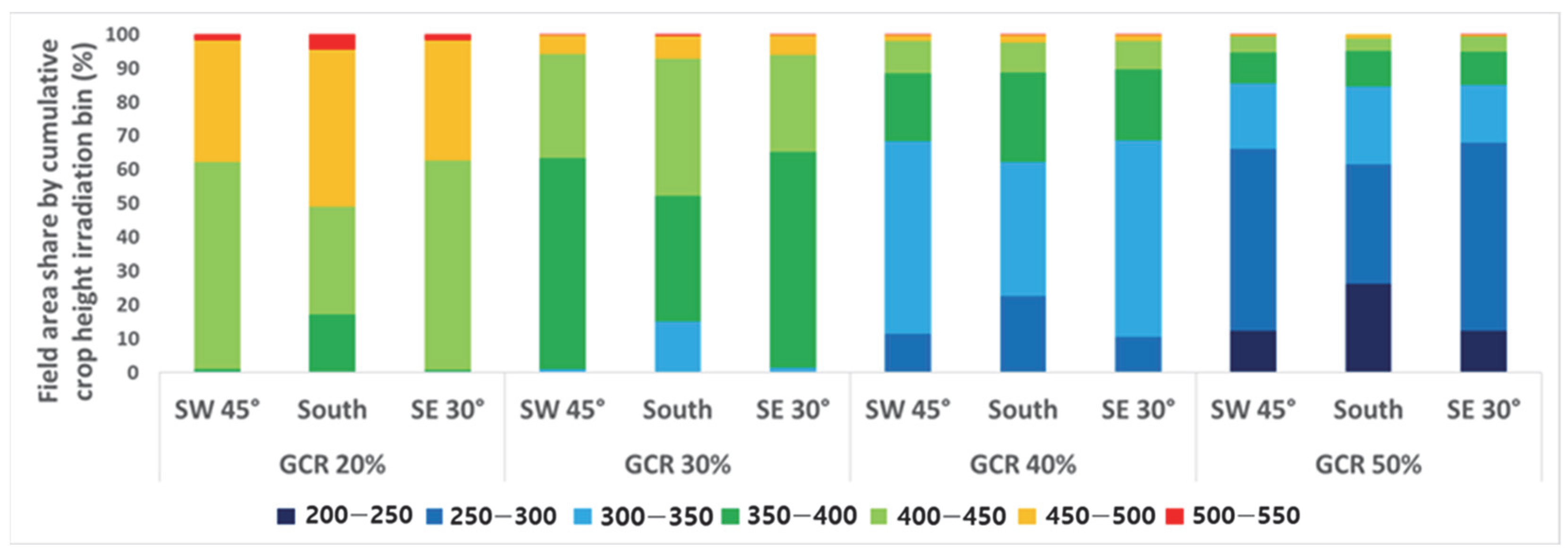
Analysis of area distribution by irradiation bins provided detailed insights into how GCR and azimuth affect irradiation distribution patterns. A general trend was observed where the proportion of higher irradiation bins (high irradiation) decreased and the proportion of lower irradiation bins (low irradiation) increased as GCR increased. In particular, for due south orientation, under the same GCR condition, the proportion of lower bins increased while the proportion of mid-to-upper bins also increased simultaneously, resulting in similar mean irradiation but with polarization of the distribution. This occurs because, in due south orientation, concentrated shading from modules creates clearly demarcated regions receiving extremely low irradiation and regions receiving relatively high irradiation.
Figure 8 shows the farmland area proportion occupied by each bin when cumulative crop irradiation is divided into 50 kWh m
−2 bins for each APV layout (GCR 20–50%, SW 45°, south, SE 30°).
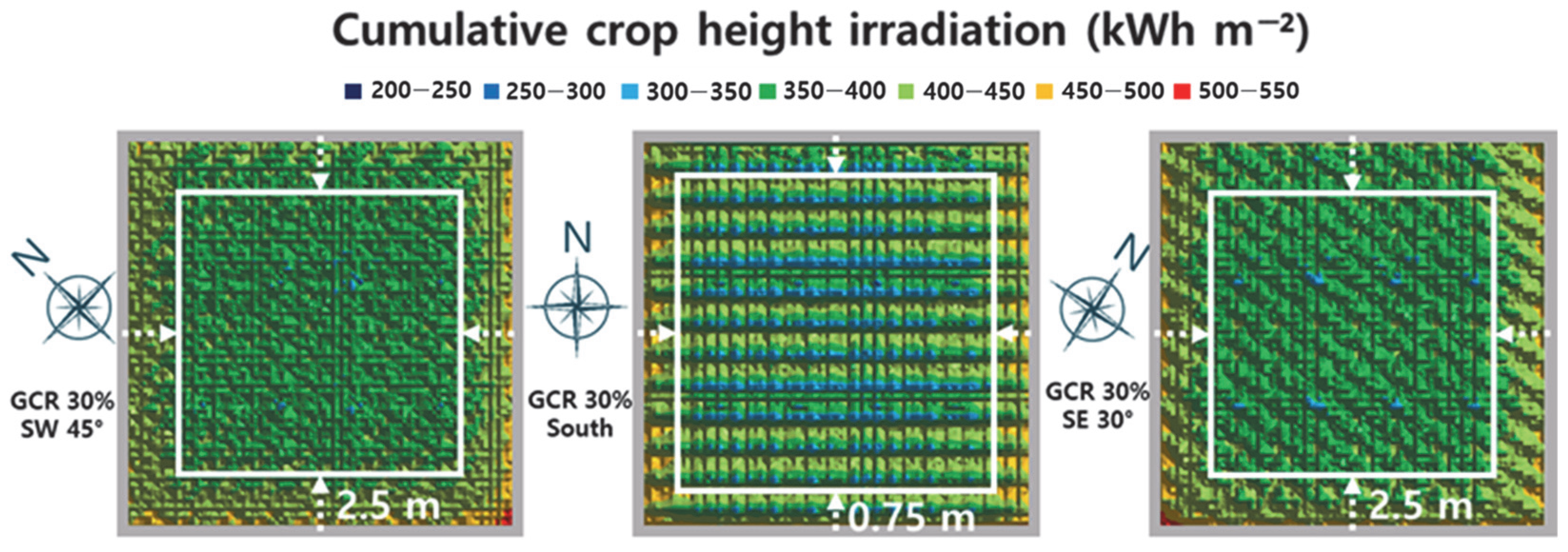
To quantitatively assess the border effect occurring at farmland boundaries, the relative standard deviation was analyzed while progressively shrinking the analysis domain inward from the entire field area in 25 cm increments. The distance at which the border effect disappears was defined as the point where the rate of decrease in relative standard deviation remained below 0.1 percentage points for two consecutive iterations. Analysis revealed that the extent of border effect influence varied with GCR and azimuth. At GCR 20%, no border effect was observed for due south orientation, whereas for 30° southeast and 45° southwest orientations, the border effect disappeared at 1.5 m from the field boundary. At GCR 30%, the distances were 0.75 m for due south, and 2.5 m for 30° southeast and 45° southwest. At GCR 40%, the distances were 2.5 m, 3.5 m, and 3.25 m, respectively, and at GCR 50%, they were 2.5 m, 3.75 m, and 3.75 m.
Figure 9 shows an example of the border effect disappearance distances at GCR 30%.
Table 8 presents the border effect disappearance distance from the field edge for each GCR and azimuth combination.
As GCR increases, module density increases, causing the border effect to penetrate deeper into the farmland interior. For due south orientation, although the width of the region where the border effect is eliminated is narrower than for southeast or southwest orientations, the relative standard deviation itself is higher, indicating that structural shading patterns from the module array have a greater impact on irradiation non-uniformity than the boundary effect.
Therefore, in APV system design, GCR is a key variable directly affecting mean irradiation and spatial uniformity, while azimuth primarily affects distribution uniformity rather than mean irradiation. Particularly in small-scale farmlands, defining the analysis domain with consideration of the border effect is essential for improving the accuracy of crop yield assessment. It should be noted that border zones are not unsuitable for crop cultivation but rather should be interpreted separately from interior zones when assessing CYR and establishing crop yield monitoring plots. Based on the observed range of border effect disappearance distances (0–3.75 m), a conservative minimum buffer of approximately 1 m from the field boundary is recommended for representative CYR assessment in practical applications.
3.4. Crop Yield Simulation Results
Based on the irradiation distribution characteristics analyzed in
Section 3.3, rice crop yield beneath the APV system was quantitatively calculated using DSSAT. The crop yield simulation aimed to produce results close to actual cultivation conditions by reflecting the spatial distribution of irradiation within the farmland, rather than simply considering mean irradiation. To achieve this, the area proportion of each of the seven irradiation bins identified in
Section 3.3 was applied to calculate yield for each bin, which was then area-weighted to determine the final farm-wide crop yield.
The simulation proceeded by inputting the mean value of each irradiation bin into DSSAT to calculate bin-specific yields. With the same soil conditions and crop management practices, only incoming solar irradiation was varied among irradiation bins and scenarios to evaluate the impact of irradiation reduction on crop growth and yield. The reference yield under open-field conditions was calculated as 6063 kg ha−1, which served as the baseline for calculating CYR for each scenario.
DSSAT predicted lower yields for irradiation bins with larger cumulative irradiation reduction, while the relative differences among bins with similar irradiation within the same GCR–azimuth combination were small. For each scenario, the farm-wide yield was therefore obtained as the area-weighted sum of the bin-specific yields, using the area proportion of each crop height irradiation bin derived in
Section 3.3.
Table 9 presents the yield by cumulative irradiation bin and the area-weighted final farm-wide yield (and yield reduction) for each GCR (20–50%) and azimuth combination.
Analysis of crop yield changes by GCR revealed a clear increasing trend in CYR as GCR increased. At GCR 20%, CYR remained below 13% for all azimuth angles, indicating relatively favorable crop productivity. At GCR 30%, CYR increased to 17–18%, satisfying the Republic of Korea guideline threshold of ≤20% for APV systems. However, at GCR 40%, CYR exceeded the guideline at 25%, and at GCR 50%, it reached approximately 33%.
Changes in crop yield by azimuth were relatively small. Under the same GCR condition, when the azimuth changed from due south to 30° southeast or 45° southwest, the variation in CYR was negligible, within 1%. This is because, as confirmed in
Section 3.3, the effect of azimuth change on mean irradiation is limited. For example, at GCR 30%, CYR was 17.7% for 45° southwest, 18.1% for due south, and 17.6% for 30° southeast, confirming that differences by azimuth are not substantial in practice.
In summary, the crop yield simulation results indicate that GCR is a critical design parameter decisively affecting crop productivity, and to satisfy the Republic of Korea CYR guideline of ≤20%, designing with GCR ≤ 30% is appropriate. Since azimuth has a limited impact on crop yield, it can be set primarily considering farmland orientation and the convenience of agricultural machinery operation.
3.5. Analysis of Light Saturation Point-Based Irradiation Requirements
Crop photosynthesis increases with increasing irradiance but reaches a light saturation point beyond which the photosynthetic rate no longer increases. For rice at 25 °C, the light saturation point is known to be 50 klx [
26], which corresponds to approximately 925 μmol m
−2 s
−1 in photosynthetic photon flux density (PPFD) [
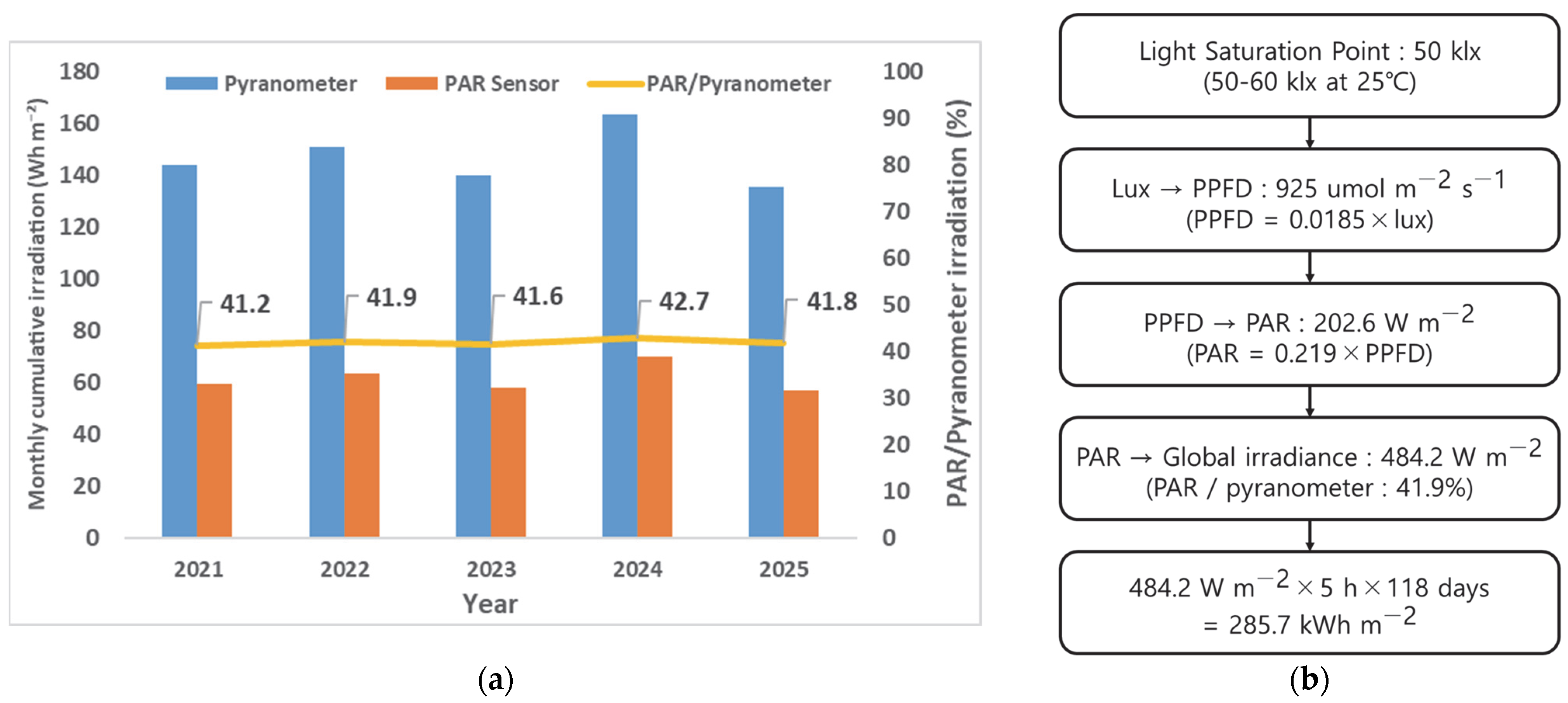
27]. PPFD represents the number of photons in the 400–700 nm wavelength range per unit area per second and indicates the amount of light directly used for plant photosynthesis. Converting this to photosynthetically active radiation (PAR) yields approximately 202.6 W m
−2 [
28], and applying the PAR-to-pyranometer ratio of 41.9% based on field measurements corresponds to 484.2 W m
−2 in total irradiance.
The PAR-to-pyranometer ratio was calculated by analyzing data from PAR sensors and pyranometers measured from May to September during 2021–2025 on the rooftop at the Tech University of Korea. Excluding months with more than 10 days of missing data (June 2022, July 2024, and September 2024), the mean PAR-to-pyranometer ratio was calculated as 41.9% based on monthly cumulative irradiation. This represents the proportion of total irradiation in wavelengths effective for photosynthesis. For simplicity, this single representative PAR-to-pyranometer ratio was applied uniformly to all regions, years, and time steps in this study.
The minimum irradiation requirement based on the light saturation point was calculated considering the rice growing period. The actual growing period under open-field conditions in the DSSAT simulation was 118 days (25 May–19 September), and accumulating the daily required sunshine duration of 5 h [
29] over the growing period yielded 484.2 W m
−2 × 5 h × 118 days = 285.7 kWh m
−2.
Figure 10a shows a comparison of monthly cumulative irradiation (pyranometer and PAR) and the PAR-to-pyranometer ratio for May–September 2021–2025, and (b) presents the conversion pathway (50 klx → PPFD → PAR → total irradiance).
Applying this light saturation point criterion, the proportion of farmland area receiving irradiation below 285.7 kWh m
−2 was analyzed for each GCR and azimuth condition. At GCR 20%, no area fell below the threshold for all azimuth angles, and at GCR 30%, the area proportion not meeting the requirement was less than 0.1%, confirming that normal photosynthesis for rice is possible in most of the farmland area. At GCR 40%, the proportion of area not meeting the requirement increased to 11.7% for due south, 1.7% for 30° southeast, and 3.2% for 45° southwest. At GCR 50%, the area proportion not meeting the requirement exceeded 50%, indicating that more than half of the farmland did not satisfy the light saturation point criterion.
Table 10 presents the farmland area proportion (%) with cumulative crop height irradiation below 285.7 kWh m
−2 for each GCR (20–50%) and azimuth combination (accumulation period: 25 May–19 September 2023). It should be noted that the light saturation point-based irradiation requirement used here is a simplified indicator rather than a mechanistic photosynthesis model. In particular, we assumed a fixed LSP value for rice at 25 °C, a constant PAR fraction (41.9%) independent of season and sky conditions, and a daily sunshine requirement of 5 h that does not resolve within-day variations in irradiance or temperature. Therefore, the threshold of 285.7 kWh m
−2 should be interpreted as an approximate benchmark for comparing design scenarios, rather than an exact physiological limit. A more detailed treatment that explicitly couples PAR, canopy microclimate, and photosynthesis is left for future work.
3.6. Electricity Generation and Land Equivalent Ratio Analysis
3.6.1. Electricity Generation Analysis
Following the methodology presented in
Section 2.1, annual energy production of the APV system was calculated using the PVlib Python library. Hourly power generation was calculated using front and rear irradiance data of bifacial modules computed by Honeybee and meteorological data from NASA POWER as inputs, which were then accumulated annually to determine total electricity generation and annual energy yield.
Analysis of irradiance reaching bifacial modules revealed that front-side irradiance (POA, plane-of-array irradiance) was nearly unaffected by GCR changes, showing variations within 1% across all GCR conditions. In contrast, rear-side irradiance responded sensitively to GCR increases, decreasing by approximately 39% when GCR increased from 20% to 50%. This is because narrower module row pitch reduces irradiance reaching the ground, consequently reducing reflected light reaching the rear side. Additionally, analysis of rear-side irradiance composition showed that the direct beam component accounted for only 0.0–0.3% on an annual basis, confirming that rear-side irradiance consists predominantly of diffuse irradiance and ground-reflected light.
Regarding azimuth changes, front-side irradiance decreased by approximately 1.8% at 30° southeast and approximately 2.6% at 45° southwest compared to due south. Rear-side irradiance showed slight increases of 0–3% with azimuth changes; however, effective irradiance accounting for the bifaciality factor decreased by 1.4–1.8% at 30° southeast and 2.2–2.6% at 45° southwest compared to due south. This is because the decrease in front-side irradiance exceeds the increase in rear-side irradiance, ultimately leading to reduced electricity generation.
As system capacity increased from 21.6 kWp (GCR 20%) to 51.8 kWp (GCR 50%) with increasing GCR, annual total electricity generation also increased linearly. However, annual energy yield per unit capacity (kWh kWp−1) showed a pattern of slight decrease. This is because, as analyzed earlier, bifacial gain decreases as rear-side irradiance decreases with increasing GCR.
At GCR 20%, the annual energy yield for due south orientation was approximately 1319 kWh kWp
−1 but decreased to approximately 1263 kWh kWp
−1 at GCR 50%.
Table 11 presents annual energy production and key system performance indicators by GCR and azimuth.
Bifacial gain, which indicates the contribution of rear-side generation in bifacial modules, showed an increasing trend as GCR decreased. It was approximately 10% at GCR 20% and approximately 6% at GCR 50%. The difference in bifacial gain by azimuth was within 1%. The bifacial performance ratio () remained constant at approximately 85% across most scenarios. Unlike CYR, electricity generation responded sensitively to azimuth changes. This is because, as confirmed in the irradiance analysis, front-side irradiance is the primary cause of effective irradiance reduction when azimuth changes.
3.6.2. Land Equivalent Ratio Analysis
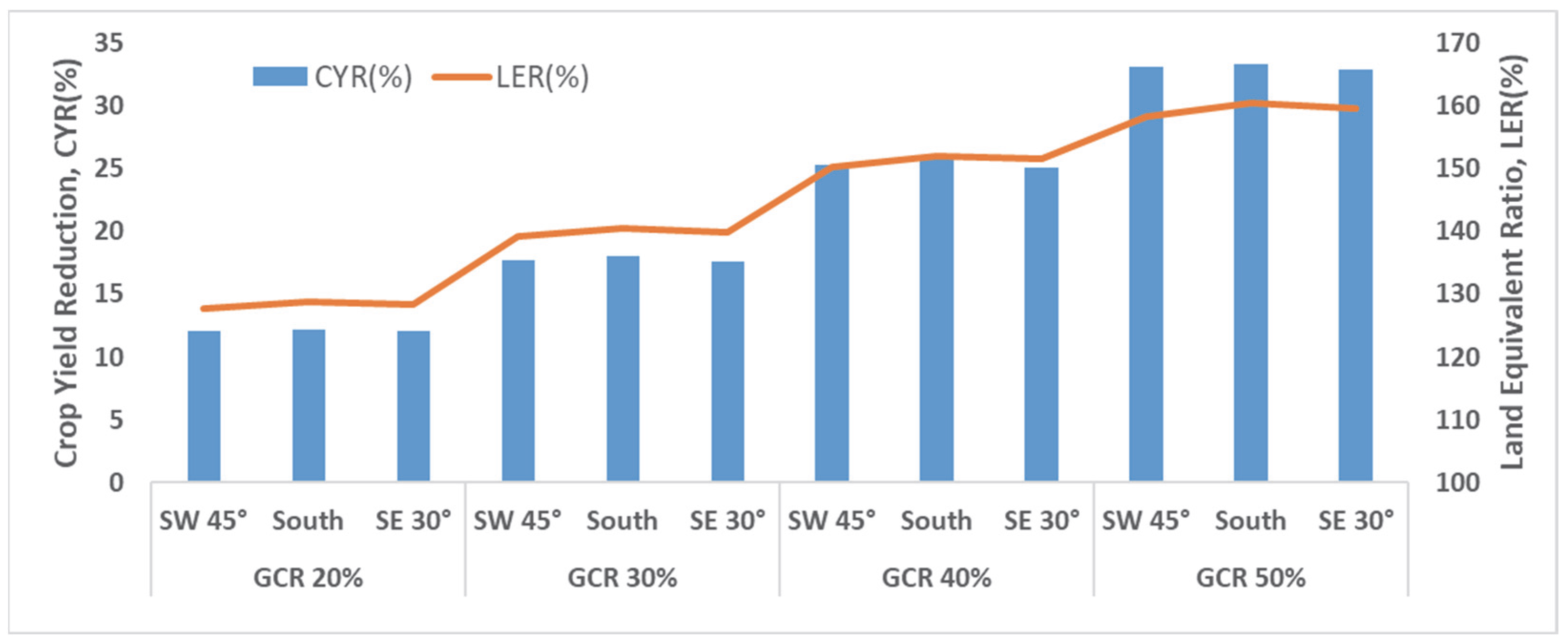
Based on the previously calculated crop yield and electricity generation results, LER was calculated according to Equation (2). The reference baselines used were an open-field crop yield of 6063 kg ha−1 and annual energy production of 69,733 kWh from the conventional ground-mounted PV system. As GCR increased from 20% to 50%, crop yield decreased from 5328 kg ha−1 to 4054 kg ha−1, while electricity generation increased significantly from 27,775 kWh to 63,833 kWh. Accordingly, CYR increased from 12% to 33%, and LER increased from 1.28 to 1.58.
At GCR 30%, CYR of 17–18% and LER of 1.39–1.40 were achieved, indicating that land use efficiency can be improved by approximately 40% while satisfying the Republic of Korea guideline of ≤20% CYR. At GCR ≥ 40%, LER exceeded 1.50, but CYR exceeded 25%, failing to meet the domestic guideline.
The effect of azimuth change on LER was very limited. Across all GCR conditions, the variation in LER with azimuth change was only 1–3%. This is because, as analyzed earlier, the effects of azimuth change on both crop productivity and electricity generation are limited.
Figure 11 shows CYR and LER by GCR and azimuth combination.
3.7. Economic Assessment
In this subsection, we evaluate how the installation of an agrivoltaic (APV) system affects the annual net income of rice farmers, based on the CYR–LER results presented above. The analysis considers the 23 m × 23 m (529 m2) test plot in Gochang and compares open-field rice cultivation with APV scenarios in which the ground coverage ratio (GCR) is varied from 20% to 50%, while other design parameters are kept constant.
The baseline net profit from rice cultivation was derived from the 2023 Production Cost Survey of paddy rice conducted by Statistics Korea, which reported a net profit of KRW 358,000 per 10a (0.1 ha) in 2023 [
30]. This corresponds to KRW 3.58 million ha
−1 yr
−1; when scaled to the 23 m × 23 m plot (529 m
2), the open-field reference net profit becomes about KRW 0.189 million yr
−1. The electricity selling price was assumed to be KRW 151.6 kWh
−1, which is the average winning price of the 2023 fixed-price contract auction for solar PV in the Republic of Korea [
31]. The initial investment cost (CAPEX) of the APV system was set to KRW 1,777,000 kW
−1 based on a 100 kW-scale APV economic analysis in the Republic of Korea [
32], and the annual operation and maintenance (O&M) cost was assumed to be 2.35% of CAPEX, following long-term LCOE forecast studies of the Korea Energy Economics Institute [
33]. The project lifetime and discount rate were set to 20 years and 4.5%, respectively.
The economic calculation follows a simple annual cash-flow model that is widely used in APV and PV economic studies [
32,
33,
34]. For each GCR scenario, the rice net profit under APV is obtained by multiplying the open-field reference net profit by (1 − CYR/100). The PV revenue is computed by multiplying the simulated annual electricity yield by the fixed electricity price (FIT). The annualized capital cost is calculated using the standard capital recovery factor (CRF) formulation, and the annual O&M cost is taken as a fixed fraction (2.35%) of CAPEX. The net profit from PV generation is then obtained by subtracting the annualized CAPEX and O&M costs from the PV revenue. The total net profit under APV is defined as the sum of the rice net profit and the PV net profit, and the additional net profit is evaluated relative to the open-field baseline. We also compute the fraction of total net profit that originates from PV, and the simple payback period of the PV investment, following the same approach as Kim and Kim [
34].
Table 12 summarizes the economic indicators for the south-facing APV system as a function of GCR. For the 23 m × 23 m test plot, the open-field annual net profit is about KRW 0.189 million yr
−1. With APV installation, CYR increases from 12.2% to 33.3% as GCR increases from 20% to 50%, and the rice net profit decreases accordingly from roughly KRW 0.166 to 0.126 million yr
−1. In contrast, the net profit from PV generation increases from roughly KRW 0.47 to 0.69 million yr
−1 as GCR increases from 20% to 40% and remains close to KRW 0.69 million yr
−1 at GCR 50%. As a result, the total annual net profit (rice + PV) ranges from approximately KRW 0.63 to 0.83 million yr
−1, i.e., more than three times higher than the open-field case for all GCR values. The maximum total net profit is obtained at GCR 40%, but the difference relative to GCR 30% is only on the order of 7%. The simple payback period is 11.3–11.9 years for all GCRs, indicating that increasing GCR has only a limited effect on the investment recovery time.
The share of PV in total net profit increases from about 74% to 85% as GCR increases from 20% to 50%, confirming that the profitability of APV projects is largely dominated by electricity sales rather than crop income, in line with previous APV economic studies in the Republic of Korea [
32,
34]. From an agricultural and policy perspective, however, excessive crop yield losses can reduce the social acceptability of APV deployment. In our case, GCR 20% yields the lowest CYR (12.2%) but also the lowest total net profit among APV scenarios. GCR 50% yields the highest total net profit but requires accepting a CYR of 33.3% while providing only a modest increase in net profit compared with GCR 30%. The south-facing APV system with GCR 30% results in CYR = 18.1%, which satisfies the commonly used Korean guideline of maintaining CYR ≤ 20% for APV projects while achieving higher LER and more than 20% greater total net profit than the GCR 20% case. Therefore, under the conditions considered in this study, the GCR 30% south-facing APV configuration offers the most balanced trade-off between economic performance and rice production and can be regarded as a practical design option that keeps agriculture as the primary land use.
3.8. Multi-Year Analysis for Two Regions
The analyses in
Section 3.1,
Section 3.2,
Section 3.3,
Section 3.4,
Section 3.5,
Section 3.6 and
Section 3.7 were conducted under the 2023 conditions of Gochang, Jeollabuk-do. To examine how the results change when the same design is applied to different years and locations, we additionally performed simulations for Gochang and Haenam (Jeollanam-do) for the years 2022–2024, resulting in six region–year combinations (Gochang 2022/2023/2024 and Haenam 2022/2023/2024).
In this analysis, we focused only on the APV configuration used as the main case in the previous subsections, namely the GCR 30% south-facing layout. The module height, row spacing, bifacial module configuration, Honeybee–Radiance irradiance simulation settings, DSSAT–CERES-Rice model setup, and PVlib energy yield calculation procedure were kept identical to the Gochang 2023 baseline scenario. For each region–year combination, NASA POWER daily meteorological data (SRAD, TMAX, TMIN, RAIN) were replaced by the corresponding local and annual data to generate WTH files, while soil properties and management practices (variety, transplanting and harvest dates, fertilization and irrigation management) calibrated for Gochang were applied commonly to both regions.
Table 13 summarizes the CYR and LER values for the GCR 30% south-facing APV layout across the six region–year combinations in Gochang and Haenam. Across these combinations, CYR ranges from approximately 10.6% to 18.1%, and LER ranges from about 1.40 to 1.48. In other words, when the same GCR 30% south-facing design is applied to different recent years and to the two rice-growing regions considered here, the balance between crop yield reduction and electricity generation remains within a similar range to that obtained for the single-year case of Gochang in 2023.
4. Conclusions
This study proposed a simulation framework to integrate the assessment of crop yield and electricity generation in APV systems. The proposed framework comprises five stages: meteorological data collection and processing, 3D modeling, irradiance simulation, crop yield simulation, and electricity generation simulation. Selecting GCR and PV module azimuth as key design variables for APV system design, simulations were performed for rice cultivation conditions in Gochang, Jeollabuk-do, Republic of Korea, yielding the following key conclusions:
(1) GCR was confirmed to be a critical design parameter decisively affecting both crop productivity and electricity generation. As GCR increased from 20% to 50%, mean cumulative irradiation for rice decreased by approximately 34% from 445–446 kWh m−2 to 292–294 kWh m−2, while the relative standard deviation indicating irradiation distribution uniformity increased from 38.4% to 55.7%, intensifying non-uniformity. Consequently, CYR increased from 12–13% to 33%, and the area proportion not meeting the light saturation point requirement (50 klx) for rice was below 0.1% up to GCR 30% but reached a maximum of 11.7% at GCR 40% and exceeded 50% at GCR 50%. In terms of electricity generation, as system capacity increased from 21.6 kWp to 51.8 kWp with increasing GCR, annual energy production increased by 130% from 27,775 kWh to 63,833 kWh; however, annual energy yield per unit capacity decreased by 4% from 1319 kWh kWp−1 to 1263 kWh kWp−1 due to reduced rear-side irradiance from narrower module row pitch.
(2) PV module azimuth had a limited impact on crop yield and electricity generation but affected crop height irradiation distribution uniformity. Under the same GCR condition, when the azimuth changed from due south to 30° southeast or 45° southwest, the difference in mean cumulative irradiation for rice was minimal within 1 kWh m−2, CYR variation was within 1%, and electricity generation decreased by only 1.2–2.9% compared to due south. However, differences by azimuth were evident in terms of rice cumulative irradiation distribution uniformity. At GCR 20%, the relative standard deviation of 38.4% for due south decreased to 21.5% and 22.2% for 30° southeast and 45° southwest, respectively, improving uniformity, and this trend was consistently observed across all GCR conditions. Therefore, when selecting azimuth, it is advisable to align the PV module azimuth with farmland orientation, also considering the convenience of agricultural machinery operation.
(3) The extent of border effect influence at field boundaries varied with GCR and azimuth. At GCR 20%, no border effect was observed for due south, whereas for 30° southeast and 45° southwest, the border effect disappeared at 1.5 m inward from the field boundary. As GCR increased, the extent of border effect influence expanded; at GCR 50%, the border effect disappeared at 2.5 m for due south and 3.75 m inward from the field boundary for 30° southeast and 45° southwest. For due south orientation, although the border effect disappearance distance is relatively short, the relative standard deviation itself is higher, confirming that structural shading patterns from the module array have a greater impact on irradiation non-uniformity than the border effect. The extent of border effect influence is an essential indicator for accurate crop yield assessment and must be considered in the design stage, especially as the proportion of the border effect region to total area increases in smaller farmlands.
(4) For domestic APV design in the Republic of Korea, designing with GCR ≤ 30% was confirmed to be appropriate to maximize land use efficiency while satisfying the CYR guideline of ≤20%. As GCR increased from 20% to 50%, LER increased from 1.28 to 1.58, but CYR increased from 12% to 33%. At GCR 30%, CYR of 17–18% satisfied the domestic guideline while achieving LER of 1.39–1.40, securing a balance between agricultural productivity and electricity generation. At GCR ≥ 40%, although LER exceeded 1.50 with improved land use efficiency, CYR exceeded 25%, failing to meet the domestic APV design guideline. The economic analysis further showed that, for the 23 m × 23 m test plot, all APV scenarios more than tripled the annual net profit compared with open-field rice and that the GCR 30% south-facing configuration provided nearly the highest total net profit among the tested GCR values while keeping CYR below 20%. In contrast, increasing GCR to 50% led to only modest additional net profit relative to GCR 30%, despite a substantial increase in CYR to about 33%, indicating that very high GCR values may not be desirable from the perspective of balancing farmer income and crop protection.
(5) When the GCR 30% south-facing layout was applied to additional simulations for Gochang and Haenam over the years 2022–2024, CYR values remained within approximately 10.6–18.1% and LER values within about 1.40–1.48. For the two regions and three years considered, the trade-off between crop yield reduction and electricity generation for this design thus stayed within a similar range to that obtained for the single-year baseline case in Gochang in 2023.
The proposed framework is extensible to diverse crops and regional conditions and can support design-stage decision-making that simultaneously considers agricultural productivity and economic viability for APV systems. At the same time, the present implementation has several limitations that should be kept in mind when interpreting the results. First, the framework has not yet been validated against long-term measurements from domestic APV demonstration sites, and all CYR and LER values are based on simulations. Second, microclimate changes induced by APV structures (e.g., air temperature, humidity, wind speed, and evapotranspiration) are not explicitly represented in the DSSAT meteorological inputs, and only the change in crop height irradiance is reflected. Third, the light saturation point-based irradiation requirement relies on a fixed LSP value, a single representative PAR-to-pyranometer ratio, and a daily sunshine duration of 5 h, and therefore provides a simplified indicator rather than a mechanistic description of photosynthesis. Fourth, soil properties and crop management parameters calibrated for Gochang were also applied to Haenam in the multi-year, two-region analysis, and spatial variability in soil and management was not resolved. Future research should expand the scope to various crop groups, such as vegetables and fruit trees, and perform analyses under diverse climate zones and soil conditions. By compiling representative meteorological, soil, and crop information for major rice cultivation regions into a database, systematically calculating CYR, LER, and annual energy production across combinations of design parameters (e.g., GCR, azimuth), and integrating these outputs with the economic assessment framework presented in
Section 3.7, the proposed workflow could evolve into a regional or national APV site assessment and planning tool capable of comparing and selecting candidate sites and design configurations. In addition, field measurements from APV demonstration systems—such as under-canopy microclimate, PAR, and yield observations—should be used to validate and refine the integrated framework and to evaluate how uncertainties in microclimate representation, light-saturation assumptions, and soil and management parameters propagate into CYR, LER, and economic indicators.