Article

Transient Modeling of a Radiantly Integrated TPV–Microreactor System (RITMS) Design
Department of Nuclear and Radiological Engineering and Medical Physics, Georgia Institute of Technology, Atlanta, GA 30332, USA
*
Author to whom correspondence should be addressed.
Energies 2025, 18(23), 6361; https://doi.org/10.3390/en18236361 (registering DOI)
Submission received: 18 November 2025 / Revised: 26 November 2025 / Accepted: 2 December 2025 / Published: 4 December 2025

Abstract

Powered by high-efficiency thermophotovoltaics and developed through economics-by-design analysis, a promising, optimized design was selected for the radiantly integrated TPV–microreactor system. However, the novelty of the conversion system, the connection between the TPV and critical reactor core, requires a proper degree of reliability analysis to develop confidence in this technology. This is made difficult by the lack of computational tools that capture the full suite of physics and feedback mechanisms present in the RITMS design. This paper outlines the methods utilized to capture power, temperature, and reactivity variation and feedback mechanisms through time, utilizing lumped conditions, point kinetics equations, and the determination of temperature reactivity coefficients. The computational package was applied to a series of accident-driven transient scenarios, demonstrating the RITMS design’s ability to return to a safe operating equilibrium without active interference. In the case of high positive reactivity insertion accidents, design solutions were demonstrated that would mitigate risk.

1. Introduction

This paper continues the work on the radiantly integrated TPV–microreactor system (RITMS) that was first published by Kaffezakis and Kotlyar in 2025 [1]. The previous work discussed the process of conducting technoeconomic optimization to design an MW-scale microreactor that is cost-viable for adoption in niche and remote power markets. While important in the licensing of all new nuclear plants, there is extra weight given to demonstrating transient reliability for reactors situated in geographically isolated regions. NRC licensing requires the determination of margins of safety during normal operation and anticipated transient conditions with demonstration of risk reduction features without a triggered SCRAM [2]. In this case, a transient is defined as an event where the normal state of operations for a plant is interrupted, and an abnormal and potentially variant state arises. While a reactor can be originally designed to operate normally within the limitations of the components, the components may fail during an unintended and under-mitigated transient. This can lead to the release of hazardous materials, as seen in the major accidents of Three-Mile Island, Chernobyl, and Fukushima Daiichi.
While the RITMS design is less vulnerable to some of the traditional failure modes of coolant-driven reactor systems, it has unique failure mechanisms, such as a re-pressurization of the emitter-TPV gap, that need to be explored. Additionally, there are important concerns about the temperature and heating rate limitations of the TPVs as well. Experimental tests of thermal shocks in TPV materials demonstrated decreases in total absorption and shifts in the spectral absorption at different wavelengths [3]. The aim of the work presented in this paper is to develop a modeling approach that captures the unique physics of the design and to determine the core’s ability to survive the transient and return to a stable state without operator interference.
Combined with the relatively high operating temperatures needed to empower TPV conversion, there is a valid concern over the RITMS being able to survive accident scenarios with thermal radiation as the only source of heat removal. Additionally, most nuclear systems and transient codes do not natively include complex radiative heat transfer solvers. Therefore, the objective of the work presented in this paper was to build a simple transient solver that can model the potential accident-induced transients of the RITMS design and to demonstrate the design elements that ensure the system’s reliability. This will be the first published work examining transient systems that combines the assessment of both radiative heat transfer and nuclear reactivity feedback mechanisms to determine power.

2. Reference Design

The radiantly integrated TPV–microreactor system is illustrated in the representative schematic in Figure 1. The basic configuration of the reactor core is a series of coaxial rings around a central graphite region that provides the structural backbone of the reactor and potential space for instrumentation and control equipment. Power is generated in the inner layers where fuel ring(s) are sandwiched between graphite layers. The heat is then conducted through a radial beryllium oxide reflector into a tungsten wrapper acting as cladding and emitter. This high-temperature emitter radiates across a low-pressure gap through black-body photons. Some of the radiative photons are captured by the TPV panels as useful electric power, while the majority of the sub-bandgap photons are reflected back to the core.
Though necessary for the final design, control elements are excluded from Figure 1 since these features are still under investigation. For the sake of the transient considerations, it will be assumed that operators are able to insert up to a few dollars of positive or negative external reactivity. Additionally, while the schematic in Figure 1 presents a hexagonal cross-section, all the modeling efforts in this dissertation assume cylindrical geometry. Firstly, while still an immature design, the final axial cross-section for RITMS is not a set feature and would need to be more thoroughly investigated as part of the final manufacturing and assembly design. Secondly, since the objective of this analysis is to highlight general behavior trends, this simplifying assumption allows for the radial dimension to be isolated when calculating temperature and thermal stress variation.
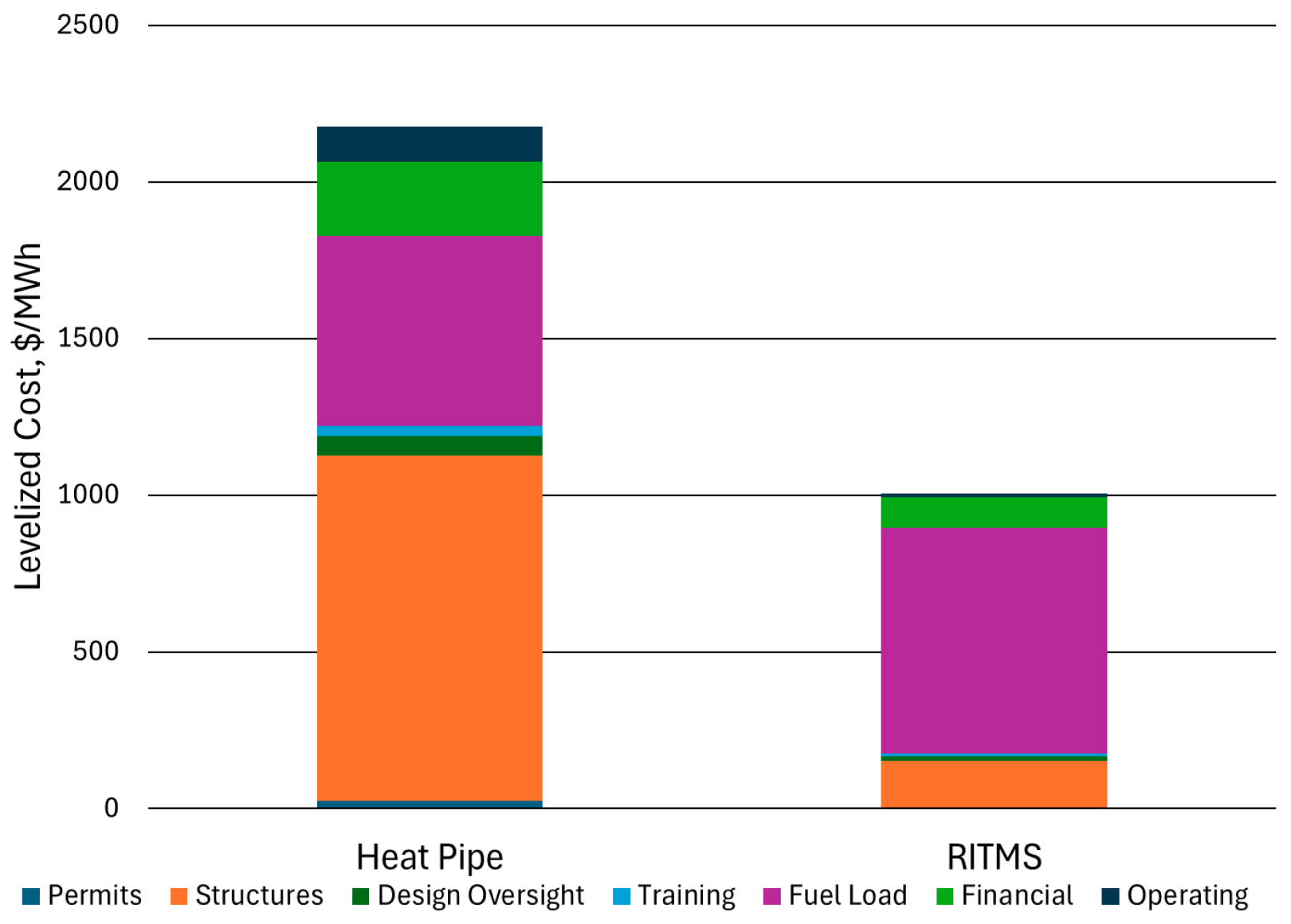
Based on the steady-state trade-off studies, a cost-optimized, single-fuel region design was selected [1]. Figure 2 presents a comparison of the account-specific contributions to levelized cost for the battery-style heat pipe reactor [4] and the optimized RITMS design. Driven largely by the reduction in system costs associated with heat exchangers, pumps, and turbines, and the extended operating time on LEU+ fuel, the selected RITMS design is able to compete with similarly sized units. For the purposes of the transient analysis, the optimized design and its steady-state operational parameters, as described in Table 1, are selected for the initial reference conditions of the model core. The model geometry in Table 1 is a properly scaled representation of the optimized design’s cylindrical geometry.

3. Codes and Methods

The developed steady-state models for RITMS incorporated comparisons of the spatial thermal–mechanical solutions against the temperature and mechanical limitations of the various materials. These safety considerations were factored into the selection of the proposed design and desired operating conditions, but the economic incentives to operate at high temperatures lead to a significant risk in crossing safety margins during transients, whether initiated through an accident scenario or intentional intervention in steady-state operating conditions. To provide a rapid but reliable methodology for calculating the transient behavior, a lumped kinetics model was developed to approximate the equations of state for the RITMS design. These equations define a system of time-dependent ordinary differential equations (ODE) that could be numerically solved from an initial condition utilizing SciPy’s ODE solver, scipy.integrate.odeint [5].

3.1. Solution Method

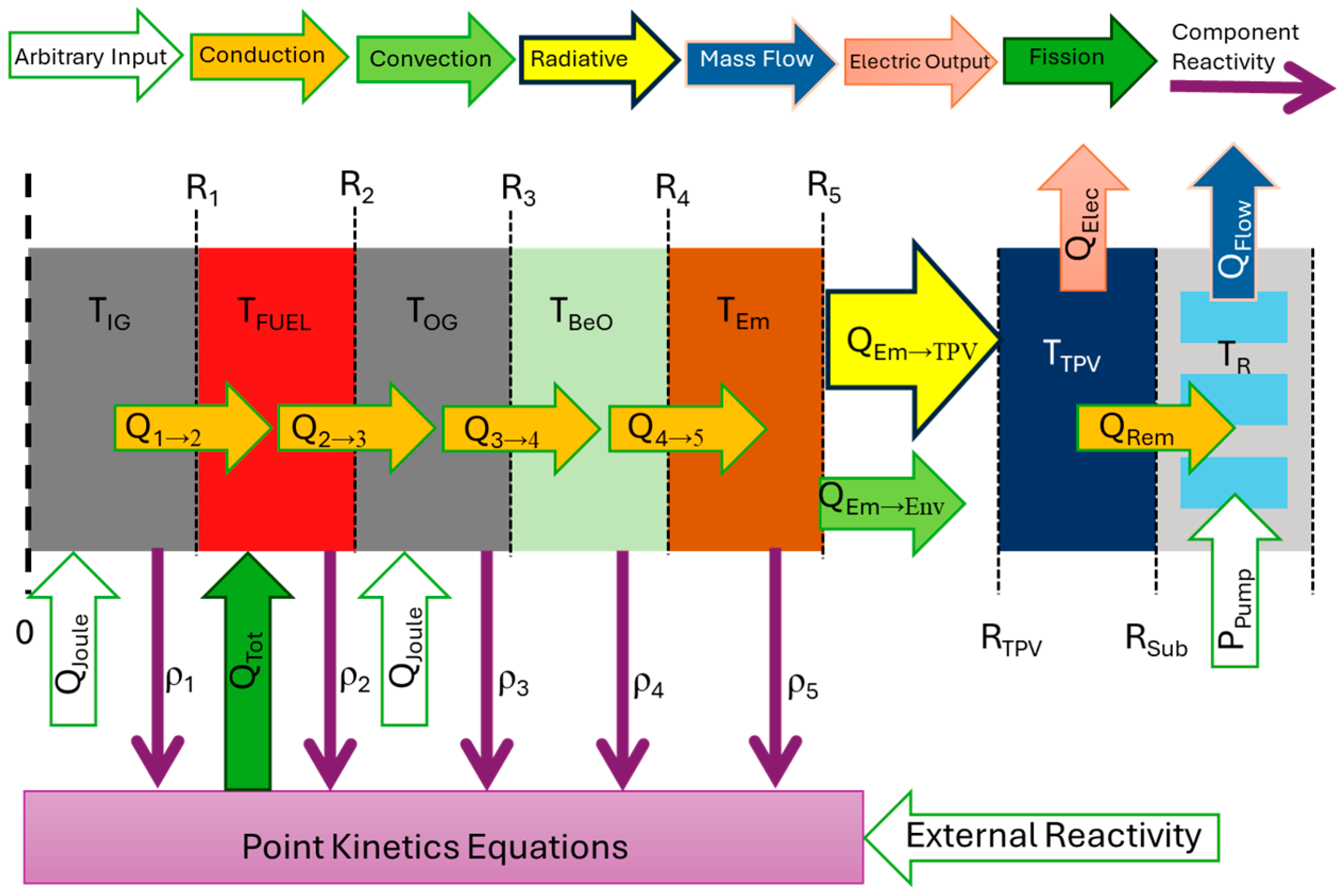
The previous sections described the derivation of the state equations for a lumped transient model of the RITMS design. The state variables of the system, which include the ring temperatures, the total power, delayed neutron concentrations, and partial reactivities, are listed in Table 2, along with the corresponding ODEs that describe the time-dependent derivative of each state variable. The derivation and further description of these equations are presented in the following sections. In approaching a transient problem, the user of this tool first defines the fixed values of the problem, which include material selection, power distribution, and geometric dimensions, in addition to the point kinetic and reactor feedback data for the desired model. Next, the user defines the variant properties and their corresponding time-dependent functions, which include external reactivity insertion, TPV placement, TPV reflectivity, coolant velocity, and the selection of reactor boundary conditions. Lastly, the user defines the initial temperature and power conditions of the model and sets the time scale for the transient simulation. These defined properties complete the description of the initial value problem that is solved using scipy.integrate.odeint [5]. A visual representation of the transient model is presented in Figure 3, which describes the flow of power within a single fuel ring RITMS design. This schematic does not represent the actual dimensions of the design case but does provide clarity on how the lumped transient model works.
The SciPy package utilizes a numerical approach to solve the integral problem, specifically a fifth-order Runge–Kutta (RK5) method [6]. Similarly to other numeric methods, the Runge–Kutta method takes a series of time steps and approximates the values of the state variables, y i , at a time step, t i , based on the state at the previous time step, t i 1 and the defined derivatives of the ODE systems of equations. This is summarized in Equation (1), where y t | i 1 i is the approximation of the change in y for across time step t i 1 i
y i t i = y i 1 t i 1 + t i t i 1 y t | i 1 i
For the first-order approximation, also known as the Euler method, the approximation is defined by the ODE system evaluated at the initial point f y i 1 ,   t i 1 , where f is a function that describes the system of equations that calculate the state variables for a given time and system state. As t approaches 0, the Euler method converges on the actual system, but for larger timesteps, the method tends to overpredict shifts and cause instability in the solution. The RK5 method attempts to correct the issue of solution stability by approximating the derivatives at multiple points within the time step and utilizing a weighted average that emphasizes the approximation of the derivatives at the midpoint. This allows for a more stable approximation of the initial value problem while using fewer timesteps and decreased computational resources. A general form for this method can be described in Equation (2).
y t | i 1 i = i = 1 5 b i k i , k 1 = f y i 1 , t i 1 , k 2 = f y i 1 + t a 21 k 1 , t i 1 + c 2 t k 3 = f y i 1 + t a 31 k 1 + a 32 k 2 , t i 1 + c 3 t k 4 = f y i 1 + t a 41 k 1 + a 42 k 2 + a 43 k 3 , t i 1 + c 3 t k 5 = f ( y i 1 + t a 51 k 1 + a 52 k 2 + a 53 k 3 + a 54 k 4 , t i 1 + c 5 t )
Here, a j i are constants defined by the Runge–Kutta matrix; b i and c i are the weights and nodes, which are variable but constrained constants that can impact the approximation error and are fully discussed by Dormand and Prince (1980) [6]. Scipy selects the weights and nodes in order to minimize error based on the problem characteristics.

3.2. Neutronic Modeling and Reactivity Feedback

Within a reactor core, changes in material temperatures often lead to changes in the neutronic behavior of the system through a shift in microscopic cross sections and a change in material density [7]. An important step in the transient modeling is to develop models that describe the effect of temperature on the produced power. This feedback is captured through the temperature reactivity coefficients (TRC), defined in Equation (3) as the variance in the system reactivity through a change in temperature of a given ring:
α T , i ( T i ) = ρ i T i
where α T , i ( T i ) [1/K] is the temperature-dependent TRC for ring, i, and ρ i is the partial reactivity of the ring. The partial reactivity is defined as the portion of the system reactivity that is affected by the variation in a given ring temperature away from the reference, as defined by Equation (4):
ρ s y s = i   ρ i ( T i ) + ρ o
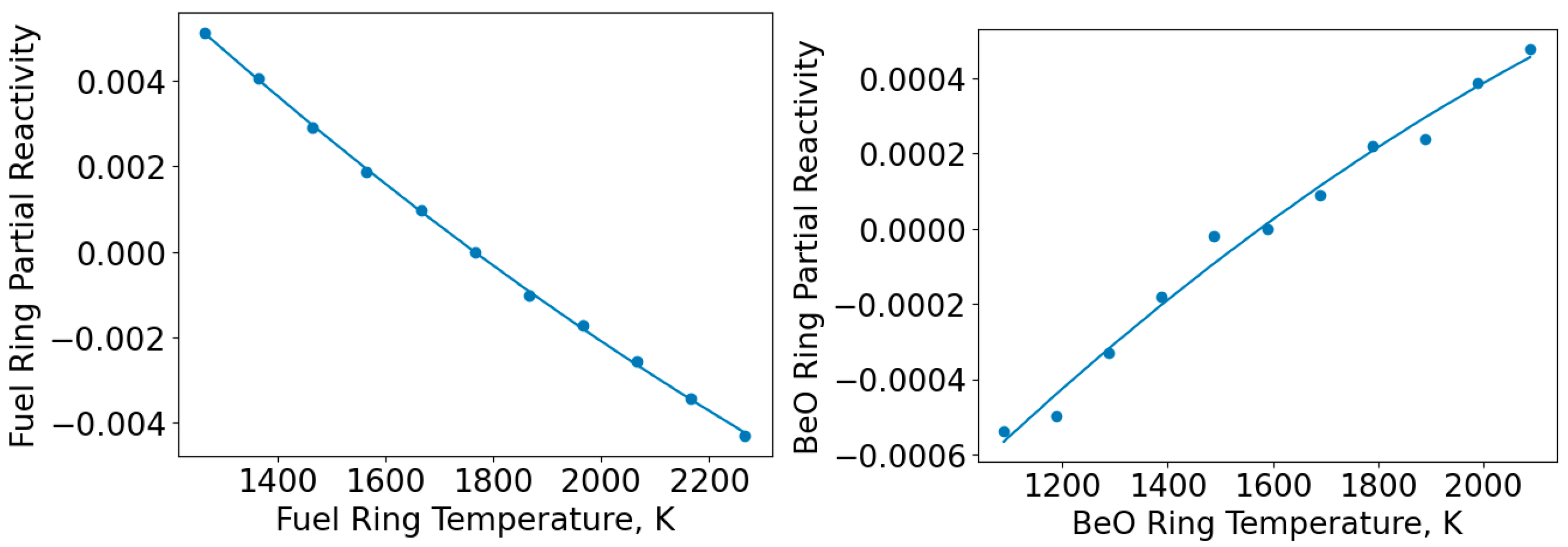
These coefficients were calculated for each ring based on a direct perturbation method. Serpent v2.2.1, which is a three-dimensional, continuous-energy Monte Carlo particle transport code developed at VTT Technical Research Centre of Finland, Ltd. (Espoo, Finland), can be utilized to calculate the eigenvalues for a given material, geometry, and temperature description [8]. For the design described in Table 1, a 2D Serpent model was created for the cylindrical geometry, utilizing the average ring temperatures of the design operating during steady-state conditions. Conducting a criticality run utilizing 100,000 particles, for 40 inactive and 100 active cycles, Serpent provided the reference reactivity with an error of less than 20 pcm. For this reference scenario, the temperature in each ring was parametrically varied up and down from 500 K at 100 K intervals. From the set of Serpent executions, the partial reactivity in each ring can be plotted against the ring temperature. These runs were conducted utilizing the temperature and energy-dependent ENDF/B-VII cross-section library. These partial reactivities were fitted to a second-order polynomial; from there, the TRCs could be derived according to Equation (3). Figure 4 presents the partial reactivity results and fitted curve for the fuel region and the BeO reflector region, as these have the greatest negative and positive feedback effects, respectively. The derived temperature-dependent reactivity feedback equations are provided in Table 3.

3.3. Power Variance Through Point-Kinetic Equations

Within the reactor core, it can be assumed that all power imparted to the materials is created from fission reactions within the fuel. A thermal neutron colliding with a fissile nucleus leads to the release of excess energy, which is mostly transferred to the fission particles as excess kinetic energy that is quickly transferred to the surrounding material. From this understanding of power production, it should be clear that the generated power is a function of the neutron flux, as defined by Equation (5):
Q ( t ) = V E f Σ f ϕ ( t )
where Q ( t ) [W] is the power generated in volume V [m3] with neutron flux ϕ ( t ) [1/m2/s] and E f [J] is the energy produced from each fission event and Σ f [1/m] is the fission cross-section. As is evident, this assumes that the neutron density and material properties are homogeneous, which matches with the lumped approach taken in the transient model. Being able to disregard the spatial components of the neutron equations allows for the utilization of the point-kinetic equations defined in Equation (6):
d Q ( t ) d t = ρ t β Λ Q t + i = 1 6 λ i C i t   , d C i d t = λ i C i t + β i Λ Q t
where ρ is the time-dependent reactivity of the system, Λ is the prompt neutron lifetime, and β is the fraction of the delayed neutrons. These delayed neutrons are subdivided into groups based on their decay constant, λ i [1/s], and the portion of total power from the precursors of each group, C i [W], is calculated utilizing the fraction, β i , that is produced. Serpent 2 can calculate the six delayed neutron group fractions and constants and the prompt neutron lifetimes. For the freshly fueled reference design, these values are provided in Table 4.

3.4. Solid-Ring Transient Conduction

In taking a lumped model approach, each ring is defined by a singular set of temperature-dependent properties. These thermal properties are presented in Table 5 and, for simplicity, are defined solely for fresh materials. Over time, radiation damage can vary these properties. The equation of state describing the interior rings of the RITMS core is derived from the conservation of energy, where the change in internal energy for a material is defined as the net total of energy entering, leaving, and being generated in the material. This is described in Equation (7):
C p , i D i V i d T i d t = q i 1 i q i i + 1 + Q i
where C p , i [J/kg/K], D i [kg/m3], and V i [m3] are the specific heat capacity, density, and volume of the material in ring, i, at temperature T i [K]. Additionally, q i 1 i [W] is the conductive power entering the ring from the one immediately inside it, and q i i + 1 [W] is the conductive power being transferred to the next outer ring. Q i [W] is the power that is being generated in the ring; for fuel regions, this is a portion of the total fission power, while for the graphite moderator regions, this could be power generated from the application of Joule heating. For the innermost ring, q i 1 i is definitionally 0, and for the emitter ring, q i i + 1 is substituted for a boundary specific heat removal described below.
The conductive power is described by a thermal equivalent circuit. However, utilizing a much larger volume than the fine mesh, it is inappropriate to apply the finite difference approximation of the thermal resistance. For the transient solution, the thermal resistance between two rings is calculated as the resistance between the mid-radii of each ring based on cylindrical coordinates. This is outlined for the power conducted between a ring and its interior neighbor in Equation (8):
q i 1 i = T i 1 T i R i 1 i   , R i 1 i = 1 2 π L k i 1 ln r i 1 r i 3 2 + 1 2 π L k i ln r i 1 2 r i 1
where R i 1 i [K/W] is the thermal resistance between ring i 1 and ring i   ;   T j [K] and k j [W/m/K] are the temperature and average thermal conductivities of the rings; L [m] is the height of the rings; r i 1 [m] is the boundary radius between the two rings; r i 3 2 [m] is the mid radius of ring i 1 ; and r i 1 2 [m] is the mid radius of ring i .

3.5. Reactor Surface Boundary Condition

The emitter ring follows a similar energy balance as the other solid rings, except that the outward heat removal described in Equation (8), through the conductive term q i i + 1 [W], is now replaced with a new power term that defines the boundary condition of the core, q N e n [W]. For the purpose of this work, three power removal scenarios are explored: radiative power between TPV and emitter, convective heat removal, or both. The maintenance of a low-pressure gap between the emitter and TPV allows for a potentially sudden shift in heat removal mechanics if the pressure chamber is breached. This necessitated the incorporation of multiple surface conditions, as described in Equation (9), and allowing for the heat removal mechanism to be changed between time steps.
q N e n   = Q s T P V + 2 π L r N h c o n v ( T N T ) Q s T P V 2 π L r N h c o n v ( T N T )
Here, r N is the outer radius of the emitter and h c o n v [W/m2/K] and T [K] are the convective heat transfer coefficient and the bulk temperature of the convective medium. These convective properties are defined within the problem being modeled. Q s T P V [W] is the net radiative heat removal at the reactor surface. The radiative heat transfer method used is fully described in the previous RITMS publication of Kaffezakis and Kotlyar (2025) [1], but in brief, the solver calculates the black-body radiation being produced by each surface in a defined problem and tracks their emanations based on view factors and optical properties that are temperature- and photon-energy-dependent. This corresponds to a matrix-based description of the net emissions, seen in Equation (10):
Q n e t ¯ = Q e m ¯ a ¯ m = 0 r ¯ m ( V f ¯ ) m + 1 Q e m ¯
where the net radiated power Q n e t ¯ [W] is found as the difference between the emitted power Q e m ¯ [W] and the absorbed portion, a ¯ , of the total power of the incoming and reflected radiative power waves. The reflected power after the m t h reflection is found is based on Equation (5), through the product of reflectivity, r ¯ , view factor, V f ,   ¯ and the previous iterations reflected power. Q n e t ¯ [W], Q e m ¯   [ W ] , a ¯ , and r ¯ are s-by-g matrices, where s is the number of surfaces and g is the number of energy groups. V f ¯ is an s-by-s matrix. is the elementwise multiplication operator and x y represents element-wise exponential.

3.6. TPV Power Balance

Conservation of energy provides the basis for approximating the thermodynamic behavior of the TPV module. It is assumed that the TPVs will be cooled utilizing a water-based micro-channel cooling system, as described in Li et al. (2021) [19]. The final cooling mechanism design has not been determined up to this point; it is important to understand the potential impacts that a change in TPV heat removal can have on reactor safety. The energy balance equation for the TPV is presented in Equation (11):
C p , t D t V t d T t d t = Q S T P V Q e Q r
where C p , t [J/kg/K] and D t [kg/m3] are the heat capacity and density of the TPV material at temperature T t and V t is the calculated volume of the TPV cell with an assumed thickness of 1 mm. The energy entering the TPV cells is given by the flow of radiative power into the system, Q S T P V [W], as calculated from the radiative heat transfer solution. This is balanced against the useful electric power being captured, Q e [W], and the power transferred out of the cell into the heat removal system, Q r [W]. The electric power can be described through Equation (12) as an approximation of integrating the product of the energy-dependent conversion efficiency η e ( E ) , and the energy-dependent radiative power impinging on the panels Q S T P V E .
Q e = η e ( E i ) Q S T P V ( E i )
Here, E i denotes the energy of the radiative photons in group i . The conversion efficiency is dependent on both the temperature of the TPV and the emitter and can be approximated through Equation (13) [20]:
η e E ,   T t ,   T N = E g E 4 1 T t T N + k b T t E g ln T N T t E E g 0 E < E g
where E g [eV] is the bandgap energy of the TPV and k b is the Boltzmann constant.
In the borrowed TPV model, the TPV substrate is attached to a cooling unit composed of metallic fins within a water coolant channel. The energy balance for the heat removal unit is described in the cited study through Equation (14):
C p , R D R V R d T R d t = A P p u m p + q r Q f l o w
where C p , R [J/kg/K], D R [kg/m3], and V R [m3] are the heat capacity, density, and volume of the heat rejection device at temperature, T R [K]; A [m2] is the TPV panel area; P p u m p [W/m2] is the power normalized to unit area added to the removal system through the coolant pump; and Q f l o w [W] is the power being carried out by the coolant flow. In the reference study, the heat dissipating into the removal system was described using an equivalent heat transfer coefficient. This coefficient is stated to be a complex function of the flow geometry and material properties of the device, and was not fully described in the paper [19]. However, the results of the study demonstrated that even with a significant change in TPV temperature, the change in the average temperature removal system was negligible. This allows for the approximation of q r [W], as presented in Equation (15), based on the assumption of no energy buildup within the coolant device. With the explicit design of the TPV units being outside of the scope of this study, this assumption captures the general physics of the TPV side without requiring an arbitrary description of undesigned subsystems.
q r = h e f f T t T R   Q f l o w A P p u m p
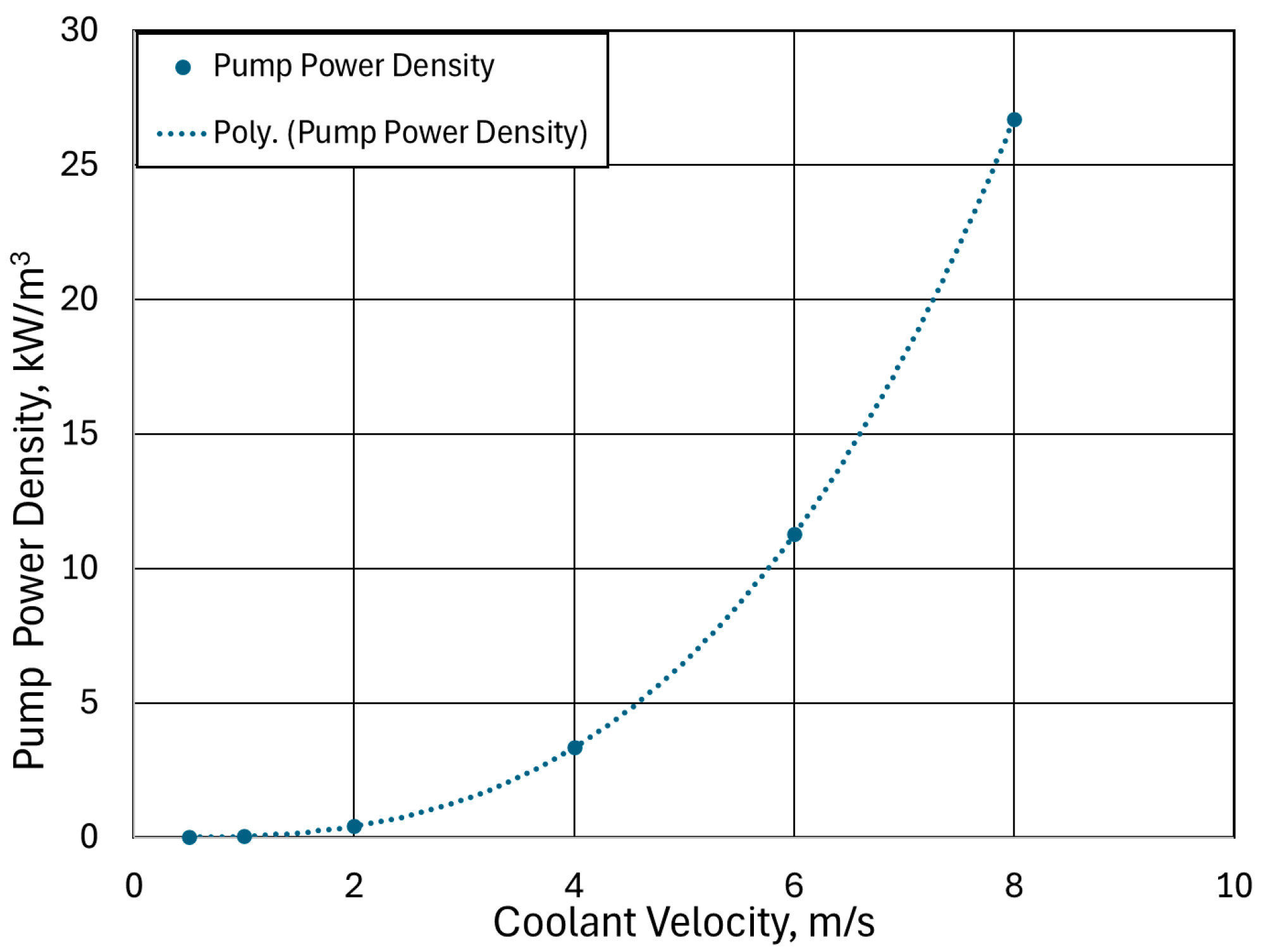
For the highest fidelity model, the pumping power, normalized to unit surface area, would be described as the amount of work needed to overcome the pressure changes within the channels due to friction losses and a change in flow area. A full description, as utilized in Li et al., 2021 [19], would require proper hydraulic treatment of the flow, but for simplicity’s sake, it is possible to generate a generalized approximation for the pumping power in terms of flow velocity, v [m/s], utilizing that study’s results. Figure 5 presents the pump power density and coolant velocity results, and the third-order approximation is presented in Equation (16):
P p u m p = 52.017 v 3 + 1.479 v 2 1.3916 v

3.7. Validation Problems

To examine the effectiveness of the RK5 method and to examine the validity of the point kinetics and thermal components of the transient tool, a toy light water reactor problem was utilized. This problem, intended to demonstrate thermal reactivity feedback effects, subdivides a reactor core into two regions: the solid fuel and fluid moderator. A general heat transfer coefficient was used to describe the power flow between the two regions and the heat removal from the system was calculated based on the defined coolant flow. Test materials and geometry were defined for the transient tool input to match the conditions described in Table 6. The transient is initiated by an insertion of $0.50 of positive reactivity. In terms of reactor kinematics, $1 of reactivity is a reactivity worth equal to the total delayed neutron fraction.
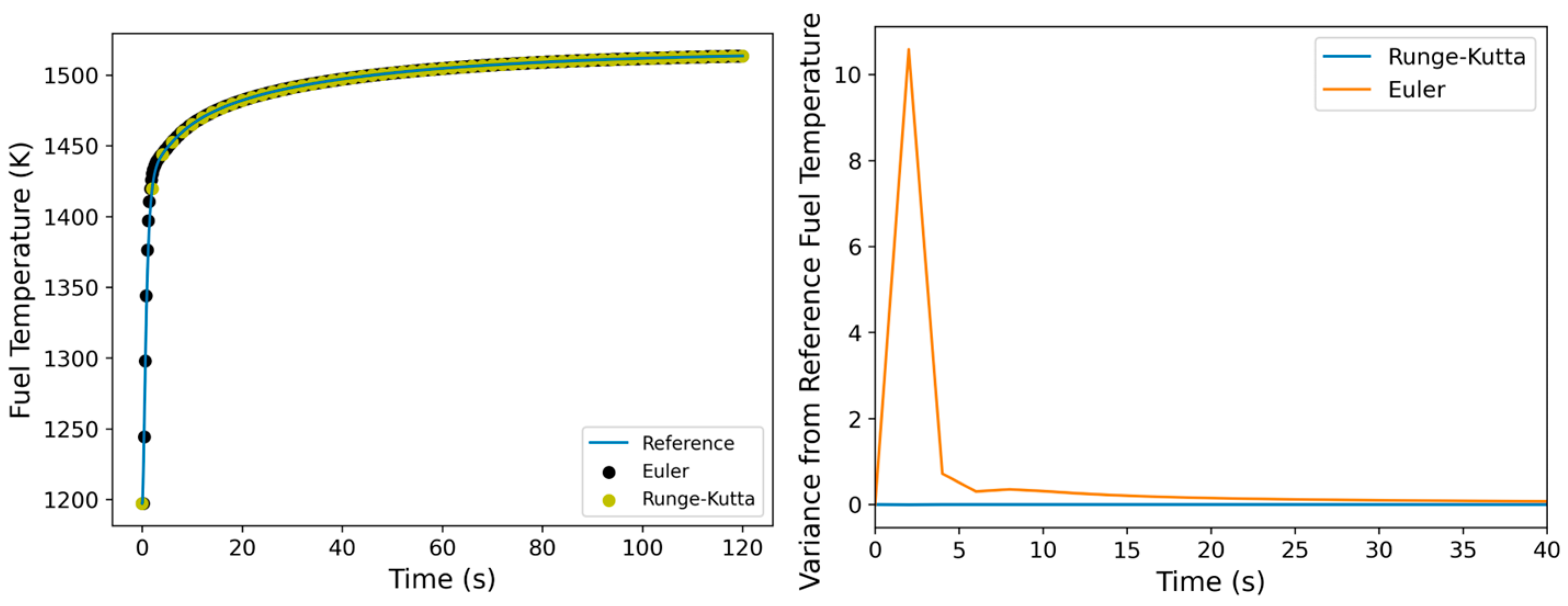
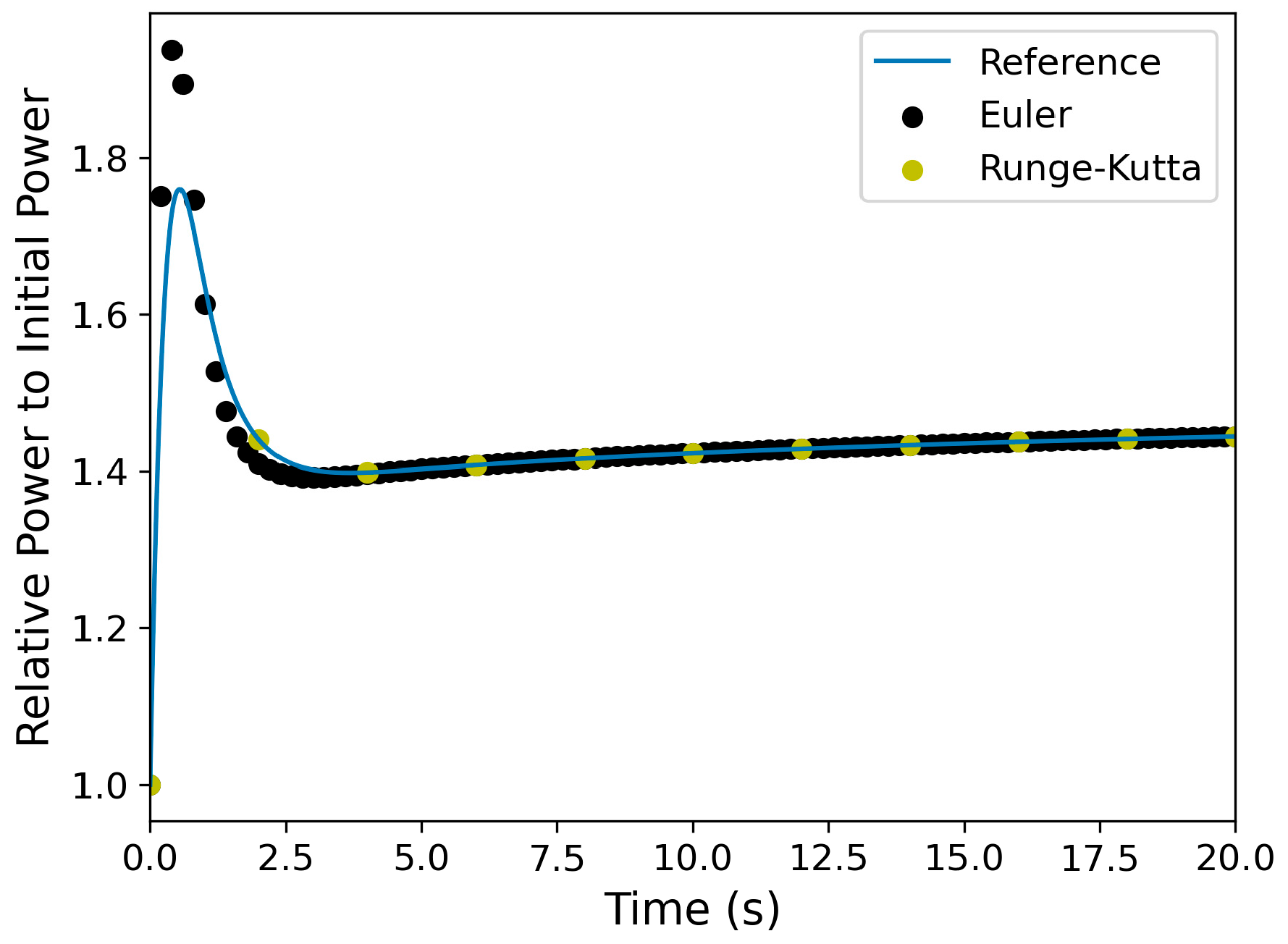
The solution to the first transient validation problem was calculated utilizing the system of ODEs for both the Euler method and RK5 method of calculation. For the Euler method, the largest step size that did not result in non-realizable solutions was 0.2 s and is presented below. Meanwhile, the RK5 method was applied utilizing a step size of 2 s. While the RK5 method evaluates the derivatives five times per step in comparison to the Euler method, which does so once, using the RK5 is twice as computationally efficient. Figure 6 and Figure 7 present the behaviors of the test problem following the initial transient incident. A reference solution was calculated utilizing the Euler approximation and a step size of 10−5 s. With the insertion of reactivity, there is a sudden rise in power which rapidly increases the temperature of the fuel and moderator regions. As these increase, the negative reactivity coefficients drive down the power and the system approaches a new equilibrium for power and temperature, which arises both when the reactivity insertion is offset and when the removed power is equivalent to the generated power. Figure 6 presents the behaviors of the fuel temperature with time and the variance between the applied solution method and the reference. These figures illustrate that the ODEs within our model capture the underlying physics of the transient and that the RK5 solution provides a more accurate approximation of the temperatures despite using 10 × fewer time steps. This is due to the significant overestimation of the power jump using the Euler method, as presented in Figure 7.
With the thermal feedback and point kinetics capabilities demonstrated, and the radiative solver recycled from the steady state, it is necessary to demonstrate the adequacy of the spatial conduction problem with time-dependent boundary conditions. For this purpose, a second validation problem was selected from the work of Holman (1983), which presents an analytical solution to the time-dependent conduction-convection problem [21]. A heated of uniform temperature and infinite height is suddenly exposed to a convective environment with cooler bulk temperatures. The properties of this problem are provided in Table 7. For a semi-infinite cylinder of uniform property and initial temperature that is being convectively cooled, an analytical solution for the temperature at a given radius and time, T r , t , is described by Equation (17) [22]:
T r , t T b T i T b = n = 1 2 λ n J 1 λ n J 0 λ n 2 + J 1 λ n 2 e λ n 2 α t R o 2 J 0 λ n r R o ,       λ n J 1 λ n J 0 λ n = h R o k    
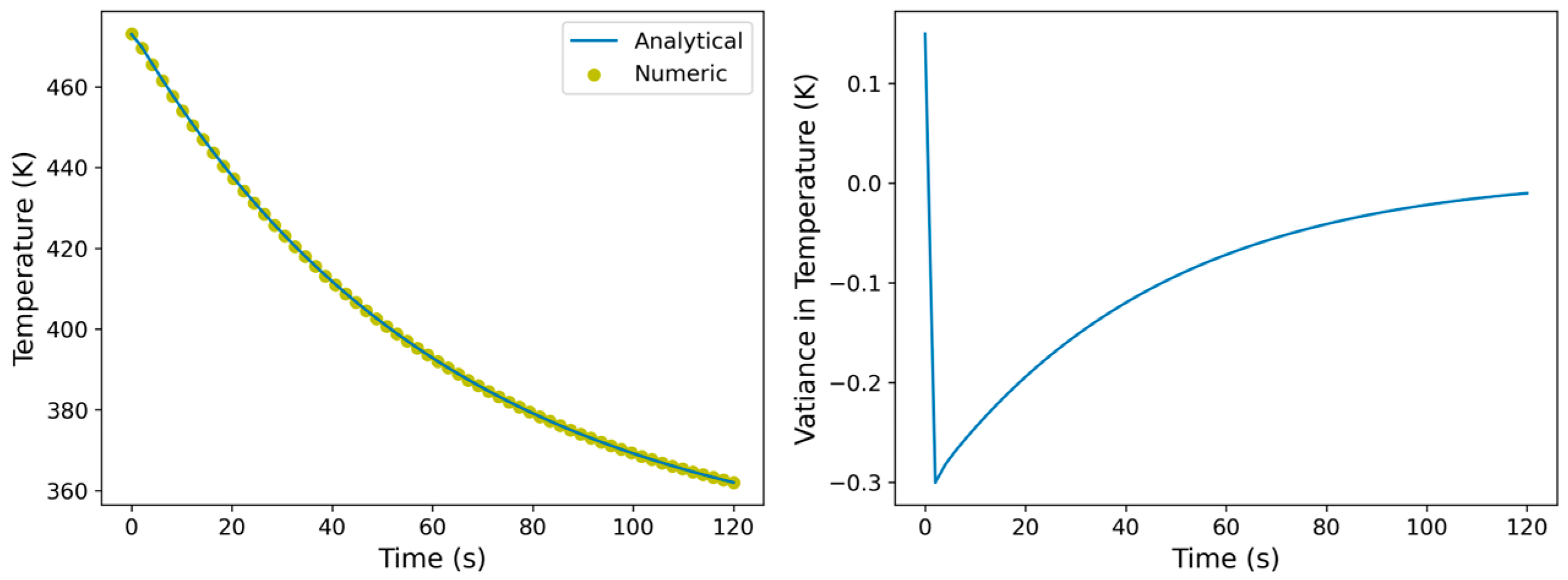
where T i [K] is the initial temperature, T b [K] is the bulk coolant temperature, R o [m] is the outer radius, α [m2/s] is the thermal diffusivity, and J o and J 1 are Bessel functions of the first kind. The λ n ’s are the roots based on h , the convective heat transfer coefficient, and k , the rod’s thermal conductivity. For the numerical solution, to approximate the temperature at radius 1.25 cm, three cylindrical regions were defined, with outer radii of 1.24 cm, 1.26 cm, and 2.5 cm. Power and temperature reactivity coefficients were set to 0 to isolate the transient conductive solution. Figure 8 presents the comparison of the analytical solution at a radius of 1.25 cm and the center ring temperatures as a function of time. The variance between the analytical and numerical solutions is within a fraction of a degree, providing confidence in the spatial heat transfer component of the transient solver.

4. Results

Some of the transient scenarios envisioned in this paper are easy to derive from the base nature of the RITMS design. Changes in heat removal at the TPV substrate and the introduction of convective flow at the reactor boundary have a greater certainty than those associated with still undesigned dynamic components. While it is out of this paper’s scope to explicitly model the reactivity control elements and TPV panel mechanisms, it is possible to make approximations that produce useful results. Several potential control mechanisms have been discussed, including the use of control rods in the interior graphite, drums [23] within the outer graphite, or designing the BeO reflector to move [24]. Regardless of the mechanism, it is assumed that the reactivity worth of the control system will be designed to compensate for the reactivity differential between the hot and cold cores and between fresh and depleted cores, with an additional margin to allow for power control. This would mean that in steady-state operations, there will be an amount of excess positive and negative reactivity that can be intentionally or accidentally inserted, external to reactivity feedback mechanisms.
As the design of the RITMS matures, it will be necessary to explicitly model or develop approximate functions that describe and limit the time-based mechanical shifts in control elements and TPV panels and the resulting effects on reactivity and view factor. However, these variations should only affect the total magnitude of the system transient response, and the approximations should provide a basis to describe the general trends in transient response. Additionally, the transients being applied here are somewhat conservative in that the changes are approximated as sudden and instantaneous shifts in the operating conditions. The transient scenarios described in this chapter can be subdivided into those affecting the heat transfer at the outer boundary of the reactor core, the periphery, and those affecting the power generation within the fuel region, i.e., the core. These separations are useful in discussing general trends in the system’s response.

4.1. Peripheral Transient Scenarios

4.1.1. Loss of Vacuum

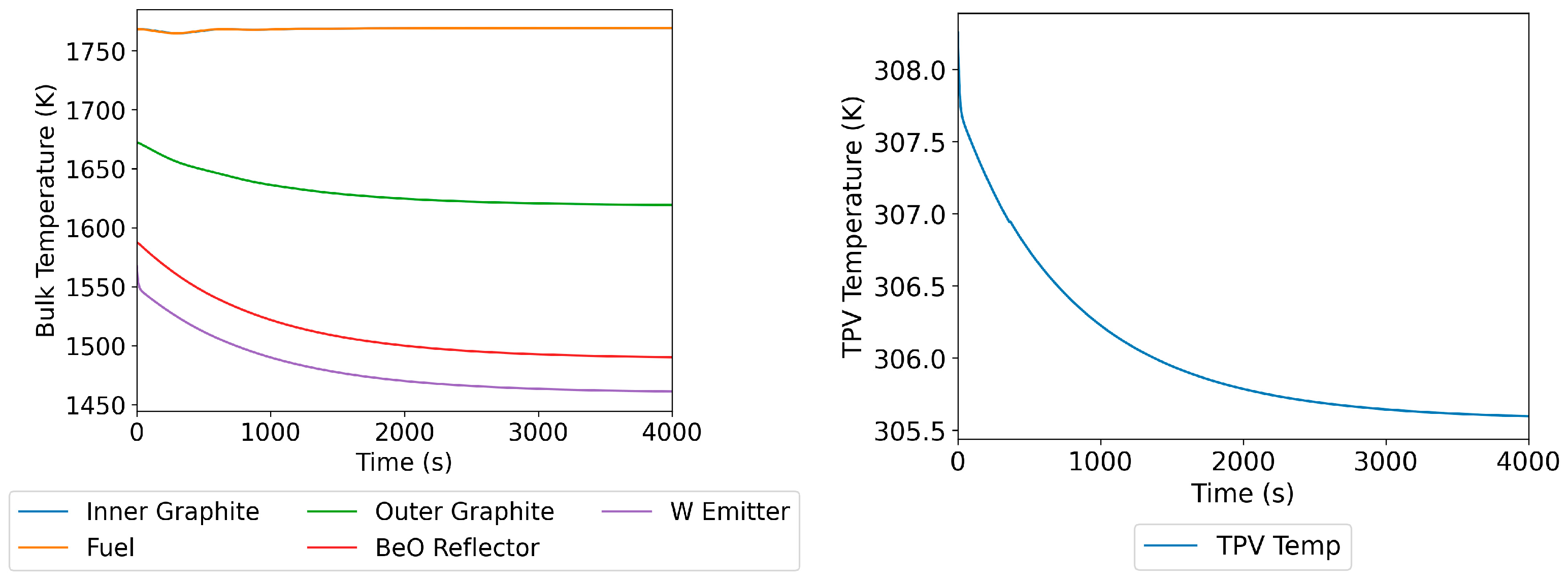
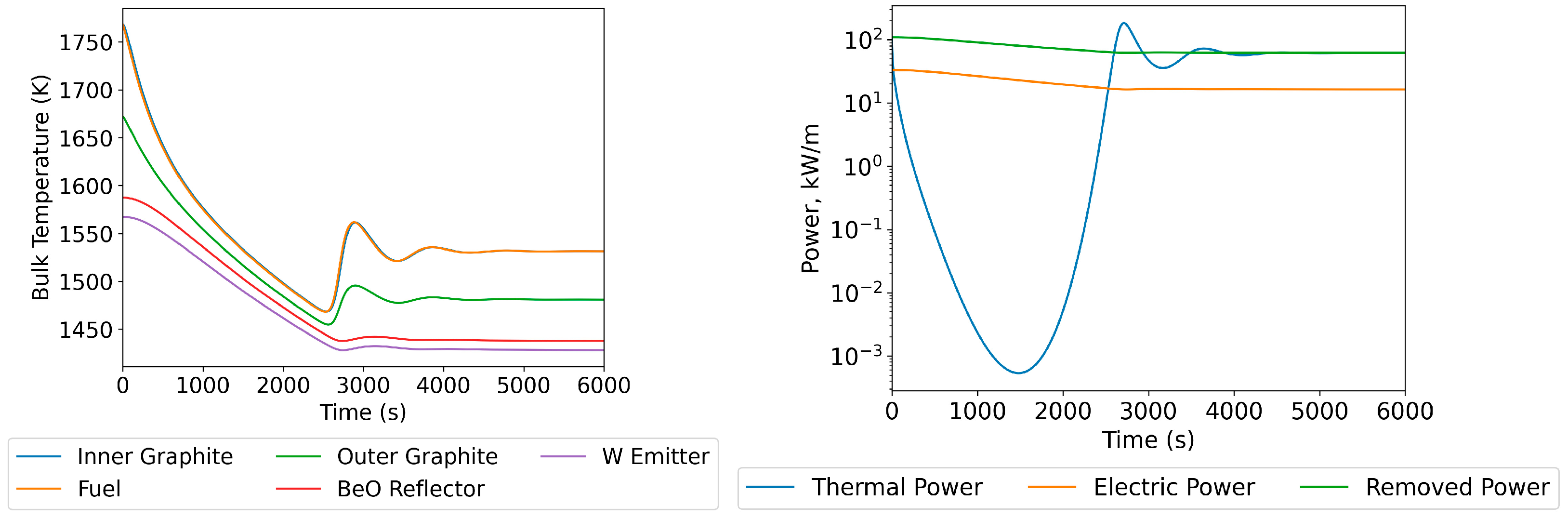
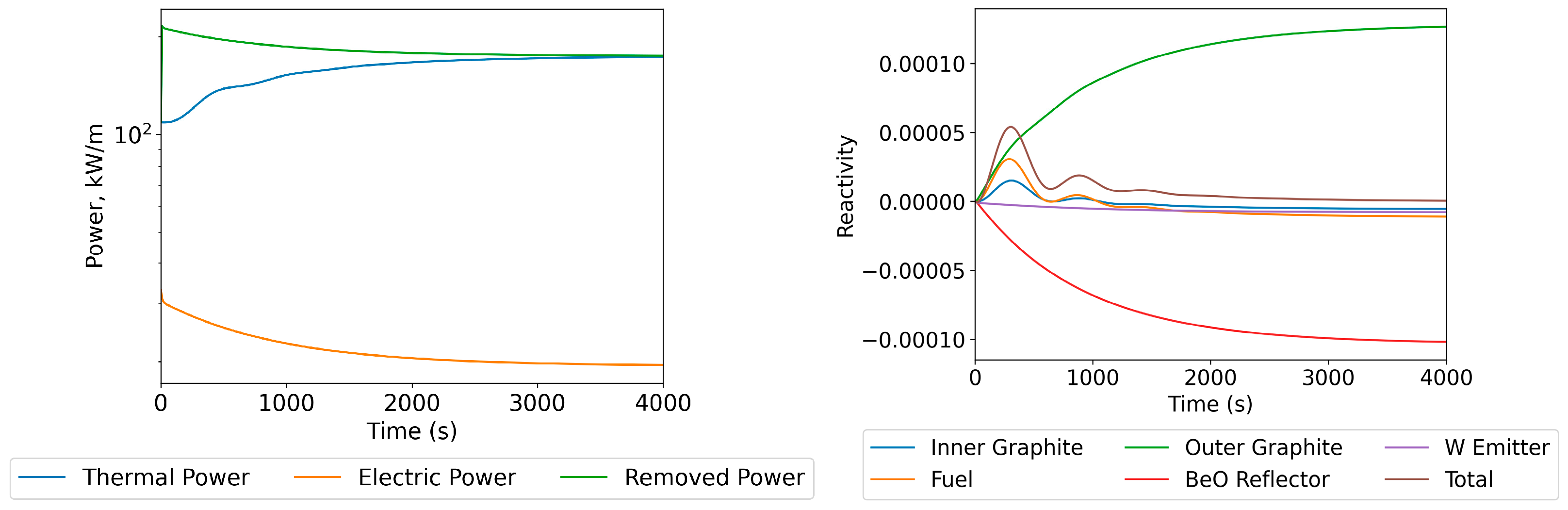
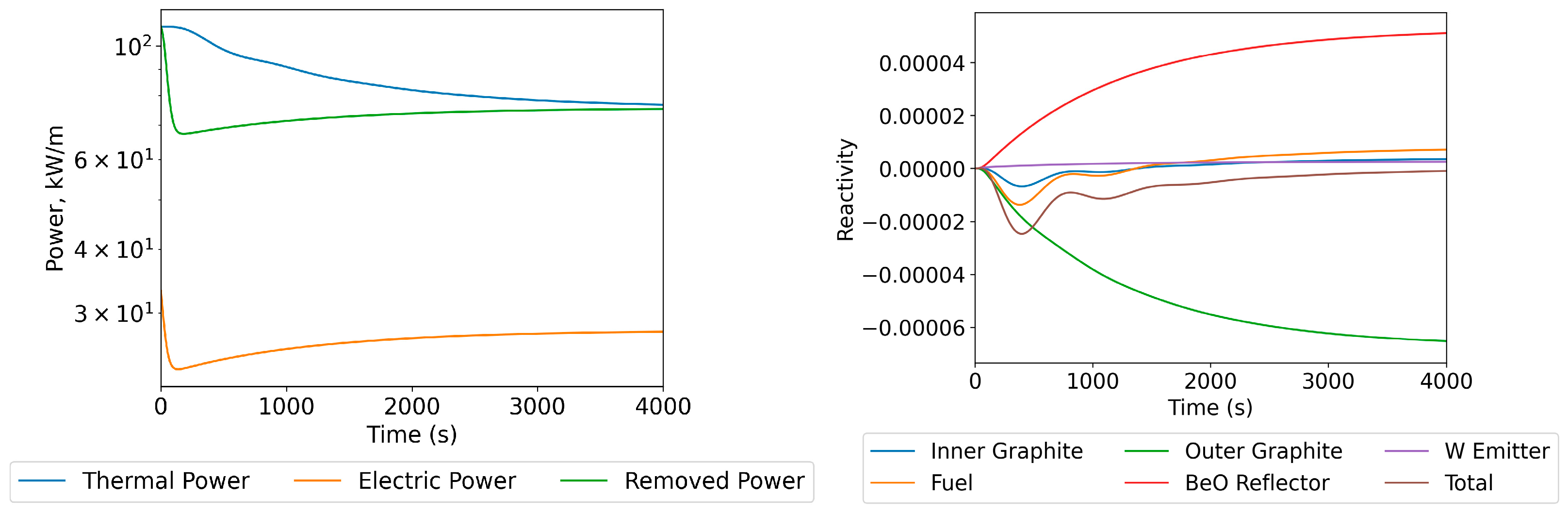
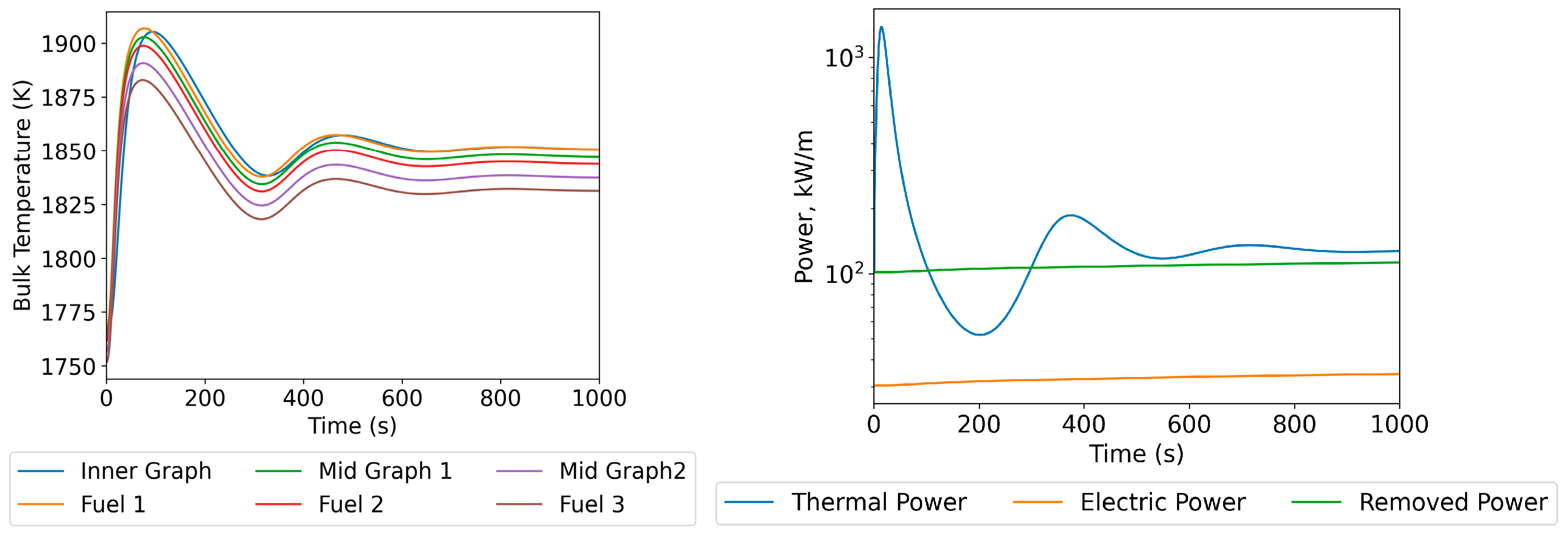
The first modeled peripheral incident covers a sudden loss of the low-pressure conditions within the radiative heat channel. It is useful to have an amount of gas between the emitter and TPV as it reduces the evaporation of tungsten and its deposition onto the panel surface, but to maximize the radiative heat transfer and thermal photon production, this density needs to be kept low. Either by inadvertently flushing the core of undesired gas product build-up or through a break in the unit vacuum chamber, this transient begins when a significant amount of atmospheric pressure gas is allowed to flood the radiative gap. This is captured by adding a convective term to the radiative heat removal boundary conditions. As presented in Figure 9 and Figure 10, the nearly doubling of the removed power at the core surface leads to a rapid decrease in the temperature of the tungsten emitter, BeO reflector, and outer graphite ring. The reduction in the radiative heat transfer to the TPV leads to both a drop in the TPV temperature and the power being converted into electricity. Meanwhile, there is a slight increase in the generated thermal core power, which is driven by the cooling of the graphite moderator. Overall, without interaction, the system reaches a new equilibrium.

4.1.2. Loss of TPV Coolant Pump

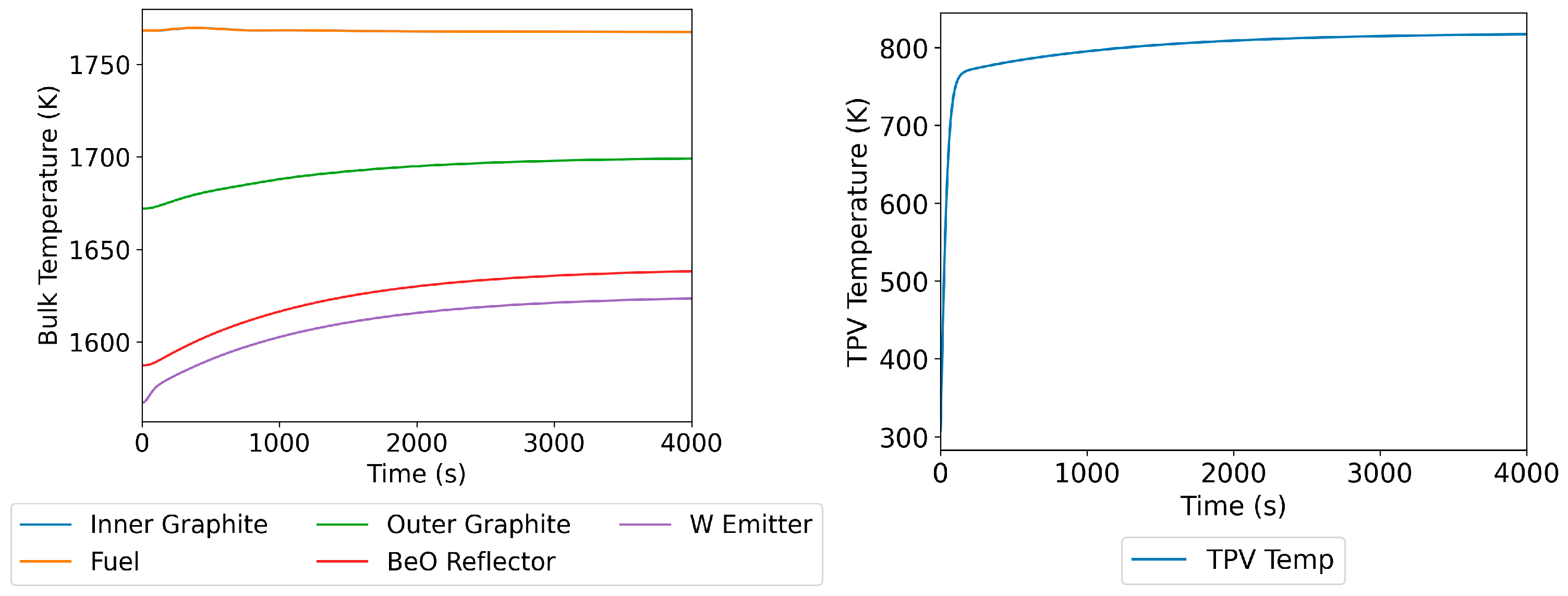
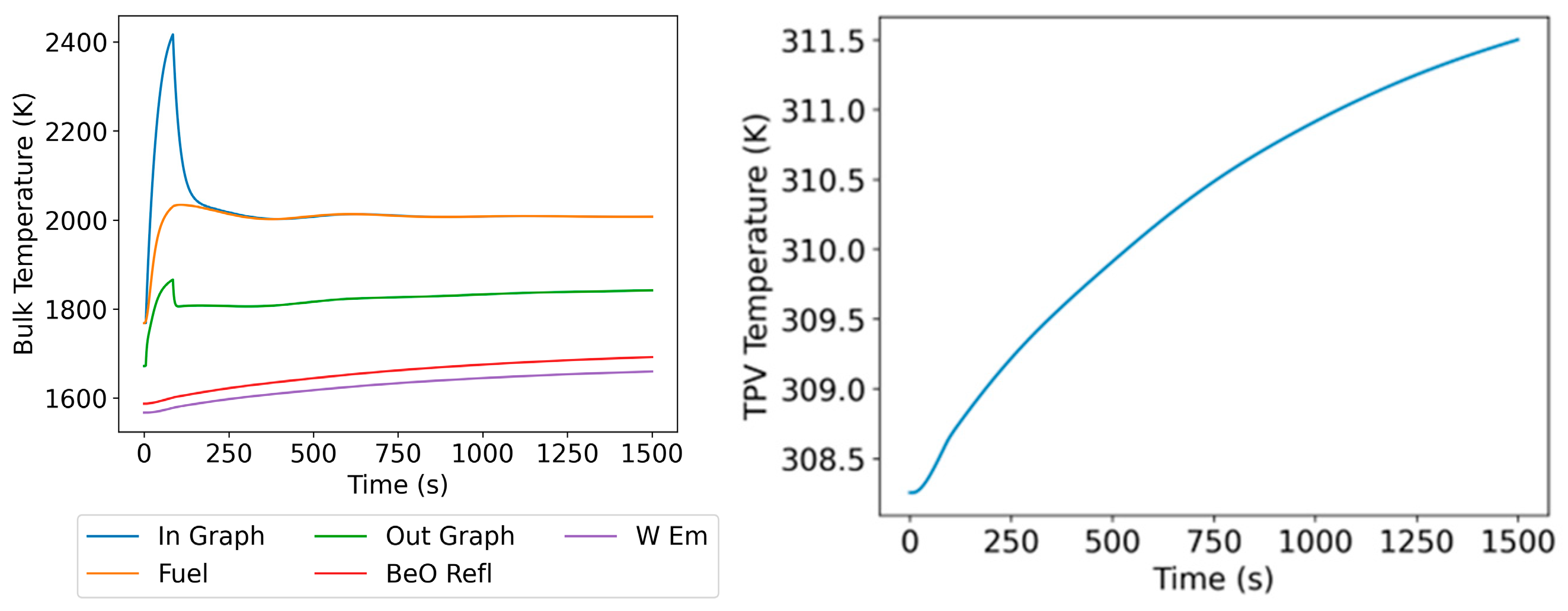
The second peripheral transient scenario is initiated through a loss of power in the pumps driving the coolant through the TPV substrate. The model for the TPV panels adopted in the transient solver borrows a simplified description for a water-based cooling system. To approximate the loss of pumping power while allowing for some naturally driven flow, the coolant velocity was suddenly decreased to 1% of the nominal flow. This massive decrease in the removed TPV power leads to a sudden and massive increase in the TPV cell temperature, as presented in Figure 11. The sudden decrease in the emitter-cell temperature differential leads to a 40% drop in the removed power and a decrease in the cell efficiency, as presented in Figure 12. This leads to an increase in the temperature of the outer rings and a corresponding decrease in the overall reactivity and power, as driven by the outer graphite moderator reactivity feedback. A new equilibrium is reached prior to the transient conditions, significantly affecting the core interior. This, however, does assume that there is continuous power to the final heat rejection system, which is not dependent on the TPV. This is a necessary assertion because while the results present a maintenance of electrical power of tens of kilowatts, it is more likely that the TPV will entirely fail at these higher temperatures. Still, since the power density of the system is relatively low and there is still some onsite power to keep environmental temperatures from rising, this failure in the TPV should not affect the stability and safety of the core, but the lack of an explicit description of the final heat rejection should be accounted for in future studies. It is worth noting that an increase in the pumping power was also modeled, but this led to a very minor decrease in the TPV temperature and a negligible change in the core.

4.2. Core Transient Scenarios

4.2.1. Sub-Prompt Positive Reactivity Insertion

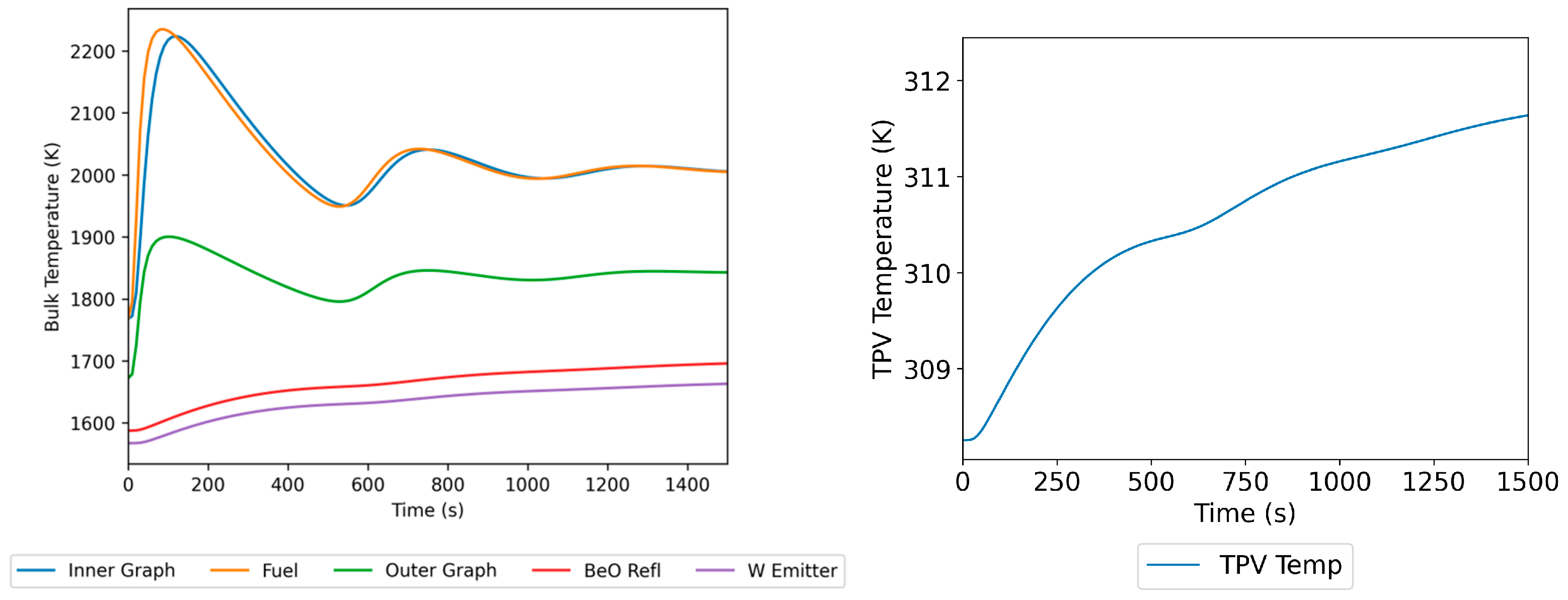
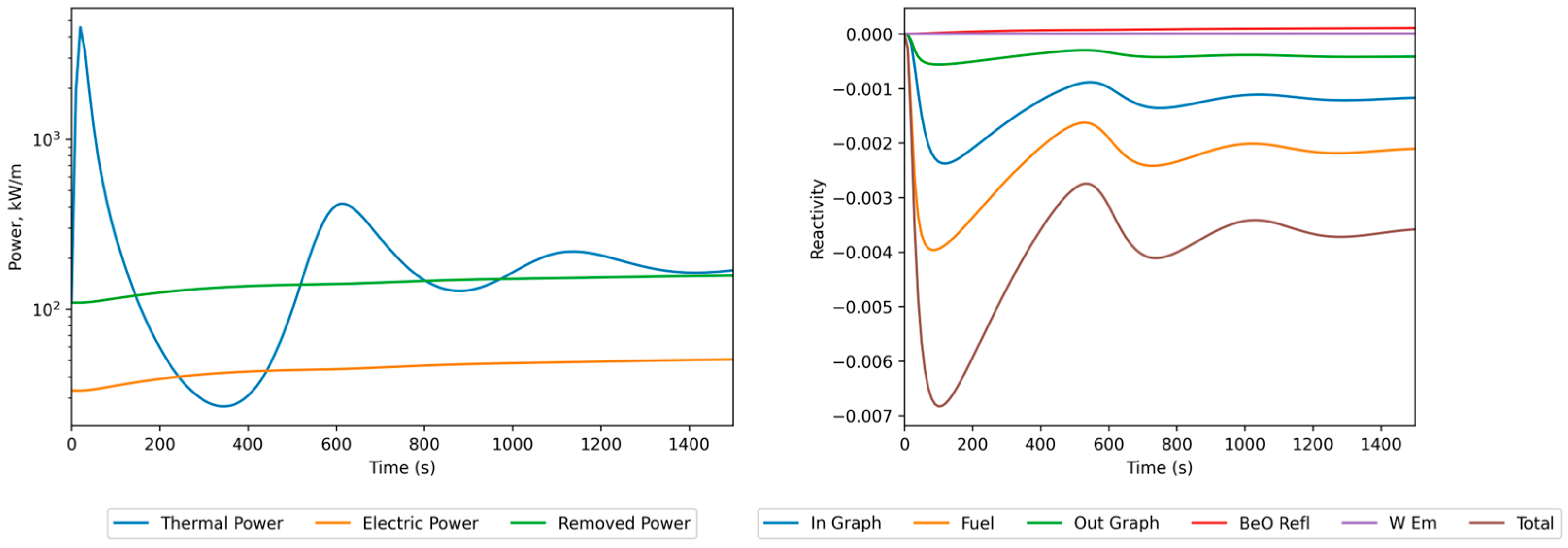
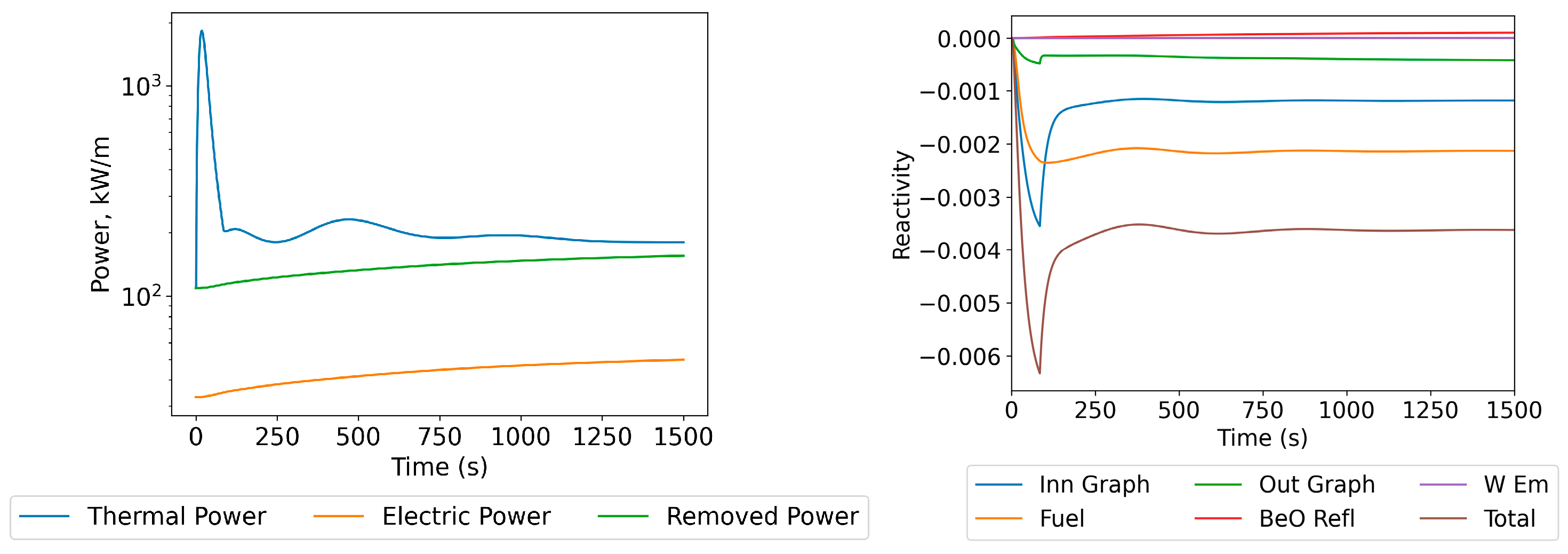
In the first of the core transient cases, sub-prompt positive reactivity is suddenly generated by the over-withdrawal of a control rod or over-rotation of a drum. The sub-prompt here describes a case where the reactivity worth inserted is below the decay neutron fraction (i.e., β ); in this case, the positive exponential growth is tempered by the slower response of the decay neutrons. For Figure 13 and Figure 14, $0.5 of positive external reactivity is added to the nominal operating conditions. This leads to a sudden rise in power and a sharp increase in the fuel temperature. With a slight delay, this increase in temperature is spread to the moderator material, and before the emitter temperature starts to rise, the power begins to drop as the negative fuel and moderator temperature coefficients start to outweigh the external reactivity. A series of oscillations in temperature and power begins as the slowly reacting emitter temperature and removed power rise. The dampened oscillations continue until the system reaches a higher-temperature, higher-power equilibrium when the power generated in the core matches the power being removed.

4.2.2. Prompt Positive Reactivity Insertion

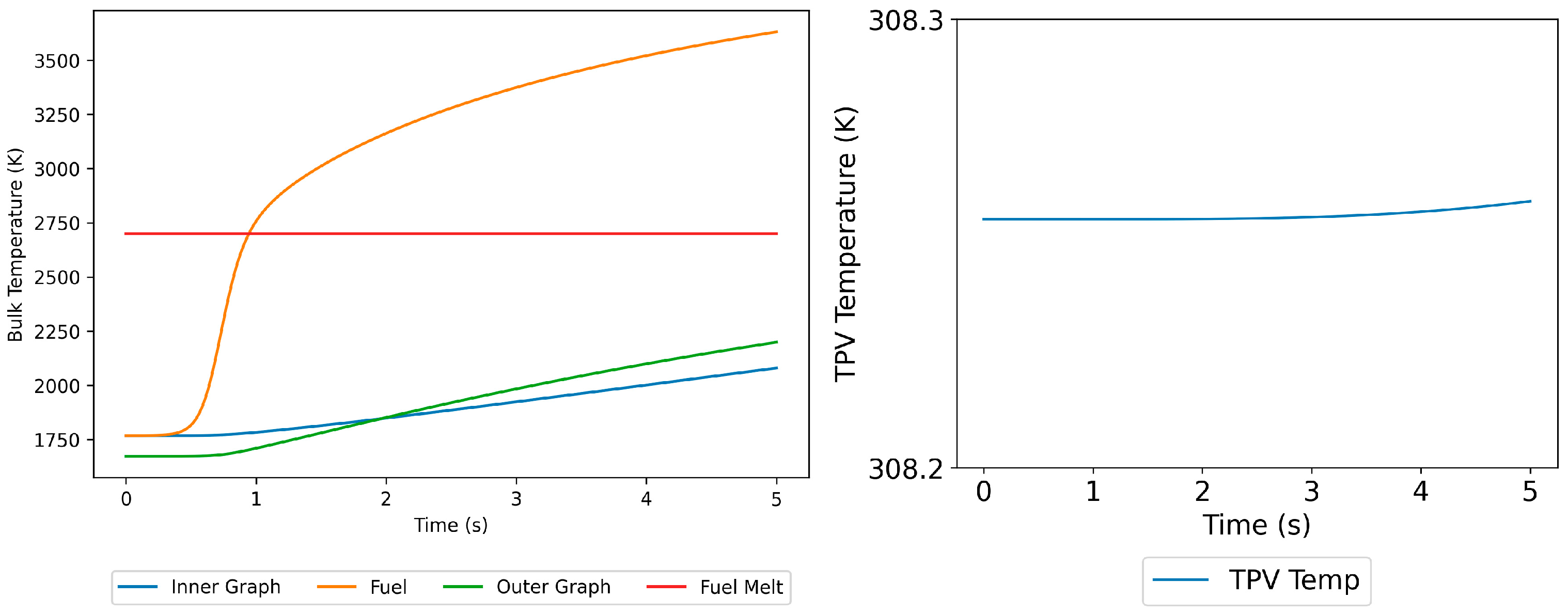
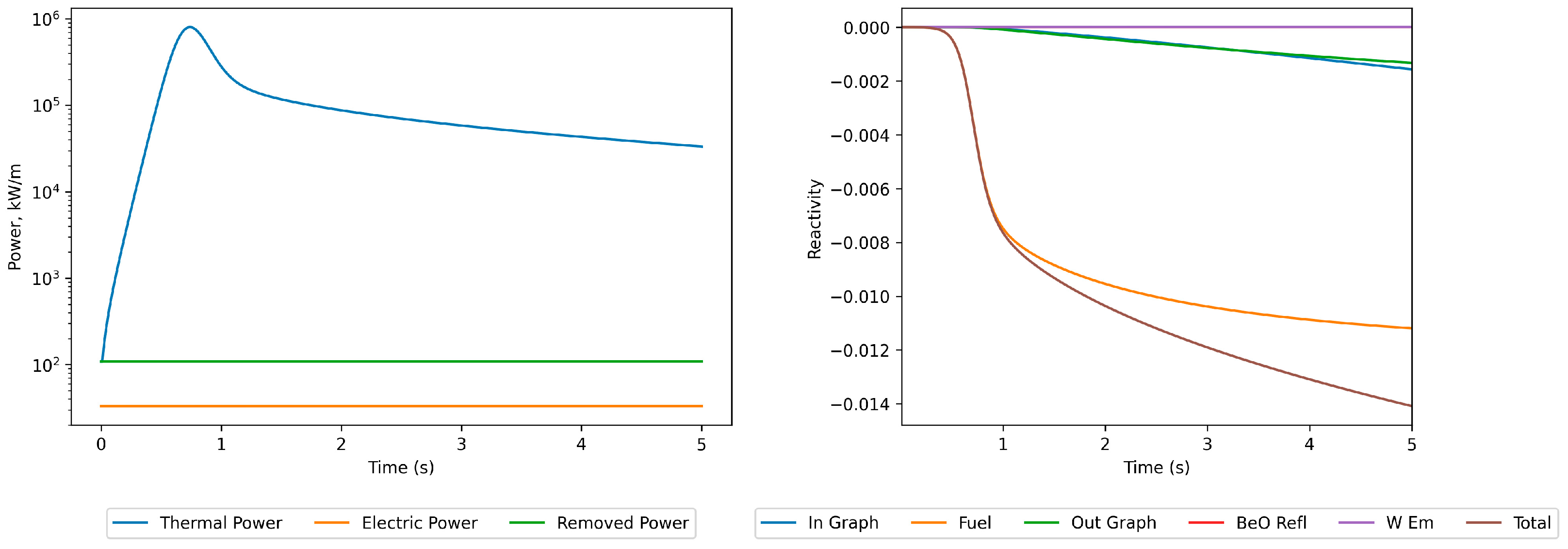
The second core transient scenario explored is initiated with a prompt positive reactivity insertion. Again, it is undetermined the exact mechanism for this change, but it is characterized by an external reactivity worth greater than the delayed neutron fraction. The growth in power is largely based on the exponential rise in the prompt neutron population, leading to the massive power jump presented within Figure 15 following a $1.50 instantaneous insertion. This leads to an immediate and massive spike in the fuel temperature, with fuel melting beginning within a second of the transient’s initiation, as presented in Figure 16. Under these conditions, the RITMS is relying solely on the negative fuel temperature coefficients but is hampered by the decreased magnitude of the Doppler effect when starting from high nominal temperatures.

4.2.3. Negative Reactivity Insertion

As the inverse of the previous cases, the transients described here are modeled to describe the insertion of negative external reactivity worth. A single dropped fuel element is approximated in Figure 17, where -$0.5 of reactivity is inserted. In this small reactivity insertion, the power and fuel temperature immediately start to drop with the emitter and removed heat following a delay. After a time, the positive feedback associated with the cooling fuel and moderator overtakes the negative insertion, and the power and temperature begin to rise again. These values oscillate until a new, lower temperature, lower power equilibrium is reached. In comparison, Figure 18 presents the effects of a larger negative insertion of −$1.50 that might be associated with a system emergency shutdown. In this case, the power drop is much more pronounced, and the feedback reactivity is unable to offset the negative insertion as the reactor essentially stalls.

5. Discussion and Design Response

Changes on the periphery of the unit are slow to propagate to the interior of the system, and by the time they do, the reactivity feedback mechanisms have brought the RITMS unit into a new equilibrium. Regarding the core-centered transients, negative reactivity insertions lead to the expected and desired decrease in power and temperature, though intentional power decreases will need to account for minor power upswings and oscillations. The main challenges to the RITMS design’s transient response come in the form of positive reactivity insertions. The overshoot and oscillation from sub-prompt insertions are non-ideal and the prompt positive insertions should be mitigated by design choices (e.g., fuel with impurities leading to a more negative fuel temperature reactivity coefficient). Some of the safeguards will have to come from the design of the control mechanisms themselves, through limitations on the total insertable worth during nominal reactor operations and rates of reactivity insertion. Others, as covered in this section, include an examination of the general RITMS design tweaks that can reduce the system’s sensitivity to transients.

5.1. Adjusting the Number of Fuel Regions

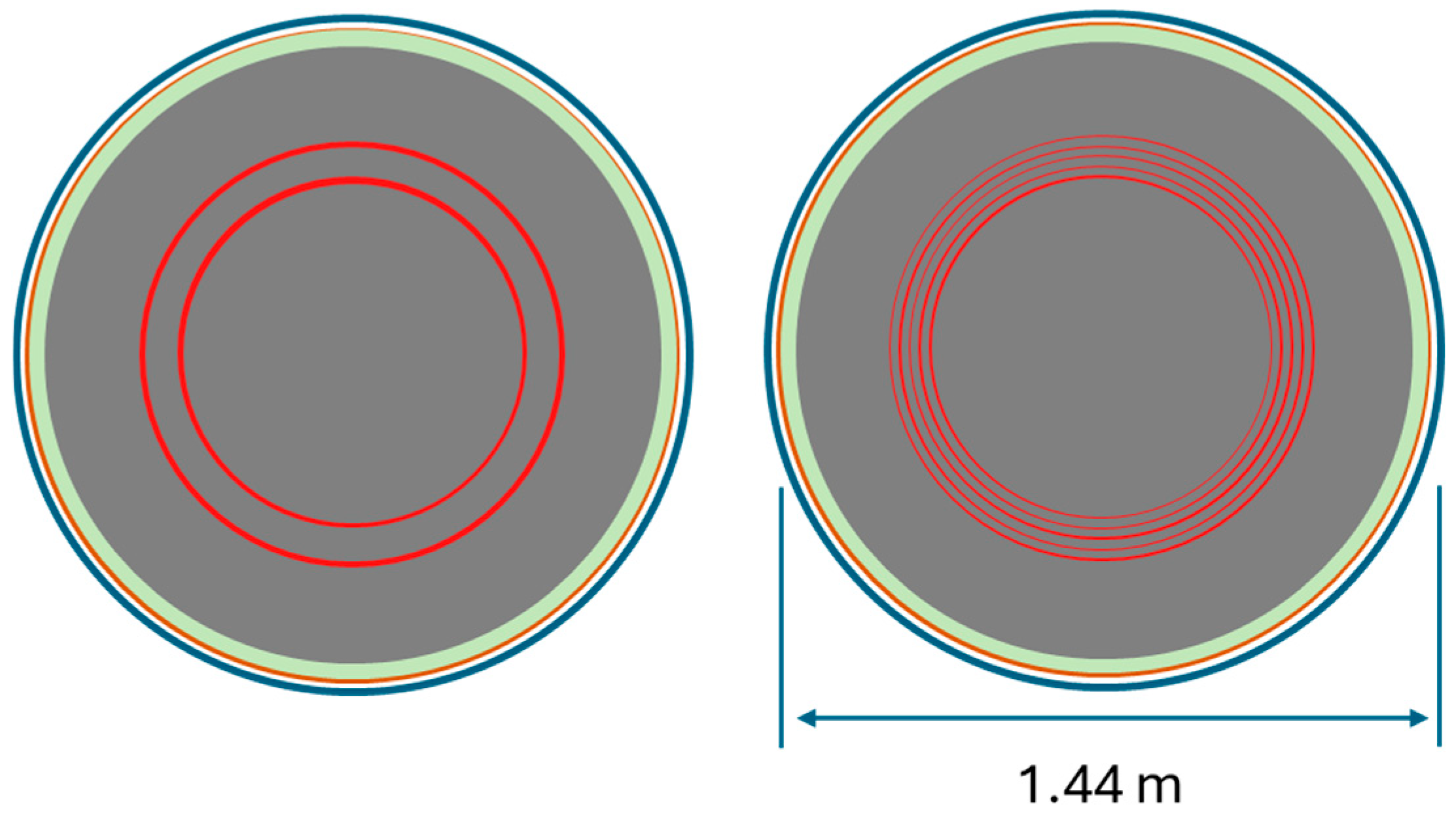
The first design alteration considered is based on increasing the number of fuel rings within the system. With a positive reactivity event, there is a delay between the temperature rise in the fuel region and in the moderator. This means that there is a delay in the moderator feedback that would temper the increasing fission power. The thought behind increasing the number of fuel rings is to cut down on that delay by improving heat transfer between fuel and moderator. Starting from the single-fuel-ring optimized design described in Table 1, the multi-ring designs are developed such that the total fuel and moderator volumes are maintained. From both the inner and outer moderator regions, 20% of the volume is taken for the interstitial graphite regions. The fuel is then separated and placed such that the radial thicknesses of the fuel rings and the radial spacings are fixed. Figure 19 presents a schematic describing the radial layouts of a two-fuel-ring and five-fuel-ring RITMS design.
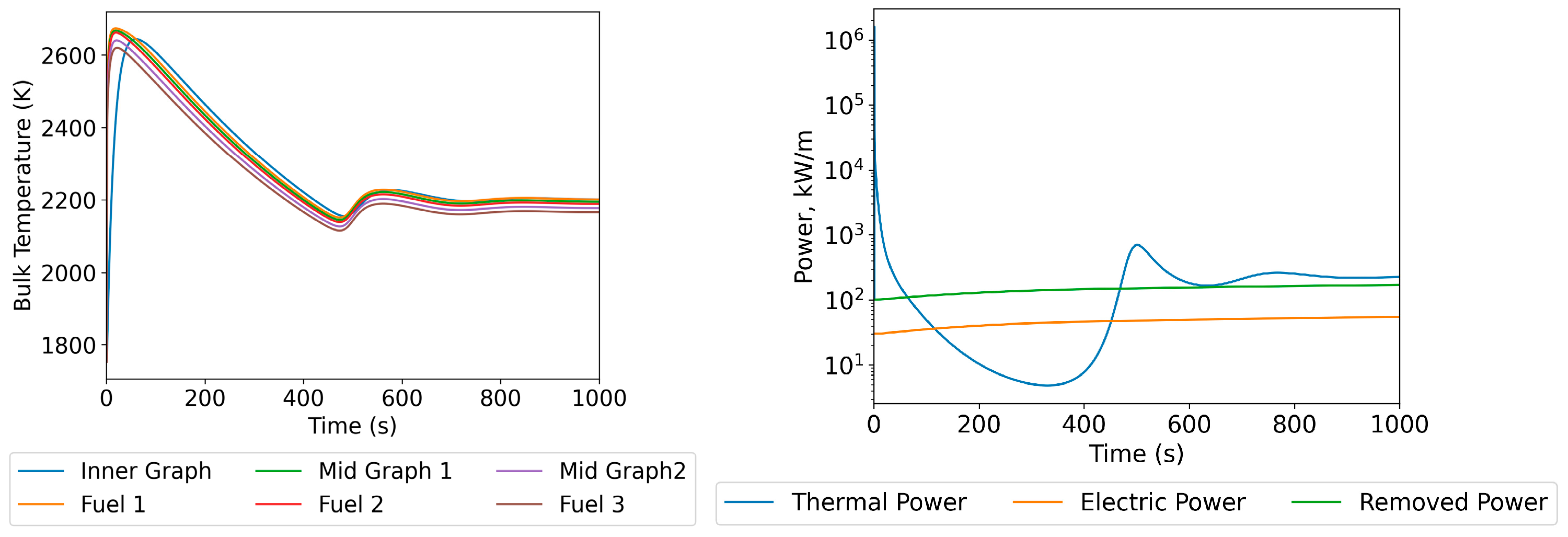
For the two-fuel-ring and five-fuel-ring RITMS designs, an initial steady-state temperature profile and the reactivity feedback coefficients for each ring were determined. From the steady-state conditions, these designs were perturbed with a $0.5 positive reactivity offset, with the results presented in Figure 20 and Figure 21. In comparison to the single-fuel-ring base design, the temperature overshoot in the two-fuel-ring design is decreased by 100 °C and by 300 °C in the five-fuel-ring case. Additionally, it is worth noting that the power oscillations for the increased number of rings are not as pronounced. While this does not prevent oscillations, utilizing multiple fuel rings does limit them and can additionally lead to lower enrichment requirements. With the focus on the sub-prompt insertion highlighting the trends in the designed improvements, it is important to highlight that a five-fuel-ring system is stable in the case of a prompt reactivity insertion as well. For a positive reactivity insertion of $2.5, which is approximately the reactivity required to start up the reactor, the five-fuel-ring design approaches but does not exceed the fuel melting temperature. This could be considered a worst-case scenario in terms of reactivity insertion and the results are presented in Figure 22. It is likely that localized fuel melting might occur, but it is unlikely that this amount of reactivity can be inserted at one time. This analysis was conducted for a two-fuel-ring design, and while the temperatures did peak and drop for a prompt insertion, the fuel temperature still peaked above the melting point.

5.2. Active Intervention with Joule Heating

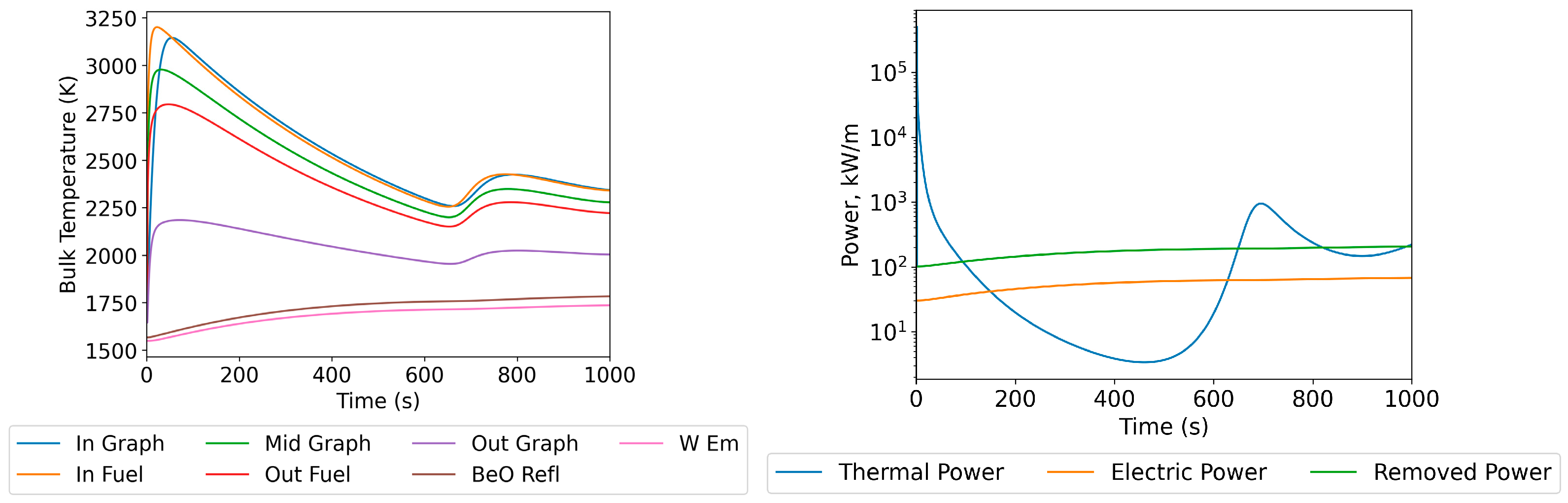
The second design intervention presented here is more of an exploration of the concept than an actual concrete proposal. With the objective of triggering the moderator feedback mechanisms, a system for Joule heating is imagined. By running contacts through the graphite, an induced current can rapidly supply additional power to these components. This scenario will start with a base design and, to approximate Joule heating, following an initial reactivity insertion of $0.50, there is a five-second delay before an additional 150 kW per meter of core is added to the inner and graphite regions. This heating is maintained for 80 s before being cut off. The results of this active intervention are presented in Figure 23 and Figure 24. As shown, this additional power decreases the peak fuel temperature by 200 °C and significantly decreases the magnitude of the secondary power oscillations. This is accomplished at the cost of reaching peak graphite temperatures that are 200 °C higher than the base case, but with graphite having a much higher melting point, it is preferable to have the temperature peak in that region. Additionally, though it is supplied for only a short time, the total power applied is greater than the electric power being produced by the system. This means that utilizing Joule heating will require a connection to the power grid or the maintenance of onsite batteries, but as demonstrated, there is a path to reactivity control through Joule heating. Though the incorporation of an active intervention adds complexity and potential additional failure points, it is nevertheless an intriguing concept for compact systems where there is less overhead for control element drivers.

6. Conclusions

To shake off the stagnation of the nuclear industry, public and private investment has been poured into the design of small modular and microreactors. However, a truly novel approach to designing these factory-fabricated integrated reactor–converter power units might be necessary to reach the desired learning rates and first-of-a-kind goals. The RITMS requires no expensive turbomachinery, and its simplicity of form and improved fuel efficiency make the design stand out. However, it is a non-conventional, high-temperature system that previously lacked studies on its reliability. This work fills an important knowledge gap not explored previously. Firstly, this paper describes a first of a kind reduced order transient model that captures the full suite of physics for the RITMS design. Secondly, it was learned that for peripheral accidents that affect the reactor heat removal, the selected design was able to return to a safe operating equilibrium without intervention. Thirdly, it was determined that for power-driven accidents, there is a concern that the diminished reactivity feedback mechanisms for the material at the higher operating temperature can lead to melting following a significantly positive reactivity insertion. Lastly, this work demonstrates that increasing fuel heterogeneity acts as an inherent mitigation tool for avoiding fuel melting in accidental reactivity insertion.
At this point, there are some design unknowns that should be addressed for further maturation of the RITMS design. Chief among them is the selection and development of the control elements. Combinations of control methods (drum, rod, movable reflector), control material (boron, europium, etc.), drivers, and in-core location need to be selected and evaluated based on their ability to perform across the lifetime of the core and across the temperatures experienced. Once designed, the effect of reactivity insertion transients and the start-up/shutdown sequence should be reexamined. Secondly, there should be a push to partner with TPV manufacturers to design the units for the RITMS design. In addition to maximizing system efficiencies, the circuit architecture of the cells will need to be highly resistant to radiation damage. This will require irradiating test samples of TPV cells within mixed radiation fields to determine the rate of breakdown within the TPV power blocks and the optimum replacement period. While control element design and further maximizing fuel utilization are important to the development of a commercially ready RITMS design, the ability of the TPV panels to meet operational demand will determine the base viability of direct core–TPV integration. A high rate of TPV burnout could potentially be remedied by shifting the reactor to operate in pulses or as a traveling wave, but that would require significant system redesign.

Author Contributions

Conceptualization, N.K. and D.K.; methodology, N.K. and D.K.; software, N.K.; formal analysis, N.K.; investigation, N.K.; resources, D.K.; writing—original draft, N.K.; writing—review and editing, D.K.; supervision, D.K.; project administration, D.K. All authors have read and agreed to the published version of the manuscript.

Funding

This research received no external funding.

Data Availability Statement

The original contributions presented in the study are included in the article, further inquiries can be directed to the corresponding author.

Conflicts of Interest

The authors declare no conflicts of interest.

References

  1. Kaffezakis, N.; Kotlyar, D. Trade-Off Studies of a Radiantly Integrated TPV-Microreactor System. Energies 2025, 18, 659. [Google Scholar] [CrossRef]
  2. Licenses, Certifications, and Approvals for Nuclear Power Plants 10 CFR Part 52 [Online]. 2007. Available online: https://www.ecfr.gov/current/title-10/chapter-I/part-52 (accessed on 17 November 2025).
  3. Shimizu, M.; Kohiyama, A.; Yugami, H. Evaluation of thermal stability in spectrally selective few-layer metallo-dielectric structures for solar thermophotovoltaics. J. Quant. Spectrosc. Radiat. Transf. 2018, 212, 45–49. [Google Scholar] [CrossRef]
  4. Abou-Jaoude, A.; Arafat, Y.; Foss, A.; Dixon, B. An Economics-by-Design Approach Applied to a Heat Pipe Microreactor Concept; INL: Idaho Falls, ID, USA, 2021.
  5. Jones, E.; Oliphant, T.; Peterson, P. SciPy: Open Source Scientific Tools for Python. 2001. Available online: https://www.researchgate.net/publication/213877848_SciPy_Open_Source_Scientific_Tools_for_Python (accessed on 17 November 2025).
  6. Dormand, J.R.; Prince, P.J. A family of embedded Runge-Kutta formulae. J. Comput. Appl. Math. 1980, 6, 19–26. [Google Scholar] [CrossRef]
  7. Stacey, W. Nuclear Reactor Physics; Wiley: Hoboken, NJ, USA, 2007. [Google Scholar]
  8. Leppänen, J.; Pusa, M.; Viitanen, T.; Valtavirta, V.; Kaltiaisenaho, T. The Serpent Monte Carlo code: Status, development and applications in 2013. Ann. Nucl. Energy 2015, 82, 142–150. [Google Scholar] [CrossRef]
  9. Matsuo, H. Measurements of thermal diffusivities of fine-grained isotropic graphites from room temperature to 2000 by laser flash method. Netsu Sokutei 2000, 17, 2–8. [Google Scholar]
  10. Zhou, X.-W.; Tang, Y.-P.; Lu, Z.-M.; Zhang, J.; Liu, B. Nuclear graphite for high temperature gas-cooled reactors. New Carbon Mater. 2017, 32, 193–204. [Google Scholar] [CrossRef]
  11. Panda, B.; Hickman, R.R.; Shah, S. Solid Solution Carbides Are the Key Fuels for Future Nuclear Thermal Propulsion; American Nuclear Society: Monterey, CA, USA, 2005. [Google Scholar]
  12. Vasudevamurthy, G.; Nelson, A.T. Uranium carbide properties for advanced fuel modeling—A review. J. Nucl. Mater. 2022, 558, 153145. [Google Scholar] [CrossRef]
  13. Hou, M.; Zhou, X.; Liu, B. Beryllium oxide utilized in nuclear reactors: Part I: Application history, thermal properties, mechanical properties, corrosion behavior and fabrication methods. Nucl. Eng. Technol. 2022, 54, 4393–4411. [Google Scholar] [CrossRef]
  14. Ceram Research. Beryllium Oxide—Beryllia; AZO Network: Sydney, Australia, 2001. [Google Scholar]
  15. Webb, J.A.; Charit, I. Analytical determination of thermal conductivity of W-UO2 and W-UN CERMET nuclear fuels. J. Nucl. Mater. 2012, 427, 87–94. [Google Scholar] [CrossRef]
  16. Tolias, P. Analytical expressions for thermophysical properties of solid and liquid tungsten relevant for fusion applications. Nucl. Mater. Energy 2017, 13, 42–57. [Google Scholar] [CrossRef]
  17. Schmidt, F. The Engineering Properties of Tungsten and Tungsten Alloys; Defense Metals Information Center: North Canton, OH, USA; Battelle Memorial Institute: Aberdeen, MD, USA, 1963; Volume 191. [Google Scholar]
  18. Levinshtein, M.; Shur, M. Handbook Series on Semiconductor Parameters; World Scientific: London, UK, 1999. [Google Scholar]
  19. Li, K.; Wu, S.; Cao, S.; Cai, Q.; Ye, Q.; Liu, X.; Wul, X. Transient performance of a nanowire-based near-field thermophotovoltaic system. Appl. Therm. Eng. 2021, 192, 116918. [Google Scholar] [CrossRef]
  20. Baldasaro, P.; Raynolds, J.E.; Charache, G.; Depoy, D.; Ballinger, C.; Donovan, T.; Borego, J. Thermodynamic analysis of thermophotovoltaic efficiency and power density tradeoffs. J. Appl. Phys. 2001, 89, 3319–3327. [Google Scholar] [CrossRef]
  21. Holman, J. Heat Transfer; Mcgraw-Hill: Columbus, OH, USA, 1963. [Google Scholar]
  22. Cengel, Y.; Ghajar, A. Heat and Mass Transfer: Fundamentals and Applications; McGraw Hill: New York, NY, USA, 2015. [Google Scholar]
  23. Goode, T.; Clemens, J.; Eades, M.; Pearson, B. Reflector and Control Drum Design for a Nuclear Thermal Rocket. In Proceedings of the Nuclear and Emerging Technologies for Space 2015, Albuquerque, NM, USA, 23–26 February 2015. [Google Scholar]
  24. Chandler, D.; Bryan, C. High Flux Isotope Reactor (HFIR); Oakridge National Laboratory: Oak Ridge, TN, USA, 2021.
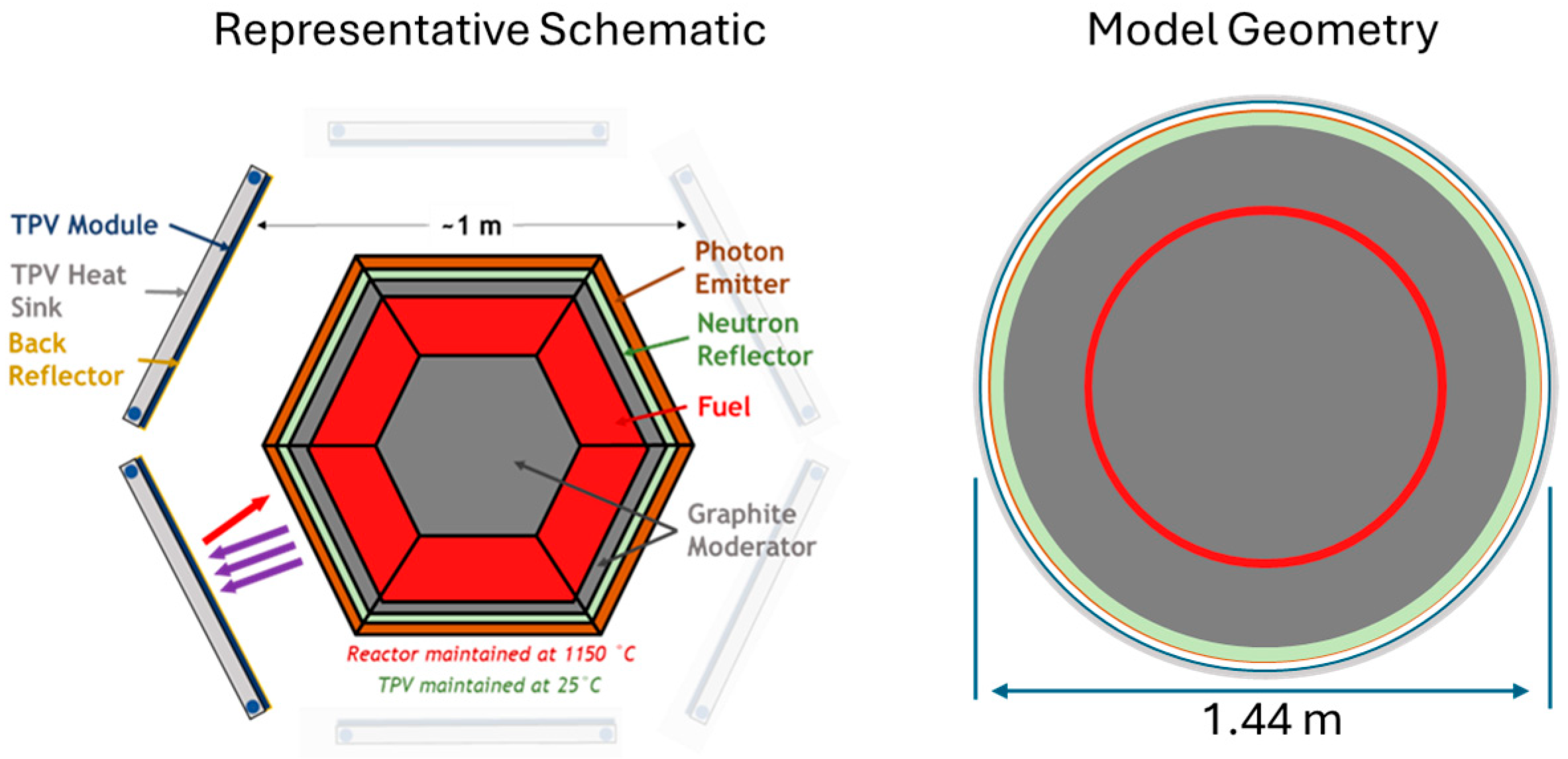
Figure 1. Cross-sectional representative schematic and the cylindrical geometry of the optimized design used for the transient analysis. Purple and red arrows (in the representative schematic) denote outgoing and incoming photons respectively.
Energies 18 06361 g001
Figure 2. Comparison and cost breakdown of battery-style microreactor designs.
Energies 18 06361 g002
Figure 3. Transient energy flow schematic for an RITMS design with arrow color and style representing power, mass and feedback flows as described in the series of arrows above the schematic.
Energies 18 06361 g003
Figure 4. Partial reactivities of the fuel ring (left) and BeO ring (right) as a function of temperature, using the steady-state conditions as a reference.
Energies 18 06361 g004
Figure 5. Pump power density and coolant velocity curve.
Energies 18 06361 g005
Figure 6. Fuel temperature (left) and its variance from reference (right) as a function of time for the first transient validation problem.
Energies 18 06361 g006
Figure 7. Relative power of the first transient validation problem as a function of time for both solution methods.
Energies 18 06361 g007
Figure 8. Temperature (left) and variance (right) at mid-radius of the second transient validation problem as a function of time.
Energies 18 06361 g008
Figure 9. Core bulk temperatures (left) and TPV temperature (right) as a function of time following a loss in radiative gap vacuum conditions. Note that the temperature in the fuel (orange) and inner graphite (blue) match closely.
Energies 18 06361 g009
Figure 10. Power (left) and partial reactivities (right) as a function of time following a loss in radiative gap vacuum conditions.
Energies 18 06361 g010
Figure 11. Core bulk temperatures (left) and TPV temperature (right) as a function of time following a loss in TPV pumping power. Note that the temperature in the fuel (orange) and inner graphite (blue) match closely.
Energies 18 06361 g011
Figure 12. Power (left) and partial reactivities (right) as a function of time following a loss in TPV pumping power.
Energies 18 06361 g012
Figure 13. Core bulk temperatures (left) and TPV temperature (right) as a function of time following a sub-prompt positive reactivity insertion.
Energies 18 06361 g013
Figure 14. Power (left) and partial reactivities (right) as a function of time following a sub-prompt positive reactivity insertion.
Energies 18 06361 g014
Figure 15. Core bulk temperatures (left) and TPV temperature (right) as a function of time following a prompt positive reactivity insertion.
Energies 18 06361 g015
Figure 16. Power (left) and partial reactivities (right) as a function of time following a prompt positive reactivity insertion. Note that the reactivity of BeO (red) and W (purple) are practicality identical and very close to zero.
Energies 18 06361 g016
Figure 17. Core bulk temperatures (left) and power (right) as a function of time following a small negative reactivity insertion. Note that the temperature in the fuel (orange) and inner graphite (blue) match closely.
Energies 18 06361 g017
Figure 18. Core bulk temperatures (left) and power (right) as a function of time following a large negative reactivity insertion. Note that the temperature in the fuel (orange) and inner graphite (blue) match closely.
Energies 18 06361 g018
Figure 19. Radial layouts for the two-fuel-ring and five-fuel-ring RITMS designs. The fuel rings are denoted by the red color.
Energies 18 06361 g019
Figure 20. Bulk temperatures (left) and power (right) as a function of time following a sub-prompt positive reactivity insertion for two fuel rings.
Energies 18 06361 g020
Figure 21. Inner region bulk temperatures (left) and power (right) as a function of time following a sub-prompt positive reactivity insertion for five fuel rings.
Energies 18 06361 g021
Figure 22. Inner region bulk temperatures (left) and power (right) as a function of time following a $2.50 positive reactivity insertion for five fuel rings.
Energies 18 06361 g022
Figure 23. Core bulk temperatures (left) and TPV temperature (right) as a function of time following a sub-prompt positive reactivity insertion with Joule heating.
Energies 18 06361 g023
Figure 24. Power (left) and partial reactivities (right) as a function of time following a sub-prompt positive reactivity insertion with Joule heating.
Energies 18 06361 g024
Table 1. Reference design description and operational conditions at nominal steady state.
RingOuter Radius, cmMaterialBulk Temperature, K
1 44.2 Graphite 1773
2 46.46 Uranium Carbide 1767
3 67.06 Graphite 1671
4 70.56 Beryllium Oxide 1589
5 70.92 Emitter 1567
TPV 72.92 InGaAs 308
ParameterValueParameterValue
Efficiency30.4%Thermal Power660 kW
Unit Length8 mUnit Mass26.1 MT
Fuel Enrichment7%Maximum Life20 yr
Levelized Cost1040 $/MWhCapital Cost$25.5 mil
Table 2. Transient model state variables and corresponding equations of state.
VariableDescriptionODE
T1 [K]Center Ring Temperature d T 1 d t = q 1 2 + Q 1 C p , 1 D 1 V 1
T1<i<N [K]Ring Temperature i > 1 d T i d t = q i 1 i q i i + 1 + Q i C p , i D i V i
TN [K]Emitter Ring Temperature d T N d t = q N 1 N q N e n + Q N C p , N D N V N
Tt [K]TPV Temperature d T t d t = q s t Q e q W C p , t D t V t
QTot [W]Total Fission Power d Q T o t d t = ρ e x + ρ i β t o t Λ Q T o t ( t ) + λ i C i
Ci [W]Power from Delayed Neutrons d C i d t = β i Λ Q T o t ( t ) λ i C i
ρ i Partial Reactivities d ρ i d t = α i ( T i ) d T j d t
Table 3. Temperature-dependent reactivity feedback coefficients for each ring.
Region Reactivity   Feedback   Coefficient ,   α T , i
Ring 1 (Moderator) 2.59 × 10 9   T 5.23 × 10 8
Ring 2 (Fuel) 3.56 × 10 9   T 1.56 × 10 5
Ring 3 (Moderator) 4.09 × 10 10   T 1.73 × 10 6
Ring 4 (Reflector) 5.46 × 10 10   T + 1.89 × 10 6
Ring 5 (Emitter) 3.53 × 10 10   T 6.09 × 10 8
Table 4. Delayed neutron group constants and prompt neutron lifetime.
Group β i λ i 1 s
1 0.0002 0.012
2 0.0011 0.032
30.00110.110
4 0.0033 0.322
50.0010 1.343
60.0003 8.964
Total0.00720.00003
Table 5. Temperature, °C, dependent thermal properties.
MaterialThermal Conductivity, W/m/KHeat Capacity,
J/kg/K
Density, kg/m3
Graphite [9,10,11] 131.2 0.08432   T + 1.96 × 10 5   T 2 4.03 + 1.14 × 10 3 T 2.04 × 10 5 T 2 1760
UC [12] 21.09 < 323 21.7 3.04 × 10 3 T + 3.61 × 10 6 T 2 323 923 20.2 + 1.48 × 10 3 T 923 2573 24.11 > 2573 247 0.009   T + 1.67 × 10 5 T 2 3.97 × 10 6 T 2 13,680
BeO
[13,14]
362.67 e 0.004   T + 5.45 × 10 4 T 13 8.45 + 0.004   T 3.17 × 10 5 T 2 0.025 < 1200 2250 > 1200 2700
Tungsten [15,16,17] 169.54 0.086   T + 33.51 × 10 6   T 2 < 890 133.82 0.01557   T > 890 124.6 + 0.0255   T 19,320 0.266 T 4.74 × 10 6   T 2 9.52 × 10 9   T 3
InGaAs [18] 5 300 5500
Table 6. Properties of the first transient validation problem.
ParameterValueParameterValue
Fuel Mass40,000 kgFuel Heat Capacity 200   J k g × K
Moderator Mass7000 kgModerator Heat Capacity 4000   J k g × K
Fuel TRC 1 × 10 5   K 1 Moderator TRC 5 × 10 5   K 1
Heat Transfer Coefficient 4 × 10 6   J s × K Initial Power 2500 × 10 6   W
Inlet Temperature 550 K Mass Flow 14,000   k g s
Initial Fuel Temp1200 KInitial Bulk Fluid Temp573 K
Table 7. Properties of the second transient validation problem.
ParameterValueParameterValue
Rod Diameter5 cmRod Initial temperature 200   ° C  
Rod Density 2700   k g m 3 Rod Heat Capacity 948   J k g × K
Rod Conductivity 215   W m K Thermal Diffusivity 8.4 × 10 5   m 2 s
Heat Transfer Coefficient 525   W m 2 Bulk Temperature 70   ° C
Disclaimer/Publisher’s Note: The statements, opinions and data contained in all publications are solely those of the individual author(s) and contributor(s) and not of MDPI and/or the editor(s). MDPI and/or the editor(s) disclaim responsibility for any injury to people or property resulting from any ideas, methods, instructions or products referred to in the content.