Pellet Supply Chain Management: Analysis of Changes

 ,
, 
 , and
, and
Abstract
1. Introduction
2. Literature Review
3. Materials and Methods
- -
- H1: The introduction of pellet raw material quality control contributed to changes in the pellet supply chain.
- -
- H2: Longer storage and drying times for pellet raw materials contributed to changes in the pellet supply chain.
- -
- H3: The implementation of pellet production automation contributed to changes in the pellet supply chain.
- -
- H4: Changes in packaging systems and distribution channels affect the transformation of the supply chain.
- -
- H5: Proper warehouse management increases security throughout the supply chain.
- -
- Type of pellets;
- -
- Physical, chemical, and mechanical properties of pellets;
- -
- Availability of raw materials;
- -
- Number of suppliers of a given type of pellets;
- -
- Technical transport capabilities;
- -
- Warehouse capabilities;
- -
- Pre-treatment capabilities prior to the conversion process;
- -
- Economic and legal conditions, and environmental protection requirements;
- -
- Location of energy production sites.
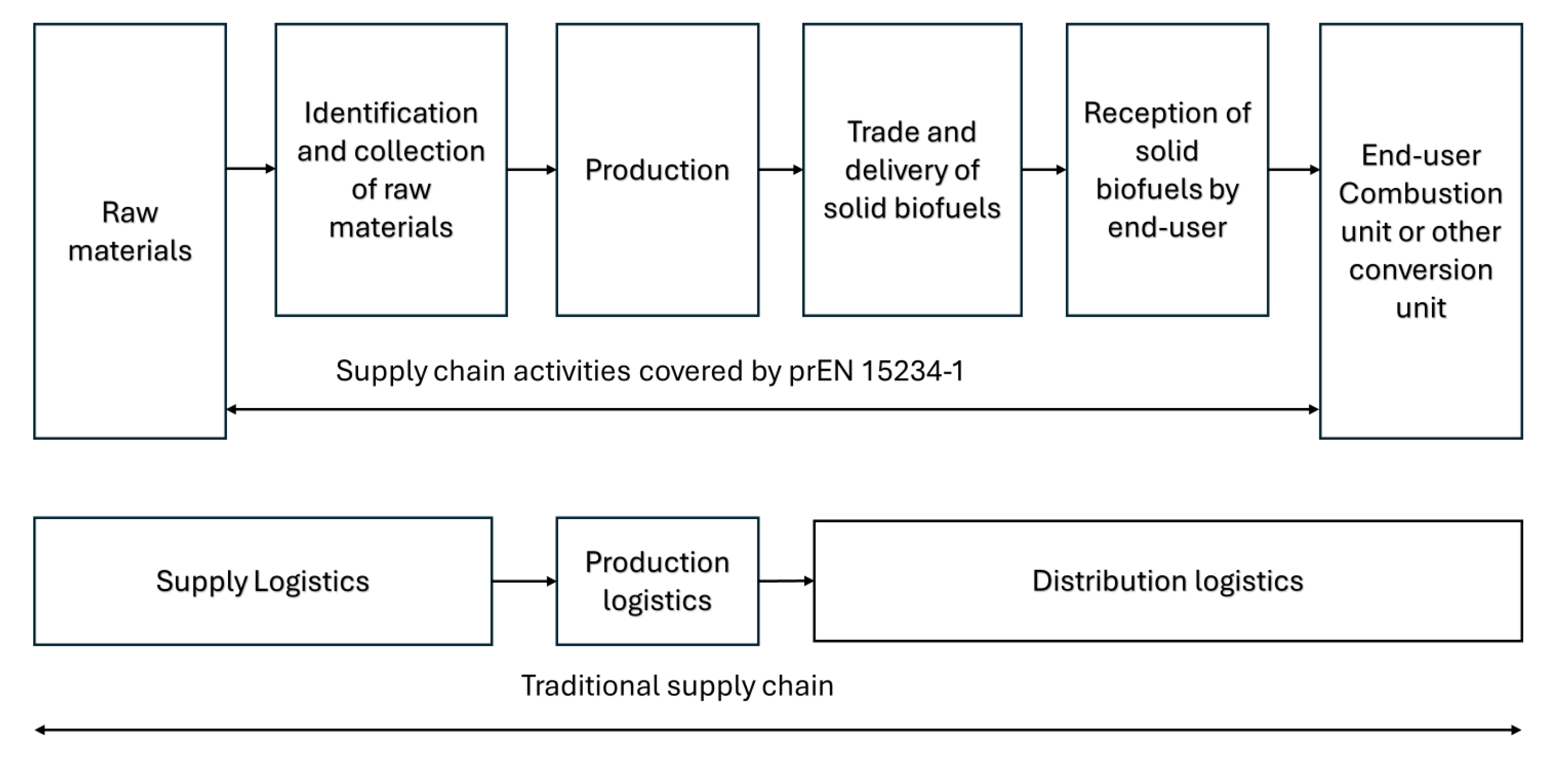
4. Pellet Supply Chain (PSC)
- -
- End consumers can access fuel that meets their needs in terms of supply and quality;
- -
- Producers/suppliers produce fuel with specific and consistent properties, accompanied by an appropriate description in accordance with customer requirements.
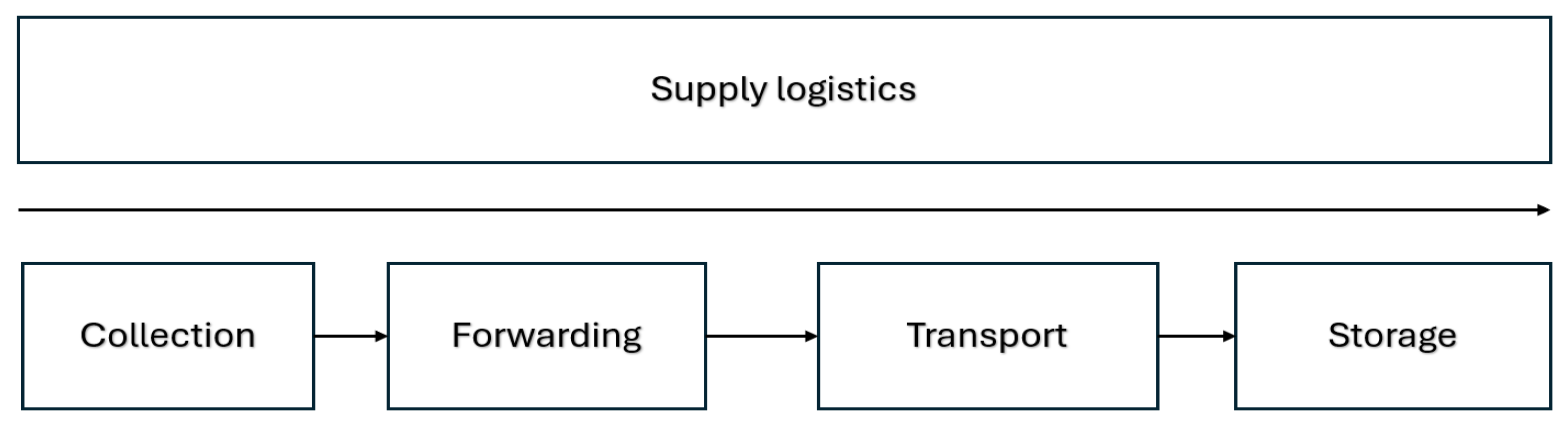
4.1. Supply Logistics
4.1.1. Softwood and Hardwood
4.1.2. Bark
4.1.3. Energy Crops
4.2. Raw Resource Warehouse Management
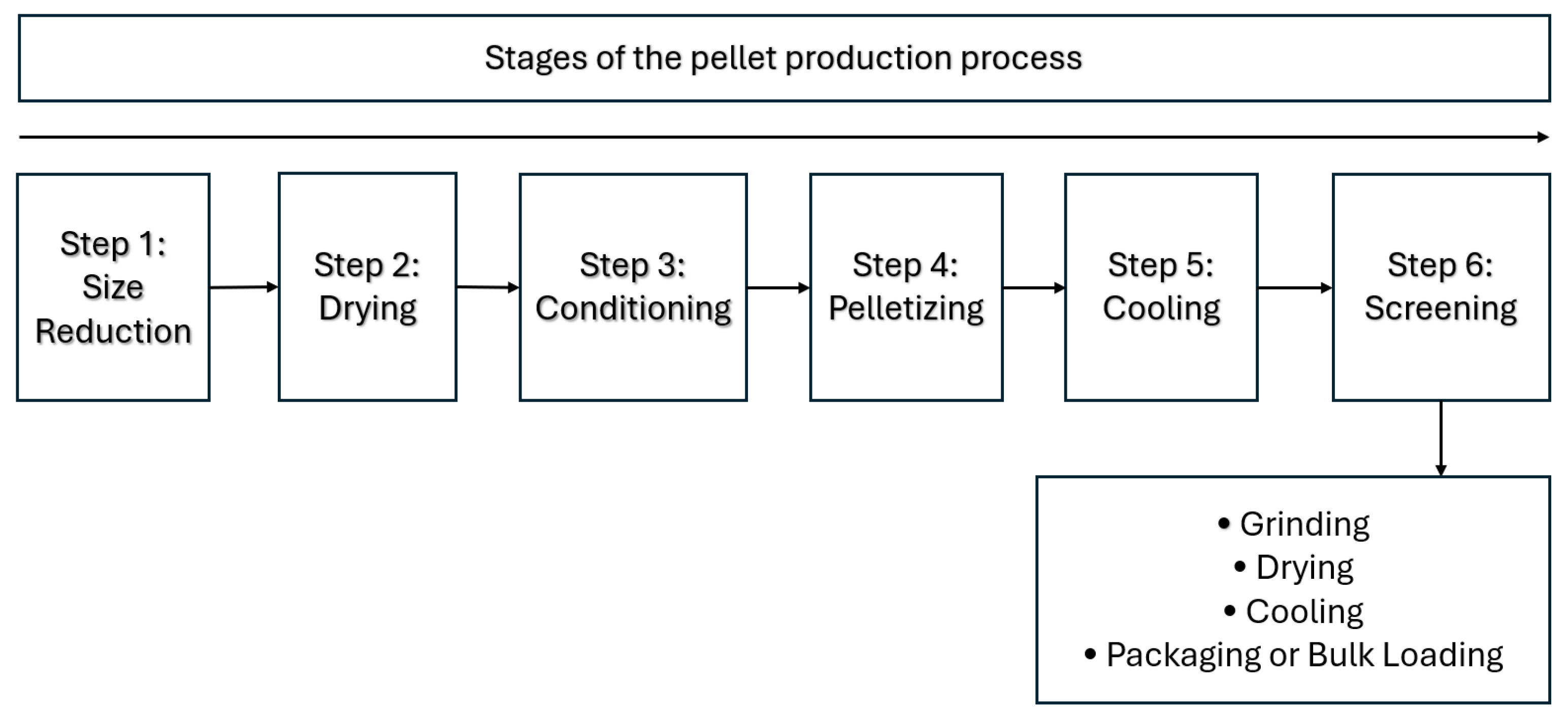
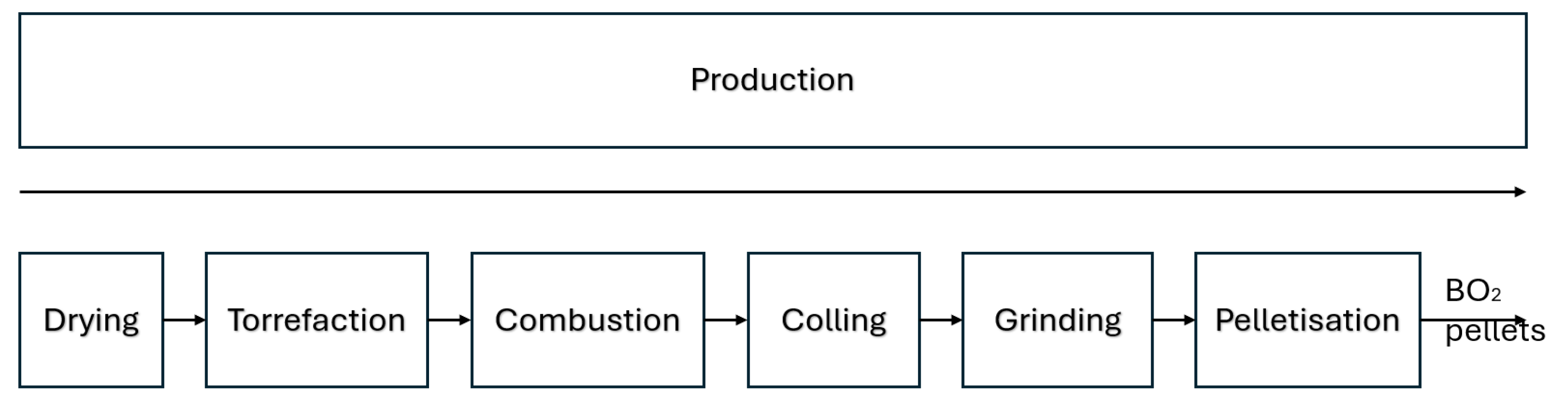
4.3. Production
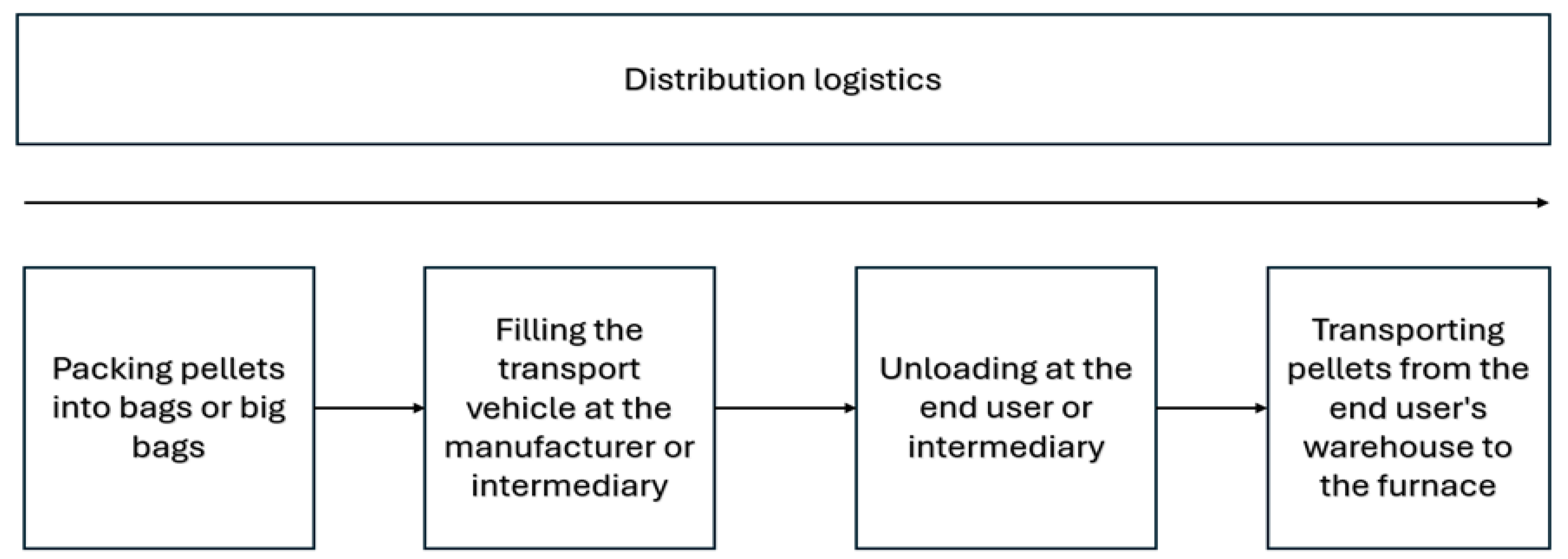
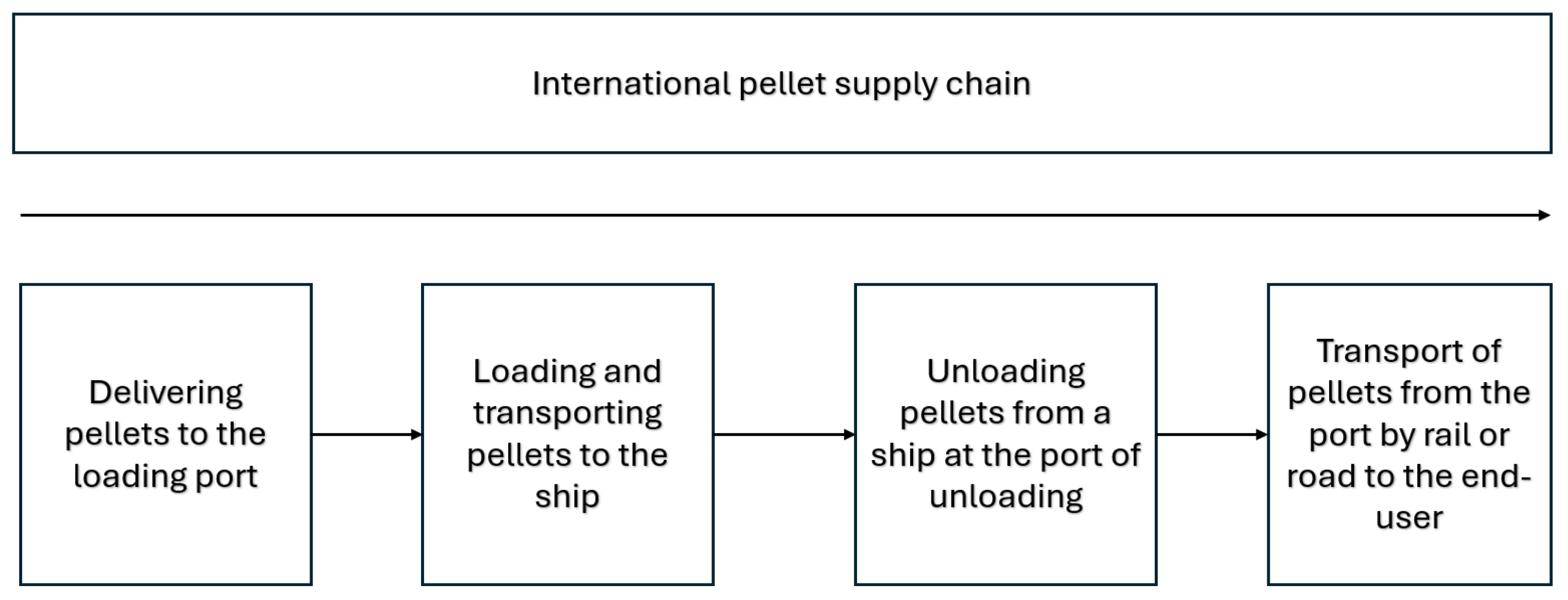
4.4. Distribution
4.5. Small-Scale Pellet Warehouse at End-User Facilities
4.6. Warehouses at Companies and Intermediaries
5. Conclusions
- -
- First, the range of raw materials used is expanding, which requires greater flexibility in production processes. Variations in moisture content and material fractions necessitate investment in drying, grinding, and bark separation equipment, which modifies the organization of raw material supplies and affects inventory planning.
- -
- Second, there is a shift in responsibility for storage in the supply chain from producers to intermediaries and wholesalers. Producers, who often have limited storage space, rely on a dispersed buffer infrastructure, which creates a need for better coordination of flows and more advanced market monitoring. At the same time, new storage technologies are being introduced, including synthetic fiber tanks and underground pellet tanks, which reduce costs and improve storage parameters.
- -
- Third, the stability of supplies is increasingly based on transport infrastructure of national and international importance. Ports, railways, and distribution networks are key elements in compensating for seasonal fluctuations in demand and local supply constraints. This requires the expansion of transport and storage capacity outside the place of production and greater use of the potential of international trade.
- -
- Fourth, the market is undergoing clear qualitative segmentation. Higher normative requirements for A1 pellets and the differentiation of product parameters for individual and industrial customers are influencing the standardization of logistics, storage, and production processes. Quality standards are becoming a key factor in determining the organization of the SC.
- -
- Fifth, there is a need to integrate environmental objectives into the supply chain. The changes concern procurement criteria, supplier qualifications, and logistics indicators, which should reflect decarbonization objectives. The SCM transformation also includes investments in low-carbon transport technologies and the modernization of the energy infrastructure of chain participants. These trends indicate a shift from viewing logistics as a tool for efficiency to treating it as an instrument supporting energy transition.
- -
- Sixth, the importance of systematic monitoring of supply, inventories, and market fluctuations is growing. Market observations and seasonality analyses are prerequisites for maintaining security of supply, especially in the absence of a coordinated storage strategy at the sector level. In this context, individual users play an important role, as they increase the resilience of the supply chain by storing fuel for 1–1.5 seasons, especially during the heating season.
Author Contributions
Funding
Data Availability Statement
Acknowledgments
Conflicts of Interest
References
- Raport URE: W Polsce Działa już 1,5 mln Mikroinstalacji OZE. Available online: https://www.ure.gov.pl/pl/urzad/informacje-ogolne/aktualnosci/12551,Raport-URE-w-Polsce-dziala-juz-15-mln-mikroinstalacji-OZE.html (accessed on 27 November 2025).
- Bastomi, M.; Sudarmiatin, S. Business Internationalization in the Wood Pellet Industry: Increasing Competitiveness in the Global Market. J. Pendidik. Dan Kewirausahaan 2024, 12, 971–986. [Google Scholar] [CrossRef]
- Jeswani, H.K.; Chilvers, A.; Azapagic, A. Environmental sustainability of biofuels: A review. Proc. R. Soc. A Math. Phys. Eng. Sci. 2020, 476, 20200351. [Google Scholar] [CrossRef] [PubMed]
- Liu, Y.; Cruz-Morales, P.; Zargar, A.; Belcher, M.S.; Pang, B.; Englund, E.; Dan, Q.; Yin, K.; Keasling, J.D. Biofuels for a sustainable future. Cell 2021, 184, 1636–1647. [Google Scholar] [CrossRef] [PubMed]
- Tun, M.M.; Juchelkova, D.; Win, M.M.; Thu, A.M.; Puchor, T. Biomass energy: An overview of biomass sources, energy potential, and management in Southeast Asian countries. Resources 2019, 8, 81. [Google Scholar] [CrossRef]
- Mladenović, M.; Paprika, M.; Marinković, A. Denitrification techniques for biomass combustion. Renew. Sustain. Energy Rev. 2018, 82, 3350–3364. [Google Scholar] [CrossRef]
- Odzijewicz, J.I.; Wołejko, E.; Wydro, U.; Wasil, M.; Jabłońska-Trypuć, A. Utilization of ashes from biomass combustion. Energies 2022, 15, 9653. [Google Scholar] [CrossRef]
- García Vera, Y.E.; Dufo-López, R.; Bernal-Agustín, J.L. Energy management in microgrids with renewable energy sources: A literature review. Appl. Sci. 2019, 9, 3854. [Google Scholar] [CrossRef]
- Marzouk, O.A. Summary of the 2023 report of TCEP (tracking clean energy progress) by the International Energy Agency (IEA), and proposed process for computing a single aggregate rating. E3S Web Conf. 2025, 601, 00048. [Google Scholar] [CrossRef]
- Global Bioenergy Statistics Report, 11th ed.; World Bioenergy Association: Stockholm, Sweden, 2024; Available online: https://www.worldbioenergy.org/uploads/241023_GBS_Report.pdf (accessed on 27 November 2025).
- IEA Bioenergy Country Reports. Implementation of Bioenergy in the European Union—2024 Update. Available online: https://www.ieabioenergy.com/wp-content/uploads/2025/01/CountryReport2024_EU27_final_v2.pdf (accessed on 27 November 2025).
- IEA Bioenergy Country Reports. Implementation of Bioenergy in the United States—2024 Update. Available online: https://www.ieabioenergy.com/wp-content/uploads/2024/12/CountryReport2024_USA_final.pdf (accessed on 27 November 2025).
- IEA. Available online: https://www.iea.org/policies?country=UnitedStates%2CUnited%20States&topic%5B0%5D=Power (accessed on 27 November 2025).
- Eurostat. Available online: https://ec.europa.eu/eurostat/cache/metadata/en/sts_esms.htm (accessed on 27 November 2025).
- IEA. Available online: https://www.iea.org/policies?country=UnitedStates%2CUnited%20States&topic%5B0%5D=Power®ion%5B0%5D=Europe (accessed on 27 November 2025).
- Kędziora-Urbanowicz, A. Dynamics of development of the Polish wood pellet industry. Made Pol. 2025, 3, 46–52. Available online: https://www.kominki.org/e-wydanie/3,fireplaces-stoves-biomass-boilers-wood-and-pellets-made-in-poland-2025 (accessed on 27 November 2025).
- Zhao, J.; Dong, K.; Dong, X. How does energy poverty eradication affect global carbon neutrality? Renew. Sustain. Energy Rev. 2024, 191, 114104. [Google Scholar] [CrossRef]
- Babiarz, B.; Krawczyk, D.A.; Siuta-Olcha, A.; Manuel, C.D.; Jaworski, A.; Barnat, E.; Cholewa, T.; Sadowska, B.; Bocian, M.; Gnieciak, M.; et al. Energy efficiency in buildings: Toward climate neutrality. Energies 2024, 17, 4680. [Google Scholar] [CrossRef]
- Torkashvand, M.; Hasan-Zadeh, A.; Torkashvand, A. Mini review on importance, application, advantages and disadvantages of biofuels. J. Mater. Environ. Sci. 2022, 13, 612–630. Available online: http://www.jmaterenvironsci.com/ (accessed on 27 November 2025).
- Wang, T.; Shi, Z.; Zhong, Y.; Ma, Y.; He, J.; Zhu, Z.; Cheng, X.; Lu, B.; Wu, Y. Biomass-Derived Materials for Advanced Rechargeable Batteries. Small 2024, 20, 2310907. [Google Scholar] [CrossRef] [PubMed]
- Yu, X.; Hu, X.; Cheng, W.; Zhao, Y.; Shao, Z.; Xue, D.; Wu, M. Preparation and evaluation of humic acid–based composite dust suppressant for coal warehouse and transportation. Environ. Sci. Pollut. Res. 2022, 29, 17072–17086. [Google Scholar] [CrossRef]
- Wang, T.; Ren, P.; Liu, Q.; Zhang, Q.; Zheng, Y.; Jia, D.; Wu, D. Coal Tar Pitch-Based Porous Carbon: Synthetic Strategies and Their Applications in Energy Warehouse. Adv. Funct. Mater. 2025, e04092. [Google Scholar] [CrossRef]
- Sliper, N.J. Energy Utilization and Conversion in Modern Biomass Conversion Technologies. J. Comput. Intell. Mater. Sci. 2024, 2, 001–011. [Google Scholar] [CrossRef]
- Brodny, J.; Tutak, M.; Grebski, W. Empirical Assessment of the Efficiency of Poland’s Energy Transition Process in the Context of Implementing the European Union’s Energy Policy. Energies 2024, 17, 2689. [Google Scholar] [CrossRef]
- Hebda, W. Energy policy of Poland until 2040: The challenges and threats to energy security in the next two decades. Politeja 2022, 19, 167–186. [Google Scholar] [CrossRef]
- Chomać-Pierzecka, E.; Sobczak, A.; Urbańczyk, E. RES market development and public awareness of the economic and environmental dimension of the energy transformation in Poland and Lithuania. Energies 2022, 15, 5461. [Google Scholar] [CrossRef]
- Igliński, B.; Pietrzak, M.B.; Kiełkowska, U.; Skrzatek, M.; Kumar, G.; Piechota, G. The assessment of renewable energy in Poland on the background of the world renewable energy sector. Energy 2022, 261, 125319. [Google Scholar] [CrossRef]
- Deora, P.S.; Verma, Y.; Muhal, R.A.; Goswami, C.; Singh, T. Biofuels: An alternative to conventional fuel and energy source. Mater. Today Proc. 2022, 48, 1178–1184. [Google Scholar] [CrossRef]
- Zaky, A.S.; Moirangthem, K.; Wahid, R. Biofuels: An Overview. Waste-to-Energy: Recent Developments and Future Perspectives Towards Circular Economy; Springer: Cham, Switzerland, 2022; pp. 85–144. [Google Scholar] [CrossRef]
- Awogbemi, O.; Kallon, D.V.V.; Onuh, E.I.; Aigbodion, V.S. An overview of the classification, production and utilization of biofuels for internal combustion engine applications. Energies 2021, 14, 5687. [Google Scholar] [CrossRef]
- Mulu, E.; M’Arimi, M.M.; Ramkat, R.C.; Mecha, A.C. Potential of wood ash in purification of biogas. Energy Sustain. Dev. 2021, 65, 45–52. [Google Scholar] [CrossRef]
- Rintala, K.; Kinnunen, V.; Berg, A.; Rintala, J.; Kokko, M. Biogas production from piloted wood-based bioethanol process using high-rate anaerobic treatment–Focusing for inhibition and improving biodegradability. Renew. Energy 2024, 237, 121594. [Google Scholar] [CrossRef]
- Løkke, S.; Aramendia, E.; Malskær, J. A review of public opinion on liquid biofuels in the EU: Current knowledge and future challenges. Biomass Bioenergy 2021, 150, 106094. [Google Scholar] [CrossRef]
- Shaah, M.A.; Allafi, F.; Hossain, M.S.; Alsaedi, A.; Ismail, N.; Kadir, M.O.A.; Ahmad, M.I. Candlenut oil: Review on oil properties and future liquid biofuel prospects. Int. J. Energy Res. 2021, 45, 17057–17079. [Google Scholar] [CrossRef]
- Anukam, A.; Berghel, J.; Henrikson, G.; Frodeson, S.; Ståhl, M. A review of the mechanism of bonding in densified biomass pellets. Renew. Sustain. Energy Rev. 2021, 148, 111249. [Google Scholar] [CrossRef]
- Bandara, J.C.; Jaiswal, R.; Nielsen, H.K.; Moldestad, B.M.; Eikeland, M.S. Air gasification of wood chips, wood pellets and grass pellets in a bubbling fluidized bed reactor. Energy 2021, 233, 121149. [Google Scholar] [CrossRef]
- Pokhrel, G.; Gardner, D.J.; Han, Y. Properties of wood–plastic composites manufactured from two different wood feedstocks: Wood flour and wood pellets. Polymers 2021, 13, 2769. [Google Scholar] [CrossRef]
- Stolarski, M.J.; Stachowicz, P.; Dudziec, P. Wood pellet quality depending on dendromass species. Renew. Energy 2022, 199, 498–508. [Google Scholar] [CrossRef]
- Kamperidou, V. Quality analysis of commercially available wood pellets and correlations between pellets characteristics. Energies 2022, 15, 2865. [Google Scholar] [CrossRef]
- Vodolazova, N. Drivers for the Buying Decisions of Pellets for Consumers in Germany: Strategic Success Factors of Pellets Marketing in Germany. Master’s Thesis, Fachhochschule Vorarlberg, Dornbirn, Austria, 2022. Available online: https://opus.fhv.at/frontdoor/deliver/index/docId/4591/file/123.pdf (accessed on 27 November 2025).
- Nunes, L.J.; Casau, M.; Ferreira Dias, M. Portuguese wood pellets market: Organization, production and consumption analysis. Resources 2021, 10, 130. [Google Scholar] [CrossRef]
- Silva, D. A L.; Filleti, R.A.P.; Musule, R.; Matheus, T.T.; Freire, F.M.C.S. A systematic review and life cycle assessment of biomass pellets and briquettes production in Latin America. Renew. Sustain. Energy Rev. 2022, 157, 112042. [Google Scholar] [CrossRef]
- Saleem, J.; Tahir, F.; Baig, M.Z.K.; Al-Ansari, T.; McKay, G. Assessing the environmental footprint of recycled plastic pellets: A life-cycle assessment perspective. Environ. Technol. Innov. 2023, 32, 103289. [Google Scholar] [CrossRef]
- Gilvari, H.; van Battum, C.H.; van Dijk, S.A.; de Jong, W.; Schott, D.L. Large-scale transportation and warehouse of wood pellets: Investigation of the change in physical properties. Particuology 2021, 57, 146–156. [Google Scholar] [CrossRef]
- Bhattacharjee, G.; Veluswamy, H.P.; Kumar, A.; Linga, P. Stability analysis of methane hydrates for gas warehouse application. Chem. Eng. J. 2021, 415, 128927. [Google Scholar] [CrossRef]
- Sidana, A.; Yadav, S.K. Recent developments in lignocellulosic biomass pretreatment with a focus on eco-friendly, non-conventional methods. J. Clean. Prod. 2022, 335, 130286. [Google Scholar] [CrossRef]
- Yashas Gowda, T.G.; Ballupete Nagaraju, S.; Puttegowda, M.; Verma, A.; Rangappa, S.M.; Siengchin, S. Biopolymer-based composites: An eco-friendly alternative from agricultural waste biomass. J. Compos. Sci. 2023, 7, 242. [Google Scholar] [CrossRef]
- Bianchini, L.; Costa, P.; Dell’Omo, P.P.; Colantoni, A.; Cecchini, M.; Monarca, D. An industrial scale, mechanical process for improving pellet quality and biogas production from Hazelnut and Olive pruning. Energies 2021, 14, 1600. [Google Scholar] [CrossRef]
- García, R.; González-Vázquez, M.D.P.; Rubiera, F.; Pevida, C.; Gil, M.V. Co-pelletization of pine sawdust and refused derived fuel (RDF) to high-quality waste-derived pellets. J. Clean. Prod. 2021, 328, 129635. [Google Scholar] [CrossRef]
- Obernberber, I.; Thek, G. The Pellet Handbook: The Production and Thermal Utilisation of Biomass Pellets; Earthscan: London, UK; Washington, DC, USA, 2010; p. 17. [Google Scholar]
- Mack, R.; Schön, C.; Kuptz, D.; Hartmann, H.; Brunner, T.; Obernberger, I.; Behr, H.M. Influence of pellet length, content of fines, and moisture content on emission behavior of wood pellets in a residential pellet stove and pellet boiler. Biomass Convers. Biorefin. 2024, 14, 26827–26844. [Google Scholar] [CrossRef]
- Picchio, R.; Di Marzio, N.; Cozzolino, L.; Venanzi, R.; Stefanoni, W.; Bianchini, L.; Pari, L.; Latterini, F. Pellet production from pruning and alternative forest biomass: A review of the most recent research findings. Materials 2023, 16, 4689. [Google Scholar] [CrossRef]
- Gagnon, B.; MacDonald, H.; Hope, E.; Blair, M.J.; McKenney, D.W. Impact of the COVID-19 pandemic on biomass supply chains: The case of the Canadian wood pellet industry. Energies 2022, 15, 3179. [Google Scholar] [CrossRef]
- Borovik, E.S.; Menyakina, A.G.; Gamko, L.N.; Podolnikov, V.E.; Sidorov, I.I. The effect of feed production technology on pellet durability. In Proceedings of the International Scientific and Practical Conference “From Modernization to Rapid Development: Ensuring Competitiveness and Scientific Leadership of the Agro-Industrial Complex” (IDSISA 2025), Ekaterinburg City, Russia, 13–14 February 2025; Volume 179, p. 01010. [Google Scholar] [CrossRef]
- Protsenko, L.; Ryzhuk, S.; Koshitska, N.; Lyashenko, M.; Bober, А.; Gunko, S.; Kazmirchuk, V. Comparative estimation of the quality of Ukrainian and European hop pellets. Food Sci. Technol. 2023, 17. [Google Scholar] [CrossRef]
- Barbu, M.C.; Tudor, E.M. State of the art of the Chinese forestry, wood industry and its markets. Wood Mater. Sci. Eng. 2022, 17, 1030–1039. [Google Scholar] [CrossRef]
- Yermak, I.T.; Domnenkova, A.V.; Kiselev, S.V.; Chernushevich, G.A. Wood Fuel Pellet Manufacturers in Belarus, Under Sanctions, Seeking Sales Markets. In Proceedings of the Environmental Safety Management System, XVIII International Scientific and Practical Conference, Yekaterinburg, Russia, 23–24 May 2024; pp. 20–24. Available online: https://elar.urfu.ru/bitstream/10995/135234/1/SMES_2024_004.pdf (accessed on 27 November 2025).
- DiGiacomo, P.M.; Conrad IV, J.L.; Bolding, M.C.; Woosnam, K.M.; Munro, H.L. Operational Characteristics and Business Perspectives of Wood Pellet Producers and Feedstock Suppliers in the Southeastern US. For. Prod. J. 2025, 75, 144–154. [Google Scholar] [CrossRef]
- Bałtycka Agencja Poszanowania Energii. Available online: https://bape.com.pl/wp-content/uploads/2015/07/Rozwoj_przemyslu_produkcji_pelet_w_Polsce_i_na_swiecie_w_2014.pdf (accessed on 27 November 2025).
- Van Loo, S.; Koppejan, J. (Eds.) The Handbook of Biomass Combustion and Co-Firing; Earthscan: London, UK, 2008. [Google Scholar]
- Di Domenico, G.; Cioccolo, E.; Bianchini, L.; Venanzi, R.; Colantoni, A.; Picchio, R.; Cozzolino, L.; Di Stefano, V. A Systematic Review of Mechanical Pretreatment Techniques of Wood Biomass for Bioenergy. Energies 2025, 18, 3294. [Google Scholar] [CrossRef]
- García-Maraver, A.; Popov, V.; Zamorano, M. A review of European standards for pellet quality. Renew. Energy 2011, 36, 3537–3540. [Google Scholar] [CrossRef]



| Year | Bioenergy | Hydro | Solar | Wind | Other Renewables |
|---|---|---|---|---|---|
| 2020 | 8.1 | 58.0 | 11.4 | 21.3 | 1.1 |
| 2021 | 8.3 | 53.9 | 13.3 | 23.3 | 1.1 |
| 2022 | 8.0 | 50.7 | 15.6 | 24.7 | 1.0 |
| 2023 | 7.8 | 47.1 | 18.3 | 25.8 | 1.0 |
| 2010 | 2011 | 2012 | 2013 | 2014 | 2015 | 2016 | 2017 | 2018 | 2019 | 2020 | 2021 | 2022 | 2023 | |
|---|---|---|---|---|---|---|---|---|---|---|---|---|---|---|
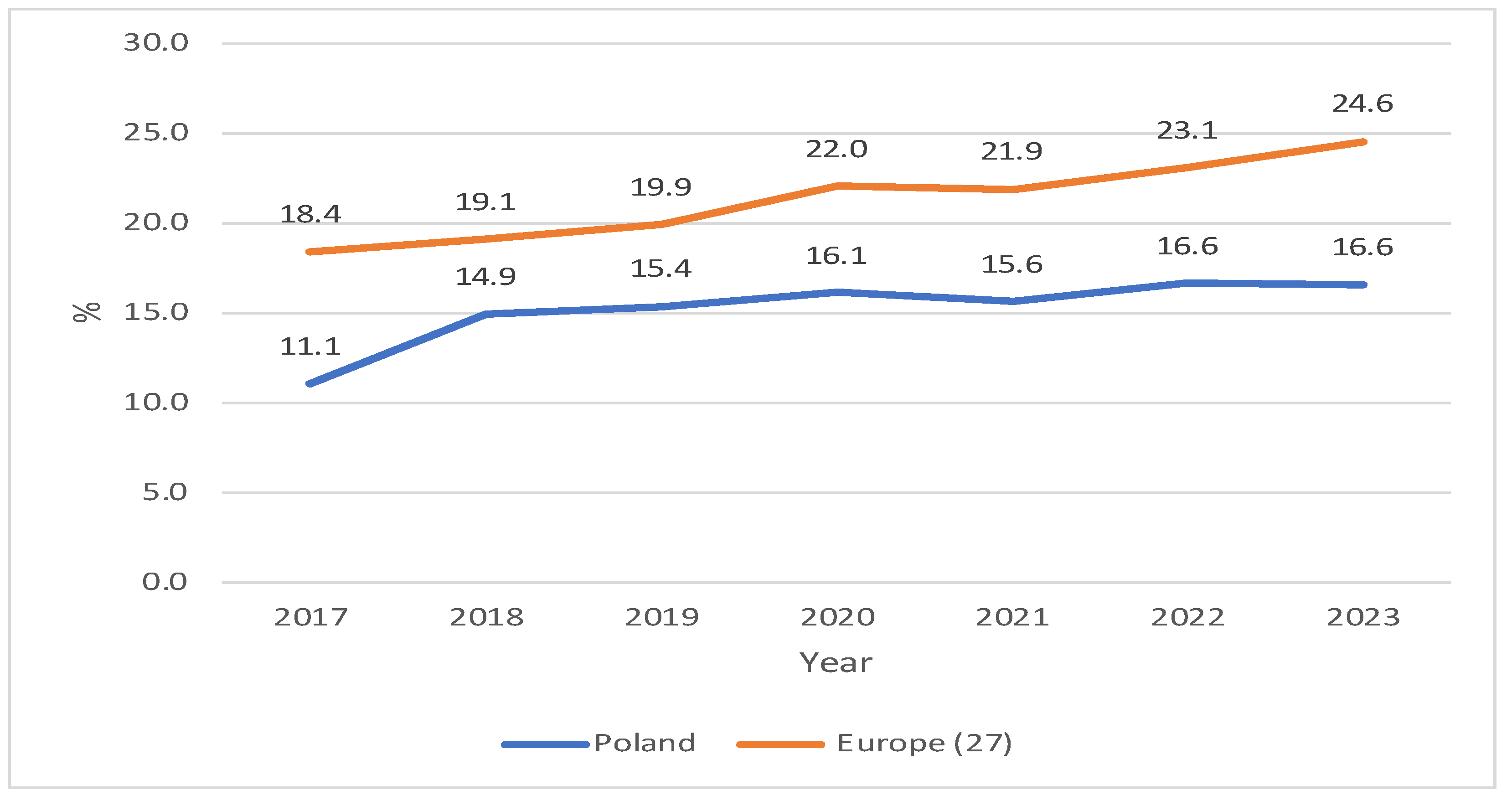
| EU | 14.4 | 14.5 | 16.0 | 16.7 | 17.4 | 17.8 | 18.0 | 18.4 | 19.1 | 19.9 | 22.0 | 21.9 | 23.1 | 24.5 |
| Poland | 9.3 | 10.3 | 11.0 | 11.5 | 11.6 | 11.9 | 11.4 | 11.1 | 14.9 | 15.4 | 16.1 | 15.6 | 16.8 | 16.5 |
| Denmark | 21.9 | 23.4 | 25.5 | 27.2 | 29.3 | 30.5 | 31.7 | 34.4 | 35.2 | 37.0 | 31.7 | 41.8 | 42.4 | 44.9 |
| Germany | 11.7 | 12.5 | 13.5 | 13.8 | 14.4 | 14.9 | 14.9 | 15.5 | 16.7 | 17.3 | 19.1 | 19.3 | 20.9 | 21.5 |
| Ireland | 5.8 | 6.6 | 7.0 | 7.5 | 8.5 | 9.1 | 9.2 | 10.5 | 10.9 | 12.0 | 16.2 | 13.0 | 13.1 | 15.3 |
| Spain | 13.8 | 13.2 | 14.2 | 15.1 | 15.9 | 16.2 | 17.0 | 17.1 | 17.0 | 17.9 | 21.2 | 20.5 | 21.9 | 24.9 |
| France | 12.7 | 10.8 | 13.2 | 13.9 | 14.4 | 14.8 | 15.5 | 15.8 | 16.4 | 17.2 | 19.1 | 19.3 | 20.4 | 22.3 |
| Italy | 13.0 | 12.9 | 15.4 | 16.7 | 17.1 | 17.5 | 17.4 | 18.3 | 17.8 | 18.2 | 20.4 | 18.9 | 19.1 | 19.6 |
| Portugal | 24.1 | 24.6 | 24.6 | 25.7 | 29.5 | 30.5 | 30.9 | 30.6 | 30.2 | 30.6 | 34.0 | 34.0 | 34.7 | 35.2 |
| Slovenia | 21.1 | 20.9 | 21.6 | 23.2 | 22.5 | 22.9 | 22.0 | 21.7 | 21.4 | 22.0 | 25.0 | 25.0 | 25.0 | 25.1 |
| Sweden | 46.1 | 47.6 | 49.4 | 50.2 | 51.2 | 52.2 | 52.6 | 53.4 | 53.9 | 55.8 | 60.1 | 62.5 | 66.3 | 66.4 |
| Norway | 61.9 | 64.6 | 64.9 | 66.5 | 68.4 | 68.5 | 69.2 | 70.0 | 71.6 | 74.4 | 77.4 | 74.0 | 75.9 | 75.6 |
| Property Class | Unit | A1 | A2 | B |
|---|---|---|---|---|
| Origin and source | Stemwood Chemically untreated wood residues | Whole trees without roots Stemwood Logging residues Bark Chemically untreated wood residues | Forest, plantation and other virgin wood By-products and residues from wood processing industry Used wood | |
| Diameter, D a and Length, L b | mm | D06 ± 1.0 3.15 ≤ L ≤ 40 D08 ± 1.0 3.15 ≤ L ≤ 40 | D06 ± 1.0 3.15 ≤ L ≤ 40 D08 ± 1.0 3.15 ≤ L ≤ 40 | D06 ± 1.0 3.15 ≤ L ≤ 40 D08 ± 1.0 3.15 ≤ L ≤ 40 |
| Moisture, M (EN 14774-1 and -2) | wt.%ar | M10 ≤ 10 | M10 ≤ 10 | M10 ≤ 10 |
| Ash, A (EN 14775) | wt.% (d.b.) | A0.7 ≤ 0.7 | A1.5 ≤ 1.5 | A3.5 ≤ 3.5 |
| Mechanical durability, DU (EN 15210-1) | wt.%ar | DU97.5 ≥ 97.5 | DU97.5 ≥ 97.5 | DU96.5 ≥ 96.5 |
| Particle size distribution, F (EN 15149-1) | wt.%ar | F1.0 ≤ 1.0 | F1.0 ≤ 1.0 | F1.0 ≤ 1.0 |
| Additives | wt.% (d.b.) | ≤ 2 Type c and amount to be stated | ≤ 2 Type c and amount to be stated | ≤ 2 Type c and amount to be stated |
| Net calorific value, Q (EN 14918) | MJ/kgar or kWh/kgar | 16.5 ≤ Q ≤ 19.0 or 4.6 ≤ Q ≤ 5.3 | 16.3 ≤ Q ≤ 19.0 or 4.5 ≤ Q ≤ 5.3 | 16.0 ≤ Q ≤ 19.0 or 4.4 ≤ Q ≤ 5.3 |
| Bulk density, BD (EN 15103) | kg/m3 | BD600 ≥ 600 | BD600 ≥ 600 | BD600 ≥ 600 |
| Nitrogen, N (prEN 15104) | wt.% (d.b.) | N0.3 ≤ 0.3 | N0.5 ≤ 0.5 | N1.0 ≤ 1.0 |
| Sulphur, S (prEN 15289) | wt.% (d.b.) | S0.03 ≤ 0.03 | S0.03 ≤ 0.03 | S0.04 ≤ 0.04 |
| Chlorine, Cl (prEN 15289) | wt.% (d.b.) | Cl 0.02 ≤ 0.02 | Cl 0.02 ≤ 0.02 | Cl 0.03 ≤ 0.03 |
| Arsenic, As (prEN 15297) | mg/kg (d.b.) | ≤1 | ≤1 | ≤1 |
| Cadmium, Cd (prEN 15297) | mg/kg (d.b.) | ≤0.5 | ≤0.5 | ≤0.5 |
| Chromium, Cr (prEN 15297) | mg/kg (d.b.) | ≤10 | ≤10 | ≤10 |
| Copper, Cu (prEN 15297) | mg/kg (d.b.) | ≤10 | ≤10 | ≤10 |
| Lead, Pb (prEN 15297) | mg/kg (d.b.) | ≤10 | ≤10 | ≤10 |
| Mercury, Hg (prEN 15297) | mg/kg (d.b.) | ≤0.1 | ≤0.1 | ≤0.1 |
| Nickel, Ni (prEN 15297) | mg/kg (d.b.) | ≤10 | ≤10 | ≤10 |
| Zinc, Zn (prEN 15297) | mg/kg (d.b.) | ≤100 | ≤100 | ≤100 |
| Ash melting behaviour, DT (prEN 15370) | °C | should be stated | should be stated | should be stated |
| Fuel Type | C wt.% (d.b) | H wt.% (d.b) | O wt.% (d.b) | Volatiles wt.% (d.b) |
|---|---|---|---|---|
| Wood chips | 47.1–51.6 | 6.1–6.3 | 38.0–45.2 | 76.0–86.0 |
| Bark | 48.8–52.5 | 4.6–6.1 | 38.7–42.4 | 69.6–77.2 |
| Straw | 43.2–48.1 | 5.0–6.0 | 36.0–48.2 | 70.0–81.0 |
| Miscathus | 46.7–50.7 | 4.4–6.2 | 41.7–43.5 | 77.6–84.0 |
| Type of Raw Material | Origin | Moisture Content at Harvest/Delivery | Lignin Content | Ash Content | Grinding Requirements | Drying Requirements | Comments on Pelletization | Typical Application |
|---|---|---|---|---|---|---|---|---|
| Industrial wood chips | Sawmill industry | 30–45% w.m. | Medium–high (softwood) | Low | Required (for particle standardization) | Necessary | Mechanically durable, low abrasion | Small and medium scale, industrial energy |
| Wood chips | Forest | 40–55% w.m. | Medium | Low | Required | Necessary | Similar to industrial energy consumption, higher energy consumption | Medium and large scale, industrial energy |
| Wood chips/sawdust | Wood industry | 5–20% w.m. | Medium–high | Low | Usually ready for granulation | Depending on humidity | Homogeneous particles, high efficiency | Small and medium scale |
| Bark | Sawmills, paper industry | 45–65% w.m. | High | High | Required (cutting mills) | Necessary | More difficult to process, high ash production | Only large-scale industrial use (class A2), briquettes |
| Energy crops | Energy-efficient crops (poplar, willow, alder) | 50% m.c. (mature 10–20% w.m.) | Low–medium | Medium–high | Required | Field drying is usually sufficient. | Good in mixtures with wood, limited in small installations | Large scale, energy industry |
| Straw and whole herbaceous plants | By-products of grain harvesting | 10–20% w.m. after drying | Low | High | Required | Field drying is sufficient | Not recommended for use alone in small installations, good in mixtures | Large scale, energy industry |
| Stage | Parameter | Range/Comments | Impact on Pellet Quality | Logistical Comments |
|---|---|---|---|---|
| Storage of raw materials | Storage time | 4–6 weeks | ↑ bulk density, ↑ durability, ↓ amount of fine particles | Longer storage increases energy consumption during pelletization |
| Raw material moisture content | Wood chips: 5–14% m.c., sawdust: up to 55% m.c. | Optimal humidity minimizes degradation and spontaneous combustion | Store raw materials in silos or closed halls. | |
| Pellet storage | Warehouse type | Silos, halls, enclosed spaces | Reduces moisture absorption and mechanical degradation | Avoid storing in open spaces |
| Separation of fine particles | Filters, screening | Minimizes dust and energy loss | Dust can be returned to production | |
| Transportation | Transport system | Pneumatic, screw, closed | Reduced mechanical degradation, less dusting | Fine particles returned to production |
| Exposure to moisture | Minimizing contact with water | Preservation of the mechanical and energy properties of pellets | Important in international transport and loading |
| Production Stage | Main Task | Critical Parameters | Impact on Pellet Quality | Automation/Advantages for the Supply Chain |
|---|---|---|---|---|
| Size reduction | Grinding raw material to the appropriate fraction | Particle size 2–6 mm, uniformity | Improves compaction, reduces unburned carbon | Stable load, fewer losses, consistent quality for further transport |
| Drying | Reducing humidity to the optimal level | Humidity 18–26% w.m. | Prevents degradation, reduces crumbling | Precise humidity control improves supply chain stability |
| Conditioning | Moistening and plasticization of lignin | Conditioning time 10–20 min, additional 2% humidity | Increases mechanical durability and uniformity | Minimizes granulator failures, stable product quality |
| Torefaction/steam treatment | Improvement of energy and mechanical properties | Temp. 200–300 °C, pressure, absence of oxygen | Increases resistance to moisture, dusting <0.6% | Product more resistant to transport, long-distance deliveries possible |
| Pelletizing | Forming granules in a matrix | Pellet diameter, pressure, roller speed | Dimensional stability, homogeneity | Higher efficiency, less waste, consistent quality throughout the SC |
| Cooling | Lowering temperature and humidity | Granule temperature 80–130 °C, moisture reduction by ~2% | Reduces brittleness, improves durability | Reduces damage during packaging and transport |
| Screening | Removal of fine particles and dust | Fractions < 1 mm, dust removal | Reduction of dust and explosion risk, uniform product | Safe transport, fewer losses in storage and delivery |
Disclaimer/Publisher’s Note: The statements, opinions and data contained in all publications are solely those of the individual author(s) and contributor(s) and not of MDPI and/or the editor(s). MDPI and/or the editor(s) disclaim responsibility for any injury to people or property resulting from any ideas, methods, instructions or products referred to in the content. |
© 2025 by the authors. Licensee MDPI, Basel, Switzerland. This article is an open access article distributed under the terms and conditions of the Creative Commons Attribution (CC BY) license (https://creativecommons.org/licenses/by/4.0/).
Share and Cite
Olkiewicz, M.; Dudek, M.; Dyczkowska, J.A.; Łyp-Wrońska, K.; Šarkan, B. Pellet Supply Chain Management: Analysis of Changes. Energies 2025, 18, 6329. https://doi.org/10.3390/en18236329
Olkiewicz M, Dudek M, Dyczkowska JA, Łyp-Wrońska K, Šarkan B. Pellet Supply Chain Management: Analysis of Changes. Energies. 2025; 18(23):6329. https://doi.org/10.3390/en18236329
Chicago/Turabian StyleOlkiewicz, Marcin, Marek Dudek, Joanna Alicja Dyczkowska, Katarzyna Łyp-Wrońska, and Branislav Šarkan. 2025. "Pellet Supply Chain Management: Analysis of Changes" Energies 18, no. 23: 6329. https://doi.org/10.3390/en18236329
APA StyleOlkiewicz, M., Dudek, M., Dyczkowska, J. A., Łyp-Wrońska, K., & Šarkan, B. (2025). Pellet Supply Chain Management: Analysis of Changes. Energies, 18(23), 6329. https://doi.org/10.3390/en18236329