1. Introduction
The global energy system faces a critical challenge: ensuring a reliable energy supply while mitigating the environmental impacts associated with current production models. The global energy system has reached a turning point: countries are struggling to reconcile growing economic needs with the need to protect the climate and pursue the ideal of sustainable development. Nevertheless, fossil fuels continue to dominate the global energy mix. Their historical cost-effectiveness has enabled them to be a source of growth and prosperity for decades. However, problems related to their use are intensifying, such as ongoing climate change, volatile commodity markets, and rising geopolitical tensions [
1].
Reports from the International Energy Agency (IEA) [
2] indicate that as much as 73% of global greenhouse gas emissions come from the energy sector. This figure clearly demonstrates the scale of the challenge and the direction we must take. In the face of the global energy crisis and the intensifying effects of climate change, improving the efficiency of carbon dioxide emissions has become a crucial component of a strategy that balances environmental protection with economic development. Reducing emissions is no longer just an expression of concern for the planet, but also a prerequisite for sustainable growth [
3]. The transition to cleaner, safer, and more sustainable energy sources is becoming increasingly urgent. There is need for both a secure energy supply and to address ecological requirements to ensure a sustainable future for future generations [
4].
Renewable energy has become a central component of contemporary energy system transformation. This development is driven by two primary factors: growing concern about climate change and the need to establish an economy aligned with sustainable development principles [
5]. Technological solutions have reached a level of maturity that enables their effective large-scale implementation. Low emissions are their hallmark: rooftop solar panels, powerful wind turbines, and reliable hydropower. These technologies are increasingly recognized globally and demonstrate growing economic competitiveness compared with conventional high-emission energy sources [
6].
This transformation encompasses not only technological change but also a broader evolution in energy preferences, moving from reliance on fossil fuels toward greater integration of clean, accessible, and environmentally sustainable sources such as wind, solar, hydropower, and biomass. Although this direction is undoubtedly the right one, its implementation requires consistent, long-term, and responsible investments that will allow us to permanently anchor ourselves in a low-emission economy [
7].
The energy transition involves several social challenges that require coordinated policy responses. In short, it can be said that highly developed societies overwhelmingly support the development and broader use of renewable energy sources (RES). This suggests that the concept of expanding renewable energy enjoys broad public support and is generally not considered a controversial issue. This pattern is linked to increasing public awareness of climate change and its recognized association with the use of fossil fuels [
8]. However, the positive image of support for renewable energy does not always persist at the local level, where specific projects are implemented [
9]. In such situations, understanding the attitudes of energy consumers becomes crucial, as their perceptions and opinions determine whether a project will be met with approval or resistance. Therefore, social acceptance is now considered one of the most important factors influencing the share of renewable energy in the national energy mix [
10]. Without adequate public support, even the most modern technologies and best-planned policies may encounter severe difficulties in practical implementation.
In recent years, the Polish government has increasingly recognized the need to integrate RES into the national energy system. The growth in the use of biomass is particularly impressive, accounting for a larger share of our energy system than in many other European Union countries [
11]. Unfortunately, the energy transition in Poland is uneven. While biomass is developing dynamically, wind and solar energy face significant obstacles. The primary barriers are legal regulations and inadequate infrastructure, which hinder the adoption of these technologies [
12]. Although the official strategy, “Poland’s Energy Policy until 2040,” sets ambitious goals, experts emphasize that achieving them within the set deadline is complex, and full transformation before 2050 remains challenging [
13]. Therefore, the development of RES in Poland is dynamic but disorganized, marked by constant regulatory changes and varying levels of support. Recent developments indicate growing engagement from financial institutions, which are increasingly recognizing the economic potential of low-carbon investments and demonstrating a greater willingness to allocate capital to such projects. This trend is consistent with the strategic objectives outlined in the European Green Deal [
14].
Poland’s energy transition trajectory remains distinctive within the European Union. While many EU countries, such as Germany or Denmark, have advanced rapidly in integrating wind and solar power, Poland continues to rely heavily on coal, which still accounts for a majority of electricity generation. Regulatory barriers, delayed infrastructure investments, and political debates over sovereignty and EU climate policy have slowed the pace of renewable adoption. This uneven progress contrasts with the more coordinated and ambitious transitions observed elsewhere in Europe, underscoring the importance of examining how Polish citizens perceive renewable energy in this unique context.
In this context, public sentiment is mixed. Although renewable energy and energy efficiency are actively promoted, public attitudes remain influenced by a long-standing reliance on coal within the national energy system, which can limit the broader acceptance of related energy policy measures [
15]. Therefore, increasing emphasis is placed on social participation and dialog—citizens are given a real opportunity to influence key decisions [
16]. This public engagement is crucial today: only by building trust and gaining support for reforms can we ensure a more sustainable and secure energy future for Poland.
Previous research on attitudes toward RES has focused primarily on micro-level analysis. This means that their attention has focused primarily on households [
17,
18], individual purchasing decisions [
19,
20], and declared intentions to use renewable technologies. These studies have often relied on classical behavioral models, particularly the Theory of Planned Behavior [
21,
22].
The literature also includes studies that analyze differences in attitudes toward RES across various demographic groups, such as age, gender, education level, or place of residence [
23,
24]. However, they are primarily comparative in nature, demonstrating that differences exist but not attempting to understand them more deeply or how they interrelate. This approach captures fundamental differences but does not fully capture the complexity of social attitudes toward renewable energy, especially those related to values, beliefs, knowledge levels, or emotional attachment to the energy transition.
Consequently, there remains a lack of segmentation-based research that empirically distinguishes different types of attitudes and patterns of engagement with RES, independent of classic demographic variables. Our study fills this gap by identifying key dimensions of attitudes toward RES and distinguishing two distinct social segments. These segments differ in their awareness, engagement, and acceptance of renewable energy development, allowing for a much more comprehensive and humanized perspective on the social determinants of energy transition.
The originality of this study lies in its application of a two-stage, advanced analytical strategy based on a representative, nationwide sample of 974 respondents. First, exploratory factor analysis (EFA) was used to empirically identify and define six key dimensions underlying attitudes (including environmental concern, knowledge and awareness, and socioeconomic support). Second, cluster analysis was used to segment respondents based on the resulting factors. The study provides a new, in-depth understanding of social heterogeneity in renewable energy engagement through this segmentation.
The contribution of this study extends beyond mere description of attitudes, offering important implications for application. The empirical finding that the structure of attitudes is primarily shaped by cognitive and evaluative factors, rather than sociodemographic variables (such as gender, age, or education), offers policymakers and strategic communicators valuable insights, enabling the development of more targeted and effective interventions in the energy transition process.
The main objective of this study is to empirically identify and describe the diversity of Poles’ attitudes toward RES. Specifically, the study aims to:
Identify the main dimensions of attitudes toward renewable energy using exploratory factor analysis (EFA).
Distinguish respondent segments based on the obtained factors using cluster analysis.
Compare the sociodemographic structures of the identified segments.
The article is divided into several logical sections. The abstract outlines the main body of the work, followed by the Introduction (
Section 1), which introduces the research context and defines its objectives. The literature review (
Section 2) then discusses the theoretical framework and the current state of knowledge in the area under study. The Materials and Methods section (
Section 3) describes the research sample and the analytical procedures, including factor analysis (EFA) and cluster analysis. Results (
Section 3 and
Section 4) are then presented, covering the factors and segments identified in the study. The Discussion (
Section 4) interprets the results in a broader context, and finally, the Conclusions (
Section 5) summarize the study and present its practical implications.
4. Results
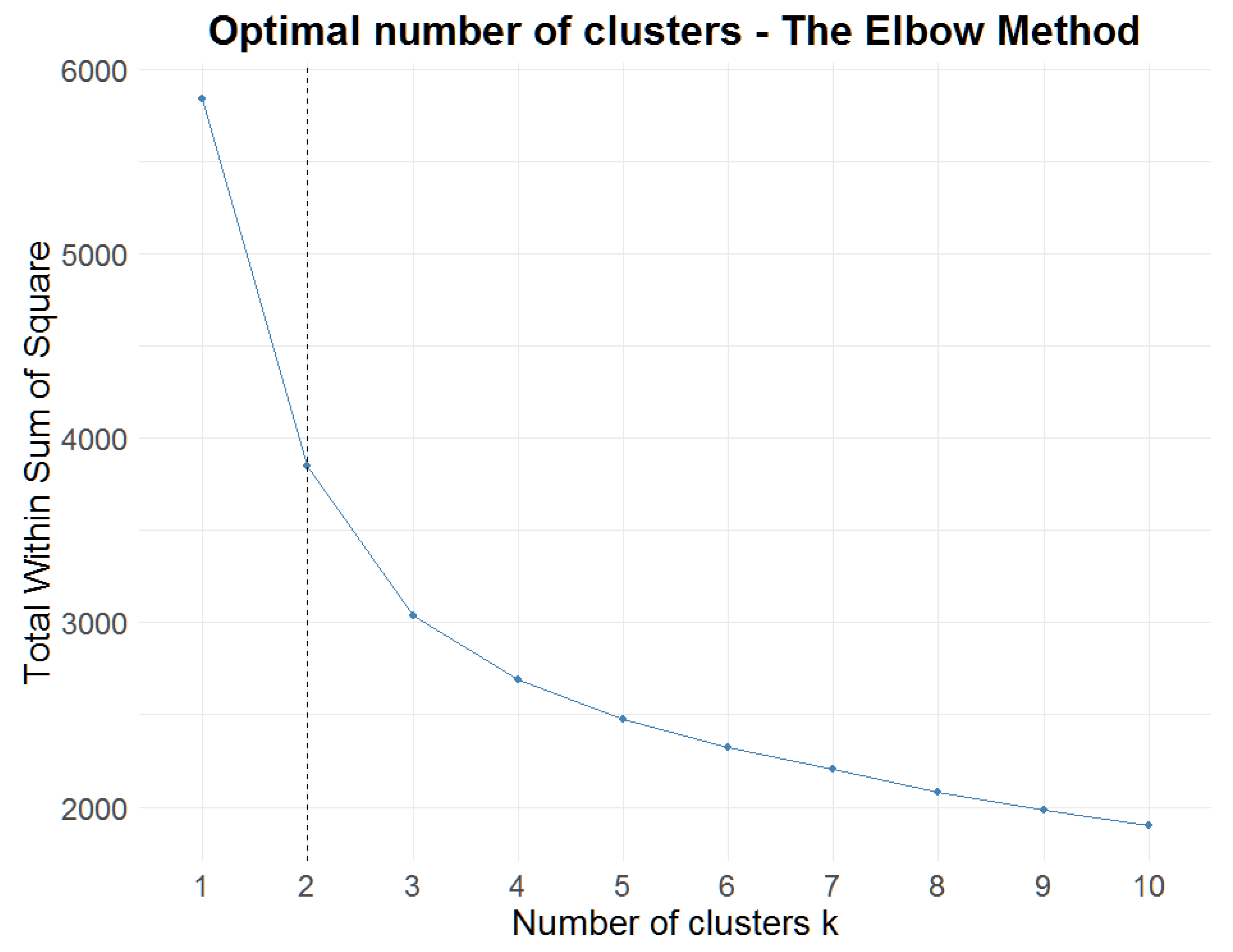
To identify groups of respondents with similar attitudes toward renewable energy, a two-stage clustering procedure was applied. In the first stage, the hierarchical Ward’s method, using the Euclidean distance metric, was employed to explore the natural grouping tendency in the data. The Elbow Method plot (
Figure 1) indicated a clear inflection point at k = 2, suggesting that the optimal solution should include two clusters. The selection of the two-cluster solution was further validated using internal clustering validation methods. The examined indices—including the Calinski–Harabasz Index, the Average Silhouette Width, and the Davies–Bouldin Index—consistently indicated, in most evaluations, that the two-cluster solution exhibited the highest quality and cohesion. For instance, the value obtained by the Average Silhouette Width for k = 2 was 0.315, indicating a relatively weak clustering structure. Nevertheless, compared to solutions with more than two clusters, the silhouette values were lower, thereby reinforcing the choice of a two-cluster partition. Therefore, solutions with a greater number of clusters (k > 2) were rejected due to a sharp decline in the separation index, suggesting that the additional clusters did not represent sufficiently distinct or stable segments.
In the second stage, the non-hierarchical k-means clustering method was employed to refine the classification and determine the final cluster membership. This approach allowed for greater precision in assigning cases to clusters and the identification of segments with distinct profiles of attitudes toward renewable energy. In robustness tests, comparing the k-means method with the previously applied Ward’s hierarchical clustering and additionally with the k-medoids approach, the resulting Adjusted Rand Index (ARI) [
115] scores, exceeding 0.92 (0.947 and 0.923, respectively), attest to the strong reliability and stability of the identified two-group partition.
The variables used to define these two segments were the centroids of the six key attitude factors previously derived from exploratory factor analysis (EFA). These centroids are presented in
Table 5, forming the basis for interpreting the established attitude profiles.
Cluster I is characterized by positive centroid values for all six factors (ranging from 0.57 to 0.77), whereas Cluster II displays negative centroid values (from −0.62 to −0.46). This pattern suggests that respondents in Cluster I exhibit stronger pro-renewable attitudes across all dimensions. In contrast, those in Cluster II demonstrate lower or even neutral-to-negative evaluations of the same aspects.
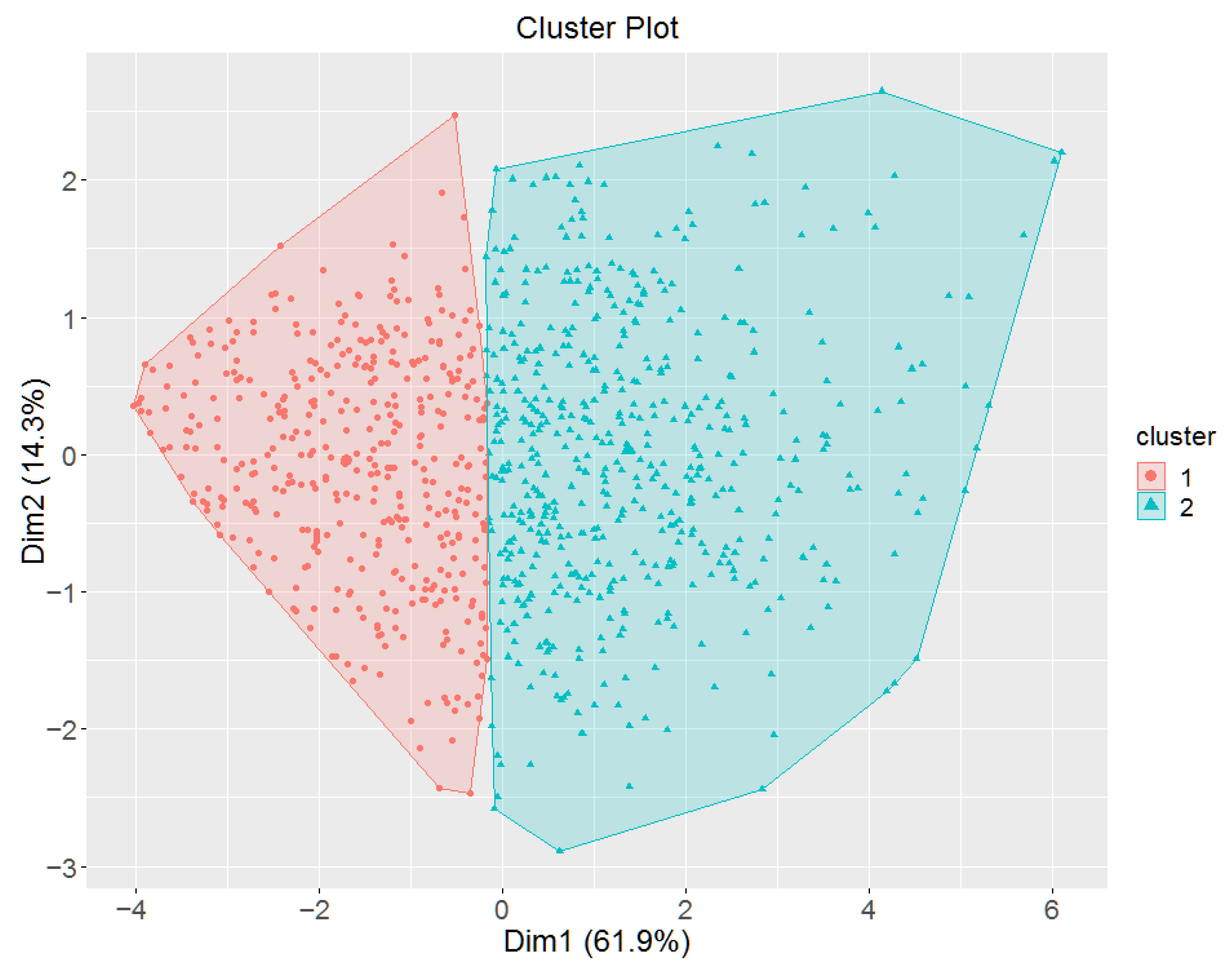
The visualization of the two-cluster structure obtained from the k-means clustering is presented in
Figure 2 (Cluster Plot). The figure clearly separates the two groups along the main factor dimensions, confirming that the data naturally form two distinct segments. Cluster I occupies the area corresponding to higher scores on all attitudinal dimensions, whereas Cluster II is concentrated in the opposite region, characterized by lower or more neutral evaluations. This graphical evidence supported the decision to adopt a two-cluster solution for subsequent analysis.
Descriptive statistics for the two clusters are provided in
Table 6. Cluster I includes 539 participants (55.34% of the sample), while Cluster II contains 435 respondents (44.66%). The mean and median values confirm that Cluster I systematically achieves higher scores across all six factors—Environmental Concern (EC), Knowledge about Renewable Energy (KRE), Social and Economic Support (SES), Ease of Use and Renewable Experience (EURE), Perceived Benefits and Attitudes (PBA), and Behavioral Intention toward Clean Use (BICU). In contrast, Cluster II shows substantially lower mean values, indicating limited engagement and weaker support for renewable energy initiatives.
The standard deviations suggest moderate variability within clusters, implying a relatively homogeneous structure in each segment. The distributions for most variables are slightly left-skewed, reflecting the predominance of higher response values, particularly within Cluster I. The kurtosis coefficients remain close to zero, indicating that the distributions are approximately normal.
Overall, the k-means classification confirmed the presence of two well-defined groups of respondents:
Cluster I (Pro-renewable segment): individuals expressing consistently favorable attitudes, higher awareness, and greater support for renewable energy solutions.
Cluster II (Less-engaged segment): respondents with more neutral or skeptical views and lower levels of knowledge and perceived benefits.
The comparison of sociodemographic distributions between the two identified clusters is presented in
Table 7. Percentages within each cluster were calculated so that the total equals 100%, allowing for a direct comparison of internal group structures.
The analysis shows that, for most of the examined characteristics—including generation, gender, education level, and place of residence—the proportions of respondents are very similar across both clusters. For instance, women account for approximately half of the respondents in both clusters (52.9% and 50.3%, respectively). Likewise, educational profiles are nearly identical: respondents with secondary education represent about 39% in Cluster I and 35% in Cluster II, while those with higher education constitute around 27% in both clusters.
The lack of clear differentiation in the sociodemographic structure is supported by the chi-square test results, which did not reveal statistically significant differences between clusters for any of the analyzed variables. Only income showed a slight deviation, with lower-income respondents appearing somewhat more frequently in Cluster I; however, the difference was close to but did not reach statistical significance. The proximity to the threshold of statistical significance suggests that income may have potential relevance for differentiating attitudes toward renewable energy sources. This suggests the need for further exploration in subsequent research.
In summary, the distributions for all analyzed demographic characteristics are closely aligned between the clusters, indicating that the two groups are broadly similar in their sociodemographic composition.
5. Discussion
The primary aim of this study was to conduct an in-depth analysis of the diversity of attitudes toward RES among Polish citizens in the context of the ongoing energy transition. The study was designed to address two research questions (RQ1 and RQ2) and one hypothesis (H1).
Regarding RQ1, the exploratory factor analysis (EFA) confirmed that attitudes toward RES are multidimensional. Based on 37 indicators adapted from Gârdan et al. [
32], six dimensions were identified, encompassing the cognitive, emotional, and behavioral components of attitudes toward renewable energy. These include environmental concern, knowledge and awareness of RES, social and economic support, perceived ease of use and renewable experience, perceived benefits and positive attitudes, and behavioral intentions toward clean use. Together, these factors reflect the informational and evaluative aspects of energy perceptions, as well as the readiness to engage in pro-environmental behaviors. This structure is consistent with prior theoretical models that describe social acceptance of renewable energy as a multidimensional construct encompassing various factors, including awareness, perceived benefits, and behavioral engagement [
35,
36]. Djurisic et al. [
116] also identified a multidimensional approach. They used Structural Equation Modeling to explore attitudes, perceptions, and behaviors toward Montenegro’s RES. These dimensions provided a framework for analyzing causal relationships in a study of 1012 respondents conducted in 2019–2020.
Addressing RQ2, the subsequent cluster analysis revealed the existence of two distinct and clearly defined groups of respondents, despite the identified factors representing different thematic areas. This finding reveals a significant polarization of attitudes toward RES within Polish society. Rather than forming a gradual continuum of opinions ranging from supportive to skeptical, the data reveal a bifurcated structure: one group is highly engaged and supportive of renewable energy, while another is more skeptical, passive, or indifferent toward the energy transition.
The first segment, Cluster I (pro-RES group), exhibited high scores across all six factors, reflecting strong pro-environmental awareness, positive emotions toward renewable technologies, and conviction in their social and economic benefits. Members of this group also demonstrate a readiness to support policies that advance renewable energy and sustainability. In contrast, Cluster II (the less-involved group) displayed lower scores across all factors, indicating weaker trust in institutions, lower awareness of the benefits of RES, and a limited willingness to engage in pro-environmental activities. This pattern mirrors similar segmentation results reported in prior research on renewable energy acceptance [
35].
Within the broader Central and Eastern European (CEE) context, the identified segmentation patterns in Poland are consistent with findings reported for other Visegrad Four (V4) countries. Studies conducted in Hungary, the Czech Republic, Slovakia, and Romania suggest that attitudes toward renewable energy are more strongly influenced by cognitive and psychosocial factors than by structural socio-demographic differences. For example, Szeberényi et al. [
117] show that among young citizens across the CEE region, pro-environmental intentions are primarily driven by individual attitudes and subjective norms, while demographic predictors play a marginal role. Similarly, Maruszewska et al. [
118] find that although young CEE residents express support for climate and energy transition policies, their readiness to accept higher financial contributions—such as energy-related taxes—remains moderate, reflecting similar cost–risk perceptions across the region. Research from Hungary and the Czech Republic further demonstrates that public support for renewable energy coexists with a persistent preference for traditional or nuclear-based energy solutions, highlighting a shared regional ambivalence rooted in historical energy structures and a lack of trust in institutions. These parallels suggest that the Polish pattern of attitudinal polarization is not unique but reflects broader CEE-specific dynamics that differentiate the region from Western European contexts.
Importantly, however, our analysis reveals that these differences between clusters cannot be attributed to demographic variables, thereby leading to the rejection of Hypothesis H1. This is a critical finding: polarization in Poland does not align with socio-demographic lines, which highlights the need to incorporate psychographic profiling in future research. Rather than attributing causality to unmeasured factors, our results highlight an empirical gap. Future studies should examine how values, institutional trust, and ideological orientations contribute to the disengagement observed in Cluster II, thereby extending the explanatory framework beyond demographics.
To address H1, the study examined whether the two clusters differed significantly in terms of socio-demographic variables, including age, gender, education, income, and place of residence. Statistical tests (chi-square and non-parametric comparisons) showed no significant differences in the distribution of these variables between clusters. This result provides empirical evidence that socio-structural, demographic, or socioeconomic characteristics cannot explain the polarization of attitudes toward renewable energy in Poland. Instead, it likely stems from cognitive and ideological differences, including environmental awareness, perceptions of energy policy fairness, and broader worldview orientations.
Other studies on attitudes toward RES also indicate that demographic factors significantly differentiate individuals’ opinions and behavioral intentions. Nassar [
23] demonstrated that attitudes toward renewable energy in Qatar are shaped by sociodemographic factors, revealing the complexity of public opinion, which depends on the social structure of respondents. Almrafee and Akaileh [
20] confirmed the existence of statistically significant differences in renewable energy purchase intentions based on age, income, and education level, demonstrating that demographic variables are an important predictor of attitudes toward RES. Comparatively, Rana et al. [
19], analyzing data from several South Asian countries, also found variation in RES adoption intentions depending on the sociodemographic context of the surveyed households. Similar observations were presented by Asli et al. [
24], who noted that demographic data (gender, age, city, education, marital status, and economic status) do not play a moderating role in the relationships between knowledge, attitudes, and behaviors toward RES. This result demonstrates the complex interplay of sociocultural, cognitive, and behavioral factors. The renewable energy sphere appears to transcend traditional demographic boundaries—its universal nature means that differences in age, gender, or social status do not significantly impact knowledge or attitudes toward renewable energy. This may indicate a society in which the discourse on renewable energy reaches a broad audience, regardless of their demographic characteristics. Demographic factors were also considered by Oh et al. [
119], who indicated that they shape public attitudes toward supporting energy transition policies toward RES in different ways. A positive attitude supporting RES (regarding nuclear energy) is more often expressed by women than men, as well as by individuals in their 30 s and 40 s, and by those with higher levels of education and belonging to higher social classes. In contrast, household income alone does not significantly differentiate support for this policy. These results support hypothesis H1, which states that attitudes toward RES vary significantly based on demographic characteristics such as gender, age, education, income, and residence. However, in the Polish dataset analyzed here, Hypothesis H1 was not confirmed: no significant differences were observed across gender, age, education, income, or place of residence. This divergence suggests that, unlike in Qatar or South Asia, where demographics play a role, polarization in Poland is shaped more by cognitive and ideological orientations.
Our analysis shows that demographic variables do not account for the segmentation of attitudes toward RES in Poland. This contrasts with prior studies that found demographic predictors of renewable energy acceptance [
23,
24,
84]. One explanation may be that the current energy crisis and climate concerns have created a more universal awareness across groups [
12,
44]. Another possibility is methodological differences in sampling or national context [
32]. In contrast, Cluster I respondents display strong environmental concern and readiness, while Cluster II remains less engaged, with weaker trust and limited willingness to adopt RES. This mirrors segmentation patterns reported elsewhere [
35], but in Poland emerges independently of socio-demographics, underscoring the need for future psychographic profiling [
36,
71].
In the Polish context, these findings may also be interpreted through the lens of ideological and political polarization. In recent years, energy and climate policy issues have become integral to public discourse on national sovereignty, economic security, and relations with the European Union [
2,
102]. Consequently, attitudes toward RES may increasingly reflect trust in institutions and information sources, rather than objective socio-economic circumstances. Similar dynamics have been observed in other countries, where environmental support aligns with ideological and value-based divisions rather than demographic attributes [
82,
83].
The lack of demographic differentiation in our results is particularly significant in the Polish case, where the energy transition is slower and more contested than in many other EU countries. This suggests that public polarization around RES in Poland is not rooted in socio-demographic divides but in ideological and cognitive factors shaped by the country’s distinctive energy pathway and political discourse.
From a theoretical perspective, these findings contribute to the broader discussion on the social acceptance of renewable energy by illustrating that in countries undergoing slower transitions, such as Poland, attitudes toward RES are complex, value-laden, and strongly intertwined with trust in institutions and political narratives. From a practical standpoint, this pattern represents a significant challenge for policymakers and communicators. Since demographic segmentation does not explain differences in attitudes, interventions cannot be tailored to specific population groups. Instead, promoting RES requires broad-based, ideologically neutral, and transparent communication emphasizing common societal benefits, long-term energy security, and credible institutional engagement.
This interpretation also aligns with the broader European context, in which a successful energy transition depends on technological development, cultivating public trust, and fostering a shared sense of participation. Therefore, future research should investigate how political orientation, institutional trust, and information framing influence public acceptance of renewable energy in Poland. Understanding these mechanisms could help policymakers design strategies that reduce ideological divides and strengthen public support for green transformation.
5.1. Practical Implications: Tailored Interventions for the Two Segments
The segmentation results allow for the development of differentiated policy tools tailored to the needs of the two identified clusters. For the less engaged or skeptical segment, targeted interventions should focus primarily on reducing cognitive barriers and addressing perceived risks. First, communication strategies should prioritize clear, simplified information that explains the functioning of RES technologies—particularly wind and photovoltaic systems—using visual materials, real-world demonstrations, and locally relevant examples. Second, messages should highlight concrete, place-based economic benefits such as lower household energy bills, municipal revenues from RES installations, and local job creation in the operation and maintenance of biomass or solar facilities. Third, policy tools should include low-cost access programs, micro-grants for small RES installations, and community-level support schemes, reducing the upfront financial burden that often reinforces skepticism. These measures can help bridge the knowledge gap and gradually build trust among less engaged households.
For the pro-green and engaged cluster, whose members already exhibit strong behavioral intentions and positive attitudes toward RES, interventions should emphasize mechanisms that amplify their impact on social norms. Policymakers should support community-led energy projects, such as energy cooperatives or local prosumer groups, that enable highly engaged citizens to become catalysts of change within their communities. Communication campaigns may also highlight visible collective actions—e.g., neighborhood solar initiatives, community heat pumps, or citizen panels on local energy planning—to strengthen descriptive and injunctive norms around renewable energy. Furthermore, this segment may be encouraged to participate in consultation processes, pilot programs, and educational activities to increase the visibility of pro-environmental behavior and thus facilitate wider social diffusion.
To illustrate how the above strategies can be implemented, it is worth referencing existing precedents. German energy cooperatives (e.g., BürgerEnergie) demonstrate how citizen ownership and governance increase local acceptance [
120]. National prosumer grant programs such as Poland’s
Mój Prąd show how micro-grants boost household PV uptake [
121]. Czech grant schemes and developing legal frameworks for energy communities provide additional models for micro-granting and community pilots [
122].
5.2. Alignment with EU and National Policy Frameworks
These recommendations are directly aligned with the strategic direction of both the European Green Deal and Poland’s Energy Policy until 2040 (PEP2040). The observed attitudinal polarization poses challenges to achieving key national targets, particularly those relating to the expansion of wind and solar capacity, the accelerated development of distributed energy, and the continued use of sustainable biomass. For example, skepticism within the less engaged segment may undermine local acceptance of onshore wind installations or large-scale photovoltaic farms, slowing progress toward the RES share envisaged in PEP2040 and the Green Deal’s decarbonization trajectory. Conversely, the strong pro-environmental orientation of the engaged cluster offers an opportunity to accelerate community-driven prosumer development and support the EU objective of empowering consumers in the energy transition.
The segmentation approach, therefore, provides policymakers with actionable insights: Poland’s RES targets cannot rely on one-size-fits-all communication. Instead, policies should combine trust-building narratives and financial facilitation for the less engaged cluster with empowerment-oriented strategies for the pro-green segment. Such a dual approach can enhance public acceptance, mitigate polarization, and enhance the implementation potential of both national and EU-level energy transition goals.
6. Conclusions
This study provides an empirical insight into the diversity and polarization of attitudes toward RES among Polish citizens, contributing to a broader understanding of public engagement with the ongoing energy transition. Using 37 validated indicators adapted from Gârdan et al. [
32], we identified six key dimensions of RES-related attitudes—cognitive, affective, and behavioral—and revealed, through cluster analysis, two distinct societal segments: one strongly supportive of renewable energy and another characterized by skepticism and low involvement.
The key theoretical conclusion is that attitudinal polarization toward RES in Poland does not result from demographic or socio-structural differences. The absence of statistically significant variations across gender, age, education, income, or place of residence demonstrates that traditional socio-demographic variables are no longer effective predictors of pro-environmental behavior. Instead, the division appears to stem from ideological and cognitive factors, such as trust in institutions, perceptions of fairness in energy policy, and individual values concerning modernization and sustainability.
From a practical perspective, this finding poses a challenge to policymakers and communication strategists. Since no specific demographic profile can be identified as particularly resistant or supportive of renewable energy, actions promoting RES adoption cannot rely on selective targeting. Instead, communication and policy interventions should be inclusive, transparent, and ideologically neutral, emphasizing shared benefits, credibility, and social trust. Promoting renewable energy in Poland thus requires engagement across all social groups, using clear information, education, and consistent policy signals that transcend political divisions.
6.1. Limitations
While the study offers valuable insights, several limitations should be acknowledged. First, the research design employed a cross-sectional approach, capturing attitudes at a single point in time (June 2025). This limits the ability to assess how attitudes evolve in response to changing economic or political circumstances, such as fluctuations in energy prices or regulatory reforms. Second, all measures were self-reported, which introduced the risk of social desirability bias—respondents may have overstated their pro-environmental attitudes. Third, the study focused exclusively on the Polish context, where specific institutional, cultural, and policy factors shape public perceptions of renewable energy. Additionally, data were collected using the CAWI method, which may lead to the underrepresentation of individuals with limited internet access or lower digital skills. No additional weighting was applied for variables such as education or region, which may somewhat limit the generalizability of the results beyond the controlled quotas. Consequently, the findings should be interpreted within this national framework and not directly generalized to other countries. Additionally, while the quantitative approach provides structural insights, it does not capture the qualitative depth of individual reasoning and motivations behind energy-related attitudes. Finally, although the use of self-reported survey data may introduce social desirability bias, future studies could employ methods to mitigate this limitation. Examples include indirect questioning or randomized response techniques, which increase respondents’ perceived anonymity. Researchers may also use more neutral item wording and incorporate short social-desirability control scales to statistically adjust for this bias. Finally, complementing declarative data with simple behavioral indicators (e.g., actual use of RES solutions) could further reduce reliance on self-reported attitudes.
6.2. Future Research Directions
Future studies should seek to overcome these limitations in several ways. First, conducting longitudinal studies would enable the tracking of changes in public attitudes over time and understanding how major events—such as energy crises, new incentives, or geopolitical shifts—influence perceptions of renewable energy. Second, cross-national comparative research could examine whether the polarization observed in Poland is also present in other Central and Eastern European countries with similar institutional legacies or energy dependencies. Third, future research should incorporate psychological and ideological variables, including political orientation, trust in institutions, media exposure, and perceived risk, to better capture the deeper drivers of public acceptance. Mixed-method approaches combining quantitative segmentation with qualitative interviews or focus groups could further enrich understanding of how individuals interpret and internalize renewable energy policies. Furthermore, self-reported data may overstate pro-environmental attitudes. To reduce the potential overestimation of respondents’ pro-environmental attitudes, future studies should consider applying statistical adjustments to account for the influence of social desirability.
Finally, extending this line of research to include behavioral indicators, such as actual energy consumption patterns or participation in renewable programs, would strengthen the connection between declared attitudes and observable actions. Exploring these dimensions could help design more effective strategies to reduce polarization, enhance public trust, and support a socially inclusive path toward Poland’s green transition.




 ,
,