Figure 1.
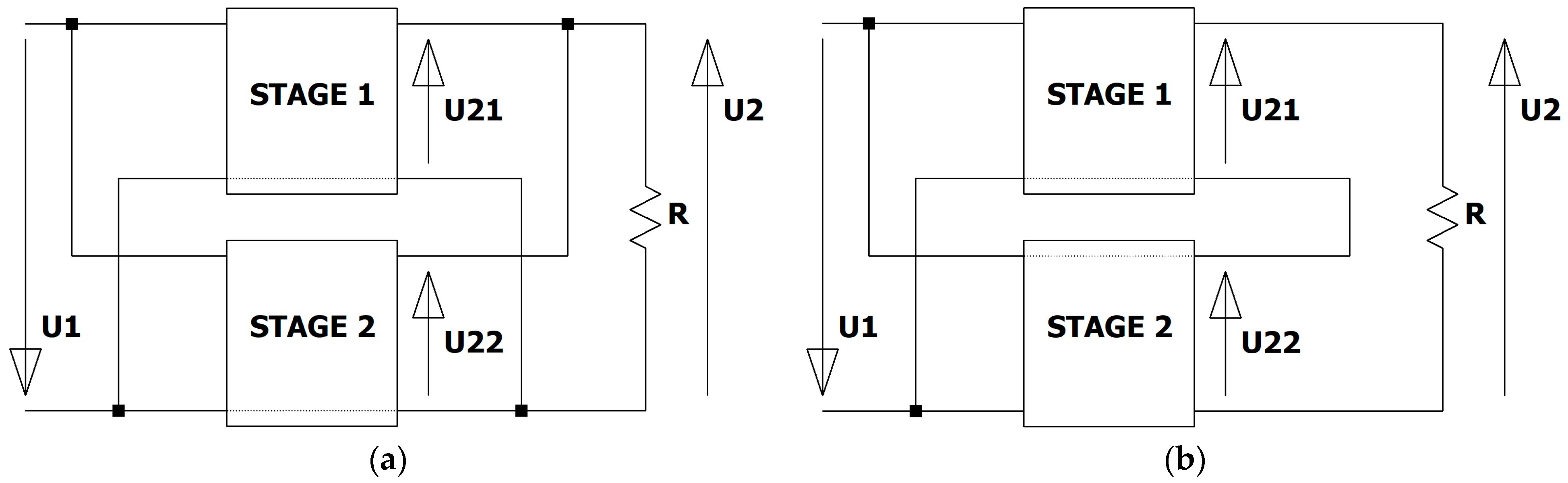
Possibilities to combine two DC/DC converters connected in parallel at the input sides: (a) interleaved; (b) floating with serial outputs and input voltage included.
Figure 1.
Possibilities to combine two DC/DC converters connected in parallel at the input sides: (a) interleaved; (b) floating with serial outputs and input voltage included.
Figure 2.
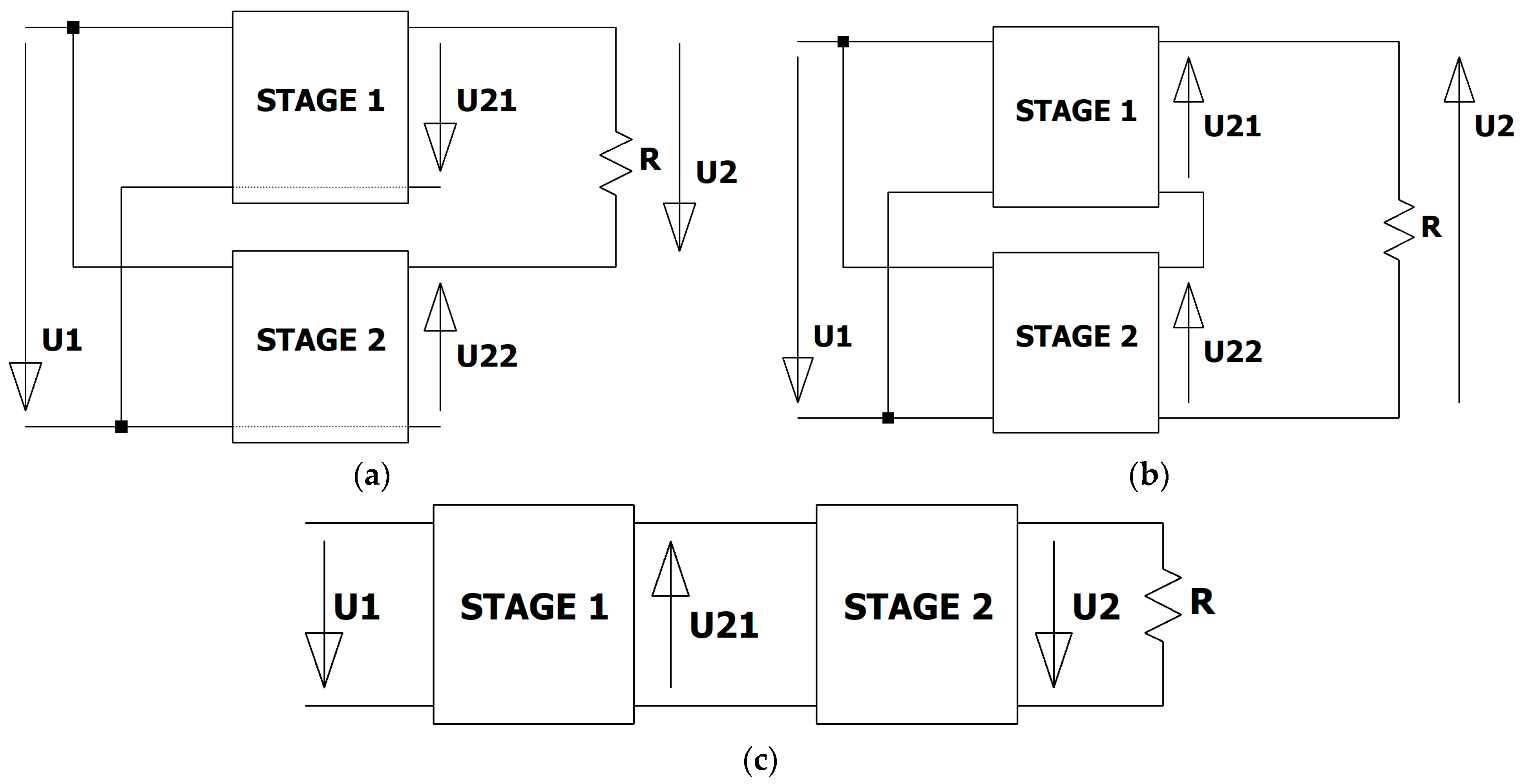
Possibilities to combine two DC/DC converters connected in parallel at the input sides: (a) floating with series output; (b) combination with serial output; (c) cascaded inverting converters.
Figure 2.
Possibilities to combine two DC/DC converters connected in parallel at the input sides: (a) floating with series output; (b) combination with serial output; (c) cascaded inverting converters.
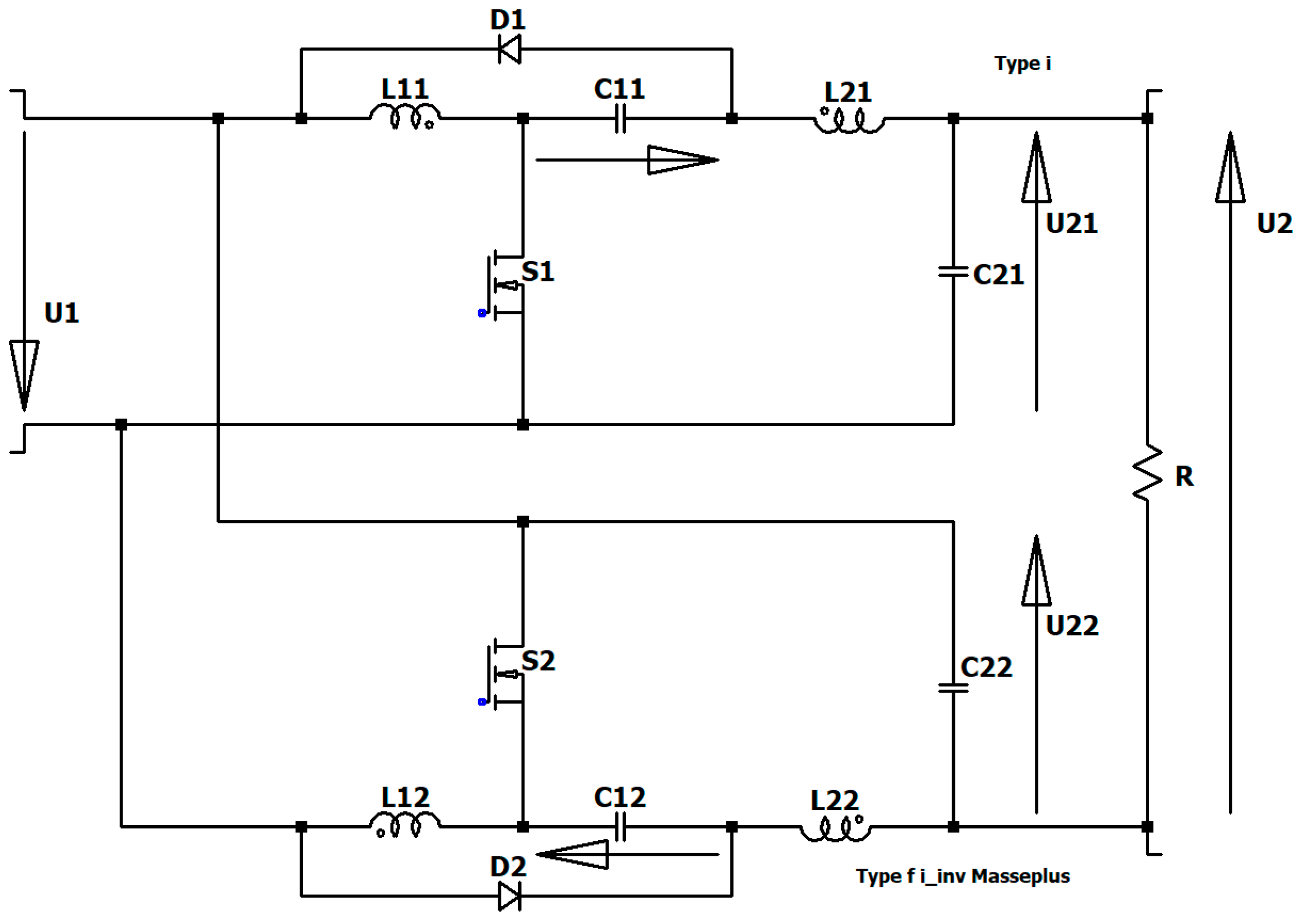
Figure 3.
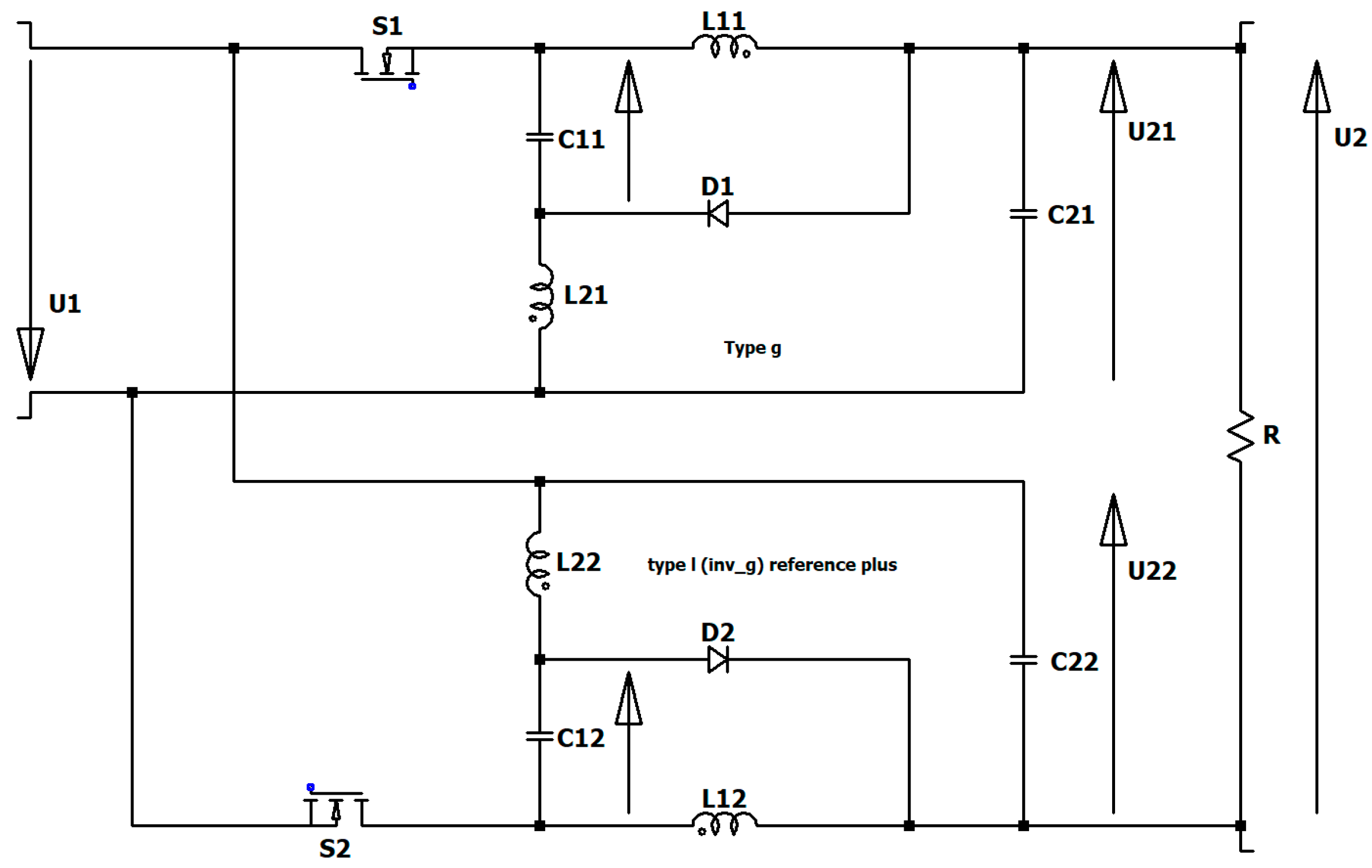
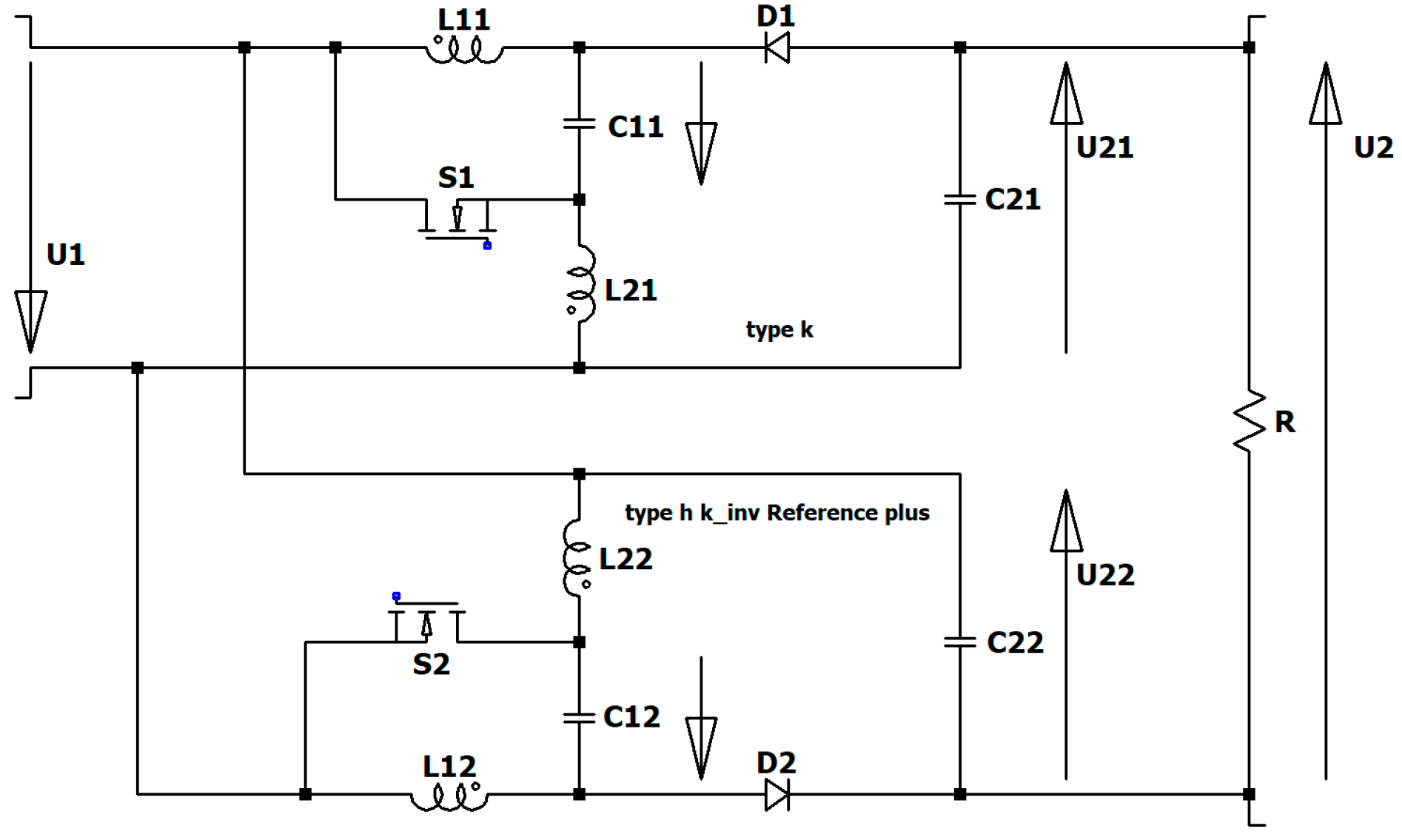
Circuit diagram of the floating two-stage inverting Boost converter type I.
Figure 3.
Circuit diagram of the floating two-stage inverting Boost converter type I.
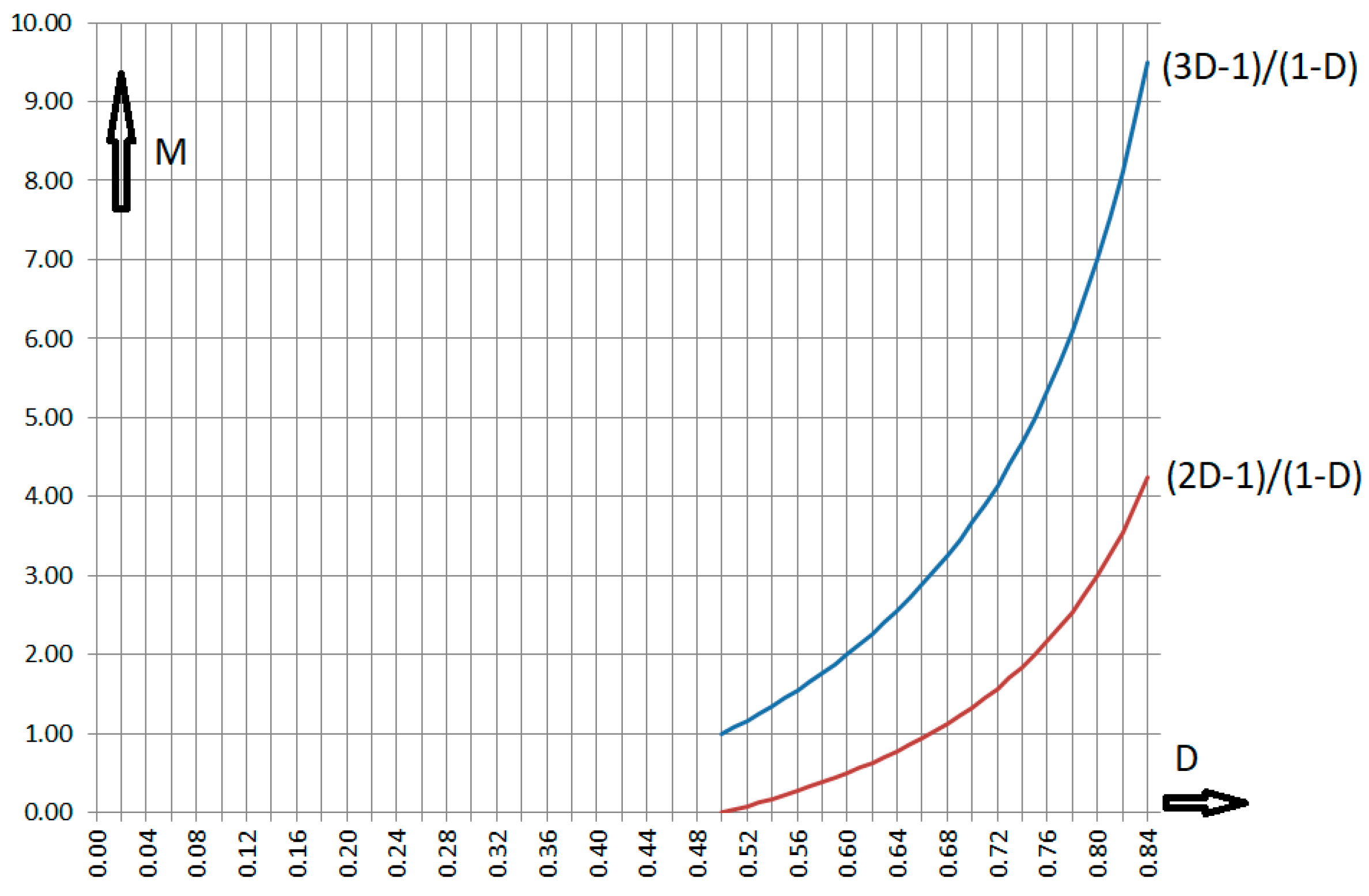
Figure 4.
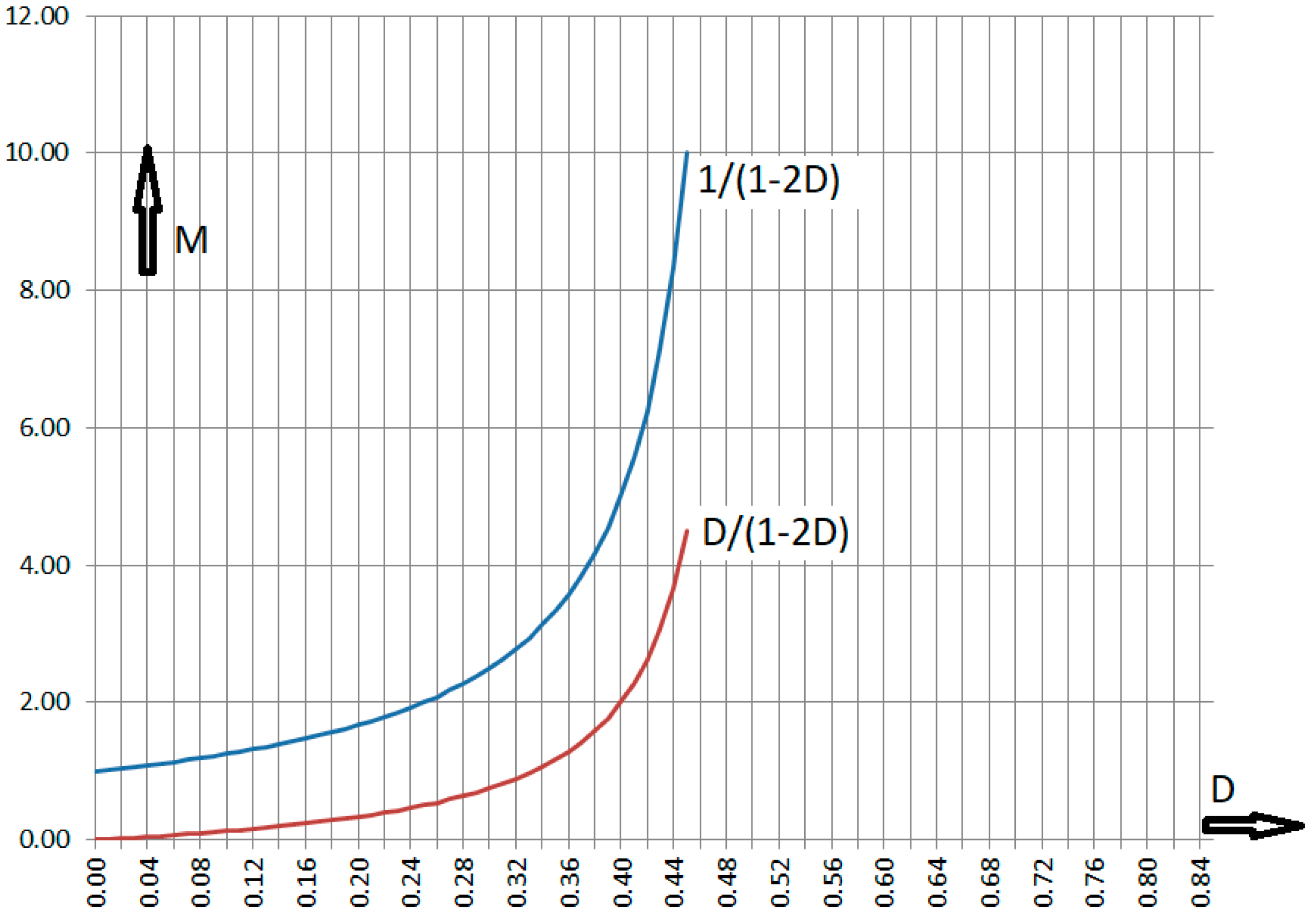
Voltage transformation ratio M in dependence on the duty cycle D: lower line—M of one stage; higher line—M of the complete converter.
Figure 4.
Voltage transformation ratio M in dependence on the duty cycle D: lower line—M of one stage; higher line—M of the complete converter.
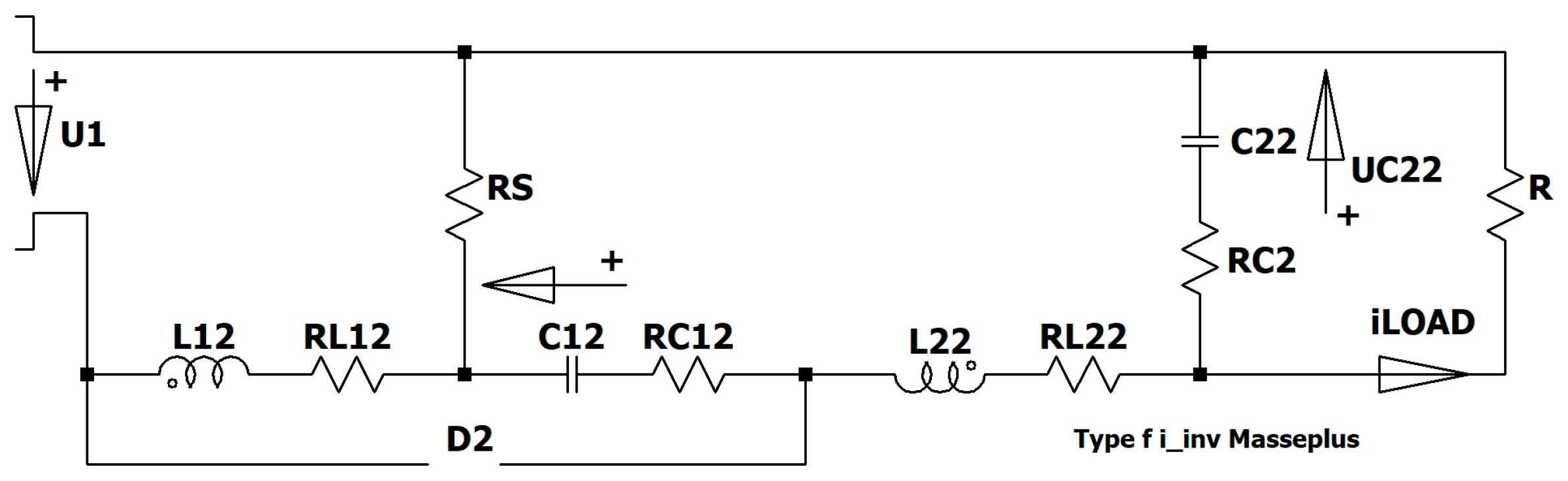
Figure 5.
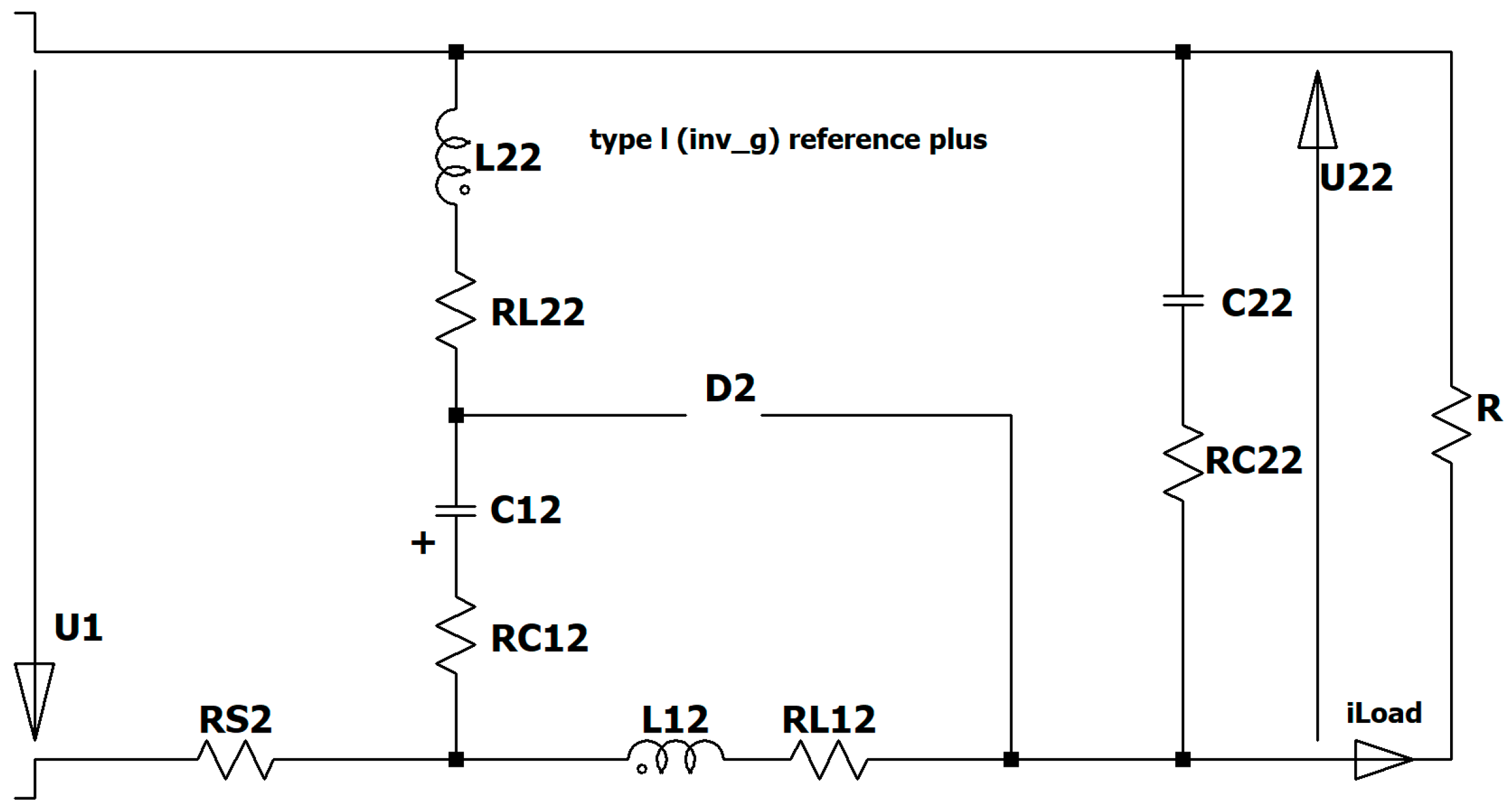
Type I: model with equivalent resistor, mode M1.
Figure 5.
Type I: model with equivalent resistor, mode M1.
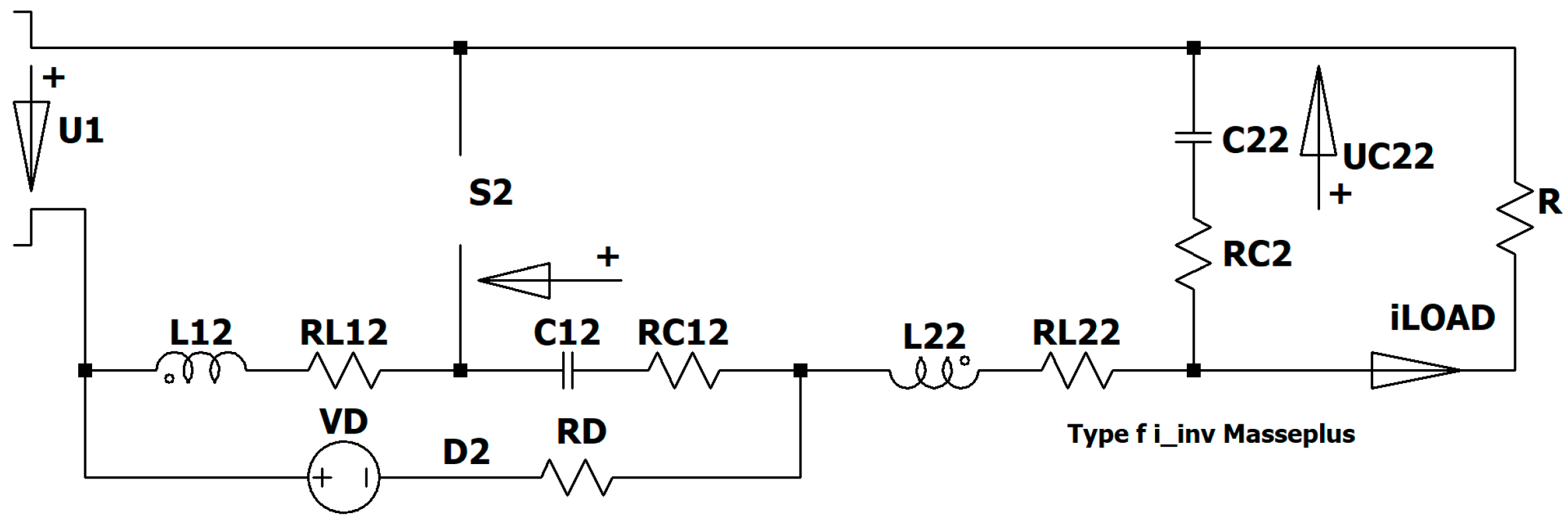
Figure 6.
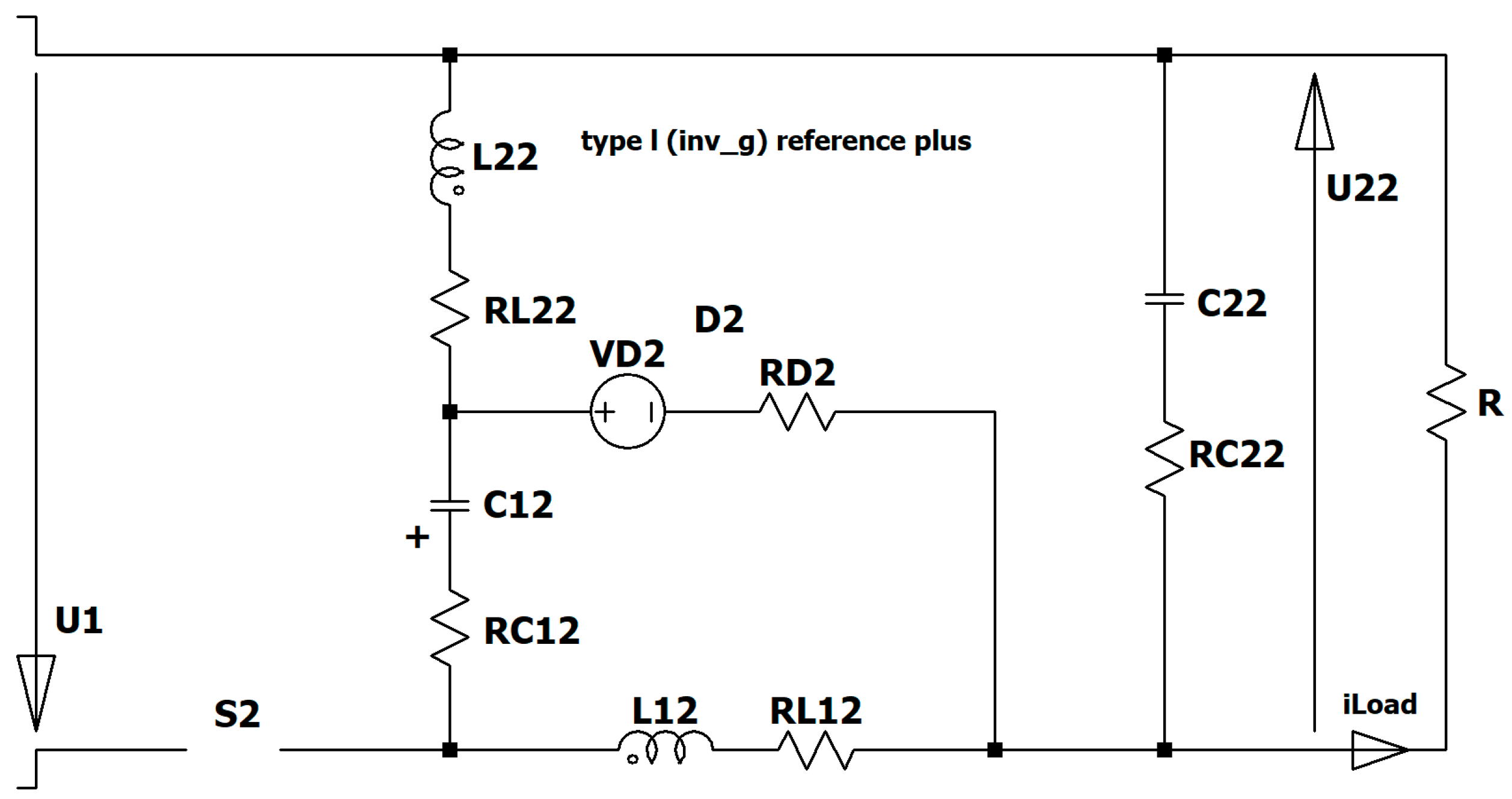
Type I: model with equivalent resistor, mode M2.
Figure 6.
Type I: model with equivalent resistor, mode M2.
Figure 7.
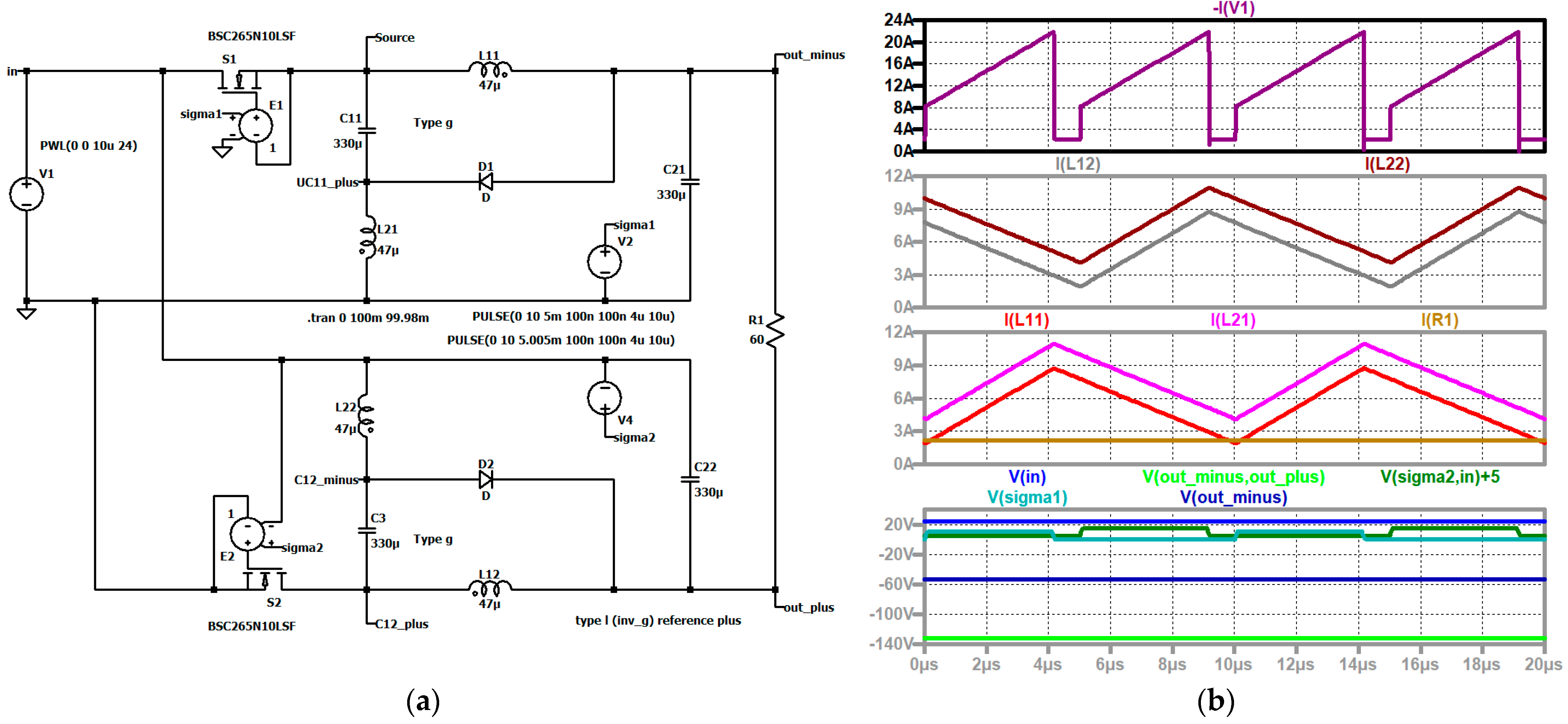
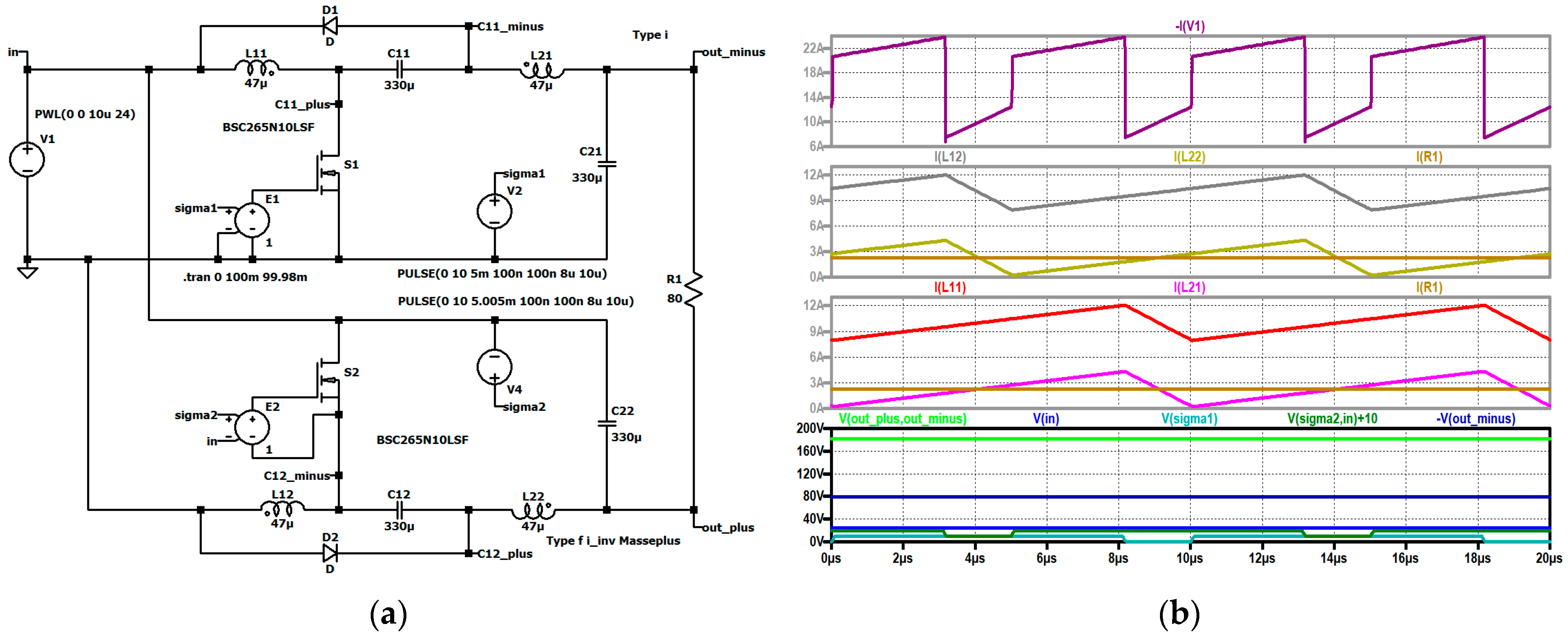
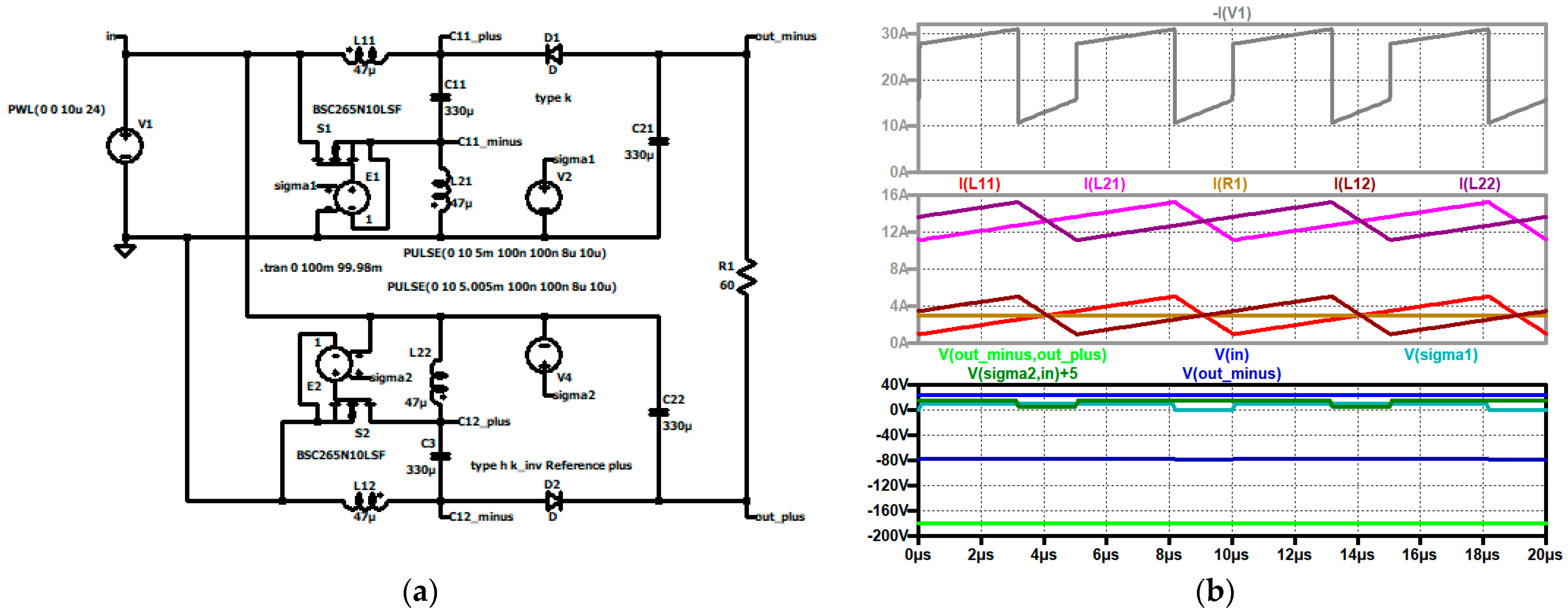
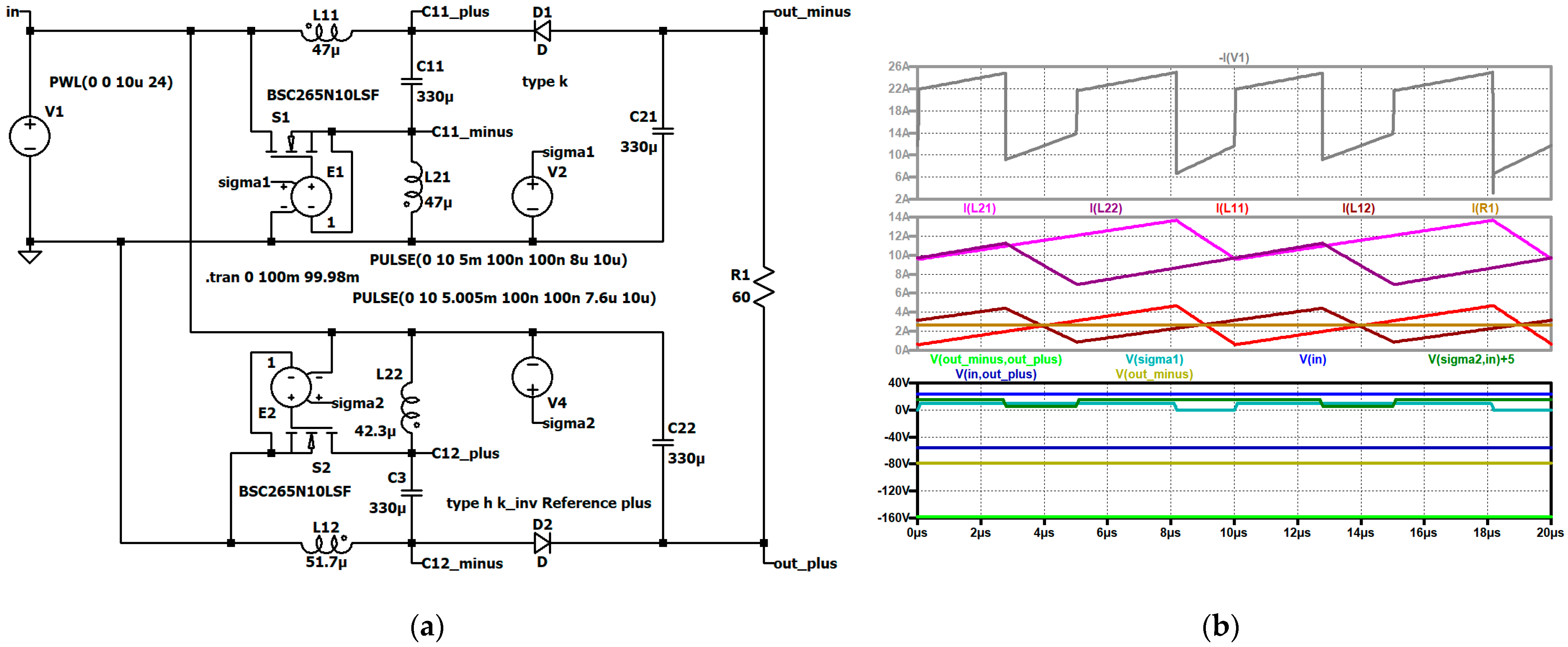
Type I: (a) Simulation circuit. (b) Top to bottom—input current (dark violet); current through second coil of the second stage (black), current through the first coil of the second stage (gray); current through the second coil of the first stage (violet), current through the first coil of the first stage (red); input voltage (blue), control signal of the second stage (dark green, shifted), control signal of the first stage (turquoise), output voltage of the first stage (dark blue), output voltage (green); the black frame is insignificant, it shows only the last active graph.
Figure 7.
Type I: (a) Simulation circuit. (b) Top to bottom—input current (dark violet); current through second coil of the second stage (black), current through the first coil of the second stage (gray); current through the second coil of the first stage (violet), current through the first coil of the first stage (red); input voltage (blue), control signal of the second stage (dark green, shifted), control signal of the first stage (turquoise), output voltage of the first stage (dark blue), output voltage (green); the black frame is insignificant, it shows only the last active graph.
Figure 8.
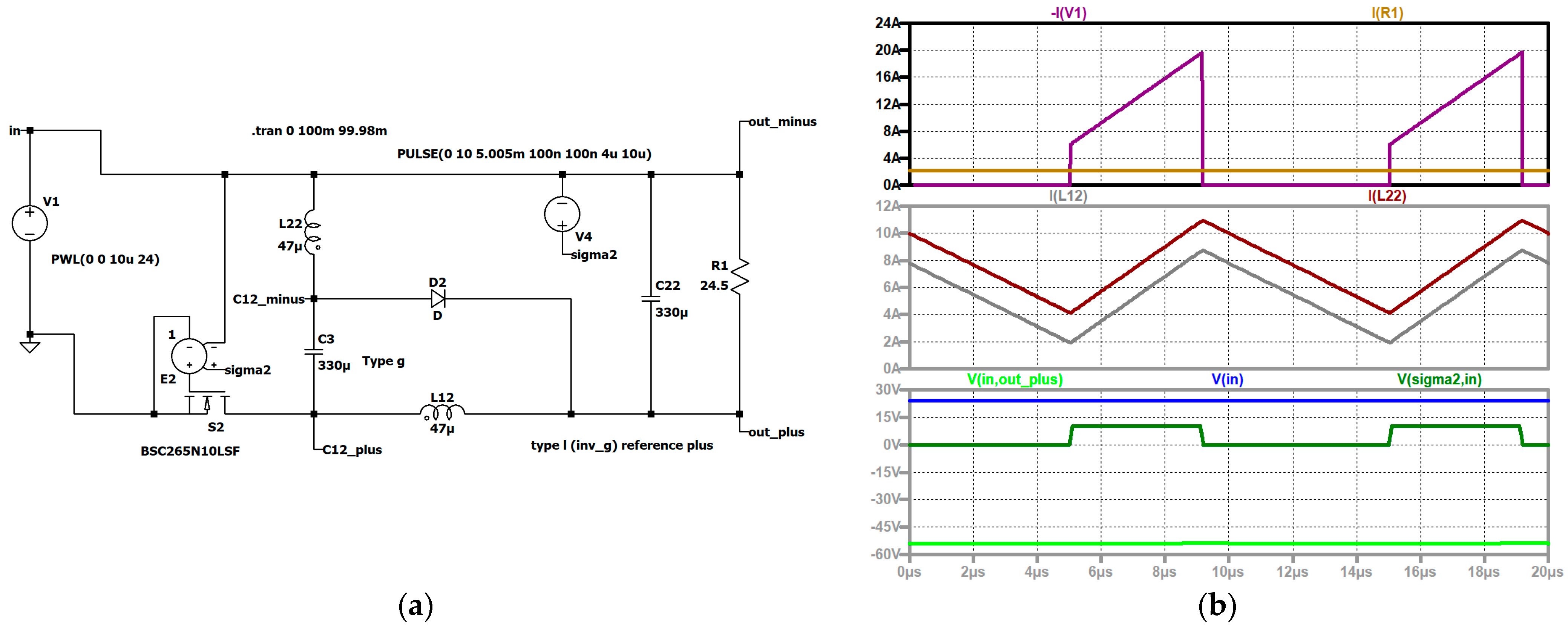
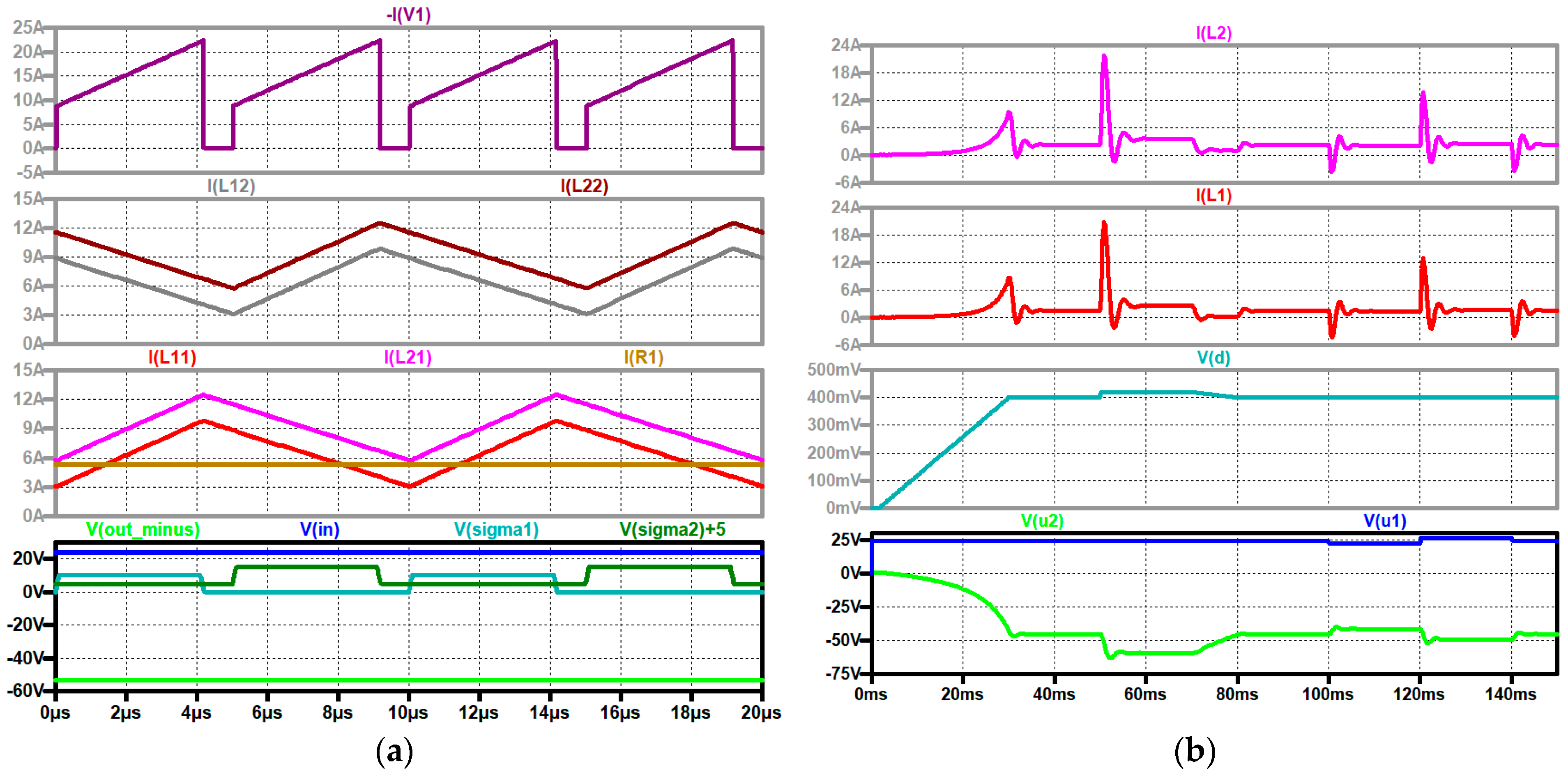
Steady-state simulation with an equivalent resistor: (a) Simulation circuit. (b) Top to bottom—input current (dark violet), load current (brown); current through second coil of the second stage (black), current through the first coil of the second stage (gray); input voltage (blue), control signal of the second stage (dark green), output voltage (green).
Figure 8.
Steady-state simulation with an equivalent resistor: (a) Simulation circuit. (b) Top to bottom—input current (dark violet), load current (brown); current through second coil of the second stage (black), current through the first coil of the second stage (gray); input voltage (blue), control signal of the second stage (dark green), output voltage (green).
Figure 9.
Type I: simulation circuit.
Figure 9.
Type I: simulation circuit.
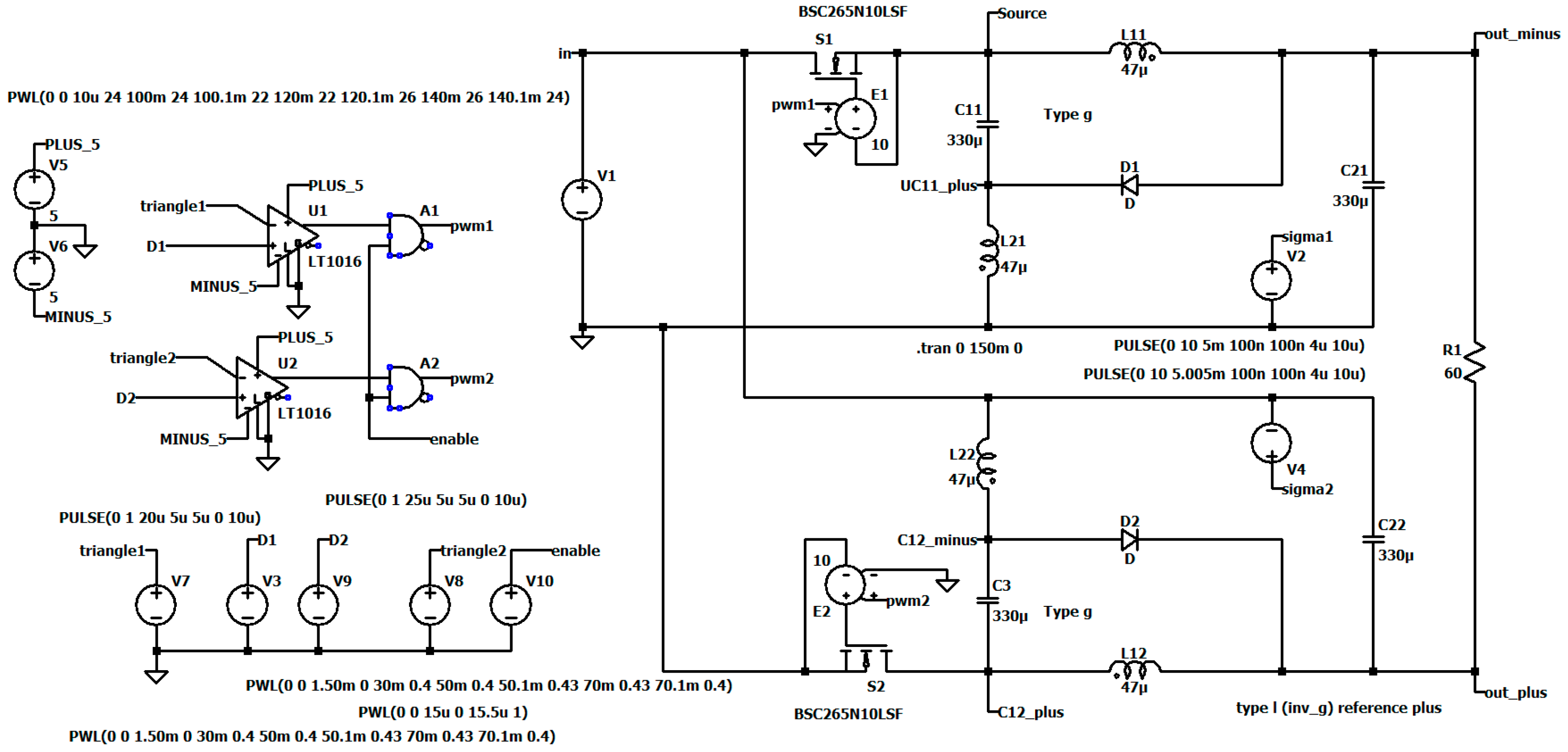
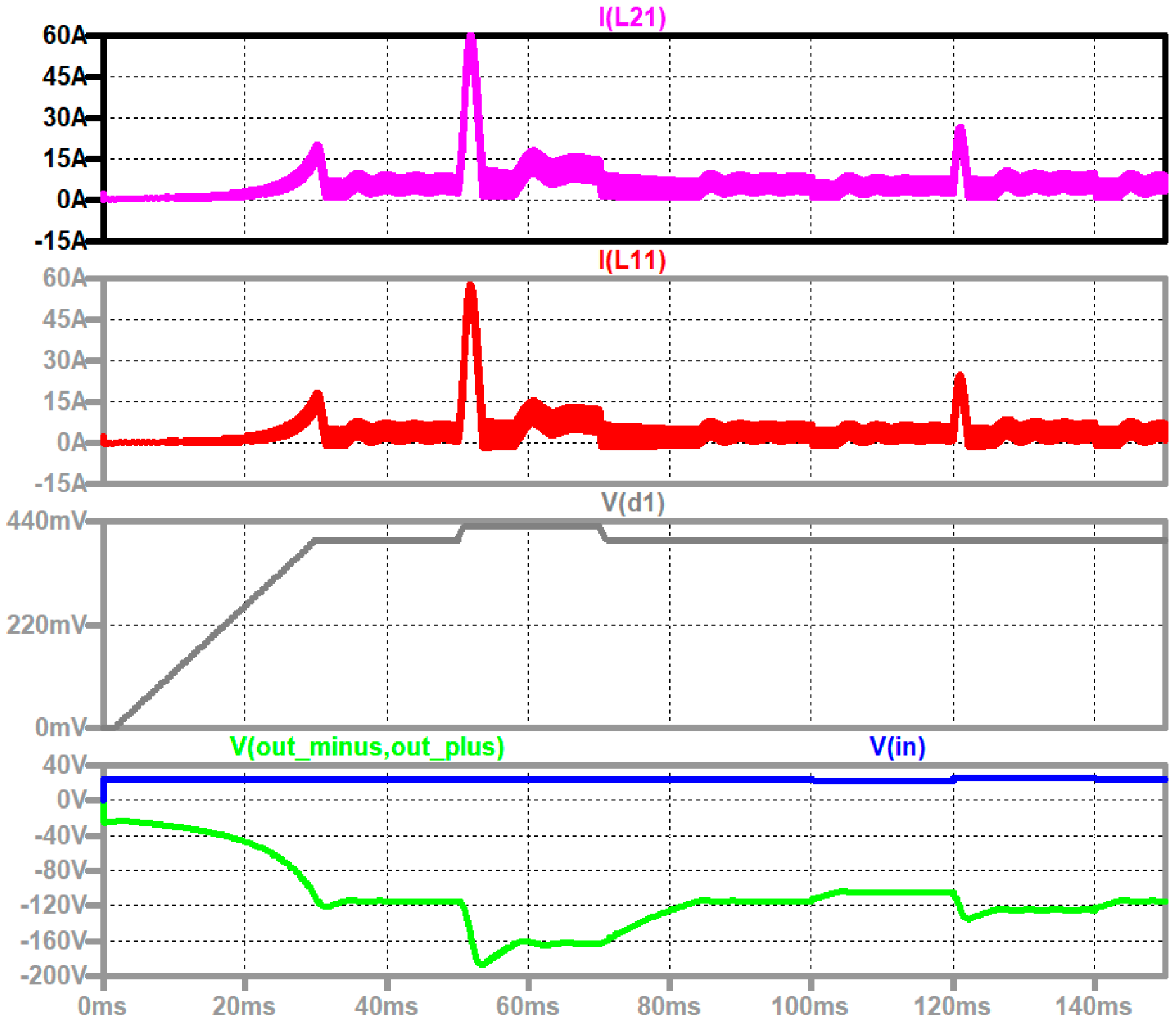
Figure 10.
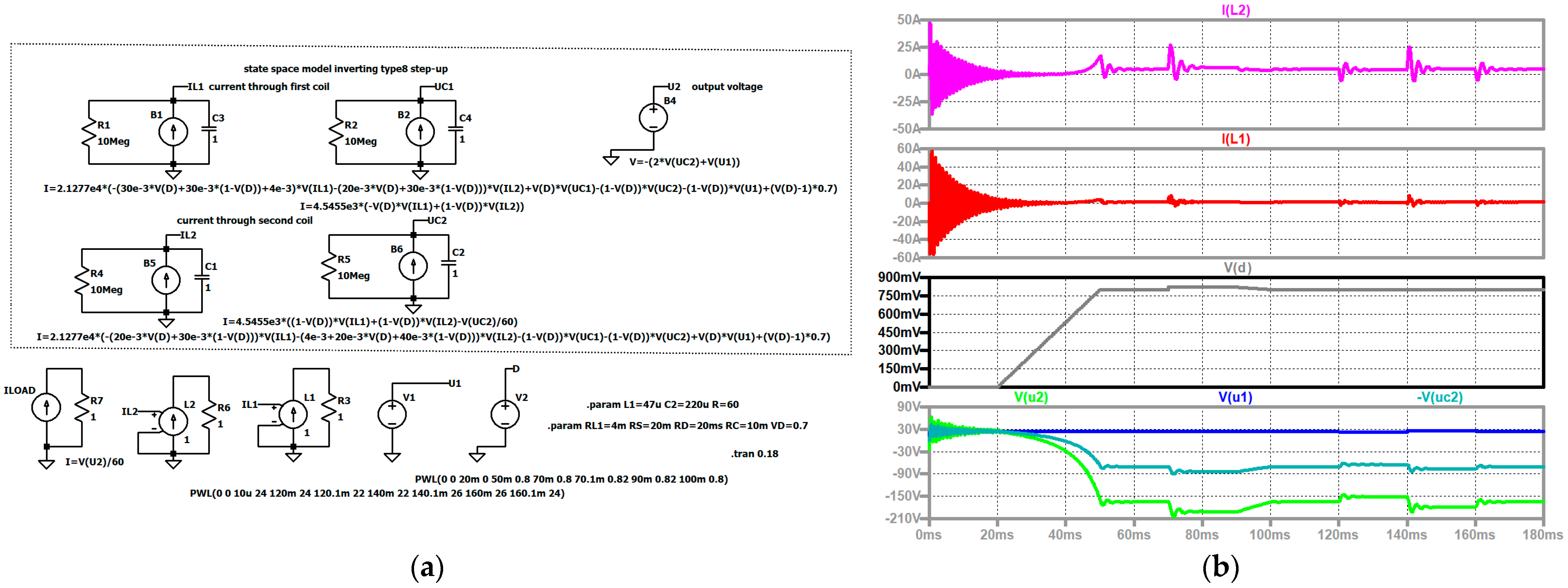
Type I start-up, duty-cycle steps, input-voltage steps. For simulation circuit, see
Figure 9. Top to bottom—current through the second coil of stage one (violet); current through the first coil of stage one (red); duty cycle (gray); input voltage (blue), output voltage (green).
Figure 10.
Type I start-up, duty-cycle steps, input-voltage steps. For simulation circuit, see
Figure 9. Top to bottom—current through the second coil of stage one (violet); current through the first coil of stage one (red); duty cycle (gray); input voltage (blue), output voltage (green).
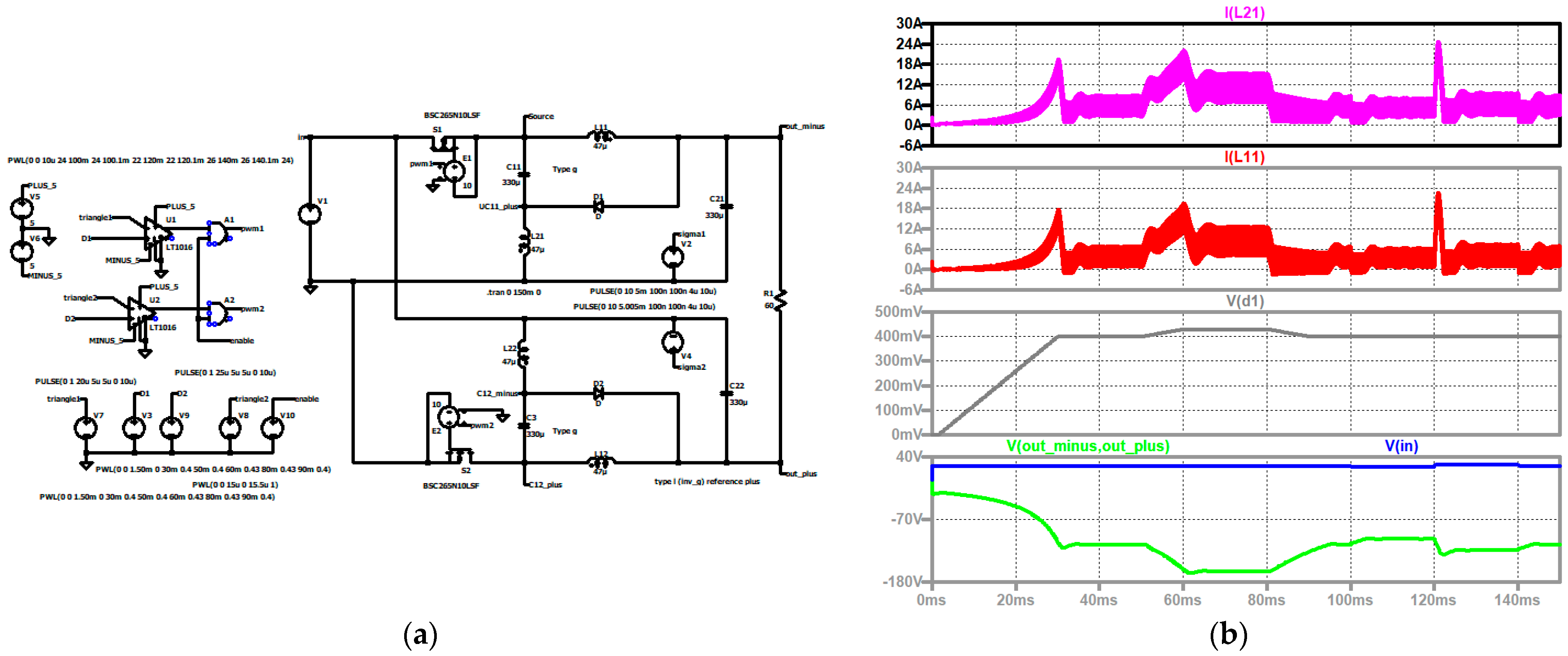
Figure 11.
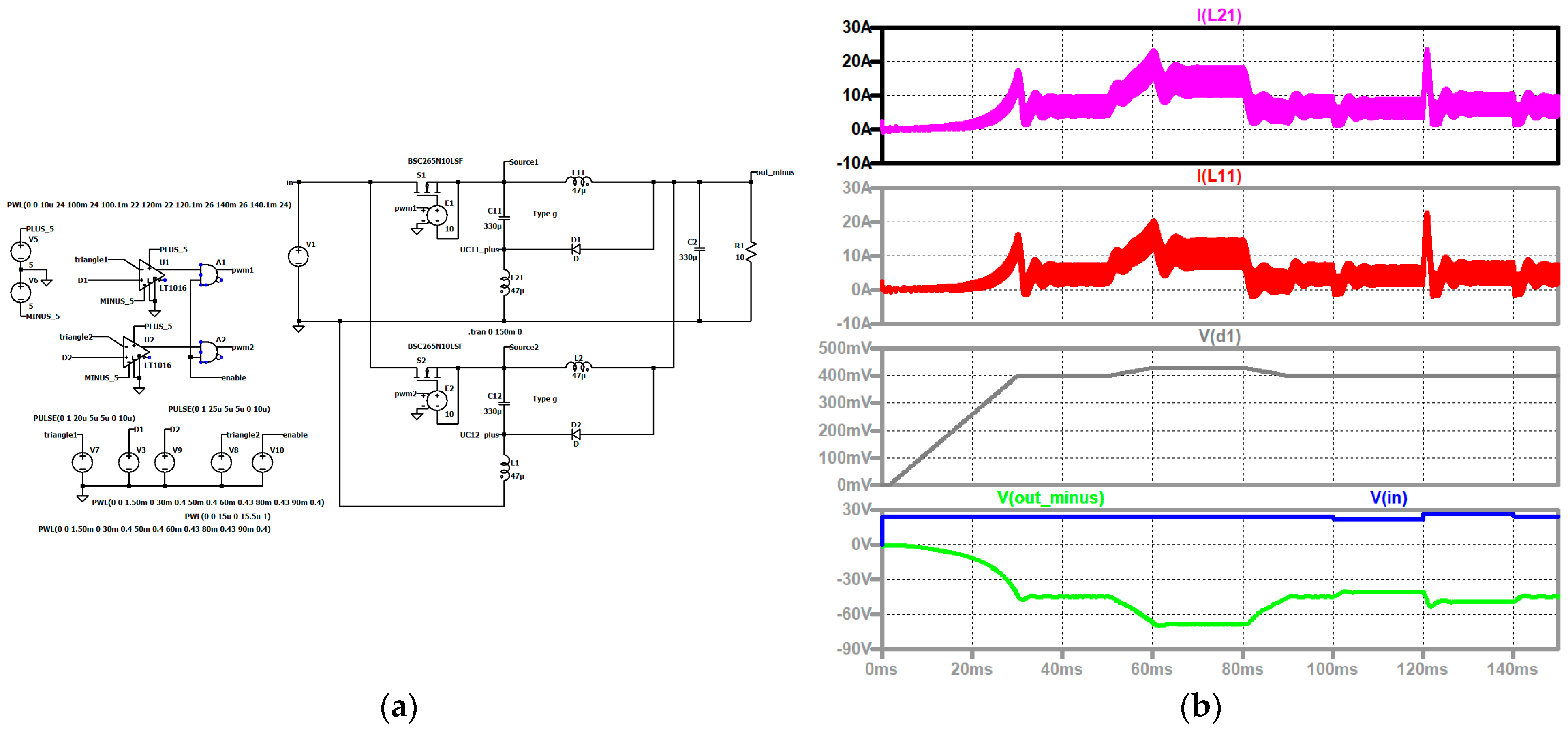
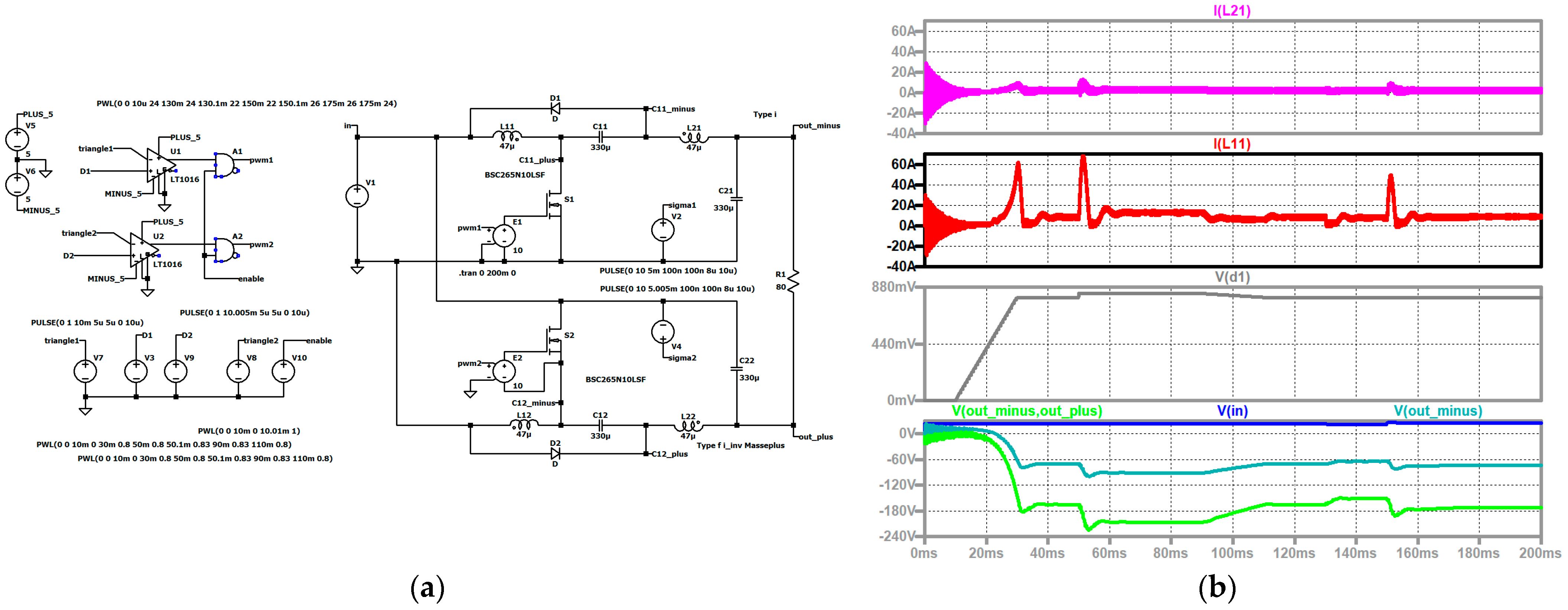
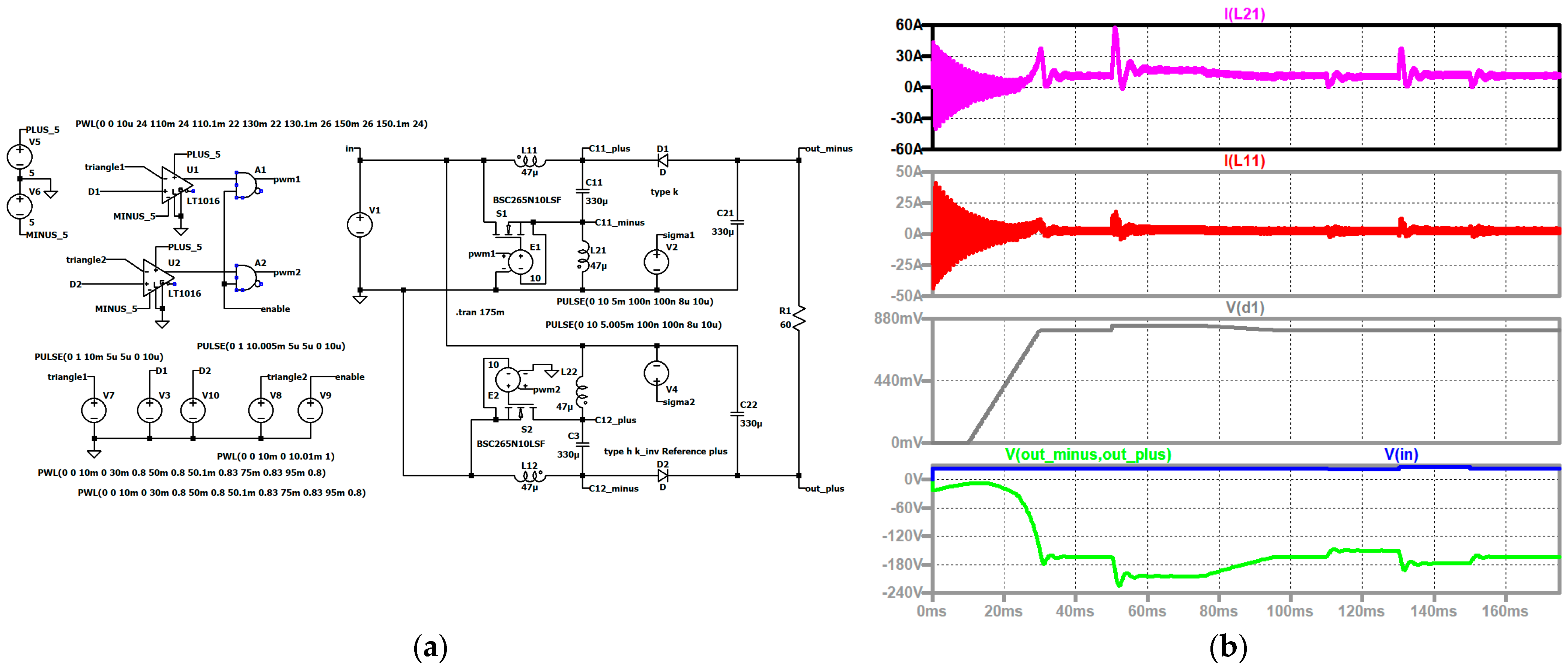
Type I start-up, duty-cycle changes, input-voltage steps: (a) Simulation circuit. (b) Top to bottom—current through the second coil of stage one (violet); current through the first coil of stage one (red); duty cycle (gray); input voltage (blue), output voltage (green).
Figure 11.
Type I start-up, duty-cycle changes, input-voltage steps: (a) Simulation circuit. (b) Top to bottom—current through the second coil of stage one (violet); current through the first coil of stage one (red); duty cycle (gray); input voltage (blue), output voltage (green).
Figure 14.
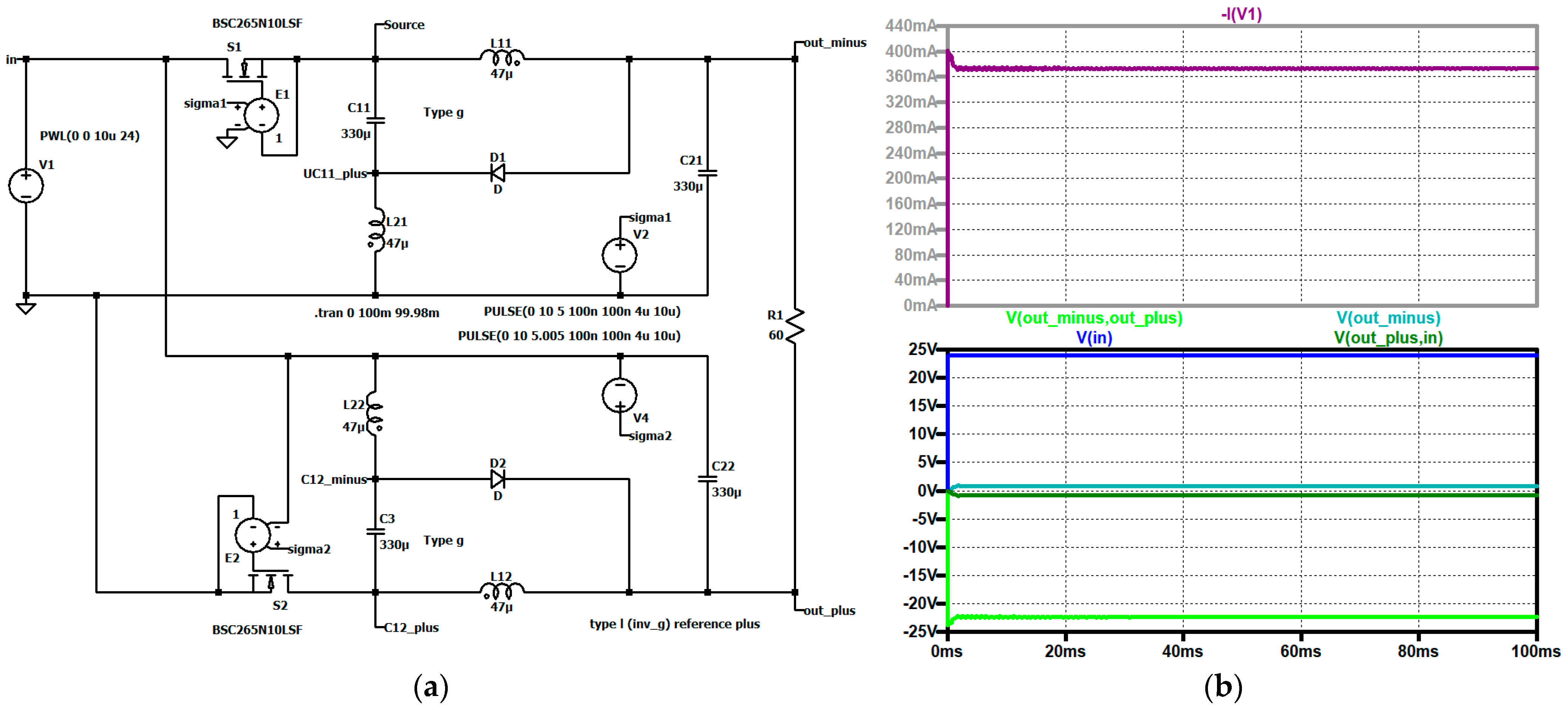
Type I: (a) Simulation circuit. (b) Top to bottom—input current (dark violet); input voltage (blue), voltage across output capacitor of stage 1 (turquoise), voltage across output capacitor of stage 2 (dark green), output voltage (green).
Figure 14.
Type I: (a) Simulation circuit. (b) Top to bottom—input current (dark violet); input voltage (blue), voltage across output capacitor of stage 1 (turquoise), voltage across output capacitor of stage 2 (dark green), output voltage (green).
Figure 15.
Type I interleaved: (a) Simulation circuit. (b) Top to bottom—current through second coil of the first stage (violet); current through first coil of the first stage (red); duty cycle (gray); input voltage (blue), output voltage (green).
Figure 15.
Type I interleaved: (a) Simulation circuit. (b) Top to bottom—current through second coil of the first stage (violet); current through first coil of the first stage (red); duty cycle (gray); input voltage (blue), output voltage (green).
Figure 16.
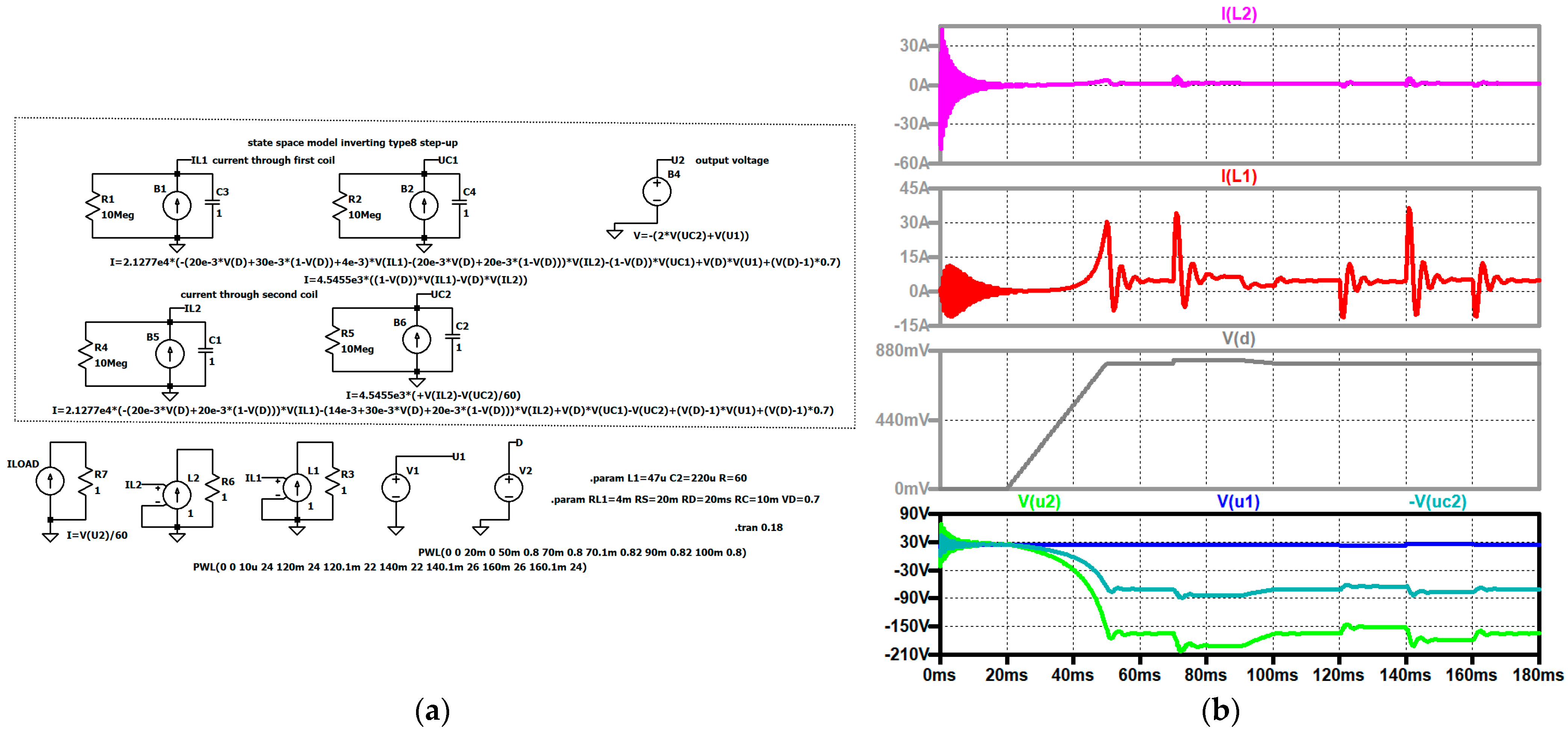
Type I interleaved: (a) Steady-state, circuit-based simulation, top to bottom—input current (dark violet); current through the second coil of the second stage (black), current through the first coil of the second stage (gray); current through second coil of the first stage (violet), current through the first coil of the first stage (red), load current (brown); input voltage (blue), control signal of the switch of the second stage (dark green, shifted), control signal of the switch of the first stage (turquoise), output voltage (green). (b) Model-based simulation, top to bottom—current through the second coil of the first stage (violet); current through the first coil of the first stage (red); duty cycle (turquoise); input voltage (blue), output voltage (green).
Figure 16.
Type I interleaved: (a) Steady-state, circuit-based simulation, top to bottom—input current (dark violet); current through the second coil of the second stage (black), current through the first coil of the second stage (gray); current through second coil of the first stage (violet), current through the first coil of the first stage (red), load current (brown); input voltage (blue), control signal of the switch of the second stage (dark green, shifted), control signal of the switch of the first stage (turquoise), output voltage (green). (b) Model-based simulation, top to bottom—current through the second coil of the first stage (violet); current through the first coil of the first stage (red); duty cycle (turquoise); input voltage (blue), output voltage (green).
Figure 17.
Type II: circuit diagram.
Figure 17.
Type II: circuit diagram.
Figure 18.
Type II duty cycle 1/3: (a) Simulation circuit. (b) Top to bottom—current through the second coil of stage one (violet), current through the second coil of stage two (dark violet), current through the first coil of stage one (red), current through the first coil of stage two (light brown), load current (brown); input voltage (blue), control signal of the second switch (dark green, shifted), control signal of the first switch (turquoise), output voltage of stage one (gray), output voltage (green).
Figure 18.
Type II duty cycle 1/3: (a) Simulation circuit. (b) Top to bottom—current through the second coil of stage one (violet), current through the second coil of stage two (dark violet), current through the first coil of stage one (red), current through the first coil of stage two (light brown), load current (brown); input voltage (blue), control signal of the second switch (dark green, shifted), control signal of the first switch (turquoise), output voltage of stage one (gray), output voltage (green).
Figure 19.
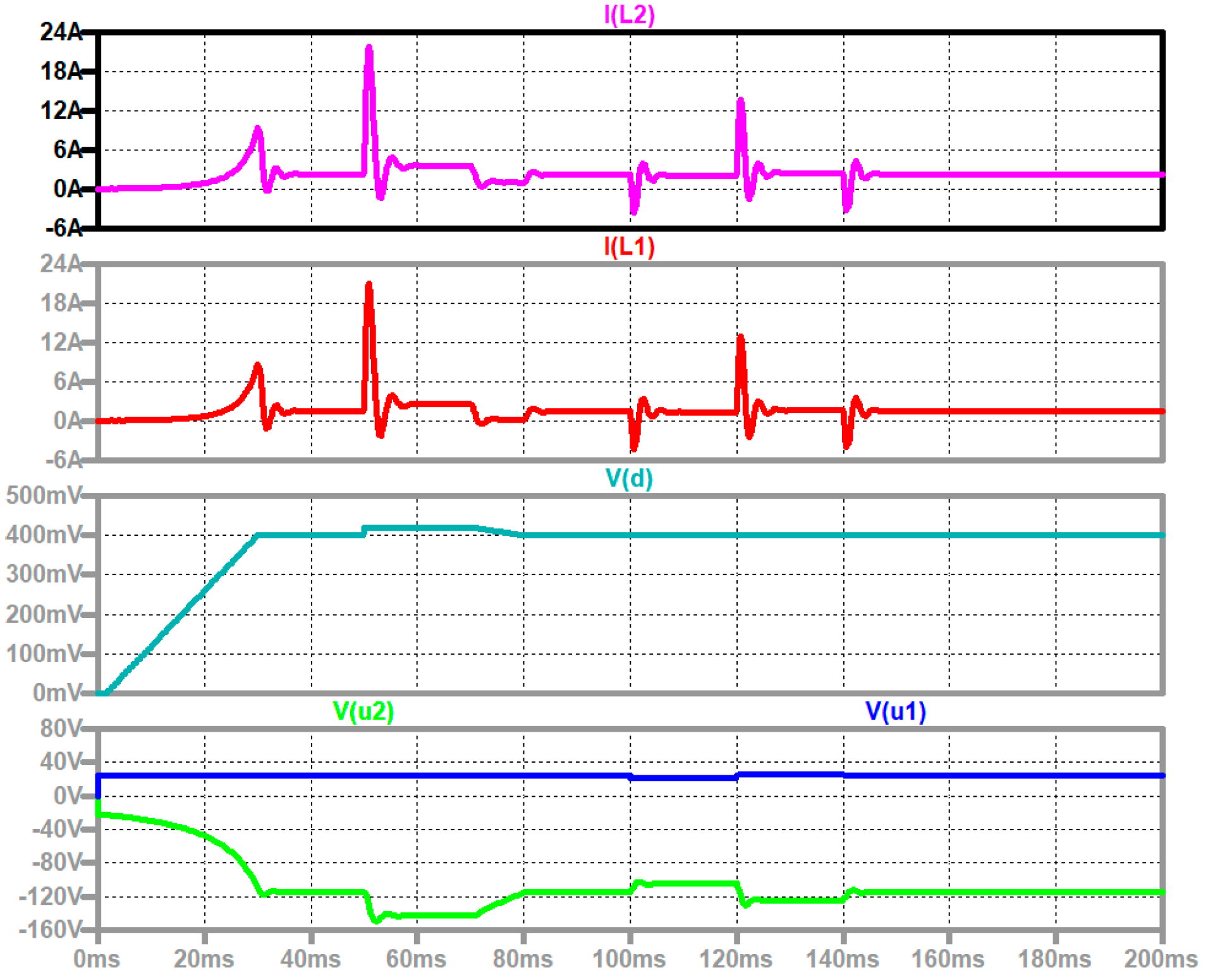
Type II dynamic simulation: (a) Simulation circuit. (b) Top to bottom—current through the second coil of stage one (violet); current through the first coil of the first stage (red); duty cycle (gray); input voltage (blue), output voltage of stage one, and output voltage of the complete converter, output voltage of the first stage (turquoise), output voltage (green).
Figure 19.
Type II dynamic simulation: (a) Simulation circuit. (b) Top to bottom—current through the second coil of stage one (violet); current through the first coil of the first stage (red); duty cycle (gray); input voltage (blue), output voltage of stage one, and output voltage of the complete converter, output voltage of the first stage (turquoise), output voltage (green).
Figure 20.
Type II inrush: (a) Top to bottom—input current (dark violet); current through the first coil of stage 2 (violet); current through the first coil of stage 1 (red); output voltage of stage 1 (turquoise), output voltage (green), output voltage of stage 2 (dark green). (b) Top to bottom—input current (dark violet); current through the first coil of stage 2 (violet); current through the first coil of stage 1 (red); input voltage (blue), output voltage (green), output voltage of stage 1 (turquoise), output voltage of stage 2 (dark green).
Figure 20.
Type II inrush: (a) Top to bottom—input current (dark violet); current through the first coil of stage 2 (violet); current through the first coil of stage 1 (red); output voltage of stage 1 (turquoise), output voltage (green), output voltage of stage 2 (dark green). (b) Top to bottom—input current (dark violet); current through the first coil of stage 2 (violet); current through the first coil of stage 1 (red); input voltage (blue), output voltage (green), output voltage of stage 1 (turquoise), output voltage of stage 2 (dark green).
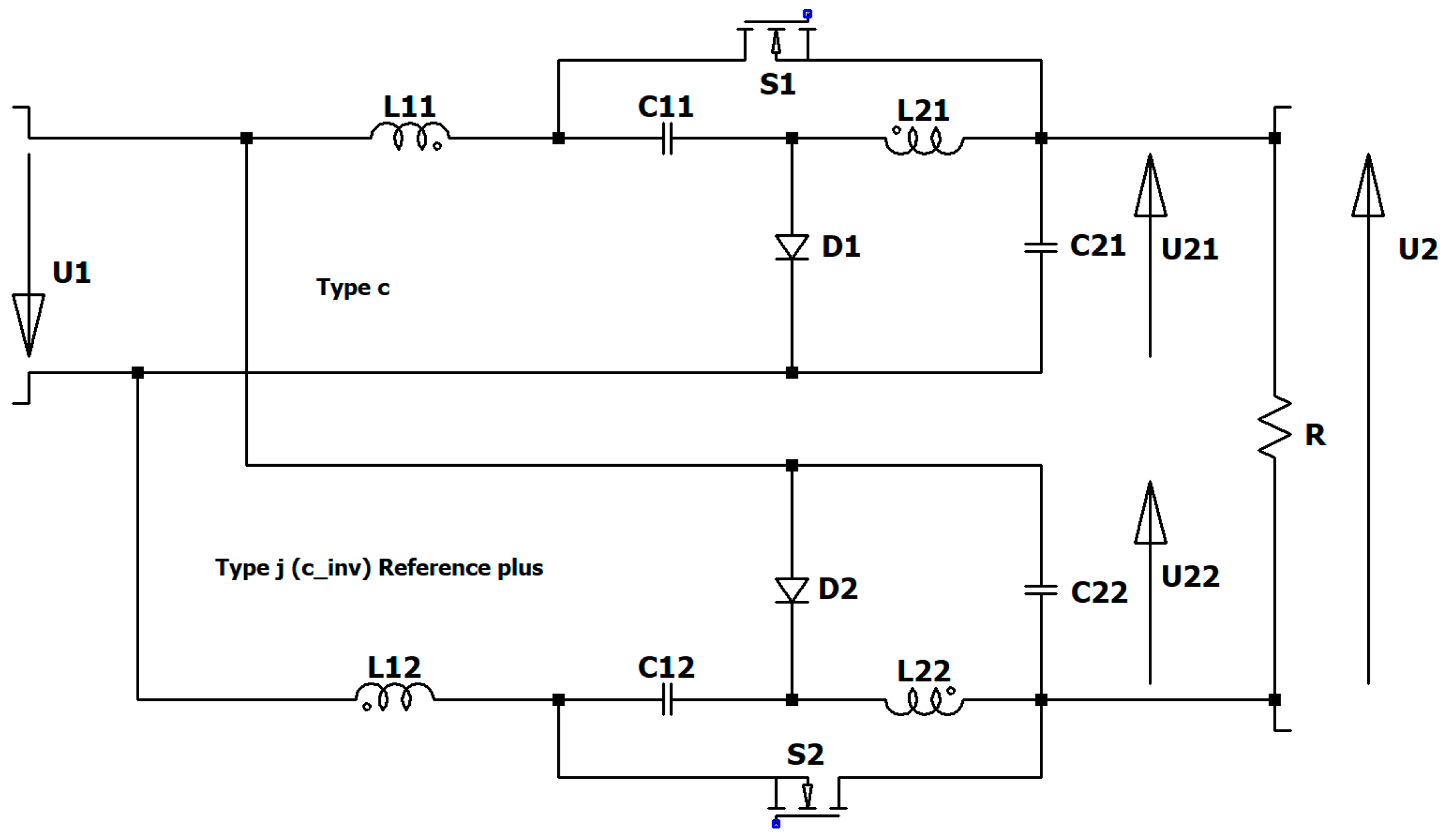
Figure 21.
Circuit diagram of the floating two-stage converter type III.
Figure 21.
Circuit diagram of the floating two-stage converter type III.
Figure 22.
Type III: voltage transformation ratio M of the two-stage converter (blue) and of a single stage (brown) in dependence of the duty cycle D.
Figure 22.
Type III: voltage transformation ratio M of the two-stage converter (blue) and of a single stage (brown) in dependence of the duty cycle D.
Figure 23.
Type V: equivalent circuit during M1.
Figure 23.
Type V: equivalent circuit during M1.
Figure 24.
Type III: equivalent circuit during M2.
Figure 24.
Type III: equivalent circuit during M2.
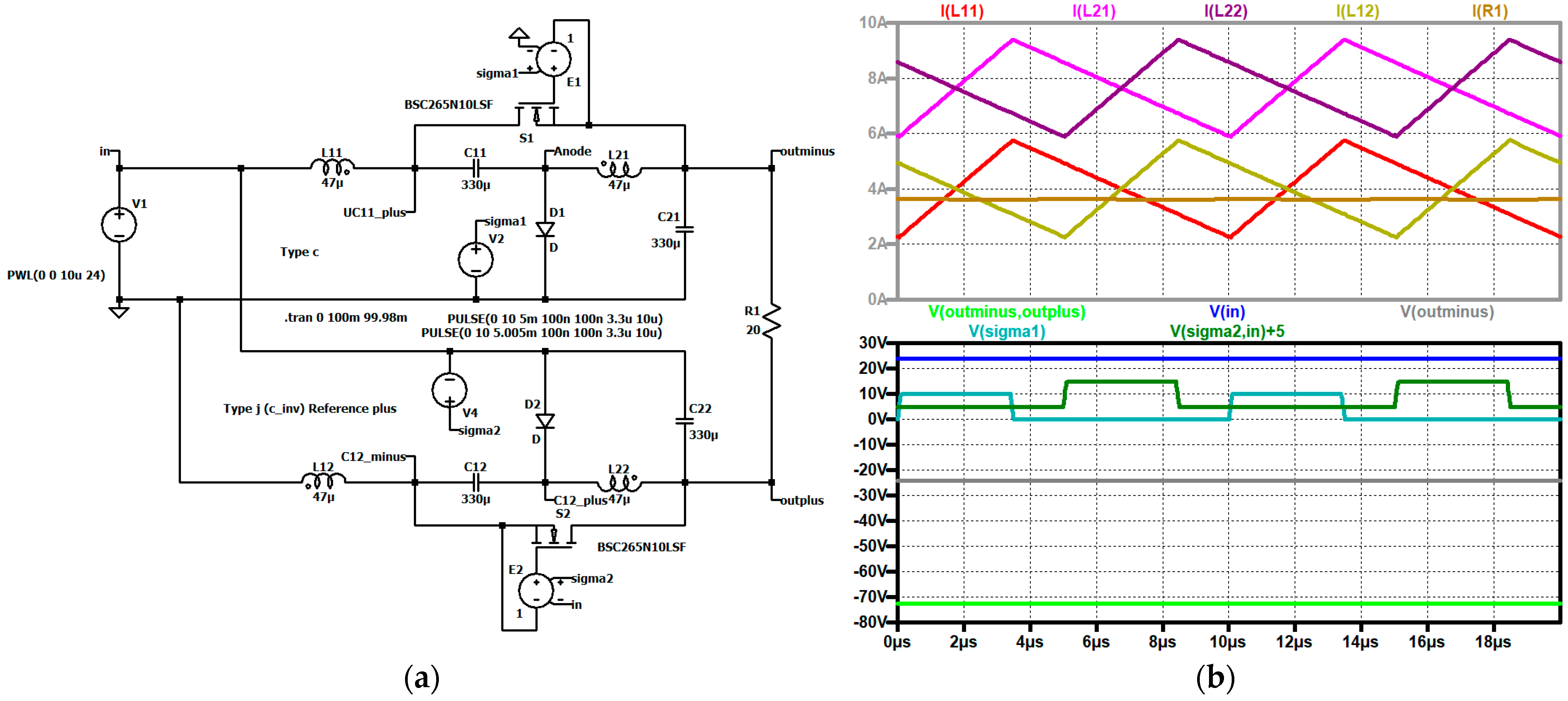
Figure 25.
Type III: (a) Simulation circuit. (b) Top to bottom—input current (dark violet); currents through the coils of stage 2 L12 (gray), L22 (light brown), load current (brown); currents through the coils of stage 1 L11 (red), L21 (violet), load current (brown); output voltage (absolute value, green), voltage across output capacitor of stage 1 (dark blue), input voltage (blue), control signal of S2 (dark green, shifted), control signal of S1 (turquoise).
Figure 25.
Type III: (a) Simulation circuit. (b) Top to bottom—input current (dark violet); currents through the coils of stage 2 L12 (gray), L22 (light brown), load current (brown); currents through the coils of stage 1 L11 (red), L21 (violet), load current (brown); output voltage (absolute value, green), voltage across output capacitor of stage 1 (dark blue), input voltage (blue), control signal of S2 (dark green, shifted), control signal of S1 (turquoise).
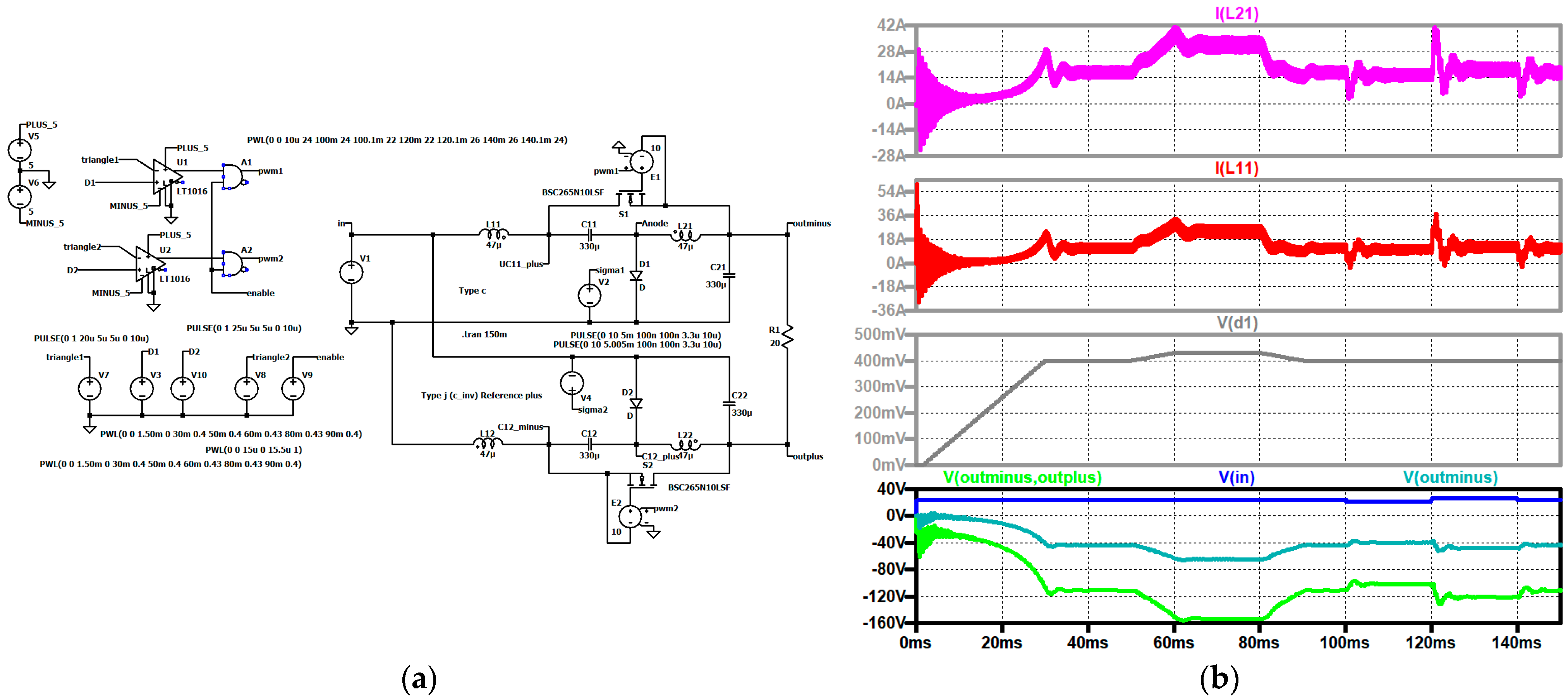
Figure 27.
Type III: (a) Simulation circuit. (b) Top to bottom—current through the second coil (violet); current through the first coil (red); duty cycle (gray); input voltage (blue), output voltage of stage 1 (turquoise), output voltage (green).
Figure 27.
Type III: (a) Simulation circuit. (b) Top to bottom—current through the second coil (violet); current through the first coil (red); duty cycle (gray); input voltage (blue), output voltage of stage 1 (turquoise), output voltage (green).
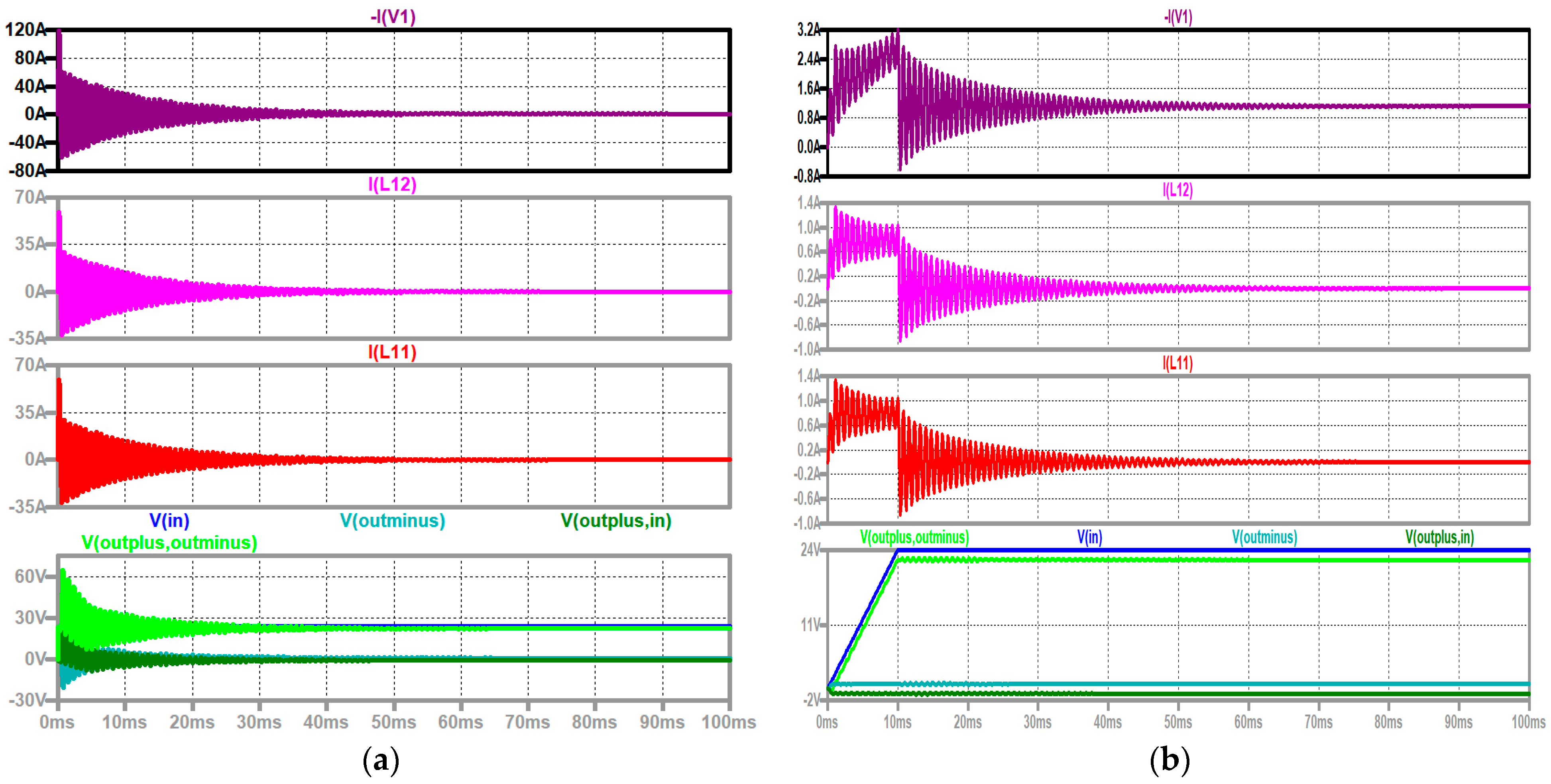
Figure 28.
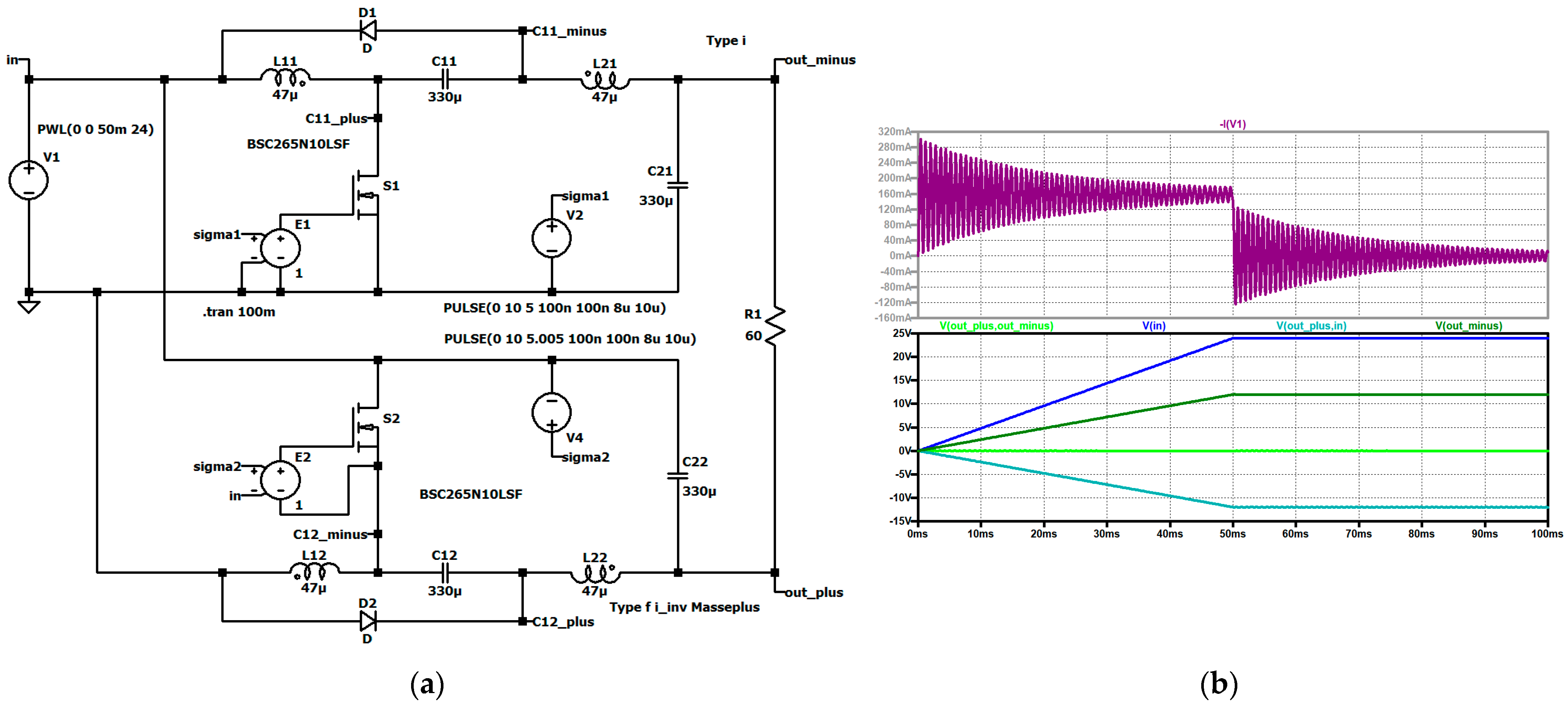
Type III with input-voltage ramp: (a) Simulation circuit. (b) Top to bottom—input current (dark violet); input voltage (blue), voltages across the outputs of stage 2 (dark green), output voltage (green), voltages across the outputs of stage 1 (turquoise).
Figure 28.
Type III with input-voltage ramp: (a) Simulation circuit. (b) Top to bottom—input current (dark violet); input voltage (blue), voltages across the outputs of stage 2 (dark green), output voltage (green), voltages across the outputs of stage 1 (turquoise).
Figure 29.
Circuit diagram type IV.
Figure 29.
Circuit diagram type IV.
Figure 30.
Type IV steady-state: (a) Simulation circuit. (b) Top to bottom—input current (gray); current through the second coil of stage one (violet), current through the second coil of stage two (dark violet), current through the first coil of stage one (red), current through the first coil of stage two (black), load current (brown); input voltage (blue), control signal of the second switch (dark green, shifted), control signal of the first switch (turquoise), output voltage of stage 1 (dark blue), output voltage (green).
Figure 30.
Type IV steady-state: (a) Simulation circuit. (b) Top to bottom—input current (gray); current through the second coil of stage one (violet), current through the second coil of stage two (dark violet), current through the first coil of stage one (red), current through the first coil of stage two (black), load current (brown); input voltage (blue), control signal of the second switch (dark green, shifted), control signal of the first switch (turquoise), output voltage of stage 1 (dark blue), output voltage (green).
Figure 31.
Type IV: (a) Simulation circuit. (b) Top to bottom—current through the second coil (violet); current through the first coil (red); duty cycle (gray); input voltage (blue), output voltage (green).
Figure 31.
Type IV: (a) Simulation circuit. (b) Top to bottom—current through the second coil (violet); current through the first coil (red); duty cycle (gray); input voltage (blue), output voltage (green).
Figure 34.
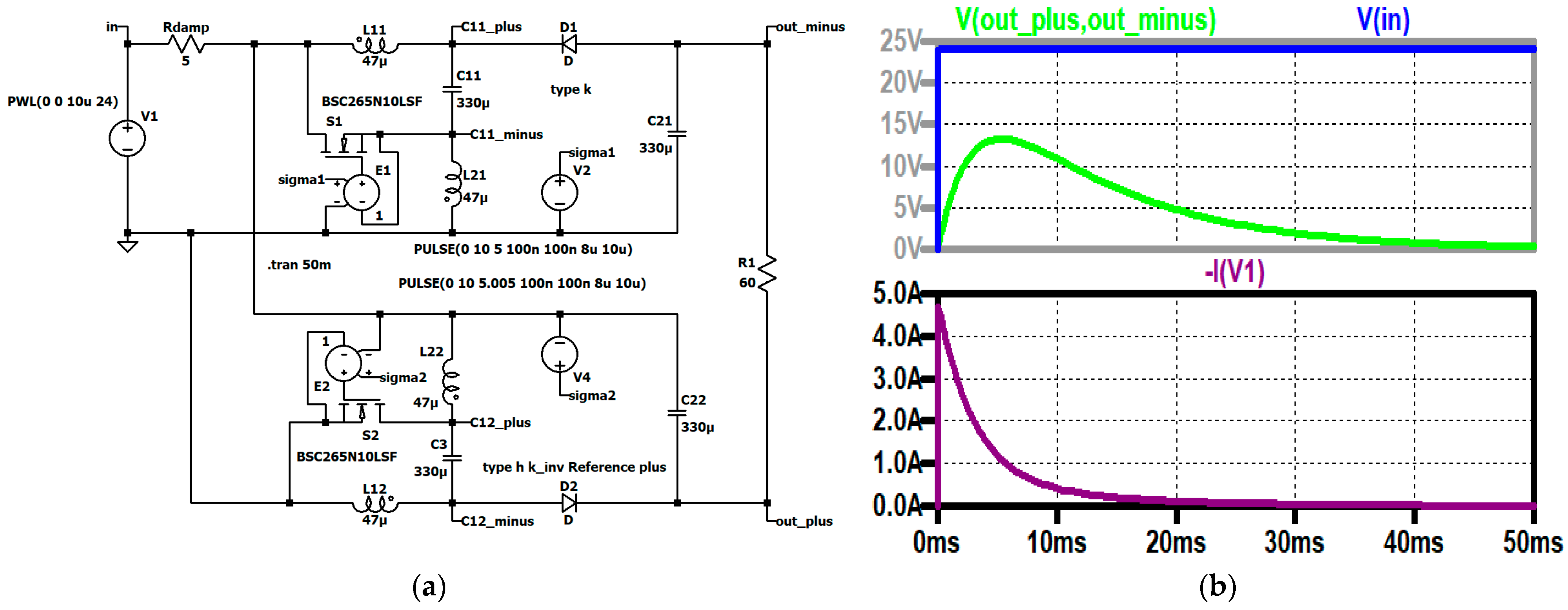
Avoiding the inrush with a damping resistor, type IV: (a) Simulation circuit. (b) Top to bottom—input voltage (blue), output voltage (green); input current (dark violet).
Figure 34.
Avoiding the inrush with a damping resistor, type IV: (a) Simulation circuit. (b) Top to bottom—input voltage (blue), output voltage (green); input current (dark violet).
Figure 35.
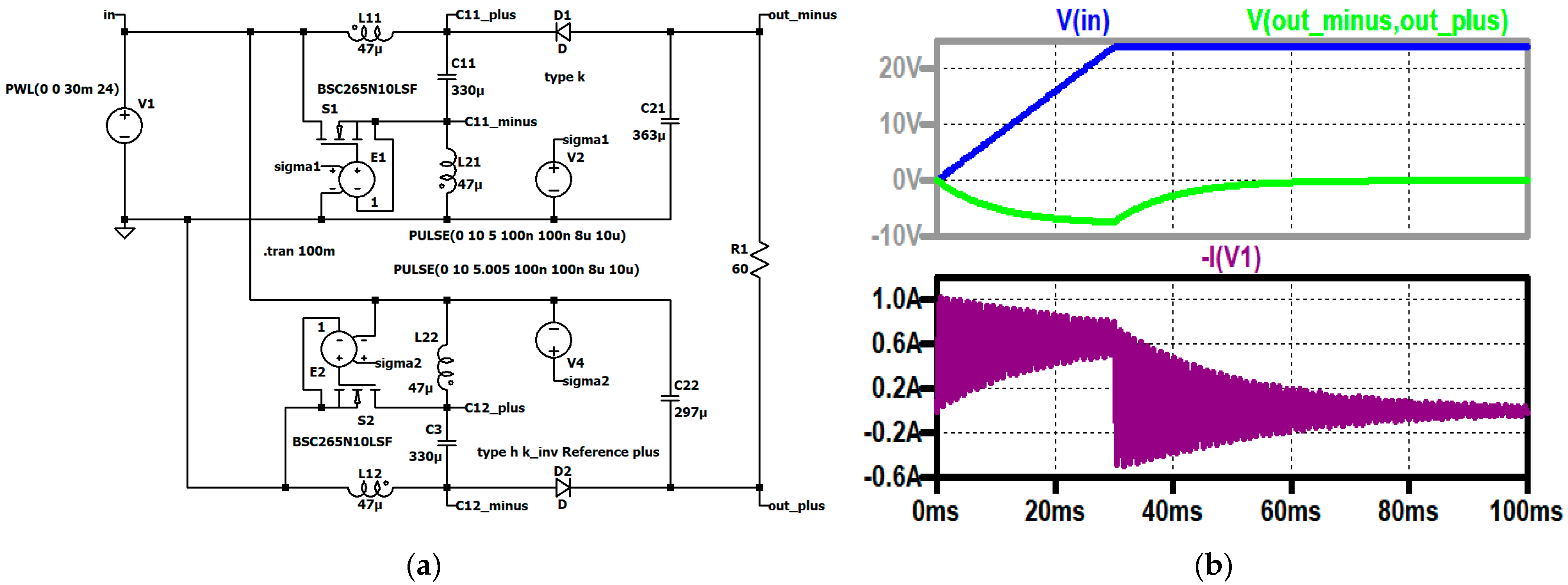
Avoiding the inrush with a ramp, type IV: (a) Simulation circuit. (b) Top to bottom—input voltage (blue), output voltage (green); input current (dark violet).
Figure 35.
Avoiding the inrush with a ramp, type IV: (a) Simulation circuit. (b) Top to bottom—input voltage (blue), output voltage (green); input current (dark violet).
Figure 36.
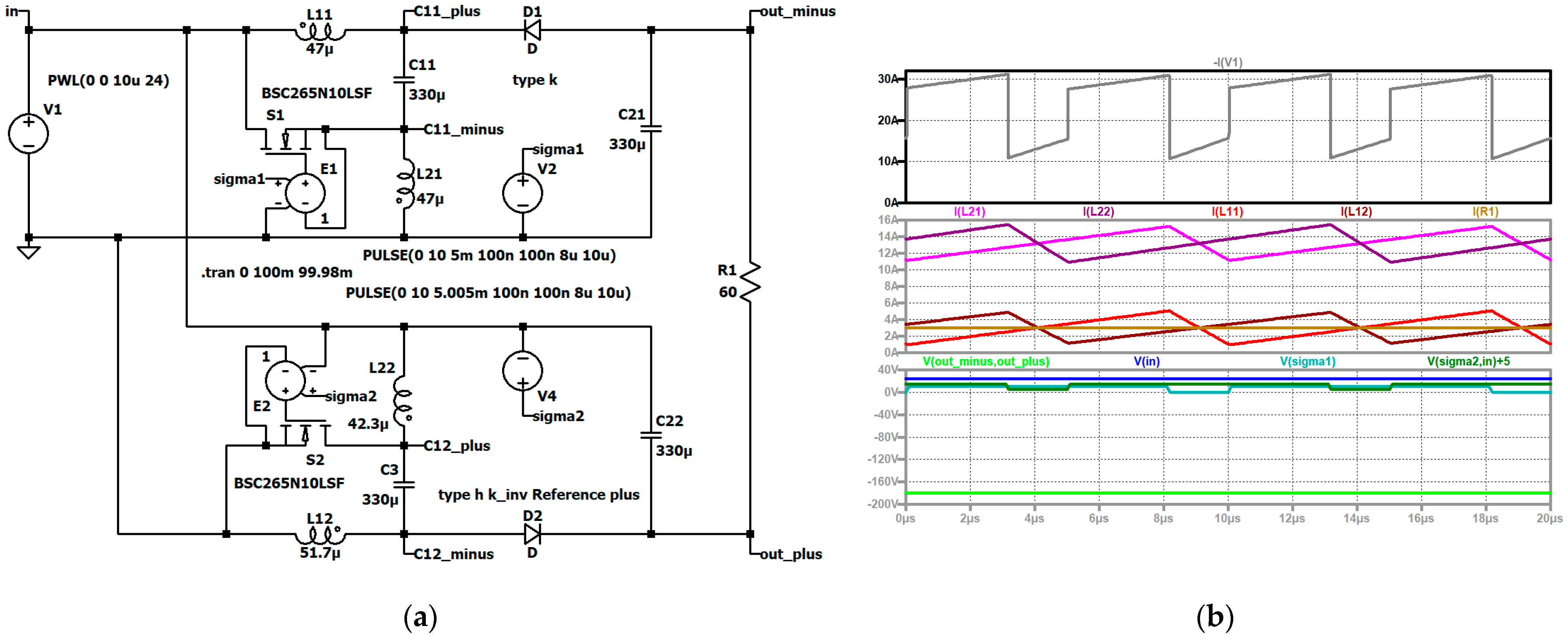
Type IV steady-state with tolerances of the coils: (a) Simulation circuit. (b) Top to bottom—input current (gray); current through the second coil of stage one (violet), current through the second coil of stage two (dark violet), current through the first coil of stage one (red), current through the first coil of stage two (black), load current (brown); input voltage (blue), control signal of the second switch (dark green, shifted), control signal of the first switch (turquoise), output voltage (green).
Figure 36.
Type IV steady-state with tolerances of the coils: (a) Simulation circuit. (b) Top to bottom—input current (gray); current through the second coil of stage one (violet), current through the second coil of stage two (dark violet), current through the first coil of stage one (red), current through the first coil of stage two (black), load current (brown); input voltage (blue), control signal of the second switch (dark green, shifted), control signal of the first switch (turquoise), output voltage (green).
Figure 37.
Type IV steady-state with tolerances of the coils by plus/minus 10% and the duty cycles of the two stages differ by 5%: (a) Simulation circuit. (b) Top to bottom—input current (gray); current through the second coil of stage one (violet), current through the second coil of stage two (dark violet), current through the first coil of stage one (red), current through the first coil of stage two (black), load current (brown); input voltage (blue), control signal of the second switch (dark green, shifted), control signal of the first switch (turquoise), output voltage of stage two (dark blue), output voltage of stage one (light brown), output voltage (green).
Figure 37.
Type IV steady-state with tolerances of the coils by plus/minus 10% and the duty cycles of the two stages differ by 5%: (a) Simulation circuit. (b) Top to bottom—input current (gray); current through the second coil of stage one (violet), current through the second coil of stage two (dark violet), current through the first coil of stage one (red), current through the first coil of stage two (black), load current (brown); input voltage (blue), control signal of the second switch (dark green, shifted), control signal of the first switch (turquoise), output voltage of stage two (dark blue), output voltage of stage one (light brown), output voltage (green).