Article

Design, Optimization, and Validation of a Dual Three-Phase YASA Axial Flux Machine with SMC Stator for Aerospace Electromechanical Actuators


by
Mehmet C. Kulan
*,
Farshid Mahmouditabar
,
Abdulrahman A. M. Alharbi
,
Bortecene Yildirim
and
Nick J. Baker
School of Engineering, Merz Court, Newcastle University, Newcastle upon Tyne NE1 7RU, UK
*
Author to whom correspondence should be addressed.
Energies 2025, 18(23), 6274; https://doi.org/10.3390/en18236274
Submission received: 26 September 2025 / Revised: 25 November 2025 / Accepted: 26 November 2025 / Published: 28 November 2025
(This article belongs to the Special Issue Advanced Technology in Permanent Magnet Motors)

Abstract

This paper presents the design, optimization, and validation of a dual three-phase yokeless and segmented armature (YASA) axial flux permanent magnet (AFPM) machine for aerospace actuators. The proposed 12-slot, 10-pole topology employs segmented soft magnetic composite (SMC) stator teeth integrated into an additively manufactured aluminium holder, combining modularity, weight reduction, and improved thermal conduction. A multi-objective optimization process based on 3D finite element analysis (FEA) was applied to balance torque capability and losses. The manufacturable design achieved a peak torque of 28.3 Nm at 1400 rpm and a peak output power of 3.5 kW with an efficiency of 81.6%, while limiting short-circuit currents to 14 Arms. Transient structural simulations revealed that three-phase short circuits induce unbalanced axial forces, exciting rotor wobbling—a phenomenon not previously reported for YASA machines. A prototype was fabricated and tested, with static torque measurements deviating by 8.6% from FEA predictions. By contrast, line-to-line back-EMF and generator-mode power output exhibited larger discrepancies (up to 20%), attributed to the frequency-dependent permeability and localized eddy currents of the SMC stator material introduced during EDM machining. These results demonstrate both the feasibility and the limitations of YASA AFPM machines for aerospace applications.

1. Introduction

The electrification of aircraft has emerged as one of the most significant technological transformations in aerospace engineering over the past two decades. The concept of the More Electric Aircraft (MEA) envisions the progressive replacement of hydraulic, pneumatic, and mechanical subsystems with electrically driven counterparts to improve efficiency, reduce weight, and lower operating costs [1,2]. Among these technologies, electromechanical actuators (EMAs) are regarded as critical enablers of this transition, providing lightweight, efficient, and environmentally sustainable alternatives to conventional hydraulic actuators. It has been reported that the adoption of MEA architectures can reduce the empty weight of long-range civil aircraft by approximately 10% and decrease fuel consumption by up to 9%, thereby addressing both economic and environmental imperatives [1,2]
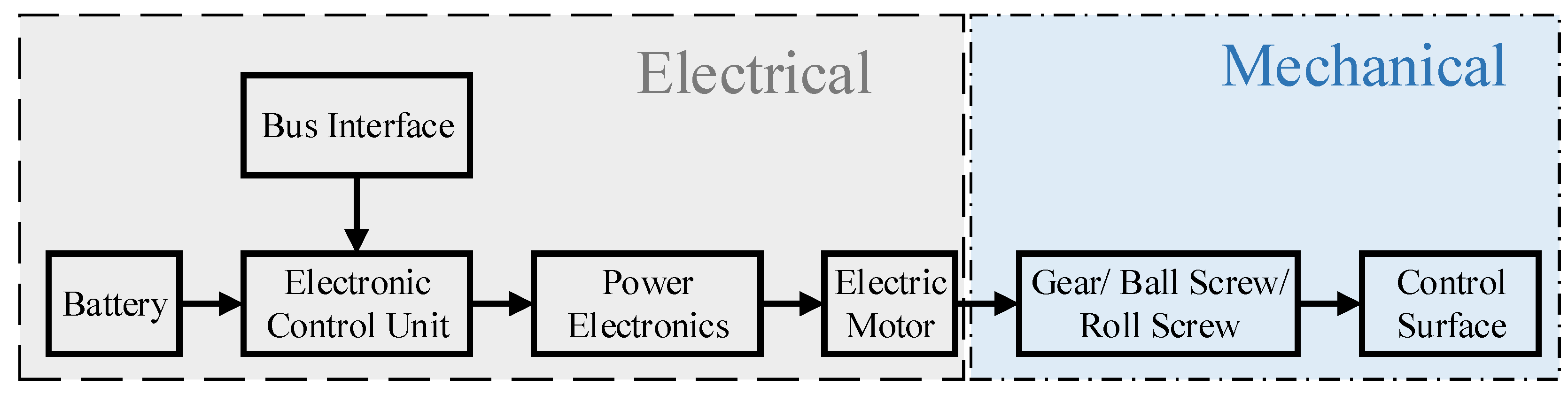
Unlike electro-hydrostatic actuators (EHAs), EMAs eliminate hydraulic fluid and instead couple an electric motor with a mechanical transmission system, such as a gearbox or ball screw [3]. This architecture improves overall system reliability and reduces maintenance requirements. Components of the electromechanical actuators are shown in Figure 1 [3]. However, aerospace EMAs must fulfill stringent requirements: compactness to fit into constrained spaces, thermal robustness to withstand ambient temperatures up to 175 °C, high torque density for actuation tasks, and inherent fault tolerance to ensure safety under single- or multi-phase failure scenarios [4,5]. These demands place extraordinary emphasis on the design of the underlying electric motor, which represents the core of the EMA system.
In aerospace motors and generators, safety and reliability requirements prohibit any single-point failure that could compromise flight control functionality. Therefore, fault tolerance is a critical design objective, aiming to ensure graceful degradation of performance, maintaining torque, power output, and controllability even in the presence of component faults [6]. Achieving such resilience necessitates architectural redundancy, often realized through multi-phase or dual three-phase winding configurations with isolated neutrals and dedicated inverters [7]. Hence, the motor topology must be carefully engineered to achieve a balance between high torque density, superior thermal robustness, and inherent fault-tolerant capability. Three main candidates, induction, switched reluctance (SR), and PM machines, offer distinct performance trade-offs [2].
Induction motors are well-established, robust, and low-cost, but their strong magnetic coupling limits modularity and fault tolerance, making them better suited for non-critical loads such as fans or auxiliary pumps [2]. SR machines, by contrast, provide excellent inherent fault tolerance due to independent stator phases and simple construction without magnets or rotor windings. However, they suffer from lower torque density, significant torque ripple, and high acoustic noise, restricting their use in high-precision aerospace actuators [8].
PM machines achieve the highest torque and power density with superior efficiency and dynamic performance [9]. Although magnet-induced back-EMF complicates fault handling, modular multi-phase designs—such as dual or triple three-phase topologies—offer balanced redundancy, electrical isolation, and smooth torque under faulted operation. Overall, PM machine architectures provide the most attractive compromise between performance, efficiency, and system complexity, making them the leading choice for modern MEA applications, including flight-surface actuators, fuel pumps, and nose-wheel steering. SR machines remain valuable for magnet-free or extreme reliability scenarios, while induction machines continue to serve secondary or non-critical functions.
In the literature, a range of electrical machine topologies have been considered for aerospace actuators, including IMs, SR machines, and PM synchronous machines (PMSMs) [4,5,10,11]. Among these, PMSMs have emerged as the most promising candidates due to their superior performance. Radial flux PMSMs have been extensively investigated for aerospace applications [12,13,14]. Papini et al. proposed a double three-phase, 12-slot, 10-pole Halbach array PMSM for helicopter EMAs, achieving efficiencies up to 98% while also examining rotor dynamics and vibration [15]. Gerada et al. analyzed 24-slot, 20- and 22-pole PMSM configurations with alternate-wound teeth to enhance fault tolerance and reduce short-circuit vulnerability [16]. Giangrande et al. developed a 24-slot, 28-pole single-layer PMSM designed for aerospace EMAs, which maximized slot fill factor, reduced end-winding length, and investigated torque saturation with q-axis current [17]. These studies collectively underline the dominance of radial flux PMSMs in current EMA research, but they also reveal the limitations in exploring alternative three-dimensional flux topologies.
Despite the progress in radial flux designs, axial flux permanent magnets (AFPMs) and transverse flux machines remain underexplored in aerospace actuator applications. This is noteworthy, given the rising adoption of AFPMs in electric vehicles, robotics, and marine systems, where their inherently compact geometries, high torque density, and modular construction have been exploited [18,19]. Modern studies emphasize diverse topologies, including single-sided, double-sided, and multidisc arrangements, as well as emerging variants such as flux-switching, vernier, and multi-port axial machines that exploit flux-modulation effects for enhanced torque density and functional integration [20]. Double-rotor TORUS-type architectures, including the YASA configuration, have demonstrated exceptional compactness, high copper fill factors, and effective thermal management via integrated liquid cooling [20]. These innovations have positioned AFPM machines as strong candidates for high-specific-power traction and aerospace electrification, with reported power densities exceeding 2.5–3 kW/kg [20,21].
In particular, the yokeless and segmented armature (YASA) topology has attracted attention in e-mobility due to its elimination of the stator yoke, which reduces active mass, and its segmented stator teeth, which enable straightforward cooling pathways [22,23]. The YASA design further allows significant weight reduction by minimizing permanent magnet usage while achieving high torque density. Yet, to the best of the authors’ knowledge, no study has systematically examined YASA-type AFPM machines in the context of aerospace EMAs, where compactness, thermal resilience, and fault tolerance are all simultaneously critical.
A further motivation for exploring YASA machines lies in their dual three-phase capability. By arranging windings in a 12-slot, 10-pole configuration with double three-phase sub-machines, it becomes possible to achieve intrinsic fault tolerance, provided that mutual coupling between phases is minimized [24]. This enables continued operation under phase or channel short-circuit conditions, which is a decisive advantage in safety-critical aerospace systems. Nevertheless, introducing such architectures also raises new challenges, particularly with respect to unbalanced magnetic forces [25]. Under healthy operation, the symmetry of a YASA machine ensures negligible axial forces. However, during short-circuit faults, significant transient axial forces may arise in the airgap, transmitted to the rotor disks and bearings, potentially leading to rotor wobbling, vibration, and noise [19]. These structural dynamics have not been thoroughly addressed in previous EMA-focused research, making them an important contribution of the present work.
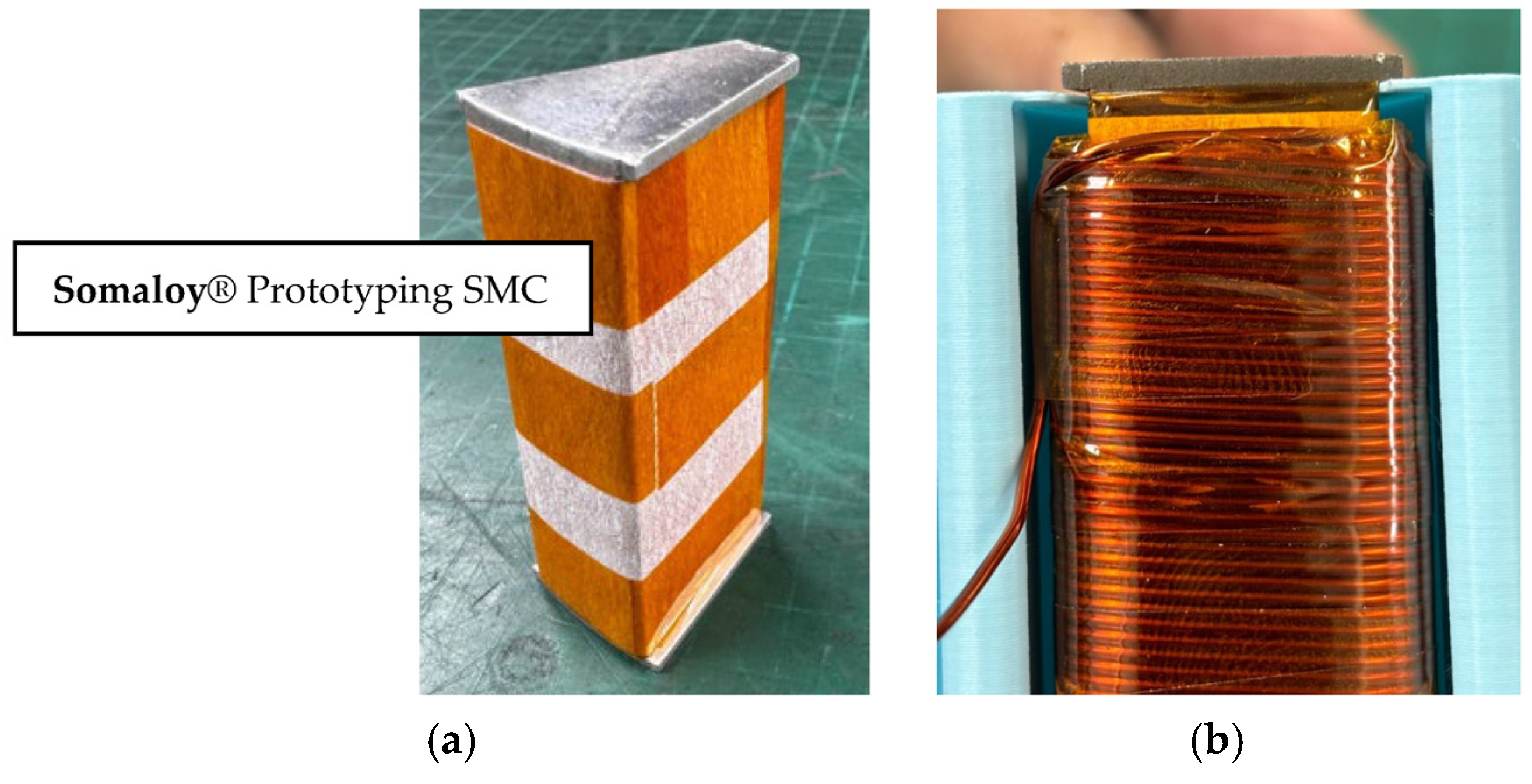
The manufacturing of YASA-type AFPM machines for aerospace applications introduces additional complexities. The segmented stator teeth of the proposed machine are fabricated from soft magnetic composites (SMCs)—shown in Figure 2—which offer isotropic magnetic properties and simplified three-dimensional geometries compared with laminated steels [26].
SMCs offer unique advantages for axial flux electrical machines, where magnetic flux inherently flows in three dimensions. Unlike laminated steels that constrain flux within the lamination plane, SMCs provide near isotropic magnetic properties, enabling efficient radial–axial flux linkage [27]. SMCs also possess high electrical resistivity, which suppresses classical eddy currents and facilitates operation at higher electrical frequencies [28]. However, their permeability is typically lower than that of electrical steels, and their effective magnetic properties are frequency dependent. The capability to form complex, net-shape geometries permits compact stator and rotor topologies with integrated yokes, reducing mass and assembly effort [29]. Although SMCs exhibit lower relative permeability and higher hysteresis losses than laminated steels, the enhanced design freedom, flux utilization, and reduced core losses under 3D excitation make them particularly attractive for YASA motor configurations.
These characteristics can introduce discrepancies between finite element analysis (FEA) predictions and experimental measurements, particularly in back electromotive force (EMF), inductance, and power output. Moreover, the machining process for SMC cores can degrade their local surface properties, giving rise to localized eddy currents and reduced effective permeability [30]. The present study, therefore, also contributes by highlighting the role of SMC-related uncertainties in the observed performance of the aerospace YASA prototype.
The use of additive manufacturing (AM) techniques presents new opportunities for aerospace actuator motors. In this work, the segmented stator teeth are integrated into an aluminum stator holder produced using metal AM. This approach enables complex, lightweight structures with thin walls and improved thermal conduction paths, while also ensuring precise positioning of the modular SMC teeth. AM-based holders allow the stator to operate reliably under high ambient temperatures and demanding structural loads, conditions representative of aerospace environments. Nevertheless, they also impose strict tolerances on manufacturing and assembly, as deviations can significantly affect flux distribution, axial force balance, and vibration behavior.
The present paper introduces a novel dual three-phase YASA-type AFPM machine tailored to aerospace EMA requirements. The machine adopts a 12-slot, 10-pole topology with segmented SMC stator teeth and concentrated windings mounted on an additively manufactured aluminum holder. The design process employed a surrogate-based optimization framework combining Latin Hypercube Sampling (LHS), response surface modelling (RSM), and genetic algorithms (GAs), integrated with detailed three-dimensional electromagnetic finite element analysis. Thermal and structural analyses were also performed to evaluate heat dissipation and rotor dynamics under short-circuit conditions. Transient structural simulations revealed that axial forces arising during short circuits (SCs) induce additional loads on the bearings and can excite rotor wobbling, a phenomenon not previously reported in the literature.
Finally, a prototype machine was fabricated and experimentally tested to validate the design. Static torque tests demonstrated close agreement with FEA predictions, while discrepancies observed in back-EMF and inductance measurements were attributed to the frequency-dependent behavior and surface effects of the SMC material [31]. These findings confirm both the feasibility of employing YASA AFPM machines in aerospace EMAs and the necessity of carefully accounting for material uncertainties and unbalanced axial forces. The contributions of this work are therefore threefold: (i) the design and optimization of a dual three-phase YASA AFPM motor for aerospace EMAs; (ii) the analysis of axial force-induced rotor dynamics in YASA machines under short-circuit faults; and (iii) the integration of SMC stators and metal additively manufactured holders into a validated aerospace-grade prototype.
This paper is structured as follows: Section 2 defines the performance requirements for the aerospace electromechanical actuator and introduces the proposed dual three-phase YASA axial-flux machine together with its model-based fault-tolerant control concept, providing system-level completeness for aerospace motor–drive design. Section 3 develops the surrogate-based optimization framework [32] that links electromagnetic geometry to torque and loss performance, forming the basis for the final design. Section 4 focuses on transient structural analysis results, with emphasis on axial force behavior under short-circuit conditions. Section 5 describes the fabrication of the prototype and presents its experimental validation through static torque, open-circuit, short-circuit, and generator-mode tests. Finally, Section 6 summarizes the principal findings and outlines future work, including the planned implementation of the fault-tolerant control on the developed hardware platform for full motor-mode testing.

2. Design Requirements and Control Concept

The design specifications for the dual three-phase axial flux permanent magnet (AFPM) motor intended for electromechanical actuator applications are summarized in Table 1.
The motor is composed of two independent three-phase channels, each required to deliver a continuous power output of 1750 W at a rated speed of 1400 rpm. The peak torque demand per channel is 11.75 Nm, with a significantly higher holding torque of 3 Nm, indicating the motor must sustain high torque at zero or low speed, such as in position-holding scenarios. A compact form factor is imposed with a maximum stator outer diameter of 108 mm and an axial active material length of 80 mm, making the design suitable for integration into constrained spaces of aerospace applications.
Thermal management is critical due to the high ambient operating temperature of 175 °C, requiring materials and designs capable of enduring a maximum thermal limit of 260 °C. Samarium cobalt magnets (i.e., Recoma 33E® by Arnold Magnetic Technologies) are specified for their superior thermal stability. The motor operates from a 270 V DC bus with a maximum phase current of 20 A (peak), and the electrical design must accommodate a fundamental frequency up to 500 Hz. The motor is configured for direct drive operation, with no gearing between motor and load (gear ratio of 1), emphasizing the importance of high torque density and precision.
The designed electromechanical actuator (EMA) for aerospace applications requires high reliability and inherent fault tolerance. To address these critical demands, the following design aspects have been carefully considered throughout the design process.

2.1. Fault-Tolerant Design

Previous studies in the literature have demonstrated the suitability of non-overlapping fractional slot concentrated winding (FSCW) architectures for fault-tolerant applications [10,33,34]. More precisely, three-phase, 12-slot, 10-pole machines possess theoretically zero mutual inductance [24]. This characteristic allows the current to be limited in case of a short circuit. In this study, the electric motors selected for an aerospace EMA utilize a double-layer winding architecture to work in limited space.

2.1.1. Short-Circuit Behavior and Fault Tolerance

PM machines present a unique fault tolerance challenge. The excitation cannot be de-energized during faults, so the magnet back-EMF continues to drive currents whenever a conductive path exists. Single or three-phase short circuits and inter-turn short circuits should be considered in fault-tolerant designs. The peak and RMS fault currents are set by the effective short-circuit impedance seen by the induced EMF. For a sinusoidal fundamental component of the back EMF ( E ^ 1 ), the per-phase short circuit, I s c , which needs to be limited, can be written in the form
I s c     E 1 R s c 2 + ω L s c 2    
where L s c is the effective short-circuit inductance. The short-circuit inductance L s c increases when the mutual coupling between sub-machines is minimized. Furthermore, enhancing slot leakage through appropriate geometric modifications and material selection can further elevate L s c . Therefore, L s c is a design parameter, and it can be decomposed as
L s c = L m a g + L l ,   s l o t + L l ,   e n d L m
L l ,   s l o t = L w i n d i n g _ s l o t + L t i p  
where L m a g is magnetizing inductance, and L l ,   s l o t is slot leakage inductance, composed of winding slot leakage L w i n d i n g _ s l o t and tooth tip leakage L t i p inductances. L m denotes mutual inductance with other phases. Analytically, a practical permeance model for tooth tip leakage of a single coil can be written as
Λ t i p     k f r μ 0 μ r ,   e f f b t i p l e f f s o ;       L t i p     N 2 Λ t i p  
where b t i p  stands for circumferential tooth-tip width, s o denotes slot opening, and l e f f  is the effective axial flux path length of the tooth-tip bridge. μ r ,   e f f  is the relative permeability of SMC at the tip. Finally, k f r accounts for 3D fringing and non-uniform flux crowding. For fixed E ^ 1 and ω , increasing the tooth-tip leakage term, L t i p  (e.g., b t i p / s o  ratio and/or μ r ,   e f f  via the material selection), increases L s c  and reduces I s c . In addition to the use of spatial separation to suppress mutual inductance in dual three-phase electric machines, the practical design of L s c  can also be an important aspect. While spatial separation effectively reduces mutual inductance in dual three-phase YASA topologies, the design of the short-circuit inductance L s c  is equally crucial. By tailoring slot leakage and tooth-tip geometry, L s c  can be increased to attenuate short-circuit currents and improve inherent fault-tolerant behavior.

2.1.2. Fault-Tolerant Winding Configuration

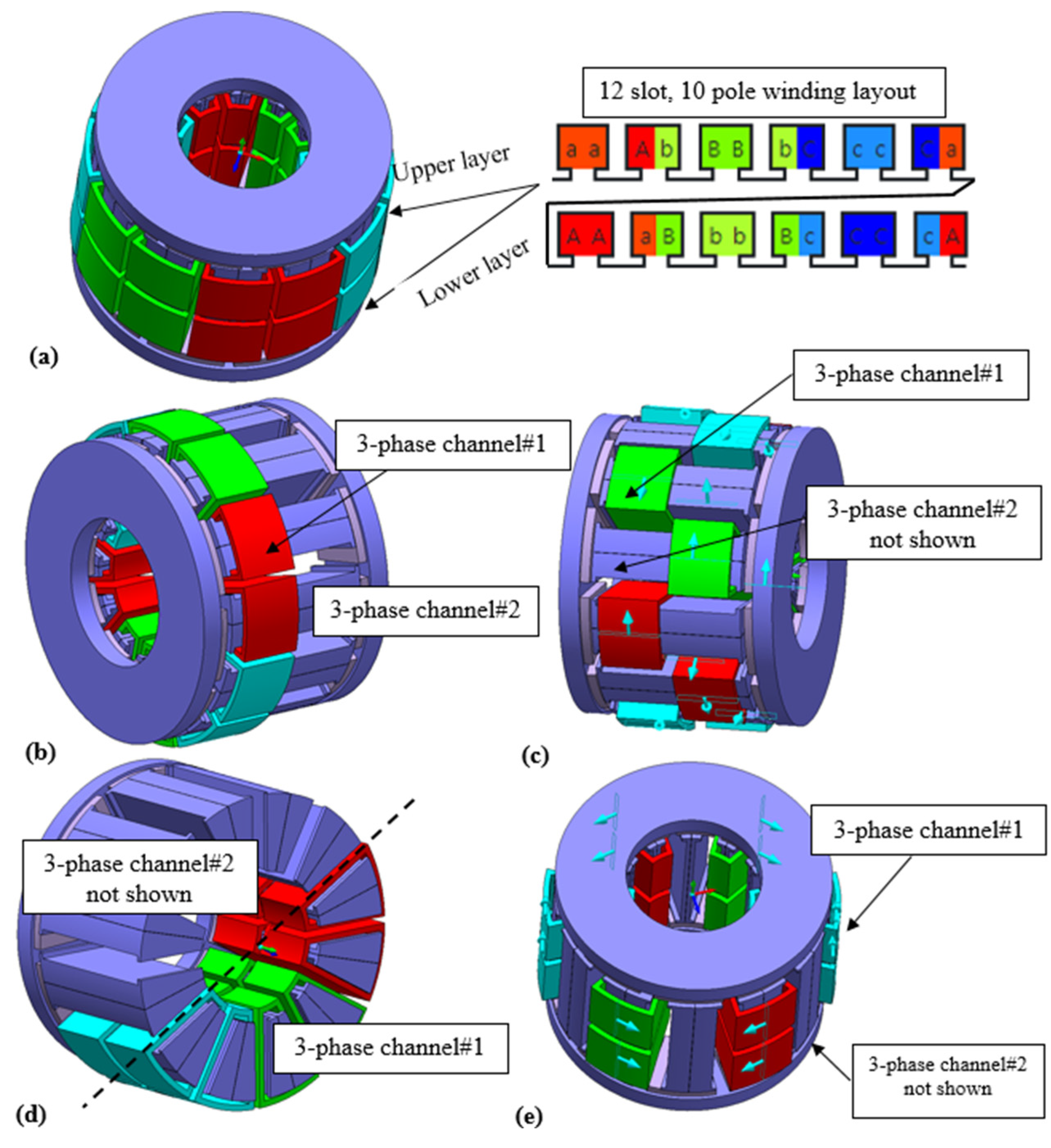
Multiple balanced winding configurations can be utilized for a motor architecture with 12 slots and 10 poles. These are shown in Figure 3. Figure 3a depicts a segmented stator with 24 motor coils that are axially separated. This design enables us to experiment with various winding connections under both normal and faulty operating conditions of the actuator. Figure 3b illustrates a three-phase sub-machine positioned in the upper axial layer of the stator. Figure 3c depicts a three-phase sub-machine that alternates axially around the perimeter of the stator. In Figure 3d, the machine is divided into two halves, with each 180-degree segment housing a separate three-phase sub-machine. Finally, in Figure 3e, another winding design that alternates radially is presented. All these potential winding layouts are compared to understand how a three-phase short circuit in one channel affects the other.
Different fault mitigation methods have been investigated in the literature [35,36,37]. Fault-tolerant design practices aim to reduce the likelihood of phase-to-phase or turn-to-turn short circuits. Phase terminals shorting during a fault reduces the short-circuit fault current, but this method can reduce the generated torque during the fault. Ideally, when a three-phase short circuit develops in one of the sub-machines on load condition, the healthy sub-machine should be able to provide the desired torque without any magnetic coupling between the healthy and faulty sub-machines. This is important because fault scenarios can impact the voltage and torque output of the machine under load.
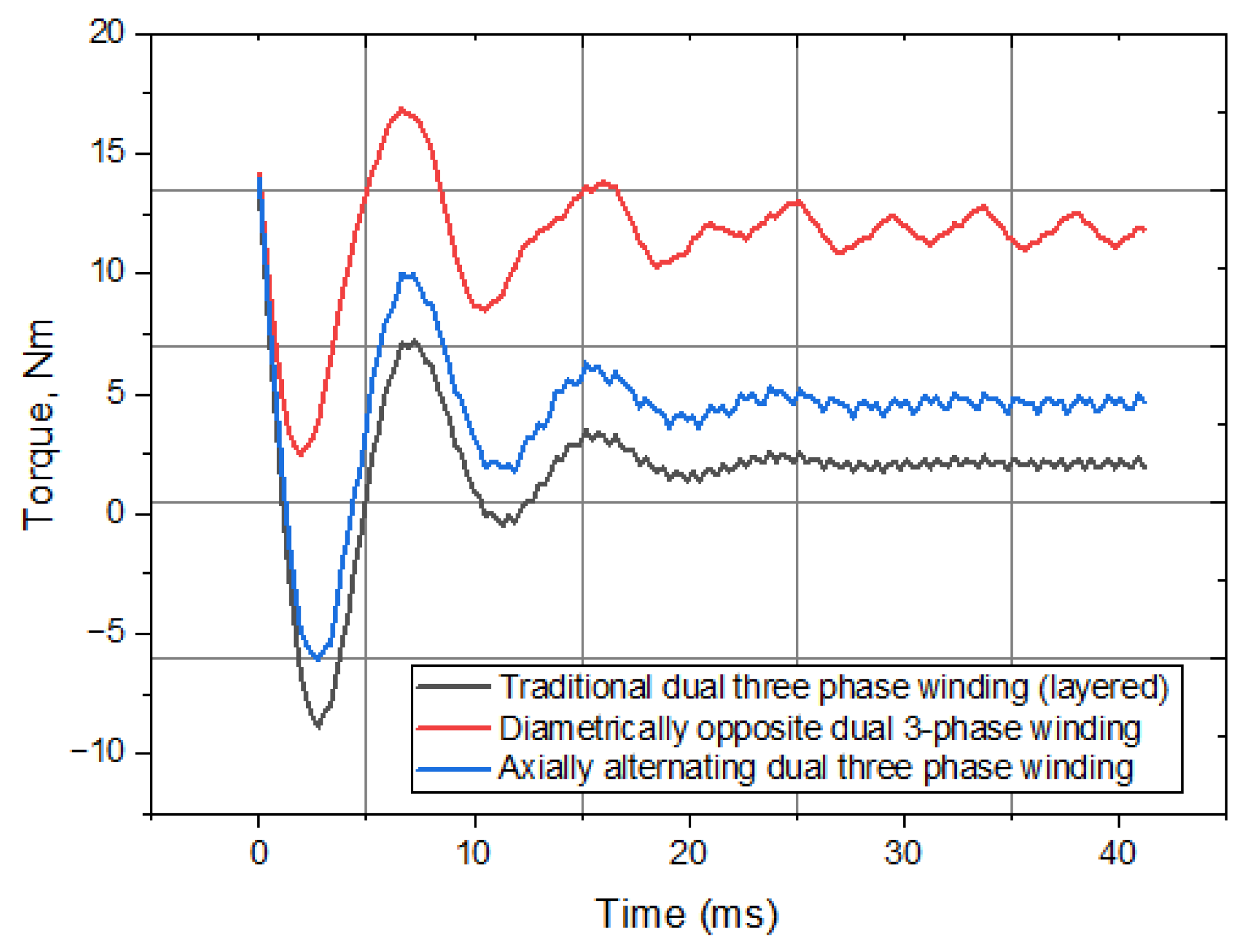
Figure 4 compares three different winding scenarios. A 12-slot-10-pole axially separated dual three-phase AFM (see Figure 3b) cannot maintain the required per-channel torque during a three-phase short circuit. The healthy channel produces only 2 Nm torque instead of 11.75 Nm in the event of a three-phase SC. Similarly, a 12-slot, 10-pole AFM stator with axially alternating coils (see Figure 3c) generates a torque of about 4.35 Nm when one of the channels is short-circuited. This implies about 60% torque drop in the healthy channel due to magnetic coupling between the healthy and faulty channels.
The only method to mitigate the coupling of healthy and faulty three-phase channels is to locate the channels diametrically opposite to each other (see Figure 3d). In this case, torque output can be maintained as given in Figure 4, where the red torque waveform is seen to satisfy the torque criterion with 15% torque ripple.

2.2. Implementation of Fault-Tolerant Motor Drive for the Proposed YASA Motor

While this study primarily focuses on the design and optimization of the YASA actuator motor, incorporating a model-based fault-tolerant control strategy provides system-level completeness relevant to aerospace applications. The presented control framework demonstrates how the dual three-phase configuration can sustain operation during faults and forms the basis for upcoming hardware validation.
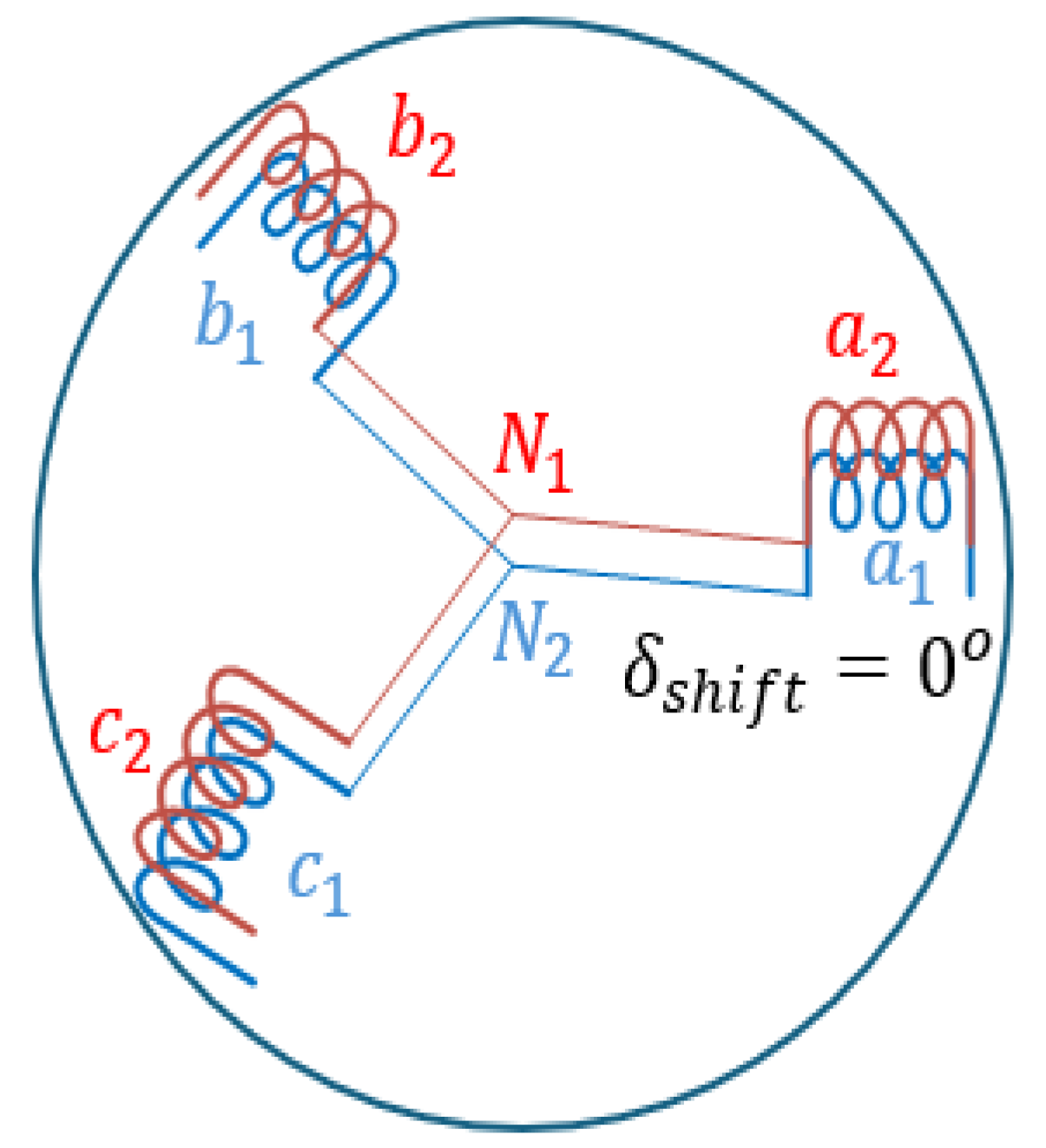
The YASA-type AFPM is configured as a double-stator system, wherein each stator set is physically and electrically isolated from the other. As illustrated in Figure 5, the three stator sets exhibit a zero-phase shift, ensuring a symmetrical design. This configuration enhances DC link utilization and simplifies vector control implementation [38,39].
The modeling of this machine is based on the following assumptions:
  • The coupling between the stators is neglected, as the motor design aims to eliminate or minimize inter-stator coupling.
  • Each individual sub-machine (set) possesses its own neutral point.
  • There is no phase shift between the two stator sets.
  • The only coupling between the two sets occurs through the rotor.
By applying vector space decomposition (VSD) to six-phase machines as expressed in (5) and (6), the six-dimensional vector space can be decomposed into fundamental harmonic subspaces and higher-order harmonic subspaces [40]. The fundamental subspace is responsible for torque and flux production, while the remaining harmonics can be nullified under healthy operating conditions. However, during fault conditions, these harmonics begin to circulate within the system, necessitating additional PI control for their suppression.
T V S D = 2 6 1 0.5 0.5           1 0.5 0.5 0 3 2 3 2           0 3 2 3 2 1 0.5 0.5           1 0.5 0.5 0 3 2 3 2           0 3 2 3 2 1 1 1           0 0 0 0 0 0           1 1 1
α β x y z 1 z 2 = T V S D a 1 b 1 c 1 a 2 b 2 c 2
where α β is the main fundamental harmonic, x y are the fifth harmonic, and z 1 , z 2 are the zero space vectors, which do not exist due to the machine design. To simplify the control, α β planes can be transformed into d q plane by using park transformation based on the rotor electrical position θ e , as shown in (7).
T R = c o s ( θ e ) s i n ( θ e ) s i n ( θ e ) c o s ( θ e )        
By applying (7) to (5), the d q and x y voltages can be expressed as follows (8) to (13):
V d = R s I d + d d d t ω e q  
V q = R s I q + d q d t + ω e d
q = L q I q
d   = L d I d + φ m
V x = R s I x + d x l s d t
V y = R s I y + d y l s d t
where R s , d , q , ω e , L q , L d , φ m , x l s , and y l s are the stator resistor, d-axis flux, q-axis flux, the electrical angular speed, q-axis inductance, d-axis inductance, magnetic flux, stator leakage flux on d-axis, and stator leakage flux on q-axis, respectively. The mechanical dynamics are described by the following plant equations:
J d ω m d t = T e T l o a d B ω m
T e = 6 2 p φ m I q        
where T e denotes the electromagnetic torque output of the motor, and p is the number of pole pairs. J (kg·m2) stands for the inertia.

2.2.1. Implementation of Fault-Tolerant Control with Sharing Power Techniques

Given that the machine is designed with two isolated neutral points, both the main space and the harmonic subspace components can be derived as shown in Equations (5) and (16)–(18):
I α β = 1 2 I α β 1 + I α β 2
I x = 1 2 I α 1 I α 2
I y = 1 2 I β 2 I β 1
It is possible to introduce a power-sharing factor for each winding set without affecting the main harmonic component, as follows:
I α β 1 = K 1 I α β   ,       I α β 2 = K 2 I α β
where the sum of the sharing factors must satisfy the constraint
K 1 + K 2 = 2                        
To implement control in the d q -frame, Equation (7) can be multiplied by Equation (5) to obtain the corresponding d q -components for the fundamental subspace. Since the x y harmonic represents the 5th harmonic subspace, the inverse of Equation (7) can be used to derive the equivalent d q -values for the x y harmonic. The resulting space harmonic equations are
I d q = 1 2 K 1 + K 2 I α β e j θ e
I d x = 1 2 K 1 K 2 I d
I q y = 1 2 K 2 K 1 I q
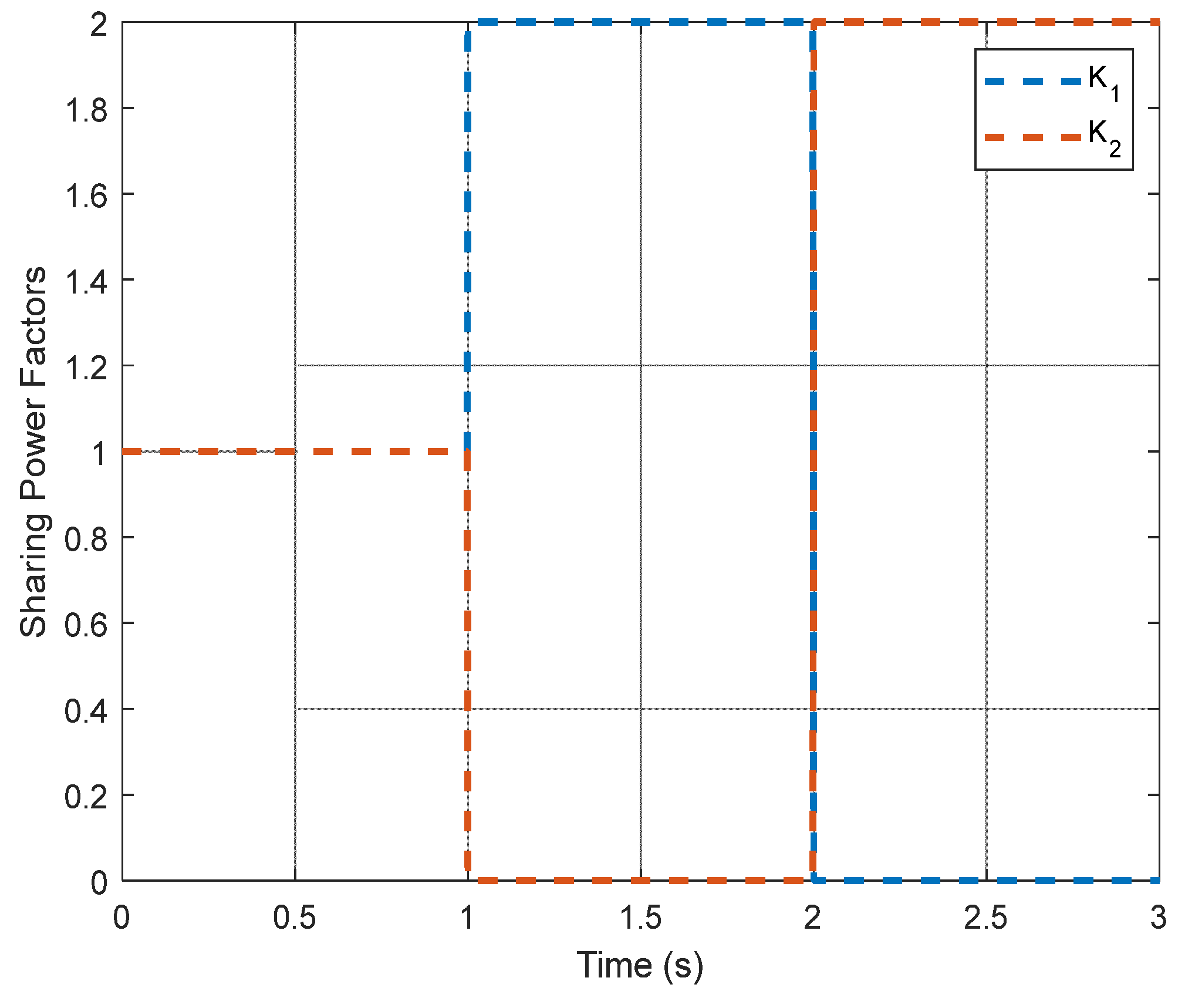
By adjusting the values of K 1 and K 2 , power can be effectively distributed between the two winding sets. This power-sharing method is particularly useful for fault-tolerant control. For instance, if a fault occurs in the first set, setting K 1 = 0 and K 2   =   2 ensures that the healthy set handles the entire power demand while still satisfying the overall constraint, as in (20).

2.2.2. Simulation Results

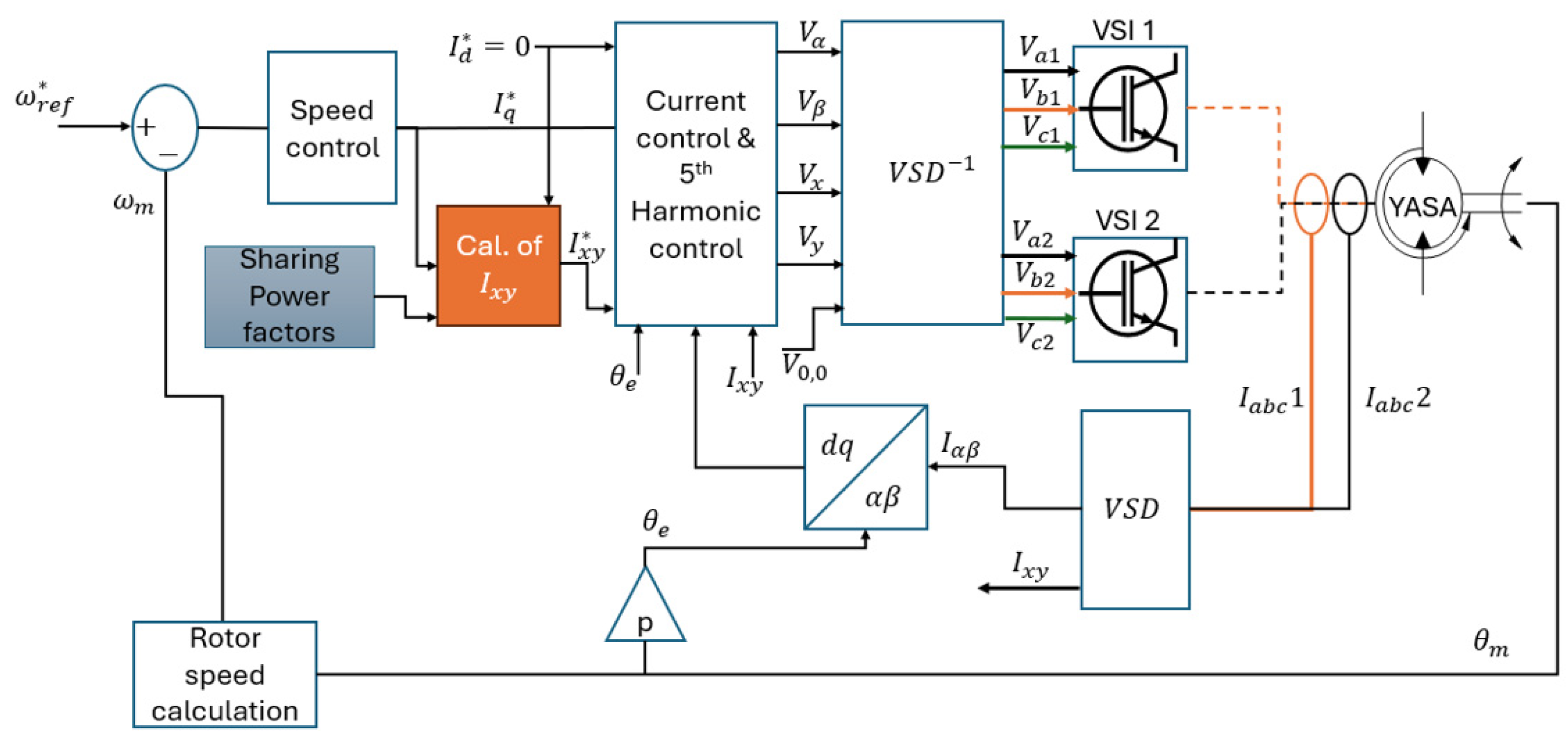
Figure 6 shows the block diagram for power sharing in the YASA-type AFPM motor. The control is implemented in MATLAB R2024a using an S-function, with the code written in C suite. The switching frequency is set to 10 kHz, and the control constants and motor parameters are listed in Table 2.
The control system functions as a speed controller, where the reference speed is derived either from position control or user input. Since field weakening is not implemented, I d is set to zero. The output of the speed controller corresponds to the desired torque, which is related to the I q current, as described in Equation (15). The reference harmonic for the x y component is obtained using Equations (20)–(23), based on the reference values of I d and I q . The power-sharing coefficients can be assigned arbitrary values, provided their sum equals 2. The fifth harmonic component is regulated using dual PI controllers for the x y harmonics.
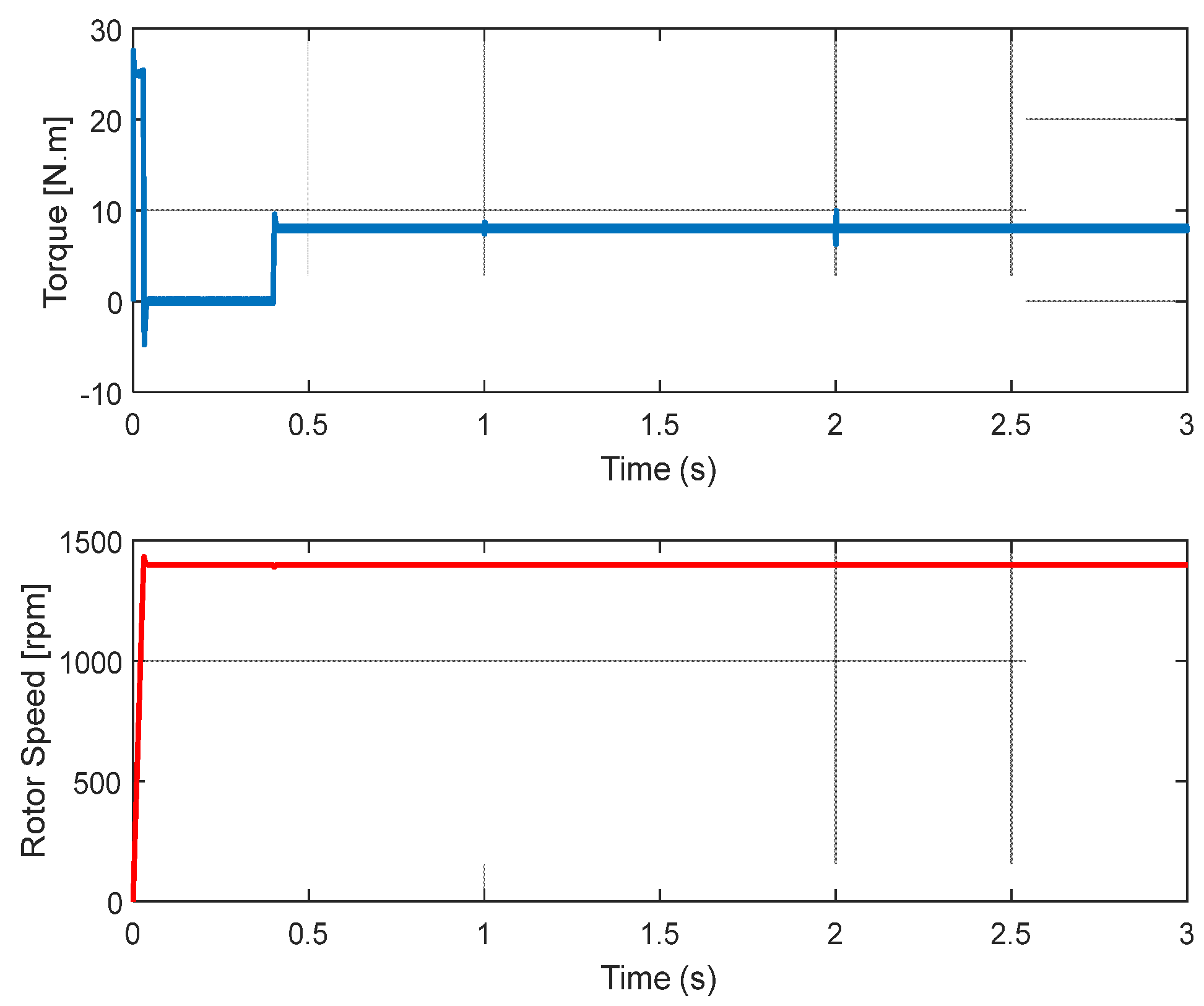
To validate the proposed power-sharing approach for the dual YASA motor under fault conditions, the system is tested by varying K 1 and K 2 as specified in Table 3. As the power contribution from the faulty set is nullified, the approach remains applicable under various fault scenarios. The control performance is evaluated under high-frequency conditions, with a load torque of 8 N·m.
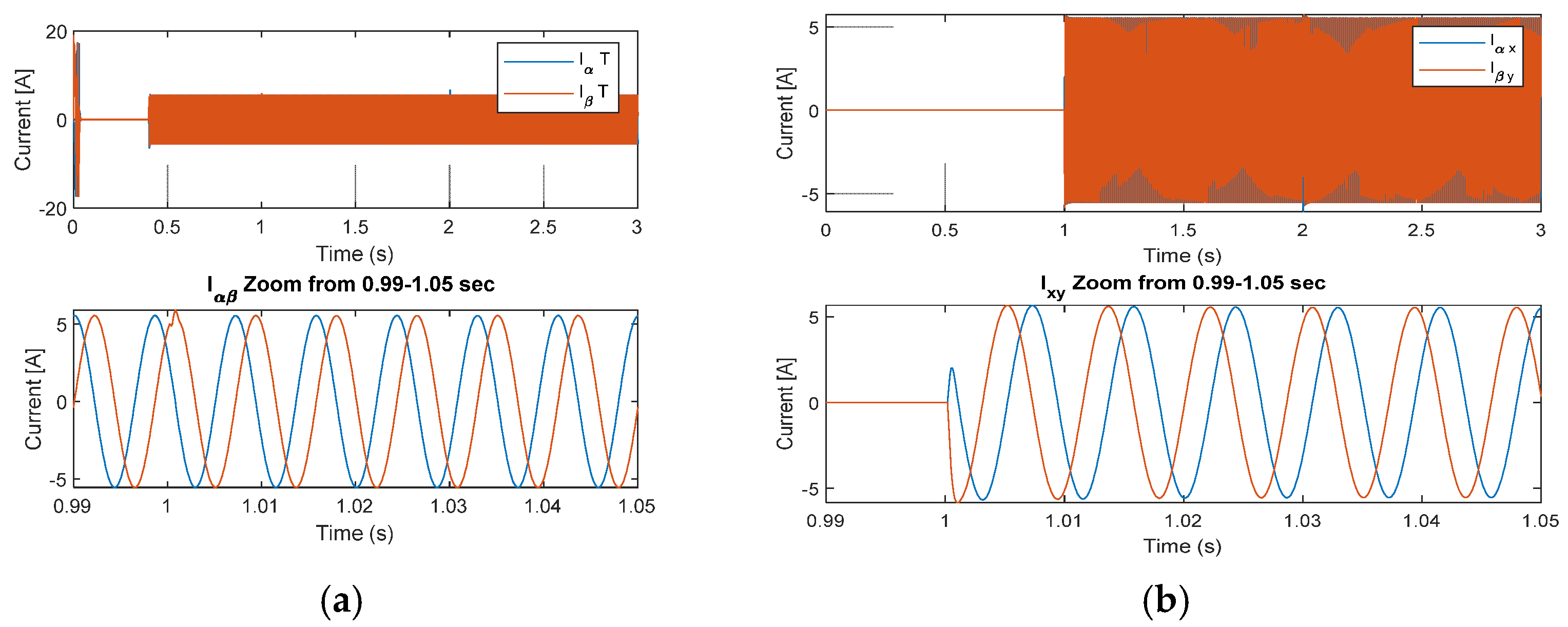
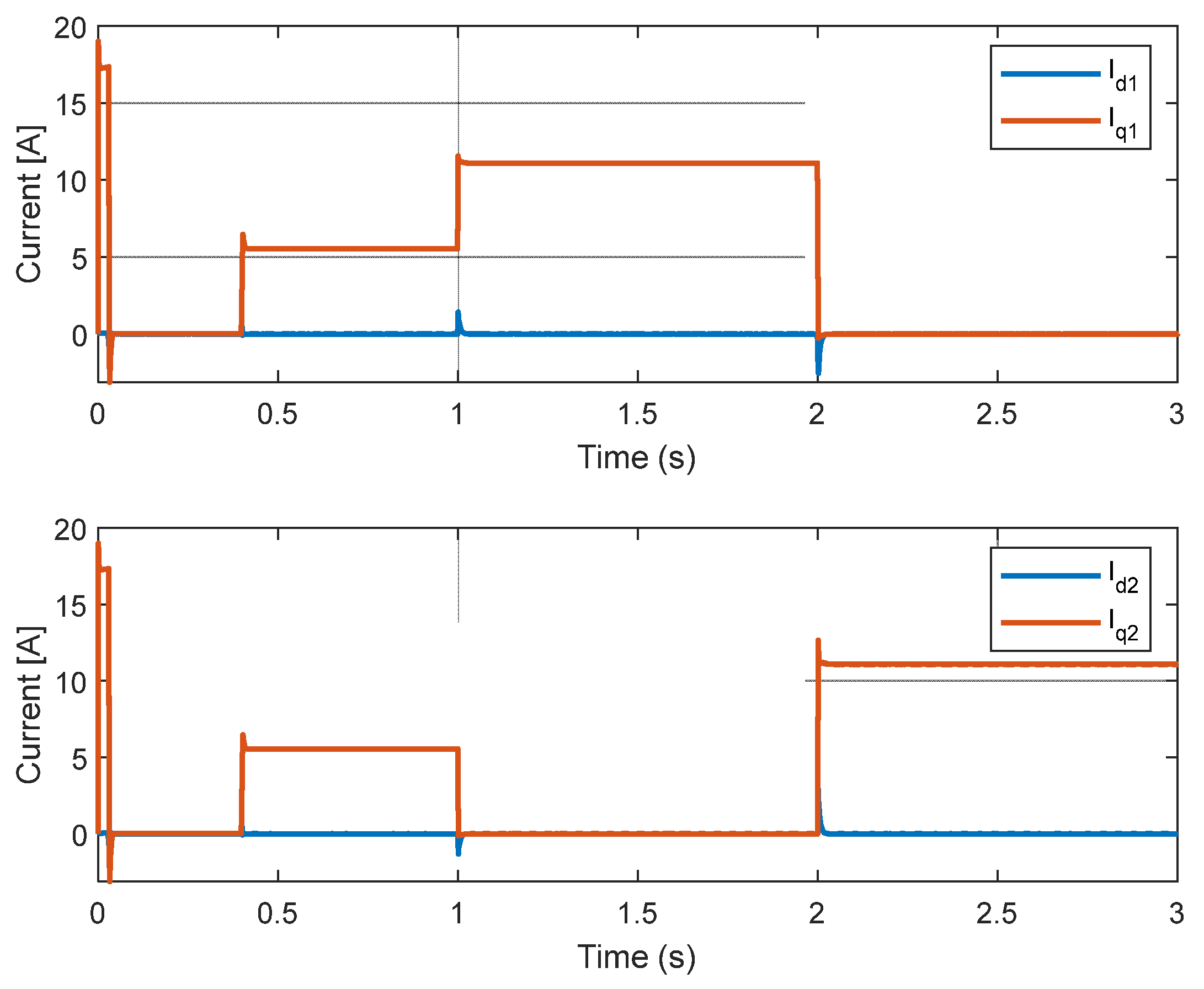
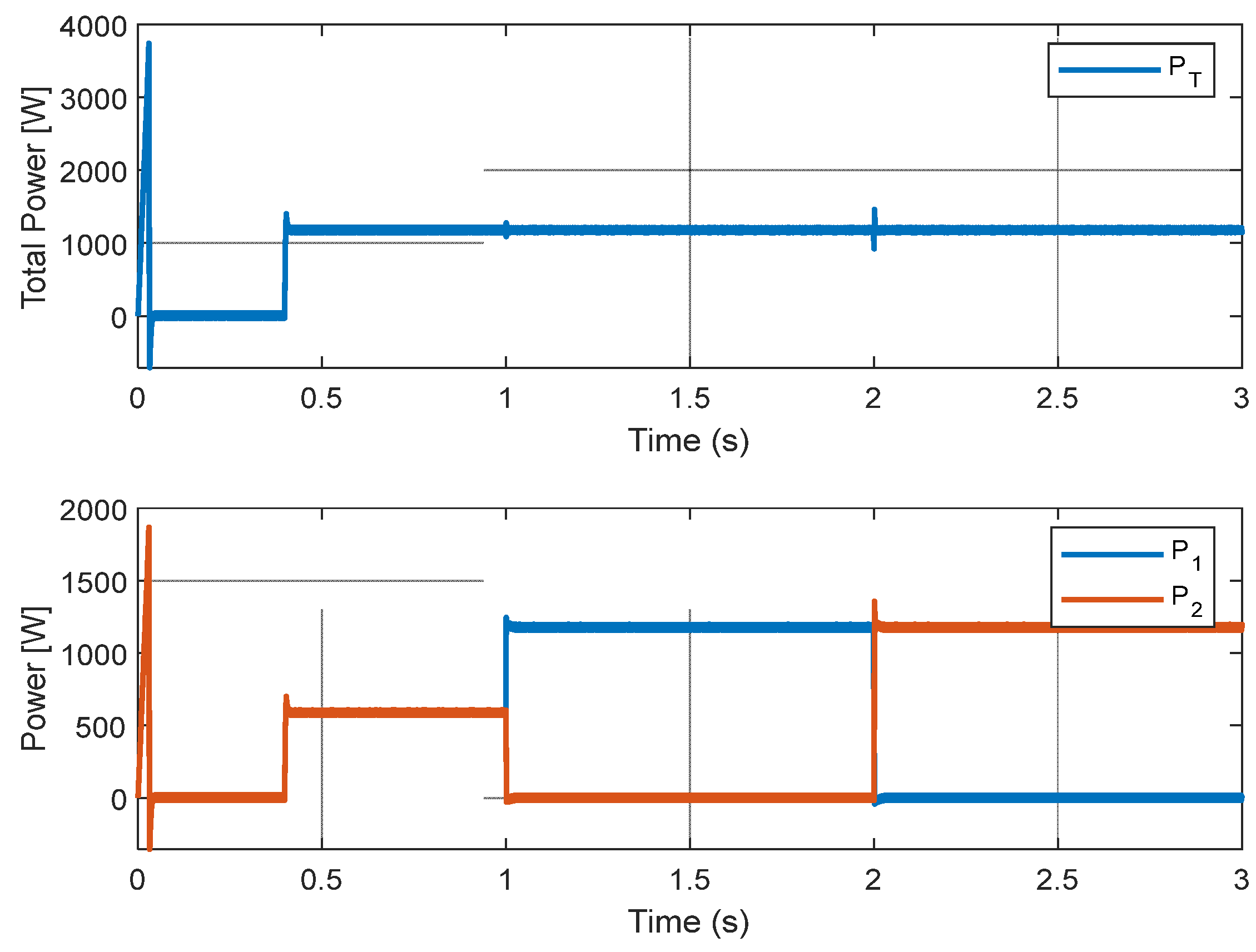
At startup, the motor speed is set to its rated value of 1400 rpm, and the torque is applied after 0.4 s, as illustrated in Figure 7. Figure 8 presents the evolution of the power-sharing coefficients across three modes: the pre-fault mode (0–1 s), the post-fault mode with set 2 faulty (1–2 s), and the post-fault mode with set 1 faulty (2–3 s). Figure 9a shows the fundamental harmonic I α β , which remains unaffected by power-sharing adjustments, indicating that the motor can deliver the required torque using only one functional set. The subharmonic I x y currents begin to circulate when one of the sets becomes faulty, as shown in Figure 9b. The I q current varies in response to changes in the power-sharing factor for each set, as illustrated in Figure 10, while I d remains zero across all fault conditions. Since the power-sharing strategy is designed to maintain constant total power output regardless of fault conditions, the machine’s overall output power remains stable. However, the power distribution between the sets adjusts dynamically according to demand, as shown in Figure 11. The control scheme demonstrates robustness by preserving the fundamental harmonic currents, magnetic flux, torque, and total power output, even under worst-case fault scenarios in which one set becomes non-functional.

3. Design Optimization

3.1. Overview

The proposed YASA-type AFPM introduces a highly coupled, 3D electromagnetic field distribution that depends on several interacting geometric variables such as slot opening, tooth-tip angle, and stator-rotor spacing, as well as material-dependent parameters. In such configurations, classical trial and error or parametric sweep design approaches are inefficient and may overlook non-linear trade-offs between torque, loss, and thermal performance. Therefore, a formal optimization framework is essential to identify a balanced design that satisfies aerospace constraints on torque, efficiency, mass, and temperature rise [41].
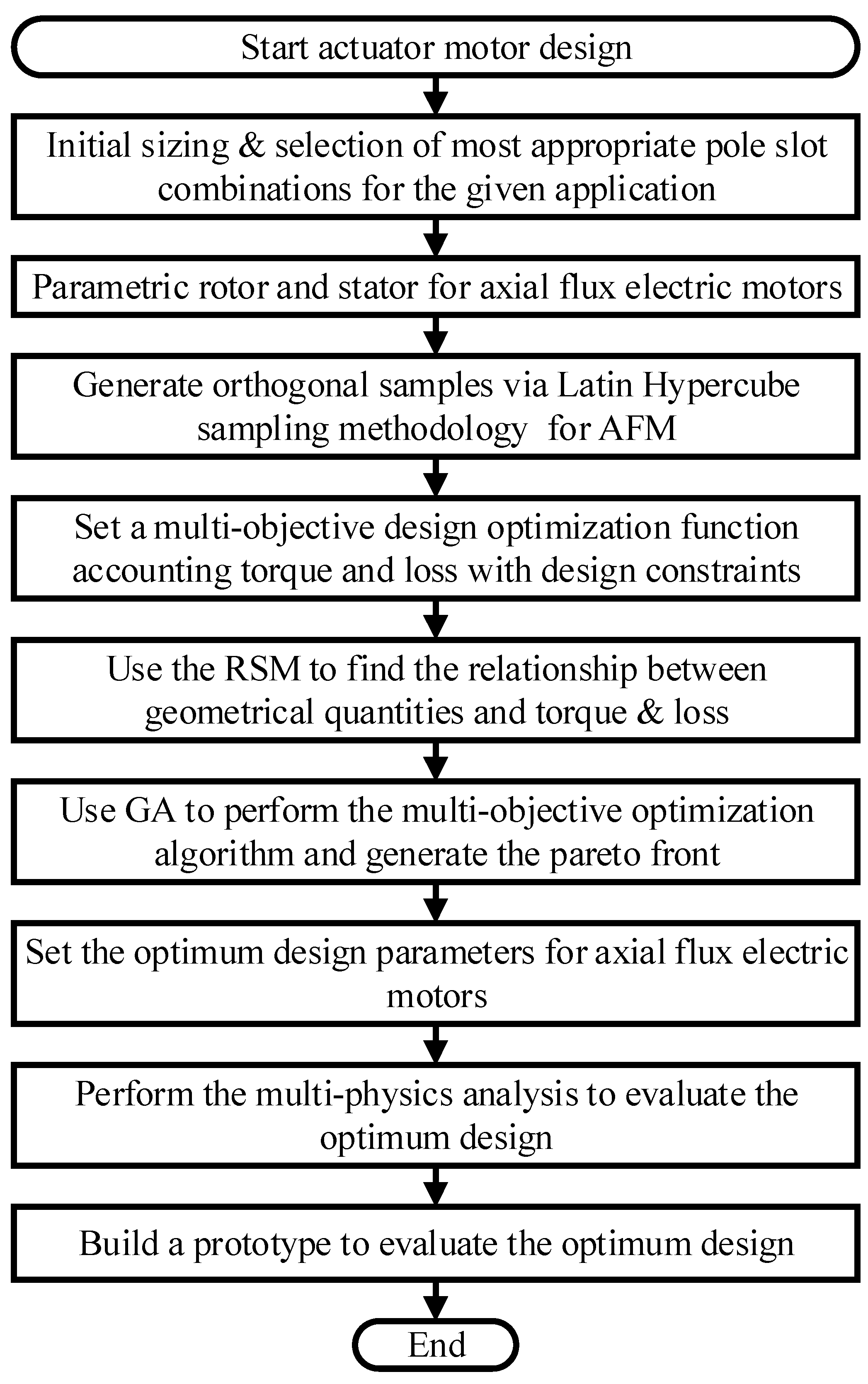
As shown in Figure 12, a surrogate-based design optimization (SBDO) framework was adopted for the efficient optimization of the axial flux permanent magnet (AFPM) motor geometry. This method is particularly advantageous for problems involving computationally expensive simulations, such as 3D finite element (FE) analysis of electric machines. Instead of relying on brute-force evaluations of every possible design through direct FE simulation—which would be prohibitively time-consuming—SBDO builds a fast-running approximation (or “surrogate”) of the system behavior using a limited number of high-fidelity simulations.
The optimization process begins with Latin Hypercube Sampling (LHS), a statistical method that ensures a space-filling and near-random distribution of samples across the entire range of design parameters. Each sampled design is evaluated using detailed FE simulations to extract performance metrics, such as electromagnetic torque and core losses. These outputs form the training data for constructing response surface models (RSMs), which are analytical or polynomial-based approximations that capture the input–output relationships of the system with high accuracy. RSMs are computationally lightweight and can be evaluated in milliseconds, making them ideal surrogates for optimization loops.
Once the surrogate models for torque and loss are established, a multi-objective genetic algorithm (GA) is employed to explore the design space efficiently. GA is well-suited for global optimization and can handle non-linear, multi-modal functions and constraint-bound problems. By operating directly on the surrogate equations instead of the original FE models, the overall computational cost of the optimization process is drastically reduced, often by several orders of magnitude, while still maintaining high fidelity in the results. This approach enables rapid exploration of trade-offs, such as maximizing torque while minimizing losses, under realistic constraints on geometry, current density, voltage, and thermal performance.

3.2. Parametric Motor Models and Variables

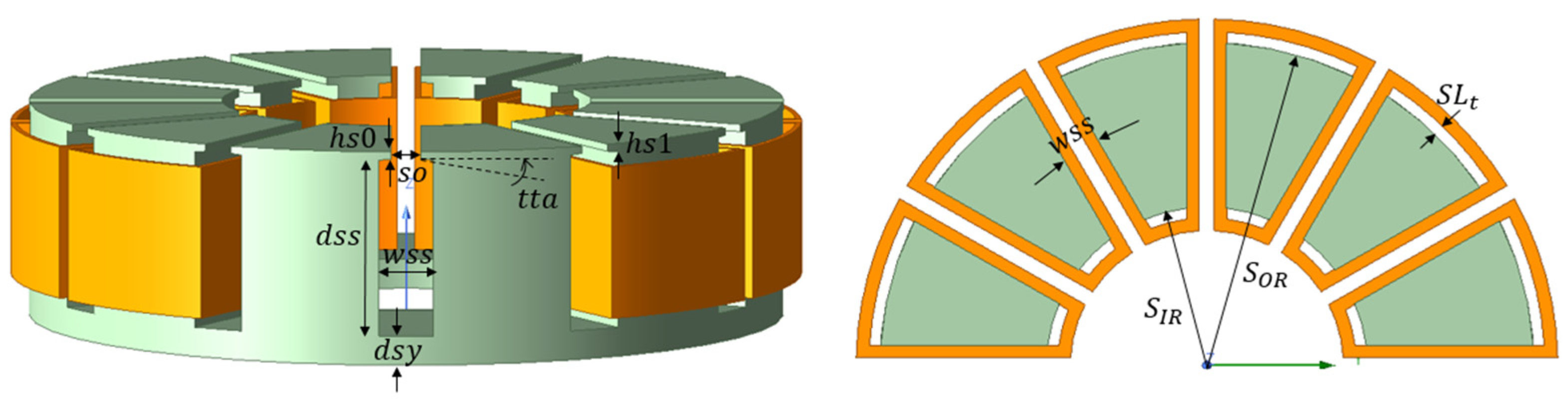
Figure 13 shows the parametric models for axial flux PMSM. The outer diameter of the motors and active lengths are fixed for the proposed designs. The upper and lower bounds of design parameters are tabulated in Table 4.

3.3. Response Surface Optimization of YASA-Type AFPM

The proposed actuators will run at the ambient temperature of 175 °C, so thermal efficiency is critical. The objective of the optimization is to maximize the torque for the given design constraints and minimize the total losses. This is given in (24). It should be noted that the change in slot geometry results in a change in slot volume. With the change in slot volume, the number of turns has been varied to keep the current density fixed under the constraint of the terminal phase voltage of 155 Vpeak (See Table 4).
M a x i m i z e   F o b j 1 z   &       M i n i m i z e     F o b j 2 z   s u b j e c t   t o L B g e o m e t r i c a l   c o n s t r a i n t s   U B J p e a k   21 A r m s m m 2   a t   T p e a k K f = 0.45 108   N t u r n s     160 V p h ^   155   V   &   I s c ^ < 20   A
where F o b j 1 z stands for torque, F o b j 2 z is for motor losses at 1400 rpm, and J p e a k and K f stand for peak operation current density and slot fill factor, respectively.
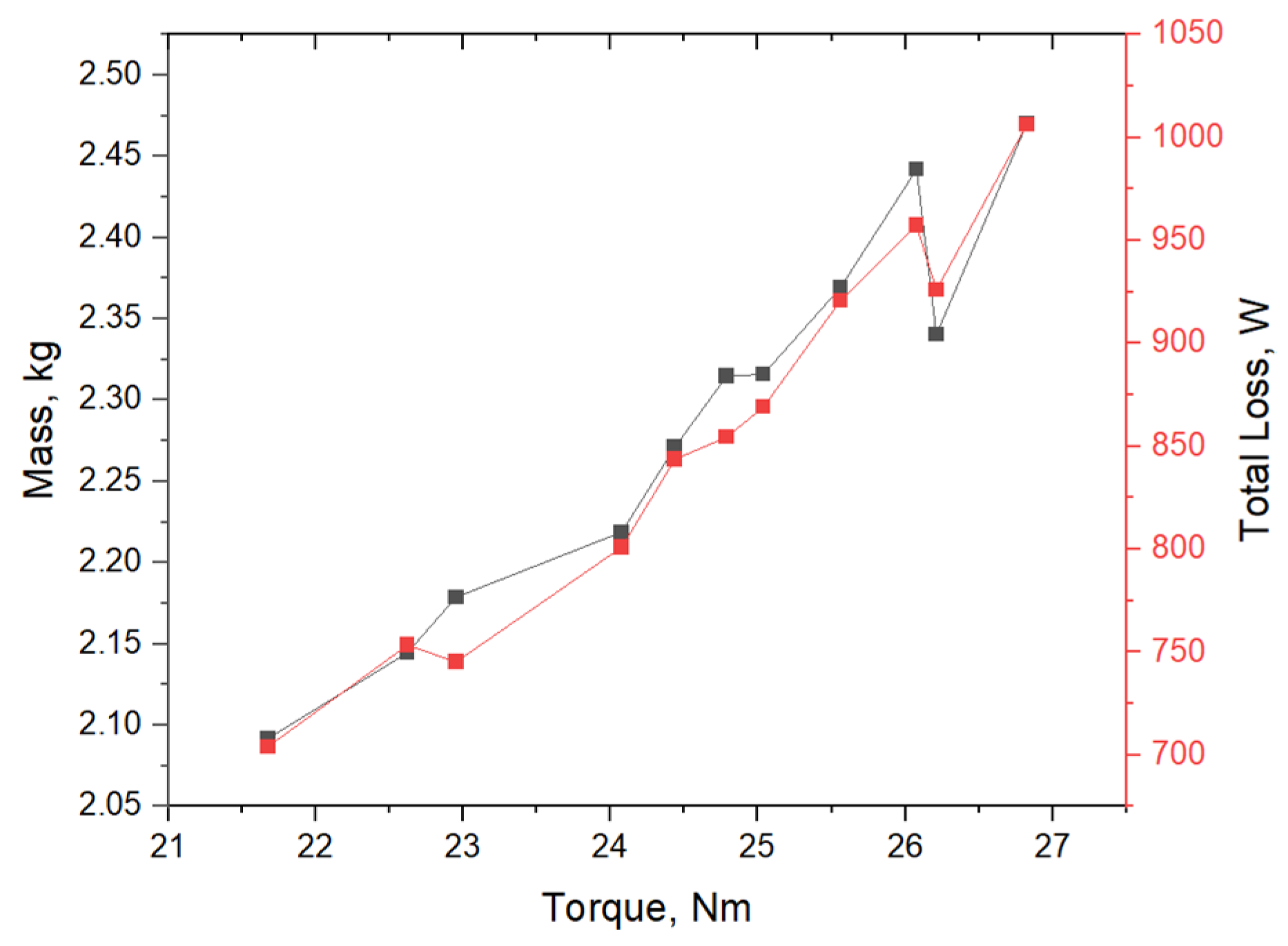
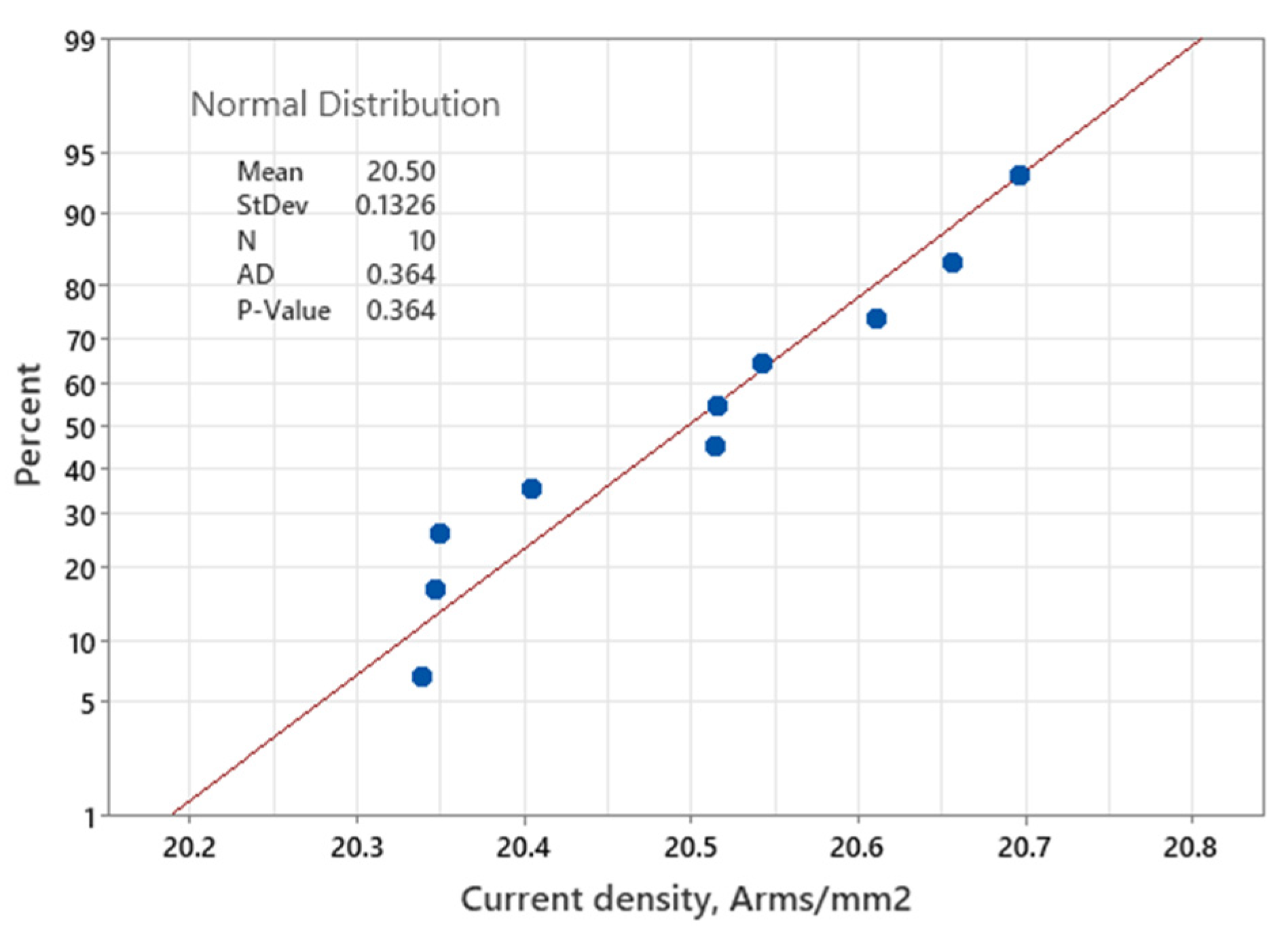
A 12-slot, 10-pole, axial flux machine is well-suited for a fault-tolerant actuator due to its ability for the windings to be organized as a double three-phase motor output. The multi-objective optimization considers torque and loss parameters. It can be noted that although mass reduction is critical in aerospace applications, the optimization function does not directly consider the mass of the designs. This is because stator active mass and loss are highly correlated (r = 0.986) based on the Pearson correlation test. The trend of mass and loss with respect to torque is shown in Figure 14. Loss reduction would ultimately lead to a reduction of active material mass in this case. The normal distribution of current density across the design space was confirmed, with a mean of 20.5 A/mm2 and a standard deviation of σ = 0.132, as shown in Figure 15.
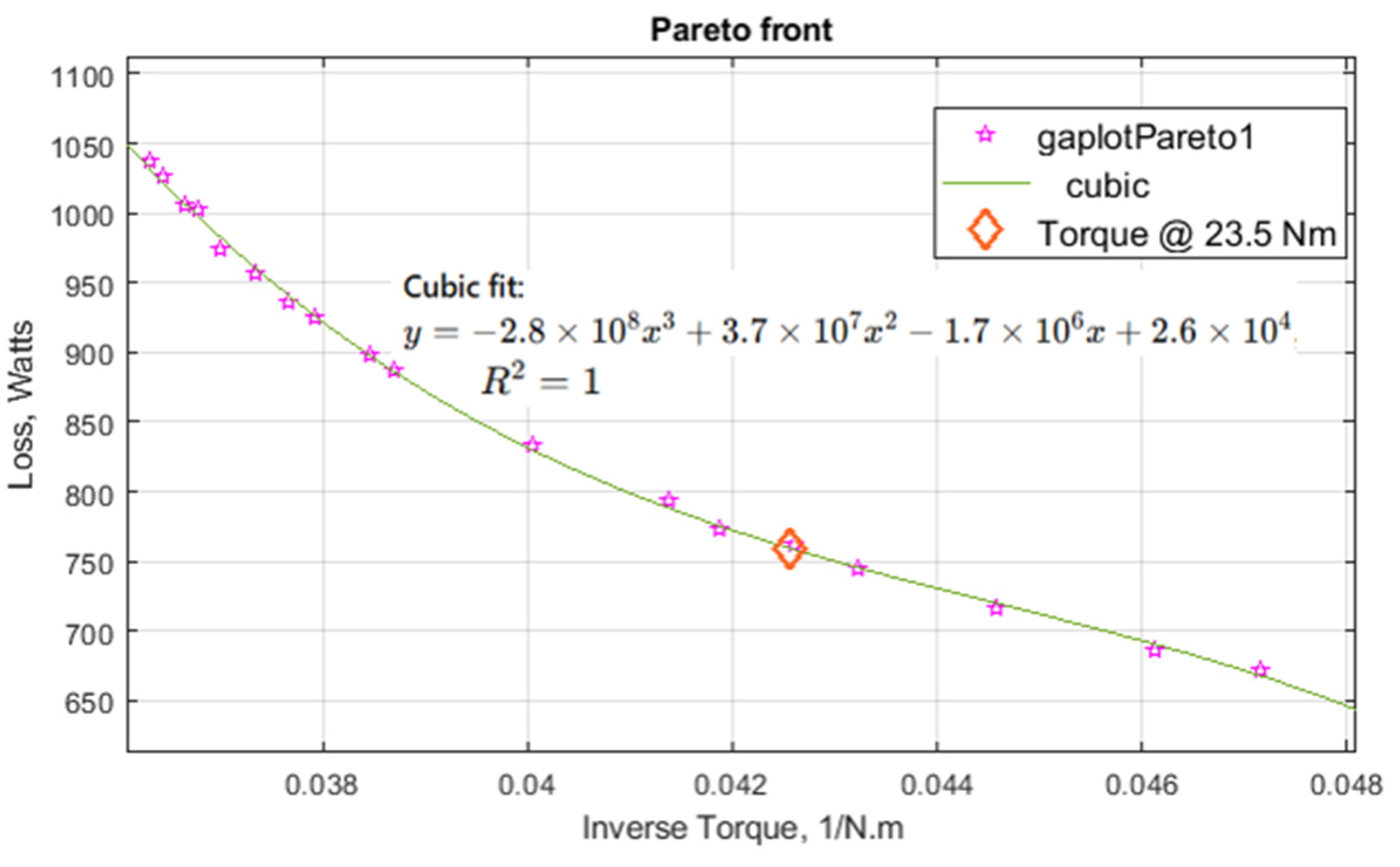
The response surface regressions for the torque and loss parameters of the axial flux machine are provided in Equations (25) and (26). The analytical equations (torque, loss) given in (21) are optimized via multi-objective GA optimization in Matlab, and the optimum parameters have been obtained under the constraints of the problem. The pareto front is shown in Figure 16, where 23.51 Nm peak torque is achieved with the parameters given in Table 5.
T o r q u e =   3.37 + 0.69   b s 0 5.48   h s 0 0.148   t t a + 5.744   w s s 0.017   ( b s 0 ) 2 + 2.16   h s 0 2 + 0.0047 t t a 2 0.249   w s s 2 0.29 b s 0 ( h s 0 )
L o s s = 227.1 + 62.72   b s 0 23.96   h s 0 1.16   t t a + 128.1   w s s 1.573   b s 0 2 + 53   h s 0 2 0.145 t t a 2 2.879 w s s 2 25.44   ( b s 0 ) ( h s 0 )

3.4. Results

3.4.1. RSM Model Reliability

To validate the accuracy of the surrogate model and the optimization results, the optimal design obtained from the response surface model (RSM) was re-evaluated using full 3D finite element analysis (FEA). The comparison between the predicted and simulated performance is summarized in Table 6. The torque prediction from the RSM differs by only 0.63% from the FEA result, while the total loss prediction shows a deviation of 2.9%. These low error margins confirm the reliability of the surrogate model in capturing the key performance metrics of the AFPM motor. This level of accuracy demonstrates that the response surface approach is well-suited for guiding the optimization process, significantly reducing computational effort without compromising predictive fidelity.

3.4.2. Magnetic Flux Density Distribution

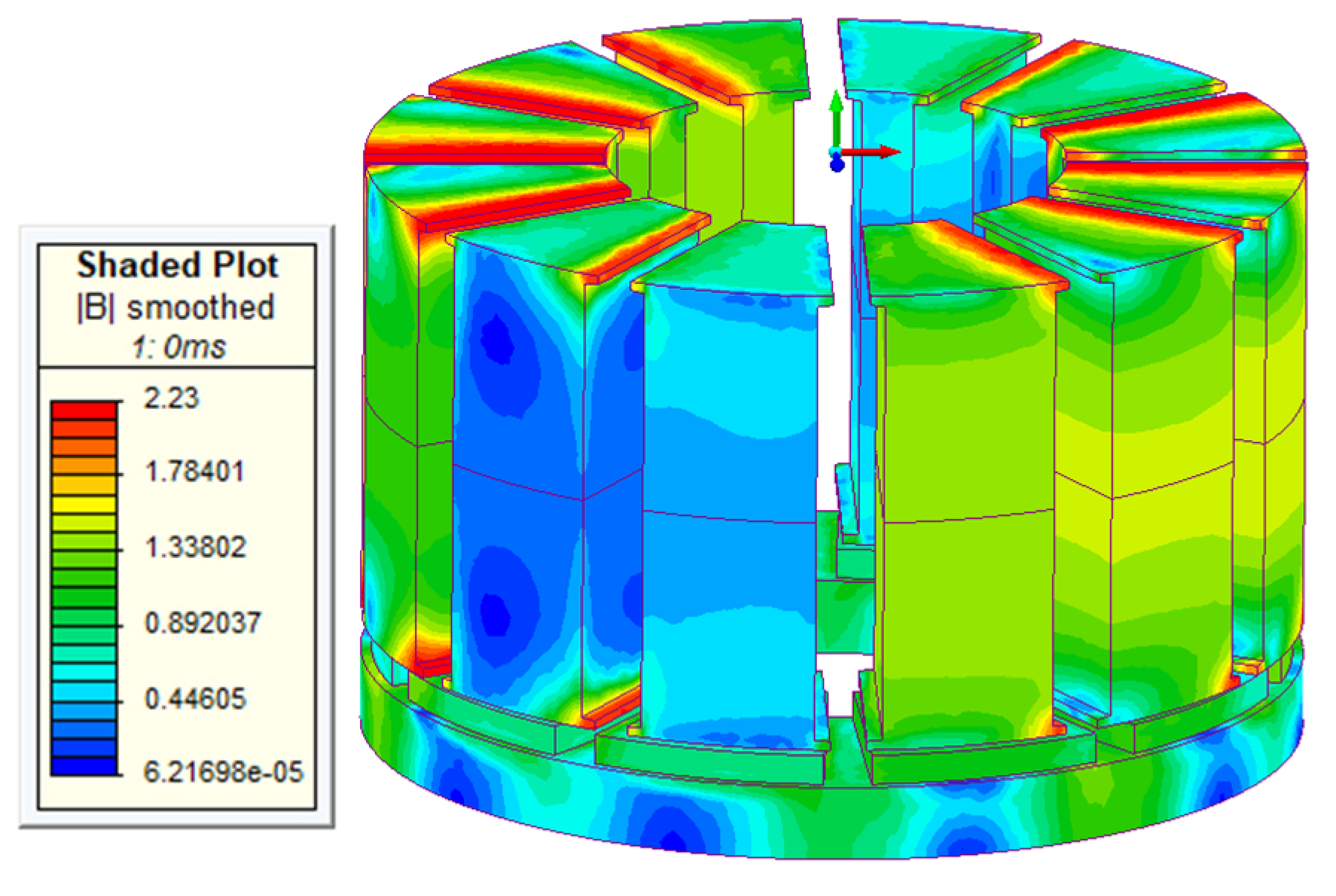
The magnetic flux density distribution of the optimized AFPM motor is illustrated in Figure 17. The results indicate a well-balanced magnetic design, with no significant saturation observed in the stator or rotor yoke regions. This confirms that the selected geometry and material usage are effective in maintaining magnetic performance within acceptable limits under peak operating conditions. The average magnetic flux density of the stator tooth is around 1.7 T, which is an acceptable value.

3.4.3. Performance Characteristics

Following the surrogate-based optimization process, the performance of the YASA-type AFPM design was assessed using 3D finite element analysis. At a peak current of 20 A and a current density of 20.6 A/mm2, the optimized machine produced 23.51 Nm with 59 turns per coil. The short-circuit current was 14 Arms, remaining within acceptable thermal and electrical limits. The design required 0.49 kg of samarium–cobalt magnets and achieved 3.5 kW at the rated speed with an efficiency of 81.6%.
In practice, the brittle nature of soft magnetic composites (SMCs) necessitated thickening of the tooth tips from 1.04 mm to 1.6 mm, which increased inter-segment flux leakage. In addition, dual three-phase operation requires mitigation of residual coupling between healthy and faulty channels, which in turn benefits from a higher number of turns. A further design consideration is the systematic discrepancy between 3D simulation and experiment, where measured torque is typically lower than predicted. The 59-turn design achieved only 23.51 Nm, nominally equal to the target torque, leaving no performance margin. To address both fault-tolerance requirements and the need for reserve torque capacity, the final design employed 74 turns per coil (see Figure 2Section 1).
This adjustment increased the peak current density to 24.9 A/mm2 (one-second duty) but was confirmed feasible through winding trials on additively manufactured mock stator segments with 0.85 mm conductors. The revised FEA predicted 28.3 Nm at 175 °C ambient, demonstrating compliance with actuator specifications while providing sufficient margin to accommodate experimental underperformance and material uncertainties.

3.4.4. Finite Element-Based Thermal Analysis

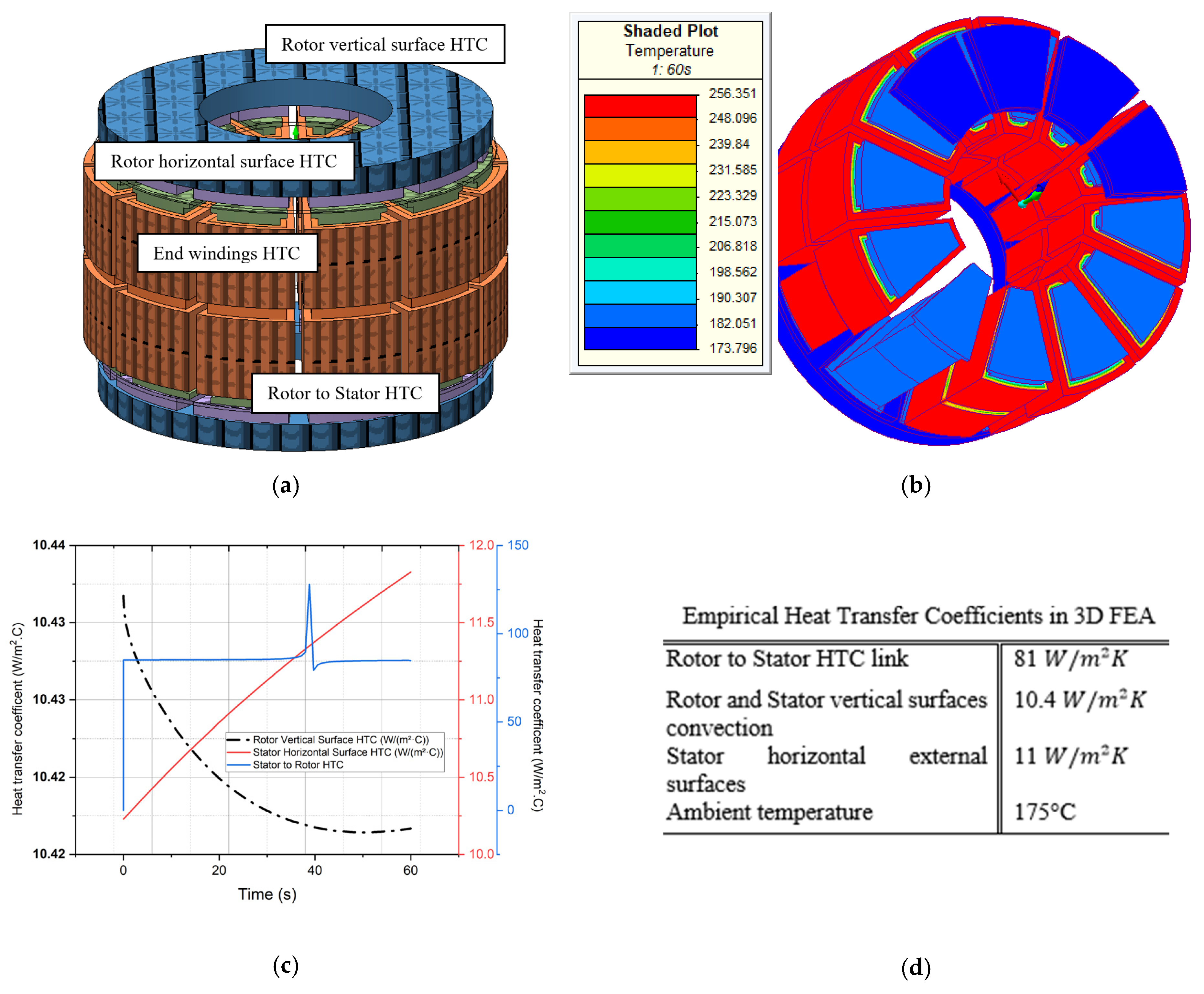
A transient thermal analysis was performed using Siemens Magnet Thermal software package on the optimized YASA-type AFPM motor to evaluate its temperature rise under peak load conditions. The simulation considered 60 s of continuous operation at peak torque, assuming an ambient temperature of 175 °C. No passive thermal management materials were included in the model, except for standard slot liners, to assess the baseline thermal behavior. The thermal setup, including boundary conditions and material properties, is illustrated in Figure 18. Empirical heat transfer coefficients (HTCs), based on established correlations [42,43], were applied to model convection and conduction effects within the motor assembly. The results show that the maximum temperature remains below the critical thermal limit of 260 °C throughout the one-minute operation. It is important to note that in the intended aerospace EMA application, peak torque is typically required only for brief durations (on the order of one second). Also, the presence of surrounding actuator components, such as the mounting plate and protective casing, would enhance heat dissipation, further reducing the temperature rise under real operating conditions.

4. Transient Structural Analysis in the Event of Short Circuits

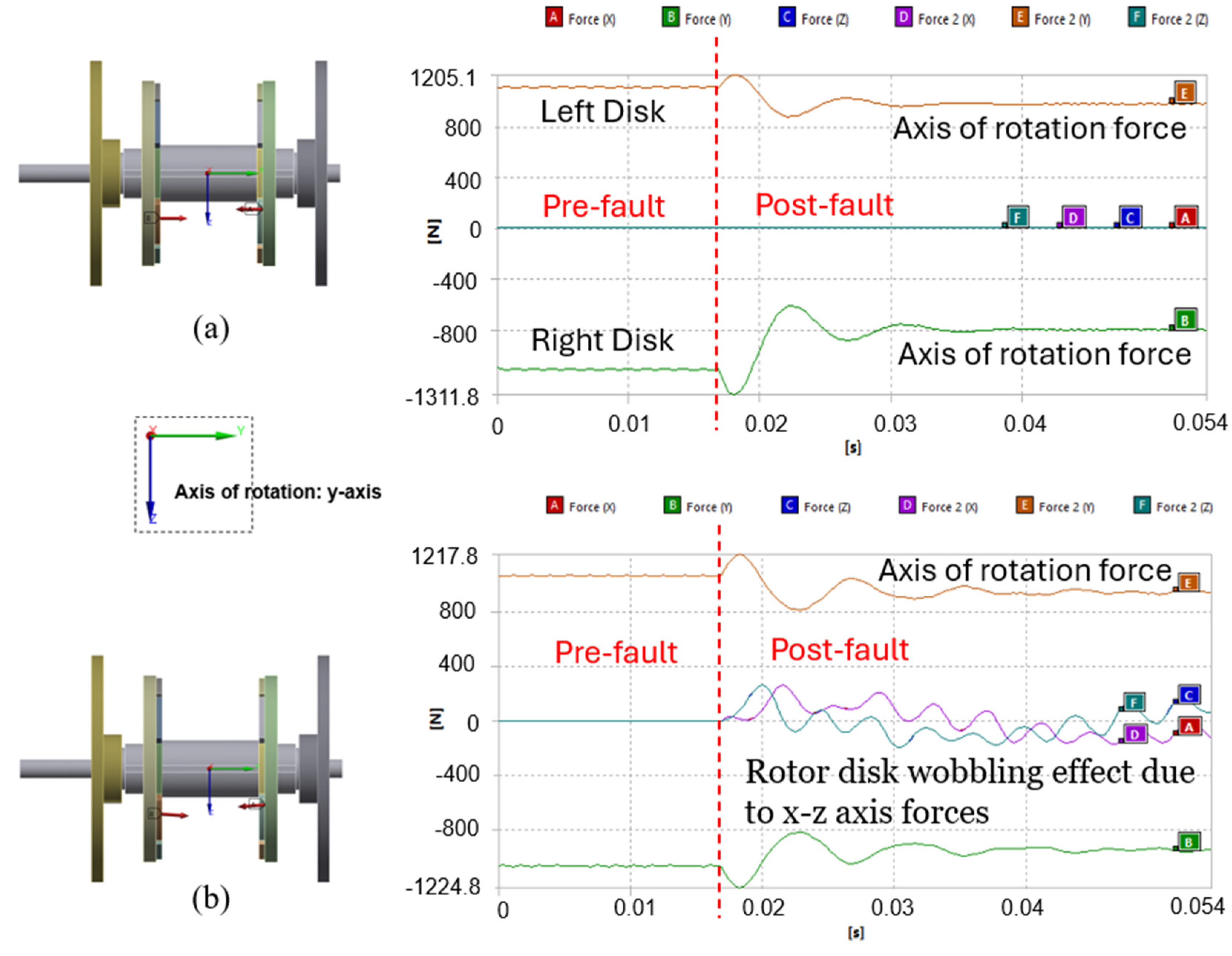
While unbalanced axial forces are negligible during healthy operation across all winding configurations of the 12-slot, 10-pole, YASA-type AFPM, their impact on rotor behavior becomes critical under fault conditions. Three-phase short circuits in one of the sub-machines can generate significant transient forces when the machine is on load. To assess this, electromagnetic simulations were performed for the winding layouts shown in Figure 3b (“conventional”) and Figure 3d (“fault-tolerant”), as described in Section 2.1. Axial forces on the rotor disks were calculated using the Maxwell stress approach, i.e., by evaluating the surface force density across the rotor airgap under three-phase short-circuit conditions. The resulting force distributions (Figure 19a,b) were subsequently imported into ANSYS Workbench 2023 R1 for structural analysis of rotor deformation.
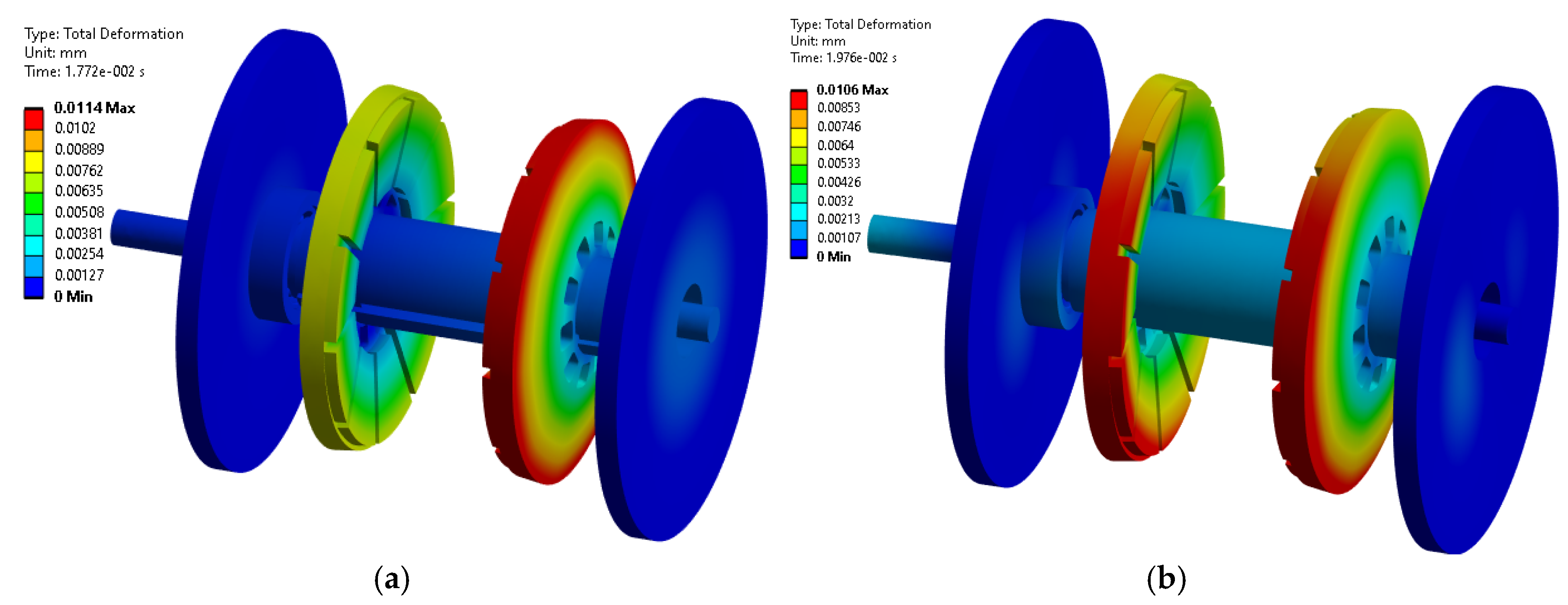
The rotating assembly consisted of an EN24T shaft, 416-grade stainless steel rotor disks, SKF angular contact bearings (ACBs) with 12 mm bore diameter, Recoma 33E (Arnold Magnetics) samarium–cobalt permanent magnets, and aerospace-grade aluminum end caps for the housing. Structural simulations were carried out using the elastic properties of these materials. The boundary conditions included fixed support at the end caps, prescribed angular velocity of the rotor, application of the calculated surface forces, and a revolute joint representing the ACBs, which provided five degrees of freedom for the bearing balls. The results (Figure 20) show that, while the fault-tolerant winding layout maintains torque production in the healthy winding sets during short circuits, it introduces unbalanced axial forces that excite rotor wobbling. Although the predicted peak displacement is relatively small (0.0106 mm) for this application, this behavior highlights a potential concern for high-speed, high-torque YASA AFPMs and should therefore be evaluated during the early design stages.

Frequency and Modal Analysis of Deformation

Sustained mechanical displacements induced by time-varying axial forces in the rotating assembly can give rise to vibration and acoustic noise. To assess these effects, a frequency domain analysis of the rotor was conducted based on the transient deformation characteristics obtained from simulations of both conventional and fault-tolerant winding configurations. Furthermore, the natural frequencies of the rotating structure were determined through a modal analysis performed in ANSYS Workbench.
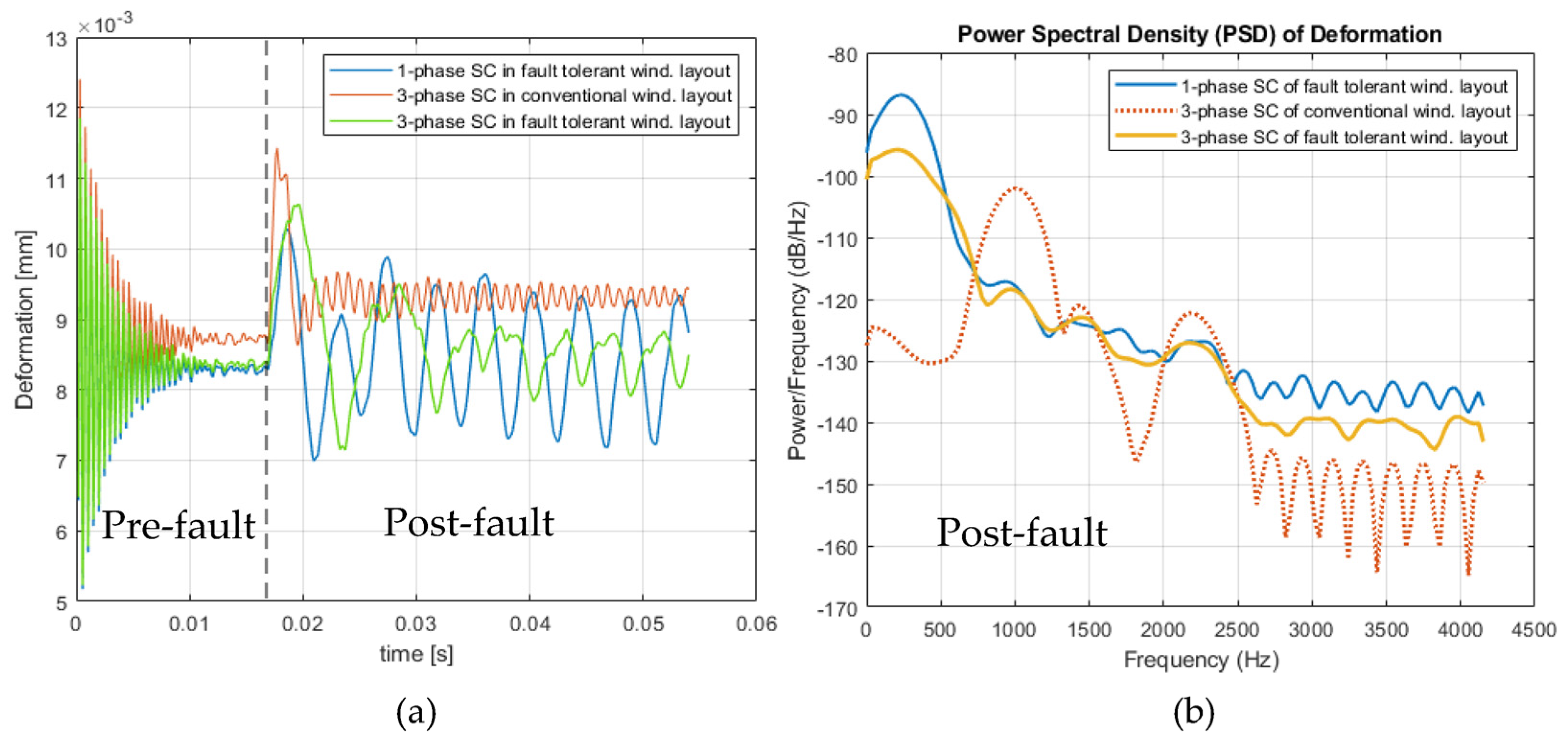
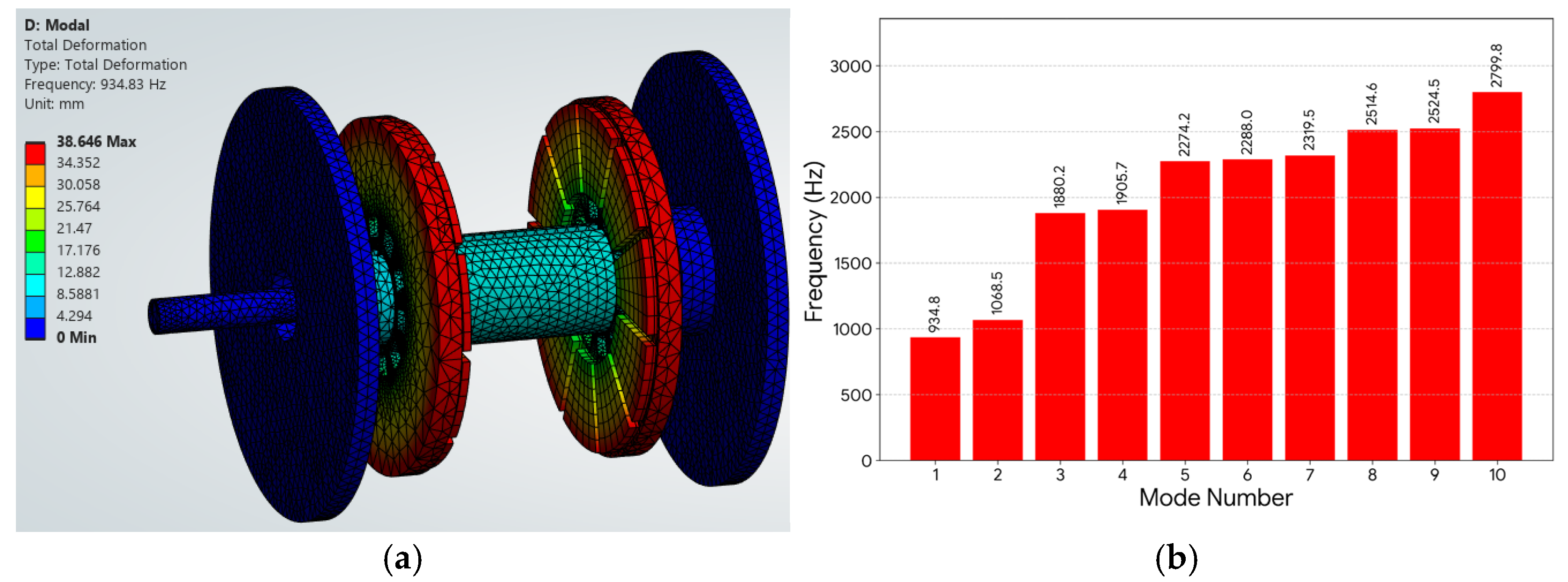
Figure 21a presents the time-varying deformation of the rotating element under single-phase and three-phase short-circuit conditions for both the conventional and the fault-tolerant winding layouts. The corresponding power spectral density (PSD) results, presented in Figure 21b, provide insight into the vibration and acoustic behavior associated with these transient events. Although the overall deformation magnitudes remain low, the spectral distribution reveals that single-phase short circuits induce higher vibration levels than three-phase faults, with the conventional winding layout exhibiting the lowest vibration response. The PSD in Figure 21b further indicates that the dominant deformation components are concentrated within the 250–1000 Hz range, consistent with low-order electromagnetic force harmonics [44]. This frequency band largely lies below the first structural natural mode at approximately 935 Hz—Figure 22. Nevertheless, a component near 933 Hz (≈8 fₑ) closely coincides with this mode and may experience slight amplification. Aside from this near-resonant component, the remaining spectral content is sub-resonant, and the PSD shows diminishing energy above 1000 Hz. This implies weak dynamic coupling with higher-order modes and hence a reduced susceptibility to resonance-driven vibration or acoustic noise.

5. Experimental Validation

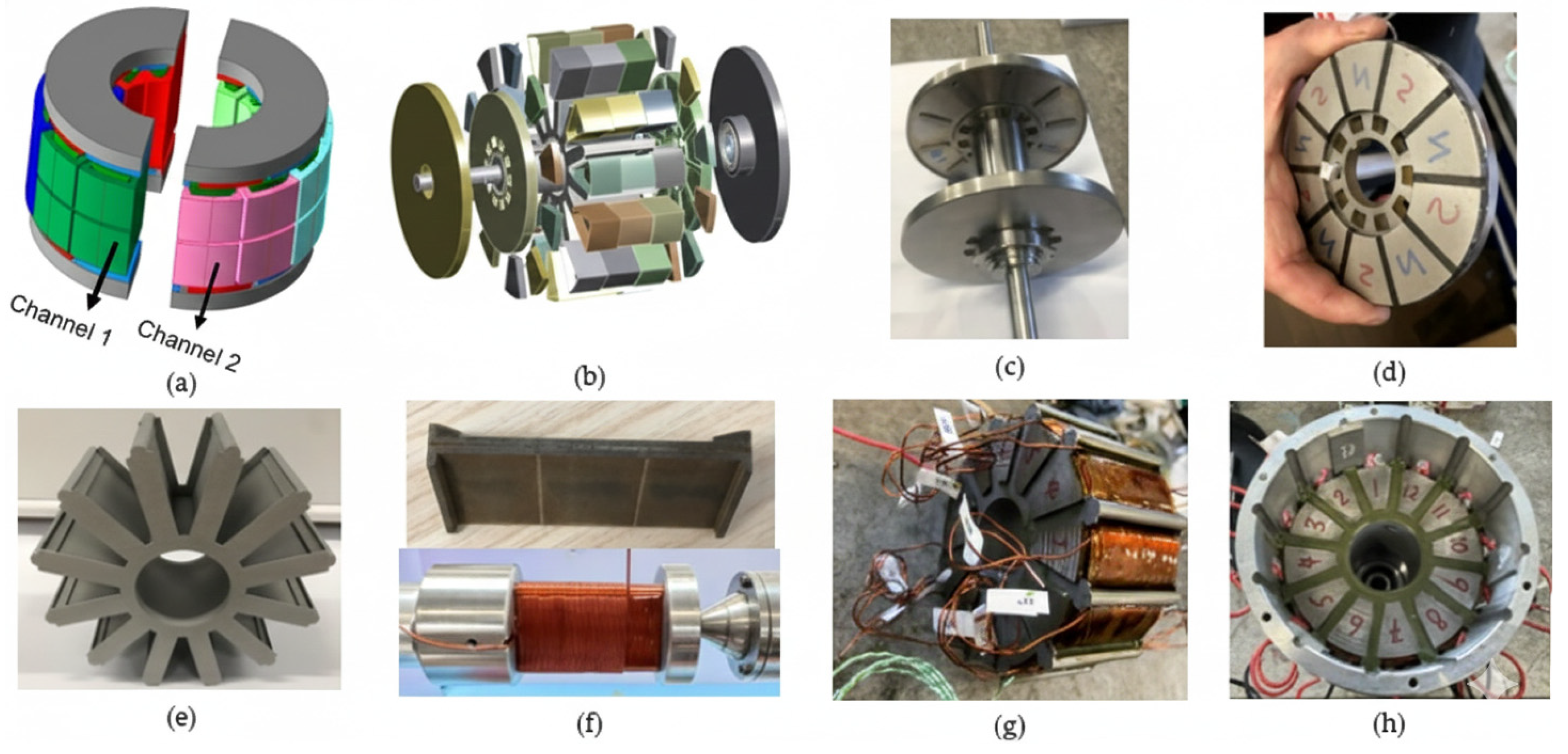
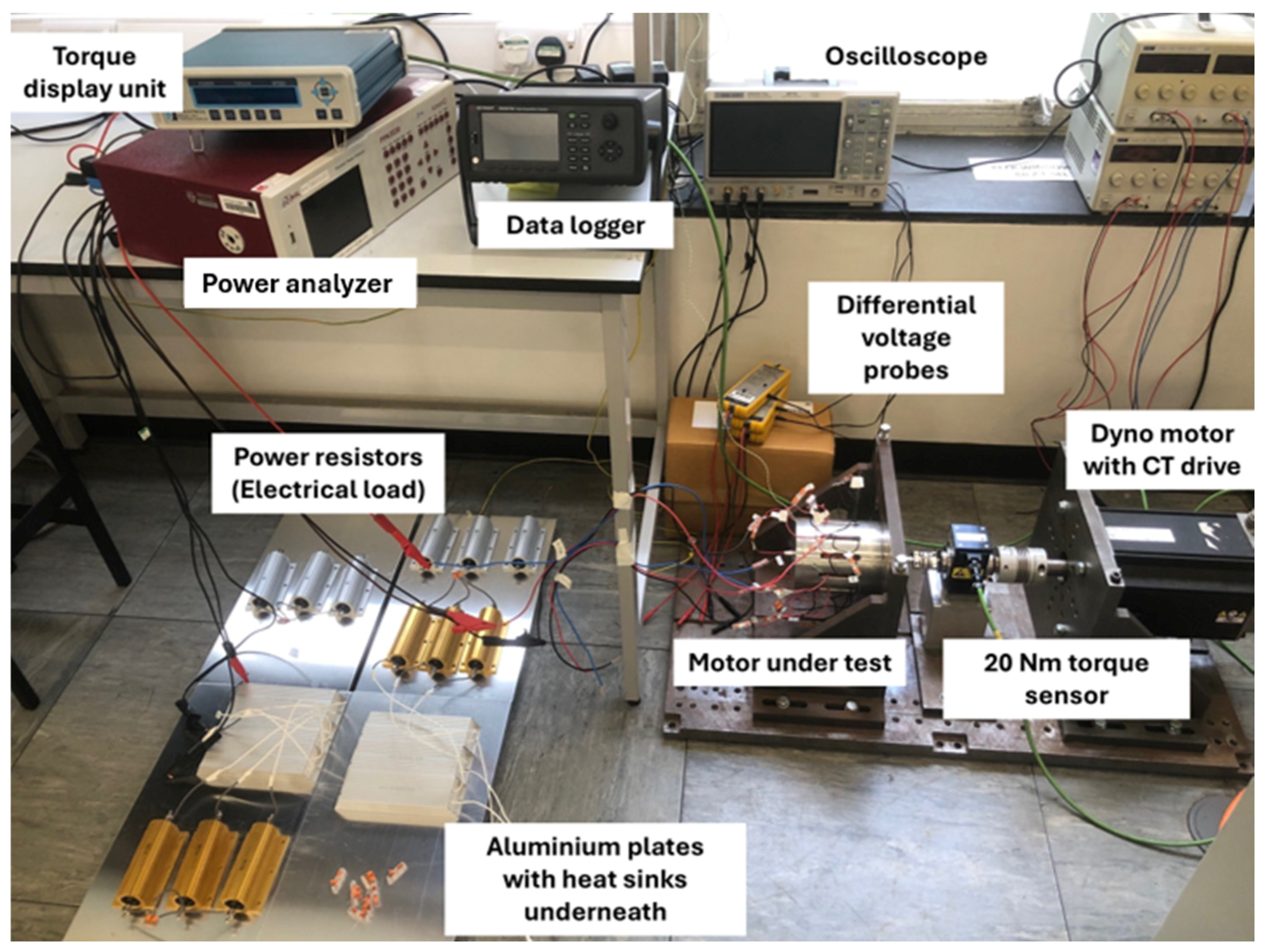
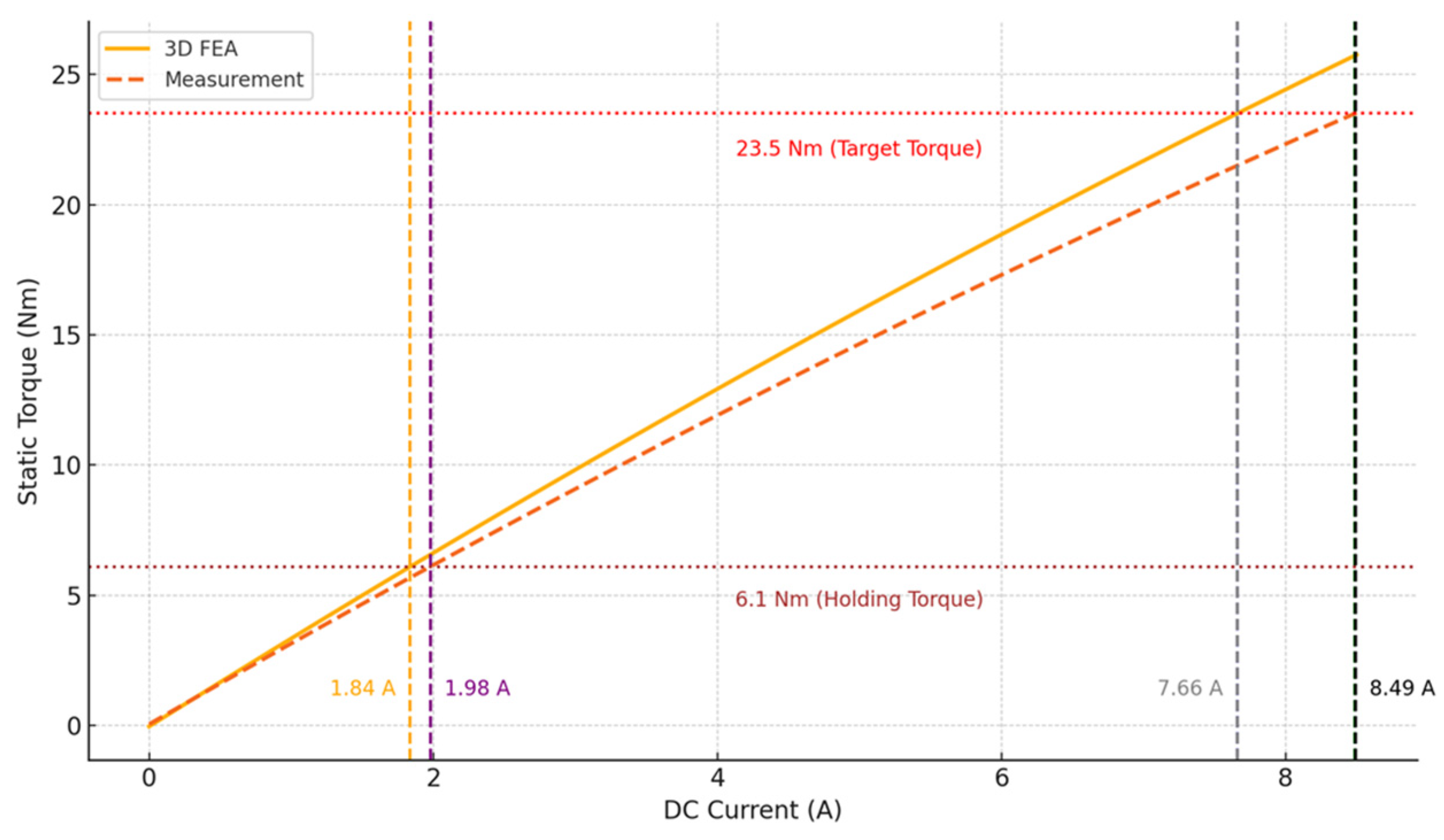
To validate the proposed dual three-phase fault-tolerant AFPM motor, as well as to assess the accuracy of both the finite element model and the optimization algorithm, a physical prototype was fabricated. The manufacturing process and key components of the motor are shown in Figure 23. To experimentally evaluate the motor’s static torque performance under controlled conditions, a dedicated test setup was developed. As illustrated in Figure 24, the setup includes a precision torque sensor, a programmable power supply, and a high-resolution encoder to capture torque output across various rotor positions with high accuracy. Static torque measurements obtained from the prototype are presented in Figure 25 and compared directly with 3D FE simulation results under identical operating conditions. The comparison indicates good agreement, with a deviation of only 8.6% between the measured and simulated torque values.
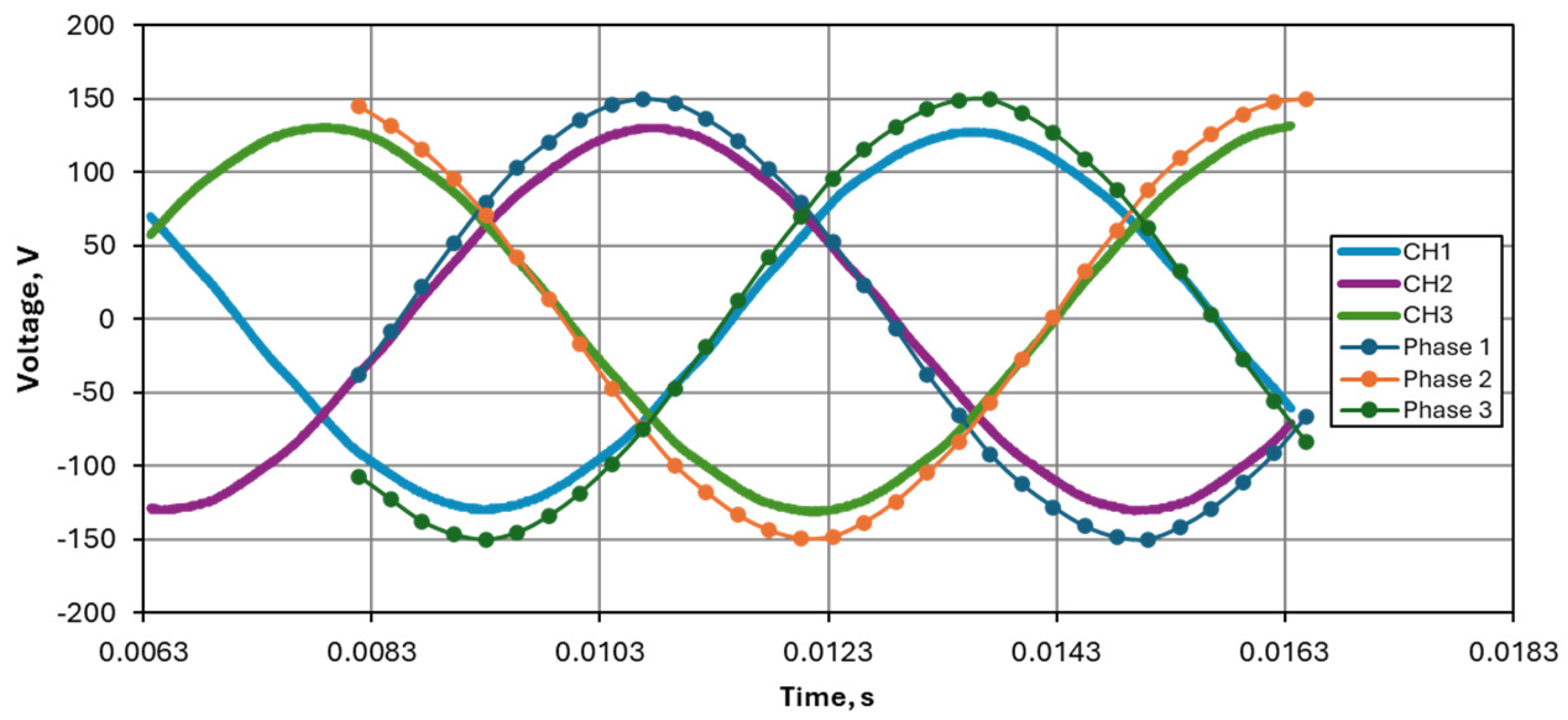
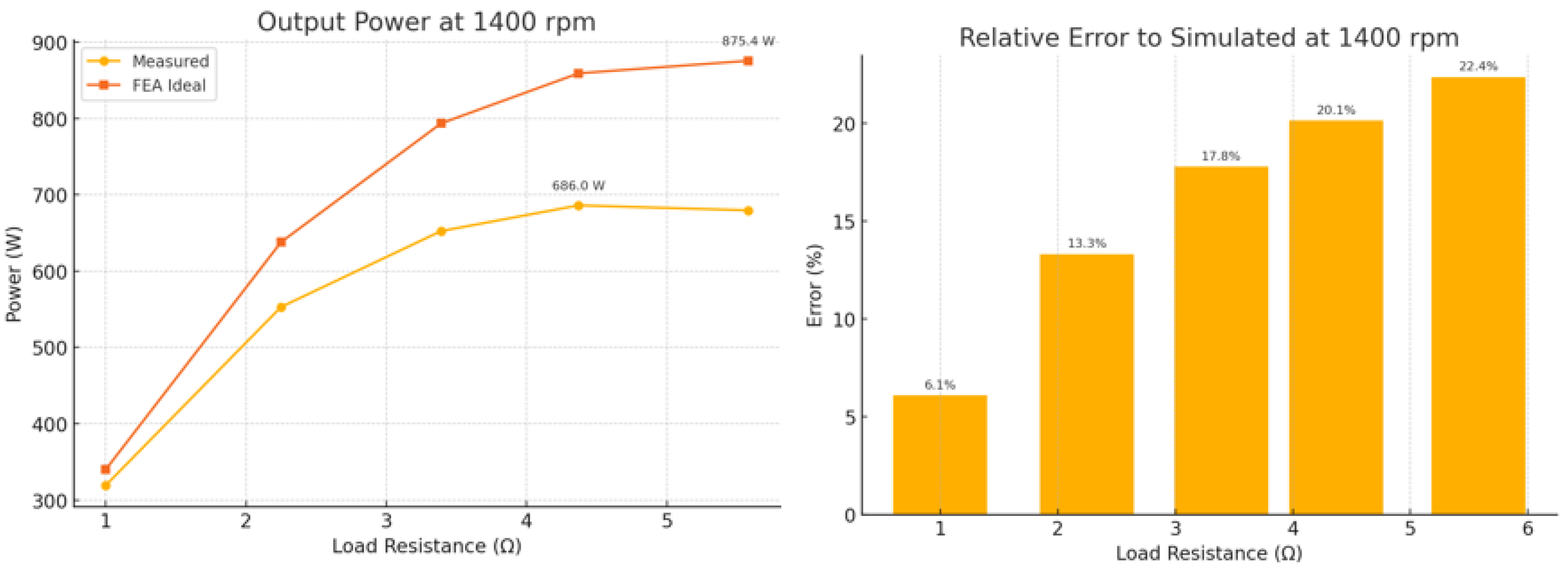
The line-to-line back-EMF measured on the prototype was consistently lower than predicted by 3D FEA, with a discrepancy of approximately 13.1% (Figure 26). When operated as a generator, the deviation increased to as much as 22% at high load resistances, whereas at low resistive loads, the error reduced to around 6% (Figure 27). This behavior cannot be attributed to core saturation, as the static torque measurements showed close agreement with simulation. The latter is explained by the fact that static torque tests mask dynamic eddy-current effects, since they are not strongly excited under DC excitation conditions. In contrast, dynamic operation introduces significant AC flux variations, exposing frequency-dependent material behavior (i.e., complex permeability) that is not fully represented in the simulation model.
The results indicate that the FEA model idealizes the flux linkage characteristics of the machine, leading to systematic overprediction of back-EMF. These idealizations are partially masked under high current loading (low resistive load), where the impedance voltage drop dominates, but become fully apparent at low current loading (high resistive load), where the terminal voltage is governed almost entirely by back-EMF. A key contributing factor is the prototyping method: electrical discharge machining (EDM) of the SMC segments damages the cut surfaces, forming locally conducting layers that increase eddy currents, alter permeability, and reduce the effective flux linkage [31]. Although FEA accounts for bulk eddy-current effects, it does not capture these localized surface phenomena, thereby explaining the observed discrepancies.

Model Calibration to Capture Material Deformation and Electrical Resistivity Effects in SMC

Wire EDM processing generates a thin heat-affected layer with locally elevated electrical conductivity on the SMC surfaces. In segmented YASA stators, this acts like a thin conductive shell around each tooth, intensifying surface eddy currents under AC excitation. The resulting demagnetizing MMF reduces flux linkage (lower EMF) and introduces frequency-dependent apparent inductance.
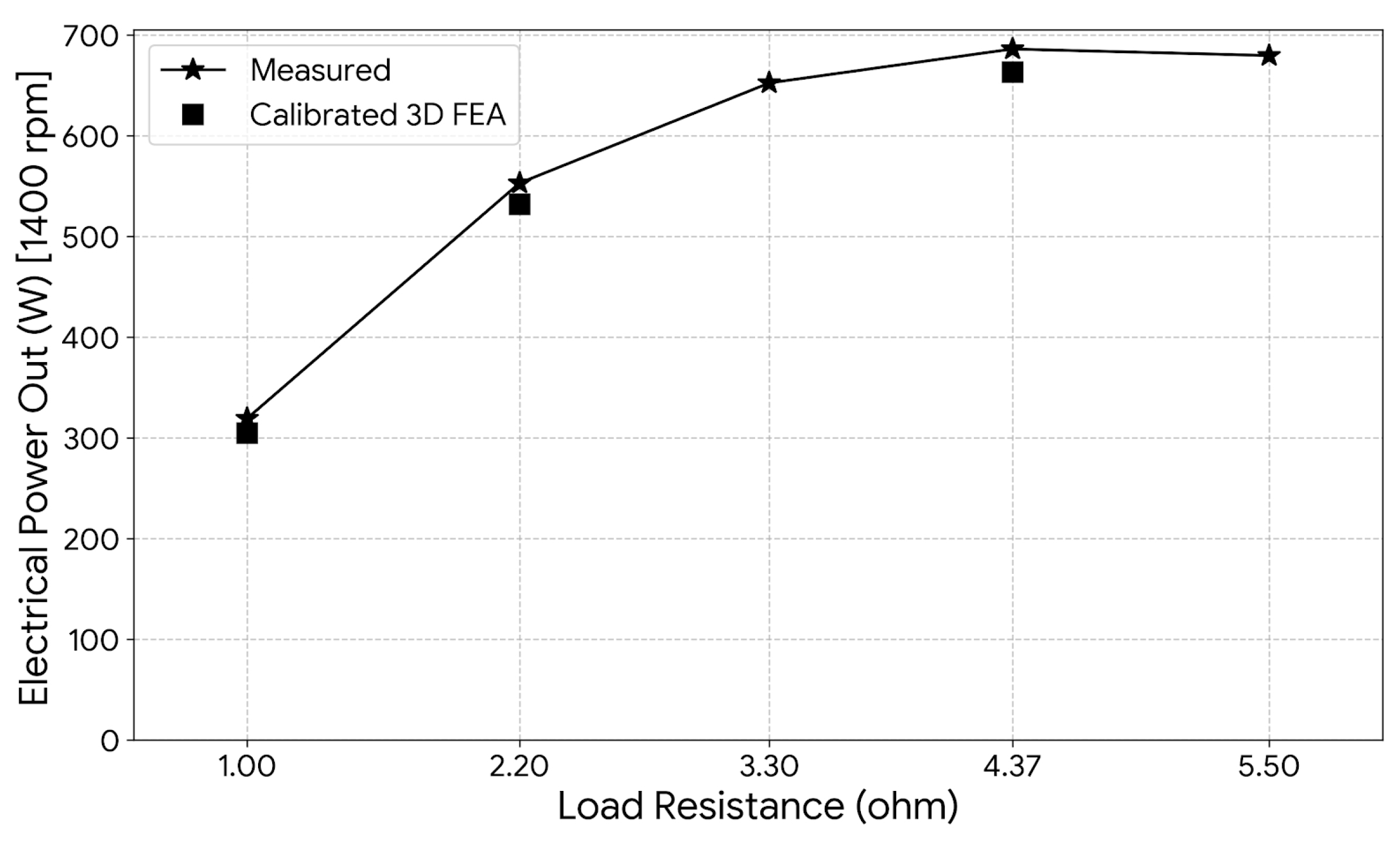
To investigate the power mismatch observed in generator mode, we evaluated two modeling adjustments while sweeping purely resistive loads: (i) reduced effective permeability of the SMC (via effective B–H curves) and (ii) increased electrical conductivity of the SMC to emulate EDM-induced surface conduction. The first approach cut the back-EMF error from 13.1% to 2.1% but did not yield a consistent improvement in predicted generator power, indicating that permeability reduction alone is not the dominant cause of the discrepancy. In contrast, the second approach, increasing the SMC electrical conductivity, produced a near-constant agreement between simulated and measured power as shown in Figure 28. Calibrated simulations showed the best fit when the effective bulk resistivity was set to a ρ S M C of 2.25 × 10 7 Ω .m (datasheet value 6 × 10 4 Ω .m), strongly implicating EDM-related conductivity increases as the principal source of error.

AC Inductance Effect

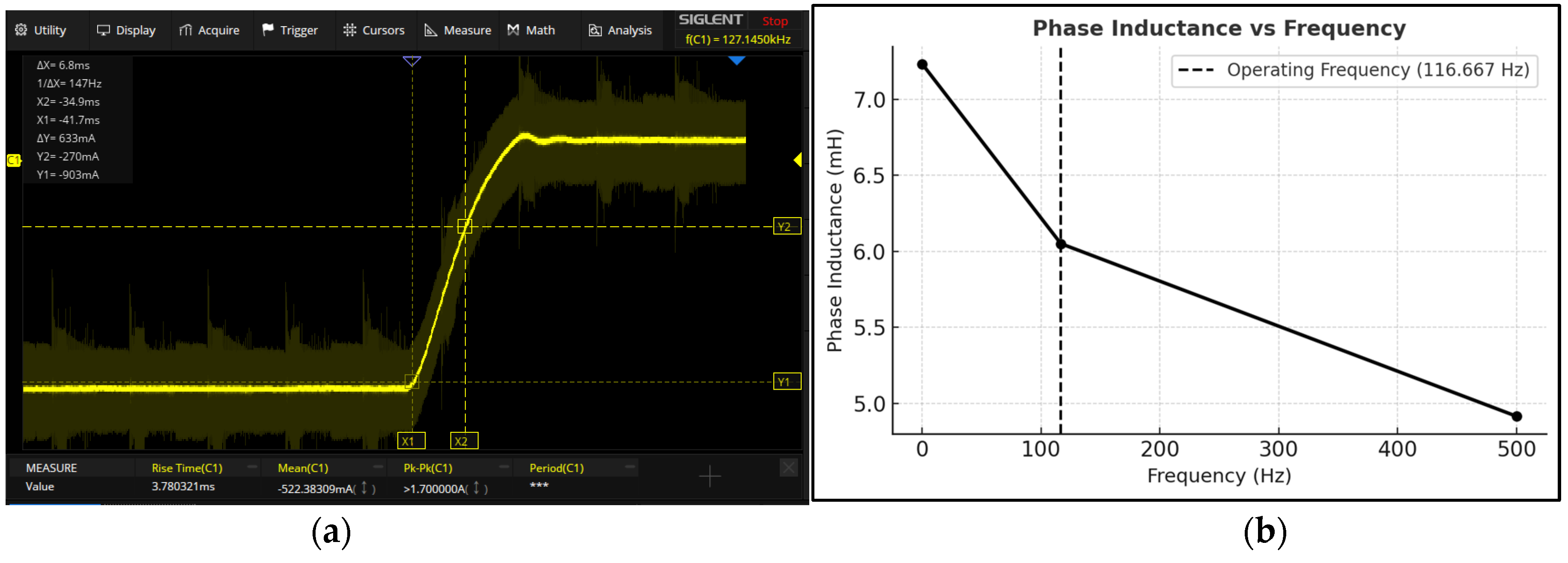
With a locked rotor test, the DC phase inductance, L p h , was identified from the RL time constant, τ = L / R Figure 29a. Time-harmonic FE simulations then revealed a frequency dependence of L p h ( f ) when using the calibrated resistivity (0–500 Hz sweep, Figure 29b). This behavior is consistent with a conductive surface layer that (i) increases eddy currents opposing the main flux, (ii) lowers the real part of the complex permeability μ ω =   μ ω j   μ ( ω ) , and (iii) hence reduces the apparent inductance with frequency.
Z p h a s e ω = R ω + j ω L p h ( ω ) ,   L p h ω   μ ( ω )
Since the generator terminal power under resistive loading depends on both the open-circuit EMF and the impedance trajectory, Z p h a s e ω , as shown in Equation (27), this AC reduction of L p h ω explains the load-dependent power shortfall even when the open-circuit EMF is matched.

6. Conclusions

This paper presented the design, optimization, and validation of a dual three-phase AFPM motor for aerospace EMA applications operating under harsh conditions, including ambient temperatures up to 175 °C. The motor employs a YASA topology with a 12-slot, 10-pole configuration, segmented SMC stator, and concentrated windings to ensure high torque density and fault tolerance.
A surrogate-based multi-objective optimization method was used, combining LHS, RSM, and GA, and significantly reducing computational time while accurately capturing the motor’s performance landscape. The optimization objective was to maximize torque and minimize losses while meeting design constraints on geometry, thermal limits, and electrical loading. The response surface model was shown to be highly accurate, with torque and loss prediction errors of just 0.63% and 2.9%, respectively, when compared to full 3D finite element results. The final manufacturable, optimized design achieved a peak torque of 28.3 Nm at 1400 rpm and an efficiency of 81.6% at a peak output power of 3.5 kW. The magnet mass was minimized to 0.49 kg, supporting a lightweight design ideal for aerospace applications.
Thermal simulations, using empirical heat transfer coefficients and finite element modeling, showed that the motor’s temperature remains below the 260 °C critical thermal limit for 60 s of peak torque operation without additional cooling structures. This confirms the design’s thermal reliability under aerospace duty cycles.
Transient structural simulations revealed that unbalanced electromagnetic forces during short-circuit conditions can induce rotor wobbling, emphasizing the importance of evaluating coupled electromechanical behavior in fault-tolerant YASA configurations. Complementary modal and frequency domain analyses showed that the dominant deformation frequencies (250–1000 Hz) are largely sub-resonant, indicating limited dynamic coupling with structural modes and a low risk of resonance-induced vibration or acoustic noise.
Experimental validation was performed on the manufactured prototype. Static torque tests showed strong agreement with finite element predictions, with a deviation of 8.6%. Furthermore, the experimental discrepancies between simulation and prototype performance under dynamic conditions primarily arise from the soft magnetic composite stator segments, where reduced permeability, bulk resistivity effects, and localized eddy currents from EDM-machined surfaces alter the effective flux linkage and degrade electromagnetic performance by up to 20%. Detailed calibration analysis demonstrated that EDM machining introduces locally conductive surface layers, elevating eddy currents and altering the effective permeability and AC inductance. A frequency-dependent inductance investigation confirmed a reduction in apparent permeability with increasing frequency, consistent with the observed generator power deviation.
Future research will focus on a comparative evaluation of conventional silicon–iron (i.e., SiFe)-based laminated axial flux motors and SMC-segmented designs to quantify the influence of three-dimensional flux-carrying composite materials relative to traditional electrical steels. Also, the developed prototype will be operated as a motor using a dual-inverter configuration with field-oriented control (FOC) to experimentally validate dynamic performance and fault-tolerant control capability under more realistic aerospace operating conditions.

Author Contributions

Conceptualization, M.C.K. and N.J.B.; investigation, M.C.K., F.M., N.J.B. and B.Y.; resources, N.J.B. and M.C.K.; supervision, N.J.B.; writing—original draft, M.C.K., F.M. and A.A.M.A. All authors have read and agreed to the published version of the manuscript.

Funding

This research received no external funding.

Data Availability Statement

The original contributions presented in this study are included in the article. Further inquiries can be directed to the corresponding author.

Acknowledgments

The authors gratefully acknowledge Chris Manning from the Mechanical Workshop, School of Engineering, Newcastle University, for his contribution to the manufacture of the prototype machine.

Conflicts of Interest

The authors declare no conflicts of interest.

References

  1. Mazzoleni, M.; Di Rito, G.; Previdi, F. Electro-Mechanical Actuators for the More Electric Aircraft; Springer: Berlin/Heidelberg, Germany, 2021; Volume 2021. [Google Scholar]
  2. Cao, W.; Mecrow, B.C.; Atkinson, G.J.; Bennett, J.W.; Atkinson, D.J. Overview of electric motor technologies used for more electric aircraft (MEA). IEEE Trans. Ind. Electron. 2011, 59, 3523–3531. [Google Scholar] [CrossRef]
  3. Li, J.; Yu, Z.; Huang, Y.; Li, Z. A review of electromechanical actuation system for more electric aircraft. In Proceedings of the 2016 IEEE International Conference on Aircraft Utility Systems (AUS), Beijing, China, 10–12 October 2016; IEEE: Piscataway, NJ, USA, 2016; pp. 490–497. [Google Scholar]
  4. Qiao, G.; Liu, G.; Shi, Z.; Wang, Y.; Ma, S.; Lim, T.C. A review of electromechanical actuators for More/All Electric aircraft systems. Proc. Inst. Mech. Eng. Part C J. Mech. Eng. Sci. 2018, 232, 4128–4151. [Google Scholar] [CrossRef]
  5. Kulan, M.C.; Baker, N.J.; Turvey, S. A High Speed Fault Tolerant Transverse Flux Alternator for Aerospace; IET Conference Proceedings CP766, 2020; IET: Stevenage, UK, 2020; pp. 563–568. [Google Scholar]
  6. Madonna, V.; Giangrande, P.; Gerada, C.; Galea, M. Thermal analysis of fault-tolerant electrical machines for aerospace actuators. IET Electr. Power Appl. 2019, 13, 843–852. [Google Scholar] [CrossRef]
  7. Boglietti, A.; Cavagnino, A.; Tenconi, A.; Vaschetto, S.; di Torino, P. The safety critical electric machines and drives in the more electric aircraft: A survey. In Proceedings of the 2009 35th Annual Conference of IEEE Industrial Electronics, Porto, Portugal, 3–5 November 2009; IEEE: Piscataway, NJ, USA, 2009; pp. 2587–2594. [Google Scholar]
  8. Jack, A.G.; Mecrow, B.C.; Haylock, J.A. A comparative study of permanent magnet and switched reluctance motors for high-performance fault-tolerant applications. IEEE Trans. Ind. Appl. 2002, 32, 889–895. [Google Scholar] [CrossRef]
  9. Benzaquen, J.; He, J.; Mirafzal, B. Toward more electric powertrains in aircraft: Technical challenges and advancements. CES Trans. Electr. Mach. Syst. 2021, 5, 177–193. [Google Scholar] [CrossRef]
  10. Kulan, M.; Baker, N.; Turvey, S. Design and Analysis of a Fault Tolerant Permanent Magnet Alternator for Aerospace. In Proceedings of the 2018 XIII International Conference on Electrical Machines (ICEM), Alexandroupoli, Greece, 3–6 September 2018; IEEE: Piscataway, NJ, USA, 2018; pp. 622–629. [Google Scholar][Green Version]
  11. Kulan, M.C.; Mahmouditabar, F.; Baker, N.J. Design and Optimization of Electromechanical Actuators for Aerospace Applications. In Proceedings of the 2024 4th International Conference on Electrical Machines and Drives (ICEMD), Tehran, Iran, 24–25 December 2024; IEEE: Piscataway, NJ, USA, 2024; pp. 1–6. [Google Scholar]
  12. Liao, C.; Bianchi, N.; Zhang, Z. Recent Developments and Trends in High-Performance PMSM for Aeronautical Applications. Energies 2024, 17, 6199. [Google Scholar] [CrossRef]
  13. Thomas, A.S.; Zhu, Z.-Q.; Owen, R.L.; Jewell, G.W.; Howe, D. Multiphase flux-switching permanent-magnet brushless machine for aerospace application. IEEE Trans. Ind. Appl. 2009, 45, 1971–1981. [Google Scholar] [CrossRef]
  14. Sarigiannidis, A.G.; Beniakar, M.E.; Kakosimos, P.E.; Kladas, A.G.; Papini, L.; Gerada, C. Fault tolerant design of fractional slot winding permanent magnet aerospace actuator. IEEE Trans. Transp. Electrif. 2016, 2, 380–390. [Google Scholar] [CrossRef]
  15. Papini, L.; Connor, P.; Patel, C.; Empringham, L.; Gerada, C.; Wheeler, P. Design and testing of electromechanical actuator for aerospace applications. In Proceedings of the 2018 25th International Workshop on Electric Drives: Optimization in Control of Electric Drives (IWED), Moscow, Russia, 31 January–2 February 2018; IEEE: Piscataway, NJ, USA, 2018; pp. 1–6. [Google Scholar]
  16. Gerada, C.; Galea, M.; Kladas, A. Electrical machines for aerospace applications. In Proceedings of the 2015 IEEE workshop on electrical machines design, control and diagnosis (WEMDCD), Turin, Italy, 26–27 March 2015; IEEE: Piscataway, NJ, USA, 2015; pp. 79–84. [Google Scholar]
  17. Giangrande, P.; Madonna, V.; Sala, G.; Kladas, A.; Gerada, C.; Galea, M. Design and testing of PMSM for aerospace EMA applications. In Proceedings of the IECON 2018—44th Annual Conference of the IEEE Industrial Electronics Society, Washington, DC, USA, 21–23 October 2018; IEEE: Piscataway, NJ, USA, 2018; pp. 2038–2043. [Google Scholar]
  18. Parviainen, A.; Niemela, M.; Pyrhonen, J.; Mantere, J. Performance comparison between low-speed axial-flux and radial-flux permanent-magnet machines including mechanical constraints. In Proceedings of the IEEE International Conference on Electric Machines and Drives, San Antonio, TX, USA, 15 May 2005; IEEE: Piscataway, NJ, USA, 2005; pp. 1695–1702. [Google Scholar]
  19. Kulan, M.C.; Baker, N.J. Design and Construction of a Fault-Tolerant Yokeless and Segmented Armature Axial Flux Motor for Aerospace Actuator Applications. In Proceedings of the 2025 IEEE International Electric Machines & Drives Conference (IEMDC), Houston, TX, USA, 18–21 May 2025; IEEE: Piscataway, NJ, USA, 2025; pp. 176–181. [Google Scholar]
  20. Huang, R.; Song, Z.; Zhao, H.; Liu, C. Overview of axial-flux machines and modeling methods. IEEE Trans. Transp. Electrif. 2022, 8, 2118–2132. [Google Scholar] [CrossRef]
  21. Amin, S.; Khan, S.; Bukhari, S.S.H. A comprehensive review on axial flux machines and its applications. In Proceedings of the 2019 2nd International Conference on Computing, Mathematics and Engineering Technologies (iCoMET), Sukkur, Pakistan, 30–31 January 2019; IEEE: Piscataway, NJ, USA, 2019; pp. 1–7. [Google Scholar]
  22. Woolmer, T.J.; McCulloch, M. Analysis of the yokeless and segmented armature machine. In Proceedings of the 2007 IEEE International Electric Machines & Drives Conference, Antalya, Turkey, 3–5 May 2007; IEEE: Piscataway, NJ, USA, 2007; pp. 704–708. [Google Scholar]
  23. Zhang, B.; Seidler, T.; Dierken, R.; Doppelbauer, M. Development of a yokeless and segmented armature axial flux machine. IEEE Trans. Ind. Electron. 2015, 63, 2062–2071. [Google Scholar] [CrossRef]
  24. Barcaro, M.; Bianchi, N.; Magnussen, F. Faulty operations of a PM fractional-slot machine with a dual three-phase winding. IEEE Trans. Ind. Electron. 2010, 58, 3825–3832. [Google Scholar] [CrossRef]
  25. Barcaro, M.; Bianchi, N.; Magnussen, F. Analysis and Tests of a Dual Three-Phase 12-Slot 10-Pole Permanent-Magnet Motor. IEEE Trans. Ind. Appl. 2010, 46, 2355–2362. [Google Scholar] [CrossRef]
  26. Asari, A.R.; Guo, Y.; Zhu, J. Performances of SOMALOY 700 (5P) and SOMALOY 500 materials under 1-D alternating magnetic flux density. In Proceedings of the 2019 International UNIMAS STEM 12th Engineering Conference (EnCon), Kuching, Malaysia, 28–29 August 2019; IEEE: Piscataway, NJ, USA, 2019; pp. 52–58. [Google Scholar]
  27. Guo, Y.; Ba, X.; Liu, L.; Lu, H.; Lei, G.; Yin, W.; Zhu, J. A review of electric motors with soft magnetic composite cores for electric drives. Energies 2023, 16, 2053. [Google Scholar] [CrossRef]
  28. Ballestín-Bernad, V.; Kulan, M.C.; Baker, N.J.; Domínguez-Navarro, J.A. Power Analysis in an SMC-Based Aerospace Transverse Flux Generator for Different Load and Speed Conditions. IEEE Trans. Transp. Electrif. 2025, 11, 5700–5708. [Google Scholar] [CrossRef]
  29. Ahmed, N.; Atkinson, G.J. A review of soft magnetic composite materials and applications. In Proceedings of the 2022 International Conference on Electrical Machines (ICEM), Valencia, Spain, 5–8 September 2022; IEEE: Piscataway, NJ, USA, 2022; pp. 551–557. [Google Scholar]
  30. Kulan, M.C.; Baker, N.J.; Liogas, K.A.; Davis, O.; Taylor, J.; Korsunsky, A.M. Empirical Implementation of the Steinmetz Equation to Compute Eddy Current Loss in Soft Magnetic Composite Components. IEEE Access 2022, 10, 14610–14623. [Google Scholar] [CrossRef]
  31. Wu, L.; Ren, X.; Zhao, F.; Zhang, Z.; Ge, S.; Li, Y. A Novel Stator Tooth Shape of Axial Flux Permanent Magnet Motors Based on Soft Magnetic Composite for Torque Density Enhancement. IEEE Access 2025, 13, 144733–144744. [Google Scholar] [CrossRef]
  32. Jia, X.; Xia, Y.; Yan, Z.; Gao, H.; Qiu, D.; Guerrero, J.M.; Li, Z. Coordinated operation of multi-energy microgrids considering green hydrogen and congestion management via a safe policy learning approach. Appl. Energy 2025, 401, 126611. [Google Scholar] [CrossRef]
  33. Bianchi, N.; Pre, M.; Grezzani, G.; Bolognani, S. Design considerations on fractional-slot fault-tolerant synchronous motors. In Proceedings of the IEEE International Conference on Electric Machines and Drives, San Antonio, TX, USA, 15 May 2005; IEEE: Piscataway, NJ, USA, 2005; pp. 902–909. [Google Scholar]
  34. El-Refaie, A.M. Fractional-slot concentrated-windings synchronous permanent magnet machines: Opportunities and challenges. IEEE Trans. Ind. Electron. 2009, 57, 107–121. [Google Scholar] [CrossRef]
  35. Arumugam, P.; Hamiti, T.; Gerada, C. Turn–turn short circuit fault management in permanent magnet machines. IET Electr. Power Appl. 2015, 9, 634–641. [Google Scholar] [CrossRef]
  36. Haylock, J.A.; Mecrow, B.C.; Jack, A.G.; Atkinson, D.J. Operation of fault tolerant machines with winding failures. IEEE Trans. Energy Convers. 1999, 14, 1490–1495. [Google Scholar] [CrossRef]
  37. Mecrow, B.; Jack, A.; Haylock, J.; Coles, J. Fault-tolerant permanent magnet machine drives. IEE Proc.-Electr. Power Appl. 1996, 143, 437–442. [Google Scholar] [CrossRef]
  38. Yepes, A.G.; Lopez, O.; Gonzalez-Prieto, I.; Duran, M.J.; Doval-Gandoy, J. A comprehensive survey on fault tolerance in multiphase ac drives, Part 1: General overview considering multiple fault types. Machines 2022, 10, 208. [Google Scholar] [CrossRef]
  39. Levi, E.; Bojoi, R.; Profumo, F.; Toliyat, H.; Williamson, S. Multiphase induction motor drives–a technology status review. IET Electr. Power Appl. 2007, 1, 489–516. [Google Scholar] [CrossRef]
  40. Alharbi, A.; Odhano, S.; Smith, A.; Deng, X.; Mecrow, B. A Review of Modeling and Control of Multi-Phase Induction Motors Under Machine Faults. In Proceedings of the 2024 International Conference on Electrical Machines (ICEM), Torino, Italy, 1–4 September 2024; IEEE: Piscataway, NJ, USA, 2024; pp. 1–9. [Google Scholar]
  41. Qi, N.; Huang, K.; Fan, Z.; Xu, B. Long-term energy management for microgrid with hybrid hydrogen-battery energy storage: A prediction-free coordinated optimization framework. Appl. Energy 2025, 377, 124485. [Google Scholar] [CrossRef]
  42. Demetriades, G.D.; De La Parra, H.Z.; Andersson, E.; Olsson, H. A real-time thermal model of a permanent-magnet synchronous motor. IEEE Trans. Power Electron. 2010, 25, 463–474. [Google Scholar] [CrossRef]
  43. Rosu, M.; Zhou, P.; Lin, D.; Ionel, D.M.; Popescu, M.; Blaabjerg, F.; Rallabandi, V.; Staton, D. Multiphysics Simulation by Design for Electrical Machines, Power Electronics and Drives; John Wiley & Sons: Hoboken, NJ, USA, 2017; Volume 66. [Google Scholar]
  44. Wang, L.; Wang, X.; Li, N.; Li, T. Modelling and analysis of electromagnetic force, vibration, and noise in permanent magnet synchronous motor for electric vehicles under different working conditions considering current harmonics. IET Electr. Power Appl. 2023, 17, 952–964. [Google Scholar] [CrossRef]
Figure 1. Components of electromechanical actuators [3].
Energies 18 06274 g001
Figure 2. SMC stator segments: (a) 0.178 mm Nomex/Kapton/Nomex slot liner, (b) three-layer enameled copper winding on SMC segments, 220 °C insulation class.
Energies 18 06274 g002
Figure 3. Dual 3-phase yokeless and segmented, fault-tolerant 12-slot, 10-pole axial flux machine electrically balanced winding configurations: (a) number of layers, (b) axially separated channels, (c) axially alternating channels, (d) diametrically opposite channels, (e) radially alternating channels.
Energies 18 06274 g003
Figure 4. Torque in the event of 3-phase on-load short circuit in one of the channels.
Energies 18 06274 g004
Figure 5. Dual-stator winding model for the proposed YASA-type AFPM.
Energies 18 06274 g005
Figure 6. Control block diagram.
Energies 18 06274 g006
Figure 7. Mechanical output during different power-sharing factors.
Energies 18 06274 g007
Figure 8. Power-sharing factor during healthy and faulty conditions.
Energies 18 06274 g008
Figure 9. Fundamental harmonic (a) and (b) fifth harmonic during different power sharing.
Energies 18 06274 g009
Figure 10. I d q in each set during different power-sharing factors.
Energies 18 06274 g010
Figure 11. Total output power (up) and power in each set (down) during different power-sharing factors.
Energies 18 06274 g011
Figure 12. Design flowchart for the aerospace actuator electric motors.
Energies 18 06274 g012
Figure 13. Parametric models and geometrical variables for design optimization.
Energies 18 06274 g013
Figure 14. Variation of stator’s active material mass and motor loss with respect to torque output of the axial flux machine. Correlation, R 2 = 0.986 .
Energies 18 06274 g014
Figure 15. Normal distribution of current density among the DoE samples.
Energies 18 06274 g015
Figure 16. Torque–loss pareto front after multi-objective GA optimization.
Energies 18 06274 g016
Figure 17. YASA-type AFPM motor on load magnetic flux density at 1400 rpm and 175 °C ambient temperature.
Energies 18 06274 g017
Figure 18. Thermal model of the active materials in yokeless and segmented axial flux PM electric motor for an EMA application: (a) thermal boundary conditions, (b) temperature distribution accounting winding slot thermal properties, (c) rotor and stator external surface time-varying heat transfer coefficients, (d) tabulated, averaged empirical HTCs for the thermal analysis.
Energies 18 06274 g018
Figure 19. Time-varying axial forces for the rotating parts, obtained through Maxwell stress calculations within the rotor airgap: (a) conventional winding layout as in Figure 3b, (b) fault-tolerant diametrically opposite three-phase winding sets as in Figure 3d.
Energies 18 06274 g019
Figure 20. Deformation in rotor disks and shaft during motion with time-varying electromagnetic forces in x, y, and z directions: (a) deformation under fault—displacement mostly occurs in the axis of rotation (more homogeneous), (b) deformation under fault—displacement mostly occurs in the plane perpendicular to the machine’s rotation axis, causing wobbling.
Energies 18 06274 g020
Figure 21. Time-varying deformation and frequency analysis: (a) deformation of conventional and fault-tolerant winding layouts at different short-circuit scenarios; (b) power spectral density (power/frequency) of time-varying, cyclic deformation.
Energies 18 06274 g021
Figure 22. Modal analysis results: (a) first mode deformation of the rotating element constrained through the housing end caps, and (b) corresponding natural frequencies for the first ten modes.
Energies 18 06274 g022
Figure 23. The manufacturing process of the proposed dual three-phase AFPM: (a) dual channel configuration, (b) exploded view of the CAD assembly, (c) double rotor with shaft, (d) permanent magnets on the rotor disk, (e) additively manufactured aluminum stator holder, (f) coil winding, (g) stator with modular SMC segments, (h) aluminum housing.
Energies 18 06274 g023
Figure 24. Experimental test setup.
Energies 18 06274 g024
Figure 25. Static torque test results.
Energies 18 06274 g025
Figure 26. Open-circuit phase voltages at 1400 rpm.
Energies 18 06274 g026
Figure 27. Generator mode power output with unity power factor electrical loads.
Energies 18 06274 g027
Figure 28. Comparison of simulated and measured generator mode power with calibrated effective SMC electrical resistivity.
Energies 18 06274 g028
Figure 29. Inductance characteristics: (a) inductance obtained from the time constant measurement under DC excitation, and (b) frequency-dependent phase inductance illustrating the influence of AC eddy-current effects.
Energies 18 06274 g029
Table 1. Electric motor requirements.
ParameterValue
Architecture3-phase + 3-phase (2 channels)
Power1750 W per channel (3.5 kW for entire motor)
Rated speed1400 rpm
Peak torque11.75 Nm per 3-phase (23.5 Nm for entire motor)
Holding torque3 Nm per 3-phase (6 Nm for entire motor)
Maximum stator outer diameter108 mm
Active material axial length80 mm
Ambient temperature175 °C
DC bus voltage270 V
Maximum inverter current20 A peak
Gear ratio1 (Direct drive)
Permanent magnetsSamarium Cobalt (Recoma 33E)
Thermal limit for 1 s peak
operation
260 °C
Table 2. Motor control parameters.
ParameterValue
Stator resistance R s 0.81 Ω
d-axis inductance L d 6.5 × 10⁻³ H
d-axis inductance L q 6.5 × 10⁻³ H
Maximum current 20 A peak
Pole pair p 5
Rated speed 1400 rpm
Output power3500 W
Magnetic flux 96.7 × 10⁻³ V.s
Table 3. Power-sharing coefficient distribution with different time slots.
Time Period K 1 K 2
[ 0 to   1   s ] 11
[ 1 to   2   s ] 20
[ 2 to   3   s ] 02
Table 4. Constraints of the geometrical motor parameters.
Parameter DescriptionLower BoundUpper Bound
d s s Slot depth54 mm
w s s Slot width7 mm11 mm
b s o Slot opening width4 mm8 mm
d s y Stator yoke depth0 mm for YASA
h s 0 Slot opening height1 mm2 mm
t t a Tooth tip angle5 deg20 deg
S I R Stator inner radius26.5 mm
S O R Stator outer radius54 mm
Table 5. The YASA-type AFPM slot geometry after optimization.
b s o —Slot Opening h s 0 —Slot Opening Height t t a —Tooth Tip Angle w s s —Slot Width
4.233 mm1.042 mm5.268 deg.7.757 mm
Table 6. The error between response surface optimum and 3D FE model.
Response Surface via Latin Hypercube Sampled DoE3D FEAError (%)
Torque (Nm)23.5123.360.63
Total Loss (W)744.7766.982.9
Disclaimer/Publisher’s Note: The statements, opinions and data contained in all publications are solely those of the individual author(s) and contributor(s) and not of MDPI and/or the editor(s). MDPI and/or the editor(s) disclaim responsibility for any injury to people or property resulting from any ideas, methods, instructions or products referred to in the content.