1. Introduction
Various design strategies have been proposed to improve the torque performance of the permanent magnet synchronous machines (PMSMs):
Beyond differences in rotor and stator configurations and material selection in electrical machines, unused space exists within the machine that can be exploited to enhance torque production. This available space can be utilized through axial-flux paths, or a combination of both radial–axial flux, as illustrated below.
1.1. Axial Space Utilization Techniques for Torque Enhancement and Challenges
Low-speed direct-drive applications, such as wind turbines and in-wheel traction systems, commonly adopt machines with a high pole count and large air-gap diameters to deliver high torque at low rotational speeds. This design approach often leads to the presence of considerable unused regions within the machine structure. In PMSMs, additional axial space naturally arises due to the stator end-winding overhang. These otherwise unutilized regions represent an opportunity for improving machine performance by enhancing torque capability [
21]. To take advantage of the available axial space, several design strategies have been explored. One approach involves axial-assisted PMs, in which the magnets are extended along the axial direction to better utilize the end-winding region and increase torque production. Similarly, rotor overhang configurations—particularly in PM vernier machines (PMVMs)—have demonstrated improved torque density by exploiting the unused end regions in machines with constrained axial length [
22].
In radial-flux permanent-magnet (RFPM) machines, the magnetic flux travels radially with respect to the shaft, a configuration that enables relatively straightforward manufacturing and has led to widespread industrial adoption. In contrast, axial-flux permanent-magnet (AFPM) machines exhibit an axial flux path between the stator and rotor discs, resulting in fundamentally different electromagnetic and geometric characteristics [
23]. One of the key advantages of AFPM machines lies in their torque production capability, as the electromagnetic torque is proportional to the cube of the rotor diameter. Since the rotor diameter in axial-flux machines is nearly equal to the overall motor diameter—unlike radial-flux machines, where the rotor occupies only part of the machine envelope—AFPM machines can achieve substantially higher torque density [
24]. This characteristic makes axial-flux topologies particularly well suited for compact, flat configurations requiring high torque output, such as in-wheel traction systems and direct-drive applications [
24].
Driven by increasingly stringent requirements on axial compactness, weight reduction, and torque density, AFPM synchronous machines have attracted significant attention in recent years. Their inherent advantages, including short axial length, high torque density, and high power density, make them promising candidates for applications in electric vehicles, renewable energy systems, and high-performance industrial drives [
25,
26]. In systems where the available axial space is severely constrained and high torque density is essential—such as joint motors and in-wheel drives—AFPM machines are often more favorable than their radial-flux counterparts.
Despite these advantages, conventional AFPM topologies face several challenges that limit their ability to fully satisfy the demanding performance requirements of modern applications. Manufacturing complexity, structural constraints, and limited axial design space can restrict further improvements in torque and power density [
23]. Consequently, various advanced design techniques and novel machine structures have been proposed to enhance the electromagnetic performance of axial-flux machines and overcome the limitations of traditional AFPMSM configurations [
27]. In addition, hybrid machine architectures that integrate radial-flux and axial-flux topologies have been proposed to improve space utilization and torque performance [
21].
1.2. Axial–Radial Flux Permanent Magnet Machines
Axial–radial flux permanent magnet (ARFPM) machines have been proposed as an effective solution for achieving higher torque density by simultaneously exploiting radial and axial magnetic flux paths. By integrating these two flux components within a single machine, ARFPM topologies can significantly increase the effective air-gap area and magnetic energy utilization, making them attractive for low-speed, high-torque applications under strict space constraints, such as industrial automation systems and special-purpose vehicles [
28]. Owing to their compact structure, reduced size and weight, and enhanced torque density, ARFPM machines have attracted increasing research interest in recent years.
Most existing studies on ARFPM machines focus on three-dimensional hybrid flux topologies, often employing dual axial-flux rotors combined with radial-flux structures and shared stators fabricated from soft magnetic composite (SMC) materials [
28]. While these designs can mitigate unbalanced axial magnetic forces and demonstrate competitive torque and efficiency compared with conventional radial- or axial-flux machines, their evaluation is predominantly limited to three-dimensional finite element analysis, with limited experimental validation. Moreover, the use of SMC stators introduces challenges related to magnetic saturation capability and mechanical strength, which may restrict their applicability in high-load conditions.
Other ARFPM configurations integrate multiple radial- and axial-flux air gaps along with toroidal or integrated windings to further extend the air-gap area and improve torque density [
29]. Although such designs achieve substantial torque enhancement relative to benchmark radial PMSMs, they typically rely on modified stator slot geometries, unconventional winding arrangements, and increased PM volume, resulting in higher material cost and increased structural complexity. Similarly, hybrid machines combining axial- and radial-flux rotors with overhang magnets and auxiliary magnetic cores have been proposed to boost air-gap flux density and power density [
30]. However, these improvements are commonly achieved through significant changes to the stator configuration and winding layout.
Several integrated axial–radial machines employing single-stator and multi-rotor arrangements have also been reported to deliver improved torque performance [
31]. Despite their effectiveness, these machines often require axial rotors that fully cover the stator slots and adopt stator winding structures that differ substantially from those of conventional radial PMSMs, which complicates manufacturing and limits compatibility with existing production processes.
In [
32], the focus is on utilizing unused spaces on the yoke side and the rotor side around the windings. The key novelty of that work lies in the exploitation of the yoke-side space, which is structurally different from the region considered in this study. In contrast, the present study proposes an additional rotor, referred to as an axial rotor, to more effectively utilize the unused axial space in PMSMs with distributed windings. This approach focuses on the region between the stator and rotor by introducing an additional rotor structure in that space. In summary, the two studies target different unused regions within the electrical machine and, consequently, propose fundamentally different structural solutions.
In summary, while existing ARFPM solutions demonstrate clear advantages in torque density, they generally depend on substantial alterations to stator slot geometry, winding configuration, or rotor complexity, which increases manufacturing difficulty and cost [
21]. Motivated by these limitations, this paper proposes an axial–radial flux PMSM topology that enhances torque density by introducing an axial rotor structure without modifying the stator slot geometry or winding arrangement. By preserving the conventional radial PMSM stator configuration, the proposed approach aims to achieve the benefits of axial–radial flux integration while maintaining structural simplicity, manufacturability, and compatibility with existing machine designs.
1.3. Magnetic Equivalent Circuit (MEC) Model
During the early stages of PMSM design, finite element method (FEM) simulations can be computationally expensive and time-consuming. To accelerate the design process, MEC models have been widely adopted as efficient analytical tools [
32,
33]. In these studies, MEC-based formulations are employed to estimate key electromagnetic quantities, including the no-load back electromotive force (back-EMF) of PMSMs.
In the reported MEC approaches, the machine is typically divided into non-overhang and overhang regions. For the non-overhang section, corresponding to the conventional radial-flux part of the machine where the rotor and stator share the same axial stack length, the magnetic reluctances of the stator, rotor, and air gap, along with the magnetomotive force (MMF) of the PMs, are modeled. Subsequently, the axial overhang region—where the PMs extend beyond the stator stack—is incorporated by introducing additional reluctance elements and the corresponding MMF contribution of the overhang magnets. The resulting magnetic network enables the estimation of the average air-gap flux density, which is then used to calculate the no-load back-EMF of the machine.
More recently, analytical and semi-three-dimensional MEC methods have been proposed as effective alternatives to full three-dimensional finite element analysis (FEA), offering a favorable trade-off between computational efficiency and modeling accuracy, particularly when overhang effects must be considered during early-stage PMSM design [
34,
35].
This paper proposes a method to enhance the torque production capability of PMSMs by integrating an axial rotor into a conventional radial PMSM structure. The proposed configuration exploits the unused axial space within the machine to increase torque output. To facilitate the efficient evaluation of different design configurations, an MEC model of the proposed structure is developed, and its accuracy is validated through finite element (FE) analysis. In addition, the experimental results are presented and shown to be in close agreement with the FE simulation outcomes.
The structure of this paper is organized as follows.
Section 2 presents the general topology of the proposed structure, the overall methodology, the experimental setup, and the development of the proposed MEC model.
Section 3 evaluates the accuracy of the MEC model through comprehensive comparisons with three-dimensional FEM results under different configurations and operating speeds, and discusses the associated computational time savings. This section also addresses the optimization of the proposed structure and compares its torque and back-EMF performance with other configurations. Finally,
Section 4 presents the experimental results, which are used to validate the simulation outcomes.
2. General Topology
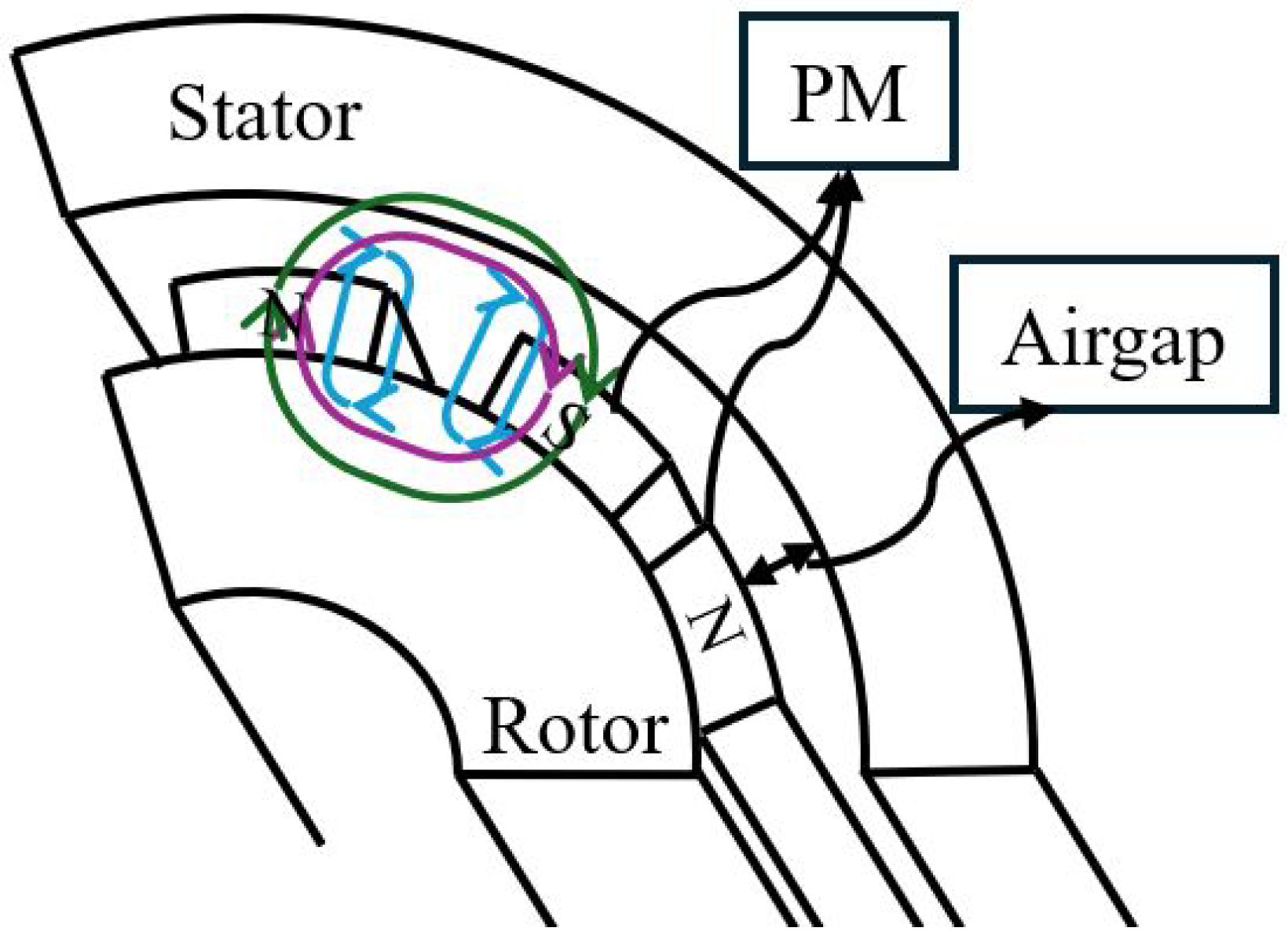
In PMSMs without overhang, the axial stack lengths of the rotor and stator are identical, and the PM length matches the common stack length of both components. A cross-sectional view of such a machine is illustrated in
Figure 1. As shown in the figure, the magnetic flux can be classified into three distinct components. The first component, indicated by the blue path, represents the flux circulating within the PM and the rotor core. The second component, shown by the purple path, corresponds to the leakage flux that flows directly between adjacent magnets through the rotor core. The third component, depicted by the green path, represents the effective air-gap flux, which crosses the air gap and links the stator core, rotor core, and PMs [
36].
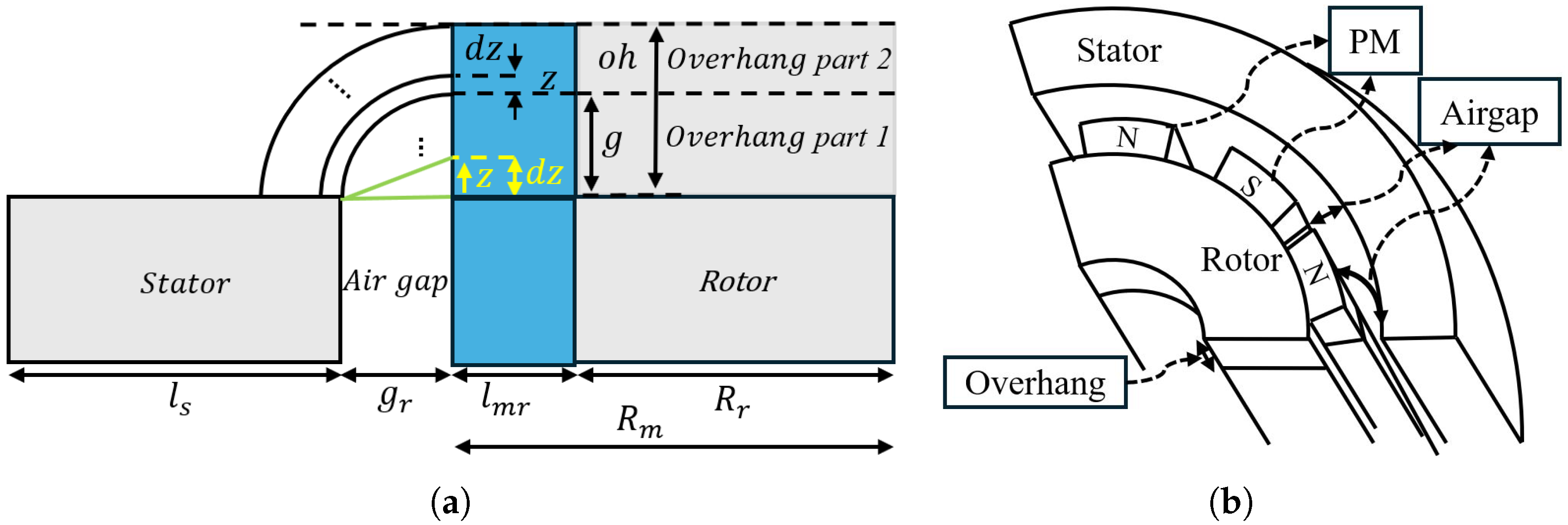
According to [
33], the airgap in the non-overhang region is uniform, but in the overhang region, it varies with axial position. As shown in
Figure 2, straight-line and arc models are used to calculate the effective airgap between the rotor overhang and the stator core [
33].
As shown in
Figure 2, the effective airgap in both overhang parts 1 and 2 is larger than the airgap in the non-overhang section of the machine.
To reduce the effective airgap compared to the conventional overhang structure, this study adds an axial rotor to the PMSM. Instead of placing magnets along the axial length of the rotor, a separate axial rotor is introduced. By reducing the effective airgap, the machine’s average magnetic field increases, leading to higher voltage and, ultimately, greater torque. The proposed structure utilizes the space in the motor to boost output torque by inserting additional PMs on the axial rotor. In the proposed structure, the stator geometry—including the stator core, slots, and windings—remains unchanged and identical to that of a conventional radial PMSM. The torque enhancement is achieved solely by adding an axial rotor to the radial PMSM structure, without modifying the original stator design.
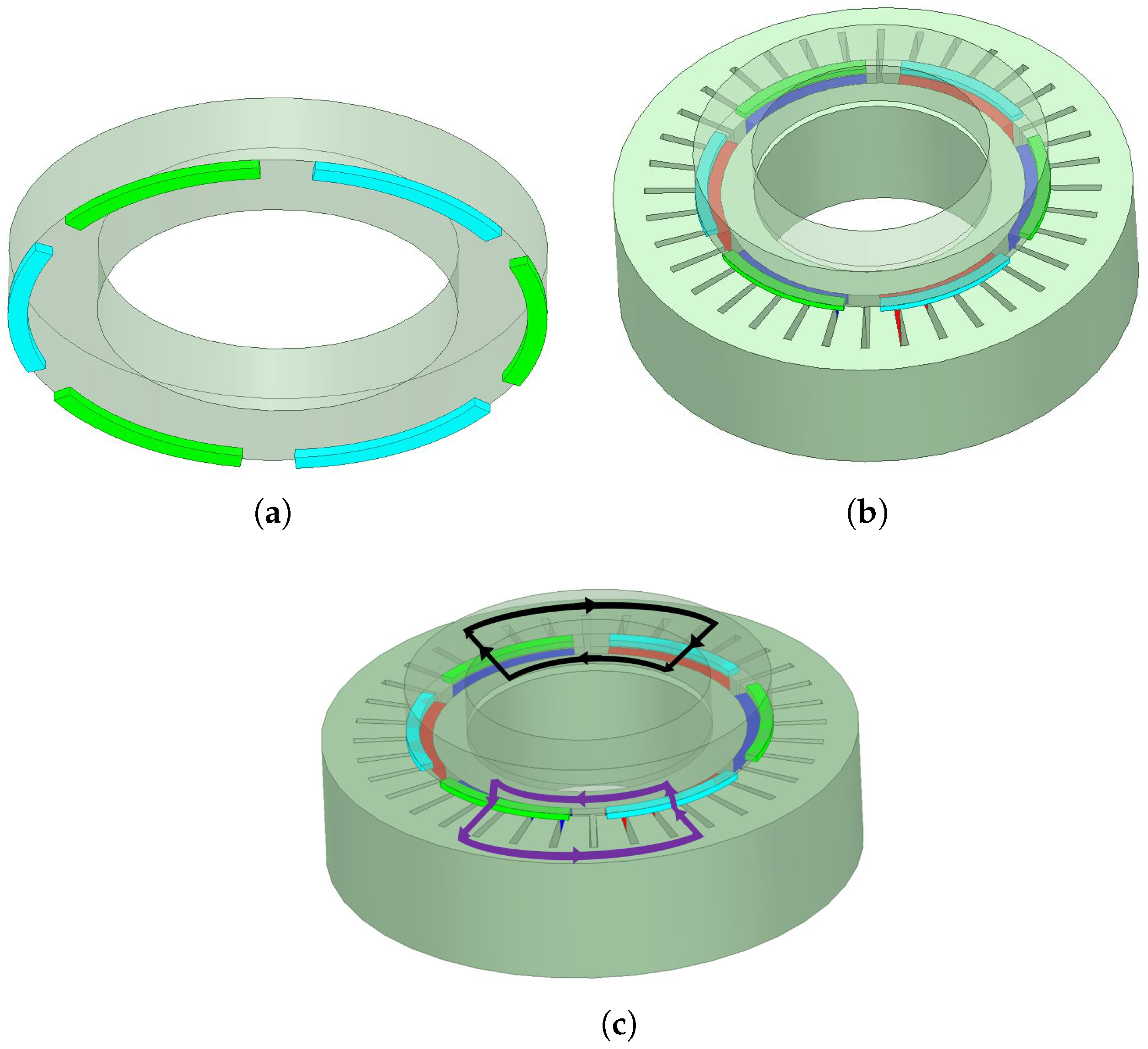
The proposed PMSM machine is shown in
Figure 3, which includes two rotors: a radial rotor and an axial rotor (
Figure 3a). The PMs in the axial rotor are magnetized axially, while those in the radial rotor are magnetized radially.
The magnetic flux distribution of the machine is illustrated in
Figure 3c. In this figure, the black line represents the magnetic flux in the conventional PMSM structure. The purple line indicates an additional flux path that flows through the stator core, then enters into the axial rotor magnet and axial rotor core. This additional flux aligns with the direction of the conventional magnetic flux (black line), resulting in an increased overall average magnetic flux in the machine. Consequently, this enhancement contributes to a higher torque output.
3. Methodology
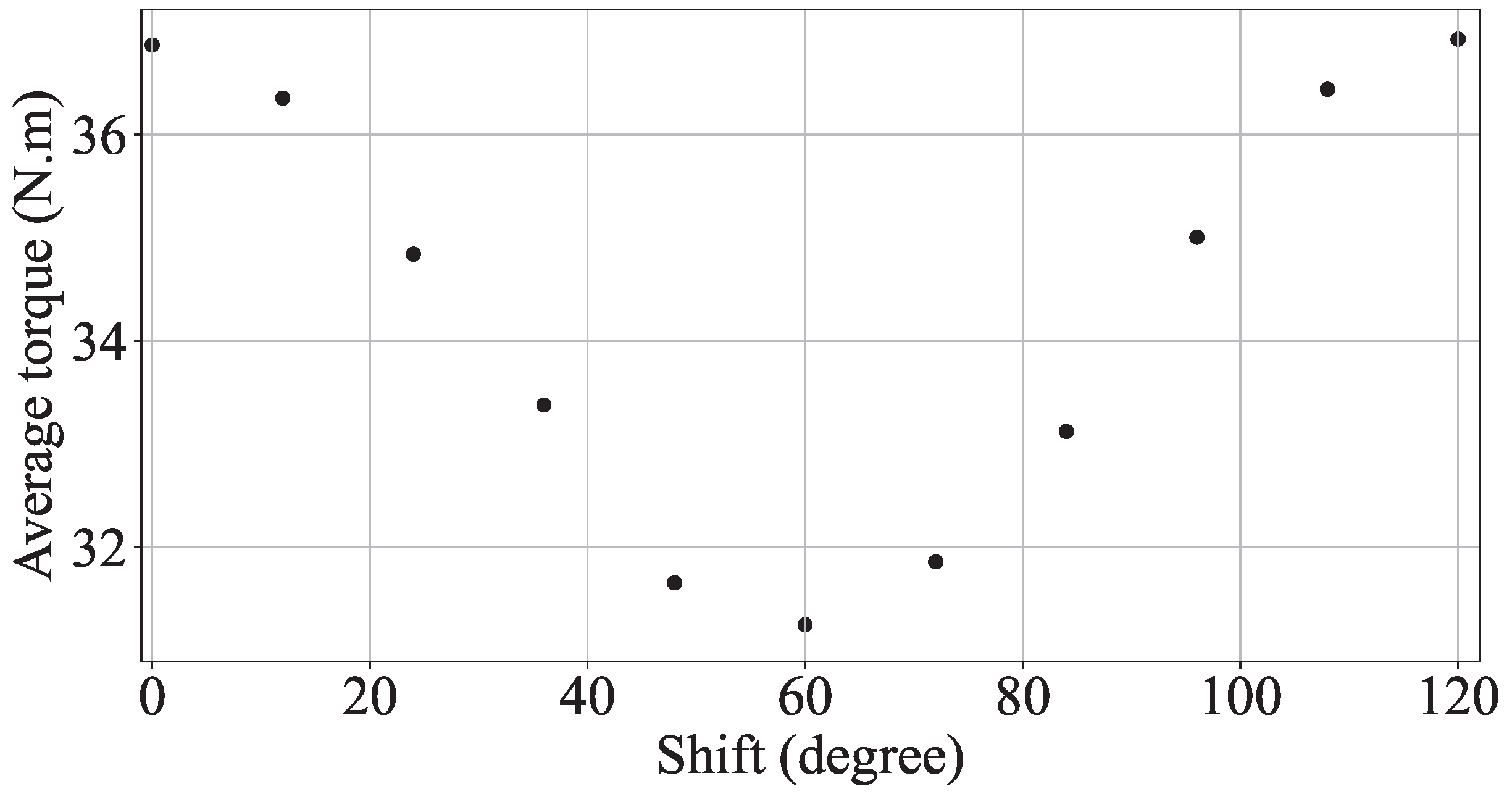
To investigate the influence of the axial rotor magnetic field in comparison with the radial rotor, the axial rotor is angularly shifted with respect to the radial rotor. As shown (
Figure 4), the electromagnetic torque reaches its maximum value when there is no angular offset between the axial and radial rotor axes. This condition allows the magnetic flux produced by the axial rotor PMs to fully circulate through the axial rotor core, air gap, stator core, and radial rotor, resulting in a stronger effective air-gap magnetic field. In contrast, due to the six pole-pair configuration of the machine, an angular shift of 60 degree causes the axial-rotor flux to oppose the radial-rotor flux. However, when the shift is increased to 120 degrees, the two magnetic fluxes become aligned and collectively enhance the overall magnetic field of the motor. Therefore, when the angular shift is set to zero, the axial rotor flux constructively aids the radial rotor flux, leading to an overall increase in the total magnetic flux and, consequently, enhanced torque production.
As shown in
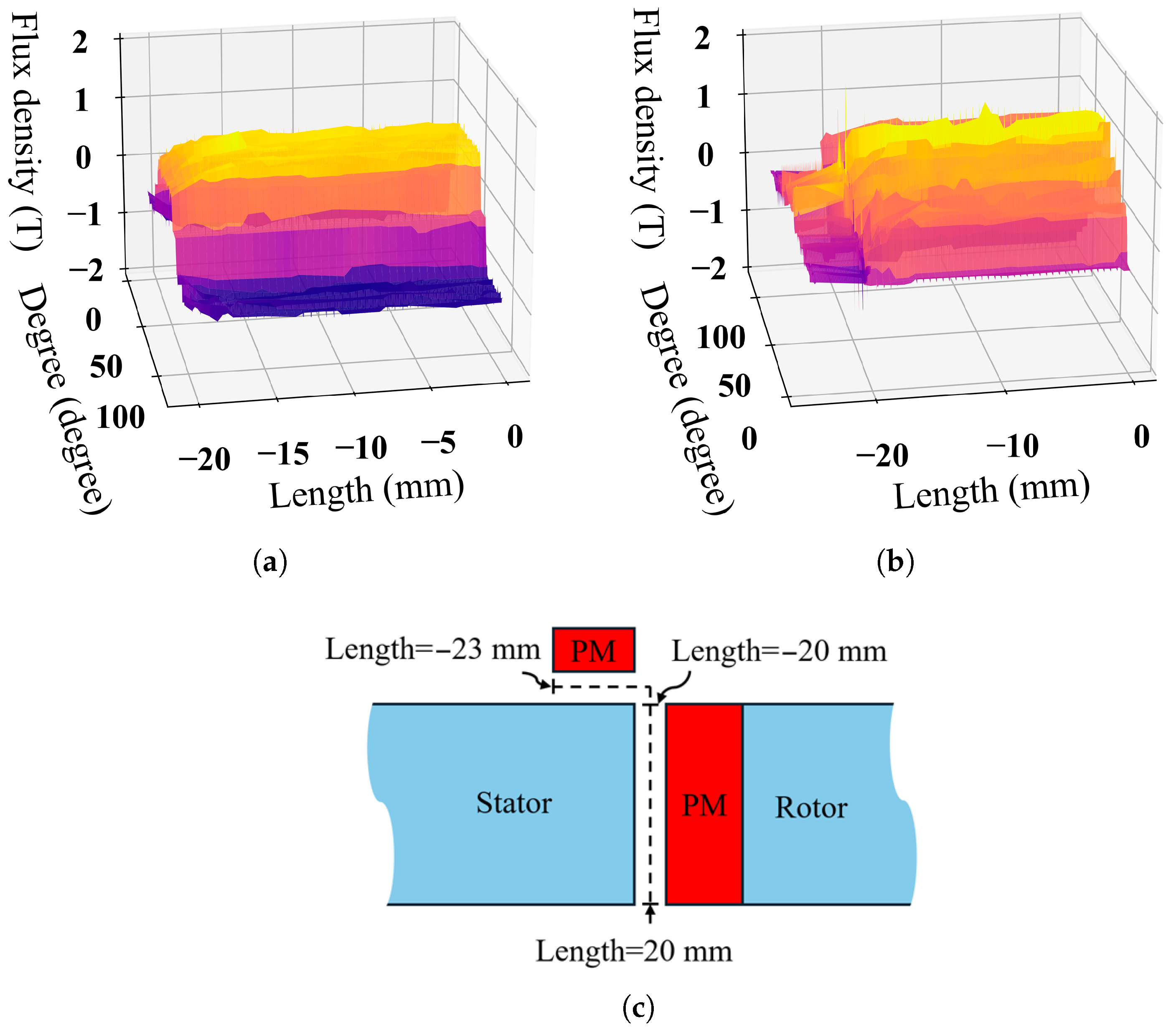
Figure 5, by comparing the magnetic field at the edge of the stack length in the air gap for the non-overhang structure and the proposed structure, it is observed that the magnetic field is extended in the proposed design. This extension of the magnetic field results in an increase in the induced voltage.
3.1. Experimental Setup
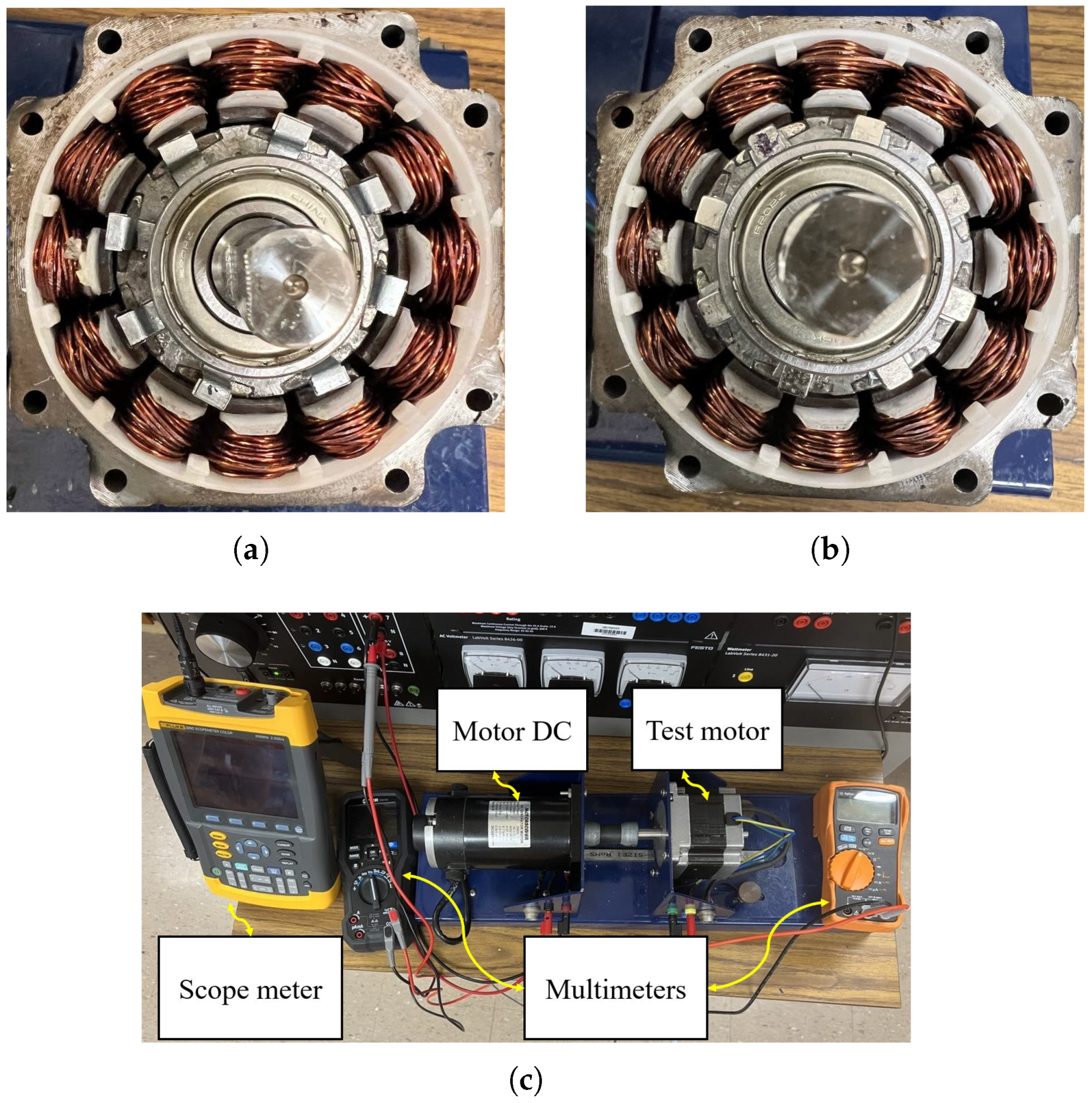
The proposed structure and the conventional overhang configuration are illustrated in
Figure 6a,b, respectively. To ensure a fair comparison, both configurations were implemented using the same total magnet volume. The complete experimental setup is shown in
Figure 6c. A Fluke 225C ScopeMeter (Fluke Corporation, Everett, WA, USA) with an optical communication port operating at a baud rate of 38,400 was used for voltage waveform acquisition. In addition, voltage measurements were verified using Agilent U1232A (Agilent Technologies, Santa Clara, CA, USA) and FLIR DM286 digital multimeters (FLIR Systems, Wilsonville, OR, USA). The motor was rigidly mounted to the test bench using M5 screws to ensure mechanical stability during testing.
3.2. Modeling
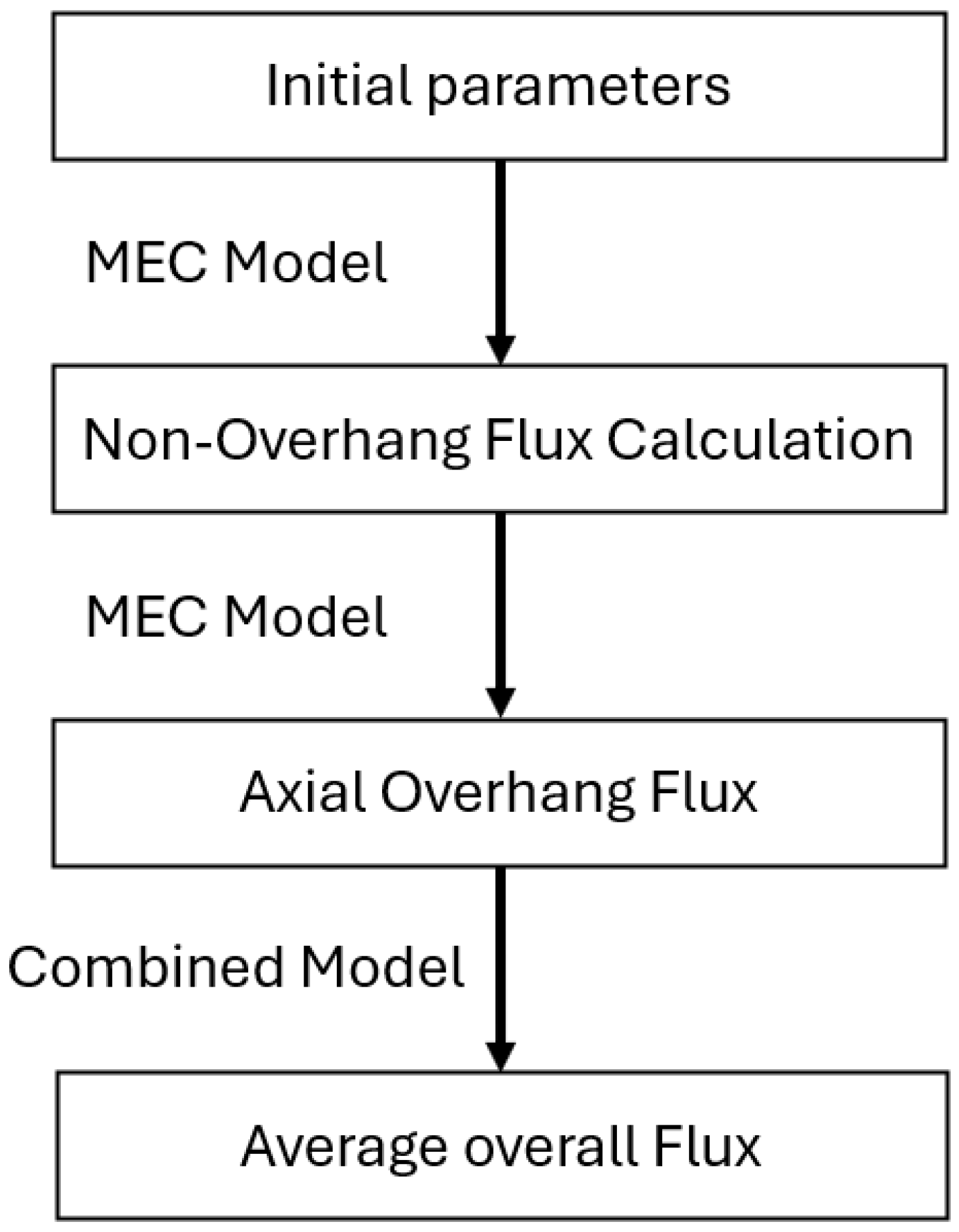
In order to calculate the magnetic field and back emf of the proposed machine, the following flowchart is proposed.
According to the flowchart presented in
Figure 7, the proposed MEC model is implemented in this study as follows:
3.3. MEC Model
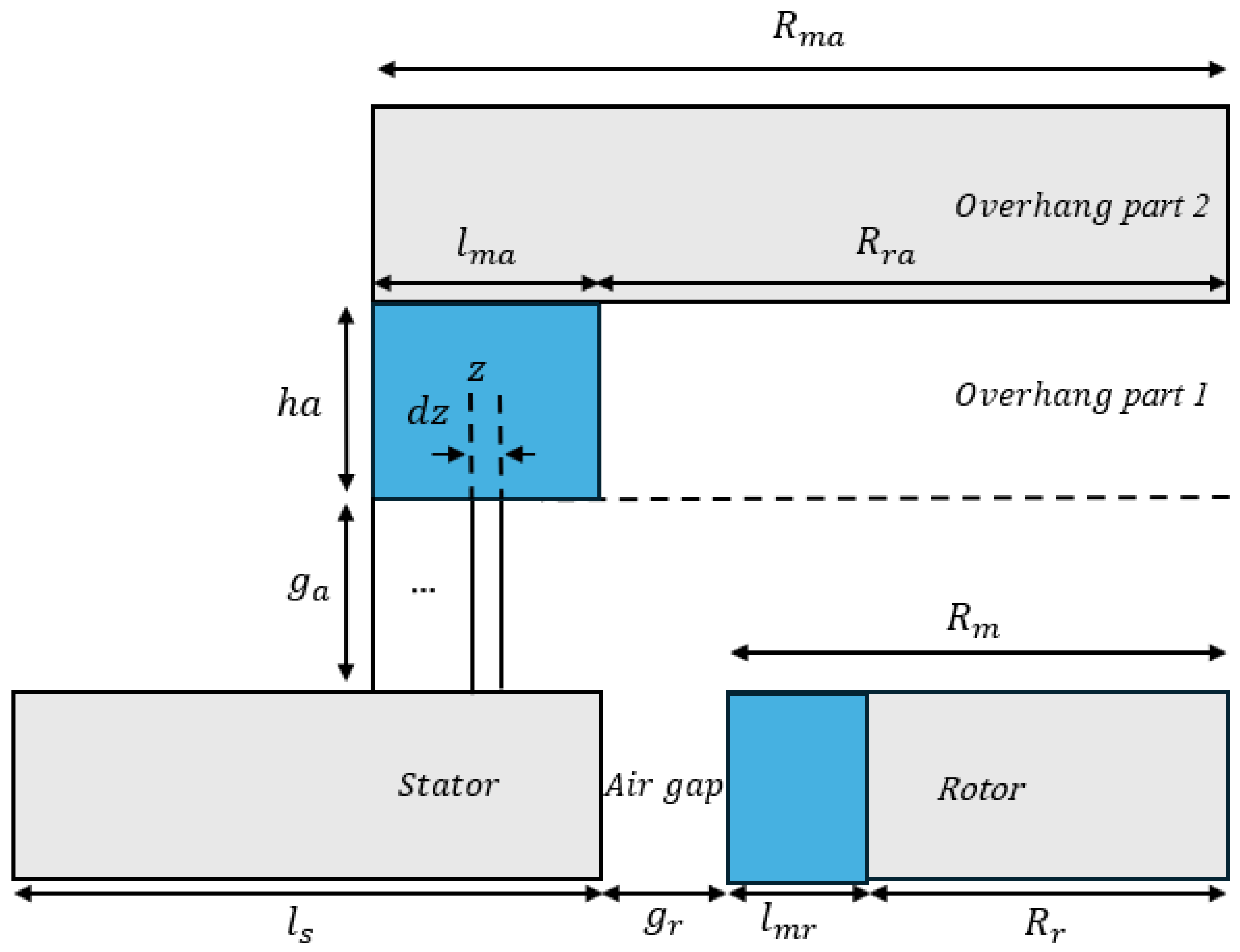
Figure 8 illustrates the side view of the proposed structure from the X-Z cross-section. It also highlights the flux path, which is essential for constructing the MEC model.
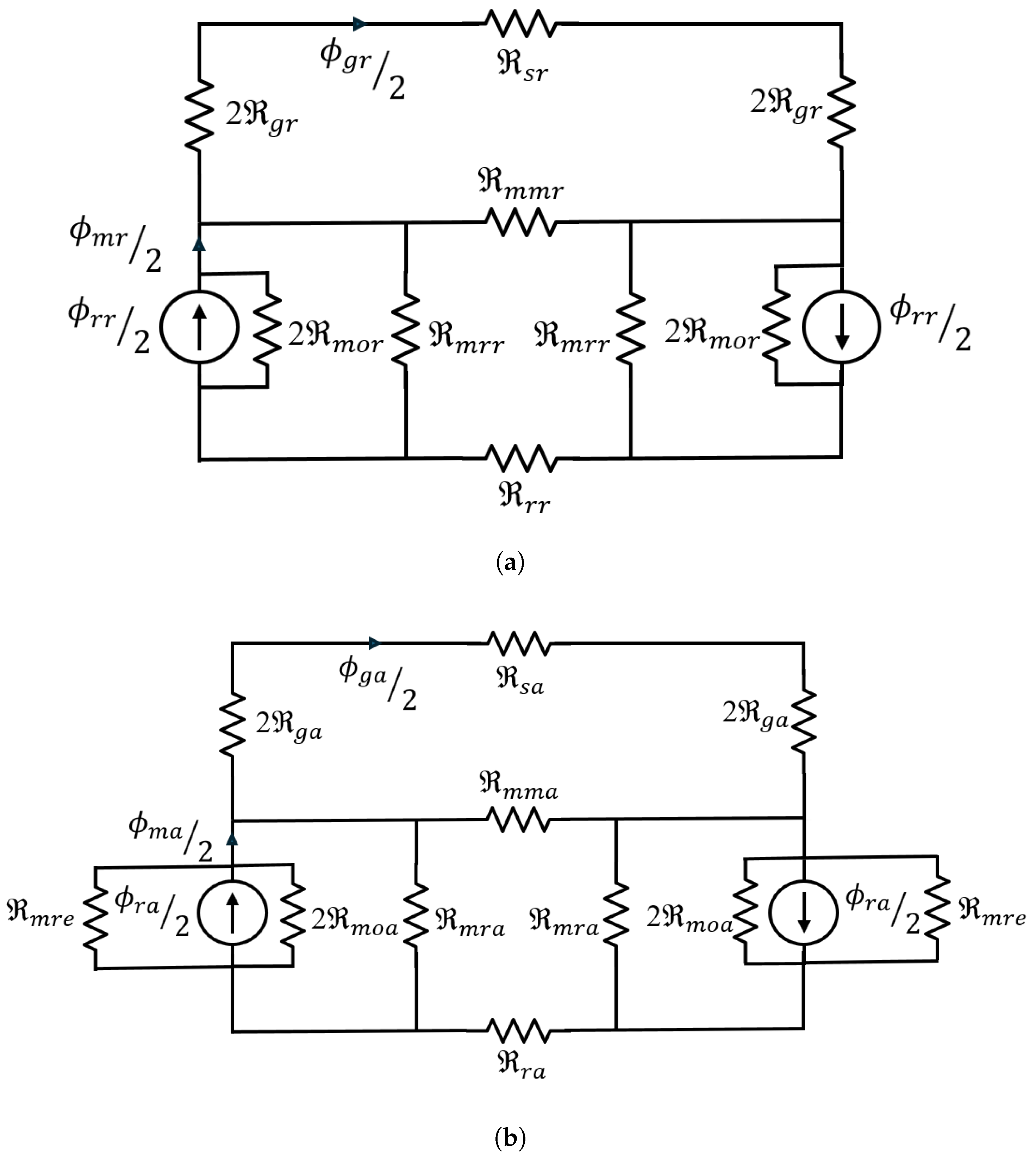
Figure 9a illustrates the MEC of the conventional PMSM, where the magnetization direction of the PMs is radial. In the proposed structure, an additional rotor with the PMs magnetized axially is introduced. This axial magnetization reduces the effective air gap compared to the conventional overhang design. The MEC model of the proposed structure is presented in this section and is depicted in
Figure 9b as well.
Radial Rotor MEC Model
The reluctance of the flux path of the MEC model (
Figure 9a) of the radial rotor is shown as follows [
33].
Based on the methodology presented in [
37], the fringing effect is incorporated into the fundamental magnetic reluctance formulation by adding 2*
to
in Equation (
2). Using this effective width, the reluctance of the radial air gap is then calculated. The magnetic flux passing through this reluctance, represents the effective flux component contributing to the radial rotor air gap. Subsequently, Equation (
3) is obtained using the fundamental magnetic reluctance relationship.
The reluctances defined in Equations (
4) and (
5) are derived through a permeance-based formulation. In this approach, the permeance of the corresponding flux paths is first evaluated, after which the reluctances are obtained as the inverse of the calculated permeances. Among the available modeling techniques, the circular-arc straight-line permeance method is adopted in this work due to its effectiveness in representing air-gap flux paths, and it is used to calculate the magnet-to-magnet and magnet-to-rotor reluctances [
37].
Axial Rotor MEC Model
The reluctances associated with the axial rotor flux paths in the MEC model, illustrated in
Figure 9b, are described as follows.
Equation (
6) for the axial rotor is formulated using the same fundamental magnetic reluctance principles applied in Equation (
1) for the radial rotor, including the consideration of fringing effects. Equation (
7), similar in form to Equation (
2), is derived directly from the basic magnetic reluctance relationship. The permeance expressions used in Equations (
8) and (
9) for the axial rotor follow the same modeling approach as those of the radial rotor; however, the radial geometric parameters are replaced by the corresponding axial air-gap length. Finally, Equation (
10) accounts for the leakage flux, as reported in [
33].
Radial and Axial Magnetic Flux Calculation
The reluctances
and
, as well as
and
, which represent the stator and rotor core reluctances in the radial and axial directions, respectively, are neglected because their values are assumed to be sufficiently small under non-saturated operating conditions, as reported in [
33].
By assembling the reluctance matrix
A from the magnetic circuit elements, the magnetic flux of the radial rotor can be obtained [
33]:
In Equation (
13), the flux density of the radial rotor PM is incorporated into the formulation. Equation (
14) defines the magnetic circuit nodes, while Equation (
15) represents the magnetic flux matrix associated with the magnetic circuit [
33]. Using these relations, the air-gap flux produced by the radial rotor is subsequently obtained in Equation (
16).
As in Equation (
11), the reluctance matrix
from the magnetic circuit elements in the axial rotor is shown in Equation (
18).
Following the same procedure as the radial flux calculation, Equation (
19) incorporates the axial rotor PM flux density, Equation (
20) specifies the magnetic circuit nodes, and Equation (
21) formulates the magnetic flux matrix for the axial rotor.
The resulting air-gap flux generated by the axial rotor is then obtained in Equation (
22).
For the MEC model, the average magnetic flux density must be determined for two sections:
- –
Non-overhang or radial section (Equation (
16));
- –
Axial section (Equation (
22)).
Once the flux density is obtained, it is incorporated into the combined model to consider the influence of the stator slots [
33].
It should be noted that the proposed MEC model, for simplicity, does not account for iron losses, hysteresis effects, or magnetic saturation. Consequently, the accuracy of the model may be reduced under certain operating conditions, particularly when nonlinear magnetic behavior becomes significant, in comparison with FEM analysis.
4. Results and Discussion
4.1. Simulation-Based Validation
As shown in
Table 1, there is a good agreement between the FEM simulation and the analytical MEC model.
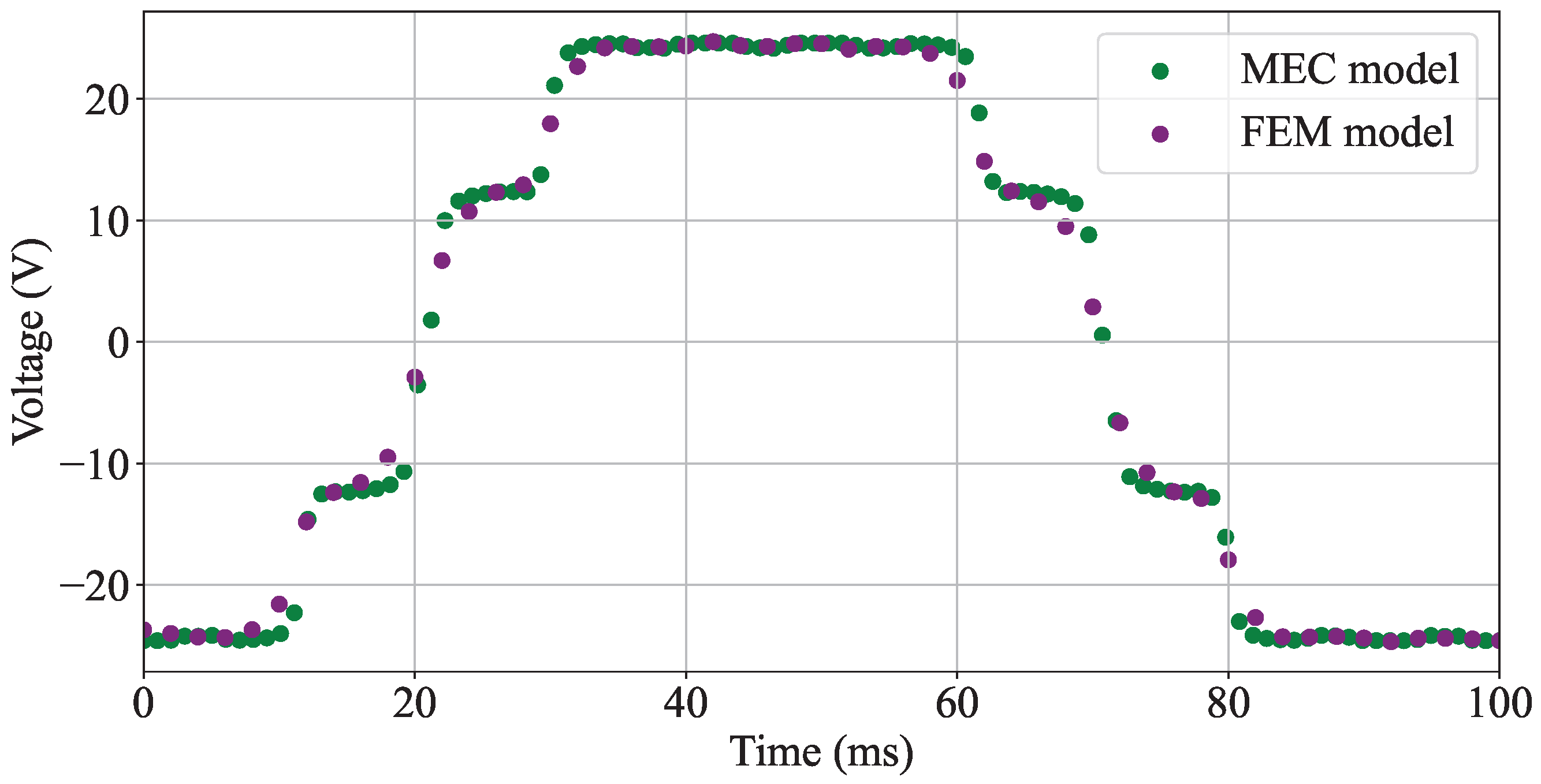
Figure 10 illustrates the time-domain back-EMF waveform obtained for the proposed structure. A close correspondence between the MEC-based predictions and the FEM results is observed, confirming the accuracy of the analytical model in the time domain. Although the figure presented in [
32] and
Figure 10 in this paper may appear visually similar, they correspond to different machine configurations and design scenarios. The results shown in
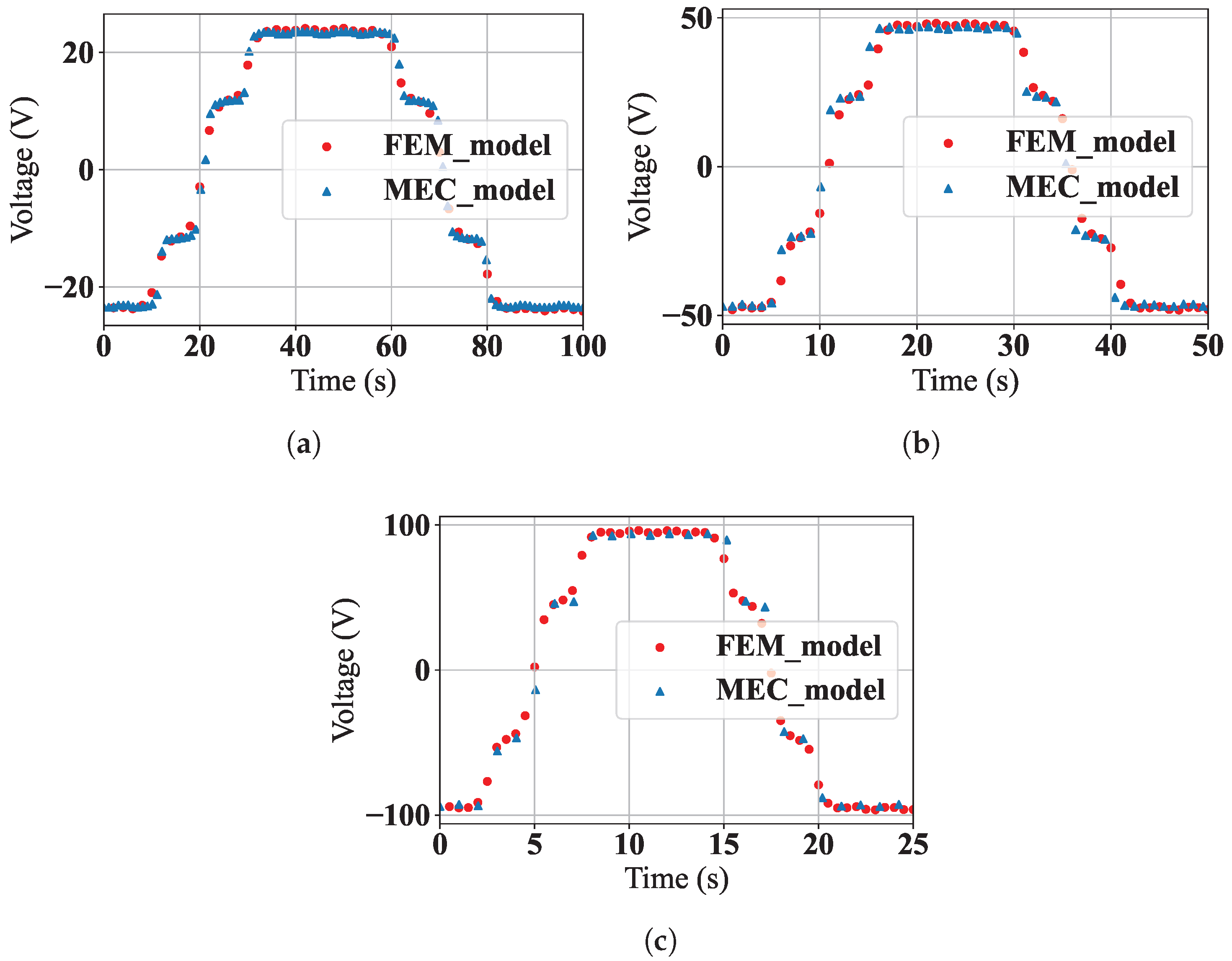
Figure 10 clearly differ, confirming that the two figures represent distinct cases. Specifically, the RMS and peak back-EMF values in the present manuscript differ due to variations in magnet dimensions and the utilization of different available regions within the machine. In addition, the back-EMF voltages of the proposed machine at different operating speeds are presented in
Figure 11 and
Table 2. Across different speeds, the MEC model exhibits consistent agreement with the FEM analysis, further validating the proposed modeling approach.
4.2. Comparative Results and Optimization
To demonstrate the impact of the proposed structure, the principal design parameters are listed in
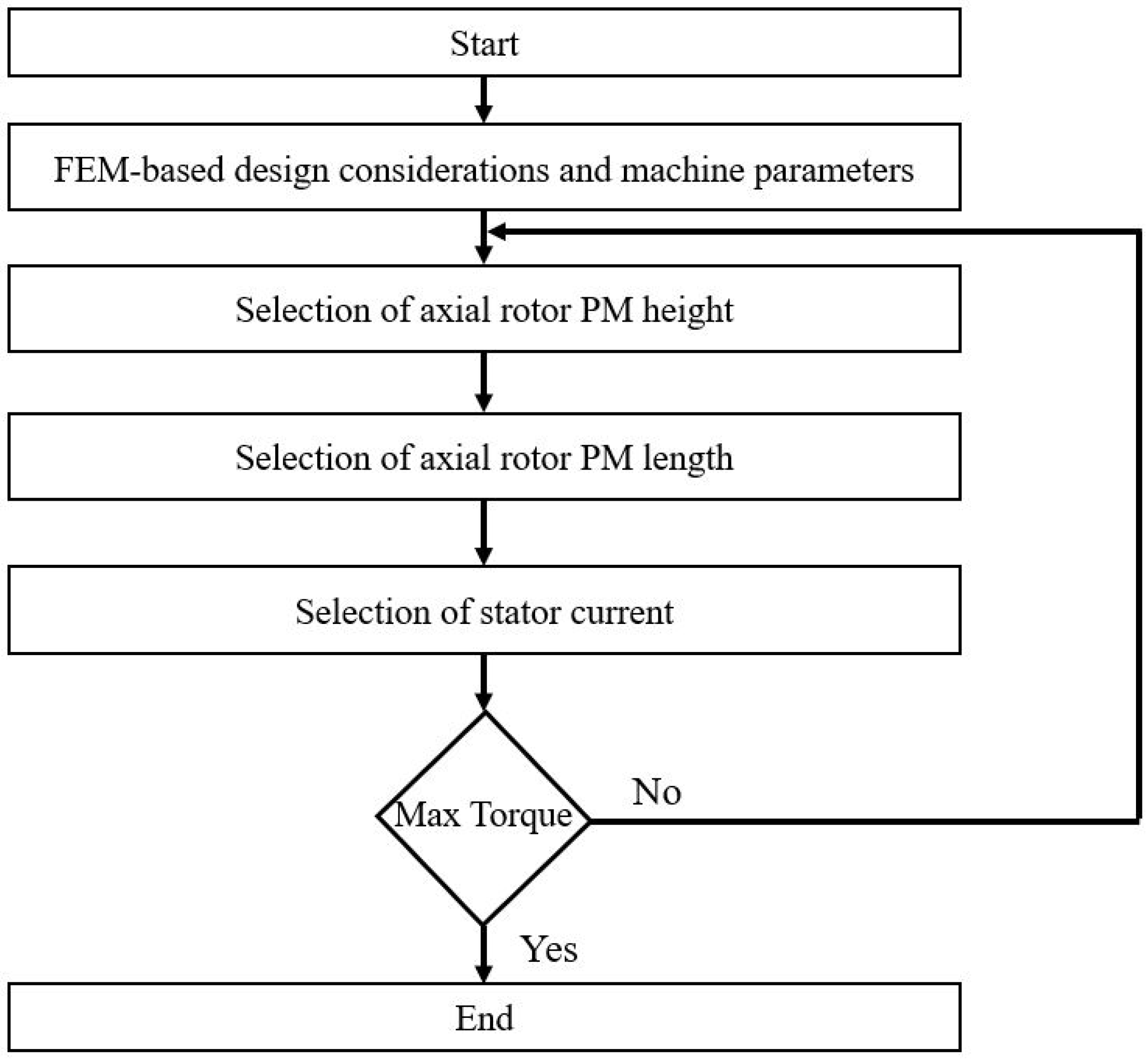
Table 3. The stator core, slot geometry, and winding configuration are identical for the non-overhang, conventional overhang, and proposed machines. To analyze the contribution of the proposed structure, its parameters are optimized to achieve maximum torque following the flowchart shown in
Figure 12, while ensuring that the machine operates in the unsaturated region.
As shown in
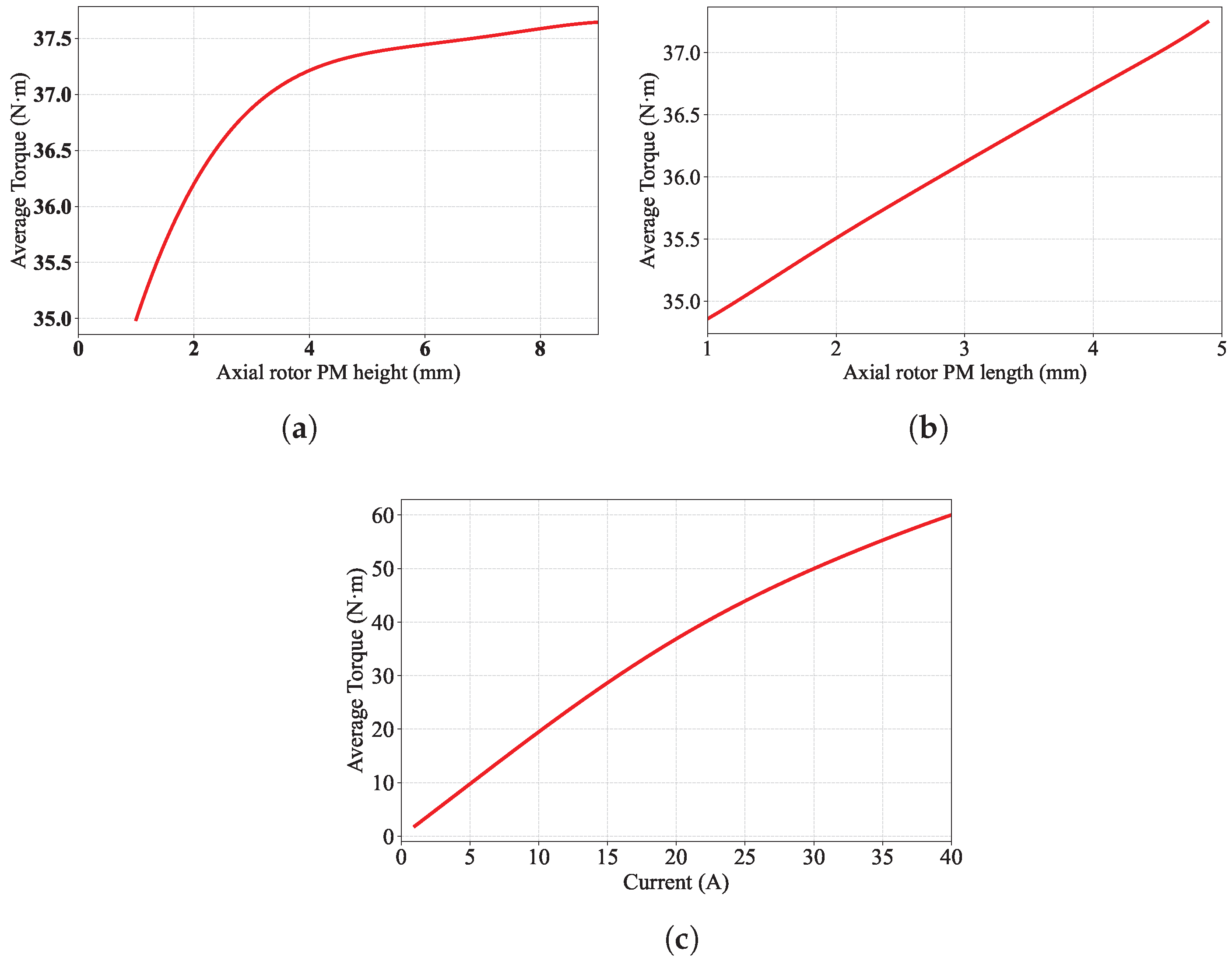
Figure 13a, with an operating current of 20 A, the axial rotor PM height of 3 mm is selected, since beyond this value the torque characteristic begins to exhibit nonlinear behavior. As illustrated in
Figure 13b, with an operating current of 20 A, the axial rotor PM length is selected as 3 mm. This parameter is constrained by the stator slot geometry and winding configuration, particularly the slot opening and winding arrangement. Finally,
Figure 13c shows that the electromagnetic torque increases linearly with current up to approximately 25 A, beyond which nonlinear behavior appears as the machine enters the saturation region.
As shown in
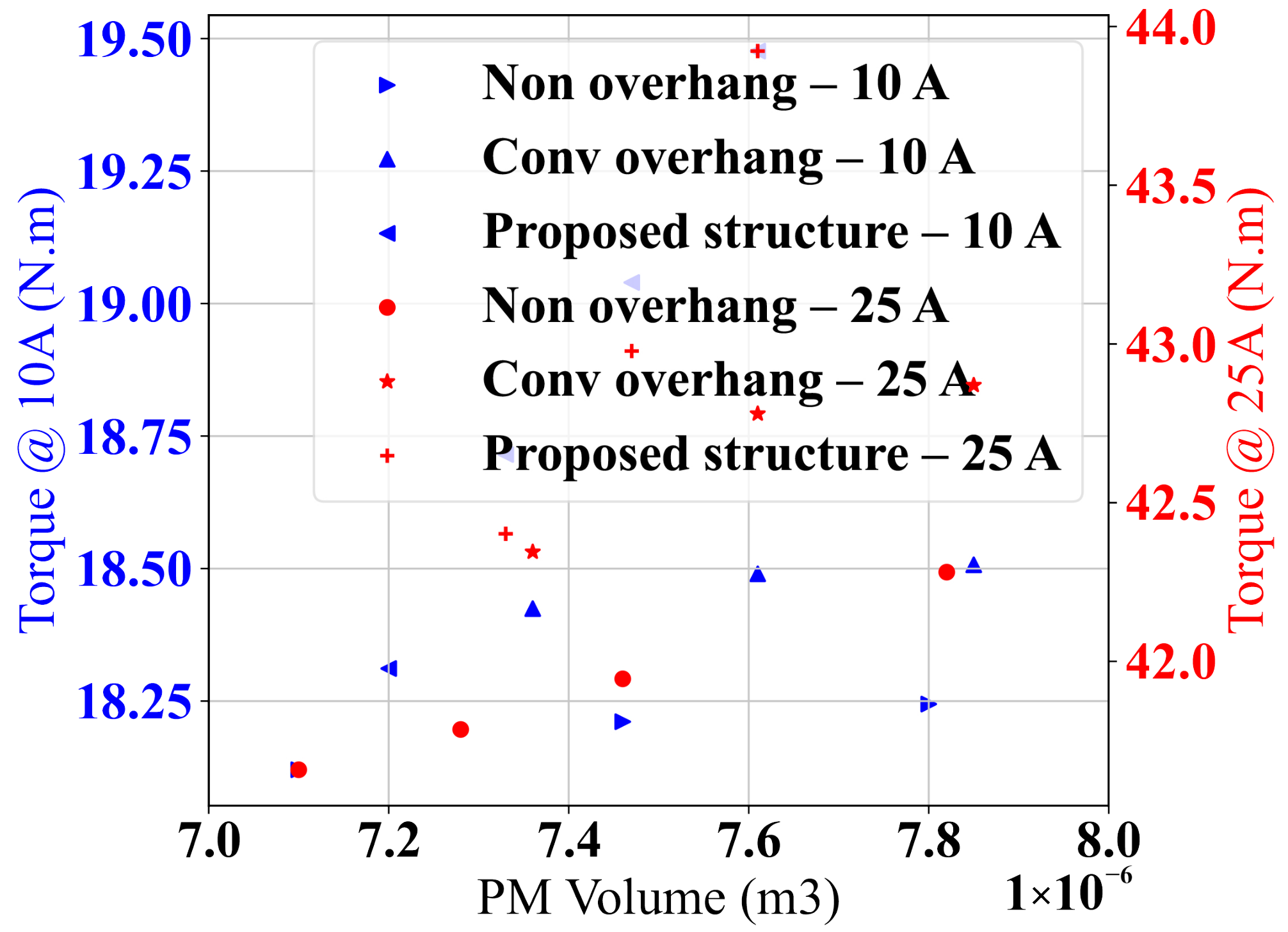
Figure 14, to highlight the effect of the proposed structure relative to the other configurations, a comparison is conducted at different magnet volumes and current levels. In the proposed structure, the length of the axially magnetized PM in the axial rotor is varied from 1 to 3 mm. In the conventional non-overhang structure, the magnet radius is adjusted from 47.7 to 47.4 mm. In the conventional overhang structure, the overhang length is set to 0.5 mm, and the inner radius of the magnet is varied from 47.7 to 47.9 mm, ensuring that all structures have comparable magnet volumes. As demonstrated by the torque comparisons, the proposed structure consistently produces higher torque than the other counterparts.
As shown in
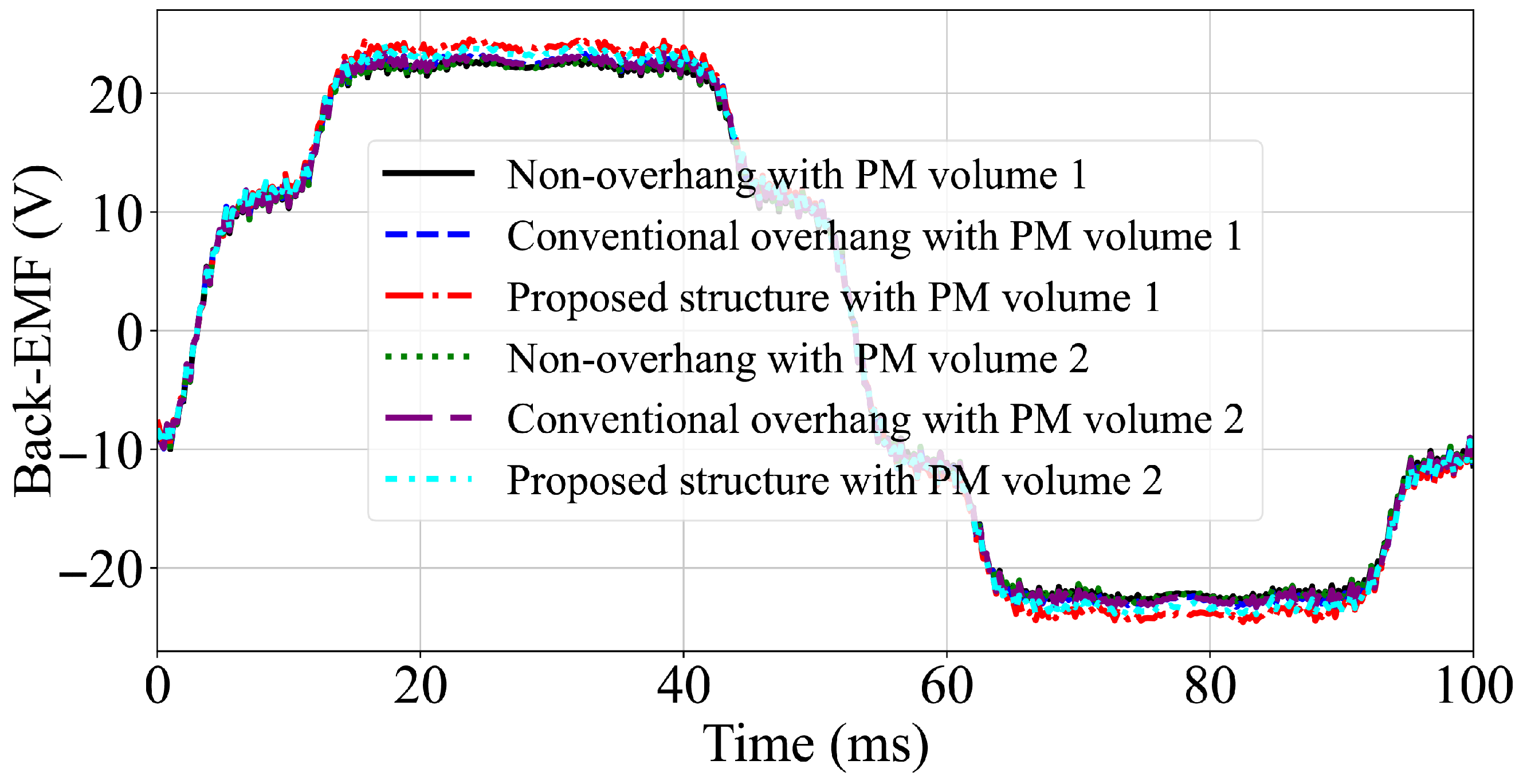
Figure 15, the back-EMF voltage of the proposed structure with a per-pole PM volume of 7.61 mm
3 (PM volume 1) and 7.47 mm
3 (PM volume 2) is higher than that of both the conventional overhang and non-overhang structures.
As shown in
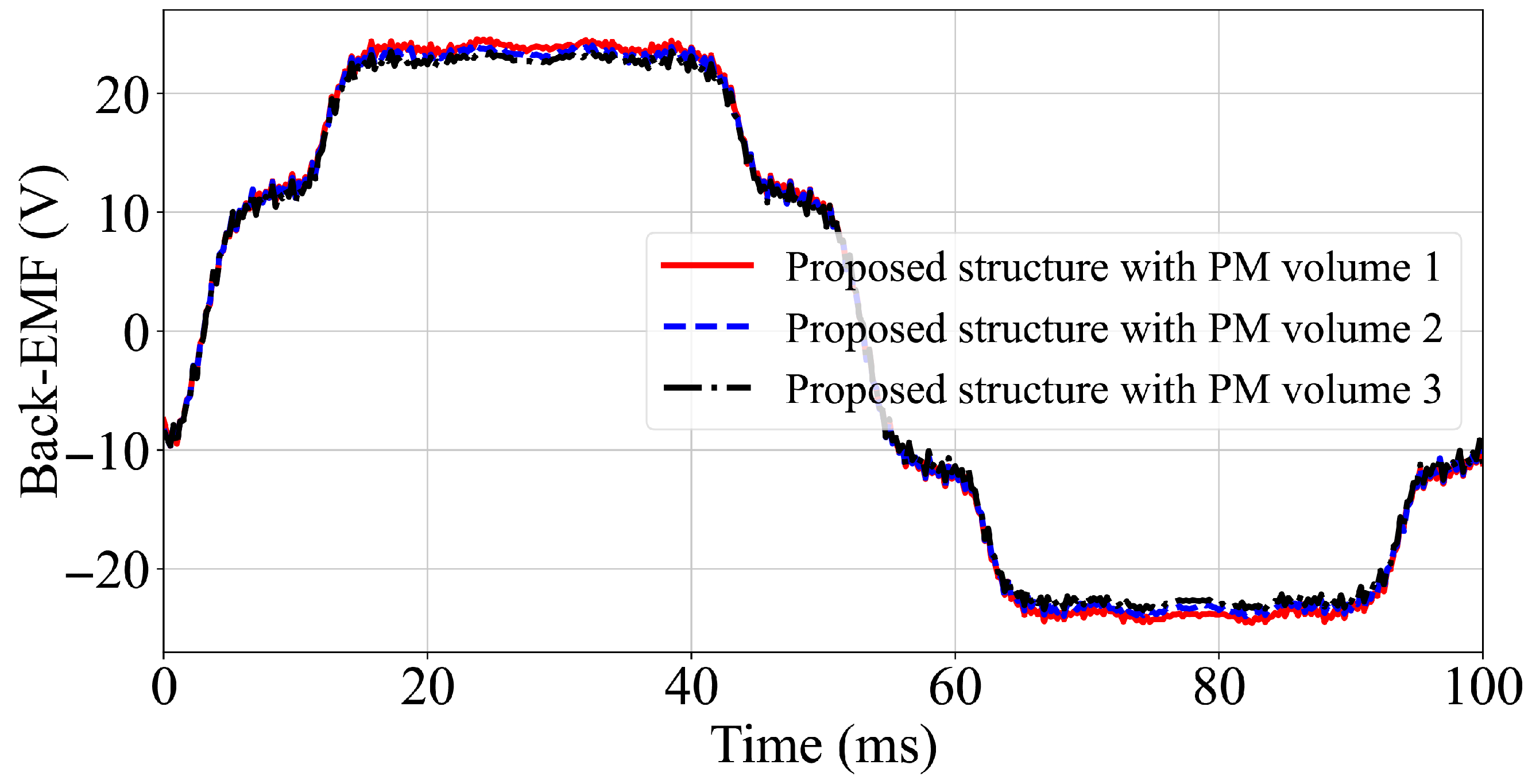
Figure 16, the back-EMF voltage of the proposed structure increases with increasing per-pole PM volume, corresponding to 7.61 mm
3 (PM volume 1), 7.47 mm
3 (PM volume 2), and 7.33 mm
3 (PM volume 3).
As shown in
Table 1, the proposed structure exhibits higher torque and voltage compared to the conventional design. Additionally, the proposed MEC model is validated through FEM, which offers the advantage of saving both energy and time. This efficiency ensures that designing the proposed structure requires significantly less time.
As shown in
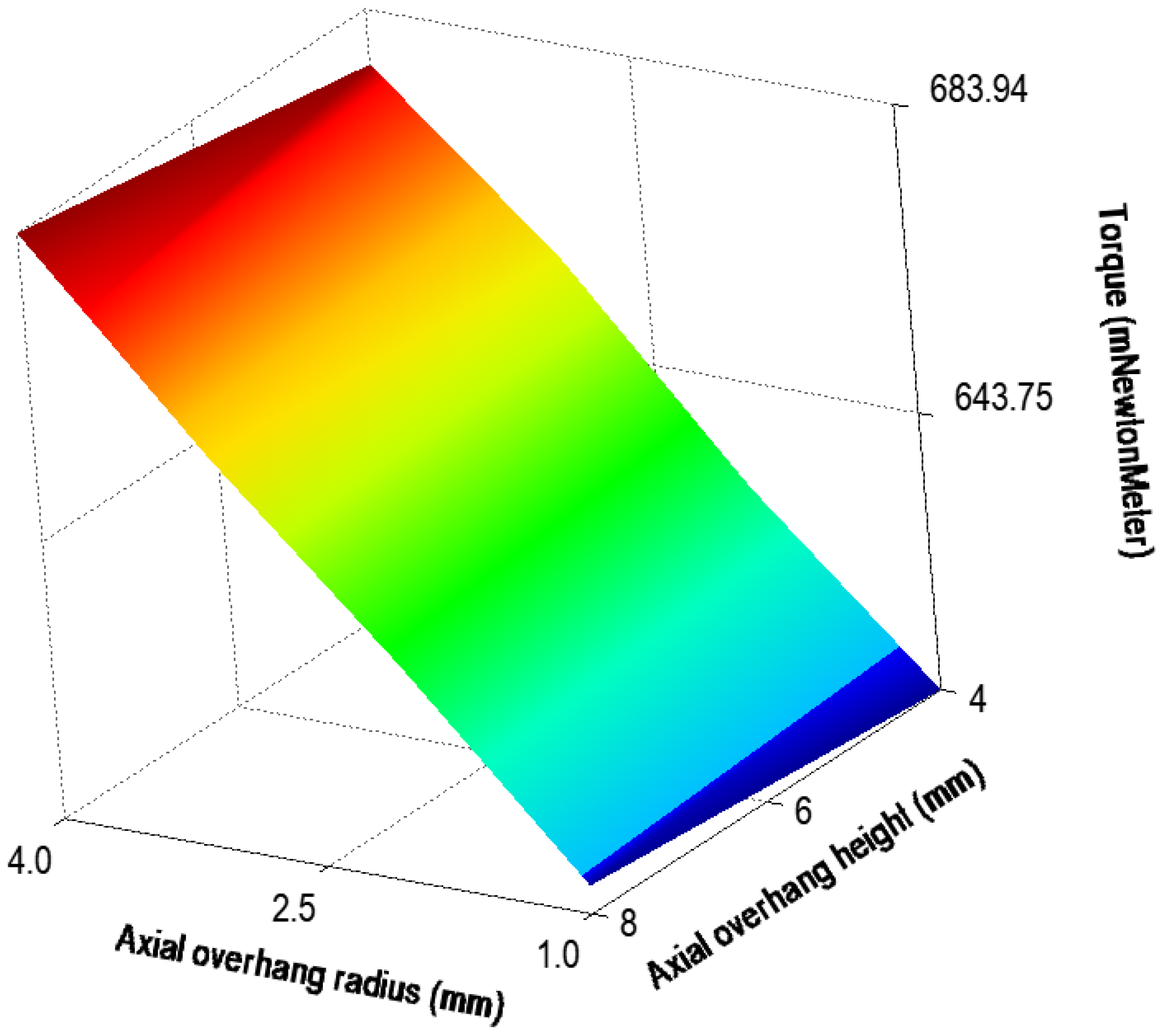
Figure 17, increasing both the radius and height of the overhang in the axial rotor leads to an increase in the machine’s torque. However, the impact of the overhang radius is more significant than that of its height. This suggests that to optimize the motor design by utilizing the unused space, prioritizing an increase in the overhang radius over its height would be more effective.
5. Experimental Validation
As shown in
Figure 18 and
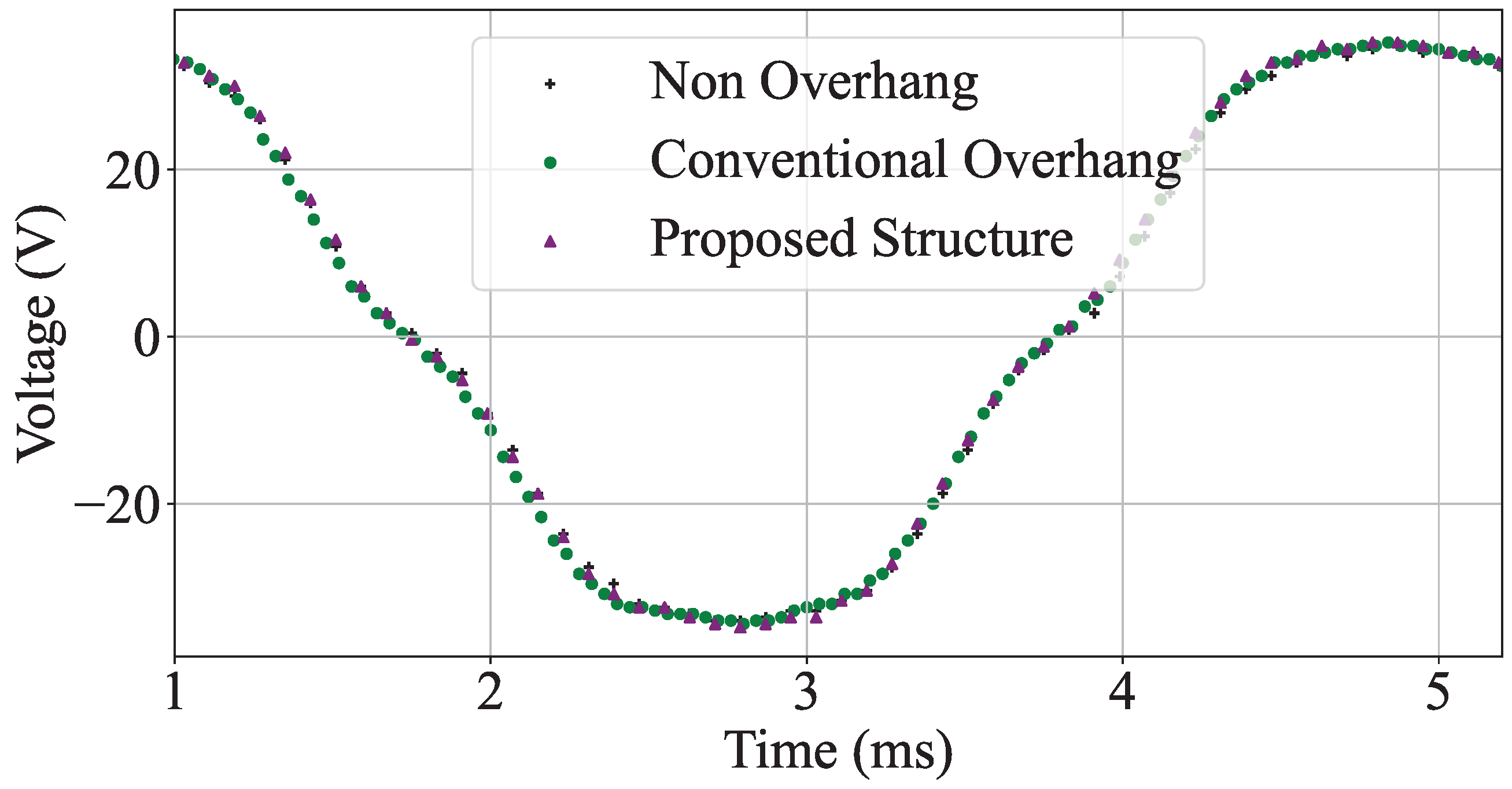
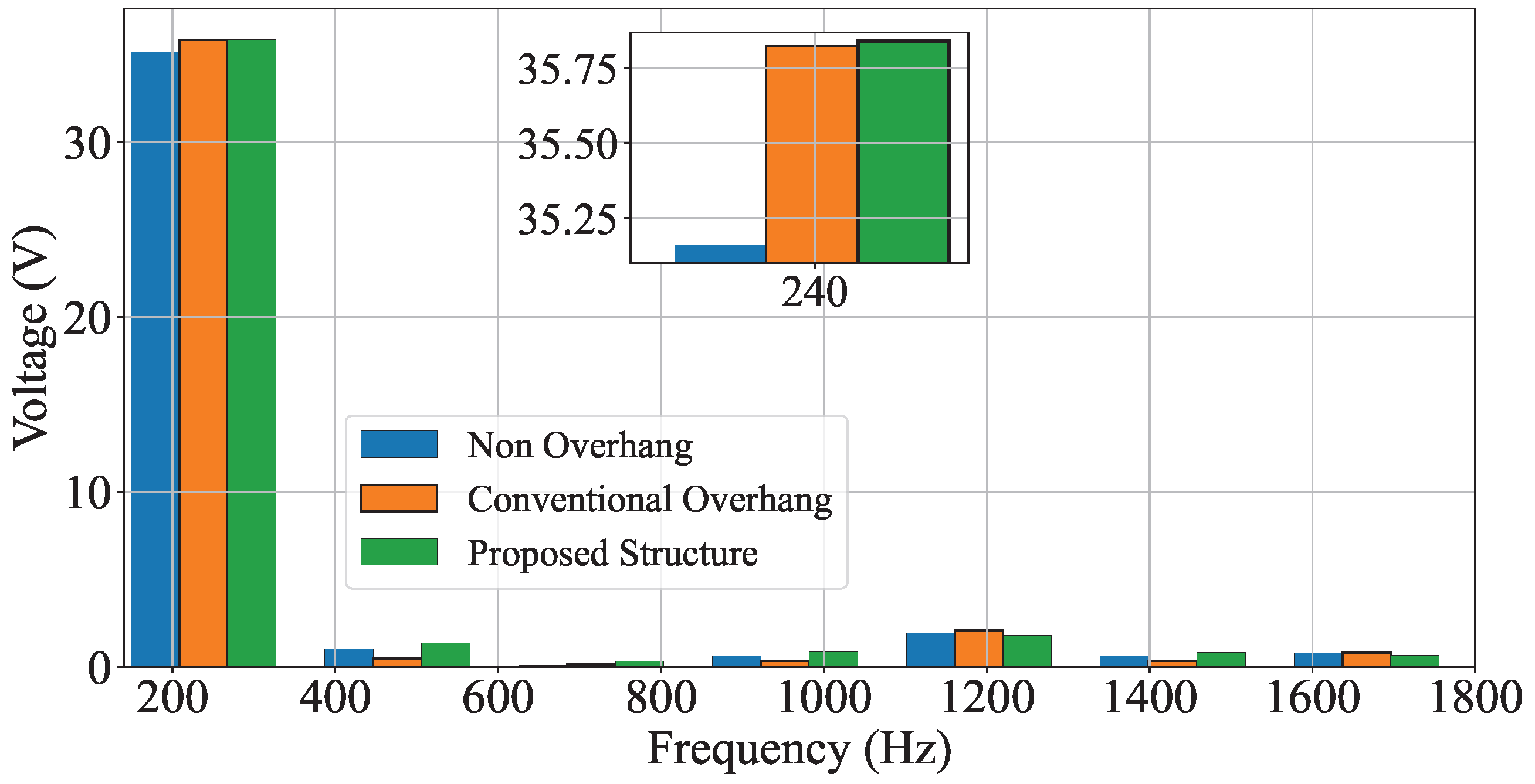
Figure 19, the rotational speed was 3550 rpm, and the motor was mechanically coupled to a DC motor supplied with 33.8 V. The measured RMS voltages were 25.41 V for the non-overhang structure, 25.68 V for the conventional overhang structure, and 25.72 V for the proposed structure, which validates the simulation results.
As illustrated in
Figure 19, the main harmonic components of the proposed structure exhibit higher magnitudes compared with those of the other configurations.
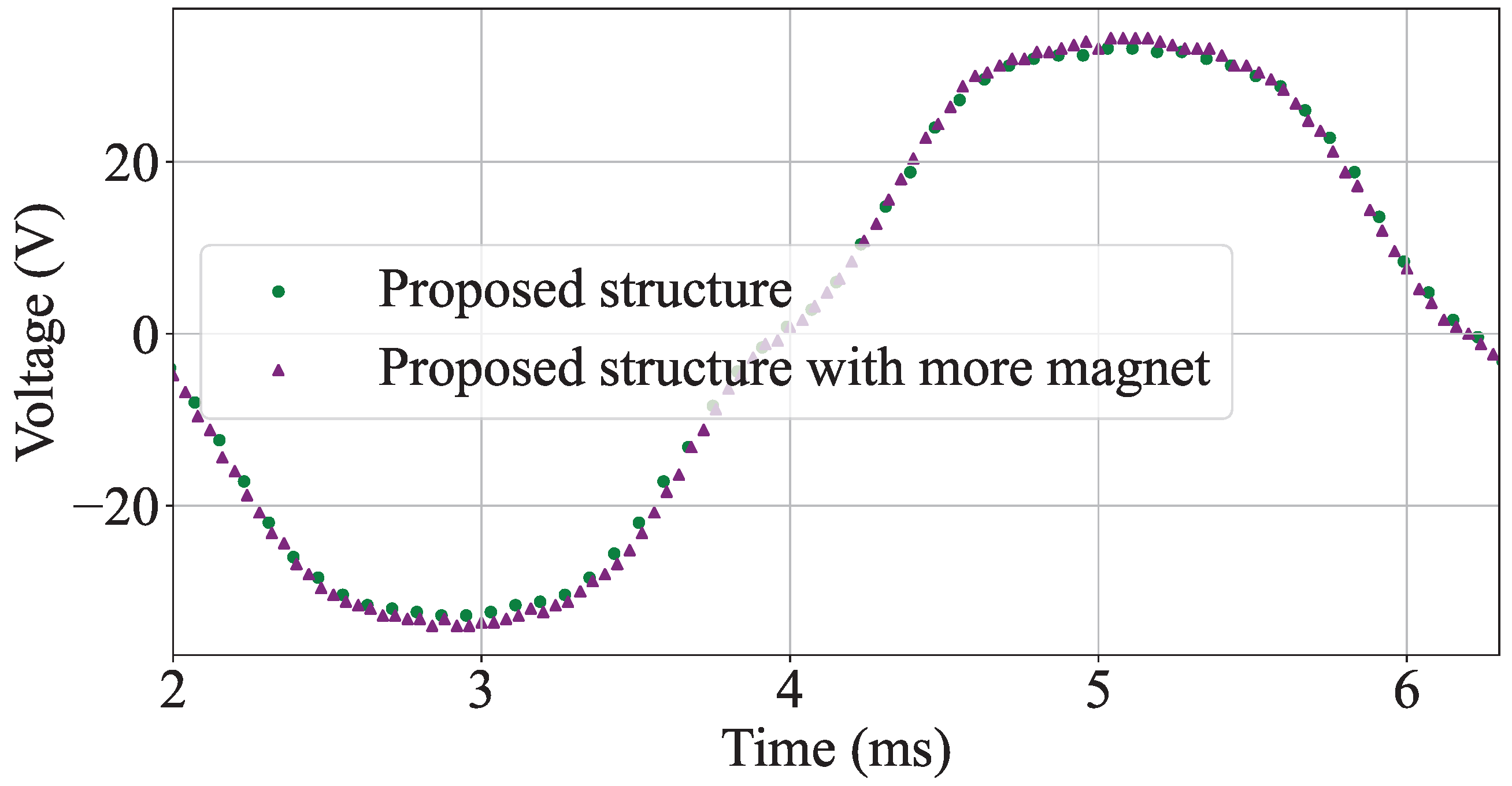
By increasing the magnet length in the axial rotor, the back-EMF voltage of the machine increases, as shown in
Figure 20.
In this case, the rotational speed was 3480 rpm, and the motor was mechanically coupled to a DC motor supplied with 33.4 V. For the proposed structure, the measured RMS back-EMF voltage was 24.36 V. When the PM mass in the axial rotor was increased by 1.4 g, the RMS back-EMF voltage increased to 25.20 V, as shown in
Figure 20.
6. Conclusions
In this study, the available space (because of end windings) in a Permanent Magnet Synchronous Machine (PMSM) with distributed windings is efficiently utilized by adding an axial rotor equipped with axially magnetized permanent magnets (PMs). This additional rotor complements the radially magnetized PMs of the main radial rotor, forming an additional magnetic loop that enhances the overall magnetic field in the air gap, thereby increasing torque. Accordingly, this paper presents an axial–radial flux PMSM topology that improves torque density by incorporating an axial rotor structure while preserving the conventional stator slot geometry and winding configuration. The improved torque performance makes the proposed structure a promising candidate for electric vehicles and transportation applications. A magnetic equivalent circuit (MEC) model is also developed, reducing simulation time from several hours with the finite element method (FEM) to less than one minute, significantly accelerating the early-stage motor design process. The accuracy of the MEC model is confirmed through comparison with FEM results and the proposed idea is further validated experimentally. Despite the demonstrated advantages of the proposed structure, some aspects require further investigation. The introduction of an additional axial rotor increases manufacturing complexity and cost, and may also pose challenges for thermal management due to the modified machine geometry, for which dedicated cooling strategies could be beneficial. In addition, potential axial flux leakage under high-speed operating conditions, along with comprehensive thermal and mechanical robustness analyses, must be addressed to ensure reliable operation. Furthermore, including the development of a full-scale prototype and its evaluation in industrial applications to evaluate the proposed structure’s lifespan. In future work, the proposed structure may also be combined with Halbach arrays and skewed configurations to further enhance torque performance.
Author Contributions
Conceptualization, S.Y.; Methodology, S.Y.; Validation, S.Y.; Formal analysis, S.Y.; Writing—original draft, S.Y.; Writing—review & editing, M.M. and P.R.; Supervision, P.R. All authors have read and agreed to the published version of the manuscript.
Funding
This research received no external funding.
Data Availability Statement
The original contributions presented in this study are included in the article. Further inquiries can be directed to the corresponding authors.
Conflicts of Interest
The authors declare no conflicts of interest.
Nomenclature
| Outer and inner arc widths of PMs and inter-pole regions on the radial rotor. |
| PM and inter-pole arc widths on the axial rotor. |
| Lengths and height of the magnets used in the radial and axial rotors. |
| Rotor, magnet, and stator radii associated with the radial and axial parts of the machine. |
| Air-gap dimensions along the radial and axial directions. |
| Magnet remanence and coverage ratio. |
| Number of pole pairs and rotor angular position. |
| Relative magnetic permeability. |
| Derivative with respect to the z-dimension. |
| Stack length. |
References
- Muthusamy, M.; Hendershot, J.; Pillay, P. Design of a spoke type PMSM with SMC stator core for traction applications. IEEE Trans. Ind. Appl. 2022, 59, 1418–1436. [Google Scholar] [CrossRef]
- Jeong, M.J.; Lee, K.B.; Pyo, H.J.; Nam, D.W.; Kim, W.H. A study on the shape of the rotor to improve the performance of the spoke-type permanent magnet synchronous motor. Energies 2021, 14, 3758. [Google Scholar] [CrossRef]
- Nam, D.W.; Lee, K.B.; Pyo, H.J.; Jeong, M.J.; Yang, S.H.; Kim, W.H.; Jang, H.K. A study on core skew considering manufacturability of double-layer spoke-type PMSM. Energies 2021, 14, 610. [Google Scholar] [CrossRef]
- Yousefnejad, S.; Amiri, E.; Rastgoufard, P. Axial-Assist Permanent Magnet Synchronous Machine with Halbach Array Magnetic Arrangement. In Proceedings of the 2024 IEEE Energy Conversion Congress and Exposition (ECCE), Phoenix, AZ, USA, 20–24 October 2024; IEEE: Piscataway, NJ, USA, 2024; pp. 5162–5166. [Google Scholar]
- Hosseinpour, A.; Abbas, A.; Sadegh, M.O.; Iqbal, A.; Flah, A.; Prokop, L.; Ali, E.; Ghaly, R.N. Optimal structure to maximize torque per volume for the consequent-Pole PMSM and investigating the temperature effect. IEEE Access 2024, 12, 108851–108862. [Google Scholar] [CrossRef]
- Mbadiwe, E.I.; Sulaiman, E.B. Design and optimization of outer-rotor permanent magnet flux switching motor using transverse segmental rotor shape for automotive applications. Ain Shams Eng. J. 2021, 12, 507–516. [Google Scholar] [CrossRef]
- Yoon, K.Y.; Lee, S.T. Performance Improvement of Permanent-Magnet-Synchronous Motors through Rotor Shape Optimization of Marine Blowing System with High-Speed Rotation. Energies 2023, 16, 5486. [Google Scholar] [CrossRef]
- Wang, S.C.; Nien, Y.C.; Huang, S.M. Multi-objective optimization design and analysis of V-shape permanent magnet synchronous motor. Energies 2022, 15, 3496. [Google Scholar] [CrossRef]
- Jeong, K.I.; Heidari, R.; Kang, D.H.; Ahn, T.J.; Park, G.S.; Ahn, J.W.; Lukman, G.F. Electromagnetic characteristics of dual-air-gap surface permanent magnet synchronous motor. Machines 2023, 11, 717. [Google Scholar] [CrossRef]
- Kim, H.J.; Baek, S.W. Optimal shape design to improve torque characteristics of interior permanent magnet synchronous motor for small electric vehicles. Microsyst. Technol. 2025, 31, 1203–1217. [Google Scholar] [CrossRef]
- Canseven, H.T.; Petrov, I.; Pyrhönen, J. Impact of stator core magnetic asymmetry on the properties of a high specific power PMSM. IEEE Trans. Ind. Appl. 2024, 60, 3830–3839. [Google Scholar] [CrossRef]
- Jo, I.H.; Lee, J.; Lee, H.W.; Lee, J.B.; Lim, J.H.; Kim, S.H.; Park, C.B. A study on MG-PMSM for high torque density of 45 kW–class tram driving system. Energies 2022, 15, 1749. [Google Scholar] [CrossRef]
- Tsunata, R.; Takemoto, M. Skewing Technology for Permanent Magnet Synchronous Motors: A Comprehensive Review and Recent Trends. IEEE Open J. Ind. Electron. Soc. 2024, 5, 1251–1273. [Google Scholar] [CrossRef]
- Hairulnizam, H.F.; Misron, N.; Ibrahim, N.A.; Ramli, H.R.; Vaithilingam, C.A. Evaluation of the Performance of New Type of Segmented Stator Permanent Magnet Synchronous Motor. IEEE Access 2025, 13, 75563–75575. [Google Scholar] [CrossRef]
- Niu, S.; Chau, K.; Li, J.; Li, W. Eddy-current analysis of double-stator inset-type permanent magnet brushless machines. IEEE Trans. Appl. Supercond. 2010, 20, 1097–1101. [Google Scholar]
- Bhagubai, P.P.; Bucho, L.F.; Fernandes, J.F.; Costa Branco, P. Optimal design of an interior permanent magnet synchronous motor with cobalt iron core. Energies 2022, 15, 2882. [Google Scholar] [CrossRef]
- Zhao, J.; Liu, X.; Wang, S.; Zheng, L. Review of design and control optimization of axial flux PMSM in renewable-energy applications. Chin. J. Mech. Eng. 2023, 36, 45. [Google Scholar] [CrossRef]
- Lee, J.I.; Bang, T.K.; Lee, H.K.; Woo, J.H.; Nah, J.; Choi, J.Y. Design of the high-speed pmsg with two different shaft material considering overhang effect and mechanical characteristics. Appl. Sci. 2021, 11, 7670. [Google Scholar] [CrossRef]
- Verma, M.; Sreejeth, M.; Singh, M. Application of hybrid metaheuristic technique to study influence of core material and core trench on performance of surface inset PMSM. Arab. J. Sci. Eng. 2022, 47, 3037–3053. [Google Scholar] [CrossRef]
- Wolnik, T.; Jarek, T. Solid rotor core vs. lamination rotor core in fractional-slot pmsm motor with high power density. Energies 2022, 15, 5729. [Google Scholar] [CrossRef]
- Dehdez, M.A.N.; Milimonfared, J. A novel radial–axial flux switching permanent magnet generator. IEEE Trans. Ind. Electron. 2021, 69, 12096–12106. [Google Scholar] [CrossRef]
- Yu, D.; Huang, X.; Wu, L.; Fang, Y. Design and analysis of outer rotor permanent-magnet vernier machines with overhang structure for in-wheel direct-drive application. Energies 2019, 12, 1238. [Google Scholar] [CrossRef]
- Kim, H.J.; Baek, S.W. Multi-Objective Optimal Design of an Axial Flux Permanent Magnet Motor for In-Wheel Drive Considering Torque Ripple Reduction. Energies 2025, 18, 4936. [Google Scholar] [CrossRef]
- Song, S.W.; Lee, S.H.; Kim, W.H. Design and Analysis of Consequent Pole Axial Flux Motors for Reduced Torque Ripple and Magnet Consumption. Processes 2025, 13, 2139. [Google Scholar] [CrossRef]
- Tak, B.O.; Ro, J.S. Analysis and design of an axial flux permanent magnet motor for in-wheel system using a novel analytical method combined with a numerical method. IEEE Access 2020, 8, 203994–204011. [Google Scholar] [CrossRef]
- Cui, S.; Zhang, Y.; Song, B.; Xu, K.; Feng, C.; Qi, S. High-Torque-Density Composite-Cooled Axial Flux Electrically Excited Synchronous Motor. Energies 2025, 18, 4585. [Google Scholar] [CrossRef]
- Xu, N.; Li, N.; Sun, X.; Wang, Y.; Wan, B. Robust multi-objective optimisation of an axial-radial flux hybrid excitation permanent magnet synchronous motors based on improved sequential Taguchi method. IET Electr. Power Appl. 2025, 19, e12543. [Google Scholar] [CrossRef]
- Long, Y.; Song, Z.; Zhang, Z. Design and Cogging Torque Optimization of Axial-Radial Flux Permanent Magnet Machine with Novel Modular Stator. IEEE Trans. Ind. Appl. 2025, 61, 7023–7034. [Google Scholar] [CrossRef]
- Chen, H.; Demerdash, N.A.; El-Refaie, A.M.; Guo, Y.; Hua, W.; Lee, C.H. Investigation of a 3D-magnetic flux PMSM with high torque density for electric vehicles. IEEE Trans. Energy Convers. 2021, 37, 1442–1454. [Google Scholar] [CrossRef]
- Seo, J.M.; Ro, J.; Rhyu, S.H.; Jung, I.S.; Jung, H.K. Novel hybrid radial and axial flux permanent-magnet machine using integrated windings for high-power density. IEEE Trans. Magn. 2015, 51, 8100804. [Google Scholar] [CrossRef]
- Shimomura, S.; Sunaga, T. Design of integrated radial and dual axial-flux ferrite magnet synchronous machine. In Proceedings of the 2016 IEEE Energy Conversion Congress and Exposition (ECCE), Milwaukee, WI, USA, 18–22 September 2016; IEEE: Piscataway, NJ, USA, 2016; pp. 1–6. [Google Scholar]
- Yousefnejad, S.; Mehrasa, M.; Rastgoufard, P. MEC-Based Modeling and Design of Permanent Magnet Synchronous Machines with Axial–Radial Rotor Extensions Using Yoke and Rotor-Side Spaces. Actuators 2025, 14, 507. [Google Scholar] [CrossRef]
- Yeo, H.K.; Ro, J.S. Novel analytical method for overhang effects in surface-mounted permanent-magnet machines. IEEE Access 2019, 7, 148453–148461. [Google Scholar] [CrossRef]
- Kim, S.M.; Jung, W.S.; Kim, W.H.; Bang, T.K.; Lee, D.H.; Kim, Y.J.; Choi, J.Y. Optimal design of permanent magnet synchronous machine based on random walk method and semi 3D magnetic equivalent circuit considering overhang effect. Energies 2022, 15, 7852. [Google Scholar] [CrossRef]
- Seok, C.H.; Yoon, S.Y.; Choi, H.S.; Lee, H.Y.; Seo, J. Analysis and modeling of axial leakage for spoke-type hybrid permanent magnet machines. IEEE Access 2022, 11, 6385–6393. [Google Scholar] [CrossRef]
- Seo, J.M.; Jung, I.S.; Jung, H.K.; Ro, J. Analysis of overhang effect for a surface-mounted permanent magnet machine using a lumped magnetic circuit model. IEEE Trans. Magn. 2013, 50, 8201207. [Google Scholar] [CrossRef]
- Qu, R.; Lipo, T.A. Analysis and modeling of air-gap and zigzag leakage fluxes in a surface-mounted permanent-magnet machine. IEEE Trans. Ind. Appl. 2004, 40, 121–127. [Google Scholar] [CrossRef]
Figure 1.
Cross-section of the PMSM structure without overhang.
Figure 1.
Cross-section of the PMSM structure without overhang.
Figure 2.
(
a) Magnetic flux modeling in the air gap using a straight-line permeance model for overhang part 1 and an arc permeance model for part 2 (half of the motor’s cross-sectional view along the x-z axis) [
33]. (
b) whole structure of the conventional overhang structure.
Figure 2.
(
a) Magnetic flux modeling in the air gap using a straight-line permeance model for overhang part 1 and an arc permeance model for part 2 (half of the motor’s cross-sectional view along the x-z axis) [
33]. (
b) whole structure of the conventional overhang structure.
Figure 3.
PMSM machine: (a) axial rotor; (b) whole configuration; (c) magnetic flux.
Figure 3.
PMSM machine: (a) axial rotor; (b) whole configuration; (c) magnetic flux.
Figure 4.
Shift in the position of the PM in the axial rotor.
Figure 4.
Shift in the position of the PM in the axial rotor.
Figure 5.
Magnetic field in the airgap: (a) non-overhang; (b) proposed structure; (c) length of the airgap in the proposed structure.
Figure 5.
Magnetic field in the airgap: (a) non-overhang; (b) proposed structure; (c) length of the airgap in the proposed structure.
Figure 6.
Motor structure of the (a) proposed structure (overhang in axial rotor), (b) conventional overhang structure, and (c) motor setup.
Figure 6.
Motor structure of the (a) proposed structure (overhang in axial rotor), (b) conventional overhang structure, and (c) motor setup.
Figure 7.
Flowchart of the magnetic field calculation in the proposed machine.
Figure 7.
Flowchart of the magnetic field calculation in the proposed machine.
Figure 8.
The modeling of the magnetic flux in the air gap between the stator core and axial and radial rotor (half of the motor’s cross-sectional view along the x-z axis).
Figure 8.
The modeling of the magnetic flux in the air gap between the stator core and axial and radial rotor (half of the motor’s cross-sectional view along the x-z axis).
Figure 9.
The MEC model of the structure (a) the radial section (b) the proposed axial section.
Figure 9.
The MEC model of the structure (a) the radial section (b) the proposed axial section.
Figure 10.
Back EMF voltage waveform of the proposed structure for an axial rotor PM height of 4 mm and an axial rotor PM length of 4 mm at 200 rpm.
Figure 10.
Back EMF voltage waveform of the proposed structure for an axial rotor PM height of 4 mm and an axial rotor PM length of 4 mm at 200 rpm.
Figure 11.
Back-EMF voltage waveforms for an axial rotor PM height of 8 mm and an axial rotor PM length of 3 mm at (a) 200 rpm, (b) 400 rpm, and (c) 800 rpm.
Figure 11.
Back-EMF voltage waveforms for an axial rotor PM height of 8 mm and an axial rotor PM length of 3 mm at (a) 200 rpm, (b) 400 rpm, and (c) 800 rpm.
Figure 12.
Optimization flowchart for the proposed structure design.
Figure 12.
Optimization flowchart for the proposed structure design.
Figure 13.
(a) Torque versus axial rotor PM height; (b) torque versus axial rotor PM length; (c) torque versus current.
Figure 13.
(a) Torque versus axial rotor PM height; (b) torque versus axial rotor PM length; (c) torque versus current.
Figure 14.
Torque of the machine versus the magnet volume at 10 and 25 A.
Figure 14.
Torque of the machine versus the magnet volume at 10 and 25 A.
Figure 15.
Voltage comparison between the conventional overhang, non-overhang, and proposed structure.
Figure 15.
Voltage comparison between the conventional overhang, non-overhang, and proposed structure.
Figure 16.
Voltage of the proposed structure with different PM volumes.
Figure 16.
Voltage of the proposed structure with different PM volumes.
Figure 17.
Torque of the machine versus the overhang radius and length.
Figure 17.
Torque of the machine versus the overhang radius and length.
Figure 18.
Back-EMF comparison of the proposed structure with the conventional PM overhang and non-overhang configurations.
Figure 18.
Back-EMF comparison of the proposed structure with the conventional PM overhang and non-overhang configurations.
Figure 19.
Back-EMF harmonic spectrum of the proposed structure compared with conventional PM overhang and non-overhang configurations.
Figure 19.
Back-EMF harmonic spectrum of the proposed structure compared with conventional PM overhang and non-overhang configurations.
Figure 20.
Back-EMF of the proposed structure with different amounts of magnet in the axial rotor.
Figure 20.
Back-EMF of the proposed structure with different amounts of magnet in the axial rotor.
Table 1.
Computation time and RMS values of the back-EMF for the proposed structure using the proposed model and 3D FEM (Computer configuration: 64 GB RAM, Intel Core i9 CPU at 3.20 GHz).
Table 1.
Computation time and RMS values of the back-EMF for the proposed structure using the proposed model and 3D FEM (Computer configuration: 64 GB RAM, Intel Core i9 CPU at 3.20 GHz).
Axial Rotor
PM Height (mm) | Axial Rotor
PM Length (mm) | Proposed
MEC Model (V) | 3D
FEM (V) | 3D FEM
Time | Proposed MEC
Model Time |
|---|
| 4 | 1 | 18.62 | 18.84 | 3 h 35 min | 29 s |
| 4 | 2 | 19.00 | 19.28 | 3 h 25 min | 29 s |
| 4 | 3 | 19.60 | 19.63 | 3 h 40 min | 29 s |
| 4 | 4 | 20.46 | 20.01 | 3 h 35 min | 29 s |
| 8 | 1 | 18.63 | 18.85 | 3 h 5 min | 29 s |
| 8 | 2 | 19.02 | 19.36 | 3 h 50 min | 29 s |
| 8 | 3 | 19.66 | 19.78 | 3 h 58 min | 29 s |
| 8 | 4 | 20.58 | 20.14 | 3 h 20 min | 29 s |
Table 2.
Comparison of RMS back-EMF values obtained using the proposed MEC model and 3D FEM at different operating speeds.
Table 2.
Comparison of RMS back-EMF values obtained using the proposed MEC model and 3D FEM at different operating speeds.
Axial Rotor
PM Height (mm) | Axial Rotor
PM Length (mm) | Speed
(RPM) | Proposed
MEC Model (V) | 3D
FEM (V) |
|---|
| 8 | 3 | 200 | 19.66 | 19.78 |
| 400 | 39.26 | 39.33 |
| 800 | 78.53 | 78.65 |
Table 3.
Design parameters.
Table 3.
Design parameters.
| Parameters | PMSM |
|---|
| Axial length (mm) | 40 |
| Overall radius (mm) | 82 |
| Rotor radius (mm) | 48 |
| Magnet radius (mm) | 52 |
| Radial air gap length (mm) | 0.5 |
| Axial air gap length (mm) | 0.5 |
| No. of phase | 3 |
| Height of the stator slot (mm) | 19.5 |
| Width of the stator slot (mm) | 1.83 |
| Magnet Flux Density (NdFeB) | 1.07 T |
| Core material | Steel 1008 |
| Disclaimer/Publisher’s Note: The statements, opinions and data contained in all publications are solely those of the individual author(s) and contributor(s) and not of MDPI and/or the editor(s). MDPI and/or the editor(s) disclaim responsibility for any injury to people or property resulting from any ideas, methods, instructions or products referred to in the content. |