Article

Implementation of Current Harmonic Suppression for Imbalance in Six-Phase Permanent Magnet Synchronous Motor Drives

1
Department of Electrical Engineering, National Taiwan University of Science and Technology, Taipei City 106, Taiwan
2
Chroma ATE Inc., Taoyuan City 333, Taiwan
*
Author to whom correspondence should be addressed.
Energies 2025, 18(23), 6112; https://doi.org/10.3390/en18236112
Submission received: 18 September 2025 / Revised: 10 November 2025 / Accepted: 13 November 2025 / Published: 22 November 2025

Abstract

Current harmonics in six-phase permanent magnet synchronous motors (PMSMs) arise from inherent asymmetries caused by manufacturing tolerances and nonlinear characteristics in the inverter output. Additionally, magnetic saturation and slight imbalances in the windings introduce flux linkage asymmetries, resulting in both fundamental current imbalance and low-order harmonics. Although these imbalances are minor and do not indicate fault conditions, they can cause uneven copper loss and eventually reduce the overall service life of the motor. This paper proposes a harmonic suppression strategy for mitigating imbalance current harmonics in non-ideal six-phase PMSMs. The method integrates back-electromotive force harmonic feedforward compensation (BEMF-HFC) with harmonic synchronous reference frame current control (HSRF-CC). An imbalance flux linkage harmonic model is developed in simulations to replicate the measured imbalance phase currents and to validate the effectiveness of the proposed strategy. The experimental setup is built using a microcontroller from Texas Instruments (TI), which generates six-phase complementary PWM signals for the power stage and receives feedback signals including phase currents, DC bus voltage, and rotor position. Rotor position is acquired through a 12-pole resolver and a 12-bit resolver-to-digital converter (RDC). The six-phase PMSM used in the tests is specified with 12 poles, a rated DC bus voltage of 600 V, a rated current of 200 Arms, and a rated rotor speed of 1200 rpm. Compared with conventional harmonic suppression strategies that do not target imbalance current harmonics, the proposed method achieves a better current balance and lower total harmonic distortion (THD). At 1200 rpm, the magnitude deviation of the fundamental, third, and fifth current harmonics is reduced from 8.61%, 2.88%, and 2.94% to 1.19%, 1.02%, and 0.5%, respectively.

1. Introduction

Multiphase PMSMs have been widely adopted in vehicle traction [1], marine propulsion [2], and aerospace systems [3]. By distributing the total current across multiple phases, multiphase systems enable the use of lower per-phase current ratings, making them well-suited for high-power applications. Additionally, multiphase systems support fault-tolerant control strategies that ensure smooth torque generation and reduce copper losses. These characteristics make them particularly suitable for applications that require high reliability and efficiency [4,5]. Multiphase systems can be extended to multi-three-phase configurations, such as six-phase or nine-phase systems, allowing a modular design, current sharing, and fault-tolerant control [6,7].The six-phase PMSM used in this study features a neutral-point-isolated and asymmetrical configuration, with a 30-degree spatial phase shift, which results in low torque ripple and improved DC bus voltage characteristics [8].
The vector space decomposition (VSD) method partitions the six-phase states into a fundamental subspace and a harmonic subspace. Under balanced phase current conditions, the fundamental subspace contains ( 12 k ± 1 ) th harmonics, while the harmonic subspace contains ( 6 k ± 1 ) th harmonics [9,10]. To reduce implementation complexity, the VSD method can be replaced by the common-mode (CM) and differential-mode (DM) transformation matrices [11], where the CM subspace corresponds to the fundamental subspace and the DM subspace corresponds to the harmonic subspace. The DM subspace exhibits significantly lower impedance than the CM subspace. Under balanced phase current conditions, the fifth and seventh voltage harmonics, originating from back electromotive harmonics, inductance voltage drop, and inverter output nonlinearity, can induce substantial current harmonics within the DM subspace [9,12].
However, unbalanced stator resistances, caused by manufacturing tolerances and aging in the connectors between the motor and the inverter, can lead to a fundamental current imbalance [13]. Unbalanced or non-sinusoidally distributed windings introduce fundamental current components into the harmonic subspace [14]. In a neutral point-isolated three-phase system, unbalanced fundamental components can be decomposed into positive- and negative-sequence components [15]. Extending this concept to a six-phase PMSM, negative-sequence fundamental, a positive-sequence fifth harmonic, and negative-sequence seventh harmonic components are introduced. Magnetic saturation in the stator inductance and current can generate third-order flux linkage harmonics. Under system imbalance conditions, these flux linkage harmonics induce imbalances in the third current harmonic component [16]. The resulting imbalances in the fundamental, third-, fifth-, seventh-, and higher-order harmonics contribute to uneven copper losses and thermal distributions, which may accelerate insulation degradation and reduce motor lifespan.
Current harmonics can be controlled and suppressed using various strategies, including multi-reference frame proportional-integral (MRF-PI) controllers, proportional-resonant (PR) controllers, and adaptive linear neuron (ALN) controllers. A comparison of their characteristics is provided in Table 1. PR controllers have been applied in both fault-tolerant control (FTC) [17,18] and the suppression of unbalanced phase currents [9], while MRF-PI controllers have also been employed in FTC [17]. The primary objective of FTC is to regulate unbalanced phase currents and suppress current harmonics.
This article proposes a harmonic suppression strategy based on multiple MRF-PI controllers combined with low-pass filters (LPFs) to mitigate unbalanced phase currents and current harmonics. The controllers operate in the harmonic synchronous reference frame (HSRF), defined at 2 n and 2 n times the rotor electrical angle within the differential-mode (DM) subspace of the rotor synchronous reference frame, where n = 1, 2, and 3. This HSRF-based approach enables simultaneous suppression of both positive- and negative-sequence current harmonics, effectively addressing imbalance in the fundamental component, the third and fifth harmonics, as well as the positive-sequence seventh harmonic.
The remainder of this paper is organized as follows: Section 2 presents the modeling of the six-phase PMSM and the associated imbalance phase current harmonics. Section 3 describes the proposed current control strategy and its implementation. Section 4 provides both simulation and experimental results to validate the effectiveness of the proposed method. Section 5 concludes the paper and highlights the main contributions.

2. Mathematical Model of Six-Phase PMSM and Imbalance Current Harmonics

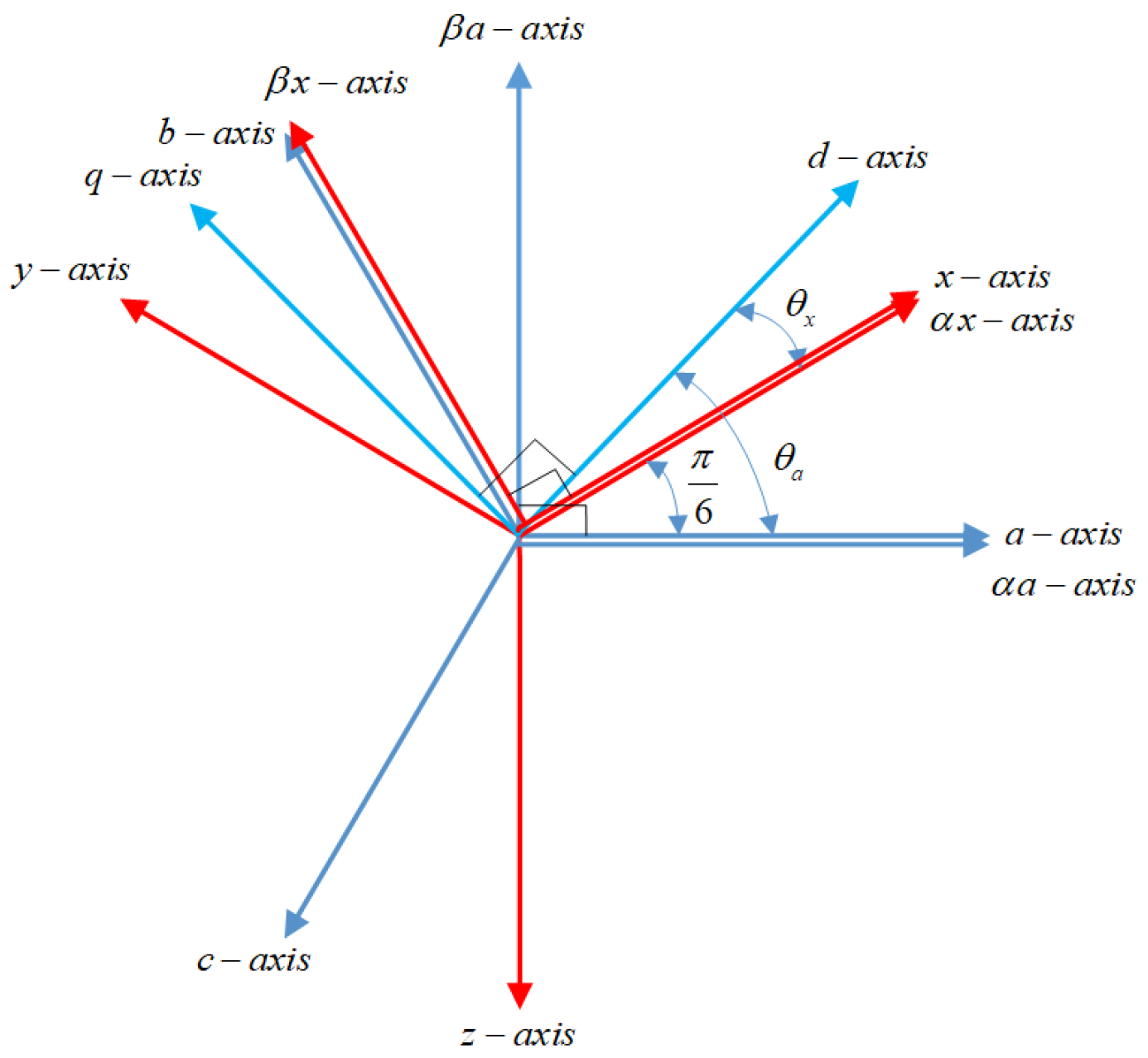
Figure 1 [19] illustrates the dual three-phase configuration of the six-phase PMSM, including both the stationary and rotor synchronous reference frames. The abc- and α β a - are shown in cyan, the xyz- and α β x -axes in red, and the dq-axes in blue. The abc- and xyz- axes represent the dual three-phase winding axes, while the α β a - and α β x -axes correspond to the stationary reference frames of each winding set. The dq-axes denote the rotor synchronous reference frame (RSRF). The spatial angle between the a- and x-axes is π / 6 . To facilitate the Clarke transformation matrix T α β , the a- and x-axes are aligned with the α a - and α x -axes, respectively. This stationary reference frame configuration allows seamless integration of standard three-phase control modules, making it particularly suitable for dual-motor control applications [19].
The phase variables in the abc- and xyz-sets are f a b c = f a f b f c T and f x y z = f x f y f z T , respectively. Stationary reference frame variables for the abc- and xyz-sets are defined as f α β a = f α a f β a T = T α β f a b c and f α β x = f α x f β x T = T α β f x y z , respectively. The abc- and xyz-set RSRF variables are f d q a = f d a f q a T = T θ a f α β a and f d q x = f d x f q x T = T θ x f α β x , respectively. θ a = θ r is the angle between the d- and α a -axes. θ x = θ r π / 6 is the angle between the d- and α x -axes. θ r is the electrical angle of the rotor. The Park transformation matrices T θ a and T θ x are defined as follows:
T θ a = cos θ a sin θ a sin θ a cos θ a
T θ x = cos θ x sin θ x sin θ x cos θ x

2.1. Six-Phase PMSM

The mathematical model of the six-phase PMSM which includes back electromotive force (BEMF) harmonics in the rotor synchronous reference frame (RSRF) can be transformed into subspaces CM and DM. These subspaces correspond to the fundamental and harmonic subspaces in vector space decomposition (VSD) [19]
v d + v q + = R s i d + i q + + 0 ω r ω r 0 λ d + λ q + + d d t λ d + λ q + + e d h + e q h +
v d v q = R s i d i q + 0 ω r ω r 0 λ d λ q + d d t λ d λ q + e d h e q h
λ d + λ q + = L d + i d + + λ m L q + i q +
λ d λ q = L d i d L q i q
e d h + e q h + = ω r λ m h 11 sin ( 12 θ a + δ 11 ) h 13 sin ( 12 θ a + δ 13 ) h 11 cos ( 12 θ a + δ 11 ) + h 13 cos ( 12 θ a + δ 13 )
e d h e q h = ω r λ m h 5 sin ( 6 θ a + δ 5 ) h 7 sin ( 6 θ a + δ 7 ) h 5 cos ( 6 θ a + δ 5 ) + h 7 cos ( 6 θ a + δ 7 )
where v, i and λ represent the voltage, current, and flux linkage, respectively. ω r is the electrical angular frequency of the rotor. The superscripts + and denote CM and DM, respectively. The CM dq-axis inductances are defined as L d + = L d + M d and L q + = L q + M q , while the DM dq-axis inductances are L d = L d M d and L q = L q M q . The parameters R s , L d , L q , M d , M q , and λ m denote the stator resistance, d-axis inductance, q-axis inductance, d-axis mutual inductance, q-axis mutual inductance, and the permanent magnet flux linkage, respectively. h n and δ n represent the magnitude and phase of the nth BEMF harmonic, respectively, where n = 5, 7, 11, and 13.
The CM-DM transformation is
f d + f d = T p n f d a f d x
f q + f q = T p n f q a f q x
where the CM-DM transformation matrix T p n and the inverse transformation matrix T p n 1 are
T p n = 1 2 1 1 1 1
T p n 1 = 1 1 1 1

2.2. Imbalance Current Harmonics

The fundamental, third, fifth, and seventh harmonic components of the imbalance phase currents in a neutral-point-isolated, asymmetrical six-phase PMSM can be decomposed into positive- and negative-sequence components and subsequently transformed into the rotor synchronous reference frame as follows:
i d a i q a = I m a , 1 p sin φ a , 1 p cos φ a , 1 p + I m a , 7 n sin ( 8 θ r φ a , 7 n ) cos ( 8 θ r φ a , 7 n ) + k = 1 3 ( I m a , ( 2 k + 1 ) p sin ( 2 k θ r φ a , ( 2 k + 1 ) p ) I m a , ( 2 k 1 ) n sin ( 2 k θ r φ a , ( 2 k 1 ) n ) I m a , ( 2 k + 1 ) p cos ( 2 k θ r φ a , ( 2 k + 1 ) p ) I m a , ( 2 k 1 ) n cos ( 2 k θ r φ a , ( 2 k 1 ) n ) )
i d x i q x = I m x , 1 p sin φ x , 1 p cos φ x , 1 p + I m x , 7 n sin ( 8 θ r φ x , 7 n ) cos ( 8 θ r φ x , 7 n ) + k = 1 3 ( I m x , ( 2 k + 1 ) p sin ( 2 k θ r φ x , ( 2 k + 1 ) p ) I m x , ( 2 k 1 ) n sin ( 2 k θ r φ x , ( 2 k 1 ) n ) I m x , ( 2 k + 1 ) p cos ( 2 k θ r φ x , ( 2 k + 1 ) p ) I m x , ( 2 k 1 ) n cos ( 2 k θ r φ x , ( 2 k 1 ) n ) )
where I m a , 1 p and I m a , 7 n represent the magnitudes of the abc-set positive-sequence fundamental current and the negative-sequence seventh harmonic, respectively. Similarly, I m x , 1 p and I m x , 7 n denote the magnitudes of the xyz-set positive-sequence fundamental current and the negative-sequence seventh harmonic, respectively. The corresponding phase angles are φ a , 1 p and φ a , 7 n for I m a , 1 p and I m a , 7 n , and φ x , 1 p and φ x , 7 n for I m x , 1 p and I m x , 7 n , respectively. In general, I m a , ( 2 k + 1 ) p and I m a , ( 2 k 1 ) n represent the magnitudes of the abc-set positive-sequence ( 2 k + 1 ) th and the negative-sequence ( 2 k 1 ) th harmonic, respectively, while I m x , ( 2 k + 1 ) p and I m x , ( 2 k 1 ) n denote those of the xyz-set. The associated phase angles are φ a , ( 2 k + 1 ) p and φ a , ( 2 k 1 ) n for the abc-set, and φ x , ( 2 k + 1 ) p and φ x , ( 2 k 1 ) n for the xyz-set. Here, k = 1, 2, and 3.
The positive-sequence ( 2 k + 1 ) th and negative-sequence ( 2 k 1 ) th current harmonics are converted into positive- and negative-sequence ( 2 k ) th current harmonics in the rotor synchronous reference frame. Since differential-mode (DM) currents do not contribute to torque production, the positive-sequence fundamental currents are identical in both the abc- and xyz-sets. By neglecting the negative-sequence seventh current harmonic, the DM current harmonics can be derived from Equations (9)–(11), (13) and (14) as
i d i q = k = 1 3 ( I m , ( 2 k + 1 ) p sin ( 2 k θ r φ ( 2 k + 1 ) p ) I m , ( 2 k 1 ) n sin ( 2 k θ r φ ( 2 k 1 ) n ) I m , ( 2 k + 1 ) p cos ( 2 k θ r φ ( 2 k + 1 ) p ) I m , ( 2 k 1 ) n cos ( 2 k θ r φ ( 2 k 1 ) n ) )
where I m , ( 2 k + 1 ) p and I m , ( 2 k 1 ) n denote the magnitudes of DM positive-sequence ( 2 k + 1 ) th and negative-sequence ( 2 k 1 ) th current harmonics, respectively. The corresponding phase angles are φ ( 2 k + 1 ) p and φ ( 2 k 1 ) n for I m , ( 2 k + 1 ) p and I m , ( 2 k 1 ) n , respectively.

3. Current Control Strategy and Implementation

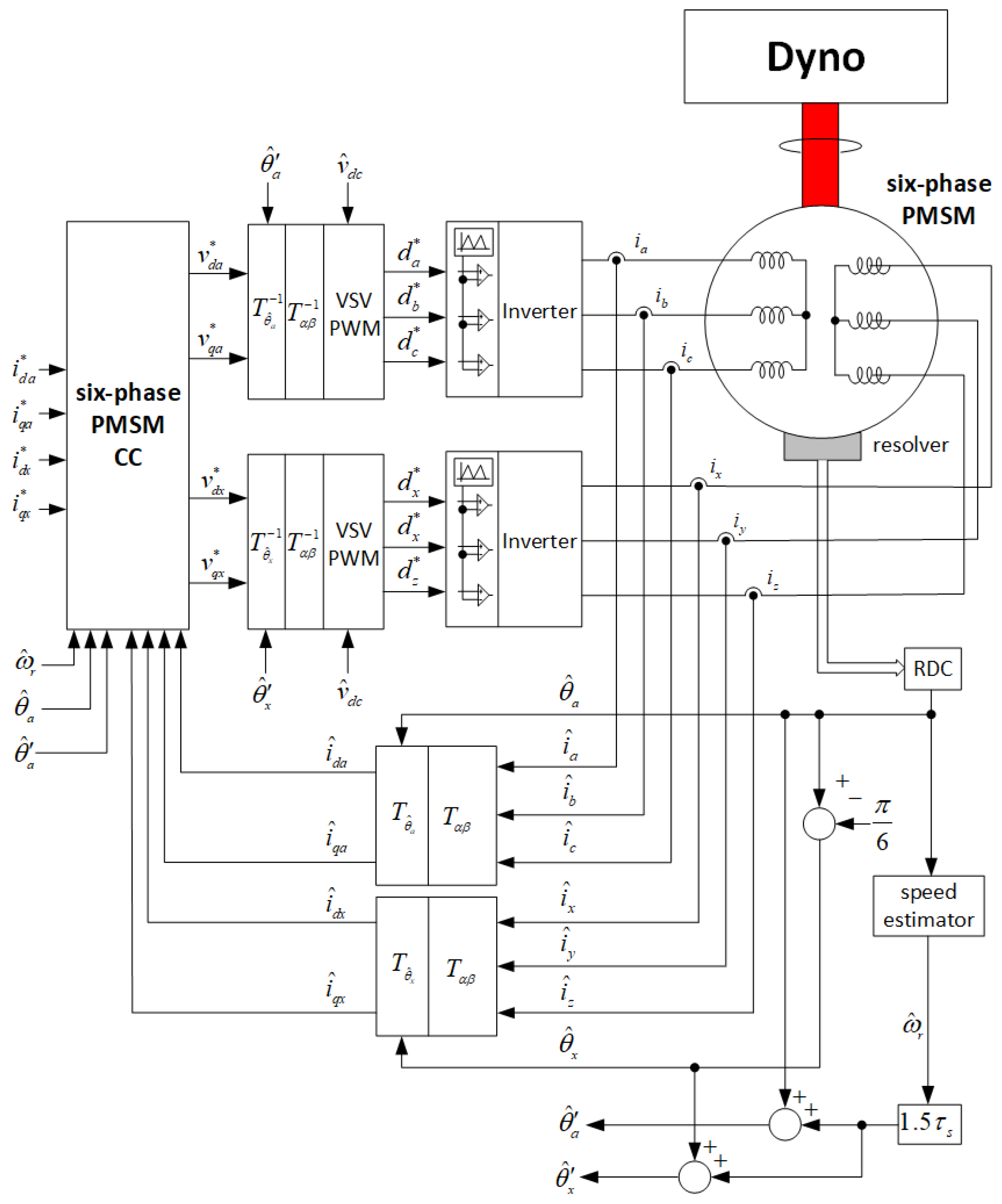
Figure 2 illustrates the system block diagram of the six-phase PMSM current controller (six-phase PMSM-CC), along with the inverters, six-phase PMSM, and the dynamometer (Dyno). The six-phase PMSM is mechanically coupled to the Dyno via a shaft, highlighted in red. The inputs to the six-phase PMSM-CC include current references ( i d a * , i q a * , i d x * , i q x * ), current feedbacks ( i ^ d a , i ^ q a , i ^ d x , i ^ q x ), rotor electrical speed feedback ( ω ^ r ), and rotor electrical angles in the abc-set ( θ ^ a , θ ^ a ). The outputs of the controller are the voltage references ( v d a * , v q a * , v d x * , v q x * ). Voltage references ( v d a * , v q a * , v d x * , v q x * ) are converted into duty ratio references ( d a * , d b * , d c * , d x * , d y * , d z * ) through a sequence of transformations, including inverse Park transformation, inverse Clarke transformation, and voltage space vector pulse width modulation (VSVPWM). These duty references are then used to generate complementary pulse width modulation (PWM) signals by comparing them with a triangular carrier wave. The PWM signals are used to trigger inverters and drive the motor. Current feedbacks ( i ^ d a , i ^ q a , i ^ d x , i ^ q x ) are obtained by applying Clarke and Park transformations to the phase current feedbacks ( i ^ a , i ^ b , i ^ c , i ^ x , i ^ y , i ^ z ). The rotor electrical angle θ ^ a is measured by a resolver (shown in grey) and a resolver-to-digital converter, and is used in the Park transformation. To compensate for sampling delay, an advanced angle θ ^ a = θ ^ a + 1.5 τ s ω ^ r is used for the inverse Park transformation [10], where τ s is the sampling period. The electrical angle feedbacks for the xyz-set are defined as θ ^ x = θ ^ a π 6 and θ ^ x = θ ^ a π 6 . The superscripts * and ^ denote the reference and feedback values of variables, respectively.
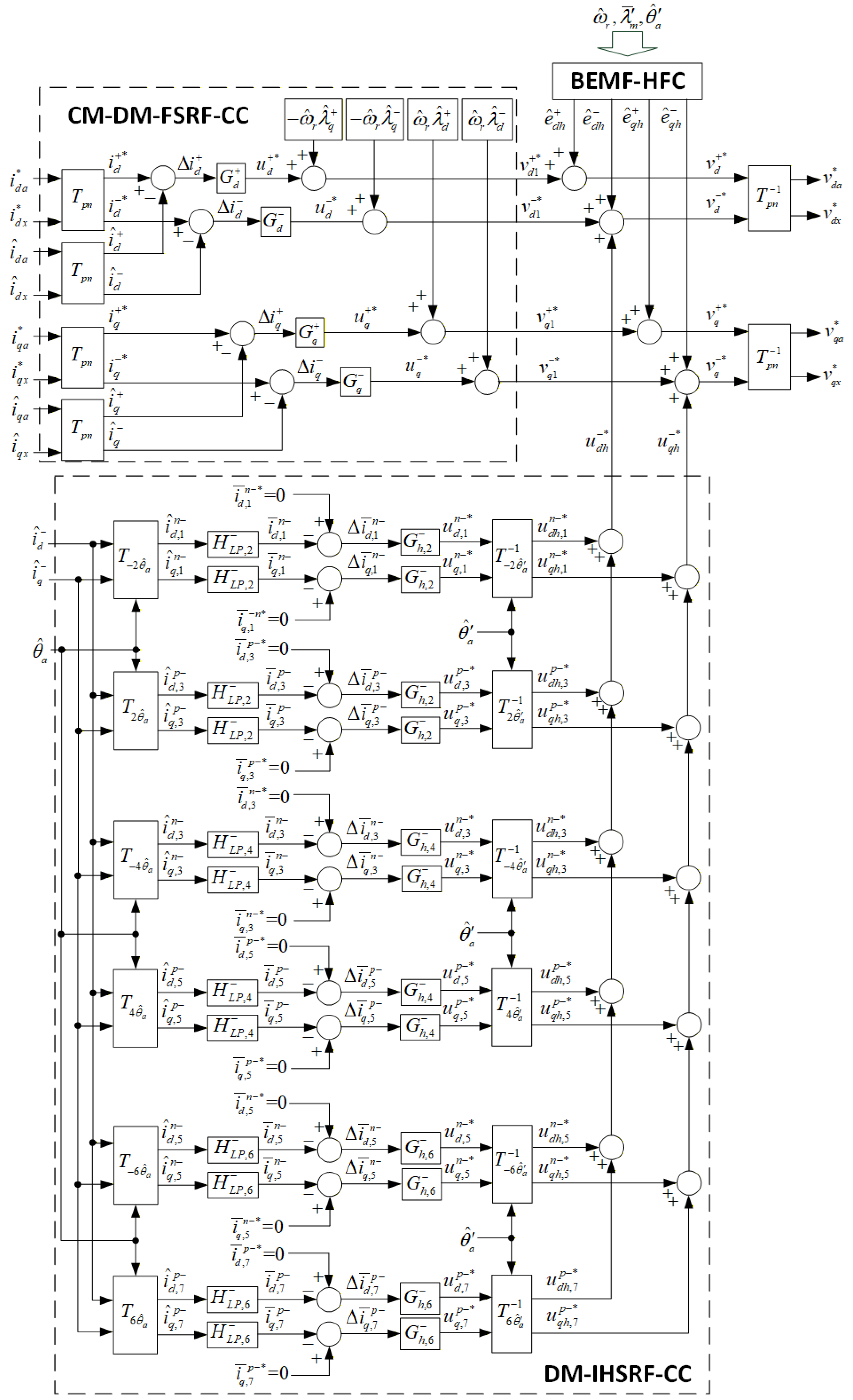
Figure 3 illustrates the architecture of the six-phase PMSM-CC, which integrates the common-mode and differential-mode fundamental synchronous reference frame current controller (CM-DM-FSRF-CC), the back electromotive force harmonic feedforward compensator (BEMF-HFC), and the differential-mode imbalance harmonic synchronous reference frame current controller (DM-IHSRF-CC). The inputs to the CM-DM-FSRF-CC are current references, current feedbacks, and the rotor electrical speed feedback, and its outputs are the voltage references v d 1 + * , v q 1 + * , v d 1 * , and v q 1 * . The BEMF-HFC receives the rotor electrical speed feedback, abc-set rotor electrical angle feedback, and the permanent magnet flux linkage as inputs, and outputs the estimated BEMF harmonics e ^ d h + , e ^ q h + , e ^ d h , and e ^ q h . The DM-IHSRF-CC takes the DM current feedbacks and the abc-set rotor electrical angle feedbacks as inputs, and provides the voltage references u d h * and u q h * as outputs. For details on the CM-DM-FSRF-CC and BEMF-HFC, please refer to [19] for CM-DM-FSRF-CC and BEMF-HFC. The DM-IHSRF-CC is described as follows.
Taking into account the DM imbalance current harmonics as expressed in Equation (15), and neglecting the negative-sequence seventh phase current harmonic, the positive-sequence ( 2 k ) th and negative-sequence ( 2 k ) th DM current harmonics rotate at 2 k and 2 k times the electrical angle of the rotor, respectively. To suppress these DM current harmonics, HSRF-CCs can be designed at 2 n θ r and 2 n θ r , where n = 1 , 2 , 3 . By applying the Park transformation at 2 n θ r and 2 n θ r , the DM imbalance current harmonics are projected into their respective harmonic synchronous reference frames (HSRFs), resulting in
T 2 n θ r i d i q = k = 1 3 ( I m , ( 2 k + 1 ) p sin [ 2 ( k n ) θ r φ ( 2 k + 1 ) p ] cos [ 2 ( k n ) θ r φ ( 2 k + 1 ) p ] + I m , ( 2 k 1 ) n sin [ 2 ( k + n ) θ r φ ( 2 k 1 ) n ] cos [ 2 ( k + n ) θ r φ ( 2 k 1 ) n ] )
T 2 n θ r i d i q = k = 1 3 ( I m , ( 2 k + 1 ) p sin [ 2 ( k + n ) θ r φ ( 2 k + 1 ) p ] cos [ 2 ( k + n ) θ r φ ( 2 k + 1 ) p ] + I m , ( 2 k 1 ) n sin [ 2 ( k n ) θ r φ ( 2 k 1 ) n ] cos [ 2 ( k n ) θ r φ ( 2 k 1 ) n ] )
when k = n , the corresponding DM current harmonic appears as a DC component in the HSRF, while harmonics with k n remain as AC components. Since θ ^ a = θ ^ r , the DM-IHSRF-CC can be implemented as shown in Figure 3, using 2 n θ ^ a and 2 n θ ^ a for the Park transformations:
i ^ d , ( 2 n + 1 ) p i ^ q , ( 2 n + 1 ) p = T 2 n θ ^ a i ^ d i ^ q
i ^ d , ( 2 n 1 ) n i ^ q , ( 2 n 1 ) n = T 2 n θ ^ a i ^ d i ^ q
where T 2 n θ ^ a = cos ( 2 n θ ^ a ) sin ( 2 n θ ^ a ) sin ( 2 n θ ^ a ) cos ( 2 n θ ^ a ) , T 2 n θ ^ a = cos ( 2 n θ ^ a ) sin ( 2 n θ ^ a ) sin ( 2 n θ ^ a ) cos ( 2 n θ ^ a )
Low-pass filters are used to remove AC components.
i ¯ d , ( 2 n + 1 ) p = H L P , ( 2 n ) ( s ) i ^ d , ( 2 n + 1 ) p
i ¯ q , ( 2 n + 1 ) p = H L P , ( 2 n ) ( s ) i ^ q , ( 2 n + 1 ) p
i ¯ d , ( 2 n 1 ) n = H L P , ( 2 n ) ( s ) i ^ d , ( 2 n 1 ) n
i ¯ q , ( 2 n 1 ) n = H L P , ( 2 n ) ( s ) i ^ q , ( 2 n 1 ) n
where H L P , ( 2 n ) ( s ) = 1 τ L P , ( 2 n ) s + 1 , ∘ is the convolution operator. The digital implementation of the low-pass filter is provided in Appendix B.
The current harmonic error is defined as follows:
Δ i d , ( 2 n + 1 ) p Δ i q , ( 2 n + 1 ) p = i d , ( 2 n + 1 ) p * i q , ( 2 n + 1 ) p * i ¯ d , ( 2 n + 1 ) p i ¯ q , ( 2 n + 1 ) p
Δ i d , ( 2 n 1 ) n Δ i q , ( 2 n 1 ) n = i d , ( 2 n 1 ) n * i q , ( 2 n 1 ) n * i ¯ d , ( 2 n 1 ) n i ¯ q , ( 2 n 1 ) n
where the superscript * indicates reference values. All current harmonic references are set to zero.
The controllers are defined as follows:
u d , ( 2 n + 1 ) p * = G h , ( 2 n ) ( s ) Δ i d , ( 2 n + 1 ) p
u q , ( 2 n + 1 ) p * = G h , ( 2 n ) ( s ) Δ i q , ( 2 n + 1 ) p
u d , ( 2 n 1 ) n * = G h , ( 2 n ) ( s ) Δ i d , ( 2 n 1 ) n
u q , ( 2 n 1 ) n * = G h , ( 2 n ) ( s ) Δ i q , ( 2 n 1 ) n
where the PI controllers are G h , ( 2 n ) ( s ) = k p , ( 2 n ) s + k i , ( 2 n ) s . See Appendix B for the digital implementation of the PI controller.
The inverse Park transformations apply 2 n θ ^ a and 2 n θ ^ a to compensate for the sampling delay [10]
u d h , ( 2 n + 1 ) p * u q h , ( 2 n + 1 ) p * = T 2 n θ ^ a 1 u d , ( 2 n + 1 ) p * u q , ( 2 n + 1 ) p *
u d h , ( 2 n 1 ) n * u q h , ( 2 n 1 ) n * = T 2 n θ ^ a 1 u d , ( 2 n 1 ) n * u q , ( 2 n 1 ) n *
where T 2 n θ ^ a 1 = cos ( 2 n θ ^ a ) sin ( 2 n θ ^ a ) sin ( 2 n θ ^ a ) cos ( 2 n θ ^ a ) , T 2 n θ ^ a 1 = cos ( 2 n θ ^ a ) sin ( 2 n θ ^ a ) sin ( 2 n θ ^ a ) cos ( 2 n θ ^ a )
Finally, HSRF-CCs voltage references summation is
u d h * u q h * = n = 1 3 ( u d h , ( 2 n 1 ) n * u q h , ( 2 n 1 ) n * + u d h , ( 2 n + 1 ) p * u q h , ( 2 n + 1 ) p * )
The stability of the HFRF-CCs in the DM subspace can be analyzed using the open-loop transfer function, expressed as follows:
G O L , ( 2 n ) ( s ) = k p , ( 2 n ) ( s + k i , ( 2 n ) ) s ( τ L P , ( 2 n ) s + 1 ) ( L s s + R s )
where L s = ( L d + L q ) / 2 . See Appendix A for the parameter details. The bode plot of G O L , ( 2 n ) ( s ) , shown in Figure 4, clearly demonstrates system stability with a phase margin of 76.3°.
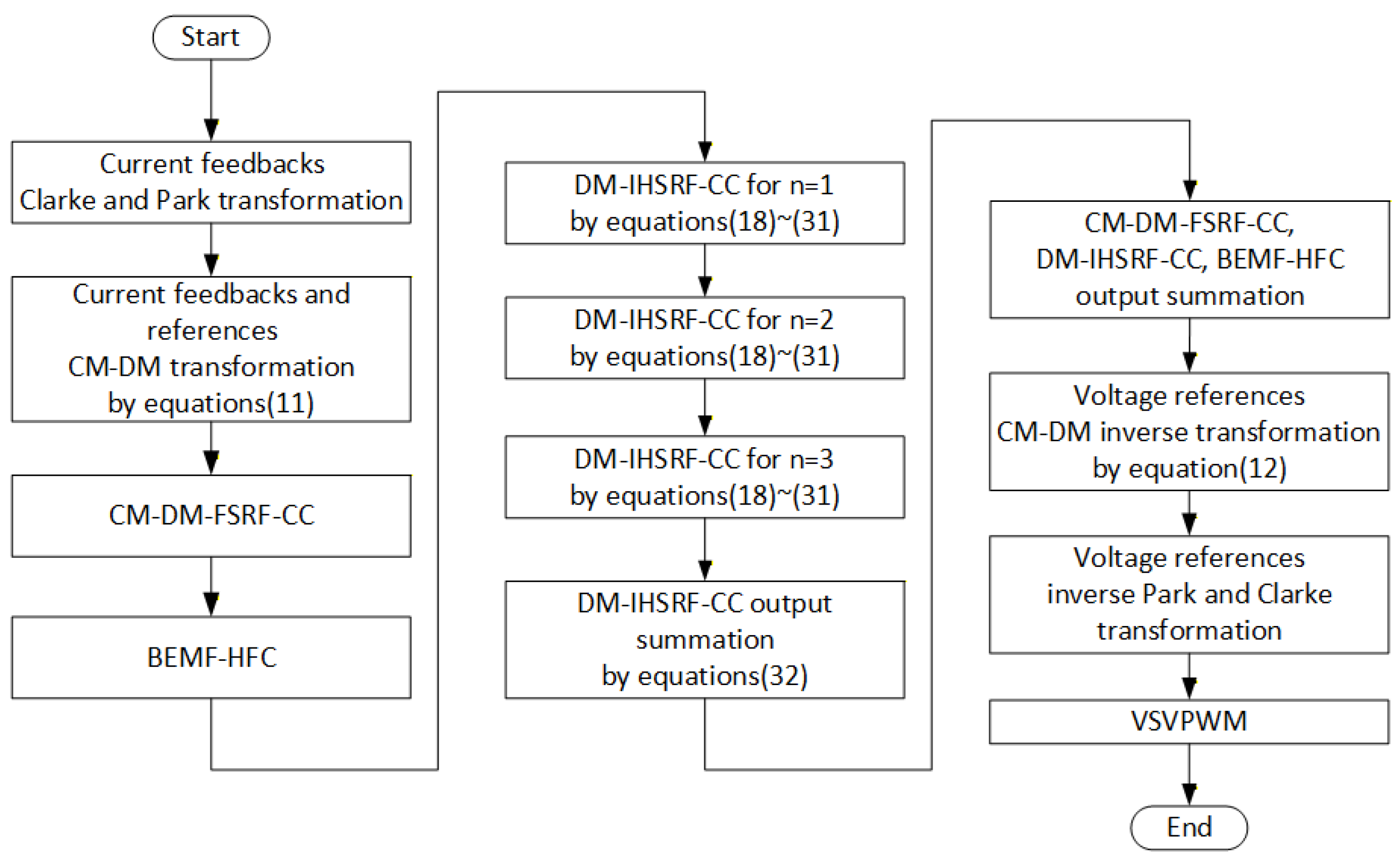
The process flow of the six-phase PMSM-CC strategy, from phase current feedback acquisition to the generation of duty ratio references, is illustrated in Figure 5 and proceeds as follows:
  • Perform Clarke and Park transformations on the dual three-phase current feedbacks ( i ^ a b c , i ^ x y z ) to obtain the RSRF current feedbacks ( i ^ d q a , i ^ d q x ). The Park transformation T θ ^ a is applied to i ^ d q a , and T θ ^ x to i ^ d q x .
  • Apply the CM-DM transformation T p n to the RSRF current references ( i d q a * , i d q x * ) and feedbacks ( i ^ d q a , i ^ d q x ) to derive the CM and DM current references ( i d q + * , i d q * ) and feedbacks ( i ^ d q + , i ^ d q ).
  • Execute the CM-DM-FSRF-CC, using the CM-DM current references and feedbacks as inputs to generate the voltage references v d q 1 + * and v d q 1 * .
  • Execute the BEMF-HFC, where the inputs are the rotor electrical angle θ ^ a and electrical speed feedback ω ^ r , and the outputs are the BEMF harmonics e ^ d q h + and e ^ d q h .
  • Execute the DM-IHSRF-CC for n = 1 , 2 , 3 . The inputs are the DM current feedback i ^ d q and rotor electrical angle signals ( θ ^ a , θ ^ a ), and the outputs are u d q h , ( 2 n + 1 ) p * and u d q h , ( 2 n 1 ) n * . Refer to Equations (18)–(31).
  • Aggregate u d q h , ( 2 n + 1 ) p * and u d q h , ( 2 n 1 ) n * for n = 1 , 2 , 3 to form the total DM-IHSRF-CC output u d q h * . Refer to Equation (32).
  • Combine the outputs from CM-DM-FSRF-CC, BEMF-HFC, and DM-IHSRF-CC to generate the complete voltage references ( v d q + * , v d q * ). Refer to Figure 3.
  • Perform the inverse CM-DM transformation on ( v d q + * , v d q * ) to obtain the RSRF voltage references ( v d q a * , v d q x * ).
  • Apply inverse Park and Clarke transformations to ( v d q a * , v d q x * ), followed by VSVPWM to generate the dual three-phase duty ratio references ( d a b c * , d x y z * ). The inverse Park transformation T θ ^ a 1 is used for v d q a * , and T θ ^ x 1 for v d q x * .

4. Simulation and Experimental Test Result

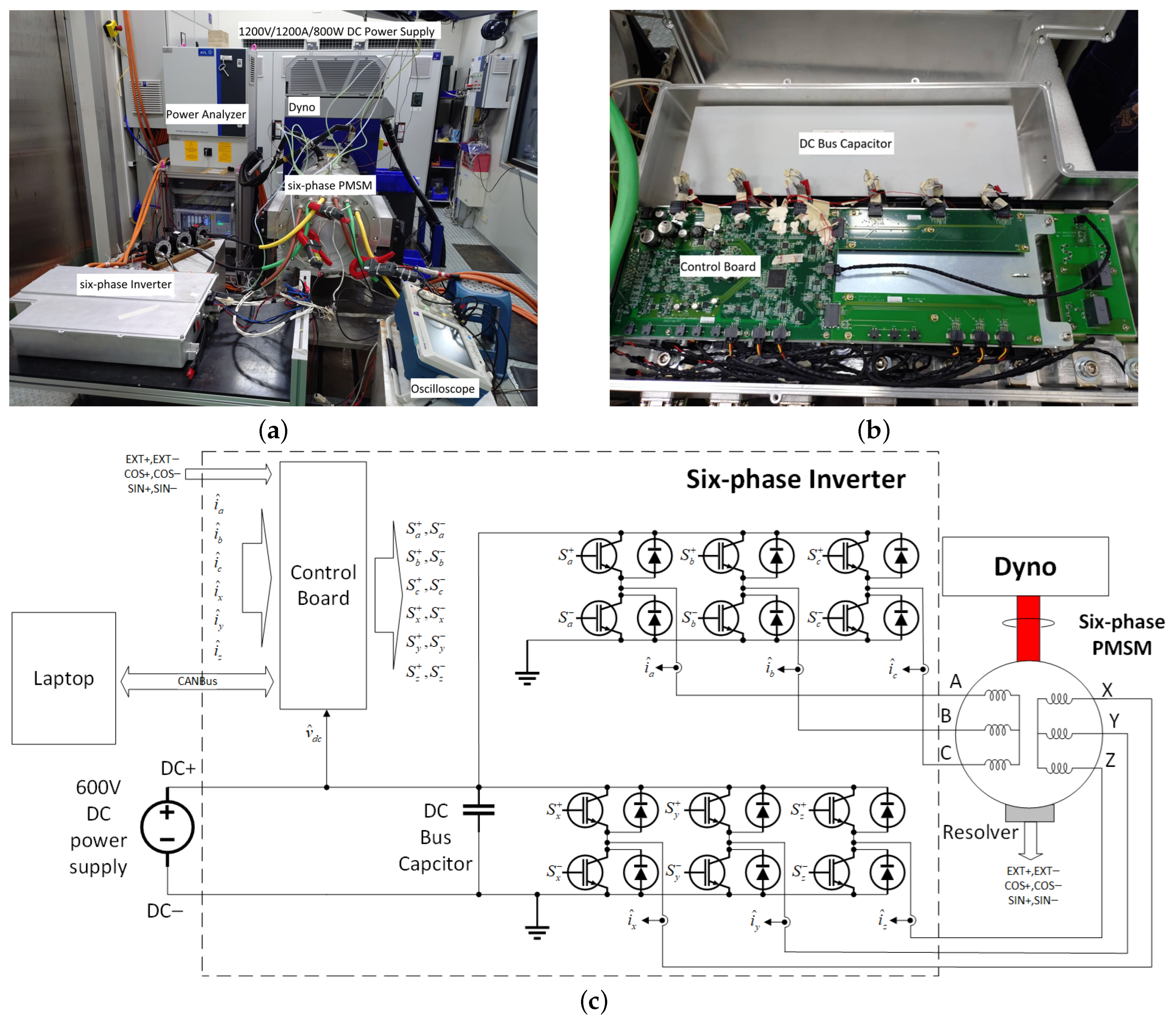
Figure 6 shows the experimental test platform, which consists of six-phase PMSM, Dyno, and a six-phase inverter. The DC power supply is rated at 1200 V/1200 A/800 kW and is configured to operate at 600 V and 400 A during the test. The control board integrates a Texas Instrument microcontroller, which generates twelve complementary PWM signals S a + , S a , S b + , S b , S c + , S c , S x + , S x , S y + , S y , S z + , and S z to drive the six-phase power stage. The microcontroller receives input signals including the phase current feedback i ^ a , i ^ b , i ^ c , i ^ x , i ^ y , i ^ z , and the DC bus voltage feedback v ^ d c . Rotor position is detected by a 12-pole resolver and converted into a digital signal using a 12-bit resolver-to-digital converter (RDC). The PWM signals operate at a carrier frequency of 5 kHz and a deadtime of 2 μs. Analog feedback signals are sampled by the microcontroller’s ADC at both the peak and trough of the PWM carrier wave, resulting in a sampling rate of 10 kHz. A host computer communicates with the six-phase inverter via a Controller Area Network (CAN) bus, allowing for parameter setting and real-time monitoring of feedback signals. A digital oscilloscope captures the phase currents i ^ a , i ^ b , i ^ x , and i ^ y , and the data are processed in MATLAB (R2024a) for spectral analysis and total harmonic distortion (THD) calculation. THD is calculated as follows:
THD = n = 2 14 I n 2 I 1
where I n is the magnitude of the n th current harmonic, and I 1 is the magnitude of the fundamental component, where n = 2 , , 14 .
The digital oscilloscope is configured with a sampling rate of 10 MHz and a memory depth of one million points. To minimize spectral leakage during the Fourier transform analysis, the fundamental frequency is set as an integer multiple of 10 Hz.

4.1. Simulation

The parameters of the six-phase PMSM and the control system are listed in Appendix A. To replicate the imbalance phase currents observed in practice, both positive- and negative-sequence flux linkage harmonics are incorporated into the RSRF of the six-phase PMSM model, resulting in Equations (35) and (36). These harmonics account for the imbalance in the fundamental component, as well as in the third, fifth, and positive-sequence seventh current harmonics.
v d a v q a = R s i d a i q a + d d t λ d a λ q a + 0 ω r ω r 0 λ d a λ q a + e d a h e q a h + ω r k = 1 3 ( λ i a , ( 2 k + 1 ) p sin ( 2 k θ r + δ i a , ( 2 k + 1 ) p ) λ i a , ( 2 k 1 ) n sin ( 2 k θ r + δ i a , ( 2 k 1 ) n ) λ i a , ( 2 k + 1 ) p cos ( 2 k θ r + δ i a , ( 2 k + 1 ) p ) λ i a , ( 2 k 1 ) n cos ( 2 k θ r + δ i a , ( 2 k 1 ) n ) )
v d x v q x = R s i d x i q x + d d t λ d x λ q x + 0 ω r ω r 0 λ d x λ q x + e d x h e q x h + ω r k = 1 3 ( λ i x , ( 2 k + 1 ) p sin ( 2 k θ r + δ i x , ( 2 k + 1 ) p ) λ i x , ( 2 k 1 ) n sin ( 2 k θ r + δ i x , ( 2 k 1 ) n ) λ i x , ( 2 k + 1 ) p cos ( 2 k θ r + δ i x , ( 2 k + 1 ) p ) λ i x , ( 2 k 1 ) n cos ( 2 k θ r + δ i x , ( 2 k 1 ) n ) )
where λ i a , ( 2 k + 1 ) p and λ i a , ( 2 k 1 ) n denote the magnitudes of the abc-set positive-sequence ( 2 k + 1 ) th and negative-sequence ( 2 k 1 ) th flux linkage harmonics, respectively; δ i a , ( 2 k + 1 ) p and δ i a , ( 2 k 1 ) n are their corresponding phase angles. Similarly, λ i x , ( 2 k + 1 ) p and λ i x , ( 2 k 1 ) n denote the magnitudes of the xyz-set positive-sequence ( 2 k + 1 ) th and negative-sequence ( 2 k 1 ) th flux linkage harmonics, respectively; δ i x , ( 2 k + 1 ) p and δ i x , ( 2 k 1 ) n are their corresponding phase angles. Here, k = 1, 2, 3.
To validate the effectiveness of the proposed imbalance current harmonic suppression strategy, each current controller within the DM-IHSRF-CC and BEMF-HFC modules can be selectively enabled or disabled to replicate conventional control strategies. Based on this configuration, three control strategies are defined as follows:
Strategy 1: No current harmonic suppression is applied; only the CM-DM-FSRF-CC is utilized. This strategy, which exhibits the most severe imbalance current harmonics, is designated as the worst-case scenario for current harmonic replication. The rich harmonic content under this condition provides essential information for tuning the positive- and negative-sequence flux linkage harmonic parameters in Equations (35) and (36).
Strategy 2: The conventional current harmonic suppression strategy [19] is applied, which is only capable of suppressing balanced current harmonics. The CM-DM-FSRF-CC is combined with DM-IHSRF-CC and BEMF-HFC, with the ± 2 θ ^ a and ± 4 θ ^ a HSRF-CCs disabled. As a result, only the negative-sequence fifth and positive-sequence seventh current harmonics in the harmonic subspace are suppressed.
Strategy 3: The proposed imbalance current harmonic suppression strategy is applied, which effectively suppresses imbalance in the fundamental, third, and fifth current harmonics. The CM-DM-FSRF-CC is integrated with both BEMF-HFC and DM-IHSRF-CC, with all HSRF-CCs enabled.
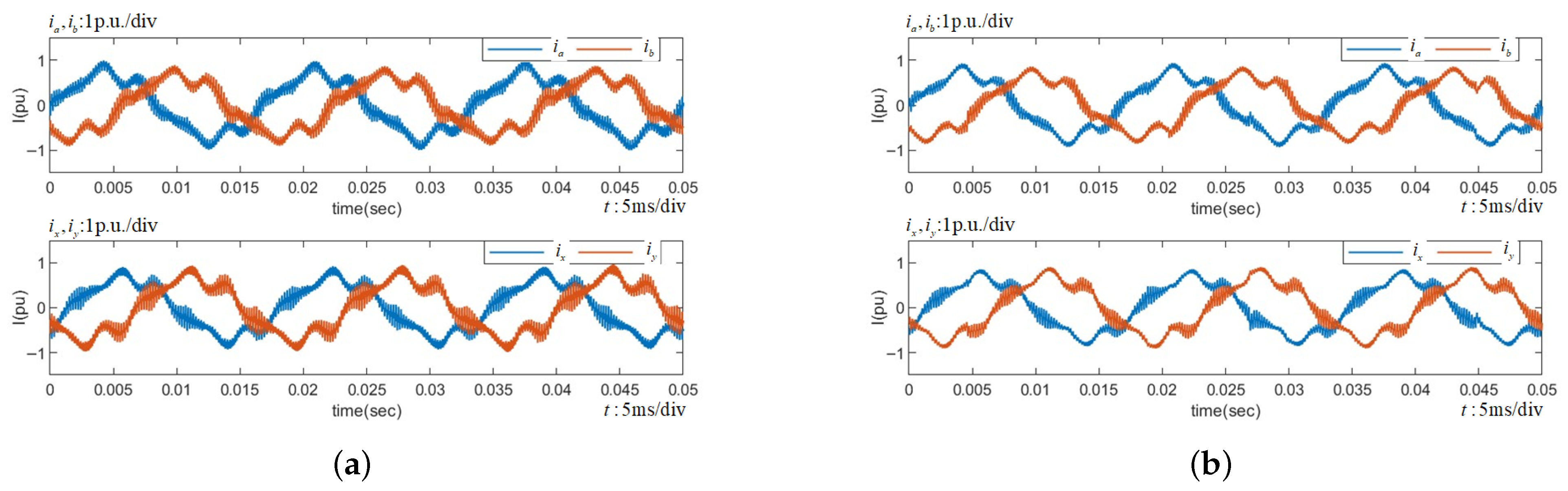
The rated current of the six-phase PMSM is 200 Arms, corresponding to a base current of 282.8 A peak. Strategy 1 phase currents i a , i b , i x , and i y at a rotor speed of 600 rpm, with current references of i d a * = i d x * = 0.5 p.u., i q a * = i q x * = 0.5 p.u. were replicated in simulation by tuning the flux linkage harmonic parameters in Equations (35) and (36). See Appendix C for flux linkage harmonic parameter settings. The measured and simulated phase current waveforms are shown in Figure 7. The magnitudes of the fundamental, third, and fifth phase current harmonics in both simulated and measured results are listed in Table 2, Table 3 and Table 4, respectively. Here, the Max-Min refers to the difference between the maximum and minimum magnitudes of the fundamental or harmonic components, and Average represents their mean value. The results indicate that the simulated values closely match the measured data, demonstrating that the model is well-calibrated and suitable for evaluating the imbalance current harmonic suppression strategy.
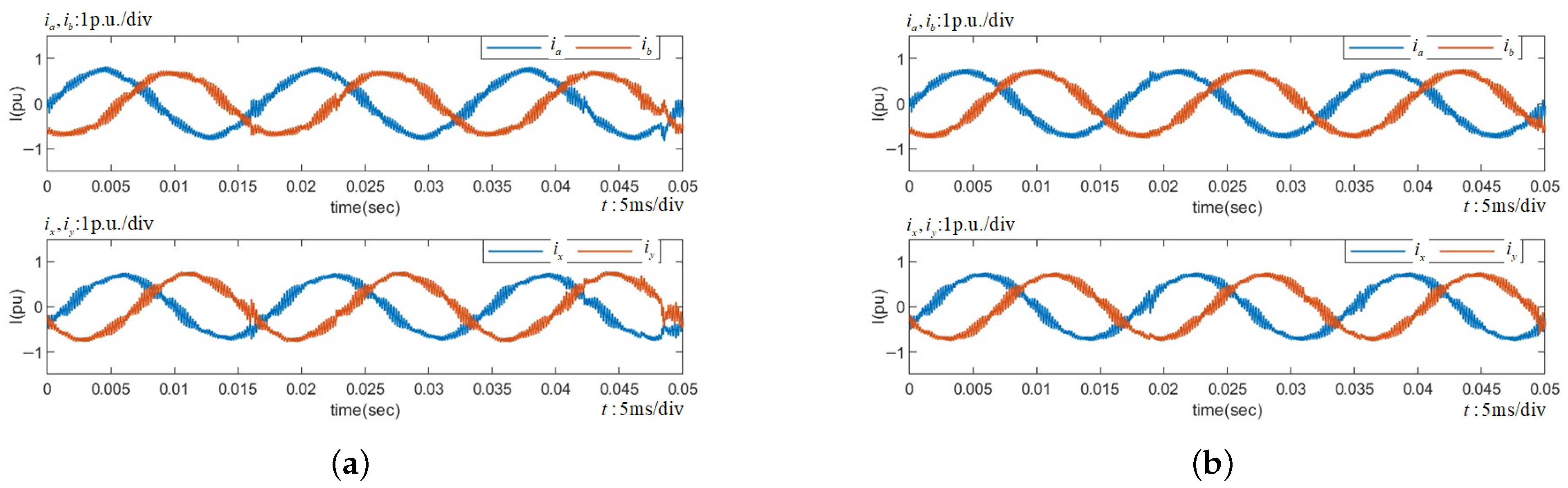
Figure 8 illustrates the simulated phase current differences between Strategy 2 and Strategy 3. The magnitudes of the fundamental, third, and fifth phase current harmonics for both simulated and measured phase currents are listed in Table 5, Table 6 and Table 7, respectively. Compared to Strategy 1, The Max-Min magnitudes of the fundamental current, third, and fifth phase current harmonics are reduced in Strategy 3, from 3.98%, 0.48%, 2.31% to 0.29%, 0.22%, 0.08%, respectively, indicating effective suppression of imbalance current harmonics. The Average magnitudes of the third and fifth phase current harmonics are also reduced in Strategy 3, from 1.34%, 11.6% to 0.16%, 0.15%, respectively. As expected, the Average and the Max-Min magnitudes show that Strategy 2 significantly reduces the fifth phase current harmonics but has limited impact on the fundamental and third phase current harmonics. Compared to Strategy 1, the Average magnitudes of the third and fifth harmonics are reduced from 1.34%, 11.6% to 0.89%, 1.78%, respectively, while the Max-Min magnitudes of the fundamental, third, and fifth current harmonics change from 3.98%, 0.48%, 2.31% to 4.24%, 0.59%, 0.16%, respectively. In fact, Strategy 2 can suppress the positive-sequence seventh and negative-sequence fifth current harmonics, but not the positive-sequence fifth harmonic. In contrast, Strategy 3 is capable of suppressing both the positive- and negative-sequence fifth harmonics. This explains why the Average magnitude of the fifth current harmonics is reduced from 1.78% in (Strategy 2) to 0.15% in (Strategy 3).

4.2. Experimental Test

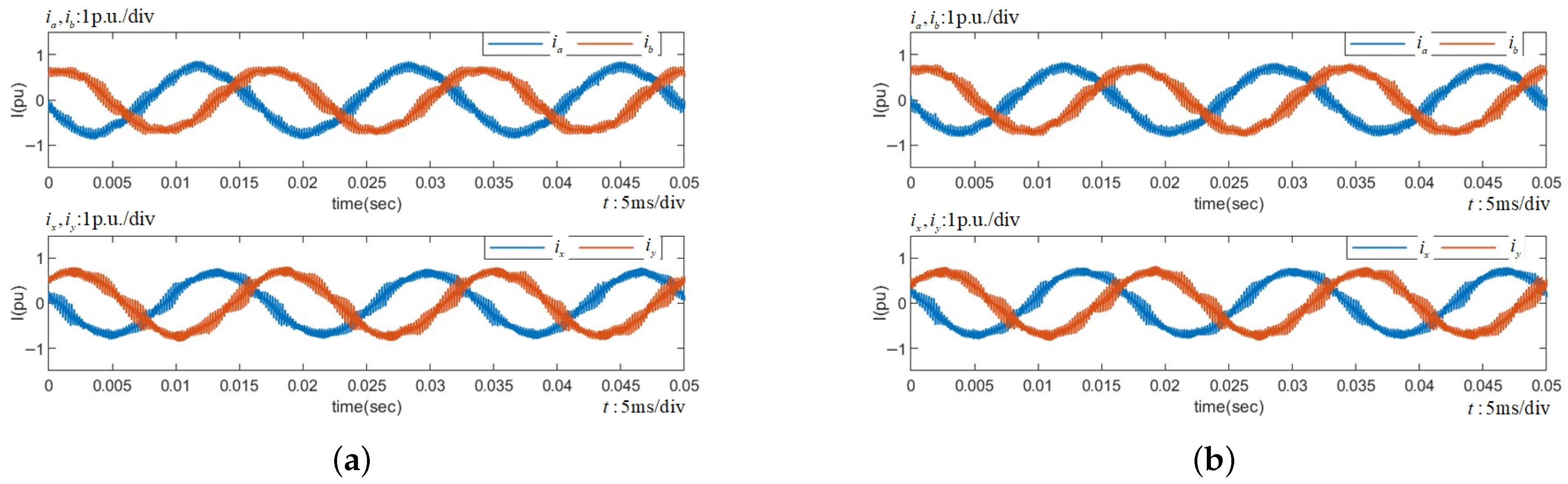
The simulation results validate the effectiveness of the proposed imbalance phase current harmonic suppression strategy. This section presents the experimental results obtained at rotor speeds of 300, 600, 900, and 1200 rpm. The current references are fixed at i d a * = i d x * = 0.5 p.u., i q a * = i q x * = 0.5 p.u. For comparison, Figure 9 shows the experimental phase current waveforms for Strategy 2 and Strategy 3 at a rotor speed of 600 rpm, demonstrating good agreement with the simulation results shown in Figure 8. The magnitudes of the fundamental, third and fifth phase current harmonics for Strategy 1, Strategy 2 and Strategy 3 at 300 rpm are presented in Table 8, Table 9 and Table 10, respectively. Similarly, the corresponding magnitudes at 600 rpm are provided in Table 11, Table 12 and Table 13; at 900 rpm in Table 14, Table 15 and Table 16; and at 1200 rpm in Table 17, Table 18 and Table 19. From the tabulated data of Strategy 1, several noteworthy trends can be observed:
  • As shown in Table 8, Table 11, Table 14 and Table 17, the Max-Min magnitude of the fundamental current increases with rotor speed, rising from 2.27% at 300 rpm to 8.87% at 1200 rpm.
  • According to Table 9, Table 12, Table 15 and Table 18, the Average magnitude of the third current harmonic increases slightly from 1.28% (300 rpm) to 1.56% (1200 rpm), while the Max-Min magnitude increases from 1.09% to 2.26% over the same speed range.
  • From Table 10, Table 13, Table 16 and Table 19, the Average magnitude of the fifth current harmonic increases significantly from 6.23% (300 rpm) to 20.87% (1200 rpm), and the Max-Min magnitude rises from 1.04% to 8.24%.
The results of Strategy 1 indicate the presence of imbalances in the fundamental flux linkage, as well as in the third and fifth flux linkage harmonics. Among these, the effect of the third flux linkage harmonic is relatively minor compared to the fundamental and fifth harmonics. Strategy 2 is only capable of suppressing the fifth and seventh balanced current harmonics. The trends observed in the tabulated data of Strategy 2, in comparison with Strategy 1, are as follows:
  • Fundamental current imbalance: According to Table 8, Table 11, Table 14 and Table 17, the Max-Min magnitudes of the fundamental current decrease from 2.27% (300 rpm), 4.67% (600 rpm), 7.25% (900 rpm), and 8.87% (1200 rpm) to 1.86%, 4.66%, 7.20%, and 8.61%, respectively. The impact of Strategy 2 on the fundamental current is limited and can be considered negligible.
  • Third harmonic current: As shown in Table 9, Table 12, Table 15 and Table 18, the Average magnitude of the third current harmonic changes from 1.28%, 1.21%, 1.44%, and 1.56% to 0.57%, 1.28%, 1.58%, and 1.78%, respectively. Similarly, the Max-Min magnitudes decrease from 1.09%, 1.46%, 2.02%, and 2.26% to 0.74%, 1.41%, 1.96%, and 2.88%. These results indicate that the impact of Strategy 2 on the third current harmonic is also limited.
  • Fifth harmonic current: Based on Table 10, Table 13, Table 16 and Table 19, the Average magnitude of the fifth current harmonic is significantly reduced from 6.23%, 12.81%, 17.39%, and 20.87% to 0.73%, 1.36%, 1.88%, and 2.70%, respectively. The Max-Min magnitudes also drop from 1.04%, 2.83%, 5.48%, and 8.24% to 0.86%, 1.32%, 2.22%, and 2.94%. These findings confirm that Strategy 2 has a significant effect on suppressing the fifth current harmonic, as expected.
The results of Strategy 2 illustrate that the conventional balanced current harmonic suppression strategy is ineffective on the fundamental and third current harmonics, highlighting a key insight: each HSRF-CC targets a specific positive- or negative-sequence current harmonic. Strategy 3 is capable of suppressing the imbalanced fundamental, third, and fifth current harmonics. A detailed comparison with Strategy 1 is omitted here. The trends observed in the tabulated data of Strategy 3, in comparison with Strategy 2, are as follows:
  • Fundamental current: From Table 8, Table 11, Table 14, and Table 17, the Max-Min magnitudes of the fundamental current decrease from 1.86% (300 rpm), 4.66% (600 rpm), 7.20% (900 rpm), and 8.61% (1200 rpm) to 1.76%, 0.83%, 1.01%, and 1.19%, respectively. The impact of Strategy 3 on the fundamental current is evident.
  • Third harmonic current: According to Table 9, Table 12, Table 15, and Table 18, the Average magnitudes of the third current harmonic change from 0.57%, 1.28%, 1.58%, and 1.78% to 1.16%, 0.68%, 0.81%, and 1.25%, respectively. The Max-Min magnitudes also decrease from 0.74%, 1.41%, 1.96%, and 2.88% to 0.55%, 0.72%, 0.56%, and 1.02%. Due to the relatively small magnitude of the third flux linkage harmonic, the effect of Strategy 3 becomes more evident at higher speeds.
  • Fifth harmonic current: As seen in Table 10, Table 13, Table 16, and Table 19, the Average magnitude of the fifth current harmonic changes from 0.73% (300 rpm), 1.36% (600 rpm), 1.88% (900 rpm), and 2.70% (1200 rpm) to 0.37%, 0.79%, 1.58%, and 2.83%, respectively. Meanwhile, the Max-Min magnitudes decrease from 0.86%, 1.32%, 2.22%, and 2.94% to 0.53%, 0.57%, 0.56%, and 0.50%. The impact of Strategy 3 on the Average magnitude of the fifth current harmonic is slightly more significant than that of Strategy 2, and its effectiveness is more pronounced with regard to reducing the Max-Min magnitude.
The analysis above demonstrates that Strategy 3 effectively suppresses the imbalance in the fundamental current and associated current harmonics. This underscores the superiority of the proposed imbalance current harmonic suppression strategy, not only in reducing harmonic content but also in promoting more uniform copper loss across the windings. Consequently, it contributes to improved thermal distribution and enhances the overall longevity of the motor.
The total harmonic distortions (THDs) of i a , i b , i x , and i y under different rotor speeds for Strategy 1, Strategy 2, and Strategy 3 are presented in Table 20, Table 21 and Table 22. Strategy 1 shows a clear trend of increasing THD with rotor speed, confirming the presence of flux linkage harmonics and their growing impact on current distortion at higher speeds. In contrast, both Strategy 2 and Strategy 3 benefit from the current harmonic suppression capability of the HSRF-CC. While Strategy 2 exhibits modest reductions with some variation across phases and speeds, Strategy 3 consistently achieves lower and more uniform THDs, highlighting its superior and more balanced suppression of current harmonics.

5. Conclusions

The imbalance phase currents in a six-phase PMSM can be decomposed into positive- and negative-sequence fundamental and harmonic components. By applying 2 n and 2 n rotor electrical angle HSRF-CCs in the rotor synchronous reference frame, the positive-sequence ( 2 n + 1 ) th and negative-sequence ( 2 n 1 ) th current harmonics can be effectively suppressed. This controller architecture is structurally symmetrical and implementation-friendly, making it suitable for real-time applications.
Considering that the DM subspace exhibits significantly lower impedance than the CM subspace, a DM-IHSRF-CC is proposed to suppress the imbalance in the fundamental, third, and fifth current harmonics, as well as the positive-sequence seventh harmonic. To accurately replicate the imbalance phase currents observed experimentally under conditions without harmonic suppression, an imbalance flux linkage harmonic model is incorporated into the six-phase PMSM dynamic model.
By integrating DM-IHSRF-CC into the six-phase PMSM current controller (PMSM-CC), an advanced imbalance current harmonic suppression strategy is established. The simulation results confirm that the proposed strategy yields more balanced fundamental phase currents and significantly reduces harmonic content compared to the conventional balanced harmonic suppression approach.
Experimental tests conducted at various rotor speeds further validate the simulation results. The proposed strategy consistently achieves lower and more uniform total harmonic distortion (THD) across all phase currents. Moreover, the improvement in current balance reduces copper loss disparity among windings, promoting better thermal distribution and enhancing the overall longevity of the motor.

Author Contributions

Conceptualization, J.-C.H. and Y.-T.L.; methodology, J.-C.H. and Y.-T.L.; software, Y.-T.L.; validation, J.-C.H. and Y.-T.L.; formal analysis, Y.-T.L.; investigation, J.-C.H. and Y.-T.L.; resources, J.-C.H. and C.-T.L.; data curation, Y.-T.L.; writing—original draft preparation, Y.-T.L.; writing—review and editing, J.-C.H.; visualization, J.-C.H. and Y.-T.L.; supervision, J.-C.H.; project administration, J.-C.H. and C.-T.L.; funding acquisition, J.-C.H. and C.-T.L. All authors have read and agreed to the published version of the manuscript.

Funding

This research was funded by Chroma ATE Inc. grant number 113-0000913.

Data Availability Statement

The data presented in this study are available on request from the corresponding author.

Acknowledgments

Special thanks to Chroma ATE Inc. for providing the materials, laboratory facilities, and research funding necessary for conducting the experiments.

Conflicts of Interest

Author Cheng-Tsung Lin was employed by the company Chroma ATE Inc. The remaining authors declare that the research was conducted in the absence of any commercial or financial relationships that could be construed as a potential conflict of interest. The authors declare that this study received funding from Chroma ATE Inc. The funder was not involved in the study design, collection, analysis, interpretation of data, the writing of this article or the decision to submit it for publication.

Abbreviations

The following abbreviations are used in this manuscript:
PMSMpermanent magnet synchronous motor
BEMFback electromotive force
HSRFharmonic synchronous reference frame
CMcommon mode
DMdifferential mode
PWMpulse width modulation
THDtotal harmonic distortion

Appendix A

Table A1. Motor specifications and controller parameters.
ParameterValue
DC link voltage (V)600
Rated Speed (rpm)1200
Poles N p 12
Phase resistance R s (m Ω )23.14
d-axis self inductance L d ( μ H)309.9
q-axis self inductance L q ( μ H)743.2
d-axis mutual inductance M d ( μ H)260.3
q-axis mutual inductance M q ( μ H)706.1
Flux linkage λ m (Wb)0.313
5th BEMFH (Magnitude:%Fundamental/Phase: °)2.17%/174.7°
7th BEMFH (Magnitude:%Fundamental/Phase: °)1.92%/2.5°
11th BEMFH (Magnitude:%Fundamental/Phase: °)0.69%/−15.4°
13th BEMFH (Magnitude:%Fundamental/Phase: °)0.45%/175.1°
Fundamental frequency current controller bandwidth (rad/s)2000
Table A2. Current controller gain settings.
ParameterValue
DM-IHSRF-CC PI gain ( k p , ( 2 n ) : Ω / k i , ( 2 n ) )) for n = 1, 2, 30.0116 Ω /533.79
DM-IHSRF-CC LPF time constant ( τ L P , ( 2 n ) : msec) for n = 1, 2, 30.936

Appendix B

PI controller G ( s ) = k p ( s + k i ) s = u * Δ i , where Δ i is the current error and u * is the voltage reference of the controller output.
Digital implementation of PI controller: u k * = k p Δ i k + u i ( k ) * , where the integrator output u i ( k ) * = u i ( k 1 ) * + τ s k i k p Δ i ( k 1 ) , τ s is the sampling period.
Low-pass filter H L P ( s ) = 1 τ L P s + 1 = i ¯ i ^ , where i ^ is the current feedback and i ¯ is the output of the low-pass filter.
Digital implementation of the low-pass filter: i ¯ k = i ¯ k 1 + τ s τ L P 1 ( i ^ k i ¯ k 1 )

Appendix C

Table A3. abc and xyz-set flux linkage harmonic parameters.
ParameterValue
abc-set positive-sequence third flux linkage harmonic(magnitude λ i a , 3 p :mWb/phase δ i a , 3 p : °)0/0°
xyz-set positive-sequence third flux linkage harmonic(magnitude λ i x , 3 p :mWb/phase δ i x , 3 p : °)0/0°
abc-set positive-sequence fifth flux linkage harmonic(magnitude λ i a , 5 p :mWb/phase δ i a , 5 p : °)1.313/37°
xyz-set positive-sequence fifth flux linkage harmonic(magnitude λ i x , 5 p :mWb/phase δ i x , 5 p : °)1.313/−143°
abc-set positive-sequence seventh flux linkage harmonic(magnitude λ i a , 7 p :mWb/phase δ i a , 7 p : °)4.337/−137°
xyz-set positive-sequence seventh flux linkage harmonic(magnitude λ i x , 7 p :mWb/phase δ i x , 7 p : °)4.337/43°
abc-set negative-sequence fundamental flux linkage harmonic(magnitude λ i a , 1 n :mWb/phase δ i a , 1 n : °)2.188/153°
xyz-set negative-sequence fundamental flux linkage harmonic(magnitude λ i x , 1 n :mWb/phase δ i x , 1 n : °)2.188/−27°
abc-set negative-sequence third flux linkage harmonic(magnitude λ i a , 3 n :mWb/phase δ i a , 3 n : °)0.637/177°
xyz-set negative-sequence third flux linkage harmonic(magnitude λ i x , 3 n :mWb/phase δ i x , 3 n : °)0.637/−3°
abc-set negative-sequence fifth flux linkage harmonic(magnitude λ i a , 5 n :mWb/phase δ i a , 5 n : °)8.395/78°
xyz-set negative-sequence fifth flux linkage harmonic(magnitude λ i x , 5 n :mWb/phase δ i x , 5 n :°)8.395/−102°
Note that these flux linkage harmonic parameter values are only applicable to i d a * = i d x * = 0.5 p.u., i q a * = i q x * = 0.5 p.u. Other current reference values must be retuned to accurately replicate the measured phase currents.

References

  1. Rodionov, A.; Acquaviva, A.; Liu, Y. Sizing and energy efficiency analysis of a multi-phase FSCW PMSM drive for traction application. In Proceedings of the IECON 2020 The 46th Annual Conference of the IEEE Industrial Electronics Society, Singapore, 18–21 October 2020; pp. 2069–2074. [Google Scholar] [CrossRef]
  2. de L. Pinheiro, M.; Suemitsu, W.I. Permanent magnet synchronous motor drive in vessels with electric propulsion system. In Proceedings of the 2013 Brazilian Power Electronics Conference, Gramado, Brazil, 27–31 October 2013; pp. 808–813. [Google Scholar] [CrossRef]
  3. Xu, J.; Zhang, B.; Fang, H.; Guo, H. Guaranteeing the fault transient performance of aerospace multiphase permanent magnet motor system: An adaptive robust speed control approach. Ces Trans. Electr. Mach. Syst. 2020, 4, 114–122. [Google Scholar] [CrossRef]
  4. Che, H.S.; Duran, M.J.; Levi, E.; Jones, M.; Hew, W.-P.; Rahim, N.A. Postfault Operation of an Asymmetrical Six-Phase Induction Machine With Single and Two Isolated Neutral Points. IEEE Trans. Power Electron. 2014, 29, 5406–5416. [Google Scholar] [CrossRef]
  5. Yang, G.; Hussain, H.; Li, S.; Zhang, J.; Yang, J. A Unified Fault-Tolerant Strategy for Multiphase Machine With Minimum Losses in Full Torque Operation Range Based on Closed-Form Expressions. IEEE Trans. Power Electron. 2022, 37, 12463–12473. [Google Scholar] [CrossRef]
  6. Mohamadian, S.; Cecati, C. Modelling, Harmonic Compensation, and Current Sharing Between Winding Sets of Asymmetric Nine-Phase PMSM. In Proceedings of the IECON 2021—47th Annual Conference of the IEEE Industrial Electronics Society, Toronto, ON, Canada, 13–16 October 2021; pp. 1–6. [Google Scholar] [CrossRef]
  7. Rubino, S.; Dordevic, O.; Armando, E.; Bojoi, I.R.; Levi, E. A Novel Matrix Transformation for Decoupled Control of Modular Multiphase PMSM Drives. IEEE Trans. Power Electron. 2021, 36, 8088–8101. [Google Scholar] [CrossRef]
  8. Zhu, Z.; Wang, S.; Shao, B.; Yan, L.; Xu, P.; Ren, Y. Advances in Dual-Three-Phase Permanent Magnet Synchronous Machines and Control Techniques. Energies 2021, 14, 7508. [Google Scholar] [CrossRef]
  9. Hu, Y.; Zhu, Z.-Q.; Liu, K. Current Control for Dual Three-Phase Permanent Magnet Synchronous Motors Accounting for Current Unbalance and Harmonics. IEEE J. Emerg. Sel. Top. Power Electron. 2014, 2, 272–284. [Google Scholar] [CrossRef]
  10. Yan, L.; Zhu, Z.Q.; Qi, J.; Ren, Y.; Gan, C.; Brockway, S.; Hilton, C. Suppression of Major Current Harmonics for Dual Three-Phase PMSMs by Virtual Multi Three-Phase Systems. IEEE Trans. Ind. Electron. 2022, 69, 5478–5490. [Google Scholar] [CrossRef]
  11. Huang, P.-S.; Tsai, C.-T.; Hwang, J.-C.; Lin, C.-T.; Lin, Y.-T. Current Harmonics Suppression of Six-Phase Permanent-Magnet Synchronous Motor Drives Using Back-Electromotive Force Harmonics Compensation. Energies 2024, 17, 6280. [Google Scholar] [CrossRef]
  12. Zhong, Z.; Li, C.; Yin, X. Current Harmonic Elimination for Dual Three-phase PMSM Based on Flux Linkage Harmonic Closed-loop Control. In Proceedings of the 2021 IEEE 16th Conference on Industrial Electronics and Applications (ICIEA), Chengdu, China, 1–4 August 2021; pp. 672–677. [Google Scholar] [CrossRef]
  13. Xu, Y.; Parspour, N.; Vollmer, U. Torque Ripple Minimization Using Online Estimation of the Stator Resistances With Consideration of Magnetic Saturation. IEEE Trans. Ind. Electron. 2014, 61, 5105–5114. [Google Scholar] [CrossRef]
  14. Ye, H.; Song, W.; Ruan, Z.; Yan, Y. Current Control Methods for Dual Three-Phase Permanent Magnet Synchronous Motors Considering Machine Parameter Asymmetry. In Proceedings of the 2019 22nd International Conference on Electrical Machines and Systems (ICEMS), Harbin, China, 11–14 August 2019; pp. 1–6. [Google Scholar] [CrossRef]
  15. Xie, F.; Jiang, M.; Lu, T.; Hu, F.; Huang, Y.; Ma, C.; Song, W. Comparative Study of Negative Sequence Current-based and Current Residual-based Online Diagnosis Method for Inter-turn Faults in PMSM Drives. In Proceedings of the 2024 5th International Conference on Power Engineering (ICPE), Shanghai, China, 13–15 December 2024; pp. 166–171. [Google Scholar] [CrossRef]
  16. Wu, Q.; Nandi, S. Fast Single-Turn Sensitive Stator Interturn Fault Detection of Induction Machines Based on Positive- and Negative-Sequence Third Harmonic Components of Line Currents. IEEE Trans. Ind. Appl. 2010, 46, 974–983. [Google Scholar] [CrossRef]
  17. Zhang, W.; Nguyen, N.K.; Semail, E.; Xu, Y. A New Harmonic Current Control Approach of Dual Three-Phase PMSM in Degraded Mode. In Proceedings of the IECON 2023—49th Annual Conference of the IEEE Industrial Electronics Society, Singapore, 16–20 October 2023; pp. 1–6. [Google Scholar] [CrossRef]
  18. Song, Z.; Jia, Y.; Liu, C. Open-Phase Fault-Tolerant Control Strategy for Dual Three-Phase Permanent Magnet Synchronous Machines Without Controller Reconfiguration and Fault Detection. IEEE Trans. Power Electron. 2023, 38, 789–802. [Google Scholar] [CrossRef]
  19. Lin, Y.-T.; Hwang, J.-C.; Tsai, C.-T.; Lin, C.-T. Implementation of a Current Harmonics Suppression Strategy for a Six-Phase Permanent Magnet Synchronous Motor. Energies 2025, 18, 665. [Google Scholar] [CrossRef]
  20. Ma, X.; Li, B.; Rui, X.; Hou, W. Harmonic Current Suppression Scheme for Dual Three-Phase PMSM Based on Harmonic Subspace Phase-Shifting Operation. In Proceedings of the 2024 27th International Conference on Electrical Machines and Systems (ICEMS), Fukuoka, Japan, 26–29 November 2024; pp. 2166–2171. [Google Scholar] [CrossRef]
  21. Ruan, Z.; Song, W.; Yan, Y. Current Harmonic Suppression for Dual Three-Phase Permanent Magnet Synchronous Motor Drives. IEEE Access 2019, 7, 143888–143898. [Google Scholar] [CrossRef]
  22. Li, Y.; Hu, Y. Comparative Study on Harmonic Current Suppression of Dual three-phase PMSM Based on LMS Adaptive Linear Neuron and Resonant Controller. In Proceedings of the 2023 26th International Conference on Electrical Machines and Systems (ICEMS), Zhuhai, China, 5–8 November 2023; pp. 2755–2760. [Google Scholar] [CrossRef]
Figure 1. The abc-axes, xyz-axes, stationary reference frames and the rotor synchronous reference frame of six-phase PMSM.
Energies 18 06112 g001
Figure 2. The system block diagram of six-phase PMSM-CC, inverter, six-phase PMSM, and Dyno.
Energies 18 06112 g002
Figure 3. Block diagram of six-phase PMSM-CC.
Energies 18 06112 g003
Figure 4. Open-loop bode diagram of G O L , ( 2 n ) ( s ) .
Energies 18 06112 g004
Figure 5. Flowchart of six-phase PMSM-CC strategy.
Energies 18 06112 g005
Figure 6. Experimental test platform of six-phase PMSM, Dyno, and six-phase Inverter test platform: (a) Dyno, DC power supply, six-phase PMSM, and six-phase inverter; (b) control board of the six-phase inverter (c) electrical diagram of the host computer, six-phase PMSM, Dyno, and six-phase inverter.
Energies 18 06112 g006
Figure 7. The measured and simulated phase current waveforms of Strategy 1 under 600 rpm and i d a * = i d x * = 0.5 p.u., i q a * = i q x * = 0.5 p.u. (1 p.u. = 282.8 A peak, note that simulated phase currents are close to measured phase currents.): (a) measured phase current; (b) simulated phase current.
Energies 18 06112 g007
Figure 8. The simulated phase current waveforms of Strategy 2 and Strategy 3 under 600 rpm and i d a * = i d x * = 0.5 p.u., i q a * = i q x * = 0.5 p.u. (1 p.u. = 282.8 A peak. Note that the difference of magnitudes in Strategy 2 is larger than Strategy 3.): (a) Strategy 2, the conventional balanced current harmonics suppression strategy; (b) Strategy 3, and the proposed imbalance current harmonics suppression strategy.
Energies 18 06112 g008
Figure 9. The measured phase current waveforms of Strategy 2 and Strategy 3 under 600 rpm and i d a * = i d x * = 0.5 p.u., i q a * = i q x * = 0.5 p.u. (1 p.u. = 282.8 A peak, the difference of magnitudes in Strategy 2 is larger than Strategy 3.): (a) Strategy 2, the conventional balanced current harmonics suppression strategy; (b) Strategy 3, the proposed imbalance current harmonics suppression strategy.
Energies 18 06112 g009
Table 1. Comparison of current harmonic control and suppression strategy.
StrategyCharacteristic
Multi-Reference Frame Proportional-Integral (MRF-PI) controllersThe control structure is complex and involves a large number of PI controllers. Methods for extracting current harmonic components include low-pass filters (LPFs) [17,19] and phase shifters (PSs) [10,20]. PSs require memory to store current samples [10]. LPFs are simple and effective in the presence of multiple current harmonics; however, they introduce dynamic lag.
Proportional-Resonant (PR) controllersThe structure is simple but requires continuous adjustment of the resonant frequency according to the rotor speed. Additionally, pre-warping techniques must be applied to mitigate the effects of discretization [9,17,18,21,22].
Adaptive Linear Neuron (ALN) controllersThese are equivalent to an ideal resonant controller, without resonant pole displacement or phase deviation at the resonant frequency [22].
Table 2. The fundamental current magnitudes of simulated and measured i a , i b , i x , and i y , under 600 rpm and i d a * = i d x * = 0.5 p.u., i q a * = i q x * = 0.5 p.u. (100% = 282.8 A, note that the simulated magnitudes are close to measured magnitudes.).
I a , 1 (%) I b , 1 (%) I x , 1 (%) I y , 1 (%) I abxy , 1 (%)
Average
I abxy , 1 (%)
Max-Min
Measured72.2567.5867.5869.5769.254.67
Simulated72.1268.1468.1571.8270.063.98
Table 3. The 3rd current harmonic magnitudes of simulated and measured i a , i b , i x , and i y , under 600 rpm and i d a * = i d x * = 0.5 p.u., i q a * = i q x * = 0.5 p.u. (100% = 282.8 A, note that the simulated magnitudes are close to measured magnitudes.).
I a , 3 (%) I b , 3 (%) I x , 3 (%) I y , 3 (%) I abxy , 3 (%)
Average
I abxy , 3 (%)
Max-Min
Measured2.130.960.671.071.211.46
Simulated1.381.311.091.571.340.48
Table 4. The 5th current harmonic magnitudes of simulated and measured i a , i b , i x and i y , under 600 rpm and i d a * = i d x * = 0.5 p.u., i q a * = i q x * = 0.5 p.u. (100% = 282.8 A, note that the simulated magnitudes are close to the measured magnitudes.).
I a , 5 (%) I b , 5 (%) I x , 5 (%) I y , 5 (%) I abxy , 5 (%)
Average
I abxy , 5 (%)
Max-Min
Measured13.0612.4111.4714.312.812.83
Simulated11.7711.8310.2412.5511.602.31
Table 5. The fundamental current magnitudes of simulated i a , i b , i x , and i y , under different strategies, 600 rpm and i d a * = i d x * = 0.5 p.u., i q a * = i q x * = 0.5 p.u., 100% = 282.8 A.
I a , 1 (%) I b , 1 (%) I x , 1 (%) I y , 1 (%) I abxy , 1 (%)
Average
I abxy , 1 (%)
Max-Min
Strategy 172.1268.1468.1571.8270.063.98
Strategy 272.2868.0468.0671.7170.024.24
Strategy 370.8370.5470.5470.6370.640.29
Table 6. The 3rd current harmonic magnitudes of simulated i a , i b , i x , and i y , under different strategies, 600 rpm and i d a * = i d x * = 0.5 p.u., i q a * = i q x * = 0.5 p.u., 100% = 282.8 A.
I a , 3 (%) I b , 3 (%) I x , 3 (%) I y , 3 (%) I abxy , 3 (%)
Average
I abxy , 3 (%)
Max-Min
Strategy 11.381.311.091.571.340.48
Strategy 20.761.170.581.050.890.59
Strategy 30.140.210.260.040.160.22
Table 7. The 5th current harmonic magnitudes of simulated i a , i b , i x , and i y , under different strategies, 600 rpm and i d a * = i d x * = 0.5 p.u., i q a * = i q x * = 0.5 p.u., 100% = 282.8 A.
I a , 5 (%) I b , 5 (%) I x , 5 (%) I y , 5 (%) I abxy , 5 (%)
Average
I abxy , 5 (%)
Max-Min
Strategy 111.7711.8310.2412.5511.602.31
Strategy 21.841.681.771.841.780.16
Strategy 30.160.150.190.110.150.08
Table 8. The fundamental current magnitudes of measured i a , i b , i x , and i y , under different strategies, 300 rpm and i d a * = i d x * = 0.5 p.u., i q a * = i q x * = 0.5 p.u., 100% = 282.8 A.
I a , 1 (%) I b , 1 (%) I x , 1 (%) I y , 1 (%) I abxy , 1 (%)
Average
I abxy , 1 (%)
Max-Min
Strategy 170.8768.8870.2768.669.662.27
Strategy 271.3969.5369.669.7570.071.86
Strategy 369.8669.6870.7368.9769.811.76
Table 9. The 3rd current harmonic magnitudes of measured i a , i b , i x , and i y , under different strategies, 300 rpm and i d a * = i d x * = 0.5 p.u., i q a * = i q x * = 0.5 p.u., 100% = 282.8 A.
I a , 3 (%) I b , 3 (%) I x , 3 (%) I y , 3 (%) I abxy , 3 (%)
Average
I abxy , 3 (%)
Max-Min
Strategy 12.021.141.030.931.281.09
Strategy 21.030.370.60.290.570.74
Strategy 31.410.860.961.391.160.55
Table 10. The 5th current harmonic magnitudes of measured i a , i b , i x , and i y , under different strategies, 300 rpm and i d a * = i d x * = 0.5 p.u., i q a * = i q x * = 0.5 p.u., 100% = 282.8 A.
I a , 5 (%) I b , 5 (%) I x , 5 (%) I y , 5 (%) I abxy , 5 (%)
Average
I abxy , 5 (%)
Max-Min
Strategy 16.445.716.016.756.231.04
Strategy 20.610.670.381.240.730.86
Strategy 30.330.170.260.70.370.53
Table 11. The fundamental current magnitudes of measured i a , i b , i x , and i y , under different strategies, 600 rpm and i d a * = i d x * = 0.5 p.u., i q a * = i q x * = 0.5 p.u., 100% = 282.8 A.
I a , 1 (%) I b , 1 (%) I x , 1 (%) I y , 1 (%) I abxy , 1 (%)
Average
I abxy , 1 (%)
Max-Min
Strategy 172.2567.5867.5869.5769.254.67
Strategy 272.0467.4767.3869.8569.194.66
Strategy 369.9470.0269.9769.1969.780.83
Table 12. The 3rd current harmonic magnitudes of measured i a , i b , i x , and i y , under different strategies, 600 rpm and i d a * = i d x * = 0.5 p.u., i q a * = i q x * = 0.5 p.u., 100% = 282.8 A.
I a , 3 (%) I b , 3 (%) I x , 3 (%) I y , 3 (%) I abxy , 3 (%)
Average
I abxy , 3 (%)
Max-Min
Strategy 12.130.960.671.071.211.46
Strategy 22.251.030.840.981.281.41
Strategy 30.970.250.60.880.680.72
Table 13. The 5th current harmonic magnitudes of measured i a , i b , i x , and i y , under different strategies, 600 rpm and i d a * = i d x * = 0.5 p.u., i q a * = i q x * = 0.5 p.u., 100% = 282.8 A.
I a , 5 (%) I b , 5 (%) I x , 5 (%) I y , 5 (%) I abxy , 5 (%)
Average
I abxy , 5 (%)
Max-Min
Strategy 113.0612.4111.4714.312.812.83
Strategy 20.931.80.72.021.361.32
Strategy 30.770.560.681.130.790.57
Table 14. The fundamental current magnitudes of measured i a , i b , i x , and i y , under different strategies, 900 rpm and i d a * = i d x * = 0.5 p.u., i q a * = i q x * = 0.5 p.u., 100% = 282.8 A.
I a , 1 (%) I b , 1 (%) I x , 1 (%) I y , 1 (%) I abxy , 1 (%)
Average
I abxy , 1 (%)
Max-Min
Strategy 172.7365.7165.4870.8268.697.25
Strategy 272.565.5665.371.1768.637.2
Strategy 369.9570.0969.7369.0869.711.01
Table 15. The 3rd current harmonic magnitudes of measured i a , i b , i x , and i y , under different strategies, 900 rpm and i d a * = i d x * = 0.5 p.u., i q a * = i q x * = 0.5 p.u., 100% = 282.8 A.
I a , 3 (%) I b , 3 (%) I x , 3 (%) I y , 3 (%) I abxy , 3 (%)
Average
I abxy , 3 (%)
Max-Min
Strategy 12.471.220.451.61.442.02
Strategy 22.731.330.771.51.581.96
Strategy 30.990.460.781.020.810.56
Table 16. The 5th current harmonic magnitudes of measured i a , i b , i x , and i y , under different strategies, 900 rpm and i d a * = i d x * = 0.5 p.u., i q a * = i q x * = 0.5 p.u., 100% = 282.8 A.
I a , 5 (%) I b , 5 (%) I x , 5 (%) I y , 5 (%) I abxy , 5 (%)
Average
I abxy , 5 (%)
Max-Min
Strategy 117.2817.5114.6420.1217.395.48
Strategy 20.692.911.452.471.882.22
Strategy 31.531.461.381.941.580.56
Table 17. The fundamental current magnitudes of measured i a , i b , i x , and i y , under different strategies, 1200 rpm and i d a * = i d x * = 0.5 p.u., i q a * = i q x * = 0.5 p.u., 100% = 282.8 A.
I a , 1 (%) I b , 1 (%) I x , 1 (%) I y , 1 (%) I abxy , 1 (%)
Average
I abxy , 1 (%)
Max-Min
Strategy 172.9664.0964.2572.3268.418.87
Strategy 272.3464.5764.3172.9268.548.61
Strategy 370.1570.19706969.841.19
Table 18. The 3rd current harmonic magnitudes of measured i a , i b , i x , and i y , under different strategies, 1200 rpm and i d a * = i d x * = 0.5 p.u., i q a * = i q x * = 0.5 p.u., 100% = 282.8 A.
I a , 3 (%) I b , 3 (%) I x , 3 (%) I y , 3 (%) I abxy , 3 (%)
Average
I abxy , 3 (%)
Max-Min
Strategy 12.581.20.322.121.562.26
Strategy 23.261.660.381.821.782.88
Strategy 31.360.681.261.71.251.02
Table 19. The 5th current harmonic magnitudes of measured i a , i b , i x , and i y , under different strategies, 1200 rpm and i d a * = i d x * = 0.5 p.u., i q a * = i q x * = 0.5 p.u., 100% = 282.8 A.
I a , 5 (%) I b , 5 (%) I x , 5 (%) I y , 5 (%) I abxy , 5 (%)
Average
I abxy , 5 (%)
Max-Min
Strategy 120.0422.1316.5424.7820.878.24
Strategy 20.873.813.412.722.702.94
Strategy 32.792.852.593.092.830.5
Table 20. Strategy 1 THDs of i a , i b , i x , and i y under different speed.
Speed
(rpm)
i a (%) i b (%) i x (%) i y (%) i abxy (%)
Average
i abxy (%)
Max-Min
30010.8110.269.8611.510.611.64
60019.9820.9219.0422.720.663.66
9002630.224.9131.228.086.29
120029.6638.2728.0837.0233.2610.19
Table 21. Strategy 2 THDs of i a , i b , i x , and i y under different speed.
Speed
(rpm)
i a (%) i b (%) i x (%) i y (%) i abxy (%)
Average
i abxy (%)
Max-Min
3002.011.711.512.191.860.68
6003.843.772.073.843.381.77
9004.35.42.964.734.352.44
12005.186.995.725.45.821.81
Table 22. Strategy 3 THDs of i a , i b , i x , and i y under different speed.
Speed
(rpm)
i a (%) i b (%) i x (%) i y (%) i abxy (%)
Average
i abxy (%)
Max-Min
3002.391.861.732.542.130.81
6002.612.491.713.062.471.35
9003.323.292.64.233.361.63
12005.034.914.466.045.111.58
Disclaimer/Publisher’s Note: The statements, opinions and data contained in all publications are solely those of the individual author(s) and contributor(s) and not of MDPI and/or the editor(s). MDPI and/or the editor(s) disclaim responsibility for any injury to people or property resulting from any ideas, methods, instructions or products referred to in the content.