
Review

Hydrogen Storage Systems Supplying Combustion Hydrogen Engines—Review

1
INNBAT Sp. z o. o., Ludwika Pasteura 1, 02-093 Warsaw, Poland
2
Łukasiewicz Research Network–Industrial Chemistry Institute, Rydygiera 8, 01-793 Warsaw, Poland
3
Łukasiewicz Research Network–Institute of Polymer Materials, Marii Skłodowskiej-Curie 55, 87-100 Toruń, Poland
4
Faculty of Pharmacy, Medical University of Warsaw, Banacha 1, 02-097 Warsaw, Poland
5
Faculty of Chemistry, University of Warsaw, Pasteura 1, 02-093 Warsaw, Poland
*
Authors to whom correspondence should be addressed.
Energies 2025, 18(23), 6093; https://doi.org/10.3390/en18236093
Submission received: 10 September 2025 / Revised: 30 October 2025 / Accepted: 19 November 2025 / Published: 21 November 2025
(This article belongs to the Special Issue Internal Combustion Engines: Research and Applications—3rd Edition)

Abstract

The hydrogen drive is a promising zero-emission solution in transportation that can be realised through hydrogen internal combustion engines or hydrogen fuel cells. The hydrogen combustion engine’s advantage lies in the simplicity and greater maturity of the technology. At the same time, these solutions require appropriate fuel storage systems. The publication presents an overview of the currently used and developed hydrogen storage technologies. The main focus is placed on hydrogen tanks intended for vehicles powered by hydrogen internal combustion engines. The manuscript describes physical storage, including popular pressurised and cryogenic tanks. Additionally, technologies which can lead to improvements in the future, such as metallic and non-metallic hydrides and sorbents, are presented. The characteristics of the storage technologies in connection with the combustion engines are shown, as well as the outlook for the future of these solutions and their recent uses in vehicles. When focusing on vehicular and combustion applications, their specifics make physical storage methods the leading technology for now. Hydrogen storage today is still not competitive with fossil fuels; however, there are promising developments than can lead to achieving the requirements needed for its viable storage and use.

1. Introduction

Due to the rising costs and instability of obtaining conventional energy sources and carriers, as well as growing concerns about environmental pollution resulting from their use, the development of low-emission power systems has been attracting much attention in recent years. Hydrogen is widely considered a promising energy carrier for the future, which could replace fossil fuels. Typically, when used in this role, it does not generate pollution, as the resulting product of its oxidation is clean water. Furthermore, hydrogen has very high specific energy. Its lower heating value (LHV) is ca. 120 MJ/kg compared to ca. 45 MJ/kg for gasoline and diesel [1,2]. On the other hand, the disadvantages of hydrogen technologies include low volumetric energy density, as well as additional costs and energy losses during fuel production and storage. The volumetric energy content of hydrogen at 1 bar is around 11 MJ/m3 compared to around 35·103 MJ/m3 for gasoline or diesel [3]. This value can be improved by pressuring hydrogen; for example, at 350 bar, hydrogen has an energy content of 3.7·103 MJ/m3 [3].
Currently, two of the most popular ways to generate energy from hydrogen are fuel cells and internal combustion engines (ICEs). Fuel cells are characterised by a high efficiency, around 45–60%, with a 40–50% efficiency for optimised hydrogen combustion engines and 30–35% for traditional combustion engines [4,5,6,7,8]. Additionally, fuel cells should generate only water as a product of hydrogen oxidation, while combusting hydrogen with air at high temperatures generally results in nitrogen oxides as unwanted by-products [1,9]. On the other hand, the characteristics of an electric motor are different than those of an ICE for varying motor speeds. The torque in the electric engine is large at low motor speeds, but it becomes lower when increasing this speed [10]. The power output of the electric motor is also limited for higher engine speeds to avoid overheating and damaging the electric wiring. The ICE displays different behaviour when its torque is relatively constant for different engine speeds, which results in a higher power output with an increase in the motor speed [10]. ICEs offer other advantages over fuel cells, such as a higher tolerance of fuel impurities, a greater versatility in possible fuels and their blends, the use of components based on more common materials, and an easier conversion from the currently used commercial technologies [3,10,11]. Hydrogen can also be co-combusted with another fuel, like methane or gasoline, combining the advantages of both systems [9]. All in all, the hydrogen-based ICEs are a promising technology that can be used to ease the transition into full zero-emission transport in the future.
Different methods of hydrogen storage have been proposed to allow for the operation of hydrogen-based engines for an extended time. Hydrogen can be physically stored as a pure element in a compressed or liquid form or by sorption in different matrices. It can also be stored in a chemical form as various hydrides or other compounds. However, the choice of the optimal storage method will depend on various factors related to properties of hydrogen and the used power source. Hydrogen can be stored in different forms, broadly divided into solid-state, liquid, and gaseous [12]. The storage methods can also be differentiated by the compounds created by the hydrogen, e.g., hydrides or pure hydrogen. Figure 1 depicts the classification of hydrogen storage methods adopted for this review, which will be discussed in-depth in the later parts.
When utilised in combustion engines, many aspects of hydrogen are better when compared to fossil fuels. Hydrogen is characterised by a low ignition delay, good flame stability, higher heating value, faster laminar flame speed, and higher octane rating than typical hydrocarbon fuels. These properties reduce knocking and improve stability during the operation of ICEs [1,13,14,15].
However, one also needs to remember the low ignition energy of hydrogen (0.02 mJ compared to 0.24 mJ for gasoline) and wider flammability range (4.3–15 vol% vs. 1.4–7.6 vol% for gasoline) [1,2,14]. Besides safety concerns, it can lead to the easier ignition of the hydrogen fuel by hot spots or residues left in the combustion chamber. The consequences of such behaviour are the pre-ignition of the fuel, knocking, loss of phasing control, lowered efficiency, back propagation of the flame, and possibly even mechanical failures [3,9,14]. The quenching distance of hydrogen is also smaller than in conventional fuels, leading to higher heat losses [3,14]. The issues with pre-ignition and knocking are more common when using port fuel injections compared to direct injection, but the latter is a more complex technology [3,10,11,16].
Depending on the intended use (aviation, land, maritime transportation) the specifics of the engine can vary due to different requirements. Nevertheless, there are some similarities, especially in waterborne and ground-based vehicles. These last two modes of transportation are the main focus of the review. Currently, a typical four-wheeled hydrogen-powered vehicle can achieve a range of over 500 km, but this requires a full hydrogen tank, which takes up more space in the car than a gasoline tank. Pressurised or cryogenic tanks are also significantly more expensive than gasoline or diesel tanks. Furthermore, energy-intensive operations connected to hydrogen and its safety are significant concerns [17,18,19,20].
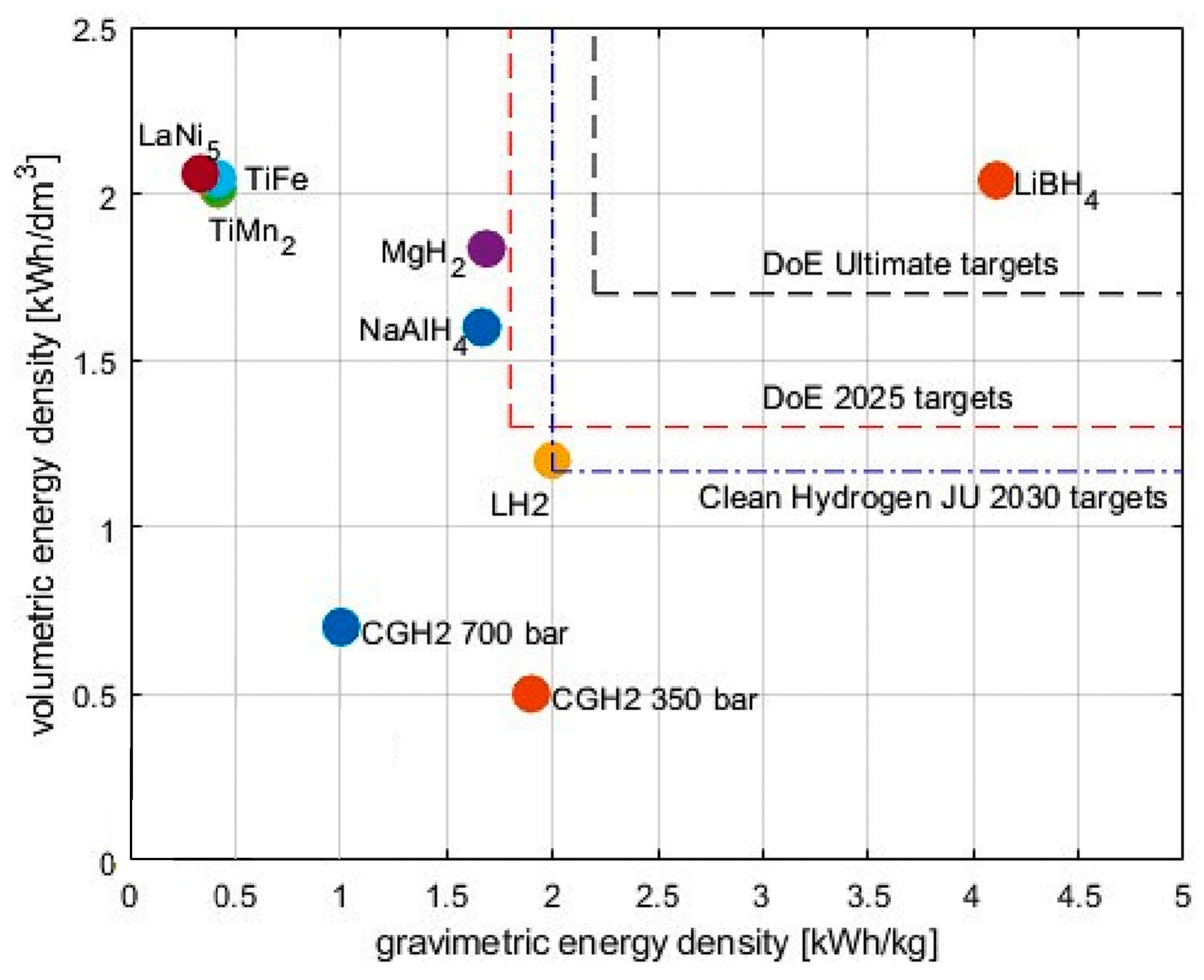
An appropriate method for hydrogen storage that takes into account the mentioned issues is required. Parameters such as safety, longevity, operating conditions of the system, the required capacity, and cost are very important in developing new methods. There are sets of properties proposed by different organisations that hydrogen storage systems should fulfil for the successful transition to a hydrogen-based economy. In 2022 the European Clean Hydrogen Partnership has published various targets for 2030, including transport applications, where 7 and 12 wt% capacities were proposed for gaseous and liquid hydrogen, respectively [21]. In 2017 the US Department of Energy proposed ultimate targets for light vehicles, including a delivery pressure from the storage system equal to 5–12 bar and storage capacities of 1.7 kWh/dm3 and 2.2 kWh/kg [22]. A comparison of the energy density of the current technologies with the proposed targets is presented in Figure 2.
As seen in Figure 2, hydrogen storage materials need to be improved to meet the proposed targets, as even the LiBH4 technology, with the best energy density shown on the graph, is currently impractical due to serious problems with the reversibility of the system. Ultimately, the best storage technology will massively depend on the specific application.
This review will focus on the application in ICEs of four main groups of hydrogen storage: physical, metallic hydrides, sorbents, and non-metallic hydrides. For each of these methods, the basic working principle is described. The characteristics of each type of hydrogen storage are discussed, including its disadvantages and advantages. Recent developments and current research topics are also presented. At the same time, the connection of hydrogen storage technologies with transportation is discussed, including listing the successful applications in different vehicles with hydrogen ICEs. At the end of this review, a comparison of different methods and a summary of the prospects of their use in hydrogen-powered ICEs is presented.

2. Physical Storage

Compression and liquefaction are the most mature physical hydrogen storage methods and are currently used in both small-scale individual vehicles and large-scale hydrogen transport systems. The main advantages of these tanks are their ability to quickly and repeatedly refill and discharge hydrogen across a wide range of operating temperatures without impacting the purity of the stored gas. Compared to more complex hydrogen storage systems, modern pressurised tanks themselves are relatively light. However, their main disadvantages are high pressure requirements, resulting in high strength requirements, which also take into account the phenomenon of hydrogen embrittlement of materials, exacerbated by increased pressure, the relatively large tank volume and the inability to adjust its shape, the high propensity for leaking through leaks and joints (especially from a long-term storage perspective), and the high energy cost of compression and liquefaction.

2.1. Compressed Hydrogen

Currently, the most common method of hydrogen storage is compression in pressure vessels. This is a common gas storage method, which has the advantages of a relatively low energy input and the simplicity of the required apparatus for both compression and decompression stages. A pressure-stored gas in a suitable container is guaranteed to retain its original purity, while at the same time being characterised by the simplicity of its release over a wide flow range regardless of the storage temperature. Compressing hydrogen compared with other gases is particularly demanding due to its lowest volumetric density of 0.08988 g/dm3 under normal conditions, which means that 89.88 m3 of gas must be compressed to store 1 kg of hydrogen.
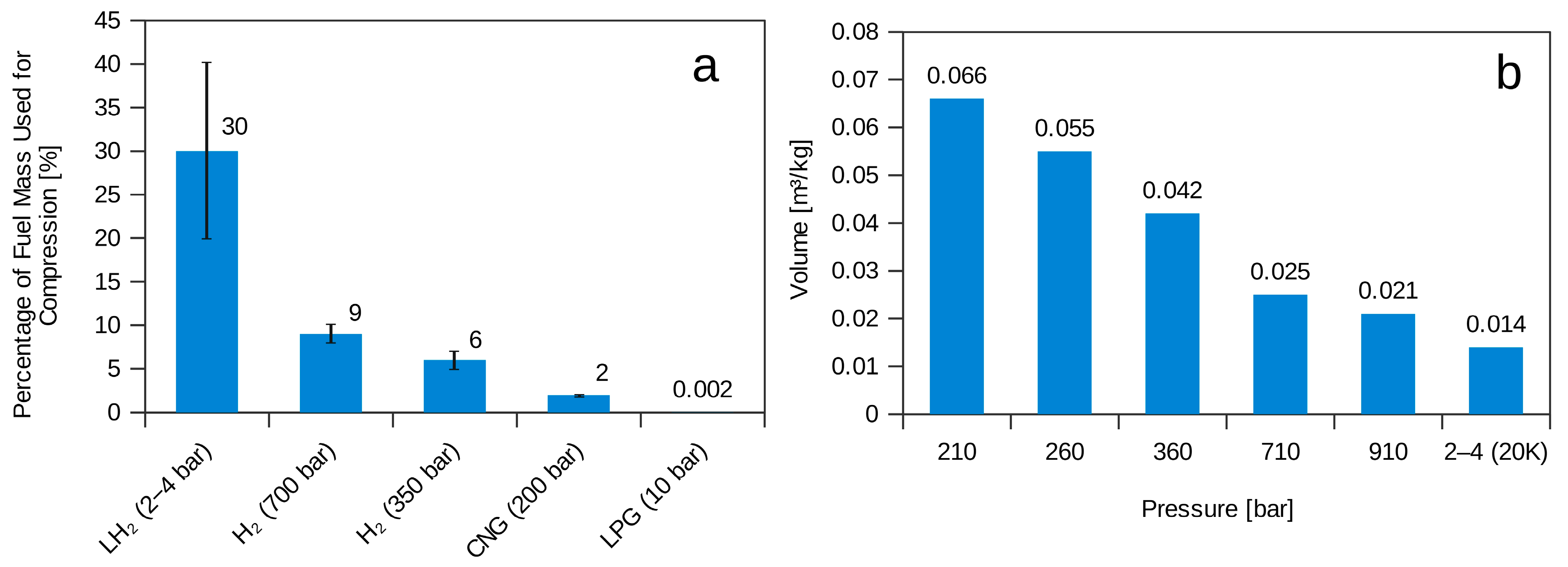
Figure 3a shows the data regarding the compression and liquefaction requirements for hydrogen (H2) at various storage conditions, as well as the requirements needed to obtain the conditions required for cars for compressed natural gas (CNG) (i.e., >90% methane) and liquefied petroleum gas (LPG) (i.e., mixture of butane and 20% propane). The highest energy demand is observed for liquefied hydrogen, with values reaching up to 35% of the stored energy, primarily due to the cryogenic cooling required to reach −253 °C. These values are consistent with estimates reported by the U.S. Department of Energy, which indicate energy requirements for hydrogen liquefaction in the range of 10–13 kWh/kg H2 [24], corresponding to approximately 30–40% of its LHV, which is approximately 33.3 kWh/kg.
High-pressure gaseous hydrogen storage is still a very energy-expensive process when compared to the costs incurred in compressing traditional hydrocarbon gaseous fuels, but it requires three times less energy for compression than the liquefaction process. Bearing such high energy costs for storing hydrogen in liquefied form is justifiable for some particularly demanding applications such as the long-term maritime transport of large quantities of hydrogen. On such a large scale, the priorities are safety, the cost of bulky tanks, and, above all, the limitations imposed by the availability of storage space on-board the tanker. By liquefying hydrogen, one gains nearly twice the volume reduction in high-pressure hydrogen compression (Figure 3b). In contrast, raising the compression ratio of gaseous stored hydrogen is non-linear and has the most beneficial effect on gas volume reduction to a pressure of around 700 bar [25]. Further pressurisation is less energy-efficient and finds economic justification in special space industry or military applications.
Figure 3. Energy cost of automotive fuel compression (a); volumetric gain of hydrogen compression (b). Based on data from [26].
Energies 18 06093 g003
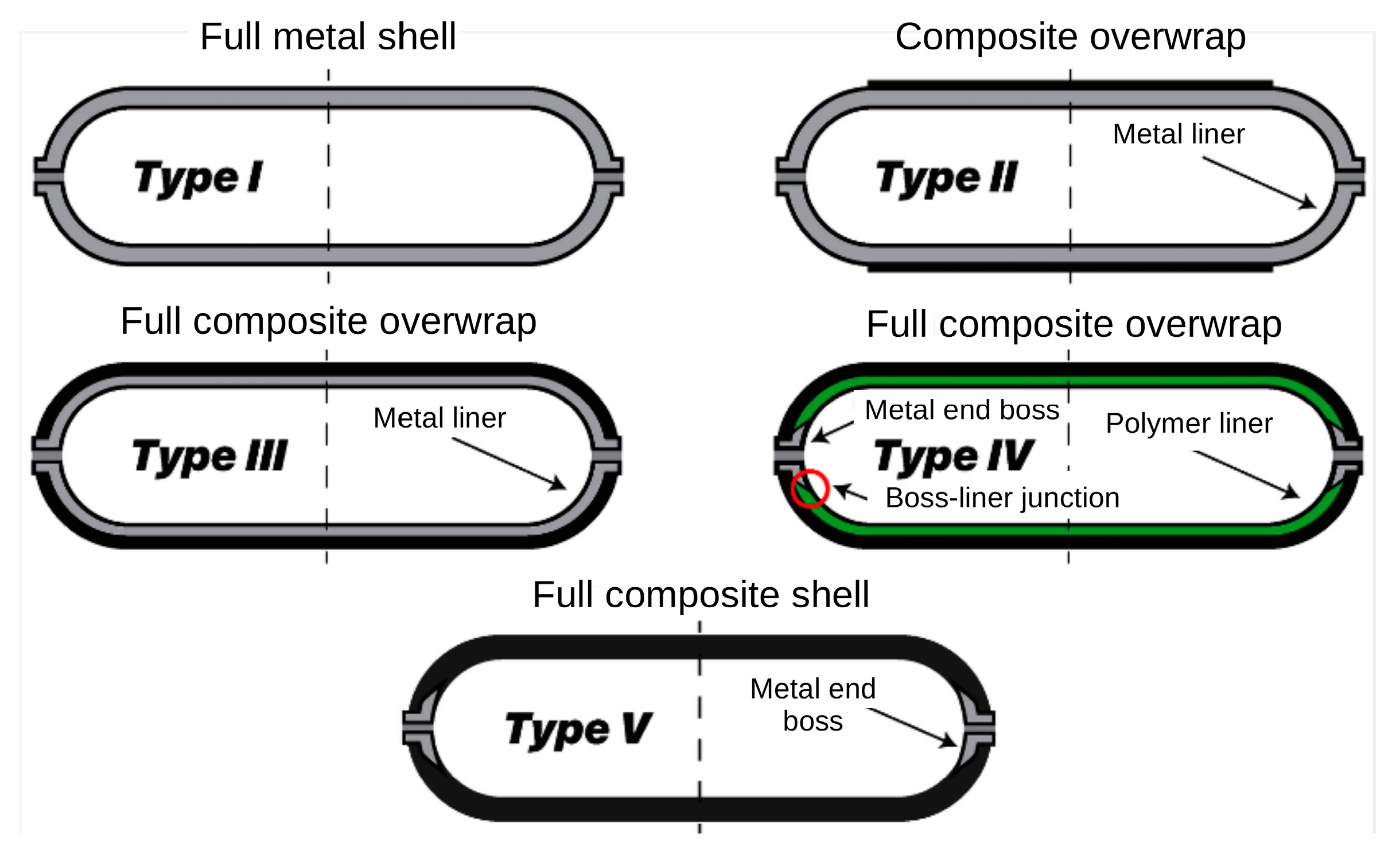
The classification of hydrogen storage tanks is primarily based on their construction, the materials used, and the maximum operating pressure. Currently, five main types of tanks are distinguished (Type I–V). The basic technical and design parameters of pressurised hydrogen tanks are presented in Figure 4 and Table 1.
Type I tanks are made entirely of metal, typically steel or aluminium, and are designed to store gases at pressures of 200 to 300 bar (with a hydrogen density of 15 to 20 kg/m3, respectively). A tank of this type with a 1 kg hydrogen load weighs approximately 100 kg.
Type II tanks are made of metal, usually AISI 4130 steel or 6061 aluminium alloy, with a reduced wall thickness. The cylindrical part of the tank is reinforced with braiding, while the domes remain unbraided. The braiding consists of glass fibres impregnated with an epoxy resin. This design can reduce the weight of the tank by up to half while increasing the pressure range to 350 bar or even 500 bar for special applications. Type I and II tanks are typically used in industrial applications. The typical hydrogen density in these containers is around 23 to 31 kg/m3.
Type III tanks are constructed by reducing the thickness of the metal liner to a few mm (it is typically 6–12 mm for 350 and 700 bar, respectively) [27]. The liner is made from Aluminium 6061-T6 alloy as a single seamless monolithic imprint, and using a full carbon and glass fibre composite braid allows for a design suitable for hydrogen storage at pressures up to 700 bar and achieves a hydrogen packing density of approximately 39 kg/m3. The 3rd generation tank design based on a metal liner has several practical advantages. The metal lining has the highest resistance to gas permeation. Metal also distributes heat evenly and quickly, which is important because large amounts of heat are generated when the tank is filled with hydrogen quickly. The rigid metal liner design facilitates the winding of the braid and allows for the attachment of control elements such as valves and sensors. Type III tanks are most often used in applications requiring large unit volumes while maintaining low weight, such as in buses.
Type IV tanks use a polymer liner made with high-density polyethylene (HDPE) (typically 5 mm thick) [27] and a full composite overwrap made with carbon (e.g., T700 carbon fibre) and glass, aramid, or Kevlar fibres [28]. These are currently the most widely used tanks in all series production cars. This type of tank requires metal inserts in the bottom to which the valve infrastructure is attached. Group IV tanks offer the best weight-to-capacity ratio and are widely used in the automotive sector. Type IV is not only lighter; it also eliminates the problem of the hydrogen embrittlement of the metal, allowing it to extend the life of the tanks. However, they are inferior to group III tanks in terms of available capacity because, due to the flexibility of the liner, they should not be emptied below 25% of their volume, while group III tanks with a rigid liner can be emptied to 5% of their content.
Type V tanks are the lightest among the pressurised tanks described in this chapter, being fully composite with no liner. This type of construction does not have a monolithic barrier surrounding the gas and requires a special type of resin and new carbon fabric impregnation technology, so it is still under development and research. The production technology uses a removable mandrel process. The mandrel keeps the shape of the vessel and must be removed from the inside of the shell after the fibre winding process, leaving only the composite material and resin to serve as the strength and permeation barrier. Removing the liner from the tank structure saves the valuable internal volume and, according to the manufacturers [29], only reduces the structure’s strength by 10% [30]. At the same time, current technology ensures that the permeability, i.e., hydrogen loss, remains at the level of Generation IV tanks. However, the advantages of the new construction are not only the lower weight of the tanks but also the ability to build tanks in shapes other than cylindrical [31]. This will allow for a more efficient use of the limited vehicle space in the future.
Figure 4. Hydrogen tank design diagrams [32].
Energies 18 06093 g004
The 700 bar Generation IV tanks are most commonly used in automotive applications for small vehicles. For heavy-duty vehicles, 350 bar is more popular. Generation III tanks are ideal for bigger vehicles and for application where a higher weight is required (forklifts, trains, tracks).
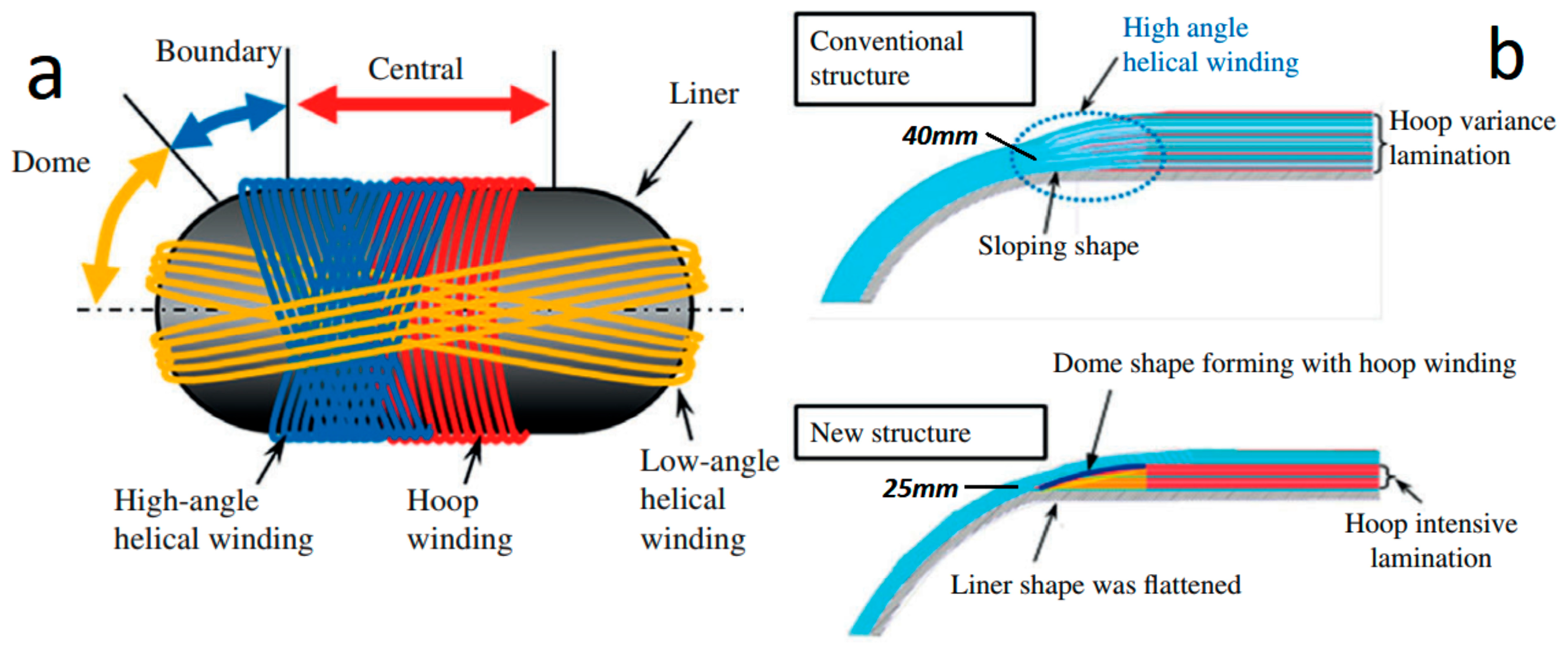
Generation IV tanks manufactured by Toyoda-Gosei were used in the 2nd generation Toyota Mirai car [33]. For the production of the liner, the company used the injection and welding of the polymer. Other popular methods of the production of liner are rotational moulding [34] and extrusion-blow moulding. The filament winding process involves a number of steps, which include the preparation of a bundle of carbon fibres, which then undergoes an impregnation process in a resin solution and is directed to be wound onto a rotating liner. Three kinds of carbon fibre winding configurations (Figure 5a) [35] were used in combination: low-angle helical winding is mainly used in the dome section of the tank, high-angle helical winding in the boundary section, and finally a hoop winding method in the cylindrical section [36]. The configuration of the fibre stitch is crucial to the strength of the vessel and the length of the fibres used. Optimisation in this respect allows for a reduction in the braid thickness (Figure 5b), resulting in a significant improvement in the System Gravimetric Capacity [37], which for the Toyoda Gosei tank reaches a value of 6.2% wt. hydrogen/storage system [38], which is close to the European Clean Hydrogen Partnership’s target of 7% by weight for 2030 [21]. The external coatings that protect the tank are produced using the same braiding and impregnation techniques, but with cheaper materials such as glass fibre, basalt fibre, and aramid fibre. The tank is then put through a conditioning process. The entire manufacturing process of the tank, including the winding and cross-linking of the resin, requires up to 10 h. If necessary, flexible impact protection foams are used when installing the tank in a car chassis [39].
The development and mass production of high-pressure, composite, and fully polymer hydrogen tanks presents significant research challenges. The important issues include ensuring the tanks’ safety and durability. To achieve this goal in long-term usage, a low permeability of polymer liners, a mitigation of hydrogen embrittlement, and a good resistance to mechanical damage and to degradation are required. One promising area of research is replacing the simple polymer liners with composite materials reinforced with fillers. These fillers can consist of other carbon materials and nanomaterials [40,41,42,43]. At the same time, the use of carbon and polymer materials in newer types of tanks requires effective recycling methods to prevent the excessive generation of waste [44,45,46]. The process of recycling is particularly complex in the case of composite materials, leading to difficulties regarding Type IV tanks, which are constructed from several layers of such materials. The reuse of materials is also connected to ensuring appropriate strength and durability in hydrogen tanks, as recycled materials are prone to exhibiting worse qualities. On the other hand, the non-destructive recovery of each tank component requires an individual approach, both in terms of recovering the undegraded polymer matrix and recovering the longest possible carbon and glass fibres that make up the tank braid. As such, these issues require careful consideration, and the development of effective and economic recycling methods is currently a challenge.

2.2. Liquid Hydrogen (LH2)

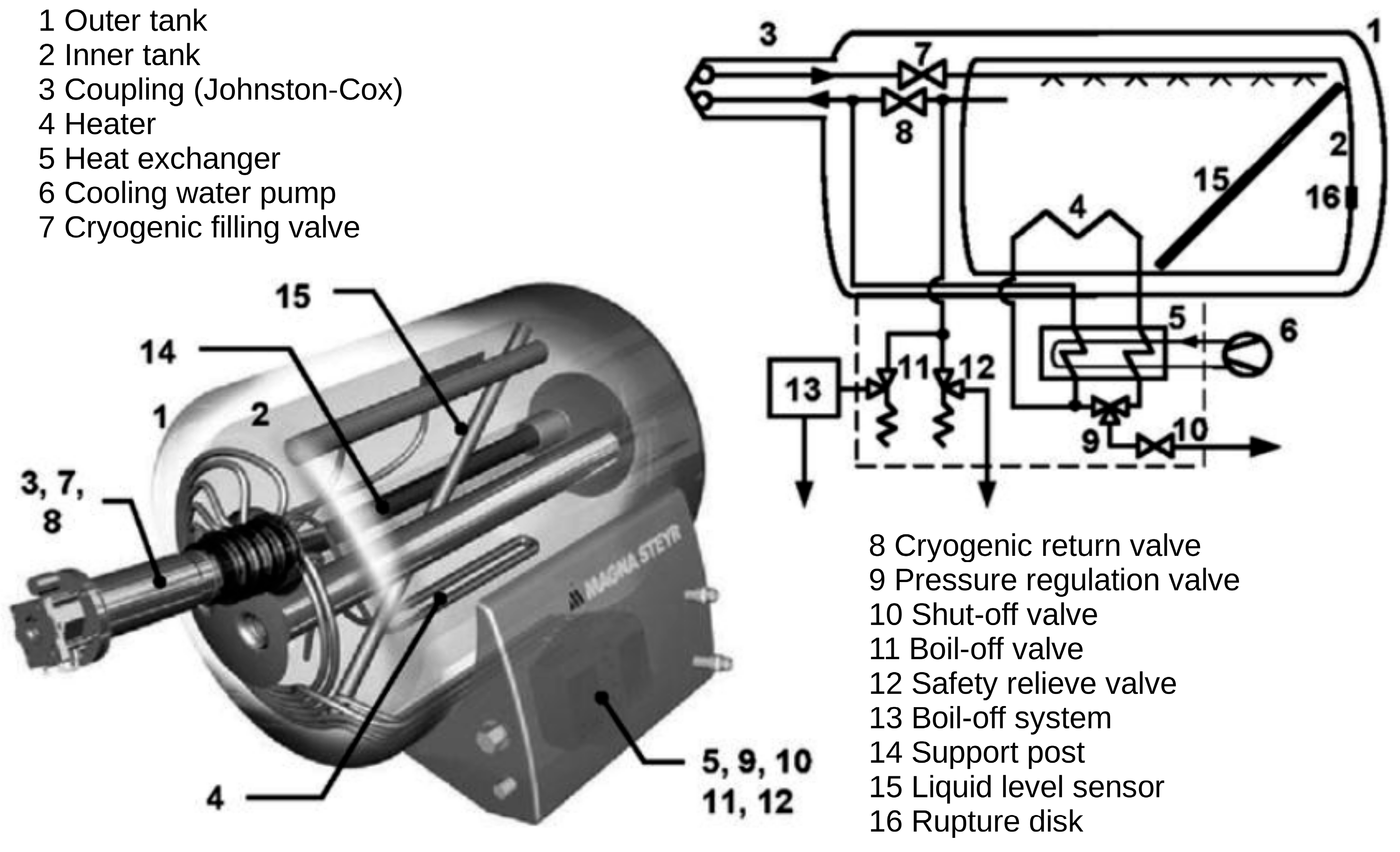
Liquefying hydrogen increases the packing density to 70 kg/m3, but this comes at the cost of a significant energy expenditure resulting from the need to lower the gas temperature to −253 °C. However, in special applications such as space and aircraft applications [47] or mass transport over long distances [48], the advantages of storing hydrogen in liquid form justify the additional costs of liquefaction. In the case of relatively small-scale vehicles, car manufacturers have so far only used a cryogenic hydrogen tank in one mass-produced BMW 745i (also called BMW hydrogen 7) [49]. The design of a liquid hydrogen tank requires different technical specifications than a pressurised gaseous hydrogen tank. The gas tank must be mechanically strong enough to withstand the internal pressure; however, there are no special requirements for thermal insulation. On the other hand, the liquid hydrogen tank is exposed to a small internal pressure of up to around 6 bar; yet it still needs to provide the best possible thermal insulation. Therefore, double-tank designs are used. In these designs, the liquid hydrogen tank is surrounded by multi-layer thermal insulation and located inside a vacuum tank. According to the manufacturer, this tank construction method extends both the loss-free autonomy time and the dormancy time (the mean time for liquid to reach equilibrium at the designed pressure resistance). Then, as the tank heats up, the liquid boils off faster. If there is no natural reduction in internal pressure through the use of stored hydrogen, the rate of loss reaches around 4% per day [49]. This premise highlights the most beneficial application of cryogenic tanks: consuming the stored hydrogen as soon as possible after refuelling. Both combustion engines and fuel cells require hydrogen in the form of a constant pressure gas, so cryogenic tanks need a complex balance of plant system (an example system diagram is shown in Figure 6) [50] to control key safety and operational parameters such as hydrogen evaporation, internal tank pressure and flow overpressure, etc. [51]. At the same time, there are very effective strategies to counteract hydrogen losses resulting from the hydrogen evaporation phenomenon [52,53] which allow for a reduction in the effects of the boil-off phenomenon to a level below 1% per day [54]. However, due to the limited space in small vehicles, typically only a hydrogen recovery system can be implemented, using the boiled hydrogen to produce electricity in an additional fuel cell module [49].

2.3. Cryo-Compresed Hydrogen (CcH2)

Increasing the pressure in the liquid hydrogen tank increases the packing density of the hydrogen to 82.2 kg/m3 (at −238 °C and 30 MPa), while limiting the unfavourable boil-off effect and extending the storage time of the tank from one day to up to eight days for LH2 [55]. In this way, CcH2 tanks combine the best features of liquid and gaseous hydrogen storage systems. These benefits are achieved because the liquid hydrogen is compressed and in a supercritical state, so the evaporation caused by heat transfer from the environment is limited by the tank’s overpressure. Other advantages of CcH2 tanks include the following [56]:
  • The storage vessel could be fitted with heat exchangers located inside and outside the tank, enabling the precise control of pressure and temperature;
  • The system can be a very efficient part of a vehicle’s cooling system;
  • Increased fuel pressure stabilises and accelerates the refuelling process, significantly simplifying the control systems;
  • The external vacuum tank provides additional protection for the internal hydrogen tank, enhancing its mechanical resistance and reducing hydrogen permeability outside the system.
On the other hand, the disadvantages of the CcH2 technology include additional costs and a lower maturity of the technology, as its reliability and safety are not yet extensively tested [32,51]. Additionally, it introduces some boil-off losses when compared with compressed hydrogen storage.
Current CcH2 tank designs resemble traditional LH2 tanks, but the internal pressure tank is constructed in a similar way to the third-generation CGH2 gas tank, i.e., it has an aluminium liner with a composite braid made of carbon fibres and epoxy resins [57]. The increased pressure resistance of the tank improves its thermal tolerance, allowing for a reduction in the required thermal insulation. Thanks to this, the CcH2 tanks require a significantly lower insulation thickness compared with LH2 tanks [56]. Using a multi-layer inner tank poses a serious design challenge due to the significant difference in thermal expansion between the aluminium liner and the composite braid. This results in increased mechanical stress and could lead to a delamination of the structure [58,59]. This problem can be solved by adapting the design of CcH2 tanks to suit the cryogenic conditions. This can be achieved by using fifth-generation uniform polymer gas tanks [60]. The first work on automotive CcH2 tanks was conducted by the Lawrence Livermore National Laboratory and BMW laboratories [61] and was planned for implementation in the second-generation BMW hydrogen 7 car in 2015 [56], but these plans were never realised.

2.4. Recent Applications of Physical Hydrogen Storage in Vehicles

In recent years, there are many examples of uses of compressed hydrogen in vehicles. These include concepts developed by commercial enterprises; however, they are typically not yet available for sale for individual users.
There were many hydrogen-fuelled ICE projects regarding road vehicles in last three years. Noticeably, a lot of interest for hydrogen is shown in motorsport. For example, during the 2023 and 2024 editions of the Le Mans 24 Hours, racing cars powered with hydrogen were presented, like Alpenglow Hy4 and Hy6, Foenix H2, or Ligier JS2 RH2 [62]. All of these cars used hydrogen tanks with pressures of 700 bars to fuel an ICE [63,64,65]. The HySe-X1 buggy, with a similar power system, participated in the 2024 Dakkar Rally [66].
Lately, companies have introduced analogous concepts based on compressed hydrogen for more typical hydrogen-based ICE cars. In 2022, Toyota presented the Corolla Cross Hydrogen Concept based on a commercial Toyota Corolla Cross [67,68]. In the same year, the French–Morrocan startup NamX presented an SUV powered by hydrogen combustion, with sales planned for 2026 [69,70]. In 2024, Solution F, a company developing clean propulsion systems, unveiled a 1976 Jeep Cherokee Chief equipped with a hydrogen ICE [71].
In the area of heavy vehicles, recent developments include a 2023 truck from the Mercedes-Benz Group, based on a medium wheelbase and short platform truck Unimog U 430 [72]. It had a hydrogen ICE and 700 bar tanks installed as a part of the WaVe Project. During the same project, a crawler vehicle similarly powered by hydrogen combustion was constructed [73]. MAN trucks also have had a hydrogen-powered truck prototype since 2021 and in 2023 presented a developed hydrogen combustion engine, the MAN H4576, which could be quickly brought to the market [74].
There were also works regarding integration of hydrogen ICEs in smaller vehicles, such as two wheelers. For example, in recent years, both Suzuki and Kawasaki designed prototypes of such vehicles [75,76].
The technologies currently dominating the hydrogen storage market for transportation are Generation IV and III pressure tanks. While it is difficult to assign a specific tank technology to a given vehicle type, this is probably because manufacturers select the tank type for a specific project based on economic policies. For example, Audi has announced plans to use Generation III tanks in the Audi A7 Sportback h-tron quattro [77], while the Audi h-tron quattro concept is planned to use Generation IV tanks [78]. Generation IV tanks are used in mass-produced passenger cars [79] such as the first- and second-generation Toyota Mirai, Hyundai Nexo, Honda Clarity, and Honda CR-V e:FCEV.
There were also some proposals from commercial companies regarding rail transport. Some hydrogen-powered trains have already entered commercial use, like the Foshan Gaoming tram, Alstom Coradia iLint, Stadler Rail FLIRT H2, or PESA SM42-6Dn [80]; however, they use fuel cells as their power source [81]. In the area of ICEs, there are some recent developments regarding engines by themselves. For example, in 2024, Deutz presented its TCG 7.8 H2 hydrogen combustion engine, which is suitable for rail transport [82]. Similarly, in 2024, Wabtec introduced its dual-fuel, hydrogen–diesel engine for railroad locomotives [83].
Besides land transport, there were developments utilising compressed hydrogen in other modes of transport. In maritime vehicles, several prototypes were built in recent years [84]. They usually use dual-fuel tanks that can run either on hydrogen or on diesel. In 2017, in Belgium, the Hydroville passenger shuttle for 16 people was built using the CMB.TECH dual-fuel hydrogen technology, using small amounts of diesel pilot fuel for co-combustion [85]. In 2021, in Japan, Hydrobingo was presented, which is an 80-passenger ferry that used the same technology [86]. In 2022, Hydrocat 48 began operations. It is a UK-based 25 m long crewboat [87]. In 2022, Hydrotug 1, a hydrogen ICE-powered tugboat, started operations in Belgium [88]. In 2024, the first of six Windcat’s Commissioning Service Operation Vessels was launched. It is an 87 m long ship that can accommodate up to 120 people, again using dual-fuel hydrogen technology [89].
As for liquid hydrogen, historically it was mainly considered for use in the aerospace sector, with much research being performed in the second half of the 20th century [90]. As for the land and maritime transport LH2, the research picked up in pace in the 21st century. While some prototype cars with LH2 tanks have been appearing since the 1970s [90], the more advanced projects have been completed in recent years. Liquid hydrogen was used as an energy source for the combustion engines of the first hydrogen-powered car produced in considerable numbers, the BMW Hydrogen 7, which had around 100 units built in late 2000s [14]. Recently, LH2 has found its application in racing cars. Toyota is leading these projects. It is developing the GR Corolla H2, which in 2023 switched from gaseous to liquid hydrogen storage and is currently competing in various races [91]. Another Toyota ICE project is the GR LH2 Racing Concept, which was unveiled during the 2025 edition of the Le Mans 24 Hours. Besides liquid hydrogen, it utilises a hybrid engine combining hydrogen ICE with an electric drive [92].
Liquid hydrogen is also being tested as a fuel for heavy-duty transport. Daimler Truck is developing its GenH2 tractor unit [93], which has two 40 kg liquid fuel tanks, each maintained at 16 bar, which can provide a potential range of more than 1000 km for a fuel cell-powered vehicle. The advantages of liquid electricity storage could be available in a marine version, which offers greater usable space with an expanded system and greater fuel capacity. Norled [94] is testing its own hydrogen ferry unit powered by a 200 kW fuel cell system from Ballard. Meanwhile, a consortium of Ballard, Glosten, and Siemens Energy are developing a coastal-class research vessel powered by a liquid hydrogen fuel cell system [95].

3. Metallic Hydrides

One of the forms of storage of hydrogen is chemical compounds. Among them, hydrides are often used as a bed in hydrogen tanks. This solution generally allows an improvement of the volumetric capacity of hydrogen storage, albeit at the cost of a decreased gravimetric capacity. Hydrides used in this role can be divided into various groups, e.g., metal hydrides, intermetallic hydrides, and complex hydrides. A short comparison of their properties is presented in Table 2, and a more detailed description is provided below.
Metal hydrides are a promising group characterised by a high capacity, where, for example, MgH2 can theoretically store up to 7.5% hydrogen by weight with the reversible capacity of ca. 5.5 wt%. In addition to its high hydrogen storage capacity, the advantages of MgH2 include the use of low-cost and non-toxic materials [23,109]. However, despite their promising properties and research for over 30 years, MgH2-type hydrides are still not in widespread use. This is mainly a result of the strong bonding between Mg and hydrogen leading to poor thermodynamic and kinetic properties, requiring the use of high operating temperatures [110,111]. Some improvements have been obtained through mechanical modifications and reducing the grain size (e.g., by milling), alloying, or substitution with different elements, adding carbon or metal–organic materials [23,111,112]. Some of the metals with possible uses for hydrogen storage in elemental metal hydrides besides magnesium are aluminium and titanium. However, they require much improvement for commercial use. Titanium hydride has a theoretical hydrogen capacity of ca. 4 wt%, but it requires high operating temperatures (600–750 °C) and has a relatively low reversible capacity (1 wt%) [99,113]. However, there are some successful efforts to reduce the temperature of desorption to ambient temperature through the introduction of vacancies in its structure [114]. Aluminium forms weaker bonds with hydrogen than magnesium, resulting in lower temperatures of desorption around 100 °C [103]. AlH3 also has fast desorption kinetics and a high theoretical hydrogen storage capacity of around 10 wt% and 148 kg H2/m3 [115,116]. On the other hand, it requires very high pressures for charging (several GPa at room temperature for a direct rehydrogenation of Al), resulting in a poor reversibility in proposed systems [103,115,116].
One of the popular types of hydrides is intermetallic compounds with different structures, e.g., AB5, AB2, or AB type (where A and B denote different metals). During reversible storage, the structure created by these compounds with hydrogen is a crystalline or amorphous solid solution. Up to the present, these types of hydrides have found commercial uses mainly in nickel metal hydride batteries and some developing hydrogen storage systems [96,115,117,118]. One of the popular AB5 types of hydrides is LaNi5. It offers a hydrogen storage capacity of ca. 1.5 wt% [23]. It has relatively good kinetics and a low operating temperature and pressure, bypassing the requirement for additional compressors during the resorption of hydrogen [23,119]. However, its gravimetric capacity is not sufficient for many applications. The properties of intermetallic hydrides can be improved by the substitutions of metals in its structure. Metals like Al, Co, Mn, and rare earth metals (often in an alloy form, called mischmetal) are often used as alloy additives [96,110]. For the AB2 and AB type of hydrides, the typical representatives are TiMn2 and TiFe, respectively. They have higher capacities compared to AB5, ca. 2 wt%, and usually do not contain expensive rare earth metals. However, their disadvantages include higher operating pressures, hysteresis for TiMn2, and a difficult activation process before first use for TiFe-type hydrides [23,99,120]. In general, for intermetallic compounds, alloying with different elements has been the main method implemented to improve their properties. There are also other types of intermetallics, like A2B, AB3, or solid solution alloys, investigated as future candidates for commercial hydrogen storage, but their current properties prevent a more widespread use.
Another promising group of hydrides is complex hydrides. They are composed of light elements and can offer high theoretical gravimetric hydrogen storage capacities of 10–20 wt%. In contrast to the conventional hydrides, the sorption of hydrogen in these types of materials is a complex multi-step process, forming intermediate compounds [121,122]. One of the examples of complex hydrides is alanates, such as NaAlH4 or LiAlH4. They are characterised by a high gravimetric capacity (ca. 5 wt% in the reversible capacity), but their high thermodynamic stability results in a poor reversibility, slow kinetics, and unfavourable operating conditions [23,101,110,123]. Another example is borohydrides (e.g., LiBH4, NaBH4), which have an even higher reversible capacity of around 10–15 wt%, but again, due to the stability of the compounds, the dehydrogenation is hardly reversible, the kinetics are poor, and it has demanding operating conditions [110,124]. Moreover, they can release toxic and volatile intermediate products like diborane [110,122]. As a result, despite very promising capacities, the complex hydrides require much improvement before use in commercial systems, using strategies such as nanoscaling, nanoconfinment, or the incorporation of catalysts [101,121,124].
In general, hydrides are one of the most widely researched materials for commercial use in hydrogen storage. Because of their properties in comparison with other materials, they can preferably be used in stationary applications whenever low-pressure systems are desired and longer recharging times are acceptable. In such applications, they offer an improved safety and better volumetric capacity of 2–4 kWh/dm3 for the hydride storage system compared to 1–2 kWh/dm3 for the compressed and liquid hydrogen [23,122]. On the other hand, they are often limited by a higher weight and thermodynamic and kinetic barriers.
In transport applications, the use of hydrides is better suited for heavy vehicles, whenever refuelling times are not important and there is space available for sizeable hydrogen tanks, which require more volume compared to fossil fuel tanks. Examples of such vehicles are ships, trains, and heavy road vehicles. However, the balance between the cargo space and space for fuel tanks must be considered. In passenger cars, hydrides are not the optimal choice due to the relatively slow kinetics resulting in longer charging times and high operating temperatures with the necessity of heat exchange. The high selectivity of hydrogen absorption/desorption in metal hydrides results in a high purity of the delivered hydrogen, but it is only a secondary issue when considering use in an ICE. The purity is much more important when hydrogen is used in fuel cells [125]. In general, the discharging of hydrides is an endothermic reaction. When combined with systems like ICEs, this leads to an advantage in heat management, where the heat generated during the engine operation can be used to supply the hydrogen tank, reducing the overall energy losses of the system. So far, there have been some examples where hydride tanks were successfully applied in hydrogen tanks for cars with both fuel cells and ICEs.
One of the earlier considerations of metal hydrides in mobile applications appeared at the end of the 1960s, with conceptual designs of road vehicles with ICEs [118,126]. In the 1980s, Daimler tested for 3 years a TiMn2-based alloy tank in an automobile fleet of five vans and five personal cars powered by ICEs [127]. In 1988, an experimental van with an ICE and a hydride-based tank with lanthanum-rich nickel–aluminium alloy was constructed and tested by the Japanese Agency of Industrial Science and Technology (currently National Institute of Advanced Industrial Science and Technology) [128]. In 1997, a hydrogen-powered city bus with AB5-based tanks was developed in Augusta, USA [129].
However, in later years, other hydrogen storage systems, like compressed and liquid hydrogen, gained more prominence, especially in ICE solutions. Nevertheless, hydride-based hydrogen tanks were still developed in tandem with fuel cell systems in various transport applications [115,130]. An example of a successful commercial use of such systems is in Type 212A and 214 submarines, produced by thyssenkrupp Marine Systems GmbH [131,132,133]. In surface ships, a canal boat “Ross Barlow” has been successfully converted from diesel to a hydrogen fuel cell at the University of Birmingham [134]. In 2022, an Italian hydrogen-powered ship “ZEUS”, with a capacity of 12 people, was built by Fincantieri [135,136]. Another ship example is the Coriolis research vessel built for the Helmholtz-Zentrum Hereon, which was completed in 2024 [137,138]. In rail transport, only some small-scale solutions were constructed using hydride storage tanks. On land, the Fuelcell Propulsion Institute constructed a mining locomotive, and the National Science and Technology Museum in Taiwan rebuilt a model mini-train for around a dozen passengers [139,140]. In South Africa, HySA Systems Competence Centre developed a forklift powered with a fuel cell using hybrid hydrogen storage combining a pressure tank and a metal hydride tank based on a low-temperature Ti-Zr alloy [125]. In recent years, some two-wheeled personal vehicles with hydride-based tanks were constructed [118]. Larger four-wheelers were also built but were limited to a one-person capacity. In 2012, Hwang and Chang described a Toyota AUTOBODY COMS, initially a battery micro-car, integrated with a fuel cell and an AB5 hydrogen tank [141]. HySA Systems Competence Centre also developed a golf cart with a hybrid compressed gas and hydride system in 2015 [142]. Another example is MHYTIC, a four-wheeled one-person vehicle with a range of 180 km, which was presented in 2023 by Minactec Energy as a demonstrator equipped with hydride tanks and fuel cells [143].
One of the aspects related to hydrides is maintaining the right hydrogen pressure. Compressed hydrogen storage can offer pressures of even 700 bar, which is sufficient even for high-pressure injection systems requiring ca. 100–300 bar [3,14]. On the other hand, this requirement limits the usable amount of hydrogen available to use in such a tank. For hydride-based tanks, their low operating pressure is usually considered an advantage, allowing them to work with low-pressure systems while not requiring additional compression during rehydrogenation. However, their potential use in high-pressure injection systems would require the use of an additional compressor and result in a lower efficiency for most hydride systems.
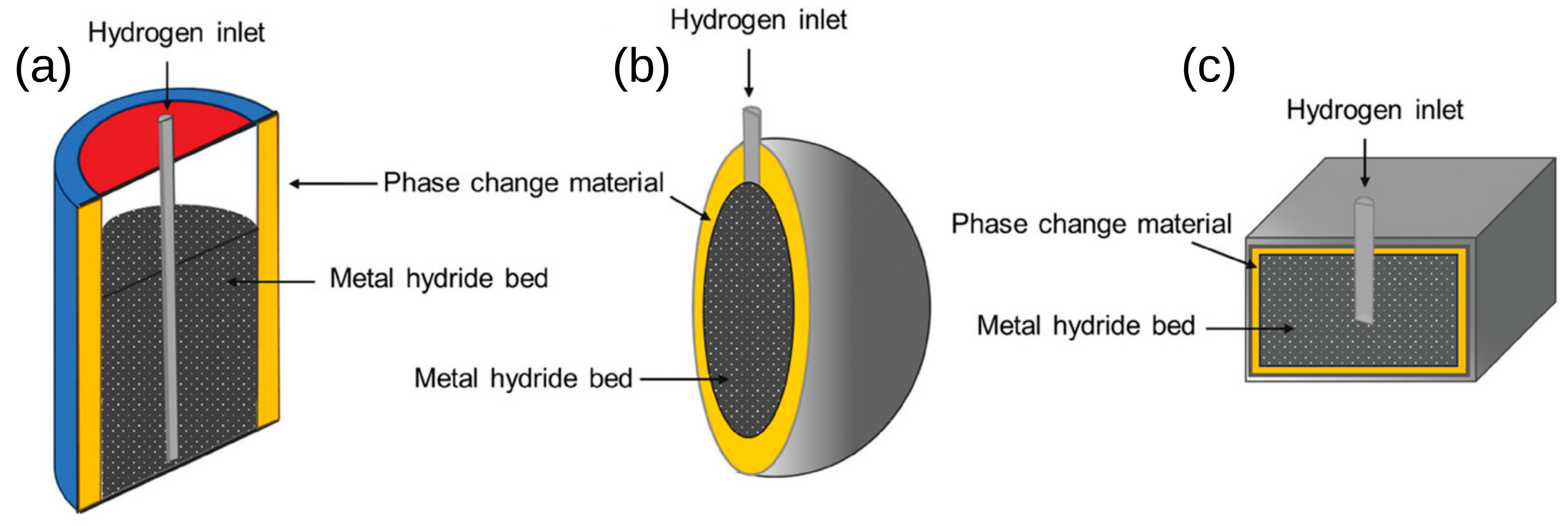
The construction of the tank itself can also be altered. Examples of tank designs with different shapes are presented in Figure 7.
As shown in Figure 7, a layer of a phase change material can be added to different types of tanks, which allows for an increased rate of heat transfer during the tank operation, leading to faster kinetics and higher charge/discharge rates [145]. However, one must remember that the heat transfer within the hydride bed is the main issue in this type of tank [146]. Appropriate tank bed modifications (e.g., compaction of hydride powders in pellets, use of metal foams), tank shape modifications (e.g., addition of fins), and the addition of heat exchangers all can lead to the better behaviour of hydride tanks during charge/discharge with higher rates [144,147]. Regarding the shape, typically the cylindrical tank design is the most popular. The spherical tank offers the worst surface area-to-volume ratio but allows for the largest volume available for the metal hydride bed. The prismatic design results in the optimal modularity, stacking, and use of space; however, they are more limited in heat management and the resistance to high pressures [146].
One aspect deserving more consideration is hybrid tanks, combining a high-pressure tank with a solid-state hydrogen storage material. When using metal hydride powder in a tank bed, the packing density is limited, and it is not possible to fill all of the available volume with powder. The remaining space could be filled with a pressurised hydrogen gas. For example, filling a 100 dm3 tank with 100 kg of Ti–Cr–Mn alloy increased the gravimetric storage capacity from 2.3 to 3.7 kg (at 35 MPa and 298 K) [122]. On the other hand, hybrid solutions increase the cost by having to adapt the tank to high operating pressures and by introducing the hydride material [122,130]. The hydrides used in the hybrid tanks should be characterised by high operating pressures. Some of the promising materials that can be used in this role are AB2-type hydrides or vanadium-based alloys. Complex hydrides could also be employed in the hybrid tanks, but they should rather be used in mixed systems together with other materials [122].

4. Sorbents

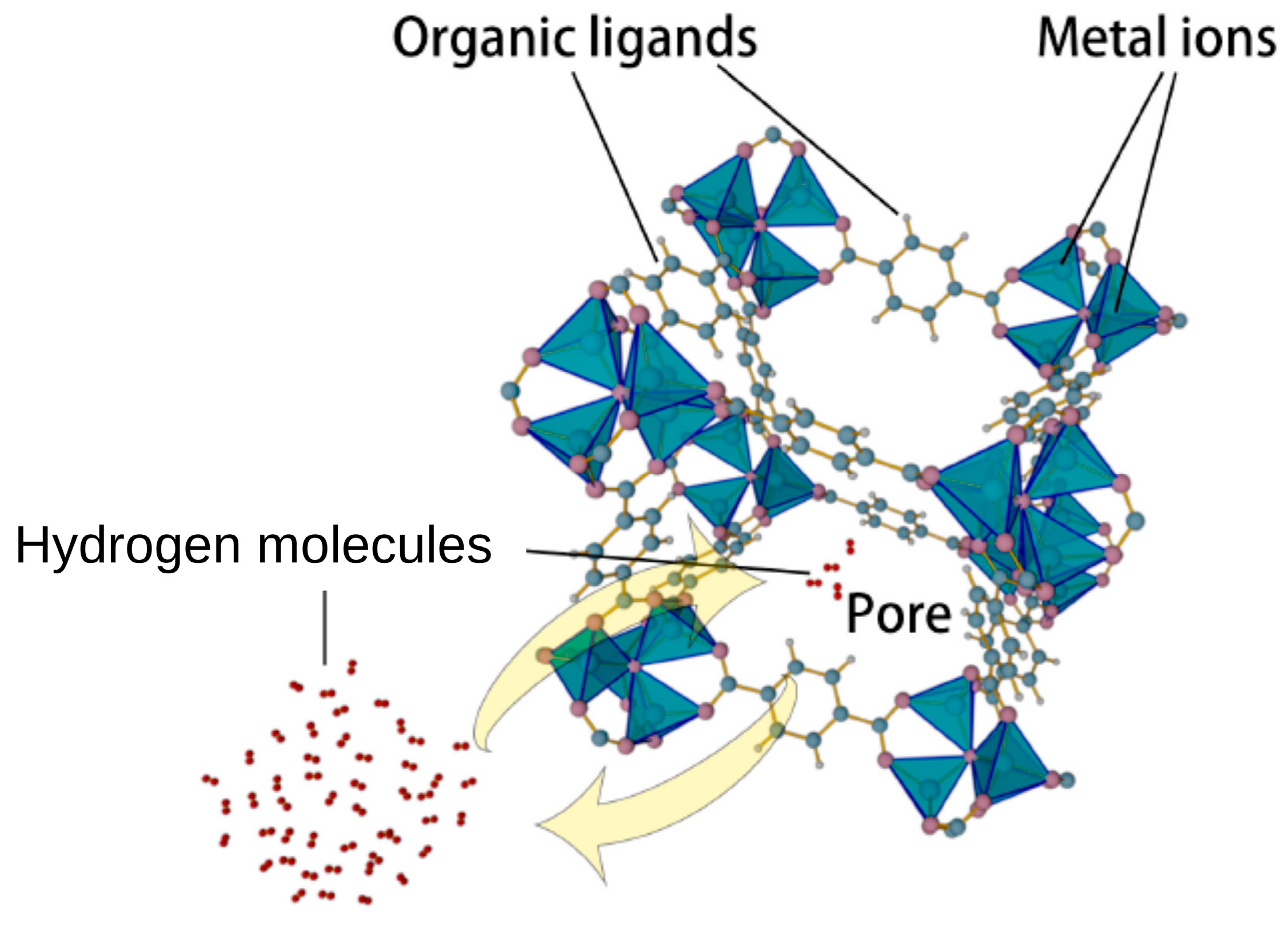
Under appropriate physicochemical l conditions, hydrogen can be adsorbed and reversibly stored in sorbents with a large surface area. In the recent years, materials such as metal–organic frameworks (MOFs), carbon-based materials, and zeolites have been the focus of research, offering some potential for hydrogen storage. Promising materials with hydrogen storing properties that have attracted a particular interest from researchers in the first decade of the 21st century are metal–organic frameworks [148,149,150,151]. MOFs are highly ordered crystalline materials, constructed by assembling metal-containing clusters into a three-dimensional structure formed by organic ligands. The structure of MOFs is characterised by the presence of channels and pores of uniform size and shape. Metal ions usually act as nodes or focal points, while organic ligands usually act as linkers. The most commonly used metals include magnesium, chromium, manganese, cobalt, nickel, copper, and zinc. Cyclic organic compounds are usually used as ligands, including, for example, 1,4-benzene dicarboxylic acid (BDC), 1,3,5-benzene tricarboxylic acid (BTC), 2-methylimidazole (2-MIM), and 1,4-benzene dicarboxylic acid (BDC). The structure and properties of organic components have a decisive influence on the size and number of pores and the possibilities of surface functionalization. The ability of MOFs to store hydrogen (and other gases) results from two basic mechanisms: physical adsorption and chemical adsorption. Physical adsorption occurs via intermolecular interactions in which hydrogen molecules are influenced by the surface of the material via van der Waals forces, adsorbing and storing the molecules in pores of the material. Chemical adsorption (similar to a typical chemical reaction) occurs via the formation of a chemical bond during which electrons are shared or transferred [17,18,20,148,151,152,153]. Examples of the structure of an MOF and the mechanism of hydrogen adsorption are shown in Figure 8.
Microporous metal–organic structures enable an efficient and safe storage and subsequent desorption of hydrogen for practical applications at temperatures close to room temperature. Thermodynamic calculations performed in the temperature range of −25 ÷ 50 °C indicate that the MOF structure exhibiting appropriate thermodynamic parameters can be efficient for hydrogen storage in the pressure range of 40–100 bar [154,155].
Due to the target application of microporous metal–organic structures for hydrogen storage, the basic parameters used to characterise this type of materials are the surface area (m2 g−1), pore volume (cm3 g−1), and hydrogen uptake. The hydrogen uptake value is usually expressed gravimetrically or volumetrically. In turn, the total hydrogen uptake, also called the absolute uptake, refers to the total amount of hydrogen adsorbed on the surface and in pores within the boundaries of an MOF crystal. This parameter includes both the hydrogen compressed in the pores of the framework and adsorbed on the surface [154,156,157,158]. Table 3 presents the typical ranges of selected, basic parameters for about 200 MOFs. In the case of surface measurements, the values determined through the BET method and the Langmuir method are presented separately.
The available data give great hope for the adsorption storage of hydrogen, as well as other gases, e.g., methane and carbon dioxide [157,160]. Numerous research works aimed at the further improvement of MOF properties are focused on factors such as increasing the volume available for storage (by increasing the specific surface area and/or pore volume) or increasing the affinity of the network for stored gas molecules [152,161]. Another main direction of the MOF development is to increase the hydrogen adsorption capacity and usability in different operating conditions. This can be achieved by altering the pore structure and electrical characteristics of the material through the addition of specific organic ligands or functional groups [20,162]. However, the practical application of MOFs in hydrogen vehicle fuel tanks still requires achieving the targets defined by the DoE [17,154,160,163].
The specific structure of MOFs provides great possibilities for modifying the structure and properties of the network at the same time. Changing the type of metal ion, the coordination method, and the shape of the organic linker provides great possibilities for designing the properties of the structure in order to increase the hydrogen storage [152,162]. Designing the appropriate structure requires a thorough study of the adsorption mechanisms and properties of MOFs and the use of modelling techniques. Luo et al. [164] studied the adsorption sites of H2 molecules and the binding energy in the MOF structure. Furthermore, using the neutron powder diffraction technique, they showed that the optimal pore size enhances the interaction between H2 molecules and the pore walls. Using the same method, Yildirim and Hartman [165] showed that, in the case of the widely studied MOF-5 (ZnO4 clusters linked by BDC), the hydrogen binding energy of the metal-oxide cluster is much larger than that of the organic linker. This result was confirmed by Huang and Ke [166] using the van der Waals density functional method (vdW-DF), indicating that the effect occurs due to the electrostatic force induced by the metal ion. In turn, Mendoza and Aduenko [167] successfully used the model of gas adsorption in porous materials with a multi-layer crystalline structure to describe hydrogen adsorption in MOFs. Designing MOFs based on theoretical models and databases is a widely used method in the development of this technology. There are known works [168,169,170,171] presenting applications of computer simulations, which include quantum calculations (ab initio and using density functional theory—DFT), molecular dynamics simulations, grand canonical Monte Carlo simulations, and machine learning in the area of hydrogen storage using metal–organic structures. Despite numerous research efforts, MOFs are not yet practically used in hydrogen storage systems. One example of advanced solutions is a hydrogen tank based on MOF-177 (octahedral Zn4O(-COO)6 and triangular 1,3,5-benzenetribenzoate (BTB)), presented by Argonne Laboratory, with an assumed gravimetric capacity of 4.8% and a volumetric capacity of 34.6 g/L at a pressure of 250 bar [104,150].
Carbon-based materials also demonstrate significant potential in the field of hydrogen physisorption. Carbon adsorbents are attractive due to their low production costs, simplicity, and lightness. In general, the ability of carbon materials to store hydrogen is directly related to the specific surface area and micropore volume. Therefore, the type of carbon material used is important, as well as the method of its preparation, aimed at obtaining small pore sizes and a minimal pore size variability. Nanocarbon adsorbents with a high specific surface area, such as carbon nanotubes, graphene, graphene oxide, reduced graphene oxide, and fullerenes, are of particular importance in the field of hydrogen storage. In the case of carbon nanotubes, the pores are characterised by a well-controlled size and distribution and minimal macropore volume, while hydrogen is adsorbed both into the interior of the nanotube and in the areas between the tubes [18,148,152,172,173]. Other interesting developments based on carbon adsorbents and MOFs are nanoporous carbons prepared through the direct carbonisation of highly porous MOFs [174], porous carbons from a metal–organic gel template (an extended MOF) [175], and metal-modified graphene materials [172].
The third group of physicosorbents are zeolites, crystalline materials consisting of SiO4 or AlO4 building blocks. The intracrystalline system of channels and cages present in zeolites is responsible for the ability to adsorb hydrogen. Zeolites are attractive due to their low production costs, chemical and thermal stability, safety, and low environmental impact. On the other hand, the geometric structure of zeolites limits the maximum hydrogen uptake to about 2.8 wt%. Furthermore, zeolites usually have a smaller surface area and smaller micropore fractions than MOFs and carbon adsorbents. Due to the above factors, zeolites are not considered as a potential solution in the hydrogen tanks of hydrogen vehicles [18,148,152,173].
In summary, sorption materials offer many possibilities in the field of hydrogen storage systems for hydrogen vehicles. Compared to pressurised hydrogen, sorbent-based systems can show higher hydrogen storage capacities (volumetric and/or gravimetric, depending on the used compound), while operating near room temperature at lower pressures. Moreover, they utilise light-weight materials and are characterised by good safety. Additionally, due to the weak interaction between the sorbent and hydrogen, physisorption-based storage systems exhibit fast kinetics, leading to charging times on the order of minutes and no problems with reversibility and large heat release during hydrogenation (especially compared to hydride-based systems) [148,156,160,168,170]. Undoubtedly, due to the fact that sorption technologies are at the research stage, the challenges include problems such as stability, the formation of connected pores, corrosion resistance, and the determination of cyclic resistance under application conditions [151].

5. Non-Metallic Hydrides

There are many non-metallic compounds containing hydrogen. The ones considered for use in hydrogen storage systems utilise reversible reactions of hydrogenation and dehydrogenation to combine their molecules with hydrogen for storage and release it when required. Some such hydrogen carriers could also be directly used for energy, e.g., in combustion engines or fuel cells. In this chapter, we will focus on carriers that are not combusted directly, but release hydrogen before energy generation. Additionally, the direct combustion of ammonia will be described as a promising technology for zero-carbon-emission ICEs deeply connected with hydrogen storage.
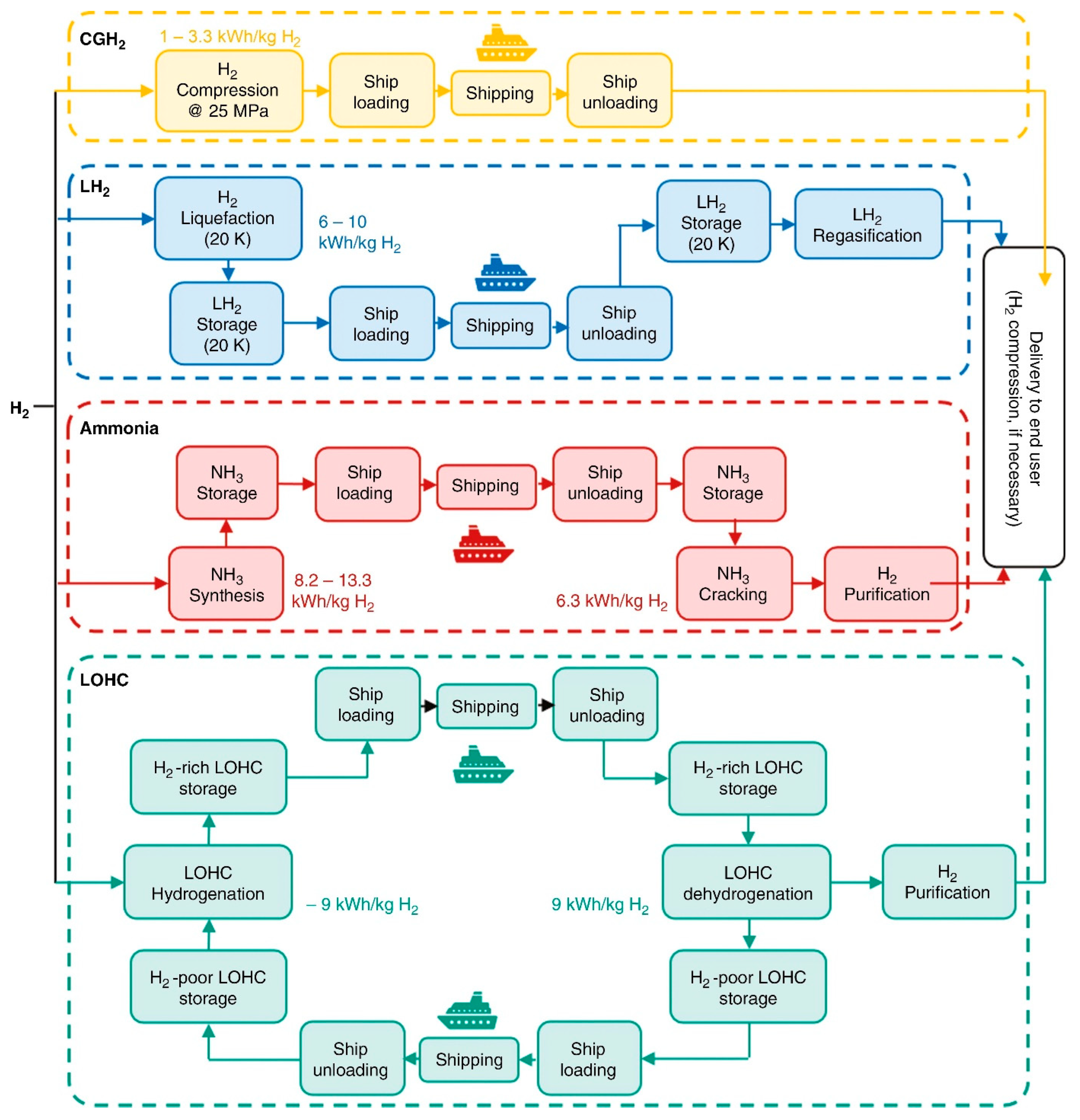
Figure 9 below presents examples of shipping supply chains using different hydrogen carriers.
For most of the non-metallic compounds used in hydrogen storage, the dehydrogenated form of their molecules forms a gas or liquid phase. Hydrogen carriers such as ammonia, methanol, or methane can be classified as so-called circular hydrogen carriers [151,177,178]. While their circular nature is often not fully realised in typical uses, theoretically, the gas molecules released during their decomposition (e.g., H2, CO2, N2) can be reused for their synthesis, forming a material loop. There are also LOHCs, which are organic compounds forming a liquid phase that can be reversibly hydrogenated/dehydrogenated and easily reused [177].
One of the most popular circular hydrogen carriers being currently investigated for hydrogen storage on a large scale is ammonia. It offers a high energy density, as liquid ammonia has an over 40% higher energy density than liquid hydrogen and double the energy density of compressed hydrogen [179]. Ammonia is also characterised by a high hydrogen content (17.8 wt%), high octane number, well-developed storage, and infrastructure in industrial applications; it has a large minimum ignition energy, narrow flammability limits, and low laminar burning velocity, improving its safety over hydrogen [179]. On the other hand, its poor combustion characteristics and larger NOx emissions limit the potential use of ammonia in ICEs.
At the same time, the dehydrogenation of ammonia is a slow, endothermic process which requires high temperatures and noble catalysts (e.g., Ru). Non-precious metal catalysts, based on Ni, Fe, Mo, or Co, are being developed [177]. Alternatively, amide–imide catalytic systems can be used; however, they are not very stable. The decomposition of ammonia can also be facilitated by other methods, like electrolysis, nonthermal plasma, or photocatalysis, but these methods have their own significant drawbacks and are still in development [151]. Another important aspect of ammonia decomposition is the separation of hydrogen from the gaseous mixture in the reactor, consisting mainly of H2, N2, and NH3. Economically viable methods that can be used for this purpose include pressure swing adsorption, temperature swing adsorption, and metal membranes [180,181].
The direct use of pure ammonia can be realised, e.g., through the use of direct or solid-oxide fuel cells and gas turbines. Due the aforementioned poor combustion characteristics, before burning the ammonia in a turbine, it has to be mixed with other fuels, like methane or coal [176]. It is feasible to use mixed or pure ammonia fuel in ICEs; however, some adaptations are required to achieve favourable ignition conditions. This can be accomplished by the increase in the compression ratio, the use of a turbocharger, or a dedicated ignition system [105]. Ammonia can also be used in ICEs in a dual-fuel mode, using a pilot injection of a more reactive fuel, e.g., diesel, acetylene, or LPG [105]. The use of ammonia in ICEs is promising; however, it requires further optimisation, e.g., in areas of the amount of pilot fuel, levels of NOx, N2O emissions, and NH3 slip [182]. The last term refers to unreacted NH3 leaving the system into the atmosphere. Due to negative effects on human health and the environment, it is vital to reduce the emission of nitrogen compounds from ammonia-powered ICEs. The available techniques for reduction in these emissions are based mainly on the use of optimised combustion conditions and catalysts with an appropriate selectivity and activity [182,183,184]. New techniques, like oxygen-enriched combustion, ammonia–hydrogen mixed combustion, and plasma-assisted combustion (PAC), can also improve the combustion properties of ammonia [179].
The large-scale storage of ammonia is currently well-developed, giving it an advantage over hydrogen. It can be stored cryogenically or pressurised as a liquid, and it has a large infrastructure available due to its current industrial uses [185]. However, there are concerns when using ammonia regarding its toxicity, gas dispersion, and corrosive properties. Its transport and storage are highly regulated, and currently there are available solutions, industry experience, and safety procedures for handling ammonia. On the other hand, the use of ammonia as a fuel would mean an increase in operations and human interaction with it, requiring further training and the development of appropriate methods [182].
Regarding energy storage, ammonia offers an improved energy density compared to hydrogen. However, it is still worse in this regard compared to diesel and other fossil fuels. Besides improving combustion, additional solutions could be developed to improve the ammonia synthesis process and reduce the costs incurred by it. For the synthesis, current research is focused on increasing the heat recovery during the high-temperature steps and decreasing the required temperature and pressure [105]. The development of alternative processes to the Haber–Bosch scheme is currently still in early stages [105].
There are other examples of circular hydrogen carriers, like methanol, ethanol, or methane. On first glance, for carbon-based compounds, their oxidation should lead to the generation of carbon oxides and the emission of greenhouse gases. However, there are various methods allowing the capture and reuse of CO2, leading to zero-emission cycles. To give one example, methanol is a carrier containing 12.5 wt% hydrogen. Its combustion can be realised using a closed loop that captures generated carbon dioxide, which can be stored and theoretically used again in the methanol synthesis. For example, using the Allam cycle, the methanol can be combusted in pure oxygen (supplied by air separation units) with transcritical CO2 as a working fluid. In these conditions, up to 98% of the carbon dioxide from combustion can be captured and stored. A 50 MWth natural gas power plant based on this process is already operating in La Porte, TX, USA, and several more are planned for construction [185]. Such systems also avoid nitrogen oxide emissions by combusting in pure oxygen instead of air, which additionally simplifies the separation of CO2 from the exhaust gases. Simpler, but less efficient and more carbon emissive methods are still more popular, e.g., using methanol combustion in air in mono- or dual-fuel ICEs or gas turbines [186]. However, such methods, as well as the combustion of ethanol or methane, are more loosely connected to hydrogen storage and zero-emission transport, and as such they are beyond the scope of this review.
As for LOHC, the well-known pairs of hydrogenated/dehydrogenated molecules include benzene/cyclohexane (BZ/CHE) and toluene/methylcyclohexane (TOL/MCH). The perhydro-dibenzyltoluene/dibenzyl toluene (H18-DBT/H0-DBT) pair also garners much attention, as both forms are not flammable, increasing safety [187].
Although cyclic hydrogen carriers offer a relatively high hydrogen content and efficiency, the processes during their synthesis and dehydrogenation may incur significant costs and energy expenditure. On the other hand, LOHCs generally are characterised by a lower hydrogen content, but a higher round-trip efficiency. Their efficiency generally benefits from more reversible reactions and stability, but the specifics highly depend on the compound involved. Some LOHCs may still require higher temperatures or pressures, but technological improvements are being intensively developed [151]. At the same time, it is connected to lower technical readiness levels and higher expenses of the LOHC systems [185]. A significant advantage of liquid organic as well as circular carriers is their general compatibility with existing fuel transport and chemical storage systems; however, circular carriers benefit from more established technologies and infrastructure [151,177]. In the context of ICEs, LOHCs would not be combusted directly, but could be a source of hydrogen used in these engines.
The BZ/CHE pair consists of a relatively simple compound and is characterised by a high hydrogen storage capacity of around 7.2 wt%. Regarding its hydrogenation/dehydrogenation processes, several catalysts have been studied, including materials such as Pt group metals, Ni, Ni/Cu, and Ni/Pt. The main disadvantages of the BZ/CHE pair are the high toxicity of BZ, high flammability of CHE, and the difficulties in separating hydrogen from the reactants [177].
The TOL/MCH pair differs from BZ/CHE by the addition of a single methyl radical to its structure. This simple change is enough to offer a wider liquid temperature range and lower toxicity at the cost of reducing the hydrogen storage capacity to 6.2 wt%. The hydrogenation/dehydrogenation of this system uses similar catalysts as the BZ-CHE pair, such as Pt group metals, mono- and multi-metallic Ni, and bi-metallic Pt/Mo on various support materials [177,188]. Regarding these reactions, there are also other innovative techniques currently being developed, like the use of electric field dehydrogenation or membrane reactors [188].
The H18-DBT/H0-DBT system is characterised by a low volatility and reactivity, and the products of its dehydrogenation have a low impact on the environment and health. It has a theoretical hydrogen storage capacity of 6.2 wt%; however, the hydrogenation/dehydrogenation processes are not fully realised and need further development [151].
Historically, the non-metallic hydrides, mainly ammonia, have found some use in ICEs in vehicles, with some examples even before World War II, and with many improvements since then. The implementation in vehicle ICEs of other non-metallic hydrogen carriers is generally a newer concept and is in the earlier stages of development. One of the first mentions of the use of ammonia-powered vehicles was in 1933, when Norsk Hydro built a truck using a hydrogen ICE and an ammonia reformer [189]. In 1943, eight buses were put in service in Belgium with engines directly combusting a mixture of ammonia and coal gas (a mixture of gases produced by coal gasification, containing mainly CO and H2) [190]. In the 1960s, ammonia was investigated as a possible fuel for jet engines by the U.S. Army, but it ultimately was deemed as non-viable due to drops in combustion efficiency and power output [105]. Due to the difficulties in combustion when using pure ammonia, developments focused on using mixtures with pilot fuels. There had been a lower interest in ammonia combustion for a few decades, with a resurgence in recent years, mainly due to climate concerns with fossil fuels. Currently, there are many planned and completed prototypes using ammonia.
In modern times, examples of ammonia-powered cars include ammonia–gasoline hybrids, like the Marangoni Toyota GT 86-R Eco-Explorer built in 2013, or the AmVeh, developed in the same year [191,192]. In 2023, Toyota and GAC presented a car engine promising a 90% reduction of carbon emissions, but not many details are currently available [193]. The use of ammonia-powered engines, especially pure ammonia, is more advanced in shipbuilding. Ammonia is the second most popular solution in currently realised zero-emission demonstration projects, being used in 38% of the considered ship projects, with methanol trailing far behind, with a 2% share [194]. The first place belongs to pure hydrogen, used in 47% of projects. As a recent example, in 2025, in China, a small vessel, “Anhui”, with a capacity of 50 tonnes, powered by pure ammonia, was completed [195]. As of June 2025, the Ammonia Energy Association estimates that 5 ammonia-fuelled vessels are operational (mostly smaller vessels), with a further 64 ordered (mostly large ships), with completion expected in 2026 and 2027 [196]. One example of an ammonia-ready ship is Eric Thun R-class tankers, which will use a new Wärtsilä 25 engine that should be able to handle alternative fuels like ammonia, hydrogen, and methanol [197,198].
There are also examples of other types of hydrogen carriers used in vehicles. In 2024, the world’s first methanol-fuelled container ship with dual-fuel engines able to operate on methanol was launched for A.P. Moller-Maersk [199]. Similarly, Van Oord ordered two Subsea Rock Installation vessels with multi-fuel engines capable of operating on methanol, expected to enter the service in 2028 and 2029 [200]. For LOHCs, an example of an advanced project is the Ship-aH2oy project, which aims to develop and demonstrate a zero-emission ship propulsion technology on a megawatt scale using green hydrogen generated from LOHC, albeit using solid oxide fuel cells, not ICEs [201].
In summary, the general advantages of non-metallic hydrides include easier handling, better technologies for storage in transport, and a relatively high energy content. The main disadvantages are the additional costs and energy requirements for the processes of hydrogentation/dehydrogenation, which can result in reducing the energy available from hydrogen, even by half. Additionally, some of the hydrogen carriers can still display unwanted properties, like toxicity and corrosivity. As for the uses in the vehicle ICEs, these hydrides are slowly entering the production stage (mainly ammonia). However, due to economic reasons and the limited fuel availability, such vehicles currently are developed mainly with dual-fuel engines or the ability to run on alternative fuels.

6. Discussion

As described in this review, hydrogen storage materials have varied properties, with some important characteristic summarised earlier in Table 2.
In this section, we will compare the four main groups of physical storage, metallic hydrides, sorbent, and non-metallic hydrides. In general, when considering gravimetric density without the tank, elemental hydrogen in physical storage technologies reaches the value of 100 wt%, corresponding to ca. 1.7 kWh per kg of the storage system for hydrogen compressed at 700 bar and 3.3 kWh/kg for liquid hydrogen [146,176]. Comparing other systems, the highest values of wt% are reached by the non-metallic hydrides and complex metallic hydrides, which can reach around 10–20 wt% of hydrogen storage [69,97,103]. When considering a system including the tanks, these materials reach a similar gravimetric energy density (in kWh/kg) as liquid hydrogen. The lowest values are displayed by the metallic hydrides, with typical capacities of around 1–5 wt% [69,97,103].
When looking at the volumetric capacity, the best materials are metallic and non-metallic hydrides, with values from around 50 up to 150 kg H2/m3 [69,97,103,115,176]. The lowest capacity of around 20–40 kg H2/m3 corresponds to compressed hydrogen [69,97,103,115,176], which is one of the main reasons driving the search for alternative storage methods.
When looking at operating conditions, there is a great variety of different storage technologies when including hydrogenation and dehydrogenation stages. The operating temperature spans from −253 °C for liquid hydrogen storage to 300 °C and higher for complex metallic and non-metallic hydrides. The optimal conditions for working in room temperature are achieved by compressed hydrogen technologies and some of the metallic hydrides and sorbents [103]. When looking at the operating pressure, the highest requirements are demanded for compressed storage, with values reaching 700 bars. On the contrary, atmospheric or near-atmospheric pressure is enough during operations of liquid hydrogen and many metallic and non-metallic hydrides.
When comparing hydrogen storage technologies, there are also other important parameters which are harder to quantify. Considering the maturity of technologies, in general, the highest technology readiness levels (TRLs) are displayed by physical storage (mainly compressed and liquid hydrogen), as well as various metallic and non-metallic hydrides (like ammonia or TiFe), which have also reached TRL 9. Other technologies are generally in the 4–6 range of TRL, with sorbents being one of the technologies with the lowest maturity. Nevertheless, this evaluation is heavily dependent on the specific compound discussed, as in each of the discussed classes of storage methods there are many new developments with promising features, but low TRLs [115,176].
Additional important factors to consider in hydrogen storage in ICEs are the system fill rates. Generally, they reach similar values, around 1.5–2 kg H2/min for physical storage, sorbents, and non-metallic hydrides [107,115,176]. For LOHCs, even higher values of around 4 kg H2/min, comparable with liquid fossil fuels, have been reported [107]. On the other hand, metallic hydrides are characterised by low charging rates, usually well below 1 kg H2/min [107,115,176].
Finally, a very important aspect in implementing the discussed technologies is its costs. One parameter that can be measured is that of the storage of one kg of hydrogen, which in compressed form can range from USD 250 to USD 1200 [176]. As shown in this example, the reported costs of acquiring such systems form a broad range. It is unsurprising, as this parameter is very dependent on the methodology, application, and scale of the usage, as well as the materials used and factors like the cost of hydrogen production and delivery, etc. The matter is also complicated by the fact that cheaper materials (like metallic hydrides) can have a lower storage capacity, increasing the cost of the system when considering the value per stored kg of hydrogen. However, some general conclusions can be listed. When evaluating the cost of storing 1 kg of hydrogen, cheaper methods include non-metallic hydrides and physical-based technologies [107,202]. Among the latter technologies, liquid hydrogen tanks have been reported as less expensive for use in vehicles than the compressed version in recent years [202,203,204]. For example, in 2023, Shin and Ha reported the cost of liquid storage as USD 200–270 per kg H2 compared to USD 400–700 for compressed gas [202]. On the other hand, currently one of the more expensive methods is sorbent-based storage [107,123].
When discussing combining hydrogen storage systems with ICEs, another important aspect is the possibility of the reuse of heat. ICEs generate heat during their operation, which is mainly lost with exhaust gases. This heat could be used by hydrogen carriers to decompose them to hydrogen, which is then supplied to the engine. Such solutions improve the performance of systems based on metallic and non-metallic hydrides as well as sorbents, as these compounds are generally characterised by endothermal processes of the dehydrogenation of carriers, which can benefit from the reuse of waste heat. This leads to an improved efficiency of the hydrogen storage system. Research on this topic includes systems working with ammonia, methanol, LOHCs, and metal hydrides [118,179,187,205,206,207]. The results show that the exhaust gases can supply the heat required for the decomposition of hydrogen carriers. These conditions can be reached during engine operation, especially for high rotational speeds. In other situations, e.g., working with low RPMs or starting the engine, an additional source of heat may be required. This can be realised by electrical heating or post-combustion systems [187]. The latter option includes a hydrogen burner which supplies the storage system with the necessary heat by burning additional hydrogen. At the same time, it is important to remember that, while such carriers usually require heat to be provided during dehydrogenation, the hydrogenation process will require the disposal of heat. When discussing vehicle applications, this means that, for on-board hydrogenation process, appropriate heat sinks are required in the vehicle. Alternatively, the spent hydrogen carrier could be transferred to a fuel processing plant.
In summary, when comparing different methods, the current leader is the physical storage methods. They offer a mature technology, reasonable costs, and good capacities. On the other hand, they have a low volumetric capacity for compressed hydrogen and additional losses (of both hydrogen and energy) when using a liquid form of this element. Other storage methods could improve on these weak points and offer a promising future if further developments of these technologies are continued. Metallic hydrides are relatively mature; they offer good safety and favourable operating conditions. However, their capacities tend to be unsatisfactory for the extensively investigated compounds. On the other hand, the complex metallic hydrides, offering improved capacities, are still not technologically mature. As for the sorbent materials, they are an emerging technology offering improved operating conditions and volumetric capacities over compressed hydrogen; however, their disadvantages currently include high costs and low TRLs. Finally, non-metallic hydrides are inexpensive, have high capacities, and use mature and tested technologies (with potential to use existing infrastructure for liquid fuels). The disadvantages include additional costs related to dehydrogenation/hydrogenation processes and less effective combustion than for pure hydrogen. There are also health and environmental problems connected with their handling. The use of LOHCs can alleviate some of these issues; however, they have a lower technological maturity and higher costs.

7. Conclusions

As shown in this review, there are many methods of hydrogen storage available today. The topic of the storage of hydrogen is connected with applications of this element, where the expanding usage will lead to the growth of storage technologies and differing requirements for various uses. For example, when regarding the ongoing energy transformation and possible use of hydrogen-based ICEs, the specific requirements for fuel storage used in such engines need to be considered. Having this in mind, the various forms of hydrogen physical storage, hydrides (metallic and non-metallic), and sorbents can be considered for use in conjunction with hydrogen ICEs. In this area, the most mature methods belong to physical storage, with compressed hydrogen being the most widely used, as it offers the best balance of cost, capacity, and operating conditions. There are still works regarding improving tanks involving this hydrogen storage technology; nevertheless, it is hard to expect breakthrough changes there. Some of the methods that do have major developments that could be accomplished in the near future are liquid and cryo-compressed hydrogen or non-metallic hydrides. Methods requiring large amounts of research before the possibility of achieving viability in vehicles include metallic hydrides and sorbents.
When describing hydrogen as an energy carrier, as well as its storage, one needs to remember currently used fossil fuels like gasoline or diesel. Despite improvements in recent years, fossil fuels are still less costly and more efficient when used in energy storage compared with hydrogen. Therefore, further improvements regarding lowering their costs and increasing efficiency are still required for hydrogen-based storage technologies. When regarding large-scale industrial usage, the technological maturity is an important aspect where some of the hydrogen technologies are lacking. Looking at the use of hydrogen specifically in ICEs, characteristics like the operating temperature or fast kinetics are also important aspects limiting the use of some of the novel storage methods. The final choice of the best hydrogen storage system requires a careful analysis of costs and benefits for the exact application, regarding such parameters of the vehicle as the mode of transportation, available volume, weight, expected range, etc.
Nevertheless, as shown in the article, there are many completed or currently developed projects using hydrogen-powered ICEs. While not the only use of hydrogen storage technologies, the topic of hydrogen-powered vehicles garners much interest in modern times. Regarding the use of such ICEs beyond laboratory prototypes, the most success was achieved in land transport and maritime uses, with various large-scale vehicles and ships. At the same time, the hydrogen ICEs are currently mainly used as proof-of-concepts or to prepare for future changes required to limit negative changes to the environment, rather than due to current economic needs. The further development of hydrogen storage technology is closely linked to the development of technologies of hydrogen application, where transportation is one of the main considerations in the near future. As gradual improvements of these technologies require time, some additional incentives would be required to allow competition with traditional fossil fuel solutions. If required to stand only on current technological progress, we can expect that hydrogen-based vehicles with on-board hydrogen storage will take some time to achieve parity or overcome carbon-based systems. On the other hand, hydrogen can quickly become an attractive alternative if combined with appropriate policies and initiatives, leading towards its increased storage in a zero-emissive economy and limiting the negative human influence on the Earth’s environment.

Author Contributions

J.L.: Conceptualization, investigation, orginal draft prepareation, review and editing; K.W.: Investigation, orginal draft prepareation, review and editing, visualization; W.T.: Investigation, orginal draft prepareation, review and editing; J.W.: Investigation; P.P.: Investigation; A.C.: Conceptualization, supervision. All authors have read and agreed to the published version of the manuscript.

Funding

This research was funded by the Łukasiewicz Research Network–Industrial Chemistry Institute, Łukasiewicz Research Network–Institute of Polymer Materials and INNBAT Sp. z o. o. The APC was funded by the University of Warsaw.

Data Availability Statement

No new data were created or analyzed in this study.

Conflicts of Interest

Author Jakub Lach was employed by the company INNBAT Sp. Z O. O. The remaining authors declare that the research was conducted in the absence of any commercial or financial relationships that could be construed as a potential conflict of interest.

References

  1. Habib, M.A.; Abdulrahman, G.A.Q.; Alquaity, A.B.S.; Qasem, N.A.A. Hydrogen combustion, production, and applications: A review. Alex. Eng. J. 2024, 100, 182–207. [Google Scholar] [CrossRef]
  2. Farias, C.B.B.; Barreiros, R.C.S.; da Silva, M.F.; Casazza, A.A.; Converti, A.; Sarubbo, L.A. Use of Hydrogen as Fuel: A Trend of the 21st Century. Energies 2022, 15, 311. [Google Scholar] [CrossRef]
  3. Yip, H.L.; Srna, A.; Yuen, A.C.Y.; Kook, S.; Taylor, R.A.; Yeoh, G.H.; Medwell, P.R.; Chan, Q.N. A Review of Hydrogen Direct Injection for Internal Combustion Engines: Towards Carbon-Free Combustion. Appl. Sci. 2019, 9, 4842. [Google Scholar] [CrossRef]
  4. Wróbel, K.; Wróbel, J.; Tokarz, W.; Lach, J.; Podsadni, K.; Czerwiński, A. Hydrogen Internal Combustion Engine Vehicles: A Review. Energies 2022, 15, 8937. [Google Scholar] [CrossRef]
  5. Piela, P.; Czerwiński, A. Review of fuel cell technology. Part I. Operating principle and possibilities. Przem. Chem. 2006, 85, 13–18. [Google Scholar]
  6. Piela, P.; Czerwiński, A. Review of fuel cell technology. Part II. Types of fuel cells. Przem. Chem. 2006, 85, 164–170. [Google Scholar]
  7. Qin, N.; Raissi, A.; Brooker, P. Analysis of Fuel Cell Vehicle Developments; U.S. Department of Transportation’s University Transportation Centers Program: Cocoa, FL, USA, 2014. [Google Scholar]
  8. Blagojević, I.; Mitić, S. Hydrogen as a vehicle fuel. In Proceedings of the International Congress Motor Vehicles & Motors 2018, Kragujevac, Serbia, 4–5 October 2018. [Google Scholar]
  9. Surygała, J. Wodór Jako Paliwo; Wydawnictwa Naukowo-Techniczne Sp. z o.o.: Warsaw, Poland, 2008. [Google Scholar]
  10. Yamane, K. Hydrogen Fueled ICE, Successfully Overcoming Challenges through High Pressure Direct Injection Technologies: 40 Years of Japanese Hydrogen ICE Research and Development. In Proceedings of the WCX World Congress Experience, SAE Technical Paper 2018-01-1145, Detroit, MI, USA, 10–12 April 2018. [Google Scholar] [CrossRef]
  11. Verhelst, S. Recent progress in the use of hydrogen as a fuel for internal combustion engines. Int. J. Hydrogen Energy 2014, 39, 1071–1085. [Google Scholar] [CrossRef]
  12. Naseem, K.; Qin, F.; Khalid, F.; Suo, G.; Zahra, T.; Chen, Z.; Javed, Z. Essential parts of hydrogen economy: Hydrogen production, storage, transportation and application. Renew. Sustain. Energy Rev. 2025, 210, 115196. [Google Scholar] [CrossRef]
  13. Choudhuri, R.; Gollahalli, S.R. Combustion characteristics of hydrogen-hydrocarbon hybrid fuels. Int. J. Hydrogen Energy 2000, 25, 451–462. [Google Scholar] [CrossRef]
  14. Verhelst, S.; Wallner, T. Hydrogen-fueled internal combustion engines Prog. Energy Combust. Sci. 2009, 35, 490–527. [Google Scholar] [CrossRef]
  15. Czaplicka-Kolarz, K.; Howaaniec, N.; Smoliński, A. Studium gospodarki paliwami i energią dla celów opracowania foresightu energetycznego dla Polski na lata 2005–2030. In Scenariusze Rozwoju Technologicznego Kompleksu Paliwowo-Energetycznego dla Zapewniania Bezpieczeństwa Energetycznego Kraju; Czaplicja-Kolarz, K., Ed.; Główny Instytut Górnictwa: Katowice, Poland, 2007. [Google Scholar]
  16. Mohamed, M.; Mirshahi, M.; Wang, X.; Zhao, H.; Harrington, A.; Hall, J.; Peckham, M. Investigation into Abnormal Combustion Events in a PFI and DI Hydrogen Spark-Ignition Engine. In Proceedings of the WCX™ World Congress Experience, SAE Technical Paper 2025-01-8399, Detroit, MI, USA, 8–10 April 2025. [Google Scholar] [CrossRef]
  17. The National Petroleum Council (NPC). Advanced Storage Technologies for Hydrogen and Natural Gas. In Advancing Technology for America’s Transportation Future; The National Petroleum Council (NPC): Washington, DC, USA, 2012. [Google Scholar]
  18. Purewal, J. Hydrogen Adsorption by Alkali Metal Graphite Intercalation Compounds. Ph.D. Thesis, California Institute of Technology, Pasadena, CA, USA, 2010. [Google Scholar]
  19. Ashby, M.F.; Polyblank, J. Materials for Energy Storage Systems; Engineering Department, University of Cambridge: Cambridge, UK, 2012. [Google Scholar]
  20. Chen, H. Hydrogen storage metal-organic frameworks: From design to synthesis. E3S Web Conf. 2024, 553, 02008. [Google Scholar] [CrossRef]
  21. Clean Hydrogen Joint Undezrtaking Strategic Research and Innovation Agenda 2021—2027. Available online: https://www.clean-hydrogen.europa.eu/system/files/2022-02/Clean%20Hydrogen%20JU%20SRIA%20-%20approved%20by%20GB%20-%20clean%20for%20publication%20%28ID%2013246486%29.pdf (accessed on 17 July 2025).
  22. Target Explanation Document: Onboard Hydrogen Storage for Light-Duty Fuel Cell Vehicles. Available online: https://www.energy.gov/eere/fuelcells/articles/target-explanation-document-onboard-hydrogen-storage-light-duty-fuel-cell (accessed on 17 July 2025).
  23. Klopčič, N.; Grimmer, I.; Winkler, F.; Sartory, M.; Trattner, A. A review on metal hydride materials for hydrogen storage. J. Energy Storage 2023, 72, 108456. [Google Scholar] [CrossRef]
  24. Department of Energy. Hydrogen and Fuel Cells Program Record; Department of Energy: Washington, DC, USA, 2009. Available online: https://www.hydrogen.energy.gov/pdfs/9013_energy_requirements_for_hydrogen_gas_compression.pdf (accessed on 31 July 2025).
  25. Eberle, U.; Felderhoff, M.; Schuth, F. Chemical and physical solutions for hydrogen storage. Angew. Chem. Int. Ed. 2009, 48, 6608–6630. [Google Scholar] [CrossRef] [PubMed]
  26. National Institute of Standards and Technology. Thermophysical Properties of Fluid Systems. In Chemistry WebBook; National Institute of Standards and Technology: Gaithersburg, MD, USA, 2025. Available online: https://webbook.nist.gov/chemistry/fluid/ (accessed on 30 July 2025).
  27. Department of Energy. Hydrogen and Fuel Cells Program Record; Department of Energy: Washington, DC, USA, 2009. Available online: https://www.hydrogen.energy.gov/docs/hydrogenprogramlibraries/pdfs/9017_storage_performance.pdf (accessed on 31 July 2025).
  28. Barthelemy, H.; Weber, M.; Barbier, F. Hydrogen storage: Recent improvements and industrial perspectives. Int. J. Hydrogen Energy 2017, 42, 7254–7262. [Google Scholar] [CrossRef]
  29. Composite Overwrapped Pressure Vessels. Available online: https://astforgetech.com/composite-overwrapped-pressure-vessels-copv-ultimate-guide/ (accessed on 30 July 2025).
  30. Infinite Composites. Available online: https://www.infinitecomposites.com/composite-pressure-vessel-resources (accessed on 31 July 2025).
  31. Jaber, M.; Yahya, A.; Arif, A.F.; Jaber, H.; Alkhedher, M. Burst pressure performance comparison of type V hydrogen tanks: Evaluating various shapes and materials. Int. J. Hydrogen Energy 2024, 81, 906–917. [Google Scholar] [CrossRef]
  32. Magliano, A.; Perez Carrera, C.; Pappalardo, C.M.; Guida, D.; Berardi, V.P. A Comprehensive Literature Review on Hydrogen Tanks: Storage, Safety, and Structural Integrity. Appl. Sci. 2024, 14, 9348. [Google Scholar] [CrossRef]
  33. The High Pressure Hydrogen Tank Produced at Inabe Plant. Available online: https://www.toyoda-gosei.com/upload/news_en/268/bc2f923823015e0b0f1a69c5db679179.pdf (accessed on 31 July 2025).
  34. Barboza Neto, E.S.; Coelho, L.A.F.; Forte, M.M.C.; Amico, S.C.; Ferreira, C.A. Processing of a LLDPE/HDPE Pressure Vessel Liner by Rotomolding. Mater. Res. 2014, 17, 236–241. [Google Scholar] [CrossRef]
  35. Nonobe, Y. Development of the Fuel Cell Vehicle Mirai. IEEJ Trans. 2017, 12, 5–9. [Google Scholar] [CrossRef]
  36. Yoshida, T.; Kojima, K. Toyota Mirai fuel cell vehicle and progress toward a future hydrogen society. Electrochem. Soc. Interface 2015, 24, 45. [Google Scholar] [CrossRef]
  37. DOE Technical Targets for Onboard Hydrogen Storage for Light-Duty Vehicles. Available online: https://www.energy.gov/eere/fuelcells/doe-technical-targets-onboard-hydrogen-storage-light-duty-vehicles (accessed on 31 July 2025).
  38. Moving From “Storage” and “Use” to “Transport” and “Production” for Hydrogen Societies. Available online: https://www.toyoda-gosei.com/csr/dl/pdf/TGReport2022_ENG_P2829.pdf (accessed on 31 July 2025).
  39. Helmolt, R.; Eberle, U. Fuel cell vehicles: Status 2007. J. Power Sources 2007, 165, 833–843. [Google Scholar] [CrossRef]
  40. Balasooriya, W.; Clute, C.; Schrittesser, B.; Pinter, G. A Review on Applicability, Limitations, and Improvements of Polymeric Materials in High-Pressure Hydrogen Gas Atmospheres. Polym. Rev. 2021, 62, 175–209. [Google Scholar] [CrossRef]
  41. Liu, M.; Lin, K.; Zhou, M.; Wallwork, A.; Bissett, M.A.; Young, R.J.; Kinloch, I.A. Mechanism of gas barrier improvement of graphene/polypropylene nanocomposites for new-generation light-weight hydrogen storage. Compos. Sci. Technol. 2024, 249, 110483. [Google Scholar] [CrossRef]
  42. Bata, A.; Gerse, P.; Kun, K.; Slezák, E.; Ronkay, F. Effect of recycling on the time- and temperature-dependent mechanical properties of PP/MWCNT composite liner materials. Results Eng. 2025, 25, 104150. [Google Scholar] [CrossRef]
  43. Bata, A.; Ronkay, F.; Zhang, C.; Gerse, P. Effect of Recycling on the Thermal and Rheological Properties of PP/MWCNT Composites Used as Liner Materials. Polymers 2025, 17, 2178. [Google Scholar] [CrossRef] [PubMed]
  44. Podara, C.; Termine, S.; Modestou, M.; Semitekolos, D.; Tsirogiannis, C.; Karamitrou, M.; Trompeta, A.-F.; Milickovic, T.K.; Charitidis, C. Recent Trends of Recycling and Upcycling of Polymers and Composites: A Comprehensive Review. Recycling 2024, 9, 37. [Google Scholar] [CrossRef]
  45. Nachtane, M.; Tarfaoui, M.; Abichou, M.A.; Vetcher, A.; Rouway, M.; Aâmir, A.; Mouadili, H.; Laaouidi, H.; Naanani, H. An Overview of the Recent Advances in Composite Materials and Artificial Intelligence for Hydrogen Storage Vessels Design. J. Compos. Sci. 2023, 7, 119. [Google Scholar] [CrossRef]
  46. Piraino, F.; Pagnotta, L.; Corigliano, O.; Genovese, M.; Fragiacomo, P. Advances in Type IV Tanks for Safe Hydrogen Storage: Materials, Technologies and Challenges. Hydrogen 2025, 6, 80. [Google Scholar] [CrossRef]
  47. Rao, A.G.; Yin, F.; Werij, H.G.C. Energy Transition in Aviation: The Role of Cryogenic Fuels. Aerospace 2020, 7, 181. [Google Scholar] [CrossRef]
  48. Moradi, R.; Groth, K.M. Hydrogen storage and delivery: Review of the state of the art technologies and risk and reliability analysis. Int. J. Hydrogen Energy 2019, 44, 12254–12269. [Google Scholar] [CrossRef]
  49. Amaseder, F.; Krainz, G. Liquid Hydrogen Storage Systems Developed and Manufactured for the First Time for Customer Cars. In Proceedings of the SAE 2006 World Congress & Exhibition, SAE Technical Paper 2006-01-0432, Detroit, MI, USA, 3–6 April 2006. [Google Scholar] [CrossRef]
  50. Flekiewicz, M.; Kubica, G. Hydrogen Onboard Storage Technologies for Vehicles. In Diesel Engines—Current Challenges and Future Perspectives; IntechOpen: London, UK, 2023. [Google Scholar] [CrossRef]
  51. Rivard, E.; Trudeau, M.; Zaghib, K. Hydrogen storage for mobility: A review. Materials 2019, 12, 1973. [Google Scholar] [CrossRef]
  52. Morales-Ospino, R.; Celzard, A.; Fierro, V. Strategies to recover and minimize boil-off losses during liquid hydrogen storage. Renew. Sustain. Energy Rev. 2023, 182, 113360. [Google Scholar] [CrossRef]
  53. Yatsenko, E.A.; Goltsman, B.M.; Novikov, Y.V.; Izvarin, A.I.; Rusakevich, I.V. Review on modern ways of insulation of reservoirs for liquid hydrogen storage. Int. J. Hydrogen Energy 2022, 47, 41046–41054. [Google Scholar] [CrossRef]
  54. Berstad, D.; Gardarsdottir, S.; Roussanaly, S.; Voldsund, M.; Ishimoto, Y.; Nekså, P. Liquid hydrogen as prospective energy carrier: A brief review and discussion of underlying assumptions applied in value chain analysis. Renew. Sustain. Energy Rev. 2022, 154, 111772. [Google Scholar] [CrossRef]
  55. Yan, Y.; Zhao, X.; Xu, Z.; Wei, W.; Ni, Z. Loading procedure for testing the cryogenic performance of cryo-compressed vessel for fuel cell vehicles. Appl. Therm. Eng. 2021, 183, 115798. [Google Scholar] [CrossRef]
  56. Brunner, T.; Kampitsch, M.; Kircher, O. Cryo-Compressed Hydrogen Storage. In Hydrogen Science and Engineering: Materials, Processes, Systems and Technology; Wiley-VCH Verlag GmbH & Co. KGaA: Weinheim, Germany, 2016. [Google Scholar]
  57. Moreno-Blanco, J.; Petitpas, G.; Espinosa-Loza, F.; Elizalde-Blancas, F.; Martinez-Frias, J.; Aceves, S.M. The storage performance of automotive cryocompressed hydrogen vessels. Int. J. Hydrogen Energy 2019, 44, 16841–16851. [Google Scholar] [CrossRef]
  58. Meng, J.; Wang, Y.; Yang, H.; Wang, P.; Lei, Q.; Shi, H.; Lei, H.; Fang, D. Mechanical properties and internal microdefects evolution of carbon fiber reinforced polymer composites: Cryogenic temperature and thermocycling effects. Compos. Sci. Technol. 2020, 191, 108083. [Google Scholar] [CrossRef]
  59. Sápi, Z.; Butler, R. Properties of cryogenic and low temperature composite materials—A review. Cryogenics 2020, 111, 103190. [Google Scholar] [CrossRef]
  60. Yan, Y.; Zhang, J.; Li, G.; Zhou, W.; Ni, Z. Review on linerless type V cryo-compressed hydrogen storage vessels: Resin toughening and hydrogen-barrier properties control. Renew. Sustain. Energy Rev. 2024, 189, 114009. [Google Scholar] [CrossRef]
  61. Aceves, S.M.; Espinosa-Loza, F.; Ledesma-Orozco, E.; Ross, T.O.; Weisberg, A.H.; Brunner, T.C.; Kircher, O. High-density automotive hydrogen storage with cryogenic capable pressure vessels. Int. J. Hydrogen Energy 2010, 35, 1219–1226. [Google Scholar] [CrossRef]
  62. Backhaus, R. Hydrogen Gets Its Opportunity in Motor Racing. ATZ Worldw. 2025, 127, 8–13. [Google Scholar] [CrossRef]
  63. Alpine Presents Alpenglow Hy6 with the Brand’s First 6-Cylinder Hydrogen Engine. Available online: https://media.alpinecars.com/alpine-presents-alpenglow-hy6-with-the-brands-first-6-cylinder-hydrogen-engine/ (accessed on 31 July 2025).
  64. Solution F Foenix G2. Available online: https://www.solutionf.com/en/foenix-h2-2024/ (accessed on 31 July 2025).
  65. Bosch Engineering and Ligier Automotive Present High-Performance Vehicle with a Hydrogen Engine at 24h Race in Le Mans. Available online: https://ligierautomotive.com/en/news/bosch-engineering-and-ligier-automotive-present-high-performance-vehicle-with-a-hydrogen-engine-at-24h-race-in-le-mans/ (accessed on 31 July 2025).
  66. HySE to Participate in the Dakar 2025 “Mission 1000 ACT2” with the HySE-X2, to Tackle Further Technical Challenges. Available online: https://global.toyota/en/newsroom/corporate/41816533.html (accessed on 31 July 2025).
  67. Zöldy, M.; Virt, M.; Lukács, K.; Szabados, G. A Comprehensive Analysis of Characteristics of Hydrogen Operation as a Preparation for Retrofitting a Compression Ignition Engine to a Hydrogen Engine. Processes 2025, 13, 718. [Google Scholar] [CrossRef]
  68. Prototype Corolla Cross Hydrogen Concept. Available online: https://www.toyota-europe.com/news/2022/prototype-corolla-cross-hydrogen-concept (accessed on 31 July 2025).
  69. Dragassi, M.-C.; Royon, L.; Redolfi, M.; Ammar, S. Hydrogen Storage as a Key Energy Vector for Car Transportation: A Tutorial Review. Hydrogen 2023, 4, 831–861. [Google Scholar] [CrossRef]
  70. The NamX Concept. Available online: https://www.namx-hydrogen.com/en/namx-hydrogen-car (accessed on 31 July 2025).
  71. Solution F Hydrogen Combustion Engine. Available online: https://www.solutionf.com/en/hydrogen-combustion-engine/ (accessed on 31 July 2025).
  72. Unimog Wave. Available online: https://special.mercedes-benz-trucks.com/en/unimog/unimog-wave.html (accessed on 31 July 2025).
  73. Successful Development Project for Hydrogen Combustion Engines. Available online: https://www.daimlertruck.com/en/newsroom/pressrelease/successful-development-project-for-hydrogen-combustion-engines-52773753 (accessed on 31 July 2025).
  74. Hydrogen Engine: A Climate Friendly Alternative. Available online: https://www.man.eu/engines/en/in-focus/engines/hydrogen-engine-a-climate-friendly-alternative-127808.html (accessed on 31 July 2025).
  75. Suzuki Announces Exhibits for Japan Mobility Show 2023. Available online: https://www.globalsuzuki.com/globalnews/2023/1003.html (accessed on 31 July 2025).
  76. World’s First Public Demonstration of Hydrogen Engine Motorcycle. Available online: https://www.kawasaki.eu/en/news/2024/july/world-s-first-public-demonstration-of-hydrogen-engine-motorcycle.html (accessed on 31 July 2025).
  77. Audi A7 Sportback h-tron Quattro. Available online: https://www.audi-technology-portal.de/en/mobility-for-the-future/hybrid-vehicles/audi-a7-sportback-h-tron-quattro_en (accessed on 31 July 2025).
  78. Audi h-tron Quattro Concept. Available online: https://www.audi-technology-portal.de/en/mobility-for-the-future/hybrid-vehicles/audi-h-tron-quattro-concept-eng (accessed on 31 July 2025).
  79. List of Fuel Cell Vehicles. Available online: https://en.wikipedia.org/wiki/List_of_fuel_cell_vehicles (accessed on 31 July 2025).
  80. SM42-6Dn Hydrogen. Available online: https://pesa.pl/en/produkty/lokomotywy/sm42-6dn-hydrogen/ (accessed on 31 July 2025).
  81. Saeed, M.; Briz, F.; Guerrero, J.M.; Larrazabal, I.; Ortega, D.; Lopez, V. Onboard Energy Storage Systems for Railway: Present and Trends. IEEE Open J. Ind. Appl. 2023, 4, 238–259. [Google Scholar] [CrossRef]
  82. The Future of Mobility: Deutz Showcases Hydrogen and Battery Technology at InnoTrans. Available online: https://www.deutz.com/en/news/press-releases/news-detail/the-future-of-mobility-deutz-showcases-hydrogen-and-battery-technology-at-innotrans/ (accessed on 31 July 2025).
  83. Hydrogen on ICE, That’s Nice! Available online: https://www.wabteccorp.com/trains-of-thought/hydrogen-on-ice-that-s-nice (accessed on 31 July 2025).
  84. Kołodziejski, M. Review of hydrogen-based propulsion systems in the maritime sector. Arch. Thermodyn. 2023, 44, 335–380. [Google Scholar] [CrossRef]
  85. Hydroville. Available online: https://www.inlandnavigation.eu/wp-content/uploads/2021/03/Flyer-Hydroville.pdf (accessed on 31 July 2025).
  86. Hydrobingo, the First Hydrogen-Powered Ferry, Has Been Presented. Available online: https://cmb.tech/news/hydrobingo-the-first-hydrogen-powered-ferry-has-been-presented/ (accessed on 31 July 2025).
  87. MAN Engines Introduces First Hydrogen Dual Fuel Engine for Workboats. Available online: https://www.worldports.org/man-engines-introduces-first-hydrogen-dual-fuel-engine-for-workboats/ (accessed on 31 July 2025).
  88. Port of Antwerp-Bruges & CMB. TECH Launch the Hydrotug 1, World’s First Hydrogen-Powered Tugboat. Available online: https://www.abc-engines.com/en/news/launch-hydrotug-1 (accessed on 31 July 2025).
  89. Windcat’s First CSOV Launched by Damen. Available online: https://www.damen.com/insights-center/news/windcat-s-first-csov-launched-by-damen (accessed on 31 July 2025).
  90. Ustolin, F.; Campari, A.; Taccani, R. An Extensive Review of Liquid Hydrogen in Transportation with Focus on the Maritime Sector. J. Mar. Sci. Eng. 2022, 10, 1222. [Google Scholar] [CrossRef]
  91. Toyota’s Liquid Hydrogen GR Corolla Completes First Full Fuji 24-Hour Endurance Race. Available online: https://myelectricsparks.com/toyota-liquid-hydrogen-gr-corolla-fuji-24-hour-endurance-race-2024/ (accessed on 31 July 2025).
  92. Toyota Gazoo Racing Unveils Liquid Hydrogen-Fueled “GR LH2 Racing Concept” at Le Mans. Available online: https://toyotagazooracing.com/wec/release/2025/0611-01/ (accessed on 31 July 2025).
  93. CO2-Neutral Technologies. Available online: https://www.daimlertruck.com/en/innovation/powertrain/co2-neutral-technologies (accessed on 31 July 2025).
  94. MF “Hydra” the World’s First. Available online: https://www.norled.no/en/nyhet/mf-hydra-the-worlds-first/ (accessed on 31 July 2025).
  95. Harnessing Hydrogen Power for World-First Coastal-Class Research Vessel. Available online: https://blog.ballard.com/marine/harnessing-hydrogen-power-world-first-coastal-class-research-vessel (accessed on 31 July 2025).
  96. Tarasov, B.P.; Fursikov, P.V.; Volodin, A.A.; Bocharnikov, M.S.; Shimkus, Y.Y.; Kashin, A.M.; Yartys, V.A.; Chidziva, S.; Pasupathi, S.; Lototskyy, M.V. Metal hydride hydrogen storage and compression systems for energy storage technologies. Int. J. Hydrogen Energy 2021, 46, 13647–13657. [Google Scholar] [CrossRef]
  97. Yang, X.; Li, W.; Zhang, J.; Hou, Q. Hydrogen Storage Performance of Mg/MgH2 and Its Improvement Measures: Research Progress and Trends. Materials 2023, 16, 1587. [Google Scholar] [CrossRef]
  98. Dematteis, E.M.; Dreistadt, D.M.; Capurso, G.; Jepsen, J.; Cuevas, F.; Latroche, M. Fundamental hydrogen storage properties of TiFe-alloy with partial substitution of Fe by Ti and Mn. J. Alloys Compd. 2021, 874, 159925. [Google Scholar] [CrossRef]
  99. Dekhtyarenko, V.A.; Savvakin, D.G.; Bondarchuk, V.I.; Shyvaniuk, V.M.; Pryadko, T.V.; Stasiuk, O.O. TiMn2-Based Intermetallic Alloys for Hydrogen Accumulation: Problems and Prospects. Prog. Phys. Met. 2021, 22, 307–351. [Google Scholar] [CrossRef]
  100. Meggouh, M.; Grant, D.M.; Walker, G.S. Optimizing the Destabilization of LiBH4 for Hydrogen Storage and the Effect of Different Al Sources. J. Phys. Chem. C 2011, 115, 22054–22061. [Google Scholar] [CrossRef]
  101. Schüth, F.; Bogdanović, B.; Felderhoff, M. Light metal hydrides and complex hydrides for hydrogen storage. Chem. Commun. 2004, 20, 2249–2258. [Google Scholar] [CrossRef] [PubMed]
  102. Puszkiel, J.; Gasnier, A.; Amica, G.; Gennari, F. Tuning LiBH4 for Hydrogen Storage: Destabilization, Additive, and Nanoconfinement Approaches. Molecules 2020, 25, 163. [Google Scholar] [CrossRef] [PubMed]
  103. Andersson, J.; Grönkvist, S. Large-scale storage of hydrogen. Int. J. Hydrogen Energy 2024, 55, 521–541. [Google Scholar] [CrossRef]
  104. Hydrogen Storage Materials. Department of Mechanical Engineering, Yuan Ze University: Taoyuan, Taiwan. Available online: https://www.scribd.com/presentation/421148908/20121214133641 (accessed on 18 November 2025).
  105. Valera-Medina, A.; Amer-Hatem, F.; Azad, A.K.; Dedoussi, I.C.; de Joannon, M.; Fernandes, R.X.; Glarborg, P.; Hashemi, H.; He, X.; Mashruk, S.; et al. Review on Ammonia as a Potential Fuel: From Synthesis to Economics. Energy Fuels 2021, 35, 6964–7029. [Google Scholar] [CrossRef]
  106. Negro, V.; Noussan, M.; Chiaramonti, D. The Potential Role of Ammonia for Hydrogen Storage and Transport. A Critical Review of Challenges and Opportunities. Energies 2023, 16, 6192. [Google Scholar] [CrossRef]
  107. Baetcke, L.; Kaltschmitt, M. Chapter 5—Hydrogen Storage for Mobile Application: Technologies and Their Assessment. In Hydrogen Supply Chains; Academic Press: Cambridge, MA, USA, 2018; pp. 167–206. [Google Scholar] [CrossRef]
  108. Lopez, L.J.; Morales-Ospino, R.; Castro-Gutiérrez, J.; Sumbhaniya, H.O.; Sdanghi, G.; Dalí, S.G.; Celzard, A.; Fierro, V. Boosting hydrogen storage and release in MOF-5/graphite hybrids via in situ synthesis. Int. J. Hydrogen Energy 2025, 173, 151272. [Google Scholar] [CrossRef]
  109. Wang, Y.; Wang, Y. Recent advances in additive-enhanced magnesium hydride for hydrogen storage. Prog. Nat. Sci. Mater. Int. 2017, 27, 41–49. [Google Scholar] [CrossRef]
  110. Rusman, N.A.A.; Dahari, M. A review on the current progress of metal hydrides material for solid-state hydrogen storage applications. Int. J. Hydrogen Energy 2016, 41, 12108–12126. [Google Scholar] [CrossRef]
  111. Yan, S.; Wei, L.; Gong, Y.; Yang, K. Enhanced hydrogen storage properties of magnesium hydride by multifunctional carbon-based materials: A review. Int. J. Hydrogen Energy 2024, 55, 521–541. [Google Scholar] [CrossRef]
  112. Shao, H.; He, L.; Lin, H.; Li, H.-W. Progress and Trends in Magnesium-Based Materials for Energy-Storage Research: A Review. Energy Technol. 2017, 6, 445–458. [Google Scholar] [CrossRef]
  113. Friedlmeier, G.; Wierse, M.; Groll, M. Titanium Hydride for High-Temperature Thermal Energy Storage in Solar-Thermal Power Stations. Z. Phys. Chem. Neue Folge 1994, 183, 175–183. [Google Scholar] [CrossRef]
  114. El bahri, A.; Ez-Zahraouy, H. Enhancing hydrogen storage properties of titanium hydride TiH2 with vacancy defects and uniaxial strain: A first-principles study. Int. J. Hydrogen Energy 2024, 87, 678–685. [Google Scholar] [CrossRef]
  115. Drawer, C.; Lange, J.; Kaltschmitt, M. Metal hydrides for hydrogen storage—Identification and evaluation of stationary and transportation applications. J. Energy Storage 2024, 77, 109988. [Google Scholar] [CrossRef]
  116. Liu, H.; Zhang, L.; Ma, H.; Lu, C.; Luo, H.; Wang, X.; Huang, X.; Lan, Z.; Guo, J. Aluminum hydride for solid-state hydrogen storage: Structure, synthesis, thermodynamics, kinetics, and regeneration. J. Energy Chem. 2021, 52, 428–440. [Google Scholar] [CrossRef]
  117. Czerwiński, A.; Rogulski, Z.; Dłubak, J.; Gumkowska, A.; Karwowska, M. Perspectives of metal hydride batteries (Ni–MH). Przem. Chem. 2009, 88, 642–648. [Google Scholar]
  118. Scarpati, G.; Frasci, E.; Di Ilio, G.; Jannelli, E. A comprehensive review on metal hydrides-based hydrogen storage systems for mobile applications. J. Energy Storage 2024, 102, 113934. [Google Scholar] [CrossRef]
  119. Sharma, V.K.; Kumar, E.A. Effect of measurement parameters on thermodynamic properties of La-based metal hydrides. Int. J. Hydrogen Energy 2014, 39, 5888–5898. [Google Scholar] [CrossRef]
  120. Dematteis, E.M.; Berti, N.; Cuevas, F.; Latroche, M.; Baricco, M. Substitutional effects in TiFe for hydrogen storage: A comprehensive review. Mater. Adv. 2021, 2, 2524–2560. [Google Scholar] [CrossRef]
  121. Dematteis, E.M.; Amdisen, M.B.; Autrey, T.; Barale, J.; Bowden, M.E.; Buckley, C.E.; Cho, Y.W.; Deledda, S.; Dornheim, M.; de Jongh, P.; et al. Hydrogen storage in complex hydrides: Past activities and new trends. Prog. Energy 2022, 4, 032009. [Google Scholar] [CrossRef]
  122. Cao, Z.; Habermann, F.; Burkmann, K.; Felderhoff, M.; Mertens, F. Unstable Metal Hydrides for Possible On-Board Hydrogen Storage. Hydrogen 2024, 5, 241–279. [Google Scholar] [CrossRef]
  123. Mehr, A.S.; Phillips, A.D.; Brandon, M.P.; Pryce, M.T.; Carton, J.G. Recent challenges and development of technical and technoeconomic aspects for hydrogen storage, insights at different scales; A state of art review. Int. J. Hydrogen Energy 2024, 70, 786–815. [Google Scholar] [CrossRef]
  124. Dragan, M. Hydrogen Storage in Complex Metal Hydrides NaBH4: Hydrolysis Reaction and Experimental Strategies. Catalysts 2022, 12, 356. [Google Scholar] [CrossRef]
  125. Lototskyy, M.V.; Tolj, I.; Davids, M.V.; Klochko, Y.V.; Parsons, A.; Swanepoel, D.; Ehlers, R.; Louw, G.; van der Westhuizen, B.; Smith, F.; et al. Metal hydride hydrogen storage and supply systems for electric forklift with low-temperature proton exchange membrane fuel cell power module. Int. J. Hydrogen Energy 2016, 41, 13831–13842. [Google Scholar] [CrossRef]
  126. Hoffman, K.C.; Winsche, W.E.; Wiswall, R.H.; Reilly, J.J.; Sheehan, T.V.; Waide, C.H. Metal Hydrides as a Source of Fuel for Vehicular Propulsion. In Proceedings of the 1969 International Automotive Engineering Congress and Exposition, SAE Technical Paper 690232, Detroit, MI, USA, 16–18 July 1969. [Google Scholar] [CrossRef]
  127. Töpler, J.; Feucht, K. Results of a Test Fleet with Metal Hydride Motor Cars. Z. Phys. Chem. Neue Folge 1989, 164, 1451–1461. [Google Scholar] [CrossRef]
  128. Hama, J.; Uchiyama, Y.; Kawaguchi, Y. Hydrogen-Powered Vehicle with Metal Hydride Storage and D.I.S. Engine System. In Proceedings of the SAE International Congress and Exposition, SAE Technical Paper 880036, Detroit, MI, USA, 29 February–4 March 1988. [Google Scholar] [CrossRef]
  129. Heung, L.K. On-Board Hydrogen Storage System Using Metal Hydride. In Hydrogen Power: Theoretical and Engineering Solutions; Saetre, T.O., Ed.; Springer: Dordrecht, The Netherlands, 2018. [Google Scholar] [CrossRef]
  130. von Colbe, J.B.; Ares, J.-R.; Barale, J.; Baricco, M.; Buckley, C.; Capurso, G.; Gallandat, N.; Grant, D.M.; Guzik, M.N.; Jacob, I.; et al. Application of hydrides in hydrogen storage and compression: Achievements, outlook and perspectives. Int. J. Hydrogen Energy 2019, 44, 7780–7808. [Google Scholar] [CrossRef]
  131. Psoma, A.; Sattler, G. Fuel cell systems for submarines: From the first idea to serial production. J. Power Sources 2002, 106, 381–383. [Google Scholar] [CrossRef]
  132. HDW Class 212A Submarine. Available online: https://www.thyssenkrupp-marinesystems.com/en/products-services/submarines/class-212 (accessed on 18 July 2025).
  133. HDW Class 214 Submarine. Available online: https://www.thyssenkrupp-marinesystems.com/en/products-services/submarines/class-214 (accessed on 18 July 2025).
  134. Bevan, A.I.; Züttel, A.; Book, D.; Harris, I.R. Performance of a metal hydride store on the “Ross Barlow” hydrogen powered canal boat. Faraday Discuss. 2011, 151, 353–367. [Google Scholar] [CrossRef]
  135. ZEUS (Zero Emission Ultimate Ship). Available online: https://www.fincantierisi.it/innovation (accessed on 18 July 2025).
  136. Cavo, M.; Rivarolo, M.; Gini, L.; Magistri, L. An advanced control method for fuel cells—Metal hydrides thermal management on the first Italian hydrogen propulsion ship. Int. J. Hydrogen Energy 2023, 54, 20923–20934. [Google Scholar] [CrossRef]
  137. The Research Vessel Coriolis. Available online: https://hereon.de/innovation_transfer/coriolis/index.php.en (accessed on 18 July 2025).
  138. Hydrogen Propulsion on the Coriolis. Available online: https://www.h2-international.com/general/zero-emission-power-system-river-and-coastal-vessel-hydrogen-propulsion-coriolis (accessed on 18 July 2025).
  139. Barnes, D.L.; Miller, A.R. Advanced Underground Vehicle Power and Control Fuel Cell Mine Locomotive. In Proceeding of the 2002 US DOE Hydrogen Program Review, NREL/CP-610–32405, Golden, CO, USA, 6–10 May 2002. [Google Scholar]
  140. Hsiao, D.-R.; Huang, B.-W.; Shih, N.-C. Development and dynamic characteristics of hybrid fuel cell-powered mini-train system. Int. J. Hydrogen Energy 2012, 37, 1058–1066. [Google Scholar] [CrossRef]
  141. Hwang, J.J.; Chang, W.R. Characteristic study on fuel cell/battery hybrid power system on a light electric vehicle. J. Power Sources 2012, 207, 111–119. [Google Scholar] [CrossRef]
  142. Lototskyy, M.; Tolj, I.; Davids, M.W.; Bujlo, P.; Smith, F.; Pollet, B.G. “Distributed hybrid” MH–CGH2 system for hydrogen storage and its supply to LT PEMFC power modules. J. Alloys Compd. 2015, 645, S329–S333. [Google Scholar] [CrossRef]
  143. Sustainable Mobility Low Pressure Hydrogen Light Vehicle Applications. Available online: https://mincatec-energy.com/wp-content/uploads/MINCATEC-flyer-MHYTIC-en-2023_5-pages-02.pdf (accessed on 18 July 2025).
  144. Liu, W.; Tupe, J.A.; Aguey-Zinsou, K.-F. Metal Hydride Storage Systems: Approaches to Improve Their Performances. Part. Part. Syst. Charact. 2025, 42, 2400163. [Google Scholar] [CrossRef]
  145. Lucas, G.G.; Richards, W.L. Mathematical modelling of hydrogen storage systems. Int. J. Hydrogen Energy 1984, 3, 225–231. [Google Scholar] [CrossRef]
  146. Mazzucco, A.; Dornheim, M.; Sloth, M.; Jensen, T.R.; Jensen, J.O.; Rokni, M. Bed geometries, fueling strategies and optimization of heat exchanger designs in metal hydride storage systems for automotive applications: A review. Int. J. Hydrogen Energy 2014, 39, 17054–17074. [Google Scholar] [CrossRef]
  147. Lototskyy, M.V.; Davids, M.W.; Tolj, I.; Klochko, Y.V.; Sekhar, B.S.; Chidziva, S.; Smith, F.; Swanepoel, D.; Polle, B.G. Metal hydride systems for hydrogen storage and supply for stationary and automotive low temperature PEM fuel cell power modules. Int. J. Hydrogen Energy 2015, 40, 11491–11497. [Google Scholar] [CrossRef]
  148. Tzimas, E.; Filiou, C.; Peteves, S.D.; Veyret, J.-B. Hydrogen Storage: State-of-the-Art and Future Perspective; Institute for Energy: Petten, The Netherlands, 2003. [Google Scholar]
  149. Sculley, J.; Yuan, D.; Zhou, H.-C. The current status of hydrogen storage in metal-organic frameworks—Updated. Energy Environ. Sci. 2011, 4, 2721–2735. [Google Scholar] [CrossRef]
  150. Ahluwalia, R.K.; Hua, T.Q.; Peng, J.-K.; Kumar, R. On-Board and Off-Board Analyses of Hydrogen Storage Options. In FY 2010 Annual Progress Report; Argonne National Laboratory: Westmont, IL, USA, 2014. [Google Scholar]
  151. Xie, Z.; Jin, Q.; Su, G.; Lu, W. A Review of Hydrogen Storage and Transportation: Progresses and Challenges. Energies 2024, 17, 4070. [Google Scholar] [CrossRef]
  152. Collins, D.J.; Zhou, H.-C. Nano/Microporous Materials: Hydrogen-Storage Materials. In Encyclopedia of Inorganic Chemistry; John Wiley & Sons: Hoboken, NJ, USA, 2009. [Google Scholar] [CrossRef]
  153. Sutton, A.L.; Mardel, J.I.; Hill, M.R. Metal-Organic Frameworks (MOFs) As Hydrogen Storage Materials at Near-Ambient Temperature. Chem. Eur. J. 2024, 30, e202400717. [Google Scholar] [CrossRef]
  154. Tanui, P.K.; Namwetako, J.S.; Cherop, H.K.; Khanna, K.M. Hydrogen Storage in Metal Organic Frameworks. World Sci. News 2022, 169, 121–135. [Google Scholar]
  155. Cherop, H.; Kanule, J. Thermodynamic Parameters for Hydrogen Storage in Metal Organic Frameworks. Eur. J. Theor. Appl. Sci. 2023, 1, 615–621. [Google Scholar] [CrossRef]
  156. Zhao, D.; Yuan, D.; Zhou, H.-C. The current status of hydrogen storage in metal–organic frameworks. Energy Environ. Sci. 2008, 1, 222–235. [Google Scholar] [CrossRef]
  157. Ma, S.; Zhou, H.-C. Gas storage in porous metal-organic frameworks for clean Energy applications. Chem. Commun. 2010, 46, 44–53. [Google Scholar] [CrossRef] [PubMed]
  158. Garg, A.; Jain, A. Hydrogen Storage in Metal-Organic Frameworks: A Review. Int. J. Environ. Sci. Technol. 2021, 7, 35–44. [Google Scholar]
  159. Collins, D.C.; Zhou, H.-C. Hydrogen storage in metal-organic frameworks. J. Mater. Chem. 2007, 17, 3154–3160. [Google Scholar] [CrossRef]
  160. Eyankware, O.E.; Ateke, I.H. Methane and Hydrogen Storage in Metal Organic Frameworks: A Mini Review. J. Environ. Earth Sci. 2020, 2, 56–68. [Google Scholar] [CrossRef]
  161. Sun, D.; Ma, S.; Ke, Y.; Collins, D.J.; Zhou, H.-C. An Interweaving MOF with High Hydrogen Uptake. J. Am. Chem. Soc. 2006, 128, 3896–3897. [Google Scholar] [CrossRef]
  162. Chen, Y.H. Metal-organic frameworks for hydrogen storage: Progression in synthetical methods on physical and chemical properties. Highl. Sci. Eng. Technol. 2022, 21, 81–89. [Google Scholar] [CrossRef]
  163. Long, P.I.J. Hydrogen Storage in Metal-Organic Frameworks. In 2015 DOE Hydrogen and Fuel Cells Program Review; Lawrence Berkeley Nat. Lab., University of California: Berkeley, CA, USA; Berkeley Nat. Inst. of Standards and Technology: Berkeley, CA, USA; General Motors Co.: Berkeley, CA, USA, 2015. [Google Scholar]
  164. Luo, J.; Xu, H.; Liu, Y.; Zhao, Y.; Daemen, L.L.; Brown, C.; Timofeeva, T.V.; Ma, S.; Zhou, H.-C. Hydrogen Adsorption in a Highly Stable Porous Rare-Earth Metal-Organic Framework: Sorption Properties and Neutron Diffraction Studies. J. Am. Chem. Soc. 2008, 130, 9626–9627. [Google Scholar] [CrossRef]
  165. Yildirim, T.; Hartman, M.R. Direct Observation of Hydrogen Adsorption Sites and Nano-Cage Formation in Metal-Organic Frameworks (MOF). Phys. Rev. Lett. 2005, 95, 215504. [Google Scholar] [CrossRef]
  166. Huang, Y.; Ke, S.-H. Hydrogen Storage in MOF-5 with Fluorine Substitution: A van der Waals Density Functional Theory Study. Adv. Mater. Res. 2013, 716, 244–247. [Google Scholar] [CrossRef]
  167. Aduenko, A.A.; Murray, A.; Mendoza-Cortes, J.L. General Theory of Absorption in Porous Materials: The Restricted Multilayer Theory. arXiv 2014. [Google Scholar] [CrossRef] [PubMed]
  168. Han, S.S.; Mendoza-Cortes, J.L.; Goddard, W.A. Recent advances on simulation and theory of hydrogen storage in metal–organic frameworks and covalent organic frameworks. Chem. Soc. Rev. 2009, 38, 1460–1476. [Google Scholar] [CrossRef] [PubMed]
  169. Li, Q.; Thonhauser, T. A theoretical study of the hydrogen-storage potential of (H2)4CH4 in metal organic framework materials and carbon nanotubes. J. Phys. Condens. Matter. 2012, 24, 424204. [Google Scholar] [CrossRef] [PubMed]
  170. Lacey, A. Powering the next wave of portable fuel cells. In Covalent Organic Frameworks for Hydrogen Storage; Department of Chemical Engineering, University of Bath: Bath, ME, USA, 2020. [Google Scholar]
  171. Yin, H.; Huang, T.; Wang, X. Discovery of MOFs for Hydrogen Storage via Machine Learning and First Principles Methods. Energy Proc. 2022, 27, 1–9. [Google Scholar] [CrossRef]
  172. Sotsky, L.; Castillo, A.; Ramos, H.; Mitchko, E.; Heuvel-Horwitz, J.; Bick, B.; Mahajan, D.; Wong, S.S. Hydrogen Storage Properties of Metal-Modified Graphene Materials. Energies 2024, 17, 3944. [Google Scholar] [CrossRef]
  173. Langmi, H.W.; McGrady, G.S. Non-hydride systems of the main group elements as hydrogen storage materials. Coord. Chem. Rev. 2007, 251, 925–935. [Google Scholar] [CrossRef]
  174. Wang, W.; Yuan, D. Mesoporous carbon originated from non-permanent porous MOFs for gas storage and CO2/CH4 separation. Sci. Rep. 2014, 4, 5711. [Google Scholar] [CrossRef]
  175. Xia, W.; Qiu, B.; Xia, D.; Zou, R. Facile preparation of hierarchically porous carbons from metal-organic gels and their application in energy storage. Sci. Rep. 2013, 3, 1935. [Google Scholar] [CrossRef]
  176. Yang, M.; Hunger, R.; Berrettoni, S.; Sprecher, B.; Wang, B. A review of hydrogen storage and transport technologies. Clean Energy 2023, 7, 190–216. [Google Scholar] [CrossRef]
  177. Abdin, Z.; Tang, C.; Liu, Y.; Catchpole, K. Large-scale stationary hydrogen storage via liquid organic hydrogen carriers. IScience 2021, 24, 102966. [Google Scholar] [CrossRef]
  178. Surkatti, R.; Ewis, D.; Konnova, M.E.; El-Naas, M.H.; Abdellatif, Y.; Alrebei, O.F.; Amhamed, A. Comprehensive insights into sustainable circular liquid hydrogen carriers: Analysis of technologies and their role in energy transition. J. Environ. Chem. Eng. 2025, 13, 118197. [Google Scholar] [CrossRef]
  179. Ma, F.; Guo, L.; Li, Z.; Zeng, X.; Zheng, Z.; Li, W.; Zhao, F.; Yu, W. A Review of Current Advances in Ammonia Combustion from the Fundamentals to Applications in Internal Combustion Engines. Energies 2023, 16, 6304. [Google Scholar] [CrossRef]
  180. Balasubramanian, V.; Haque, N.; Bhargava, S.K.; Parthasarathy, R. Techno-economic comparison of ammonia cracking and separation using metal membrane and pressure swing adsorption. Int. J. Hydrogen Energy 2025, 166, 150904. [Google Scholar] [CrossRef]
  181. Wen, D.; Wei, X.; Bruneau, A.; Maroonian, A.; Maréchal, F.; Van herle, J. Techno-economic analysis of ammonia to hydrogen and power pathways considering the emerging hydrogen purification and fuel cell technologies. Appl. Energy 2025, 390, 125871. [Google Scholar] [CrossRef]
  182. Laursen, R.; Barcarolo, D.; Patel, H.; Dowling, M.; Penfold, M.; Faber, J.; Király, J.; van der Veen, R.; Pang, E.; van Grinsven, A. Potential of Ammonia as Fuel in Shipping. In Update on Potential of Biofuels in Shipping; European Maritime Safety Agency: Lisbon, Portugal, 2022. [Google Scholar]
  183. Lan, T.; Zhao, Y.; Deng, J.; Zhang, J.; Shia, L.; Zhang, D. Selective catalytic oxidation of NH3 over noble metal-based catalysts: State of the art and future prospects. Catal. Sci. Technol. 2020, 10, 5792–5810. [Google Scholar] [CrossRef]
  184. Marchuk, V.; Sharapa, D.I.; Grunwaldt, J.D.; Doronkin, D.E. Surface States Governing the Activity and Selectivity of Pt-Based Ammonia Slip Catalysts for Selective Ammonia Oxidation. ACS Catal. 2024, 14, 1107–1120. [Google Scholar] [CrossRef]
  185. Brown, T.; Hampp, J. Ultra-long-duration energy storage anywhere: Methanol with carbon cycling. Future Energy 2023, 7, 2414–2420. [Google Scholar] [CrossRef]
  186. Domínguez, V.M.; Hernández, J.J.; Ramos, A.; Reyes, M.; Rodríguez-Fernández, J. Hydrogen or hydrogen-derived methanol for dual-fuel compression-ignition combustion: An engine perspective. Fuel 2023, 333, 126301. [Google Scholar] [CrossRef]
  187. Pedrazzi, S.; Zucchi, M.; Muscio, A.; Kaya, A.F. Liquid Organic Hydrogen Carriers Applied on Methane–Hydrogen-Fueled Internal Combustion Engines: A Preliminary Analysis of Process Heat Balance. Appl. Sci. 2023, 13, 4424. [Google Scholar] [CrossRef]
  188. Sekine, Y.; Higo, T. Recent Trends on the Dehydrogenation Catalysis of Liquid Organic Hydrogen Carrier (LOHC): A Review. Top. Catal. 2021, 64, 470–480. [Google Scholar] [CrossRef]
  189. Lucentini, I.; Garcia, X.; Vendrell, X.; Llorca, J. Review of the Decomposition of Ammonia to Generate Hydrogen. Ind. Eng. Chem. Res. 2021, 60, 18560–18611. [Google Scholar] [CrossRef]
  190. Koch, E. Ammonia—A fuel for motor buses. J. Inst. Pet. 1945, 31, 213–223. [Google Scholar]
  191. Hodson, H. Out of thin air. New Sci. 2013, 219, 22. [Google Scholar] [CrossRef]
  192. The AmVeh—An Ammonia Fueled Car from South Korea. Available online: https://ammoniaenergy.org/articles/the-amveh-an-ammonia-fueled-car-from-south-korea/ (accessed on 8 August 2025).
  193. GAC and Toyota Develop Ammonia Engine for 90% CO2 Reduction. Available online: https://www.autocar.co.uk/car-news/new-cars/gac-and-toyota-develop-ammonia-engine-90-co2-reduction (accessed on 8 August 2025).
  194. Leitao, A.M.; Welling, A.A.; Abhold, K. Mapping of Zero-Emission Pilots and Demonstration Projects, 5th ed.; Getting to Zero Coalition: Copenhagen, Denmark; Global Maritime Forum: Copenhagen, Denmark, 2024. [Google Scholar]
  195. World’s First Pure Ammonia-Fueled Demonstration Vessel Completes Maiden Voyage in China. Available online: https://english.news.cn/20250628/651788ff10ec4edb91ef5651e14f3268/c.html (accessed on 8 August 2025).
  196. Ammonia Energy Association. Low-Emission Ammonia Data (LEAD): Vessels (Executive Summary); Ammonia Energy Association: Brooklyn, NY, USA, 2025. [Google Scholar]
  197. Erik Thun AB. Sustainability. Available online: https://thun.se/csr/ (accessed on 8 August 2025).
  198. How Does the Wärtsilä 25 Engine Help Futureproof a Newbuild Fleet? Available online: https://www.wartsila.com/insights/case-study/erik-thun-ab (accessed on 8 August 2025).
  199. World’s First Methanol-Fueled Containership Launched. Available online: https://igpmethanol.com/2023/05/18/worlds-first-methanol-fueled-containership-launched/ (accessed on 8 August 2025).
  200. Van Oord Orders Next Generation Subsea Rock Installation Vessels. Available online: https://www.vanoord.com/en/updates/van-oord-orders-next-generation-subsea-rock-installation-vessels/ (accessed on 8 August 2025).
  201. Horizon Europe Funds First-of-a-Kind Maritime Onboard Application of Superior Safe LOHC Technology at Megawatt-Scale with 15 Million Euros in Ship-aH2oy Project. Available online: https://hydrogenious.net/horizon-europe-funds-first-of-a-kind-maritime-onboard-application-of-superior-safe-lohc-technology-at-megawatt-scale-with-15-million-euros-in-ship-ah2oy-project/ (accessed on 8 August 2025).
  202. Shin, H.K.; Ha, S.K. A Review on the Cost Analysis of Hydrogen Gas Storage Tanks for Fuel Cell Vehicles. Energies 2023, 16, 5233. [Google Scholar] [CrossRef]
  203. Mukelabai, M.D.; Wijayantha, U.K.G.; Blanchard, R.E. Renewable hydrogen economy outlook in Africa. Renew. Sustain. Energy Rev. 2022, 167, 112705. [Google Scholar] [CrossRef]
  204. Burke, A.; Ogden, J.; Fulton, L.; Cerniauskas, S. Hydrogen Storage and Transport: Technologies and Costs; Reference No. UCD-ITS-RR-24-17; Institute of Transportation Studies UC Davis: Davis, CA, USA, 2024. [Google Scholar]
  205. Sittichompoo, S.; Nozari, H.; Herreros, J.M.; Serhan, N.; da Silva, J.A.M.; York, A.P.E.; Millington, P.; Tsolakis, A. Exhaust energy recovery via catalytic ammonia decomposition to hydrogen for low carbon clean vehicles. Fuel 2021, 285, 119111. [Google Scholar] [CrossRef]
  206. Sterlepper, S.; Fischer, M.; Claßen, J.; Huth, V.; Pischinger, S. Concepts for Hydrogen Internal Combustion Engines and Their Implications on the Exhaust Gas Aftertreatment System. Energies 2021, 14, 8166. [Google Scholar] [CrossRef]
  207. Pettersson, L.; Sjöström, K. Decomposed Methanol as a Fuel—A review. Combust. Sci. Technol. 1991, 80, 265–303. [Google Scholar] [CrossRef]
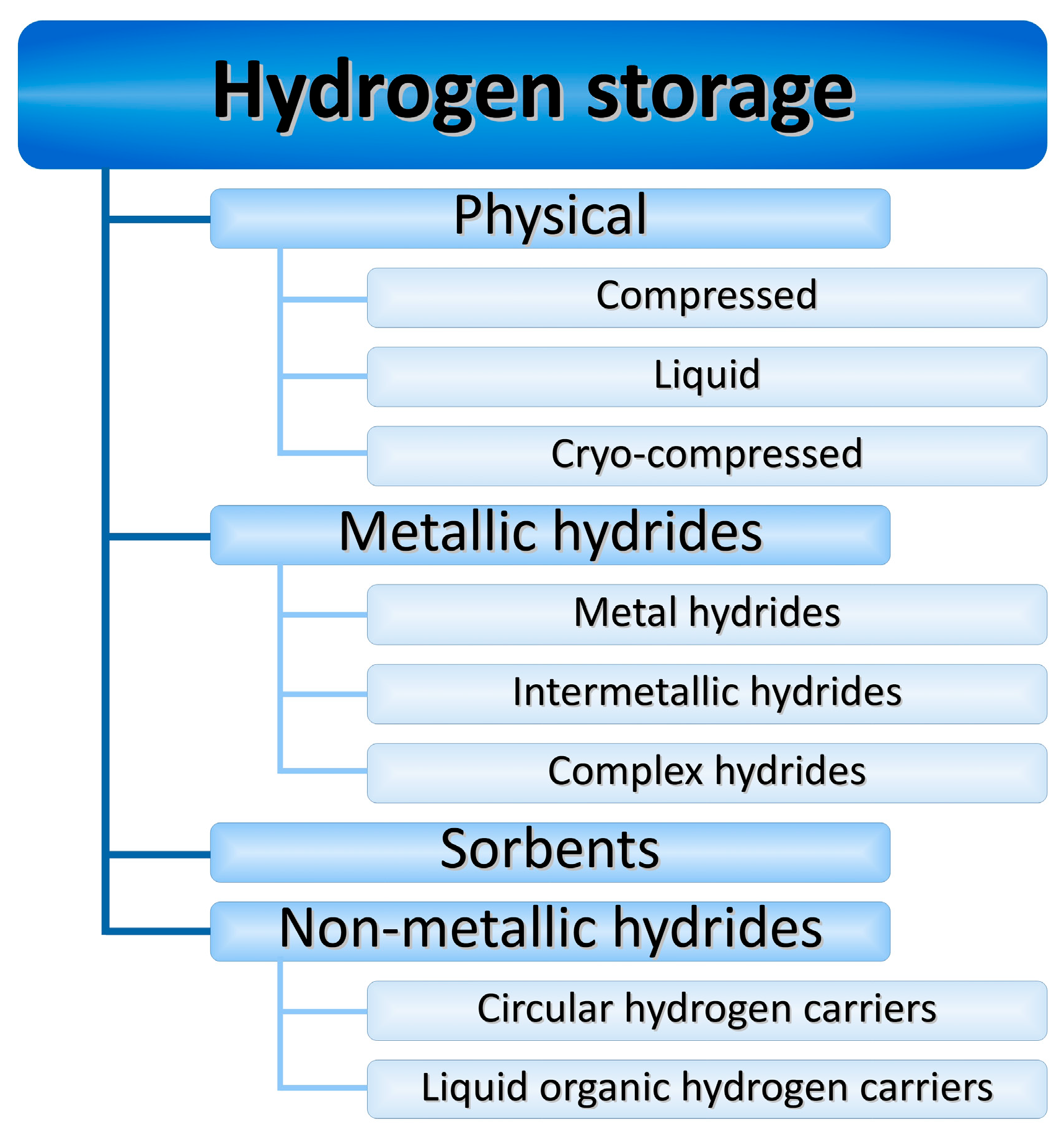
Figure 1. Different classes of hydrogen storage methods.
Energies 18 06093 g001
Figure 2. Volumetric and gravimetric energy densities of different storage systems. CGH2—compressed hydrogen, LH2—liquid hydrogen. Adapted from [23].
Energies 18 06093 g002
Figure 5. The configuration of the fibre winding patterns (a) and their optimisation (b) [35].
Energies 18 06093 g005
Figure 6. Liquid hydrogen storage system [50].
Energies 18 06093 g006
Figure 7. Metal hydride storage tanks with an added phase change material and different shapes: (a) cylindrical, (b) spherical, (c) prismatic [144].
Energies 18 06093 g007
Figure 8. An example of the structure and mechanism of hydrogen adsorption in an MOF. Adapted from [151].
Energies 18 06093 g008
Figure 9. Main elements of hydrogen supply chain based on the shipping of CGH2, LH2, ammonia, and a liquid organic hydrogen carrier (LOHC). The energy consumed by hydrogenation/dehydrogenation processes is marked in the diagram. Adapted from [176].
Energies 18 06093 g009
Table 1. Advantages and disadvantages of hydrogen storage tanks.
DesignFuturesTypical Application
TYPE IAISI 4130 steel (most cases) or 6061 aluminium alloy
+
Basic, cheapest design commonly manufactured worldwide
-
Lowest compression ratio and highest weight
Stationary applications of various sizes, from small- and medium-sized laboratory installations to large-scale industrial installations
TYPE IIA classic design, like the Type I tank, which is reinforced with a partial glass fibre composite overwrap
+
30–40% lighter than Type I and designed for higher pressures
-
50% more expensive than Type I
TYPE IIIThin 6061 aluminium alloy liner fully covered with carbon/glass fibre composite
+
Up to 30% lighter than Type II and designed for higher pressure and storage volume
-
Relatively heavy liner susceptible to corrosion and advanced manufacturing process
Portable applications such as vehicles; passenger and heavy-duty tracks are also suitable for hydrogen transportation
TYPE IVPolymer (mostly HDPE) liner fully covered with carbon/glass fibre composites
+
The lightest tanks on the market
-
Compared to Type III, it has less heat transfer and is less robust and resistant to damage and leakage; its usable capacity is 25% less than its total capacity
TYPE VFully made with composite fibres
+
Weight reduction and increased volume compared to Type IV
-
Long way to the commercial market in the future due to the most advanced manufacturing process
The most advanced applications, such as military and space
Table 2. Summary of properties of some hydride-based hydrogen storage materials compared with examples of other technologies [23,96,97,98,99,100,101,102,103,104,105,106,107,108]. Values of capacities in parenthesis correspond to the reversible capacity.
Hydrogen StorageGravimetric
Capacity/wt%
Vol Energy Density/kWh/dm3Operating Pressure/barOperating Temp/°C
Compressed H2
350 bar
1000.8350Ambient temp.
Compressed H2
700 bar
1001.3700Ambient temp.
Liquid H21002.21–10−253
Ammonia17.84.0150–300
1–20 (storage)
350 ÷ 500
Ambient temp. (storage)
Toluene/methylcyclohexane6.22.01–30350 ÷ 500
Ambient temp. (storage)
MOF-5 (sorbent)5.01.33–350−200 to ambient temp.
MgH27.6 (5.5)3.7 (2.7)1–30250 ÷ 400
TiFe1.9 (1.5)4.0 (3.3)0.5–100 ÷ 100
TiMn21.9 (1.2)4.1 (2.5)0.5–20−50 ÷ 150
LaNi51.5 (1.3)4.1 (3.5)0.5–150 ÷ 200
LiBH418.5 (13.4)4.1 (3.0)1–350300 ÷ 700
NaAlH47.5 (3.7)3.2 (1.6)1–400200 ÷ 400
Table 3. Summarised ranges of the surface area, pore volume, and hydrogen absorption values for various MOFs (for about 200 MOFs) [149,156,157,159].
Range of ValuesTypical Range of Values *Average Value
Surface area
[m2 g−1]
BET
method
65–6240190–40201655
Langmuir method42–10,400300–56002180
Pore volume
[cm3 g−1]
0.04–3.60.1–1.90.71
Hydrogen uptake at −196 °C 1 atm
[wt%]
0.1–4.50.6–2.51.48
Maximum hydrogen uptake
[wt%]
At −196 °C0.7–11.4
(16 bar) (78 bar)
1.0–7.1
(35 bar) (40 bar)
4.10
At 25 °C0.05–4.0
(35 bar) (100 bar)
0.13–3.0
(30 bar) (100 bar)
0.81
* Range excluding 10% of extreme values.
Disclaimer/Publisher’s Note: The statements, opinions and data contained in all publications are solely those of the individual author(s) and contributor(s) and not of MDPI and/or the editor(s). MDPI and/or the editor(s) disclaim responsibility for any injury to people or property resulting from any ideas, methods, instructions or products referred to in the content.