Article

Resilient Preventive Scheduling for Hydrogen-Based Integrated Energy Systems Considering Impacts of Natural Disasters


1
School of Internet of Things Engineering, Wuxi University, Wuxi 214105, China
2
Key Laboratory of Measurement and Control of CSE, Ministry of Education, Southeast University, Nanjing 210096, China
*
Author to whom correspondence should be addressed.
Energies 2025, 18(23), 6091; https://doi.org/10.3390/en18236091
Submission received: 23 October 2025 / Revised: 12 November 2025 / Accepted: 18 November 2025 / Published: 21 November 2025
(This article belongs to the Section A1: Smart Grids and Microgrids)

Abstract

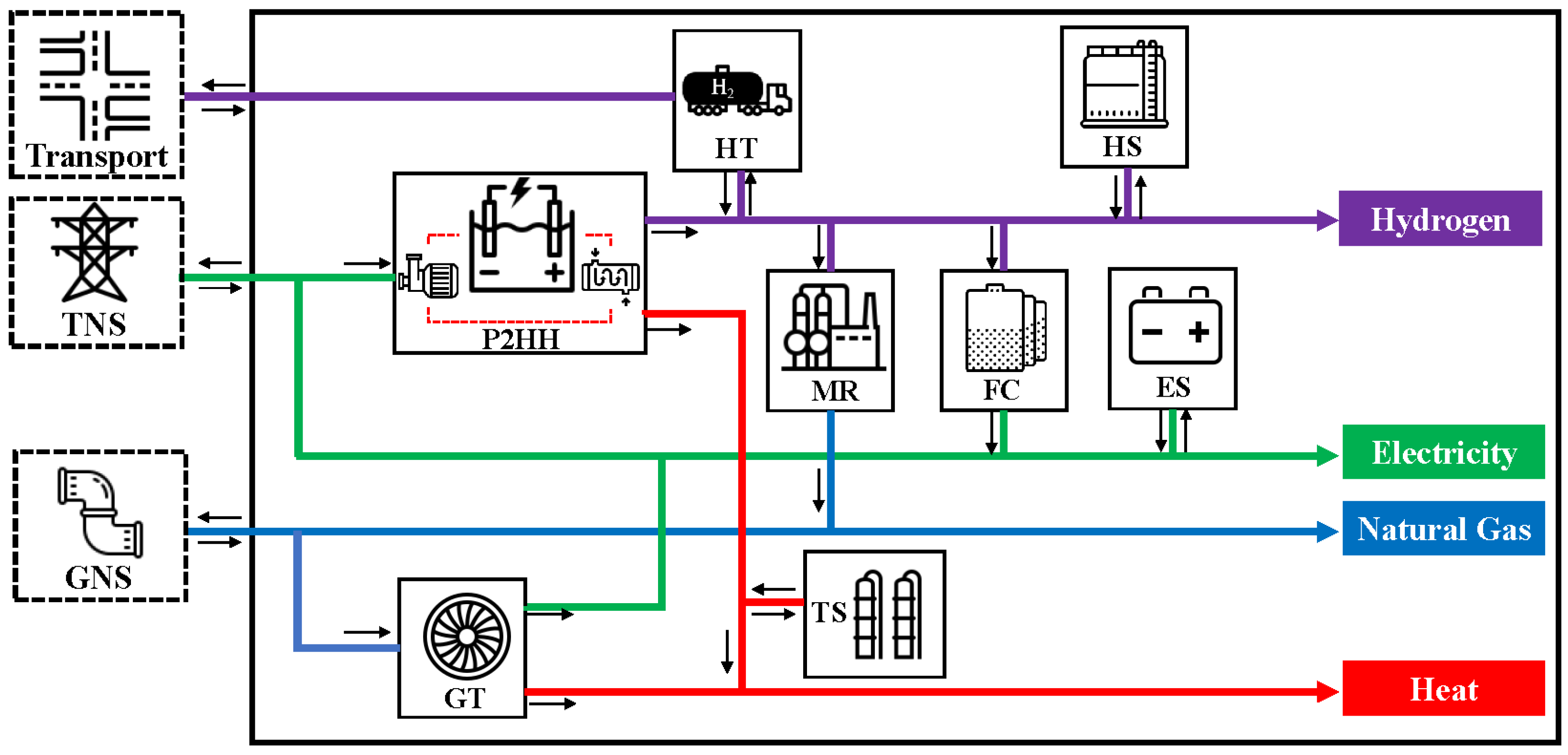
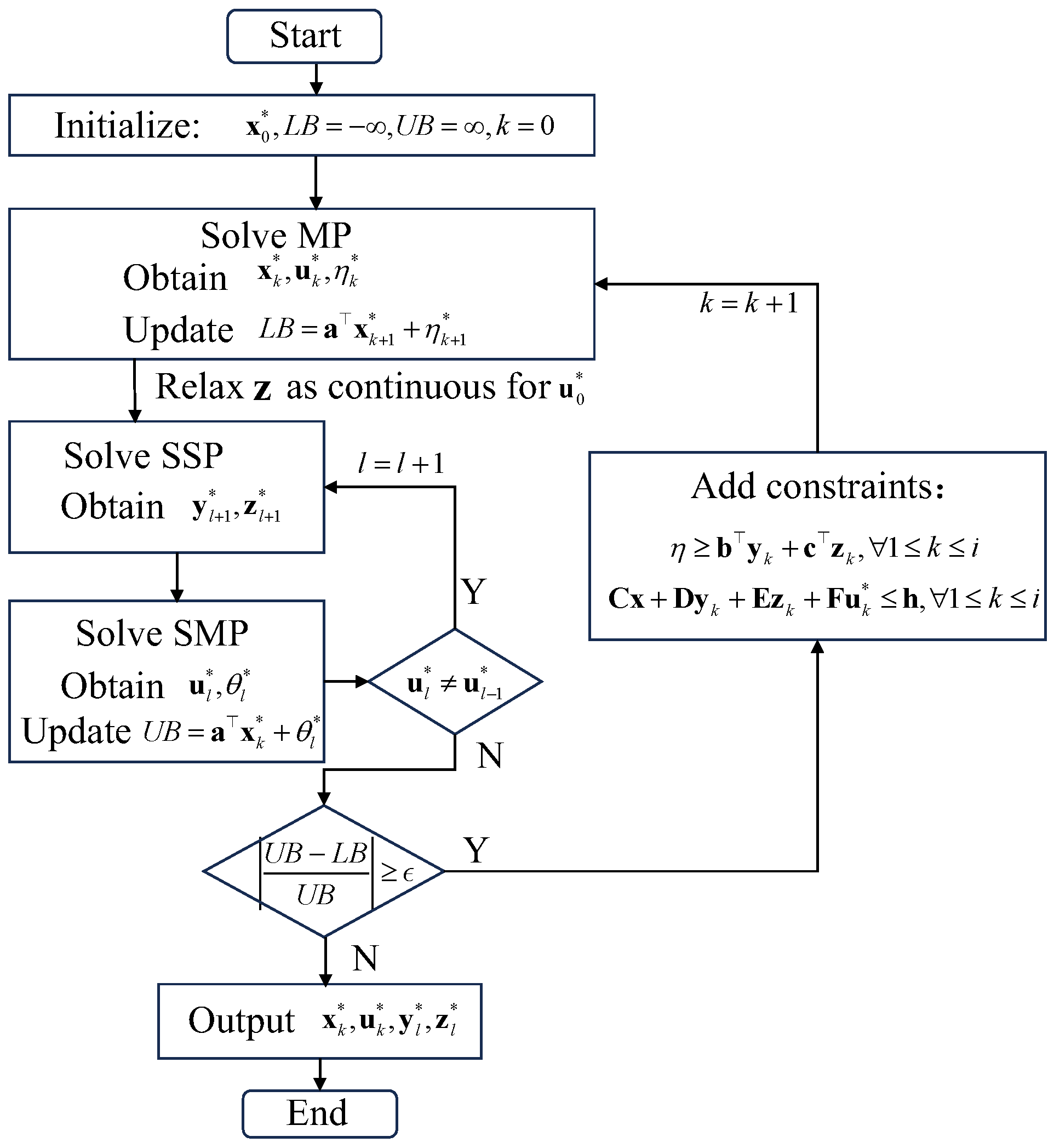
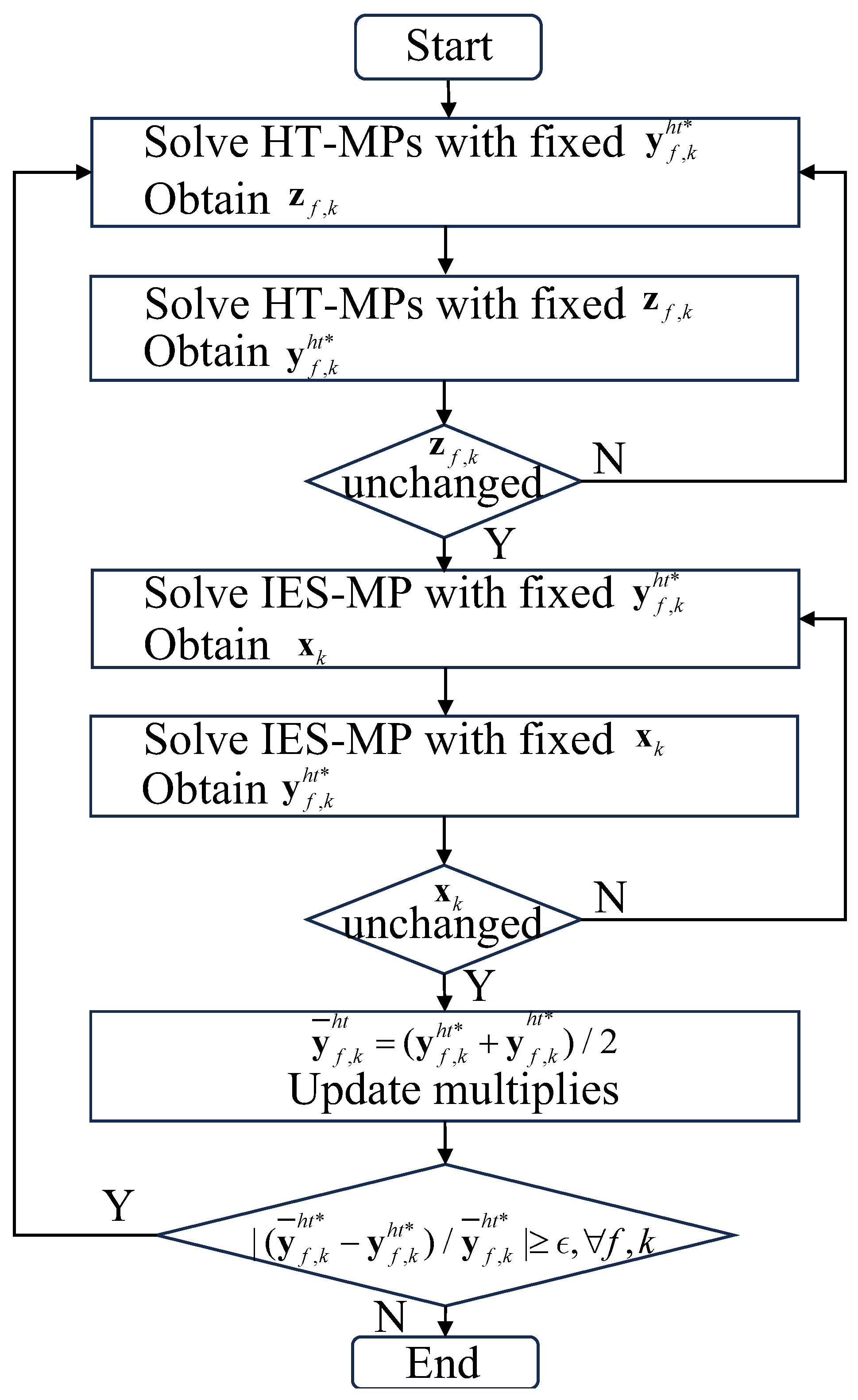
Hydrogen energy is developing rapidly, and the hydrogen-based integrated energy system (HIES) offers improved economic performance, flexibility, and environmental benefits compared with conventional power systems. However, the increasing frequency of natural disasters caused by climate change introduces significant vulnerabilities that threaten system security. Preventive scheduling provides a proactive and economical means to enhance system resilience against such uncertainties. This paper proposes a preventive scheduling model for HIES based on adaptive robust optimization (ARO) to address the uncertain impacts of natural disasters on transmission lines, pipelines, and roads. The model incorporates the operational constraints and interdependencies among multiple energy subsystems and integrates flexible scheduling strategies such as power-to-hydrogen-and-heat (P2HH) and hydrogen transportation (HT). A hybrid algorithm is developed to efficiently solve the large-scale ARO problem with numerous integer variables. Case studies performed on two test systems demonstrate that the proposed preventive scheduling model effectively reduces operational costs and load curtailments. Simulation results show that coordinating P2HH and HT reduces power, heat, hydrogen, and gas load curtailments by 14.35%, 43.39%, 49.97%, and 40.32%, respectively, as well as operational costs by 14.60%. Moreover, the proposed hybrid algorithm enhances computational efficiency, reducing solution time by 21% with only a 2% deviation from the solution obtained by the conventional C&CG–AOP algorithm.
Keywords: resilience; hydrogen-based integrated energy system; hydrogen transportation; adaptive robust optimization; column-and-constraint-generation; analytical target casting resilience; hydrogen-based integrated energy system; hydrogen transportation; adaptive robust optimization; column-and-constraint-generation; analytical target casting