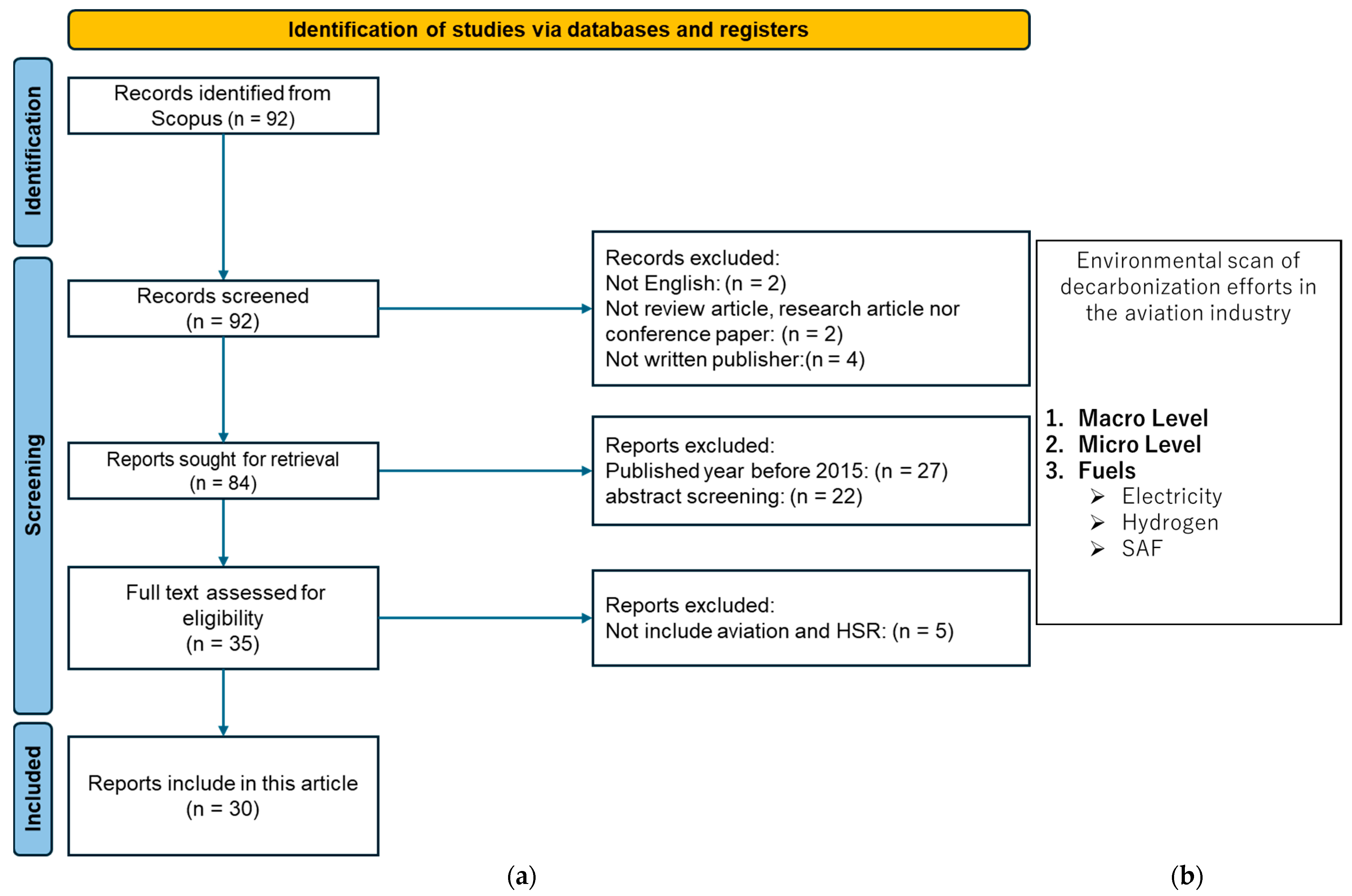


Emission Reductions in the Aviation Sector: A Systematic Review of the Sustainability Impacts of Modal Shifts



Abstract
1. Introduction
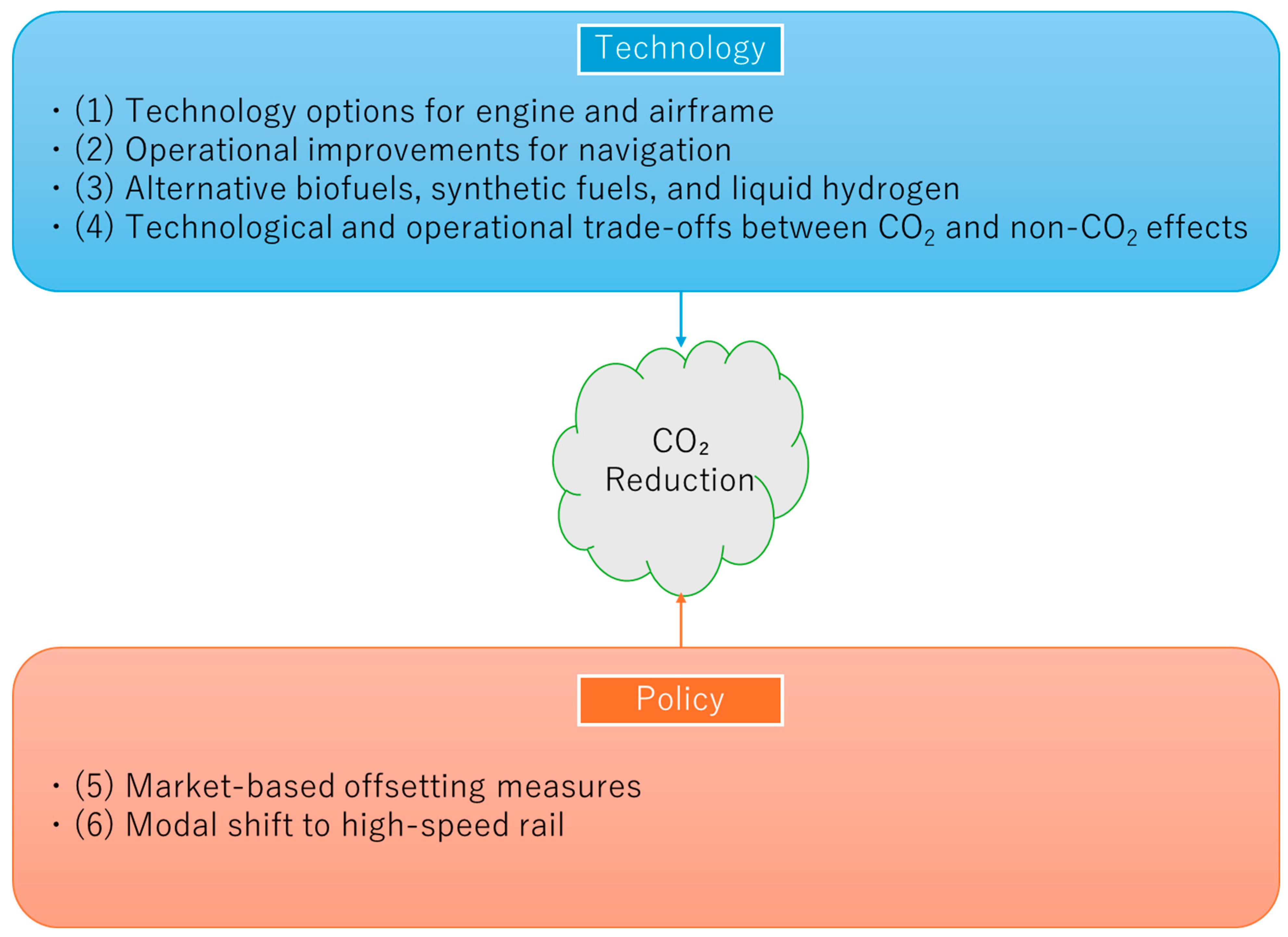
2. Literature Review
2.1. Research Trends

| Country | Length (km) | Max Speed (km/h) |
|---|---|---|
| China | 45,390 | 350 |
| Spain | 3993 | 300 |
| Japan | 3147 | 320 |
| France | 2760 | 320 |
| Germany | 1631 | 300 |
| Türkiye | 1232 | 300 |
| Finland | 1120 | 220 |
| Italy | 921 | 300 |
| Sweden | 895 | 200 |
| Republic of Korea | 874 | 305 |
| USA | 735 | 240 |
2.2. Economic Perspectives
2.3. Environmental Perspectives
2.4. Social Perspectives
3. Decarbonization Efforts in the Aviation Sector
3.1. Macro Level
3.2. Micro Level
3.3. Fuels
3.3.1. Electricity
3.3.2. Hydrogen
3.3.3. Sustainable Aviation Fuel (SAF)
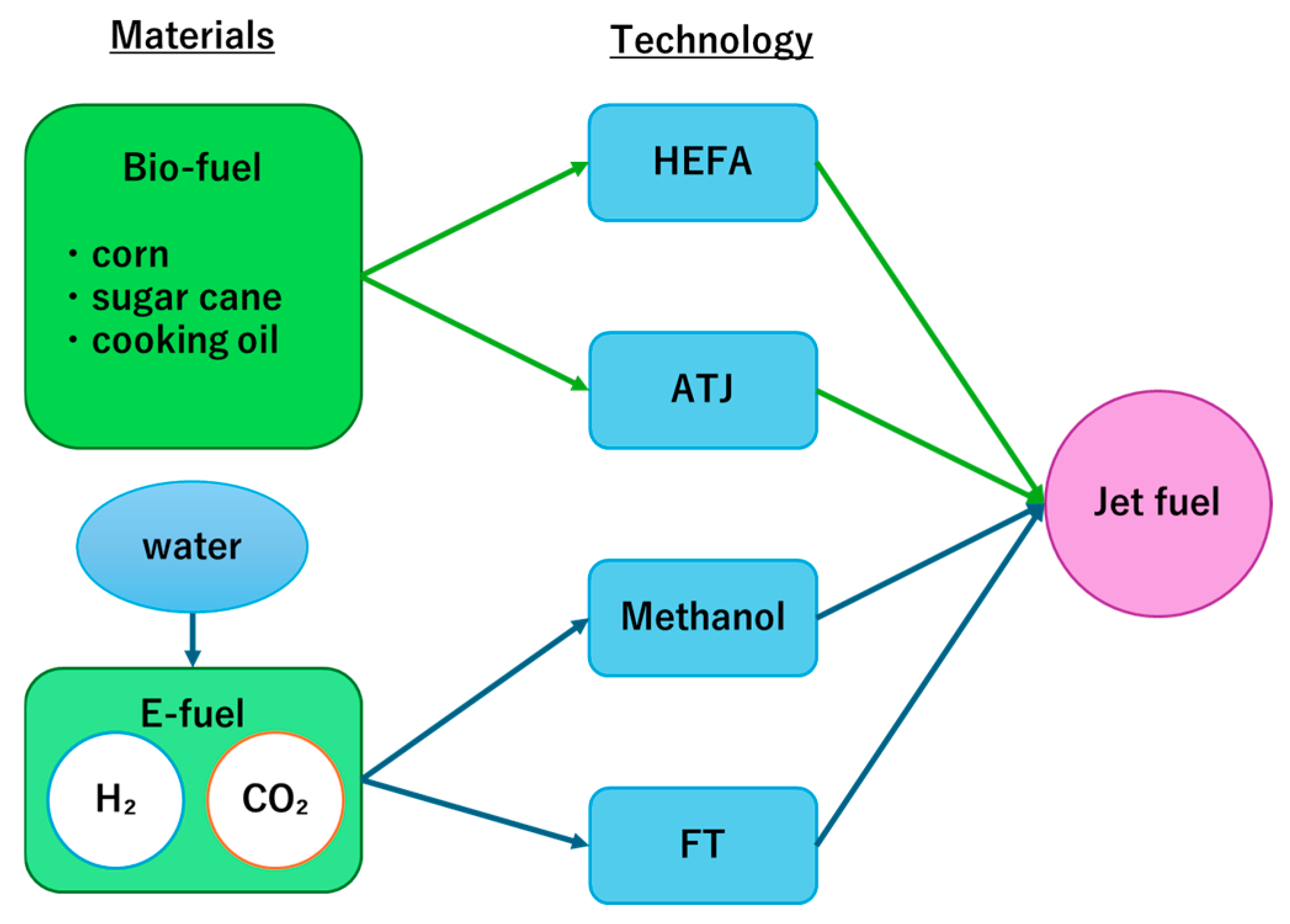
| Technology | Merit | Sources | Future Challenges | References |
|---|---|---|---|---|
| HEFA | High energy content Less CO2 Mature production process | Used cooking oil Waste animal fats | Production cost Limitation of material Low percentage of hydrocarbon | [82,86,87,88] |
| FT process | Mature production process Cost intensive Low conversion related emission | Biomass Coal Natural gas | Technology and running cost conversion efficiency | [8,86,87,88] |
| AtJ | Less CO2 Similar energy density with conventional fuel | Agricultural waste products | production cost conversion efficiency | [78,86,88,89] |
| PtL | Closed carbon cycle | Electricity Water CO2 | Higher cost Competition with the electricity consumption Low conversion efficiency | [80,82,83,84,90] |
4. Results and Discussion
4.1. Overview of Current Research Landscape
4.2. Economic Implications of Modal Shift and Aviation Decarbonization
4.3. Environmental Synergies and Limitations
| Distance Band | Approx. Travel Time | HSR Advantage Status | References |
|---|---|---|---|
| <170 km | <1.5 h | Non-HSR > FGEA | [30,44] |
| 170–400 km | ≈2 h | HSR > FGEA | [44,45] |
| 400–1100 km | ≈2–5 h | HSR > Air | [32,38,41] |
| >1400 km | >5 h | Air > HSR | [42] |
4.4. Social and Behavioral Dimensions
4.5. Integration of Modal Shift and Aviation Decarbonization Strategies
- ➢
- Short term (2025–2035): Promote modal shift through short-haul flight restrictions, dynamic HSR pricing, integrated ticketing systems, and reinvestment of aviation carbon revenues into HSR capacity and electrification.
- ➢
- Medium term (2035–2045): Scale up SAF production via blending mandates, lifecycle-based emission standards, and harmonized international certification schemes. Strengthen cross-border rail interoperability and expand renewable electricity supply for rail systems.
- ➢
- Long term (beyond 2045): Deploy hydrogen and electric aircraft where technologically and economically viable, supported by a fully renewable-powered HSR network. Integrate TMC systems and airport-level emission ceilings to ensure system-level net-zero alignment.
5. Conclusions
Funding
Data Availability Statement
Conflicts of Interest
Appendix A. Included Studies Master Table
| Study Identification | Study Design | Participant Characteristics | Results | Potential Bias | Access Date | ||
|---|---|---|---|---|---|---|---|
| Ref | Type | Region | Sample | ||||
| [23] | Article | Modeling considering pricing equilibrium and passenger preference | Policy is needed to enhance rail travel’s attractiveness rather than direct market intervention. | Need for empirical validation | 10 September 2025 | ||
| [24] | Article | Game theory | China and Europe | Beijing-Shanghai | Airlines will face significant pressure from railway deregulation | Need to consider capacity | 14 September 2025 |
| [48] | Article | Gravity model | Germany | Germany and from Germany to major cities in neighboring countries | 1% speed increase in rail decreases 0.55% air passengers for less than 800 km | Using annual average, possibility of seasonal variation | 1 August 2025 |
| [29] | Article | Case study | Europe | Europe short haul flight(time:2 h30 min–6 h30 min) | Augmentation of rail infrastructure is required to absorb aviation demand | Tradeoff of connectivity and further emission reduction | 30 July 2025 |
| [34] | Article | Bi-Level Optimization Approach | China | 10 city pairs in China | Well-designed carbon tax encourages modal shift to HSR | Model assumption and data scope | 14 September 2025 |
| [33] | Article | Bi-Level Multi-Objective Optimization Approach | China | Network composed of seven central cities in China | Government’s carbon tax policy depends on the sensitivity to the tax and its intensity | 14 September 2025 | |
| [27] | Article | Comparison of energy consumption and carbon footprint | China | Beijing-Shanghai | Modal shift from aviation to HSR has the potential for carbon mitigation. Carrying capacity is the limitation | Need for decarbonization in power generation industry | 14 September 2025 |
| [46] | Article | Comparison of CO2 emissions and distance | United Kingdom | UK aviation market | 41% of UK passengers use aviation connected in less than 24 h rail travel, though only 14% UK aviation emission | Need to address the transfer travel and destination change | 14 September 2025 |
| [31] | Conference paper | Synthetic control method | Germany | Berlin-Munich city pair | Reduction in rail travel time has no impact on air passengers, though LCC share has increased | Travel time is over 4 h | 14 September 2025 |
| [22] | Conference paper | Review | Scopus and gray literature | Rail emits less carbon than air travel. Need to enhance rail travel’s attractiveness | 14 September 2025 | ||
| [37] | Article | Case study | Europe | 3000 city pairs in 73 main metropolitan areas | TMC scheme will reduce 8% aviation use and drive a shift to railway | Potential for circumventing regulations due to destination changes | 14 September 2025 |
| [49] | Article | Carbon footprint analysis | France | 159 research entities in France | Air travel has a large carbon footprint, and intercontinental flights are the dominant emission source | Need to consider the rationale for fieldwork | 14 September 2025 |
| [42] | Article | Difference-in-differences analysis | China | Over 700 non-stop air routes | Significant environmental benefit by HSR entry in 600–1400 km range | Need for decarbonization in power generation industry | 11 January 2025 |
| [47] | Article | Case study | Austria | Linz– Vienna | Modal shift from aviation to other transport modes has occurred and transfer passengers have switched to use Frankfurt | Introduction of new long flight in vacant slot | 14 September 2025 |
| [43] | Article | Transit Network Design and Frequency Setting Problems (TNDFSP) | Europe | 124 of Europe’s main metropolitan areas | Service design with externalities will induce modal shift from aviation to HSR | Assumption of complete availability of high quality and interoperable HSR infrastructure | 14 September 2025 |
| [28] | Article | Two-level aggregate nested logit model | London-Paris | Preference differs by passenger attributes | Need to maintain level of service | 31 July 2025 | |
| [36] | Article | Two-level aggregate nested logit model | London-Amsterdam | Reduction in HSR fare and aviation tax are not enough to expand HSR market share | Need to derive welfare maximizing tax on CO2 and fuel usage | 14 September 2025 | |
| [35] | Article | TransportPLAN model | Denmark | Danish transport sector | Introduction of aviation passenger tax and improvement of railway infrastructure | Significant upscale of technologies | 14 September 2025 |
| [18] | Article | Comparison of CO2 emissions, generalized travel costs and RTT | Europe (Schengen area) | Intra-European aviation focused on flights less than 800 km | Route removal policies will be more impactful to FSC than LCC | Introduction of new long flight in vacant slot | 28 August 2024 |
| [21] | Article | Review | HSR project and air road and ordinary speed rail | Development of game theory model and application of LCA to the life-cycle emissions | 17 December 2024 | ||
| [45] | Article | Comparison of CO2 emissions and RTT | Finland | Domestic 34 route in Finland and from Finland to Sweden and to Estonia | Electric aircraft has the potential for door to door travel time beyond 300 km without HSR | Need to consider energy mix | 14 September 2025 |
| [32] | Article | Gravity model | China | Over 2900 city pairs | Inducing $35 carbon tax will reduce 6 million tons of carbon emissions from aviation | Single country observation | 14 September 2025 |
| [30] | Article | Comparison of CO2 emissions and RTT | Finland | 16 city pairs in Finland | NHSR is competitive with aviation up to 400 km | 23 March 2024 | |
| [44] | Article | Comparison of CO2 emissions and RTT | Finland | 47 city pairs in Finland | FGEA has advantages in CO2 emissions and RTT in short haul flight compared with existing aircraft | Does not consider the emissions from building and maintaining infrastructure for other transportation systems | 16 May 2024 |
| [16] | Article | Comparison of CO2 emissions per person | Finland | 16 city pairs in Finland | replacing short-haul flights has a significant impact on emissions | Does not consider EU ETS and CORSIA | 21 May 2024 |
| [40] | Article | Carbon footprint analysis | Australia | Sydney–Melbourne city pair | CO2 reduction potential of renewable energy technologies and transportation system integration | 20 September 2025 | |
| [38] | Article | Detailed line-based methodology models | Turkey | Two most demanded HSR lines | Modal shift from aviation to HSR has the potential for carbon mitigation | High fossil-based electricity generation | 14 September 2025 |
| [41] | Article | Panel data regression analysis | China | Air patronage data of 104 city pair in 1993–2012 | Railway extension and acceleration are negatively associated with air patronage | Does not consider air travel price | 14 September 2025 |
| [50] | Conference paper | User Survey | Turkey | Face-to-face survey 421HSR users | Modal shift from air to HSR was also observed in Ankara-Istanbul corridor | Single country observation | 14 September 2025 |
| [39] | Article | Scenario Analysis | Australia | Sydney–Melbourne city pair | Replacing short-haul flight with HSR could reduce CO2 emissions | Does consider the use of aviation bio-fuel | 23 March 2024 |
References
- UNFCCC. Paris Agreement; UNFCCC: Bonn, Germany, 2015. [Google Scholar]
- ICAO. Environmental Report 2022 Special Supplement Long-Term Aspirational Goal; ICAO: Montreal, Canada, 2022. [Google Scholar]
- IPCC. Mitigation of Climate Change; IPCC: Geneva, Switzerland, 2022. [Google Scholar]
- IEA. Aviation. Available online: https://www.iea.org/energy-system/transport/aviation (accessed on 10 July 2024).
- MLIT. 3 Approaches Progress and Current Status in (In Japanese). 2023. Available online: https://www.mlit.go.jp/koku/content/001877418.pdf (accessed on 19 June 2025).
- ICAO. Environmental Report 2022 Innovation for a Green Transition; ICAO: Montreal, QC, Canada, 2022. [Google Scholar]
- Gray, N.; McDonagh, S.; O’Shea, R.; Smyth, B.; Murphy, J.D. Decarbonising Ships, Planes and Trucks: An Analysis of Suitable Low-Carbon Fuels for the Maritime, Aviation and Haulage Sectors. Adv. Appl. Energy 2021, 1, 100008. [Google Scholar] [CrossRef]
- Dominković, D.F.; Bačeković, I.; Pedersen, A.S.; Krajačić, G. The Future of Transportation in Sustainable Energy Systems: Opportunities and Barriers in a Clean Energy Transition. Renew. Sustain. Energy Rev. 2018, 82, 1823–1838. [Google Scholar] [CrossRef]
- Pereira, S.R.; Fontes, T.; Coelho, M.C. Can Hydrogen or Natural Gas Be Alternatives for Aviation?—A Life Cycle Assessment. Int. J. Hydrogen Energy 2014, 39, 13266–13275. [Google Scholar] [CrossRef]
- Larsson, J.; Elofsson, A.; Sterner, T.; Åkerman, J. International and National Climate Policies for Aviation: A Review. Clim. Policy 2019, 19, 787–799. [Google Scholar] [CrossRef]
- FAA. Sustainable Aviation Fuels (SAF)—Federal Aviation Administration. Available online: https://www.faa.gov/about/officeorg/headquartersoffices/ang/redac-environment-energy-2022-03-sustainable-aviation-fuels (accessed on 20 August 2024).
- Shahriar, M.F.; Khanal, A. The Current Techno-Economic, Environmental, Policy Status and Perspectives of Sustainable Aviation Fuel (SAF). Fuel 2022, 325, 124905. [Google Scholar] [CrossRef]
- Scheelhaase, J.; Maertens, S.; Grimme, W.; Jung, M. EU ETS versus CORSIA—A Critical Assessment of Two Approaches to Limit Air Transport’s CO2 Emissions by Market-Based Measures. J. Air Transp. Manag. 2018, 67, 55–62. [Google Scholar] [CrossRef]
- Becken, S.; Mackey, B. What Role for Offsetting Aviation Greenhouse Gas Emissions in a Deep-Cut Carbon World? J. Air Transp. Manag. 2017, 63, 71–83. [Google Scholar] [CrossRef]
- Larsson, J.; Kamb, A.; Nässén, J.; Åkerman, J. Measuring Greenhouse Gas Emissions from International Air Travel of a Country’s Residents Methodological Development and Application for Sweden. Environ. Impact Assess. Rev. 2018, 72, 137–144. [Google Scholar] [CrossRef]
- Baumeister, S. Replacing Short-Haul Flights with Land-Based Transportation Modes to Reduce Greenhouse Gas Emissions: The Case of Finland. J. Clean. Prod. 2019, 225, 262–269. [Google Scholar] [CrossRef]
- IEA. Net Zero by 2050 A Roadmap for the Global Energy Sector; IEA: Paris, France, 2021. [Google Scholar]
- Avogadro, N.; Cattaneo, M.; Paleari, S.; Redondi, R. Replacing Short-Medium Haul Intra-European Flights with High-Speed Rail: Impact on CO2 Emissions and Regional Accessibility. Transp. Policy 2021, 114, 25–39. [Google Scholar] [CrossRef]
- Vandoorne, S. France Bans Short-Haul Flights Where Trains are Available. CNN, 23 May 2023. [Google Scholar]
- D’Alfonso, T.; Jiang, C.; Bracaglia, V. Air Transport and High-Speed Rail Competition: Environmental Implications and Mitigation Strategies. Transp. Res. Part A Policy Pract. 2016, 92, 261–276. [Google Scholar] [CrossRef]
- Jiang, C.; Wan, Y.; Yang, H.; Zhang, A. Impacts of High-Speed Rail Projects on CO2 Emissions Due to Modal Interactions: A Review. Transp. Res. D Transp. Environ. 2021, 100, 103081. [Google Scholar] [CrossRef]
- Anagnostopoulos, A. Modal Shift to Rail Transport as a Mitigation Measure to Decarbonize the Transport Sector: Review of Barriers and Opportunities. In Proceedings of the E3S Web of Conferences, Les Mureaux, France, 21–22 November 2024. [Google Scholar] [CrossRef]
- Nerja, A.; Sánchez, M. The Dynamics of HSR Preference in the Context of Short-Haul Flight Bans. Transp. Policy 2025, 173, 103773. [Google Scholar] [CrossRef]
- Wang, Y.; Wang, K.; Pels, E.; Wu, J. Railway Deregulation in the West and East: The Impacts of Organizational Structure Patterns on Air-HSRs Competition. Trans. Res. Part B Methodol. 2025, 200, 103304. [Google Scholar] [CrossRef]
- Alšauskas, O.; Teter, J.; Triunfo, N. Rail. Available online: https://www.iea.org/energy-system/transport/rail (accessed on 22 September 2025).
- UIC. ATLAS High Speed Rail 2024; UIC: Chicago, IL, USA, 2023. [Google Scholar]
- Liu, D.; Wang, J.; Xu, L.; Zhang, H.; Tan, X. Comparison of Energy Consumption and Carbon Emissions of High-Speed Rail with Other Transportation Modes from Life Cycle Perspective: A Case of Beijing-Shanghai. Res. Transp. Bus. Manag. 2025, 59, 101278. [Google Scholar] [CrossRef]
- Avogadro, N.; Redondi, R. Diverted and Induced Demand: Evidence from the London-Paris Passenger Market. Res. Transp. Econ. 2023, 100, 101304. [Google Scholar] [CrossRef]
- Bruno, F.; Zefreh, M.M.; Fröidh, O.; Cats, O. Replacing Short-Haul Flights with Train Travel: Exploring Impacts, Capacity Requirements and Policy Implications. Transp. Policy 2025, 171, 326–343. [Google Scholar] [CrossRef]
- Baumeister, S.; Leung, A. The Emissions Reduction Potential of Substituting Short-Haul Flights with Non-High-Speed Rail (NHSR): The Case of Finland. Case Stud. Transp. Policy 2021, 9, 40–50. [Google Scholar] [CrossRef]
- Wozny, F. The Impact of Reduced Railway Travel Time on Air Passenger Numbers: A Synthetic Control Group Approach. Transp. Res. Procedia 2025, 86, 345–352. [Google Scholar] [CrossRef]
- Strauss, J.; Li, H.; Cui, J. High-Speed Rail’s Impact on Airline Demand and Air Carbon Emissions in China. Transp. Policy 2021, 109, 85–97. [Google Scholar] [CrossRef]
- Li, L. Promoting Freight Modal Shift to High-Speed Rail for CO2 Emission Reduction: A Bi-Level Multi-Objective Optimization Approach. Sustainability 2025, 17, 6310. [Google Scholar] [CrossRef]
- Li, L. Decarbonizing China’s Express Freight Market Using High-Speed Rail Services and Carbon Taxes: A Bi-Level Optimization Approach. Symmetry 2025, 17, 1364. [Google Scholar] [CrossRef]
- Kany, M.S.; Mathiesen, B.V.; Skov, I.R.; Korberg, A.D.; Thellufsen, J.Z.; Lund, H.; Sorknæs, P.; Chang, M. Energy Efficient Decarbonisation Strategy for the Danish Transport Sector by 2045. Smart Energy 2022, 5, 100063. [Google Scholar] [CrossRef]
- Avogadro, N.; Pels, E.; Redondi, R. Policy Impacts on the Propensity to Travel by Hsr in the Amsterdam-London Market. SSRN Electron. J. 2023. Available online: http://www.ssrn.com/abstract=4213519 (accessed on 19 June 2025). [CrossRef]
- Tanner, S.; Provoost, J.; Cats, O. Tradable Mobility Credits for Long-Distance Travel in Europe. Transp. Res. Part A Policy Pract. 2024, 186, 104156. [Google Scholar] [CrossRef]
- Dalkic, G.; Balaban, O.; Tuydes-Yaman, H.; Celikkol-Kocak, T. An Assessment of the CO2 Emissions Reduction in High Speed Rail Lines: Two Case Studies from Turkey. J. Clean. Prod. 2017, 165, 746–761. [Google Scholar] [CrossRef]
- Robertson, S. The Potential Mitigation of CO2 Emissions via Modal Substitution of High-Speed Rail for Short-Haul Air Travel from a Life Cycle Perspective—An Australian Case Study. Transp. Res. Part D Trans. Environ. 2016, 46, 365–380. [Google Scholar] [CrossRef]
- Robertson, S. A Carbon Footprint Analysis of Renewable Energy Technology Adoption in the Modal Substitution of High-Speed Rail for Short-Haul Air Travel in Australia. Int. J. Sustain. Transp. 2018, 12, 299–312. [Google Scholar] [CrossRef]
- Li, L.; Loo, B.P.Y. Railway Development and Air Patronage in China, 1993–2012: Implications for Low-carbon Transport: Railway Development and Air Patronage in China from 1993 to 2012. J. Reg. Sci. 2017, 57, 507–522. [Google Scholar] [CrossRef]
- Li, J.; Sun, X.; Cong, W.; Miyoshi, C.; Ying, L.C.; Wandelt, S. On the Air-HSR Mode Substitution in China: From the Carbon Intensity Reduction Perspective. Transp. Res. Part A Policy Pract. 2024, 180, 103977. [Google Scholar] [CrossRef]
- Grolle, J.; Donners, B.; Annema, J.A.; Duinkerken, M.; Cats, O. Service Design and Frequency Setting for the European High-Speed Rail Network. Transp. Res. Part A Policy Pract. 2024, 179, 103906. [Google Scholar] [CrossRef]
- Baumeister, S.; Leung, A.; Ryley, T. The Emission Reduction Potentials of First Generation Electric Aircraft (FGEA) in Finland. J. Transp. Geogr. 2020, 85, 102730. [Google Scholar] [CrossRef]
- Jenu, S.; Baumeister, S.; Pippuri-Mäkeläinen, J.; Manninen, A.; Paakkinen, M. The Emission Reduction Potential of Electric Transport Modes in Finland. Environ. Res. Lett. 2021, 16, 104010. [Google Scholar] [CrossRef]
- Morgan, M.; Wadud, Z.; Cairns, S. Can Rail Reduce British Aviation Emissions? Transp. Res. D Transp. Environ. 2025, 138, 104513. [Google Scholar] [CrossRef]
- Maertens, S.; Grimme, W. The Discontinuation of Domestic Flights in Austria: A Case Study on the Impact on Passenger Routings, Regional Airports and the Environment. Reg. Stat. 2024, 14, 898–921. [Google Scholar] [CrossRef]
- Oesingmann, K.; Ennen, D. The Impacts of High-Speed Rail Expansion on Short-Haul Air Passenger Transport—Evidence from German Domestic and International Traffic. Case Stud. Transp. Policy 2025, 21, 101549. [Google Scholar] [CrossRef]
- Ben-Ari, T.; Lefort, G.; Mariette, J.; Aumont, O.; Jeanneau, L.; Santerne, A.; Spiga, A.; Roche, P.-E. Flight Quotas Outperform Focused Mitigation Strategies in Reducing the Carbon Footprint of Academic Travel. Environ. Res. Lett. 2024, 19, 054008. [Google Scholar] [CrossRef]
- Celikkol-Kocak, T.; Dalkic, G.; Tuydes-Yaman, H. High-Speed Rail (HSR) Users and Travel Characteristics in Turkey. Procedia Eng. 2017, 187, 212–221. [Google Scholar] [CrossRef]
- European Union. Reducing Emissions from Aviation. Available online: https://climate.ec.europa.eu/eu-action/transport/reducing-emissions-aviation_en (accessed on 18 November 2024).
- Zhang, Y.; Wang, K. Mitigation Effect of the European Union Emission Trading System on Aviation Emissions. Transp. Res. D Transp. Environ. 2024, 130, 104186. [Google Scholar] [CrossRef]
- Scheelhaase, J.; Grimme, W.; Maertens, S. EU Trilogue Results for the Aviation Sector—Key Issues and Expected Impacts. Transp. Res. Procedia 2024, 78, 206–214. [Google Scholar] [CrossRef]
- Nava, C.R.; Meleo, L.; Cassetta, E.; Morelli, G. The Impact of the EU-ETS on the Aviation Sector: Competitive Effects of Abatement Efforts by Airlines. Transp. Res. Part A Policy Pract. 2018, 113, 20–34. [Google Scholar] [CrossRef]
- Oesingmann, K. The Effect of the European Emissions Trading System (EU ETS) on Aviation Demand: An Empirical Comparison with the Impact of Ticket Taxes. Energy Policy 2022, 160, 112657. [Google Scholar] [CrossRef]
- Fageda, X.; Teixidó, J.J. Pricing Carbon in the Aviation Sector: Evidence from the European Emissions Trading System. J. Environ. Econ. Manag. 2022, 111, 102591. [Google Scholar] [CrossRef]
- Gössling, S.; Humpe, A.; Bausch, T. Does ‘Flight Shame’ Affect Social Norms? Changing Perspectives on the Desirability of Air Travel in Germany. J. Clean. Prod. 2020, 266, 122015. [Google Scholar] [CrossRef]
- Gössling, S.; Hanna, P.; Higham, J.; Cohen, S.; Hopkins, D. Can We Fly Less? Evaluating the ‘Necessity’ of Air Travel. J. Air Transp. Manag. 2019, 81, 101722. [Google Scholar] [CrossRef]
- Chiambaretto, P.; Mayenc, E.; Chappert, H.; Engsig, J.; Fernandez, A.S.; Le Roy, F. Where Does Flygskam Come from? The Role of Citizens’ Lack of Knowledge of the Environmental Impact of Air Transport in Explaining the Development of Flight Shame. J. Air Transp. Manag. 2021, 93, 102049. [Google Scholar] [CrossRef]
- Schäfer, A.W.; Barrett, S.R.H.; Doyme, K.; Dray, L.M.; Gnadt, A.R.; Self, R.; O’Sullivan, A.; Synodinos, A.P.; Torija, A.J. Technological, Economic and Environmental Prospects of All-Electric Aircraft. Nat. Energy 2018, 4, 160–166. [Google Scholar] [CrossRef]
- Epstein, A.H.; O’Flarity, S.M. Considerations for Reducing Aviation’s CO2 with Aircraft Electric Propulsion. J. Propul. Power 2019, 35, 572–582. [Google Scholar] [CrossRef]
- Brelje, B.J.; Martins, J.R.R.A. Electric, Hybrid, and Turboelectric Fixed-Wing Aircraft: A Review of Concepts, Models, and Design Approaches. Prog. Aerosp. Sci. 2019, 104, 1–19. [Google Scholar] [CrossRef]
- Talwar, C.; Joormann, I.; Ginster, R.; Spengler, T.S. How Much Can Electric Aircraft Contribute to Reaching the Flightpath 2050 CO2 Emissions Goal? A System Dynamics Approach for European Short Haul Flights. J. Air Transp. Manag. 2023, 112, 102455. [Google Scholar] [CrossRef]
- Zaporozhets, O.; Isaienko, V.; Synylo, K. Trends on Current and Forecasted Aircraft Hybrid Electric Architectures and Their Impact on Environment. Energy 2020, 211, 118814. [Google Scholar] [CrossRef]
- Bicer, Y.; Dincer, I. Life Cycle Evaluation of Hydrogen and Other Potential Fuels for Aircrafts. Int. J. Hydrogen Energy 2017, 42, 10722–10738. [Google Scholar] [CrossRef]
- Cui, Q.; Shi, X.; Guo, L. Cost-Benefit Analysis of Using Hydrogen Energy in African Aviation Industry. Energy 2024, 313, 134173. [Google Scholar] [CrossRef]
- Prewitz, M.; Schwärzer, J.; Bardenhagen, A. Potential Analysis of Hydrogen Storage Systems in Aircraft Design. Int. J. Hydrogen Energy 2023, 48, 25538–25548. [Google Scholar] [CrossRef]
- Hamburg Airport. Hamburg Airport Joins International “Hydrogen Hub at Airports” Network. Available online: https://www.hamburg-airport.de/en/hamburg-airport-joins-international-hydrogen-hub-at-airports-network-77616 (accessed on 12 August 2024).
- Scheelhaase, J.; Oesingmann, K.; Classen, A.B. Roadmap for Implementing Hydrogen Technology at Medium-Sized European Airports. Transp. Res. Procedia 2024, 81, 155–166. [Google Scholar] [CrossRef]
- Lufthansa-Technik. Hydrogen-Lab. Available online: https://www.lufthansa-technik.com/en/hydro-lab (accessed on 12 August 2024).
- Yusaf, T.; Fernandes, L.; Abu Talib, A.R.; Altarazi, Y.S.M.; Alrefae, W.; Kadirgama, K.; Ramasamy, D.; Jayasuriya, A.; Brown, G.; Mamat, R.; et al. Sustainable Aviation—Hydrogen Is the Future. Sustainability 2022, 14, 548. [Google Scholar] [CrossRef]
- JAL. JAL Has Signed Agreements with Three Hydrogen-Electric Aircraft/Engine Manufacturers on Joint Studies for Introducing Sustainable Hydrogen-Powered Flight to Japan. Available online: https://press.jal.co.jp/en/release/202311/007757.html (accessed on 12 August 2024).
- Massaro, M.C.; Biga, R.; Kolisnichenko, A.; Marocco, P.; Monteverde, A.H.A.; Santarelli, M. Potential and Technical Challenges of On-Board Hydrogen Storage Technologies Coupled with Fuel Cell Systems for Aircraft Electrification. J. Power Sources 2023, 555, 232397. [Google Scholar] [CrossRef]
- Verstraete, D. On the Energy Efficiency of Hydrogen-Fuelled Transport Aircraft. Int. J. Hydrogen Energy 2015, 40, 7388–7394. [Google Scholar] [CrossRef]
- Nicolay, S.; Karpuk, S.; Liu, Y.; Elham, A. Conceptual Design and Optimization of a General Aviation Aircraft with Fuel Cells and Hydrogen. Int. J. Hydrogen Energy 2021, 46, 32676–32694. [Google Scholar] [CrossRef]
- IATA. Net Zero 2050: Sustainable Aviation Fuels; IATA: Montreal, QC, Canada, 2023. [Google Scholar]
- AIRBUS. Airbus Is Raising the Bar for Sustainable Aviation Fuel. Available online: https://www.airbus.com/en/newsroom/stories/2024-02-airbus-is-raising-the-bar-for-sustainable-aviation-fuel (accessed on 16 July 2024).
- Prussi, M.; Lee, U.; Wang, M.; Malina, R.; Valin, H.; Taheripour, F.; Velarde, C.; Staples, M.D.; Lonza, L.; Hileman, J.I. CORSIA: The First Internationally Adopted Approach to Calculate Life-Cycle GHG Emissions for Aviation Fuels. Renew. Sustain. Energy Rev. 2021, 150, 111398. [Google Scholar] [CrossRef]
- Bell, A.; Mannion, L.A.; Kelly, M.; Ghaani, M.R.; Dooley, S. Life Cycle CO2e Intensity of Commercial Aviation with Specific Sustainable Aviation Fuels. Appl. Energy 2025, 382, 125075. [Google Scholar] [CrossRef]
- Yang, F.; Yao, Y. Sustainable Aviation Fuel Pathways: Emissions, Costs and Uncertainty. Resour. Conserv. Recycl. 2025, 215, 108124. [Google Scholar] [CrossRef]
- METI. Toward Creating a Supply Chain for Bio and Synthetic fuels. Energy and Resources Agency (In Japanese). 2024. Available online: https://www.mlit.go.jp/maritime/content/001735441.pdf (accessed on 5 September 2025).
- Peters, M.A.; Alves, C.T.; Onwudili, J.A. A Review of Current and Emerging Production Technologies for Biomass-Derived Sustainable Aviation Fuels. Energies 2023, 16, 6100. [Google Scholar] [CrossRef]
- Xu, Y.; Zhang, Y.; Deng, X.; Lee, S.-Y.; Wang, K.; Li, L. Bibliometric Analysis and Literature Review on Sustainable Aviation Fuel (SAF): Economic and Management Perspective. Transp. Policy 2025, 162, 296–312. [Google Scholar] [CrossRef]
- Grimme, W. The Introduction of Sustainable Aviation Fuels—A Discussion of Challenges, Options and Alternatives. Aerospace 2023, 10, 218. [Google Scholar] [CrossRef]
- Drünert, S.; Neuling, U.; Zitscher, T.; Kaltschmitt, M. Power-to-Liquid Fuels for Aviation—Processes, Resources and Supply Potential under German Conditions. Appl. Energy 2020, 277, 115578. [Google Scholar] [CrossRef]
- ATAG. WayPoint 2050; ATAG: Geneva, Switzerland, 2021. [Google Scholar]
- Braun, M.; Grimme, W.; Oesingmann, K. Pathway to Net Zero: Reviewing Sustainable Aviation Fuels, Environmental Impacts and Pricing. J. Air Transp. Manag. 2024, 117, 102580. [Google Scholar] [CrossRef]
- Wang, B.; Ting, Z.J.; Zhao, M. Sustainable Aviation Fuels: Key Opportunities and Challenges in Lowering Carbon Emissions for Aviation Industry. Carbon Capture Sci. Technol. 2024, 13, 100263. [Google Scholar] [CrossRef]
- Afonso, F.; Ferreira, A.; Ribeiro, I.; Lau, F.; Suleman, A. On the Design of Environmentally Sustainable Aircraft for Urban Air Mobility. Transp. Res. D Transp. Environ. 2021, 91, 102688. [Google Scholar] [CrossRef]
- Grim, R.G.; Ravikumar, D.; Tan, E.C.D.; Huang, Z.; Ferrell, J.R.; Resch, M.; Li, Z.; Mevawala, C.; Phillips, S.D.; Snowden-Swan, L.; et al. Electrifying the Production of Sustainable Aviation Fuel: The Risks, Economics, and Environmental Benefits of Emerging Pathways Including CO2. Energy Environ. Sci. 2022, 15, 4798–4812. [Google Scholar] [CrossRef]
- Hu, Y.-J.; Yang, L.; Cui, H.; Wang, H.; Li, C. Developing a Balanced Strategy: A Multi-Objective Model for Emissions Reduction and Development of Civil Aviation in China. Energy 2024, 307, 132597. [Google Scholar] [CrossRef]
- Pin, J.; Jones, D.S.; Hartley, D.; Burli, P.H.; Langholtz, M.; Hellwinckel, C.; Thompson, D. Optimizing a Nationwide Supply Chain for Winter Oilseeds in Sustainable Aviation Fuel Production: Pennycress, Camelina, and Carinata. Renew. Sustain. Energy Rev. 2025, 215, 115555. [Google Scholar] [CrossRef]
- Chiaramonti, D. Sustainable Aviation Fuels: The Challenge of Decarbonization. Energy Procedia 2019, 158, 1202–1207. [Google Scholar] [CrossRef]
- Forsyth, P. The Impact of Climate Change Policy on Competition in the Air Transport Industry. In OECD/ITF Joint Transport Research Centre Discussion Papers; Organisation for Economic Co-Operation and Development (OECD): Paris, France, 2008. [Google Scholar]
- Chao, H.; Agusdinata, D.B.; DeLaurentis, D.; Stechel, E.B. Carbon Offsetting and Reduction Scheme with Sustainable Aviation Fuel Options: Fleet-Level Carbon Emissions Impacts for U.S. Airlines. Transp. Res. D Transp. Environ. 2019, 75, 42–56. [Google Scholar] [CrossRef]
- Ng, K.S.; Farooq, D.; Yang, A. Global Biorenewable Development Strategies for Sustainable Aviation Fuel Production. Renew. Sustain. Energy Rev. 2021, 150, 111502. [Google Scholar] [CrossRef]
- Zhang, W.; Li, C.; Jia, T.; Wang, S.; Hao, Q.; Yang, J. Evolutionary Game Analysis of Sustainable Aviation Fuel Promotion. Energy 2025, 322, 135723. [Google Scholar] [CrossRef]
- CE Delft. Potential of Modal Shift to Rail Transport; CE Delft: Delft, The Netherlands, 2011. [Google Scholar]

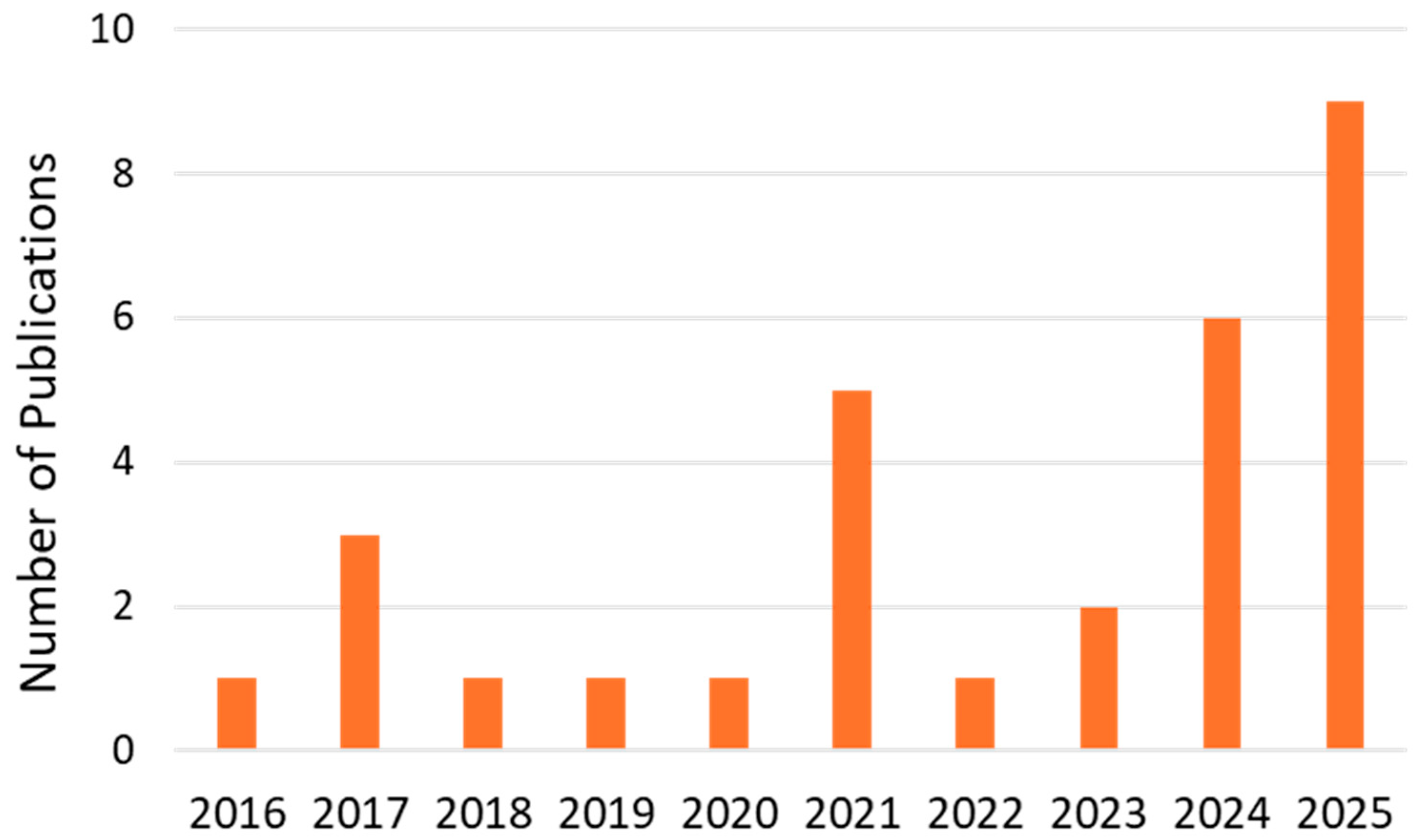

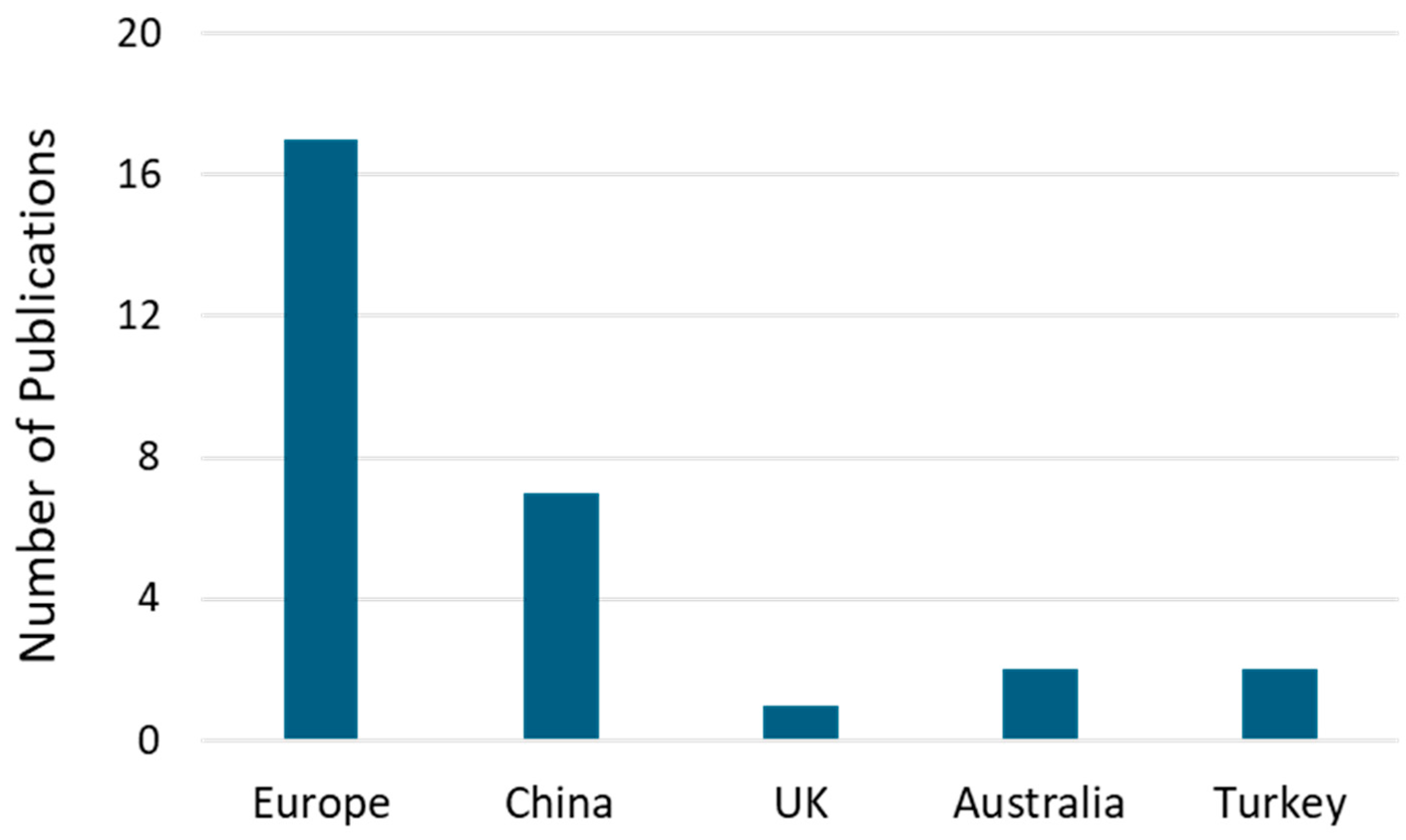
| Australia | Turkey | Europe | China | Total | |
|---|---|---|---|---|---|
| 2016 | 1 | 1 | |||
| 2017 | 2 | 1 | 3 | ||
| 2018 | 1 | 1 | |||
| 2019 | 1 | 1 | |||
| 2020 | 1 | 1 | |||
| 2021 | 3 | 1 | 4 | ||
| 2022 | 1 | 1 | |||
| 2023 | 2 | 2 | |||
| 2024 | 5 | 1 | 6 | ||
| 2025 | 5 | 4 | 9 | ||
| Total | 2 | 2 | 17 | 7 | 28 |
Disclaimer/Publisher’s Note: The statements, opinions and data contained in all publications are solely those of the individual author(s) and contributor(s) and not of MDPI and/or the editor(s). MDPI and/or the editor(s) disclaim responsibility for any injury to people or property resulting from any ideas, methods, instructions or products referred to in the content. |
© 2025 by the authors. Licensee MDPI, Basel, Switzerland. This article is an open access article distributed under the terms and conditions of the Creative Commons Attribution (CC BY) license (https://creativecommons.org/licenses/by/4.0/).
Share and Cite
Kawaguchi, R.; Chapman, A. Emission Reductions in the Aviation Sector: A Systematic Review of the Sustainability Impacts of Modal Shifts. Energies 2025, 18, 5974. https://doi.org/10.3390/en18225974
Kawaguchi R, Chapman A. Emission Reductions in the Aviation Sector: A Systematic Review of the Sustainability Impacts of Modal Shifts. Energies. 2025; 18(22):5974. https://doi.org/10.3390/en18225974
Chicago/Turabian StyleKawaguchi, Ryo, and Andrew Chapman. 2025. "Emission Reductions in the Aviation Sector: A Systematic Review of the Sustainability Impacts of Modal Shifts" Energies 18, no. 22: 5974. https://doi.org/10.3390/en18225974
APA StyleKawaguchi, R., & Chapman, A. (2025). Emission Reductions in the Aviation Sector: A Systematic Review of the Sustainability Impacts of Modal Shifts. Energies, 18(22), 5974. https://doi.org/10.3390/en18225974