Article

Forecasting the Methane Yield of a Commercial-Scale Anaerobic Digestor Based on the Biomethane Potential of Feedstocks


1
Department of Inter-Curricular Courses, Cankaya University, Ankara 06790, Türkiye
2
Anaerobic Digestion Research and Education Center, Department of Biosystems & Agricultural Engineering, Michigan State University, East Lansing, MI 48824, USA
*
Author to whom correspondence should be addressed.
Energies 2025, 18(22), 5914; https://doi.org/10.3390/en18225914
Submission received: 30 August 2025 / Revised: 31 October 2025 / Accepted: 5 November 2025 / Published: 10 November 2025

Abstract

With rising energy demand and the need for sustainable waste treatment, anaerobic digestion (AD) has emerged as a key technology for converting organic residues into renewable energy. However, predicting methane yield in full-scale facilities remains challenging due to the complexity of AD processes, the variability of feedstocks, and the impracticality of frequent biochemical methane potential (BMP) testing. In this study, we developed a simple, data-driven approach to forecast methane production in a commercial-scale digester co-digesting manure and food waste. The model employs weekly cumulative BMP of feedstock mixtures, calculated from literature values, as the explanatory variable. The model achieved an R2 of 0.70 and a forecast mean absolute percentage error (MAPE) of 7.4, indicating its potential for full-scale AD prediction. Importantly, the analysis revealed a long-run equilibrium between BMP and methane yield, with deviations corrected within roughly one month—closely matching the system’s hydraulic retention time. These findings demonstrate that literature-based BMP values can be used to reliably predict methane yield in operating AD systems, offering a low-cost and scalable tool to support decision-making in waste management and biogas plant operations.

1. Introduction

Anaerobic digestion (AD) is a biological process in which microorganisms decompose organic materials in the absence of oxygen, producing two key outputs: (i) biogas, which can be used as an energy resource or processed into renewable natural gas, and (ii) digestate, a mixture of solid and liquid fractions that can serve various beneficial purposes, such as nutrient rich fertilizer, animal bedding, and raw material for bio-based products [1,2]. As such, AD represents a valuable technique for both renewable energy generation and organic waste management.
Numerous models have been developed to understand AD dynamics, optimize reactor performance, and predict methane yield. Among them, the most widely adopted is the Anaerobic Digestion Model 1 (ADM1) developed by Batstone et al. [3], which has been adapted by many researchers for different feedstocks, reactor configurations, and operational conditions [4,5,6,7,8,9]. However, due to the inherent complexity of the AD process, comprehensive mechanistic modeling is often impractical for real-time or large-scale applications, as it requires extensive input data and numerous kinetic parameters that are difficult to obtain experimentally [9,10,11]. Consequently, empirical, statistical, and data-driven modeling approaches that bypass the need for detailed mechanistic knowledge are gaining traction for methane yield prediction.
Among these data-driven approaches, machine learning (ML) and deep learning (DL) methods have shown particular promise due to their ability to capture complex nonlinear relationships within AD systems. Various ML and DL algorithms, such as artificial neural network (ANN), feedforward neural network (FNN), random forest (RF), k-nearest neighbors (KNN), extreme gradient boosting (XGBoost), adaptive gradient boosting (AdaBoost), conventional support vector machine (C-SVM), gradient boosting machine (GBM), generalized linear model network (GLMNET), and decision tree (DT), have been employed in AD studies for a range of applications. Such applications include monitoring and controlling system performance, predicting biogas yield and volatile fatty acid (VFA) accumulation, forecasting microbial community dynamics, conducting life cycle assessment, etc. In a comprehensive review by Cruz et al. [12], the authors summarize the application of ML in AD. Most of the studies reviewed are based on laboratory experimental data [13], which limits their generalizability to full-scale systems. To address this limitation, there is a growing trend toward using operational data from full-scale AD systems in ML/DL models and statistical approaches such as regression and SARIMAX [14,15,16,17,18,19,20,21,22,23,24]. The authors of these studies typically utilize a set of input variables that include feedstock types and quantities, physicochemical properties of the substrates (e.g., total solids (TS), volatile solids (VS), and chemical oxygen demand (COD)), operational conditions (e.g., organic loading rate (OLR), reactor temperature, pH, and alkalinity), digestate characteristics, and daily biogas production.
Laboratory-scale biomethane potential (BMP) tests are widely used to estimate the maximum methane yield from a given feedstock expressed in liters of CH4 at standard temperature and pressure (0 °C and 1 atm) per kilogram of volatile solids (VS) added. However, these standardized tests are conducted in batch mode under idealized conditions that often differ significantly from those in full-scale AD reactors. Therefore, BMP values of feedstocks are commonly used as a benchmark for observed biogas production in AD reactors in biogas yield calculations under the operational conditions adopted. As a result, BMP tests alone are insufficient for evaluating the actual performance of commercial AD systems fed without a feeding schedule [25].
Despite these limitations, Holliger et al. [26] demonstrated that BMP tests can still be used to approximate biogas production at the full scale by applying an extrapolation coefficient ranging from 0.8 to 1.0 that represents the ratio of observed methane yield in a full-scale to the BMP value. This factor accounts for the difference between laboratory and operational conditions. Building on the above, Kalamaras et al. [27] applied Holliger’s method to estimate the effect of ammonia toxicity on methane production in biogas plants fed by cattle, poultry, dry poultry, and pig manure, whey, fruit pulp, corn silage, spent grapes, glycerine, biodiesel soap residue, dried digestate and dough waste, and concluded that methane reduction rates could be reasonably predicted based on the ammonia concentration and the BMP values of the substrate mixtures. More recently, van der Berg et al. [28] refined Holliger’s method by adjusting the BMP calculations to use total solids (TS) and VS on a chemical oxygen demand (COD) basis and compared it with a dynamic model of biogas production in a continuous stirred tank reactor (CSTR) [29]. The findings indicated that BMP tests, when interpreted using either method, can effectively be scaled up to predict the performance of full-scale wastewater AD systems with further refinement and validation [28]. Moreover, the wide variability of feedstocks used in commercial AD facilities makes it impractical to measure BMP for every substrate received. The above raises a key research question: Can literature-based BMP values be reliably used to predict biogas production in a full-scale AD reactor?
To answer the above question, in this study, we aim to predict the methane yield of a commercial AD reactor co-digesting a variety of manure and food waste, using the daily BMP of feedstock mixtures calculated from individual BMPs reported in the literature. One of the main operational challenges of the AD reactor examined in this study is the lack of feeding schedule or pattern, which requires a rapid decision-making process to accept the feedstock delivery. There is a need to develop a method to forecast the biomethane yield without using the feedstock compositional properties, which may be expensive and time consuming. This approach represents one of the few attempts to model full-scale AD performance based solely on literature-derived BMP data, leveraging BMP as a proxy for the digestibility of feedstocks and their contribution to methane production over time.

2. Materials and Methods

2.1. The Commercial-Scale AD Plant

The commercial-scale AD reactor (SCAD) examined in this study is located at the South Campus of Michigan State University (MSU), Lansing, MI, and has been in operation since 2013. By the end of 2020, the reactor had processed 159,145 metric tons of organic waste and generated 15,165,156 kWh of electricity for the MSU community. SCAD is configured as a CSTR operating under mesophilic conditions (35–38 °C), which is the most common setup for digesting a wide variety of feedstocks.
The facility includes two reception tanks: one designated for low-energy feedstocks (referred to as the “manure pit”) and the other for high-energy materials (the “food pit”), reflecting their relative BMP. A diverse range of feedstocks is co-digested at SCAD, including dairy, beef, poultry, and swine manure; waste animal feed sourced from the MSU Dairy Farm and/or MSU Teaching and Research Center; food waste from campus dining halls; food manufacturing waste from southern Michigan, Indiana, and Ohio; and fats, oils, and grease (FOG) collected from local restaurants. Incoming feedstocks are assigned to either a manure or food pit based on their BMP characteristics published in the relevant literature. Each pit often contains more than six different substrates simultaneously. On certain days, co-digestion is not possible due to a lack of available feedstock or scheduled maintenance operations that paused feeding altogether. Feedstocks are pumped from the pits to a central mixing tank, where they are homogenized to create a uniform blend. This mixture is then passed through a heat exchanger before entering the digester. The digester contents are continuously mixed using two hydraulically powered submersible mixers, maintaining a hydraulic retention time (HRT) of approximately 25 days.
The resulting digestate undergoes solid–liquid separation. The solid fraction is composted, whereas the liquid fraction (filtrate) is stored in a holding tank for later use as nutrient-rich fertilizer. The biogas produced is treated to remove hydrogen sulfide (H2S) and is used for electricity generation via a 450 kW combined heat and power (CHP) system. When necessary, digestate or filtrate is recycled back into the reception pits to adjust the feedstock TS and VS concentration. Waste heat recovered from these processes is used to maintain the digester’s temperature and to heat nearby facilities.
To monitor digester performance, pH and temperature are recorded both manually at the beginning and end of each day and automatically every 10 min. Biogas flow is measured in real time using a flow meter (reported in standard cubic feet, SCF), while gas quality—specifically CH4 (%), O2 (%), and H2S (ppm)—is continuously monitored with an in-line gas analyzer.

2.2. Data

Daily cumulative methane volume (m3) data were obtained from SCAD operation records spanning from 2014 to the end of 2020. These daily data were aggregated into weekly totals to construct the training dataset used for model fitting. Data from 2020 onward were reserved to evaluate the forecasting performance of the model.
In Table 1, the average and standard deviation of weekly substrate quantities (kg) by feedstock type and year are summarized. Among manure feedstocks, Dairy Gutter (denoted as “Dairy”) and Dairy Free-Stall Manure (denoted as “Parlor”) were the most frequently used. For food-based inputs, FOG and pulp were the most prevalent, with the latter sourced from the Brody Dining Hall at MSU. A marked decrease in pulp feedstock occurred in 2020, likely due to COVID-19 restrictions that reduced campus dining activities after 15 March 2020.
In addition to pulp, a reduction in beef manure was also observed in 2020; in comparison, the use of other manure (primarily egg waste), FOG, and other food increased relative to earlier years. Pineapple and swine manure were not utilized in 2020. Consequently, the feedstock composition during the forecast period differed from the training period, not only in quantity but also in the combination of substrates.
An analysis of feedstock mixture frequencies revealed that the most common daily combination was dairy gutter and parlor manure with FOG (9.9% of days), followed by dairy gutter alone (7.6%), dairy gutter with FOG (6.0%), dairy gutter and parlor manure (5.7%), and more complex mixtures involving other food or cart food. The greatest number of consecutive days with the same mixture observed was six—specifically for the combination of dairy gutter, parlor manure, and FOG.
Next, TS (%w/w), VS (%w/w TS), and BMP values of the substrates were gathered from the literature. Recently, Moretta et al. [30] created a database using sources from the literature regarding commonly used substrates to develop a data-driven model that optimizes feedstock blending. The corresponding values for some of the substrates utilized (manure made from dairy, pig, chicken, swine, and food waste) were taken from their database; any values not found in the study were gathered from other articles for egg [31], FOG [32], pineapple [33], and pulp [34].
It should be noted that for beef manure and parlor, the BMP values for dairy manure are used. Moreover, the feedstock referred to as “Food Other” in SCAD data includes many substrates such as different types of milk, different fruits, corn etc., which are not reported individually. Thus, their individual values are not obtained; instead, they are all considered as food waste.
Since we could not find a related study on waste animal feed in the literature, the results of the laboratory analysis performed for SCAD at the Anaerobic Digestion Research and Education Center (ADREC) at MSU were used, namely, TS (%w/w), VS (%w/w TS), and BMP are taken as 90.00, 99.22, and 350 mL CH4 (at STP)/g VS animal feed, respectively. BMP values for the recycled digestate are taken from Uludag-Demirer and Demirer [35], which are also used for the recycled filtrate and solids in this study.
To evaluate whether their BMP values are equivalent, BMP results obtained from samples that were evaluated for digestate, filtrate, and solids (coded as A1–A10, B3, B9, B14–15, B18, and B27–28 in the reference) were obtained from the study by Romio et al. [36] and tested using repeated ANOVA since the same sample’s BMP values of digestate, filtrate, and solids are paired. The ones coded as A were separated at the lab, whereas the ones coded with B were industrially separated. Thus, separation units are taken as between subject factors. It was found that there is no statistical difference between BMP values of digestate, filtrate, and solids (F = 2.357; p = 0.112) or any difference between industrial or lab separation (F = 1.013; p = 0.330), in addition to their interaction (F = 0.430; p = 0.654). Based on Levene’s test of variance equality, there is no violation of this assumption (digestate F = 0.011, df = 1;15, p = 0.919; filtrate F = 3.329, df = 1;15, p = 0.088; solids F = 1.750, df = 1;15, p = 0.206) and no violation of sphericity based on Mauchly’s W test statistics (p = 0.060). Thus, the assumptions of repeated ANOVA are valid.
Lastly, the TS and VS percentages used in modeling were obtained from the laboratory analyses conducted at ADREC. The results are as follows: the TS (% total amount) and VS (% TS) values are 4.02 ± 0.938 and 67.04 ± 6.49 for filtrate, 5.84 ± 1.155 and 78.11 ± 3.60 for digestate, and 26.10 ± 3.493 and 88.63 ± 2.427 for solids, respectively.

2.3. Modeling Methodology

Daily methane production from the co-digested feedstocks was estimated following the approach of Holliger et al. [26], under the assumption of additivity and the absence of synergetic or inhibitory interactions:
B M P m i x =   Q i T S i V S i B M P i
where Qi is the amount of ith substrate (tons) in that day’s mixture, and TSi, VSi, and BMPi are the total solids content (%w/w), volatile solids content (%w/w TS), and biomethane potential (Nm3CH4tVS−1) of the ith substrate.
These daily BMP values were then aggregated to obtain weekly BMP values using the same assumptions. Unlike the approach of Holliger et al. [26], in this study, we do not incorporate variability in the BMP values of individual substrates.
Methane yield was modeled using a second-order polynomial regression:
Y i = β 0 + β 1 X i + β 2 X i 2 + ε i ; i = 1 , , n
where Yi is the dependent variable, Xi is the explanatory variable, and εi is the independent and identically distributed error term, assumed to follow a normal distribution.
Since time series regression often suffers from autocorrelated residuals, violating core assumptions and leading to spurious results (e.g., biased coefficients and invalid hypothesis tests), lagged terms of the dependent and explanatory variables were introduced. Additionally, the influence of feedstock BMP may not manifest immediately due to complex and hierarchical reactions in AD reactors. Let Yt denote total methane production during tth week and Xt denote the centered total BMP of the feedstock fed in the tth week. The following autoregressive distributed lag (ADL) model was adopted:
Y t = β 0 + i   =   1 p β i Y t i + j = 0 q β p + 1 + j X t j + l   =   0 q β p   +   q +   2 +   l X t l 2 + ε t ;   t = 1 , , T
Assuming p = q = 1, the model can be reparametrized into a generalized error correction model (GECM):
Y t = β 0 + γ Y t 1 X t 1 X t 1 2 + λ 1 X t + λ 2 X t 1 + λ 3 X t 2 + λ 4 X t 1 2 + ε t
where ∆Yt = YtY(t−1) is the change in the amount of methane produced during the tth week; ∆Xt = XtX(t−1) is the change in the BMP value of the feedstock mixture during the tth week; and X t 2 = X t 2 X t 1 2 is the change in the squares of the BMP value of the feedstock mixture during the tth week.
In this framework, λ1 and λ3 capture the immediate (short-term) linear and quadratic effects of BMP, and –(λ2 – γ) ⁄ γ and –(λ4 – γ) ⁄ γ represent the long-term linear and quadratic effects, respectively [37].
It should be noted that cubic terms were not added to the model since they were found to be insignificant at the analysis stage. Moreover, it may be possible to model the logarithm of the variables. However, it is not preferred since it models relative changes rather than absolute ones and requires the conversion of the effects’ magnitudes to the original scale.
All modeling calculations in this study were performed using R version 4.4.2 (2024-10-31 ucrt) and RStudio version 2024.09.1 Build 394.

2.4. Prediction Accuracy Evaluation

To evaluate the prediction performance of the model, the following error metrics were calculated:
Root Mean Square Error (RMSE) calculated using the following equation:
R M S E = 1 T t = 1 T Y t Y ^ t 2
Mean Absolute Error (MAE) calculated using the following equation:
M A E = 1 T t = 1 T Y t Y ^ t
Mean Absolute Percentage Error (MAPE) calculated using the following equation:
M A P E = 1 T t   =   1 T Y t     Y ^ t Y t
Yt and Y ^ t represent the actual and predicted weekly methane volume, respectively. We calculated the value of methane of the tth week in the prediction period, which starts from 5 January 2020 to 31 December 2020 in this study. These metrics (RMSE, MAE, MAPE) were computed over the same prediction period.

3. Results

3.1. Statistical Analysis of the Data

Table 2 presents the summary statistics of the weekly cumulative methane volume and the corresponding BMPmix values computed from the feedstock mixture in the training dataset. Notably, the BMPmix values consistently exceed the observed methane yields, which aligns with previous findings [26]. This discrepancy reflects real-world process inefficiencies, such as incomplete degradation, operational variability (mixing, temperature, and retention time), and potential inhibitory effects, such as ammonia and volatile fatty acid accumulation, that are typically absent in BMP test conditions. Both methane yield and BMPmix exhibit non-symmetric distributions with visible outliers. Specifically, methane yield data show slight left skewness, whereas BMPmix values are strongly right skewed, indicating the presence of occasional high-energy feedstock combinations with high levels of readily degradable components. Due to these characteristics, BMP values were centered using the median rather than the mean prior to model fitting (Equation (3)) to enhance robustness against outliers and non-normality. Figure 1 illustrates the distribution of the deviations (in 103 m3) between the theoretical methane volume estimated from the BMP of feedstock mixtures and the measured methane volume from the full-scale digester. Most of the differences fall within the 10–40 × 103 m3 range, indicating that the calculated BMPmix generally overestimates actual methane production, and a few large deviations reflect occasional outlier weeks likely caused by operational disturbances or feedstock composition shifts. The data confirms the positive bias of BMP-based estimates, additionally justifying the need for a data-driven correction model to calibrate theoretical expectations against operational data.

3.2. Regression Model

The regression model in Equation (3) was fitted to the training data. The Akaike Information Criterion (AIC) and Bayesian Information Criterion (BIC) values for different lag values of BMPmix (Table 3) indicate that q = 3 is more efficient than the others. However, when the model is fitted, it is observed that the coefficients of the second and third lags of BMPmix and its square are all insignificant (p = 0.67257, 0.32509, 0.12555, and 0.57123, respectively). Their adjusted R-squared values are 0.6921 for q = 1 and 0.6926 for q = 3, and the relative change is only minor. Therefore, it can be concluded that additional lags do not improve the model significantly, and a first-lag order structure (p = q = 1) is appropriate.
Outliers were retained in the model by including a dummy variable (value 1 for that specific week; 0 for others), preserving valuable data points that might otherwise be excluded. It should be noted that there were 85 missing CH4 values in the training set, which were due to equipment failure or maintenance, which increased missing CH4 values to 99 at the model fitting stage due to the use of the lag values in the model. The final model is summarized in Table 4, showing an adjusted R2 of 0.6921, indicating that approximately 70% of the variability in methane production is explained by the model. The R2 value is considered reasonable for biological systems, which are typically noisy and influenced by a multitude of interrelated variables. Key findings from the regression analysis include the following: (1) a strong positive short-run linear effect of BMP (β = 0.02942, p < 0.001); (2) a statistically significant quadratic (nonlinear) effect (β = −2.898 × 10⁻⁷, p = 0.0079), suggesting diminishing returns at higher BMP levels; and (3) no statistically significant effect of the first lag of BMP, although the quadratic lag term remains significant (p = 0.03391), indicating a delayed nonlinear influence. These results imply that both the current and past week’s BMP values play distinct roles in methane yield, with diminishing marginal effects for high-energy feed inputs, possibly due to kinetic limitations or inhibitory buildup within the reactor.

3.3. Model Evaluation

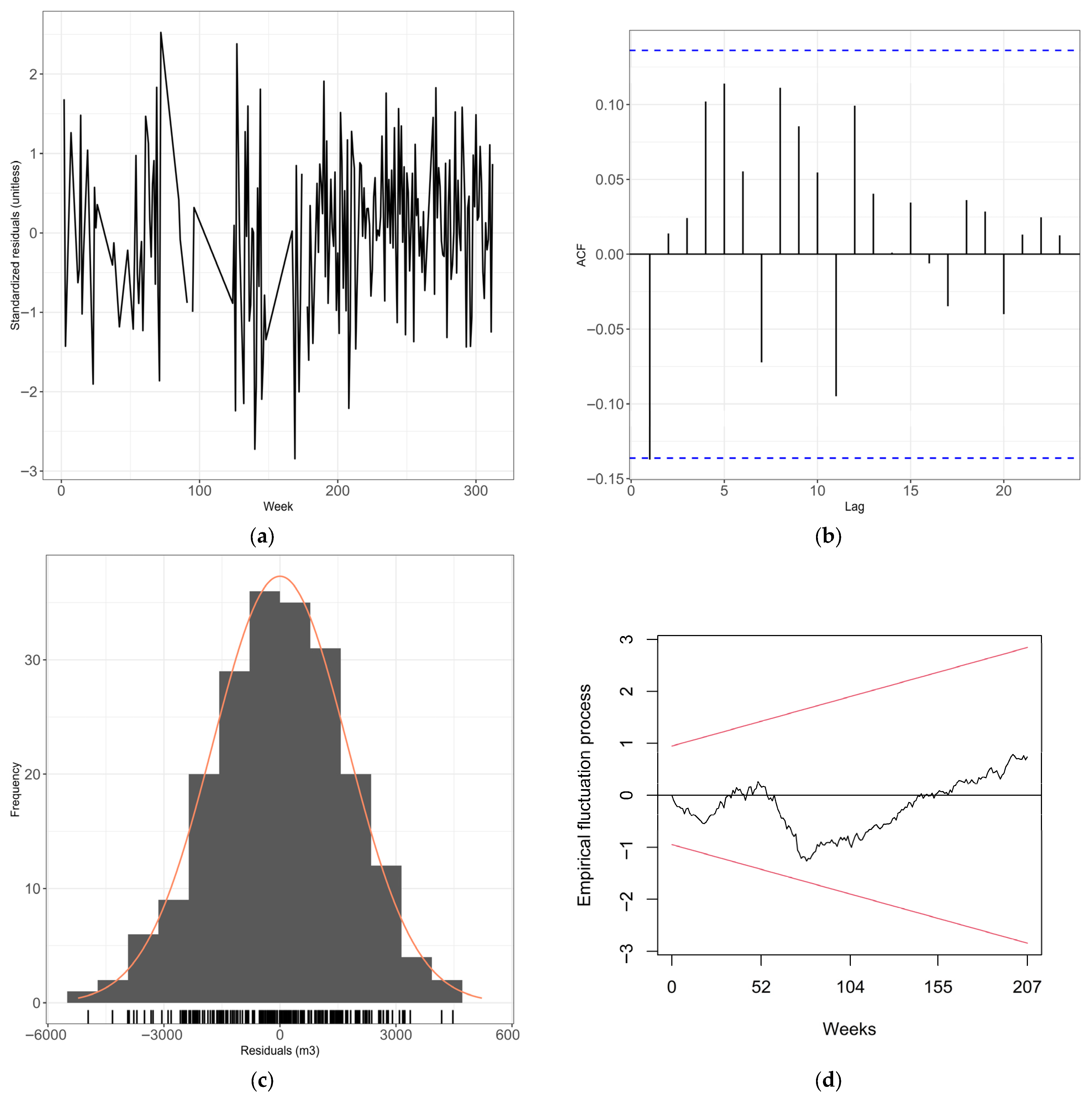
Model residuals were thoroughly tested for standard regression assumptions, namely, normality, homoscedasticity (constant variance), and lack of autocorrelation. As shown in Figure 2a, the histogram of residuals indicates an approximately normal distribution, which is also supported by the Jarque–Bera test (p = 0.5497) that jointly tests the null hypothesis of zero skewness and kurtosis equal to three. The autocorrelation function (ACF) plot in Figure 2b shows that all residual autocorrelations fall within the white-noise confidence band, suggesting no significant autocorrelation; this finding is further supported by the Breusch–Godfrey LM test (p = 0.057). In addition, the Breusch–Pagan test result (p = 0.488) confirms homoscedasticity of residuals, and all the variance inflation factors (VIFs) were below 3.0, ruling out multicollinearity concerns.
To further assess model stability, the recursive cumulative sum (CUSUM) test was conducted by estimating the model recursively starting from a minimum number of observations and adding one observation at a time to generate a sequence of coefficients and recursive residuals. If the coefficients are stable, the cumulative sum of standardized residuals should fluctuate randomly around zero. As shown in Figure 2c, the CUSUM plot confirms this behavior, and the test statistic (S = 0.7197, p = 0.2232) verifies that the model remains structurally stable throughout the study period. Collectively, these diagnostics demonstrate that the fitted autoregressive model satisfies all standard statistical assumptions, is robust against variation in feedstock composition, and provides reliable forecasts of methane yield in full-scale anaerobic digestion systems.

3.4. Long-Run Equilibrium

Bounds testing using F/Wald and t-tests confirmed a long-run equilibrium relationship between BMPₘᵢₓ and methane yield (F = 14.123, p = 1 × 10⁻⁶; t = −5.6066, p = 1× 10⁻⁶). The short-run multipliers for linear and quadratic BMP terms are 0.02942 and −2.898 × 10⁻⁷, respectively; in comparison, the corresponding long-run multipliers are 0.1647 and −2.23123 × 10⁻⁶. These values suggest that the volume of methane response to BMP is both immediate and sustained, though the long-term effect is nonlinear and subject to attenuation. The estimated weekly adjustment rate toward equilibrium is 23.57%, corresponding to an approximate one-month recovery period following a feedstock perturbation. This timescale is comparable to the measured hydraulic retention time (24.17 ± 15.74 days) of SCAD, suggesting that the digester’s dynamic response is governed by an overall system memory similar in magnitude to its hydraulic turnover, though not implying direct mechanistic equivalence. This finding supports the interpretation of HRT as a natural lag in the digestion system’s dynamic response, which aligns well with the hierarchical reactions in the AD reactors involving complex organics in dissolved and solid forms with different rates of degradation.

3.5. Forecast Accuracy and Model Applicability

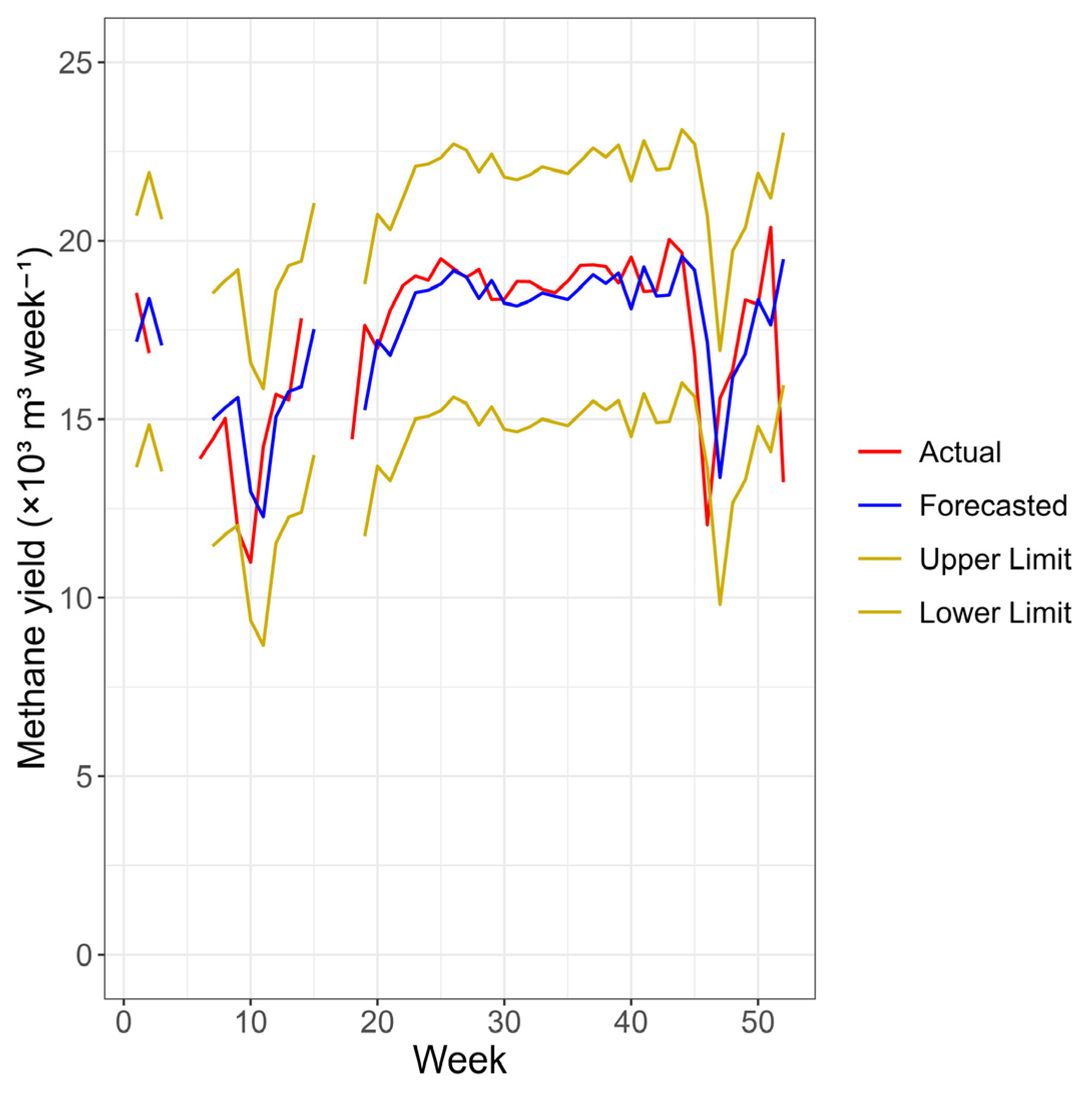
The model’s forecast performance for the year 2020 is illustrated in Figure 3 where observed methane production (blue) is compared with model-predicted values (red), including upper and lower confidence limits. The close alignment between actual and forecasted trends indicates that the model accurately captures temporal variations in methane yield and performs reliably even under dynamic feedstock conditions. Also, the performance metrics are as follows: RMSE = 1740.072, MAE = 1141.994, and MAPE = 7.4113. A MAPE below 10% is generally considered highly acceptable for engineering applications, especially in complex biological systems. To test the prediction performance of the model for different time spans, we used two different splits of the data: (i) training data period: 2014–2017, test data period: 2018; (ii) training data period: 2015–2018, test data period: 2019. The performance measures obtained are RMSE = 1557.728 and 2154.906, MAE = 1259.377 and 1587.170, MAPE = 7.6707 and 10.3272, respectively. It should be noted that the decrease in the training set size adversely affects the estimation of the model coefficients, which contributes to prediction error. Despite this, the MAPE values are still at acceptable levels. These results demonstrate that the model generalizes well to previously unseen feedstock mixtures, provided the system remains in a relatively stable operational regime. These findings reinforce the potential of using literature-derived BMP values for real-time methane yield prediction in full-scale AD systems. While the model currently assumes additive effects without synergy or inhibition, it serves as a strong baseline that can be further refined by incorporating interaction terms or microbial activity data.

3.6. Implications of the Model

The findings of this study demonstrate that the methane yield of a commercial anaerobic digester, co-digesting a diverse mix of manure and food waste, can be effectively modeled using a second-order polynomial autoregressive framework. The key explanatory variable was the weekly biomethane potential (BMPmix), computed from literature-reported values of the individual substrates, such as the estimation approach proposed by Holliger et al. [26]. The model successfully captured 70% of the variability in methane yield and achieved a MAPE of 7.4% when forecasting weekly methane production for an independent test year. These results validate the feasibility of using literature-based BMP values for predictive modeling in full-scale systems, despite operational variability and incomplete compositional knowledge. This finding is particularly important because of the numerous BMP studies available in the literature for different feedstocks, and they can be used to approximate the volume of methane production to predict the production of energy (heat, electricity).
It is important to note that the current model assumes additive contributions of individual feedstocks, with no explicit consideration of synergistic or inhibitory effects, a simplification that does not fully reflect the complexity of co-digestion dynamics. Nonetheless, this assumption is reasonable for many real-world scenarios, where feedstock combinations are determined by availability rather than optimal biochemical interaction. Incorporating interaction terms or microbial activity indicators into future models may further enhance predictive performance. Additionally, while this study utilized fixed BMP values without accounting for intra-substrate variability or changes over time, integrating uncertainty ranges or dynamic BMP measurements could improve robustness. Expanding the underlying database, as recommended by Raposo et al. [38], would facilitate this advancement and support broader adoption of BMP-based modeling strategies. The model’s autoregressive structure reveals that weekly methane yield is influenced not only by the current week’s feedstock BMP but also by residual effects from previous weeks. The observed long-run adjustment period of approximately one month aligns closely with the system’s HRT, reinforcing its role as a natural memory function in digester dynamics. While additional studies are needed to confirm this correspondence, the finding underscores the biological consistency of the model.

4. Conclusions

The methane yield of a commercial AD reactor co-digesting several varieties of manure and food waste is modeled by means of second-order polynomial autoregression, where the explanatory variable is the daily mixtures’ BMP value calculated from the substrates’ individual BMPs, which are calculated based on the values reported in the literature. The fitted model explained 70% of the variability in methane yield and forecasted the methane yield for the upcoming year with an average of 7.4% absolute difference. It was found that weekly methane yield is influenced by not only that week’s feedstock load but also the previous week’s load, and there is a long-run relation between BMPs and methane yield. It was empirically observed that, when the system deviates from this equilibrium, it tends to return to a new equilibrium state over roughly one month, a timescale comparable to the measured HRT of the SCAD digester. This correspondence should not be interpreted as a mechanistic equivalence but rather as evidence that the overall system response time, governed by both hydraulic turnover and microbial adaptation, occurs on a similar order of magnitude. Further research integrating microbial community dynamics, substrate degradation kinetics, and operational control parameters will be essential to confirm the biological underpinnings of this behavior. Overall, the results demonstrate that literature-based BMP values can be effectively leveraged to forecast methane yield in full-scale AD systems, providing a practical and low-cost framework for predicting digester performance and supporting decision-making during design, operation, and feedstock management.

Author Contributions

Conceptualization, Ö.T.B., S.U.-D., and W.L.; methodology, Ö.T.B.; software, Ö.T.B.; validation, Ö.T.B., S.U.-D., and M.X.; formal analysis, Ö.T.B.; investigation, Ö.T.B.; resources, Ö.T.B. and W.L.; data curation, Ö.T.B. and M.X.; writing—original draft preparation, Ö.T.B.; writing—review and editing, Ö.T.B., S.U.-D., M.X., and W.L.; visualization, Ö.T.B.; supervision, W.L.; project administration, W.L.; funding acquisition, Ö.T.B. and W.L. All authors have read and agreed to the published version of the manuscript.

Funding

This study was funded by the International Postdoctoral Research Fellowship Program provided by the Scientific and Technological Research Council of Türkiye (TUBITAK) 2219 (project number: 1059B192302192). The authors also thank Michigan AgBioResearch for the financial support provided.

Data Availability Statement

The dataset used in this study is not publicly available. Researchers should contact the corresponding author to request the dataset. We will provide support and additional information within reasonable boundaries.

Conflicts of Interest

The authors declare no conflicts of interest.

References

  1. Mao, C.; Feng, Y.; Wang, X.; Ren, G. Review on research achievements of biogas from anaerobic digestion. Renew. Sustain. Energy Rev. 2015, 45, 540–555. [Google Scholar] [CrossRef]
  2. Kovačić, Đ.; Lončarić, Z.; Jović, J.; Samac, D.; Popović, B.; Tišma, M. Digestate management and processing practices: A review. Appl. Sci. 2022, 12, 9216. [Google Scholar] [CrossRef]
  3. Batstone, D.J.; Keller, J.; Angelidaki, I.; Kalyuzhnyi, S.V.; Pavlostathis, S.G.; Rozzi, A.; Vavilin, V.A. The IWA anaerobic digestion model no 1 (ADM1). Water Sci. Technol. 2002, 45, 65–73. [Google Scholar] [CrossRef] [PubMed]
  4. Lauwers, J.; Appels, L.; Thompson, I.P.; Degrève, J.; Van Impe, J.F.; Dewil, R. Mathematical modelling of anaerobic digestion of biomass and waste: Power and limitations. Prog. Energy Combust. Sci. 2013, 39, 383–402. [Google Scholar] [CrossRef]
  5. Yu, L.; Wensel, P.C.; Ma, J.; Chen, S. Mathematical modeling in anaerobic digestion (AD). J. Bioremed. Biodegrad. S 2013, 4, 3. [Google Scholar] [CrossRef]
  6. Xu, F.; Li, Y.; Wang, Z.W. Mathematical modeling of solid-state anaerobic digestion. Prog. Energy Combust. Sci. 2015, 51, 49–66. [Google Scholar] [CrossRef]
  7. Ge, X.; Xu, F.; Li, Y. Solid-state anaerobic digestion of lignocellulosic biomass: Recent progress and perspectives. Bioresour. Technol. 2016, 205, 239–249. [Google Scholar] [CrossRef]
  8. Khuntia, H.K.; Paliwal, A.; Kumar, D.R.; Chanakya, H.N. Review on solid-state anaerobic digestion of lignocellulosic biomass and organic solid waste. Environ. Monit. Assess. 2022, 194, 514. [Google Scholar] [CrossRef]
  9. Liu, X.; Coutu, A.; Mottelet, S.; Pauss, A.; Ribeiro, T. Overview of numerical simulation of solid-state anaerobic digestion considering hydrodynamic behaviors, phenomena of transfer, biochemical kinetics and statistical approaches. Energies 2023, 16, 1108. [Google Scholar] [CrossRef]
  10. Saghouri, M.; Abdi, R.; Ebrahimi-Nik, M.; Rohani, A.; Maysami, M. Modeling and optimization of biomethane production from solid-state anaerobic co-digestion of organic fraction municipal solid waste and other co-substrates. Energy Sources Part A Recovery Util. Environ. Eff. 2024, 46, 8564–8580. [Google Scholar] [CrossRef]
  11. Pommier, S.; Chenu, D.; Quintard, M.; Lefebvre, X. A logistic model for the prediction of the influence of water on the solid waste methanization in landfills. Biotechnol. Bioeng. 2007, 97, 473–482. [Google Scholar] [CrossRef]
  12. Cruz, I.A.; Chuenchart, W.; Long, F.; Surendra, K.C.; Andrade, L.R.S.; Bilal, M.; Ferreira, L.F.R. Application of machine learning in anaerobic digestion: Perspectives and challenges. Bioresour. Technol. 2022, 345, 126433. [Google Scholar] [CrossRef] [PubMed]
  13. Gupta, R.; Zhang, L.; Hou, J.; Zhang, Z.; Liu, H.; You, S.; Li, W. Review of explainable machine learning for anaerobic digestion. Bioresour. Technol. 2023, 369, 128468. [Google Scholar] [CrossRef]
  14. De Clercq, D.; Wen, Z.; Fei, F.; Caicedo, L.; Yuan, K.; Shang, R. Interpretable machine learning for predicting biomethane production in industrial-scale anaerobic co-digestion. Sci. Total Environ. 2020, 712, 134574. [Google Scholar] [CrossRef] [PubMed]
  15. Hansen, B.D.; Tamouk, J.; Tidmarsh, C.A.; Johansen, R.; Moeslund, T.B.; Jensen, D.G. Prediction of the methane production in biogas plants using a combined gompertz and machine learning model. In Computational Science and Its Applications–ICCSA 2020: 20th International Conference, Cagliari, Italy, 1–4 July 2020; Proceedings; Springer International Publishing: Cham, Switzerland, 2020; Part I 20; pp. 734–745. [Google Scholar] [CrossRef]
  16. Long, F.; Xu, M.; Liao, W.; Liu, H. Machine learning for predicting and optimizing the performance of a commercial-scale anaerobic digester with diverse feedstocks and operating conditions. Bioresour. Technol. 2025, 435, 132940. [Google Scholar] [CrossRef] [PubMed]
  17. Jeong, K.; Abbas, A.; Shin, J.; Son, M.; Kim, Y.M.; Cho, K.H. Prediction of biogas production in anaerobic co-digestion of organic wastes using deep learning models. Water Res. 2021, 205, 117697. [Google Scholar] [CrossRef]
  18. Wang, Y.; Huntington, T.; Scown, C.D. Tree-based automated machine learning to predict biogas production for anaerobic co-digestion of organic waste. ACS Sustain. Chem. Eng. 2021, 9, 12990–13000. [Google Scholar] [CrossRef]
  19. Li, C.; He, P.; Peng, W.; Lü, F.; Du, R.; Zhang, H. Exploring available input variables for machine learning models to predict biogas production in industrial-scale biogas plants treating food waste. J. Clean. Prod. 2022, 380, 135074. [Google Scholar] [CrossRef]
  20. Schroer, H.W.; Just, C.L. Feature engineering and supervised machine learning to forecast biogas production during municipal anaerobic co-digestion. ACS EST Eng. 2023, 4, 660–672. [Google Scholar] [CrossRef]
  21. Sappl, J.; Harders, M.; Rauch, W. Machine learning for quantile regression of biogas production rates in anaerobic digesters. Sci. Total Environ. 2023, 872, 161923. [Google Scholar] [CrossRef]
  22. Yildirim, O.; Ozkaya, B. Prediction of biogas production of industrial scale anaerobic digestion plant by machine learning algorithms. Chemosphere 2023, 335, 138976. [Google Scholar] [CrossRef]
  23. Zhang, Y.; Zhao, Y.; Feng, Y.; Yu, Y.; Li, Y.; Li, J.; Han, Y. Novel intelligent system based on automated machine learning for multiobjective prediction and early warning guidance of biogas performance in industrial-scale garage dry fermentation. ACS EST Eng. 2023, 4, 139–152. [Google Scholar] [CrossRef]
  24. Meola, A.; Weinrich, S. Full-scale dynamic anaerobic digestion process simulation with machine and deep learning algorithms at intra-day resolution. Appl. Energy 2025, 390, 125781. [Google Scholar] [CrossRef]
  25. Koch, K.; Hafner, S.D.; Weinrich, S.; Astals, S.; Holliger, C. Power and limitations of biochemical methane potential (BMP) tests. Front. Energy Res. 2020, 8, 63. [Google Scholar] [CrossRef]
  26. Holliger, C.; Fruteau de Laclos, H.; Hack, G. Methane production of full-scale anaerobic digestion plants calculated from substrate’s biomethane potentials compares well with the one measured on-site. Front. Energy Res. 2017, 5, 12. [Google Scholar] [CrossRef]
  27. Kalamaras, S.D.; Vitoulis, G.; Christou, M.L.; Sfetsas, T.; Tziakas, S.; Fragos, V.; Kotsopoulos, T.A. The effect of ammonia toxicity on methane production of a full-scale biogas plant—An estimation method. Energies 2021, 14, 5031. [Google Scholar] [CrossRef]
  28. van der Berg, D.J.; Teke, G.M.; Görgens, J.F.; van Rensburg, E. Predicting commercial-scale anaerobic digestion using biomethane potential. Renew. Energy 2024, 235, 121304. [Google Scholar] [CrossRef]
  29. Fiore, S.; Ruffino, B.; Campo, G.; Roati, C.; Zanetti, M.C. Scale-up evaluation of the anaerobic digestion of food-processing industrial wastes. Renew. Energy 2016, 96, 949–959. [Google Scholar] [CrossRef]
  30. Moretta, F.; Goracci, A.; Manenti, F.; Bozzano, G. Data-driven model for feedstock blending optimization of anaerobic co-digestion by BMP maximization. J. Clean. Prod. 2022, 375, 134140. [Google Scholar] [CrossRef]
  31. Ugwu, S.N.; Enweremadu, C.C. Ranking of energy potentials of agro-industrial wastes: Bioconversion and thermo-conversion approach. Energy Rep. 2020, 6, 2794–2802. [Google Scholar] [CrossRef]
  32. Nazaitulshila, R.; Idris, A.; Harun, R.; Wan Azlina, W.A.K.G. The influence of inoculum to substrate ratio on the biochemical methane potential of fat, oil, and grease in batch anaerobic assays. Energy Sources Part A Recovery Util. Environ. Eff. 2015, 37, 590–597. [Google Scholar] [CrossRef]
  33. Gunaseelan, V.N. Biochemical methane potential of fruits and vegetable solid waste feedstocks. Biomass Bioenergy 2004, 26, 389–399. [Google Scholar] [CrossRef]
  34. Ahire, P.D.; Upadhyay, A.; Talwar, P.; Khatri, H.; Singh, R.; Lindenberger, C.; Vivekanand, V. Tool development for estimation of biomethane potential of different food waste for a sustainable bioeconomy. Biomass Bioenergy 2024, 182, 107107. [Google Scholar] [CrossRef]
  35. Uludag-Demirer, S.; Demirer, G.N. Post-anaerobic treatability and residual biogas potential of digestate. Biomass Convers. Biorefin. 2022, 12, 1695–1702. [Google Scholar] [CrossRef]
  36. Romio, C.; Ward, A.J.; Møller, H.B. Characterization and valorization of biogas digestate and derived organic fertilizer products from separation processes. Front. Sustain. Food Syst. 2024, 8, 1415508. [Google Scholar] [CrossRef]
  37. Keele, L.; De Boef, S. Not Just for Cointegration: Error Correction Models with Stationary Data; Documento de Trabajo; Departamento de Política y Relaciones Internacionales, Nuffield College y Oxford University: Oxford, UK, 2004. [Google Scholar]
  38. Raposo, F.; Borja, R.; Ibelli-Bianco, C. Predictive regression models for biochemical methane potential tests of biomass samples: Pitfalls and challenges of laboratory measurements. Renew. Sustain. Energy Rev. 2020, 127, 109890. [Google Scholar] [CrossRef]
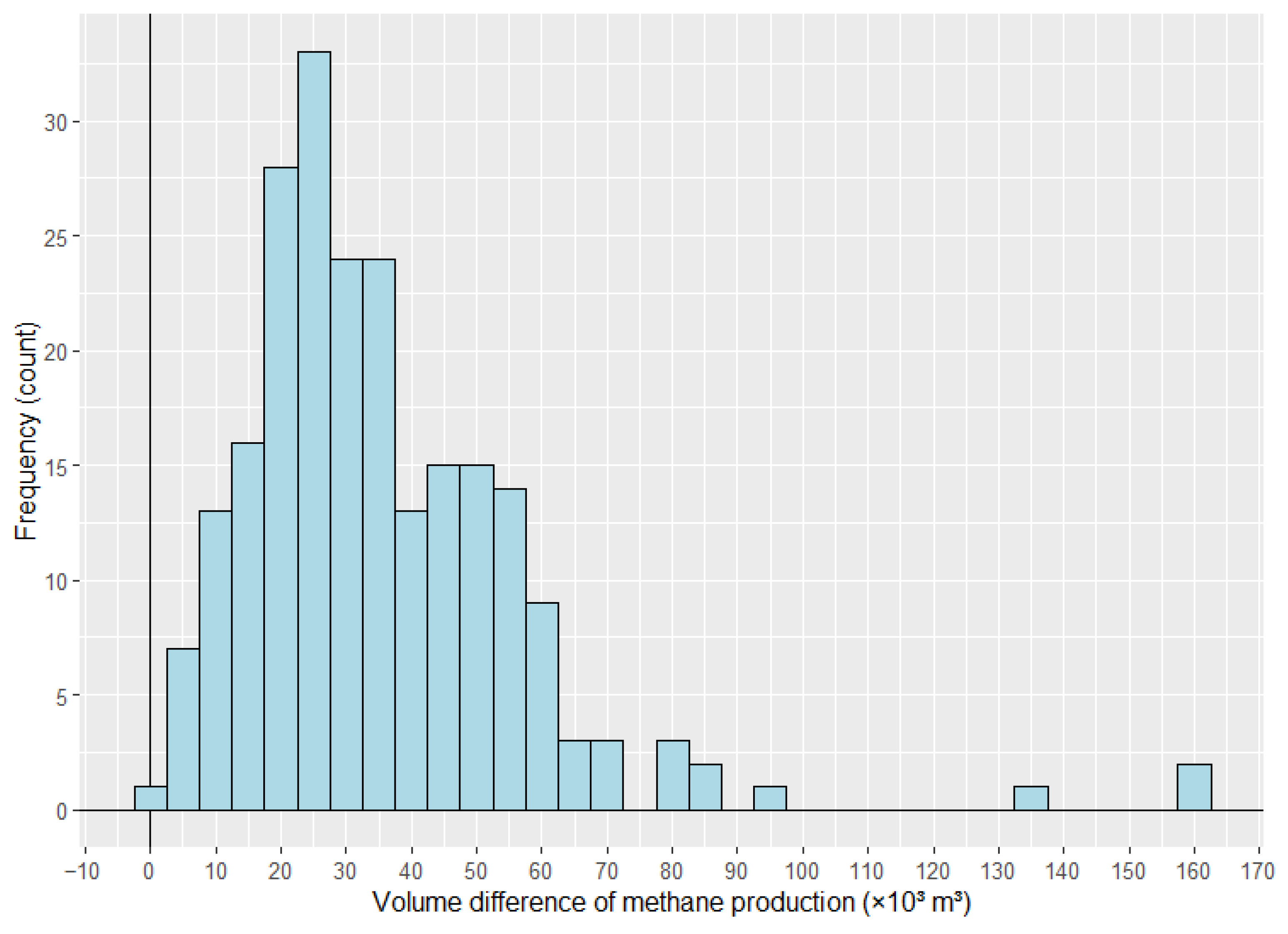
Figure 1. Histogram for the volume difference between calculated BMPmix and actual methane produced.
Energies 18 05914 g001
Figure 2. Diagnostic plots for the fitted autoregressive model: (a) residual time series, (b) residual autocorrelation function (ACF) with white noise band (blue dashed lines), (c) residual histogram with normal fit (orange line), and (d) recursive CUSUM stability test for ADL(1,1,1) model with 95% confidence boundaries (red lines).
Energies 18 05914 g002
Figure 3. Actual and Forecasted Weekly Methane Yield for the Full 52 Weeks of 2020 with 95% Prediction Intervals (Gold lines).
Energies 18 05914 g003
Table 1. Average and Standard Deviation of Weekly Utilized Substrate Amounts (kg).
Receiving VesselSubstrate 2014201520162017201820192020
MANUREDigestateMean0.005987.2319,248.7712,380.635686.480.00436.49
Stdev.0.0022,431.7429,661.2217,968.1816,057.160.002327.61
SolidsMean0.003702.341083.384363.02724.87969.981127.17
Stdev.0.006497.213225.015227.081837.553937.164764.43
DairyMean79,344.8487,138.7597,407.0193,662.5292,879.8393,792.2488,741.42
Stdev.22,740.0317,866.8111,106.1516,208.097719.0112,284.799424.27
ParlorMean82,207.0490,921.1280,191.5791,352.0599,123.75112,111.4710,2696.51
Stdev.30,997.8528,737.5729,633.8821,858.1320,722.8727,473.7229,105.13
BeefMean13,641.682319.424683.324226.094393.727378.691242.14
Stdev.20,540.266699.626828.434133.044660.687391.932704.58
Waste FeedMean324.6359.32651.59840.430.00662.421050.24
Stdev.1189.53306.002208.251857.180.002164.372550.11
PoultryMean0.000.0088.10245.620.00375.08296.578
Stdev.0.000.00310.04574.260.00776.19837.27
SwineMean499.822764.280.002193.182167.220.000.00
Stdev.2729.137813.100.0011,214.479104.630.000.00
OtherMean83.88581.66329.34555.7296.6560.541441.72
Stdev.256.321921.111258.011322.97660.29306.332822.83
FOOD WASTEFiltrateMean25,428.8934,974.9924,967.5011,111.663871.924120.784534.14
Stdev.30,196.3831,562.8839,422.9022,870.589463.918879.0411,072.14
SolidsMean0.001015.875207.561680.853927.915107.07626.48
Stdev.0.003069.877540.323143.975439.126670.751938.79
PineappleMean51,584.4247,950.5721,506.620.000.000.000.00
Stdev.18,566.1023,314.0328,275.460.000.000.000.00
PulpMean1960.261814.451533.221454.571540.641775.46381.19
Stdev.1137.85692.94881.75651049.8473915.31301088.4253772.35
FOGMean77,970.57149,888.11162,181.7315,9731.50154,845.60189,611.83231,224.89
Stdev.31,662.0570,642.0491,841.1459,168.2767,885.11115,598.7855,199.08
Waste FeedMean470.49540.820.000.0031.400.000.00
Stdev.1703.902166.740.000.00226.450.000.00
OtherMean2290.153286.292969.03847.97848.092487.7639,556.67
Stdev.7987.806376.455725.451296.651602.796355.2927,495.01
CartMean5485.307034.046163.40291.41274.69212.5758.63
Stdev.3603.664232.014219.12221.48366.99269.9696.15
Table 2. Summary Measures for Methane Volume and BMP.
Min1st Quar.MedianMean3rd Quar.MaxStdevSkewnessKurtosisNA’s
CH4 volume (m3)457512,11215,03114,43716,92821,4643304.157−0.502.5785
BMPmix (m3)10,26632,25844,06147,71459,59917,593121,999.221.8410.080
Table 3. AIC and BIC * values for different lag values (q) in the ADL model.
Lag Order (q)12345
AIC3695.6873676.8483657.9373661.2833663.301
BIC3729.0143716.7823704.4593714.4523723.115
* AIC and BIC are dimensionless; lower values indicate a better model fit.
Table 4. Methane Production Prediction Model.
EstimateStd. Errort Test Statisticp-Value
Intercept3557627.85.666<0.001 *
CH4,t−10.76430.0421518.134<0.001 *
BMPt0.029420.0087213.374<0.001 *
BMPt−10.0094050.0089811.0470.29623
BMP2t−2.898 × 10−71.080 × 10−7−2.6840.00790 *
BMP2t−1−2.361 × 10−71.105 × 10−7−2.1360.03391 **
Dummy1−85821788−4.800<0.001 *
Dummy2454217992.5250.01234 **
Dummy3436917982.4290.01603 **
Residual standard error: 1775 on 198 degrees of freedom
(99 observations deleted due to incomplete data)
R-squared0.7041Adj R-squared0.6921
F-statistic58.88 on 8 and 198 DF, p-value: <2.2 × 10−16
* 0.01 and ** 0.05 significance level.
Disclaimer/Publisher’s Note: The statements, opinions and data contained in all publications are solely those of the individual author(s) and contributor(s) and not of MDPI and/or the editor(s). MDPI and/or the editor(s) disclaim responsibility for any injury to people or property resulting from any ideas, methods, instructions or products referred to in the content.