1. Introduction
Based on the EuroStat database [
1], in 2023, the gross heat production from fossil fuels in EU-27 countries was estimated at 1211 PJ. A significant part of the total heat production is used by the industrial sector, which recorded a heat final consumption of 481 PJ in the same year. Additionally, the highest heat consumption was recorded by the chemical and petrochemical industry (228.7 PJ), followed by the paper and pulp industry (approximately 60 PJ), whereas the non-metallic minerals industry (glass, cement and plaster) reported lower heat consumption at 3.8 PJ.
Heat is demanded by industrial processes at different temperature levels. Heat at a lower temperature level (<100 °C) is typically required by the food and beverages industry; pulp and paper, rubber and plastic, and non-metallic minerals industries mainly required heat at 100–140 °C. Chemical and pharmaceutical industries and iron and steel production require heat at temperatures between 100 and 500 °C or even higher [
2].
Moreover, thanks to easier temperature control and a higher heat transfer coefficient due to the latent heat release during condensation [
3], steam is often used as a heat carrier medium in many of these industrial processes. Also, steam finds wide application in critical thermal processes such as pasteurizing, sterilizing, evaporation, distillation and drying [
2,
4].
In this context, the next “Industrial Decarbonisation Accelerator Act” expected for early 2026 and aimed at driving European industries toward climate neutrality is forcing the replacement of traditional boilers used for hot water or steam generation [
5]. To face this challenge, high temperature heat pumps (HTHPs) and steam generating heat pumps (SGHPs) are emerging as energy-saving and environmentally friendly technologies [
4]. In fact, they exploit low-grade energy sources (such as warm air, ground heat and industrial wastewater) to generate hot water or low-pressure steam required for processes with greater efficiency and economic advantages than combustion-based systems [
3]. Although the definition of HTHPs is not univocal in the specialized literature [
2], this term is herein used to identify the industrial applications of HPs requiring a supply temperature above 100 °C. With the same meaning, the term SGHPs is used to identify the subclass of HTHPs intended to supply steam for industrial purposes.
According to the European Heat Pump Association, heat pumps (HPs afterwards) could supply around 39% of process heat demand if fully implemented [
5].
However, the maximum achievable supply temperature limits the scope of application of HTHPs and SGHPs. In particular, while low-pressure steam (i.e., pressure less than 6 bar) can be generated by HP-based systems using a heat source at 60–80 °C, high-pressure steam (i.e., 15 bar and beyond) cannot easily be generated through SGHPs [
3].
SGHP technology is based on closed-loop systems which can be classified as compression HPs and absorption HPs [
6]. Furthermore, compression HPs can be further divided into vapor compression systems based on the left-running Carnot cycle [
7] and gas compression systems based, for instance, on the reversed Stirling cycle [
8].
Unlike the past, the widespread use of HP-based technology can rely on new eco-friendly refrigerants, such as hydrofluoroolefin (HFO) and natural refrigerants, having a very low environmental impact. Moreover, this technology can benefit from new zeotropic refrigerant mixtures that allow for better temperature matching between refrigerant and heat sink/source, thus improving the heat utilization efficiency. Additionally, to exploit the full potential of these mixtures, advantageous modifications to the thermodynamic cycle (such as auto-cascade cycles and flash vapor supplementation technology) can be introduced.
The present review has the goal of providing a general overview of the state of the art of SGHP technology employed for industrial applications, paying particular attention to the best practices for thermodynamic performance improvement and optimization procedures to enhance the design of these systems. Advantageous modifications to the standard HP cycle are also mentioned. To the best of the authors’ knowledge, these aspects are neglected or not sufficiently highlighted in other reviews dealing with both SGHPs [
9] and HTHPs in general [
2,
10].
This review is organized as follows. The main four configurations (hereafter, concepts) of SGHPs considered in the specialized literature are discussed and reviewed in
Section 2. Particular emphasis is placed on compression HP-based systems.
Section 2.5 offers a comparative analysis in terms of supply temperature ranges, economic constraints and efficiency metrics, while cases of comparison among different concepts are discussed in
Section 2.6. Additionally, an overview of integration challenges and barriers to the widespread use of SGHPs is provided in
Section 2.7.
In
Section 3, the refrigerants commonly used for SGHPs are presented and listed along with their main properties (
Section 3.1). In the same Section, the use of different refrigerants (
Section 3.2) and zeotropic refrigerant mixtures encountered in this review and potential ones (
Section 3.3) are also mentioned. Lastly, the criteria used to select the most suitable refrigerant are discussed in
Section 3.4.
The best practices useful to improve thermodynamic performance of SGHP systems are described in
Section 4. Additionally, possible modifications to the HP thermodynamic cycle are handled in
Section 5. In particular, auto-cascade cycles are discussed in
Section 5.1, as well as quasi-two-stage compression (QTC) cycles based on flash vapor supplementation technology (
Section 5.2). Finally, strategies for general optimization of HP design are reviewed in
Section 6.
2. Steam Generating Heat Pumps
SGHPs are used to produce water steam starting from liquid feedwater. Following Ref. [
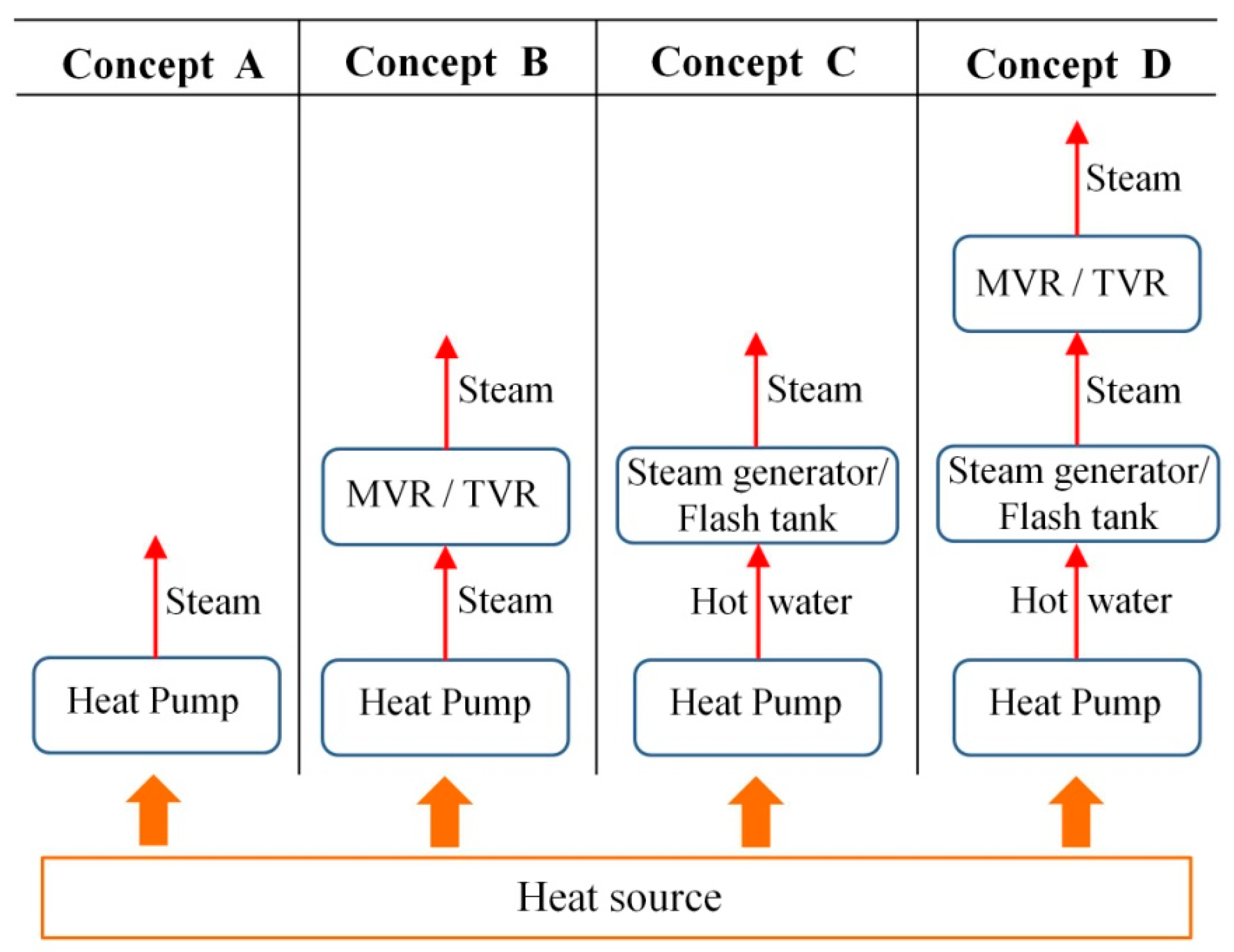
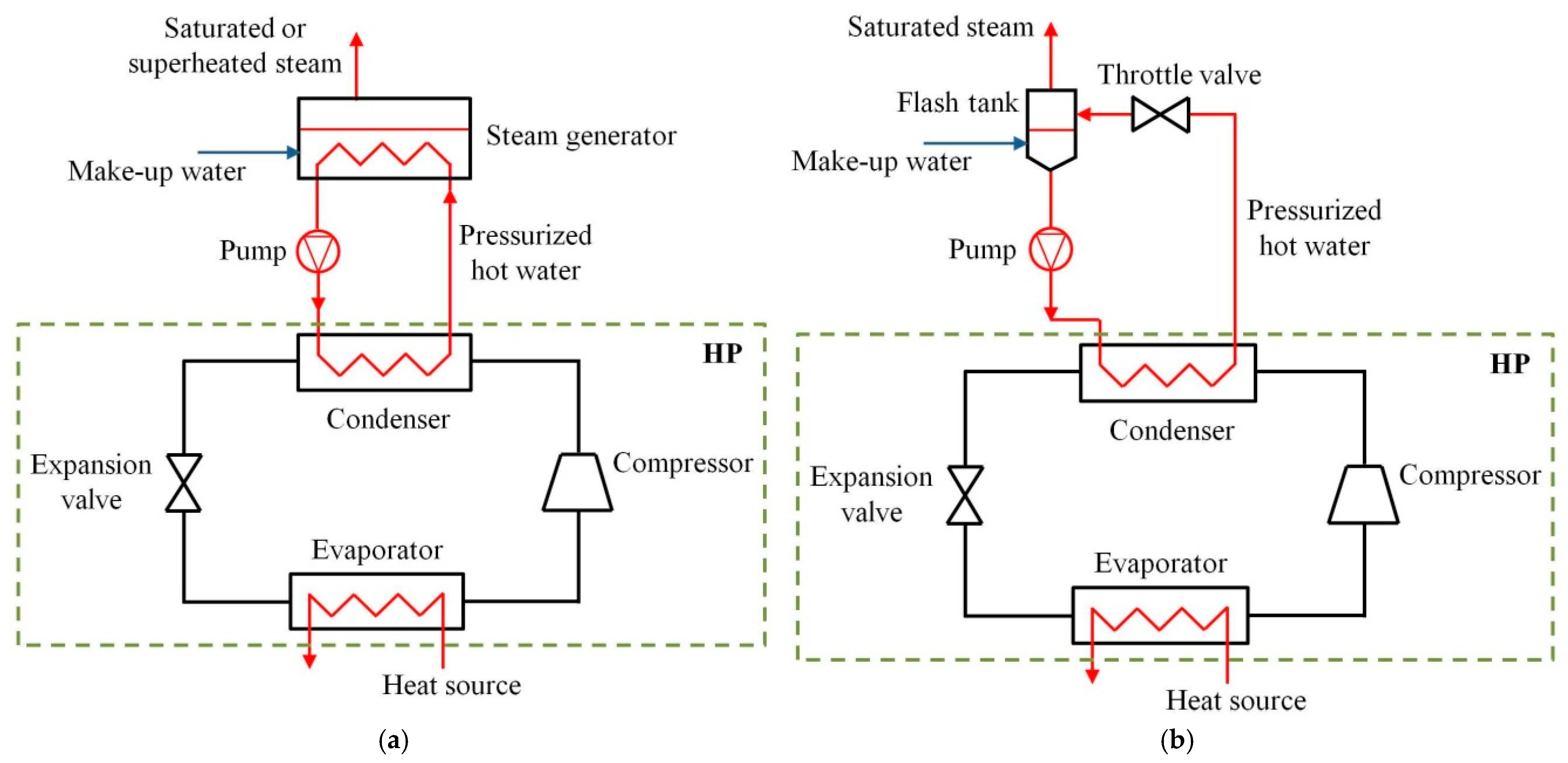
9], the four concepts of SGHP sketched in
Figure 1 can be identified. Note that all of these concepts involve closed-loop heat pumps.
The concept A-based SGHP is the simplest way to produce steam. Indeed, the steam is directly generated on the heat sink side of the condenser of the heat pump. The concept B-based SGHP adds a downstream steam compression system to a closed-cycle heat pump which generates low-pressure steam. Either mechanical vapor recompression (MVR) or thermal vapor recompression (TVR) can be used. On the contrary, concept C-based SGHPs use a closed-loop heat pump as the bottom cycle to heat up pressurized hot water; steam is then generated using either a steam generator or a flash tank. The concept D-based SGHP extends the concept C by adding a downstream steam compression system to supply steam at a higher temperature and pressure. Each of these concepts is discussed in
Section 2.1,
Section 2.2,
Section 2.3 and
Section 2.4. Additionally, they are compared in terms of supply temperature ranges, economic constraints and efficiency metrics in
Section 2.5. Also, cases of comparison among concepts A, B and C studied in the literature are reviewed in
Section 2.6. Finally, integration challenges and techno-economic barriers that hinder the widespread use of SGHPs in industries are discussed in
Section 2.7.
2.1. Concept A-Based SGHPs
As stated by Klute et al. [
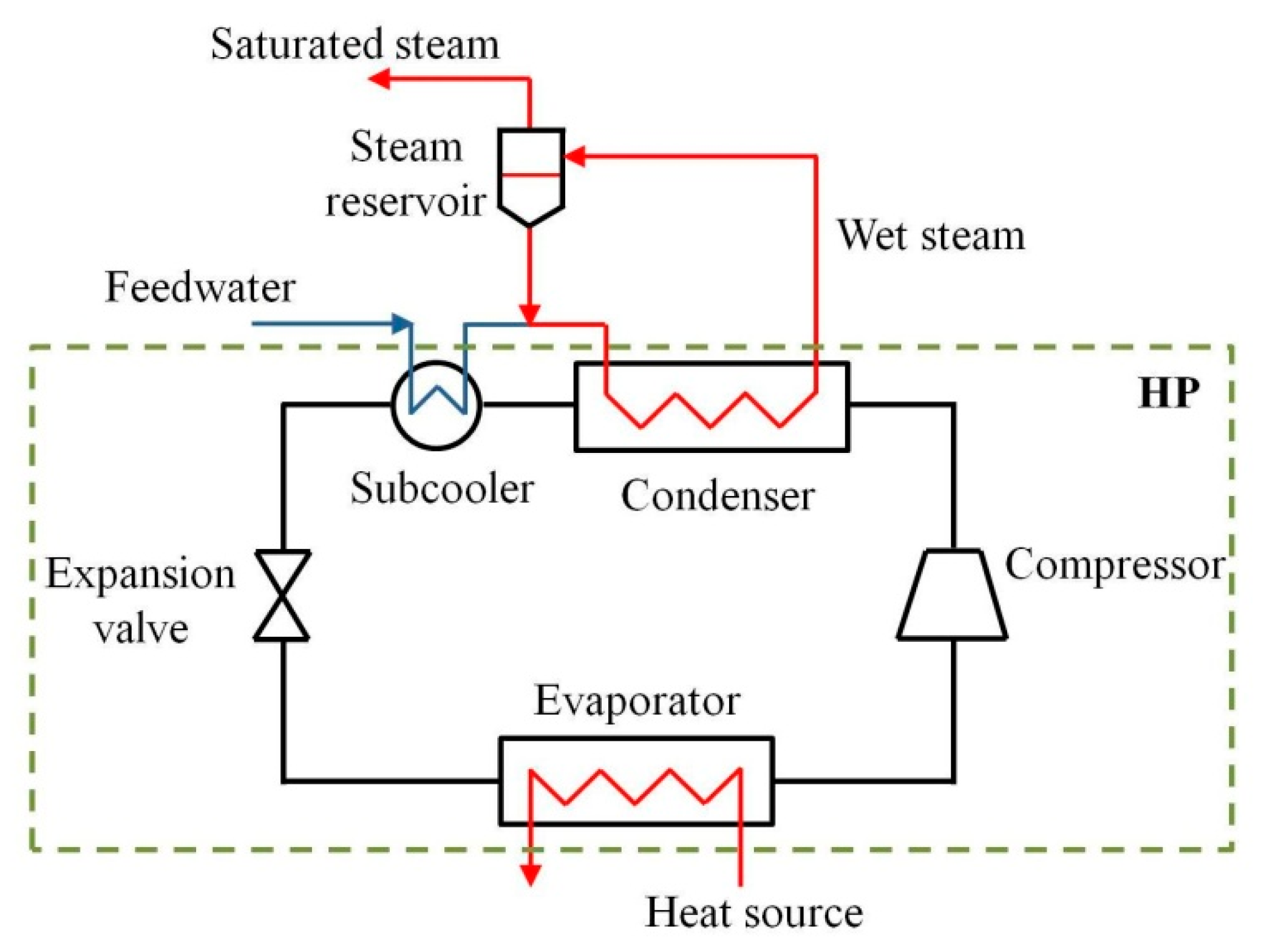
9], this is the most common type of SGHP. As mentioned, this concept foresees that the steam is directly generated on the heat sink side of the condenser (or gas cooler) of the HP. Most of the HPs used for this purpose are based on vapor compression cycles (
Figure 2), although gas compression cycles can also be encountered.
In many cases the feedwater is first preheated in a subcooler, and then it is evaporated and eventually superheated in the HP condenser. Often the generated steam is collected in a steam reservoir aimed at separating the residual water droplets from the supplied steam (as shown in
Figure 2). The steam reservoir is also needed because water may not fully evaporate to steam at the condenser outlet during operating transients, as stated in Ref. [
11]. Also, a steam reservoir may be used to keep steam in a saturated state rather than a superheated state. Indeed, as the heat transfer coefficient of saturated steam is much higher than that of superheated steam, heat may be supplied to the process more efficiently.
The main research papers and systems available on the market that focused on concept A-based SGHP are listed in
Table 1. This table reports the steam supply temperature, the source temperature, the internal temperature lift, the heating power, the used refrigerant and the maximum heating COP of the considered system; the object of the research papers and the main information available from manufacturers are also provided.
In 2017, Wemmers et al. [
12] successfully tested a 160 kW pilot-scale SGHP integrated in a paper production process. This HP was built using commercially available components to produce saturated steam at 2 bar, exploiting wastewater at 60 °C. The possibility to produce steam at 3.4 bar was also demonstrated. Additionally, this system included a further heat exchanger devoted to supplying hot water at 75–100 °C.
The two-stages HP system for steam generation presented by Marina et al. [
13] differs from the classical configuration. This system foresees two evaporators, two separator tanks, two internal heat exchangers, two compressors, two parallel condensers and a steam separator vessel. The HP receives heat at two distinct temperature levels from waste heat streams produced by industrial processes. Experimental analysis of this SGHP was performed through a special test rig simulating the industrial process. Despite the low efficiency, the experimental results demonstrated that it is possible to reach a maximum steam temperature of 150 °C, corresponding to a saturation pressure of 4.8 bar [
13].
The possible integration of SGHPs and marine engines was theoretically investigated by Kosmadakis et al. [
14]. The system studied by these authors exploits the cooling water of marine engines at 85 °C as a heat source and foresees two integration options: (1) HP is used to preheat feedwater of an auxiliary steam boiler, and (2) HP is used to generate 6 bar steam directly for the needs of ship. The authors reported significant economic and environmental advantages, especially for the first option.
However, gas compression cycles (reversed-Braiton cycle and reversed-Stirling cycle) are also used [
3]. Among the concept A-based SGHPs, gas compression cycles currently allow the highest supply temperatures; notwithstanding, these systems generally offer lower performances for steam generation as the heat discharge is not latent but sensitive [
9].
For the sake of completeness, absorption heat pumps (AHPs) have to be mentioned. Indeed, for steam generation purposes, AHPs working as heat transformers can be employed [
15]. To reach the steam temperature of 160–180 °C, usually demanded by the manufacturing industry, multi-stage configurations of heat transformers are needed [
16,
17]. Furthermore, as this kind of HP uses the heat source as driving energy, they generally require higher source temperatures (up to 130 °C) [
9].
Table 1.
Concept A-based SGHPs.
Table 1.
Concept A-based SGHPs.
| Reference | Supply
Temp. [°C] | Source Temp. [°C] | Temp.
Lift [°C] | Heating Power [kW] | Refrigerant | Max
COP | Objective or Main Info |
|---|
| [18] | 120 | 60–80 | - | 30 | R245fa | 3.5 | feedwater is preheated in a subcooler |
| Wemmers et al. [12] | 120 | 60 | - | 160 | R600 | 3.6 | pilot-scale SGHP, hot process water is supplied through an optional heat exchanger |
| [19] | - | - | 80 | 2000–10,000 | R1336mzz(Z) R1224yd(Z) R1233zd(E) | 3.6 | feedwater is preheated in a subcooler; a two-stage hermetic compressor is used |
| Yoo et al. [11] | - | 60–80 | - | 11 | R245fa | 3.4 | lab-scale SGHP, a reciprocating compressor (4 cylinders) is used |
| [20] | 90 | 145 | - | 1000 | R601 | 2.6 | an oil-lubricated screw compressor is used |
| Meroni et al. [21] | 100 | 150 | - | 1406 | R601, | 4.38 | HP design was coupled with the design model of the centrifugal compressor through a multi-objective optimization |
| 1626 | R601a, | 4.18 |
| 1225 | cyclopentane, | 4.74 |
| 743 | R1233zd(E) | 3.86 |
| 242 | MM (siloxane) | 4.54 |
| [22] | 150 | 115 | - | 8000–70,000 | R1233zd(E)
R1234ze(E) | 4.1 | a turbocompressor is used |
| Marina et al. [13] | 120–150 | 65–105 | 30–40 (I stage)
100 (II stage) | 150 | R601 | 2.7 | design and experimental analysis of a two-stage system (allowing heat input at two evaporators) is presented |
| [23] | 134–159 | 85–95 | - | 500–1000 | R1233zd(E)
R1234ze(E)
R1224yd(Z)
R1336mzz(E)
R1336mzz(Z) | 3.9 | a 4-cylinder compressor designed for HFO at high temperatures is used |
| [24] | 90–165 | 40–120 | - | 1000 | HFOs (not specified) | 4.8 | a reciprocating compressor is used |
| [25] | 150 | 95 | - | 3000–30,000 | HCs siloxanes (not specified) | 3.1 | Large-scale plants |
| Bless et al. [3] | 150 | 50–100 | - | - | R1233zd(E)
transcritical R600 | 2.7 | a theoretical comparison with other concepts is performed |
| Kosmadakis et al. [14] | <158 | 85 | 73 | 140 | R1233zd(E) | 2 | the integration of SGHP with marine engines is investigated |
| Saini et al. [26] | 140 | 40 | - | 500 | R134a mixed with R245fa | 2 | a commercial HP is compared with parabolic solar collectors for steam generation |
| Hong et al. [15] | 120 | 80–95 | | 11 | H2O/LiBr | 0.47 | an analysis of a single-stage adsorption heat transformer is performed |
| Moriwaki et al. [16] | 180 | <100 | - | 14 | H2O/LiBr
2-Ethylhexanol | 0.3 | a scale prototype of a double-lift absorption heat transformer was tested |
| Lubis et al. [17] | 170 | 80 | - | 200 | H2O/LiBr
2-Ethylhexanol | 0.3 | a prototype of a double-lift absorption heat transformer was tested |
Note that although AHPs and compression HPs are listed together in
Table 1, they should not be compared in terms of COP as they use different driving energies. In fact, for a HP like that shown in
Figure 2, the COP is defined by Equation (1) as the ratio between the heat flow rate released at the condenser
(including subcooling and de-superheating) and the mechanical power
required for refrigerant compression
while for an AHP the COP is computed as follows [
17]:
where
is the heat flow rate released at the high temperature absorber; also,
and
represent the heat flow rate supplied at the evaporator and generator, respectively. In the case of a double-lift AHP, the related COP can still be calculated through Equation (2) provided that
and
account for the heat flow rate exchanged at the high-temperature absorber and the low-temperature evaporator, respectively [
17].
2.2. Concept B-Based SGHPs
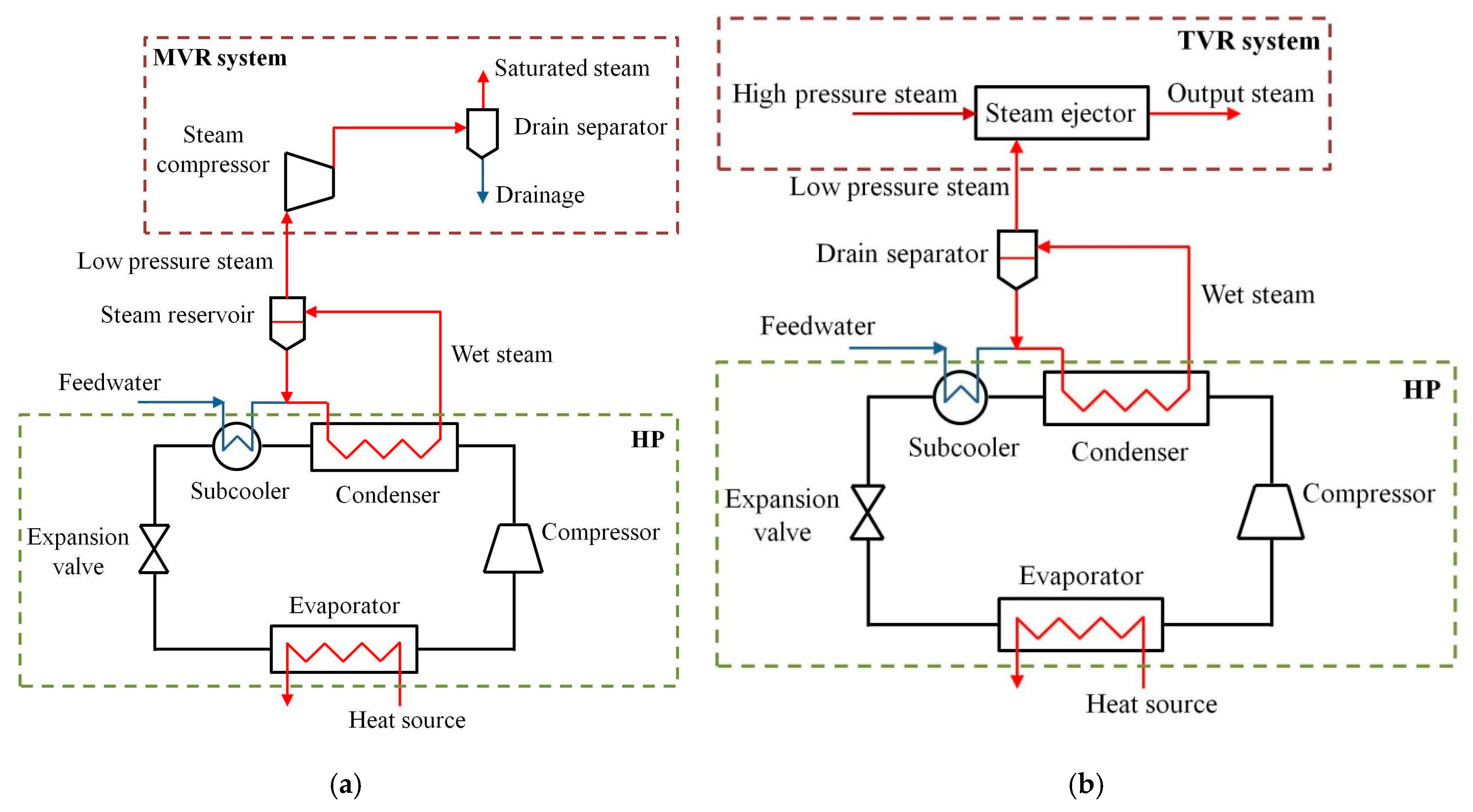
The concept B-based SGHP extends the closed-cycle heat pump by adding a downstream steam compression system. For this reason, concept B-based SGHPs allow higher supply temperatures to be reached than those achievable using concept A but, at the same time, it leads to higher complexity. Additionally, two compression systems exist: (1) mechanical vapor recompression or MVR (see
Figure 3a) and (2) thermal vapor recompression or TVR (
Figure 3b).
For MVR systems, all common types of compressors can be used. For small temperature and pressure lifts, rotary blowers or axial or centrifugal fans are preferred, while for higher temperature lifts, axial and centrifugal compressors are used. Also, piston compressors are used for very large lifts [
9]. These systems are widely employed in industrial heat recovery applications involving steam temperatures comprising between 80 and 250 °C, with a heating capacity of several MW [
9].
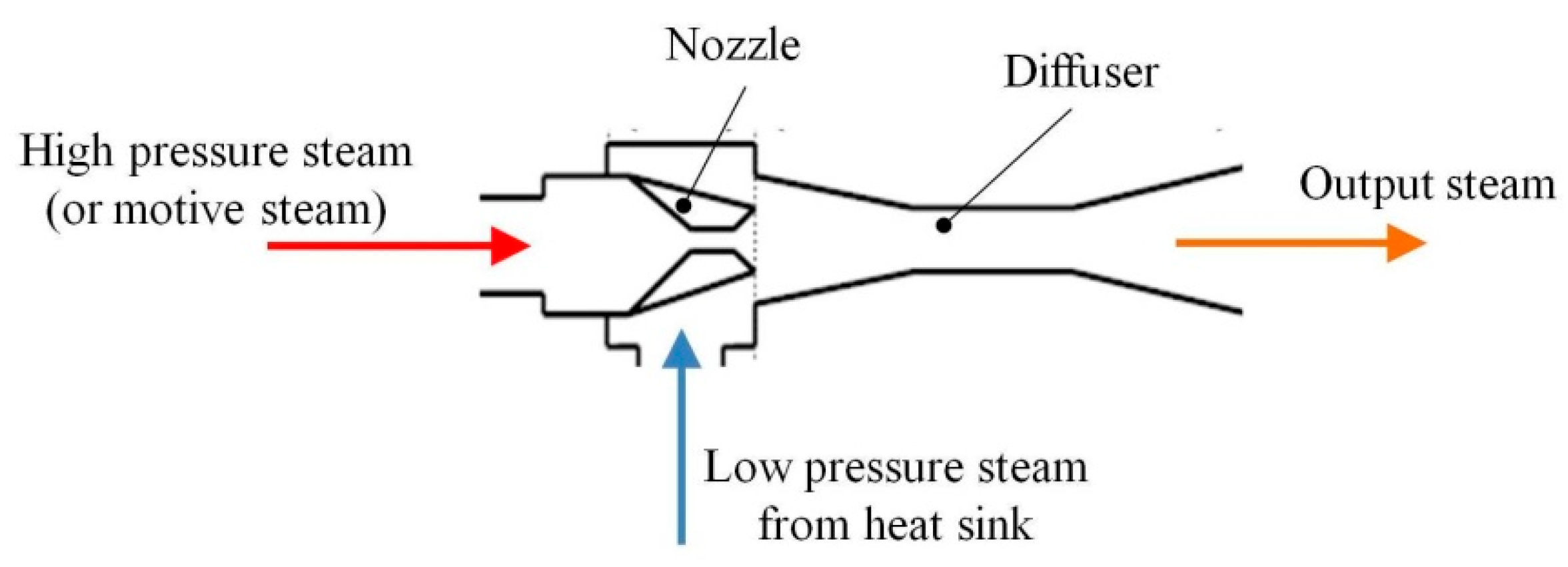
Thermal vapor compression is performed in steam ejectors, which essentially consist of a suction and motive nozzle, a mixing chamber and a diffuser (see
Figure 4). High-pressure steam (motive steam) serves as the driving energy to compress low-pressure steam. Generally speaking, TVR systems find applications in several industrial processes using steam (such as distillation, cooking, evaporation and stripping), both in small-scale plants and extensive ones. The maximum supply temperature can reach 240 °C, but with special equipment, temperatures up to 350 °C are achievable [
9].
Steam ejectors have high durability and reliability due to their simple structure, which has no moving parts [
27]. However, an application-specific design is necessary due to the dependence of the performances on the motive steam parameters, which makes benchmarking possible only to a limited extent [
9]. Consequently, the TVR systems were encountered in only a few cases in the specialized literature.
The main research papers and systems available on the market that focused on concept B-based SGHPs are listed in
Table 2.
Richard and Labrecque [
28] performed a technical and economic assessment of the combination of a closed-cycle HP and MVR system used to produce steam at 130 kPa (117 °C). The investigated system is aimed at recovering heat from wet-air stream produced by a paper-drying process. Specifically, the MVR system is used to compress steam from 0.5 bar to 1.3 bar, consuming power close to 220 kW. These authors found that the combination of HP and MVR for this application was not economically justifiable in the context of low natural gas prices. However, whether the price of electricity compares to fuel prices, it could be economically advantageous.
As an example of complex systems, Zühlsdorf et al. [
29] presented a steam generation unit foreseeing a central evaporator at which heat is supplied by different closed-cycle HPs; the steam generated from the central evaporator is then compressed through a high-temperature three-stage MVR system (with intermediate cooling), which supplies steam at different pressure levels to different processes. The maximum supply temperature is around 290 °C.
Watanabe et al. [
30] presented different industrial HP technologies. Of particular relevance for the purpose of this paper is the integration of a concept B-based SGHP into an existing steam supply system. The HP generates low-pressure steam at 2 bar and 120 °C, which is then compressed through a steam ejector (TVR) using motive steam at 8 bar and 170 °C. The steam thus generated by the SGHP is supplied at 150 °C and 5 bar.
Lastly, among the listed cases, in just one research work an absorption heat pump is involved [
27]. This HP is coupled with a steam ejector to supply steam at 3 bar (143 °C), exploiting about 1000 kg/h of motive steam at 11 bar and 188 °C.
Table 2.
Concept B-based SGHPs. (HP + vapor compression system).
Table 2.
Concept B-based SGHPs. (HP + vapor compression system).
| Reference | Supply
Temp. [°C] | Source Temp. [°C] | Temp.
Lift [°C] | Heating Power [kw] | Refrigerant | Max
COP | Objective or Main Info |
|---|
| Richard and Labrecque [28] | >110 | 85 | 66 | 2400 | R134a | 3.6 | a technical–economic analysis of HP + MVR using wet air as heat source is performed |
| | 54 | 2300 | R245fa | 4.1 |
| Bless et al. [3] | 150 | 50–100 | - | - | R600
R1234ze(Z)
R1233zd(E) | 4 | a theoretical investigation of HP + two-stage MVR is performed |
| [31] | 150 | 40–70 | - | 1200–5000 | R717 | 4.2 | HP + MVR multi-stage steam compressors |
| [19] | - | - | - | 2000–10,000 | R1336mzz(Z) R1224yd(Z) R1233zd(E) | 3.6 | HP + MVR |
| [22] | 190 | 80 | - | 8000–70,000 | R1233zd(E)
R1234ze(E) | 2.9 | HP + MVR |
| Zühlsdorf et al. [29] | 297 | 110 | 92–138 | 8200–50,000 | R600 | 4.2 | feasibility of parallel HP + multistage MVR with intercooled compressions is assessed |
| Watanabe et al. [30] | 150 | 60–80 | - | 30 | R245fa | 3.5 | HP + TVR (motive steam at 170 °C) |
| Fukusumi et al. [27] | 143 | 86 | - | 534 | - | - | experimental test on absorption HP +TVR is performed |
| Ma et al. [32] | 150 | 40–100 | - | - | R245fa | 4 | a comparison between a HP + flash and a HP + MVR is performed through the 4E criterion |
It is worth noting that in
Table 2 the COP of a HP integrated with a MVR system should not be confused with that related to a SGHP involving a TVR system. Specifically, the COP of a concept B-based SGHP integrated with a MVR system to generate superheated steam (mass flow rate
, and enthalpy
hstm) from liquid feedwater (
and
hfw) is calculated as follows [
32]:
where
and
are the powers required for refrigerant and steam compression, respectively.
On the contrary, when a TVR system exploiting high-pressure motive steam (
,
hmtv) is used to supply medium-pressure compressed steam (
) generated by an upstream compression HP, the related COP is computed as
where
and
are the enthalpy of the steam supplied by the TVR system and the liquid feedwater, respectively.
2.3. Concept C-Based SGHPs
The concept C-based SGHPs generate steam using either a steam generator or a flash tank, which are fed with pressurized hot water supplied by a closed-loop HP acting as the bottom cycle. When a steam generator is used (
Figure 5a), the pressurized hot water is circulated in a closed loop and used for heating an additional steam generator. Note that to avoid intermediate heat exchanges, the condenser can be embedded into the steam generator, as occurs in the system studied by Li et al. [
33]. In the case of a flash tank (
Figure 5b), an open circuit is used instead: the pressurized hot water from the bottom cycle is throttled and partly evaporated in a flash tank to generate saturated steam. The liquid phase of the flash tank is then mixed with make-up water and fed back to the bottom cycle.
The flash design is only suitable for generating saturated steam, while a steam generator can also be used to supply superheated steam. In both cases, the maximum achievable steam temperature is limited by the maximum supply temperature of the closed-looped HP. Regardless, the concept C-based SGHPs generally achieve supply temperatures slightly below those of concept A. This is due to the flash or evaporation process, which is always associated with a certain temperature gradient [
9].
The main research papers and systems available on the market that focused on concept C-based SGHPs are listed in
Table 3.
Lee et al. [
34] designed, developed and tested a SGHP combined with a flash tank to produce saturated steam using waste heat at 50–70 °C from a scrubbing process in a chemical factory.
Using a similar configuration and the same refrigerant (R245fa), Chang et al. [
35] tested a 10 kW prototype able to supply saturated steam at 120 °C (1.987 bar). Additionally, these authors designed the high-temperature condenser of the HP. In particular, they combined a plate and shell heat exchanger and a shell and tube heat exchanger in order to ensure high-temperature and high-pressure operation.
Zhao et al. [
36] investigated a model to predict the capacity and efficiency of a concept C-based SGHP employed to generate saturated steam at 1.1–2 bar from industrial waste heat sources at 55–85 °C. These authors also built a testbed to validate the results and to assess the performance of the system. They stated that the COP can increase from 3.06 to 10.95 when the steam pressure decreases from 2 bar to 1.1 bar.
Kang et al. [
37] showed that reducing the temperature of the flash tank increases the performance of the SGHP when the temperature at the evaporator of the HP is fixed. In particular, for a source temperature of 70 °C, reducing the temperature of the flash tank from 120 to 115 °C increases the COP of 10.8%.
A case study regarding the integration of a gas compression HP into the steam supply system of a pharmaceutical factory was presented by Tveit et al. [
38]. The HP is based on the reversed-Stirling cycle exploiting helium as a refrigerant. The evaporator of the HP is used to heat up pressurized water, which is then used to produce steam at 183 °C at 1 MPa in a steam generator.
The possibility of using medium-low-temperature geothermal water as a heat source in a SGHP was investigated by Lu et al. [
39]. These authors performed a thermodynamic analysis of a high-temperature HP coupled with a flash tank to produce saturated steam at 100 °C. Also, they tested different working fluids and reported that the refrigerant R141b offers the optimal performance, leading to a COP near to 3.8.
Koundinya et al. [
40] simulated and tested a SGHP employed to produce steam at 1.5 bar through a flash tank alternatively to a diesel boiler. The authors analyzed a month of operation to assess system performance and overall savings. The analysis results showed that the use of SGHPs in India leads to a 20% increase in carbon emissions compared to diesel, while in the European Union it can reduce emissions by 58%.
Li et al. [
33] suggested a cascade HP coupled with a steam generator to produce low-pressure saturated steam using the hot air available in a steam-used workshop as a heat source. This system will be better described in
Section 4.2. Another example of a steam generating system based on a particular HP cycle, known as the auto-cascade cycle (discussed in
Section 5.1), coupled with a flash tank was suggested by Ma et al. [
41].
Table 3.
Concept C-based SGHPs. (HP + evaporator or flash tank).
Table 3.
Concept C-based SGHPs. (HP + evaporator or flash tank).
| Reference | Supply
Temp. [°C] | Source Temp. [°C] | Temp.
Lift [°C] | Heating Power [kW] | Refrigerant | Max
COP | Objective or Main Info |
|---|
| Lee et al. [34] | 118 | 50–70 | - | 348 | R245fa | 3 | field test of a manufactured HP + flash tank in a chemical factory is performed |
| Chang et al. [35] | 120 | ≤70 | - | 300 | R245fa | - | experimental test on a 10 kW HP + flash tank with high-temperature condenser is conducted |
| [42] | 120 | 25–65 | - | 370 | R245fa | 3.5 | HP + flash tank, two-stage twin-screw compressor is used |
| Zhao et al. [36] | 120 | 55–85 | - | - | R245fa | 10.9 | a theoretical model of HP + flash tank is suggested, and a testbed is built |
| Kang et al. [37] | 115–125 | 60–70 | 18 | - | R245fa | 3.6 | performance improvement of a HP + flash tank through an IHX is evaluated experimentally |
| Tveit et al. [38] | 183 | 40 | - | 500 | R704 | 1.4 | a case study of a gas compression HP+ steam generator in pharmaceutical factor is investigated |
| Lu et al. [39] | 100 | <90 | 70 | - | R141b
(R123, R245fa, R1234ze(Z)) | 3.79 | a HP + flash tank using geothermal water as a heat source is investigated |
| Koundinya et al. [40] | 109 | 50–60 | 80 | 60 | R245fa | 2.2 | simulation and pilot test on a HP + flash tank are performed |
| Li et al. [33] | 100–120 | 20–40 | 90 | - | R134a
R245fa
R1234ze(Z)
R1336mzz(Z) | 2.7 | simulation of a cascade HP + steam generator using the refrigerant injection technique is performed |
| Ma et al. [41] | 100 | 20 | - | - | different mixtures of R1234yf with
R245fa
R1233zd(E)
R1224yd(Z)
R1336mzz(Z) | 2.1 | an auto-cascade HP with IHX and steam injection is modeled |
2.4. Concept D-Based SGHPs
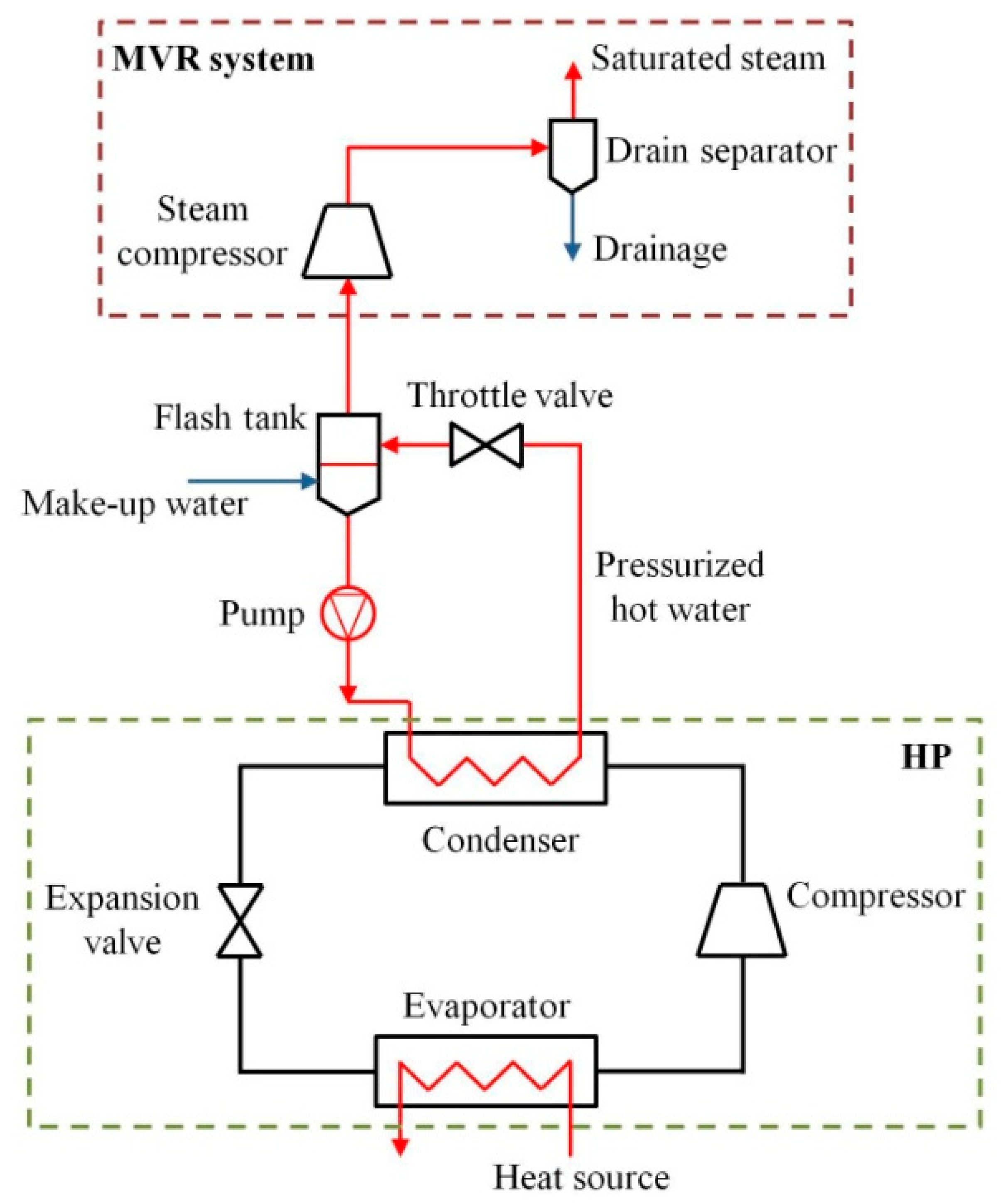
The concept D-based SGHP extends the concept C by adding a downstream steam compression system. This enables the supply of superheated steam and higher steam pressures. Indeed, in this concept, pressurized hot water is produced by a bottom HP and is then sent to a flash tank through a throttle valve; the saturated steam from the flash tank is subsequently compressed by a MVR system [
43]. It is described in
Figure 6.
Table 4 lists the two references found dealing with concept D-based SGHPs.
Yan et al. [
43] presented a prototype of a concept D-based SGHP using ambient air as a heat source to generate steam at 2 bar and 120 °C. According to the authors, their system offers significant economic and environmental advantages over traditional boilers.
2.5. Comparative Analysis
The operating supply temperature ranges for different SGHP concepts are displayed in
Table 5.
There are no restrictions on the heat source temperature (typically below 100 °C for industrial wastewater), with the exception of AHPs which usually require a higher source temperature between 55 and 130 °C [
9].
Concepts B and D with the highest supply temperatures are the most versatile SGHPs. Indeed, as shown by
Table 5, they can generate steam from 100 °C to 350 °C; the highest temperatures are achieved when using multi-stage MVR systems (with intermediate cooling) or special equipment (cooling tubes) in addition to TVR systems. These systems are both well-established technologies. However, TVR systems are about twice as cheap as MVR systems in terms of investment costs [
9]. They offer further advantages in terms of operating costs, thanks not only to the lower maintenance costs (no moving parts) but especially to when the motive steam comes from exhaust steam.
Regarding concepts A and C they have been split up into two groups based on the used HP technology: (1) vapor compression HPs and (2) gas compression HPs or AHPs. The latter group allows higher supply temperatures to be reached than vapor compression HPs. This applies in particular to gas compression HPs, which currently offer the highest supply temperatures among the closed-loop HPs (up to 250 °C) [
9]. Furthermore, concept C-based SGHPs generally reach slightly lower steam supply temperatures than those offered by concept A. This is due to the flash tank and steam generation processes which are always characterized by a temperature gradient. As mentioned above, when using a flash tank, only saturated steam can be supplied.
It is worth noting that AHPs show specific investment costs higher than other HP technologies [
9]; also, depending on the plant location, additional cooling costs may be incurred to dissipate the heat discharged into the AHP condenser.
Despite all these considerations, it should be noted that the most cost-effective SGHP concept for a given application depends not only on the investment costs of the heat pump technology but also on the boundary conditions of the specific application (such as temperature and pressure levels, heating and cooling requirements, electricity and fuel prices, grid accessibility and availability of exhaust steam).
Additionally, it is difficult to carry out a fair performance comparison between different concepts in terms of COP, as different forms of driving energies may be involved. For the sake of completeness, the efficiency metrics (COPs) used for different concepts are defined and summarized in
Table 6.
2.6. COP Comparison of the Main SGHP Concepts
Ma et al. [
32] presented a comprehensive performance comparison between concept B- and concept C-based SGHPs, considering energy, exergy, economy and environmental (4E) aspects. In particular, they studied two closed-cycle HPs: the former utilizes a flash tank for the steam generation, i.e., concept C (denoted as HP + FT afterwards), while the latter involves a MVR system, i.e., concept B (HP + MVR). The coefficient of performance (COP), the exergy efficiency, the annual net profit (ANP) and the annual emission reduction are some of the terms of comparison. In both cases, the chosen reference refrigerant is R245fa. These authors evaluated the performance of these two concepts by computing the COP as a function of both the heat source temperature and the condensation temperature. It was shown that the COP of both HP + FT and HP + MVR increases when the source temperature increases. Also, considering a supplied steam temperature of 150 °C, the HP + MVR system offers a COP always higher than the HP + FT. Additionally, if the heat source temperature rises, the waste heat utilization rate (defined as the ratio between the heat supplied at the evaporator and the enthalpy rising of the feedwater) of both systems increases.
They also demonstrated that for a constant waste heat temperature (70 °C), the COP of the HP + MVR system decreases when the condensation temperature increases. Indeed, when the condensation temperature rises and the source temperature is kept constant, a higher power consumption of the HP compressor and a lower waste heat utilization ratio are obtained; as a result, the heating capacity of the SGHP decreases and, consequently, the steam mass flow rate also decreases. Moreover, from the MVR side, the power consumption of the MVR steam compressor slightly decreases, as the supplied steam temperature is kept constant. Consequently, the COP decreases. The authors reported a COP of the HP + MVR system of 2.51 for a condenser temperature of 105 °C. On the contrary, as the condenser temperature of the HP + FT system is fixed by the steam temperature, which is in turn constant, its COP results in only 1.71. They concluded that the thermodynamic performance of the HP + MVR system is superior to that of the HP + FT system.
Regarding the exergy efficiency, both HP + MVR and HP + FT systems exhibit a maximum of the total exergy efficiency when varying the source temperature [
32]. Also, the exergy efficiency of the HP + MVR system decreases when the condenser temperature increases. Regardless, its exergy efficiency is always greater than that of the HP + FT system.
To compare concept A- and concept B-based SGHPs, Zhao et al. [
45] performed a technical–economic analysis accounting for COP and construction costs under variable operation conditions. The studied systems involve a cascade HTHP which uses R245fa and R1234ze(Z) as working fluids. Results showed that the concept B-based SGHP offers the best performance in terms of COP under all conditions; higher COP values are achieved at a condenser temperature around 110 °C, while lower values are obtained when the condenser temperature drops to 170 °C. On the contrary, the construction cost of such a system is the largest for most working conditions due to the large volume flow rate at the compressor suction port. However, the costs of the two concepts become comparable for heat source temperatures above 85 °C.
The COPs of concept A- and concept B-based SGHPs were also compared by Bless et al. [
3]. In particular, these authors considered three simple closed-cycle HPs (concept A) involving either a vapor compression cycle (using R1233zd(E) as refrigerant) or a reversed-Brayton cycle (using CO
2), as well as a transcritical cycle (using R600). For concept B-based SGHPs, they studied the behavior of a single HP (using R600, R1233zd(E) and R1234ze(Z) as refrigerants) combined with two MVR systems. Considering a supplied steam temperature of 150 °C, they computed the COP of the systems described above as a function of both heat source temperature and isentropic efficiency of the compressors. The results showed that the concept B-based SGHPs offer COPs always higher than the concept A-based SGHPs. Additionally, the different concept B-based SGHPs exhibited comparable COP values over a wide range of heat source temperatures. Moreover, the transcritical R600 and the reversed-Brayton CO
2 cycles resulted in being the less-efficient cycles due to the temperature glides occurring in the heat sinks.
Regarding the influence of the isentropic efficiency of the compressors (ηis), concept B remains the most efficient cycle. However, for ideal compressions (i.e., ηis = 1) the highest COP is reached by the reversed-Brayton cycle (concept A).
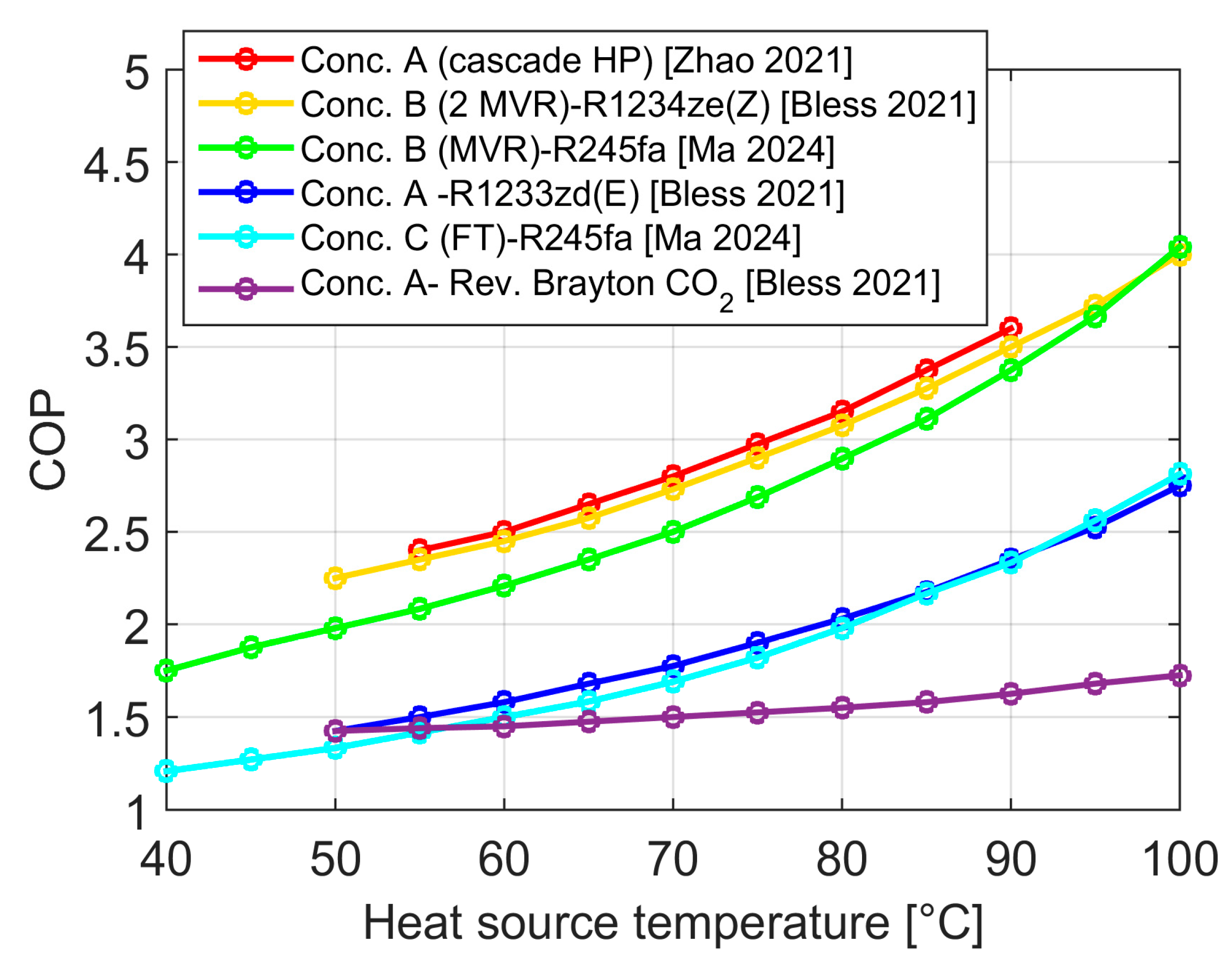
The COPs of the main SGHP concepts discussed above are plotted in
Figure 7 as functions of the heat source temperature, considering a constant supply temperature of 150 °C.
As shown by
Figure 7, the higher the heat source temperature, the higher the COP. Also, the highest COP is achieved through B concepts that exploit a MVR system (single-stage [
32] or dual-stage [
3]). However, the cascade HP (concept A) studied by Zhao et al. [
45] reaches the highest COP values for a large temperature range. Notwithstanding, the other concept A systems investigated by Bless et al. [
3] offer lower efficiency in the same conditions, especially the system based on the CO
2 compression cycle (violet curve). Lastly, the concept C system integrated with a flash tank [
32] exhibits the lowest COP when the heat source temperature is below 50 °C.
2.7. Challenges and Barriers
Steam generating heat pumps have high market potential on a global scale, driven by the increasing need to reduce the carbon footprint of many consumer products. The general trend is to replace fossil fuels with green electricity to produce industrial heat, with huge benefit in terms of emissions. HTHPs also introduce the concept of
circularity of thermal resources in industrial processes, allowing the recovery of low-grade heat to make it re-useable for the higher-temperature processes. However, the wide use of SGHPs is challenged by the high capital expenditure needed to replace or back-up standard boilers, which may make the economic case not attractive in a short- to mid-term period. The availability of and accessibility to green electricity is another topic that must be considered in the general context of industrial heat pumps, as well as the cost of electricity compared to much cheaper fossil fuels [
46], when assessing the operating costs of the investment.
Market experience shows that large companies can only bear the capital expenditure required to improve process efficiency (such as SGHP integration into industrial contexts) if the payback period (PBP) is less than five years [
26]. In particular, case studies revealed that the PBP of SGHP integration in large industries (aluminum production) is less than 5 years when the electricity is self-generated from renewable energies and biogas is the fuel being replaced. Also, it is below 8 years when natural gas is consumed from the grid [
29]. During this assessment, the costs associated with customized design for the SGHP integration must also be taken into account.
Another issue is the uncertainty of service and maintenance costs due to the novelty of the technologies and the limited operating hours in real industrial environments.
All of these considerations inevitably lead to the need for policies and incentives that either have an effect on the initial investment or on the operating cost (i.e., green mortgages or discounts on electricity price [
47]) and support the industries to introduce the SGHPs in their processes. Of course, this is vital at the current early stage of development when a dominant design is not defined and economies of scale are not possible yet, but this will become less important in the future, especially in areas where green resources (like solar energy) are more accessible and widely available.
In addition to these economic barriers, other obstacle to the widespread use of SGHPs and HTHPs in industries are related to (1) a lack of knowledge on heat consumption and excess heat by many industrial processes [
48] and (2) a lack of awareness of the potential applications of HPs (integration concepts, boundary conditions and performance) on the part of installers, decision-makers and energy managers [
48,
49]. Furthermore, process integration methods (such as pinch analysis) represent valuable tools to help engineers to design efficient solutions for heat integration problems. The reader can find a discussion about these methods in Ref. [
49].
The availability of functional models, which allow laboratory test results to be up-scaled directly to a real industrial scale, is an important research area that would provide another useful tool for demonstrating the feasibility of integrating HPs into industries [
50].
3. Refrigerants for SGHPs
The working fluid (or refrigerant) plays a paramount role in the design of whatever HPs. In fact, its critical temperature limits the condensation temperature (i.e., the supply temperature) and the condensation enthalpy (i.e., the heating COP); also, it determines the pressure levels within the HP and, therefore, the compression ratio and equipment material efforts. Moreover, it affects the lubricant choice as the stability of the refrigerant–lubricant mixture limits the compression-discharged temperature; its flammability and toxicity affect the cost of the necessary safety devices; and lastly, the HP materials (metals and polymers) must be chemically compatible with the refrigerant itself.
In this Section, after presenting the refrigerants used for SGHPs along with general selection criteria (
Section 3.1),
Section 3.2 discusses their uses. New refrigerant mixtures and potential ones are also mentioned (
Section 3.3). Finally, refrigerant selection criteria used in the most recent literature are reviewed in
Section 3.4.
3.1. Refrigerants List
In the past, chlorofluorocarbons (CFCs) and hydrochlorofluorocarbons (HCFCs) were often used as refrigerants. Although these substances offered good thermodynamic performance, the use of CFCs and HCFCs was progressively forbidden under the Montreal Protocol and the EU regulation 2009/1005 due to their Ozone Depletion Potential (ODP). Hydrofluorocarbons (HFCs), initially introduced to replace CFCs and HCFCs, were subsequently appointed as greenhouse gases by the Kyoto Protocol because of their high Global Warming Potential (GWP). For this reason, their production is gradually decreasing in Europe under the F-gas regulation 2014/517. Furthermore, the more recent EU regulation 2024/573 sets intermediate targets to definitely phase out HFC by 2050. Due to this restriction, new synthetic refrigerants such as hydrofluoroolefins (HFOs) and hydrochlorofluoroolefins (HCFOs) have been suggested as environmentally friendly alternatives by virtue of their low GWP and ODP.
When choosing the refrigerant for SGHPs, the following properties should be considered [
32]: high critical temperature, low GWP, zero or low ODP, excellent thermodynamic properties and practicality, non-toxic and non-flammable, low cost and short atmospheric lifetime. Moreover, the industrial sector is heavily shifting towards synthetic fluids which do not contain trifluoroacetic acid (TFA) and perfluoroalkylic substance (PFAS) [
51]. Therefore, the absence of these substances could represent another limiting factor for refrigerant selection in the near future.
The working fluids encountered in the present review are listed in
Table 7, specifying both their designation code and the corresponding chemical name. In the same table, their main properties (critical temperature
Tc, critical pressure
Pc, GWP, ODP and safety classification according to ASHRAE standard) are also provided.
A noteworthy point is that ASHRAE classifies refrigerant toxicity into two classes, A and B: Class A groups refrigerants that have lower toxicity with an occupational exposure limit (denoted as OEL, i.e., the maximum concentration of a substance in the workspace air that workers can be exposed to over a specified time period) exceeding 400 ppm, while Class B includes refrigerants that have higher toxicity (OEL below 400 ppm) [
54]. Additionally, flammability is rated on a three-level scale: “1” is for refrigerants that have no flame propagation, “2” is for refrigerants with lower flammability (a subclass 2L is also defined to further classify refrigerants with a maximum burning velocity less than 10 cm/s), and “3” is for highly flammable refrigerants.
3.2. Uses of Different Refrigerants
Chlorofluorocarbons (such as R12 and R114) and hydrochlorofluorocarbons (such as R141b and R123), widely used in conditioning and refrigeration applications (industrial and civil) before the Montreal Protocol, were replaced by HFCs (such as R245fa and R134a). The most commonly used refrigerant in industrial high-temperature applications is now R245fa [
51], thanks to its high critical temperature of 153.9 °C. Conversely, the critical point of R134a (
Tc = 101.1 °C and
Pc = 40.6 bar) makes this refrigerant particularly suitable for lower-temperature applications, such as domestic air conditioners and refrigerators. As mentioned above, these substances will be replaced by new environmentally friendly refrigerants with lower GWP. Among these, the refrigerants R1234ze(E) and R1234yf (belonging to the HFO tetrafluoropropene series) are candidates for replacing R134a, as they have comparable critical points. These refrigerants find application not only in the field of automotive air conditioners and refrigerators, but also use in the first stage of cascade HTHPs [
2]. Attractive substitutes for R245fa are the refrigerants R1336mzz(Z) and R1234ze(Z) [
2]. Specifically, R1336mzz(Z) (exafluorobutene series of HFOs) is stable up to 250 °C and, for that reason, it is suitable for organic Rankine cycles (ORCs), waste heat recovery and steam generation applications. It is also suitable for large HPs with flooded evaporators thanks to its negligible temperature glide [
2]. Moreover, R1234ze(Z), with its critical point (Tc = 150.1 °C and Pc = 35.3 bar) allowing high-temperature subcritical cycles to operate, is another promising candidate to replace R245fa.
Another refrigerant with a high critical point (Tc = 166.5 °C and Pc = 36.2 bar) is the HCFO R1233zd(E). For this reason, it is recommended for HTHP applications, although thermal studies highlighted discoloration of steel after 7 days of exposure to this refrigerant at 250 °C [
2]. The HCFO R1224yd(Z), introduced for centrifugal chillers and waste heat recovery HPs, shows thermophysical properties similar to those of R245fa and R1233zd(E). Note that the ODP of these substances is not exactly zero because they contain chlorine; however, the short atmospheric lifetimes of R1233zd(E) (41 days) and R1224yd(Z) (21 days) result in a negligible impact on the ozone layer [
51].
Hydrocarbons (such as R600, R601, R601a and cyclopentane) represent a subclass of natural refrigerants with no ODP and very low GWP. Their high critical temperatures, due to the number of carbon atoms (usually less than 5), make them particularly suitable for use in HTHPs [
51]. However, flammability issues, on one hand, limit the recommended use of HCs to small systems with reduced charging volumes [
2], and, on the other hand, they limit the evaporation pressure to the atmospheric one to avoid the risk of air infiltrations, especially for R601 (pentane) and R601a (isopentane) [
51]. Cyclopentane is an HC widely used in the chemical industry (both in insulating foam production and as a solvent), but it is also known as a refrigerant in cooling systems and HTHP applications due to its high critical point (Tc = 238.6 °C and Pc = 45.7 bar).
The large latent heat of water (R718) (15 times greater than that of R134a at 50 °C) and its high critical temperature (373.9 °C) makes it interesting for HTHP applications involving temperatures above 150 °C. However, the low steam density leads to greater pressure ratios, and, in order to keep the discharged temperature within acceptable limits, several compression stages (with intermediate cooling) are required [
2,
58].
The high critical pressure (Tc = 132.3 °C and Pc = 113.3 bar) of ammonia (R717) limits its use to applications with supply temperature levels below 100 °C [
51]. In fact, the existing ammonia compressors with special construction reach pressures of up to 76 bar (at 110 °C) [
2]. Neverthelss, R717 offers high volumetric heating capacity, which is useful for reducing compressor size. Ammonia corrodes copper, zinc and cooper alloys, and it is also highly toxic and slightly flammable [
51], so special safety devices must be employed.
Carbon dioxide (R744) is a natural refrigerant characterized by a low critical temperature (31 °C) which generally operates with a transcritical cycle. The high transcritical temperature difference in the gas cooler makes it suitable as a working fluid for domestic hot water heating. In HTHP applications, the heat sink temperature can reach values of up to 120 °C [
2]. For steam generation from industrial wastewater, R744 operates with a gas compression cycle [
3].
Helium (R704) is another natural refrigerant with zero GWP, zero ODP and a very low critical point. Unlike CO2, it always requires a gas compression cycle in every HP application.
3.3. Refrigerant Mixtures
Further advantages such as balancing flammability, lowering environmental impact, and improving thermodynamic performance in HPs can be achieved by using refrigerant mixtures. Among these, particular attention is paid to non-azeotropic (or simply zeotropic) mixtures consisting of two or more components with significantly different boiling points. Because of that, contrary to pure fluids, during phase transitions they exhibit temperature variation at constant pressure. This feature is known as “temperature glide” and it allows for better matching of the temperature variations between refrigerant and heat source (usually wastewater) at the evaporator of a HP. Consequently, these mixtures can reduce exergy destruction and improve heat utilization efficiency [
59].
On the other hand, critical aspects related to the condensation of mixtures can occur. In fact, different boiling points between the mixture components may yield to local composition changes during the phase transition, negatively affecting the heat transfer capabilities compared to a pure fluid.
Some of the novel low-GWP binary mixtures consist of HFO and HCFO, such as R1234yf&R1234ze (Z), R1234ze(E)&R1224yd(Z) and R1234ze(E)&R1233zd [
59]. However, they are usually used in modified HP thermodynamic cycles, as described in
Section 5.1.
Other zeotropic mixtures consisting of carbon dioxide and acetone have been recently suggested to be employed in HTHPs with a supply temperature of 150–220 °C [
60]. Also, in the supply temperature range between 140 and 170 °C, Obika et al. [
53] investigated novel zeotropic mixtures between HC and HCO (or HCFO); the pure refrigerants used as mixture components are namely cyclohexane, cyclopropane, R1234ze(Z), R1336zz(Z), R600, R600a, R601 and R601a. Although the above mixtures were suggested for HTHPs, they can also be potentially applied in SGHPs, especially in concepts C- and D-based systems where better temperature matching in the HP condenser can be realized.
3.4. Refrigerant Selection Criteria
General guidelines to perform a screening of possible working fluids for HTHPs were defined by Zuhlsdorf et al. [
61]. This evaluation process should include thermodynamic performance (for instance, COP and volumetric heating capacity or VHC), economic performance and secondary performance indicators (such as environmental indicators: ODP and GWP). Additionally, economic indicators can include the total investment capital cost (TCI), purchased equipment cost (PEC), net present value (NPV), capital recovery factor (CRF) and specific cost of heat [
61]. Furthermore, other thermodynamic indicators consider the compression ratio and compressor discharge temperature. Flammability and toxicity of the refrigerants can also be considered as secondary performance indicators.
The most recent research papers providing refrigerant selection criteria are reviewed afterwards.
A comparative analysis to evaluate the candidate pure fluids for HTHPs (including natural and synthetic fluids) was performed by Zini et al. [
51]. The terms of comparison were the overall performance (such as, for instance, COP, condenser thermal power), compressor parameters (such as VHC, compression ratio, discharged temperature), heat exchangers parameters (such as figures of merit for boiling and condensation heat transfer, transport properties) and safety considerations (flammability and toxicity). The authors considered a standard HP configuration that included an IHX to ensure comparability of the results. Two analyses were carried out: the former under constant temperature lift between evaporator and condenser, and the latter varying this temperature difference. Subsequently, they were able to select the most suitable working fluid for different temperature ranges. Results of the analysis indicated that natural fluids (such as water, ethanol and methanol) are particularly compelling candidates.
Furthermore, these authors suggested the use of ammonia for low-temperature level applications (i.e., with supply temperatures around 100 °C), methanol or ethanol for medium-temperature levels (supply temperatures around 140 °C) and water for ultra-high-temperature applications (supply temperatures around 180 °C) [
51].
Vieren et al. [
62] presented a financial approach to screen a large number of working fluids (including zeotropic binary mixtures) based on the minimization of the levelized cost of heat (LCOH) of a HTHP. The LCOH is related to the total cost associated with generating a unit of heat over the lifetime of the HP. The suggested method seeks also to optimize some operational parameters of the HP (such as condensation and evaporation pressure, superheating degree and subcooling degree). Specifically, the suggested procedure was applied to a large set of both supply temperatures between 160 °C and 200 °C and heat source temperatures (80–120 °C). Findings proved that the simple COP maximization may lead to a non-optimal financial solution. Additionally, the authors concluded that binary mixtures of natural refrigerants (for instance, water–ammonia or water–hydrocarbons) often achieved the best results from a financial perspective.
To assess the performance of 560 binary refrigerant mixtures employable in HTHPs, Xu et al. [
54] defined a multi-objective optimization using a non-dominated sorting genetic algorithm of second generation (NSGA-II). The analyzed mixtures were defined by selecting eight pure working fluids and changing their composition in terms of mass fraction with 5% intervals. Moreover, the optimization algorithm was combined with a HP model (operating under defined boundary conditions) to achieve a trade-off between COP and VHC by defining the Pareto optimal solution for each mixture. The mixtures related to optimal solutions were then evaluated using the Simple Additive Weighting (SAW) method to quantitatively assess their main characteristics (flammability, toxicity, environmental performance and temperature glide properties). Behaving like this, Xu et al. defined a performance index. The authors found that the mixture R142b/R1233zd(E) exhibits superior performance when the basic cycle is considered.
Additionally, other cycle configurations including vapor injection technology or an internal heat exchanger (IHX), which will be discussed in the next Section, were investigated in the work by Xu et al. [
54]. Mixture R600a/R601(0.6/0.4) offers good general performance for a HP involving vapor injection technology; however, it raises flammability issues. When an IHX is applied, highest performance in terms of temperature glide and environmental impact can be reached using mixture R245fa/R601(0.2/0.8).
4. Best Practices for Performance Improvement
In this Section, the best practices useful to improve thermodynamic performance of SGHPs are described. In detail, internal heat exchanger and refrigerant injection technologies are discussed in
Section 4.1 and
Section 4.2, respectively. Additionally, recommended guidelines for best operation of lubricated compressors are provided in
Section 4.3.
4.1. Internal Heat Exchanger (IHX)
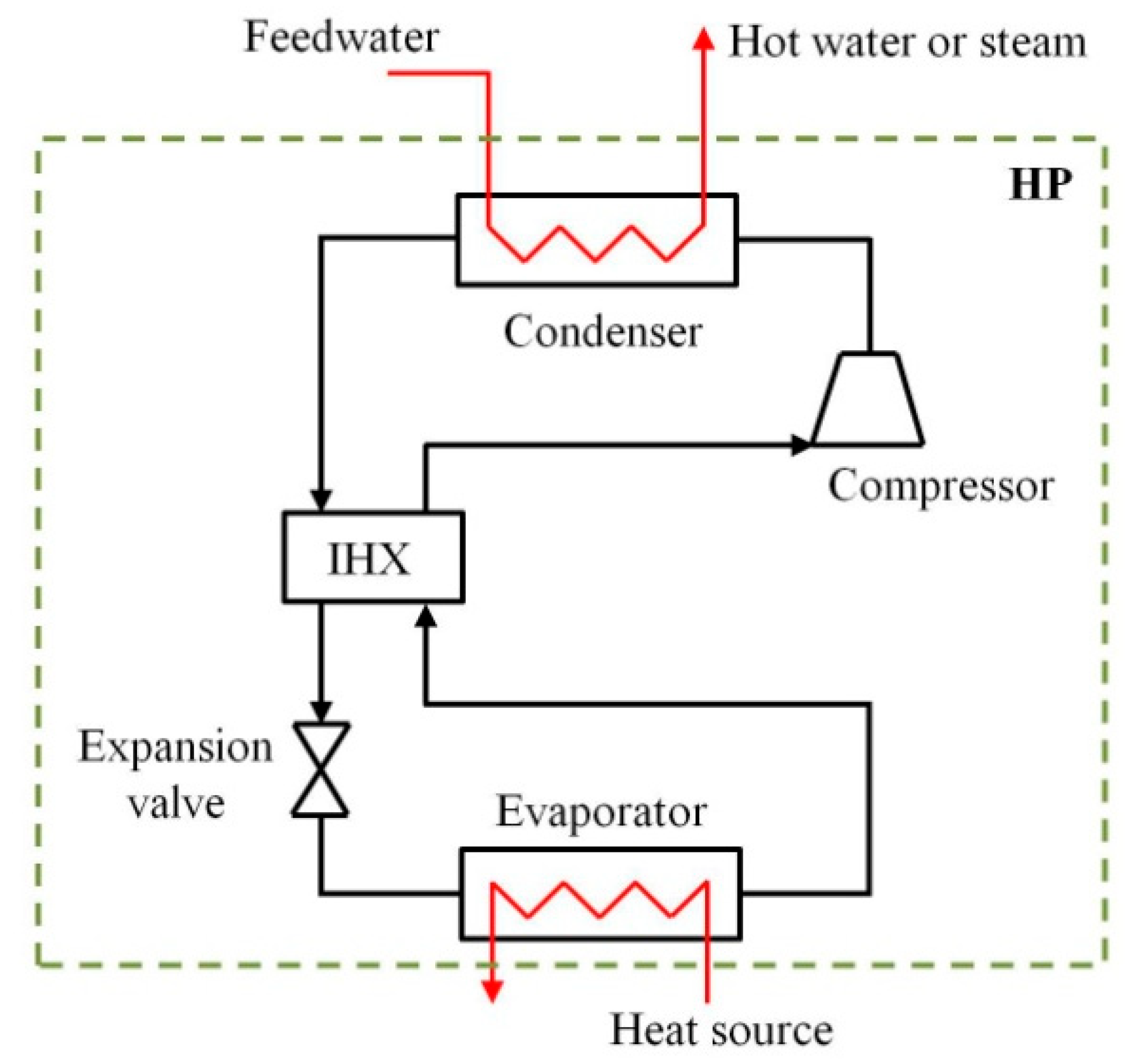
A schematic of a vapor compression HP involving an internal heat exchanger (IHX) is shown in
Figure 8. It is mainly used to prevent the compressor from running on liquid refrigerant (i.e., wet compression). On the one hand, it allows the evaporating and condensing heat transfer rates to be increased due to the decrease in the evaporator inlet enthalpy and the increase in the condenser inlet enthalpy, respectively; on the other hand, the compression work slightly increases. Regardless, the COP usually increases. The COP improvement strictly depends on the refrigerant as observed by Lee et al. [
34], who showed that using an IHX is more beneficial for R245fa rather than R134a.
The effect of an IHX on the performance of a SGHP was experimentally investigated by Kang et al. [
37]. These authors compared the performance of the SGHP with and without the IHX by varying the refrigerant (R245fa) mass flow rate passing the IHX, which was controlled through a bypass line placed on the low-temperature side of the IHX itself.
For a heat source temperature of 60 °C, these authors reported that the COP of the SGHP rises when using the IHX, although the compression work increases by 6.2% due to the increase in the degree of superheating at the compressor inlet (from 12 °C to 64 °C).
For a heat source temperature of 70 °C, the same authors investigated the SGHP performance for different IHX mass flow split ratios, defined as the mass flow rate entering the low-temperature side of the IHX over the total mass flow rate. Despite the increase in the condensing and evaporating heat transfer rates over the mass flow split ratio, the COP exhibits a maximum for a mass flow split ratio equal to 0.8. Additionally, the steam generation rate increases from 2.3 to 2.5 g/s when raising the mass flow split ratio.
4.2. Refrigerant Injection Technique
A promising technology to improve the performance of SGHPs operating in severe conditions is the refrigerant injection technique [
39].
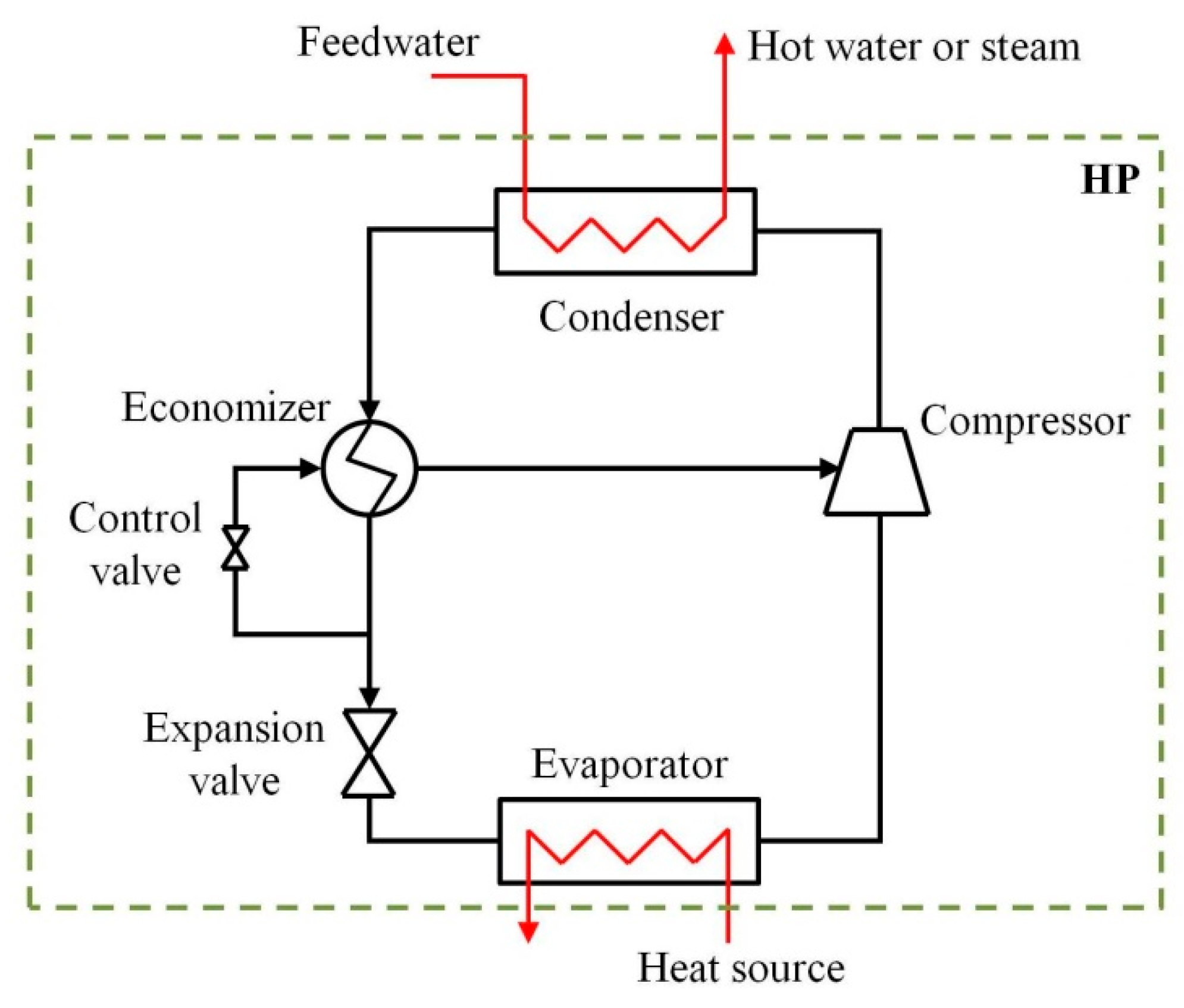
The schematic of a SGHP with the refrigerant injection technique is shown in
Figure 9. This figure shows not only the classical components of a HP but also an economizer and a control valve; note also that the compressor now has a supplementary inlet.
In fact, the refrigerant injection technique foresees that the liquid refrigerant outgoing from the economizer is split up in two parts: (1) a fraction is directed towards the evaporator through the expansion valve, and (2) the remaining part first goes through the control valve (where it expands and partially vaporizes due to the pressure drop) and then flows through the economizer where it receives heat to complete the vaporization from the liquid coming from the condenser; after that, it is injected in the compressor through the supplementary inlet (see
Figure 9).
Lu et al. [
39] proved that raising the injection ratio (defined as the ratio between the injected and the inlet mass flow rates in the compressor) from 0 to 0.5 is beneficial for the COP of a concept C-based SGHP when using different working fluids (i.e., R141b, R123, R245fa and R1234ze(Z)). Indeed, for constant operation conditions and an injection ratio equal to 0.5, the COP of the SGHP is at least 17% higher than that computed for a zero injection ratio. Moreover, the maximum COP rising was obtained for R123 (+18.6%), while the minimum rising (+17.5%) was for R1234ze(Z).
The enhancement of the COP versus the injection ratio can be justified by both the presence of the economizer and the vapor injection in the scroll compressor. On the one hand, when the injection ratio rises, the subcooling degree of the liquid refrigerant achievable in the economizer increases, the specific cooling effect at the evaporator is greater, and the heating power increases; on the other hand, the compression work is not significantly affected by the vapor injection in the compressor as it modifies the enthalpies of compression at the injection point, reducing the discharge temperature. As a result, the COP of the SGHP increases.
Moreover, the authors reported that the discharge temperature of the scroll compressor decreases by a few Celsius degrees when the injection ratio increases from 0 to 0.5. This was observed for all the considered refrigerants; in particular, the maximum reduction (4.3 °C) was obtained for R1234ze(Z), while the minimum one (1.2 °C) was obtained for R245fa.
The potentialities of the refrigerant injection technique were also investigated for a steam generating system involving two cascade HPs by Li et al. [
33]. The system studied by these authors is a HP split up in two sections: a low-temperature section and a high-temperature section. In the former, R134a is used as refrigerant, and it circulates in a classical closed-cycle HP in which the condenser is replaced by an intermediate heat exchanger; the latter presents an economizer producing the vapor injected in the compressor through the supplementary inlet. Moreover, the high-temperature section involves a supercooler at the condenser outlet to complete the condensation and subcooling process of selected refrigerants (namely, R245fa, R1234ze(Z) and R1336mzz(Z)).
According to these authors, the injection refrigerant technique can be beneficial for the high-temperature section. Indeed, in such a case the COP of SGHP exhibits a maximum over the vapor injection temperature, and it strictly depends on the refrigerant. Note that the injection temperature is related to the injection ratio: the injection ratio is higher, and the injection temperature is lower. The reason for the maximum in the COP should be sought in the presence of the low-temperature section, which in the cascade configuration can limit the benefits of a greater subcooling degree of the refrigerant and, consequently, the improvement of the heating capacity of the SGHP. The evaporation temperature of the high-temperature section is, in fact, greater than that of the single-stage HP configuration and, hence, the vaporization heat of the refrigerant can be lower.
4.3. Super Heating in Lubricated Compressors
Adequate superheating between lubricant temperature and refrigerant saturation temperature is crucial to avoid degradation of the lubricant in oil-lubricated compressors [
34]. Indeed, during operation the refrigerant mixes with the compressor lubricant. The concentration of the refrigerant in the lubricant depends on both the lubricant pressure and the temperature difference between the lubricant and the refrigerant saturation point. At constant pressure, the refrigerant concentration in lubricant steeply rises when lubricant temperature approaches refrigerant saturation temperature. Therefore, this temperature difference is an index of reliability. Moreover, when the degree of superheating is small, lubrication performance is impaired, especially for HFC refrigerants whose viscosity is much lower than that of pure lubricant [
34]. The position of the oil reservoir in the compressor determines whether suction superheating is needed to ensure compressor reliability rather than discharge superheating. In fact, to ensure lubrication performance, an adequate superheating degree should be guaranteed where the oil reservoir is located [
34]. In low-pressure shell compressors, oil reservoirs are usually placed in the suction port, while in high-temperature shell compressors they are placed in the discharge port.
Furthermore, the solubility and viscosity of the compressor lubricant also depend on the compressor discharge temperature [
40]. A higher discharge temperature causes degradation of the lubricant, yielding greater wear on mechanical parts. For this reason, the compressor discharge temperature is often limited by manufacturers.
5. Modified Thermodynamic Cycles for Steam Generation
Possible modifications to the thermodynamic cycle of a SGHP, aimed at managing large temperature lift and reducing exergy losses, are discussed here. In particular, basic auto-cascade and quasi-two-stage compression cycles are analyzed in
Section 5.1 and
Section 5.2, respectively, along with their enhanced versions.
5.1. Auto-Cascade Cycles
Achieving a larger temperature lift in single-stage cycles leads to an increased compression ratio, and, consequently, it raises manufacturing issues for compressor and reliability problems. Higher temperature lift can surely be obtained by means of cascade HPs involving two single-stage cycles that use refrigerants with different boiling points. However, they have higher costs and greater complexity.
An interesting approach to achieve a larger temperature lift is offered by the so-called “auto-cascade” cycles. Although auto-cascade cycles initially found application in freezing and cryogenic refrigeration, nowadays they are being studied in the field of SGHPs [
4,
59]. These particular cycles exploit the different boiling points of the components of zeotropic refrigerant mixtures. Specifically, they work in such a way that the refrigerant rich in the low-boiling-point component is conveyed to the evaporator, whereas the condenser is crossed by the refrigerant rich in the high-boiling-point component. This leads to a lower compression ratio [
63].
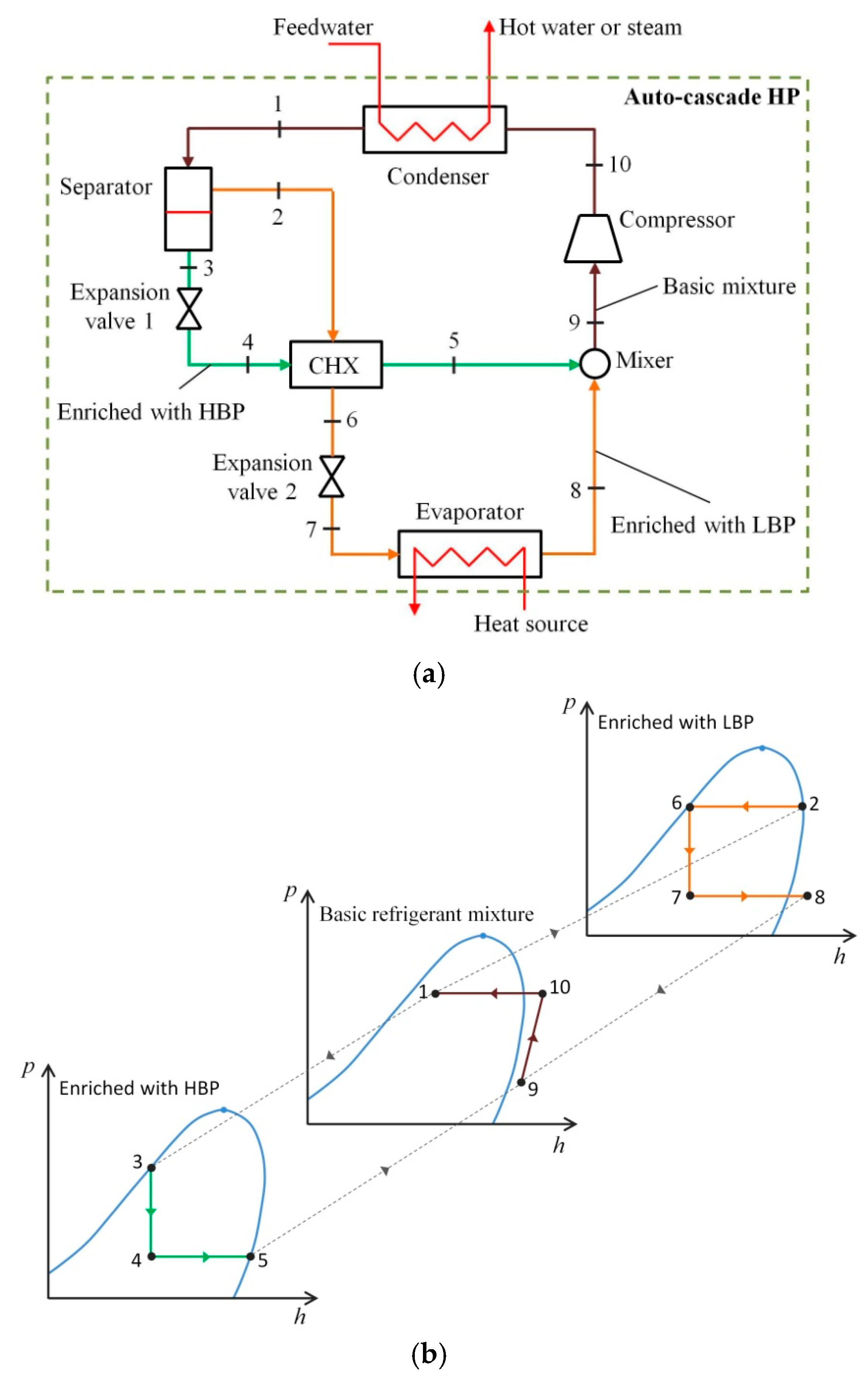
The basic auto-cascade cycle is depicted in
Figure 10a, while the related thermodynamic cycle (P-h diagram) is displayed in
Figure 10b. In addition to the single-stage cycle components it also foresees a separator, a cascading heat exchanger (CHX), a mixer and a second expansion valve.
The zeotropic mixture partially condenses as a liquid–vapor mixture in the condenser. This liquid–vapor mixture is then separated in the separator into two parts: a saturated liquid rich in the high-boiling-point component and a saturated vapor rich in the low-boiling-point component. The saturated liquid refrigerant goes through expansion valve I and then crosses the CHX where it undergoes evaporation into a saturated or superheated vapor before entering the mixer. On the contrary, the vapor refrigerant is sent to the CHX where it condenses into a subcooled liquid. This liquid flows through expansion valve II before absorbing heat in the evaporator, where it reaches a gaseous state and is sent to the mixer. After that, it is mixed with the vapor from the CHX before undergoing a compression transformation in the compressor to reach the vapor state at high temperature and high pressure. In the end, the basic mixture enters the condenser where it releases heat to produce high-temperature steam.
Although auto-cascade cycles are characterized by construction simplicity and flexibility, the partial condensation achieved in the condenser makes them inferior to the single-stage cycles in terms of thermodynamic performance [
59].
To improve their thermodynamic performance, several researchers suggested different approaches. For instance, these improvements include, but are not limited to, the introduction of one or more ejectors [
64] and using steam injection technique for compressors [
41,
65]. It is worth noting that an injector makes the performance of a HP more sensitive under variable operating conditions than steam injection [
41].
Moreover, in HPs designed for industrial steam generation, the heat source exploited in the evaporator often consists of wastewater, providing sensible heat with significant temperature variations; conversely, steam circulates in the heat sink of the condenser, absorbing latent heat with temperature variations equal to zero or almost zero. These features do not allow for perfect temperature matching when using either zeotropic mixtures or pure refrigerants. To achieve better temperature matching, Feng et al. suggested an improved auto-cascade cycle involving two-stage separation technology and two evaporators at different pressure levels [
59]. In the improved cycle, the wastewater (heat source) sequentially passes through the two evaporators, while atmospheric pressure water crosses the condenser to be transformed into steam for industrial processes. Also, to achieve further heating and pressurization, a steam compressor can be coupled with the heat pump. Additionally, the two separators allow the refrigerant enriched with the low-boiling-point components to be guided into the two evaporators. This new arrangement yields a higher evaporator pressure and, consequently, a reduction in compression power consumption. Moreover, in comparison to the basic auto-cascade cycle, it exhibits a lower vapor quality at the condenser outlet. As a result, the heat source utilization efficiency is enhanced.
For this cycle, Feng et al. [
59] tested four binary zeotropic refrigerant mixtures, namely R134a&R245fa used as reference case (denoted as R0 for short), R1234yf&R1234ze (Z) (denoted as R1), R1234ze(E)&R1224yd(Z) (R2) and R1234ze(E)&R1233zd(E) (R3). They reported that the mixture R3 exhibits the highest COP in comparison to R0, with a 4.4–4.9% improvement. On the contrary, the mixture R2 offers a lower COP with respect to the same R0. Also, according to the authors, the performance improvement observed when using the mixture R3 is due to the higher specific enthalpy difference at the condenser (i.e., the stronger heating capacity) on the one hand and the lower compression ratio obtainable with this mixture on the other hand.
In a very recent paper by the same authors [
4], vapor injection technology and parallel compression technique were incorporated into an auto-cascade-cycle-based SGHP in order to enhance the thermodynamic performance of the system and reduce compressor power consumption. Moreover, to enable the simultaneous production of steam at two different temperature levels, two-stage condensation technology was included. This also enhances the temperature-matching capabilities of the condenser. Authors reported that their improved auto-cascade cycle yields a COP increase of 18.17–37.4% compared to the single-stage closed-cycle-based HP and 6.3–21.2% compared to the basic auto-cascade cycle. The highest thermodynamic performance was achieved using the zeotropic mixtures consisting of R1234ze(E)& R1336mzz(Z).
5.2. Quasi-Two-Stage Compression Cycle
As HP-based steam generation requires a large amount of heat to convert water into steam, a significant amount of refrigerant mass should circulate in the system. As a result, the exergy losses in the compressor and expansion valve may be significant. To reduce these losses by improving the thermodynamic performance of the SGHP, the flash vapor supplementation technology can be applied.
One of the earliest applications based on this technology is the quasi-two-stage compression (QTC) system [
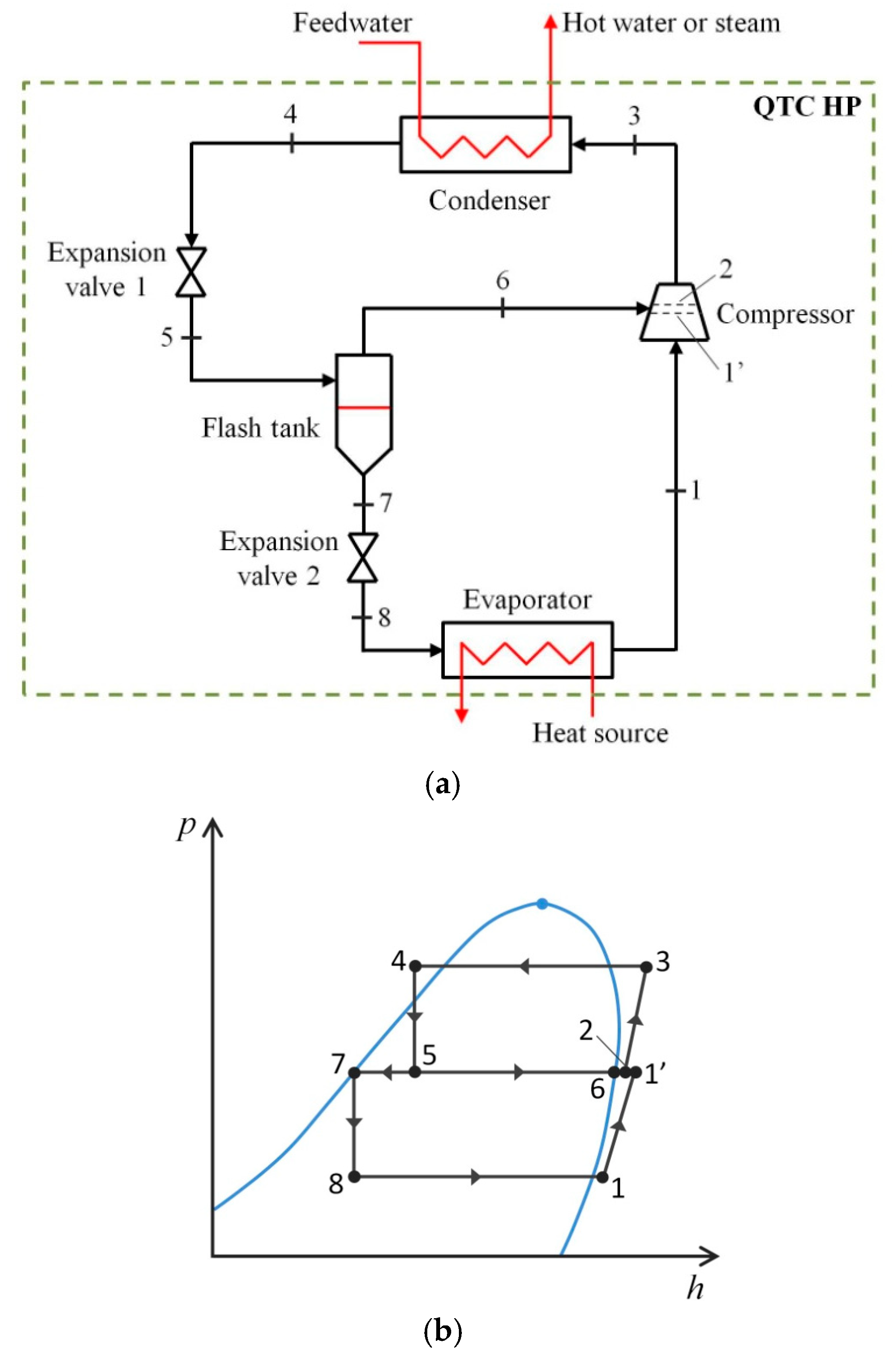
66]. As shown by
Figure 11a, a QTC system consists of a flash tank integrated into the HP cycle. The refrigerant (wet vapor) outgoing from the first expansion valve enters in flash tank, and it is separated here into a saturated vapor (sent directly to the compressor) and a liquid fraction (sent to the evaporator through a second expansion valve). Note that the evaporation pressure can be lower compared to a classical vapor compression cycle HP. For the sake of completeness, the P-h diagram of the QTC cycle is shown in
Figure 11b.
Zhang et al. [
66] showed that when the condensation temperature is 120 °C and R245fa is used as refrigerant, the QTC system has a COP approximately 16% higher than that obtained with a single-stage HP.
It is worth noting that in a previous paper it was shown that the COP of a QTC system could be increased by 5% by including an IHX [
67].
Regardless, to further reduce the exergy losses, the same authors suggested to adopt a dual-flash vaporization process: two flash tanks are added to the system instead of one [
66]. To investigate the beneficial effects of the dual-flash process, these authors considered three different system configurations. The new system consists of an evaporator, two compressors, a buffer tank (between the compressors), a condenser, two flash tanks and three expansion valves. Each configuration has a particular connection between the flash tanks and the compressors.
The authors reported that when using the best configuration with a condensation temperature of 120 °C, the COP of the dual-flash process is 18% higher than that of a QTC system and 31% higher than a single-stage HP.
7. Conclusions
The growing interest in SGHP technology to achieve the European industry decarbonization targets has been outlined in the present review. Regarding the available technology, the following conclusions can be highlighted:
Concept A- and C-based SGHPs can benefit from gas compression cycles to reach higher supply steam temperatures, despite these cycles offering lower performances for steam generation due to the sensitive heat discharged.
Concept B- and D-based SGHPs allow the highest supply temperatures and pressures to be reached thanks to the integration with steam compression systems (MVR or TVR). However, this integration leads to higher construction costs.
SGHPs can rely on promising new eco-friendly refrigerants, such as HFOs, HCFOs, some HCs and natural refrigerants (including their zeotropic mixtures).
The auto-cascade cycle and its improved configurations are promising alternatives to standard HP cycles, allowing the full potential of new zeotropic mixtures to be exploited.
Reduction in exergy losses in SGHPs can be reached through QTC cycles and flash vapor supplementation technology.
Moreover, using an internal heat exchanger and/or refrigerant injection technique can increase the thermodynamic performance of both standard and non-standard compression cycle-based steam generating systems. Furthermore, TOPSIS method, advanced exergy analysis, exergy-based cost minimization and combined HP–compressor design method are helpful optimization tools to enhance the design of a SGHP. Lastly, further improvements can be achieved by using the available tools to select the most suitable working fluid.
Although some of the concepts reviewed in this work achieved the highest technology readiness level (system testing in a real operational environment), in order to enable a widespread use of SGHPs in industries, it is still necessary to up-scale some of these systems to reach heating power above 10 MWth. This objective cannot be separated from the need for policies and incentives that support industries to introduce SGHPs into their processes. Electricity pricing, which makes HPs the most competitive option, is one of the strategies for accelerating their spread.