Review

Recent Progress in Experimental Techniques for Thin Liquid Film Evaporation

1
Institute of Building Environment and Sustainable Technology, School of Human Settlements and Civil Engineering, Xi’an Jiaotong University, Xi’an 710049, China
2
Zhongxing Telecommunication Equipment Corporation, Shenzhen 518055, China
*
Author to whom correspondence should be addressed.
Energies 2026, 19(3), 664; https://doi.org/10.3390/en19030664
Submission received: 23 December 2025 / Revised: 17 January 2026 / Accepted: 21 January 2026 / Published: 27 January 2026
(This article belongs to the Special Issue Innovations in Thermal Energy Processes and Management)

Abstract

Thin liquid film evaporation leverages latent heat and low thermal resistance to achieve superior heat transfer capabilities, making it pivotal for next-generation high-heat-flux thermal management systems. This paper presents a systematic review of the fundamental mechanisms, interfacial transport behaviors, and experimental techniques associated with static thin films and falling liquid films. This work elucidates the complex coupling of Marangoni convection, van der Waals disjoining pressure, and contact line dynamics. These mechanisms collectively govern film stability and the intensity of non-equilibrium phase change in the micro-region. The influence of surface wettability and dynamic contact angle hysteresis on hydraulic replenishment and dry spot formation is critically analyzed, offering insights into optimizing surface engineering strategies. In addition, the review categorizes advanced non-intrusive diagnostics, including optical interferometry, laser-induced fluorescence (LIF), and infrared thermography, evaluating their capacity to resolve spatiotemporal variations in film thickness (ranging from 10 nm to several μm) and temperature under complex boundary conditions. Special attention is directed toward falling film evaporation over horizontal tubes, addressing flow regime transitions and the impact of interfacial shear from external airflow. The work concludes by identifying key challenges in multi-physics coupling and proposing future directions for synchronized diagnostics and adaptive surface design.

1. Introduction

Efficient heat transfer has long been a central research focus in the fields of energy engineering, chemical processes, HVAC systems, and electronic device cooling. With the rapid advancement of modern industry and information technology, thermal management challenges have become increasingly prominent [1]. In particular, the power density of microchips has been growing at a rate of approximately 10–15% per year in recent years, and the local heat flux has already exceeded 1000 W/cm2, posing unprecedented challenges to conventional cooling technologies [2].
However, traditional single-phase forced convection is limited by the thermal conductivity of the working fluid and the boundary layer thickness; as a result, its heat transfer coefficient has approached the theoretical limit, making further enhancement under limited temperature differences extremely difficult. The heat transfer coefficient serves as a key parameter for evaluating thermal transport performance.
To overcome this bottleneck, researchers have increasingly turned their attention to two-phase heat transfer, particularly evaporative heat transfer that exploits the latent heat of liquid–vapor phase change [3]. This mechanism enables a substantial increase in heat flux under relatively small temperature differences and has therefore become a research focus for next-generation high-efficiency thermal management technologies.
Data show that single-phase forced convection generally exhibits heat transfer coefficients in the range of 102–104 W/(m2·K), whereas traditional phase-change processes such as boiling can increase this value to approximately 105 W/(m2·K). Remarkably, emerging heat transfer enhancement techniques such as ultrathin liquid film evaporation and micro-channel cooling can achieve coefficients on the order of 105–106 W/(m2·K) [4], representing several orders of magnitude improvement over conventional methods. The key advantage of two-phase heat transfer lies in its ability to significantly enhance the heat transfer capacity per unit area while simultaneously reducing energy consumption and temperature fluctuations [5]. Among the various two-phase heat transfer mechanisms, thin liquid film evaporation has attracted particular attention due to its extremely low thermal resistance and highly efficient phase-change heat transfer. When a liquid forms a thin film with a thickness ranging from nanometers to micrometers on a heated surface, the internal thermal conduction resistance becomes negligible, and the evaporation rate is primarily governed by the interfacial phase-change process. This implies that maintaining the continuity and stability of the liquid film is crucial for sustaining efficient heat transfer. Consequently, thin liquid film evaporation is considered a key mechanism for dissipating high heat fluxes at the chip scale and plays an essential role in various advanced thermal management systems, including micro heat pipes, flat heat pipes, loop heat pipes, spray cooling, and micro-channel evaporators.
At the macroscopic and engineering application level, another important form of liquid film evaporation is falling film evaporation. Falling film flow refers to a process in which a liquid forms a continuous, dynamic film along a heated surface and flows downward under the influence of gravity or shear forces. Unlike microscale thin liquid films, falling films are generally thicker; however, their heat transfer performance is still strongly dependent on the film’s flow regime, wave characteristics, and stability [6]. An excessively thin film tends to rupture and form dry patches, leading to local overheating and a dramatic decline in heat transfer performance. Conversely, an overly thick film increases thermal conduction resistance, thereby reducing evaporation efficiency. Consequently, optimizing liquid film flow and surface design to control film thickness distribution, enhance film stability, and improve phase-change efficiency has become a key research direction. The study of thin film and falling film evaporation holds not only significant theoretical value but also broad engineering applicability. For instance, in power plant condensers, seawater desalination units, and chemical distillation columns, falling film evaporation and condensation serve as critical processes for energy transfer and mass separation. In building HVAC systems, membrane-based evaporative coolers can significantly reduce energy consumption [7]. Meanwhile, in aerospace and high-performance computing, microscale thin film evaporation is regarded as a promising approach to achieving lightweight and highly efficient thermal management solutions. These diverse application backgrounds collectively drive the continuous advancement of liquid film evaporation theory, experimental techniques, and numerical modeling methods. From a mechanistic perspective, thin liquid film evaporation is an intrinsically complex phenomenon involving multi-scale and multi-physical coupling processes. Parameters such as film thickness, flow regime, surface tension gradient, thermo-capillary convection, vapor shear stress, contact line dynamics, and surface wettability all exert significant influence on evaporation intensity. Numerous studies have demonstrated that surface wettability and contact angle are critical factors in determining the morphology and stability of liquid films [8]. Hydrophilic surfaces promote the spreading of liquids, maintain a more uniform film thickness, and thus enhance evaporation efficiency. In contrast, hydrophobic surfaces tend to cause film rupture and the formation of dry spots, which may improve local heat transfer but lead to overall instability. Therefore, surface modification techniques such as micro/nanostructure design, hydrophilic–hydrophobic patterning, and surface coatings are crucial for precisely controlling film distribution and improving system performance.
To gain deeper insight into the complex behavior of liquid film evaporation, researchers have developed a range of advanced experimental characterization techniques. These include white-light interferometry for submicron-scale film thickness measurement, laser-induced fluorescence (LIF) for temperature field mapping, particle image velocimetry (PIV) for velocity field analysis, and digital holographic microscopy for capturing three-dimensional film morphology. The integration of these methods enables a quantitative description of the entire film evolution process, thus providing a solid experimental foundation for validating theoretical models and numerical simulations. Meanwhile, advances in high-performance computing have facilitated the development of multi-scale numerical models, making it possible to simulate liquid film evaporation processes involving phase change, thermo-capillary effects, and contact line dynamics.
In summary, thin film and falling film evaporation represent key mechanisms for achieving efficient heat transfer, offering significant potential for future research and engineering applications. Nevertheless, several challenges remain unresolved, including an incomplete understanding of multi-physical coupling mechanisms, insufficient models for predicting film stability, and experimental limitations under complex boundary conditions. To address these gaps, it is essential to systematically review and synthesize existing research in this field, identify current scientific and technical bottlenecks, and clarify future research priorities. The objective of this paper is to provide a comprehensive review focusing on the formation mechanisms of thin and falling films, the influence of surface wettability and contact angle, and advanced experimental techniques. By integrating theoretical and experimental findings, this work aims to assess the advantages, limitations, and applicability of various approaches and to offer insights and theoretical guidance for the design of next-generation high-efficiency evaporative heat exchangers. To ensure a systematic and comprehensive overview, the literature selection for this review was conducted primarily using the Web of Science Core Collection and Google Scholar databases. The search strategy focused on identifying key developments over the past decade, while also including seminal classical studies to establish the theoretical foundation. The search queries combined keywords related to the core physical phenomena (e.g., “thin liquid film evaporation,” “falling film,” “heat transfer”), interfacial properties (e.g., “wettability,” “contact angle,” “solid-liquid interface,” “hydrophilic/hydrophobic surface”), and diagnostic methods (e.g., “experimental techniques,” “measurement methods”). In terms of inclusion criteria, this review prioritizes experimental investigations and numerical studies validated by experiments. Theoretical mechanisms are primarily synthesized in the early sections to provide context, while the latter sections focus on the evaluation of advanced experimental measurement techniques.
The remainder of this review is organized as follows: Section 2 establishes the theoretical foundation, synthesizing evaporation mechanisms and the role of surface wettability. Section 3 evaluates measurement techniques for static thin films, focusing on the fundamental resolution of thickness and temperature. Section 4 extends this discussion to the more complex regime of falling film evaporation, critically reviewing the evolution of flow diagnostics from simple probes to advanced optical coupling.

2. Evaporation in Thin Liquid Films

2.1. Evaporation Mechanism

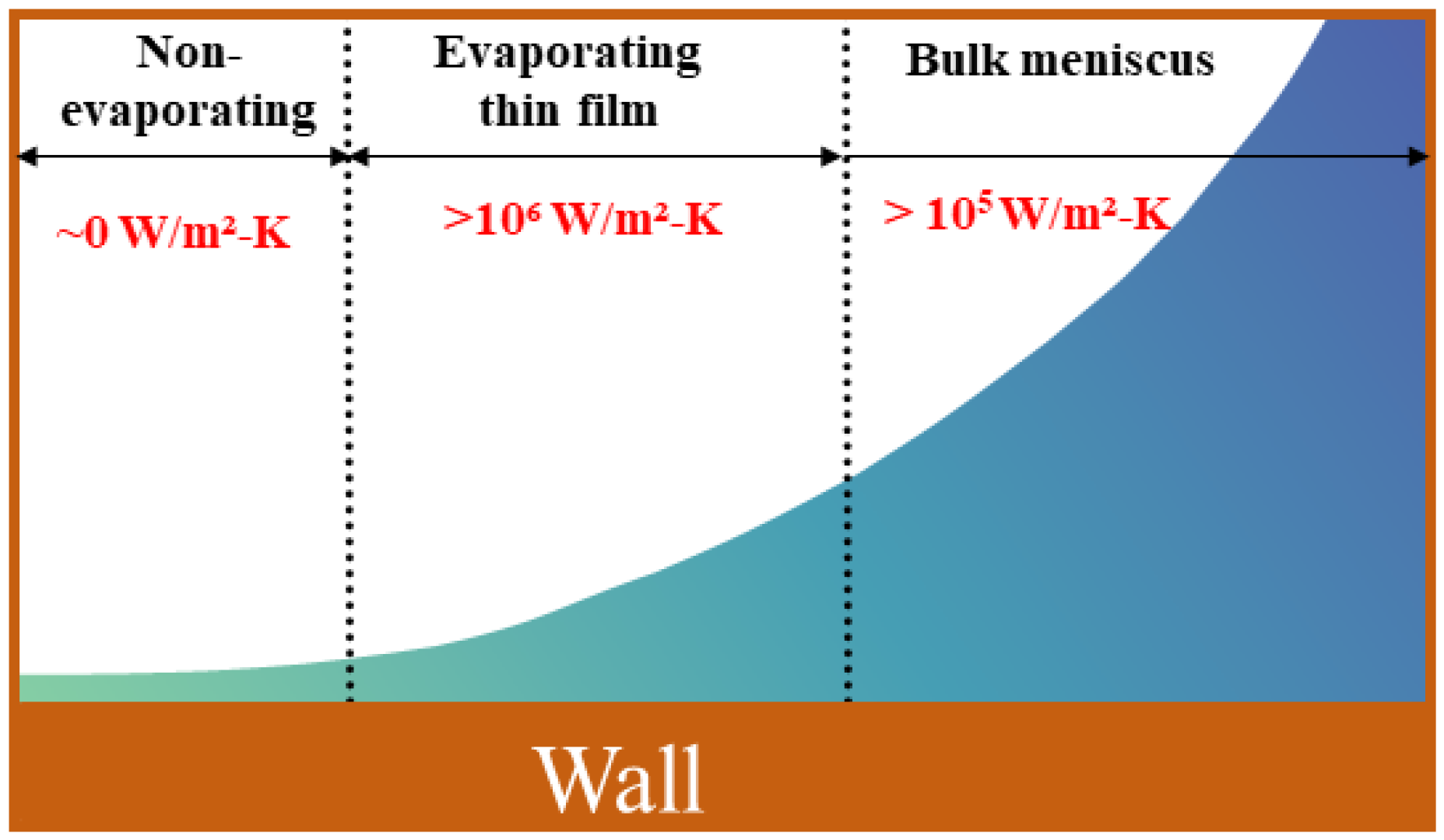
Thin liquid film evaporation is recognized as one of the most efficient heat transfer mechanisms, owing to its dual advantages of utilizing the large latent heat of phase change while maintaining a low thermal resistance across the liquid–vapor interface. Unlike pool boiling or convective evaporation, thin film evaporation is dominated by interfacial phenomena, where both heat and mass transfer occur within micrometer- or sub-micrometer-scale liquid layers. Therefore, gaining an in-depth understanding of the underlying mechanisms of thin film evaporation is essential for the development of advanced cooling technologies applicable to high heat flux scenarios. The classical description of thin film evaporation typically divides the liquid meniscus into three distinct regions, as illustrated in Figure 1: the non-evaporating film, the thin film region, and the bulk meniscus region. In the non-evaporating region, the film thickness is usually only a few molecular layers, where molecular adsorption forces dominate, and evaporation can be neglected. The thin film region, often referred to as the micro-region, exhibits the highest evaporation rate, since the local film thickness is comparable to the capillary length, resulting in maximum heat conduction efficiency. Finally, in the bulk meniscus region, the evaporation rate is limited by diffusion through the relatively thick liquid layer.
Studies typically indicate that the micro-region can contribute up to 60–80% of the total heat transfer under evaporation-dominated regimes [9]. The local heat transfer performance in the thin film region is significantly influenced by several coupled physical mechanisms. First, a temperature gradient along the interface induces a surface tension gradient, generating Marangoni convection, which enhances liquid replenishment near the evaporative front. Ahmadian-Yazdi and Eslamian [10] experimentally observed that Marangoni-induced circulatory motion on heated substrates redistributes liquid from the bulk region to the thin film region, thereby substantially delaying film dry-out. However, it is critical to note that the role of Marangoni convection is not universally stabilizing. While it typically replenishes liquid to the thin film region, conflicting findings exist where strong thermo-capillary stresses induce instability rather than stability. Second, molecular interactions such as van der Waals disjoining pressure play a crucial role in determining the equilibrium thickness and stability of the liquid film. Molecular dynamics simulations have shown that stronger solid–liquid interactions yield thinner and more stable films, reducing thermal resistance and enhancing interfacial heat flux density [11]. In recent years, research has increasingly focused on the active control of liquid film morphology to maximize the effective evaporative area. For instance, Li et al. [12] proposed a patterned surface that spatially confines the film into micro-bridge structures, effectively extending the evaporation front. Experimental results revealed that, compared with a flat substrate, such a patterned surface achieved over 40% enhancement in the overall heat transfer coefficient. These findings highlight the critical role of surface morphology in regulating film stability and evaporation performance.
Despite significant progress, several challenges remain in fully characterizing thin film evaporation and developing comprehensive models. On the one hand, the dynamic evolution of film thickness is highly transient and extremely sensitive to local disturbances, making in situ measurements difficult. Current research employs advanced techniques, such as laser-induced fluorescence (LIF), optical interferometry, and high-speed infrared thermography, to capture film thickness and temperature distributions with high spatial and temporal resolution. However, achieving synchronous visualization of these quantities together with the flow field remains technically challenging. On the other hand, at the modeling level, conventional continuum mechanics approaches struggle to accurately capture heat transfer in the adsorbed and transition regions, where non-equilibrium effects, molecular layering, and interfacial thermal resistance are non-negligible. Consequently, multi-scale numerical models that couple continuum fluid dynamics with molecular dynamics (MD) simulations are emerging as powerful tools for elucidating nanoscale transport mechanisms.
In summary, thin film evaporation provides an effective route for achieving ultra-high heat flux dissipation. A deeper understanding of the interactions among interfacial transport, Marangoni convection, and disjoining pressure is key to optimizing surface structures and operating conditions. Future research should focus on three major directions. First, it is essential to develop more accurate multi-physics models to capture non-equilibrium interfacial effects. Second, experimental techniques must be advanced to allow for the simultaneous measurement of film thickness, temperature, and flow fields. Finally, bioinspired and hierarchical surface designs should be explored to maintain film stability under extreme heat flux conditions.
These efforts are expected to establish a foundation for next-generation evaporative cooling systems, enabling substantial improvements in thermal performance and operational reliability.

2.2. Wettability and Contact Angle

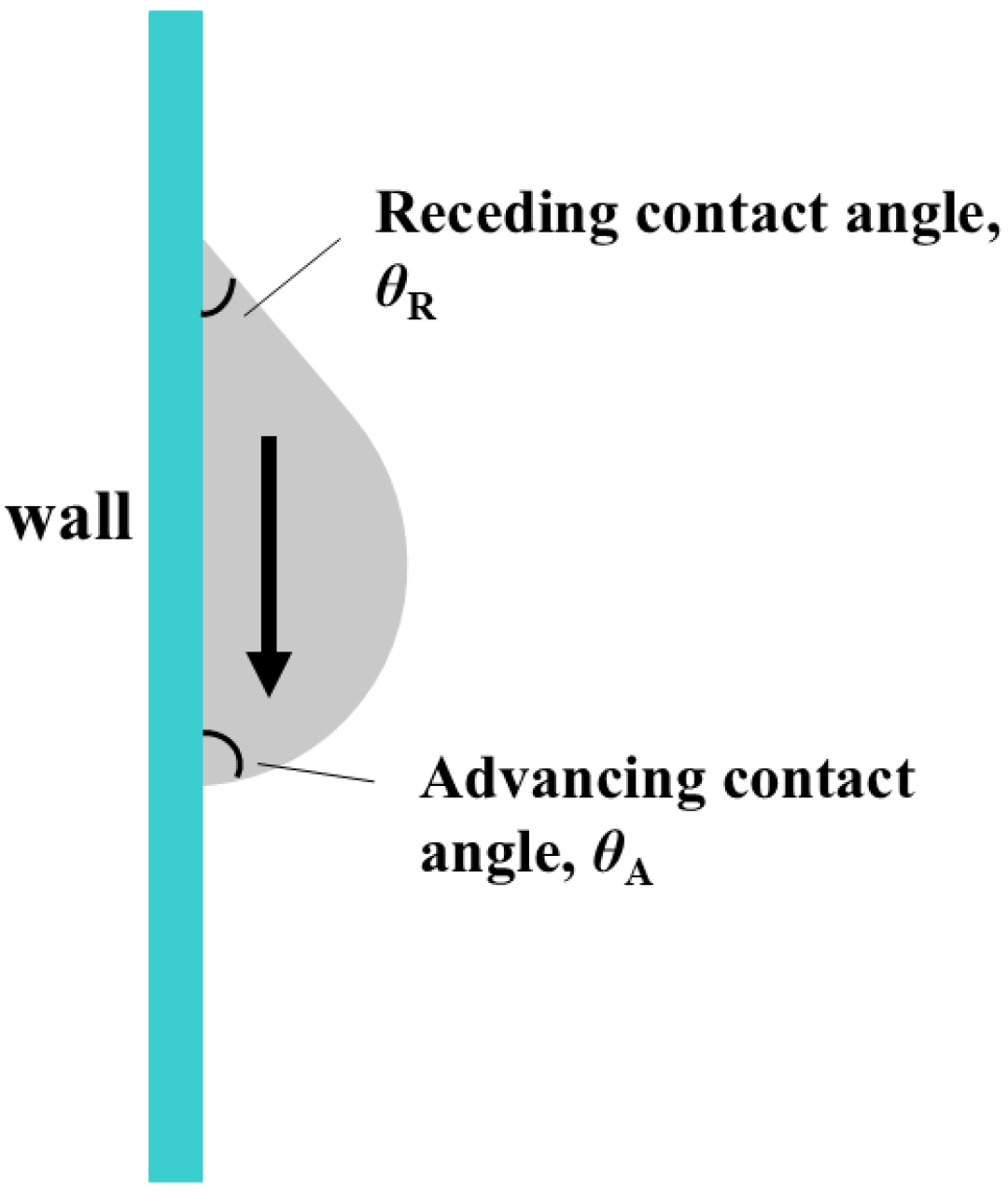
The solid–liquid interaction exerts a direct and profound influence on the process of thin film evaporation. The mechanical and thermal conditions near the three-phase contact line determine the formation, thickness distribution, stability, and liquid replenishment capacity of the film, all of which directly control the evaporative flux within the thin-film or micro-layer region [13]. For clarity, wettability-related characteristics are typically classified into three categories: the intrinsic or equilibrium contact angle (reflecting the inherent interfacial balance), the apparent contact angle (a macroscopic manifestation affected by surface roughness or chemical heterogeneity), and the dynamic contact angle (advancing contact angles/receding contact angles that occur under moving or flowing contact line conditions) [14]. As illustrated in Figure 2, the advancing contact angle appears along the direction of liquid motion, while the receding contact angle is observed on the trailing side of a moving droplet [15]. These three types of contact angles play distinct roles across different scales and operating conditions in thin film evaporation.
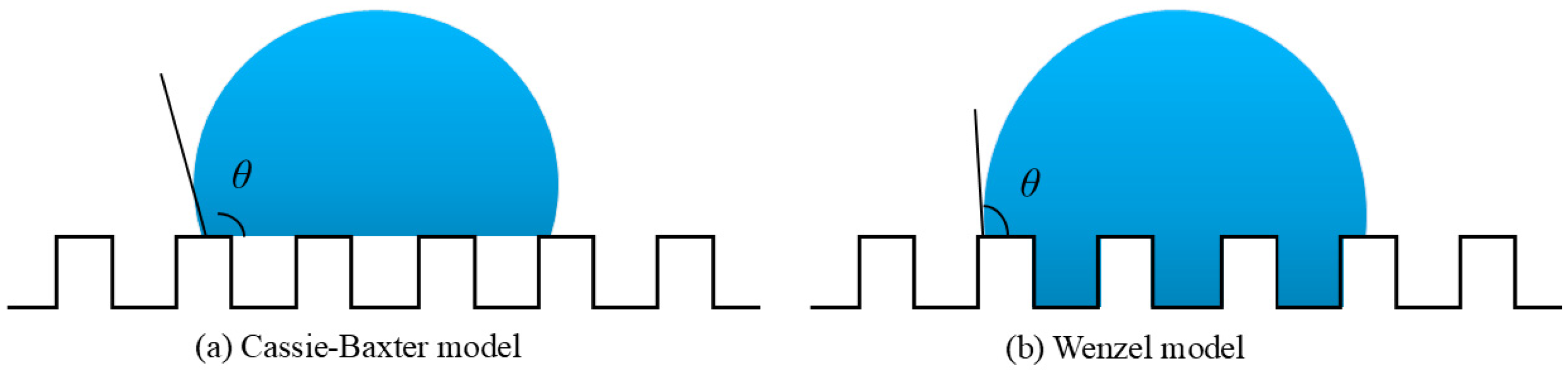
The intrinsic contact angle, defined by the Young equation [16], represents a geometric manifestation of the interfacial tension balance at the solid–liquid–vapor equilibrium. It reflects the inherent surface energy of the solid and the intrinsic wettability of the liquid [17]. In the thin film region, when the solid surface is chemically homogeneous and microscopically smooth, conditions under which Young’s assumptions approximately hold, the intrinsic contact angle predominantly determines the local initial wetting state and the driving force for microscopic capillary replenishment. However, practical surfaces typically exhibit non-ideal characteristics, where surface roughness and chemical heterogeneity alter the macroscopic wettability behavior, leading to the so-called apparent contact angle. The Wenzel and Cassie–Baxter models provide classical frameworks for understanding apparent wettability on rough surfaces. As shown in Figure 3, in the Wenzel state, the liquid completely wets the rough structures, and the apparent contact angle is amplified by the roughness factor, making hydrophilic regions more hydrophilic and hydrophobic regions more hydrophobic [18,19].
In contrast, the Cassie–Baxter state corresponds to composite solid–air contact, exhibiting super-hydrophobicity and reduced solid–liquid contact area [14]. In evaporative systems, the apparent contact angle determines the projected geometry of the contact line and the effective contact area between the liquid film and the solid surface, thereby influencing the local heat flux density and the length of the evaporative front. More importantly, the dynamic contact angle, defined as the instantaneous angle during contact line motion, plays a critical role in film stability. In falling film flows, interfacial waves and surface oscillations cause the contact line to continuously advance or recede, leading to an asymmetry between advancing and receding angles, which results in contact angle hysteresis. The relationship between dynamic contact angle and contact line velocity can be approximately described by the Cox–Voinov theory, though corrections are often required under high shear, high evaporation rates, or conditions involving interfacial chemical kinetics [20]. In falling film evaporation, the dynamic contact angle affects several key behaviors: local film thickness near the contact line, capillary backflow rate, and the local relaxation induced by evaporation. When the contact angle advances, the liquid film can spread into previously dry regions, replenishing the evaporative front. Conversely, when the contact line recedes or becomes pinned, local dry spots tend to form, resulting in a sharp decline in heat transfer performance. Additionally, a critical discrepancy often arises when equilibrium contact angle models are applied to dynamic evaporation. Experimental evidence confirms that the contact angle is highly dynamic, decreasing with increasing wall temperature and evaporation rates. Simulations relying on static equilibrium angles fail to capture this velocity-dependent behavior, leading to distorted predictions of the wetted area and local heat flux distribution. This mismatch between static theoretical models and dynamic experimental realities remains a primary source of error in predicting dry spot formation. To characterize dynamic contact angle behavior, experiments typically employ high-speed shadow graphic imaging to record the rapid evolution of the meniscus. Captured image sequences are processed using edge detection algorithms to locate the liquid–solid interface coordinates frame by frame. By correlating instantaneous contact angles with contact line velocity, contact angle hysteresis can be quantified, providing an effective means for investigating thin liquid film stability and the formation mechanism of dry spots.
Surface modification and the presence of surfactants further complicate the coupling between wettability and evaporation dynamics. The adsorption of surfactant molecules at the solid–liquid interface alters the local surface tension and modifies the spatial distribution of Marangoni stresses [21]. There are usually two competing effects as described below. On the one hand, rapid adsorption of certain surfactants can lower surface tension and enhance wettability (reducing the contact angle), thereby promoting continuous film formation and improving liquid replenishment stability. On the other hand, non-uniform surfactant distribution may induce solutal or interfacial Marangoni flows, which can either enhance or suppress local evaporation depending on the direction of concentration gradients and adsorption/desorption kinetics. As summarized by Kalam [21], both the kinetics of surfactant adsorption and the equilibrium thickness of the adsorbed layer directly affect the time-dependent evolution of the contact angle. Under conditions of rapidly changing evaporation rates, this temporal lag can make the short-term behavior of the contact line highly unpredictable. In falling film systems, strong solutal Marangoni effects may even trigger reverse flow, disrupting the normal capillary replenishment mechanism and inducing premature dry-out.
In addition, the reactivity of the solid surface significantly affects evaporation. Kumar and Prabhu [22] systematically reviewed this distinction, noting that in certain cases, chemical reactions or dissolution between the liquid and solid can alter the surface energy over time, thereby changing the equilibrium contact angle and the contact line dynamics. This is particularly important during long-term operation or high-temperature evaporation, where progressive surface chemical transformations modify the wetting and adsorption characteristics of the thin film, influencing long-term evaporation stability. For practical devices, this implies that material–fluid compatibility and long-term interfacial interactions must be considered, rather than relying solely on the initial contact angle.
Empirical and theoretical studies have established several general correlations between wettability and evaporation performance. In general, stronger hydrophilicity favors the formation of uniform, continuous, and thinner films, reducing liquid-phase thermal resistance and enhancing the steady-state evaporation flux. However, excessive hydrophilicity can lead to excessively thick films, especially under strong replenishment conditions, increasing conduction resistance and reducing instantaneous evaporation efficiency. Conversely, hydrophobic or hybrid hydrophilic–hydrophobic designs can enhance local heat transfer by manipulating film distribution and the position of the evaporative front, though often at the cost of film continuity [23]. In practical engineering, the theory of wettability directly translates into two key design strategies for evaporation systems: delaying dry spots and extending the film area. Enhancing macroscopic hydrophilicity is the primary strategy for suppressing dry spot formation in engineering applications [24]. For falling film evaporators, super-hydrophilic coatings facilitate rapid rewetting of dry spots, thereby maintaining effective heat transfer area even at low flow rates. In practical design, surface patterning enables active manipulation of liquid film morphology to maximize performance. A notable example is the work by Li et al. [12], who designed a patterned surface confining the liquid film space into stable micro-bridges. This topological modification significantly extended the length of the three-phase contact line—the region of highest evaporation intensity. Experimental benchmarks confirm that this design achieves an overall heat transfer coefficient improvement exceeding 40% compared to conventional unstructured surfaces. Therefore, for practical engineering applications, a hybrid design approach is recommended: utilizing high-surface-energy (hydrophilic) materials to ensure global liquid film stability, while employing microstructures to maximize the density of thin film evaporation regions [7,14].
In dynamic visualizations of falling film flow, the transient response of the contact angle couples strongly with film waves, leading to pronounced spatial non-uniformity in film thickness. Variations in dynamic contact angle can cause local thickening near wave crests and thinning near troughs, affecting the localization of evaporation and the initiation of dry spots. Experimental studies have consistently shown that, under the same average flow rate, surfaces exhibiting smaller contact angle hysteresis can delay dry spot formation and sustain longer periods of efficient evaporation. Furthermore, contact angle hysteresis itself is often associated with surface roughness, chemical heterogeneity, and the presence of adsorbed layers. Hence, maintaining surface consistency and cleanliness is essential to ensure experimental reproducibility and reliable operation performance in arrayed heat transfer devices.
In summary, the solid–liquid contact angle and surface wettability influence thin film evaporation through four interconnected mechanisms. First, these factors control initial film spreading and local thickness, which directly determines the thermal resistance of the liquid phase. Second, they regulate contact line motion and hysteresis. These dynamics govern fluid replenishment and the formation of dry spots. Third, wettability couples with surfactant adsorption and chemical reactions to modify surface tension distributions. This interaction can either induce or suppress Marangoni-driven flows. Finally, surface microstructures alter the length and spatial distribution of the evaporative front through apparent contact angle effects. Consequently, high-efficiency devices require the joint optimization of static and dynamic contact angles. Surface microstructures and interfacial chemistry must also be tuned to ensure both performance enhancement and operational robustness.

3. Static Thin Liquid Film Measurement

3.1. Liquid Film Thickness

Historically, the study of liquid film evaporation traces back to the seminal theoretical works of Nusselt on laminar film condensation and Kapitza on wavy film hydrodynamics. While early experimental validation relied heavily on visual observation and intrusive mechanical probes, the mid-20th century saw the introduction of electrical methods (e.g., capacitance sensors) for mean thickness monitoring. However, it was not until the advent of laser-based diagnostics in the late 1990s that researchers could resolve the microscopic mechanisms predicted by Derjaguin’s disjoining pressure theory. This review bridges these eras, focusing on how modern techniques have evolved to validate these classical theories with unprecedented spatiotemporal resolution. The following section systematically reviews the commonly used techniques for film thickness measurement through emphasis on their applicability, limitations, and recent advances.
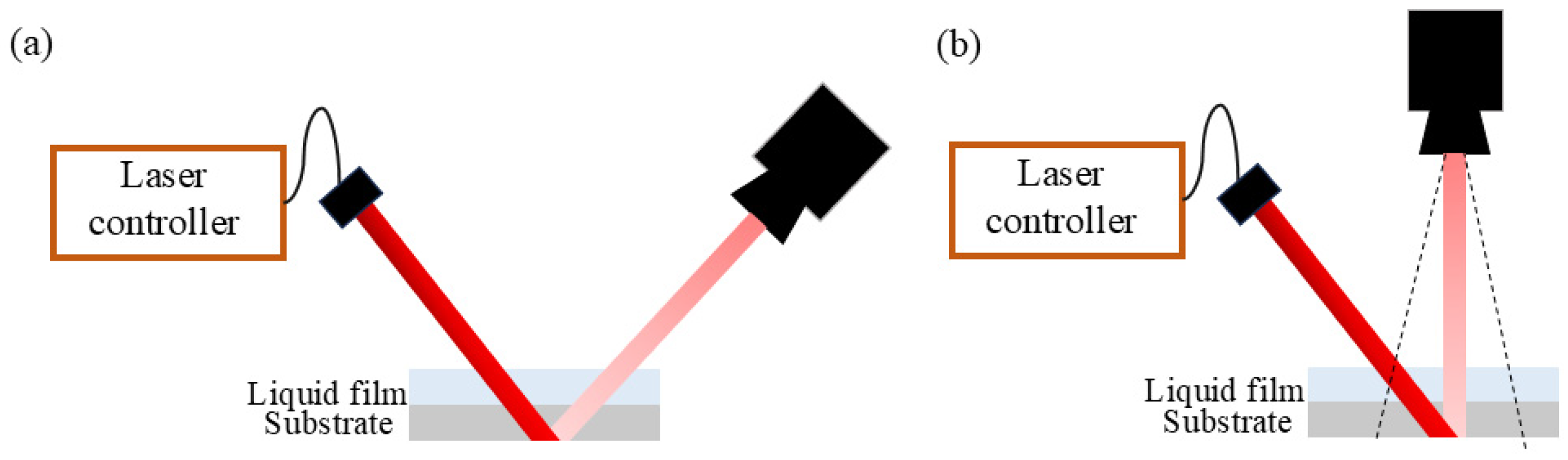
Optical measurement techniques are the most widely employed methodologies for liquid film thickness determination. These approaches infer film thickness based on the propagation, interference, reflection, or absorption of light transmitted through or reflected by the liquid layer. The classical laser and interference methods were among the earliest used for measuring film thickness. For example, Gatapova [25] applied image analysis interferometry and the gradient filter Schlieren method to measure thin liquid film thickness (40 nm–20 µm) and analyze droplet evaporation rate. Xue et al. [26] further summarized the applicability and error control of interferometric methods for thin film thickness measurement. The main advantages of interferometry include high spatial resolution (ranging from nanometer to micrometer scale), non-intrusive operation, and minimal disturbance to the liquid surface. However, this technique is less effective for highly scattering, turbid, opaque liquids, and it requires precise control of substrate smoothness, refractive index uniformity, and light source stability. The near-infrared (NIR) absorption imaging method, as illustrated schematically in Figure 4, has been introduced for film measurements. This technique estimates film thickness by relating the reduction in transmitted light intensity to the path length of light through the film [27]. Lubnow et al. [27] implemented a time-multiplexed NIR technique to achieve high-frame-rate imaging of film thickness. The NIR method performs well within the tens to hundreds of micrometers thickness range, but its accuracy is limited by the calibration of the liquid absorption coefficient, scattering effects, and the precision of background reflection correction. Another commonly used optical technique is laser-induced fluorescence (LIF) imaging [28]. In this method, a small concentration of fluorescent dye is dissolved in the liquid, and the film thickness is derived from the calibration curve relating fluorescence intensity to film thickness. This technique is particularly suitable for transparent or semi-transparent liquids, and it is frequently combined with particle image velocimetry (PIV) or micro-PIV (μPIV) to obtain coupled velocity–thickness field information in fluid dynamic and film flow studies. However, LIF measurements are subject to several limitations, including dye-induced perturbation of liquid properties, fluorescence bleaching, self-absorption, and non-uniform light intensity, all of which must be carefully controlled during experimental design.
In addition to the classical optical techniques discussed above, total internal reflection microscopy (TIRM) is another powerful method for measuring extremely thin liquid films. Grasso et al. [29] quantitatively analyzed the accuracy and error sources of the TIRM technique for film thickness measurement. TIRM utilizes the critical angle reflection phenomenon in total internal reflection imaging to determine the radius of the interfacial reflection ring, from which film thickness can be inferred. A geometric relationship between the reflection ring diameter and the film thickness enables TIRM to achieve measurement resolutions at the micrometer or even sub-micrometer scale. However, this method requires highly smooth interfaces, and errors may arise from overlapping reflection rings or interfacial inhomogeneities.
Another widely used approach is based on electrical methods, including conductivity and capacitance-based sensing. These techniques operate on the principle that a liquid film bridging electrodes alters either conductive or capacitive properties, allowing thickness to be correlated with electrical signals. Lee and Kim [30] demonstrated the feasibility of using a three-electrode conductivity sensor to measure film thickness. Such probes are typically arranged in interdigitated electrode configurations, employing high-frequency AC signals to minimize polarization effects. The advantages of these methods include fast response, simple structure, and the ability to implement real-time arrayed monitoring. However, the liquid must possess adequate electrical conductivity, and fluctuations in temperature or concentration can affect the signal. Furthermore, the probes themselves may slightly disturb the film surface, and their spatial resolution is generally lower than that of optical methods. Capacitance-based sensors have also been developed for non-conductive or organic liquids. Yu et al. [31] proposed a high-resolution capacitive sensor with a dielectric coating for measuring thin films of viscous liquids. By applying a dielectric layer of known properties over the electrodes, the design improves both the linearity and stability of the measurements.
Acoustic and ultrasonic techniques offer strong penetration capabilities, making them particularly suitable for environments where optical access is limited. These methods typically employ pulse-echo techniques to determine the travel time or multiple reflection signals of ultrasonic waves within the liquid film, from which the film thickness is derived. Several studies [32] utilized ultrasonic probes to measure film thicknesses ranging from tens of micrometers to several millimeters, while other studies applied low-frequency ultrasound for similar monitoring purposes [33]. The main advantages of acoustic methods include applicability to opaque liquids, the ability to penetrate walls, and robustness in field conditions [34]. Their disadvantages include low resolution (particularly at the lower thickness limit, where signal overlap occurs), velocity calibration errors, and significant interference from interface reflections and multiple echoes. For ultrathin films (a few micrometers), echo overlap and poor signal-to-noise ratio necessitate frequency-domain analysis or signal matching techniques to extract valid thickness data.
Atomic force microscopy (AFM), as a scanning probe technique, can provide topographical information at the nanometer scale and has been widely applied for studying adsorbed films, capillary structures, and interfacial molecular layers [35]. AFM determines thickness by monitoring the feedback between the probe and the film surface via repulsive or adhesive forces, allowing reconstruction of surface morphology. AFM offers unique capabilities for exploring adsorbed films, capillary configurations, and the microscale structure near the contact line. However, due to its slow scanning speed, limited scanning area, and inability to perform real-time measurements under flowing or dynamic film conditions, it is primarily used for static films or for characterizing initial surface states [36].
Ellipsometry, another optical method, infers film thickness and optical constants from the change in the polarization state of light upon reflection at the film–substrate interface. It is a highly sensitive, non-contact measurement technique widely applied in semiconductor thin film and coating studies. Politano et al. [37] provided a comprehensive review of ellipsometry’s principles, model fitting, error analysis, and application prospects in thin film thickness measurement. In the context of liquid film research, ellipsometry is particularly effective for stable or slowly varying films where thickness can be determined with sub-nanometer accuracy. Its limitations lie in its difficulty in analyzing non-uniform or wavy films, as well as its inability to capture high-frequency dynamic fluctuations. In practical film thickness measurement studies, the complementary use of multiple techniques is often necessary. For instance, in fundamental research, interferometric or phase-shifting interferometry and ellipsometry can be used to establish high-precision calibration standards, which are then complemented by electrical or ultrasonic sensors for real-time monitoring. In practical experimental applications, high-speed LIF or NIR absorption imaging is often employed as the primary technique, supported by electrode probes or ultrasonic transducers for calibration and validation. Table 1 summarizes the advantages, disadvantages, and applicability of several existing methods. The selection of static film measurement techniques depends primarily on the film thickness range. For ultrathin films (<10 μm) dominated by disjoining pressure, interferometry and ellipsometry are the preferred choices due to their nanometer-level vertical resolution. Conversely, for thicker films (>100 μm) where macroscopic behaviors dominate, confocal displacement sensors offer a more robust and cost-effective solution. Besides, the values for uncertainty and resolution represent typical ranges derived from the cited references. Actual performance may vary depending on specific experimental configurations (e.g., optical magnification, sensor sensitivity) and calibration protocols.
In summary, for microscale films or regions near the contact line, high-resolution optical techniques, interferometry, phase-shifting interferometry, TIRM, or ellipsometry are preferred. For fundamental studies of ultrathin films (<10 μm) dominated by disjoining pressure, interferometry is the most effective technique. For opaque liquids or complex environments, ultrasonic and electrical sensing approaches are advantageous, while AFM remains indispensable for studying static films or adsorbed molecular layers. Future developments in film thickness measurement should focus on enhancing dynamic resolution, particularly through high-frame-rate imaging, real-time signal processing, multi-technique hybrid calibration, and improved error compensation (e.g., correction of temperature, solute concentration, sound velocity, and refractive index effects), as well as extending these techniques to complex geometries and non-ideal operating conditions.

3.2. Temperature Measurements

The temperature field of a thin liquid film is a key factor governing evaporation intensity and local heat transfer performance. It is strongly coupled with both the film thickness, as discussed in Section 3.1. Therefore, accurate temperature measurement within thin liquid films is fundamental to elucidating heat transfer mechanisms. The interfacial temperature directly determines the local evaporation flux, superheat distribution, and Marangoni flow driven by temperature gradients. Consequently, achieving high spatial and temporal resolution in film temperature measurement is a prerequisite for understanding evaporation mechanisms and developing validated predictive models. However, measuring the temperature field in thin films presents several major challenges [39]. Film thicknesses span a wide range, extending from nanometers to hundreds of micrometers. Therefore, measurement techniques must effectively cover these multiple spatial scales. Beyond spatial constraints, evaporation processes involve rapid transients like local dry-out and contact line jumps. Capturing these dynamic events necessitates high temporal resolution. Furthermore, high-precision techniques often require complex experimental calibration for parameters such as emissivity. The measurement process itself can also interfere with the system by introducing thermal disturbances. Based on these constraints, commonly used temperature measurement techniques for thin films, along with their respective advantages, limitations, and recent developments, are summarized below. Planar laser-induced fluorescence (PLIF) represents one of the most widely used and spatially precise optical temperature measurement techniques in studies of thin films and microscale phase-change processes [40]. A temperature-sensitive fluorescent tracer is dissolved in the liquid, and the fluorescence intensity or lifetime is correlated with local temperature through calibration curves. When combined with high-frame-rate imaging, PLIF can capture transient interfacial temperature distributions with millisecond or even microsecond temporal resolution. Classical reviews have shown that single-dye intensity-based PLIF is strongly affected by laser intensity non-uniformity, self-absorption, and tracer concentration fluctuations. Consequently, modern approaches predominantly employ two-color LIF or lifetime-based LIF to eliminate these interferences and improve robustness. Koegl et al. [28] systematically evaluated the temperature sensitivity, photo-stability, and self-absorption characteristics of several tracers in cooling and lubricating oils as well as common heat transfer fluids. They further demonstrated the feasibility of dual-color ratio techniques for simultaneous measurement of film temperature and thickness, which have been successfully applied in recent experiments involving impinging jet and confined jet cooling configurations. Moreover, advances in dual-tracer and multichannel PLIF techniques have extended their applicability to broader temperature ranges and complex chemical systems, improving reliability in solute-containing or highly absorbing liquids [41]. Overall, PLIF remains the preferred technique for thin film studies under optically accessible conditions (i.e., transparent or weakly scattering liquids with compatible dyes), particularly in investigations of thermo-mass coupling near the contact line.
Infrared (IR) thermography provides a convenient, non-contact, full-field temperature measurement method suitable for macroscale and mesoscale investigations, such as evaluating the surface temperature and transient heat flux fluctuations of heated substrates. Recent developments have significantly enhanced its performance through higher frame rates, visible–IR coaxial imaging, and IR-transparent heater designs, achieving spatial resolutions down to tens of micrometers and temporal resolutions exceeding 1000 frames per second [42]. These advances enable visualization of rapid heat flux fluctuations and wet–dry transition cycles in micro-channel boiling and thin film evaporation experiments. It should be noted that IR thermography is highly sensitive to surface emissivity, and for semi-transparent or ultrathin films where the thickness is comparable to or smaller than the IR wavelength, transmitted and reflected radiation from the substrate can introduce substantial errors. Therefore, it is often necessary to apply high-emissivity coatings, employ multi-wavelength or multi-angle correction techniques, or use calibrated thermocouples for validation. The combination of high-speed IR thermography with optical visualization has recently become an important diagnostic tool for analyzing transient thermal events in micro-channels and droplet-based cooling systems, providing critical insight into macroscale and microscale heat flux dynamics.
Thermo-chromic liquid crystals (TLCs) and thermo-sensitive coatings provide a convenient means of visualizing temperature distributions, particularly when isothermal contours or localized temperature mapping are desired. Compared with infrared thermography, TLCs offer the advantages of intuitive color visualization, high spatial resolution, and insensitivity to emissivity variations. However, TLCs’ drawbacks include a narrow operating temperature range, sensitivity to illumination and chemical compatibility, and a relatively slow temporal response. Studies [43] on embedded thermo-chromic crystal arrays and thin films have demonstrated that TLCs can serve as complementary temperature diagnostics for wall surfaces within micro-channels or confined geometries, when combined with IR thermography for cross-calibration. TLCs can significantly improve local temperature accuracy. Therefore, for experiments requiring high-resolution mapping within a narrow temperature window on the film surface, TLCs remain an effective option, provided that their temperature calibration and encapsulation are carefully designed to prevent chemical interactions with the liquid film or heating substrate.
For applications demanding ultrahigh spatial resolution or targeting nano-scale/microscale thermal phenomena, such as investigating molecular layers near the contact line, adsorbed films, or temperature gradients across the three-phase region, techniques including time-domain thermo-reflectance (TDTR), static/transient Raman thermometry, and thermo-reflectance-based pump–probe techniques have shown great potential [44]. These laser-based methods enable the measurement of transient thermal responses and heat diffusion at the sub-micrometer scale, and they are widely used to study solid thin films and interfacial thermal resistance. Recent advances in instrumentation and data analysis have significantly improved their sensitivity and temporal precision. Nonetheless, applying these methods directly to liquid films remains challenging due to optical heating effects at liquid interfaces and the inherently weak Raman signals in pure liquids. Consequently, these techniques are mainly employed for studying solid film interfaces or specific sub-problems in thin film research that require micro/nanoscale reference data. With ongoing improvements in laser and detector technology, TDTR and Raman thermometry are expected to play an increasingly important role in future solid–liquid interfacial thermal studies [45], although they have not yet become mainstream tools for conventional thin film evaporation experiments.
In summary, for static or quasi-static thin films, if the liquid is transparent and compatible with fluorescent tracers, carefully calibrated two-color or lifetime-based PLIF should be the preferred technique for obtaining high-resolution interfacial temperature profiles. For studies focused on microscale wall surfaces or conductive materials, high-frame-rate infrared thermography, with proper emissivity and transmission/reflection corrections, is most suitable. When narrow-range, high-resolution visual mapping is required, TLCs offer a practical solution. For investigations involving nanometer or sub-micrometer scales or interfacial thermal resistance, TDTR and Raman thermometry serve as valuable supplementary techniques. Ultimately, the choice of measurement method should be guided by factors such as film thickness, optical/electrical properties of the liquid, experimental visibility, and temporal resolution requirements. Whenever possible, multi-method cross-calibration is recommended to ensure data traceability and reliability.

4. Falling Liquid Film Measurement

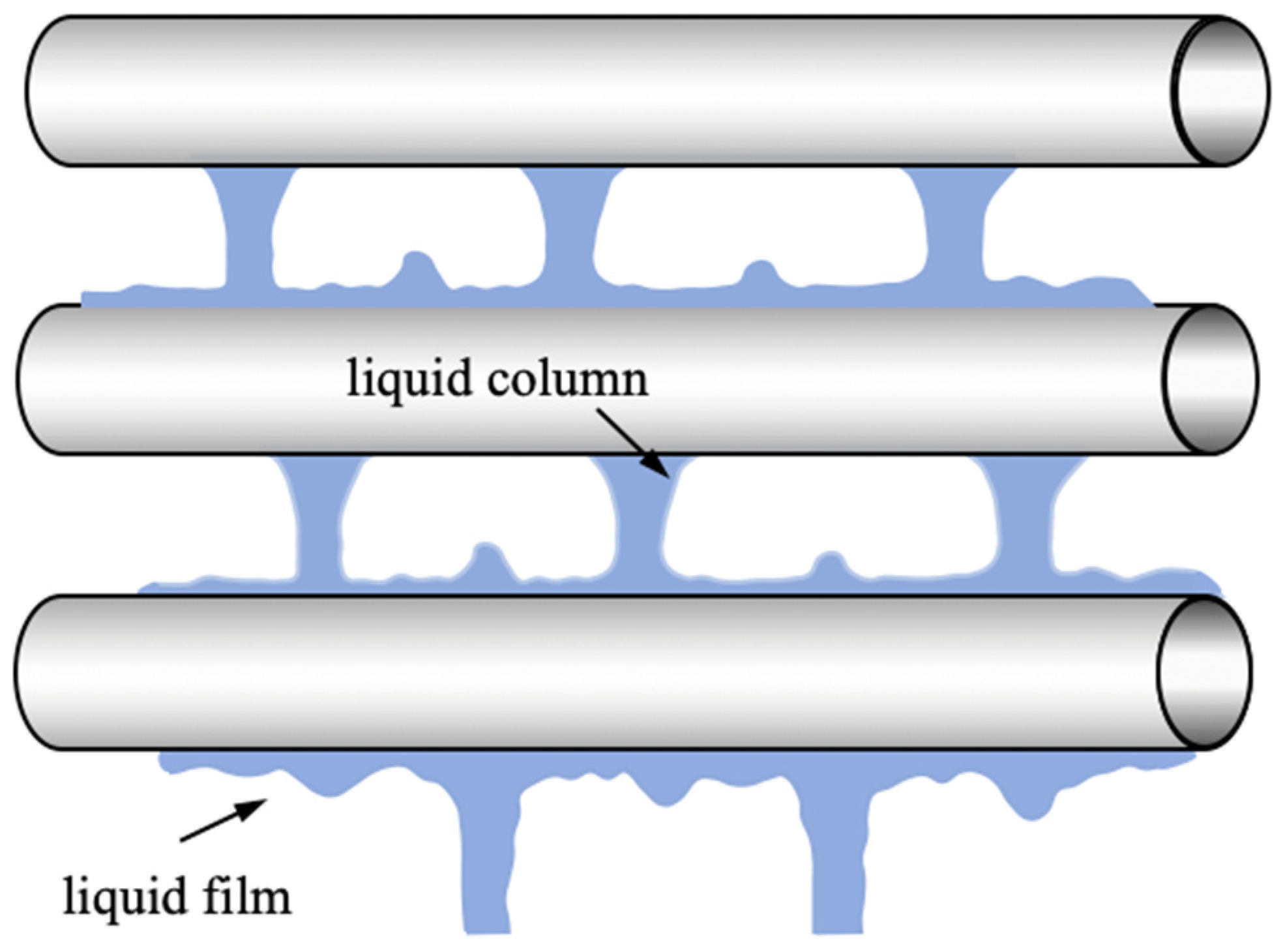
Falling film flow has received extensive attention due to its efficient phase-change heat transfer characteristics. Compared with static liquid films, the falling film flow process is more complex, particularly on the surface of circular tubes. As shown in Figure 5, the liquid film thickness and temperature distribution exhibit significant inhomogeneity, with multi-directional motion occurring both along and perpendicular to the tube, and the flow is strongly affected by airflow disturbances [46]. Therefore, accurate measurement of the key parameters of falling film flow, including falling film thickness, temperature, and flow state, is not only a crucial topic in experimental research but also the foundation for developing high-efficiency heat exchange equipment and improving theoretical models. This section will review the relevant experimental methods, technical advancements, and existing challenges from three aspects: falling film thickness measurement, temperature measurement, and flow state measurement.

4.1. Falling Film Thickness

Accurate measurement of liquid film thickness in falling film evaporation systems has long been essential for understanding the mechanisms of heat transfer and fluid flow. The film thickness not only directly determines thermal resistance and evaporation intensity but also influences surface temperature distribution and the formation of dry patches. Hence, the evolution of thickness measurement techniques reflects the continuous advancement of experimental methodologies, from early coarse measurements using contact-based probes to the recent adoption of optical, imaging, and advanced sensor-based non-intrusive techniques. Researchers have progressively transitioned from qualitative observation to quantitative characterization.
For falling films over flat plates, studies on thickness distribution have reached a mature stage; however, increasing attention has recently been devoted to the measurement and analysis of film distribution in flows around single tubes and tube bundles. These investigations have revealed significant non-uniformities in both circumferential and axial directions and have challenged the applicability of classical theories such as the Nusselt model under curved geometries. This section summarizes recent progress in measuring film thickness over tubes and tube bundles, emphasizing the employed techniques, representative experimental setups, comparative advantages and limitations, and emerging trends.
The evolution of film thickness measurement techniques reflects a clear transition from intrusive point-probing to non-intrusive full-field imaging. Early investigations primarily relied on mechanical micrometers and electrical contact probes. For instance, Hou et al. [47] utilized displacement micrometers to map circumferential thickness, establishing fundamental correlations between film thickness and tube spacing. However, these contact-based methods inherently disturb the flow field and are limited to discrete measurement points [48]. To overcome these limitations, optical non-contact methods have been employed to obtain more detailed film distribution data around tubes. With advances in optical measurement technology, laser interferometry and light reflection techniques have gradually replaced traditional methods. Interferometric techniques infer the film thickness from the phase difference of reflected light at the film surface, offering submicron-level resolution capable of capturing minute thickness fluctuations [49]. However, such methods are prone to signal distortion when the film surface exhibits strong undulations or roughness; thus, special optical arrangements and data filtering algorithms are required for dynamic falling film studies. In recent years, fluorescence-based imaging techniques have gained prominence. By adding fluorescent tracers to the working fluid, researchers can visualize two-dimensional film thickness distributions using laser-induced fluorescence (LIF) assisted approaches [50]. These techniques are non-intrusive and highly sensitive, making them particularly suitable for capturing complex film morphologies in tube-based falling film systems. Chen et al. [51] successfully visualized the two-dimensional film topology of seawater films. This technological leap allows for the precise identification of film thinning near the φ = 90° region without flow perturbation. Consequently, the current trend focuses on integrating these optical methods with high-speed imaging to resolve the spatiotemporal evolution of dry spots under complex aerodynamic conditions.
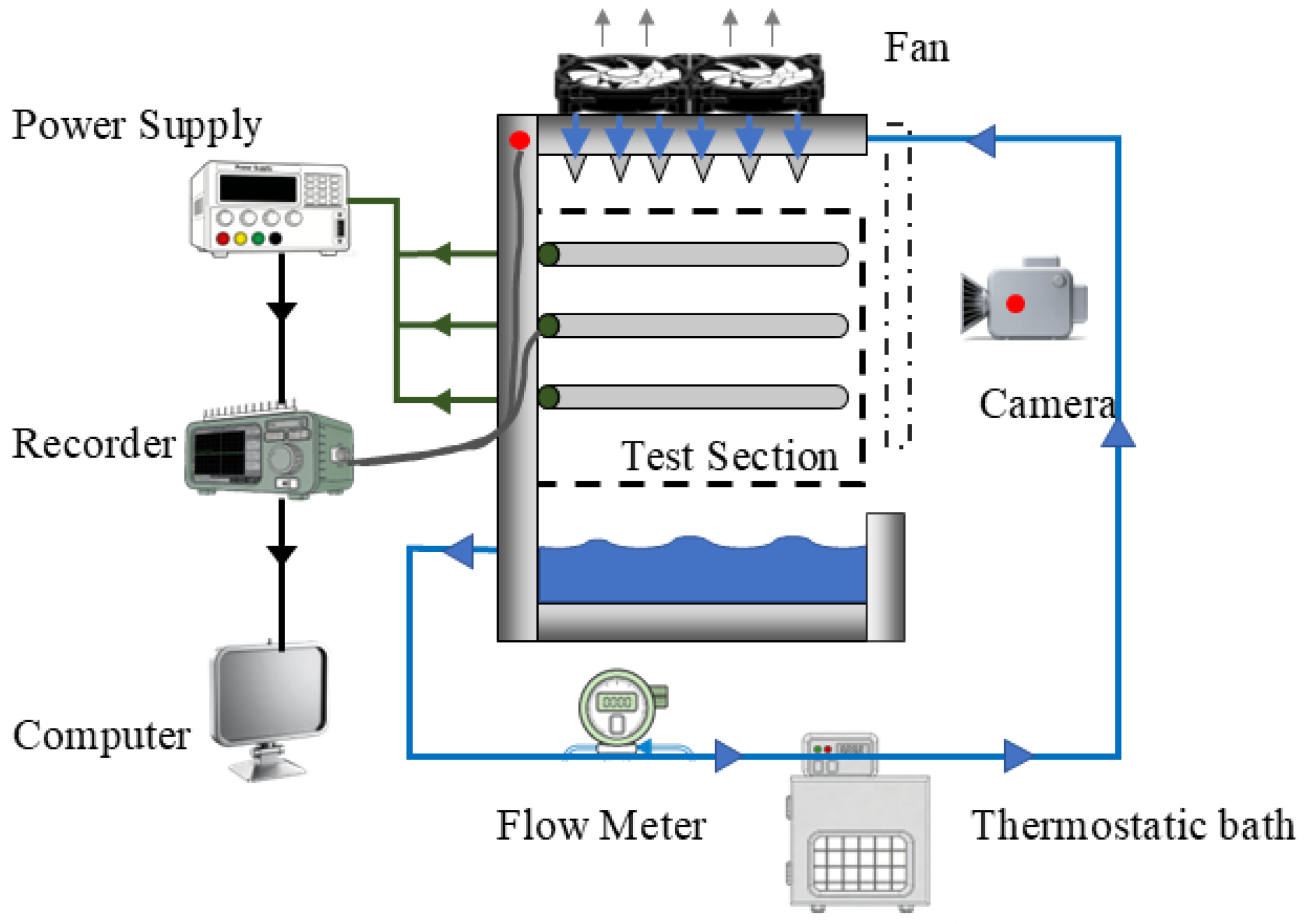
Beyond optical techniques, electrical resistance tomography (ERT) and electrical capacitance tomography (ECT) have also been utilized for film thickness measurement. These methods employ multi-electrode arrays to capture cross-sectional electric field distributions, followed by inverse algorithms to reconstruct the film thickness profile [52]. The main advantage of these techniques lies in their ability to perform real-time monitoring of dynamic processes, making them suitable for multiphase and opaque systems. However, their spatial resolution remains limited, preventing the capture of microscale fluctuations. In practical falling film conditions, the liquid film often exhibits wave-like structures, and the measurement becomes more challenging around curved tubes due to curvature-induced asymmetry [47]. Studies have shown that film distribution tends to be uniform at low Reynolds numbers, whereas at higher Reynolds numbers, periodic waves and dry patches appear, imposing higher demands on measurement techniques. Comparative analyses between numerical simulations and experimental data have further driven the refinement of measurement methods, improving the accuracy of film thickness prediction. Three-dimensional simulations of columnar liquid flows have also provided valuable insights into spatial thickness variations. Volume of fluid (VOF)-based numerical simulations indicate that in columnar flow regimes, the film exhibits pronounced axial and circumferential thickness fluctuations. Under conditions of small tube spacing and low Reynolds numbers, the film tends to be thicker on the outer side of the column and between adjacent columns, while thinning or dry spots may appear beneath the tube bundle. Wang et al. [53] simulated cases with tube spacing of 10–30 mm and Reynolds numbers between 221 and 295, finding that film thickness was larger at wave crests and that the separated segments of the liquid column exhibited greater thickness than predicted by the classical Nusselt solution. With fixed tube geometry, axial position was shown to have a strong influence on film thickness. Recent experiments have also examined film thickness distributions in falling films subjected to cross-flowing air. Xu et al. [54] used electrical conductivity probes to measure both axial and circumferential film thickness around tube bundles under cross-flow conditions. The results revealed that cross-flow disrupted the circumferential symmetry of the film, shifting the thinnest region to between 100° and 120°. Along the axial direction, the inter-column region exhibited alternating wave crests and troughs, which were influenced by wind velocity and tube spacing. Figure 6 shows a typical experimental setup for measuring falling film flow. By changing external conditions, the flow of the outer water film under wind shear conditions can be measured [55]. Based on these findings, several recommendations and trends can be summarized for film thickness measurement in tube and tube bundle systems. In terms of experimental setup, multiple viewing angles should be employed to achieve circumferential coverage. When feasible, either rotating cameras or rotating tubes can be used to mitigate occlusion effects. In optical measurements, refraction and reflection corrections are crucial, and factors such as tube wall material, transparency, refractive index, and optical path design must be carefully considered. The selection, concentration, and quenching behavior of fluorescent dyes should be calibrated in advance. When airflow is present, simultaneous measurement of film thickness and flow parameters is recommended to analyze how cross-flow influences circumferential asymmetry or film detachment.
Overall, each thickness measurement method presents unique advantages and limitations. Optical interferometry and LIF techniques offer superior resolution and precision but depend on transparent working media and optical access. Electrical tomography methods are suitable for opaque systems but have limited spatial resolution. Traditional probe methods are simple to implement but introduce flow disturbances. Under windy and non-windy conditions, notable differences arise in measurement outcomes. Air shear enhances film waviness and may excessively thin the film on the leeward side, increasing the risk of dry patches. Consequently, future research should focus on developing high spatiotemporal-resolution, non-intrusive, and environmentally adaptive measurement techniques, integrated with numerical simulations and experimental approaches for multi-scale validation.

4.2. Temperature Measurement

In falling film evaporation systems, the temperature distribution within the liquid film or thin liquid layer is critical for determining the evaporation rate, interfacial driving forces, thermal resistance distribution, and overall heat transfer performance. Compared with film thickness measurement, temperature measurement faces additional challenges due to the extremely thin film layer and the resulting weak temperature gradients, as well as complex effects such as thermo-optic interference, interface fluctuation, refraction and reflection, and droplet or vapor disturbances. Consequently, the development of temperature measurement technologies has evolved from simple wall-mounted sensors to advanced optical and hybrid techniques, and more recently, multi-physics synchronized measurements coupled with uncertainty analysis. Moreover, because liquid film thickness over circular tubes exhibits characteristic non-uniformity in both circumferential and axial directions, temperature measurement must not only capture average temperature levels but also resolve local temperature gradients. In addition, airflow conditions significantly affect the stability of the falling film and the internal temperature field, posing further experimental challenges.
Early studies primarily relied on miniature thermocouples, resistance temperature detectors (RTDs), or thin film temperature/heat flux sensors that were attached to or embedded within the wall or substrate to determine wall or near-interface temperatures, which were then used to infer interfacial temperatures and overall heat transfer rates. These techniques feature simple structures and stable signals and have produced valuable results under steady film flow or low-disturbance, no-wind conditions. However, under strong fluctuations, high-frequency disturbances, or airflow interference, their response times may be insufficient, and their contact nature can introduce additional thermal resistance or alter local flow patterns. Furthermore, surface-mounted or embedded sensors may cause spatial deviations between the measurement point and the actual film or interface position. Thermocouples, in particular, provide only local temperature data and cannot capture the overall circumferential temperature distribution around tubes [38]. With advances in experimental technology, non-contact temperature measurement has become dominant. The laser-induced fluorescence (LIF) technique has been widely used to measure temperature fields within thin liquid films or at the liquid–air interface. This method is not only applicable to the static liquid films discussed in Section 3.2 but also to the measurement process of dynamic falling liquid films. Xue et al. [38] demonstrated that variations in fluorescence intensity with temperature enable visualization of two- or even three-dimensional temperature fields inside a falling liquid film. Under no-wind conditions, the falling film flow is relatively stable, and the temperature field is primarily governed by film thickness distribution and latent heat of evaporation. Studies have shown that the temperature difference between the windward and leeward sides of the tube is small, resulting in a relatively symmetric temperature field [56]. However, under cross-flow conditions, shear forces from the air enhance surface disturbances, accelerate the evaporation process, and create significant circumferential temperature differences around the tube. Experimental results indicate that the film temperature on the windward side is lower, while a lagging effect occurs on the leeward side [57]. Nonetheless, in cases of intense interfacial fluctuations, strong airflow shear, significant variations in gas refractive index, or vapor interference with the optical path, phenomena such as beam refraction, fluorescence quenching, non-uniform dye concentration, and curvature-induced viewing angle errors can significantly degrade measurement accuracy.
Infrared thermography (IR) is also suitable for measurements of dynamic falling film flow. An infrared camera can record real-time temperature maps of the entire tube surface, and when coupled with high-frame-rate imaging, it enables the dynamic measurement of temperature evolution in both time and space [58]. Once the emissivity of the liquid film surface and its environmental calibration are established, this method provides wide-field, two-dimensional temperature distributions. Under no-wind or low-disturbance conditions, IR thermography has been effectively applied to capture the evaporative cooling effect, local temperature drops, and the evolution of thermal peaks and troughs. For example, Volkov et al. [39] combined planar laser-induced fluorescence (PLIF), infrared thermography, and particle tracking velocimetry (PTV) to investigate freely falling films on an inclined heated glass substrate, achieving high spatiotemporal resolution data on film surface temperature, film height, and velocity fields. Such hybrid techniques are particularly suitable for studying film wave dynamics and coupled heat–flow interactions. However, infrared thermography is strongly affected by the emissivity and reflectivity of the film surface. Under airflow conditions, surface disturbances and ripples can lead to significant uncertainty in temperature measurements. Table 2 summarizes the comparative characteristics of different experimental temperature measurement techniques. As research methodologies have evolved, early setups primarily focused on wall temperature and global heat flux measurements. Later, optical thermometry enabled the visualization of surface and interfacial temperature distributions. The most recent approaches combine simultaneous measurements of thickness, temperature, and velocity fields to investigate the coupled heat–flow mechanisms in falling film evaporation.
Future advancements in temperature measurement for falling film evaporation focus on several key aspects. High temporal resolution is essential for optical thermometry. This capability allows for the capture of transient temperature drops caused by wave dynamics and interfacial instabilities. Synchronized measurement systems are also critical. These systems must integrate the simultaneous acquisition of film thickness, temperature, and velocity fields to validate coupled models. Regarding spatial coverage, multi-point layouts should be expanded for tubes and bundles. Multi-camera perspectives can effectively capture closed-surface temperature distributions. Furthermore, optical robustness requires improvement against interferences like droplet scattering. Optimized window designs and image-processing algorithms can achieve this stability. Uncertainty quantification also demands attention. Analysis must explicitly identify error sources and their cumulative effects. Finally, the field should explore novel materials and imaging modalities. Techniques such as confocal fluorescence thermometry can significantly enhance measurement accuracy.
In summary, temperature measurement remains an indispensable yet challenging component of falling film evaporation research. Experimental design must carefully account for varying operating conditions, and the optimal choice of diagnostic technique is strictly dictated by the specific evaporation conditions. For applications focused on macroscopic film stability and dry patch evolution, infrared thermography (IR) is the superior technique due to its non-intrusiveness and wide field-of-view. Conversely, for fundamental studies involving high heat flux and rapid interfacial fluctuations, where resolving the internal thermal boundary layer is critical, planar laser-induced fluorescence (PLIF) is recommended as the most effective tool to capture transient temperature fields without the flow disturbances associated with intrusive probes.

4.3. Flow Mode Measurement

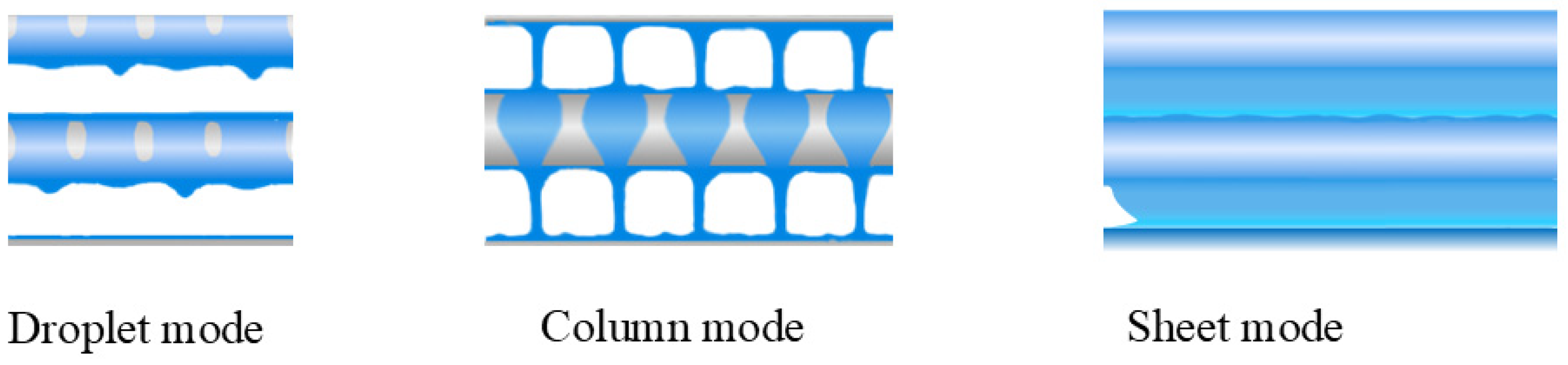
Characterizing the flow regimes of falling films represents another crucial aspect in the study of liquid film dynamics and heat transfer mechanisms. Compared with planar surfaces, falling film flows around cylindrical tubes exhibit more complex hydrodynamic behaviors due to the combined influences of gravity, surface tension, wall curvature, and external airflow disturbances. Under different operating conditions, the falling liquid film may evolve into a variety of flow modes, including droplet mode, column mode, and jet mode, as illustrated in Figure 7. Transitions between these regimes are strongly affected by factors such as liquid loading rate, surface wettability, tube geometry, and external perturbations. Accurate identification and measurement of these flow regimes are vital for elucidating the underlying heat transfer mechanisms and optimizing engineering system design.
Early investigations primarily relied on macroscopic visualization techniques, using high-speed imaging or observation windows to record film morphology and classify flow modes empirically [59]. With advances in optical diagnostics and digital image processing, researchers can quantitatively identify transient flow regimes and extract key statistical parameters such as wavelength, wave velocity, and amplitude distributions. These developments provide a powerful foundation for correlating flow pattern transitions with local heat transfer behavior and for improving the predictive capability of multiphase flow models.
The droplet regime typically occurs under conditions of low flow rates and high-wettability surfaces. Liquid periodically detaches from the tube wall to form droplets, leading to significant fluctuations in the local heat transfer coefficient. Studies have shown that the instantaneous liquid film thickness is extremely non-uniform in the droplet regime, and the thermal resistance varies periodically; thus, its heat transfer performance is often superior to that of a stable smooth film [60]. On the surface of a circular tube, periodic droplet shedding occurs when the local liquid film is excessively thin, resulting in a marked decrease in heat transfer efficiency. Experimentally, high-speed photography combined with image processing methods is commonly used to capture the generation, movement, and shedding processes of droplets [61]. However, due to the non-uniform distribution of droplet sizes, a quantitative description of droplet dimensions, frequency, and distribution remains challenging. In recent years, several studies have introduced fluorescent particle tracing and three-dimensional reconstruction techniques, enabling more accurate characterization of the spatial structure under the droplet regime [62]. The column regime is a relatively common form in falling film flow over circular tubes, particularly evident at high flow rates. The liquid film accumulates at the top of the tube to form liquid columns, which flow circumferentially or axially along the tube. Its stability is affected by tube diameter, liquid feed rate, and external airflow conditions. Measurement methods for the column regime mostly rely on optical imaging and local liquid film thickness sensors. Under windless conditions, liquid columns flow relatively stably along the tube wall with regular temperature and thickness distributions. In contrast, under windy conditions, cross-flow air causes deflection or even breakage of liquid columns, leading to a reduction in liquid film coverage.
The sheet regime often appears at high liquid loads or when significant shear forces are exerted by the external airflow. Liquid forms continuous liquid columns or filaments on the tube wall, with possible dry-out in some regions. Characterization of these regimes requires not only visualization but also the combination of mass flux and local heat flux measurements to analyze the mechanisms of dry spot formation and rewetting behavior. In this regime, the interaction between the liquid film and airflow is most intense, with widespread surface fluctuations and secondary atomization. Experimental measurements of the sheet regime mainly rely on particle image velocimetry (PIV) and laser interferometry techniques, which can capture the coupled characteristics of the liquid flow velocity field and film thickness distribution [63]. However, due to the high susceptibility of the liquid film to wind field disturbances in the sheet regime, its flow state is highly unstable, leading to significant uncertainties in measurement results.
Under windy conditions, the external airflow exerts additional shear stress on the liquid film surface, significantly altering the transition boundaries of flow regimes. Studies have indicated that with increasing air velocity, wavy flow is more likely to transition to the sheet regime, enhancing liquid film fluctuations and even inducing droplet shedding. This results in a reduction in the average liquid film thickness and intensification of heat transfer [64]. To quantitatively study the effect of airflow, experimental setups often employ a wind tunnel test section to control the evolution of liquid film flow regimes under different air velocities. Laser sheet illumination combined with PIV is used to measure the liquid film surface velocity field, enabling quantitative identification of flow states.
For falling film flow over tube bundles, the tube array geometry plays a crucial role in flow regime transitions. If the tube spacing is small, liquid bridges or droplet coalescence may form between tubes, leading to excessive local liquid film thickness and deteriorated heat transfer. Conversely, increased tube spacing is more conducive to the formation of stable wavy flow or periodic droplets, thereby achieving higher heat transfer efficiency [65]. Research tends to combine 3D numerical simulations (e.g., volume of fluid (VOF) and Lattice–Boltzmann methods) with experimental observations to thoroughly investigate the evolution laws of tube falling films under various regimes, further providing theoretical guidance for heat exchanger design [66]. To systematically describe flow states, many scholars have attempted to establish flow regime maps based on dimensionless parameters such as the Reynolds number (Re), Weber number (We), and Capillary number (Ca). Experimental and theoretical analyses have shown that the transition thresholds between different regimes are often co-regulated by tube curvature and external air velocity. The droplet regime is more likely to occur at low Re, while the column regime is more stable at medium to high Re. High air velocities and high We conditions may induce the sheet regime. Such quantitative analyses provide an important basis for predicting flow regimes under different operating conditions.
In summary, research on falling film flow regimes has undergone a gradual development process from qualitative observation to quantitative measurement, from single tubes to tube bundles, and from static windless conditions to consideration of airflow coupling. The measurement of falling film flow states faces challenges such as small liquid film scales and fast time scales, while requiring maintenance of measurement accuracy under complex boundary conditions. Future research directions may focus on three aspects. On one hand, efforts could be devoted to developing optical and electrical sensors with higher spatiotemporal resolution to capture the transient evolution of different flow regimes. On the other hand, it is necessary to establish a regime identification framework that combines experiments and numerical simulations to improve the prediction capability of regime transitions under windy conditions. In addition, multi-parameter measurements should be integrated with machine learning methods to achieve rapid identification and quantitative analysis of complex falling film flow states.

5. Conclusions and Prospects

5.1. Conclusions

As an efficient phase-change heat transfer method, thin liquid film evaporation has significant research and application value in the fields of enhanced heat transfer and high-efficiency heat dissipation due to its low heat transfer resistance and large interfacial area. This study systematically reviews the fundamental mechanisms of thin liquid film evaporation, the influence of laws of surface wettability on the heat transfer process, and the measurement techniques for key parameters such as liquid film thickness and temperature. The aim is to provide a reference for an in-depth understanding of its multi-scale transport behavior and engineering applications.
Studies have shown that the heat transfer enhancement in the thin liquid film region mainly stems from the coupling effect of multiple mechanisms, including capillary pressure, Marangoni convection, and intermolecular forces. These effects collectively determine liquid film stability, thickness distribution, and local evaporation flux, serving as the core factors for achieving efficient phase-change heat transfer.
Surface wettability and its dynamic variation characteristics exert a decisive influence on liquid film evaporation behavior. Hydrophilic surfaces facilitate the formation of continuous and stable liquid films, enabling uniform evaporation distribution. In contrast, hydrophobic surfaces or those with micro/nano structures can enhance heat flux in local regions but are more prone to liquid film rupture and dry spot formation. Dynamic wetting processes (including advancing/receding contact angles and hysteresis phenomena) directly affect liquid replenishment and dry spot evolution, thereby playing a crucial role in the overall performance of falling film evaporation systems. Therefore, how to achieve precise control of liquid film thickness and stable maintenance of interfacial evaporation through the synergistic regulation of surface structure and chemical properties represents an important research direction for realizing efficient evaporative heat transfer in the future.
In experimental research, existing liquid film measurement techniques, such as optical interferometry, laser-induced fluorescence (LIF), ellipsometry, and infrared thermography, can acquire distribution information of liquid film thickness, temperature, and flow states across different spatial and temporal scales. However, these methods still have limitations in terms of spatial resolution, dynamic response, and adaptability to high-temperature and high-humidity environments. Beyond technique selection, ensuring data reliability is paramount, given the sensitivity of thin film evaporation. Measurement uncertainty in these experiments typically stems from systematic errors (e.g., calibration drift, optical distortion) and random errors (e.g., environmental fluctuations). Therefore, regardless of the chosen technique, rigorous calibration strategies such as in situ calibration using standard targets are essential. Furthermore, to verify reproducibility, experimental results should invariably be reported with error bars derived from multiple independent runs, distinguishing physical evaporation dynamics from experimental noise.

5.2. Prospects

Research on thin liquid film evaporation is advancing rapidly. The field is moving from qualitative descriptions to quantitative and controllable applications. Future research should prioritize three concrete directions:
(1)
Synchronized Multi-Physics Diagnostics: The primary experimental challenge is to move beyond single-parameter measurements. Future experimental setups are suggested to focus on the simultaneous acquisition of film thickness, temperature fields (via dual-color LIF), and velocity profiles (via PIV/PTV) to validate coupled heat-mass transfer mechanisms.
(2)
Standardization of Protocols: There is a lack of unified criteria for benchmarking. The community should establish standardized definitions for critical phenomena, such as ‘dry spot onset’ and ‘film breakdown thresholds,’ to ensure data comparability across different studies.
(3)
Coupled Multi-Scale Modeling: To resolve the contact line singularity, modeling efforts are advised to shift from standalone simulations to hybrid MD-CFD frameworks. This coupling is essential to accurately predict dynamic wetting behaviors that continuum mechanics alone cannot resolve.
Simultaneously, future efforts should address the significant bottlenecks in robustness and manufacturability when scaling up experimental tube bundles from laboratory prototypes to industrial-scale falling film evaporators. The long-term stability of functional surfaces in experiments represents a critical issue often overlooked in short-term studies. Highly hydrophilic surfaces are prone to “aging” or chemical contamination, where adsorption of atmospheric hydrocarbons or surface oxidation alters equilibrium contact angles over time. In practical applications like seawater desalination, surface fouling and salt crystallization further degrade the designed wetting performance. Future research must therefore quantify the lifespan of these coatings under real operating conditions. Second, manufacturability constraints limit the scaling of micro-structured tubes. While precision techniques like laser structuring or photolithography are effective for small-scale prototypes, they often prove prohibitively expensive for large tube bundles. There is an urgent need to develop low-cost, scalable manufacturing methods, such as anodization or advanced 3D printing techniques, to ensure uniform surface quality across large heat exchange areas.
Furthermore, engineering applications require specific attention. This technology holds promise for electronic device cooling, membrane distillation, and energy conversion. Ultimately, interdisciplinary integration will drive this research forward. These efforts will provide new theoretical support for efficient thermal management systems.

Author Contributions

Methodology, investigation, writing—original draft preparation, Y.Z.; investigation, C.H.; Investigation, Y.X.; investigation, supervision, W.Y.; writing—review and editing, funding acquisition, supervision, X.C. All authors have read and agreed to the published version of the manuscript.

Funding

This work was supported by the National Natural Science Foundation of China (52478105, 52106025).

Data Availability Statement

No new data were created or analyzed in this study.

Conflicts of Interest

Author Weichao Yan was employed by the company Zhongxing Telecommunication Equipment Corporation. The remaining authors declare that the research was conducted in the absence of any commercial or financial relationships that could be construed as a potential conflict of interest.

References

  1. Sun, Q.; Zhi, G.; Zhou, S.; Dong, X.; Shen, Q.; Tao, R.; Qi, J. Advanced Design and Manufacturing Approaches for Structures with Enhanced Thermal Management Performance: A Review. Adv. Mater. Technol. 2024, 9, 2400263. [Google Scholar] [CrossRef]
  2. Ahmed, A.S.E. High-Performance Cooling of Power Semiconductor Devices Embedded in a Printed Circuit Board. Doctoral Dissertation, INSA De Lyon, Lyon, France, 2024. [Google Scholar]
  3. Liu, X.; Yang, J.; Zou, Q.; Hu, Y.; Li, P.; Tan, L.; Miljkovic, N. Enhancing Liquid—Vapor Phase-Change Heat Transfer with Micro/Nano-Structured Surfaces. ACS Nano 2025, 19, 9513–9589. [Google Scholar] [CrossRef] [PubMed]
  4. Ohadi, M.; Qi, J.; Lawler, J. Microscale Heat Transfer Fundamentals and Applications: Proceedings of the NATO Advanced Study Institute on Microscale Heat Transfer—Fundamentals and Applications in Biological and Microelectromechanical Systems Cesme-Izmir, Turkey 18–30 July 2004; Springer: Berlin/Heidelberg, Germany, 2005; pp. 321–338. [Google Scholar]
  5. Guo, Q.; Liu, H.L.; Xie, G.; Guo, C.; Xu, Z.; Shao, X.D. Investigation on the Two-Phase Flow and Heat Transfer Behaviors in a New Central Uniform Dispersion-Type Heat Exchanger. Int. Commun. Heat Mass Transf. 2022, 137, 106283. [Google Scholar] [CrossRef]
  6. Wang, Z.; Li, M. A Comprehensive Review on Studies of Flow Characteristics in Horizontal Tube Falling Film Heat Exchangers. Energies 2025, 18, 3587. [Google Scholar] [CrossRef]
  7. Yan, W.; Cui, X.; Meng, X.; Yang, C.; Zhang, Y.; Liu, Y.; An, H.; Jin, L. Multi-Objective Optimization of Hollow Fiber Membrane-Based Water Cooler for Enhanced Cooling Performance and Energy Efficiency. Renew. Energy 2024, 222, 119892. [Google Scholar] [CrossRef]
  8. Caliskan, T.D. Impact of Fluorinated Segment Chemistry on Film Wettability: Comparative Study of Short-Chain Perfluoroalkyl and Perfluoropolyether Structures. Polym. Eng. Sci. 2025, 65, 4052–4060. [Google Scholar] [CrossRef]
  9. Nahar, M.M.; Ma, B.; Guye, K.; Chau, Q.H.; Padilla, J.; Iyengar, M.; Agonafer, D. Review Article: Microscale Evaporative Cooling Technologies for High Heat Flux Microelectronics Devices: Background and Recent Advances. Appl. Therm. Eng. 2021, 194, 117109. [Google Scholar] [CrossRef]
  10. Ahmadian-Yazdi, M.R.; Eslamian, M. Effect of Marangoni Convection on the Perovskite Thin Liquid Film Deposition. Langmuir 2021, 37, 2596–2606. [Google Scholar] [CrossRef]
  11. Hu, C.; Pei, Z.; Shi, L.; Tang, D.; Bai, M.L. Phase Transition Properties of Thin Liquid Films with Various Thickness on Different Wettability Surfaces. Int. Commun. Heat Mass Transf. 2022, 135, 106125. [Google Scholar] [CrossRef]
  12. Li, Z.; Cao, Q.; Cui, Z. Enhanced Heat Transfer of Liquid Film Evaporation via Subdividable Patterned Surfaces. J. Mol. Liq. 2023, 391, 123404. [Google Scholar] [CrossRef]
  13. Wang, H.; Lee, H.J.; Jin, J.; Koya, A.N.; Choi, C.K.; Li, L.; Li, W.; Lee, S.H. Design of a High-Performance Surface Plasmon Resonance Device for Effective Measurement of Thin Liquid Film Thickness. J. Mech. Sci. Technol. 2024, 38, 5769–5778. [Google Scholar] [CrossRef]
  14. Sotoudeh, F.; Mousavi, S.M.; Karimi, N.; Lee, B.J.; Abolfazli-Esfahani, J.; Manshadi, M.K.D. Natural and Synthetic Superhydrophobic Surfaces: A Review of the Fundamentals, Structures, and Applications. Alex. Eng. J. 2023, 68, 587–609. [Google Scholar] [CrossRef]
  15. Göhl, J.; Mark, A.; Sasic, S.; Edelvik, F. An Immersed Boundary Based Dynamic Contact Angle Framework for Handling Complex Surfaces of Mixed Wettabilities. Int. J. Multiph. Flow 2018, 109, 164–177. [Google Scholar] [CrossRef]
  16. Kim, E.; Kim, D.; Kwak, K.; Nagata, Y.; Bonn, M.; Cho, M. Wettability of Graphene, Water Contact Angle, and Interfacial Water Structure. Chem 2022, 8, 1187–1200. [Google Scholar] [CrossRef]
  17. Zhu, S.; Xie, K.; Lin, Q.; Cao, R.; Qiu, F. Experimental Determination of Surface Energy for High-Energy Surface: A Review. Adv. Colloid Interface Sci. 2023, 315, 102905. [Google Scholar] [CrossRef]
  18. Yang, H.; Ji, F.; Li, Z.; Tao, S. Preparation of Hydrophobic Surface on PLA and ABS by Fused Deposition Modeling. Polymers 2020, 12, 1539. [Google Scholar] [CrossRef]
  19. Zhang, Y.; Zhang, Z.; Yang, J.; Yue, Y.; Zhang, H. A Review of Recent Advances in Superhydrophobic Surfaces and Their Applications in Drag Reduction and Heat Transfer. Nanomaterials 2022, 12, 44. [Google Scholar] [CrossRef]
  20. Ozsipahi, M.; Wilson, A.A.; Ajaev, V.S.; Beskok, A. Evaporation from Nanoscale Thin Films and Menisci: Experiments, Theories, and Simulations. Adv. Heat Transf. 2024, 58, 1–38. [Google Scholar] [CrossRef]
  21. Kalam, S.; Abu-Khamsin, S.A.; Kamal, M.S.; Patil, S. Surfactant Adsorption Isotherms: A Review. ACS Omega 2021, 6, 32342–32348. [Google Scholar] [CrossRef]
  22. Kumar, G.; Prabhu, K.N. Review of Non-Reactive and Reactive Wetting of Liquids on Surfaces. Adv. Colloid Interface Sci. 2007, 133, 61–89. [Google Scholar] [CrossRef]
  23. Xu, B.; Chang, J.; Wu, M.; Chen, Z. Flow and Heat Transfer Characteristics of Spray Cooling on Hydrophilic—Hydrophobic Mixed Surface under Heterogeneous Heat Sources. Therm. Sci. Eng. Prog. 2025, 60, 103442. [Google Scholar] [CrossRef]
  24. Panda, A.; Pati, A.R.; Kumar, A.; Mohapatra, S.S. Dropwise Evaporation of Hydrophilic Coolant Droplets: A Methodology for the Development of Hydrophilic Coating and Attainment of Enhanced Heat Transfer. Int. Commun. Heat Mass Transf. 2019, 105, 19–27. [Google Scholar] [CrossRef]
  25. Gatapova, E.Y.; Peschenyuk, Y.A. Optical Methods for Measuring the Thickness of Thin Evaporating Liquid Films. J. Opt. Technol. 2024, 91, 285. [Google Scholar] [CrossRef]
  26. Wu, Y.; Xue, T. A Novel Laser Interferometric Method for Thin Film Thickness Measurement in Gas-Liquid Intermittent Flow. Meas. Sci. Technol. 2024, 35, 105027. [Google Scholar] [CrossRef]
  27. Lubnow, M.; Jeffries, J.B.; Dreier, T.; Schulz, C. Water Film Thickness Imaging Based on Time-Multiplexed near-Infrared Absorption. Opt. Express 2018, 26, 20902. [Google Scholar] [CrossRef]
  28. Koegl, M.; Delwig, M.; Zigan, L. Characterization of Fluorescence Tracers for Thermometry and Film Thickness Measurements in Liquid Coolants Relevant for Thermal Management of Electric and Electronic Components. Sensors 2022, 22, 8892. [Google Scholar] [CrossRef]
  29. Grasso, M.; Petrov, V.; Manera, A. Accuracy and Error Analysis of Optical Liquid Film Thickness Measurement with Total Internal Reflection Method (TIRM). Exp. Fluids 2024, 65, 83. [Google Scholar] [CrossRef]
  30. Lee, K.B.; Kim, J.R.; Park, G.C.; Cho, H.K. Feasibility Test of a Liquid Film Thickness Sensor on a Flexible Printed Circuit Board Using a Three-Electrode Conductance Method. Sensors 2017, 17, 42. [Google Scholar] [CrossRef]
  31. Yu, Y.; Ma, L.; Ye, H.; Zheng, Y.; Ma, Y. Design of Instantaneous Liquid Film Thickness Measurement System for Conductive or Non-Conductive Fluid with High Viscosity. AIP Adv. 2017, 7, 065207. [Google Scholar] [CrossRef]
  32. Dou, P.; Jia, Y.; Zheng, P.; Wu, T.; Yu, M.; Reddyhoff, T.; Peng, Z. Review of Ultrasonic-Based Technology for Oil Film Thickness Measurement in Lubrication. Tribol. Int. 2022, 165, 107290. [Google Scholar] [CrossRef]
  33. Wang, M.; Liu, J.; Bai, Y.; Zheng, D.; Fang, L. Flow Rate Measurement of Gas-Liquid Annular Flow through a Combined Multimodal Ultrasonic and Differential Pressure Sensor. Energy 2024, 288, 129852. [Google Scholar] [CrossRef]
  34. Al-Aufi, Y.A.; Hewakandamby, B.N.; Dimitrakis, G.; Holmes, M.; Hasan, A.; Watson, N.J. Thin Film Thickness Measurements in Two Phase Annular Flows Using Ultrasonic Pulse Echo Techniques. Flow Meas. Instrum. 2019, 66, 67–78. [Google Scholar] [CrossRef]
  35. Dufrêne, Y.F.; Viljoen, A.; Mignolet, J.; Mathelié-Guinlet, M. AFM in Cellular and Molecular Microbiology. Cell. Microbiol. 2021, 23, e13324. [Google Scholar] [CrossRef] [PubMed]
  36. Meinhardt, A.; Lakner, P.; Huber, P.; Keller, T.F. Mapping the Nanoscale Elastic Property Modulations of Polypyrrole Thin Films in Liquid Electrolyte with EC-AFM. Nanoscale Adv. 2023, 6, 102–110. [Google Scholar] [CrossRef] [PubMed]
  37. Politano, G.G.; Versace, C. Spectroscopic Ellipsometry: Advancements, Applications and Future Prospects in Optical Characterization. Spectrosc. J. 2023, 1, 163–181. [Google Scholar] [CrossRef]
  38. Xue, T.; Zhang, S. Investigation on Heat Transfer Characteristics of Falling Liquid Film by Planar Laser-Induced Fluorescence. Int. J. Heat Mass Transf. 2018, 126, 715–724. [Google Scholar] [CrossRef]
  39. Volkov, R.S.; Strizhak, P.A. Using Planar Laser Induced Fluorescence to Determine Temperature Fields of Drops, Films, and Aerosols. Meas. J. Int. Meas. Confed. 2020, 153, 107439. [Google Scholar] [CrossRef]
  40. Dulin, V.; Cherdantsev, A.; Volkov, R.; Markovich, D. Application of Planar Laser-Induced Fluorescence for Interfacial Transfer Phenomena. Energies 2023, 16, 1877. [Google Scholar] [CrossRef]
  41. Koegl, M.; Mil‘to, N.; Zigan, L. Simultaneous Film Temperature and Film Thickness Measurements for Jet Impingement Applications Using Two-Color Laser-Induced Fluorescence. Exp. Fluids 2024, 65, 41. [Google Scholar] [CrossRef]
  42. Yoshida, M.; Yamada, S.; Funami, Y.; Nakamura, H. High Spatio-Temporal Resolution Measurement of Boiling Heat Transfer of a Falling Droplet. Appl. Therm. Eng. 2023, 228, 120464. [Google Scholar] [CrossRef]
  43. Miskovic, V.; Malafronte, E.; Minetti, C.; Machrafi, H.; Varon, C.; Iorio, C.S. Thermotropic Liquid Crystals for Temperature Mapping. Front. Bioeng. Biotechnol. 2022, 10, 806362. [Google Scholar] [CrossRef]
  44. Islam, M.O.; Myneni, G.R.; Elsayed-Ali, H.E. Time-Domain Thermoreflectance Measurement of the Thermal Diffusivity of Nb Thin Films. Thin Solid Film. 2024, 790, 140213. [Google Scholar] [CrossRef]
  45. Xu, S.; Fan, A.; Wang, H.; Zhang, X.; Wang, X. Raman-Based Nanoscale Thermal Transport Characterization: A Critical Review. Int. J. Heat Mass Transf. 2020, 154, 119751. [Google Scholar] [CrossRef]
  46. Qiu, Q.; Meng, C.; Quan, S.; Wang, W. 3-D Simulation of Flow Behaviour and Film Distribution Outside a Horizontal Tube. Int. J. Heat Mass Transf. 2017, 107, 1028–1034. [Google Scholar] [CrossRef]
  47. Hou, H.; Bi, Q.; Ma, H.; Wu, G. Distribution Characteristics of Falling Film Thickness around a Horizontal Tube. Desalination 2012, 285, 393–398. [Google Scholar] [CrossRef]
  48. Grabas, B. Vibration-Assisted Laser Surface Texturing of Metals as a Passive Method for Heat Transfer Enhancement. Exp. Therm. Fluid Sci. 2015, 68, 499–508. [Google Scholar] [CrossRef]
  49. Berto, A.; Lavieille, P.; Azzolin, M.; Bortolin, S.; Miscevic, M.; Del Col, D. Liquid Film Thickness and Heat Transfer Measurements during Downflow Condensation inside a Small Diameter Tube. Int. J. Multiph. Flow 2021, 140, 103649. [Google Scholar] [CrossRef]
  50. Chang, S.; Yang, Y.; Shi, Q.; Qi, H. Experimental Study of Shear-Driven Water Film with Brightness-Based Laser-Induced Fluorescence Technique. Int. J. Multiph. Flow 2023, 166, 104514. [Google Scholar] [CrossRef]
  51. Chen, X.; Shen, S.; Wang, Y.; Chen, J.; Zhang, J. Measurement on Falling Film Thickness Distribution around Horizontal Tube with Laser-Induced Fluorescence Technology. Int. J. Heat Mass Transf. 2015, 89, 707–713. [Google Scholar] [CrossRef]
  52. Almutairi, Z.; Al-Alweet, F.M.; Alghamdi, Y.A.; Almisned, O.A.; Alothman, O.Y. Investigating the characteristics of two-phase flow using electrical capacitance tomography (ECT) for three pipe orientations. Processes 2020, 8, 51. [Google Scholar] [CrossRef]
  53. Wang, J.; Chen, X.; Lu, T.; Chen, X.; Shen, S.; Liu, B. Three-Dimensional Film Thickness Distribution of Horizontal Tube Falling Film with Column Flow. Appl. Therm. Eng. 2019, 154, 140–149. [Google Scholar] [CrossRef]
  54. Xu, Z.; Zhu, H.; Zhao, Y. Experimental Study on the Falling Film Thickness Distribution on a Horizontal Tube under the Cross Airflow. Heat Mass Transf. 2023, 59, 2167–2179. [Google Scholar] [CrossRef]
  55. Zheng, J.W.; Yang, K.S.; Wu, Y.L. Falling Film Thickness Distribution around a Horizontal Tube under Countercurrent Air Flow. Int. J. Heat Mass Transf. 2025, 245, 127011. [Google Scholar] [CrossRef]
  56. Liu, S.; Mu, X.; Shen, S.; Li, C.; Wang, B. Experimental Study on the Distribution of Local Heat Transfer Coefficient of Falling Film Heat Transfer Outside Horizontal Tube. Int. J. Heat Mass Transf. 2021, 170, 121031. [Google Scholar] [CrossRef]
  57. Lee, Y.T.; Wen, C.Y.; Chien, L.H.; He, J.; Yang, A.S. Heat Transfer of Spray Falling Films over Horizontal Tubes with Counter Current Airflows in an Evaporative Condenser. Int. J. Heat Mass Transf. 2022, 183, 122199. [Google Scholar] [CrossRef]
  58. Kumar Ahirwar, B.; Kumar, A. A Comprehensive Review on Heat Transfer Enhancement in Tubular Heat Exchangers Using Twisted Tapes, Wire Coil Inserts, and Their Combined Effect with Nanofluids. Renew. Sustain. Energy Rev. 2025, 224, 116035. [Google Scholar] [CrossRef]
  59. Hu, X.; Jacobi, A.M. Departure-site spacing for liquid droplets and jets falling between horizontal circular tubes. Exp. Therm. Fluid Sci. 1998, 16, 322–331. [Google Scholar] [CrossRef]
  60. Ding, H.; Xie, P.; Ingham, D.; Ma, L.; Pourkashanian, M. Flow Behaviour of Drop and Jet Modes of a Laminar Falling Film on Horizontal Tubes. Int. J. Heat Mass Transf. 2018, 124, 929–942. [Google Scholar] [CrossRef]
  61. Yan, W.M.; Pan, C.W.; Yang, T.F.; Ghalambaz, M. Experimental Study on Fluid Flow and Heat Transfer Characteristics of Falling Film over Tube Bundle. Int. J. Heat Mass Transf. 2019, 130, 9–24. [Google Scholar] [CrossRef]
  62. Chen, X.; Wang, J.; Lu, T.; Sheng, J.; Chen, X. Three-Dimensional Film Thickness Distribution of Horizontal Tube Falling Film with Droplet and Sheet Flow. Int. J. Multiph. Flow 2022, 148, 103933. [Google Scholar] [CrossRef]
  63. Wang, R.; Duan, R.; Jia, H. Experimental Validation of Falling Liquid Film Models: Velocity Assumption and Velocity Field Comparison. Polymers 2021, 13, 1205. [Google Scholar] [CrossRef]
  64. Zhao, C.Y.; Li, Q.T.; Qi, D.; Feng, Z.X.; Jiang, J.M. Numerical Study of the Cross-Vapor Stream Effect on Falling Film Heat Transfer Performance over a Horizontal Tube. Appl. Therm. Eng. 2023, 224, 120109. [Google Scholar] [CrossRef]
  65. Qiu, Q.; Zhang, X.; Zhu, X.; Quan, S.; Shen, S. Influential Analysis of Geometrical Parameters on Falling-Film Thickness and Distribution of Sheet Flow Outside Horizontal Tube. Desalin. Water Treat. 2018, 124, 98–105. [Google Scholar] [CrossRef]
  66. Zhao, C.Y.; Yao, Z.L.; Qi, D.; Ji, W.T.; Li, A.G.; Tao, W.Q. Numerical Investigation of Tube Bundle Arrangement Effect on Falling Film Fluid Flow and Heat Transfer. Appl. Therm. Eng. 2022, 201, 117828. [Google Scholar] [CrossRef]
Figure 1. Schematic diagram of the solid–liquid evaporation contact line.
Energies 19 00664 g001
Figure 2. Dynamic contact angle. The arrow denotes the direction of liquid flow, illustrating the advancing and receding contact angles.
Energies 19 00664 g002
Figure 3. Droplet wetting states on rough surfaces: (a) Cassie–Baxter model; (b) Wenzel model.
Energies 19 00664 g003
Figure 4. Schematic diagram of the optical NIR method for thin film: (a) specular reflection; (b) diffuse reflection.
Energies 19 00664 g004
Figure 5. Schematic diagram of falling film evaporation outside horizontal tubes.
Energies 19 00664 g005
Figure 6. Schematic of the falling film liquid circulation system.
Energies 19 00664 g006
Figure 7. Flow modes of the falling film on horizontal tubes.
Energies 19 00664 g007
Table 1. Comparison of thin film thickness measurement methods.
Method
Category
Spatial Res. (Typical)Measurable RangeScalability
& Complexity
AdvantagesLimitationsRefs.
Interferometry/Ellipsometry<1 nm–0.5 µm1 nm–20 µmLow Scalability/High Cost. (Strictly lab-scale, vibration sensitive)Sub-micron precision; Non-intrusive.Requires optically smooth interface; Limited dynamic range.[25,37]
Confocal/LIF Imaging1–10 µm>5 µmMedium Scalability. (Requires optical access & lasers)2D field mapping; Coupled velocity measurement.Dye contamination; Signal attenuation; Complex calibration.[28,38]
Conductive/Capacitive Sensors0.1–1 mm10 µm–5 mmHigh Scalability/Low Cost. (Industrial applicable)Fast response (>1 kHz); Robust in opaque fluids.Intrusive (probes); Conductivity dependent; Low spatial res.[30,31]
Ultrasonic Pulse Echo~50 µm>100 µmHigh Scalability. (Penetrates metal walls)Non-intrusive; Works for opaque liquids/pipes.Blind zone for thin films; Sound speed calibration errors.[32,34]
Table 2. Comparison of thin liquid film temperature measurement methods.
MethodAccuracy
(Typical)
Temporal Res.ScalabilityKey ApplicationRefs.
Micro-Thermocouple±0.1–0.5 KLow (~Hz)High (Simple, cheap)Point measurement in stable films.[38]
PLIF (Two-color)±0.5–1.0 KHigh (>1 kHz)Low (Complex optics)2D temperature field in dynamic micro-films.[28,41]
IR Thermography±1.0–2.0 KHigh (>1 kHz)Medium (Window required)Surface temperature mapping; Dry spot detection.[42]
Thermochromic Liquid Crystals (TLC)±0.5 KLow (<100 Hz)MediumVisualizing isotherms on complex curved walls.[43]
Disclaimer/Publisher’s Note: The statements, opinions and data contained in all publications are solely those of the individual author(s) and contributor(s) and not of MDPI and/or the editor(s). MDPI and/or the editor(s) disclaim responsibility for any injury to people or property resulting from any ideas, methods, instructions or products referred to in the content.