Numerical Simulations of Forced Ignition and Flame Dynamics in an Ammonia/Air Mixing Layer

Abstract
1. Introduction
2. Model and Numerical Methods
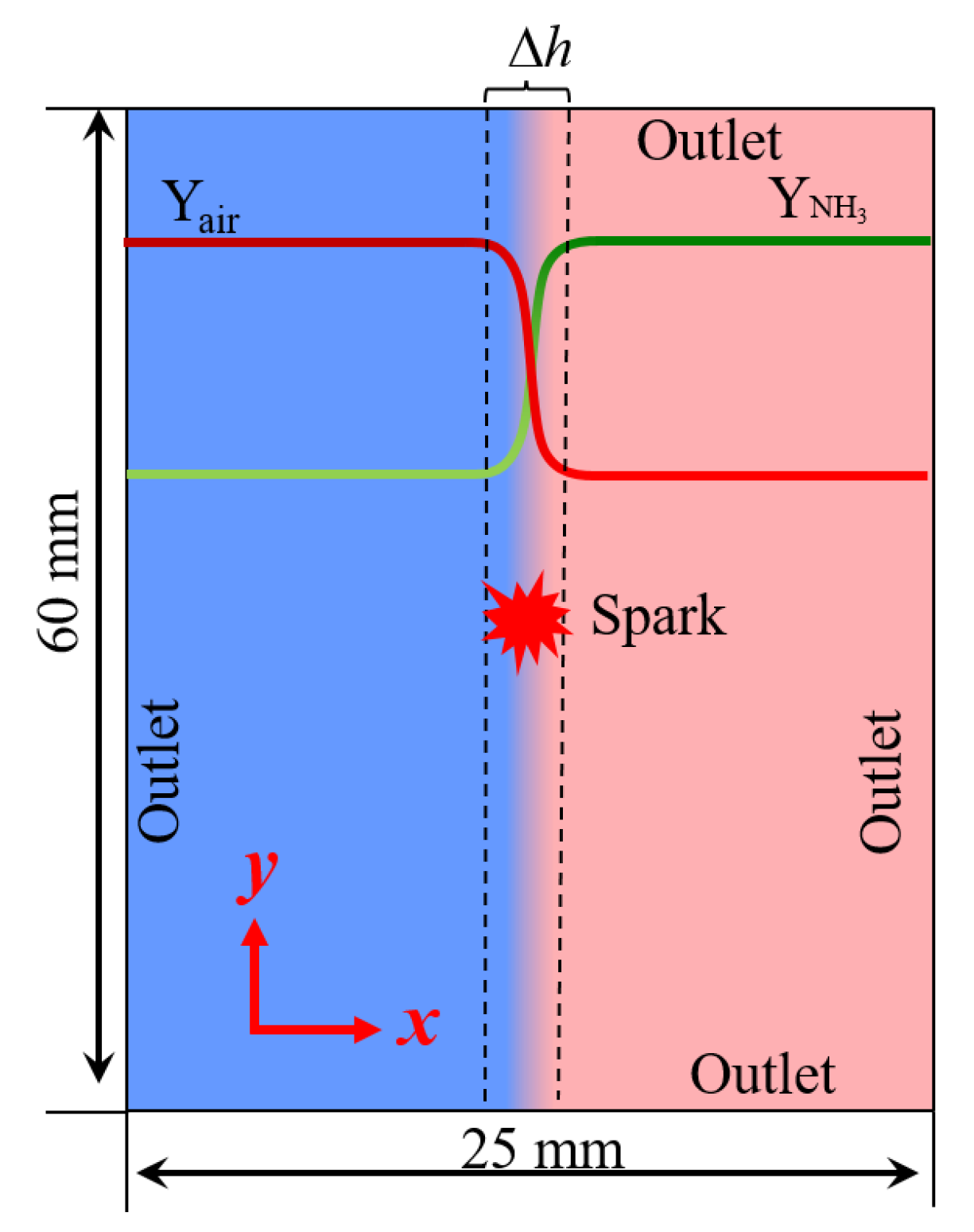
2.1. Configuration
2.2. Governing Equations
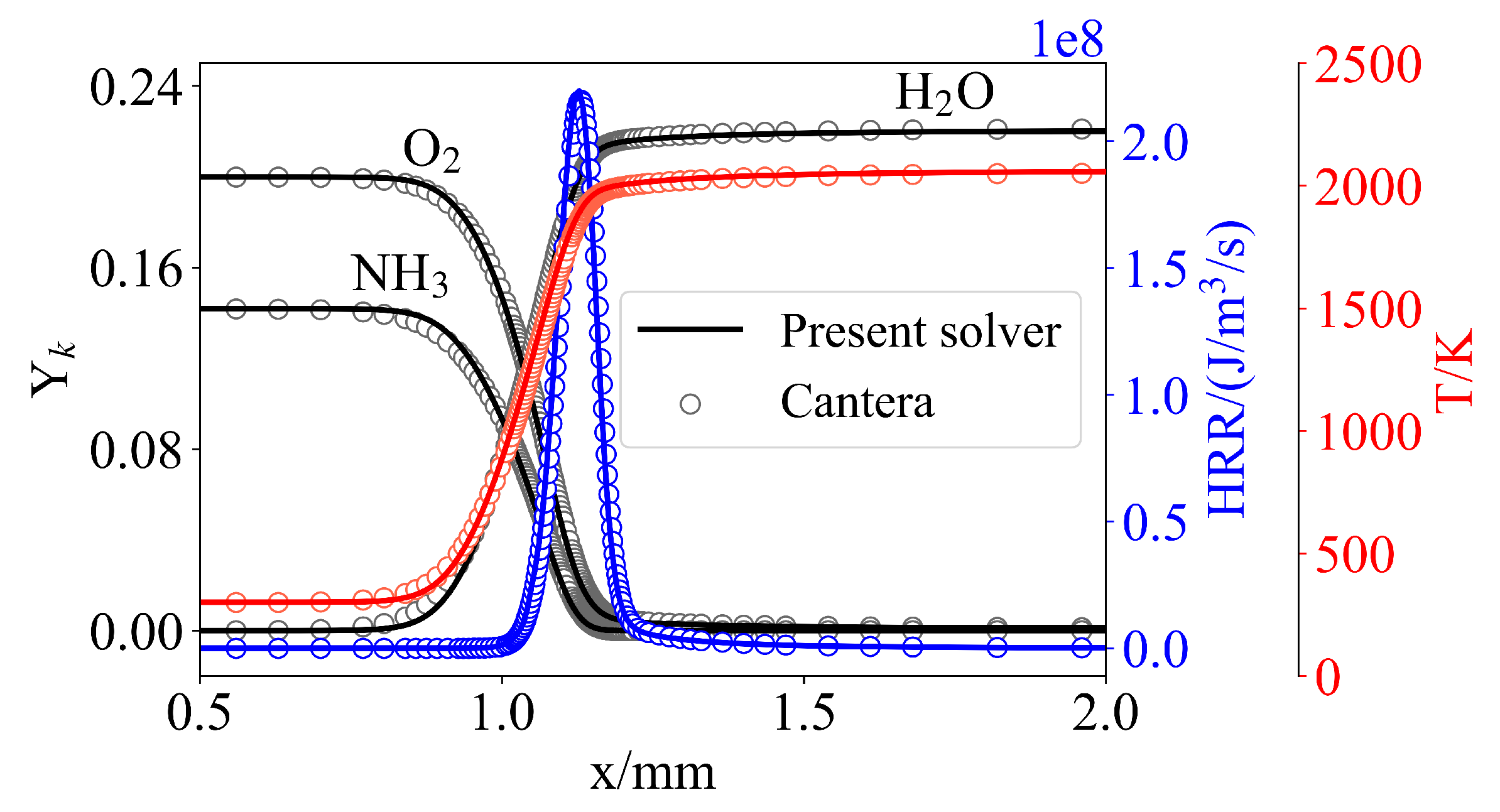
2.3. Numerical Methods
3. Results and Discussion
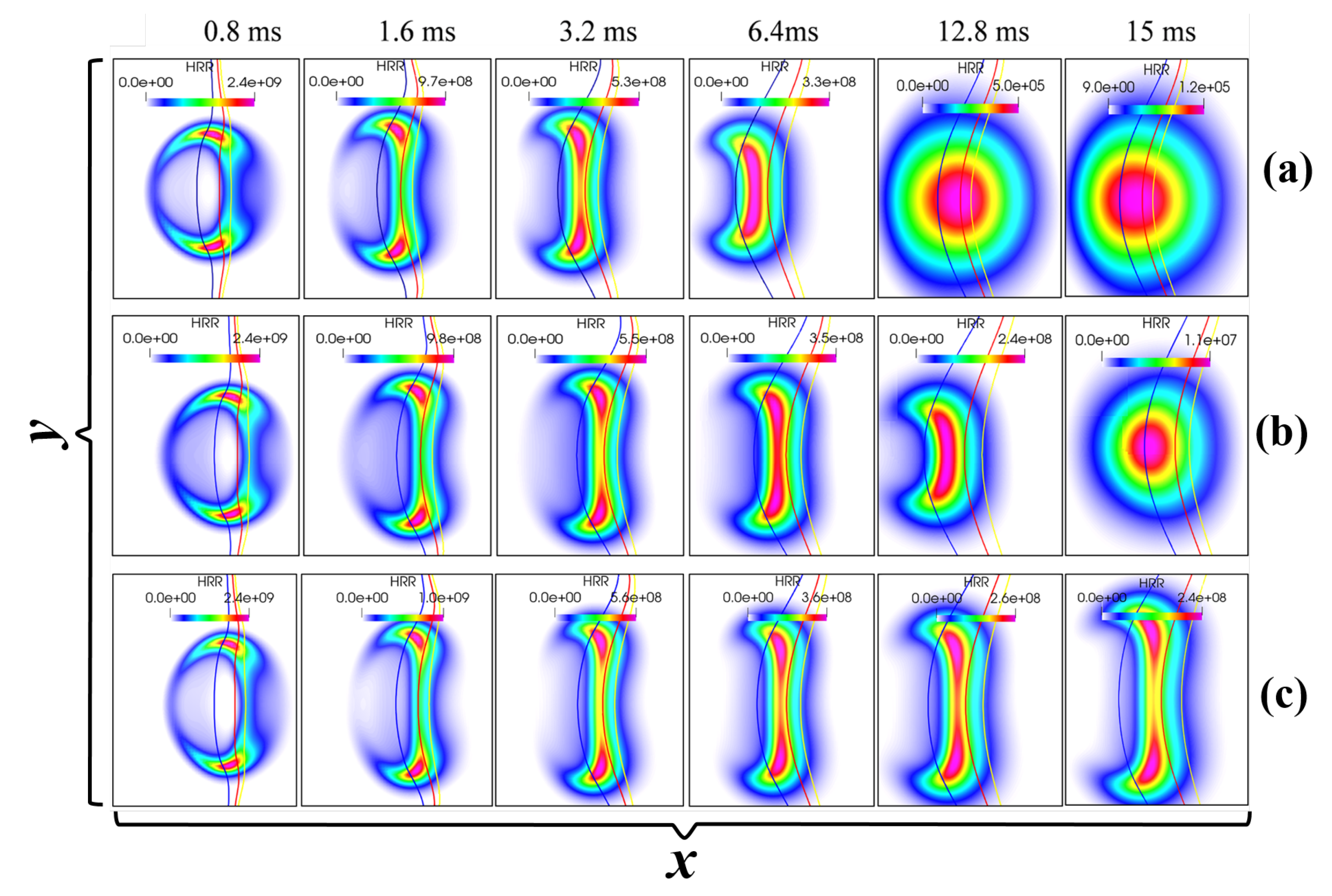
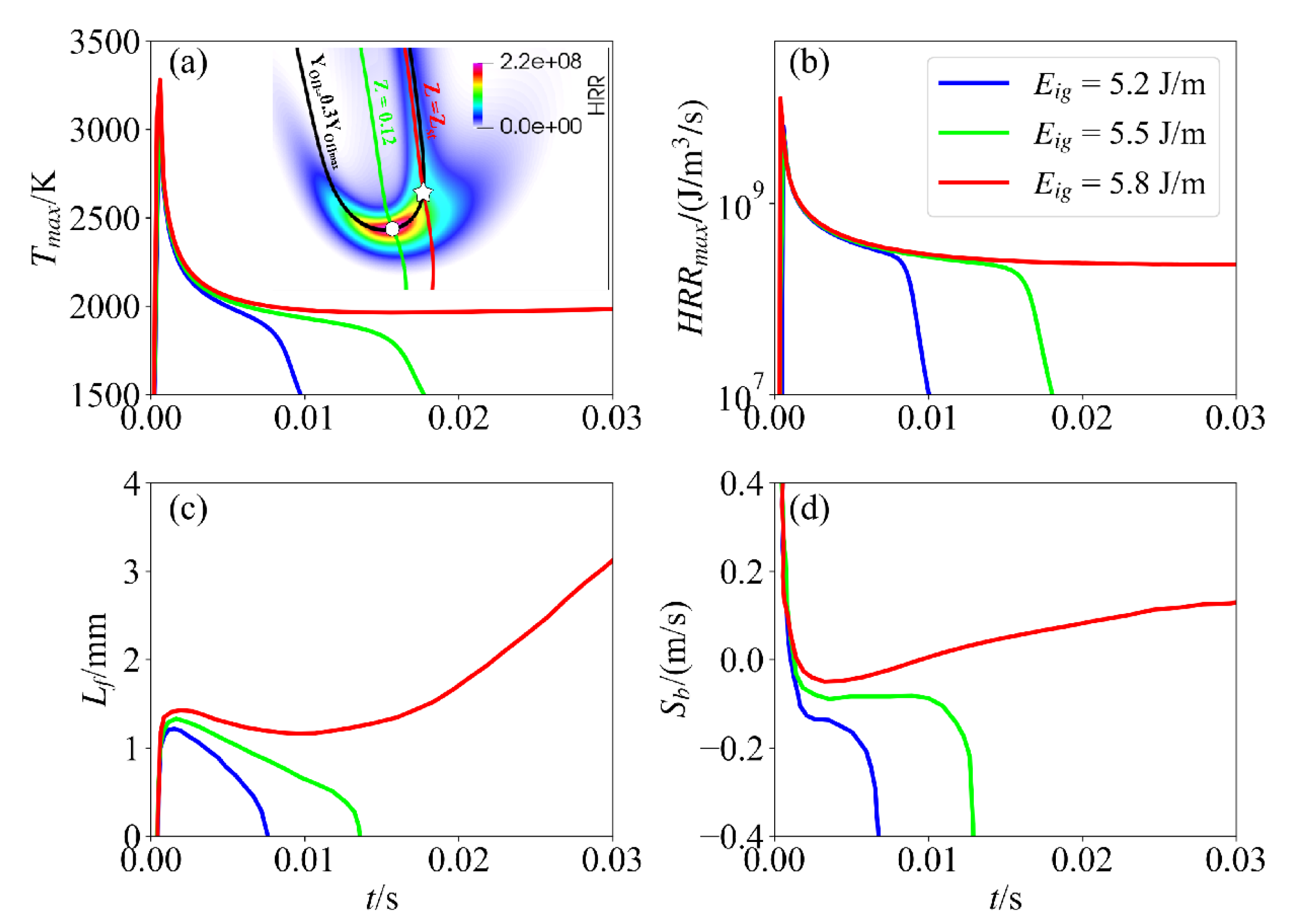
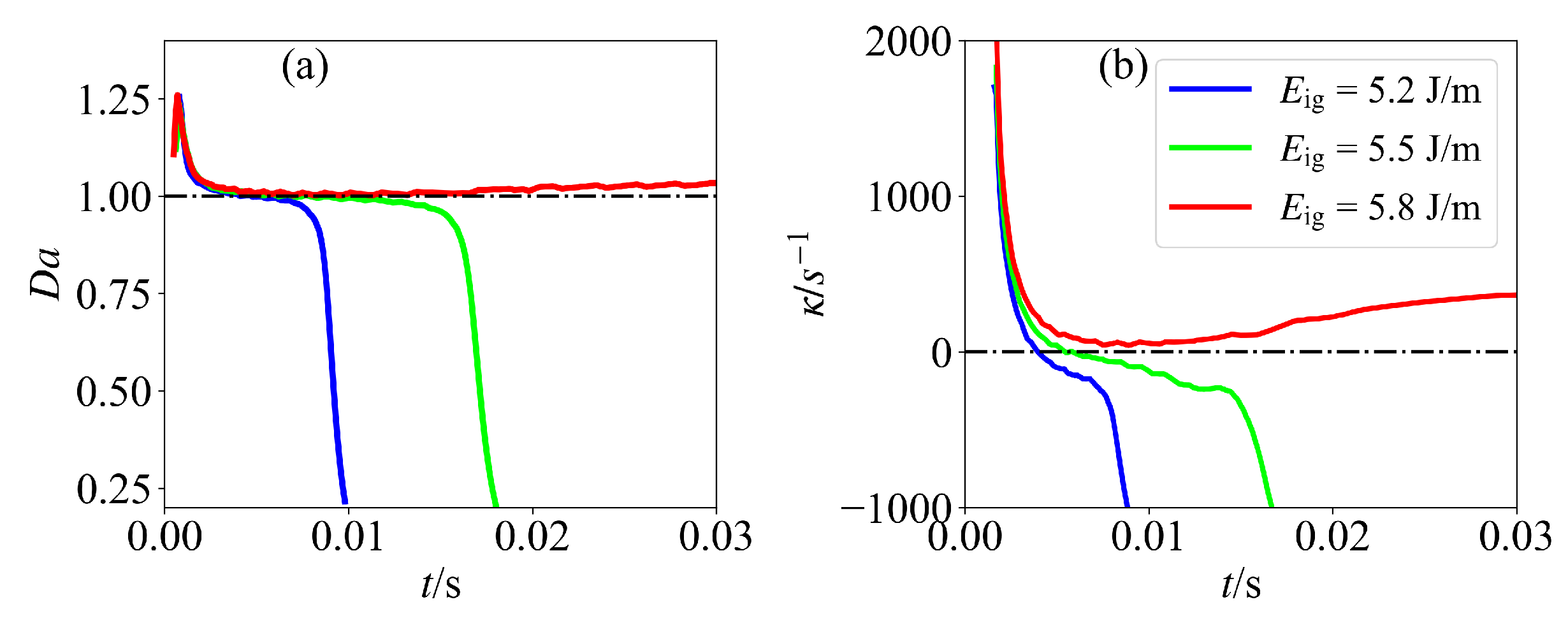
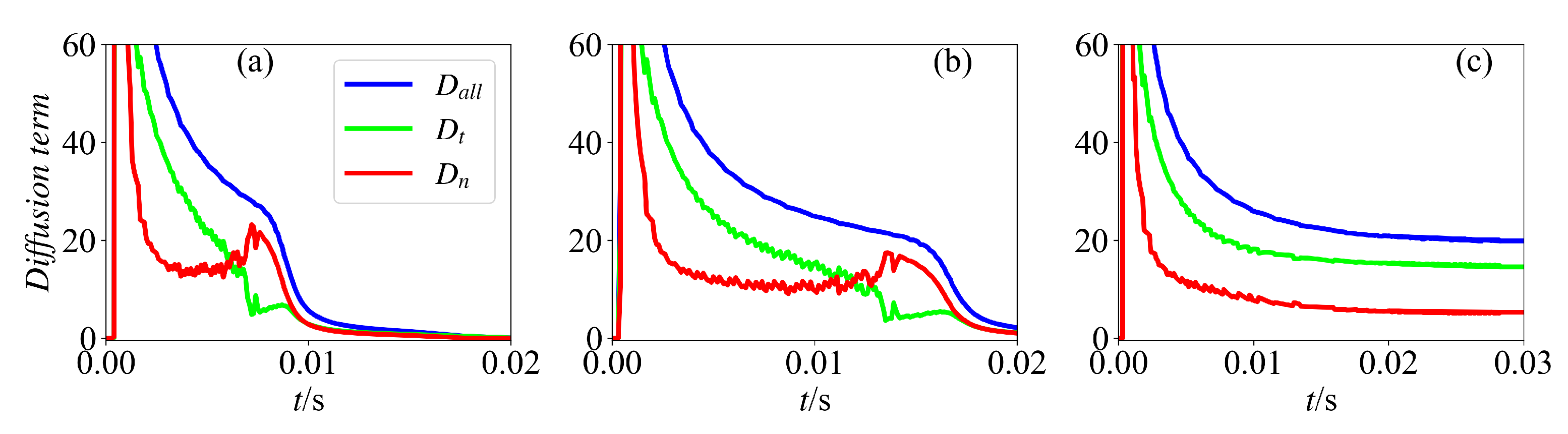
3.1. Effect of Ignition Energy on Ignition Process
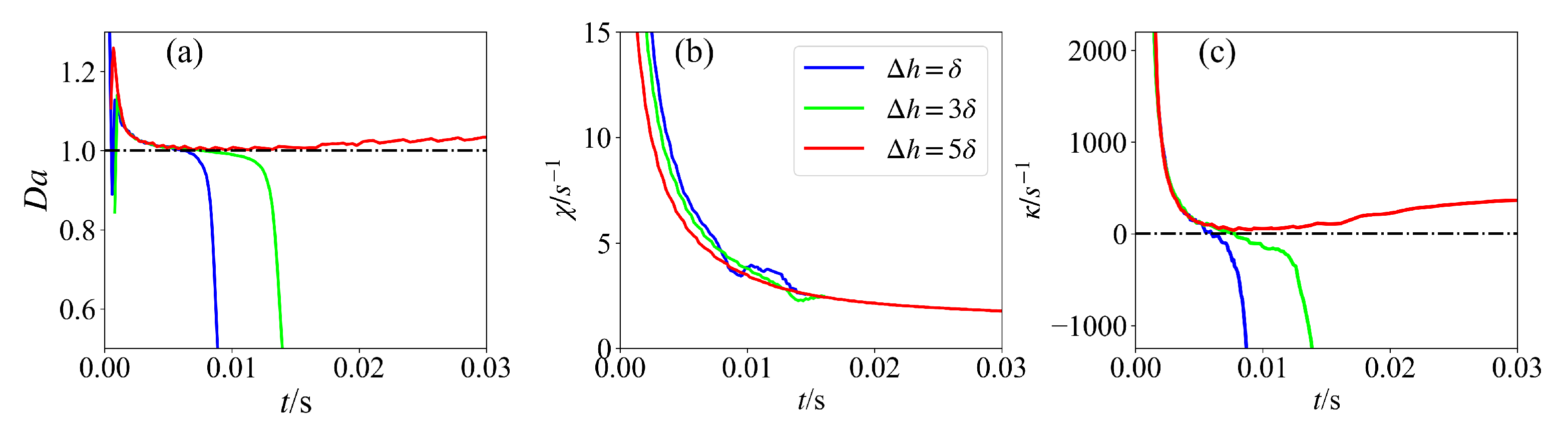
3.2. Effect of Mixing Layer Thickness on Ignition Process
3.3. Effect of Spark Position on Ignition Process
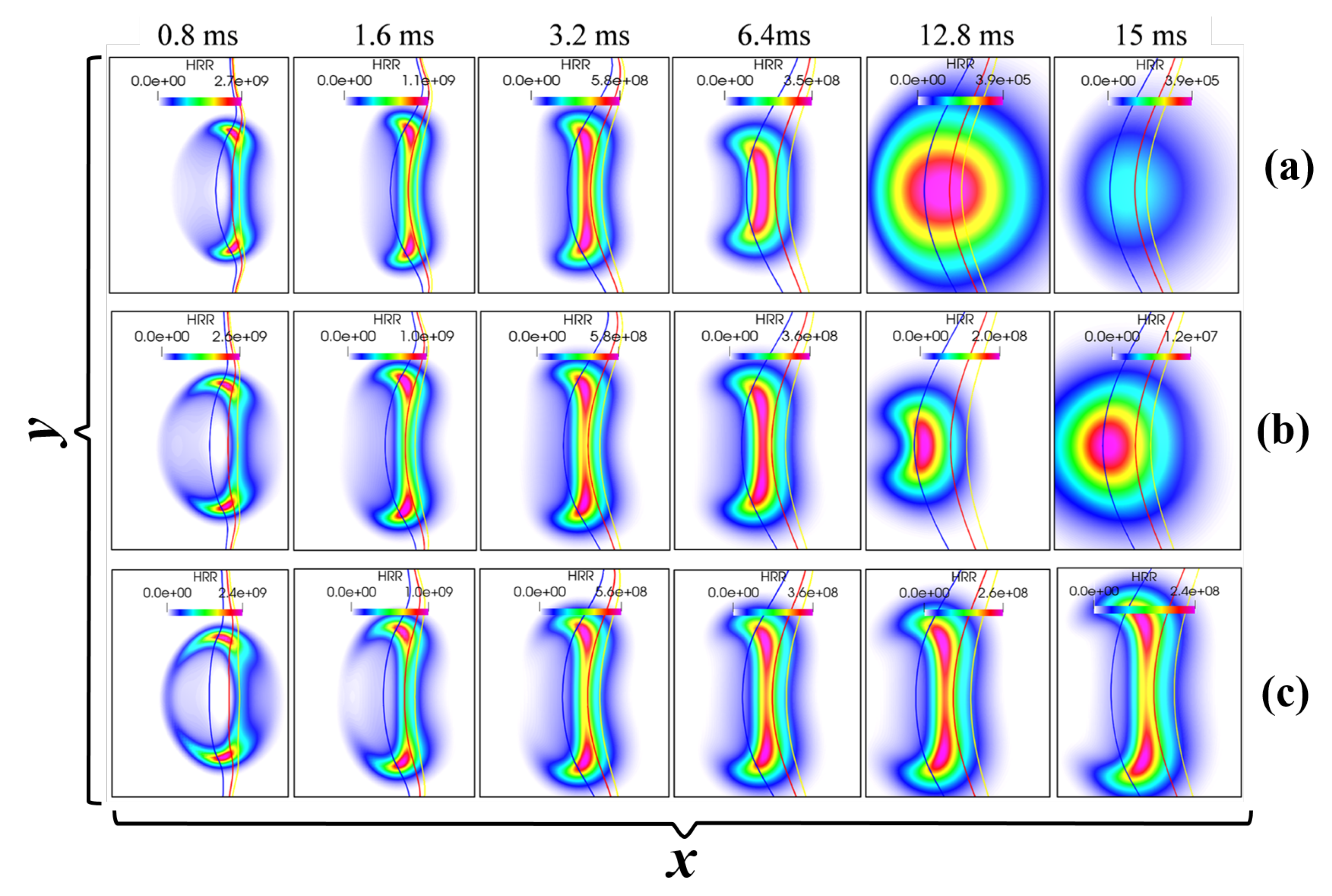
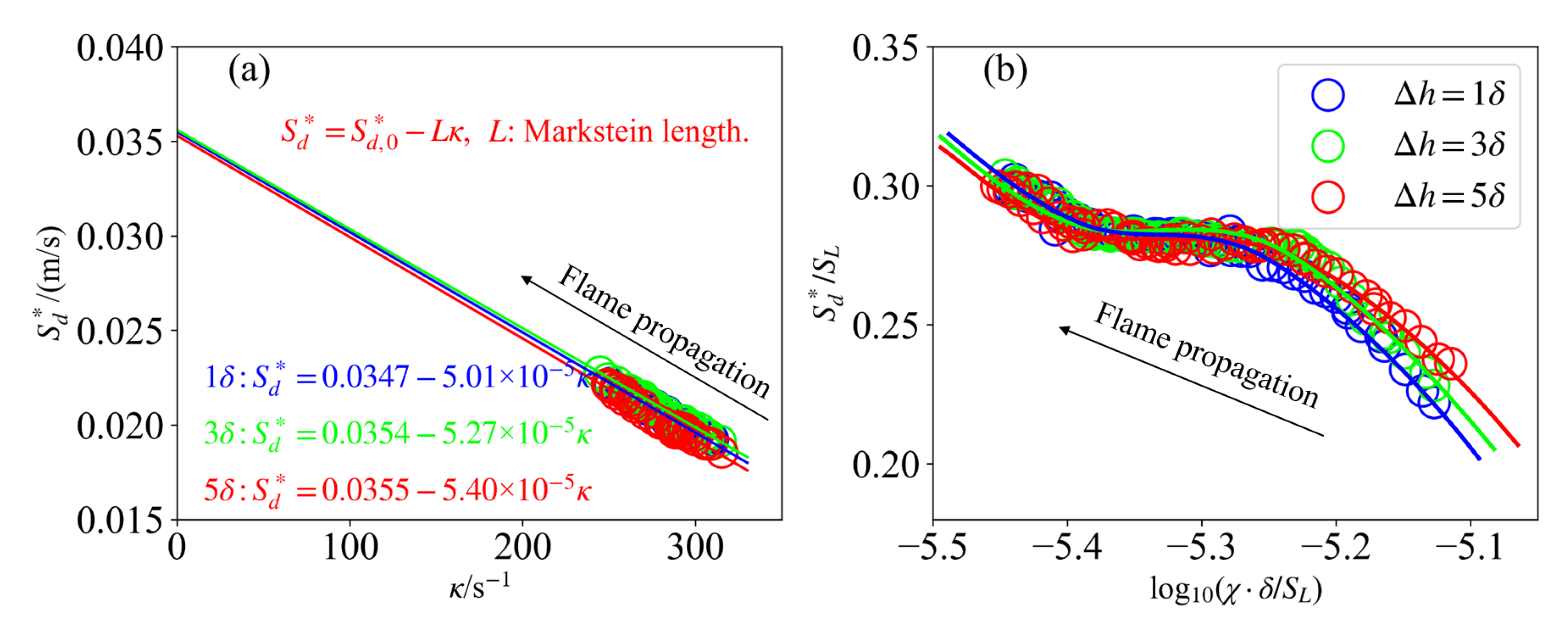
3.4. Flame Dynamics During Flame Propagation
4. Conclusions
Author Contributions
Funding
Data Availability Statement
Conflicts of Interest
References
- Kang, L.; Pan, W.; Zhang, J.; Wang, W.; Tang, C. A review on ammonia blends combustion for industrial applications. Fuel 2023, 332, 126150. [Google Scholar]
- Mathieu, O.; Petersen, E.L. Experimental and modeling study on the high-temperature oxidation of Ammonia and related NOx chemistry. Combust. Flame 2015, 162, 554–570. [Google Scholar] [CrossRef] [Scilit]
- Chang, Z.; Wang, H.; Hawkes, E.R.; Luo, K.; Fan, J. Effects of turbulence intensity on forced ignition of ammonia/air mixing layers. Proc. Combust. Inst. 2024, 40, 105515. [Google Scholar] [CrossRef] [Scilit]
- Chen, T.; Yu, S.; Liu, Y.C. Soret effects on the diffusion-chemistry interaction of hydrogen-air edge flames propagating in transverse gradient evolving mixing layers. Fuel 2022, 315, 123014. [Google Scholar] [CrossRef] [Scilit]
- Reveillon, J.; Demoulin, F.X. Evaporating droplets in turbulent reacting flows. Proc. Combust. Inst. 2007, 31, 2319–2326. [Google Scholar] [CrossRef] [Scilit]
- Chen, X.Y.; Xie, S.; Böttler, H.; Scholtissek, A.; Han, W.; Yu, D.; Hasse, C.; Chen, Z. Effects of electrodes and imposed flow on forced ignition in laminar premixed hydrogen/air mixtures with large Lewis number. Proc. Combust. Inst. 2023, 39, 1967–1976. [Google Scholar] [CrossRef] [Scilit]
- Owston, R.; Abraham, J. Flame propagation in stratified hydrogen-air mixtures: Spark placement effects. Int. J. Hydrogen Energy 2009, 34, 6532–6544. [Google Scholar] [CrossRef] [Scilit]
- Yu, C.; Eckart, S.; Essmann, S.; Markus, D.; Valera-Medina, A.; Schießl, R.; Shu, B.; Krause, H.; Maas, U. Investigation of spark ignition processes of laminar strained premixed stoichiometric NH3-H2-air flames. J. Loss Prevent. Proc. 2023, 83, 105043. [Google Scholar] [CrossRef] [Scilit]
- Cui, G.; Zeng, W.; Li, Z.L.; Fu, Y.; Li, H.; Chen, J. Experimental study of minimum ignition energy of methane/air mixtures at elevated temperatures and pressures. Fuel 2016, 175, 257–263. [Google Scholar] [CrossRef] [Scilit]
- Owston, R.; Abraham, J. Numerical study of hydrogen triple flame response to mixture stratification, ambient temperature, pressure, and water vapor concentration. Int. J. Hydrogen Energy 2010, 35, 4723–4735. [Google Scholar] [CrossRef] [Scilit]
- Han, J.L.; Yamashita, H.; Hayashi, N. Numerical study on the spark ignition characteristics of a methane-air mixture using detailed chemical kinetics: Effect of equivalence ratio, electrode gap distance, and electrode radius on MIE, quenching distance, and ignition delay. Combust. Flame 2010, 157, 1414–1421. [Google Scholar]
- Wang, Y.; Han, W.; Zirwes, T.; Zhang, F.; Bockhorn, H.; Chen, Z. Effects of low-temperature chemical reactions on ignition kernel development and flame propagation in a DME-air mixing layer. Proc. Combust. Inst. 2023, 39, 1515–1524. [Google Scholar]
- Richardson, E.S.; Mastorakos, E. Numerical investigation of forced ignition in laminar counterflow non-premixed methane-air flames. Combust. Sci. Technol. 2007, 179, 21–37. [Google Scholar] [CrossRef] [Scilit]
- Lesmana, H.; Zhu, M.; Zhang, Z.; Gao, J.; Wu, J.; Zhang, D. An experimental investigation into the effect of spark gap and duration on minimum ignition energy of partially dissociated NH3 in air. Combust. Flame 2022, 241, 112053. [Google Scholar] [CrossRef] [Scilit]
- Owston, R.; Abraham, J. Exploratory studies of modeling approaches for hydrogen triple flames. Int. J. Hydrogen Energy 2011, 36, 8570–8582. [Google Scholar] [CrossRef] [Scilit]
- Wu, C.Y.; Li, Y.H.; Chang, T.W. Effects of CO addition on the propagation characteristics of laminar CH4 triple flame. Combust. Flame 2012, 159, 2806–2816. [Google Scholar] [CrossRef] [Scilit]
- Fatehi, M.; Renzi, M. Modelling and development of ammonia-air non-premixed low NOx combustor in a micro gas turbine: A CFD analysis. Int. J. Hydrogen Energy 2024, 88, 1–10. [Google Scholar] [CrossRef] [Scilit]
- Tang, H.; Hadi, Z.; Guiberti, T.F.; Sun, W.; Magnotti, G. Experimental study of nitric oxide distributions in non-premixed and premixed ammonia/hydrogen-air counterflow flames. Combust. Flame 2024, 267, 113556. [Google Scholar]
- Göttgens, J.; Mauss, F.; Peters, N. Analytic approximations of burning velocities and flame thicknesses of lean hydrogen, methane, ethylene, ethane, acetylene, and propane flames. Symp. Combust. Proc. 1992, 24, 129–135. [Google Scholar]
- Zhang, W.; Chen, Z.; Kong, W. Effects of diluents on the ignition of premixed H2/air mixtures. Combust. Flame 2022, 159, 151–160. [Google Scholar]
- Bilger, R.W.; Stårner, S.H.; Kee, R.J. On reduced mechanisms for methane-air combustion in nonpremixed flames. Combust. Flame 1990, 80, 135–149. [Google Scholar] [CrossRef] [Scilit]
- Weller, H.G.; Tabor, G.; Jasak, H.; Fureby, C. A tensorial approach to computational continuum mechanics using object-oriented techniques. Comput. Phys. 1998, 12, 620–631. [Google Scholar] [CrossRef] [Scilit]
- Goodwin, D.G.; Speth, R.L.; Moffat, H.K.; Weber, B.W. Cantera: An object-oriented software toolkit for chemical kinetics, thermodynamics, and transport processes. Comput. Phys. 2018, 12. [Google Scholar] [CrossRef] [Scilit]
- Zirwes, T.; Häber, T.; Zhang, F.C.; Kosaka, H. Numerical study of quenching distances for side-wall quenching using detailed diffusion and chemistry. Flow Turbul. Combust. 2021, 106, 649–679. [Google Scholar] [CrossRef] [Scilit]
- Kee, R.; Coltrin, M.; Glarborg, P. Chemically Reacting Flow: Theory and Practice; Wiley: Hoboken, NJ, USA, 2005. [Google Scholar]
- Okafor, E.C.; Naito, Y.; Colson, S.; Ichikawa, A.; Kudo, T.; Hayakawa, A.; Kobayashi, H. Experimental and numerical study of the laminar burning velocity of CH4-NH3-air premixed flames. Combust. Flame 2018, 187, 185–198. [Google Scholar] [CrossRef] [Scilit]
- Lesmana, H.; Zhu, M.; Zhang, Z.; Gao, J.; Wu, J.; Zhang, D. Experimental and kinetic modelling studies of laminar flame speed in mixtures of partially dissociated NH3 in air. Fuel 2020, 278, 118428. [Google Scholar] [CrossRef] [Scilit]
- Kee, R.J.; Warnatz, J.; Miller, J.A. Fortran Computer-Code Package for the Evaluation of Gas-Phase Viscosities, Conductivities, and Diffusion Coefficients; Sandia National Labs: Livermore, CA, USA, 1983. [Google Scholar]
- Chen, Z.; Ju, Y. Theoretical analysis of the evolution from ignition kernel to flame ball and planar flame. Combust. Theory Model. 2007, 11, 427–453. [Google Scholar] [CrossRef] [Scilit]
- Mason, S.D.; Chen, J.H.; Im, H.G. Effects of unsteady scalar dissipation rate on ignition of non-premixed hydrogen/air mixtures in counterflow. Proc. Combust. Inst. 2002, 29, 1629–1636. [Google Scholar] [CrossRef] [Scilit]
- Wang, H.O.; Hawkes, E.R.; Chen, J.H.; Zhou, B.; Li, Z.; Aldén, M. Direct numerical simulations of a high Karlovitz number laboratory premixed jet flame—An analysis of flame stretch and flame thickening. J. Fluid Mech. 2017, 815, 511–536. [Google Scholar] [CrossRef] [Scilit]
- Chen, R.; Axelbaum, R.L. Scalar dissipation rate at extinction and the effects of oxygen-enriched combustion. Combust. Flame 2005, 142, 62–71. [Google Scholar] [CrossRef] [Scilit]
- Guo, H.; Liu, F.; Smallwood, G.J. A numerical study of laminar methane/air triple flames in two-dimensional mixing layers. Int. J. Therm. Sci. 2006, 45, 586–594. [Google Scholar] [CrossRef] [Scilit]
- Hayakawa, A.; Goto, T.; Mimoto, R.; Arakawa, Y.; Kudo, T.; Kobayashi, H. Laminar burning velocity and Markstein length of ammonia/air premixed flames at various pressures. Fuel 2015, 159, 98–106. [Google Scholar] [CrossRef] [Scilit]
- Zitouni, S.; Brequigny, P.; Mounam-Rousselle, C. Influence of hydrogen and methane addition in laminar ammonia premixed flame on burning velocity, Lewis number and Markstein length. Combust. Flame 2023, 253, 112786. [Google Scholar] [CrossRef] [Scilit]



| Cases | (J/m) | / | |
|---|---|---|---|
| Case 1 | 5.2 | 5 | 0.142 |
| Case 2 | 5.5 | 5 | 0.142 |
| Case 3 | 5.8 | 5 | 0.142 |
| Case 4 | 5.8 | 1 | 0.142 |
| Case 5 | 5.8 | 3 | 0.142 |
| Case 6 | 5.8 | 5 | 0.012 |
| Case 7 | 5.8 | 5 | 0.298 |
Disclaimer/Publisher’s Note: The statements, opinions and data contained in all publications are solely those of the individual author(s) and contributor(s) and not of MDPI and/or the editor(s). MDPI and/or the editor(s) disclaim responsibility for any injury to people or property resulting from any ideas, methods, instructions or products referred to in the content. |
© 2025 by the authors. Licensee MDPI, Basel, Switzerland. This article is an open access article distributed under the terms and conditions of the Creative Commons Attribution (CC BY) license (https://creativecommons.org/licenses/by/4.0/).
Share and Cite
Chang, Z.; Wang, H.; Luo, K.; Fan, J. Numerical Simulations of Forced Ignition and Flame Dynamics in an Ammonia/Air Mixing Layer. Energies 2025, 18, 5850. https://doi.org/10.3390/en18215850
Chang Z, Wang H, Luo K, Fan J. Numerical Simulations of Forced Ignition and Flame Dynamics in an Ammonia/Air Mixing Layer. Energies. 2025; 18(21):5850. https://doi.org/10.3390/en18215850
Chicago/Turabian StyleChang, Zhuchuan, Haiou Wang, Kun Luo, and Jianren Fan. 2025. "Numerical Simulations of Forced Ignition and Flame Dynamics in an Ammonia/Air Mixing Layer" Energies 18, no. 21: 5850. https://doi.org/10.3390/en18215850
APA StyleChang, Z., Wang, H., Luo, K., & Fan, J. (2025). Numerical Simulations of Forced Ignition and Flame Dynamics in an Ammonia/Air Mixing Layer. Energies, 18(21), 5850. https://doi.org/10.3390/en18215850