Article

Optimal Distribution Network Reconfiguration Using Particle Swarm Optimization-Simulated Annealing: Adaptive Inertia Weight Based on Simulated Annealing


by
Franklin Jesus Simeon Pucuhuayla
1,
Dionicio Zocimo Ñaupari Huatuco
1,*,
Yuri Percy Molina Rodriguez
2 and
Jhonatan Reyes Llerena
1
1
Facultad de Ingeniería Eléctrica y Electrónica, Universidad Nacional de Ingeniería, Av. Túpac Amaru 210, Lima 15333, Peru
2
Department of Electrical Engineering, Federal University of Paraíba, João Pessoa 58051-900, PB, Brazil
*
Author to whom correspondence should be addressed.
Energies 2025, 18(20), 5483; https://doi.org/10.3390/en18205483
Submission received: 18 September 2025 / Revised: 8 October 2025 / Accepted: 14 October 2025 / Published: 17 October 2025
(This article belongs to the Section F5: Artificial Intelligence and Smart Energy)

Abstract

The reconfiguration of distribution networks plays a crucial role in minimizing active power losses and enhancing reliability, but the problem becomes increasingly complex with the integration of distributed generation (DG). Traditional optimization methods and even earlier hybrid metaheuristics often suffer from premature convergence or require problem reformulations that compromise feasibility. To overcome these limitations, this paper proposes a novel hybrid algorithm that couples Particle Swarm Optimization (PSO) with Simulated Annealing (SA) through an adaptive inertia weight mechanism derived from the Lundy–Mees cooling schedule. Unlike prior hybrid approaches, our method directly addresses the original non-convex, combinatorial nature of the Distribution Network Reconfiguration (DNR) problem without convexification or post-processing adjustments. The main contributions of this study are fourfold: (i) proposing a PSO-SA hybridization strategy that enhances global exploration and avoids stagnation; (ii) introducing an adaptive inertia weight rule tuned by SA, more effective than traditional schemes; (iii) applying a stagnation-based stopping criterion to speed up convergence and reduce computational cost; and (iv) validating the approach on 5-, 33-, and 69-bus systems, with and without DG, showing robustness, recurrence rates above 80%, and low variability compared to conventional PSO. Simulation results confirm that the proposed PSO-SA algorithm achieves superior performance in both loss minimization and solution stability, positioning it as a competitive and scalable alternative for modern active distribution systems.

1. Introduction

The distribution network is a fundamental layer of the electric power system, responsible for delivering electricity from substations to end-users. Traditionally designed with a radial topology due to its simplicity, low investment cost, and ease of protection coordination, such networks are inherently limited in terms of flexibility and resilience. To address these limitations, Distribution Network Reconfiguration (DNR) is employed as a strategic operational tool that modifies the topological structure by altering the status of sectionalizing and tie-switches, with the goal of enhancing network performance under both normal and contingency conditions [1].
Flexible Distribution Network Reconfiguration aims to reduce power losses, balance load distribution, and optimize system operation under normal conditions. Additionally, in contingency scenarios, it enables the restoration of service to the maximum number of loads possible, thereby enhancing system reliability [2].
The increasing integration of distributed generation (DG), particularly from renewable sources such as wind and solar energy, along with the proliferation of electric vehicles, has significantly transformed modern distribution networks. These changes have altered power flow patterns and voltage profiles, introducing new operational challenges. As a result, rapid and dynamic network reconfiguration strategies are required to adapt to evolving system conditions [3,4,5,6,7].
Distribution Network Reconfiguration constitutes a combinatorial optimization problem, characterized by rapidly increasing computational complexity as the network scale expands [8,9].
Metaheuristic approaches have proven to be effective for addressing the Distribution Network Reconfiguration (DNR) problem, particularly in scenarios involving renewable generation. For instance, in 2021, Bramm et al. [10] proposed an hourly reconfiguration strategy that integrates two solar power plants with decision tree-based forecasting. The method achieved a 24% reduction in active power losses, highlighting the significant impact of solar generation on network topology. The study also suggests that future improvements could be attained by incorporating graph theory and advanced heuristic techniques.
The study by [11] proposes a market-based hybrid method that combines the Fireworks Algorithm (FWA) and Improved Game-Based Algorithm (IGBA) to maximize the benefits of distributed generation (DG) while minimizing power losses. The approach incorporates the computation of Locational Marginal Prices (LMPs) and employs a self-adaptive framework to enhance the efficiency of the FWA. Simulation results demonstrate significant reductions in active power losses, as well as improvements in system reliability and power quality.
In [12], the QOC-NNA algorithm is presented, which integrates chaotic neural networks with local search techniques and quasi-oppositional learning to address both reconfiguration and optimal distributed generation (DG) allocation in radial distribution networks. Case studies conducted on 33-, 69-, and 118-bus systems demonstrate significant improvements in energy loss reduction, voltage stability, and robustness under daily load and generation variability.
In 2022, Nguyen et al. [13] proposed the NR-DGP approach, which integrates fuzzy decision-making with the Improved Moth Swarm Algorithm (IMSA), achieving enhanced technical performance in benchmark distribution systems with 33 and 84 nodes. Similarly, Wang et al. [14] introduced the PSMA algorithm, designed to optimize power losses, voltage stability, load balancing, and switching times, demonstrating superior performance in the IEEE-33 bus system.
Other studies, such as [15], consider load and renewable generation variability to minimize power losses and maximize renewable distributed generation (RDG) absorption through hybrid optimization techniques. In [16], the Firefly Algorithm is employed for network reconfiguration and distributed generation allocation, resulting in lower combined operational costs and improved voltage profiles.
In 2023, Zheng et al. [17] proposed a two-stage framework aimed at optimizing both economic operation and security in active distribution networks. In parallel, Bai et al. [18] employed a Modified Improved Particle Swarm Optimization (MIPSO) algorithm combined with the Voltage Stability Deviation Index (VSDI) to efficiently identify sensitive buses and allocate distributed generation.
Finally, Suk et al. [19] address the problem of dynamic Distribution Network Reconfiguration through a hybrid SPSO-IPOPT method, with a particular focus on contingency scenarios and energy storage management. In parallel, Mishra et al. [20] highlight the growing importance of automation in modern distribution systems, providing a comprehensive review of recent advances such as the integration of electric vehicles and switching operation challenges.
In 2024, Ref. [21] introduced the hybrid ISA-HC algorithm, which combines Improved Simulated Annealing with Selective Space Search for optimal Distribution Network Reconfiguration. Implemented in OpenDSS, this approach demonstrated high robustness and reliable convergence toward global solutions. In the same year, a comprehensive review [22] classified heuristic, metaheuristic, conventional, and modern reconfiguration methods, with particular emphasis on dynamic reconfiguration in smart networks, providing guidance for method selection according to network infrastructure characteristics.
Building on these contributions, research in 2025 has increasingly focused on optimal Distribution Network Reconfiguration. One study presented a mixed-integer linear programming (MILP)-based multi-period model with explicit transition steps and realistic operational constraints, ensuring an accurate representation of zero-impedance branches [23]. Another work proposed a hybrid algorithm combining Particle Swarm Optimization with the Grey Wolf Optimizer for systems integrating renewable energy sources and electric vehicles, achieving significant reductions in power losses, maintaining voltage limits, and outperforming conventional approaches [24].
Table 1 provides a summary of the reviewed literature, highlighting the year, optimization method, test system, and publication source for each study.
Recent studies demonstrate that metaheuristic approaches—particularly hybrid and adaptive algorithms—offer promising results in addressing the Distribution Network Reconfiguration (DNR) problem. Techniques such as hybrid FWA-IGBA frameworks, QOC-NNA neural models, and fuzzy logic integrated with swarm-based strategies have proven effective in optimizing multi-objective criteria, including power loss minimization, voltage profile improvement, load balancing, and switching efficiency. Moreover, the integration of renewable generation and electric vehicles has added significant complexity, demanding more robust, dynamic, and computationally efficient optimization frameworks.
In this context, this study introduces a novel hybrid algorithm, PSO-SA, which synergistically integrates Particle Swarm Optimization (PSO) with an adaptive inertia weight mechanism derived from the cooling schedule of Simulated Annealing (SA), based on the LundyMees formulation. This hybridization enhances the balance between global exploration and local exploitation, improving convergence speed and robustness against premature stagnation. The main contributions of this paper can be summarized as follows:
(a)
Hybrid Optimization Strategy: A novel algorithm is proposed that hybridizes Particle Swarm Optimization (PSO) with Simulated Annealing (SA), enhancing the global search capability for Distribution Network Reconfiguration problems.
(b)
Adaptive Inertia Weight Equation: The inertia weight in the PSO velocity update is dynamically controlled using a cooling schedule derived from SA (Lundy–Mees model), effectively balancing exploration and exploitation throughout the search process.
(c)
Stopping Criteria Mechanism: A stopping rule based on stagnation (maximum number of iterations without improvement) is incorporated, which helps reduce unnecessary computational effort and accelerates convergence.
(d)
Computational Efficiency and Robustness: The proposed PSO-SA algorithm demonstrates superior performance in test systems with and without distributed generation, consistently achieving high-quality global solutions while maintaining low standard deviation and recurrence rates above 80%, confirming its robustness and effectiveness for real-world applications.
The structure of this paper is organized as follows: Section 2 presents the mathematical formulation of the Distribution Network Reconfiguration problem. Section 3 provides an overview and analysis of the classical Particle Swarm Optimization (PSO) algorithm. Section 4 introduces the proposed PSO-SA hybrid method, which is then applied to the reconfiguration problem in Section 5. The simulation results and performance analysis of the proposed approach are detailed in Section 6. Finally, Section 7 presents the main conclusions drawn from this study.

2. Distribution Network Reconfiguration (DNR)

Distribution Network Reconfiguration is a nonlinear, combinatorial, and multi-objective optimization problem that determines the optimal status of sectionalizing and tie switches in a distribution system to achieve specific operational objectives. These objectives include minimizing active power losses, balancing feeder loads, improving voltage profiles, and enhancing reliability and resiliency under both normal and contingency conditions [25]. Switching actions modify the radial topology of the network, and therefore, radiality and operational constraints must be satisfied throughout the optimization process. In the adopted formulation, the configuration variable x represents the status of each switch (open or closed), acting as a binary decision variable. To reduce the search space, only switches associated with fundamental loops are considered as candidates for reconfiguration (see Section 4.2).
Beyond loss reduction, Distribution Network Reconfiguration also contributes to optimizing feeder load distribution, relieving overloaded branches, and maximizing the available capacity of the system [25]. Moreover, its application supports advanced functionalities in modern smart grids, such as demand-side management, adaptive protection schemes, and service restoration planning in scenarios with distributed energy resources.
The integration of distributed generation units, particularly those from intermittent renewable sources such as solar photovoltaic and wind energy, further increases the complexity of the reconfiguration problem [2,3]. These sources alter the magnitude and direction of power flows, impact voltage regulation, and may introduce bidirectional injections in feeders, complicating the search for an optimal configuration. In this work, the influence of distributed generation is explicitly incorporated into the power flow analysis performed in OpenDSS, where nodal injections and branch flows are consistently considered in both the evaluation of the objective function and the enforcement of voltage and branch capacity constraints (Equations (2) and (3)).
From a graph-theoretical perspective, the distribution system must maintain a radial structure, i.e., it must form a spanning tree without closed loops [26,27]. This condition guarantees that each load bus is connected to at least one source node through a unique path, preserving selectivity and coordination in protection schemes. In the present formulation, the network is explicitly modeled as a radial graph. Equations (4) and (5) define the radiality condition and establish the relationship between buses, lines, and sources, while topological validation ensures complete connectivity and prevents the formation of islands or isolated nodes during reconfiguration.
Mathematically, the objective function is defined as the minimization of total active power losses in the system, represented by Equation (1):
min f ( x ) = l = 1 l = n l P l
where n l represents the total number of lines, P l is the active power loss associated with line l, and f ( x ) denotes the total active power losses across all lines. The variable x defines the system configuration, indicating the status of the switches (open or closed). The evaluation of f ( x ) is performed through a power flow analysis in OpenDSS [28], which uses a backward/forward sweep algorithm based on Newton–Raphson, specifically designed for radial or weakly meshed distribution systems, ensuring both numerical accuracy and computational efficiency.

2.1. Constraints

The optimization model for Distribution Network Reconfiguration (DNR) is subject to a set of operational and topological constraints to ensure technical feasibility and compliance with regulatory standards. These constraints preserve the radial topology, maintain voltage levels within acceptable bounds, limit branch loading, and ensure full system connectivity. Below, we detail the principal constraints embedded in the optimization framework.

2.1.1. Voltage Limits

The nodal voltage magnitudes must be maintained within the permissible range defined by system operation standards to ensure power quality and avoid undervoltage or overvoltage conditions. This is represented by the following inequality constraint (2):
E m i n E k E m a x
where | E k | denotes the voltage magnitude at bus k, while E min and E max represent the minimum and maximum permissible voltage levels, respectively. This constraint guarantees an adequate voltage profile and ensures compliance with regulatory standards in radial reconfiguration scenarios. According to the Brazilian grid code (PRODIST–ANEEL, Module 8 on power quality), distribution systems operating at voltage levels between 1 kV and 69 kV must maintain nodal voltages within the acceptable range, defined as 0.93 · E ref E med 1.05 · E ref .

2.1.2. Branch Power Capacity

The power flowing through each branch or line must not exceed the maximum allowable capacity defined by its physical characteristics. Accordingly, the power P l flowing through line l must be within the permissible limits P l m a x , as shown in Equation (3):
P l m a x P l P l m a x
where P l max is the maximum permissible power flow through branch l. The bidirectional formulation accounts for potential reverse power flows introduced by high DG penetration or load transfers during contingency reconfiguration.

2.1.3. Radiality of the Network

The topological configuration of the system is constrained to a radial structure in order to ensure a technically feasible and operationally simple operation. This condition is imposed to guarantee that each node is connected to a single source through a unique path, thus avoiding the formation of electrical loops.
From the perspective of graph theory, this constraint can be formulated by means of two basic structural conditions, as outlined in [26,27]:
-
The network topology must satisfy
N l o o p s = ( N l i n e s N b u s e s ) + 1
so that the presence of loops ( N l o o p s > 0 ) can be controlled.
-
The number of active lines must satisfy
N l i n e s = N b u s e s N s o u r c e s
where N s o u r c e s represents the number of power sources or substations.
-
Finally, it is required that the network be fully connected and energized, which implies that all buses must be part of a single interconnected structure (a connected graph), with access to at least one energy source.

3. Particle Swarm Optimization (PSO)

As described in [29,30,31,32], Particle Swarm Optimization (PSO) is a population-based metaheuristic inspired by the cooperative behavior observed in biological swarms, such as bird flocks and fish schools. In the context of Distribution Network Reconfiguration (DNR), PSO has been extensively used due to its ability to navigate high-dimensional, discrete, and non-convex search spaces without requiring gradient information. Its stochastic nature and implicit parallelism make it suitable for solving combinatorial optimization problems such as network topology adjustment, which seeks to minimize active power losses while maintaining radiality and voltage profile.
Originally developed by Kennedy and Eberhart, PSO mimics the social learning dynamics of agents (particles) that adjust their positions based on individual experience (local best) and collective knowledge (global best). Each particle in the swarm represents a candidate switching configuration of the distribution network. Through iterative position and velocity updates, the swarm collectively searches for a near-optimal topology that satisfies operational constraints. Despite its simplicity and effectiveness, the standard PSO algorithm may suffer from premature convergence, particularly in multi-modal or constrained optimization scenarios typical in DNR problems with distributed generation (DG) integration.

Algorithm Overview

Several variants of the PSO algorithm have been proposed in the literature, including micro-PSO for high-dimensional problems with a small particle count [33], discrete PSO for combinatorial problems [34], correlation-based binary PSO [35], heterogeneous strategy PSO, which combines fully informed particles with independently informed ones to improve convergence and maintain diversity [36], and multi-objective PSO [37].
Despite these variations, the standard PSO algorithm for function optimization (whether maximization or minimization) generally follows these steps:
  • Swarm Initialization: Randomly generate a set of particles, each with a position, objective function value at that position, a velocity vector indicating direction and displacement, and a record of its best-known position.
  • Particle Evaluation: Compute the objective function value for each particle at its current position.
  • Position and Velocity Update: Update each particle’s velocity and position. This critical step is detailed in the “Particle Movement” subsection.
  • Repeat: If the stopping criterion is not met, return to Step 2.
The following subsections describe the internal mechanisms of the algorithm, which are later integrated into a single function.
  • Particle Creation: Each particle has a position, velocity, and fitness value that evolves as it moves through the search space. It also stores its personal best position. At initialization, only the position and velocity are known, typically set to zero. The other values are determined after evaluation.
  • Particle Evaluation: Evaluating a particle involves computing the objective function value at its current position and updating its personal best if the current value is better (depending on whether it is a maximization or minimization problem).
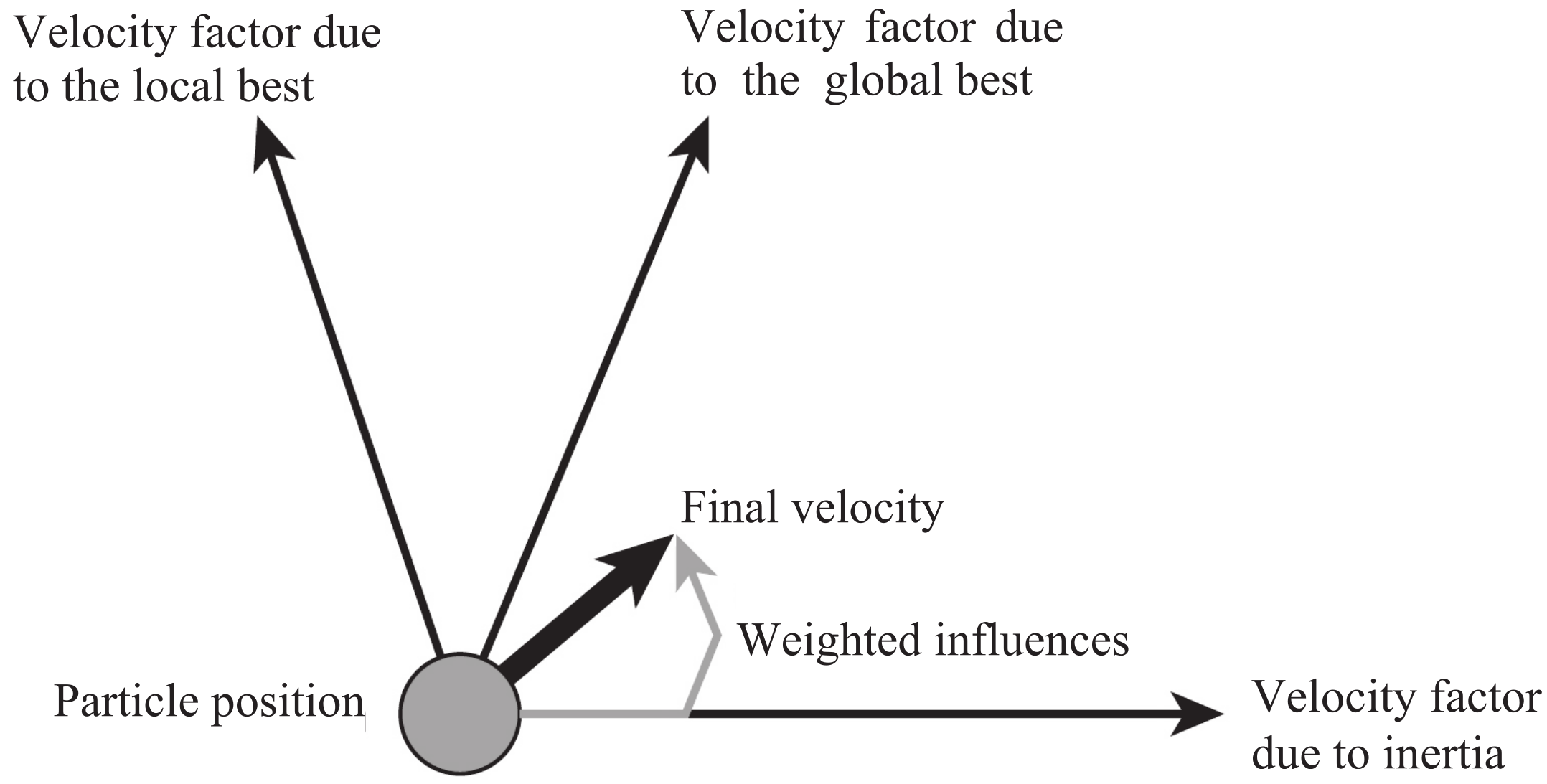
  • Particle Movement: A particle’s movement is governed by updates to its velocity and position, which are crucial for optimization. The velocity is updated according to the following equation:
    v i t + 1 = W v i t + C 1 r 1 x ^ i ( t ) x i ( t ) + C 2 r 2 g ( t ) x i ( t )
    where
    v i ( t + 1 ) : new velocity of particle i at iteration t + 1 .
    v i ( t ) : current velocity of particle i at iteration t.
    W: inertia coefficient, used to balance exploration and exploitation.
    C 1 : cognitive acceleration coefficient.
    r 1 : random vector in [ 0 , 1 ] of the same dimension as the velocity vector.
    x ^ i ( t ) : best position found so far by particle i (personal best).
    x i ( t ) : current position of particle i at iteration t.
    C 2 : social acceleration coefficient.
    r 2 : random vector in [ 0 , 1 ] of the same dimension as the velocity vector.
    g ( t ) : best position found by the entire swarm up to iteration t (global best).
To understand how this equation relates to the particle’s motion, it is useful to identify three key components (see Figure 1):
Once the new velocity is computed, the particle’s position is updated using Equation (7):
x i t + 1 = x i t + v 1 t + 1
A key challenge of the PSO algorithm is that particles may reach excessively high velocities, which can cause them to exit the search space or hinder convergence to the optimal solution. This issue has been the subject of various studies and algorithmic refinements.

4. Proposed Method

This section introduces a hybrid optimization strategy that integrates Particle Swarm Optimization (PSO) with a dynamic inertia weight adjustment scheme inspired by the cooling process of Simulated Annealing (SA). Specifically, the cooling schedule follows the Lundy–Mees formulation, which offers fine-grained control over the inertia weight decay. By embedding this adaptive mechanism into the PSO framework, the algorithm dynamically tunes the trade-off between global exploration and local exploitation during the reconfiguration process, improving its capability to navigate highly non-convex and multimodal search spaces typically observed in Distribution Network Reconfiguration problems. The implementation is carried out in Python 3, where OpenDSS is invoked through its API as the solution engine. In this setup, Python coordinates the optimization process and generates new candidate solutions, while OpenDSS internally computes the corresponding power flow and returns electrical performance metrics such as voltages, currents, losses, and energies. This design does not constitute a co-simulation platform; instead, it provides an integrated environment in which Python manages the optimization logic and OpenDSS executes the system evaluations.
Unlike methods that reformulate the problem into a convex version, the proposed PSO-SA algorithm directly addresses the original nonconvex and combinatorial formulation, preserving the radiality and discreteness constraints of the Distribution Network Reconfiguration problem. This approach eliminates the need for post-processing adjustments that are often required in convexified models, ensuring that the obtained solutions are inherently feasible.

4.1. Inertia Weight

The inertia weight is defined by upper and lower bounds ( W m a x and W m i n ), and evolves across iterations according to a SA-inspired decay model. The inertia update equation enhances the swarm’s global search capability during the early stages and emphasizes local intensification as the iterations progress. This is particularly important in DNR scenarios involving high DG penetration, where the optimization landscape presents multiple near-optimal configurations with subtle differences in active power loss values.
A notable feature of the Lundy–Mees cooling scheme is its effectiveness at low temperatures in the context of Simulated Annealing, due to several key reasons:
  • Precise control at low temperatures: The Lundy–Mees method smoothly adjusts the cooling rate at low temperatures, allowing for small improvements in solutions near the optimum. This is crucial during the final stages of optimization.
  • Reduced risk of being trapped in local optima: At low temperatures, the gradual cooling of Lundy–Mees allows the algorithm to temporarily accept worse solutions, helping to escape local optima and increasing the probability of reaching the global optimum.
  • Improved precision in global optimum search: The more gradual temperature decrease promotes an exhaustive search in regions near the optimum, which is essential for problems with multiple closely located local minima.
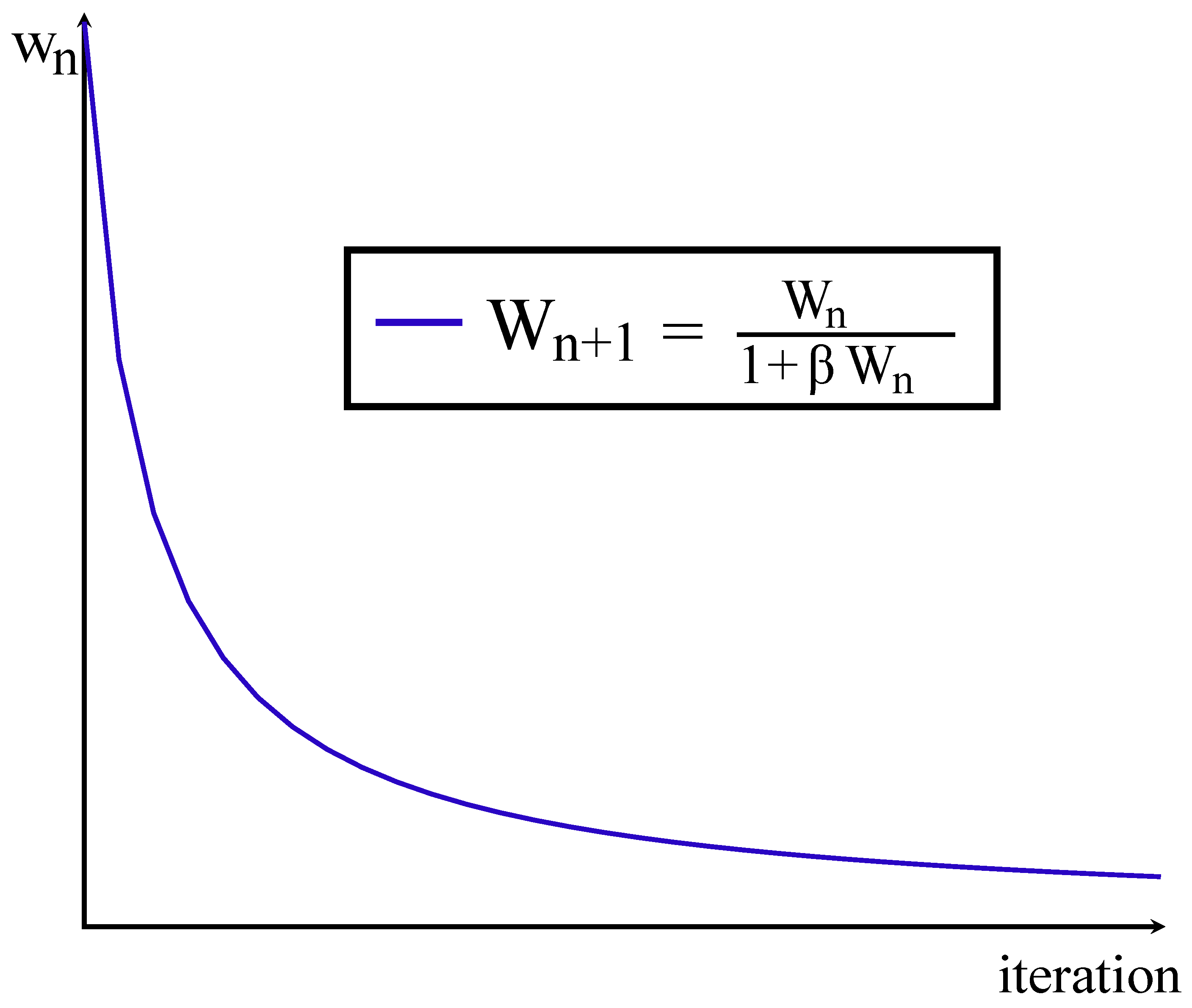
The equation for the inertia weight W is given by the following:
d W = W m a x W m i n
β = d W N i t e r · W m a x · W m i n
W n + 1 = W n 1 + β · W n
where
  • W n + 1 is the inertia weight at iteration n + 1 ;
  • W n is the inertia weight at the current iteration n;
  • β is a variable that controls the rate of decay (cooling);
  • N i t e r is the total number of iterations;
  • W m a x is the maximum inertia weight;
  • W m i n is the minimum inertia weight.
It is important to note that although β remains constant during the iterative process, its value is defined as a function of the total number of iterations N iter (see Equation (9)). Consequently, the update rule in Equation (10) ensures that the sequence decreases smoothly from W max to W min within N iter steps, avoiding convergence to zero and preserving the correctness of the formulation. Figure 2 illustrates the behavior of the proposed cooling strategy.

4.2. Mesh Creation

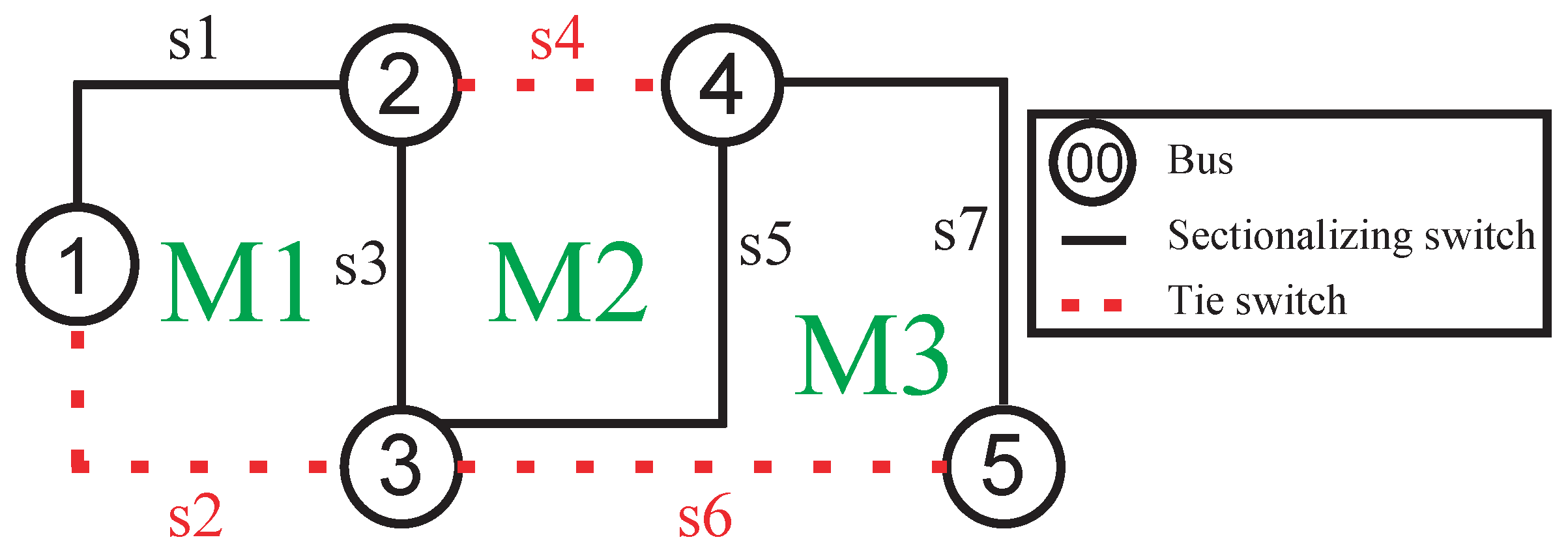
As mentioned, the number of possible configurations is given by 2 n , where n is the number of switches. Since each line in the system has an operable switch, the number of controllable switches ( n c ) equals the number of lines ( n l ). For instance, in a small system with five buses and seven lines, the number of possible configurations is 2 7 = 128 .
Fundamental loops refer to those that can be formed in the system without containing any other loops within them. In this case, with three fundamental loops, the representative chain of a radial topology includes only three candidate elements for disconnection. This ensures that not all switchable elements are considered as candidates, but only those associated with the fundamental loops of the system. The use of real-number encoding allows for a significant reduction in the length of the representative chain of individuals (topologies) compared to binary encodings [38].
In the Selective Space Mesh (SSM) approach, each line in the system is equipped with a single switch that can be operated. Therefore, the number of operable switches ( n c ) is equal to the number of lines ( n l ). For instance, in a system comprising five buses and seven lines, there can be 2 7 = 128 possible configurations.
Equation (4) enables the identification of the three fundamental loops of the 5-bus system, illustrated in Figure 3 and denoted as M1, M2, and M3.

4.3. Stopping Criterion

To ensure convergence reliability while maintaining computational efficiency, the termination of the PSO-SA algorithm is governed by two complementary stopping criteria. The first is a maximum number of iterations, N i t e r , which establishes an upper computational bound and facilitates comparability across case studies. The second is a stagnation-based criterion, defined by the maximum number of consecutive iterations without improvement in the global best solution (Gbest), denoted by N R m . Once this threshold is reached, the search process is terminated under the assumption that convergence has been achieved. This dual mechanism reduces unnecessary evaluations, mitigates the risk of premature convergence in the presence of multiple local optima—commonly observed in Distribution Network Reconfiguration (DNR) problems—and provides a balance between solution quality and execution time. The specific values of N i t e r and N R m were chosen based on common practice in the literature and validated through preliminary experiments.

5. Application of PSO-SA to the DNR Problem

The metaheuristic approach integrates Particle Swarm Optimization (PSO) with a dynamically adaptive inertia weight strategy based on the Simulated Annealing (SA) cooling schedule proposed by Lundy–Mees, effectively enhancing the algorithm’s ability to traverse the combinatorial search space inherent to DNR problems with or without distributed generation (DG).
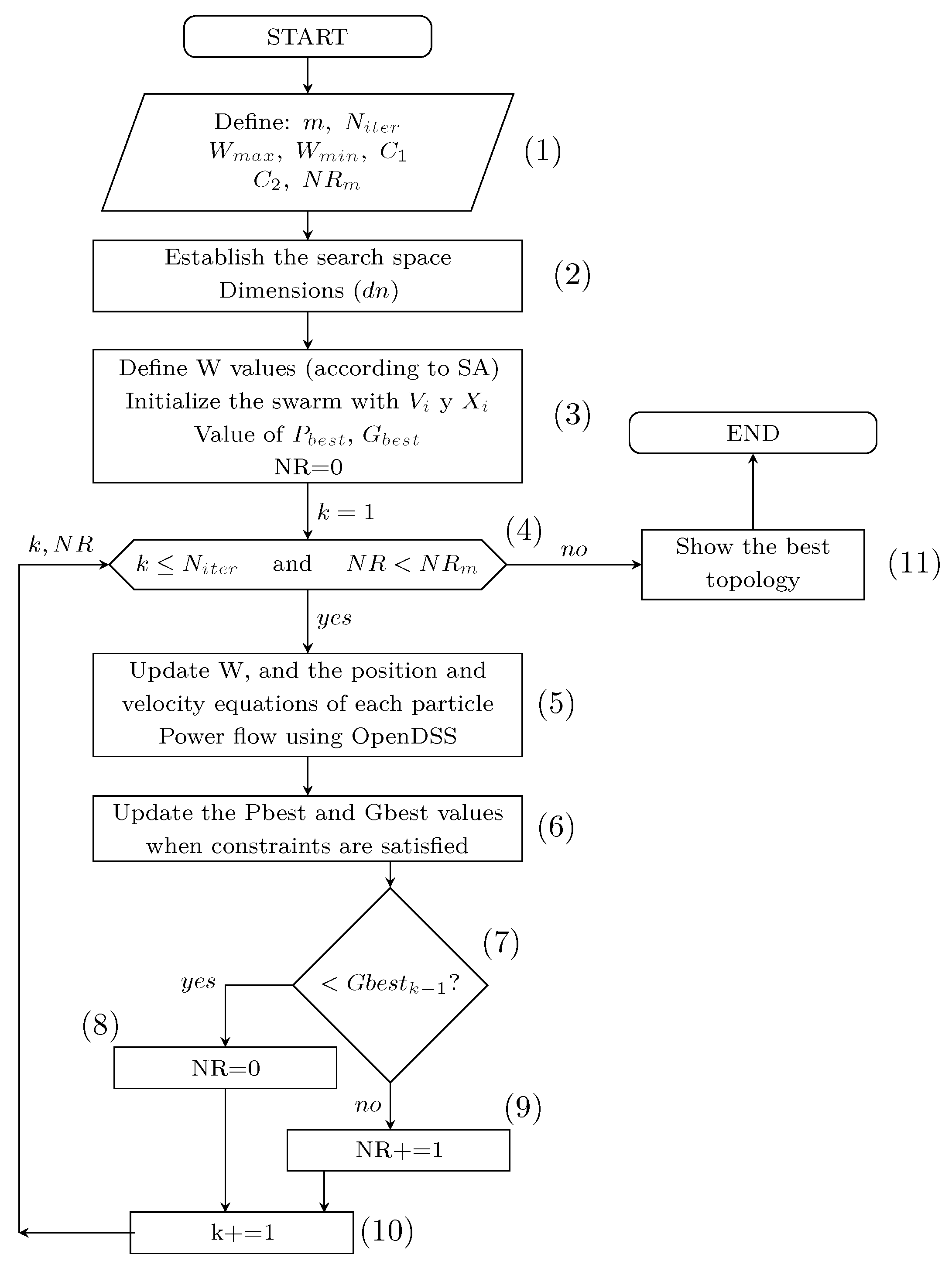
The proposed algorithm follows the steps below:
  • Define the input parameters, including the initial network topology, swarm population size (m), maximum number of optimization cycles ( N i t e r ), inertia weight bounds ( W min , W max ), acceleration coefficients for cognitive and social components ( C 1 , C 2 ), and the maximum stagnation threshold ( N R m ), which limits the number of consecutive iterations without global improvement.
  • Construct the reduced feasible solution space ( S d n ) based on the identification of fundamental loops derived from the meshed network, and define the dimensionality ( d n ) of the optimization problem as the number of independent loops subjected to topological reconfiguration.
  • Compute the initial inertia weight (W) using the SA-based cooling Equations (8)–(10). Initialize the particle positions and velocities, and randomly assign personal best positions ( P b e s t ). The global best solution ( G b e s t ) is extracted from the best-performing individual at the initial iteration.
  • Evaluate the stopping condition: if the current iteration index k exceeds N i t e r or if the global solution has stagnated beyond the limit defined by N R m , proceed directly to step 11. Otherwise, continue the iterative optimization process.
  • Update the inertia weight, velocity, and particle position vectors according to the modified PSO-SA movement equations. Perform power flow analysis using the OpenDSS engine to assess the fitness value of each candidate network configuration.
  • Enforce the operational and topological constraints (2)–(5), including bus voltage limits, line ampacity, radiality preservation, and full system connectivity, before updating P b e s t and G b e s t .
  • Compare the current global solution with the previous iteration’s global best ( k 1 ). If an improvement is observed, proceed to step 8. Otherwise, continue to step 9.
  • Reset the stagnation counter to zero, indicating that a new superior global solution has been identified by the swarm.
  • Increment the stagnation counter by one if no enhancement is observed in G b e s t compared to the previous iteration.
  • Increase the iteration index: k k + 1 and return to step 4.
  • Return the final reconfiguration strategy represented by G b e s t , corresponding to the optimal radial topology with minimized power losses.
The complete flowchart of the proposed algorithm is shown in Figure 4.

6. Simulation and Results

The Distribution Network Reconfiguration (DNR) problem was addressed for benchmark radial distribution systems composed of 5, 33, and 69 buses, which are widely adopted in the literature for validating optimization algorithms applied to power distribution networks. The proposed PSO-SA algorithm was implemented and executed on a computing platform equipped with an Intel(R) Core(TM) i5-7200U CPU at 2.50 GHz. Each simulation scenario was designed to assess the convergence dynamics, solution robustness, and computational efficiency of the algorithm under both deterministic and stochastic operating conditions. In all test cases, the swarm size m denotes the number of particles employed in the optimization process. For the 33- and 69-bus systems, comparative performance evaluations were conducted against established PSO variants, including the following: (i) Generic PSO, which uses a fixed inertia weight; (ii) Linearly Decreasing inertia weight (LD) [39]; (iii) PSO with Oscillating Inertia Weight (OIW) [40]; and (iv) PSO with Oscillating Exponential Decay (OED) [41]. The results are reported in terms of objective function convergence (active power loss minimization), recurrence rate of the global optimum, and statistical dispersion (standard deviation), providing a comprehensive performance profile of the proposed hybrid method under high-dimensional and multimodal optimization landscapes.
The simulation scenarios were initialized according to the flow presented in Figure 4, where the swarm size (m), maximum iterations ( N i t e r ), inertia weight limits ( W m i n , W m a x ), acceleration coefficients ( C 1 , C 2 ), and stagnation threshold ( N R m ) were predefined. These parameters were tuned for each case study (5-, 33-, and 69-bus systems) to ensure fair comparisons with other PSO variants. Power flow evaluations were carried out in OpenDSS, as indicated in step 5 of the flowchart, ensuring that all candidate topologies satisfied operational and radiality constraints before updating the global best.
The PSO parameters ( W m a x , W m i n , C 1 , C 2 ) were selected based on values commonly reported in the literature for Distribution Network Reconfiguration. Preliminary sensitivity tests confirmed that these settings provide a stable balance between exploration and exploitation, ensuring convergence reliability and comparability with previous studies.
Table 2 presents a comparative overview of the evaluated PSO variants. The proposed algorithm employs an adaptive inertia weight adjustment based on the Lundy–Mees Simulated Annealing scheme, resulting in a more dynamic balance between exploration and exploitation. Consequently, it achieves superior convergence speed and robustness across different network configurations (5-, 33-, and 69-bus systems).
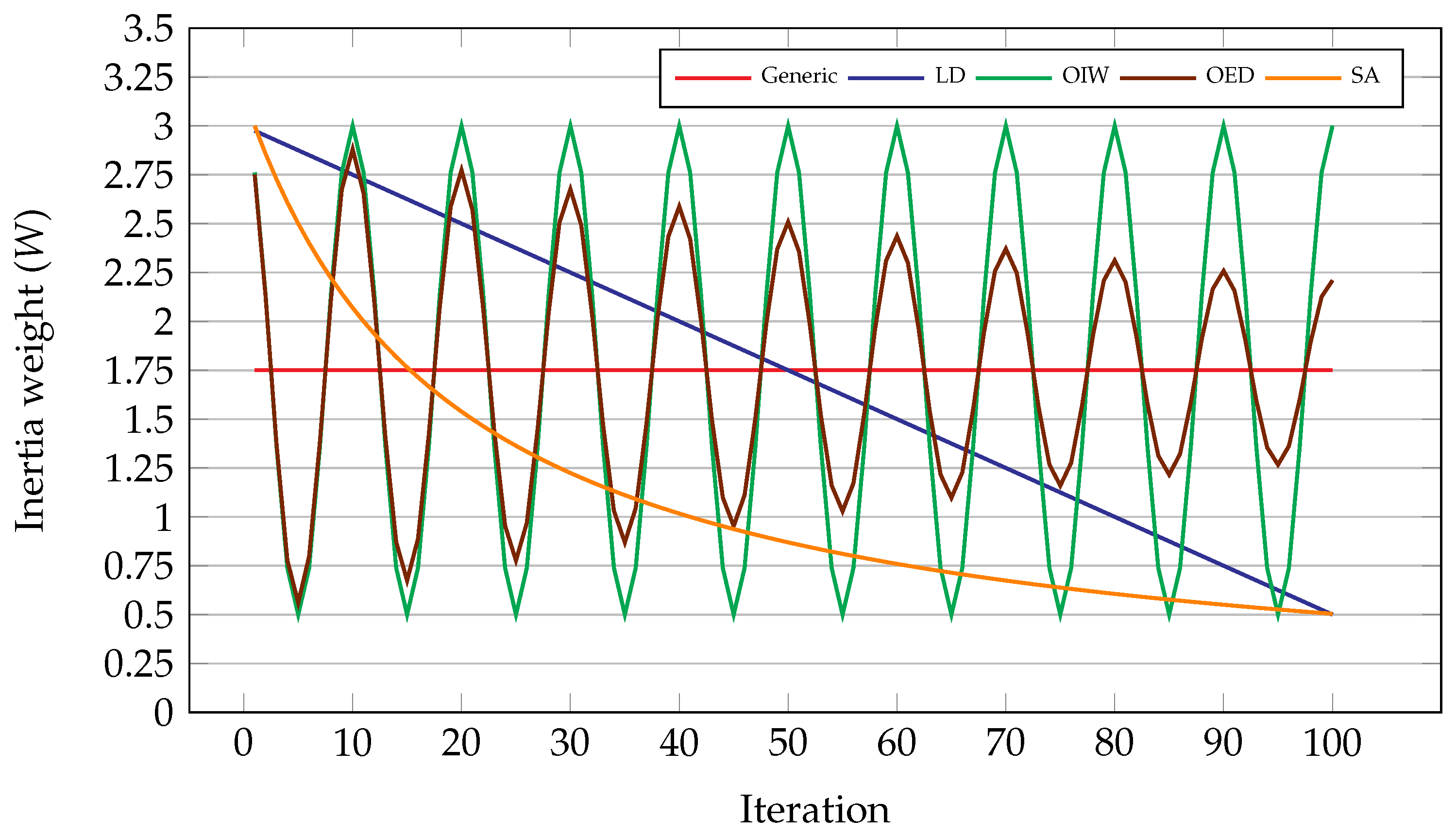
Figure 5 shows the evolution of the inertia weight W throughout 100 iterations for different PSO-based methods, considering W m a x = 3 and W m i n = 0.5.
The population size (m) was defined according to the network dimension to maintain a proper balance between exploration and convergence. Several population sizes were tested to assess their effect on solution quality and computational efficiency: {15, 20, 25} for the 5-bus system, {60, 80, 100} for the 33-bus system, and {80, 100, 120} for the 69-bus system. The results showed that the optimal number of particles depends on network complexity; smaller populations restrict exploration, whereas excessively large ones increase computational cost without improving accuracy. Therefore, the population size was empirically tuned for each case to ensure stable and efficient performance. All PSO-based algorithms were compared using m = 100 to maintain consistency.

6.1. Case Study 1: 5-Bus Distribution System

This case study considers a 5-bus educational distribution system comprising seven lines, as described in [42]. The network features a primary substation located at Bus 1, four sectionalizing switches (s1, s3, s5, and s7), and three tie-switches (s2, s4, and s6). The radial configuration of the system can be altered by opening or closing these switches, forming several potential loops, as illustrated in Figure 3.
The simulation parameters adopted for this case are as follows: W m a x = 3 , W m i n = 0.5 , C 1 = 1.5 , C 2 = 2 , and N R m = 25 .
Table 3 summarizes the results obtained from 100 independent runs of the metaheuristic algorithm under different configurations of population size (m) and number of iterations ( N i t e r ).
As shown in Table 3, the algorithm consistently converged to the same optimal configuration in all 100 runs across every tested parameter set. This is evidenced by a standard deviation of zero in all cases, indicating robust convergence behavior and absence of premature convergence or local optima trapping.
The optimal switch configuration identified was [ 3 , 4 , 7 ] , which yields minimum active power losses of 36.248 kW. Although all parameter combinations led to the same solution, the configuration with m = 15 and N i t e r = 40 is considered the most efficient due to its lower computational cost and faster convergence.

6.2. Case Study 2: 33-Bus Distribution System

This case study evaluates the well-known 33-bus, 10 MVA radial distribution system originally proposed by Baran and Wu [43], with further configurations adapted from [25]. The network operates at 12.66 kV and comprises 37 branches, 32 sectionalizing switches, and 5 tie-switches. The loops formed by the switching elements are illustrated in Figure 6, considering the presence of renewable distributed generation (DG). These loops are denoted by the letter M.
The DG units and their power ratings are taken from [44], where optimal sizing and placement were previously determined. Since these generation values originate from a distinct optimization stage, the reconfiguration process introduces multiple local optima, thereby increasing the problem’s complexity and testing the robustness of the proposed method. The DG allocation used in this case study is listed in Table 4.
The parameter settings adopted for this case are W m a x = 3 , W m i n = 0.5 , C 1 = 1.5 , C 2 = 2 , and N R m = 60 .
Table 5 presents the outcomes of 100 independent simulations for different population sizes (m) and iteration numbers ( N i t e r ). The objective is to assess the repeatability, stability, and quality of the solutions obtained by the metaheuristic.
From Table 5, it is evident that the standard deviation remains below 0.141 in all configurations, indicating good consistency and robustness of the optimization process. The proposed method successfully converged to the global optimum in over 66% of runs, even in the presence of multiple local optima. The best-performing configuration, in terms of efficiency and computational cost, is achieved with m = 60 and N i t e r = 100 , offering performance similar to larger populations but at reduced computational effort.
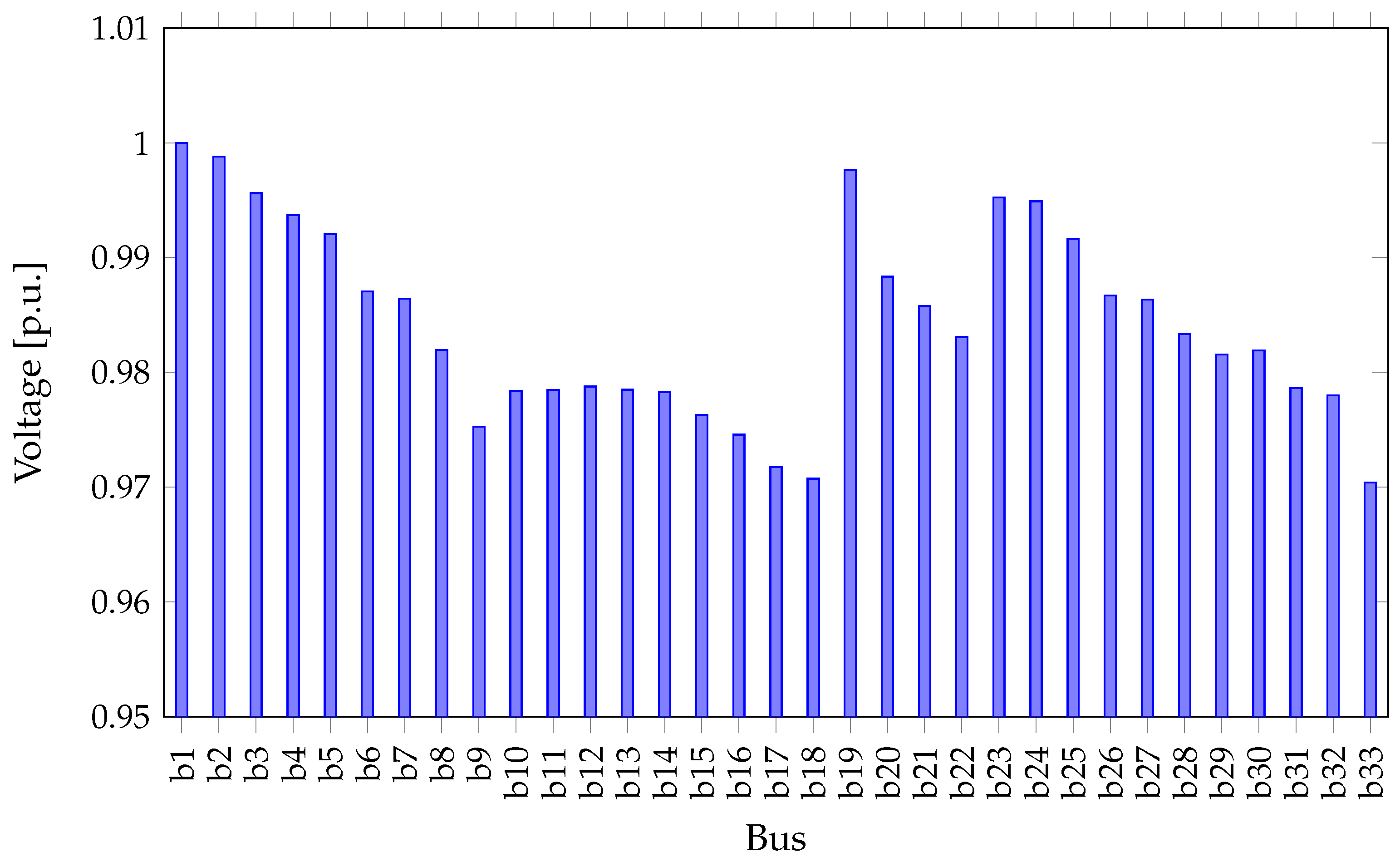
Figure 7 illustrates the voltage profile corresponding to the best solution, confirming that voltage levels across all buses remain within acceptable operational limits.
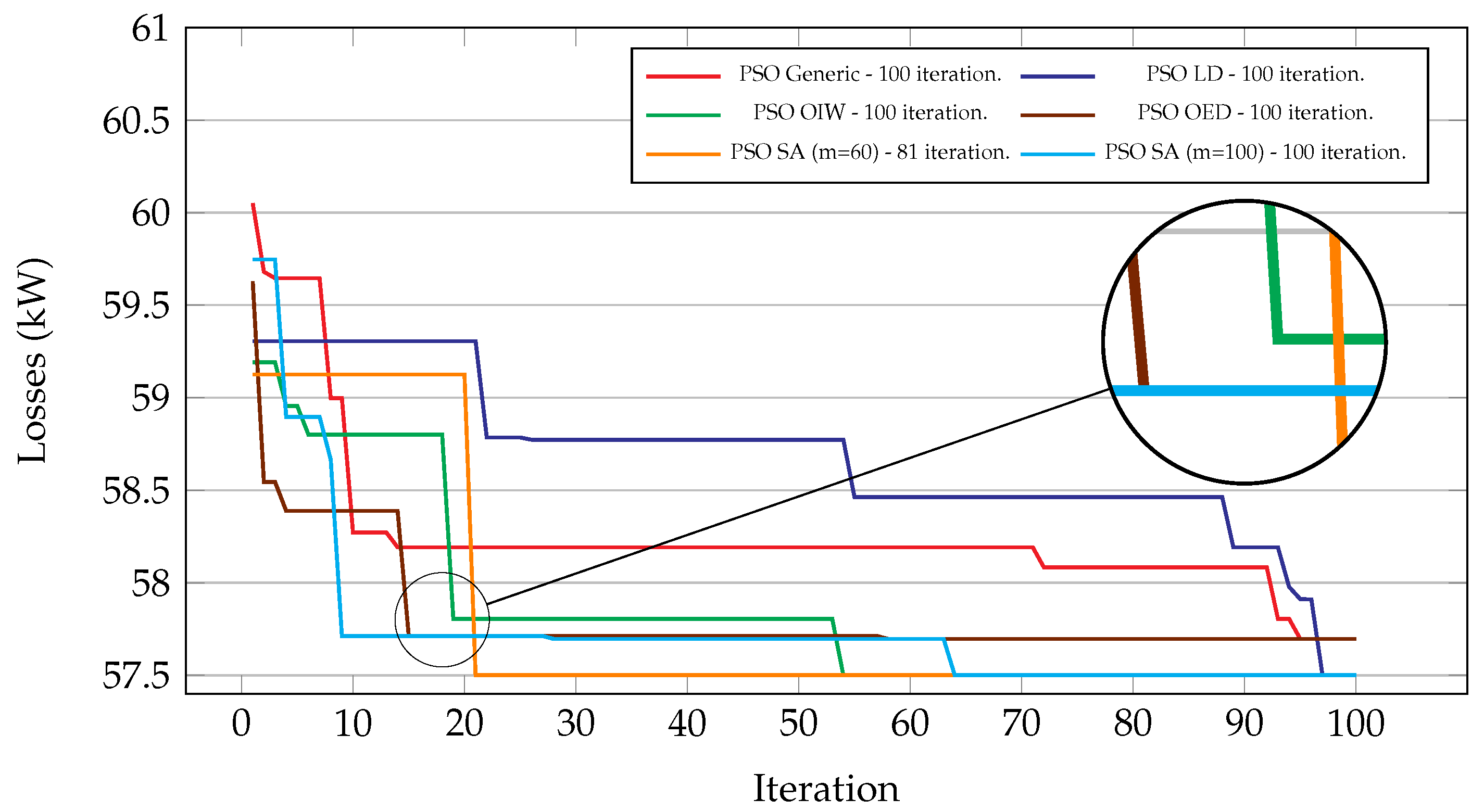
Figure 8 presents the convergence curves of the proposed method and several PSO-based variants. The results indicate that the proposed strategy outperforms the alternatives in reaching the minimum active power loss of 57.5 kW more consistently and with fewer iterations.
Finally, Table 6 provides a comparative summary of the proposed approach and existing PSO-based methods in the literature. The proposed PSO-SA variant with m = 60 demonstrates competitive results in terms of solution quality, convergence stability, and computational time, achieving the global optimum in 82% of the simulations with the lowest observed standard deviation (0.078).

6.3. Case Study 3: 69-Bus Distribution System

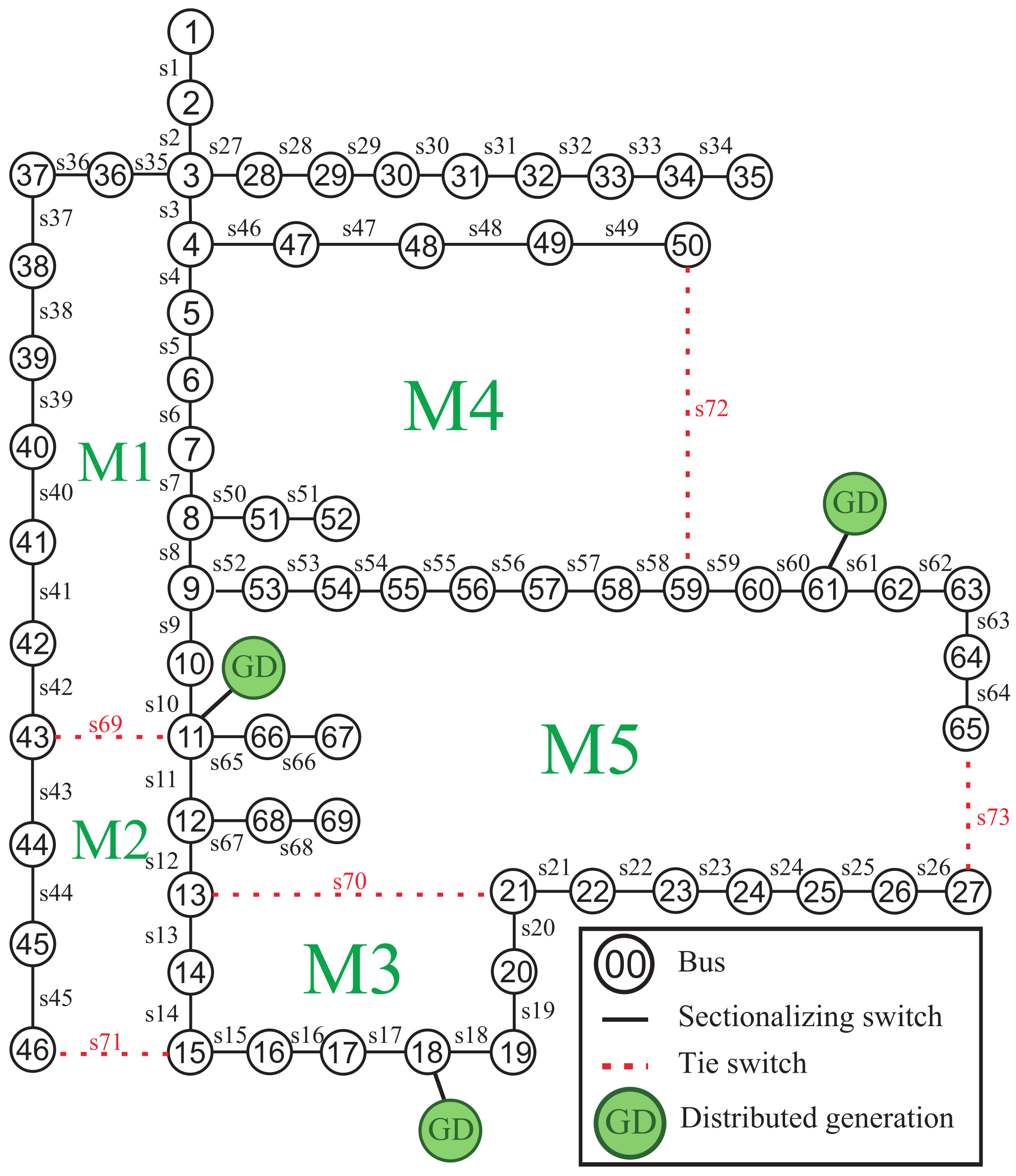
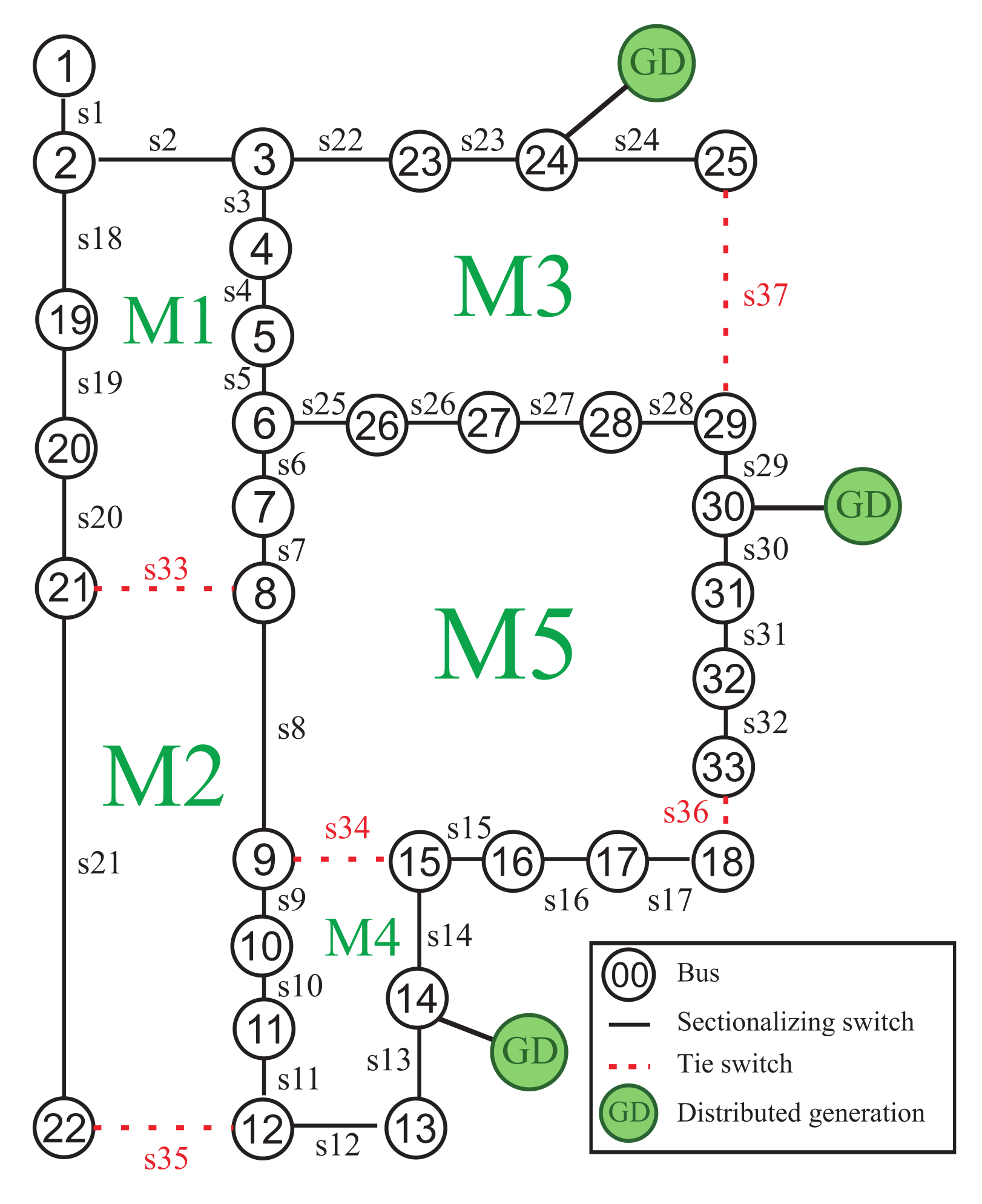
The third case study analyzes the 69-bus distribution system with a total load of 10 MVA, originally introduced in [45] and later detailed by Savier and Das [46]. The network operates at 12.66 kV and consists of 73 branches, 68 sectionalizing switches, and 5 tie-switches, yielding a five-dimensional reconfiguration problem. As illustrated in Figure 9, the loops generated by the switching elements under DG integration are denoted as M1 through M5.
Renewable generation data were obtained from [44], where the optimal placement and sizing of DG units were determined through a separate optimization process. As a consequence, the resulting reconfiguration problem becomes more challenging due to the presence of multiple local optima, requiring the proposed method to maintain robustness while identifying high-quality solutions. Table 7 lists the active power injections and power factors of the three installed DG units.
The parameters defined for this system are W m a x = 3 , W m i n = 0.5 , C 1 = 1.5 , C 2 = 2 , and N R m = 60 .
Table 8 presents the results obtained from 100 independent runs of the metaheuristic algorithm under different combinations of population size (m) and iteration count ( N i t e r ).
From Table 8, it can be observed that in all cases, the standard deviation is less than or equal to 0.247, which implies that in more than 68% of the 100 simulations, the global optimal solution is reached. The results suggest that the best performance is achieved with m = 100 , N i t e r = 100 , using a population of 100 particles, yielding a recovery rate of 93% and high efficiency, as evidenced by the low standard deviation of 0.012.
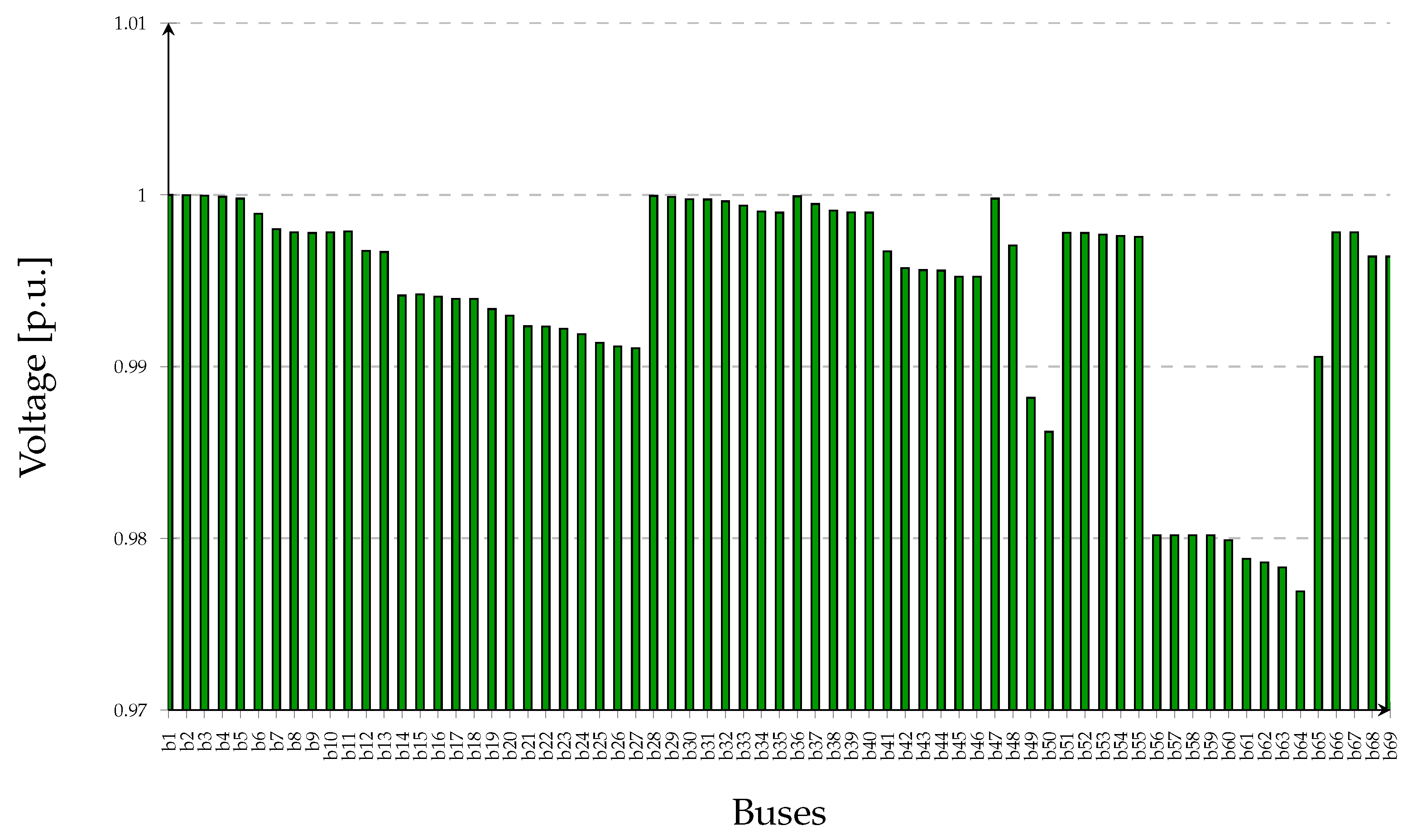
The voltage profile associated with the best solution is presented in Figure 10, confirming that all buses remain energized and voltages are within permissible limits.
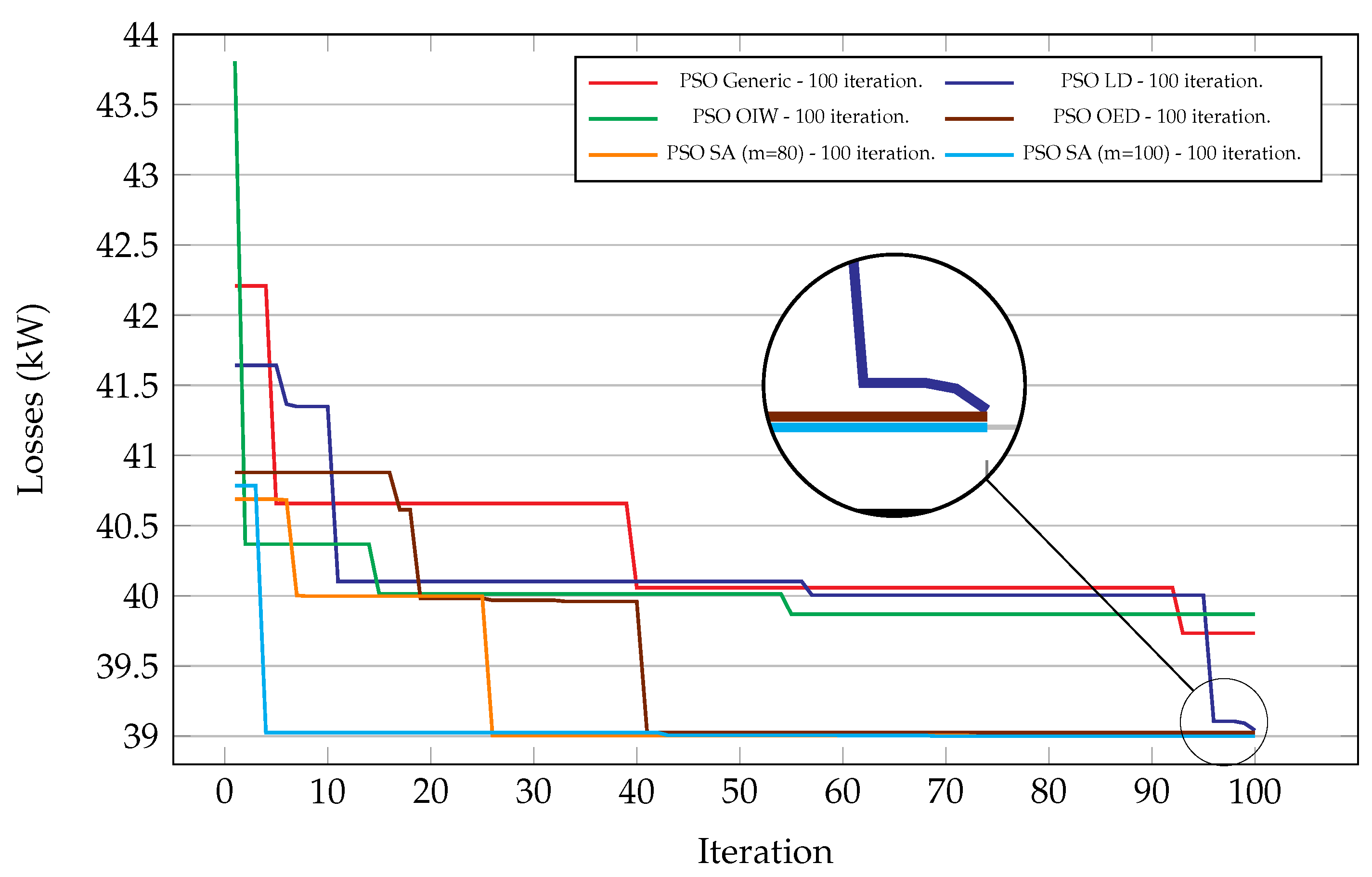
Figure 11 presents a comparison between the proposed method and different PSO variants. The proposed method achieves better performance, obtaining a solution with active losses of 38.99 kW. Other methods, such as Generic PSO, OIW, and LD, fail to reach this optimal solution for the evaluated system. The legend indicates the number of iterations used for each method.
Finally, Table 9 provides a comparative analysis among the evaluated methods. The PSO-SA variant (with m = 100 ) achieved the best overall performance, with 93% of the runs converging to the global solution and a standard deviation of just 0.012. In contrast, other methods demonstrated significantly lower robustness, with global solution frequencies below 17% and higher standard deviations. These results reaffirm the effectiveness of the proposed method in handling complex, multimodal solution spaces—a characteristic particularly relevant in large-scale distribution systems with integrated distributed generation.
It is worth noting that in scenarios with distributed generation, the candidate solutions obtained after reconfiguration tend to be very close to each other due to the existence of multiple local optima derived from the prior DG placement and sizing optimization. This explains the relatively small gap between the best and worst solutions reported. The results confirm the robustness of the proposed method, achieving recurrence rates above 80% and low standard deviations in the 5-, 33-, and 69-bus systems. Unlike convexified approaches that require post-processing adjustments, the PSO-SA algorithm preserves the discrete and radial nature of the problem, ensuring feasible and robust solutions even under high DG penetration.

7. Conclusions

This research presented a robust and efficient metaheuristic approach for optimal Distribution Network Reconfiguration, incorporating renewable distributed generation (DG). The proposed strategy, based on an enhanced Particle Swarm Optimization (PSO) algorithm with strategic adaptation (PSO-SA), was evaluated on three benchmark distribution systems: the 5-bus, 33-bus, and 69-bus networks.
The combination of these two metaheuristic methods provides efficient solutions for network reconfiguration, achieving fast convergence and low computational cost. The proposed algorithm was evaluated on three benchmark systems widely used in the technical literature, which allowed the verification of its effectiveness. The best results were obtained on the 33-bus system, outperforming the results reported by the author who provided the renewable generation data. This demonstrates the algorithm’s ability to perform exhaustive search and avoid stagnation in local optima.
The results obtained across 100 independent simulations for each test system confirm the effectiveness and robustness of the proposed method. In the 5-bus system, the algorithm consistently converged to the global optimum in all runs, demonstrating stability in small-scale scenarios. For the 33-bus and 69-bus systems—both characterized by the presence of optimally placed DG units and complex topologies—the method outperformed traditional PSO variants, achieving convergence rates above 80% and significantly lower standard deviations. In particular, the PSO-SA variant with a moderate population size ( m = 60 or m = 100 ) achieved global optimal solutions with high frequency and reduced computational effort.
The inclusion of renewable generation in distribution systems increases the number of local solutions, many of which present very similar active power loss values. This poses a challenge for metaheuristic methods, as it hampers their ability to find optimal solutions. The PSO-SA algorithm has demonstrated high recurrence in systems with renewable generation, being equally effective for reconfiguration in systems with or without such generation.
The proposed PSO-SA method offers practical advantages: it guarantees the feasibility of solutions by preserving the original problem constraints, and it exhibits high computational robustness. These features make it a competitive alternative for smart grid scenarios, where model simplifications may compromise the applicability and validity of the obtained solutions.
The PSO-SA algorithm has been validated on widely recognized benchmark networks, providing a solid basis for performance comparison, while future work will extend its application to large-scale real distribution feeders. Although computational effort increases with system size, the stagnation-based stopping criterion effectively mitigates this impact. Future research will focus on incorporating renewable generation uncertainty, extending the method to multi-objective formulations that include reliability and economic cost, and validating the algorithm under dynamic conditions in real-world networks.

Author Contributions

Conceptualization, D.Z.Ñ.H., F.J.S.P., and Y.P.M.R.; methodology, D.Z.Ñ.H., F.J.S.P., and Y.P.M.R.; validation, D.Z.Ñ.H., F.J.S.P., and Y.P.M.R.; investigation, F.J.S.P. and J.R.L.; writing—review and editing, D.Z.Ñ.H., F.J.S.P., and Y.P.M.R.; visualization, F.J.S.P.; supervision, Y.P.M.R. All authors have read and agreed to the published version of the manuscript.

Funding

This research received no external funding.

Data Availability Statement

The original contributions presented in this study are included in the article. Further inquiries can be directed to the corresponding author.

Acknowledgments

The authors also gratefully acknowledge Al Vicerrectorado de Investigación de la Universidad Nacional de Ingeniería, Lima, Perú. This research was supported by grant EDITAL Nº 19/2022—Programa de Apoio a Núcleos em Consolidação do Estado da Paraíba (FAPESQ), under the project entitled Reconfiguração da Rede em Sistemas de Distribuição usando Meta-Heurística Híbrida (Protocol No. 55480.923.44003.27102022). The authors would like to express their sincere gratitude to the Faculty of Electrical Engineering at the National University of Engineering (Lima, Peru) and to the Department of Electrical Engineering at the Federal University of Paraíba (Brazil) for their institutional support and collaboration throughout the development of this work.

Conflicts of Interest

The authors declare no conflict of interest.

List of Acronyms and Symbol

AcronymMeaning
DNRDistribution Network Reconfiguration
DGDistributed Generation
DERDistributed Energy Resources
PSOParticle Swarm Optimization
SASimulated Annealing
PSO-SAParticle Swarm Optimization with Simulated Annealing
LDLinearly Decreasing (Inertia Weight)
OIWOscillating Inertia Weight
OEDOscillating Exponential Decay
SSMSelective Space Mesh
LMPLocational Marginal Price
IMSAImproved Moth Swarm Algorithm
MIPSOModified Improved Particle Swarm Optimization
VSDIVoltage Stability Deviation Index
FWAFireworks Algorithm
IGBAImproved Game-Based Algorithm
QOC-NNA Quasi-Oppositional Chaotic Neural Network Algorithm
IEEEInstitute of Electrical and Electronics Engineers
OpenDSSOpen Distribution System Simulator
SymbolDescription
f ( x ) Objective function representing total active power losses
P l Active power loss in line l
n l Total number of lines
xSystem configuration (switch states)
| E k | Voltage magnitude at bus k
E min , E max Minimum and maximum voltage limits
P l max Maximum power capacity of line l
N l o o p s Number of loops in the network
N l i n e s Number of lines
N b u s e s Number of buses
N s o u r c e s Number of power sources (substations)
v i ( t ) Velocity of particle i at iteration t
x i ( t ) Position of particle i at iteration t
x ^ i ( t ) Personal best position of particle i
g ( t ) Global best position in the swarm at iteration t
c 1 , c 2 Acceleration coefficients (cognitive and social)
r 1 , r 2 Random numbers uniformly distributed in [ 0 , 1 ]
WInertia weight
W max , W min Maximum and minimum inertia weights
W n Inertia weight at iteration n
N i t e r Maximum number of iterations
β Decay rate coefficient for inertia weight
d W Difference between W max and W min
N R m Maximum stagnation threshold
mNumber of particles in the swarm

References

  1. Brown, R. Distribution reliability assessment and reconfiguration optimization. In Proceedings of the 2001 IEEE/PES Transmission and Distribution Conference and Exposition. Developing New Perspectives (Cat. No.01CH37294), Atlanta, GA, USA, 2 November 2001; Volume 2, pp. 994–999. [Google Scholar] [CrossRef]
  2. Nie, S.; Fu, X.-P.; Li, P.; Gao, F.; Ding, C.-D.; Yu, H.; Wang, C.-S. Analysis of the impact of dg on distribution network reconfiguration using opendss. In Proceedings of the IEEE PES Innovative Smart Grid Technologies, Tianjin, China, 21–24 May 2012; pp. 1–5. [Google Scholar] [CrossRef]
  3. Marques, R.C.; Eichkoff, H.S.; de Mello, A.P.C. Analysis of the distribution network reconfiguration using the opendss® software. In Proceedings of the 2018 Simposio Brasileiro de Sistemas Eletricos (SBSE), Niteroi, Brazil, 12–16 May 2018; pp. 1–6. [Google Scholar] [CrossRef]
  4. Mello, A.P.C.D. Reconfiguração de Redes de Distribuição Considerando Multivariáveis e Geração Distribuída. Master’s Thesis, Universidade Federal de Santa Maria, Santa Maria, Brazil, 2014. [Google Scholar]
  5. Bernardon, D.P. Novos Métodos Para Reconfiguração das Redes de Distribuição a Partir de Algoritmos de Tomadas de Decisão Multicritérios. Ph.D. Thesis, Universidade Federal de Santa Maria, Santa Maria, Brazil, 2007. [Google Scholar]
  6. Antončič, M.; Mikec, M.; Blažič, B. Development of distribution network model in opendss using matlab and gis data. In Proceedings of the 2019 7th International Youth Conference on Energy (IYCE), Bled, Slovenia, 3–6 July 2019; pp. 1–6. [Google Scholar] [CrossRef]
  7. Zeb, M.Z.; Imran, K.; Khattak, A.; Janjua, A.K.; Pal, A.; Nadeem, M.; Zhang, J.; Khan, S. Optimal placement of electric vehicle charging stations in the active distribution network. IEEE Access 2020, 8, 68124–68134. [Google Scholar] [CrossRef]
  8. de Andrade, B.A.R.; Ferreira, N.R. Simulated annealing and tabu search applied on network reconfiguration in distribution systems. In Proceedings of the 2018 Simposio Brasileiro de Sistemas Eletricos (SBSE), Niteroi, Brazil, 12–16 May 2018; pp. 1–6. [Google Scholar] [CrossRef]
  9. Chiang, H.-D.; Jean-Jumeau, R. Optimal network reconfigurations in distribution systems. i. a new formulation and a solution methodology. IEEE Trans. Power Deliv. 1990, 5, 1902–1909. [Google Scholar] [CrossRef]
  10. Bramm, A.; Eroshenko, S. Optimal reconfiguration of distribution network with solar power plants. In Proceedings of the 2021 Ural-Siberian Smart Energy Conference (USSEC), Novosibirsk, Russian, 13–15 November 2021; pp. 1–5. [Google Scholar]
  11. Azad-Farsani, E.; Sardou, I.G.; Abedini, S. Distribution network reconfiguration based on lmp at dg connected busses using game theory and self-adaptive fwa. Energy 2021, 215, 119146. [Google Scholar] [CrossRef]
  12. Tran, T.V.; Truong, B.-H.; Nguyen, T.P.; Nguyen, T.A.; Duong, T.L.; Vo, D.N. Reconfiguration of distribution networks with distributed generations using an improved neural network algorithm. IEEE Access 2021, 9, 165618–165647. [Google Scholar] [CrossRef]
  13. Nguyen, T.T.; Duong, T.L.; Ngo, T.Q. Network reconfiguration and distributed generation placement for multi-goal function based on improved moth swarm algorithm. Math. Probl. Eng. 2022, 2022, 5015771. [Google Scholar] [CrossRef]
  14. Wang, H.-J.; Pan, J.-S.; Nguyen, T.-T.; Weng, S. Distribution network reconfiguration with distributed generation based on parallel slime mould algorithm. Energy 2022, 244, 123011. [Google Scholar] [CrossRef]
  15. Wen, J.; Qu, X.; Huang, Y.; Lin, S. A reconfiguration method of distribution network considering time variations for load and renewable distributed generation. In Proceedings of the 2022 7th Asia Conference on Power and Electrical Engineering (ACPEE), Hangzhou, China, 15–17 April 2022; pp. 544–549. [Google Scholar]
  16. Naguib, M.; Omran, W.A.; Talaat, H.E. Performance enhancement of distribution systems via distribution network reconfiguration and distributed generator allocation considering uncertain environment. J. Mod. Power Syst. Clean Energy 2022, 10, 647–655. [Google Scholar] [CrossRef]
  17. Zheng, G.; Nan, Y.; Meng, F.; Shen, J.; Lu, C.; Han, Y. A two-stage power flow optimization method for active distribution network considering distribution network reconfiguration. In Proceedings of the 2023 4th International Conference on Advanced Electrical and Energy Systems (AEES), Shanghai, China, 1–3 December 2023; pp. 482–489. [Google Scholar]
  18. Bai, C.; Wang, F. An novel integrated optimization approach for reconfiguring distribution network with distributed generation. In Proceedings of the 2023 IEEE 6th International Electrical and Energy Conference (CIEEC), Hefei, China, 12–14 May 2023; pp. 1826–1831. [Google Scholar]
  19. Suk, S.; Wibowo, R.S.; Putri, V.L.B. Dynamic distribution network reconfiguration considering distributed generator and energy storage system using hybrid spso-ipopt method. In Proceedings of the 2023 International Seminar on Intelligent Technology and Its Applications (ISITIA), Surabaya, Indonesia, 26–27 July 2023; pp. 528–533. [Google Scholar]
  20. Mishra, A.; Tripathy, M.; Ray, P. A survey on different techniques for distribution network reconfiguration. J. Eng. Res. 2023, 12, 173–181. [Google Scholar] [CrossRef]
  21. Pucuhuayla, F.J.S.; Correa, C.C.; Ñaupari Huatuco, D.Z.; Rodriguez, Y.P.M. Optimal reconfiguration of electrical distribution networks using the improved simulated annealing algorithm with hybrid cooling (isa-hc). Energies 2024, 17, 4477. [Google Scholar] [CrossRef]
  22. Lotfi, H.; Hajiabadi, M.E.; Parsadust, H. Power distribution network reconfiguration techniques: A thorough review. Sustainability 2024, 16, 10307. [Google Scholar] [CrossRef]
  23. Nebuloni, R.; Ilea, V.; Bovo, C.; Berizzi, A.; Arrigoni, C.; Re, F.; Bonera, R. Optimal reconfiguration of radial distribution networks with renewable energy resources by considering configuration shift steps. Sustain. Energy Grids Netw. 2025, 34, 101861. [Google Scholar] [CrossRef]
  24. Nguyen, T.L.; Nguyen, Q.A. A multi-objective pso-gwo approach for smart grid reconfiguration with renewable energy and electric vehicles. Energies 2025, 18, 2020. [Google Scholar] [CrossRef]
  25. Pegado, R.; Ñaupari, Z.; Molina, Y.; Castillo, C. Radial distribution network reconfiguration for power losses reduction based on improved selective bpso. Electr. Power Syst. Res. 2019, 169, 206–213. [Google Scholar] [CrossRef]
  26. Lavorato, M.; Franco, J.F.; Rider, M.J.; Romero, R. Imposing radiality constraints in distribution system optimization problems. IEEE Trans. Power Syst. 2011, 27, 172–180. [Google Scholar] [CrossRef]
  27. Niknam, T.; Azadfarsani, E.; Jabbari, M. A new hybrid evolutionary algorithm based on new fuzzy adaptive pso and nm algorithms for distribution feeder reconfiguration. Energy Convers. Manag. 2021, 54, 7–16. [Google Scholar]
  28. Dugan, R.C.; Montenegro, D. Reference Guide: The Open Distribution System Simulator (Opendss); Electric Power Research Institute, Inc.: Amsterdam, The Netherlands, 2020; Volume 9.0, pp. 1–218. Available online: https://sourceforge.net/p/electricdss/code/HEAD/tree/trunk/Distrib/Doc/OpenDSSManual.pdf (accessed on 10 October 2025).
  29. Artal, C.G. Inteligencia Artificial—Universidad de Las Palmas de Gran Canaria (España). 2018. Available online: https://cayetanoguerra.github.io/ia/ (accessed on 10 October 2025).
  30. Rodrigo, J.A. Optimización con Enjambre de Partículas (Particle Swarm Optimization). 2019. Available online: https://cienciadedatos.net/documentos/py02_optimizacion_pso (accessed on 10 October 2025).
  31. Singh, P.; Meena, N.K.; Yang, J.; Slowik, A. Swarm intelligence algorithms: A tutorial. In Swarm Intelligence Algorithms; CRC Press: Boca Raton, FL, USA, 2020; pp. 265–277. [Google Scholar]
  32. Vasuki, A. Nature-Inspired Optimization Algorithms; Academic Press: New York, NY, USA, 2020; pp. 77–87. [Google Scholar]
  33. Han, W.H. A new simple micro-pso for high dimensional optimization problem. Appl. Mech. Mater. 2012, 236, 1195–1200. [Google Scholar] [CrossRef]
  34. Zhong, W.-H.; Zhang, J.; Chen, W.-N. A novel discrete particle swarm optimization to solve traveling salesman problem. In Proceedings of the 2007 IEEE congress on evolutionary computation, Singapore, 25–28 September 2007; pp. 3283–3287. [Google Scholar]
  35. Wang, H.; Ke, R.; Li, J.; An, Y.; Wang, K.; Yu, L. A correlation-based binary particle swarm optimization method for feature selection in human activity recognition. Int. J. Distrib. Sens. Netw. 2018, 14, 1550147718772785. [Google Scholar] [CrossRef]
  36. Du, W.-B.; Ying, W.; Yan, G.; Zhu, Y.-B.; Cao, X.-B. Heterogeneous strategy particle swarm optimization. IEEE Trans. Circuits Syst. II Express Briefs 2016, 64, 467–471. [Google Scholar] [CrossRef]
  37. Sethanan, K.; Neungmatcha, W. Multi-objective particle swarm optimization for mechanical harvester route planning of sugarcane field operations. Eur. J. Oper. Res. 2016, 252, 969–984. [Google Scholar] [CrossRef]
  38. Cardero, E.C.; Fonseca, I.S.; Torres, N.A.C.; García, D.J.; Oliva, J.C.; Formigo, D.D.R.B. Reconfiguración multiobjetivo en sistemas de distribución primaria con presencia de generación distribuida, Ingeniare. Rev. Chil. Ing. 2022, 30, 592–601. [Google Scholar] [CrossRef]
  39. Shi, Y.; Eberhart, R. A modified particle swarm optimizer. In Proceedings of the 1998 IEEE International Conference on Evolutionary Computation Proceedings. IEEE World Congress on Computational Intelligence (Cat. No. 98TH8360), Anchorage, AK, USA, 4–9 May 1998; pp. 69–73. [Google Scholar]
  40. Silveira, T.; de Oliveira, H.C.B.; da Silva, L.E.; Salgado, R.M. Controle de inércia não monotônico na otimização por enxame de partículas. Scientia 2009, 20, 69–82. [Google Scholar] [CrossRef]
  41. Rodrigues, F.; Molina, Y.; Silva, C.; Naupari, Z. Simultaneous tuning of the avr and pss parameters using particle swarm optimization with oscillating exponential decay. Int. J. Electr. Power Energy Syst. 2021, 133, 107215. [Google Scholar] [CrossRef]
  42. Gerez, C.; Silva, L.I.; Belati, E.A.; Filho, A.J.S.; Costa, E.C.M. Distribution network reconfiguration using selective firefly algorithm and a load flow analysis criterion for reducing the search space. IEEE Access 2019, 7, 67874–67888. [Google Scholar] [CrossRef]
  43. Baran, M.E.; Wu, F.F. Network reconfiguration in distribution systems for loss reduction and load balancing. IEEE Power Eng. Rev. 1989, 9, 101–102. [Google Scholar] [CrossRef]
  44. Tran, T.T.; Truong, K.H.; Vo, D.N. Stochastic fractal search algorithm for reconfiguration of distribution networks with distributed generations. Ain Shams Eng. J. 2020, 11, 389–407. [Google Scholar] [CrossRef]
  45. Chiang, H.-D.; Jean-Jumeau, R. Optimal network reconfigurations in distribution systems. ii. solution algorithms and numerical results. IEEE Trans. Power Deliv. 1990, 5, 1568–1574. [Google Scholar] [CrossRef]
  46. Savier, J.S.; Das, D. Impact of network reconfiguration on loss allocation of radial distribution systems. IEEE Trans. Power Deliv. 2007, 22, 2473–2480. [Google Scholar] [CrossRef]
Figure 1. Velocity factors.
Energies 18 05483 g001
Figure 2. Proposed cooling schedule.
Energies 18 05483 g002
Figure 3. A 5-bus distribution system.
Energies 18 05483 g003
Figure 4. Flowchart of the proposed method.
Energies 18 05483 g004
Figure 5. Comparison of inertia weight W for different PSO-based methods.
Energies 18 05483 g005
Figure 6. Loop formation in the 33-bus system with distributed generation.
Energies 18 05483 g006
Figure 7. Voltage profile for the 33-bus system.
Energies 18 05483 g007
Figure 8. Comparison of PSO methods for 33 buses.
Energies 18 05483 g008
Figure 9. Loops of the 69-bus system.
Energies 18 05483 g009
Figure 10. Voltage profile for the 69-bus distribution system.
Energies 18 05483 g010
Figure 11. Comparison of PSO methods for the 69-bus system.
Energies 18 05483 g011
Table 1. Summary of reviewed literature on Distribution Network Reconfiguration.
Ref.YearMethod/AlgorithmTest SystemSource
[1]2001Annealed local searchIEEE
[2]2012Simulated annealing33-busIEEE
[3]2018Branch exchange123-busIEEE
[8]2018Simulated annealing + Tabu search16-bus, 33-busIEEE
[9]1990Simulated annealing with epsilon constraintIEEE
[10]2021Graph theory-based approach15-bus (proposed)IEEE
[11]2021Firework with iterative game theory84-busElsevier
[12]2021Quasi-oppositional chaotic neural network33-bus, 69-bus, 118-busIEEE
[13]2022Improved moth swarm algorithm33-bus, 84-busWiley
[14]2022Parallel slime mould algorithm33-busElsevier
[15]2022Hybrid particle swarm optimization33-busIEEE
[16]2022Firefly algorithm33-busIEEE
[17]2023Two-stage power flow model33-busIEEE
[18]2023Modified immune particle swarm optimization33-bus, 69-busIEEE
[19]2023Selective particle swarm optimization + interior point method33-busIEEE
[20]2023Survey of reconfiguration techniques33-busElsevier
[21]2024Improved simulated annealing with hybrid cooling5-bus, 33-bus, 69-bus, 94-busMDPI
[22]2024Review of reconfiguration methods16-bus, 33-busMDPI
[23]2025Mixed-integer linear programming12-bus, 69-busElsevier
[24]2025Hybrid particle swarm + grey wolf optimizer33-busMDPI
Table 2. Comparison of inertia weight strategies in PSO variants.
MethodStrategyStrengthsWeaknesses
GenericConstant inertia weight.Simple and stable.Low exploration; early convergence.
LDLinearly decreases from W m a x to W m i n .Smooth convergence control.Fixed decay; limited adaptability.
OIWPeriodic oscillation between bounds.Maintains diversity; avoids stagnation.Possible instability at late stages.
OEDOscillation with exponential decay.Dynamic balance between phases.Sensitive to oscillation settings.
ProposedAdaptive decay inspired by annealing.Fast, stable convergence with balanced search.May reduce diversity in later stages.
Table 3. Results for the 5-bus system—100 simulations.
ParametersResults
AverageStandardWorst SolutionBest SolutionNo.
m N iter (kW)DeviationLosses (kW)SwitchesLosses (kW)SwitchesRecov.
154036.2480.00036.248[3, 4, 7]36.248[3, 4, 7]100
204036.2480.00036.248[3, 4, 7]36.248[3, 4, 7]100
254036.2480.00036.248[3, 4, 7]36.248[3, 4, 7]100
155036.2480.00036.248[3, 4, 7]36.248[3, 4, 7]100
205036.2480.00036.248[3, 4, 7]36.248[3, 4, 7]100
255036.2480.00036.248[3, 4, 7]36.248[3, 4, 7]100
Table 4. DG data in the 33-bus system.
BusPower (kW)Power Factor
DG1147541.0
DG2241099.41.0
DG3301071.41.0
Table 5. Results for 33-bus system—100 simulations.
ParametersResults
Mean Standard Worst Solution Best Solution #Opt
m N iter (kW) Deviation Losses (kW) Solution Losses (kW) Solution Found
6010057.530.07857.91[7, 8, 26, 9, 32]57.5[7, 8, 37, 9, 32]82
8010057.540.08957.98[7, 8, 37, 10, 36]57.5[7, 8, 37, 9, 32]78
10010057.530.07257.91[7, 8, 27, 34, 36]57.5[7, 8, 37, 9, 32]85
6012057.570.12058.08[7, 8, 28, 9, 36]57.5[7, 8, 37, 9, 32]67
8012057.580.14158.27[7, 8, 27, 11, 36]57.5[7, 8, 37, 9, 32]66
10012057.560.10357.91[7, 8, 27, 34, 36]57.5[7, 8, 37, 9, 32]70
Table 6. Comparison of methods for 33-bus system—100 simulations.
MethodmGlobal
Solution (%)
Standard
Deviation
TypeOpen SwitchesLosses
(kW)
Average
Time (s)
PSO-SA60820.078Best7-8-37-9-3257.559.35
PSO-SA100850.072Best7-8-37-9-3257.565.04
PSO-Generic100460.158Best7-8-37-9-3257.557.84
PSO-LD100460.148Best7-8-37-9-3257.556.84
PSO-OIW100530.097Best7-8-37-9-3257.561.36
PSO-OED     100450.108Best7-8-37-9-3257.574.40
Table 7. Distributed generation data for the 69-bus system.
BusPower (kW)Power Factor
DG111526.81.0
DG218380.41.0
DG36117191.0
Table 8. Results for 69-bus system—100 simulations.
ParametersResults
Mean Standard Worst Solution Best Solution No.
m N iter Value (kW) Deviation Losses Solution Losses Solution Recov.
(kW) (kW) Cases
8010039.010.01839.10[69, 12, 14, 57, 64]38.99[69, 13, 70, 55, 64]83
10010039.000.01239.09[69, 12, 14, 55, 64]38.99[69, 13, 70, 55, 64]93
12010039.040.15740.09[9, 12, 13, 56, 64]38.99[69, 13, 70, 55, 64]89
8012039.080.24740.26[69, 12, 13, 55, 63]38.99[69, 13, 70, 55, 64]68
10012039.040.16940.13[9, 12, 14, 56, 64]38.99[69, 13, 70, 55, 64]79
12012039.020.12339.99[10, 12, 13, 55, 64]38.99[69, 13, 70, 55, 64]82
Table 9. Comparison of methods for 69-bus system—100 simulations.
MethodmGlobal
Solution (%)
Standard
Deviation
TypeOpen SwitchesLosses
(kW)
Average
Time (s)
PSO-SA80830.018Best69-13-70-55-6438.9980.66
PSO-SA100930.012Best69-13-70-55-6438.99116.86
PSO-Generic10070.485Best69-13-70-55-6438.9990.72
PSO-LD100120.523Best69-13-70-55-6438.9982.53
PSO-OIW100160.275Best69-13-70-55-6438.9984.33
PSO-OED100170.303Best69-13-70-55-6438.9985.94
Disclaimer/Publisher’s Note: The statements, opinions and data contained in all publications are solely those of the individual author(s) and contributor(s) and not of MDPI and/or the editor(s). MDPI and/or the editor(s) disclaim responsibility for any injury to people or property resulting from any ideas, methods, instructions or products referred to in the content.