Article

Entropy–Evolutionary Evaluation of Sustainability (E3): A Novel Approach to Energy Sustainability Assessment—Evidence from the EU-27

by
Magdalena Tutak
1,*,
Jarosław Brodny
2,* and
Wieslaw Wes Grebski
3
1
Faculty of Mining, Safety Engineering and Industrial Automation, Silesian University of Technology, 44-100 Gliwice, Poland
2
Faculty of Organization and Management, Silesian University of Technology, 44-100 Gliwice, Poland
3
The Pennsylvania State University, 76 University Drive, Hazleton, PA 18202, USA
*
Authors to whom correspondence should be addressed.
Energies 2025, 18(20), 5481; https://doi.org/10.3390/en18205481
Submission received: 22 September 2025 / Revised: 9 October 2025 / Accepted: 15 October 2025 / Published: 17 October 2025

Abstract

In the current geopolitical context, sustainable energy development has become one of the pillars of global economic growth. This issue is well recognized in the European Union, which has undertaken a number of measures to achieve sustainable development goals. For these measures to be effective, it is essential to conduct a reliable, multi-variant diagnosis of the state of energy development in the EU-27 countries. This paper addresses this highly topical and important issue. It presents a new proprietary method—the Entropy–Evolutionary Evaluation of Sustainability (E3)—based on a multidimensional approach to researching and evaluating the state of sustainable energy development in the EU-27 countries between 2014 and 2023. Through the integration of 19 indicators representing the adopted dimensions of the study (energy, economic, environmental, and social), the method enabled both a static assessment and a dynamic analysis of energy transition processes across space and time. To determine the weights of the indicators for each dimension of sustainable energy development, the CRITIC, Entropy, and equal weight methods, along with the Laplace criterion, were applied. The Analytic Hierarchy Process method was used to establish the weights of the dimensions themselves. An important component of the approach was the inclusion of scenario studies, which made it possible to assess sustainable energy development under five variants: baseline, level, equilibrium, transformational, and neutral. These scenarios were based on different weight values assigned to three factors: the level of energy development (L), its stability (S), and the trajectory of change ( T ~ ). The results, expressed in the form of a total index value and dimensional indices, reveal significant diversity among the EU-27 countries in terms of sustainable energy development. Sweden, Finland, Denmark, Latvia, and Austria achieved the best results, while Cyprus, Malta, Ireland, and Luxembourg—countries heavily dependent on energy imports, with limited diversification of their energy mix and high energy costs—performed the worst. The developed method and the results obtained should serve as a valuable source of knowledge to support decision-making and the formulation of strategies concerning the pace and direction of actions related to the energy transition.

1. Introduction

The modern global economy faces a number of challenges related to ensuring stable energy supplies while limiting negative impacts on the environment and public health [1,2]. The dynamic growth in energy demand, the complex geopolitical situation, the dependence of many countries on raw material imports, and the growing effects of climate change make energy transition one of the key issues for the development of civilization in the 21st century [3,4,5]. In this context, the concept of sustainable energy development—combining economic, environmental, and social dimensions with energy security—is becoming increasingly important [6,7].
Sustainable energy development is one of the key priorities of European Union policy in the 21st century and is closely linked to the European Green Deal and the goal of climate neutrality by 2050 [8,9,10]. The transformation of energy systems towards low-carbon, efficient, and crisis-resistant models is a response to the challenges of climate change and the need to ensure economic competitiveness and social security [11,12].
For many years, EU countries have been taking steps to reduce greenhouse gas emissions, increase the share of renewable energy sources, improve energy efficiency, and integrate energy markets [8,13,14,15]. The period from 2014 to 2023 also brought significant challenges, including the COVID-19 pandemic and the war in Ukraine, which strongly affected the stability of energy systems and the direction of energy and climate policy [16,17].
In this context, the study of sustainable energy development as a complex and multidimensional process takes on particular importance. Such research must consider energy, economic, environmental, and social aspects [18]. This broad approach makes it possible to assess the actual effectiveness of the measures undertaken by the EU and to identify areas requiring particular attention and potential intervention.
The need for such a broad, multidimensional study of sustainable energy development in the EU-27 countries stems from several reasons. First, it allows for the identification of developmental differences between these countries, which is crucial for implementing a common energy and climate policy. Second, it enables the analysis of the effectiveness of the instruments and mechanisms used to support transformation processes. Third, it facilitates the formulation of recommendations that ensure a balance between climate goals and economic and social requirements. Finally, such an assessment highlights the adaptive potential and resilience of energy systems to dynamic geopolitical and economic changes.
Taking these considerations into account, research was conducted to assess the sustainable energy development of the EU-27 countries between 2014 and 2023 across the four key dimensions—energy, economic, environmental, and social—using a new analytical approach based on the E3 (Entropy–Evolutionary Evaluation of Sustainability) model. This approach enables a dynamic and multidimensional evaluation of progress, capturing both the level and stability of development as well as the trajectory of changes over time.
In line with the study’s objectives, the following research questions were formulated:
RQ(1): What was the level of sustainable energy development in the EU-27 countries between 2014–2023, taking into account the four dimensions: energy, economic, environmental, and social?
RQ(2): To what extent does the use of different component weighting scenarios in the E3 model affect the final sustainability assessment and the position of individual countries in comparative rankings?
RQ(3): Does the scenario analysis indicate a trend towards convergence in the level of sustainable energy development in the EU-27 countries, or does it rather confirm the persistence of polarization between the leaders and the countries with lower scores?
The research was conducted using the proprietary Entropy–Evolutionary Evaluation of Sustainability (E3) methods, which, within the indicated scope, serves as a tool for the synthetic assessment of the energy transition process from a multidimensional perspective. This method makes it possible to integrate various indicators, taking into account both the dynamics of energy transition processes and their spatial and temporal diversity, thereby enabling the formulation of comparative conclusions. In contrast to previous studies, which have focused mainly on static indicators such as the Energy Transition Index (ETI) or the World Energy Trilemma Index (WETI), the approach proposed in this study—E3 (Entropy–Evolutionary Evaluation of Sustainability)—integrates three key assessment dimensions: level of development (L), structural stability (S), and trajectory of change ( T ~ ). This framework enables simultaneous spatial and temporal analysis of energy transition processes, allowing for the identification of both the current level of sustainability of energy systems and the direction of their evolution over time. This represents an important and advantageous feature compared to earlier methods, which only to a limited extent accounted for dynamics and the balance between the dimensions of sustainable development.
To assess the sustainable energy development of the EU-27 countries, the E3 method was applied, integrating different groups of indicators. This allowed for a synthetic and comparative long-term assessment of the degree of sustainability of energy systems. The research aligns with the broader literature on climate and energy policy in various regions of the world (including the EU-27) and makes a significant contribution to the debate on the coherence and effectiveness of actions aimed at achieving the objectives of the European Green Deal and climate neutrality by 2050. An important theoretical contribution of the study is the development of a multidimensional assessment model, which can be adapted to comparative analyses not only at the regional level (EU) but also in a broader global context.
An additional strength of the developed approach is the use of scenario analysis, which enables the assessment of sustainable energy development under different variants of model dimension weighting. The study considers five scenarios, baseline, level, equilibrium (ESG), transformational, and neutral, which differ in the weights assigned to the level of energy development (L), stability (S), and the trajectory of change ( T ~ ). This approach captures different aspects of the transformation process: from assessing the current state (level scenario), through compromise between the present and dynamics (baseline), to variants emphasizing the pace and direction of change (transformational and neutral) or the balance between dimensions (ESG equilibrium). The scenario-based approach thus not only provides a multifaceted view of the energy transition in the EU-27 countries but also allows for an in-depth analysis of polarization and convergence within the community, constituting an additional cognitive value of the developed model.

2. Literature Review

This literature review focuses on presenting the research background of the topic and the results of studies on methods for measuring and assessing the sustainable energy development of countries and groups of countries.

2.1. Research Background

Sustainable energy development, as a component of sustainable development [19], has long been the subject of intensive research at global and regional levels. It combines issues of energy security, economic transformation, environmental protection, and social acceptance—key pillars of modern civilization. Contemporary energy systems are complex technical, economic, and social structures essential not only for economic stability but also for citizens’ quality of life and environmental protection [20,21].
This development is closely linked to the implementation of international climate commitments such as the Paris Agreement (2015) [22] and regional strategies including the European Green Deal (2019) [8]. The literature emphasizes the need for a multidimensional approach integrating energy, economic, environmental, and social aspects, as only their combination enables a comprehensive assessment of sustainability [18,20,23,24,25]. A full evaluation of the energy transition is possible only when all these dimensions are clearly interconnected.
For this reason, the issue remains central to academic, political, and economic debate. Research focuses on developing tools for assessment and identifying the conditions and barriers affecting the effectiveness of the transition.
The energy dimension is most often analyzed through the lens of security and diversification. Many researchers stress that this perspective should also encompass the diversification of the energy mix, self-sufficiency, the expansion of zero-emission—mainly renewable—sources, and improvements in efficiency as foundations of long-term system stability [26,27,28]. The economic dimension concerns the costs and benefits of implementing climate and energy policies. Sovacool et al. [29] note that low-carbon strategies are vital for industrial competitiveness but also highlight disparities in economic effects among EU countries, complicating uniform policy implementation [30]. The environmental aspect remains the most extensively studied, focusing on greenhouse gas reduction and renewable energy expansion—key to meeting international commitments and the European Green Deal goals [8,31]. The social dimension, increasingly explored in recent research, has gained importance in the context of the just transition. Studies underline that public acceptance, energy access, and reducing energy poverty are crucial challenges in achieving a low-carbon economy [32].
It can therefore be assumed that taking these perspectives into account in a comprehensive analysis and assessment of the effectiveness of the energy transition process makes it possible to identify its key elements and assess its impact on different social groups.

2.2. Overview of Methods for Measuring and Assessing the Sustainable Energy Development of Countries and Groups of Countries

Sustainable energy development is a complex and multidimensional process involving energy, environmental, economic, and social issues. Its measurement and assessment require tools that enable objective, comparative, and temporal evaluation. This need is reflected in numerous research approaches.
The first group includes studies based on synthetic indicators and indices, such as the Energy Transition Index (ETI) [33] and the World Energy Trilemma Index (WETI) [34], which assess energy security, availability, environmental impact, and system readiness for transformation. These indicators are widely used in comparative analyses of energy security and transition progress across countries.
The second group encompasses studies using multi-criteria decision-making (MCDM) methods to assess sustainable energy development. Methods such as the Analytic Hierarchy Process (AHP), Technique for Order Preference by Similarity to Ideal Solution (TOPSIS), Preference Ranking Organization Method for Enrichment Evaluations (PROMETHEE), VIseKriterijumska Optimizacija I Kompromisno Resenje (VIKOR), and Weighted Aggregated Sum Product Assessment (WASPAS) [35,36,37,38,39,40] integrate multiple indicators into a single measure while accounting for the relative importance of criteria. They are widely applied in national and regional assessments of sustainable energy development.
Neofytou et al. [39] developed the Sustainable Energy Transition Readiness (SETR) indicator using AHP and PROMETHEE II to evaluate the readiness of 14 countries across four pillars: social, political-regulatory, economic, and technological. Trojanowska and Nęcki [40] compared several MCDM methods (SAW, TOPSIS, Hellwig, WASPAS) to assess sustainable energy development in Polish regions, proposing a procedure to select the optimal linear ordering method. Su et al. [37] applied VIKOR, TOPSIS, and WASPAS to evaluate sustainable energy development in EU countries and China (2005–2016), confirming consistency across methods. Romania, the Czech Republic, and Latvia performed best, while Luxembourg, Ireland, and Sweden ranked lowest. China improved from 21st place (2005) to 13th (2016), showing strong progress in energy efficiency and renewables.
Brodny and Tutak [35] used an integrated MCDM approach (CODAS, EDAS, TOPSIS, VIKOR, WASPAS) to assess EU energy and climate sustainability with 17 indicators aligned with Europe 2020 and Agenda 2030 (SDG 7 and 13). Siksnelyte et al. [41] applied the MULTIMOORA method to evaluate eight Baltic Sea countries (2008–2015), later extending it with neutrosophic MULTIMOORA to capture uncertainty; Denmark and Latvia achieved the best results. Remeikienė et al. [42] combined the entropy method with PROMETHEE II to rank EU countries by renewable energy, efficiency, and environmental performance, with Latvia, Sweden, and Austria leading and Germany, Poland, and Belgium lagging.
Dmytrów et al. [43] integrated COPRAS and Dynamic Time Warping (DTW) to assess SDG7 progress (2005–2020) in Europe, identifying leaders (Denmark, Sweden, Estonia) and laggards (Luxembourg, Belgium, Bulgaria). Ziemba and Zair [44] developed Temporal PROSA, extending PROMETHEE/PROSA with Weighted Mean Absolute Deviation (WMAD) to capture long-term stability, showing Sweden, Portugal, Denmark, and Finland as leaders.
Recently, hybrid approaches combining MCDM with fuzzy logic or optimization methods have gained popularity. Saraji and Streimikiene [45] proposed a Fermatean fuzzy SWARA–MEREC–TOPSIS framework using 53 indicators grouped into five categories (economic, institutional, technical, social, environmental) to assess EU countries in 2015 and 2020. Fuzzy logic captured uncertainty, and sensitivity analysis confirmed result stability. Similarly, Saraja et al. [38] used a Pythagorean fuzzy SWARA–TOPSIS approach, ranking Western and Northern European countries (e.g., Denmark, Sweden, Luxembourg) highest and Southern and Eastern countries lowest.
The third group includes taxonomic methods that classify and order countries or regions using multidimensional datasets to identify leaders, laggards, and clusters. For example, [46] applied cluster analysis to study energy transition strategies in Europe, identifying groups via Ward’s method and discriminant analysis. Bluszcz and Manowska [47] used multidimensional comparative analysis with nine diagnostic variables (e.g., renewable energy share, CO2 emissions per capita, coal consumption, GDP energy intensity), identifying similar country groups and outliers such as Luxembourg, Sweden, and Finland.
The literature review confirms that measuring and assessing sustainable energy development is a current and significant issue, widely reflected in research. Methods range from synthetic indicators and indices to MCDM, taxonomic, and hybrid approaches. This methodological diversity reflects the multidimensional nature of the energy transition and the need to incorporate economic, environmental, social, and institutional aspects. Overall, the analysis shows a clear need to further refine and expand assessment tools to enable more comprehensive, objective, and dynamic measurement of progress.

2.3. Research Gap

The literature review confirms that most previous studies have focused on assessing the overall level of sustainable energy development, with limited consideration of change dynamics and interdependencies between the energy, economic, environmental, and social dimensions. Despite the widespread use of indicators, indices, multi-criteria decision-making (MCDM) methods, and taxonomic approaches, certain limitations and research gaps remain. Two main gaps can be identified: (1) most assessments address sustainable energy development as a whole, without detailed analysis of individual dimensions (energy, environmental, economic, and social), which makes it difficult to identify the specific strengths and weaknesses of individual countries; (2) a static approach dominates, which does not account for the annual dynamics and evolution of energy transition processes, hindering the capture of the real pace and direction of change.
The proposed E3 (Entropy–Evolutionary Evaluation of Sustainability) model addresses these limitations by combining entropy theory with an evolutionary perspective. This combination enables a dynamic analysis of three complementary aspects of sustainable energy development: the level of development (L), structural stability (S), and trajectory of change ( T ~ ). Consequently, the E3 model allows not only for a synthetic evaluation of progress but also for the identification of the direction, stability, and pace of transformational processes over time. This represents its key innovative feature compared to static methods, which describe only a momentary state without considering the dynamics of changes occurring in the energy sector. An additional advantage of the proposed approach is its transparency, replicability, and flexibility, allowing adaptation to changing research conditions such as data availability and the scope of analyzed dimensions.

3. Research Methodology

The research, whose main objective was to measure and assess the sustainable energy development of the EU-27 countries between 2014–2023, was conducted using an original multi-criteria approach. The assessment was based on 19 indicators describing four key dimensions: energy, economic, environmental, and social. Each dimension was characterized by a set of primary indicators reflecting its specific features.
The weights of the indicators within each dimension were determined using objective methods: Criteria Importance Through Intercriteria Correlation (CRITIC), the entropy method, and the equal weight principle. Final weights were established using the Laplace’s criterion, which averages results from the different methods. This solution was adopted because no single weighting method is optimal—each has limitations and different sensitivities to data variability. The combination of the CRITIC, entropy, and equal-weight methods was applied to ensure high result stability. Each of these approaches accounts for a different aspect of data analysis: the entropy method emphasizes informational diversity, the CRITIC method focuses on variability and correlations between indicators, while the equal weight approach ensures neutrality. Their integration through the Laplace criterion makes it possible to obtain averaged weights that better reflect the actual importance of individual variables and minimize the risk of error resulting from relying on a single, arbitrary method.
The weights of the dimensions themselves were determined using the Analytic Hierarchy Process (AHP), which reflected the priorities of EU energy and climate policy.
The resulting weighted database formed the basis for further analysis, normalization, and aggregation, leading to synthetic assessments of the level and dynamics of sustainable energy development in the EU-27 during the study period.

3.1. Data

The empirical data used in the research came from databases of international institutions and statistical studies, including Eurostat [48] and the OECD [49], as well as the Energy Statistical Pocketbook [50]. These sources were selected due to their high methodological quality, timeliness, and widespread recognition in the scientific and expert community, which enables international comparisons and long-term analyses. The data used for the research had to meet specific criteria, including relevance to the research objective, timeliness and completeness, availability and comparability between countries, methodological consistency, and the credibility of the institutions providing them. This selection of source material ensured the high reliability of the results obtained and reduced the risk of misinterpretation. Since complete data were available for all variables and all EU-27 countries, it was unnecessary to apply any data imputation techniques, such as interpolation or data exclusion, as full time series were accessible for the entire study period (2014–2023).
Table 1 summarizes the indicators used in the research and discusses their significance in the context of the research objective.

3.2. Methods

3.2.1. Methods for Determining Indicator Weights

Three objective methods were used to determine the weights of indicators characterizing individual dimensions of sustainable energy development: Criteria Importance Through Intercriteria Correlation (CRITIC), Entropy, and the equal weights method. Then, in order to obtain the final values of the weights used in further calculations, the Laplace criterion (1) was used, which allows for the equivalent consideration of results obtained from different techniques:
w j = 1 3 w j ( C R I T I C ) + w j ( E n t r o p y ) + w j ( E q u a l )
where: wj is the weight of indicator j.
The weights obtained in this way are balanced because they take into account both the diversification of data (Entropy) [51,52], their variability and correlations (CRITIC) [53,54,55], as well as neutrality (Equal).
This approach minimizes the risk of arbitrariness resulting from the selection of a single method, thereby increasing the objectivity, stability, and reliability of the indicator weighting process.
In turn, the Analytic Hierarchy Process (AHP) method was used to determine the weights of individual dimensions of energy sustainability assessment, which allows for the hierarchization of criteria based on pairwise comparisons, taking into account subjective expert assessments, while verifying the consistency of the results obtained.
Detailed computational procedures for the CRITIC, Entropy, and AHP [56,57,58] methods are presented in Appendix A of the manuscript, due to their length, which could otherwise reduce the readability of the main text.

3.2.2. Entropy–Evolutionary Evaluation of Sustainability (E3) Method

The Entropy–Evolutionary Evaluation of Sustainability (E3) method is a synthetic assessment tool that enables the analysis and comparison of development processes in various areas, including, in particular, sustainable energy development in a multidimensional perspective. By integrating information on the current level of development, the degree of balance between individual dimensions, and the direction and pace of change, this method provides a comprehensive picture of the objects under study, which can then be organized and evaluated from both a static and dynamic perspective.
The basic idea behind the method is that it is not enough to take into account only the current level of development for a full assessment, as is the case with classic indices such as the Energy Transition Index (ETI) [33] or the World Energy Trilemma Index (WETI) [34], or indices obtained using MCDM methods [35,36,37,38,39,40,41,42,43,44,45,46,47]. Three key aspects must be taken into account simultaneously: the level of development (L), i.e., the current position of the country at a given moment; stability or balance (S), understood as the harmony of development between individual dimensions, without the dominance of any one of them; and the trajectory of change (T), indicating the direction and pace of evolution of the object under study, i.e., whether growth, stagnation, or regression is observed. Thus, this new proprietary method combines three perspectives of analysis: the current state, the quality of the structure, and the dynamics of change. Its aim is to obtain a single, synthetic index E3 that allows for the comparison of countries, regions, or organizations in both static (level and stability) and dynamic (development trajectory) terms.
The algorithm developed for the method is as follows:
(1)
Selection of dimensions and indicators, construction of a data matrix:
(2)
A set of dimensions d = 1, …, n is defined (e.g., energy, economic, environmental, social).
(3)
For each dimension, primary indicators x(dj), where j = 1, …, k(d) are selected.
(4)
Each indicator is classified as:
Stimulants (benefits)—the higher the value, the better;
Destimulants (costs)—the lower the value, the better.
In this step, a matrix is created for each dimension (23):
X = x d j n × k d
where: the rows contain the units of analysis (e.g., countries), and the columns contain the indicators within the dimensions.
(5)
Normalization of indicators. Each indicator is transformed to the range [0, 1] using the min–max method (Equations (8) and (9)).
(6)
Aggregation of indicators into dimensions. For each dimension d, the Id value (dimension index) is determined as the weighted average of its normalized indicators:
I d = j = 1 k d v d j I d j j = 1 k d v d j
where v d j is the weight assigned to indicator j in dimension d, where v d j 0 ,   d v d j = 1 .
(7)
Aggregation of dimension indicators to level L (weighted average of all dimensions):
L = d = 1 n w d I d
where: wd is the weight of the dimension ( w d 0 ,   d w d = 1 ).
(8)
Determination of stability S (equilibrium). For the profile of dimension values in a given year (t1), Shannon entropy is determined:
p d = I d r = 1 n I r
S = 1 ln n d = 1 n p d ln p d
where: S [ 0 ,   1 ] . Interpretation: S→1 means a harmonious, balanced profile; S → 0 means a strong dominance of one dimension.
(9)
Determination of the trajectory (dynamics) of changes between the years under study (comparison of levels between successive periods (t1, t0):
L = L t 1 L t 0
T = t a n h L
T ~ = 1 + T 2 [ 0 ,   1 ]
where: t0 denotes the baseline year (e.g., the beginning of the analyzed period, 2014), and t1 denotes any year within the studied time frame (e.g., 2015, 2018, 2023).
In this approach, ΔL reflects the change in the level of the development index relative to the starting point. This allows not only for analyzing year-to-year differences but also for examining long-term development trajectories in comparison with the initial values. In this context, T ~ ≈ 1 means strong growth; T ~ ≈ 0.5 corresponds to stagnation, and T ~ ≈ 0 means regression.
The use of the hyperbolic tangent function tanh in the transformation of the difference ΔL transformation limits the values of this indicator to the range (−1;1). As a result, large increases in ΔL asymptotically approach values close to 1, while large decreases approach values close to –1, which avoids the excessive influence of individual extreme changes. For small differences, the function behaves almost linearly, so that small changes in the level of development are mapped proportionally. This solution increases the method’s resistance to anomalies in the data and ensures the stability of results over a longer time horizon.
(10)
Determination of the sustainable energy development index E3:
E 3 = w L × L t 1 + w S × S t 1 + w T ~ × T ~
where: parameters wL, ws, wt are the weights of individual components, wL + ws + wt = 1.
The stability index (S) reflects the degree of structural balance within the energy system—the higher its value, the more sustainable and resilient the system is to disruptions among the dimensions of sustainable development. For policymakers, this indicates greater coherence of sectoral policies and a lower risk of unintended side effects of the transition (e.g., increased social costs or higher emissions in the economic sector). In turn, the trajectory index ( T ~ ) makes it possible to determine the direction and pace of changes over time—its increase signals an acceleration of the transition, while a decrease may indicate stagnation or regression. From a public policy perspective, the T ~ index thus serves as a tool for monitoring the effectiveness of implemented energy and climate strategies.
Figure 1 presents a schematic of the research procedure.
The study adopted a weighted average variant, in which the current level (L) is given greater weight than balance (S) and trajectory ( T ~ ). This is due to the fact that the level of energy development in a given year forms the basis for the assessment, while balance and dynamics serve as additional factors that allow countries with similar levels but differing in the quality of their structure and pace of change to be distinguished. Table 2 presents recommendations for the selection of weights for the parameters wL, wS, wT.
In order to capture the various possible assessment priorities, a set of weighting scenarios was also developed for wL, wS, wT. Each of them corresponds to a different approach to the interpretation of sustainable development: the baseline scenario (recommended for the main analysis) ensures a balance between the level and structural–dynamic factors, the level scenario emphasizes the current state, the equilibrium scenario (Environmental, Social, Governance—ESG) emphasizes harmonious development, and the transformation scenario rewards countries with high dynamics of change. A neutral variant has also been introduced, in which all components are treated equally and which serves as a reference point in the comparative analysis. The scenarios are presented in Table 3.
The development of five analytical scenarios was a deliberate methodological approach designed to capture different interpretive perspectives from the standpoint of energy policy. The base scenario enables an analysis of the balance between the level of development and the dynamics of change; the level scenario allows for the assessment of the current state of transformation; the equilibrium (ESG) scenario reflects an approach oriented toward a just transition and balance among dimensions; and the transformational scenario emphasizes the importance of change dynamics and the pace of convergence. The neutral scenario serves as a reference point, allowing for the comparison of the impact of weighting on the final index outcome. This structure also allows the results to be practically applied in the process of shaping public policies through the analysis of the effects of alternative development priorities.

4. Results

4.1. Weights of Indicators and Weights of Dimensions

Sustainable energy development in this study was characterized using 19 diagnostic indicators, grouped into four dimensions: energy, economic, environmental, and social. In the first stage of the analysis, the weights of the indicators within each dimension were determined using an approach based on three objective methods: Entropy, CRITIC, and equal weights. Subsequently, the Laplace criterion was applied, which made it possible to obtain the final weights used in further calculations.
The weights of the indicators were determined separately for each year covered by the study. Table 4 presents the results of these calculations for 2014 and 2023.
Based on the results in Table 4, it can be concluded that the weight values of individual indicators vary significantly depending on the research method used. This is due to the fact that each of these methods emphasizes different aspects—the Entropy method focuses on information diversification, the CRITIC method additionally takes into account variability and correlations between indicators, and the equal weight method assumes complete neutrality. Therefore, in order to minimize the risk of arbitrariness and obtain balanced results, the Laplace criterion was used to determine the final weight values. The results of the indicator weights determined in this way for the years 2014–2023, together with information on their variability over time, are presented in Table 5.
The summary presented in Table 5 shows which indicators have a relatively stable significance in the assessment of sustainable energy development (e.g., Primary energy consumption or Energy supply concentration index) and which are more sensitive to changes in the socio-economic context (e.g., Population unable to keep home adequately warm or Premature deaths due to exposure to PM2.5). Although the coefficient of variation for all indicators included in the study did not exceed 10%, a decision was made to use the average values for 2014–2023 in further analyses. This solution eliminates the impact of short-term fluctuations in weights on the final results, as well as ensures greater stability and comparability of assessments in the long term. This approach increases the reliability and transparency of the results obtained, while facilitating the replication of the study and the comparability of results in future analyses.
In the next stage of the research, the weights of the individual assessment dimensions (energy, economic, environmental, and social) were determined using the AHP method. As this method is based on subjective expert assessments, the proportions adopted were determined in relation to the priorities of the European Union’s energy policy. Between 2014–2021, the greatest emphasis was placed on the environmental dimension, reflecting the goals of decarbonization, renewable energy development, and energy efficiency improvement. After 2022, in the context of the energy crisis and the need to become independent from Russian supplies, the energy dimension was considered to be on a par with the environmental dimension, which emphasizes the parallel importance of energy security and climate neutrality.
The economic and social dimensions were considered important but secondary—their significance lies primarily in ensuring public acceptance and the possibility of financing the transition process.
To verify these assumptions, three experts (academic researchers) representing the fields of energy, environmental economics, and sustainable development policy were asked to rank the four dimensions according to their perceived importance for the energy transition. Their rankings were consistent and confirmed the adopted hierarchy: energy = environment > economy > society, which aligns with the strategic evolution of EU policy priorities. This expert verification confirms the validity of the adopted weighting structure and its logical consistency, also supported by the literature review.
As the analysis covers the years 2014–2023, it was ultimately assumed that the most important dimensions are energy and the environment, which are of equal strategic importance, followed by the economy and, finally, society. This hierarchy fully reflects the evolution of EU energy policy priorities, from a strong emphasis on decarbonization and the development of renewable energy sources, through the simultaneous consideration of energy security in times of crisis, to the consideration of economic and social dimensions as supporting factors, ensuring the financial feasibility of the transition and its social acceptability.
For the adopted assessment criteria, the weights of individual dimensions (energy, economic, environmental, social) were determined using the AHP method. The results are presented in Table 6.
An analysis of the weights presented in Table 5 shows, in accordance with the established priorities, a clear dominance of two dimensions: energy and environment, which together account for almost 80% of the total weight of the assessment. This means that in the process of measuring sustainable energy development, key importance has been attached to both energy security and climate neutrality. The economic dimension, although important, is of a supporting nature (15.2%), while the social dimension was assessed as the least significant (6.8%), reflecting its role in ensuring the acceptability and financial feasibility of the transition, but not as the main driver of change.
In order to verify the correctness of the estimated weights, the consistency indices of the comparison matrix, i.e., the Consistency Index (CI) and the Consistency Ratio (CR), were calculated. The largest eigenvalue of the matrix was λmax = 4.0435, for which the Consistency Index took the value CI = 0.0145, while the Consistency Ratio CR = 0.0161. Since the obtained CR value is <0.10, it can be assumed that the determined weights are consistent and reliable.

4.2. Research Results on Dimensional Indices of Sustainable Energy Development

In order to better understand the structure and dynamics of sustainable energy development in the EU-27 countries, an analysis of dimensional indices, i.e., energy, economic, environmental, and social, was first conducted. This approach allows not only for the determination of the overall level of sustainable development, but also for the identification of the strengths and weaknesses of individual countries in the areas analyzed. The analysis of dimensional indices allows for the following:
Comparing the degree of progress of the energy transition in various aspects;
Identifying the countries with the best and worst results in each dimension;
Identifying areas requiring intensified action in the context of achieving EU energy policy objectives.
This subsection presents detailed results of the analysis broken down by the dimensions examined, together with their interpretation in comparative and dynamic terms for the period 2014–2023.

4.2.1. Energy Dimension

The first dimension included in the overall assessment of sustainable energy development was the energy dimension, which primarily refers to the issue of energy security of the EU-27 Member States. It includes an assessment of self-sufficiency, diversification of the energy mix, energy consumption levels, losses in transformation and distribution processes, and the share of emission-generating and zero-emission sources in the energy mix. The values of this dimensional index, as in the case of the other dimensions, were determined in accordance with Equation (3), i.e., as the weighted average of normalized indicators, with the weights of individual indicators determined on the basis of the procedure described in Section 3.
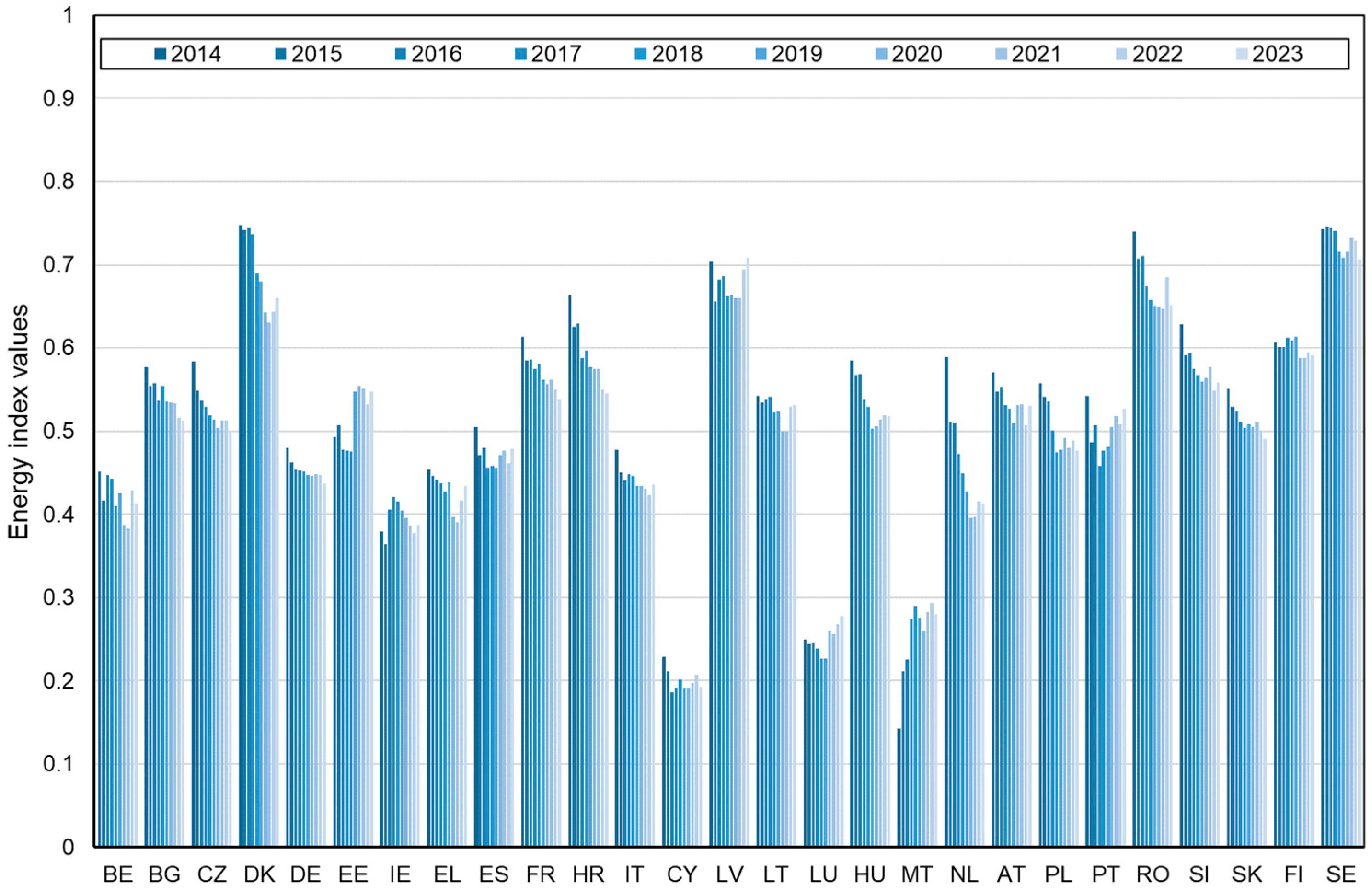
Figure 2 shows the energy index values obtained by the EU-27 countries for each year of the analysis. The graphical representation of the results allows for an assessment of changes in the level of sustainable energy development over time, as well as a comparison of the positions of the EU-27 countries in relation to each dimension.
An analysis of the energy dimension index values in the EU-27 countries shows clear differences between these countries, as well as significant polarization in terms of the achievement of energy security and energy transition goals.
The results show that Denmark, Latvia, Sweden, and Romania achieved the best results throughout the entire period under review, with values ranging from 0.65 to 0.75. In the case of Sweden and Denmark, their high position was a consequence of the large share of zero-emission energy sources, such as hydropower, biomass, and wind, as well as low dependence on energy imports, high self-sufficiency, and significant diversification of the supply structure. Latvia achieved consistently high values thanks to the dominant share of hydropower, which translated into favorable energy security parameters.
In terms of dynamics, Sweden maintained a relatively stable index value throughout the analyzed period. Its values ranged from approximately 0.74 to 0.75 in 2014–2017 and remained close to this level after 2020, falling slightly to 0.71 in 2023. In Denmark, the index fell from 0.75 in 2014 to 0.66 in 2023, indicating a certain weakening of energy security parameters in the context of increasing dependence on energy imports. A similar, albeit milder, trend was observed in Latvia: the index fell from 0.70 in 2014 to 0.66 in 2018, followed by a rebound and improvement to 0.71 in 2023, demonstrating the country’s ability to partially offset earlier losses.
Romania, on the other hand, was characterized by high self-sufficiency and low dependence on imports for most of the period under review, but its index fell from 0.74 in 2014 to 0.65 in 2023, indicating a gradual deterioration in its energy security balance.
The second group consists of countries with moderate index values (the Czech Republic, Poland, Lithuania, Spain, and Portugal), which achieved results in the range of 0.45–0.55. These countries have made moderate progress in reducing energy intensity and increasing the share of renewables in the energy mix, but this process is slowed down by continued dependence on fossil fuels and the significant role of energy imports. Poland recorded a decline in the index from 0.56 in 2014 to around 0.48 in 2023, reflecting the slow pace of transition to renewable energy sources and the dominance of coal in the domestic mix, accompanied by an increase in dependence on imported energy sources and a decline in self-sufficiency. A similar trend can be observed in the Czech Republic, where the index fell from 0.58 in 2014 to 0.50 in 2023. Lithuania, on the other hand, maintained index values in the range of 0.53–0.54 until 2016, but subsequent declines to 0.50 in 2020 and 0.53 in 2023 show that progress in RES development is offset by limited self-sufficiency and heavy dependence on energy imports. Spain and Portugal, despite relatively dynamic development of renewable sources (wind, solar energy), also faced challenges related to energy security. Their index values ranged between 0.46 and 0.53.
At the other end of the ranking were the countries with the lowest energy index values: Malta, Cyprus, Luxembourg, and Ireland, for which the index values did not exceed 0.30–0.40 in most years. These countries are characterized by a very high degree of import dependency (above 80–90%), limited domestic resources, and difficulties in diversifying their supply structure. Cyprus and Malta remain particularly vulnerable to geopolitical and market changes, as virtually all of their energy needs are met through fuel imports. Luxembourg, on the other hand, is characterized by very low self-sufficiency and limited opportunities for renewable energy development.
External shocks are particularly significant in the context of the period under review: the COVID-19 pandemic between 2020–2021, which contributed to a decline in the stability of many energy systems, and the war in Ukraine in 2022, which became an impetus for accelerated diversification of supplies and a move away from imports of raw materials from Russia.

4.2.2. Economic Dimension

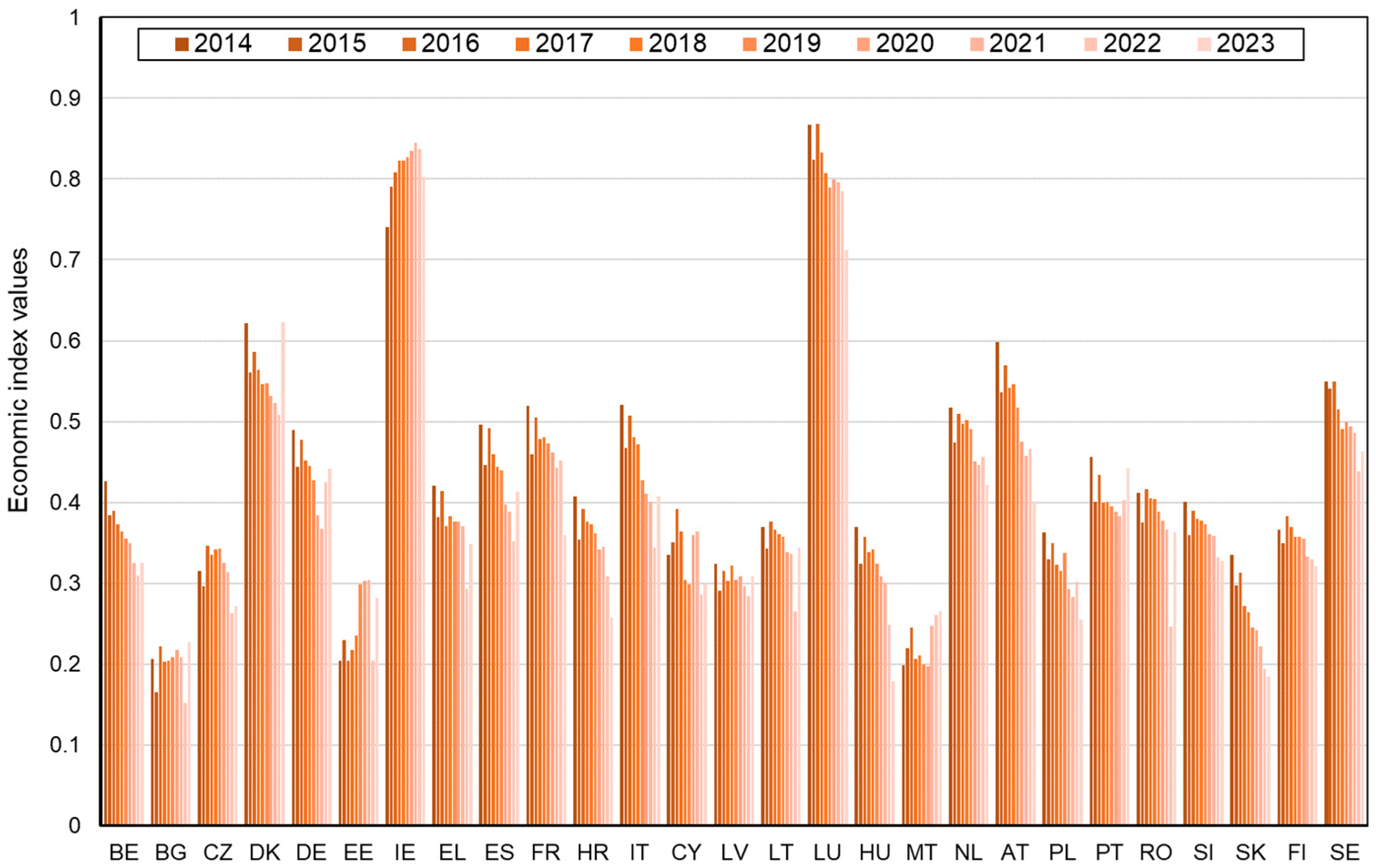
The second dimension included in the overall assessment of sustainable energy development was the economic dimension. The values of this dimensional index (Figure 3) were determined on the basis of four diagnostic indicators: gross domestic product per capita, energy productivity, energy intensity of the economy, and electricity costs for the business sector. This set reflects both the overall economic condition of the countries surveyed and their energy efficiency and competitiveness in the context of energy prices.
Analysis of this dimension also shows clear differences between the EU-27 countries, as in the case of the energy dimension. Among the best-performing countries for the entire study period were Ireland, Luxembourg, Denmark, and Austria. Ireland stands out in particular, with its index remaining at a very high level between 2015 and 2023, exceeding 0.80 and even reaching 0.85 at its peak (2021). This is mainly due to dynamic GDP per capita growth, high energy productivity, and relatively low energy intensity of the economy. Luxembourg occupied an equally strong position, despite a decline in its index from 0.87 in 2014 to 0.71 in 2023. The country remains one of the leaders thanks to the highest GDP per capita in the EU-27 and favorable energy efficiency parameters. Denmark and Austria, with scores above 0.60 in the first part of the study period, also maintained a high level of economic competitiveness supported by a stable energy sector.
The second group consists of countries with average results, with index values ranging from 0.35 to 0.50. These include Germany, France, Spain, Italy, Portugal, and Sweden. In their case, a gradual decline in indices is visible in the second half of the study period—e.g., in Germany from 0.49 in 2014 to 0.44 in 2023, and in France from 0.52 in 2014 to only 0.36 in 2023. These declines are mainly due to rising energy costs for businesses and a slower pace of improvement in energy productivity. Spain and Italy recorded values of around 0.40–0.45, with their indices also showing a downward trend, reflecting the challenges of combining the energy transition with maintaining economic competitiveness.
The lowest economic index values were recorded in Bulgaria, Romania, Malta, Hungary, Slovakia, and the Baltic countries (Latvia, Lithuania, Estonia). Bulgaria and Romania scored below 0.25 in most of the years surveyed, reflecting low GDP per capita, high energy intensity of the economy, and sensitivity to energy costs. Slovakia recorded a particularly sharp decline, from 0.33 in 2014 to just 0.18 in 2023, making it one of the countries with the weakest dynamics in this dimension. Malta and Hungary, despite isolated increases in selected years, remained at a low level, confirming the difficulties of smaller economies in combining energy stability with economic development.
From a dynamic perspective, the economic index showed a downward trend in most EU-27 countries, particularly after 2018. This was influenced by rising electricity costs for businesses, the global economic slowdown, and disruptions related to the COVID-19 pandemic. Between 2020–2021, despite a rebound in some economies (e.g., Ireland, Luxembourg), many countries saw a further weakening of their economic position, due, among other things, to disruptions in supply chains and rising energy prices. The energy crisis triggered by the war in Ukraine since 2022 has further highlighted these differences, with energy costs for the business sector rising sharply in many countries, negatively affecting competitiveness.
The economic dimension is characterized in the EU-27 countries by a clear division into two groups: highly developed economies, which maintain high index values thanks to their economic strength and high energy efficiency (Ireland, Luxembourg, Denmark, Austria), and countries with lower levels of development and higher energy intensity, for which the costs of the transition are a serious burden (Bulgaria, Romania, Slovakia, Hungary). In the context of the energy transition, maintaining a balance between economic competitiveness and environmental and energy objectives is a particular challenge for countries in the second group.

4.2.3. Environmental Dimension

Another dimension included in the assessment of sustainable energy development was the environmental dimension. It was characterized by four diagnostic indicators: greenhouse gas emissions per capita, emissions intensity, share of renewable energy sources, and forest cover as a percentage of the country’s area. These indicators reflect key aspects of climate and environmental policy, as they combine in a single index both the effectiveness of emission reduction and the ability to replace fossil fuels with clean energy sources, as well as the importance of natural resources in the process of balancing CO2 emissions.
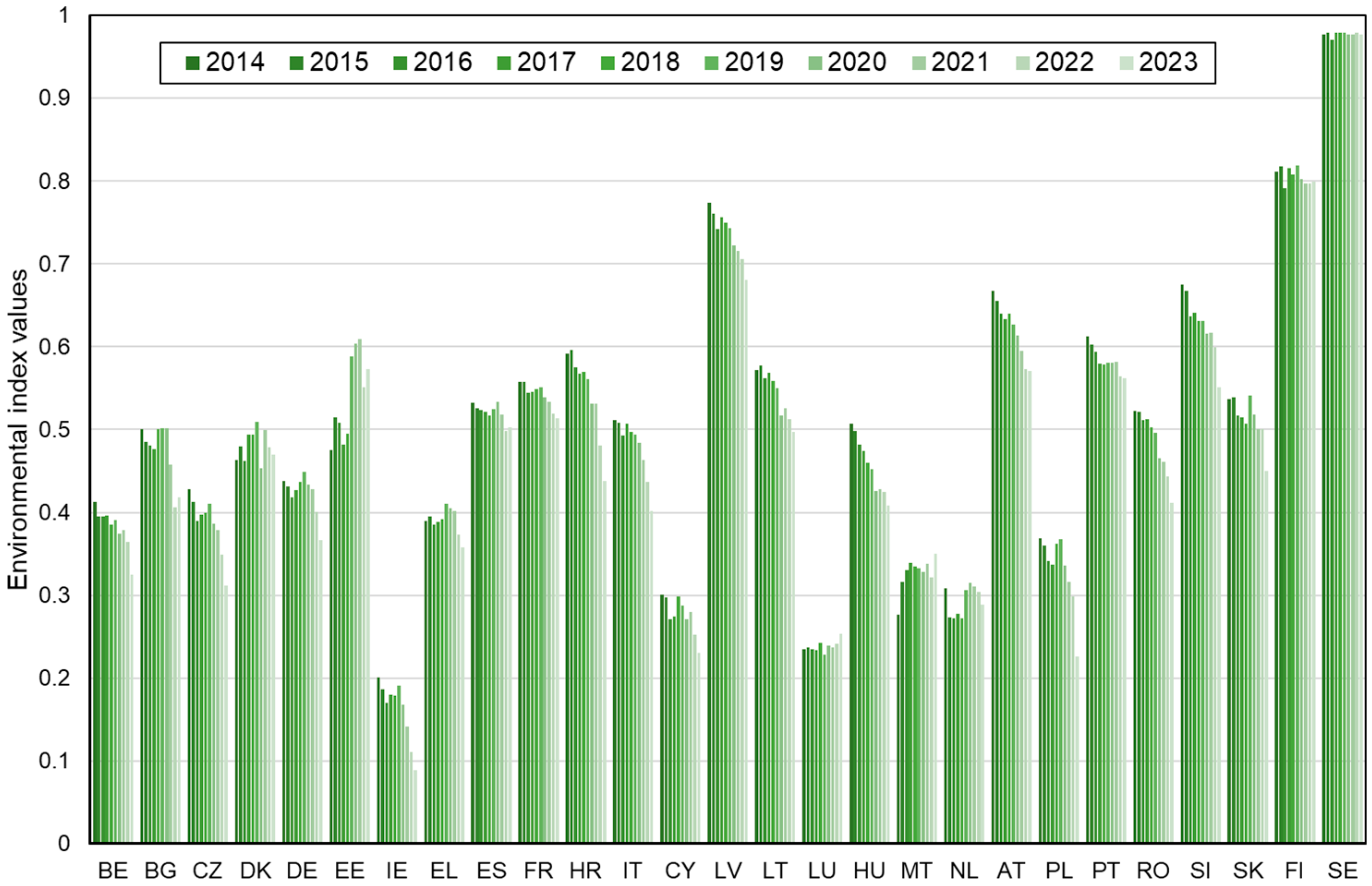
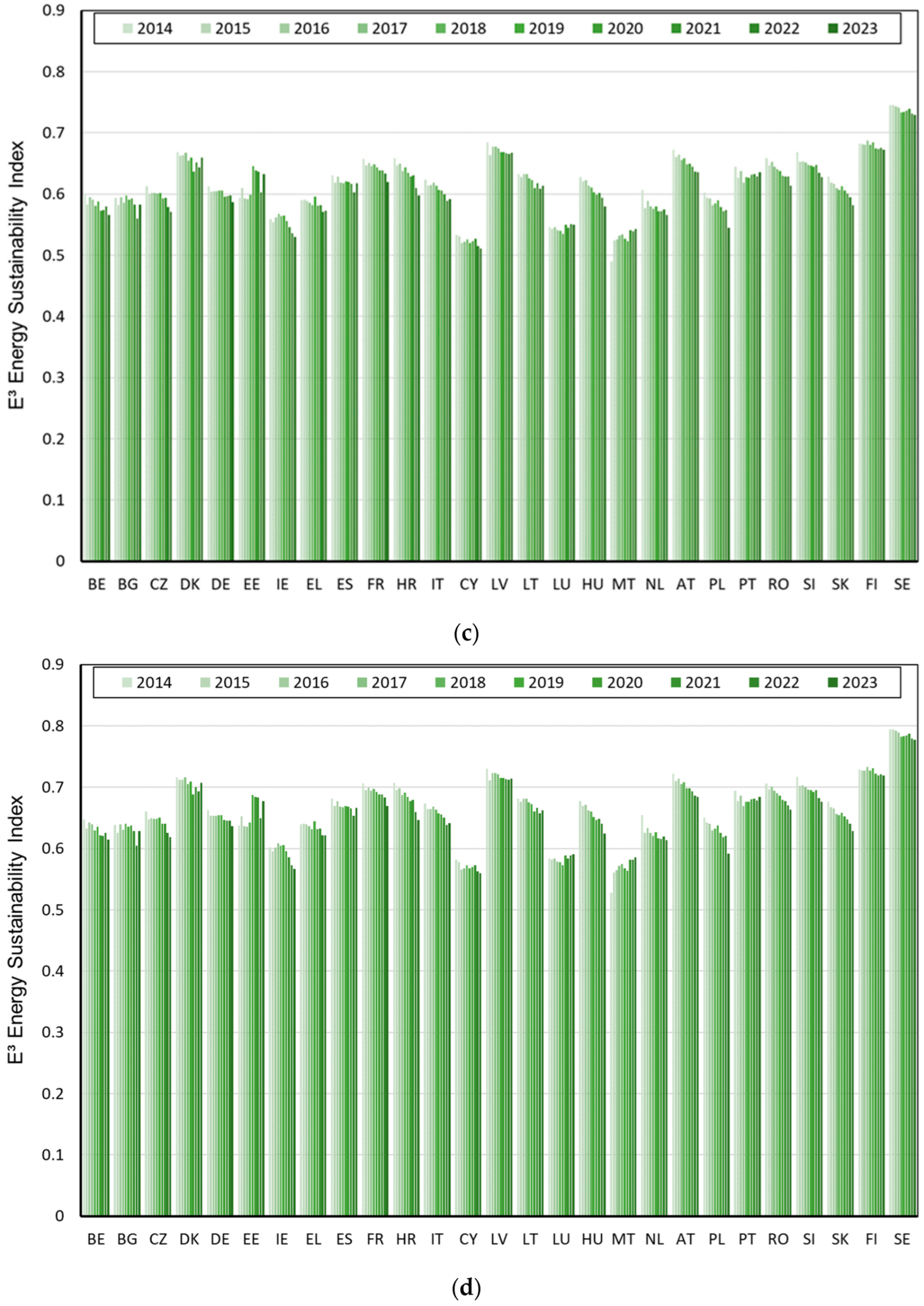
An analysis of the index values for this dimension in EU countries between 2014–2023 (Figure 4) shows very strong variation. It is higher than in the case of the energy dimension, which results from different rates of emission reduction, the development of renewable energy sources, and diverse natural conditions conducive to achieving climate neutrality.
Two Scandinavian countries topped the ranking for this dimension: Sweden and Finland, which achieved the highest index values, above 0.97 and 0.80, respectively, throughout the entire period under review. Sweden, with almost maximum index values (0.97–0.98), is the absolute leader in terms of emission reduction and renewable energy use—more than 66% of its energy in 2023 came from renewable sources (mainly hydropower and biomass), and an additional advantage is its extensive forest areas, which act as natural CO2 sinks. Finland has a similar profile, with forests covering over 70% of the country’s area.
Latvia, Austria, Slovenia, and Portugal also recorded high environmental index values, ranging from 0.65 to 0.77. Latvia, whose index fell slightly from 0.77 in 2014 to 0.68 in 2023, owes its position to the exceptionally high proportion of forests in the country’s area and its favorable energy consumption structure. Austria maintained its index values at 0.67–0.57, and Slovenia at 0.67–0.55—in both cases, high forest cover was crucial in reducing net greenhouse gas emissions. Portugal, on the other hand, despite a gradual decline in its index value from 0.61 in 2014 to 0.56 in 2023, stood out for its growing use of renewable energy sources, which allowed it to maintain a relatively high position among the countries with the best environmental performance.
The average environmental index value, ranging from 0.40 to 0.60, was characteristic of countries such as Spain, Italy, Germany, and Lithuania. Spain maintained relatively stable index values, from 0.53 in 2014 to 0.50 in 2023, reflecting progress in the use of renewable energy sources, offset, however, by the economy’s continued emissions and moderate share of forested areas. Italy showed a similar trend: the index value fell from 0.51 in 2014 to 0.40 in 2023, indicating some limitations in effective emission reduction and growing difficulties in increasing the share of renewable energy use.
Germany, despite the consistent implementation of the Energiewende policy [59,60,61,62], had index values only in the range of 0.42–0.44 in 2014–2019, followed by a further decline to 0.37 in 2023. Their relatively low position was mainly due to the high emissions intensity of their economy and the limited potential for CO2 sequestration through forest areas compared to the Scandinavian countries. Lithuania, on the other hand, initially achieved values above 0.57 (2014–2015), but in subsequent years its index fell steadily, reaching 0.50 in 2023. This trend indicates that despite the dynamic development of renewable energy, high emissions per unit of energy and limited forest area were significant barriers to improving environmental performance.
At the bottom of the ranking were countries with the lowest environmental index values, such as Poland, Ireland, Cyprus, Luxembourg, Malta, and the Netherlands, with scores often below 0.30. Poland, despite some modernization efforts, maintained one of the highest levels of per capita emissions and high energy emissions, resulting in a drop in the index to just 0.22 in 2023. Ireland also had a low share of RES, high energy consumption, and emissions, and its index fell below 0.10, the lowest in the entire EU-27. Cyprus and Malta, due to their very limited RES development potential and low share of forest areas, maintained index values between 0.23 and 0.35. The Netherlands and Luxembourg, despite their high level of economic development, had very high emissions and a low share of RES, which limited their results.
In dynamic terms, it can be seen that until 2019, most countries maintained relative stability in their indices, while some, such as Estonia and Denmark, improved their scores thanks to accelerated development of renewable energy. In 2020, during the COVID-19 pandemic, greenhouse gas emissions fell in many countries, which temporarily improved environmental index scores (e.g., Estonia rose to 0.60). However, after 2021, emissions rose again due to economic recovery and the energy crisis.
The environmental dimension reveals the greatest contrasts in the EU-27: from countries that are almost completely climate neutral (Sweden, Finland, Latvia) to countries that are high emitters and dependent on fossil fuels (Poland, Ireland, Cyprus, Luxembourg, the Netherlands). The dynamics of change indicate that external factors—the pandemic and the war—temporarily improved and then worsened the situation, with structural differences between countries widening rather than narrowing.

4.2.4. Social Dimension

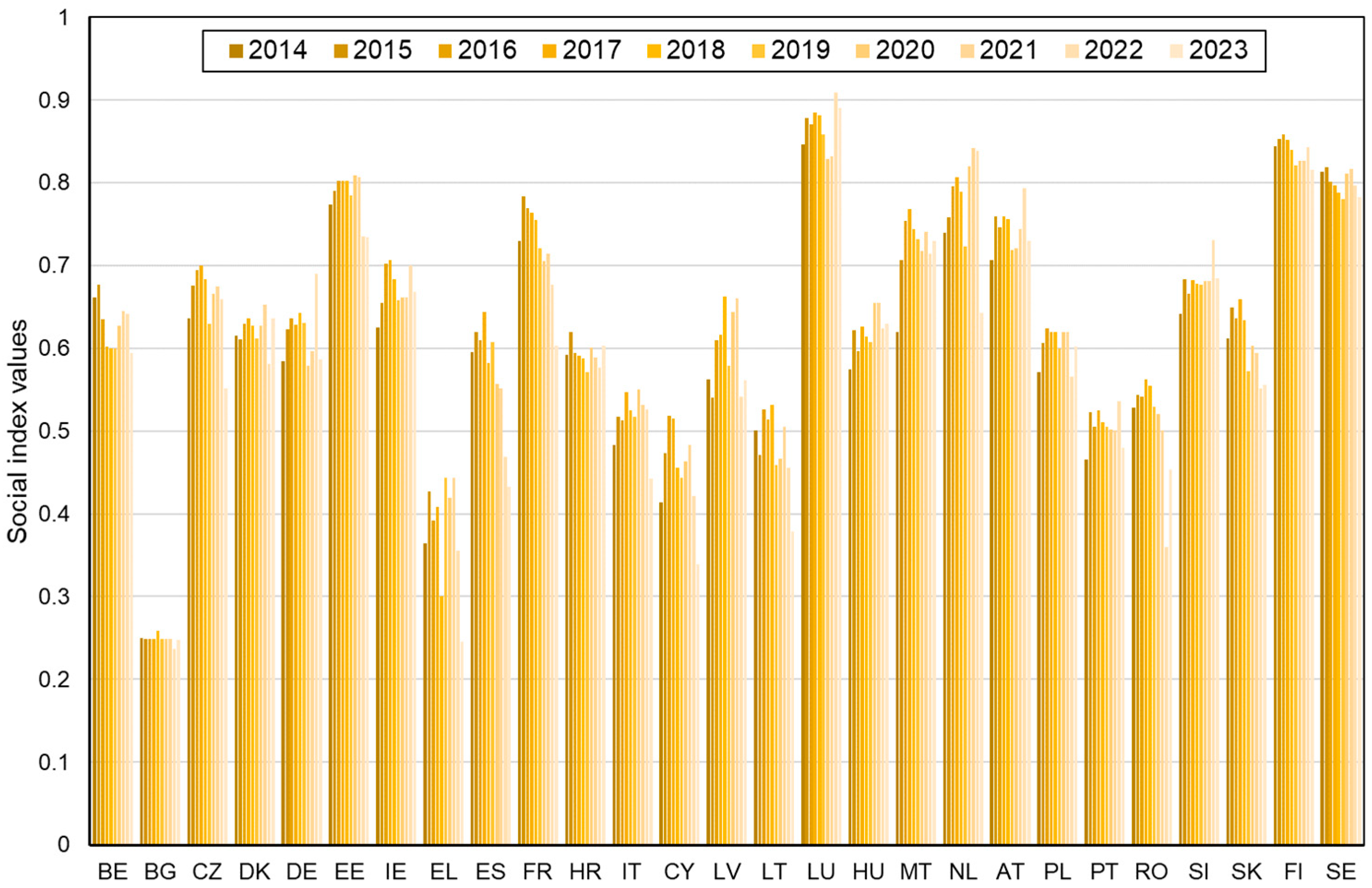
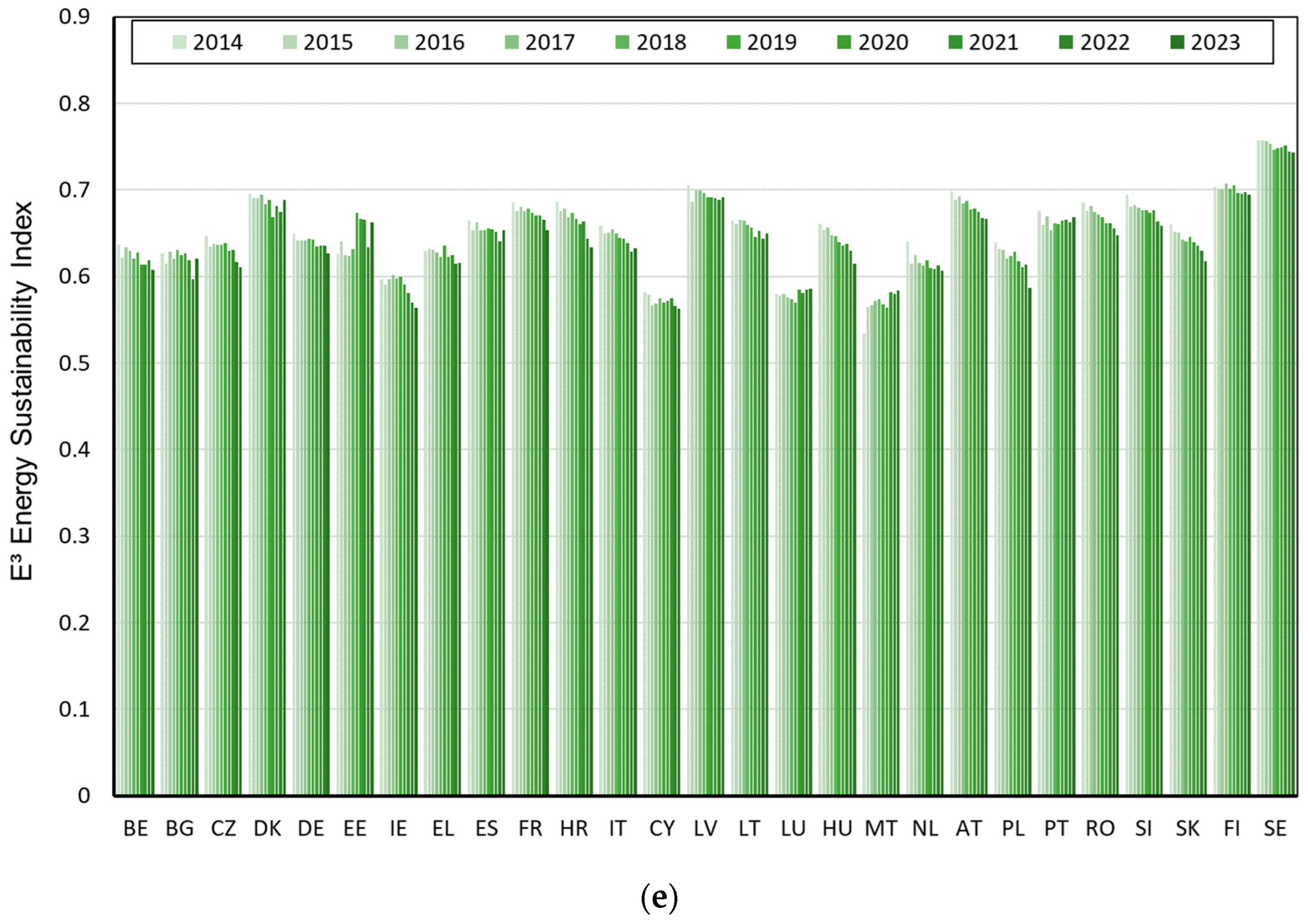
The final dimension included in the assessment of sustainable energy development was the social dimension, which reflects the direct impact of energy and environmental transformation processes on citizens’ quality of life. This dimension was characterized using four indicators: adjusted disposable household income per capita, the percentage of the population unable to maintain adequate temperatures in their homes due to energy poverty, household electricity prices (including all taxes and charges), and the number of premature deaths caused by exposure to PM2.5 fine particulate matter. These indicators made it possible to capture both the economic burden on households related to energy and the health and social consequences of the functioning of energy systems. Figure 5 shows the values of this dimensional index for the EU-27 countries between 2014–2023.
Luxembourg, Finland, and Sweden had the highest social index values in the period under review. Between 2014 and 2023, their indices ranged from 0.78 to 0.89. In the case of Luxembourg, this position is primarily due to the very high level of disposable income, which minimizes the impact of high energy prices on households. Finland and Sweden achieved equally good results thanks to a combination of high incomes, relatively low energy poverty, and effective environmental policies that reduce the number of premature deaths related to air pollution.
High social dimension index values (between 0.70 and 0.90) were recorded not only in the Scandinavian countries and Luxembourg, but also in the Netherlands, Austria, France, Estonia, and Malta. Despite differences in household electricity prices, these countries were characterized by favorable income conditions and well-functioning protective mechanisms that effectively reduced the risk of energy poverty. For example, the Netherlands maintained index values of 0.75–0.84 for most of the period under review, which was the result of high disposable household income and stable support policies. Austria, on the other hand, had index values between 0.70 and 0.79, thanks to a combination of high purchasing power among its citizens and a relatively low level of energy poverty. In France, the index values were initially above 0.75, although since 2016 there has been a downward trend to 0.60 in 2023, which can be linked to the growing burden of energy costs combined with social tensions related to climate and energy policy. Estonia, with values ranging from 0.77 to 0.81, owed its results to rising disposable income and effective protection of consumers against energy poverty, despite the relatively high energy intensity of its economy. Malta, on the other hand, despite its limited resources and the need to import energy, achieved social index values of 0.70–0.76, which was a consequence of active energy price subsidy programs and measures to reduce the risk of energy poverty among households.
Average social index values ranging from 0.50 to 0.65 were achieved by a group of countries such as Germany, Spain, the Czech Republic, Croatia, and Poland. These countries have relatively favorable income conditions and moderate energy costs, but the burden of energy expenditure on households and persistent air quality problems (including premature deaths caused by exposure to PM2.5 particulate matter) lowered the final index values. Germany, despite rising incomes, was characterized by large social disparities and rising energy costs, which caused the index to fall from around 0.64 in 2018 to 0.59 in 2023. Spain and the Czech Republic maintained index values of around 0.55–0.65, but the energy crisis after 2021 significantly worsened the situation of households, leading to declines in the index. In Poland, the index values remained relatively stable during the period under review, ranging between 0.57 and 0.62, reflecting, on the one hand, a steady increase in income and, on the other, high energy prices in relation to the purchasing power of the population.
The lowest index values were recorded in Bulgaria, Greece, Cyprus, and Lithuania, where the index usually ranged between 0.23 and 0.45. Bulgaria remained at the bottom of the ranking throughout the period (around 0.24–0.26), reflecting very low household incomes and a high percentage of people affected by energy poverty. Similarly, in Greece and Cyprus, economic crises and structural problems in the energy market translated into a low ability of the population to bear energy costs, with the index ranging between 0.30 and 0.45. Lithuania, despite a gradual improvement in income, struggled with high energy costs and significant environmental problems, which caused the index to fall from around 0.53 in 2016 to just 0.38 in 2023.
An analysis of the dynamics of change shows that until 2019, the index values in most countries were stable or slightly increasing. After 2021, the outbreak of the energy crisis related to the war in Ukraine led to a sharp increase in electricity prices across the EU. This phenomenon had a particularly negative impact on the countries of Southern and Central and Eastern Europe (e.g., Greece, Bulgaria, Cyprus, Lithuania, Poland), where the problem of energy poverty intensified again. At the same time, richer countries (Luxembourg, Finland, Austria) were able to partially cushion the effects of price increases thanks to support mechanisms and higher incomes.

4.3. Assessment of the Sustainable Development of the EU-27 Countries—Scenario Analyses

The determination of dimensional indices made it possible to determine the total values of the energy sustainability index E3 for the years 2014–2023 for the EU-27 countries studied.
In order to take into account various possible assessment priorities, five weighting scenarios were prepared for components L, S, and T. The baseline scenario (wL = 0.50, wS = 0.25, wT = 0.25) provides a compromise between the current level and structural–dynamic factors and has been adopted as the basic variant of the analysis. The level scenario (0.60; 0.20; 0.20) places the greatest emphasis on the current state and is used in benchmarking analyses. The equilibrium scenario (ESG) (0.40; 0.35; 0.25) emphasizes harmonious development between dimensions and is in line with the philosophy of just transition policy. The transformation scenario (0.40; 0.25; 0.35) rewards the dynamics and direction of change, making it useful in studies of transformation processes and catching up. The neutral scenario (0.33; 0.33; 0.33) treats all components equally and serves as a reference point in comparative analyses.
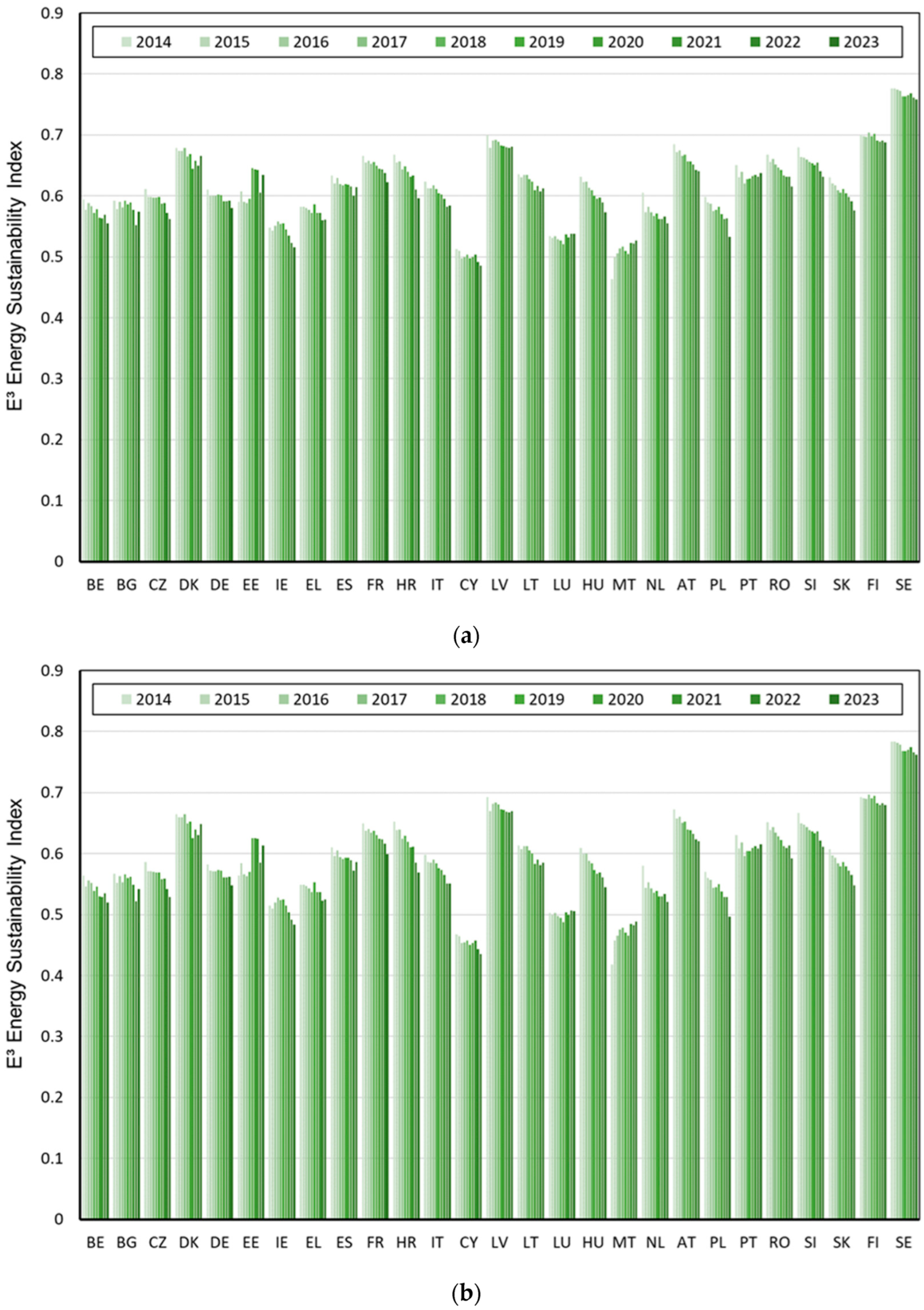
The results of the calculations for individual EU-27 countries for the adopted scenarios are presented in Figure 6. These results make it possible to capture both the levels of the E3 index for different scenarios and the changes occurring over time in individual countries.
These results indicate a high degree of stability among the leaders and consistency among the group of countries with the lowest energy sustainability index values. The leaders’ results are stable in all scenarios examined. The Nordic countries, in particular Sweden, Finland, and Denmark, consistently remain at the top regardless of the set of weights used.
In 2023, the index values ranged as follows: Sweden ~0.76–0.78, Finland ~0.68–0.72, Denmark ~0.65–0.71. These results confirm the sustained advantage in the areas of security, stability, and the dynamics of energy transition in these countries. On the other hand, countries that are catching up, such as Poland, Romania, Lithuania, Slovenia, and Bulgaria, are seeing a significant improvement in their position in scenarios where greater weight is given to the development trajectory, i.e., in the transformation and neutral variants. There is a visible improvement in their position compared to the level scenario, which focuses mainly on the current level of development. A different profile is presented by economies heavily dependent on energy imports, such as Ireland, Malta, Cyprus, and Luxembourg, whose index values in the level scenario remain low, while in the transformation and neutral scenarios they increase thanks to the inclusion of dynamics and stability, which mitigate the negative impact of low self-sufficiency. The greatest differences between the scenarios are evident in the cases of countries with a medium level of development.
The level scenario (wL = 0.60, wS = 0.20, wT = 0.20) rewards the current state of transformation, resulting in the lowest values compared to variants emphasizing dynamics and stability, and revealing strong disparities between leaders and weaker countries. For example, Germany achieves an index value of 0.548 here, compared to 0.637 in the transformation scenario and 0.627 in the neutral scenario. For Poland, these values are 0.497 compared to 0.592 and 0.586, respectively, and for Ireland 0.483 compared to 0.566 and 0.564, which shows the effect of the “trajectory premium”.
The baseline scenario (wL = 0.50, wS = 0.25, wT = 0.25) provides a compromise between the level and structural–dynamic factors. Its values are usually between the level scenario and the transformation scenario, as in the case of the Netherlands (0.555 compared to 0.521 and 0.614) or Romania (0.616 compared to 0.593 and 0.664).
The equilibrium scenario (ESG) (wL = 0.40, wS = 0.35, wT = 0.25) should theoretically emphasize consistency between dimensions and mitigate polarization, rewarding countries with a balanced profile at the expense of leaders. However, the results obtained indicate that the equilibrium values coincide with the level values, which suggests the need to re-verify the input data, especially the weights of the stability component.
The transformational scenario (wL = 0.40, wS = 0.25, wT = 0.35) most strongly rewards the pace of change and the direction of transformation, resulting in increases in countries such as Poland (0.592), Romania (0.664), Lithuania (0.663), Bulgaria (0.628), the Netherlands (0.614), Germany (0.637), Ireland (0.566), and Malta (0.586). The leaders remain stable (Sweden 0.778, Finland 0.719, Denmark 0.707), although the gap to the average is narrowing compared to the level scenario.
The neutral scenario (wL = 0.33, wS = 0.33, wT = 0.33), in which all components have equal weight, gives intermediate results—Poland 0.586, Romania 0.647, Lithuania 0.650, Bulgaria 0.621, Germany 0.627, the Netherlands 0.607—i.e., higher than in the level scenario, but slightly lower than in the transformation scenario. Sweden (0.743), Finland (0.695), and Denmark (0.688) also remain at the forefront, although their advantage over the average is smaller here than in the level variant.
In general, it can be said that the level scenario shows the greatest polarization between the leaders and the countries with the lowest index values, while the transformation and neutral scenarios favor convergence, enabling countries modernizing their energy sectors to close the gap with the leaders more quickly. The baseline scenario, on the other hand, acts as a center of gravity, balancing level, stability, and dynamics, thus best reflecting both the current state and the development potential of the economies analyzed.
Table 7 presents the results for the EU-27 countries for 2023 in all five scenario variants.
The data in Table 7 show the values of the energy sustainability index E3 and the ranking positions for each EU-27 country. This summary allows us to assess how strongly the index values change depending on the weights of the components (L, S, T ~ ) and to what extent these changes translate (or do not translate) into the ranking position. It can be seen that although the index values themselves can increase significantly when greater weight is given to the dynamics ( T ~ ) and stability (S) components, the ranking remains stable: the leaders (Sweden, Finland, Denmark) maintain positions 1–4 regardless of the variant, and the countries at the bottom of the table (Cyprus, Ireland, Malta) remain in positions 25–27. However, a detailed analysis of the results indicates that full convergence of rankings between the scenarios occurs in the case of 13 out of the 27 EU Member States. In the remaining cases, differences in the positions of individual countries are observed, resulting from their varying responses to the change in the weighting system, which is determined by the structure of their energy-economic profiles. The convergence of results for some countries confirms the coherence of transformation processes within the group of states with a similar level of development and energy strategy (e.g., the Nordic countries or Western Europe). Minor shifts in the positions of other countries, on the other hand, indicate a higher sensitivity of their assessment to the adopted weights, reflecting the diverse pace and structure of the energy transition. The obtained results confirm that the E3 model is characterized by high methodological stability, while maintaining a level of sensitivity that allows the identification of subtle differences in the level and dynamics of sustainable development among the EU-27 countries.
The differences are most noticeable for the transformation variant, which shows clear increases compared to the level variant for “catching up” (emerging) economies, i.e., for Poland + 0.095 (0.592 vs. 0.497), Romania + 0.071 (0.664 vs. 0.593), Lithuania + 0.078 (0.663 vs. 0.585), Bulgaria + 0.086 (0.628 vs. 0.542), as well as for countries with high import dependency, such as Ireland + 0.083 (0.566 vs. 0.483), the Netherlands + 0.094 (0.614 vs. 0.521) and Germany + 0.089 (0.637 vs. 0.548). At the same time, the gap between them and the leaders is narrowing slightly, as can be seen in the relatively modest transformation “bonuses” for the Scandinavian countries (Sweden + 0.015; Finland + 0.039; Denmark + 0.059). The neutral variant, with equal weights for the L, S, and T components, gives intermediate values (e.g., Poland 0.586; Germany 0.627; Netherlands 0.607), bringing the distribution closer to the transformation variant, but softening the spikes. In the baseline scenario (L-S- T ~ compromise), the averaging is clearly visible, as the positions of the countries fall exactly between the level and transformational variants (e.g., Netherlands 0.555 vs. 0.521 and 0.614; Romania 0.616 vs. 0.593 and 0.664).
The results presented indicate that the level scenario polarizes countries the most (it rewards the “here and now” state), while the transformation and, to a lesser extent, the neutral scenarios favor convergence, as they strengthen countries with faster growth rates. The baseline scenario remains a useful “center of gravity” as it accurately reflects both the current level and the potential for change.
Regardless of the scenario adopted, however, the results clearly show strong differences between the EU-27 countries in terms of sustainable energy development. The highest values throughout the entire study period covering 2014–2023 were achieved by the Scandinavian countries—Sweden and Finland, as well as Latvia, which were characterized by a high degree of energy self-sufficiency, low emissions, and a significant share of renewable energy sources in the mix. Austria and Denmark also achieved consistently high index values, confirming the strong position of northern and western European countries, which combine energy security with relatively high social resilience to potential crises. These countries can be seen as examples of mature energy systems and the ability to implement policies in line with European climate and energy goals.
The second group consists of countries such as France, Spain, Portugal, Slovenia, Croatia, and Romania. In their case, stable development can be observed, but after 2019, a downward trend emerges. For example, France’s index value in the baseline scenario decreased from 0.67 in 2014 to 0.62 in 2023, and Romania’s from 0.67 to 0.62, indicating a deterioration in the balance between the energy, economic, and environmental dimensions. Spain maintained stable values between 0.61 and 0.63, indicating moderate but relatively balanced progress.
Another group consists of countries such as Germany, the Czech Republic, Poland, and Italy. Despite the large scale of their economies, these countries face challenges related to high emissions, significant dependence on fossil fuels, and the costly process of energy transition. The downward trend is particularly evident in Poland, where the index value fell from 0.60 in 2014 to 0.53 in 2023, reflecting the slow pace of transformation and the strong role of coal in the national energy mix. A similar phenomenon can be observed in Germany, where, despite an ambitious climate policy (Energiewende), constraints related to the high energy intensity of the economy and the rising costs of the transition have resulted in stagnation and a decline in the index value.
At the bottom of the ranking are the countries with the lowest scores, i.e., Cyprus, Ireland, Malta, and Luxembourg. The relatively low index values in these countries reflect a high level of dependence on energy imports, limited opportunities for diversifying the energy mix, and high energy costs, which weighed on both the economic and social components of the index.

4.4. Comparative Analysis of the E3 Model with ETI and Energy Trilemma Index

In the final stage of the study, a comparative analysis was conducted between the results obtained using the E3 model (Entropy–Evolutionary Evaluation of Sustainability) and those of the European Union countries evaluated based on two recognized international indices: the Energy Transition Index (ETI) [33] developed by the World Economic Forum and the Energy Trilemma Index [34] published by the World Energy Council.
The purpose of the analysis was to determine the degree of consistency between country rankings obtained through different methodological approaches and to verify the coherence of the E3 model with widely used measures of energy sustainability. To assess consistency, Spearman’s rank correlation coefficient was applied, as it allows for comparing the hierarchy of countries in independent rankings without assuming linear relationships. The analysis was carried out for index values for the year 2023 (baseline scenario) the results are presented in Table 8.
The obtained results indicate a high and statistically significant correlation between the rankings produced by different models, which confirms the internal consistency and reliability of the E3 model. At the same time, the correlation coefficients (0.68 for ETI and 0.62 for the Energy Trilemma Index) are slightly lower than the correlation between ETI and Trilemma themselves (0.82), which results from their different methodological assumptions.
These differences are systemic in nature, as the ETI and Energy Trilemma Index primarily focus on a static assessment of the energy sector’s condition at a given moment, emphasizing security, accessibility, and the sustainability of energy sources. In contrast, the E3 model introduces a dynamic perspective, encompassing three complementary components: the level of development (L), structural stability (S), and the trajectory of change ( T ~ ). This enables the capture of both the current state of sustainability and the pace and direction of transformation over time.
Therefore, the lower correlation between E3 and the traditional indices confirms the greater sensitivity of the E3 model to evolutionary processes, which are not visible in static approaches. The model makes it possible to identify countries that, despite a similar level of energy development, differ in the pace and stability of their transition.
In summary, the correlation analysis confirms that the E3 model is directionally consistent with recognized international indices, while also broadening their interpretative scope through its dynamic approach to stability and transformation trajectories over time. This represents a significant added value in assessing the sustainable development of energy systems.

5. Discussion

Sustainable energy development, understood as the ability to simultaneously ensure energy security, economic competitiveness, low emissions, and public acceptance of transformation processes, has been—and will continue to be—the subject of numerous studies, given its importance in the context of global and regional development challenges. A key part of this research area is the measurement and assessment of the sustainability of energy systems across countries and regions. The European Union occupies a special place in this regard, as its member states form a highly diverse yet cohesive area of economic and political integration, working toward common climate and energy goals, including climate neutrality by 2050.
This paper introduces a new proprietary method for measuring sustainable energy development: the Entropy–Evolutionary Evaluation of Sustainability (E3). The method assumes that assessment should account for four key dimensions (energy, economic, environmental, and social), though the number of dimensions may be adapted to the research context. Each dimension is represented by a set of indicators, normalized and integrated into dimensional indices. Unlike existing sustainability assessment approaches, such as the Human Development Index (HDI) [63], the Sustainable Development Index (SDI) [64], or the Energy Trilemma Index [34] developed by the World Energy Council, which primarily provide a static view of the current level, the E3 method introduces a dynamic component.
Another distinguishing feature of E3 is the integration of elements typical of multi-criteria decision support methods (e.g., AHP, TOPSIS, PROMETHEE), which are widely applied in assessing sustainable energy development. While MCDM methods allow the inclusion of heterogeneous indicators and weighting schemes, they usually focus on one-year assessments and produce rankings or hierarchies of countries [35,36,37,38,39,40,41,42,43,44,45,46,47]. In contrast, the E3 method goes beyond simple aggregation by combining the analysis of the current level (L) with an assessment of stability (S) and the trajectory of change ( T ~ ). This enables the capture of transformation dynamics and long-term consequences, making it possible not only to compare countries in terms of climate and energy goals, but also to identify those with the greatest potential to close the gap with transition leaders.
The literature emphasizes that many existing tools, though useful, are limited to selected aspects (often economic and environmental), while neglecting the social dimension [65,66,67,68]. Others, such as trilemma indices, aggregate indicators at a single point in time, without accounting for system dynamics over longer horizons. In this context, the E3 method fills an important research gap by combining static and dynamic perspectives and enabling scenario analysis through differentiated weights of L, S, and T ~ . This allows for a more nuanced assessment of sustainable energy development in the EU-27 and supports comparative analysis at any scale, including the global level.
The results highlight the lasting advantage of the Nordic countries (Sweden, Finland, Denmark) in the energy transition process. Regardless of the scenario adopted, they consistently rank at the top of sustainable energy development. This finding is consistent with existing literature, which emphasizes Scandinavia’s leadership in climate and energy transition due to a high share of renewables, strong institutions, and broad public support for pro-climate policies [69,70,71,72,73]. Stable, high performance in Latvia and Austria also aligns with previous analyses, which point to the importance of biomass and hydropower in their energy mixes, as confirmed by Eurostat [74] and IEA reports [75]. At the same time, the advancement of Central and Eastern European countries such as Poland, Romania, Bulgaria, and Lithuania in the transformation and neutral scenarios demonstrates their significant modernization potential despite relatively low current levels of development. Similar conclusions appear in studies of EU energy and climate policy progress, which emphasize rapid growth in renewable capacity and improvements in energy efficiency in the region [76,77,78]. These results show that the E3 method effectively identifies “catching-up” countries as beneficiaries of scenarios that reward the trajectory of change.
In contrast, low index values for island states and import-dependent countries such as Cyprus, Malta, and Ireland are consistent with earlier findings on energy security [79,80].
Compared with previous approaches, the E3 method stands out for its ability to account for the dynamics and stability of transformation processes. This constitutes a major advantage and opens broad opportunities for practical application. While indices such as the Energy Trilemma Index [34] have produced similar directional findings (e.g., Nordic leadership, challenges for southern and peripheral EU countries), their static nature prevented the evaluation of how quickly countries were altering their sustainability profiles [81,82,83]. In contrast, the scenario analysis applied in this study demonstrates that incorporating trajectory and stability not only enriches result interpretation but also more accurately reflects convergence and divergence processes among the EU-27.

6. Conclusions, Recommendations, Limitations, and Directions for Future Research

The paper presents research assessing the sustainable energy development of the EU-27 countries in the period 2014–2023. The analysis was based on a new, proprietary methodology employing a multidimensional approach that enables both static and dynamic evaluation of the performance of the countries studied.
Based on the conducted research and the obtained results, the following conclusions were formulated regarding both the energy transition process in the EU-27 countries and the usefulness of the developed E3 (Entropy–Evolutionary Evaluation of Sustainability) method:
The results confirm the sustained advantage of the Nordic countries (Sweden, Finland, Denmark) in transformation processes. Regardless of the scenario adopted, they consistently lead the ranking, combining high levels of energy security, competitiveness, and low carbon emissions with broad public acceptance.
Scenario analyses revealed that Central and Eastern European countries, such as Poland, Romania, Bulgaria, and Lithuania, demonstrate significant modernization potential, particularly evident in scenarios rewarding the development trajectory (transformational and neutral).
The weakest results were recorded in island countries and those heavily dependent on energy imports (Cyprus, Malta, Ireland, Luxembourg), where limited diversification of the energy mix and high energy costs negatively impact the economic and social components of the index.
From a methodological perspective, the E3 method proved to be a tool that enables not only a static assessment of the level of development but also a dynamic analysis of stability and the trajectory of change. Its advantage over classical indices (HDI, SDI, Energy Trilemma Index) and MCDM approaches lies in its ability to capture both the current state and the evolutionary potential of energy systems. This provides a more accurate representation of convergence and divergence processes in the EU-27 countries. The new research approach therefore offers significant opportunities to expand knowledge about the pace and direction of change in the energy transition. From a practical perspective, the proposed E3 model is a useful analytical tool that can support the monitoring of energy transition progress at both national and regional levels. Owing to its modular structure, the model can be easily adapted to the conditions of other world regions, including OECD countries and developing economies, by adjusting the set of indicators to local priorities. This makes it applicable both for interregional comparisons and for convergence analysis within clusters of countries sharing similar energy profiles. The inclusion of scenario analysis additionally enables prospective research, allowing policymakers to assess the effects of alternative policy priorities on the long-term sustainability of energy systems.
The results obtained using the E3 model are consistent with the objectives and priorities of the latest European Union initiatives, such as Fit for 55 and REPowerEU, which aim to accelerate the energy transition, increase the share of renewable energy sources, and strengthen energy security. Countries achieving the highest values of the trajectory component ( T ~ ), such as Sweden, Finland, and Denmark, show the greatest progress in implementing the goals of these programs. Conversely, countries with lower structural stability (S) require stronger coordination of sectoral policies and greater support for the integration of energy, economic, and social measures. Thus, the E3 model can serve as a valuable tool for monitoring progress in the implementation of EU energy transition strategies, enabling the identification of areas requiring intensified action and the assessment of the effectiveness of implemented public policies.
Based on the results, a number of practical recommendations were formulated. The most important include the following:
Energy and climate policy in the EU-27 should take into account not only the current level of development but also the stability and trajectory of change, in order to reward countries that meet their targets and improve their situation.
The social dimension of the energy transition should be strengthened, as underestimating it may limit acceptance and slow the implementation of new technological and organizational solutions.
Instruments supporting diversification and energy self-sufficiency should be developed, particularly for countries heavily dependent on energy imports.
The research presented in this paper also has certain limitations, which is natural for any study. First, the set of indicators used, although reflecting the key dimensions of sustainable energy development, depends heavily on the availability and reliability of long-term statistical data. For many variables, publication delays—often of around two years—limit the possibility of conducting continuous year-on-year analyses and hinder a full assessment of short-term effects of the energy transition. Second, the selection of indicators, based on data from Eurostat, IEA, and WEC databases, represents another limitation. While these indicators capture the most important energy, economic, environmental, and social aspects, they do not fully encompass emerging challenges increasingly shaping modern energy systems. These include, in particular, issues related to the cybersecurity of critical infrastructure, system resilience to external geopolitical shocks, and the impact of technological innovations (e.g., digitization, artificial intelligence in energy network management) on transformation processes. Expanding the indicator base to cover these aspects could increase the comprehensiveness and accuracy of future assessments.
In light of these limitations, several directions for further research can be indicated. First, the development of the E3 method should include its application in other regions of the world, enabling comparative assessments across different energy transition models and identifying regional conditions and the specific features of energy and climate policies. Second, in-depth analysis of the social dimension is essential, covering not only energy availability and costs but also just transition issues, social acceptance of new technologies, and the socio-economic consequences of decarbonization. Third, systematic comparisons of results obtained using the E3 method with those from classical MCDM approaches (AHP, TOPSIS, PROMETHEE) would allow for a broader evaluation of this method and a clearer understanding of its strengths and areas requiring improvement.

Author Contributions

Conceptualization, M.T. and J.B.; methodology, J.B. and M.T.; software, M.T. and J.B.; formal analysis, J.B. and M.T.; investigation, J.B. and M.T.; resources, M.T., J.B. and W.W.G.; data curation, M.T. and J.B.; writing—original draft preparation, M.T., J.B. and W.W.G.; writing—review and editing, J.B. and M.T.; visualization, M.T.; supervision, M.T. and J.B.; project administration, M.T. and J.B.; funding acquisition, M.T. All authors have read and agreed to the published version of the manuscript.

Funding

This publication was funded by the statutory research performed at Silesian University of Technology, Department of Production Engineering (13/030/BK_25/0089), Faculty of Management and Organization.

Data Availability Statement

The raw data supporting the conclusions of this article will be made available by the authors on request.

Conflicts of Interest

The authors declare no conflicts of interest.

Appendix A

Appendix A.1. Entropy Method

The entropy method is based on information theory. Indicators with greater variability between objects contain more information and are given higher weights. Criteria that are not very diverse have a low weight because they do not contribute significant knowledge to the assessment process [51,52].
The calculation algorithm in the method is as follows:
(1)
Construction of the decision matrix:
X = x i j n × m
where xij denotes the value of the j-th indicator for the i-th object.
(2)
Data normalization:
p i j = x i j i = 1 n x i j
(3)
Determination of entropy for the indicator:
E j = k i = 1 n p i j × ln p i j
where
k = 1 ln n
where k is normalization coefficient (n is number of variants).
(4)
Calculation of the degree of divergence (dj):
d j = 1 E j
(5)
Determination of weights ( w i j ):
w j ( E n t r o p y ) = d j j = 1 m d j

Appendix A.2. Criteria Importance Through Intercriteria Correlation (CRITIC) Method

The CRITIC method takes into account the variability of a given indicator (standard deviation) and its correlation with other criteria. Indicators that are highly differentiated and at the same time low correlated with the others are given high weight, as they contribute unique information to the assessment [53].
The calculation algorithm in the method is as follows:
(1)
Construction of a decision matrix (Equation (1));
(2)
Data normalization:
For stimulants (the more, the better):
x i j = x i j m i n x j m a x x j m i n x j
For destimulants (the less, the better):
x i j = m a x x j x i j m a x x j m i n x j
where x i j is the initial value of the indicator, m a x x j ,   m i n x j are the largest and smallest values of the j-th indicator, respectively, x i j is the normalized value of the indicator.
(3)
Determination of the standard deviation ( σ j ) of the indicator:
σ j = i = 1 n x i j x j ¯ 2 n 1
(4)
Calculation of the correlation matrix between indicators (rjk):
r j k = i = 1 n x i j x ¯ j x i k x ¯ k i = 1 n x i j x ¯ j 2 × i = 1 n x i k x ¯ k 2
(5)
Determination of the measure of contrast and conflict (Cj):
C j = σ j k = 1 m 1 r j k
(6)
Calculation of weights:
w j ( C R I T I C ) = C j j = 1 m C j

Equal Weight Method

The equal weights method is the simplest approach to assigning weights to indicators. It assumes that all criteria are equally important for assessing sustainable energy development. It is often used as a reference method or in the absence of expert knowledge [54,55].
The calculation algorithm for this method is as follows:
(1)
Assignment of equal weight to each indicator:
w j E q u a l = 1 m
where m is number of indicators included in the assessment.

Appendix A.3. AHP Method

The AHP method is one of the most commonly used methods of multi-criteria decision support, enabling the determination of criterion weights based on pairwise comparisons. Experts assess the relative importance of one criterion to another on a scale of 1 to 9 (where 1 means equal importance and 9 means a clear advantage). On this basis, a comparison matrix is constructed, from which a weight vector is calculated that approximates the eigenvalue of the matrix. An important element of AHP is the assessment of the consistency of expert assessments, thanks to which the method minimizes the impact of arbitrariness and inconsistency in decisions [56,57,58].
The algorithm for determining weights in this method is as follows:
(1)
Construction of a pairwise comparison matrix:
A = 1 a 1 n 1 a 1 n 1
(2)
Normalization of the matrix and determination of average values. The values in each column are summed:
s j = i = 1 n a i j ,         j = 1 , 2 , , n
Then the matrix is normalized:
a ~ i j = a i j s j
The weight vector w = [w1, w2, …, wn] is obtained as the average values of the rows:
w i = 1 n j = 1 n a ~ i j ,     i = 1 , 2 , , n
(3)
Determination of the eigenvalue λmax. The product of matrix A and weight vector w is calculated:
A w = λ m a x w
then
λ m a x = 1 n i = 1 n A w i w i
(4)
Consistency assessment by determining the consistency ratio:
C I = λ m a x n n 1
and
C R = C I R I
where RI is a random consistency index (Random Index) depending on the number of criteria n.
If CR ≤ 0.1, the comparison matrix is considered consistent.
(5)
Determination of the final weight vector. If the matrix is consistent, vector w is accepted as the final set of criterion weights. Otherwise, the expert assessments must be verified.

References

  1. Romanello, M.; di Napoli, C.; Green, C.; Kennard, H.; Lampard, P.; Scamman, D.; Walawender, M.; Ali, Z.; Ameli, N.; Ayeb-Karlsson, S.; et al. The 2023 Report of the Lancet Countdown on Health and Climate Change: The Imperative for a Health-Centred Response in a World Facing Irreversible Harms. Lancet 2023, 402, 2346–2394. [Google Scholar] [CrossRef]
  2. Bell, M.L.; Gillingham, K.T. The Health Impacts of Transitioning Away from Fossil Fuel Toward Cleaner Energy. Annu. Rev. Public Health 2025, 46, 315–330. [Google Scholar] [CrossRef]
  3. Dirma, V.; Neverauskienė, L.O.; Tvaronavičienė, M.; Danilevičienė, I.; Tamošiūnienė, R. The Impact of Renewable Energy Development on Economic Growth. Energies 2024, 17, 6328. [Google Scholar] [CrossRef]
  4. Van Hung, T. Renewable Energy Transition and Economic Development in the United Kingdom. Discov. Sustain. 2025, 6, 812. [Google Scholar] [CrossRef]
  5. AlKathiri, N.; Darandary, A. Analysing the Role of Energy in Economic Growth and Convergence: A Cross-Country Study from 1980–2019. Appl. Econ. Lett. 2025, 1–7. [Google Scholar] [CrossRef]
  6. Del Duca, V.; Ponsiglione, C.; Primario, S.; Strazzullo, S. Towards Economic, Environmental, and Societal Sustainable World: Reviewing the Interplay of Methodologies, Variables, and Impacts in Energy Transition Models. J. Clean. Prod. 2024, 479, 144074. [Google Scholar] [CrossRef]
  7. Terra dos Santos, L.C.; Frimaio, A.; Giannetti, B.F.; Agostinho, F.; Liu, G.; Almeida, C.M.V.B. Integrating Environmental, Social, and Economic Dimensions to Monitor Sustainability in the G20 Countries. Sustainability 2023, 15, 6502. [Google Scholar] [CrossRef]
  8. European Commission. The European Green Deal; Publications Office of the European Union: Luxembourg, 2019; Available online: https://eur-lex.europa.eu/legal-content/EN/TXT/?uri=CELEX:52019DC0640 (accessed on 13 August 2025).
  9. Salim, S.S.; Luxembourg, S.L.; Smekens, K.; Dalla Longa, F.; van der Zwaan, B. Pathways to Climate Neutrality: Europe’s Energy Transition under the Green Deal. Renew. Sustain. Energy Rev. 2026, 226, 116272. [Google Scholar] [CrossRef]
  10. Talenti, R. Climate Neutrality through Green Growth? Addressing Possible Tensions Between the European Green Deal and the Precautionary Principle. Int. Environ. Agreements 2025, 25, 449–468. [Google Scholar] [CrossRef]
  11. Gielen, D.; Boshell, F.; Saygin, D.; Bazilian, M.D.; Wagner, N.; Gorini, R. The Role of Renewable Energy in the Global Energy Transformation. Energy Strategy Rev. 2019, 24, 38–50. [Google Scholar] [CrossRef]
  12. Solaun, K.; Cerdá, E. Climate Change Impacts on Renewable Energy Generation: A Review of Quantitative Projections. Renew. Sustain. Energy Rev. 2019, 116, 109415. [Google Scholar] [CrossRef]
  13. European Commission. Stepping up Europe’s 2030 Climate Ambition: Investing in a Climate-Neutral Future for the Benefit of Our People; COM(2020) 562 Final; European Commission: Brussels, Belgium, 2020. Available online: https://eur-lex.europa.eu/legal-content/EN/TXT/?uri=CELEX:52020DC0562 (accessed on 13 September 2025).
  14. European Parliament and Council of the European Union. Directive 2009/28/EC of 23 April 2009 on the Promotion of the Use of Energy from Renewable Sources. Off. J. Eur. Union 2009, L 140, 16–62. Available online: https://eur-lex.europa.eu/legal-content/EN/TXT/?uri=CELEX:32009L0028 (accessed on 13 September 2025).
  15. European Parliament and Council of the European Union. Directive 2012/27/EU of 25 October 2012 on Energy Efficiency. Off. J. Eur. Union 2012, L 315, 1–56. Available online: https://eur-lex.europa.eu/legal-content/EN/TXT/?uri=CELEX:32012L0027 (accessed on 13 September 2025).
  16. Sadowska, E. The Impact of the Russian-Ukrainian War on the European Union’s Energy Security. Energy Policy Stud. 2022, 2, 41–52. [Google Scholar] [CrossRef]
  17. International Energy Agency (IEA). Global Energy Review 2020: The Impacts of the COVID-19 Crisis on Global Energy Demand and CO2 Emissions; IEA: Paris, France, 2020; Available online: https://www.iea.org/reports/global-energy-review-2020 (accessed on 13 September 2025).
  18. Brodny, J.; Tutak, M. Decade of Progress: A Multidimensional Measurement and Assessment of Energy Sustainability in EU-27 Nations. Appl. Energy 2025, 382, 125222. [Google Scholar] [CrossRef]
  19. United Nations. Transforming Our World: The 2030 Agenda for Sustainable Development; United Nations: New York, NY, USA, 2015. Available online: https://sdgs.un.org/2030agenda (accessed on 13 September 2025).
  20. Cherp, A.; Vinichenko, V.; Jewell, J.; Brutschin, E.; Sovacool, B. Integrating Techno-Economic, Socio-Technical and Political Perspectives on National Energy Transitions: A Meta-Theoretical Framework. Energy Res. Soc. Sci. 2018, 37, 175–190. [Google Scholar] [CrossRef]
  21. Amin, R.; Mathur, D.; Ompong, D.; Zander, K.K. Integrating Social Aspects into Energy System Modelling Through the Lens of Public Perspectives: A Review. Energies 2024, 17, 5880. [Google Scholar] [CrossRef]
  22. United Nations Framework Convention on Climate Change (UNFCCC). Paris Agreement; UNFCCC: Paris, France, 2015; Available online: https://unfccc.int/process-and-meetings/the-paris-agreement/the-paris-agreement (accessed on 13 September 2025).
  23. Grigoroudis, E.; Kouikoglou, V.S.; Phillis, Y.A.; Kanellos, F.D. Energy Sustainability: A Definition and Assessment Model. Oper. Res. Int. J. 2021, 21, 1845–1885. [Google Scholar] [CrossRef]
  24. Khan, I. Sustainability Assessment of Energy Systems: Indicators, Methods, and Applications. In Methods in Sustainability Science: Assessment, Prioritization, Improvement, Design and Optimization; Elsevier: Amsterdam, The Netherlands, 2021; pp. 47–70. [Google Scholar]
  25. Karpavicius, T.; Balezentis, T.; Streimikiene, D. Energy Security Indicators for Sustainable Energy Development: Application to Electricity Sector in the Context of State Economic Decisions. Sustain. Dev. 2025, 33, 1381–1400. [Google Scholar] [CrossRef]
  26. Cherp, A.; Jewell, J. The Concept of Energy Security: Beyond the Four As. Energy Policy 2014, 75, 415–421. [Google Scholar] [CrossRef]
  27. European Commission. A Policy Framework for Climate and Energy in the Period from 2020 to 2030; COM(2014) 15 Final; European Commission: Brussels, Belgium, 2014. Available online: https://eur-lex.europa.eu/legal-content/EN/TXT/?uri=CELEX:52014DC0015 (accessed on 13 September 2025).
  28. Ürge-Vorsatz, D.; Kelemen, A.; Tirado-Herrero, S.; Thomas, S.; Thema, J.; Mzavanadze, N.; Hauptstock, D.; Suerkemper, F.; Teubler, J.; Gupta, M.; et al. Measuring Multiple Impacts of Low-Carbon Energy Options in a Green Economy Context. Appl. Energy 2016, 179, 1409–1426. [Google Scholar] [CrossRef]
  29. Sovacool, B.K.; Burke, M.; Baker, L.; Kotikalapudi, C.K.; Wlokas, H. New Frontiers and Conceptual Frameworks for Energy Justice. Energy Policy 2017, 105, 677–691. [Google Scholar] [CrossRef]
  30. Rogge, K.S.; Kern, F.; Howlett, M. Conceptual and Empirical Advances in Analysing Policy Mixes for Energy Transitions. Energy Res. Soc. Sci. 2017, 33, 1–10. [Google Scholar] [CrossRef]
  31. European Environment Agency (EEA). Trends and Projections in Europe 2020: Tracking Progress Towards Europe’s Climate and Energy Targets; EEA Report No 13/2020; European Environment Agency: Copenhagen, Denmark, 2020. [Google Scholar]
  32. Goldthau, A.; Sitter, N. A Liberal Actor in a Realist World: The European Union Regulatory State and the Global Political Economy of Energy; Oxford University Press: Oxford, UK, 2020. [Google Scholar]
  33. World Economic Forum (WEF). Fostering Effective Energy Transition 2023: Energy Transition Index (ETI) Benchmarking Report; World Economic Forum: Geneva, Switzerland, 2023; Available online: https://www.weforum.org/reports/fostering-effective-energy-transition-2023 (accessed on 13 September 2025).
  34. World Energy Council (WEC). World Energy Trilemma Index 2023; World Energy Council: London, UK, 2023; Available online: https://www.worldenergy.org/transition-toolkit/world-energy-trilemma-framework (accessed on 13 August 2025).
  35. Brodny, J.; Tutak, M. Assessing the Energy and Climate Sustainability of European Union Member States: An MCDM-Based Approach. Smart Cities 2023, 6, 339–367. [Google Scholar] [CrossRef]
  36. Siksnelyte, I.; Zavadskas, E.K.; Streimikiene, D.; Sharma, D. An Overview of Multi-Criteria Decision-Making Methods in Dealing with Sustainable Energy Development Issues. Energies 2018, 11, 2754. [Google Scholar] [CrossRef]
  37. Su, W.; Zhang, D.; Zhang, C.; Streimikiene, D. Sustainability Assessment of Energy Sector Development in China and European Union. Sustain. Dev. 2020, 28, 1063–1076. [Google Scholar] [CrossRef]
  38. Kamali Saraji, M.; Streimikiene, D.; Ciegis, R. A Novel Pythagorean Fuzzy-SWARA-TOPSIS Framework for Evaluating the EU Progress towards Sustainable Energy Development. Environ. Monit. Assess. 2022, 194, 42. [Google Scholar] [CrossRef]
  39. Neofytou, H.; Nikas, A.; Doukas, H. Sustainable Energy Transition Readiness: A Multicriteria Assessment Index. Renew. Sustain. Energy Rev. 2020, 131, 109988. [Google Scholar] [CrossRef]
  40. Trojanowska, M.; Nęcka, K. Selection of the Multiple-Criteria Decision-Making Method for Evaluation of Sustainable Energy Development: A Case Study of Poland. Energies 2020, 13, 6321. [Google Scholar] [CrossRef]
  41. Siksnelyte, I.; Zavadskas, E.K.; Bausys, R.; Streimikiene, D. Implementation of EU Energy Policy Priorities in the Baltic Sea Region Countries: Sustainability Assessment Based on Neutrosophic MULTIMOORA Method. Energy Policy 2019, 125, 90–102. [Google Scholar] [CrossRef]
  42. Remeikienė, R.; Gasparėnienė, L.; Fedajev, A.; Szarucki, M.; Đekić, M.; Razumienė, J. Evaluation of Sustainable Energy Development Progress in EU Member States in the Context of Building Renovation. Energies 2021, 14, 4209. [Google Scholar] [CrossRef]
  43. Dmytrów, K.; Bieszk-Stolorz, B.; Landmesser-Rusek, J. Sustainable Energy in European Countries: Analysis of Sustainable Development Goal 7 Using the Dynamic Time Warping Method. Energies 2022, 15, 7756. [Google Scholar] [CrossRef]
  44. Ziemba, P.; Zair, A. Temporal Analysis of Energy Transformation in EU Countries. Energies 2023, 16, 7703. [Google Scholar] [CrossRef]
  45. Kamali Saraji, M.; Štreimikienė, D. An Analysis of Challenges to the Low-Carbon Energy Transition Toward Sustainable Energy Development Using an IFCM-TOPSIS Approach: A Case Study. J. Innov. Knowl. 2024, 9, 100496. [Google Scholar] [CrossRef]
  46. Strielkowski, W.; Chygryn, O.; Drozd, S.; Koibichuk, V. Sustainable Transformation of Energy Sector: Cluster Analysis for the Sustainable Development Strategies of Selected European Countries. Heliyon 2024, 10, e38930. [Google Scholar] [CrossRef] [PubMed]
  47. Bluszcz, A.; Manowska, A. Differentiation of the Level of Sustainable Development of Energy Markets in the European Union Countries. Energies 2020, 13, 4882. [Google Scholar] [CrossRef]
  48. EUROSTAT Database. Available online: https://ec.europa.eu/eurostat/data/database?gclid=CjwKCAiA2pyuBhBKEiwApLaIO8iQvu_6cM_yhwD3iQsRLSVwAJQmaF5zehH8buKu9HCB2ejTmNKkrxoCbUgQAvD_BwE (accessed on 13 September 2025).
  49. Organisation for Economic Co-operation and Development (OECD). OECD Data; OECD: Paris, France, 2025; Available online: https://www.oecd.org/en/data.html (accessed on 13 August 2025).
  50. EU Energy Statistical Pocketbook. Available online: https://energy.ec.europa.eu/data-and-analysis/eu-energy-statistical-pocketbook-and-country-datasheets_en (accessed on 13 September 2025).
  51. Zhu, Y.; Tian, D.; Yan, F. Effectiveness of Entropy Weight Method in Decision-Making. Math. Probl. Eng. 2020, 2020, 3564835. [Google Scholar] [CrossRef]
  52. Song, M.; Zhu, Q.; Peng, J.; Santibanez Gonzalez, E. Improving the evaluation of cross efficiencies: A method based on Shannon entropy weight. Comput. Ind. Eng. 2017, 112, 99–106. [Google Scholar] [CrossRef]
  53. Diakoulaki, D.; Mavrotas, G.; Papayannakis, L. Determining Objective Weights in Multiple Criteria Problems: The CRITIC Method. Comput. Oper. Res. 1995, 22, 763–770. [Google Scholar] [CrossRef]
  54. Paradowski, B.; Shekhovtsov, A.; Bączkiewicz, A.; Kizielewicz, B.; Sałabun, W. Similarity Analysis of Methods for Objective Determination of Weights in Multi-Criteria Decision Support Systems. Symmetry 2021, 13, 1874. [Google Scholar] [CrossRef]
  55. Brodny, J.; Tutak, M.; Grebski, W.W. A Holistic Assessment of Sustainable Energy Security and the Efficiency of Policy Implementation in Emerging EU Economies: A Long-Term Perspective. Energies 2025, 18, 1767. [Google Scholar] [CrossRef]
  56. Saaty, T.L. How to make a decision: The analytic hierarchy process. Eur. J. Oper. Res. 1990, 48, 9–26. [Google Scholar] [CrossRef]
  57. Moslem, S.; Saraji, M.K.; Mardani, A.; Alkharabsheh, A.; Duleba, S.; Esztergár-Kiss, D. A Systematic Review of Analytic Hierarchy Process Applications to Solve Transportation Problems: From 2003 to 2022. IEEE Access 2023, 11, 11973–11990. [Google Scholar] [CrossRef]
  58. Brodny, J.; Tutak, M.; Grebski, W.W. Empirical Evaluation of the Energy Transition Efficiency in the EU-27 Countries over a Decade—A Non-Obvious Perspective. Energies 2025, 18, 3367. [Google Scholar] [CrossRef]
  59. Federal Government of Germany. Energiekonzept der Bundesregierung 2010 (Federal Government’s Energy Concept, 2010); Federal Ministry of Economics and Technology (BMWi) and Federal Ministry for the Environment, Nature Conservation and Nuclear Safety (BMU): Berlin, Germany, 2010. [Google Scholar]
  60. Federal Republic of Germany. Atomausstieg—13. Gesetz zur Änderung des Atomgesetzes; Federal Law Gazette I: Bonn, Germany, 2011. [Google Scholar]
  61. Federal Republic of Germany. Erneuerbare-Energien-Gesetz (EEG, Renewable Energy Sources Act); Federal Law Gazette I: Bonn, Germany, 2000. [Google Scholar]
  62. Federal Republic of Germany. Klimaschutzgesetz (Federal Climate Change Act, 2019; Amended 2021); Federal Law Gazette I: Berlin, Germany, 2019. [Google Scholar]
  63. United Nations Development Programme (UNDP). Human Development Reports, 1990–2022; UNDP: New York, NY, USA, 2025; Available online: https://hdr.undp.org (accessed on 13 September 2025).
  64. The Sustainable Development Index (SDI). Available online: https://www.sustainabledevelopmentindex.org (accessed on 13 September 2025).
  65. McCollum, D.L.; Zhou, W.; Bertram, C.; de Boer, H.-S.; Bosetti, V.; Busch, S.; Després, J.; Drouet, L.; Emmerling, J.; Fay, M.; et al. Energy Investment Needs for Fulfilling the Paris Agreement and Achieving the Sustainable Development Goals. Nat. Energy 2018, 3, 589–599. [Google Scholar] [CrossRef]
  66. Sovacool, B.K. How Long Will It Take? Conceptualizing the Temporal Dynamics of Energy Transitions. Energy Res. Soc. Sci. 2016, 13, 202–215. [Google Scholar] [CrossRef]
  67. Jenkins, K.; McCauley, D.; Heffron, R.; Stephan, H.; Rehner, R. Energy Justice: A Conceptual Review. Energy Res. Soc. Sci. 2016, 11, 174–182. [Google Scholar] [CrossRef]
  68. Sovacool, B.K.; Ryan, S.E.; Stern, P.C.; Janda, K.; Rochlin, G.; Spreng, D.; Pasqualetti, M.J.; Wilhite, H.; Lutzenhiser, L. Integrating Social Science in Energy Research. Energy Res. Soc. Sci. 2015, 6, 95–99. [Google Scholar] [CrossRef]
  69. Urban, F.; Nordensvärd, J. Low Carbon Energy Transitions in the Nordic Countries: Evidence from the Environmental Kuznets Curve. Energies 2018, 11, 2209. [Google Scholar] [CrossRef]
  70. Sovacool, B.K. Contestation, Contingency, and Justice in the Nordic Low-Carbon Energy Transition. Energy Policy 2017, 102, 569–582. [Google Scholar] [CrossRef]
  71. Sivonen, M.H.; Kivimaa, P. Politics in the Energy-Security Nexus: An Epistemic Governance Approach to the Zero-Carbon Energy Transition in Finland, Estonia, and Norway. Environ. Sociol. 2023, 10, 55–72. [Google Scholar] [CrossRef]
  72. International Energy Agency (IEA); Nordic Energy Research (NER); Risø DTU; Ea Energianalyse A/S (EAEA); VTT Technical Research Centre of Finland (VTT); University of Iceland (UI); National Energy Authority of Iceland (NEA); Icelandic Meteorological Institute (IMI); Landsvirkjun, Institute For Energy Technology (IFE); SINTEF Energy Research (SINTEF); et al. Nordic Energy Technology Perspectives: Pathways to a Carbon Neutral Energy Future; OECD/IEA: Paris, France, 2013; Available online: https://www.nordicenergy.org/wp-content/uploads/2012/03/Nordic-Energy-Technology-Perspectives.pdf (accessed on 13 September 2025).
  73. Satymov, R.; Bogdanov, D.; Galimova, T.; Breyer, C. Energy and Industry Transition to Carbon-Neutrality in Nordic Conditions via Local Renewable Sources, Electrification, Sector Coupling, and Power-to-X. Energy 2025, 319, 134888. [Google Scholar] [CrossRef]
  74. Eurostat. Share of Energy from Renewable Sources; Eurostat: Luxembourg, 2023; Available online: https://ec.europa.eu/eurostat/statistics-explained/index.php/Renewable_energy_statistics (accessed on 13 September 2025).
  75. International Energy Agency (IEA). World Energy Outlook 2023; IEA: Paris, France, 2023; Available online: https://www.iea.org/reports/world-energy-outlook-2023 (accessed on 13 September 2025).
  76. Shivakumar, A.; Dobbins, A.; Fahl, U.; Singh, A. Drivers of Renewable Energy Deployment in the EU: An Analysis of Past Trends and Projections. Energy Strategy Rev. 2019, 26, 100402. [Google Scholar] [CrossRef]
  77. Driha, O.; Cascetta, F.; Nardini, S.; Bianco, V. Evolution of Renewable Energy Generation in EU27: A Decomposition Analysis. Renew. Energy 2023, 207, 348–358. [Google Scholar] [CrossRef]
  78. Zastempowski, M. Analysis and Modeling of Innovation Factors to Replace Fossil Fuels with Renewable Energy Sources—Evidence from European Union Enterprises. Renew. Sustain. Energy Rev. 2023, 178, 113262. [Google Scholar] [CrossRef]
  79. Bąk, I.; Wawrzyniak, K.; Szczecińska, B.; Barej-Kaczmarek, E.; Oesterreich, M. Spatial Differentiation of EU Countries in Terms of Energy Security. Energies 2025, 18, 4310. [Google Scholar] [CrossRef]
  80. Brodny, J.; Tutak, M.; Grebski, W.W. Multi-Barrier Framework for Assessing Energy Security in European Union Member States (MBEES Approach). Energies 2025, 18, 4905. [Google Scholar] [CrossRef]
  81. Tagliapietra, S.; Zachmann, G.; Edenhofer, O.; Glachant, J.-M.; Linares, P.; Loeschel, A. The European Union Energy Transition: Key Priorities for the Next Five Years. Energy Policy 2019, 132, 950–954. [Google Scholar] [CrossRef]
  82. Kang, H. An Analysis of the Relationship between Energy Trilemma and Economic Growth. Sustainability 2022, 14, 3863. [Google Scholar] [CrossRef]
  83. Nihal, A.; Areche, F.O.; Araujo, V.G.S.; Ober, J. Synergistic evaluation of energy security and environmental sustainability in BRICS geo-political entities: An integrated index framework. Equilib. Q. J. Econ. Econ. Policy 2024, 19, 793–839. [Google Scholar] [CrossRef]
Figure 1. Diagram of the research process using the E3 (Entropy–Evolutionary Evaluation of Sustainability) model.
Energies 18 05481 g001
Figure 2. Energy index values for EU-27 countries between 2014–2023.
Energies 18 05481 g002
Figure 3. Economic index values for EU-27 countries between 2014–2023.
Energies 18 05481 g003
Figure 4. Environmental index values for EU-27 countries between 2014–2023.
Energies 18 05481 g004
Figure 5. Social index values of the EU-27 countries between 2014–2023.
Energies 18 05481 g005
Figure 6. Energy sustainability index (E3) values in EU-27 countries for the scenarios studied ((a)—baseline, (b)—level, (c)—equilibrium, (d)—transformational, (e)—neutral).
Energies 18 05481 g006aEnergies 18 05481 g006bEnergies 18 05481 g006c
Table 1. Characteristics of the dimensions and indicators included in the study.
DimensionSignificance of the DimensionIndicatorsSignificance of the Indicator
EnergyRefers to the security, efficiency, and stability of the energy system, which are key elements in ensuring the continuity of energy supply and the transition to low-carbon sources.Primary energy consumption, tons of oil equivalent per capitaDetermines the level of energy consumption per capita; high values may indicate intensive energy use and growing needs, which pose challenges for efficiency and decarbonization.
Energy imports dependency, %Measures the degree of dependence on energy imports; a high value reduces energy security and exposes the economy to fluctuations in commodity prices.
Energy self-sufficiency indexIndicates a country’s ability to meet its energy needs independently; a high level promotes system resilience.
Energy supply concentration index—Herfindahl-Hirschman Index (HHI)Provides information on the degree of diversification of energy sources—low diversification increases the risk of supply shocks.
Total energy losses (transformation and distribution), %Reflects energy losses in conversion and transmission processes; reducing these losses is part of improving efficiency and reducing emissions.
Share of emission-generating energy sources in the energy mix, %Determines the share of high-emission fossil fuels in the mix; the higher it is, the more difficult it is to achieve climate goals.
Share of low-carbon/zero-emission sources in the energy mix, %Illustrates the scale of the transition to low-carbon and renewable sources.
EconomicReflects the impact of energy on the competitiveness of the economy and its ability to grow sustainably while reducing costs and improving efficiency.Gross Domestic Product Per Capita, EuroMeasures the level of economic development and prosperity, which determines the possibilities for investment in green transformation.
Energy productivity, Euro per kilogram of oil equivalentIndicates how efficiently energy is converted into added value; higher productivity means greater synergy between the economy and energy efficiency.
Energy intensity of the economy, kilograms of oil-equivalent per thousand euros in purchasing power standards (PPS)It determines the amount of energy needed to produce a unit of GDP; a decrease in the of the indicator indicates progress in decarbonization and efficiency improvement.
Electricity costs for the business sector (consumption from 500 MWh to 1999 MWh), euro/kilowatt (all taxes and levies included)Reflects the cost competitiveness of businesses; high prices can hamper economic growth and innovation.
EnvironmentalCharacterizes the impact of the energy system on the climate, emissions, and natural resources, and thus indicates the economy’s ability to decarbonize in line with climate policy objectives.Total greenhouse gases per capita, t CO2 eq./capitaReflects the carbon footprint of a citizen; reducing this indicator is a basic condition for climate neutrality.
Greenhouse gases intensity of Energy, kg CO2 eq./toeMeasures emissions per unit of energy consumed; shows the degree of “cleanliness” of the energy mix.
Share of energy consumption from renewable sources, %Shows progress in replacing fossil fuels with renewable energy sources; a key indicator of EU climate and energy policy.
Forested areas, %Determines the potential of natural CO2 sinks that support ecological balance.
SocialRefers to the well-being of society, energy justice, and the impact of energy on public health, which determines the social dimension of the transition.Disposable household income per capita, EuroMeasures the financial resources of households; higher income improves energy accessibility and reduces the risk of energy poverty.
Population unable to keep home adequately warm by poverty status, %Measures the scale of energy poverty.
Residential electricity prices (consumption from 2500 kWh to 4999 kWh) euro/kilowatt all taxes and levies included)Illustrates the energy cost burden on households.
Premature deaths due to exposure to fine particulate matter (PM2.5), rateDetermines the health effects associated with air pollution.
Table 2. Recommendations for the selection of parameter weights wL, wS, wT.
WeightInterpretationWhen to UseRangeJustification/Comment
wL—level LFocus on current level of development (present state)When the aim of the study is to assess competitiveness, the level of development at a given moment, comparisons between countries0.4 ≤ wL ≤ 0.6 The current level should be the basis for assessment; too high a weight (>0.70) causes balance and dynamics to lose their significance, and the index is reduced to a simple ranking of levels
wS—stability SEmphasis on balance and harmonious development between dimensionsIn ESG analyses, sustainable development, EU policies (e.g., “just transition”); when we want to penalize imbalances0.2 ≤ wS ≤ 0.35 Higher weighting emphasizes the importance of harmony between dimensions and penalizes imbalances (e.g., strong economic development at the expense of the environment); lower weighting allows for partial compensation for deficiencies in one area with achievements in another
wT—trajectory T ~ Emphasis on the dynamics and direction of change (rate of growth or decline)When the goal is to assess transformation (e.g., green transition, Agenda 2030), supporting countries that are catching up0.2 ≤ wT ≤ 0.35 A higher weight rewards countries with a strong rate of improvement, but may cause hypersensitivity to short-term fluctuations; a lower weight limits this effect and stabilizes the ranking
Table 3. Scenarios for selecting weights wL, wS, wT in the E3 index.
ScenariowLwSwTCharacteristics and Application
Base0.500.250.25Provides a compromise between level and structural–dynamic factors; treated as a starting point and recommended variant for main analysis
Horizontal0.600.200.20Greatest emphasis on the current state of development; used when the study focuses on the current position of countries and comparisons “here and now”.
Equilibrium (ESG)0.400.350.25Emphasizes harmonious development and avoiding disparities between dimensions; consistent with the ESG philosophy and just transition policy. “Equilibrium” here means prioritizing consistency between dimensions, not equal weighting.
Transformational0.400.250.35Emphasizes the pace and direction of change; rewards countries that are catching up and undergoing rapid transformation. Used in long-term process analysis and dynamics assessment.
Neutral0.330.330.33Emphasizes the pace and direction of change; rewards countries that are catching up and undergoing rapid transformation. Used in long-term process analyses and dynamics assessment.
Table 4. Weights of indicators used to assess the sustainable energy development of the EU-27 countries.
DimensionIndicators2014 2023
Critic MethodEntropy MethodEqual WeightsCritic MethodEntropy MethodEqual Weights
EnergyPrimary energy consumption, tons of oil equivalent per capita0.1900.0980.1430.1870.0860.143
Energy imports dependency, %0.1270.1410.1430.1210.1520.143
Energy self-sufficiency index0.0820.1270.1430.1010.0750.143
Energy supply concentration index—Herfindahl-Hirschman Index (HHI)0.1320.2270.1430.1240.2330.143
Total energy losses (transformation and distribution), %0.1990.1330.1430.2020.1790.143
Share of emission-generating energy sources in the energy mix, %0.1350.0290.1430.1330.0550.143
Share of low-carbon/zero-emission sources in the energy mix, %0.1350.2450.1430.1330.2210.143
EconomicGross Domestic Product Per Capita, Euro0.1730.5460.2500.2170.4380.250
Energy productivity, Euro per kilogram of oil equivalent0.2270.2440.2500.2890.3390.250
Energy intensity of the economy, kilograms of oil equivalent per thousand euros in purchasing power standards (PPS)0.3980.0850.2500.2690.1110.250
Electricity costs for business sector (consumption from 500 MWh to 1999 MWh), euro/kilowatt (all taxes and levies included)0.2030.1250.250.2250.1110.250
EnvironmentalTotal greenhouse gases per capita, t CO2 eq./capita0.3680.1620.2500.3490.1090.250
Greenhouse gases intensity of Energy, kg CO2 eq./toe0.2210.0920.2500.2130.1170.250
Share of energy consumption from renewable sources, %0.1530.4170.250.1650.3390.250
Forested areas, %0.2580.3280.2500.2740.4350.250
SocialDisposable household income per capita, Euro0.2190.0640.2500.2430.0440.250
Population unable to keep home adequately warm by poverty status, %0.1470.5930.2500.1610.3690.250
Residential electricity prices (consumption from 2500 kWh to 4999 kWh) euro/kilowatt all taxes and levies included)0.4200.0710.2500.4040.1050.250
Premature deaths due to exposure to fine particulate matter (PM2.5), rate0.2140.2710.250.1910.4820.250
Table 5. Indicator weight values determined based on the CRITIC, Entropy, equal weights, and Laplace criteria.
Indicator2014201520162017201820192020202120222023Variability
Coefficient, %
Value Adopted for Research—Average for 2014–2023
Primary energy consumption, tons of oil equivalent per capita0.1430.1380.1400.1410.1370.1380.1440.1430.1440.13820.141
Energy imports dependency, %0.1370.1350.1370.1400.1400.1290.1290.1300.1310.13930.135
Energy self-sufficiency index0.1170.1190.1220.1080.1060.1080.1080.1080.1090.10650.111
Energy supply concentration index—Herfindahl-Hirschman Index (HHI)0.1670.1700.1610.1660.1680.1630.1630.1650.1650.16620.165
Total energy losses (transformation and distribution), %0.1580.1630.1630.1660.1770.1850.1760.1750.1730.17550.171
Share of emission-generating energy sources in the energy mix, %0.1020.1020.1020.1020.1010.1040.1080.1080.1070.11030.105
Share of low-carbon/zero-emission sources in the energy mix (%)0.1740.1730.1750.1750.1700.1720.1710.1710.1710.16520.172
Gross Domestic Product Per Capita, Euro0.3230.3260.3180.3100.3060.3080.3080.3090.2980.30230.311
Energy productivity, Euro per kilogram of oil equivalent0.2400.2430.2470.2540.2580.2600.2680.2660.2670.29360.260
Energy intensity of the economy, kilograms of oil equivalent per thousand euros in purchasing power standards (PPS)0.2440.2460.2500.2510.2500.2480.2500.2500.2430.21050.244
Electricity costs for business sector (consumption from 500 MWh to 1999 MWh), euro/kilowatt (all taxes and levies included)0.1930.1850.1850.1860.1850.1840.1740.1740.1920.1954%0.185
Total greenhouse gases per capita, t CO2 eq./capita0.2600.2550.2470.2370.2440.2450.2570.2540.2470.23630.248
Greenhouse gases intensity of Energy, kg CO2 eq./toe0.1880.1870.1860.1990.1960.1980.2000.1980.1940.19330.194
Share of energy consumption from renewable sources, %0.2730.2740.2700.2680.2620.2560.2400.2490.2520.25140.260
Forested areas, %0.2790.2830.2960.2960.2990.3010.3030.2980.3070.32040.298
Disposable household income per capita, Euro0.1780.1760.1770.1730.1730.1710.1770.1750.1720.17920.175
Population unable to keep home adequately warm by poverty status, %0.3300.3320.3310.3220.3070.3230.3110.2960.2590.26090.307
Residential electricity prices (consumption from 2500 kWh to 4999 kWh) euro/kilowatt all taxes and levies included)0.2470.2500.2480.2480.2450.2460.2460.2440.2630.25320.249
Premature deaths due to exposure to fine particulate matter (PM2.5), rate0.2450.2420.2440.2570.2750.2590.2660.2850.3070.30890.269
Table 6. Weight values of dimensions determined using the AHP method.
DimensionWeight
Energy0.390
Environmental0.390
Economic0.152
Social0.068
Table 7. Energy sustainability index values for EU-27 countries in 2023 in the five scenarios analyzed.
CountriesScenario
BaselineLevelEquilibriumTransformationalNeutral
E3 Index ValueRankingE3 Index ValueRankingE3 Index ValueRankingE3 Index ValueRankingE3 Index ValueRanking
Belgium0.555220.519220.566210.615210.60821
Bulgaria0.574170.542180.583160.628160.62116
Czechia0.562190.528190.571200.619200.61120
Denmark0.66640.64840.65940.70740.6884
Germany0.580150.548150.587150.637150.62715
Estonia0.63470.61370.63270.67770.6627
Ireland0.516260.483260.530260.566260.56426
Greece0.561200.524200.573190.622190.61618
Spain0.614110.586110.617100.666100.65410
France0.62290.59990.62090.67090.6549
Croatia0.596130.569130.598130.646130.63313
Italy0.584140.551140.592140.642140.63214
Cyprus0.485270.435270.511270.560270.56327
Latvia0.68130.67030.66830.71530.6923
Lithuania0.612120.585120.614110.663120.65011
Luxembourg0.538230.505230.550230.590240.58624
Hungary0.573180.545170.579180.624180.61519
Malta0.526250.488250.543250.586250.58425
Netherlands0.555210.521210.566220.614220.60722
Austria0.64050.62050.63650.68460.6676
Poland0.533240.497240.545240.592230.58623
Portugal0.63760.61560.63560.68550.6685
Romania0.616100.593100.613120.664110.64712
Slovenia0.63280.61180.62880.67680.6598
Slovakia0.576160.547160.582170.628170.61817
Finland0.68820.68020.67320.71920.6952
Sweden0.75810.76210.73010.77810.7431
Table 8. Spearman’s rank correlation coefficients between E3, ETI, and Energy Trilemma Index values.
Spearman’s Rank Correlation Coefficient
Valuep
E3 & ETI0.6770.000
E3 & Enery Trilemma Index0.6160.001
ETI & Enery Trilemma Index0.8220.000
Disclaimer/Publisher’s Note: The statements, opinions and data contained in all publications are solely those of the individual author(s) and contributor(s) and not of MDPI and/or the editor(s). MDPI and/or the editor(s) disclaim responsibility for any injury to people or property resulting from any ideas, methods, instructions or products referred to in the content.