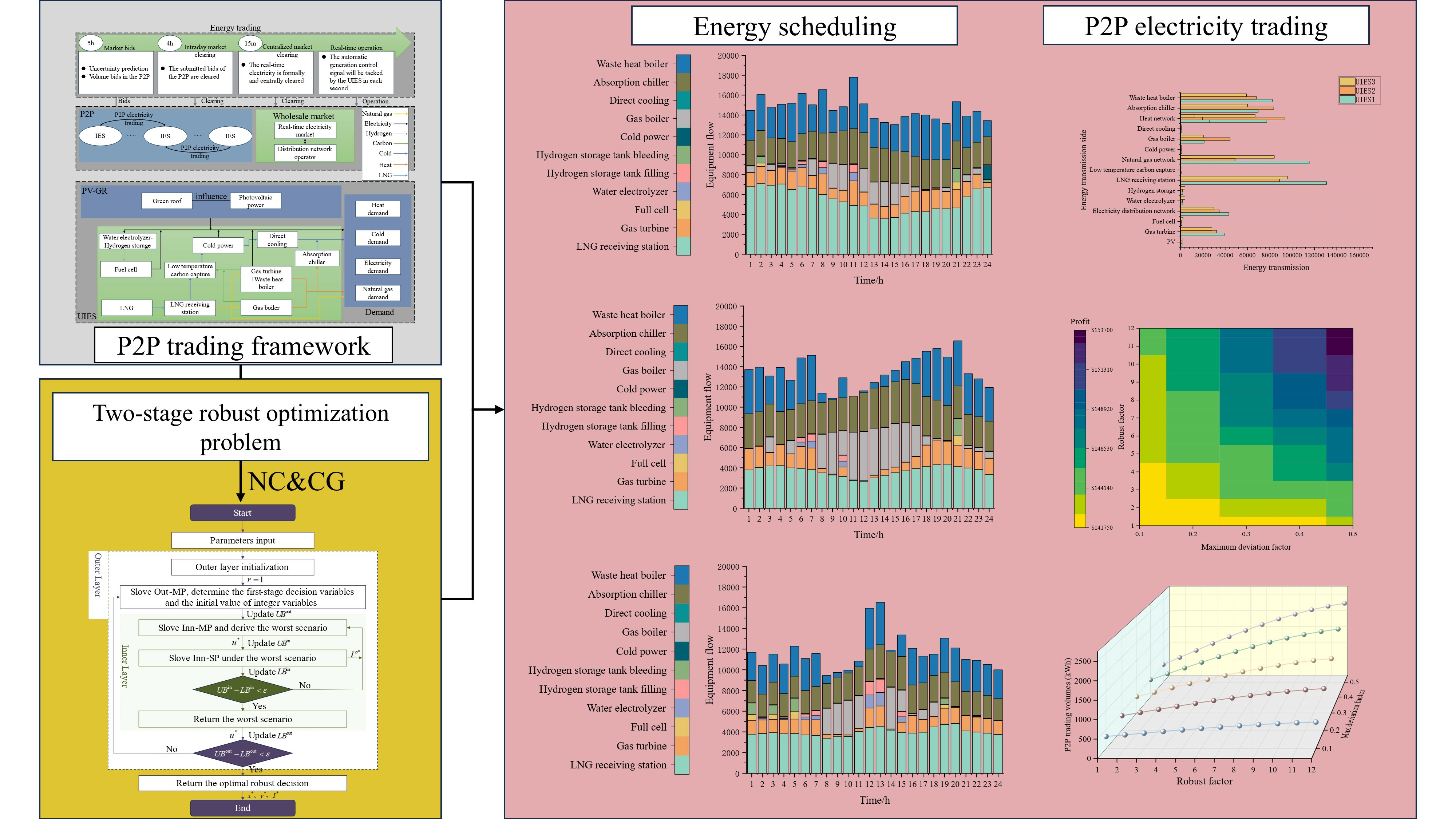
A Two-Stage Robust Optimization Strategy for Long-Term Energy Storage and Cascaded Utilization of Cold and Heat Energy in Peer-to-Peer Electricity Energy Trading



Abstract
Share and Cite
Chen, Y.; Zhao, Y.; Zhang, X.; Wang, Y.; Mi, R.; Song, J.; Hao, Z.; Xu, C. A Two-Stage Robust Optimization Strategy for Long-Term Energy Storage and Cascaded Utilization of Cold and Heat Energy in Peer-to-Peer Electricity Energy Trading. Energies 2025, 18, 323. https://doi.org/10.3390/en18020323
Chen Y, Zhao Y, Zhang X, Wang Y, Mi R, Song J, Hao Z, Xu C. A Two-Stage Robust Optimization Strategy for Long-Term Energy Storage and Cascaded Utilization of Cold and Heat Energy in Peer-to-Peer Electricity Energy Trading. Energies. 2025; 18(2):323. https://doi.org/10.3390/en18020323
Chicago/Turabian StyleChen, Yun, Yunhao Zhao, Xinghao Zhang, Ying Wang, Rongyao Mi, Junxiao Song, Zhiguo Hao, and Chuanbo Xu. 2025. "A Two-Stage Robust Optimization Strategy for Long-Term Energy Storage and Cascaded Utilization of Cold and Heat Energy in Peer-to-Peer Electricity Energy Trading" Energies 18, no. 2: 323. https://doi.org/10.3390/en18020323
APA StyleChen, Y., Zhao, Y., Zhang, X., Wang, Y., Mi, R., Song, J., Hao, Z., & Xu, C. (2025). A Two-Stage Robust Optimization Strategy for Long-Term Energy Storage and Cascaded Utilization of Cold and Heat Energy in Peer-to-Peer Electricity Energy Trading. Energies, 18(2), 323. https://doi.org/10.3390/en18020323