Article

Effect of Axial and Lateral Magnetic Field Configurations on Heat Transfer in Mixed Convection Ferrofluid Flow

by
Gabriela H. Bęben-Kucharska
*,
Robert Mulka
and
Bartosz Zajączkowski
*
Faculty of Mechanical and Power Engineering, Wrocław University of Science and Technology, 50-370 Wrocław, Poland
*
Authors to whom correspondence should be addressed.
Energies 2025, 18(18), 4790; https://doi.org/10.3390/en18184790
Submission received: 20 August 2025 / Revised: 2 September 2025 / Accepted: 5 September 2025 / Published: 9 September 2025
(This article belongs to the Special Issue Advances in Heat and Mass Transfer)

Abstract

This study investigates the effects of magnetic field orientation and axial extent on convective heat transfer in a laminar flow of water-based ferrofluid through a heated horizontal tube. Experiments were conducted at Reynolds numbers of 109, 150, and 164 using two field configurations: lateral fields, with magnets positioned on opposite sides of the tube with varying polarities, and axial fields, with one to three magnets arranged sequentially underneath the tube to vary the magnetic interaction length. In lateral configurations, the impact on the local Nusselt number was negligible or slightly negative depending on magnet orientation. In contrast, axial configurations demonstrated a clear relationship between the magnetic field interaction length and heat transfer enhancement. The local Nusselt number increased progressively with the number of magnets, reaching a maximum of 28.0% for the triple-magnet configuration at Re = 109. The average improvements in the magnetically influenced region were 6.8%, 10.3%, and 14.7% for the single, double, and triple magnet configurations, respectively. These values resulted from the combined effect of magnetic field geometry and Reynolds number, emphasizing the importance of both interaction length and flow conditions in shaping convective heat transfer in ferronanofluid systems.

1. Introduction

Nanofluids, defined as suspensions of solid nanoparticles in base fluids, have attracted considerable attention due to their ability to enhance heat transfer performance in a variety of thermal systems [1,2]. The inclusion of nanoparticles enhances the average thermal conductivity of the fluid, primarily due to the inherently higher thermal conductivity of solid particles compared to the base fluid as well as the emergence of nanoscale phenomena such as Brownian motion and liquid layering. As a result, nanofluids are considered highly promising for applications such as industrial heat exchangers, electronics cooling, and renewable energy systems [3,4].
Despite these advantages, the potential for improving heat transfer by increasing nanoparticle concentration is fundamentally limited. At higher concentrations, nanofluids often exhibit stability problems such as sedimentation or agglomeration, as well as significantly increased viscosity, which can lead to greater flow resistance and energy consumption [5,6,7,8]. As a result, alternative strategies are being sought to enhance thermal performance using nanofluids.
One of the most promising approaches involves the use of ferronanofluids, a subclass of nanofluids that contain magnetic nanoparticles. These fluids exhibit superparamagnetic behavior, responding to external magnetic fields without retaining magnetization after the field is removed [9]. The application of a magnetic field introduces additional body forces into the fluid, allowing dynamic control over the internal flow structure and potentially enhancing convective heat transfer by modifying mass transport mechanisms [10,11,12,13,14,15,16,17,18].
The fundamental interactions between magnetic fields and ferronanofluid flow are viscous force, inertial force, and magnetic force [19]. Their combined influence determines how effectively a magnetic field can influence the thermal and hydrodynamic behavior of a flowing ferrofluid. Ongoing efforts aim to establish better control over these interactions through tailored ferrofluid formulations [20].
Previous studies have investigated magnetic field parameters, such as intensity, pole orientation, and time-varying field configurations [21,22,23,24,25,26,27]. However, the spatial relationship between the magnetic field and convective flow structures, particularly under mixed convection conditions, has received far less attention. In particular, the impact of magnetic field interaction length, defined as the axial extent over which the magnetic field influences the flow, remains poorly understood. Furthermore, the thermal consequences of lateral magnet arrangements in relation to the positioning of convective vortices have not been systematically assessed. This aspect is crucial for identifying magnet configurations that yield meaningful control over convective heat transfer.

1.1. Mixed Convection

Heat transfer in a ferronanofluid subjected to a magnetic field results from the complex interaction between viscous forces, fluid inertia, and magnetic forces. Additionally, gravitational force plays a crucial role and must be considered in the analysis [19].
The phenomenon of mixed convection in a thermally developing tube flow arises due to a temperature gradient between the heated near-wall fluid layer and the cooler core region of the fluid. This gradient, in conjunction with gravity, gives rise to buoyancy-driven forces that induce fluid circulation. The influence of mixed convection on heat transfer becomes particularly pronounced in laminar flow at low Reynolds number values. Several studies [28,29,30,31,32,33,34] have demonstrated that, in thermally developing laminar tube flows, the presence of mixed convection can enhance heat transfer compared to pure forced laminar convection. This enhancement is primarily due to buoyancy-induced secondary flow structures that increase the temperature difference between the heated wall and adjacent fluid layers [28,35].
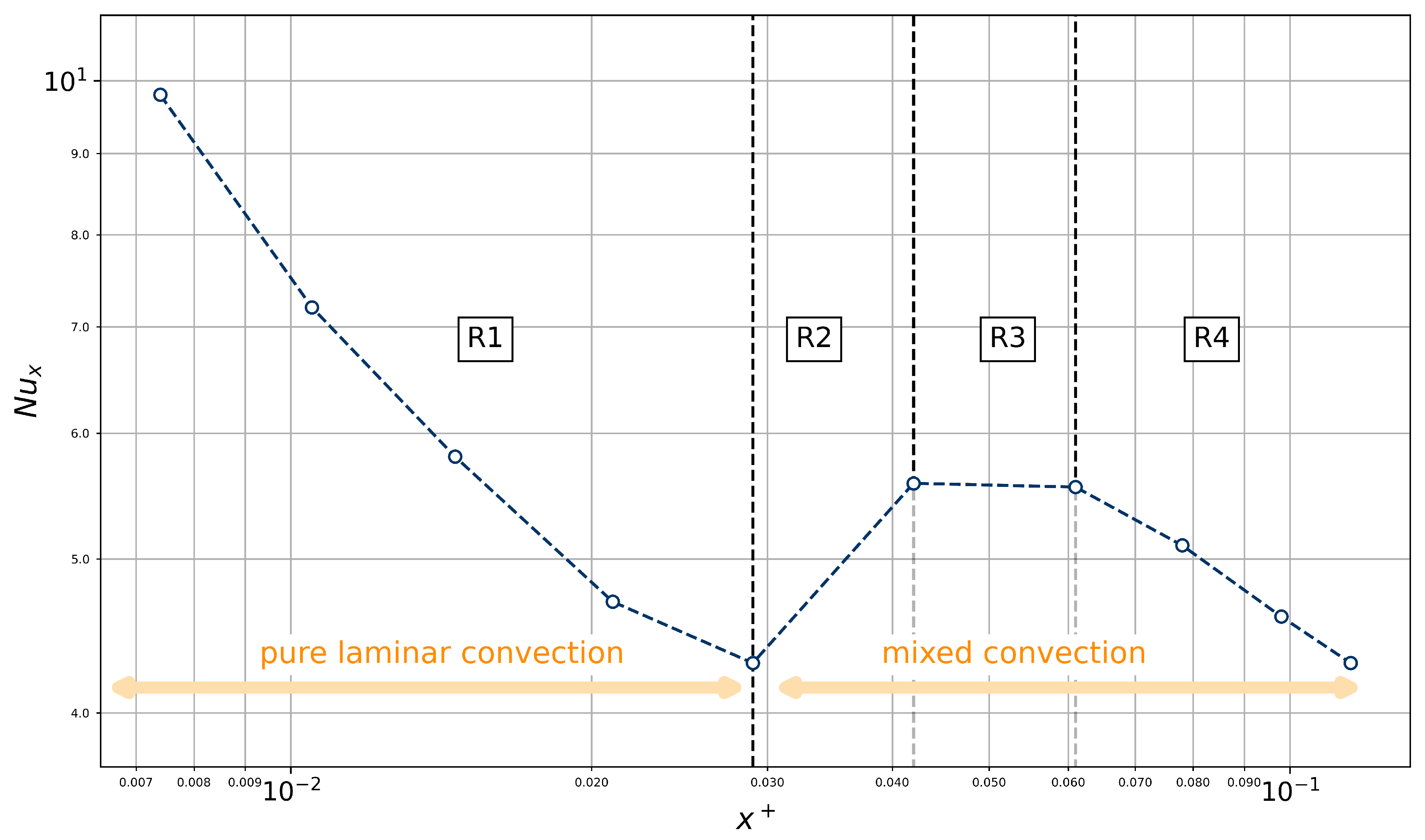
In mixed convection, four distinct flow regions can be identified [13,36], each can be identified by the impact on heat transfer (Figure 1):
  • Region 1 is dominated by pure forced convection. At this initial stage, buoyancy effects are negligible, and heat transfer between the wall and fluid layers occurs primarily through conduction.
  • Region 2 marks the onset of mixed convection. This is characterized by a noticeable rise in the local Nusselt number, indicating the influence of buoyancy forces. As a result, secondary flows and vortices emerge, leading to fluid circulation between the near-wall region and the core flow. Heat transfer is now governed by both conduction and fluid recirculation.
  • Region 3 is the transitional stage where temperature gradients between flow layers diminish. The circulation slows down, and vortex structures dissipate as thermal equilibrium is approached.
  • Region 4 corresponds to the reestablishment of forced convection dominance. The buoyancy-induced effects vanish, and the heat transfer mechanism once again becomes governed primarily by the external pumping system.
Figure 1. Exemplary distribution of the local Nusselt number Nux along heated tube in a thermally developing ferrofluid horizontal flow, illustrating the characteristic regions of mixed convection: R1—pure laminar convection; R2—onset of free convection; R3—developed mixed convection; R4—decay and transition toward forced convection.
Energies 18 04790 g001
Understanding the dynamics of mixed convection is essential when analyzing the potential for heat transfer enhancement in ferronanofluid flows under a magnetic field. The additional magnetic force will influence mass transfer in mixed convection, making it a critical factor in the design of advanced thermal management systems.

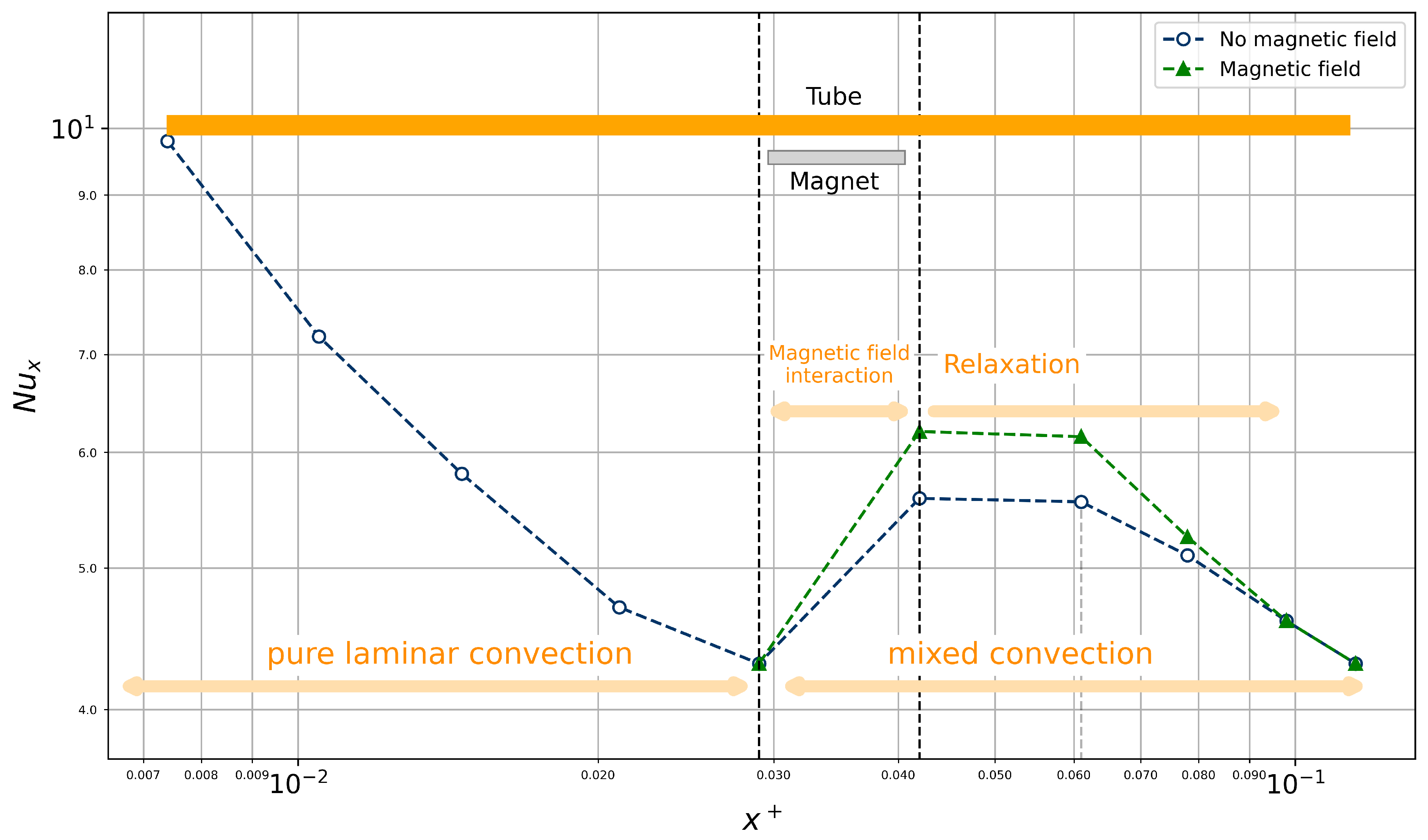
1.2. Relaxation Period

Ferronanoparticles are classified as superparamagnetic materials. This means that they exhibit magnetic behavior when subjected to an external magnetic field and do not retain any residual magnetization once the field is removed [37]. Under the influence of a magnetic field, these particles can induce the formation of secondary flow structures within the base fluid. As a result, this mechanism can lead to local temperature non-uniformities and enhance convective heat transfer.
The persistence of these secondary flows and their impact on heat transfer do not cease immediately upon passing the magnetic field influenced region. Instead, the system enters a relaxation period (Figure 2), during which the effects of the previously applied magnetic field gradually diminish. Although the magnetic force is no longer present, the thermal and hydrodynamic conditions within the fluid continue to reflect its prior presence. This is particularly evident in the sustained influence on mass transport processes, which can continue to alter the local temperature distribution and affect the heat transfer rate.
Over time, the viscosity of the fluid suppresses these residual flow structures, gradually restoring the system to its original forced convection regime. The end of the relaxation period is typically identified by the return of the local Nusselt number to values characteristic of forced convection, indicating that the magnetic memory effects and their influence on convective transport have fully dissipated [15].
Previous studies [13,14] have shown that a constant magnetic field can exert both positive and negative effects on heat transfer. A beneficial effect is observed when the magnetic force is aligned with gravity, i.e., when the magnet is placed beneath the tube. In contrast, a detrimental effect arises when the magnet is positioned above the tube, opposing the direction of gravity.
This study investigates how the spatial extent and alignment of magnetic fields relative to convective structures influence heat transfer in laminar ferrofluid flow under mixed convection conditions. A set of magnet configurations is applied to a water-based ferrofluid flowing through a uniformly heated horizontal tube, encompassing both lateral and axial arrangements of permanent magnets. The axial configuration enables an extension of the magnetic interaction region along the flow direction, allowing for evaluation of its effect on convective heat transfer. The lateral configuration considers the influence of radial magnetic forces and the interaction between adjacent magnets, both attractive and repulsive configurations, on vortex development and nanoparticle behavior. This approach facilitates the characterization of relaxation phenomena and provides insight into the coupling between magnetic fields and buoyancy-driven vortices, as indicated by variations in the local Nusselt number.

2. Materials and Methods

2.1. Experimental Setup

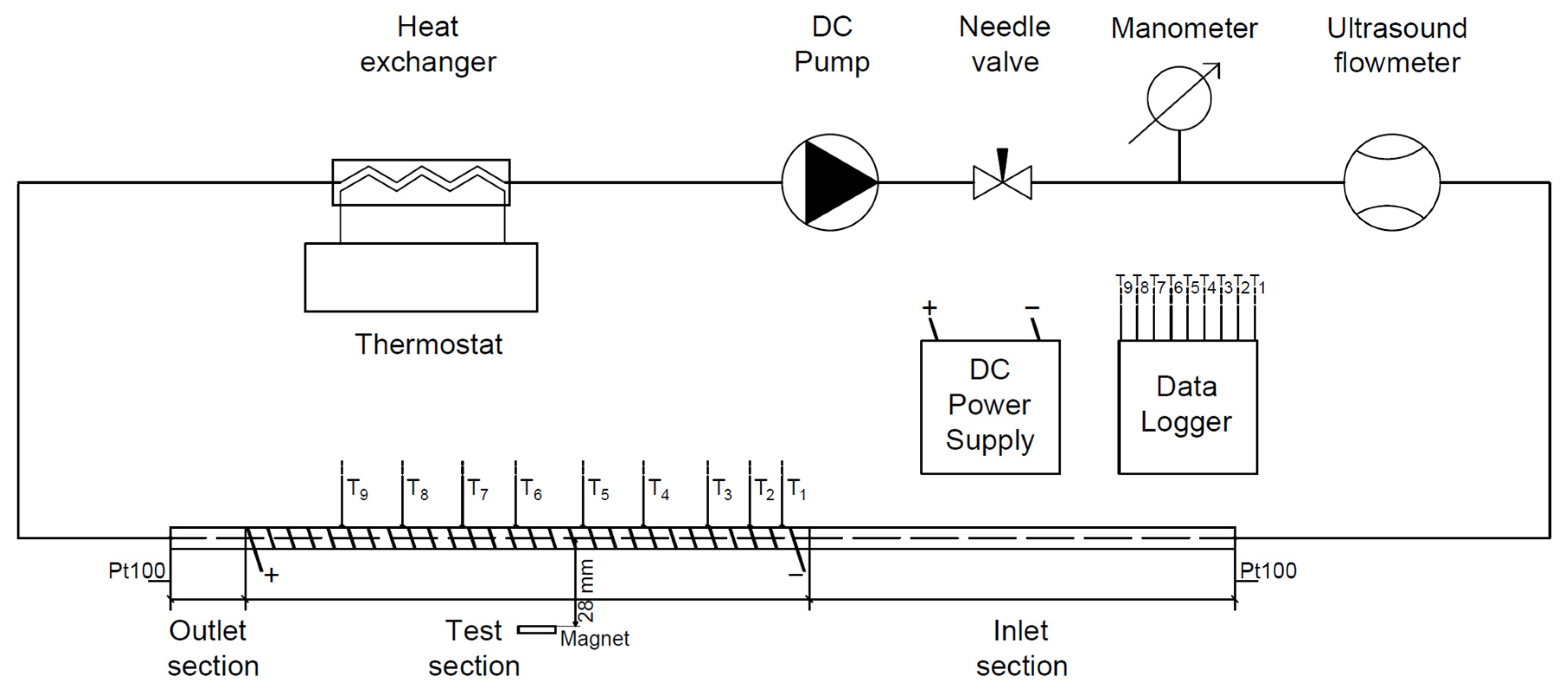
Figure 3 presents the experimental setup, which is the same as that used in previous studies focused on horizontal and inclined laminar flow of ferronanofluids [13,14]. The device comprises a main measuring section and a circulating circuit equipped with components to maintain flow parameters. The measuring section consists of a copper tube (99.9% Cu) with an inner diameter of 6 mm and a wall thickness of 1 mm. The measuring section is divided into three parts: The inlet section (900 mm) to achieve fully developed flow and determine the inlet temperature, a test section (1185 mm) equipped with 9 calibrated K-type thermocouples for precise temperature measurement, and an outlet section (150 mm) with a mixing insert to equalize the fluid temperature. Thermocouples are positioned at distances of 57, 100, 185, 245, 355, 484, 625, 781, and 965 mm from the entrance of the test section. Inlet and outlet temperatures are measured using Pt100 (Termo-precyzja, Wrocław, Poland) resistance thermometers. All sections are thermally insulated: the heated section with Aeroflex HT insulation (19 mm, EPDM, NMC sa, Eynatten, Belgium), and the inlet and outlet sections with K-Flex ST Frigo (13 mm, synthetic rubber foam, Uniejów, Poland). The test section is additionally electrically insulated with fiberglass tape (E-glass fiber type, Technozbyt, Warszawa, Poland). Magnets are placed in 3D printed clamps. The data is recorded with a KD7 digital recorder for data acquisition (Lumel, Zielona Góra, Poland). The medium circulation is driven by a gear pump, and the flow rate is measured using an Atrato AT720 ultrasonic flow meter (Titan Enterprises, Sherborne, UK). The test section is heated by a resistance wire connected to a DC power supply LongWei PDS-3010M (Dongguan, Guangdong, China). After flowing through the test section, ferronanofluid is cooled down in a plate heat exchanger connected to a thermostat (PolyScience SD7LR-20-A12E, Niles, IL, USA) that allows precise temperature control. Table 1 provides specifications regarding the accuracy of the measurement devices employed.

2.2. Magnets

The experiment employed neodymium NdFeB (N38) permanent magnets with dimensions of 40 × 10 × 8 mm3 (length × width × height). The magnets have an axial magnetization direction aligned with their height. The maximum carrying capacity of a single magnet is 11.53 kg when applied to a steel surface. The study used magnets that individually generated a magnetic field strength of 60.6 A·cm−1. This value was measured at the center of the tube (the flow core), 28 mm above the upper surface of the magnet, using a magnetic field meter (MP-1000, List-Magnetik GmbH, Leinfelden-Echterdingen, Germany). The experiment investigates the effects of two different configurations of permanent magnet placement along the tube. In the first configuration, two magnets are positioned symmetrically on the left and right sides of the tube, aligned longitudinally with the tube axis. In the second configuration, multiple magnets are placed sequentially beneath the tube, also aligned with the direction of fluid flow.

2.3. Ferronanofluid

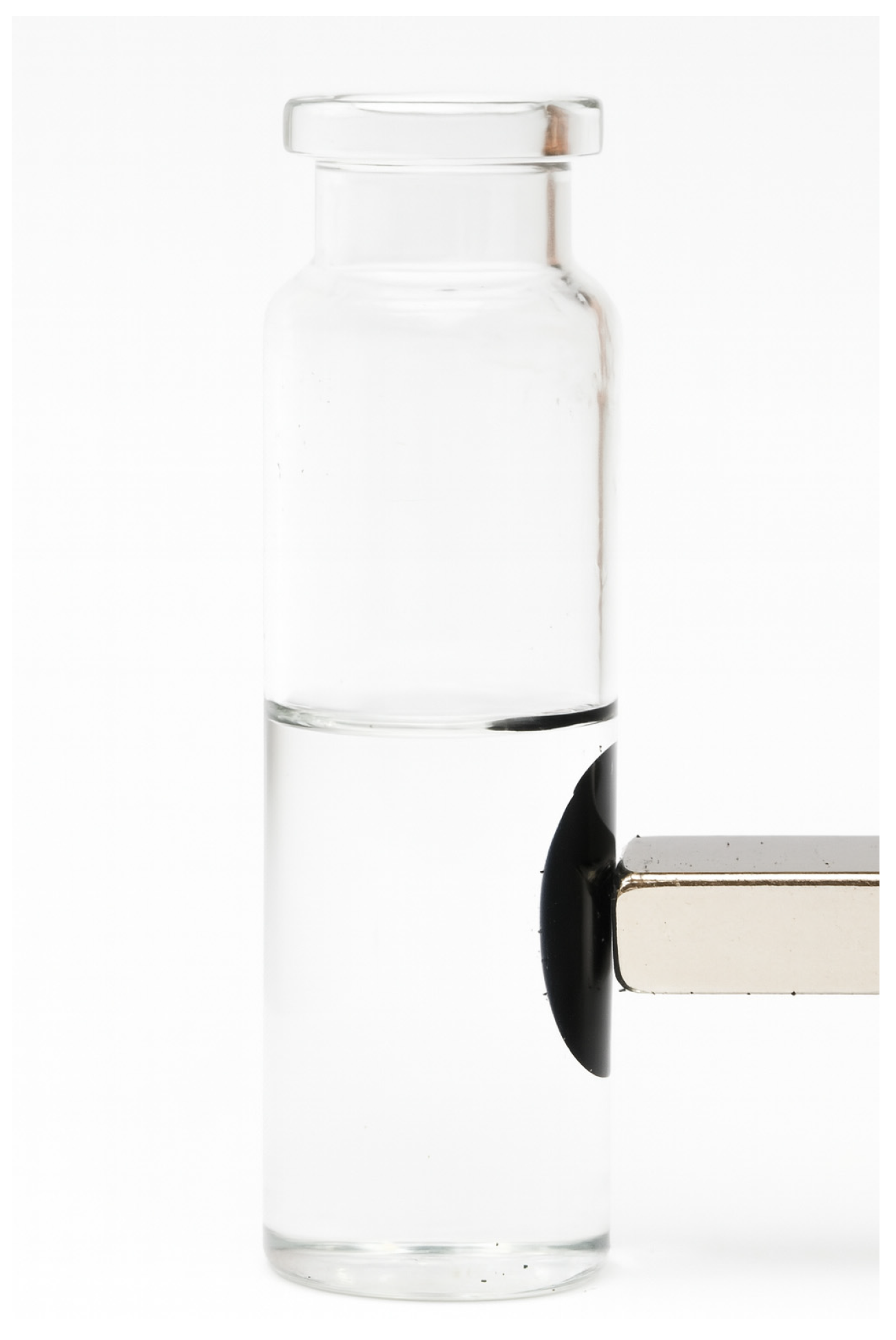
The ferronanofluid used in this study is a commercial product named MSG-W10 (FerroTec, Livermore, CA, USA), which consists of magnetite (Fe3O4) particles suspended in a water (H2O) base fluid. The volumetric concentration of the ferronanoparticles is in the range from 2.8% to 3.5%, and the suspension is stabilized with an anionic polymer. The thermophysical properties, including specific heat, density, and viscosity within the investigated temperature range, were determined in a previous study using the same experimental setup and working fluid [13]. Data on the thermal conductivity of the ferrofluid used in this study are available in [15]. Figure 4 illustrates the effect of a permanent magnet on the tested ferronanofluid. The image demonstrates the spot ferronanofluid accumulation caused by the interaction with the magnetic field.

2.4. Experimental Procedure

The experiments are performed in the laminar regime, with Reynolds number values of 109, 150, and 164 ± 3. These values were chosen because the influence of the magnetic field is most pronounced at low Reynolds numbers, enabling a deeper understanding of its effect on ferronanofluids. At the same time, they replicate the conditions from [13], making the present work complementary to our previous studies by extending them with additional magnetic field configurations and spatial analyses. To enable meaningful comparison between individual measurements, the inlet temperature to the test section is maintained at 15 °C. This ensures uniform initial thermal conditions and consequently constant Prandtl number at the inlet. A constant heat flux of 3350 W·m−2 is applied to the test section. Before the experiments employing a magnetic field, reference measurements are made.
Two experimental cases are considered:
  • Application of a radial magnetic force using permanent magnets placed on the right side, the left side, and symmetrically on both sides of the tube, with various magnetic pole orientations.
  • Axial magnetic field interaction induced by magnets arranged sequentially beneath the tube along the flow direction. The analysis is conducted for single, double, and triple magnet configurations, where the triple configuration refers to three identical magnets placed consecutively along the flow axis.
The local heat transfer conditions are assessed using the local Nusselt number, determined at each thermocouple position along the length of the test section.
N u i = h i · d k f l
where k f l is the local thermal conductivity of nanofluid, and d is the inner diameter of the test tube.
Heat transfer coefficient for the local conditions:
h i = q T w a l l , i T f l , i
where q stands for the heat flux, T w a l l , i is the inner wall temperature, and T f l , i refers to the fluid temperature calculated at the thermocouple position.
Calculation of the temperature at the inner surface of the tube, based on one-dimensional steady-state conduction, is as follows:
T w a l l , i = T t c , i q · d · log D d 2 · k C u
where T t c , i is the temperature at the external surface of the wall measured by a thermocouple, and D denotes the outer diameter of the test section.
Determination of the bulk fluid temperature at the location of the thermocouple is as follows:
T f l , i = T i n + q · π · d · x m f l · c p f l
where x denotes the position of the thermocouple, c p f l is a specific heat capacity of the fluid, and m f l represents the mass flow rate of the ferronanofluid.
Uncertainties were evaluated by standard error propagation and expressed as the root-sum-square of the individual measurement errors. Equations used to determine the local Nusselt number error are as follows:
u c N u i = N u i h i 2 · u c 2 h i + N u i d 2 · u c 2 d i n + N u i k f l , i 2 · u c 2 k f l , i
u c h i = h i q 2 · u c 2 q + h i T w a l l , i 2 · u c 2 T w a l l , i + h i T f l , i 2 · u c 2 T f l , i
u c T w a l l , i = T w a l l , i T t c , i 2 · u c 2 T t c , i + T w a l l , i q 2 · u c 2 q + T w a l l , i d i n 2 · u c 2 d + T w a l l , i D 2 · u c 2 D + T w a l l ,   i k C u 2 · u c 2 k C u
u c T f l , i = T f l , i T i n 2 · u c 2 T i n + T f l , i q 2 · u c 2 q + T f l , i d 2 · u c 2 d + T f l , i x 2 · u c 2 x + T f l , i m f l 2 · u c 2 m f l + T f l , i c p f l 2 · u c 2 c p f l
The equation used to determine the dimensionless axial position error is
u c x / d = x / d   x 2 · u c 2 x + x / d d 2 · u c 2 d
The Nusselt number change is
N u % = N u m f N u b a s e N u b a s e · 100 %
where N u m f represents the Nusselt number calculated for the flow of the ferronanofluid under the effect of a magnetic field, while N u b a s e refers to the Nusselt number calculated for the flow of the ferronanofluid in the absence of a magnetic field.
In this study, the focus was placed on determining the relaxation period, defined as the end of the magnetic field interaction effect. The differences N u were calculated as follows:
N u = N u m f N u b a s e
To compare the effects of different permanent magnet configurations, which extend the region of magnetic field interaction, the distribution of local Nusselt numbers along the mixed convection zone is approximated using polynomial fitting. The fitted curve is then integrated over the specified range. The mean local Nusselt number is calculated as the ratio of the resulting area to the length of the integration interval, as defined by the following expression:
N u ¯ = 1 b a a b   f x d x

3. Results and Discussion

3.1. The Radial Magnetic Force on Both Sides of the Tube

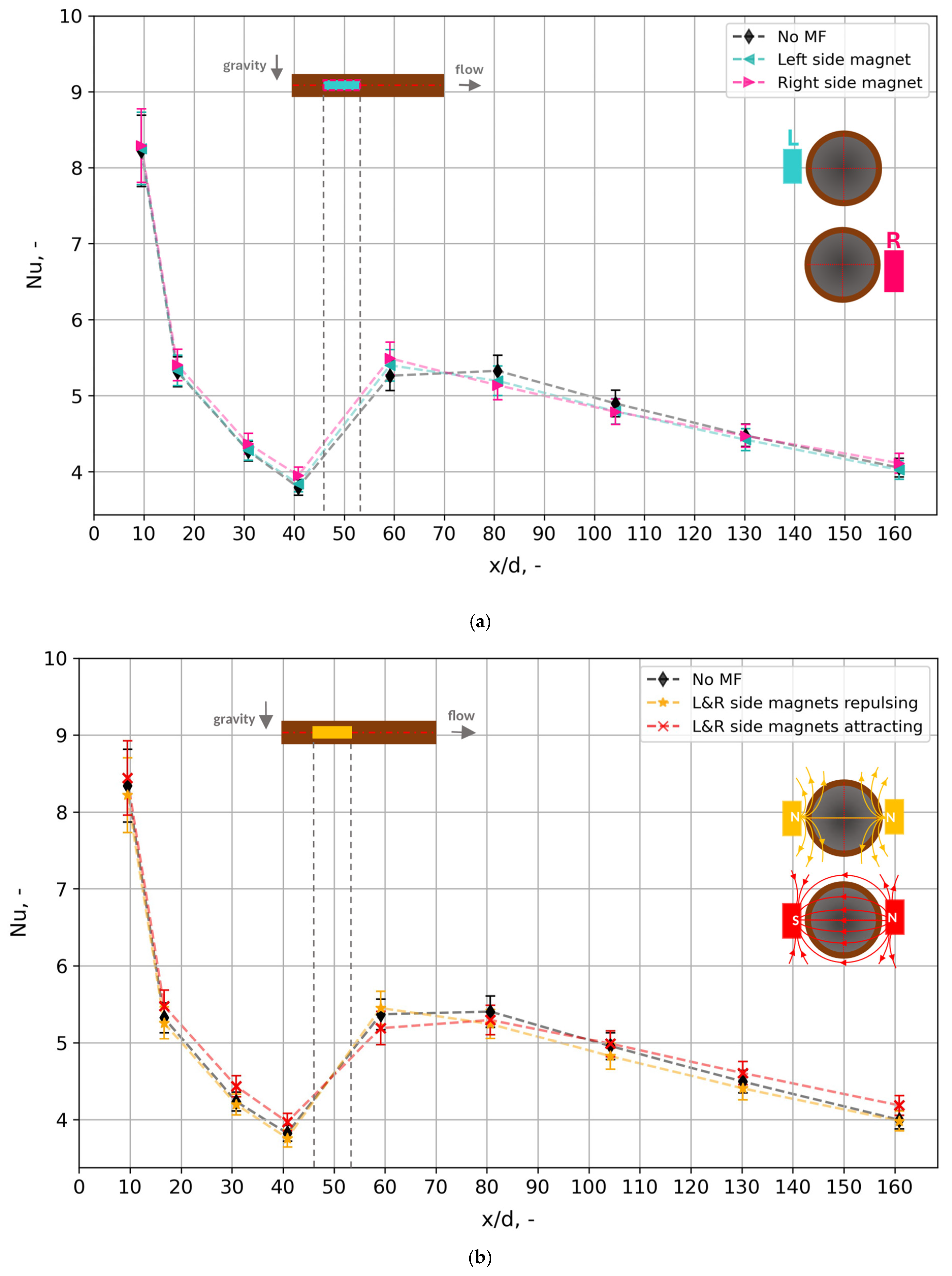
Figure 5a shows the distribution of the Nusselt number along the test section for a magnet placed sequentially on the left side (cyan triangles) and the right side (pink triangles) of the tube, compared to the reference case without magnetic field influence, represented by black diamond markers. The magnetic field strength generated by the magnet is 60.6 A·cm−1. The analyzed flow corresponds to a Reynolds number of Re = 109.
For all tested configurations, both with and without magnetic field application, a distinct increase in the Nusselt number is observed downstream of the fifth thermocouple. This increase exceeds the characteristic values for thermally developing laminar flow, thereby confirming the presence of mixed convection phenomena in the investigated case.
The placement of the magnet on either the left or right side of the tube results in similar Nusselt number distributions, indicating comparable flow behavior. This observation confirms the existence of a symmetric distribution of mixed convection vortices, as described in [38]. Moreover, no significant variation in the Nusselt number is observed within the region influenced by the magnetic field for either case. The maximum deviation of the Nusselt number relative to the reference case without magnetic field influence occurs at the measurement point located closest to the magnet. The deviations amount to 2.6% for the magnet positioned on the left side and 4.4% for the magnet positioned on the right side of the tube. However, these variations fall within the measurement error margin.
In the analyzed case, the lateral interaction between the flowing ferronanofluid and the applied magnetic field does not lead to a significant change in heat transfer. The magnetic force acting on the flow is insufficient to disturb the mass transport driven by buoyancy forces. As a result, the dominant mechanism governing the heat transfer remains associated with mixed convection, and no substantial enhancement is observed under the given magnetic field and flow conditions.
Figure 5b presents the case of two oppositely oriented magnets arranged in either attracting or repelling configurations. When identical poles face each other, magnetic field repulsion occurs (indicated by yellow stars), whereas when opposite poles are aligned, mutual attraction between the magnets is observed (indicated by red crosses).
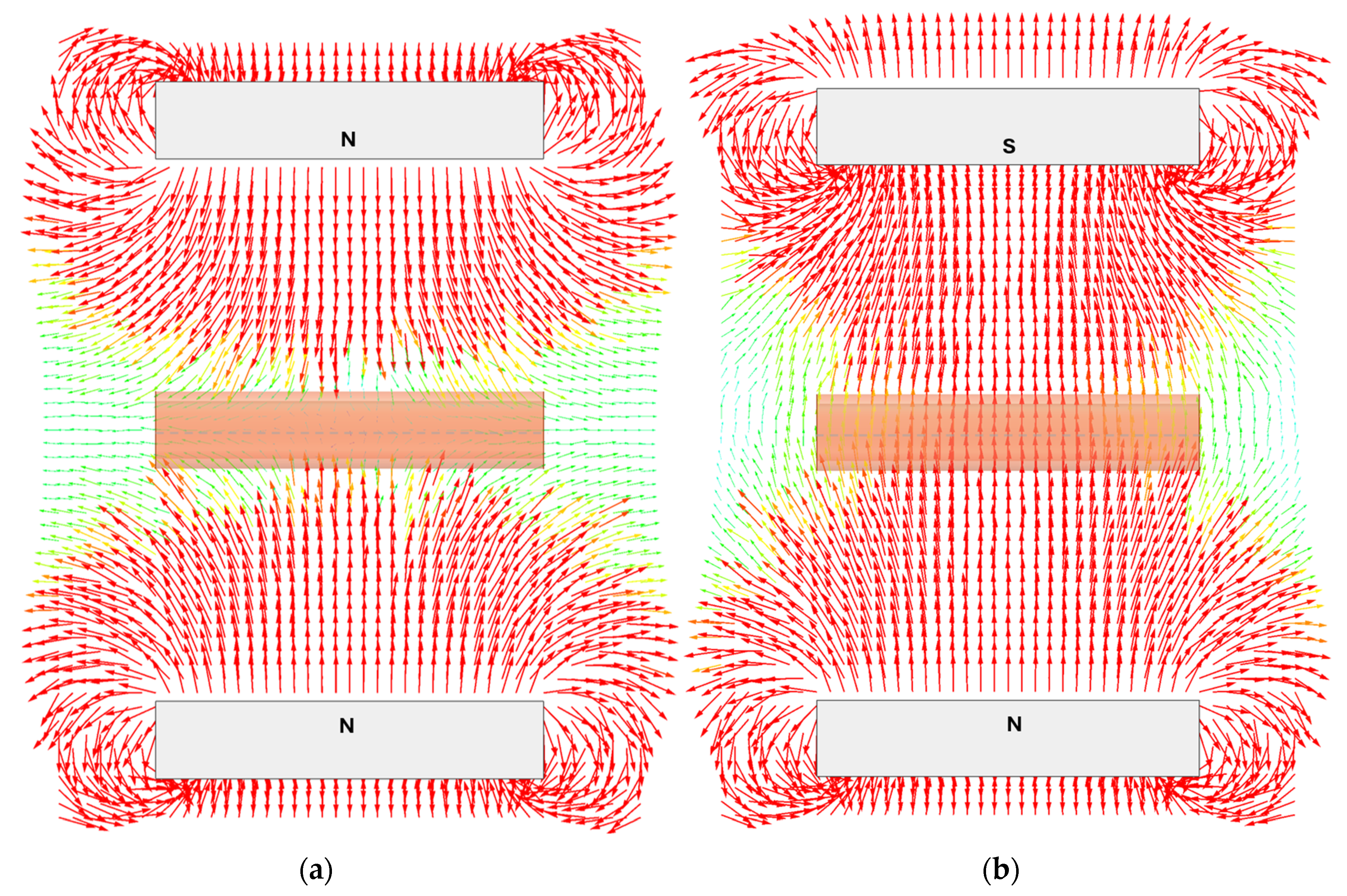
Figure 6 illustrates magnetic field interactions between magnets. The arrows represent vectors of the magnetic field strength, and their direction indicates the local orientation of the field lines. The color scale encodes the relative magnitude of the field, where blue corresponds to values close to zero, green to weak fields, yellow to intermediate strength, and red to the strongest fields. The magnetic field distribution was calculated numerically in ANSYS Maxwell 2024 by solving the magnetostatic form of Maxwell’s equations using the finite element method (FEM).
In the repelling configuration, a region of reduced magnetic flux density forms between the magnets due to the vector superposition of the opposing magnetic fields. The bending of magnetic field lines outward reflects this local minimum in field strength, as illustrated in Figure 6a. In the region of mixed convection, no significant change in heat transfer is noted. This indicates that this specific magnetic field arrangement is not capable of substantially affecting mass transfer processes within the tube.
When the magnets are oriented with opposite poles facing each other, a relatively uniform magnetic field is established between them, as shown in Figure 6b. Under the influence of this attractive magnetic interaction, the distribution of the local Nusselt number exhibits a slight reduction compared to the reference case without magnetic field application (Figure 5b). Specifically, the Nusselt number decreases by approximately 3.3%. The intensified magnetic field appears to interfere with the convective structures, resulting in a localized reduction in heat transfer. While the observed decrease falls within the measurement uncertainty, it remains consistent with the expected physical response. In contrast, the repelling configuration produces a weak magnetic field in the center, where the dominant component of mixed convection develops, characterized by strong downward mass transport. This weak field is insufficient to perturb the flow structure, which explains the absence of any measurable heat transfer effect.

3.2. Extended Spatial Range of Magnetic Field Influence on Heat Transfer

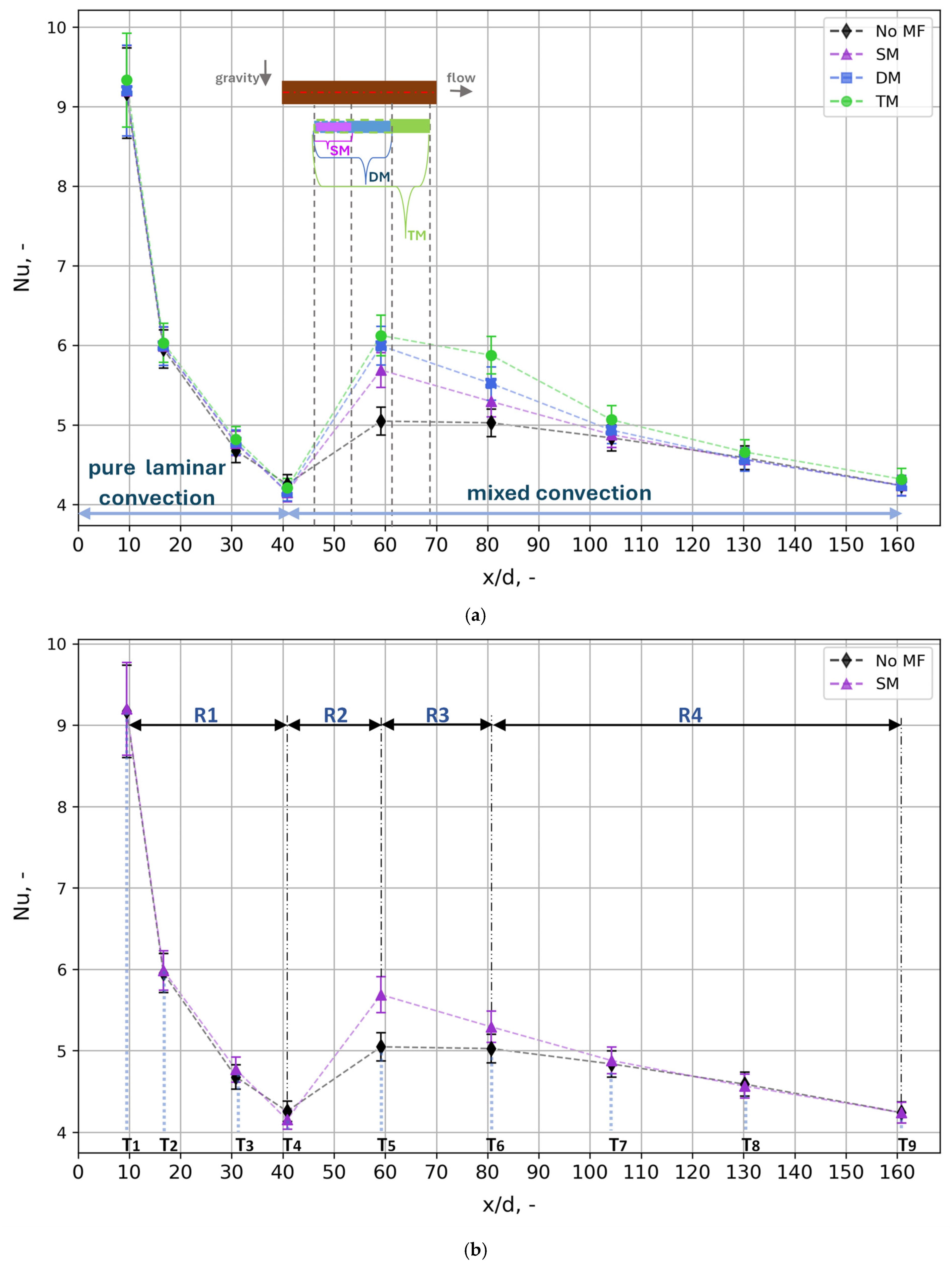
This section is dedicated to analyzing the extension of the effect by using several identical permanent magnets, arranged one after another in the flow direction. Placement of magnets along the length of the test section is illustrated at Figure 7a. Case one (SM) involves a single magnet placed behind thermocouple T 4 . This position also corresponds to the onset of mixed convection. Case two (DM), the double magnet configuration, corresponds to the use of two identical permanent magnets arranged one after another. Similarly, in the third case (TM), the triple magnet configuration corresponds to the use of three identical magnets placed one after another.
Understanding the structure of mixed convection regions is essential for correctly interpreting heat transfer results. Figure 7b shows the identified regions of mixed convection for the configuration with a single magnet. The thermocouples are labeled as T i (where i = 1 to 9), indicating the positions of the individual temperature sensors along the test section.
When an additional magnetic field is applied, it enhances buoyancy effects and strengthens the convective vortex. As a result, Region R3 exhibits a decreasing trend in the Nusselt number profile. This behavior is attributed to the concentration of magnetic field around thermocouple T 5 , which diminishes its influence further downstream at T 6 . Therefore, it is important not to confuse Region R3 with Region R4, particularly when interpreting heat transfer behavior under pure mixed convection conditions.
This distinction is also evident in the triple-magnet configuration (Figure 7a), where the third magnet is located just downstream of thermocouple T 5 . In this case, the magnetic influence extends toward T 6 , resulting in a flattening of the Nusselt number profile between T 5 and T 6 , similar to the case of mixed convection in the scenario without magnetic field (Figure 7b).
Figure 7a presents the distribution of the local Nusselt number at a Reynolds number of Re = 164 for different cases of magnetic field interaction length. An improvement in the local Nusselt number is observed for each magnet configuration compared to the reference case without magnetic field application.
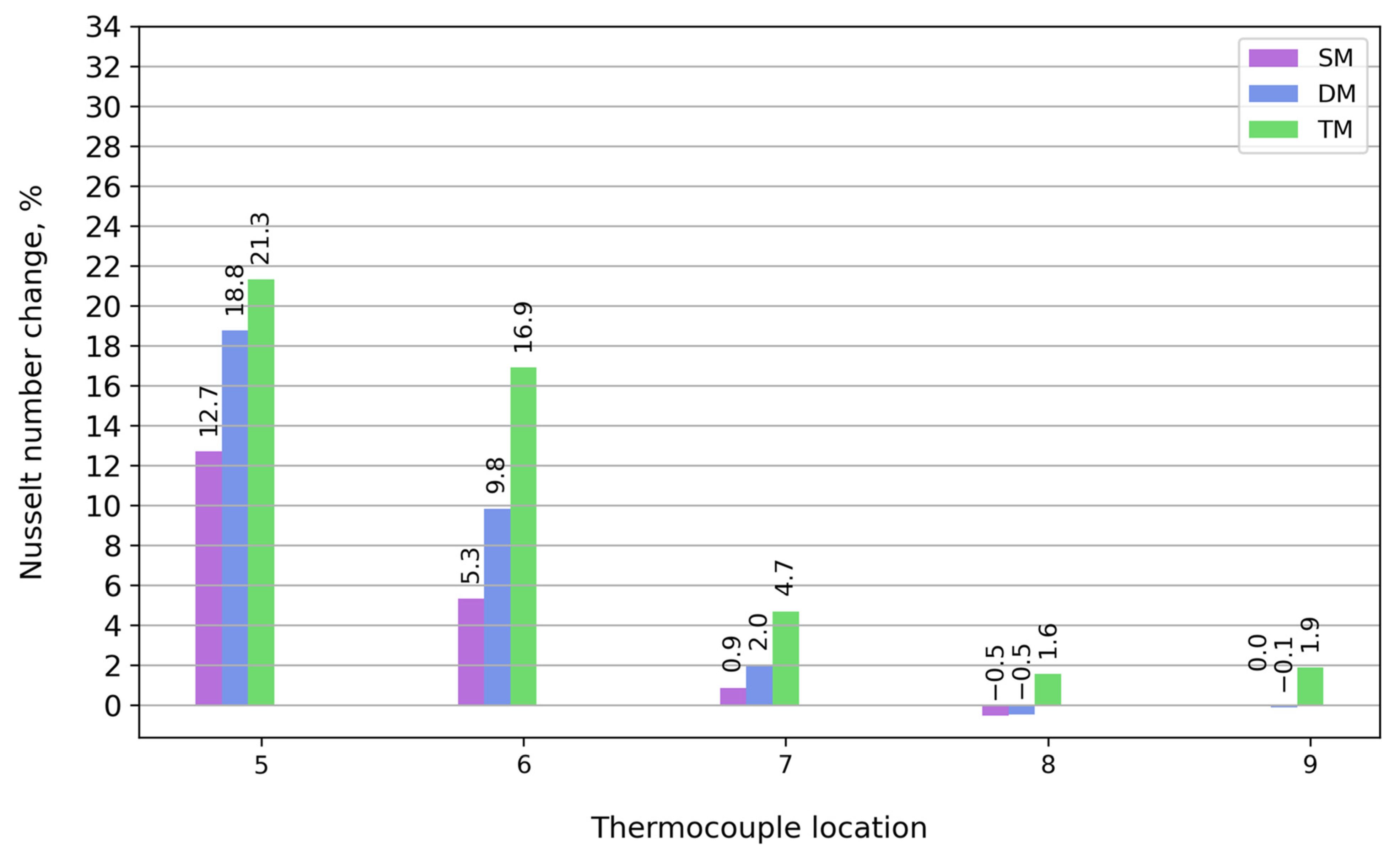
For the single magnet (SM) configuration, the local Nusselt number near thermocouple T 5 increases by 12.7%. For the double magnet (DM) configuration, the increase reaches 18.8%, while for the triple magnet (TM) configuration, it reaches 21.3%. The difference between the SM and DM configurations amounts to 6.1 percentage points, and between the DM and TM configurations to 2.5 percentage points. The greatest enhancement is observed at thermocouples T 5 and T 6 , while the influence extends downstream to T 7 only for the TM configuration.
This trend indicates that the improvement in heat transfer is most pronounced when a single magnet is applied, while the magnitude of further enhancement diminishes as more magnets are introduced. This non-linear response stems from the fact that the magnetic field strengths do not superimpose. Instead, adding magnets alters the spatial distribution of the field, primarily along the test section, but also locally, as evidenced by the increase near the fifth thermocouple.
Figure 8 presents the exact values of the percentage change in the local Nusselt number for thermocouples located within the region influenced by mixed convection for Re = 164. For each configuration (SM, DM, and TM), a local analysis of the data shows that the impact of the magnetic field on heat transfer decreases with increasing distance from the magnetic field source. In the SM and DM configurations, the magnetic field influence becomes negligible at thermocouple T 8 , whereas in the TM configuration, a positive effect on heat transfer is still observed at this location. This observation indicates that increasing the number of magnets extends both the spatial range and magnitude of the heat transfer enhancement along the tube.
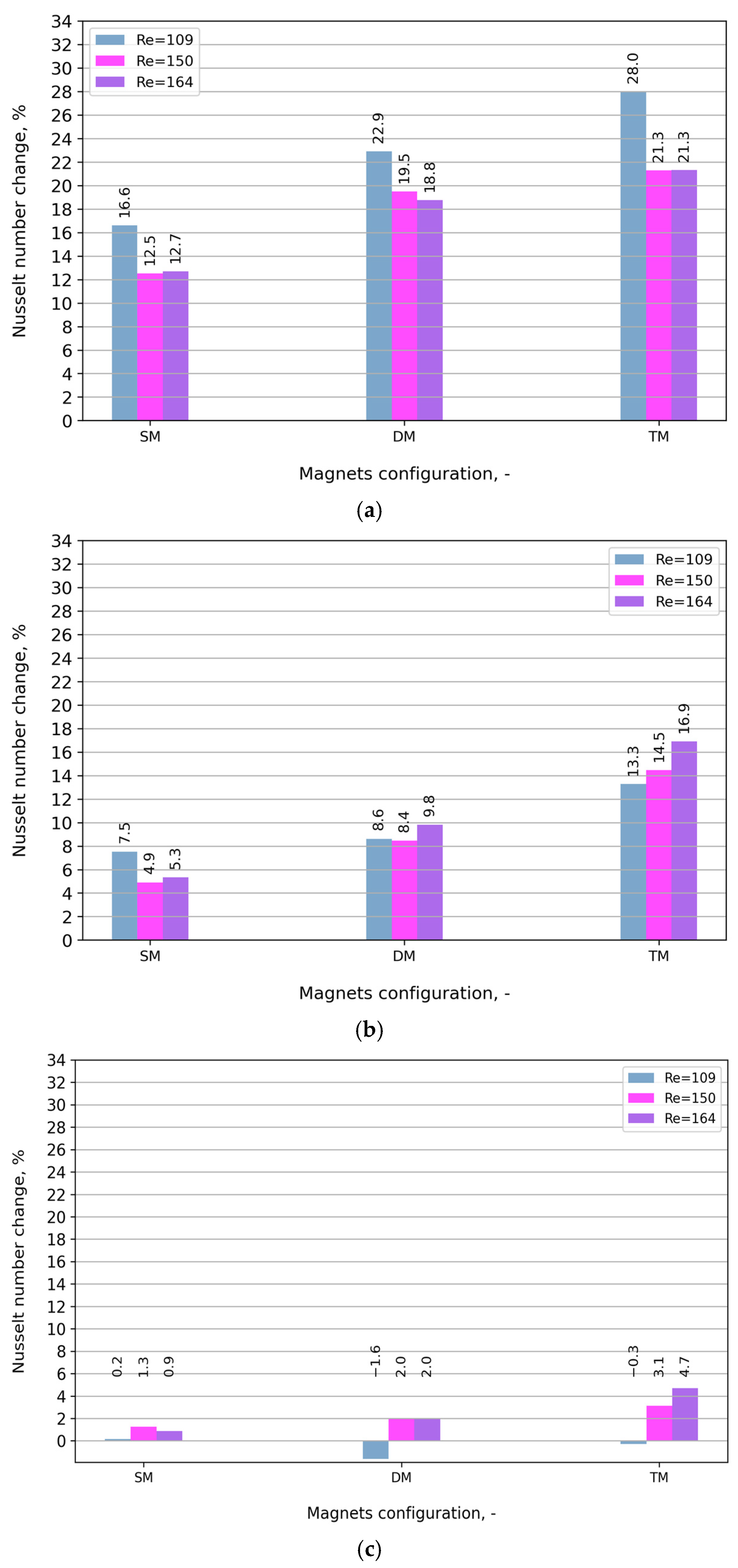
Figure 9 presents a comparison of the changes in the Nusselt number for thermocouples T 5 (Figure 9a), T 6 (Figure 9b), and T 7 (Figure 9c) for all tested magnet configurations and the measured Reynolds numbers.
Analyzing Figure 9a, the largest changes in the local Nusselt number are observed for the flow at Re = 109. The greatest enhancement, with a maximum improvement of 28%, occurs for the TM configuration at this Reynolds number. For the higher Reynolds numbers, Re = 150 and Re = 164, the enhancements for a given magnet configuration are similar, increasing from 12.5% for the SM configuration to 21.3% for the TM configuration, following the trend of greater improvement with the extension of the magnetic field interaction region.
Figure 9b presents the results for thermocouple T 6 . As the magnetic field interaction is extended from SM to DM and TM configurations, the local Nusselt number increases with the length of the magnetic field region, as previously observed at thermocouple T 5 . However, while for the SM configuration the greatest enhancement again occurs at the lowest Reynolds number (Re = 109), the DM and TM configurations exhibit a different dependence on flow rate, with the strongest improvements recorded at the highest Reynolds number (Re = 164). Specifically, the enhancements in the local Nusselt number for DM and TM at Re = 164 reach 9.8% and 16.9%, respectively, compared to 8.6% and 13.3% at Re = 109.
Figure 9c presents the results for thermocouple T 7 . An increase in the change of the local Nusselt number is observed for the flows at Re = 150 and Re = 164, with a consistent tendency for greater enhancement as the number of magnets increases. However, the maximum improvement does not exceed 4.7%, and no significant enhancement of heat transfer is observed at this location. Still, the influence of the extended magnetic field interaction can be noted.
The obtained data confirm the phenomenon observed in previous study [13], indicating that an increase in the Reynolds number allows for the extension of the effect of the change in the Nusselt number, which is associated with an improvement in the heat transfer coefficient. In the case of low flow values, the effect is significant only locally.

3.3. Relaxation Period

The obtained data were analyzed in two aspects. The first aspect focused on the influence of magnet length on the relaxation period, while the second focused on the influence of Reynolds number on the relaxation period.
The outer wall temperature measurement does not allow for a precise determination of the exact point at which the influence of the magnetic field ceases. This limitation stems from uncontrolled heat conduction along the tube wall, which cannot be avoided, especially for materials of high thermal conductivity, such as copper. As a result, the temperature readings obtained at the wall represent an averaged response, rather than a spatially resolved thermal profile. The most representative parameter capturing the effect of heat transfer enhancement in this context is the local Nusselt number, which quantifies the increase in heat transfer through the fluid layer due to convection relative to pure conduction within the same fluid layer.
The authors of [15] suggest that the relaxation distance can be significant, extending several characteristic lengths of the magnets from the area of magnetic field influence. In their study, the authors employed 120 × 12 × 5 mm3 NdFeB magnets with a nominal holding force of 10.59 kg. For the magnetic force aligned with the direction of gravity, they determined the relaxation time corresponding to two lengths of the magnets used.
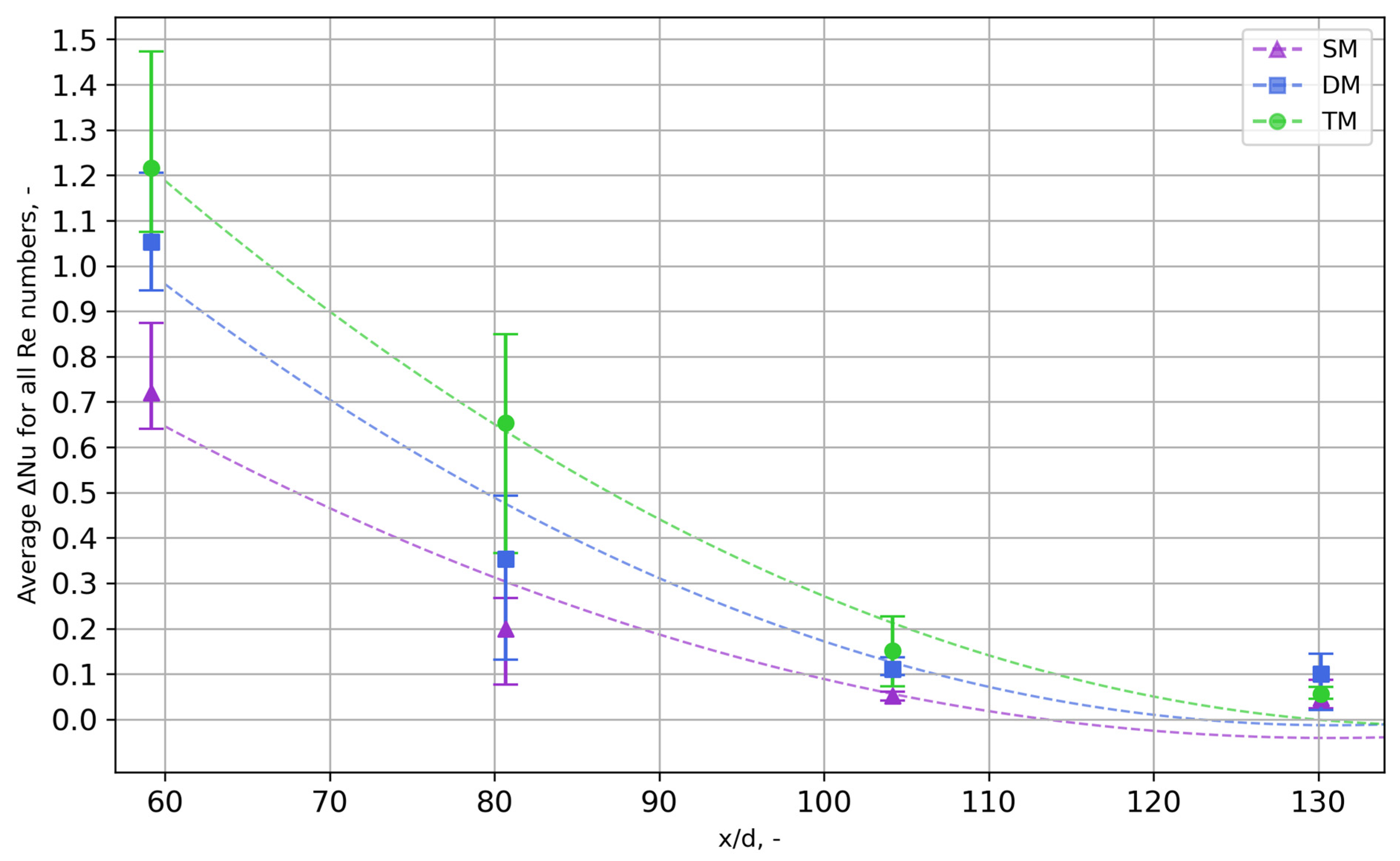
Figure 10 presents results related to the influence of magnet length within the region of mixed convection. The average difference in the local Nusselt number was determined for each magnet configuration (SM, DM, TM), with values averaged across all measured Reynolds numbers. The plot displays data points representing these average values, and a polynomial approximation was applied to illustrate the trend. At the locations of thermocouples T 5 ( x / d   ≈ 60) and T 6 ( x / d   ≈ 80), a noticeable spread in the data is observed, which reflects the substantial variation in local magnetic field intensity. In the region of thermocouple T 7 ( x / d ≈ 104), the data points begin to converge, with average differences ranging from 0.05 to 0.15. For thermocouple T 8 , the data points overlap entirely, with values between 0.05 and 0.10, indicating the absence of additional heat transfer mechanisms. Based on this observation, a threshold value of 0.1 was adopted to determine the end of the relaxation period.
Accordingly, for the SM configuration, the relaxation period ends just before thermocouple T 7 ; for DM, it ends within the range of T 7 ; and for TM, it extends approximately halfway between T 7 and T 8 .
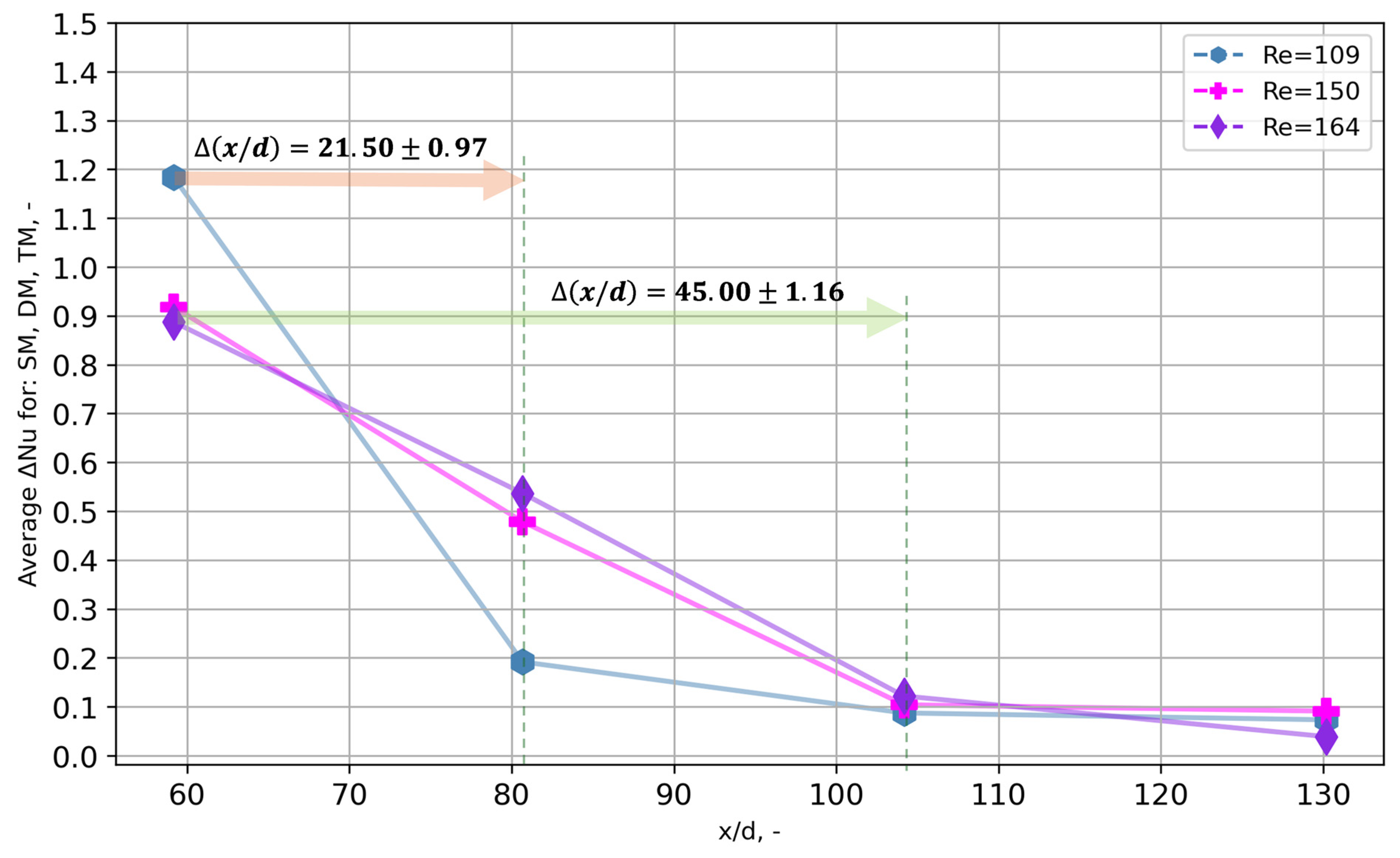
Figure 11 presents the influence of the Reynolds number on the relaxation period, based on averaged differences in the local Nusselt number for all configurations of permanent magnets. The plot includes data from all thermocouple positions that are in the relaxation region.
For the flow at Re = 109, a strong and localized effect is observed: the Nusselt number difference drops sharply from 1.18 to 0.19 over a short distance of Δ x / d = 21.50. For flows at higher Reynolds number values, the initial difference is lower—approximately 0.90, and the subsequent decrease occurs more gradually, over a longer distance of Δ x / d = 45.00. This indicates that the influence of the magnetic field extends approximately twice as far when inertial effects increase.
A clear trend can be observed: at low Reynolds numbers, the magnetic field induces a strong but spatially limited enhancement of heat transfer. As the Reynolds number increases and inertial forces become more significant, the magnetic influence becomes more distributed, resulting in a broader but less intense effect.
For thermocouple T 7 , the third measurement point, the recorded differences in all analyzed cases fall within the range of 0.09 to 0.12, with an average of approximately 0.10. This value corresponds to the threshold identified in Figure 10. Based on this criterion, the relaxation period for Re = 109 ends before thermocouple T 7 ( x / d = 100), whereas for higher Reynolds numbers, it extends beyond this point, within the range 110 <   x / d   < 120.
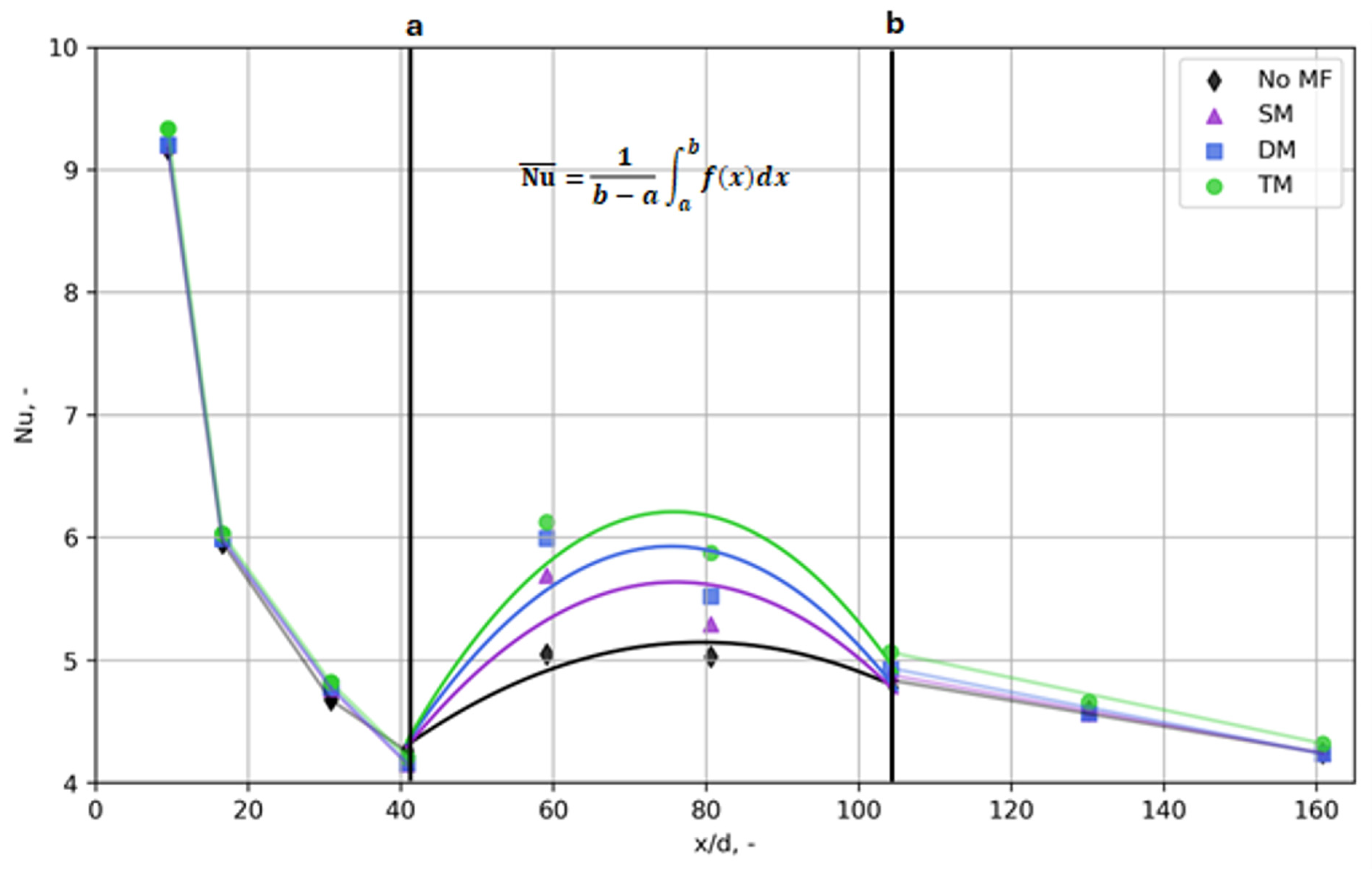
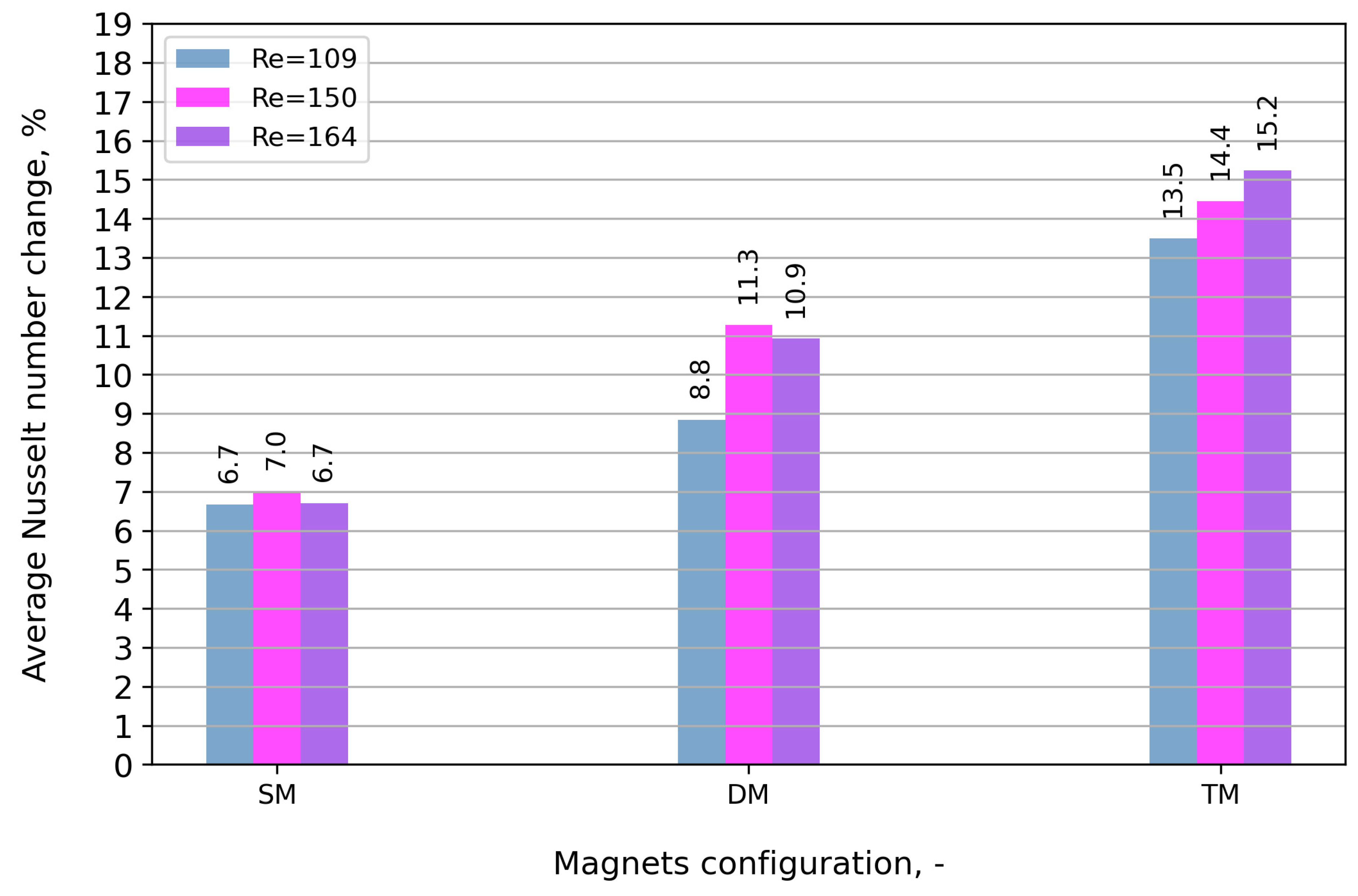
To evaluate the overall effect of extending the magnetic field interaction and to assess the influence of the Reynolds number on its spatial extent, the average change in the local Nusselt number was calculated. Figure 12 presents the analyzed region for the flow at Re = 164. For consistency across all cases, the position of thermocouple T 7 was taken as the endpoint of the relaxation region, as indicated by previous analysis. The distribution of local Nusselt number values within the mixed convection region, between thermocouples T 4 and T 7 , was approximated using polynomial fitting. In this procedure, the polynomial coefficients were determined using the least-squares method and subsequently optimized by minimizing the mean squared error (MSE) with the L-BFGS-B algorithm implemented in the SciPy library (Python 3.12), yielding a coefficient of determination R 2 in the range of 0.80–0.91. The resulting polynomial function was then integrated over the specified range, and the ratio of the obtained area to the length of the x-range (between T 4 and T 7 ) yields the average local Nusselt number. For Re = 164, the resulting average values range from 4.93 to 5.78, depending on the magnet configuration. The same procedure was applied to all other investigated Reynolds numbers.
Figure 13 presents the percentage change in the average local Nusselt number for each magnet configuration relative to the baseline case without magnetic field influence, for all Reynolds numbers. The results reveal a clearly increasing trend: from 6.7% for the SM configuration to a maximum of 15.2% for the TM configuration. For SM, the average enhancement across all Reynolds numbers falls within a narrow range of 6.7% to 7.0%, indicating that the net improvement remains similar regardless of flow rate. This suggests that, for lower Reynolds numbers, the effect is concentrated near the magnet, while for higher Reynolds numbers it becomes more spatially distributed, yet the overall gain remains comparable. For the DM configuration, the average improvement ranges from 8.8% to 11.3%, and for TM it ranges from 13.5% to 15.2%. In both cases, the smallest enhancements are observed at the lowest Reynolds number.

4. Conclusions

This study investigated the influence of magnetic field geometry, specifically the interaction length and lateral positioning, on convective heat transfer in laminar flow of a water-based ferrofluid containing magnetite nanoparticles. Experiments were conducted at Reynolds numbers of 109, 150, and 164.
The experiments were carried out under mixed convection conditions in a horizontal tube. In the first part of the study, lateral configurations were examined by placing single magnets on the left and right sides of the pipe, followed by a symmetrical arrangement with two magnets positioned on opposite sides. These magnets were oriented either to attract or repel, allowing evaluation of how radial field alignment and intensity influence local heat transfer. In the second part, axial configurations with one, two, and three magnets placed sequentially beneath the tube were tested to systematically investigate the effect of increasing magnetic field interaction length along the flow direction. The key findings of the investigation can be summarized as follows:
  • Experimental results with a single magnet positioned alternately on the left and right sides of the tube confirmed the symmetry of the resulting convection structures. The influence of the magnetic field was most apparent near the magnet, where deviations in the local Nusselt number reached 2.6% (left) and 4.4% (right) compared to the reference case. However, these changes remained within the experimental uncertainty, indicating that the applied magnetic field strength was insufficient to induce substantial modifications in the heat transfer under mixed convection conditions.
  • The pole orientation in a two-magnet setup influences the resulting heat transfer performance. In the attracting configuration (opposite poles facing), the local Nusselt number decreased by approximately 3.3%, suggesting a mild suppression of secondary motions. In the repelling configuration (identical poles facing), no measurable change in heat transfer was observed. This outcome is consistent with the very low magnetic flux density in the central region, where convective vortices typically develop.
  • Extending the magnetic field interaction region along the flow direction emerged as the most effective strategy for enhancing convective heat transfer, with the local Nusselt number increasing by 28.0% for the triple magnet configuration at Re = 109. However, the relative benefit of adding more magnets diminished progressively: the increase in local Nusselt number was 16.6% for a single magnet, followed by an additional 6.3 percentage points for two magnets, and only 5.1 points more for three magnets. This indicates that the enhancement of local heat transfer becomes progressively less pronounced as the magnetic field interaction region is extended.
  • The extent and persistence of magnetic field influence, referred to as the relaxation period, are governed by both the spatial length of magnetic field interaction and the flow conditions. For low Reynolds number flow (Re = 109), a strong but localized enhancement is observed: the relative Nusselt number change drops sharply from 1.18 to 0.19 within a short distance of Δ x / d   = 21.50. At higher Reynolds numbers (Re = 150 and 164), the initial difference is smaller (approximately 0.90), but the effect decays more gradually, over a longer distance of Δ x / d   = 45.00. This indicates that as inertial forces increase, the magnetic field effect becomes less intense but more spatially extended.
  • The magnetic field effect is more pronounced at low Reynolds numbers, while at higher values it becomes weaker but more spatially extended. Consequently, the average Nusselt number reflects the combined influence of both magnetic field interaction length and Reynolds number. The averaged Nusselt number in the affected flow part increases from 6.8% for a single magnet to 10.3% for two and 14.7% for three magnets. These findings underscore that both magnetic field configuration and flow conditions must be considered jointly to optimize heat transfer performance.
The findings of this study demonstrate that spatial arrangement and interaction length play a key role in shaping heat transfer performance in ferrofluid systems. Configurations with laterally placed magnets, regardless of their polarity, were found to have negligible effect on Nusselt number, confirming that radial magnetic fields misaligned with the flow structures of mixed convection are ineffective. In contrast, axial configurations, where the magnetic field interacts with the flow over an extended region beneath the tube, resulted in substantial enhancement, especially at a low Reynolds number. The results show that extending the magnetic field region improves not only the local heat transfer but also its spatial distribution along the tube. This effect becomes more diffuse with increasing Reynolds number, emphasizing the need to consider both flow parameters and magnetic interaction length when designing magnetic field-assisted thermal systems.

Author Contributions

Writing—original draft, G.H.B.-K.; visualization, G.H.B.-K.; validation, G.H.B.-K.; investigation, G.H.B.-K. and R.M.; formal analysis, G.H.B.-K.; writing—review and editing, B.Z. and R.M.; methodology, R.M.; software, R.M.; supervision, B.Z. and R.M.; resources, B.Z. All authors have read and agreed to the published version of the manuscript.

Funding

This research received no external funding.

Data Availability Statement

Dataset available on request from the authors.

Acknowledgments

During the preparation of this work, the authors used ChatGPT (GPT-4o) in order to improve the readability and language of the manuscript. After using this tool/service, the authors reviewed and edited the content as needed and take full responsibility for the content of the published article.

Conflicts of Interest

The authors declare no conflict of interest.

Nomenclature

Symbols
x+dimensionless axial position scaled by flow and thermal properties
NuNusselt number
hlocal heat transfer coefficient W m−2 K−1
dinternal diameter, m
Dexternal diameter, m
kthermal conductivity, W m−1 K−1
qheat flux, W m−2
Ttemperature, K
xthermocouple position, m
mmass flow, kg s−1
cpspecific heat capacity, J kg−1 K−1
x/ddimensionless axial position
ReReynolds Number
Subscripts
iindex of a thermocouple position
ininternal
flfluid
wallwall
tcthermocouple
Cucopper
mfmagnetic field
basebase state (without magnetic field)
configconfiguration

References

  1. Buschmann, M.H.; Hernández López, L.; Buj Vicente, L. Handbook on Industrial Applications of Nanofluids in Energy Sector; Universitat Jaume I: Castellón, Spain, 2020. [Google Scholar] [CrossRef]
  2. Bianco, V.; Manca, O.; Nardini, S.; Vafai, K. Heat Transfer Enhancement with Nanofluids; CRC Press: Boca Raton, FL, USA, 2015; Available online: https://www.taylorfrancis.com/books/9781482254020 (accessed on 19 April 2020).
  3. Bhanvase, B.A.; Barai, D.P.; Żyła, G.; Said, Z. Towards Nanofluids for Large-Scale Industrial Applications I; Elsevier: Amsterdam, The Netherlands, 2024. [Google Scholar] [CrossRef]
  4. Riehl, R.R. Thermal enhancement using nanofluids on high heat dissipation electronic components. J. Nanofluids 2019, 8, 30–40. [Google Scholar] [CrossRef]
  5. Murshed, S.M.S.; Estellé, P. A state-of-the-art review on viscosity of nanofluids. Renew. Sustain. Energy Rev. 2017, 76, 1134–1152. [Google Scholar] [CrossRef]
  6. Sawicka, D.; Cieśliński, J.T.; Smolen, S. A comparison of empirical correlations of viscosity and thermal conductivity of water–ethylene glycol–Al2O3 nanofluids. Nanomaterials 2020, 10, 1487. [Google Scholar] [CrossRef]
  7. Venerus, D.C.; Buongiorno, J.; Christianson, R.; Townsend, J.; Bang, I.C.; Chen, G.; Chung, S.J.; Chyu, M.; Chen, H.; Ding, Y.; et al. Viscosity measurements on colloidal dispersions (nanofluids) for heat transfer applications. Appl. Rheol. 2010, 20, 44582. [Google Scholar] [CrossRef]
  8. Żyła, G. Viscosity and thermal conductivity of MgO–EG nanofluids: Experimental results and theoretical models predictions. J. Therm. Anal. Calorim. 2017, 129, 171–180. [Google Scholar] [CrossRef]
  9. He, Y.; Bi, Q.; Chen, T. Heat transfer of ferrofluids: A review. Int. J. Microscale Nanoscale Therm. Fluid Transp. Phenom. 2014, 5, 129–152. [Google Scholar]
  10. Gürsoy, E.; Gürdal, M.; Gedik, E.; Arslan, K.; Dağdeviren, A. Experimental and numerical study on ferrohydrodynamic and magneto-convection of Fe3O4/water ferrofluid in a sudden expansion tube with dimpled fins. J. Taiwan Inst. Chem. Eng. 2024, 164, 105676. [Google Scholar] [CrossRef]
  11. Gürdal, M.; Gürsoy, E.; Pazarlıoğlu, H.K.; Arslan, K.; Gedik, E. An innovative approach of alternating magnetic field diversified with different wave types and magnet positions for ferrofluid flow in dimpled tube. J. Magn. Magn. Mater. 2023, 581, 170975. [Google Scholar] [CrossRef]
  12. Gürdal, M.; Pazarlıoğlu, H.K.; Tekir, M.; Altunay, F.M.; Arslan, K.; Gedik, E. Implementation of hybrid nanofluid flowing in dimpled tube subjected to magnetic field. Int. Commun. Heat Mass Transf. 2022, 134, 106032. [Google Scholar] [CrossRef]
  13. Mulka, R.; Bęben, G.; Zajączkowski, B.; Buschmann, M.H. Magnetic field impact on ferronanofluid laminar flow. Int. J. Therm. Sci. 2024, 203, 109108. [Google Scholar] [CrossRef]
  14. Mulka, R.; Bęben, G.; Zajączkowski, B.; Buschmann, M.H. Magnetic field influence on heat transfer in inclined laminar ferronanofluid flow. Int. J. Therm. Sci. 2024, 205, 109312. [Google Scholar] [CrossRef]
  15. Rudl, J.; Hanzelmann, C.; Feja, S.; Meyer, A.; Potthoff, A.; Buschmann, M.H. Laminar pipe flow with mixed convection under the influence of magnetic field. Nanomaterials 2021, 11, 824. [Google Scholar] [CrossRef] [PubMed]
  16. Shyam, S.; Mehta, B.; Mondal, P.K.; Wongwises, S. Investigation into the thermo-hydrodynamics of ferrofluid flow under the influence of constant and alternating magnetic field by infrared thermography. Int. J. Heat Mass Transf. 2019, 135, 1233–1247. [Google Scholar] [CrossRef]
  17. Asfer, M.; Mehta, B.; Kumar, A.; Khandekar, S.; Panigrahi, P.K. Effect of magnetic field on laminar convective heat transfer characteristics of ferrofluid flowing through a circular stainless steel tube. Int. J. Heat Fluid Flow 2016, 59, 74–86. [Google Scholar] [CrossRef]
  18. Guzei, D.V.; Minakov, A.V.; Pryazhnikov, M.I. Experimental-calculated study of the forced convection magnetic nanofluids. J. Phys. Conf. Ser. 2017, 925, 012008. [Google Scholar] [CrossRef]
  19. Buschmann, M.H. Critical review of heat transfer experiments in ferrohydrodynamic pipe flow utilising ferronanofluids. Int. J. Therm. Sci. 2020, 157, 106426. [Google Scholar] [CrossRef]
  20. Meyer, A.; Potthoff, A.; Hanzelmann, C.; Feja, S.; Buschmann, M.H. Magnetic amplification of heat transfer requires customized ferronanofluids. Int. J. Thermophys. 2025, 46, 119. [Google Scholar] [CrossRef]
  21. Azizian, R.; Doroodchi, E.; McKrell, T.; Buongiorno, J.; Hu, L.W.; Moghtaderi, B. Effect of magnetic field on laminar convective heat transfer of magnetite nanofluids. Int. J. Heat Mass Transf. 2014, 68, 94–109. [Google Scholar] [CrossRef]
  22. Dahmani, A.; Muñoz-Cámara, J.; Solano, J.P.; Laouedj, S. Thermal-hydraulic analysis of ferrofluid laminar flow in tube under non-uniform magnetic field created by a periodic current-carrying wire. Front. Heat Mass Transf. 2022, 18, 42. [Google Scholar] [CrossRef]
  23. Shahsavar, A.; Saghafian, M.; Salimpour, M.R.; Shafii, M.B. Experimental investigation on laminar forced convective heat transfer of ferrofluid loaded with carbon nanotubes under constant and alternating magnetic fields. Exp. Therm. Fluid Sci. 2016, 76, 1–11. [Google Scholar] [CrossRef]
  24. Dibaei, M.; Kargarsharifabad, H. New achievements in Fe3O4 nanofluid fully developed forced convection heat transfer under the effect of a magnetic field: An experimental study. J. Heat Mass Transf. Res. 2017, 4, 1–11. [Google Scholar] [CrossRef]
  25. Tekir, M.; Gedik, E.; Arslan, K.; Pazarlıoğlu, H.K.; Aksu, B.; Taskesen, E. Hydrothermal behavior of hybrid magnetite nanofluid flowing in a pipe under bi-directional magnetic field with different wave types. Therm. Sci. Eng. Prog. 2022, 34, 101399. [Google Scholar] [CrossRef]
  26. Goharkhah, M.; Salarian, A.; Ashjaee, M.; Shahabadi, M. Convective heat transfer characteristics of magnetite nanofluid under the influence of constant and alternating magnetic field. Powder Technol. 2015, 274, 258–267. [Google Scholar] [CrossRef]
  27. Yagci, E.; Yagci, O.K.; Bali, T.; Aydin, O. Laminar flow and convective heat transfer of ferrofluid in a tube under oscillating magnetic fields: Effect of magnetic phase shift. Exp. Therm. Fluid Sci. 2024, 159, 111293. [Google Scholar] [CrossRef]
  28. Henniche, R.; Korichi, A. Mixed and forced convection heat transfer in baffled channels: A brief review. J. Heat Mass Transf. Res. 2025, 12, 15–28. [Google Scholar] [CrossRef]
  29. Bessaih, R.; Abid, C. Conjugate mixed convection in a horizontal cylindrical duct under the solid shell internal heat generation. J. Appl. Comput. Mech. 2021, 7, hal-03658267. Available online: https://amu.hal.science/hal-03658267v1 (accessed on 1 April 2025).
  30. Orfi, J.; Galanis, N.; Nguyen, C.T. Bifurcation in steady laminar mixed convection flow in uniformly heated inclined tubes. Int. J. Numer. Methods Heat Fluid Flow 1999, 9, 543–567. [Google Scholar] [CrossRef]
  31. Ghajar, A.J.; Tam, L.M. Flow regime map for a horizontal pipe with uniform wall heat flux and three inlet configurations. Exp. Therm. Fluid Sci. 1995, 10, 287–297. [Google Scholar] [CrossRef]
  32. Everts, M.; Meyer, J.P. Relationship between pressure drop and heat transfer of developing and fully developed flow in smooth horizontal circular tubes in the laminar, transitional, quasi-turbulent and turbulent flow regimes. Int. J. Heat Mass Transf. 2018, 117, 1231–1250. [Google Scholar] [CrossRef]
  33. Meyer, J.P.; Everts, M. Single-phase mixed convection of developing and fully developed flow in smooth horizontal circular tubes in the laminar and transitional flow regimes. Int. J. Heat Mass Transf. 2018, 117, 1251–1273. [Google Scholar] [CrossRef]
  34. Everts, M.; Bhattacharyya, S.; Bashir, A.I.; Meyer, J.P. Heat transfer characteristics of assisting and opposing laminar flow through a vertical circular tube at low Reynolds numbers. Appl. Therm. Eng. 2020, 179, 115696. [Google Scholar] [CrossRef]
  35. Orfi, J.; Galanis, N. Developing laminar mixed convection with heat and mass transfer in horizontal and vertical tubes. Int. J. Therm. Sci. 2002, 41, 117–128. [Google Scholar] [CrossRef]
  36. Colla, L.; Fedele, L.; Buschmann, M.H. Laminar mixed convection of TiO2–water nanofluid in horizontal uniformly heated pipe flow. Int. J. Therm. Sci. 2015, 97, 26–40. [Google Scholar] [CrossRef]
  37. Chikazumi, S.; Graham, C.D., Jr. Physics of Ferromagnetism, 2nd ed.; Oxford University Press: Oxford, UK, 1997. [Google Scholar] [CrossRef]
  38. Everts, M.; Mahdavi, M.; Sharifpur, M.; Meyer, J.P. Simultaneous development of the hydrodynamic and thermal boundary layers of mixed convective laminar flow through a horizontal tube with a constant heat flux. Int. J. Therm. Sci. 2023, 187, 108178. [Google Scholar] [CrossRef]
Figure 2. Illustrative example of the relaxation period in ferrofluid flow. The local Nusselt number increases due to magnetic field interaction, followed by a gradual decline as the influence of the magnetic field vanishes downstream.
Energies 18 04790 g002
Figure 3. Scheme of the experimental setup.
Energies 18 04790 g003
Figure 4. Ferronanofluid under the influence of a magnetic field.
Energies 18 04790 g004
Figure 5. Distribution of the local Nusselt number along the length of the test section for Re = 109: (a) Left and right side single magnet, the black diamonds represent the flow without magnets, the cyan triangles represent a magnet positioned on the left side of the tube, and the pink triangles represent a magnet positioned on the right side of the tube; (b) Left and right side double magnets, the yellow stars represent repulsing magnets, and the red crosses represent attracting magnets.
Energies 18 04790 g005
Figure 6. Illustration of magnetic field interactions between magnets: (a) repulsive interaction; (b) attractive interaction. Arrows: direction of the magnetic field strength; Color: blue—values close to zero, green—weak, yellow—intermediate, red—strongest field intensity.
Energies 18 04790 g006
Figure 7. The distribution of the local Nusselt number along the length of the test section: (a) For different magnetic field interaction lengths and a flow with Re = 164; (b) Mixed convection region division. Black diamonds correspond to the flow without the influence of the magnetic field, purple triangles correspond to the use of a single magnet, blue squares to the use of a double magnet, and green dots to the use of a triple magnet.
Energies 18 04790 g007
Figure 8. The percentage change in the local Nusselt number due to the influence of the magnetic field for the permanent magnet configurations SM, TM, and DM at Re = 164.
Energies 18 04790 g008
Figure 9. Nusselt number change for all Reynolds numbers: (a) at thermocouple 5; (b) at thermocouple 6; (c) at thermocouple 7.
Energies 18 04790 g009
Figure 10. The influence of magnet length on the relaxation period.
Energies 18 04790 g010
Figure 11. The influence of the Reynolds number on the relaxation period.
Energies 18 04790 g011
Figure 12. Local Nusselt number distribution for different configurations of permanent magnets at Re = 164, with a polynomial fitting approximation in the range from a to b, corresponding to the region between thermocouples 4 and 7.
Energies 18 04790 g012
Figure 13. Change in the average Nusselt number for the investigated Reynolds numbers and permanent magnet configurations.
Energies 18 04790 g013
Table 1. Measurement accuracy of the devices employed.
DeviceAccuracy
Thermocouple type K (Termo-precyzja, Wrocław, Poland)0.3 K
Pt1000.15 + 0.002 t
DC power supply (LongWei, PDS-3010M)0.3% ± 1 digit
Flowmeter (Atrato 720)1%
Disclaimer/Publisher’s Note: The statements, opinions and data contained in all publications are solely those of the individual author(s) and contributor(s) and not of MDPI and/or the editor(s). MDPI and/or the editor(s) disclaim responsibility for any injury to people or property resulting from any ideas, methods, instructions or products referred to in the content.