Article

Design of Zonal E/E Architectures in Vehicles Using a Coupled Approach of k-Means Clustering and Dijkstra’s Algorithm


University of Stuttgart, Faculty 7: Engineering Design, Production Engineering and Automotive Engineering (F07), Institute of Automotive Engineering (IFS), 70569 Stuttgart, Germany
*
Author to whom correspondence should be addressed.
Energies 2023, 16(19), 6884; https://doi.org/10.3390/en16196884
Submission received: 29 August 2023 / Revised: 8 September 2023 / Accepted: 15 September 2023 / Published: 29 September 2023

Abstract

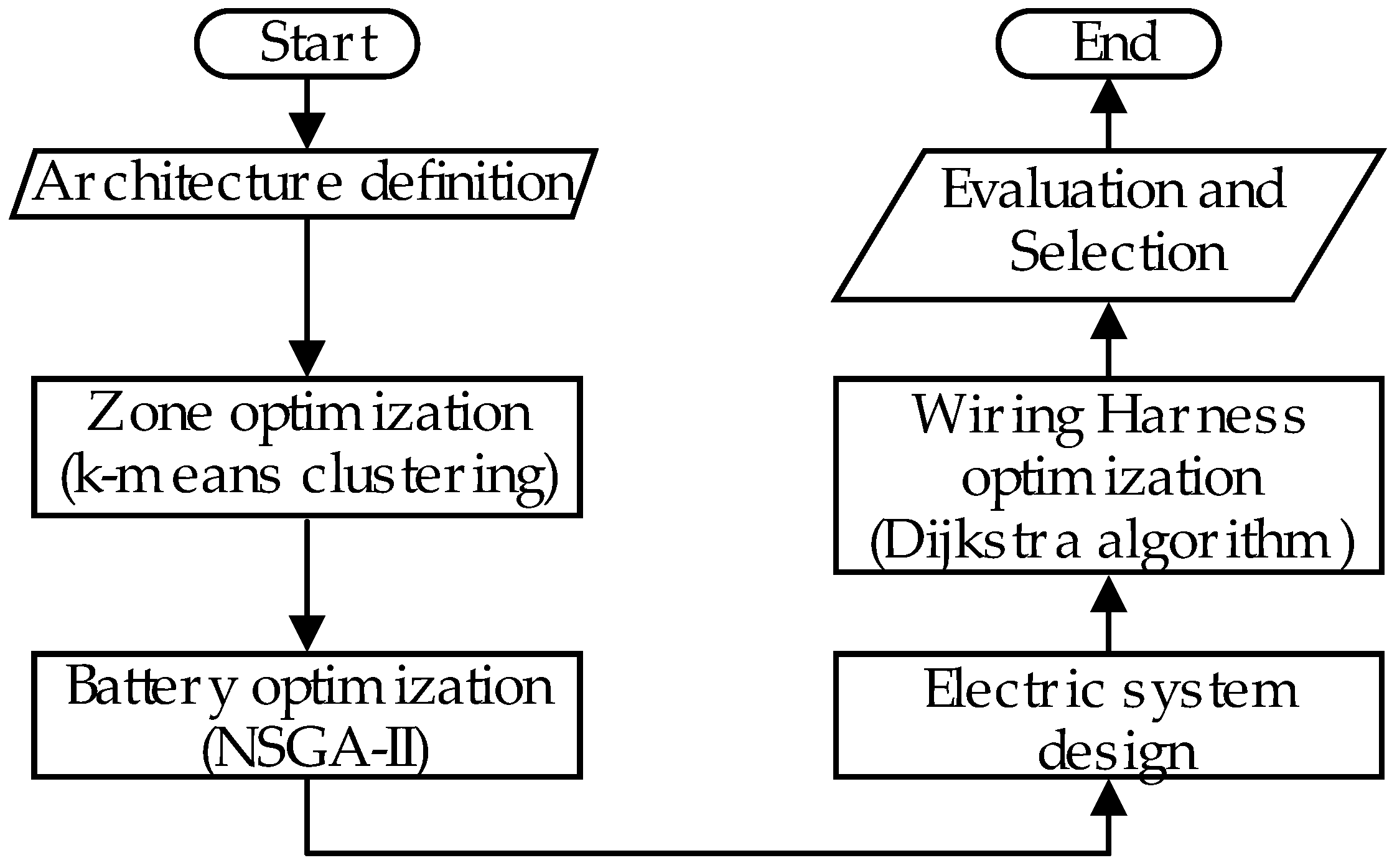
Electromobility and autonomous driving has started a transformation in the automotive industry, resulting in new requirements for vehicle systems. Due to its functions, the electrical/electronic (E/E) architecture is one of the essential systems. Zonal E/E architecture is a promising approach to tackle this issue. The research presented in this paper describes a methodology for determining the optimal number of zones, the position of the zone control units (ZCU), and the assignment of electric components to these zones and ZCUs. Therefore, the design of the power supply and the wiring harness is essential. This approach aims to identify the most suitable system architecture for a given vehicle geometry and a set of electric components. For this purpose, the assignment of electric components is accomplished by k-means clustering, and Dijkstra’s algorithm is used to optimize the cable routing. As ZCUs will be the hubs for the in-vehicle data and information transport in zonal architectures, their position and their number are crucial for the architecture and wiring harness development. Simulations show a suitable zonal architecture reduces wiring harness length as well as weight and brings functional benefits. However, the number of zones must be chosen with care, as there may also be functional limitations.
Keywords: E/E architecture; clustering; wiring harness; zonal architecture; zone control unit E/E architecture; clustering; wiring harness; zonal architecture; zone control unit