Article

Environmental Impact Assessment and Classification of 48 V Plug-in Hybrids with Real-Driving Use Case Simulations

1
Robert Bosch GmbH, Robert-Bosch-Straße 2, 71701 Schwieberdingen, Germany
2
Institute for Power Electronics and Electrical Drives (ISEA), RWTH Aachen University, Jägerstraße 17-19, 52066 Aachen, Germany
3
Institute of Automotive Engineering (IFS), University of Stuttgart, Pfaffenwaldring 12, 70569 Stuttgart, Germany
4
Helmholtz Institute Münster (HI MS), IEK-12, Forschungszentrum Jülich, Corrensstraße 46, 48149 Münster, Germany
*
Author to whom correspondence should be addressed.
Energies 2022, 15(7), 2403; https://doi.org/10.3390/en15072403
Submission received: 25 February 2022 / Revised: 18 March 2022 / Accepted: 22 March 2022 / Published: 24 March 2022
(This article belongs to the Special Issue Plug-In Hybrid Electric Vehicles Energy Management)

Abstract

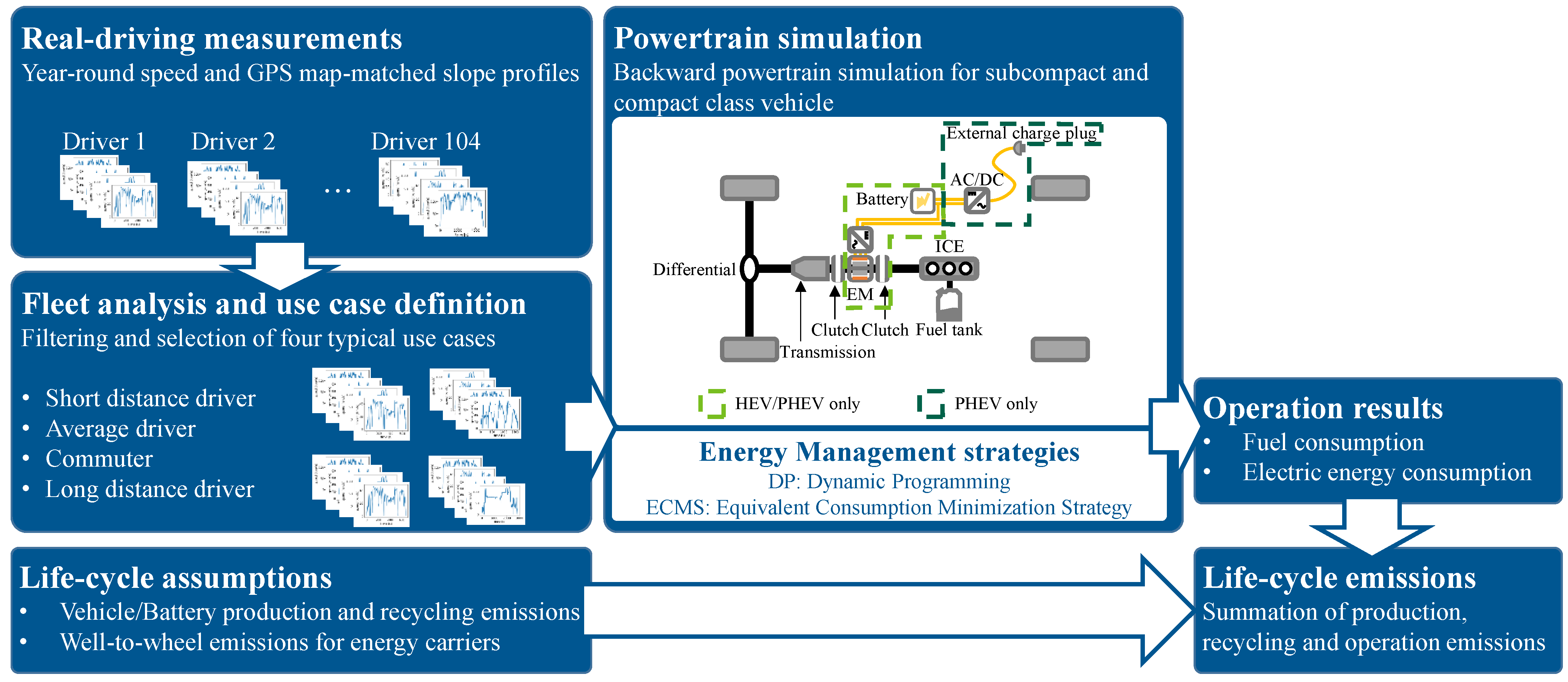
Plug-in hybrid electric vehicles (PHEVs) are commonly operated with high-voltage (HV) components due to their higher power availability compared to 48 V-systems. On the contrary, HV-powertrain components are more expensive and require additional safety measures. Additionally, the HV system can only be repaired and maintained with special equipment and protective gear, which is not available in all workshops. PHEVs based on a 48 V-system level can offer a reasonable compromise between the greenhouse gas (GHG) emission-saving potential and cost-effectiveness in small- and medium-sized electrified vehicles. In our study, the lifecycle emissions of the proposed 48 V PHEV system were compared to a conventional vehicle, 48 V HEV, and HV PHEV for individual driving use cases. To ensure a holistic evaluation, the analysis was based on measured real-driving cycles including Global Position System (GPS) map-matched slope profiles for a parallel hybrid. Optimal PHEV battery capacities were derived for the individual driving use cases. The analysis was based on lifecycle emissions for 2020 and 2030 in Europe. The impact analysis revealed that 48 V PHEVs can significantly reduce GHG emissions compared to vehicles with no charging opportunity for all use cases. Furthermore, the findings were verified for two vehicle segments and two energy mix scenarios. The 48 V PHEVs can therefore complement existing powertrain portfolios and contribute to reaching future GHG emission targets.
Keywords: hybrid electric vehicle (HEV); plug-in hybrid electric vehicle (PHEV); 48 V; battery sizing; real-driving simulation; life cycle analysis; greenhouse gas (GHG) emissions hybrid electric vehicle (HEV); plug-in hybrid electric vehicle (PHEV); 48 V; battery sizing; real-driving simulation; life cycle analysis; greenhouse gas (GHG) emissions