Article

Scalable Room Occupancy Prediction with Deep Transfer Learning Using Indoor Climate Sensor
1
Department of Mechanical Engineering and Automation, Aalto University, 02150 Espoo, Finland
2
Innovations, Granlund Oy, 00701 Helsinki, Finland
3
College of Urban Construction, Nanjing Tech University, Nanjing 211800, China
*
Author to whom correspondence should be addressed.
Energies 2022, 15(6), 2078; https://doi.org/10.3390/en15062078
Submission received: 15 February 2022 / Revised: 3 March 2022 / Accepted: 10 March 2022 / Published: 12 March 2022

Abstract

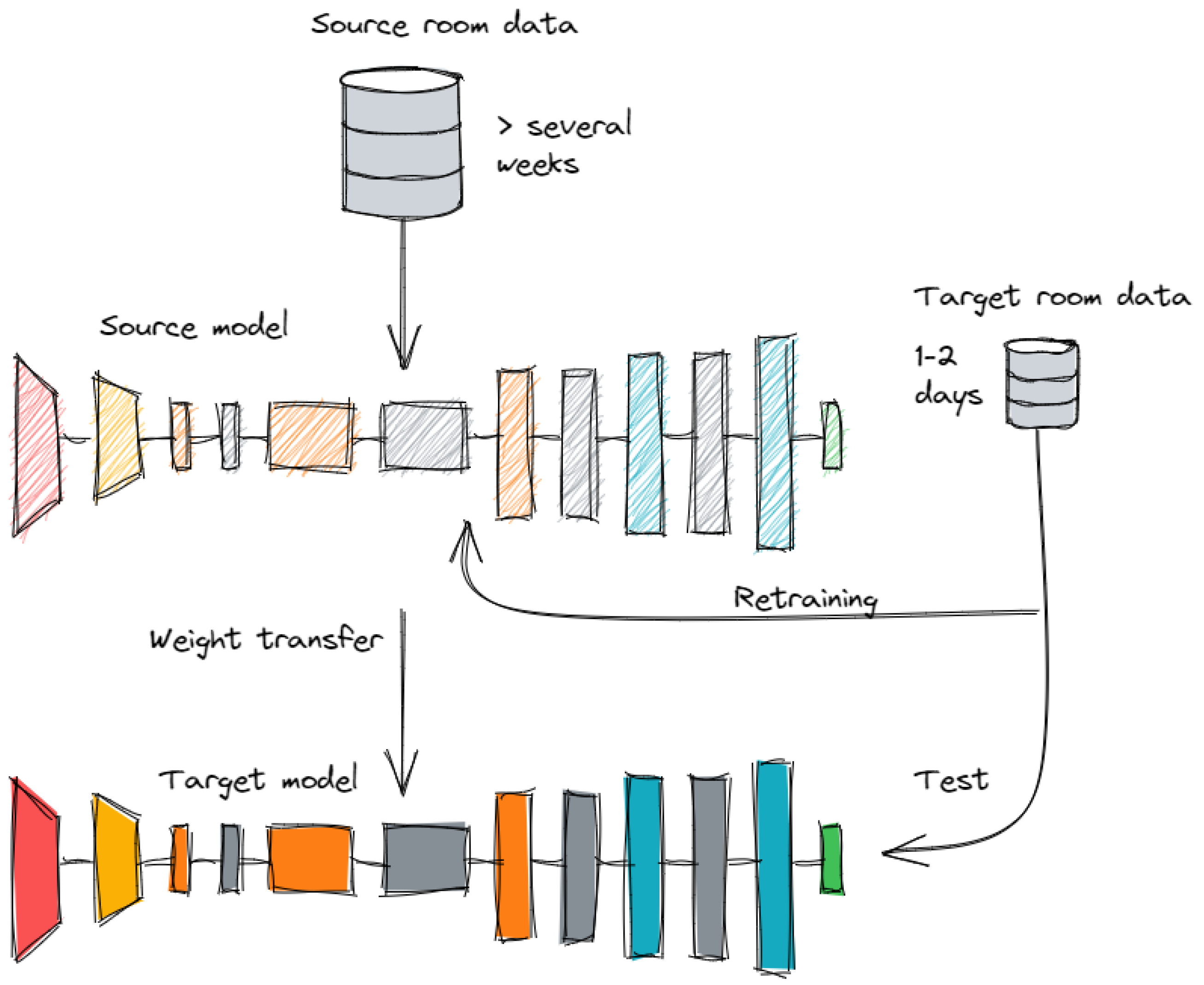
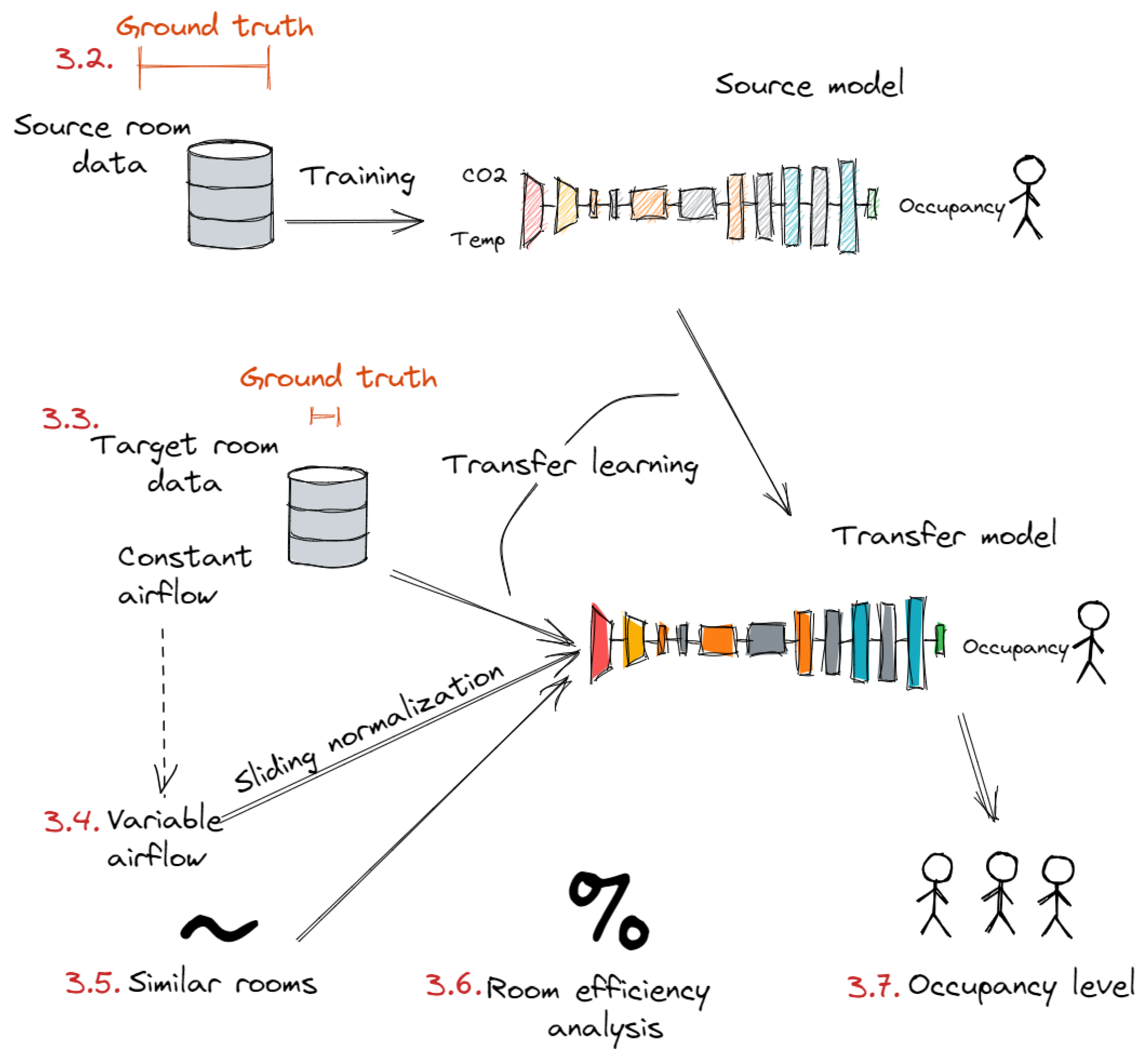
An important instrument for achieving smart and high-performance buildings is Machine Learning (ML). A lot of research has been done in exploring the ML models for various applications in the built environment such as occupancy prediction. Nevertheless, the research focused mostly on analyzing the feasibility and performance of different supervised ML models but has rarely focused on practical applications and the scalability of those models. In this study, a transfer learning method is proposed as a solution to typical problems in the practical application of ML in buildings. Such problems are scaling a model to a different building, collecting ground truth data necessary for training the supervised model, and assuring the model is robust when conditions change. The practical application examined in this work is a deep learning model used for predicting room occupancy using indoor climate IoT sensors. This work proved that it is possible to significantly reduce the length of ground truth data collection to only two days. The robustness of the transferred model was tested as well, where performance stayed on a similar level if a suitable normalization technique was used. In addition, the proposed methodology was tested with room occupancy level prediction, showing slightly lower performance. Finally, the importance of understanding the performance metrics is crucial for market adoption of ML-based solutions in the built environment. Therefore, in this study, additional analysis was done by presenting the occupancy prediction model performance in understandable ways from the practical perspective.
Keywords: transfer learning; occupancy prediction; indoor climate; IoT; model robustness; space efficiency; energy efficiency transfer learning; occupancy prediction; indoor climate; IoT; model robustness; space efficiency; energy efficiency