Article

Investigation and Validation of Unstructured Mesh Methodologies for Modeling Experimental Reactors
1
École Polytechnique Fédérale de Lausanne, Laboratory for Reactor Physics and Systems Behaviour, 1015 Lausanne, Switzerland
2
Paul Scherrer Institut, Laboratory for Reactor Physics and Systems Behaviour, Nuclear Energy and Safety Department, PSI, 5132 Villigen, Switzerland
*
Author to whom correspondence should be addressed.
Energies 2022, 15(4), 1512; https://doi.org/10.3390/en15041512
Submission received: 20 January 2022 / Revised: 14 February 2022 / Accepted: 16 February 2022 / Published: 18 February 2022
(This article belongs to the Special Issue State-of-Art in Nuclear Reactor Physics)

Abstract

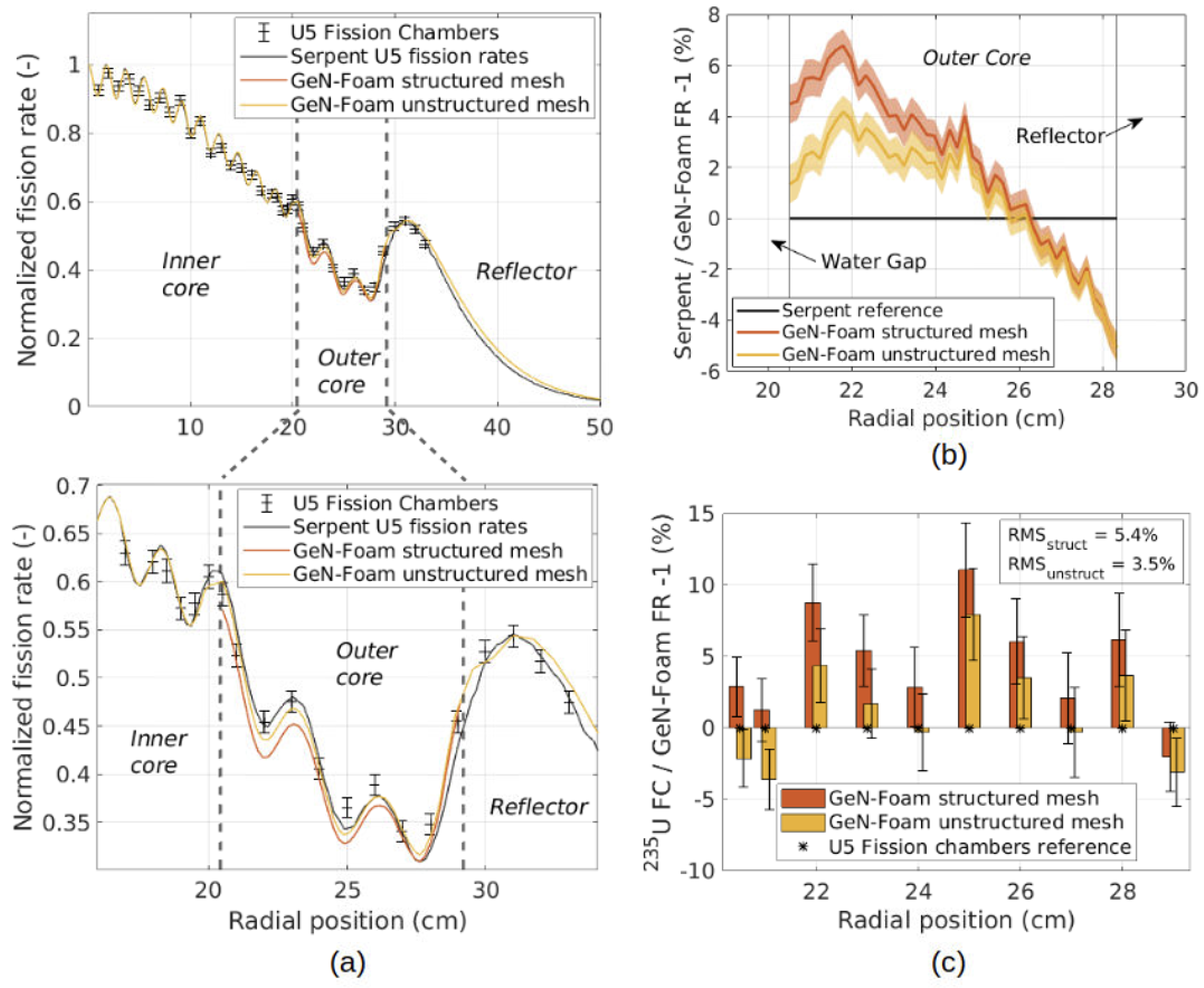
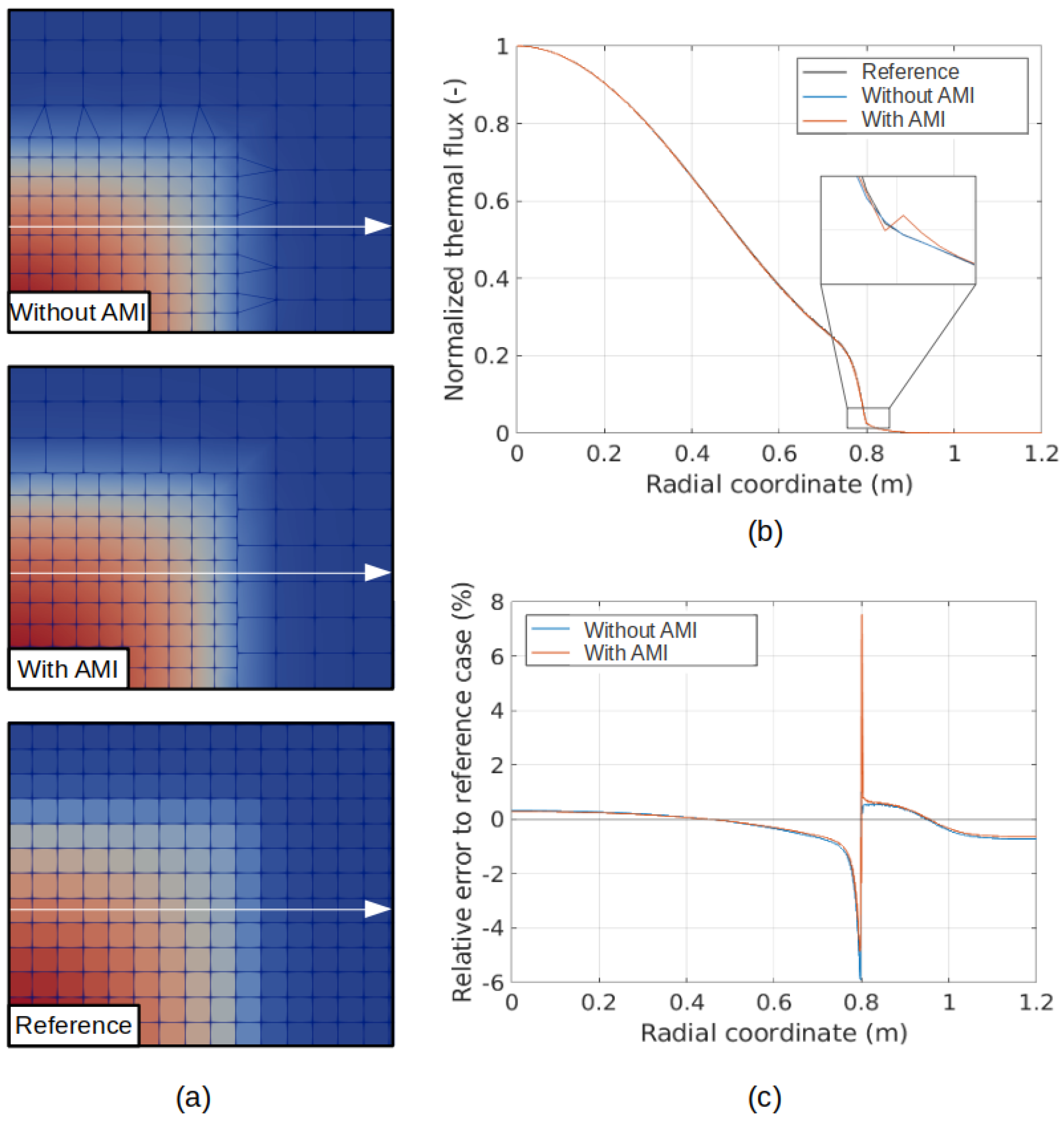
This paper summarizes a methodology developed at École Polytechnique Fédérale de Lausanne for the neutronic modeling of the CROCUS experimental reactor and proposes solutions to the challenges one may face while modeling a research reactor with a complex geometry. Indeed, the double-lattice configuration of CROCUS makes it difficult to use codes for neutron diffusion and transport relying on a structured mesh description. For this reason, and based on the available in-house competences, we decided to make use of the neutronic capabilities of the GeN-Foam multiphysics solver, which takes advantage of general finite volume methodologies on unstructured meshes to provide sufficient flexibility for the study of unconventional reactor designs. In this work, GeN-Foam is used to build a first SP3 model of CROCUS based on an unstructured mesh to have an explicit modeling of the double lattice and the water gap between the two lattices. Form functions are then used to reconstruct the intra-pin fission rates for validation against measured distributions. We also discuss the limitations of the SP3 approximation of neutron transport in regions with steep neutron flux gradients and the planned future developments.
Keywords: GeN-Foam; unstructured mesh; SP3; neutron transport; CROCUS GeN-Foam; unstructured mesh; SP3; neutron transport; CROCUS