


Effect of Volcanic Events on Hydrocarbon Generation of Lacustrine Organic-Rich Shale: An Example of the Upper Triassic Galedesi Formation in the Hala Lake Depression, South Qilian Basin, China
 , ,
, ,
Abstract
:1. Introduction
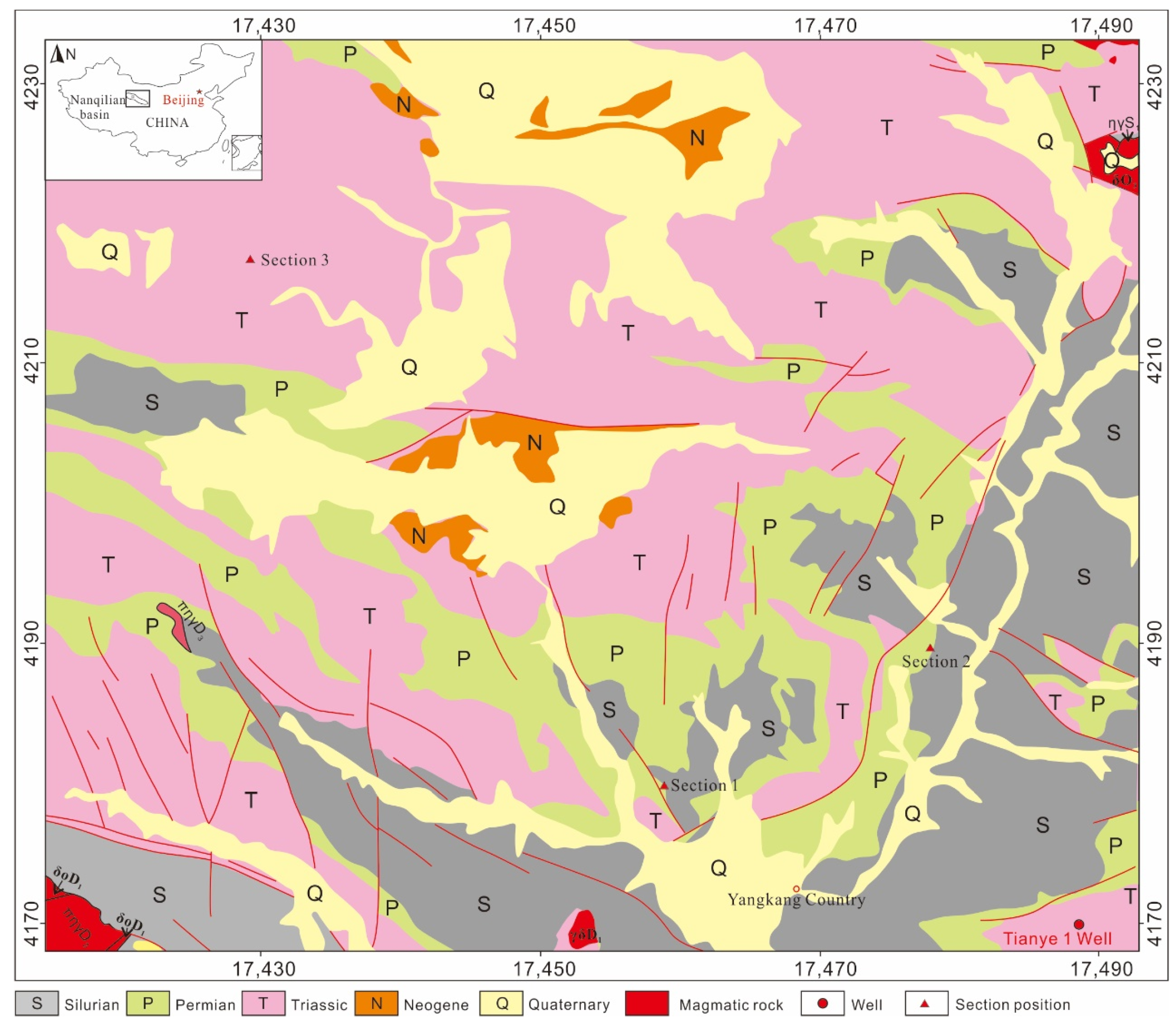
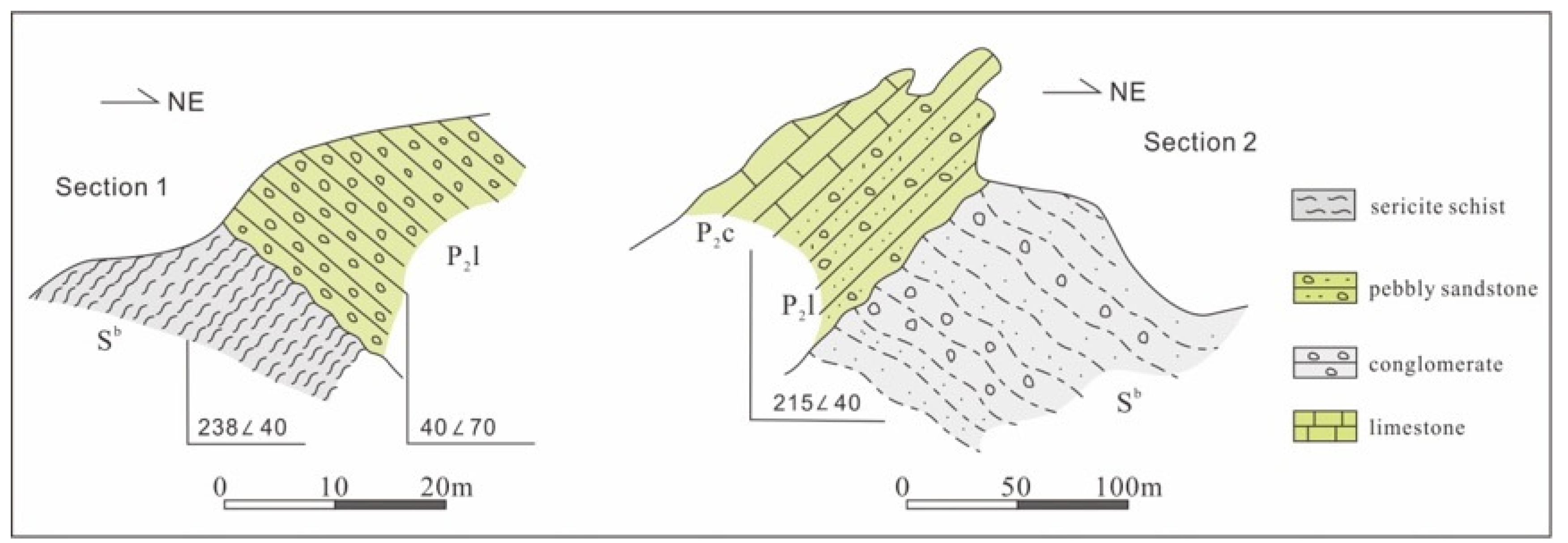
2. Geological Setting
3. Samples and Methods
4. Results
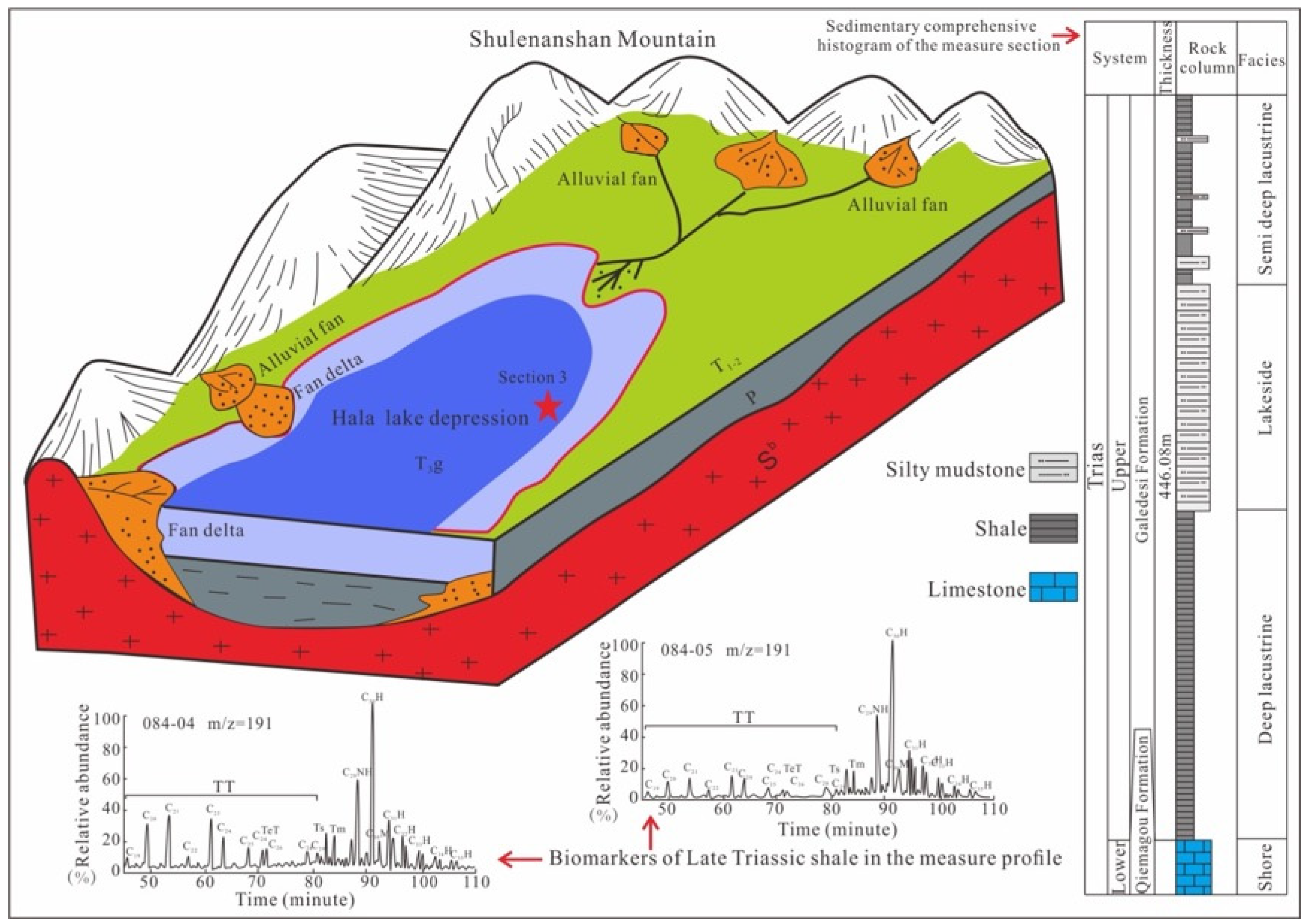
4.1. Sedimentary Evolution Characteristics
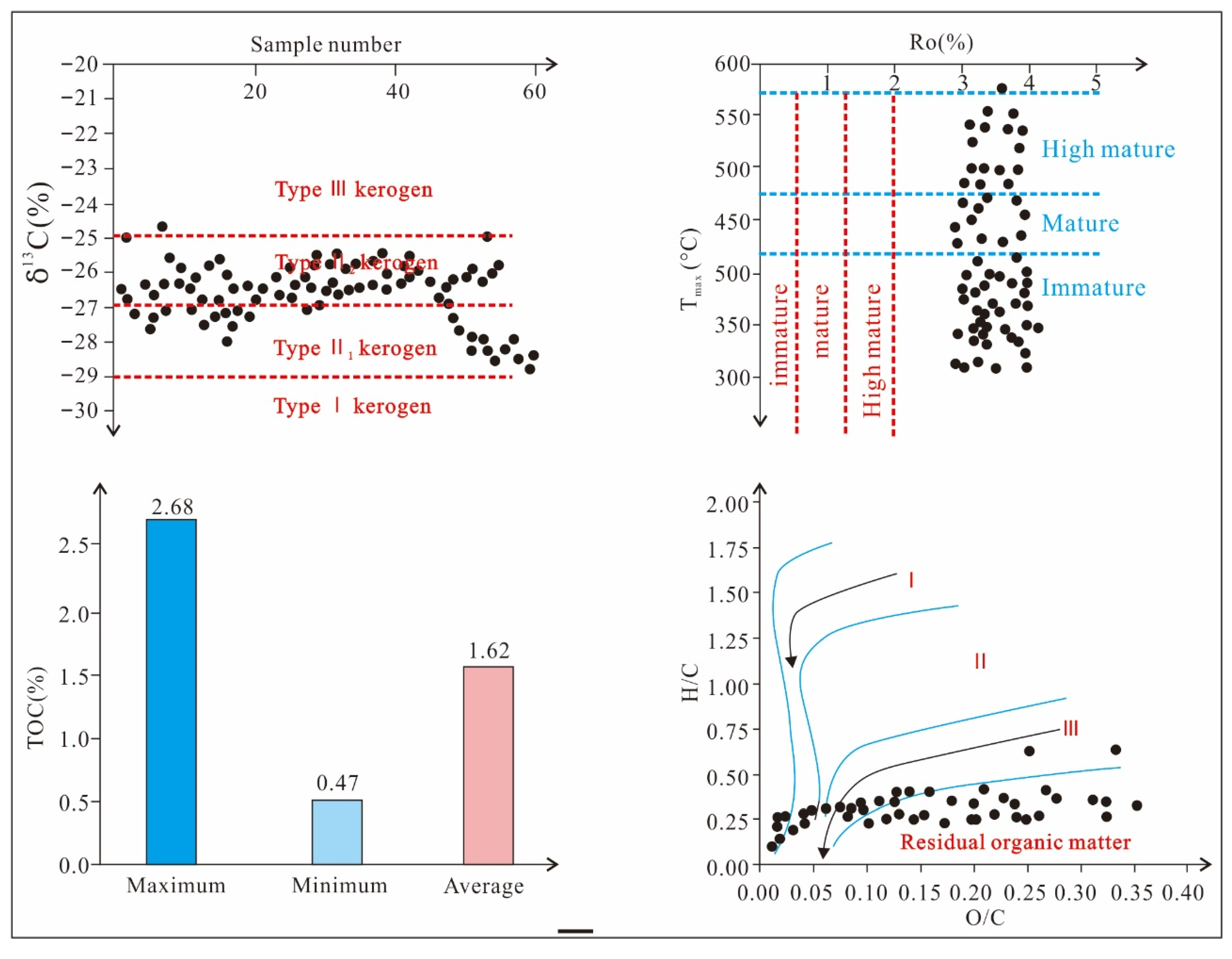
4.2. Organic Geochemical Characteristics
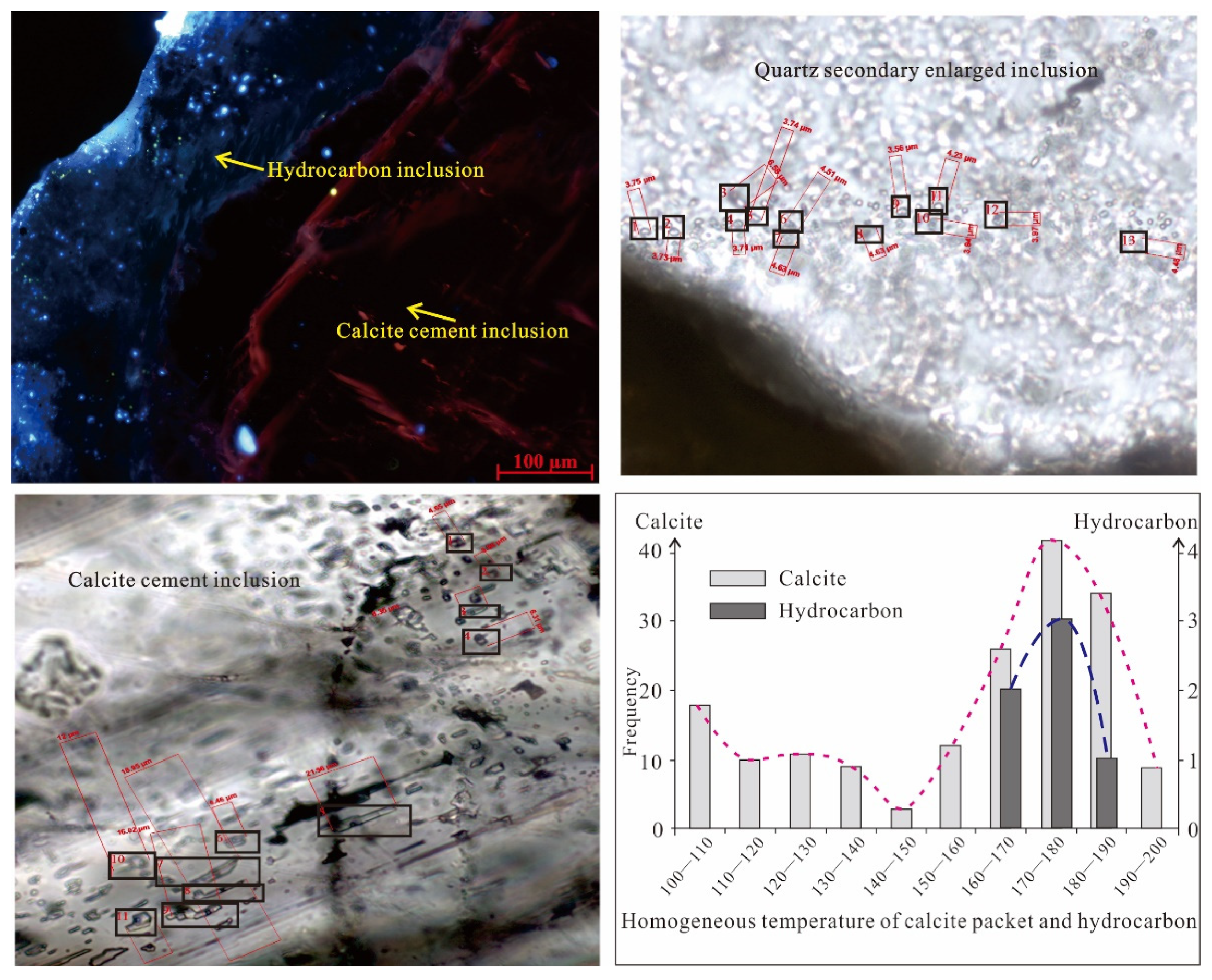
4.3. Diagenetic Fluid Properties
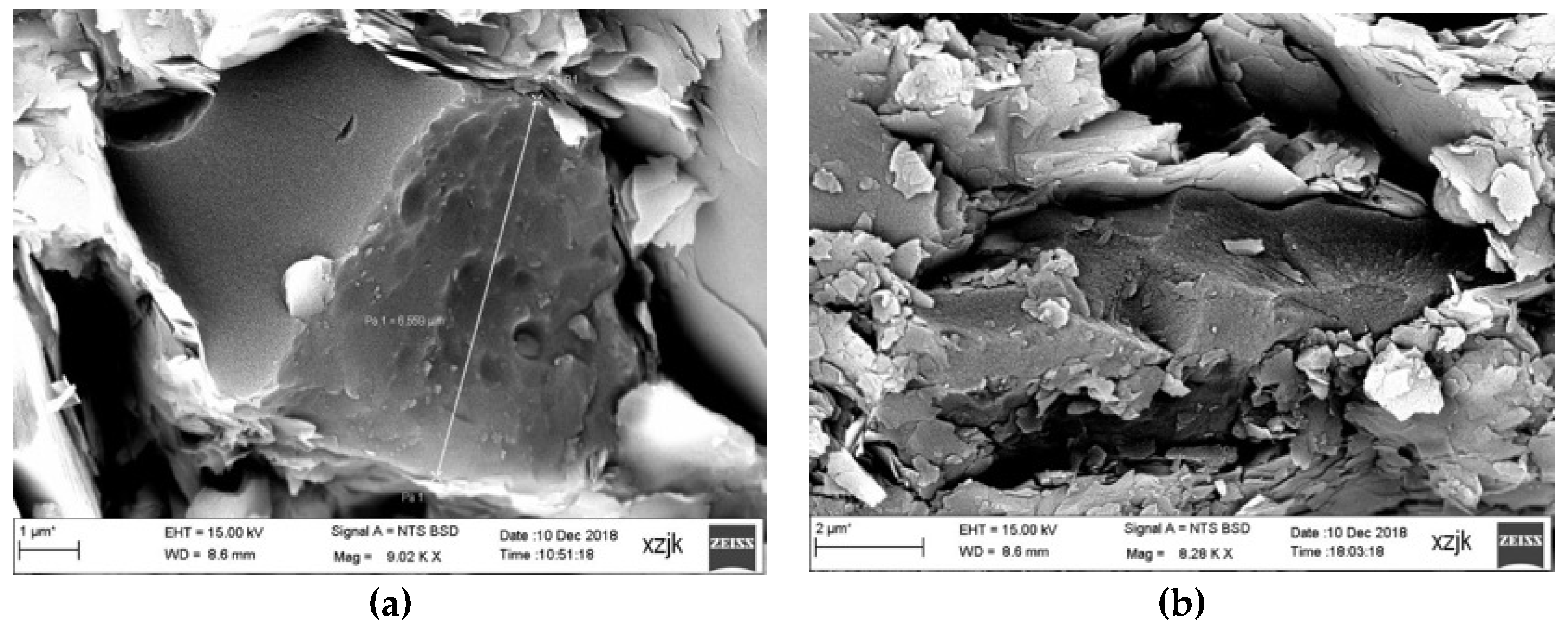
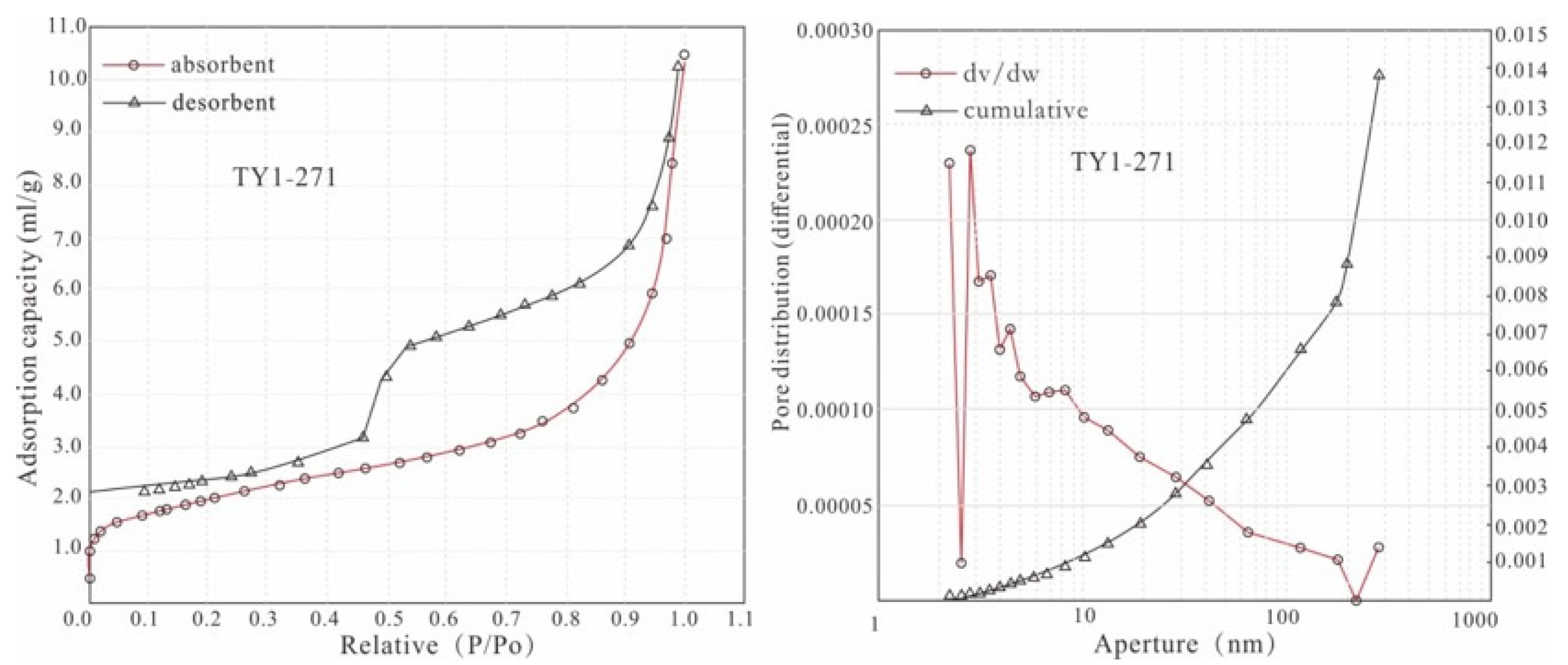
4.4. Characteristics of the Reservoir Pore Structure
5. Discussion
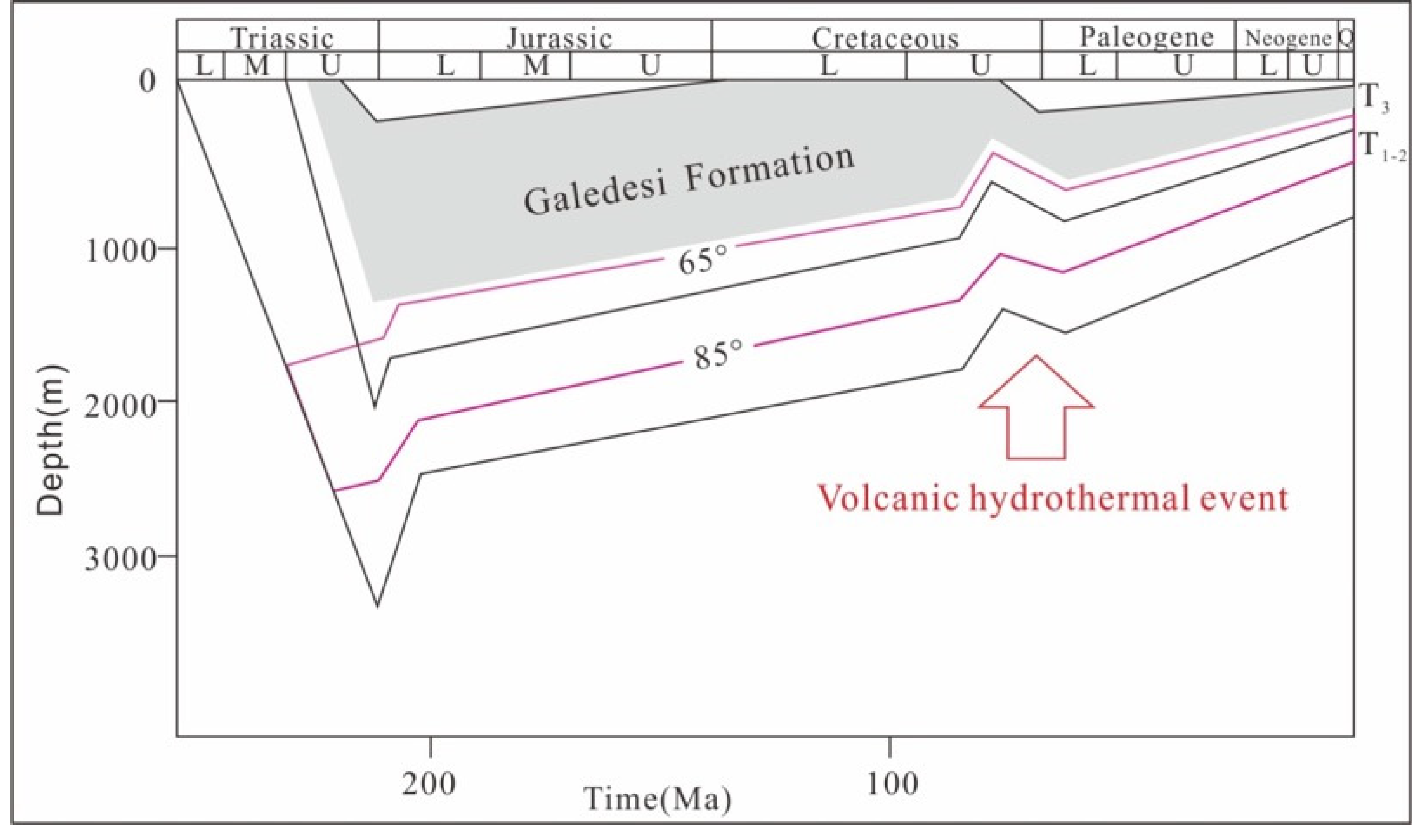
5.1. Evidence and Models of Volcanic Events
5.2. Constraints of Volcanic Thermal Events on the Evolution of Shale Organic Matter
5.3. Shale Gas Exploration Prospect
6. Conclusions
- (1)
- The Galedesi Formation shale in the Hala Lake Depression of the South Qilian Basin is dominated by deep-lake facies, which has a large thickness, rich organic matter, and abnormally high thermal evolution. The diagenetic temperature of the shale was as high as 200 °C.
- (2)
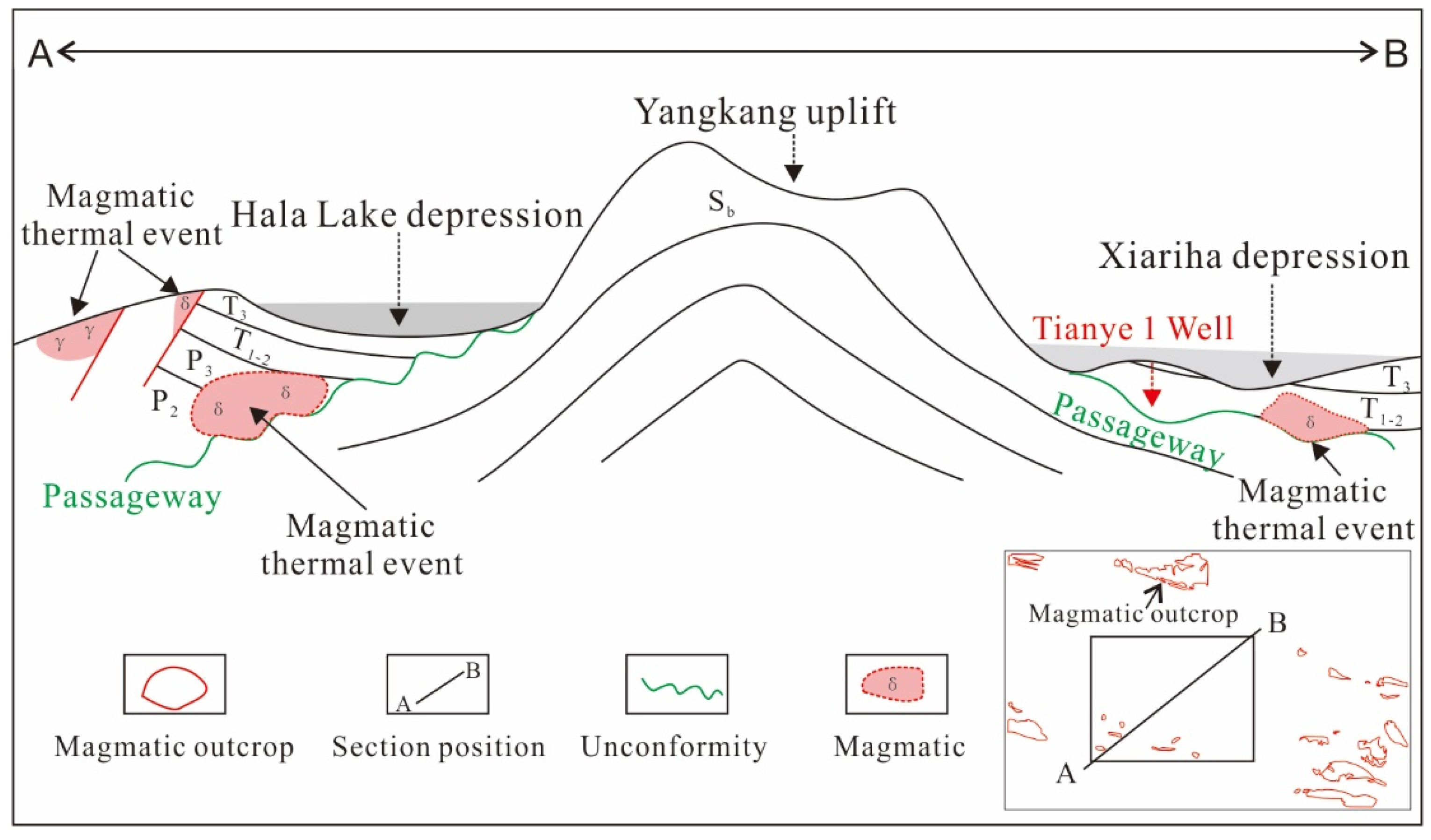
- After deposition, volcanic thermal events caused by multi-stage tectonic movements considerably affected the Galedesi Formation shale. High temperatures prevented the shale organic matter from generating hydrocarbons via the normal thermal evolution process; however, apparent carbonization occurred, indicating the possibility of continental shale gas exploration in this area.
Author Contributions
Funding
Institutional Review Board Statement
Informed Consent Statement
Data Availability Statement
Conflicts of Interest
References
- Wenqing, W.; Chiyang, L.; Wenhui, L.; Xiaofeng, W.; Pei, G.; Jianqiang, W.; Zuodong, W.; Zhongping, L.; Dongdong, Z. Dominant products and reactions during organic matter radiolysis: Implications for hydrocarbon generation of uranium-rich shales. Mar. Petrol. Geol. 2022, 137, 105497. [Google Scholar] [CrossRef]
- Bo, G.; Xiaoling, W.; Ying, Z.; Xinjun, C.; Ruikang, B.; Qianwen, L. Hydrocarbon generction and evolution characteristics of Triassic Zhangjiatan oil shale in southern Ordos Basin. Pet. Geol. Exp. 2022, 44, 24–32. [Google Scholar]
- Xiugen, F.; Jian, W.; Wenbin, C.; Xinglei, F.; Dong, W.; Chunyan, S.; Shengqiang, Z. Elemental geochemistry of the early Jurassic black shales in the Qiangtang Basin, eastern Tethys: Constraints for palaeoenvironment conditions. Geol. J. 2016, 51, 443–454. [Google Scholar]
- Caineng, Z.; Guosheng, Z.; Zhi, Y.; Shizhen, T.; Lianhua, H.; Rukai, Z.; Xuanjun, Y.; Qiquan, R.; Denghua, L.; Zhiping, W. Geological concepts, characteristics, resource potential and key techniques of unconventional hydrocarbon: On unconventional petroleum geology. Pet. Explor. Dev. 2013, 40, 385–399. [Google Scholar]
- Wenzhi, Z.; Suyan, H.; Lianhua, H.; Tao, Y.; Xin, L. Types and resource potential of continental shale oil in China and its boundary with tight oil. Pet. Explor. Dev. 2020, 47, 1–11. [Google Scholar]
- Jiamin, H.; Yue, Z.; Xiaowen, L.; Gang, X. Early Mesozoic deformations of the eastern Yanshan thrust belt, northern China. Int. J. Earth Sci. 2010, 99, 785–800. [Google Scholar]
- Jinning, Z.; Jiansheng, Z.; Dunqing, X.; Guomeng, H.; Min, Z.; Lixin, F.; Hongjun, L.; Da, L. Control of the Mesozoic tectonic movement on the hydrocarbon generation and evolution of Upper Paleozoic coal-measure source rocks in the Huanghua Depression, Bohai Bay Basin. Nat. Gas Ind. 2019, 39, 1–10. [Google Scholar]
- Sarkar, S.; Marfurt, K.J. Effect of volcanic bodies on hydrocarbon reservoirs in the northeastern part of the Chicontepec Foredeep, Mexico. Interpret. J. Subsurf. Charact. 2017, 5, SK1–SK10. [Google Scholar] [CrossRef]
- Xixin, W.; Yuming, L.; Jiagen, H.; Shaohua, L. The relationship between synsedimentary fault activity and reservoir quality—A case study of the Ek1 formation in the Wang Guantun area, China. Interpretation 2020, 8, sm15–sm24. [Google Scholar] [CrossRef]
- Xixin, W.; Xinrui, Z.; Shaohua, L.; Naidan, Z.; Ling, J.; Hang, L. Mechanism Study of Hydrocarbon Differential Distribution Controlled by the Activity of Growing Faults in Faulted Basins: Case Study of Paleogene in the Wang Guantun Area, Bohai Bay Basin, China. Lithosphere 2021, 7115985. [Google Scholar]
- Pasquarè, F.A.; Tormey, D.; Vezzoli, L.; Okrostsvaridze, A.; Tutberidze, B. Mitigating the consequences of extreme events on strategic facilities: Evaluation of volcanic and seismic risk affecting the Caspian oil and gas pipelines in the Republic of Georgia. J. Environ. Manag. 2011, 92, 1774–1782. [Google Scholar] [CrossRef] [PubMed]
- Weihai, S.; Xinzhou, Z.; Pujun, W. Tertiary tectonic-volcanic events in the middle continental margin from eastern china and their control over oil-bearing basin. J. Jilin Univ. Earth Sci. Ed. 2003, 33, 479–484. [Google Scholar]
- Xixin, W.; Fan, Z.; Shaohua, L.; Luxing, D.; Yuming, L.; Xiaoxu, R.; Depo, C.; Wen, Z. The Architectural Surfaces Characteristics of Sandy Braided River Reservoirs, Case Study in Gudong Oil Field, China. Geofluids 2021, 8821711. [Google Scholar] [CrossRef]
- Ancheng, X.; Long, Y.; Guangyao, X.; Junyong, Z.; Yongshu, Z.; Lei, W.; Haifeng, Z.; Suhua, Q. Triassic retroarc foreland basin in southern Qilian area: Evidence from sedimentary filling and tectonics. Acta Petrol. Sin. 2021, 37, 2385–2400. [Google Scholar] [CrossRef]
- Haifeng, Y.; Jia, W.; Xianfeng, T.; Lei, C.; Cheng, Y.; Long, X.; Shiming, L.; Cong, J. Sedimentary characteristics of Permian-Triassic in Yangkang area, South Qilian Basin. Pet. Geol. Exp. 2019, 41, 699–716. [Google Scholar]
- Yimeng, F. Investigatory summary of the Qilian Orogenic belt, China: History, presence and Prospect. Adv. Earth Sci. 1997, 4, 5–12. [Google Scholar]
- Xiaoyuan, H.; Xinke, Y.; Yong, W.; Ruihua, G.; Zhaoyang, L.; Xianhu, W.; Shujuan, P. Geochemiacl and zircon U-Pb chronoligy of the volcanic rocks from the Balonggonggaer Formation in Tuergendaban, southern Qilian Mountain. Acta Geol. Sin. 2021, 95, 750–764. [Google Scholar]
- Yongjiang, L.; Neubauer, F.; Weiming, L.; Genser, J.; Wei, L. Tectono-thermal events of the northern Qaidam margin-southern Qilian area, Western China. J. Jilin Univ. Earth Sci. Ed. 2012, 42, 1317–1329. [Google Scholar]
- Qifeng, X.; Lifa, Z.; Yuanfeng, C.; Yu, L.; Zhiwu, L.; Suli, W. Geochmical characteristics of Permain marine source rocks and its constrains of the prcvenance and Paleoenvironment in the South Qilian Basin, Qinghai Province. Acta Geol. Sin. 2015, 89, 1288–1301. [Google Scholar]
- Caineng, Z.; Songqi, P.; Qun, Z. On the connotation, challenge and significance of China’s “energy independence” strategy. Pet. Explor. Dev. 2020, 47, 416–426. [Google Scholar]
- Aisheng, H.; Jian, L.; Dongliang, W.; Zhisheng, L.; Junfeng, C.; Huiying, C.; Xiaohua, J. Biomarker characteristics of source rock of carboniferous and Upper Triassic Galedesi Formation in Southern Qilian Basin. Unconv. Oil Gas 2016, 3, 7–13. [Google Scholar]
- Yu, T.; Genhou, W.; Yipeng, F.; Dan, C.; Dian, L.; Zhengze, F.; Xi, G.; Yufeng, W.; Jixin, H.; Peilie, Z. Tectonic-stratigraphic Properties and Evolution of the Yeba Volcanic Arc on the south of Gangdese, Tibet. Earth Sci. Front. 2022, 29, 285–302. [Google Scholar] [CrossRef]
- Shijie, Z. Mantle dynamics on large spatial and temporal scales. Chin. J. Geophys. 2021, 64, 3478–3502. [Google Scholar]
- Guoshuai, B.; Youlu, J.; Shuai, H.; Xingxia, C. Main controlling factors and genetic mechanism of high-quality volcanic reservoirs in the Huoshiling formation of the Longfengshan area. Earth Sci. 2021. Available online: https://kns.cnki.net/kcms/detail/42.1874.P.20211025.1901.012.html (accessed on 12 May 2022).
- Zengbao, H.; Jianping, Z.; Baohua, L.; Wei, Q.; Zhijun, W.; Xu, C. Age and Geochemistry of the Early Paleozoic Back-arc Type Ophiolite in Dadaoerji Area, South Qilian, China. Geotecton. Metallog. 2021, 40, 826–838. [Google Scholar]
- Bo, J.; Jiyuan, Y.; Xiangming, L.; Botao, H.; Lei, W.L. The disintegration of Balonggongge’er Formation and the definition of lithostratigraphic unit in Danghenanshan area of South Qilian Mountain: Evidence from petrology and chronology. Geol. Bull. China 2018, 37, 621–633. [Google Scholar]
- Xudong, B.; Bo, Y.; Zhongguo, Z.; Guangwen, O.Y.; Zhiqing, Z.; Chenglv, H. LA-MC-ICPMS zircon U-Pb dating and geochemical characteristics of Late Ordovician volcanic rocks in southern Qilian Mountains, Qinghai Provence. Northwest. Geol. 2018, 51, 125–136. [Google Scholar]
- Ross, D.J.; Bustin, R. Characterizing the shale gas resource potential of Devonian-Mississippian strata in the Western Canada sedimentary basin: Application of an integrated formation evaluation. AAPG Bull. 2008, 92, 87–125. [Google Scholar] [CrossRef]
- Dongfeng, H.; Zhihong, W.; Ruobing, L.; Xiangfeng, W.; Weiran, C.; Zhujiang, L. Enrichment control factors and exploration potential of lacustrine shale oil and gas: A case study of Jurassic in the Fuling area of the Sichuan Basin. Nat. Gas Ind. 2021, 41, 113–120. [Google Scholar]
- Tonglou, G.; Yuping, L.; Zhihong, W. Reservoir-forming conditions of shale gas in Ziliujing Formation of Yuanba area in Sichuan Basin. Nat. Gas Geosci. 2011, 22, 1–7. [Google Scholar]
- Xiangzeng, W.; Shengli, G.; Chao, G. Geological features of Mesozoic continental shale gas in south of Ordos Basin, NW China. Pet. Explor. Dev. 2014, 41, 294–304. [Google Scholar]
- Jarvie, D. Unconventional shale resource plays: Shale gas shale oil opportunities. Tex. Word Wide Geochem. 2008, 7–17. Available online: https://www.yumpu.com/en/document/view/10690125/unconventional-shale-resource-plays-shale-gas-and-shaleoil (accessed on 12 May 2022).
- Ghareb, H.; Veronique, J. Developed correlations between sound wave velocity and porosity, permeability and mechanical properties of sandstone core samples. Pet. Res. 2020, 5, 326–338. [Google Scholar]

| Test Type | Number of Samples | Minimum | Maximum | Average | Result |
|---|---|---|---|---|---|
| TOC (%) | 113 | 0.47 | 2.68 | 1.62 | Good level |
| Ro (%) | 66 | 2.82 | 4.13 | 3.65 | Over mature |
| δ13C (%) | 113 | −28.89 | −24.83 | −26.90 | II2 kerogen |
| H/C | 66 | 0.07 | 0.62 | 0.28 | III kerogen |
| O/C | 66 | 0.02 | 0.36 | 0.19 |
| Sample Number | Well Depth (m) | TOC (%) | Total Hydrocarbon (%) | Gas Content (m3/t) |
|---|---|---|---|---|
| 1 | 20.62 | 2.90 | / | / |
| 2 | 67.74 | 1.77 | / | / |
| 3 | 123.15 | 1.10 | 0.0876 | 0.0600 |
| 4 | 171.36 | 1.00 | 0.3062 | 0.1150 |
| 5 | 196.46 | 1.28 | 0.0824 | / |
| 6 | 255.67 | 0.73 | 0.0584 | / |
| 7 | 272.90 | 1.11 | 0.1840 | / |
| 8 | 299.40 | 1.52 | 0.1726 | / |
| 9 | 356.05 | 2.13 | 0.2537 | / |
| 10 | 385.50 | 0.25 | 0.0501 | / |
| 11 | 395.20 | 2.06 | 0.0965 | / |
| 12 | 418.50 | 2.84 | 0.0939 | / |
| 13 | 451.05 | 1.75 | 0.0524 | / |
| 14 | 468.30 | 3.06 | 0.1321 | / |
| 15 | 500.70 | 5.61 | 0.0801 | / |
| 16 | 516.70 | 0.74 | 0.1822 | / |
| 17 | 527.00 | 0.47 | 0.1179 | 0.0100 |
| 18 | 607.60 | 0.33 | 0.1225 | / |
| 19 | 627.04 | 0.20 | 0.0430 | / |
| 20 | 655.80 | 0.21 | 0.0412 | / |
| 21 | 664.60 | 0.35 | 0.1696 | / |
| 22 | 675.00 | 0.04 | 0.1036 | / |
| 23 | 692.60 | 0.13 | 0.1216 | / |
| 24 | 717.60 | 1.78 | 0.1468 | / |
| 25 | 744.34 | 1.40 | 0.1440 | / |
| 26 | 783.28 | 0.04 | 0.0776 | / |
| 27 | 816.00 | 1.20 | 0.0635 | 0.0500 |
| 28 | 852.60 | 0.97 | 0.1237 | / |
| 29 | 866.60 | 1.12 | 0.0373 | / |
| 30 | 887.90 | 0.93 | 0.0918 | / |
| 31 | 921.90 | 1.10 | 0.0580 | 0.0800 |
| 32 | 1067.90 | 1.37 | 0.0052 | 0.0500 |
| 33 | 1088.64 | 1.02 | 0.0036 | 0.0200 |
| 34 | 1105.45 | 0.74 | 0.0698 | 0.0400 |
| 35 | 1148.70 | 2.54 | 0.0074 | 0.0300 |
| 36 | 1156.18 | 1.50 | 0.0063 | / |
| 37 | 1168.50 | 2.94 | 0.0700 | 0.0600 |
| 38 | 1303.50 | 0.15 | 0.0063 | 0.0500 |
| 39 | 1321.90 | 0.45 | 0.0004 | 0.0500 |
| 40 | 1338.90 | 0.72 | 0.0003 | 0.0500 |
| 41 | 1362.10 | 0.75 | 0.2576 | 0.0400 |
| 42 | 1420.60 | 0.67 | 0.0729 | 0.0700 |
| 43 | 1443.30 | 1.05 | 0.2161 | 0.0500 |
| 44 | 1478.40 | 1.33 | 0.1811 | 0.0500 |
| Sample Number | Pore Volume (cm3/g) | Percentage of Pore Volume (%) | |||||
|---|---|---|---|---|---|---|---|
| <10 nm | 10~00 nm | >100 nm | Total Pore Volume | <10 nm | 10~00 nm | >100 nm | |
| TY1-D01 | 0.0237 | 0.0421 | 0.0283 | 0.0941 | 25.19 | 44.74 | 30.07 |
| TY1-D02 | 0.0144 | 0.0375 | 0.0695 | 0.1214 | 11.86 | 30.89 | 57.25 |
| TY1-D03 | 0.0148 | 0.041 | 0.0135 | 0.0693 | 21.36 | 59.16 | 19.48 |
| TY1-D04 | 0.0495 | 0.0595 | 0.0162 | 0.1252 | 39.54 | 47.52 | 12.94 |
| TY1-D05 | 0.012 | 0.0378 | 0.0151 | 0.0694 | 18.49 | 58.24 | 23.27 |
| TY1-D06 | 0.0117 | 0.0346 | 0.0151 | 0.0614 | 19.06 | 56.35 | 24.59 |
| TY1-D07 | 0.0187 | 0.0514 | 0.0201 | 0.0902 | 20.73 | 56.98 | 22.28 |
| TY1-D08 | 0.0103 | 0.0354 | 0.0317 | 0.0774 | 13.31 | 45.74 | 40.96 |
| TY1-D09 | 0.0128 | 0.0377 | 0.0138 | 0.0643 | 19.91 | 58.63 | 21.46 |
| TY1-D10 | 0.0071 | 0.0233 | 0.0094 | 0.0398 | 17.84 | 58.54 | 23.62 |
| TY1-D11 | 0.0052 | 0.0192 | 0.0172 | 0.0416 | 12.50 | 46.15 | 41.35 |
| TY1-D12 | 0.0044 | 0.0157 | 0.0372 | 0.0573 | 7.68 | 27.40 | 64.92 |
| TY1-D13 | 0.0088 | 0.0244 | 0.0178 | 0.0510 | 17.25 | 47.84 | 34.90 |
| TY1-D14 | 0.0098 | 0.0259 | 0.0197 | 0.0554 | 17.69 | 46.75 | 35.56 |
| TY1-D15 | 0.0103 | 0.0264 | 0.051 | 0.0787 | 11.74 | 30.10 | 58.15 |
| TY1-D16 | 0.0096 | 0.0255 | 0.0459 | 0.0810 | 11.85 | 31.48 | 56.67 |
| TY1-D17 | 0.006 | 0.0218 | 0.0486 | 0.0764 | 7.85 | 28.53 | 63.61 |
| TY1-D18 | 0.0058 | 0.0229 | 0.0204 | 0.0491 | 11.45 | 46.83 | 41.72 |
| TY1-D19 | 0.0092 | 0.0092 | 0.0092 | 0.0426 | 20.75 | 57.55 | 21.70 |
| TY1-D20 | 0.0118 | 0.0274 | 0.0541 | 0.0934 | 12.74 | 29.34 | 57.92 |
| TY1-D21 | 0.0047 | 0.0167 | 0.0499 | 0.0713 | 6.59 | 23.42 | 69.98 |
| Average value | 0.0124 | 0.0303 | 0.0287 | 0.0719 | 16.45 | 44.39 | 39.16 |
Publisher’s Note: MDPI stays neutral with regard to jurisdictional claims in published maps and institutional affiliations. |
© 2022 by the authors. Licensee MDPI, Basel, Switzerland. This article is an open access article distributed under the terms and conditions of the Creative Commons Attribution (CC BY) license (https://creativecommons.org/licenses/by/4.0/).
Share and Cite
Wang, J.; Zhu, C.; Tan, X.; Luo, L.; Jiang, N.; Qu, X.; Gao, X.; Li, S.; Xiao, L.; Liu, H. Effect of Volcanic Events on Hydrocarbon Generation of Lacustrine Organic-Rich Shale: An Example of the Upper Triassic Galedesi Formation in the Hala Lake Depression, South Qilian Basin, China. Energies 2022, 15, 3818. https://doi.org/10.3390/en15103818
Wang J, Zhu C, Tan X, Luo L, Jiang N, Qu X, Gao X, Li S, Xiao L, Liu H. Effect of Volcanic Events on Hydrocarbon Generation of Lacustrine Organic-Rich Shale: An Example of the Upper Triassic Galedesi Formation in the Hala Lake Depression, South Qilian Basin, China. Energies. 2022; 15(10):3818. https://doi.org/10.3390/en15103818
Chicago/Turabian StyleWang, Jia, Chaobin Zhu, Xianfeng Tan, Long Luo, Nan Jiang, Xuejiao Qu, Xuanbo Gao, Shengyu Li, Long Xiao, and Haijun Liu. 2022. "Effect of Volcanic Events on Hydrocarbon Generation of Lacustrine Organic-Rich Shale: An Example of the Upper Triassic Galedesi Formation in the Hala Lake Depression, South Qilian Basin, China" Energies 15, no. 10: 3818. https://doi.org/10.3390/en15103818
APA StyleWang, J., Zhu, C., Tan, X., Luo, L., Jiang, N., Qu, X., Gao, X., Li, S., Xiao, L., & Liu, H. (2022). Effect of Volcanic Events on Hydrocarbon Generation of Lacustrine Organic-Rich Shale: An Example of the Upper Triassic Galedesi Formation in the Hala Lake Depression, South Qilian Basin, China. Energies, 15(10), 3818. https://doi.org/10.3390/en15103818

