A Decision-Making Approach Based on TOPSIS Method for Ranking Smart Cities in the Context of Urban Energy



Abstract
1. Introduction
2. Literature Review
3. Materials and Methods
4. Results and Discussion
5. Conclusions
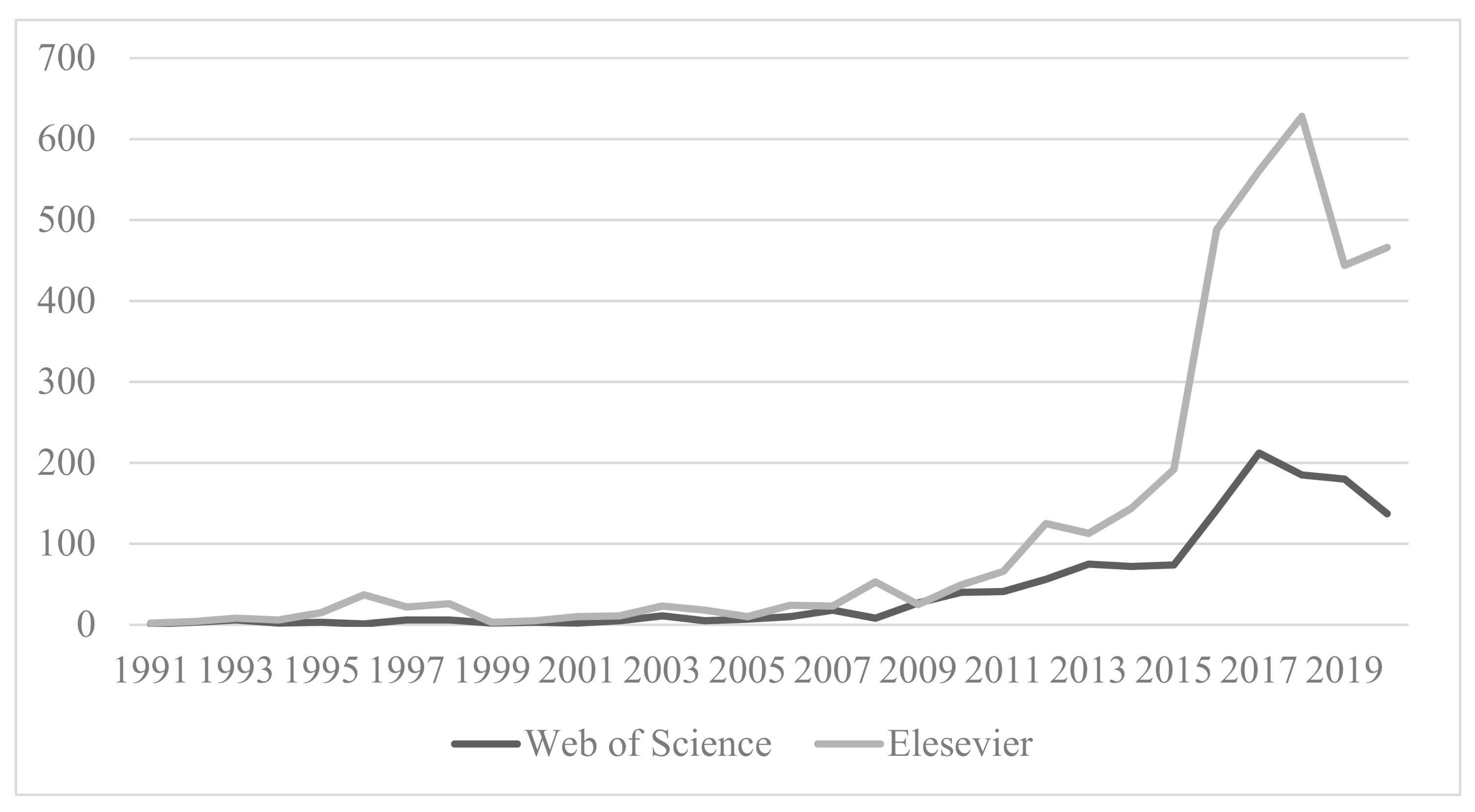
- Urban energy is an important research direction, as confirmed by the growing number of publications.
- MCDM techniques are one of the important tools in solving decision-making problems in the field of urban energy, especially energy efficiency, sustainability performance, environmental efficiency, and low-carbon ecological city evaluation.
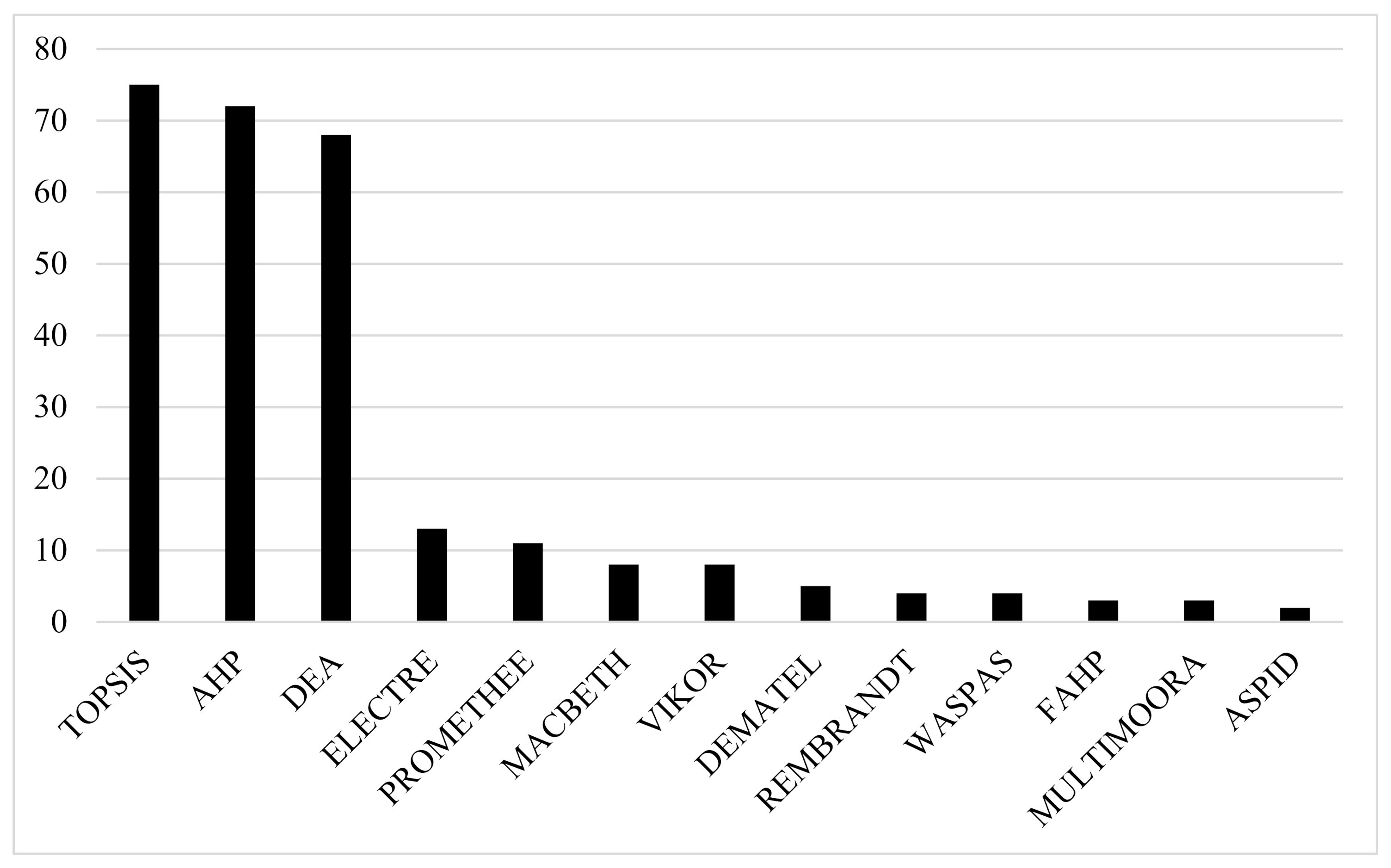
- TOPSIS, AHP, and DEA are the most popular MCDM techniques in the field of urban energy.
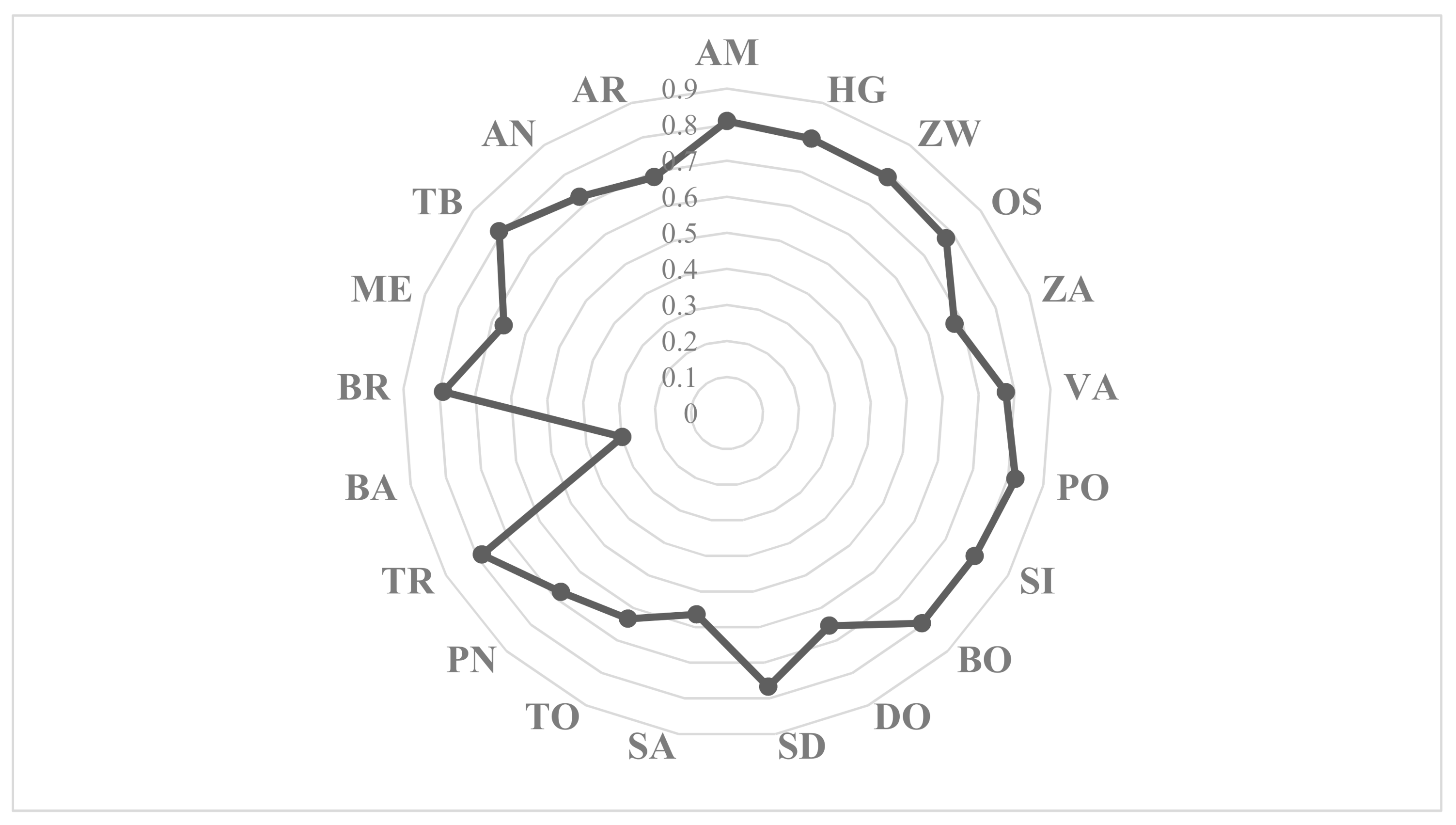
- A ranking of smart cities in terms of urban energy was obtained based on the multi-criteria analysis conducted using the TOPSIS technique. Porto was found to be the best location for energy enterprises and projects. Bueno Aires was ranked last.
Author Contributions
Funding
Institutional Review Board Statement
Informed Consent Statement
Data Availability Statement
Acknowledgments
Conflicts of Interest
Abbreviations
| AM | Amsterdam |
| HG | Hague |
| ZW | Zwolle |
| OS | Oslo |
| ZA | Zagreb |
| VA | Valencia |
| PO | Porto |
| SI | Sintra |
| BO | Boston |
| DO | Doral |
| SD | San Diego |
| SA | Saint-Augustin-de-Desmaures |
| TO | Toronto |
| PN | Piedras Negras |
| TR | Torreon |
| BA | Bueno Aires |
| BR | Brisbane |
| ME | Melbourne |
| TB | Tbilisi |
| AN | Amman |
| AR | ArRiyadh |
Appendix A

| X1 | X2 | X3 | X4 | X5 | X6 | X7 | |
|---|---|---|---|---|---|---|---|
| AM | 0.97924 | 0.04765 | 0.97696 | 0.04217 | 0.97196 | 0.98619 | 0.98609 |
| HG | 0.98204 | 0.04770 | 0.97348 | 0.00386 | 0.98213 | 1.00000 | 0.99292 |
| ZW | 0.97935 | 0.04770 | 0.96794 | 0.01740 | 0.97523 | 0.99841 | 0.97218 |
| OS | 0.89166 | 0.04770 | 0.93839 | 0.28425 | 0.93069 | 0.97876 | 0.97547 |
| ZA | 0.97976 | 0.04714 | 0.97618 | 0.00238 | 0.98308 | 0.91184 | 0.89555 |
| VA | 0.97427 | 0.04770 | 0.98365 | 0.01375 | 0.98349 | 0.94636 | 0.98280 |
| PO | 0.96674 | 0.04770 | 0.99328 | 0.06033 | 0.97166 | 1.00000 | 0.97673 |
| SI | 0.96749 | 0.04770 | 0.99480 | 0.00777 | 0.95324 | 1.00000 | 1.00000 |
| BO | 0.96461 | 0.04770 | 0.96187 | 0.04351 | 0.95028 | 0.98354 | 1.00000 |
| DO | 0.89697 | 0.04770 | 0.88836 | 0.00116 | 0.89188 | 0.92990 | 0.99975 |
| SD | 0.96700 | 0.04770 | 0.94478 | 0.03278 | 0.96663 | 0.96654 | 0.96813 |
| SA | 0.83479 | 0.04770 | 0.92006 | 0.28280 | 0.90912 | 0.84387 | 0.90137 |
| TO | 0.96687 | 0.04770 | 0.78795 | 0.09050 | 0.95408 | 0.92618 | 0.98002 |
| PN | 0.85841 | 0.04770 | 0.95436 | 0.00000 | 0.85511 | 0.99947 | 0.99899 |
| TR | 0.99083 | 0.04770 | 0.99824 | 0.00096 | 0.98553 | 0.96283 | 0.98306 |
| BA | 0.97262 | 0.04704 | 0.95852 | 0.00000 | 0.97867 | 0.68136 | 0.65857 |
| BR | 0.96236 | 0.04770 | 0.95605 | 0.02349 | 0.95984 | 0.99841 | 0.99798 |
| ME | 0.96892 | 0.04770 | 0.87563 | 0.03582 | 0.86170 | 0.98513 | 0.95245 |
| TB | 0.98423 | 0.04770 | 0.99328 | 0.05604 | 0.98794 | 0.99947 | 0.94790 |
| AN | 0.99771 | 0.04736 | 0.98065 | 0.00104 | 0.99387 | 0.99203 | 0.88948 |
| AR | 0.91411 | 0.04765 | 0.97557 | 0.00000 | 0.95388 | 0.90972 | 0.94057 |
Appendix B
| X1 | X2 | X3 | X4 | X5 | X6 | X7 | |
|---|---|---|---|---|---|---|---|
| AM | 0.17793 | 0.00000 | 0.17796 | 0.00355 | 0.17623 | 0.18269 | 0.18292 |
| HG | 0.17844 | 0.00000 | 0.17732 | 0.00032 | 0.17808 | 0.18525 | 0.18418 |
| ZW | 0.17795 | 0.00000 | 0.17631 | 0.00146 | 0.17683 | 0.18495 | 0.18034 |
| OS | 0.16201 | 0.00000 | 0.17093 | 0.02390 | 0.16875 | 0.18131 | 0.18095 |
| ZA | 0.17802 | 0.00000 | 0.17781 | 0.00020 | 0.17825 | 0.16892 | 0.16612 |
| VA | 0.17702 | 0.00000 | 0.17918 | 0.00116 | 0.17833 | 0.17531 | 0.18231 |
| PO | 0.17566 | 0.00000 | 0.18093 | 0.00507 | 0.17618 | 0.18525 | 0.18118 |
| SI | 0.17579 | 0.00000 | 0.18121 | 0.00065 | 0.17284 | 0.18525 | 0.18550 |
| BO | 0.17527 | 0.00000 | 0.17521 | 0.00366 | 0.17230 | 0.18220 | 0.18550 |
| DO | 0.16298 | 0.00000 | 0.16182 | 0.00010 | 0.16171 | 0.17226 | 0.18545 |
| SD | 0.17570 | 0.00000 | 0.17210 | 0.00276 | 0.17527 | 0.17905 | 0.17959 |
| SA | 0.15168 | 0.00000 | 0.16759 | 0.02378 | 0.16484 | 0.15632 | 0.16720 |
| TO | 0.17568 | 0.00000 | 0.14353 | 0.00761 | 0.17299 | 0.17157 | 0.18179 |
| PN | 0.15597 | 0.00000 | 0.17384 | 0.00000 | 0.15505 | 0.18515 | 0.18531 |
| TR | 0.18003 | 0.00000 | 0.18183 | 0.00008 | 0.17869 | 0.17836 | 0.18235 |
| BA | 0.17672 | 0.00000 | 0.17460 | 0.00000 | 0.17745 | 0.12622 | 0.12216 |
| BR | 0.17486 | 0.00000 | 0.17415 | 0.00198 | 0.17404 | 0.18495 | 0.18512 |
| ME | 0.17605 | 0.00000 | 0.15950 | 0.00301 | 0.15624 | 0.18249 | 0.17668 |
| TB | 0.17883 | 0.00000 | 0.18093 | 0.00471 | 0.17913 | 0.18515 | 0.17583 |
| AN | 0.18128 | 0.00000 | 0.17863 | 0.00009 | 0.18021 | 0.18377 | 0.16499 |
| AR | 0.16609 | 0.00000 | 0.17770 | 0.00000 | 0.17296 | 0.16852 | 0.17447 |
References
- Commission of the European Communities. Green Paper. A European Strategy for Sustainable, Competitive and Secure Energy; SEC(2006)317. Available online: https://eur-lex.europa.eu/legal-content/EN/TXT/PDF/?uri=CELEX:52006DC0105&from=PL (accessed on 11 November 2020).
- International Energy Agency. Available online: www.iea.org/data-and-statistics (accessed on 18 December 2020).
- Jelonek, D.; Stępniak, C.; Turek, T.; Ziora, L. Planning Cities Development Directions with the Application of Sentiment Analysis. Prague Econ. Pap. 2020, 3, 274–290. [Google Scholar] [CrossRef] [Scilit]
- Jelonek, D.; Stępniak, C.; Turek, T. The concept of building regional business spatial community. In Proceedings of the 2013 International Conference on e-Business (ICE-B), Reykjavik, Iceland, 29–31 July 2013; pp. 1–8. [Google Scholar]
- Falcone, P.M. Analysing stakeholders’ perspectives towards a socio-technical change: The energy transition journey in Gela Municipality. AIMS Energy 2018, 6, 645–657. [Google Scholar] [CrossRef] [Scilit]
- Koepke, M.; Monstadt, J.; Otsuki, K. Rethinking energy transitions in Southern cities: Urban and infrastructural heterogeneity in Dar es Salaam. Energy Res. Soc. Sci. 2021, 74, 101937. [Google Scholar] [CrossRef] [Scilit]
- Pulselli, R.M.; Broersma, S.; Martin, C.L.; Keeffe, G.; Bastianoni, S.; Dobbelsteen, A.V.D. Future city visions. The energy transition towards carbon-neutrality: Lessons learned from the case of Roeselare, Belgium. Renew. Sustain. Energy Rev. 2021, 137, 110612. [Google Scholar] [CrossRef] [Scilit]
- Mitchell, W.J. Intelligent cities. e-J. Knowl. Soc. 2007, 5, 4–9. Available online: https://uocpapers.uoc.edu/uocpapers/5/dt/eng/mitchell.html (accessed on 10 January 2021).
- Komninos, N. The Age of Intelligent Cities. Smart Environments and Innovation-for-All Strategies; Routledge: New York, NY, USA, 2015. [Google Scholar]
- Yeh, H. The effects of successful ICT-based smart city services: From citizens’ perspectives. Gov. Inf. Q. 2017, 34, 556–565. [Google Scholar] [CrossRef] [Scilit]
- Kourtit, K.; Nijkamp, P. Smart cities in the innovation age. Innov. Eur. J. Soc. Sci. Res. 2012, 25, 93–95. [Google Scholar] [CrossRef] [Scilit]
- Yigitcanlar, T. Smart cities: An effective urban development and management model? Aust. Plan. 2015, 52, 27–34. [Google Scholar] [CrossRef] [Scilit]
- Giourka, P.; Sanders, M.W.; Angelakoglou, K.; Pramangioulis, D.; Nikolopoulos, N.; Rakopoulos, D.; Tzovaras, D. The smart city business model canvas—A smart city business modeling framework and practical tool. Energies 2019, 12, 4798. [Google Scholar] [CrossRef] [Scilit]
- Sobczak, A. Model of delivering value from the construction of a smart city. Ann. Coll. Econ. Anal. 2014, 33, 487–496. [Google Scholar]
- Guedes, A.L.A.; Alvarenga, J.C.; Goulart, M.D.S.S.; Rodriguez, M.V.R.Y.; Soares, C.A.P. Smart Cities: The Main Drivers for Increasing the Intelligence of Cities. Sustainability 2018, 10, 3121. [Google Scholar] [CrossRef] [Scilit]
- Veselitskaya, N.; Karasev, O.; Beloshitskiy, A. Drivers and barriers for smart cities development. Theor. Empir. Res. Urban Manag. 2019, 14, 85–110. [Google Scholar]
- Nicula, A.-S.; Boțan, C.N.; Gligor, V.; Cociș, E.-A. Celebrating the Great Union through Smart Digital Solutions: Lessons from Alba Iulia, Romania. J. Urban Hist. 2020. [Google Scholar] [CrossRef] [Scilit]
- Creţan, R.; Málovics, G.; Méreiné-Berki, B. On the perpetuation and contestation of racial stigma: Urban Roma in a disadvantaged neighbourhood of Szeged. Geogr. Pannonica 2020, 24, 294–310. [Google Scholar] [CrossRef] [Scilit]
- Satyam, A.; Calzada, I. The Smart City Transformations: The Revolution of the 21st Century; Bloomsbury Publishing: London, UK, 2017. [Google Scholar]
- Creţan, R.; O’Brien, T. Corruption and conflagration: (in)justice and protest in Bucharest after the Colectiv fire. Urban Geogr. 2020, 41, 368–388. [Google Scholar] [CrossRef] [Scilit]
- Jaššo, M.; Petríková, D. Towards creating place attachment and social communities in the SMART cities. In Smart Technology Trends in Industrial and Business Management; Springer: Cham, Switzerland, 2019; pp. 401–411. [Google Scholar]
- Bonetto, R.; Rossi, M. Smart Gird for the Smart City. In Designing, Developing, and Facilitating Smart Cities; Angelakis, V., Tragos., E., Pöhls, H., Kapovitas, A., Bassi, A., Eds.; Springer: Cham, Switzerland, 2017; pp. 241–263. [Google Scholar] [CrossRef] [Scilit]
- Tsolakis, N.; Anthopoulos, L. Eco-cities: An integrated system dynamics framework and a concise research taxonomy. Sustain. Cities Soc. 2015, 17, 1–14. [Google Scholar] [CrossRef] [Scilit]
- Steemers, K. Energy and the city: Density, buildings and transport. Energy Build. 2003, 35, 3–14. [Google Scholar] [CrossRef] [Scilit]
- Hu, J.-L.; Wang, S.-C. Total-factor energy efficiency of regions in China. Energy Policy 2006, 34, 3206–3217. [Google Scholar] [CrossRef] [Scilit]
- Honma, S.; Hu, J.-L. Total-factor energy efficiency of regions in Japan. Energy Policy 2008, 36, 821–833. [Google Scholar] [CrossRef] [Scilit]
- Cherubini, F.; Bargigli, S.; Ulgiati, S. Life cycle assessment of urban waste management: Energy performances and environmental impacts. The case of Rome, Italy. Waste Manag. 2008, 28, 2552–2564. [Google Scholar] [CrossRef] [Scilit]
- Kozhevnikov, S.; Skobelev, P.; Pribyl, O.; Svitek, M. Development of Resource-Demand Networks for Smart Cities 5.0. In Industrial Applications of Holonic and Multi-Agent Systems; (HoloMAS, 2019, Lecture Notes in Computer Science); Marik, V., Kadera, P., Rzevski, G., Zoitl, A., Anderst-Kotsis, G., Tjoa, A.M., Khalil, I., Eds.; Springer: Cham, Switzerland, 2019; Volume 11710, pp. 203–217. [Google Scholar] [CrossRef] [Scilit]
- Haarstad, H.; Wathne, M.W. Are smart city projects catalyzing urban energy sustainability? Energy Policy 2019, 129, 918–925. [Google Scholar] [CrossRef] [Scilit]
- Gargiulo, C.; Russo, L. Cities and Energy Consumption: Strategies for an Energy Saving Planning. In Smart Planning: Sustainability and Mobility in the Age of Change. Green Energy and Technology; Papa, R., Fistola, R., Gargiulo, C., Eds.; Springer: Cham, Switzerland, 2018; pp. 49–70. [Google Scholar] [CrossRef] [Scilit]
- Anthopoulos, L.G. The Smart City in Practice. In Understanding Smart Cities: A Tool for Smart Government or an Industrial Trick? (Public Administration and Information Technology); Springer: Cham, Switzerland, 2017; Volume 22, pp. 215–262. [Google Scholar] [CrossRef] [Scilit]
- Trianni, A.; Merigó, J.M.; Bertoldi, P. Ten years of Energy Efficiency: A bibliometric analysis. Energy Effic. 2018, 11, 1917–1939. [Google Scholar] [CrossRef] [Scilit]
- Porro, O.; Pardo-Bosch, F.; Agell, N.; Sanchez, M. Understanding location decisions of energy multinational enterprises within the European smart cities’ context: An integrated AHP and extended fuzzy linguistic TOPSIS method. Energies 2020, 13, 2415. [Google Scholar] [CrossRef] [Scilit]
- Colapinto, C.; Jayaraman, R.; Ben Abdelaziz, F.; La Torre, D. Environmental sustainability and multifaceted development: Multi-criteria decision models with applications. Ann. Oper. Res. 2020, 293, 405–432. [Google Scholar] [CrossRef] [Scilit]
- D’Adamo, I.; Falcone, P.M.; Gastaldi, M.; Morone, P. RES-T trajectories and an integrated SWOT-AHP analysis for biomethane. Policy implications to support a green revolution in European transport. Energy Policy 2020, 138, 111220. [Google Scholar] [CrossRef] [Scilit]
- Jayaraman, R.; Colapinto, C.; La Torre, D.; Malik, T. Multi-criteria model for sustainable development using goal programming applied to the United Arab Emirates. Energy Policy 2015, 87, 447–454. [Google Scholar] [CrossRef] [Scilit]
- Dell’Ovo, M.; Dell’Anna, F.; Simonelli, R.; Sdino, L. Enhancing the Cultural Heritage through Adaptive Reuse. A Multicriteria Approach to Evaluate the Castello Visconteo in Cusago (Italy). Sustainability 2021, 13, 4440. [Google Scholar] [CrossRef] [Scilit]
- Estévez, R.A.; Espinoza, V.; Ponce Oliva, R.D.; Vásquez-Lavín, F.; Gelcich, S. Multi-Criteria Decision Analysis for Renewable Energies: Research Trends, Gaps and the Challenge of Improving Participation. Sustainability 2021, 13, 3515. [Google Scholar] [CrossRef] [Scilit]
- Mardani, A.; Zavadskas, E.K.; Khalifah, Z.; Zakuan, N.; Jusoh, A.; Nor, K.M.; Khoshnoudi, M. A review of multi-criteria decision-making applications to solve energy management problems: Two decades from 1995 to 2015. Renew. Sustain. Energy Rev. 2017, 71, 216–256. [Google Scholar] [CrossRef] [Scilit]
- Xu, T.; You, J.; Li, H.; Shao, L. Energy Efficiency Evaluation Based on Data Envelopment Analysis: A Literature Review. Energies 2020, 13, 3548. [Google Scholar] [CrossRef] [Scilit]
- Geng, Y.; Zhang, H. Coordination assessment of environment and urbanization: Hunan case. Environ. Monit. Assess. 2020, 192, 637. [Google Scholar] [CrossRef] [Scilit]
- Fang, C.; Pang, B.; Liu, H. Quantitative Study on the Dynamic Mechanism of Smart Low-Carbon City Development in China. Sustainability 2016, 8, 507. [Google Scholar] [CrossRef] [Scilit]
- Pang, B.; Fang, C. TOPSIS-based measurement and analysis on dynamics of smart low-carbon development for major Chinese cities. J. Landsc. Res. 2016, 8, 51–58, 62. [Google Scholar] [CrossRef]
- Luo, J.; Chen, S.; Sun, X.; Zhu, Y.; Zeng, J.; Chen, G. Analysis of city centrality based on entropy weight TOPSIS and population mobility: A case study of cities in the Yangtze River Economic Belt. J. Geogr. Sci. 2020, 30, 515–534. [Google Scholar] [CrossRef] [Scilit]
- Zhu, S.; Li, D.; Feng, H. Is smart city resilient? Evidence from China. Sustain. Cities Soc. 2019, 50, 101636. [Google Scholar] [CrossRef] [Scilit]
- Ozkaya, G.; Erdin, C. Evaluation of smart and sustainable cities through a hybrid MCDM approach based on ANP and TOPSIS technique. Heliyon 2020, 6, e05052. [Google Scholar] [CrossRef] [Scilit] [PubMed]
- Stanković, J.; Džunić, M.; Džunić, Ž.; Marinković, S. A multi-criteria evaluation of the European cities’ smart performance: Economic, social and environmental aspects. J. Econ. Bus. 2017, 35, 519–550. [Google Scholar] [CrossRef] [Scilit]
- Carli, R.; Dotoli, M.; Pellegrino, R. Multi-criteria decision-making for sustainable metropolitan cities assessment. J. Environ. Manag. 2018, 226, 46–61. [Google Scholar] [CrossRef] [Scilit]
- Li, J.; Gong, L.; Chen, Z.; Zeng, L.; Yang, G.; Zhang, J. The Hierarchy and Transition of China’s Urban Energy Efficiency. Energy Procedia 2016, 104, 110–117. [Google Scholar] [CrossRef] [Scilit]
- Wang, L.; Long, R.; Chen, H. Study of Urban Energy Performance Assessment and Its Influencing Factors Based on Improved Stochastic Frontier Analysis: A Case Study of Provincial Capitals in China. Sustainability 2017, 9, 1110. [Google Scholar] [CrossRef] [Scilit]
- Wang, X.; Li, Z. A systematic approach to evaluate the impact of urban form on urban energy efficiency: A case study in Shanghai. Energy Procedia 2017, 105, 3225–3231. [Google Scholar] [CrossRef] [Scilit]
- Li, Y.; Chiu, Y.-H.; Lu, L.C. Urban energy environment efficiency in China: Based on dynamic meta-frontier slack-based measures. J. Air Waste Manag. Assoc. 2019, 69, 320–332. [Google Scholar] [CrossRef] [Scilit] [PubMed]
- Huang, H.; Chen, X.; Yue, X.; Chen, M. The Relationship between Industrial Production Performance and Energy Conservation Efficiency in Coastal and Inland Cities in China. J. Coast. Res. 2019, 96, 12–20. [Google Scholar] [CrossRef] [Scilit]
- Dirutigliano, D.; Delmastro, C.; Moghadam, S.T. A multi-criteria application to select energy retrofit measures at the building and district scale. Therm. Sci. Eng. Prog. 2018, 6, 457–464. [Google Scholar] [CrossRef] [Scilit]
- Lombardi, P.; Abastante, F.; Moghadam, S.T.; Toniolo, J. Multicriteria Spatial Decision Support Systems for Future Urban Energy Retrofitting Scenarios. Sustainability 2017, 9, 1252. [Google Scholar] [CrossRef] [Scilit]
- Moutinho, V.; Madaleno, M.; Robaina, M.; Villar, J. Advanced scoring method of eco-efficiency in European cities. Environ. Sci. Pollut. Res. 2018, 25, 1637–1654. [Google Scholar] [CrossRef] [Scilit] [PubMed]
- Song, T.; Cai, J.; Yang, Z.; Chen, M.; Lin, J. Urban metabolic efficiencies and elasticities of Chinese cities. Chin. Geogr. Sci. 2016, 26, 715–730. [Google Scholar] [CrossRef] [Scilit]
- Liu, C.; Zhou, Z.; Liu, Q.; Xie, R.; Zeng, X. Can a low-carbon development path achieve win-win development: Evidence from China’s low-carbon pilot policy. Mitig. Adapt. Strat. Glob. Chang. 2020, 25, 1199–1219. [Google Scholar] [CrossRef] [Scilit]
- Wang, S.; Gao, S.; Huang, Y.; Shi, C. Spatiotemporal evolution of urban carbon emission performance in China and prediction of future trends. J. Geogr. Sci. 2020, 30, 757–774. [Google Scholar] [CrossRef] [Scilit]
- Wang, L.; Yuan, G.; Long, R.; Chen, H. An urban energy performance evaluation system and its computer implementation. J. Environ. Manag. 2017, 204, 684–694. [Google Scholar] [CrossRef] [Scilit]
- Zheng, X.; Lianguang, M. Analysis of the factors influencing the area distribution of urban energy efficiency. In Proceedings of the 3rd International Conference on Intelligence System Design and Engineering Applications, Hong Kong, China, 16–18 January 2013. [Google Scholar] [CrossRef] [Scilit]
- Su, M.; Li, R.; Lu, W.; Chen, C.; Chen, B.; Yang, Z. Evaluation of a Low-Carbon City: Method and Application. Entropy 2013, 15, 1171–1185. [Google Scholar] [CrossRef] [Scilit]
- Chodakowska, E.; Nazarko, J. Assessing the Performance of Sustainable Development Goals of EU Countries: Hard and Soft Data Integration. Energies 2020, 13, 3439. [Google Scholar] [CrossRef] [Scilit]
- Wang, L.; Long, R.; Chen, H.; Li, W.; Yang, J. A review of studies on urban energy performance evaluation. Environ. Sci. Pollut. Res. 2019, 26, 3243–3261. [Google Scholar] [CrossRef] [Scilit]
- Hajduk, S. The Smartness Profile of Selected European Cities in Urban Management—A Comparison Analysis. J. Bus. Econ. Manag. 2018, 19, 797–812. [Google Scholar] [CrossRef] [Scilit]
- Hajduk, S. Assessment of urban transport—A comparative analysis of selected cities by taxonomic methods. Eng. Manag. Prod. Serv. 2016, 8, 67. [Google Scholar] [CrossRef] [Scilit]
- ISO37122. Sustainable Cities and Communities—Indicators for Smart Cities. Available online: https://www.iso.org/obp/ui/#iso:std:iso:37122:ed-1:v1:en (accessed on 10 November 2020).
- ISO37123. Sustainable Cities and Communities—Indicator for Resilient Cities. Available online: https://www.iso.org/obp/ui/#iso:std:iso:37123:ed-1:v1:en (accessed on 21 November 2020).
- Fox, M.S. The role of ontologies in publishing and analyzing city indicators. Comput. Environ. Urban Syst. 2015, 54, 266–279. [Google Scholar] [CrossRef] [Scilit]
- Hwang, C.L.; Yoon, K. Multiple Attributes Decision Making Methods and Application; Lecture Notes in Economics and Mathematical Systems; Springer: Berlin/Heidelberg, Germany, 1981. [Google Scholar] [CrossRef] [Scilit]
- Halicka, K. Technology Selection Using the TOPSIS Method. Foresight STI Gov. 2020, 14, 85–96. [Google Scholar] [CrossRef] [Scilit]
- Ban, A.J.; Ban, O.J.; Bogdan, V.; Sabau Popa, D.C.; Tuse, D. Performance evaluation model of Romanian manufacturing listed companies by fuzzy AHP and TOPSIS. Technol. Econ. Dev. Econ. 2020, 26, 808–836. [Google Scholar] [CrossRef] [Scilit]
- Hajduk, S. Instruments of Spatial Management in the Context of Sustainability—A Multi-Dimensional Comparative Analysis of the Regional Cities. Annu. Set Environ. Prot. 2018, 20, 1219–1233. [Google Scholar]
- Fox, M.S. The semantics of populations: A city indicator perspective. J. Web Semant. Sci. Serv. Agent World Wide Web 2018, 48, 48–65. [Google Scholar] [CrossRef] [Scilit]
- World Council on City Data. Available online: http://open.dataforcities.org/ (accessed on 9 November 2019).


| Authors | Method | Aims | Objects | Main Indicators |
|---|---|---|---|---|
| Geng, Zhang, 2020 [41] | TOPSIS | To establish a correlation model and a comprehensive evaluation system between environment and urbanization | 13 cities in Hunan province of China | Environment subsystem: resource elements (sown area, water consumption), ecological elements (park green land, green area coverage rate), ecological pressure (sewage discharged, energy consumption), ecological response (gas utilization rate, sewage treatment rate) Urbanization subsystem: population (population growth rate, urbanization rate), economic (GDP, investment in fixed assets, output value of the tertiary industries), spatial (area of paved roads, population density), social (retail sales of consumer goods, number of vehicles, number of general educations, number of health institutions) |
| Fang, Pang, Liu, 2016 [42] | TOPSIS | To creatively take a quantitative study on a smart low-carbon city’s dynamic mechanism | 64 Chinese cities | 59 major indicators in six categories: science and technology, resource and environment, economy and industry, facilities and functions, critical capital, institution and culture |
| Porro, Pardo-Bosch, Agell, Sanchez 2020 [33] | Integrated AHP and fuzzy linguistic TOPSIS | To design a framework oriented to public managers based on the assessment of criteria and sub-criteria the strategic location decision made by enterprises | Energy sector enterprises of European cities | 27 sub-criteria in six criteria: characteristics of the city’s host country or region, structural factors, government and its policies, socioeconomic context, environmental conditions, market condition for energy firms |
| Pang, Fang, 2016 [43] | TOPSIS | To investigate the dynamic of smart low-carbon development | 52 Chinese cities | 52 indicators from six categories (science and technology, resource and environment, economy and industry, facilities and functions, critical capital, institution and culture) e.g., number of national key laboratories, energy intensity, GPD city, internet penetration rate, number of R&D personnel, urbanization level |
| Luo, Chen, Sun, Zhu, Zeng, Chen, 2020 [44] | TOPSIS | To measure the centrality together with the factors influencing centrality using data for the population flow | Cities in the Yangtze River Economic Belt | 17 indicators such as: total permanent residential population, GDP, added value of secondary and tertiary industries, total fixed assets investment, total retail sales of consumer goods, actual use of foreign investment, R&D expenditure, tourism income |
| Zhu, Li, Feng, 2019 [45] | hybrid AHP-TOPSIS | To explore the potential links between urban smartness and resilience | 187 Chinese cities | 21 indicators such as: principal arterial, tertiary industry, population natural growth, persons covered of unemployment insurance, green coverage |
| Gokhan, Ceren, 2020 [46] | Analytic Network Process, TOPSIS | To evaluate the dimensions of smart cities | 44 cities around the world | 47 criteria such as: innovation index score, research and development score, entrepreneurship index score |
| Stanković, Džunić, Džunić, Marinković, 2017 [47] | Combining the AHP and TOPSIS | To analyze the social, economic and environmental aspects of urban life and to provide the ranking cities according to smart performance | 23 Central and Eastern European cities | 26 qualitative indicators divide into five thematic categories: infrastructure, liveability and housing conditions, environment, employment and finance, governance, urban safety, trust and social cohesion as well as two indictors refers to citizens’ perceptions on quality of life in the city (satisfaction with cities and aspects of urban life) |
| Carli, Dotoli, Pellegrino, 2018 [48] | Sensitive analysis for AHP | To analyze the sustainable development of energy, water and environmental systems, through a set of objective performance indicators | 4 Italian metropolitan areas: Bari, Bitonto, Mola, Molfetta | 35 indicators from seven dimensions: energy consumption and climate (e.g., energy consumption per capita); penetration of energy and CO2 saving measures; renewable energy potential and utilization (e.g., renewable energy in electricity production); water and environmental quality; CO2 emissions and industrial profile (e.g., CO2 emissions of buildings); city planning and social welfare (e.g., GDP per capita); R&D, innovation and sustainability policy (e.g., patents in clean technologies) |
| Li et al., 2016 [49] | DEA | To identify urban energy efficiency hierarchy and level transition analysis | 49 China’s cities | Input: capital, area, labor, electricity, water Output: GDP, PM2,5, SO2 |
| Wang et al., 2017 [50] | Stochastic Frontier Analysis | To assess urban energy performance factors | 30 provincial capitals in China | Capital (total fixed asset investment), labor (the number of urban employees), energy (annual energy consumption), economic output (gross regional product); urbanization level (urbanization rate), population and area (population density), urban climate (temperature index), travel selection (household car ownership per 100 urban resident households) |
| Wang, Li, 2017 [51] | DEA, correlation analysis | To measure the urban energy efficiency | Five central districts in Shanghai city | Input: total energy consumption Output: heating degree day and cooling degree day, population, total building area, annual output of industry |
| Li et al., 2019 [52] | Meta-frontier dynamic DEA | To evaluate the dynamic energy efficiency of the urban environments | 31 Chinese cities | Input: labor, fixed assets, energy consumption Output: GDP Carry-over: PM2.5, SO2 |
| Huang et al., 2019 [53] | DEA | To analyze the changes in industrial production performance and energy conservation efficiency | 656 Chinese cities (including cities above prefecture-level and country-level cities) | Employment number, capital investment of the secondary industry, electricity used in production in the secondary industry |
| Dirutigliano et al., 2018 [54] | PROMOTHEE | To provide a guideline for ranking different alternatives of building retrofitting at the building and district level | 198 buildings in Turin’s district (Italy) | 13 economic and socio-environmental criteria: investment cost, replacement cost, maintenance cost, tax detraction, internal comfort, energy bill savings, reliability, built environment, improvement of internal thermal comfort, social image and awareness |
| Lombardi et al., 2017 [55] | MACBETH, “Playing Cards” | To analyse and test approaches into ranking of the evaluation criteria | Two projects: District Information Modelling and Management for Energy Reduction, Zero Energy Buildings in Smart Urban District | Economic (investment costs, payback period), environmental (reduction of the CO2 emissions), technical (reduction of the energy requirement, resilience of the energy systems) |
| Moutinho et al., 2018 [56] | DEA | To assess urban performance in term of eco-efficiency | 24 German and 14 French cities | Input: energy consumption, population density, labor productivity, resource productivity, patents per inhabitant Output: GDP, CO2 emissions |
| Song et al., 2016 [57] | Energy Synthesis, Slacks-Based Measure DEA | To measure the urban metabolic evolution index | 31 major Chinese cities | Renewable energy, indigenous renewable energy, locally non-renewable energy, imported energy, exported energy, waste energy |
| Liu et al., 2020 [58] | DEA | To measure urban green total factor productivity (GTFP) with a difference-in-difference (DID) approach | 283 prefecture-level Chinese cities (96 pilot and 187 non-pilot cities) | Input variables: capital stock, number of employees, energy consumption Output variables: GDP, CO2 emissions Control variables: innovation index |
| Wang et al., 2020 [59] | Slacks-Based Measure DEA based on non-expected output | To explore the spatiotemporal evolution of urban carbon emission performance | 283 cities in China | Input: fixed-asset investment, inventory assets, number of employees, energy consumption, urban electricity consumption Expected output: GDP Non-expected output: urban CO2 emissions |
| Year | Name of Standard | Number of Thematic Groups | Total Number of Indicators | Number of Energy Indicators | |
|---|---|---|---|---|---|
| ISO 37120 | 2014 | Sustainable development of communities—indicators for city services and quality of life | 17 | 46 + 54 * | 7 |
| ISO 37122 | 2019 | Sustainable cities and communities—indicators for smart cities | 19 | 76 | 7 |
| ISO 37123 | 2019 | Sustainable cities and communities—indicators for resilient cities | 16 | 66 | 3 |
| Cities | Country | Certification Year | Population | City Land Area [km2] | Population Density | City Product per Capita [USD] |
|---|---|---|---|---|---|---|
| Amsterdam | Netherlands | 2014 | 834,713 | 164.66 | 5065.00 | 71,627.00 |
| Hague | Netherlands | 2017 | 519,988 | 98.13 | 5298.97 | 45,933.67 |
| Zwolle | Netherlands | 2017 | 124,896 | 119.30 | 1046.00 | 42,988.80 |
| Oslo | Norway | 2016 | 658,390 | 426.38 | 1544.14 | 95,628.00 |
| Zagreb | Croatia | 2016 | 790,017 | 641.32 | 1232.48 | 20,181.20 |
| Valencia | Spain | 2015 | 787,266 | 137.48 | 5849.19 | 24,288.33 |
| Porto | Portugal | 2016 | 214,329 | 41.42 | 5180.50 | 863.75 |
| Sintra | Portugal | 2017 | 382,521 | 319.23 | 1198.30 | 20,801.29 |
| Boston | USA | 2014 | 672,840 | 125.00 | 5383.00 | 177,079.00 |
| Doral | USA | 2016 | 51,382 | 40.06 | 1281.02 | 76,066.18 |
| San Diego | USA | 2016 | 1,381,083 | 842.23 | 1639.79 | 62,295.00 |
| Saint-Augustin-de-Desmaures | Canada | 2016 | 19,369 | 85.84 | 225.64 | 119,889.10 |
| Toronto | Canada | 2015 | 2,808,503 | 634.00 | 4430.00 | 50,325.00 |
| Piedras Negras | Mexico | 2018 | 163,595 | 70.87 | 2308.38 | 8829.54 |
| Torreon | Mexico | 2016 | 679,288 | 305.23 | 2225.50 | 11,352.00 |
| Buenos Aires | Argentina | 2014 | 2,890,151 | 203.00 | 14,450.80 | 27,720.00 |
| Brisbane | Australia | 2016 | 1,184,215 | 1338.10 | 882.00 | 48,416.33 |
| Melbourne | Australia | 2014 | 122,207 | 37.70 | 3088.78 | 587.14 |
| Tbilisi | Georgia | 2017 | 1,113,000 | 502.00 | 2217.13 | 55,343.19 |
| Amman | Jordan | 2014 | 2,584,600 | 680.00 | 3800.88 | 2705.81 |
| ArRiyadh | Saudi Arabia | 2016 | 6,506,700 | 3115.00 | 2088.00 | 22,213.00 |
| Input | Process | Output | |
|---|---|---|---|
| Alternatives | AM HG ZW OS ZA VA PO SI BO DO SD SA TO PN TR BA BR ME TB AN AR | Calculation of TOPSIS technique | Results, ranking and clustering |
| Criteria | X1 X2 X3 X4 X5 X6 X7 | ||
| Units | Character | Max Value, City | Min Value, City | ||||
|---|---|---|---|---|---|---|---|
| X1 | kWh/Year/capita | D | 2558.8 | 2331.8 | 91.1 | 9201.5 SA | 127.2 AN |
| X2 | % | S | 97.9 | 7.3 | 7.5 | 100.0 PO | 98.62 BA |
| X3 | kWh/m2/year | D | 149.0 | 160.5 | 107.8 | 615.1 TO | 5.1 TR |
| X4 | % | S | 18.2 | 29.4 | 161.3 | 99.0 OS | 0.0 BA |
| X5 | kWh/Year/capita | D | 9412.3 | 7487.3 | 79.5 | 28,375 PN | 1200.5 AN |
| X6 | customer/year | D | 0.86 | 1.21 | 140.9 | 6.0 BA | 0.0 PO |
| X7 | hours | D | 1.5 | 2.3 | 152.1 | 13.5 BA | 0.0 SI |
| X1 | X2 | X3 | X4 | X5 | X6 | X7 | |
|---|---|---|---|---|---|---|---|
| 0.31331 | 1.00000 | 0.31159 | 0.68221 | 0.31475 | 0.29990 | 0.29896 | |
| 0.68669 | 0.00000 | 0.68841 | 0.31779 | 0.68525 | 0.70010 | 0.70104 | |
| 0.18170 | 0.00000 | 0.18215 | 0.08409 | 0.18132 | 0.18525 | 0.18550 |
| Cities | |||||
|---|---|---|---|---|---|
| AM | 0.02167 | 0.09234 | 0.80993 | 0.0536712 | 2 |
| HG | 0.02430 | 0.09489 | 0.79611 | 0.0527552 | 4 |
| ZW | 0.02415 | 0.09157 | 0.79131 | 0.0524375 | 7 |
| OS | 0.02564 | 0.08945 | 0.77719 | 0.0515017 | 10 |
| ZA | 0.03513 | 0.07396 | 0.67793 | 0.044924 | 15 |
| VA | 0.02559 | 0.08855 | 0.77578 | 0.0514085 | 11 |
| PO | 0.02054 | 0.09401 | 0.82071 | 0.0543855 | 1 |
| SI | 0.02501 | 0.09608 | 0.79350 | 0.0525823 | 6 |
| BO | 0.02370 | 0.09198 | 0.79513 | 0.0526905 | 5 |
| DO | 0.04258 | 0.08065 | 0.65447 | 0.0433695 | 18 |
| SD | 0.02590 | 0.08556 | 0.76763 | 0.0508684 | 12 |
| SA | 0.04987 | 0.06461 | 0.56441 | 0.0374019 | 20 |
| TO | 0.04491 | 0.07741 | 0.63285 | 0.0419366 | 19 |
| PN | 0.04369 | 0.09154 | 0.67690 | 0.0448562 | 16 |
| TR | 0.02507 | 0.09148 | 0.78488 | 0.0520116 | 9 |
| BA | 0.09026 | 0.03831 | 0.29794 | 0.0197434 | 21 |
| BR | 0.02489 | 0.09336 | 0.78952 | 0.0523191 | 8 |
| ME | 0.04028 | 0.08002 | 0.66520 | 0.0440807 | 17 |
| TB | 0.02167 | 0.09140 | 0.80835 | 0.0535666 | 3 |
| AN | 0.03162 | 0.08374 | 0.72589 | 0.0481026 | 13 |
| AR | 0.03568 | 0.07755 | 0.68491 | 0.0453869 | 14 |
| Level | Status | Ranges | Cities |
|---|---|---|---|
| I | Excellent | 0.83854 | - |
| II | Good | PO, AM, TB, HG, BO, SI, ZW, BR, TR, OS, VA, SD, AN | |
| III | Medium | AR, ZA, PN, ME, DO, TO | |
| IV | Low | SA, BA |
Publisher’s Note: MDPI stays neutral with regard to jurisdictional claims in published maps and institutional affiliations. |
© 2021 by the authors. Licensee MDPI, Basel, Switzerland. This article is an open access article distributed under the terms and conditions of the Creative Commons Attribution (CC BY) license (https://creativecommons.org/licenses/by/4.0/).
Share and Cite
Hajduk, S.; Jelonek, D. A Decision-Making Approach Based on TOPSIS Method for Ranking Smart Cities in the Context of Urban Energy. Energies 2021, 14, 2691. https://doi.org/10.3390/en14092691
Hajduk S, Jelonek D. A Decision-Making Approach Based on TOPSIS Method for Ranking Smart Cities in the Context of Urban Energy. Energies. 2021; 14(9):2691. https://doi.org/10.3390/en14092691
Chicago/Turabian StyleHajduk, Sławomira, and Dorota Jelonek. 2021. "A Decision-Making Approach Based on TOPSIS Method for Ranking Smart Cities in the Context of Urban Energy" Energies 14, no. 9: 2691. https://doi.org/10.3390/en14092691
APA StyleHajduk, S., & Jelonek, D. (2021). A Decision-Making Approach Based on TOPSIS Method for Ranking Smart Cities in the Context of Urban Energy. Energies, 14(9), 2691. https://doi.org/10.3390/en14092691