Article

An Ensemble Forecasting Model of Wind Power Outputs Based on Improved Statistical Approaches


Department of Energy Grid, Sangmyung University, Seoul 03016, Korea
*
Author to whom correspondence should be addressed.
Energies 2020, 13(5), 1071; https://doi.org/10.3390/en13051071
Submission received: 28 January 2020 / Revised: 24 February 2020 / Accepted: 25 February 2020 / Published: 1 March 2020

Abstract

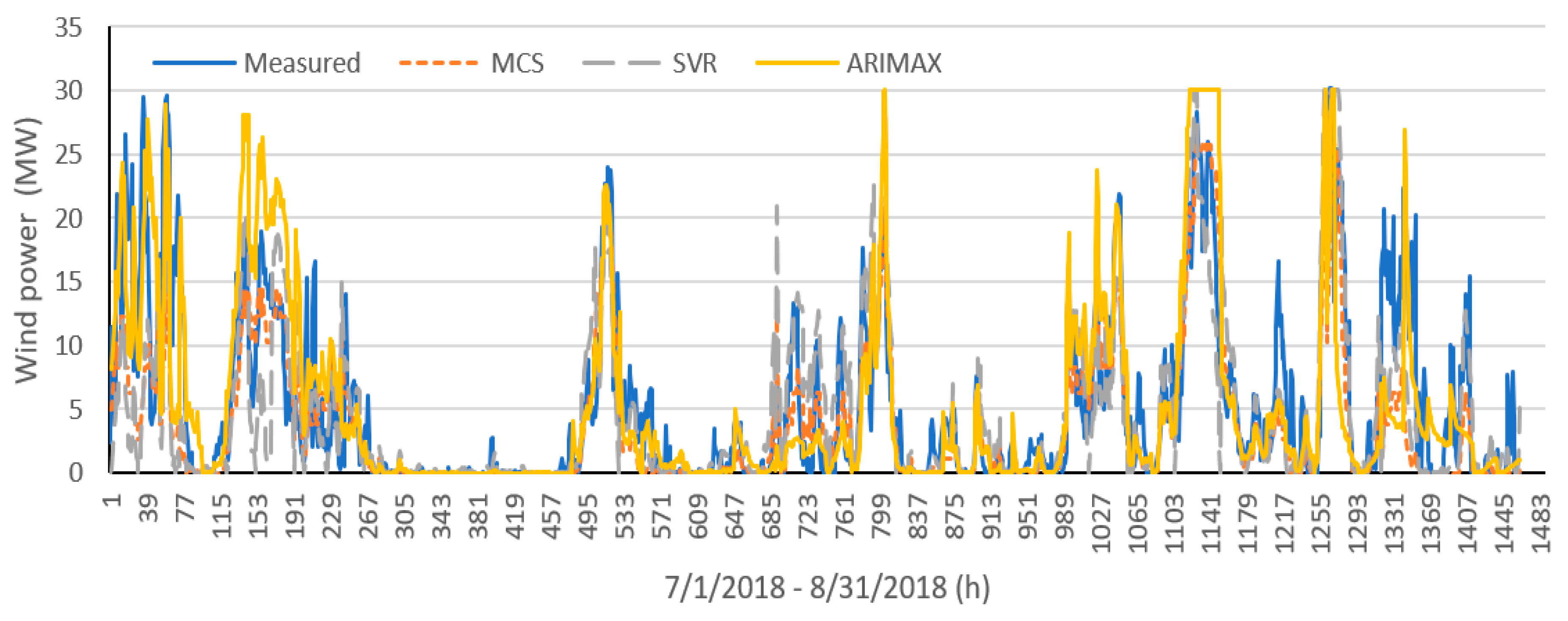
The number of wind-generating resources has increased considerably, owing to concerns over the environmental impact of fossil-fuel combustion. Therefore, wind power forecasting is becoming an important issue for large-scale wind power grid integration. Ensemble forecasting, which combines several forecasting techniques, is considered a viable alternative to conventional single-model-based forecasting for improving the forecasting accuracy. In this work, we propose the day-ahead ensemble forecasting of wind power using statistical methods. The ensemble forecasting model consists of three single forecasting approaches: autoregressive integrated moving average with exogenous variable (ARIMAX), support vector regression (SVR), and the Monte Carlo simulation-based power curve model. To apply the methodology, we conducted forecasting using the historical data of wind farms located on Jeju Island, Korea. The results were compared between a single model and an ensemble model to demonstrate the validity of the proposed method.
Keywords: wind power forecasting; ensemble method; autoregressive integrated moving average with exogenous variable; support vector regression; power curve modeling wind power forecasting; ensemble method; autoregressive integrated moving average with exogenous variable; support vector regression; power curve modeling