Article

Multi-Criteria Stochastic Selection of Electric Vehicles for the Sustainable Development of Local Government and State Administration Units in Poland


Faculty of Economics, Finance and Management, University of Szczecin, Cukrowa 8, 71-004 Szczecin, Poland
Energies 2020, 13(23), 6299; https://doi.org/10.3390/en13236299
Submission received: 2 November 2020 / Revised: 15 November 2020 / Accepted: 27 November 2020 / Published: 29 November 2020
(This article belongs to the Special Issue Smart Energy and Intelligent Transportation Systems)

Abstract

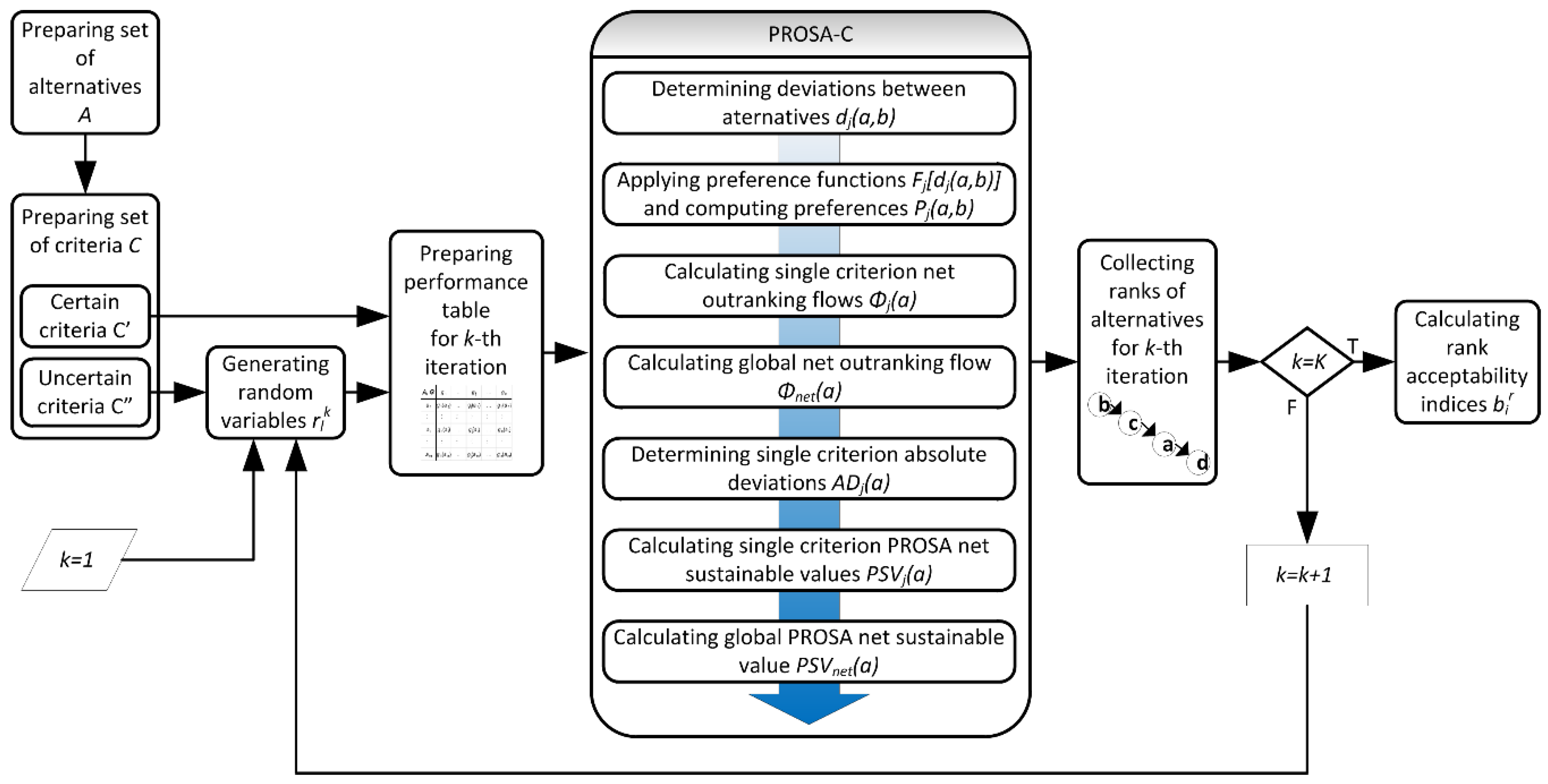
Increasing the popularity of electric vehicles is one way of reducing greenhouse gas emissions and making the economy more sustainable. In Poland, the use of electric vehicles is to be increased by the adoption of the Act on Electromobility and Alternative Fuels. This Act obliges local government units and state administration to expand the electric vehicle fleet. The expansion of the fleet should be carried out on a planned basis, based on rational decisions supported by economic analyses. Therefore, the aim of this article is to provide a recommendation of an electric vehicle that meets the needs of local and state administration to the greatest extent possible. The aim has been achieved using the multi-criteria decision analysis method called PROSA-C (PROMETHEE for Sustainability Assessment—Criteria) combined with the Monte Carlo method. The PROSA-C method allows promoting more sustainable vehicles with high technical, economic, environmental and social parameters. The Monte Carlo method, on the other hand, is a stochastic simulation tool that allows for taking into account the uncertainty of parameters describing vehicles. As a result of the research, the most and least attractive vehicles were identified from the perspective of the needs of local government units and state administration. Moreover, the conducted research allowed confirming the effectiveness and usefulness of the research methodology proposed in the article and the procedural approach combining the PROSA-C and Monte Carlo methods.
Keywords: electric vehicles; PROSA; PROMETHEE for Sustainability Assessment; MCDA; Multi-Criteria Decision Analysis; stochastic analysis; Monte Carlo; uncertainty electric vehicles; PROSA; PROMETHEE for Sustainability Assessment; MCDA; Multi-Criteria Decision Analysis; stochastic analysis; Monte Carlo; uncertainty