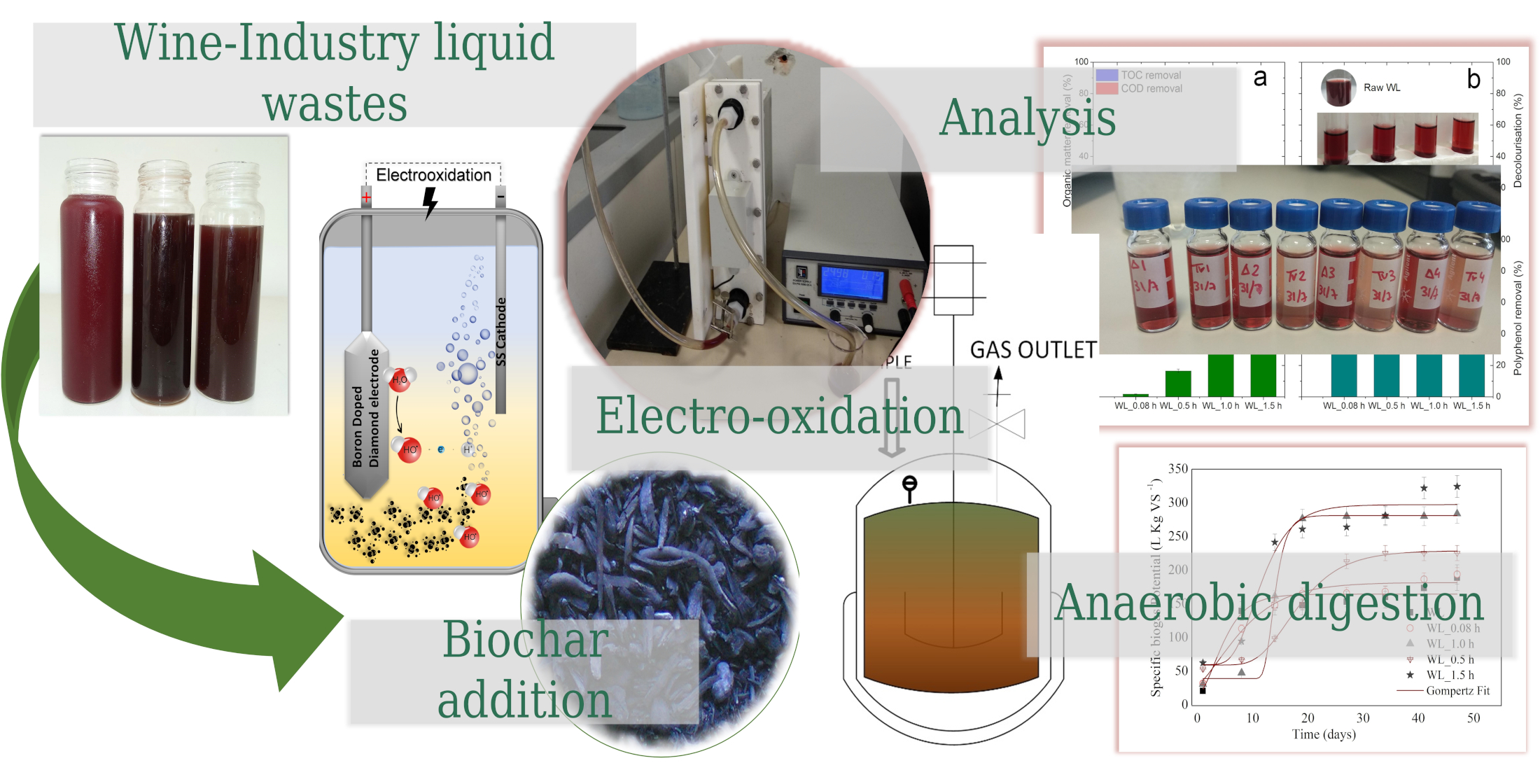
Improving the Anaerobic Digestion of Wine-Industry Liquid Wastes: Treatment by Electro-Oxidation and Use of Biochar as an Additive

 ,
,  ,
,  and
and 
Abstract
Share and Cite
Arenas Sevillano, C.B.; Chiappero, M.; Gomez, X.; Fiore, S.; Martínez, E.J. Improving the Anaerobic Digestion of Wine-Industry Liquid Wastes: Treatment by Electro-Oxidation and Use of Biochar as an Additive. Energies 2020, 13, 5971. https://doi.org/10.3390/en13225971
Arenas Sevillano CB, Chiappero M, Gomez X, Fiore S, Martínez EJ. Improving the Anaerobic Digestion of Wine-Industry Liquid Wastes: Treatment by Electro-Oxidation and Use of Biochar as an Additive. Energies. 2020; 13(22):5971. https://doi.org/10.3390/en13225971
Chicago/Turabian StyleArenas Sevillano, Cristian Bernabé, Marco Chiappero, Xiomar Gomez, Silvia Fiore, and E. Judith Martínez. 2020. "Improving the Anaerobic Digestion of Wine-Industry Liquid Wastes: Treatment by Electro-Oxidation and Use of Biochar as an Additive" Energies 13, no. 22: 5971. https://doi.org/10.3390/en13225971
APA StyleArenas Sevillano, C. B., Chiappero, M., Gomez, X., Fiore, S., & Martínez, E. J. (2020). Improving the Anaerobic Digestion of Wine-Industry Liquid Wastes: Treatment by Electro-Oxidation and Use of Biochar as an Additive. Energies, 13(22), 5971. https://doi.org/10.3390/en13225971