A Universal Design of FPGA-Based Real-Time Simulator for Active Distribution Networks Based on Reconfigurable Computing



Abstract
1. Introduction
2. Overall Architecture of the FPGA-Based Real-Time Simulator Based on Reconfigurable Computing
2.1. Reconfigurable Computing
2.2. Architecture Design of the FPGA-Based Real-Time Simulator Based on Reconfigurable Computing
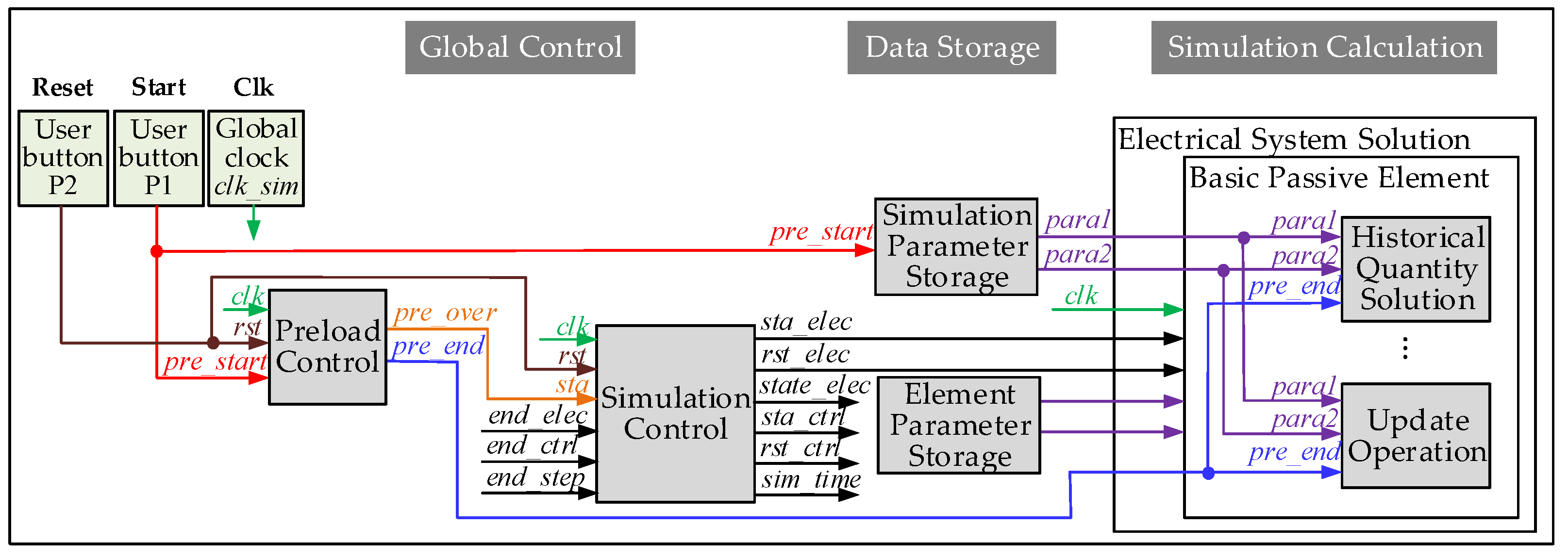
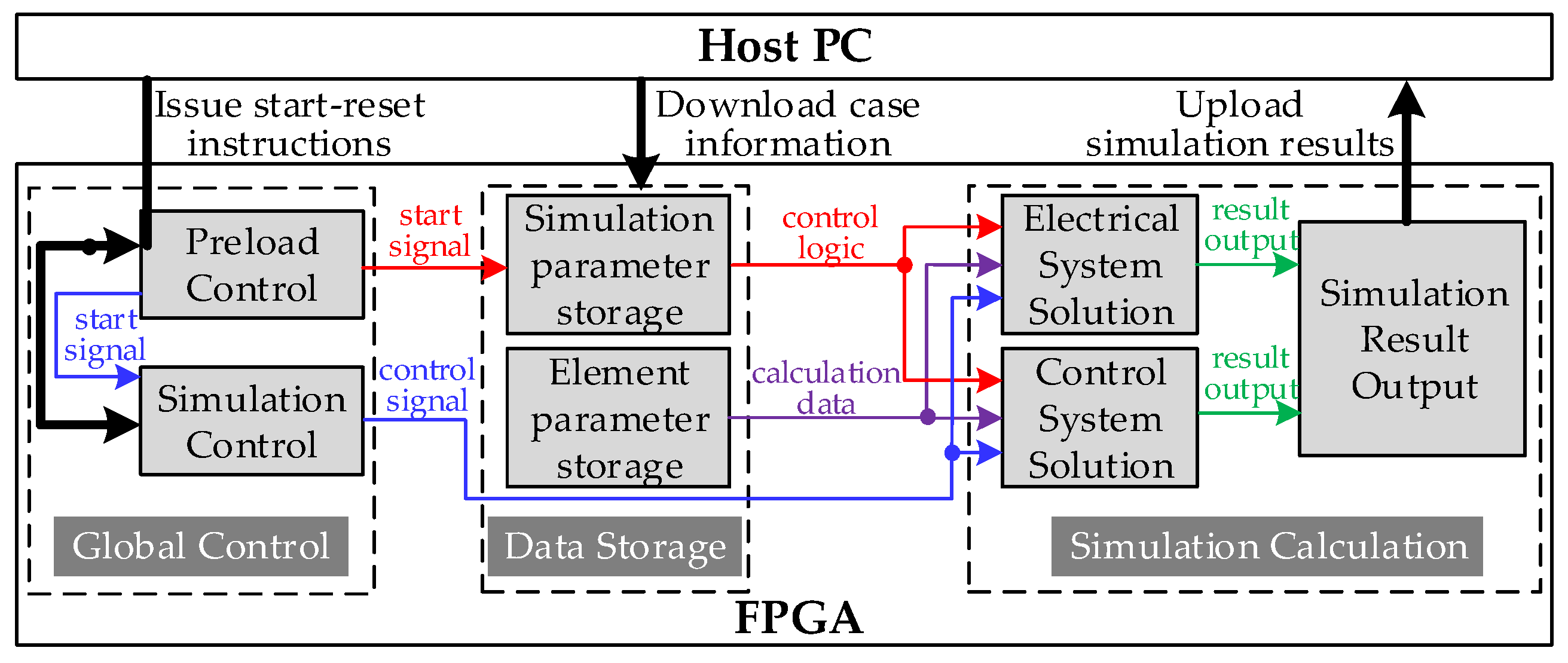
- Global Control is mainly used to control the simulator operation.
- Data Storage is mainly used to store the parameters of the simulation case, including simulation parameters, such as simulation time-step and numbers of the elements, and element parameters, such as equivalent conductance and element node number.
- Simulation Calculation is mainly responsible for the operation and processing of the calculation. The calculation processing logic is irrelevant with the case to be simulated, but can be controlled and reconfigured by simulation parameters.
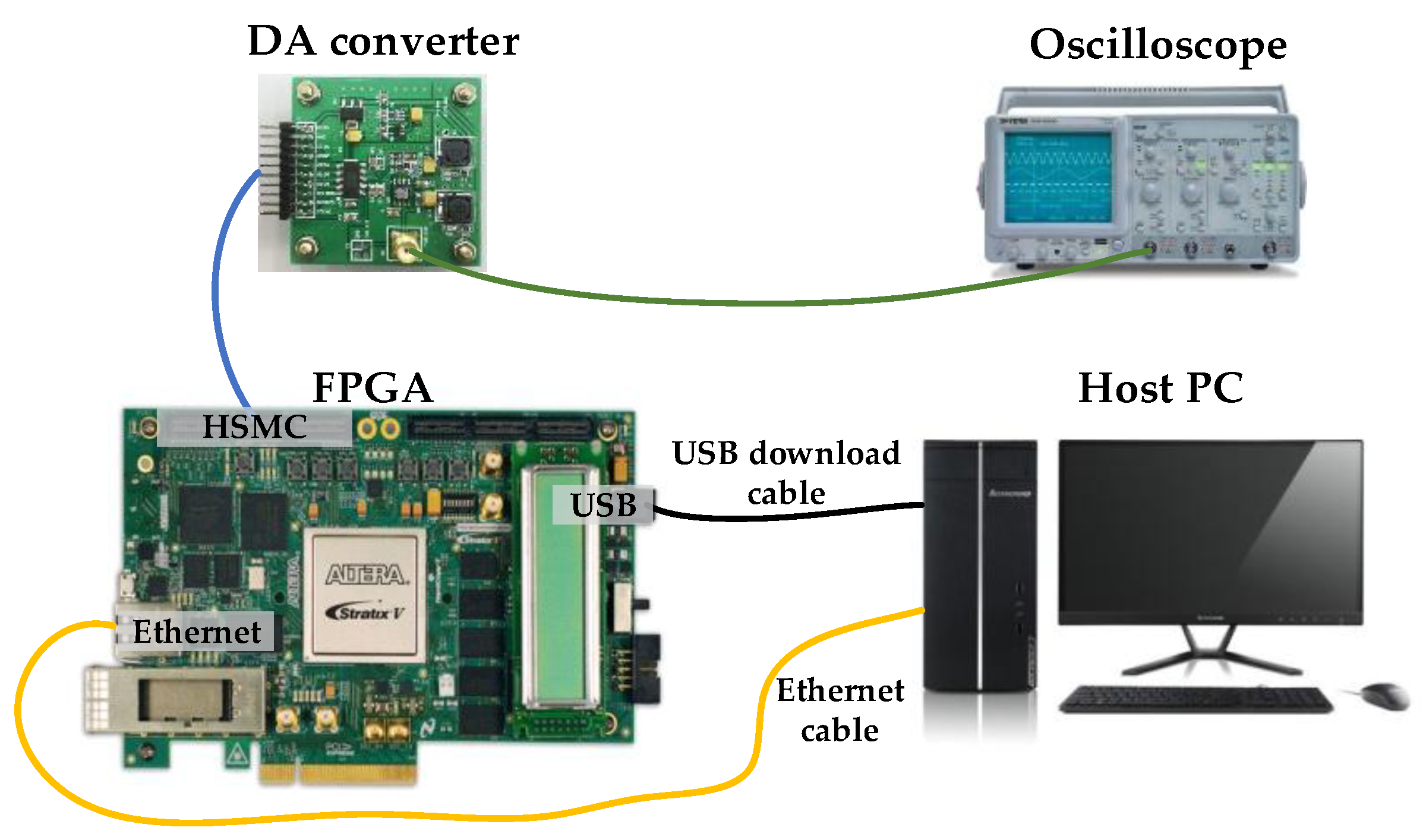
- In addition, the host PC, as a software environment, is responsible for scheduling FPGA start and reset, and is responsible for managing and downloading case data.
3. Detailed Implementation of the Universal Design of the FPGA-Based Real-Time Simulator
- Before the start of the simulation, according to the simulation parameters as the control flow, the relevant operation control logic in Simulation Calculation is reconfigured so that different cases can be calculated in this part.
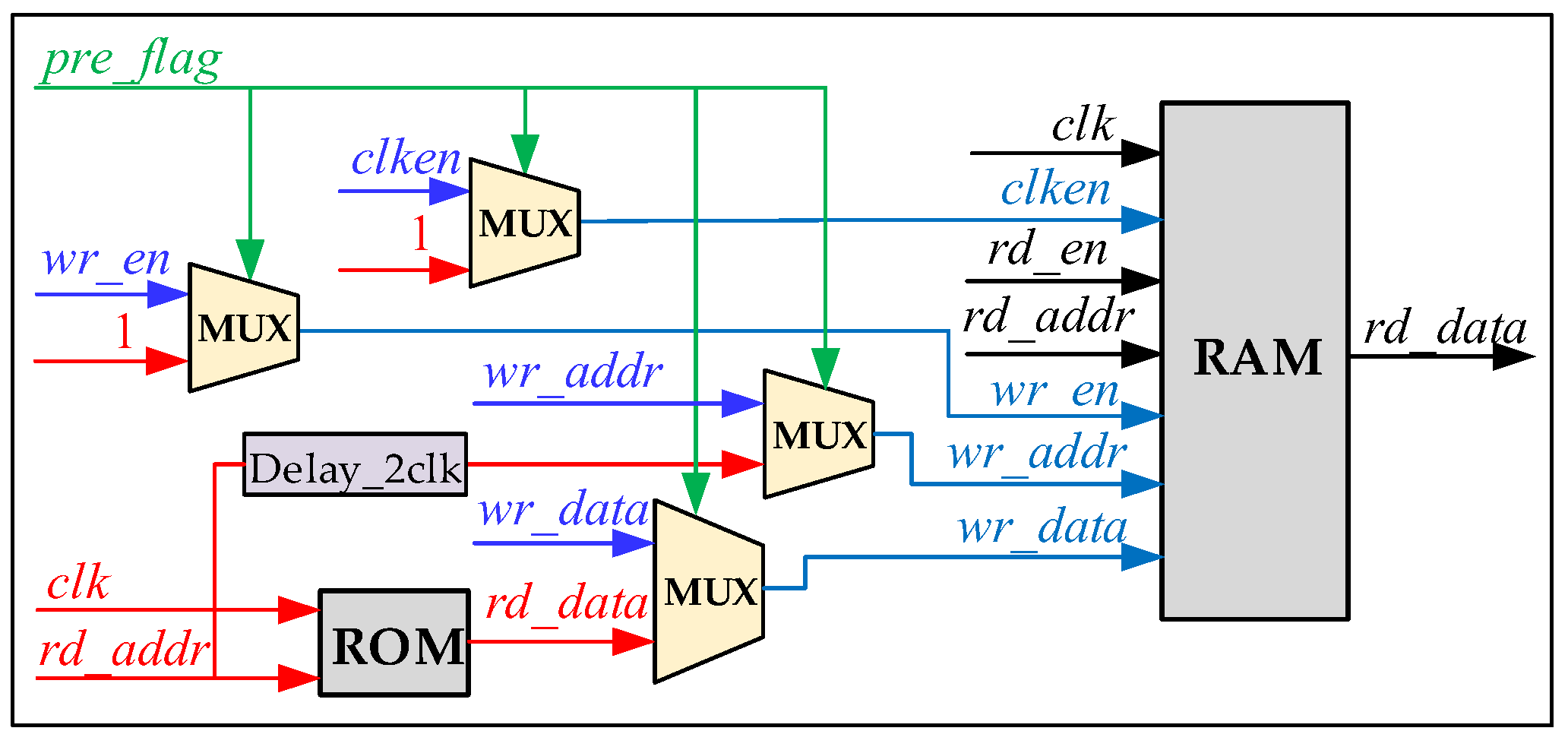
- Before the start of the simulation, the initial values of the simulation calculation are set so that the initialization of Simulation Calculation is completed.
- The linear equations solving module in Simulation Calculation is designed so that it is compatible with equations of different dimensions without changing with the simulation case.
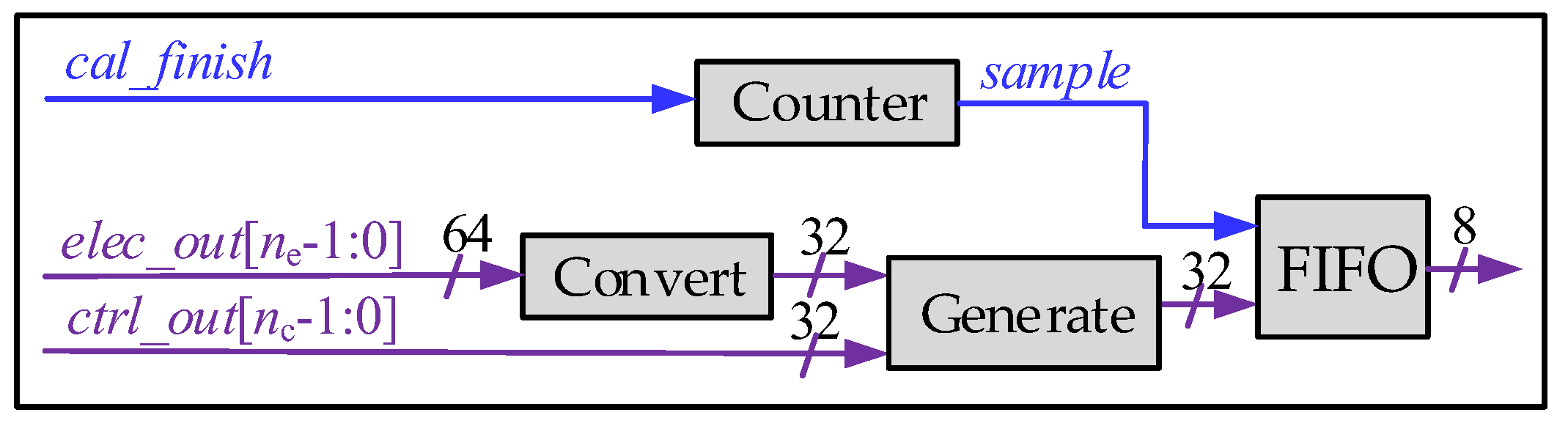
- The simulation result output module in Simulation Calculation is designed so that the output results can be adaptive to change with the user’s choice as the control flow.
3.1. Universal Design of the Simulation Parameter Configuration
- The signal pre_start is set to the high level: The parameter reading start signal pre_start is entered by the user button to start the preload process. At the same time, the signal is transmitted to the simulation parameter storage module. The reading of parameters is controlled by the finite state machine. When the high level of pre_start is detected, the finite state machine operates. At each state, one parameter is read out from the memory and assigned to the corresponding register. Then, the parameter is transmitted to the relevant module through the port.
- The signal pre_end is set to the high level: After tpre1 time, the simulation parameter reading has been completed, and the parameter configuration start signal pre_end is set to the high level. The signal is transmitted into sub-modules of the element modules (such as the historical quantity solution module in the basic passive element module). When the high level of pre_end is detected, the input simulation parameter data signals are assigned to the corresponding register.
- The signal pre_over is set to the high level: After tpre2 time, the simulation parameter configuration has been completed, and the real-time simulation start signal pre_over is set to the high level. The signal is transmitted to the simulation control module, and the simulation control module begins to generate the control signals of each time step periodically according to the simulation time step. At this point, the preload process has been completed.
3.2. Universal Design of the Simulation Initial Value Setting
3.3. Universal Design of the Linear Equations Solving Module
3.4. Universal Design of the Simulation Result Output Module
4. Case Study
4.1. Simulation Platform
4.2. Test Case 1
4.3. Test Case 2
4.4. Test Case 3
5. Conclusions
- The universal design of the parameter configuration and the initial value setting is proposed. In the preload process, the simulation parameters are configured, and the memories are initialized. Therefore, it’s unnecessary to compile the FPGA design when the simulation case is modified or changed.
- The universal design of the linear equations solving module is proposed. A margin for the linear equation solving module is introduced, so that the cases can be modified to some extent and simulated consecutively without recompiling.
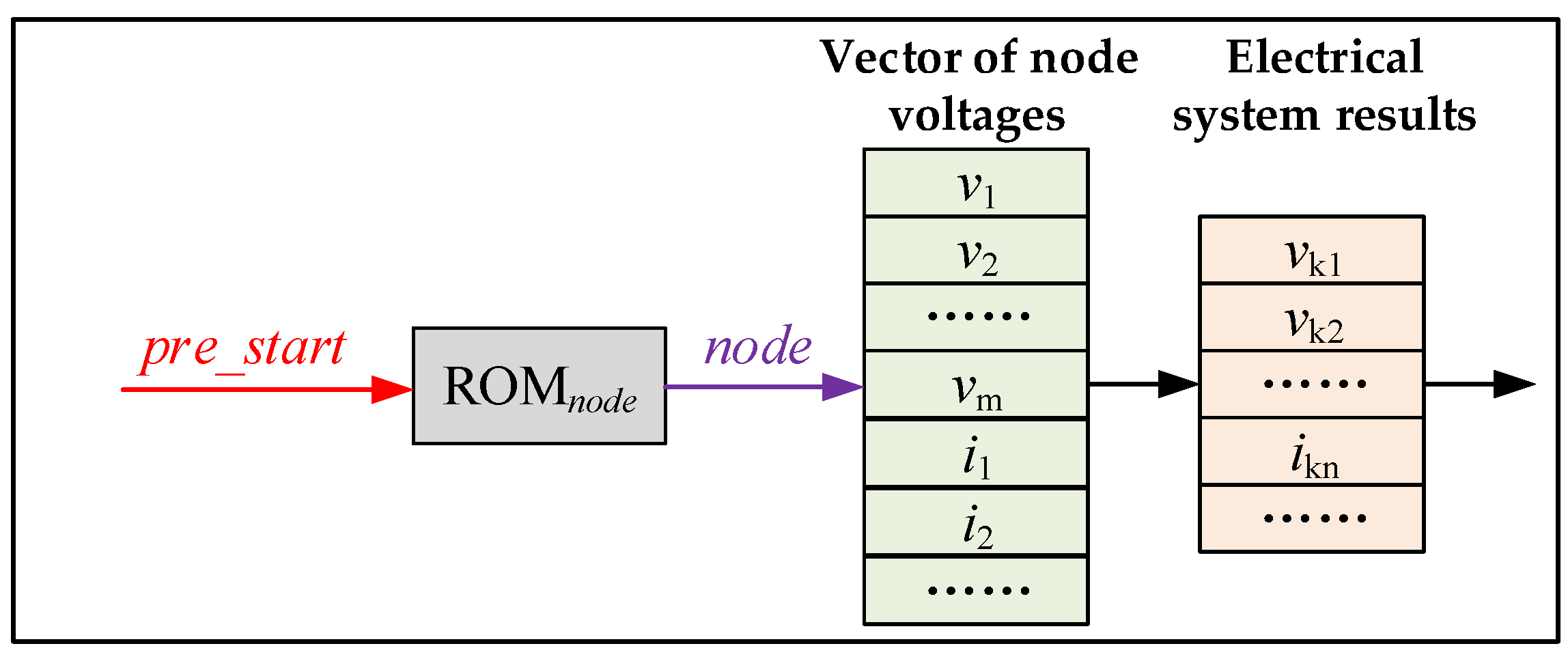
- The universal design of the simulation result output module is proposed. The output results can be obtained by reading the corresponding node numbers from the ROM of the measurement element, and the output results can be adaptive to change with the user’s choice.
Author Contributions
Funding
Conflicts of Interest
References
- Yan, B.; Wang, B.; Zhu, L.; Liu, H.; Liu, Y.; Ji, X.; Liu, D. A novel, stable, and economic power sharing scheme for an autonomous microgrid in the energy internet. Energies 2015, 8, 12741–12764. [Google Scholar] [CrossRef] [Scilit]
- Li, P.; Ji, H.; Wang, C.; Zhao, J.; Song, G.; Ding, F.; Wu, J. Coordinated control method of voltage and reactive power for active distribution networks based on soft open point. IEEE Trans. Sustain. Energy 2017, 8, 1430–1442. [Google Scholar] [CrossRef] [Scilit]
- Lopes, J.A.P.; Hatziargyriou, N.; Mutale, J.; Djapic, P.; Jenkins, N. Integrating distributed generation into electric power systems: A review of drivers, challenges and opportunities. Electr. Power Syst. Res. 2007, 77, 1189–1203. [Google Scholar] [CrossRef] [Scilit]
- Li, P.; Ji, H.; Wang, C.; Zhao, J.; Song, G.; Ding, F.; Wu, J. Optimal operation of soft open points in active distribution networks under three-phase unbalanced conditions. IEEE Trans. Smart Grid 2019, 10, 380–391. [Google Scholar] [CrossRef] [Scilit]
- Xyngi, I.; Ishchenko, A.; Popov, M.; van der Sluis, L. Transient stability analysis of a distribution network with distributed generators. IEEE Trans. Power Syst. 2009, 24, 1102–1104. [Google Scholar] [CrossRef] [Scilit]
- Wang, C.; Fu, X.; Li, P.; Wu, J.; Wang, L. Multiscale simulation of power system transients based on the matrix exponential function. IEEE Trans. Power Syst. 2017, 32, 1913–1926. [Google Scholar] [CrossRef] [Scilit]
- Hooshyar, H.; Mahmood, F.; Vanfretti, L.; Baudette, M. Specification, implementation, and hardware-in-the-loop real-time simulation of an active distribution grid. Sustain. Energy Grids Netw. 2015, 3, 36–51. [Google Scholar] [CrossRef] [Scilit]
- Mclaren, P.G.; Kuffel, R.; Wierckx, R.; Giesbrecht, J.; Arendt, L. A real time digital simulator for testing relays. IEEE Trans. Power Deliv. 1992, 7, 207–213. [Google Scholar] [CrossRef] [Scilit]
- Bélanger, J.; Lapointe, V.; Dufour, C.; Schoen, L. eMEGAsim: An open high-performance distributed real-time power grid simulator. Architecture and specification. In Proceedings of the International Conference on Power System, Bangalore, India, 12–14 December 2007. [Google Scholar]
- Paré, D.; Turmel, G.; Soumagne, J.C.; Do, V.Q.; Casoria, S.; Bissonnette, M.; Marcoux, B.; McNabb, D. Validation tests of the Hypersim digital real-time simulator with a large AC-DC network. In Proceedings of the International Conference on Power Systems Transients, New Orleans, LA, USA, 28 September–2 October 2003. [Google Scholar]
- Krebs, R.; Ruhle, O. NETOMAC real-time simulator-a new generation of standard test modules for enhanced relay testing. In Proceedings of the Eighth IEE International Conference on Developments in Power System Protection, Amsterdam, The Netherlands, 5–8 April 2004. [Google Scholar]
- Perron, M.; Ghahremani, E.; Heniche, A.; Kamwa, I.; Lafond, C.; Racine, M.; Akremi, H.; Cadieux, P.; Lebeau, S.; Landry, S. Wide-area voltage control system of flexible AC transmission system devices to prevent voltage collapse. IET Gener. Transm. Distrib. 2017, 11, 4556–4564. [Google Scholar] [CrossRef] [Scilit]
- Le-Huy, P.; Sybille, G.; Giroux, P.; Loud, L.; Huang, J.A.; Kamwa, I. Real-time electromagnetic transient and transient stability co-simulation based on hybrid line modelling. IET Gener. Transm. Distrib. 2017, 11, 2983–2990. [Google Scholar] [CrossRef] [Scilit]
- Doorwar, A.; Bhalja, B.; Malik, O.P. A New Internal Fault Detection and Classification Technique for Synchronous Generator. IEEE Trans. Power Deliv. 2019, 34, 739–749. [Google Scholar] [CrossRef] [Scilit]
- Hong, Y.Y.; Wei, Y.H.; Chang, Y.R.; Lee, Y.D.; Liu, P.W. Fault detection and location by static switches in microgrids using wavelet transform and adaptive network-based fuzzy inference system. Energies 2014, 7, 2658–2675. [Google Scholar] [CrossRef] [Scilit]
- Al Jowder, F.A.R.; Ooi, B.T. Series compensation of radial power system by a combination of SSSC and dielectric capacitors. IEEE Trans. Power Deliv. 2005, 20, 458–465. [Google Scholar] [CrossRef] [Scilit]
- Hu, Y.; Wu, W.; Zhang, B.; Guo, Q. Development of an RTDS-TSA hybrid transient simulation platform with frequency dependent network equivalents. In Proceedings of the 2013 4th IEEE/PES Innovative Smart Grid Technologies Europe, Lyngby, Denmark, 6–9 October 2013. [Google Scholar]
- Meka, R.; Sloderbeck, M.; Faruque, M.O.; Langston, J.; Steurer, M.; DeBrunner, L.S. FPGA model of a high-frequency power electronic converter in an RTDS power system co-simulation. In Proceedings of the 2013 IEEE Electric Ship Technologies Symposium, Arlington, VA, USA, 22–24 April 2013. [Google Scholar]
- Dufour, C.; Belanger, J.; Lapointe, V. FPGA-based ultra-low latency HIL fault testing of a permanent magnet motor drive using RT-LAB-XSG. In Proceedings of the Joint International Conference on Power System Technology and IEEE Power India Conference, New Delhi, India, 12–15 October 2008. [Google Scholar]
- Zhang, B.D.; Fu, S.W.; Jin, Z.; Hu, R.Z. A novel FPGA-based real-time simulator for micro-grids. Energies 2017, 10, 1239. [Google Scholar] [CrossRef] [Scilit]
- Zhang, B.D.; Wu, Y.J.; Jin, Z.; Wang, Y. A real-time digital solver for smart substation based on orders. Energies 2017, 10, 1795. [Google Scholar] [CrossRef] [Scilit]
- Chen, Y.; Dinavahi, V. Multi-FPGA digital hardware design for detailed large-scale real-time electromagnetic transient simulation of power systems. IET Gener. Transm. Distrib. 2013, 7, 451–463. [Google Scholar] [CrossRef] [Scilit]
- Matar, M.; Karimi, H.; Etemadi, A.; Iravani, R. A high performance real-time simulator for controllers hardware-in-the-loop testing. Energies 2012, 5, 1713–1733. [Google Scholar] [CrossRef] [Scilit]
- Li, P.; Wang, Z.Y.; Ding, C.D.; Yu, H.; Wang, C.S. A design of grid-connected PV system for real-time transient simulation based on FPGA. In Proceedings of the 2015 IEEE Power and Energy Society General Meeting, Piscataway, NJ, USA, 26–30 July 2015. [Google Scholar]
- Li, P.; Wang, Z.Y.; Wang, C.S.; Fu, X.P.; Yu, H.; Wang, L.W. Synchronisation mechanism and interfaces design of multi-FPGA-based real-time simulator for microgrids. IET Gener. Transm. Distrib. 2017, 11, 3088–3096. [Google Scholar] [CrossRef] [Scilit]
- Gort, M.; Anderson, J. Design re-use for compile time reduction in FPGA high-level synthesis flows. In Proceedings of the 2014 International Conference on Field-Programmable Technology (FPT), Shanghai, China, 10–12 December 2014. [Google Scholar] [CrossRef] [Scilit]
- Sankar, Y.; Rose, J. Trading quality for compile time: Ultra-fast placement for FPGAs. In Proceedings of the ACM/SIGDA Seventh International Symposium on Field Programmable Gate Arrays, Monterey, CA, USA, 21–23 February 1999. [Google Scholar] [CrossRef] [Scilit]
- Chen, Y. Large-Scale Real-Time Electromagnetic Transient Simulation of Power Systems Using Hardware Emulation on FPGAs. Ph.D. Thesis, University of Alberta, Edmonton, AB, Canada, 2012. [Google Scholar]
- Wang, C.S.; Ding, C.D.; Li, P.; Yu, H. Real-time transient simulation for distribution systems based on FPGA, Part II: System architecture and algorithm verification. Proc. CSEE 2014, 34, 628–634. [Google Scholar] [CrossRef]
- Behnke, M.; Ellis, A.; Kazachkov, Y.; McCoy, T.; Muljadi, E.; Price, W.; Sanchez-Gasca, J. Development and validation of WECC variable speed wind turbine dynamic models for grid integration studies. In Proceedings of the AWEA’s 2007 Wind Power Conference, Los Angeles, CA, USA, 4–7 June 2007. [Google Scholar]
- Tsai, H.L.; Tu, C.S.; Su, Y.J. Development of generalized photovoltaic model using Matlab/Simulink. In Proceedings of the World Congress on Engineering and Computer Science 2008, San Francisco, CA, USA, 22–24 October 2008. [Google Scholar]
- Estrin, G.; Bussell, B.; Turn, R.; Bibb, J. Parallel processing in a restructurable computer system. IEEE Trans. Electron. Comput. 1964, EC-12, 747–755. [Google Scholar] [CrossRef] [Scilit]
- Dehon, A.; Wawrzynek, J. Reconfigurable computing: What, why, and implications for design automation. In Proceedings of the 36th ACM/IEEE Conference on Design Automation, New Orleans, LA, USA, 21–25 June 1999. [Google Scholar] [CrossRef] [Scilit]
- Watson, N.; Arrillaga, J. Power Systems Electromagnetic Transients Simulation; The Institution of Electrical Engineers: London, UK, 2003; ISBN 978-08-5296-106-3. [Google Scholar]
- Wei, S.J.; Liu, L.B.; Yin, S.Y. Key techniques of reconfigurable computing processor. Sci. Sin. Inf. 2012, 42, 1559–1576. [Google Scholar] [CrossRef] [Scilit]
- Compton, K.; Hauck, S. Reconfigurable computing: A survey of systems and software. ACM Comput. Surv. 2002, 34, 171–210. [Google Scholar] [CrossRef] [Scilit]
- Wang, C.S.; Ding, C.D.; Li, P.; Yu, H. Real-time transient simulation for distribution systems based on FPGA, Part I: Module realization. Proc. CSEE 2014, 34, 161–167. [Google Scholar] [CrossRef]
- Dommel, H.W. Digital computer solution of electromagnetic transients in single-and multiphase networks. IEEE Trans. Power Appl. Syst. 1969, 4, 388–399. [Google Scholar] [CrossRef] [Scilit]
- Li, P.; Wang, C.S.; Huang, B.B.; Gao, F.; Ding, C.D.; Yu, H. Methodology of transient simulation in time domain for DG and microgrid (1): Basic framework and algorithm. Electr. Power Autom. Equip. 2013, 33, 33–39. [Google Scholar] [CrossRef]
- Baran, M.E.; Wu, F.F. Network reconfiguration in distribution systems for loss reduction and load balancing. IEEE Trans. Power Deliv. 1989, 4, 1401–1407. [Google Scholar] [CrossRef] [Scilit]
- Papathanassiou, S.; Hatziargyriou, N.; Strunz, K. A benchmark low voltage microgrid network. In Proceedings of the GIGRE Symposium, Athens, Greece, 13–16 April 2005. [Google Scholar]






| Type of Simulator | Compile Time | Calculation Time |
|---|---|---|
| Universal simulator | 0 | 4 s |
| Conventional simulator | 3 h 44 min 18 s | 4 s |
| Type of Simulator | Compile Time | Calculation Time |
|---|---|---|
| Universal simulator | 0 | 4 s |
| Conventional simulator | 4 h 21 min 21 s | 4 s |
© 2019 by the authors. Licensee MDPI, Basel, Switzerland. This article is an open access article distributed under the terms and conditions of the Creative Commons Attribution (CC BY) license (http://creativecommons.org/licenses/by/4.0/).
Share and Cite
Jin, S.; Yu, H.; Fu, X.; Wang, Z.; Yuan, K.; Li, P. A Universal Design of FPGA-Based Real-Time Simulator for Active Distribution Networks Based on Reconfigurable Computing. Energies 2019, 12, 2086. https://doi.org/10.3390/en12112086
Jin S, Yu H, Fu X, Wang Z, Yuan K, Li P. A Universal Design of FPGA-Based Real-Time Simulator for Active Distribution Networks Based on Reconfigurable Computing. Energies. 2019; 12(11):2086. https://doi.org/10.3390/en12112086
Chicago/Turabian StyleJin, Shuo, Hao Yu, Xiaopeng Fu, Zhiying Wang, Kai Yuan, and Peng Li. 2019. "A Universal Design of FPGA-Based Real-Time Simulator for Active Distribution Networks Based on Reconfigurable Computing" Energies 12, no. 11: 2086. https://doi.org/10.3390/en12112086
APA StyleJin, S., Yu, H., Fu, X., Wang, Z., Yuan, K., & Li, P. (2019). A Universal Design of FPGA-Based Real-Time Simulator for Active Distribution Networks Based on Reconfigurable Computing. Energies, 12(11), 2086. https://doi.org/10.3390/en12112086