

Modeling the Total Energy Consumption of Mobile Network Services and Applications

 ,
,  ,
,  , ,
, ,
Abstract
1. Introduction
- (1)
- We present a comprehensive end-to-end energy consumption model for 15 major mobile services by taking into account the important factors from each network segment from cloud to core network, mobile network and end-user devices;
- (2)
- We then demonstrate how key parameters can be measured for service-specific end-to-end energy assessments and the inter-dependency between key factors in different network segments;
- (3)
- To address usage pattern heterogeneity of mobile users, we conduct a sensitivity analysis for key mobile applications and we show that the difference in energy profiles of mobile services is mainly due to the service type, service data traffic, duration of the service and the type of end-to-end network topology;
- (4)
- Finally, we evaluate how two emerging network technologies, small cell offloading and mobile edge caching, could be used to reduce the overall energy consumption of mobile services.
2. Related Work
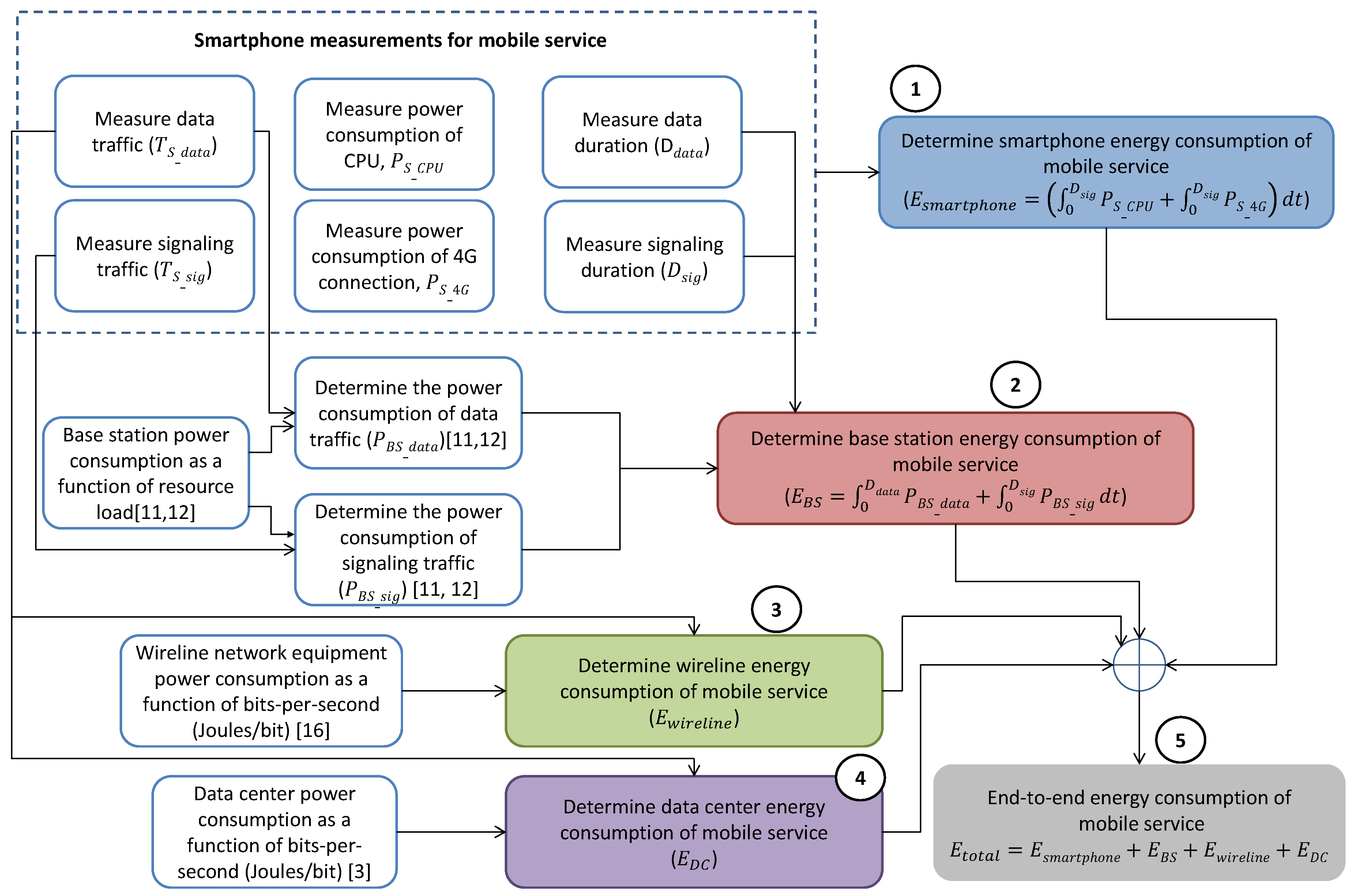
3. Service-Specific End-To-End Energy Consumption Model
3.1. Smartphone Energy Consumption Model
3.2. BS Energy Consumption Model
3.3. Wireline Core Network Energy Consumption Model
3.4. Data Center Energy Consumption Model
- (kWh) is the annual electricity consumption of a data center. For example, the annual electricity consumption of Akamai’s data centers was about 233 × 106 kWh in 2016 [3].
- (bit) is the annual data throughput of a data center, and can be calculated with the average daily web traffic of a data center which exceeded 30 Terabits per second for Akamai [3].
4. Service-Specific Smartphone Energy and Traffic Measurements
5. Total Service-Specific End-To-End Energy Consumption
- Web browsing: we accessed the website sina.cn with time ranges from 60 s to 500 s to keep refreshing page content.
- Youku video: we viewed different videos with sizes ranging from 7.9 MBytes to 26 MBytes.
- VR: we accessed different videos with sizes ranging from 50 MBytes to 177 MBytes.
- IM voice message: we sent and received voice messages ranging from 10 s to 60 s.
- Audio chat: we tested voice calls from 60 s to 1200 s.
- Video chat: we tested video chats from 60 s to 1200 s.
- (1)
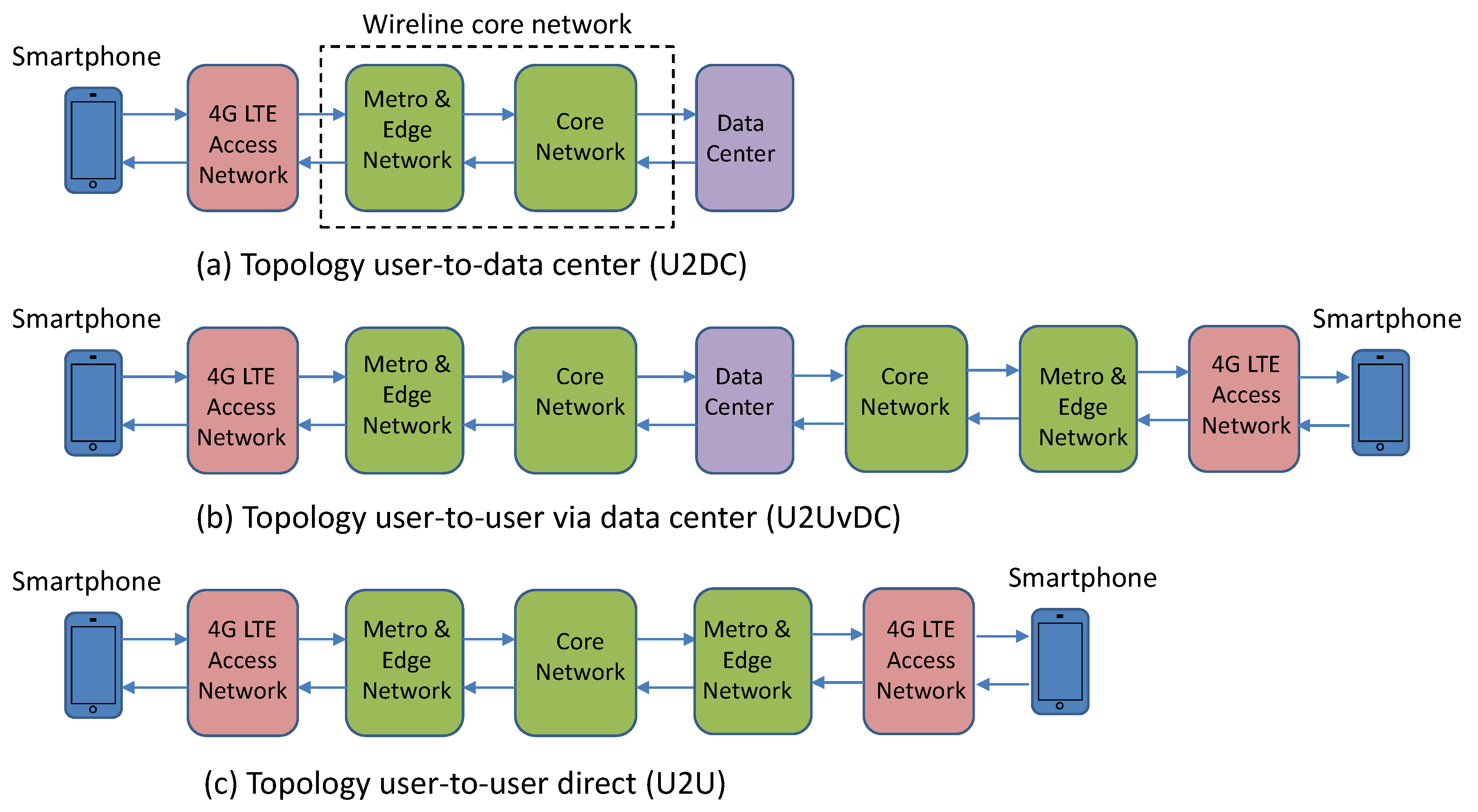
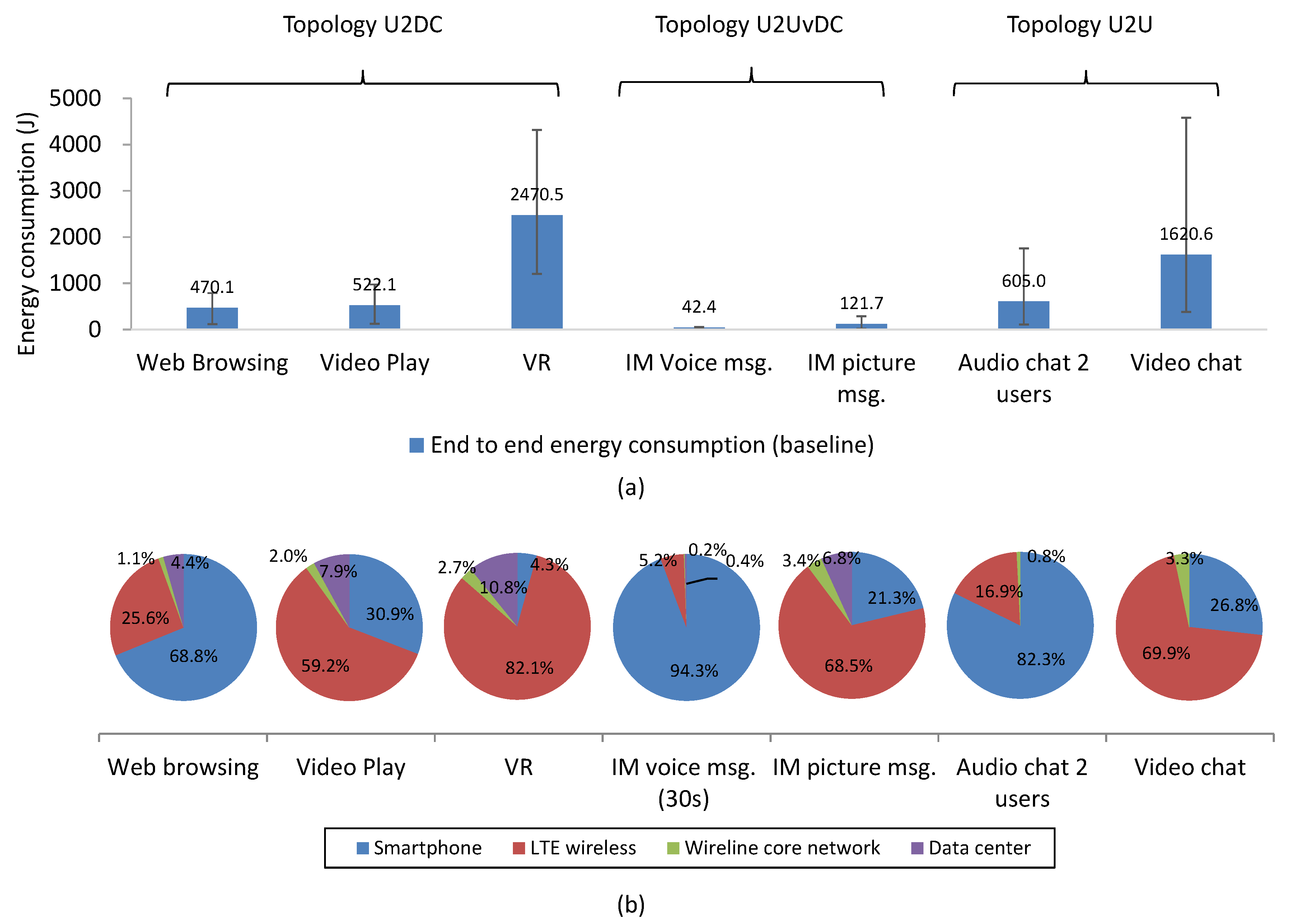
- Topology U2DC: Under this topology, covering web browsing, video play and VR, data are transferred between the smartphone and the cloud server. Therefore, the end-to-end energy consumption of such a service consists of the energy consumed by the smartphone (i.e., 4G and CPU), the 4G LTE access network, the wireline core network, and the data center. Figure 5a shows that the average end-to-end energy consumption of Topology U2DC services could vary significantly from 470.1 Joules (web browsing) to 2470.5 Joules (VR) in the baseline. From the average energy consumption breakdown shown in Figure 5b, we observe that for high energy consumption services (i.e., VR) the LTE wireless network tends to dominate, while for services with low energy consumption services (i.e., web browsing) the smartphone dominates.
- (2)
- Topology U2UvDC: This topology includes IM voice and picture messaging services. Their commonality is that data is transmitted to the cloud server before being forwarded to the intended recipient’s smartphone. Therefore, the end-to-end energy consumption consists of (1) the energy consumed by sending the message from the sender to the cloud server and (2) the transmission of the message from the cloud server to the receiver. Figure 5a shows that voice messages are typically short, resulting in a relatively low service-specific end-to-end energy consumption compared to picture messages. For IM picture messages, because the size of an image can be large (ranging from 0.2 MB to 8 MB for the images used in our tests), the energy consumed in the 4G LTE access network can be higher than in the other network segments. In addition, sending and receiving small messages triggers frequent network reconnections, which generate a large amount of signaling traffic [11]. Therefore, the 4G connection requires more than 90% of the smartphone’s energy use for IM text and voice messages.
- (3)
- Topology U2U: This topology includes voice, audio chat and video chat services. Their commonality is that the users are connected directly by the P2P-like protocol so that the data is transferred directly between smartphones. The end-to-end service energy consumption increases as the usage increases. The total service-specific end-to-end energy consumption consists of the energy consumed by smartphones and the corresponding LTE wireless network and the wireline core network. As depicted in Figure 5, the average end-to-end energy consumption of video chat is around 1620 Joules, with the LTE network accounting for more than 69% of the total service energy consumption, followed by the energy consumed by the smartphones (26.8%). For audio chat services, the average end-to-end energy consumption is around 605 Joules with the smartphone accounting for more than 82% of the total service energy consumption. This is due to the audio chat generating less data traffic than video chat with the same connection duration.
6. Opportunities for Reducing the Energy Consumption of Mobile Services
6.1. Offloading Heavy Mobile Services from Macro Cells to Smaller Cells
6.2. Multi-Access Edge Computing and Caching
7. Conclusions
Author Contributions
Funding
Acknowledgments
Conflicts of Interest
References
- Device Specifications, Comparison between: Apple iPhone 6, Apple iPhone X, oppoA57, LGG2. Available online: https://www.devicespecifications.com/en/comparison/cf30dbb58 (accessed on 22 November 2018).
- China Mobile Limited Annual Report 2016. Available online: http://www.chinamobileltd.com/en/ir/reports/ar2016.pdf (accessed on 22 November 2018).
- Akamai Technologies Inc. CDP 2017 Climate Change 2017 Information Request. Available online: https://www.akamai.com/us/en/multimedia/documents/sustainability/akamai-2016-cdp-programme-response.pdf (accessed on 22 November 2018).
- Bastug, E.; Bennis, M.; Médard, M.; Debbah, M. Toward interconnected virtual reality: Opportunities, challenges, and enablers. IEEE Commun. Mag. 2017, 55, 110–117. [Google Scholar] [CrossRef] [Scilit]
- Erol-Kantarci, M.; Sukhmani, S. Caching and Computing at the Edge for Mobile Augmented Reality and Virtual Reality (AR/VR) in 5G. In Ad Hoc Networks; Springer: Cham, Switzerland, 2018; pp. 169–177. [Google Scholar]
- Misra, R.; Gudipati, A.; Katti, S. Scaling mobile network capacity aggressively with QuickC. GetMob. Mob. Comput. Commun. 2017, 21, 30–34. [Google Scholar] [CrossRef] [Scilit]
- Ahmad, R.W.; Gani, A.; Hamid, S.H.A.; Shojafar, M.; Ahmed, A.I.A.; Madani, S.A.; Saleem, K.; Rodrigues, J.J. A survey on energy estimation and power modeling schemes for smartphone applications. Int. J. Commun. Syst. 2017, 30, e3234. [Google Scholar] [CrossRef] [Scilit]
- Thiagarajan, N.; Aggarwal, G.; Nicoara, A.; Boneh, D.; Singh, J.P. Who killed my battery: Analyzing mobile browser energy consumption? In Proceedings of the 21st International Conference on World Wide Web, Lyon, France, 16–20 April 2012.
- Schwartz, C.; Lehrieder, F.; Wamser, F.; Hoßfeld, T.; Tran-Gia, P. Smart-phone energy consumption vs 3G signaling load: The influence of application traffic patterns. In Proceedings of the 24th Tyrrhenian International Workshop on Digital Communications-Green ICT (TIWDC), Genoa, Italy, 23–25 September 2013. [Google Scholar]
- Cui, Y.; Xiao, S.; Wang, X.; Lai, Z.; Yang, Z.; Li, M.; Wang, H. Performance-aware energy optimization on mobile devices in cellular network. IEEE Trans. Mob. Comput. 2017, 16, 1073–1089. [Google Scholar] [CrossRef] [Scilit]
- Chan, C.A.; Li, W.; Bian, S.; Chih-Lin, I.; Gygax, A.F.; Leckie, C.; Yan, M.; Hinton, K. Assessing network energy consumption of mobile applications. IEEE Commun. Mag. 2015, 53, 182–191. [Google Scholar] [CrossRef] [Scilit]
- Yan, M.; Chan, C.A.; Li, W.; Chih-Lin, I.; Bian, S.; Gygax, A.F.; Leckie, C.; Hinton, K.; Wong, E.; Nirmalathas, A. Network energy consumption assessment of conventional mobile services and over-the-top instant messaging applications. IEEE J. Sel. Areas Commun. 2016, 34, 3168–3180. [Google Scholar] [CrossRef] [Scilit]
- Arnold, O.; Richter, F.; Fettweis, G.; Blume, O. Power consumption modeling of different base station types in heterogeneous cellular networks. In Proceedings of the Future Network and Mobile Summit, Florence, Italy, 16–18 June 2010. [Google Scholar]
- Gupta, M.; Jha, S.C.; Koc, A.T.; Vannithamby, R. Energy impact of emerging mobile Internet applications on LTE networks: Issues and solutions. IEEE Commun. Mag. 2013, 51, 90–97. [Google Scholar] [CrossRef] [Scilit]
- Vallero, G.; Deruyck, M.; Meo, M.; Joseph, W. Accounting for Energy Cost When Designing Energy-Efficient Wireless Access Networks. Energies 2018, 11, 617. [Google Scholar] [CrossRef] [Scilit]
- Olsson, M.; Tombaz, S.; Gódor, I.; Frenger, P. Energy performance evaluation revisited: Methodology, models and results. In Proceedings of the 2016 IEEE 12th International Conference on Wireless and Mobile Computing, Networking and Communications, New York, NY, USA, 17–19 October 2016; pp. 1–7. [Google Scholar] [CrossRef] [Scilit]
- Auer, G.; Giannini, V.; Desset, C.; Godor, I.; Skillermark, P.; Olsson, M.; Imran, M.A.; Sabella, D.; Gonzalez, M.J.; Blume, O.; et al. How much energy is needed to run a wireless network? IEEE Wirel. Commun. 2011, 18, 40–49. [Google Scholar] [CrossRef] [Scilit]
- Vishwanath, A.; Jalali, F.; Hinton, K.; Alpcan, T.; Ayre, R.W.; Tucker, R.S. Energy consumption comparison of interactive cloud-based and local applications. IEEE J. Sel. Areas Commun. 2015, 33, 616–626. [Google Scholar] [CrossRef] [Scilit]
- Bianco, A.; Mashayekhi, R.; Meo, M. Energy consumption for data distribution in content delivery networks. In Proceedings of the IEEE International Conference on Communications, Kuala Lumpur, Malaysia, 22–27 May 2016. [Google Scholar]
- Vishwanath, A.; Hinton, K.; Ayre, R.W.; Tucker, R.S. Modeling energy consumption in high-capacity routers and switches. IEEE J. Sel. Areas Commun. 2014, 32, 1524–1532. [Google Scholar] [CrossRef] [Scilit]
- Uddin, M.; Rahman, A.A. Energy efficiency and low carbon enabler green IT framework for data centers considering green metrics. Renew. Sustain. Energy Rev. 2012, 16, 4078–4094. [Google Scholar] [CrossRef] [Scilit]
- Baccarelli, E.; Cordeschi, N.; Mei, A.; Panella, M.; Shojafar, M.; Stefa, J. Energy-efficient dynamic traffic offloading and reconfiguration of networked data centers for big data stream mobile computing: Review, challenges, and a case study. IEEE Netw. 2016, 30, 54–61. [Google Scholar] [CrossRef] [Scilit]
- Pelley, S.; Meisner, D.; Wenisch, T.F.; VanGilder, J.W. Understanding and abstracting total data center power. In Proceedings of the Workshop Energy-Efficient Design, Austin, TX, USA, 20 June 2009; pp. 1–6. [Google Scholar]
- Abdelwahab, S.; Hamdaoui, B.; Guizani, M.; Znati, T. Network function virtualization in 5G. IEEE Commun. Mag. 2016, 54, 84–91. [Google Scholar] [CrossRef] [Scilit]
- Datsika, E.; Antonopoulos, A.; Zorba, N.; Verikoukis, C. Software defined network service chaining for OTT service providers in 5G networks. IEEE Commun. Mag. 2017, 55, 124–131. [Google Scholar] [CrossRef] [Scilit]
- Fernández, A.F.F.; Cervelló-Pastor, C.; Ochoa-Aday, L. Energy Efficiency and Network Performance: A Reality Check in SDN-Based 5G Systems. Energies 2017, 10, 2132. [Google Scholar] [CrossRef] [Scilit]
- Chih-Lin, I.; Liu, Y.; Han, S.; Wang, S.; Liu, G. On Big Data Analytics for Greener and Softer RAN. IEEE Access 2015, 3, 3068–3075. [Google Scholar] [CrossRef] [Scilit]
- Tran, T.X.; Hajisami, A.; Pandey, P.; Pompili, D. Collaborative mobile edge computing in 5G networks: New paradigms, scenarios, and challenges. IEEE Commun. Mag. 2017, 55, 54–61. [Google Scholar] [CrossRef] [Scilit]
- Wang, S.; Zhang, X.; Zhang, Y.; Wang, L.; Yang, J.; Wang, W. A survey on mobile edge networks: Convergence of computing, caching and communications. IEEE Access 2017, 5, 6757–6779. [Google Scholar] [CrossRef] [Scilit]
- Gomes, A.S.; Sousa, B.; Palma, D.; Fonseca, V.; Zhao, Z.; Monteiro, E.; Braun, T.; Simoes, P.; Cordeiro, L. Edge caching with mobility prediction in virtualized LTE mobile networks. Future Gener. Comput. Syst. 2017, 70, 148–162. [Google Scholar] [CrossRef] [Scilit]
- Chen, X.; Wu, J.; Cai, Y.; Zhang, H.; Chen, T. Energy-efficiency oriented traffic offloading in wireless networks: A brief survey and a learning approach for heterogeneous cellular networks. IEEE J. Sel. Areas Commun. 2015, 33, 627–640. [Google Scholar] [CrossRef] [Scilit]
- Datsika, E.; Antonopoulos, A.; Yuan, D.; Verikoukis, C. Matching Theory for Over-the-top Service Provision in 5G Networks. IEEE Trans. Wirel. Commun. 2018, 17, 5452–5464. [Google Scholar] [CrossRef] [Scilit]
- Khoda, M.E.; Razzaque, M.A.; Almogren, A.; Hassan, M.M.; Alamri, A.; Alelaiwi, A. Efficient computation offloading decision in mobile cloud computing over 5G network. Mob. Netw. Appl. 2016, 21, 777–792. [Google Scholar] [CrossRef] [Scilit]
- Cisco White Papers, The Zettabyte Era: Trends and Analysis. Available online: https://www.cisco.com/c/en/us/solutions/collateral/service-provider/visual-networking-index-vni/vni-hyperconnectivity-wp.html (accessed on 22 November 2018).
- Zhang, L.; Feng, G.; Nie, W.; Qin, S. A Comparison Study of Coupled and Decoupled Uplink-Downlink Access in Heterogeneous Cellular Networks. In Proceedings of the 2015 IEEE Global Communications Conference, San Diego, CA, USA, 6–10 December 2015. [Google Scholar] [CrossRef] [Scilit]
- Bousia, A.; Kartsakli, E.; Antonopoulos, A.; Alonso, L.; Verikoukis, C. Sharing the small cells for energy efficient networking: How much does it cost? In Proceedings of the 2014 IEEE Global Communications Conference, Austin, TX, USA, 8–12 December 2014; pp. 2649–2654. [Google Scholar]
- Dolfi, M.; Morosi, S.; Cavdar, C.; Re, E.D. Energy efficient optimization of a sleep mode strategy in heterogeneous cellular networks. In Proceedings of the 2017 European Conference on Networks and Communications, Oulu, Finland, 12–15 June 2017; pp. 1–6. [Google Scholar] [CrossRef] [Scilit]
- Cao, D.; Zhou, S.; Niu, Z. Optimal combination of base station densities for energy-efficient two-tier heterogeneous cellular networks. IEEE Trans. Wirel. Commun. 2013, 12, 4350–4362. [Google Scholar] [CrossRef] [Scilit]
- Fu, H.L.; Lin, P.; Lin, Y.B. Reducing signaling overhead for femtocell/macrocell networks. IEEE Trans. Mob. Comput. 2013, 12, 1587–1597. [Google Scholar] [CrossRef] [Scilit]
- Taleb, T.; Samdanis, K.; Mada, B.; Flinck, H.; Dutta, S.; Sabe, D. On multi-access edge computing: A survey of the emerging 5G network edge cloud architecture and orchestration. IEEE Commun. Surv. Tutor. 2017, 19, 1657–1681. [Google Scholar] [CrossRef] [Scilit]
- Liu, D.; Chen, B.; Yang, C.; Molisch, A.F. Caching at the Wireless Edge: Design Aspects, Challenges, and Future Directions. IEEE Commun. Mag. 2016, 54, 22–28. [Google Scholar] [CrossRef] [Scilit]
- Choi, N.; Guan, K.; Kilper, D.C.; Atkinson, G. In-network caching effect on optimal energy consumption in content-centric networking. In Proceedings of the IEEE International Conference on Communications (ICC), Ottawa, ON, Canada, 10–15 June 2012. [Google Scholar]
- Traverso, S.; Ahmed, M.; Garetto, M.; Giaccone, P.; Leonardi, E.; Niccolini, S. Unravelling the impact of temporal and geographical locality in content caching systems. IEEE Trans. Multimed. 2015, 17, 1839–1854. [Google Scholar] [CrossRef] [Scilit]
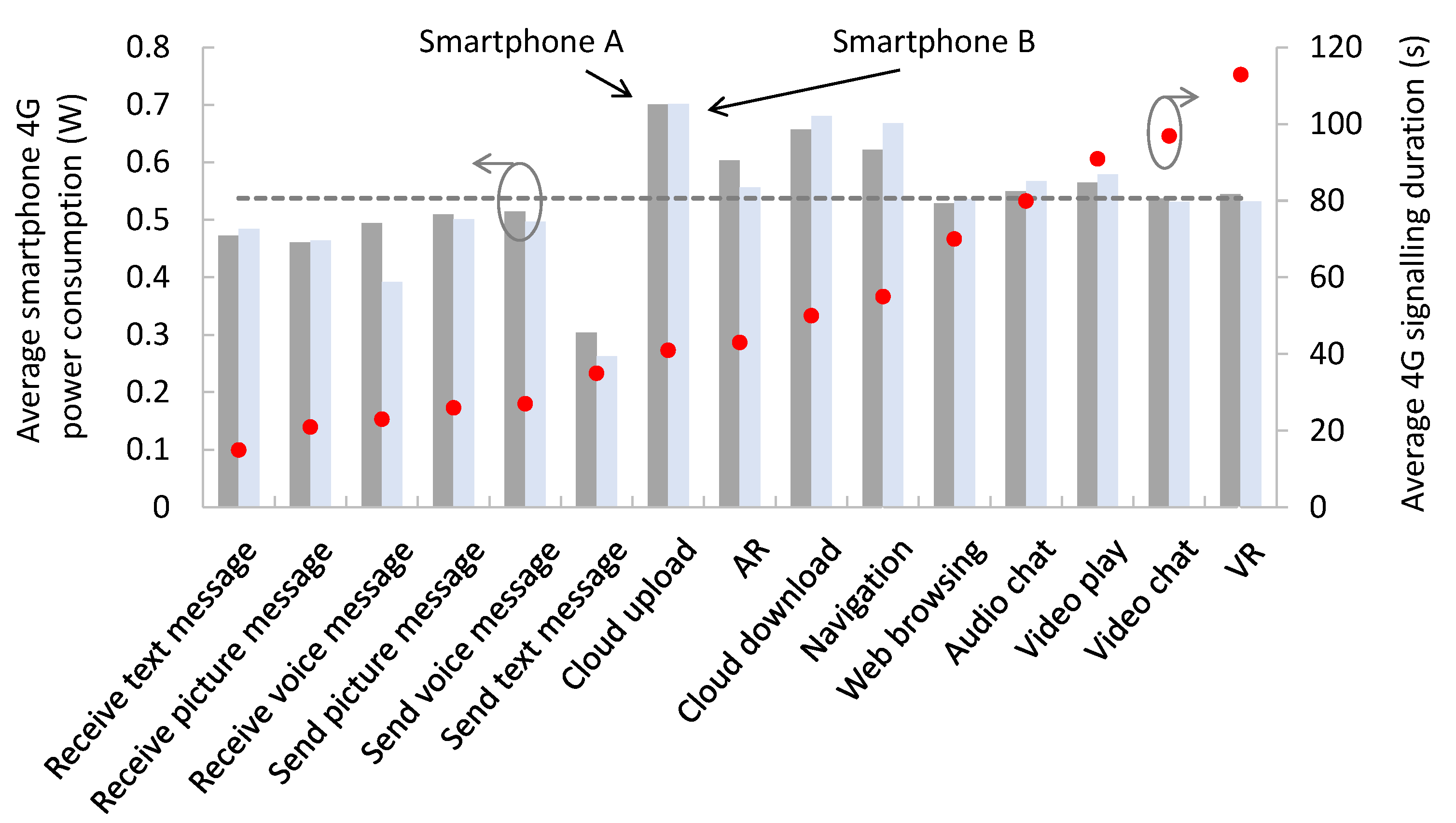
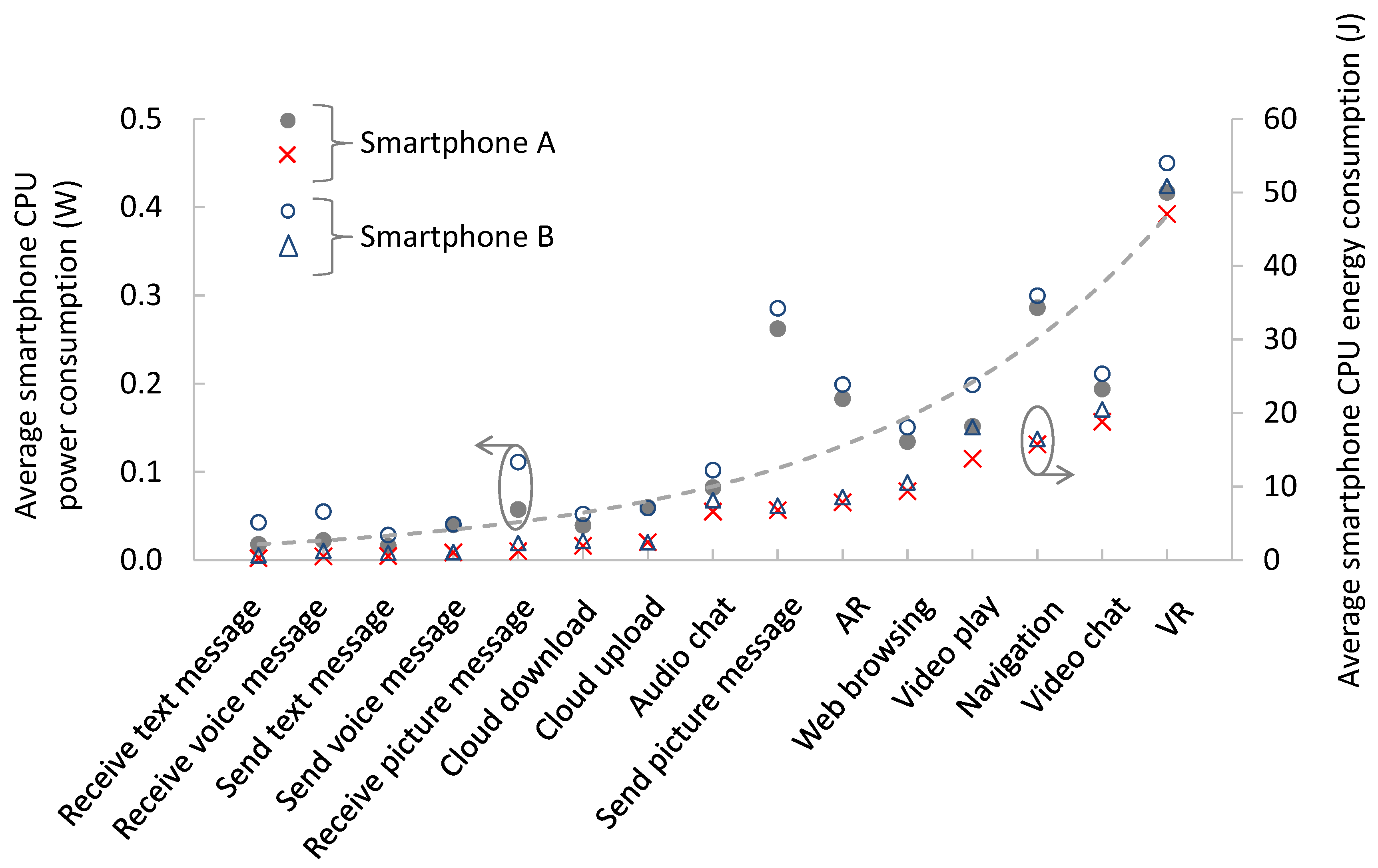

| No. | Services | Test Information | Average 4G UL Traffic (kBytes) | Average 4G DL Traffic (kBytes) | Average 4G Energy Consumption (J) | Average CPU Energy Consumption (J) | Average Signaling Duration (s) | Network Topology |
|---|---|---|---|---|---|---|---|---|
| 1 | Web browsing | Built-in browser, open m.sohu.com | 358.4 | 593.92 | 37.02 | 9.4 | 70 | U2DC |
| 2 | Navigation | Baidu Map, Place search and route planning | 184.32 | 440.32 | 34.2 | 15.75 | 55 | |
| 3 | Cloud upload | Baidu Cloud, upload a picture (size = 2.5 MB) | 2580.48 | 92.16 | 28.72 | 2.46 | 41 | |
| 4 | Cloud download | Baidu Cloud, download a picture (size = 2.5 MB) | 102.4 | 2641.92 | 32.86 | 1.98 | 50 | |
| 5 | Video play | Youku, open a video online (length = 60 s, size = 5 MB) | 194.56 | 5089.28 | 51.4 | 13.8 | 91 | |
| 6 | AR | Let’s go, display the store info in the screen | 20.48 | 163.84 | 25.93 | 7.88 | 43 | |
| 7 | VR video | Orange VR, open a video (length = 65 s, size = 58 MB) | 389.12 | 61440 | 61.5 | 47.1 | 113 | |
| 8 | Send text message | Wechat, type & send a 16-Chinese character text message | 0.57 | 0.51 | 10.63 | 0.56 | 35 | U2UvDC |
| 9 | Receive text message | Wechat, receive a 16-Chinese character text message | 0.41 | 0.47 | 7.09 | 0.27 | 15 | |
| 10 | Send voice message | Wechat, send a voice message (length = 10 s) | 18.37 | 2.63 | 13.89 | 1.08 | 27 | |
| 11 | Receive voice message | Wechat, receive a voice message (length = 10 s) | 3 | 26 | 11.37 | 0.52 | 23 | |
| 12 | Send picture message | Wechat, send a picture (size = 2.67 MB) | 2810 | 132 | 13.24 | 6.82 | 26 | |
| 13 | Receive picture message | Wechat, receive a picture (size = 2.67 MB) | 43 | 2793 | 9.67 | 1.21 | 21 | |
| 14 | Audio chat | Wechat, audio chat 60 s | 358.4 | 307.2 | 44 | 6.6 | 80 | U2U |
| 15 | Video chat | Wechat, video chat 60 s | 4321.28 | 5514.24 | 52.075 | 18.825 | 97 |
© 2019 by the authors. Licensee MDPI, Basel, Switzerland. This article is an open access article distributed under the terms and conditions of the Creative Commons Attribution (CC BY) license (http://creativecommons.org/licenses/by/4.0/).
Share and Cite
Yan, M.; Chan, C.A.; Gygax, A.F.; Yan, J.; Campbell, L.; Nirmalathas, A.; Leckie, C. Modeling the Total Energy Consumption of Mobile Network Services and Applications. Energies 2019, 12, 184. https://doi.org/10.3390/en12010184
Yan M, Chan CA, Gygax AF, Yan J, Campbell L, Nirmalathas A, Leckie C. Modeling the Total Energy Consumption of Mobile Network Services and Applications. Energies. 2019; 12(1):184. https://doi.org/10.3390/en12010184
Chicago/Turabian StyleYan, Ming, Chien Aun Chan, André F. Gygax, Jinyao Yan, Leith Campbell, Ampalavanapillai Nirmalathas, and Christopher Leckie. 2019. "Modeling the Total Energy Consumption of Mobile Network Services and Applications" Energies 12, no. 1: 184. https://doi.org/10.3390/en12010184
APA StyleYan, M., Chan, C. A., Gygax, A. F., Yan, J., Campbell, L., Nirmalathas, A., & Leckie, C. (2019). Modeling the Total Energy Consumption of Mobile Network Services and Applications. Energies, 12(1), 184. https://doi.org/10.3390/en12010184

