Pareto-Efficient Capacity Planning for Residential Photovoltaic Generation and Energy Storage with Demand-Side Load Management



Abstract
1. Introduction
2. System Model
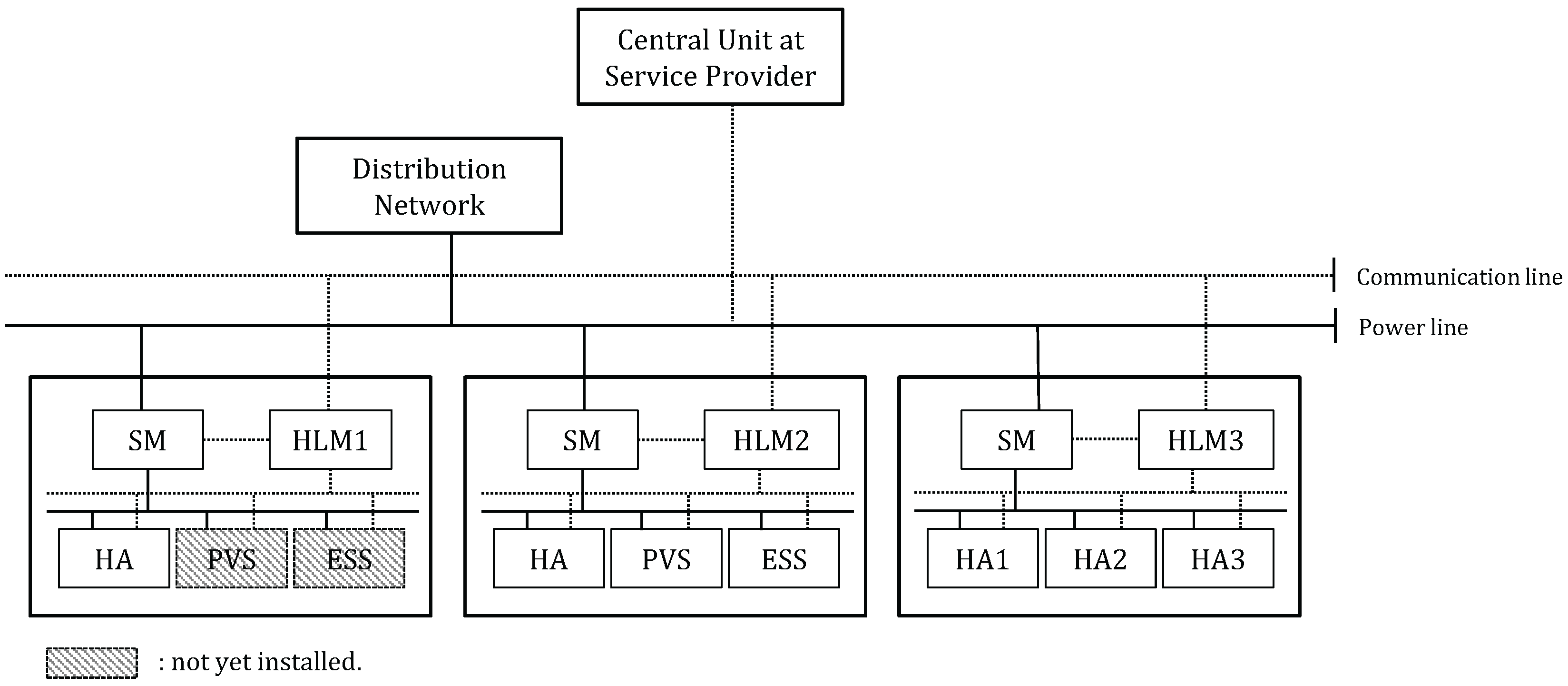
2.1. Smart Grid Model
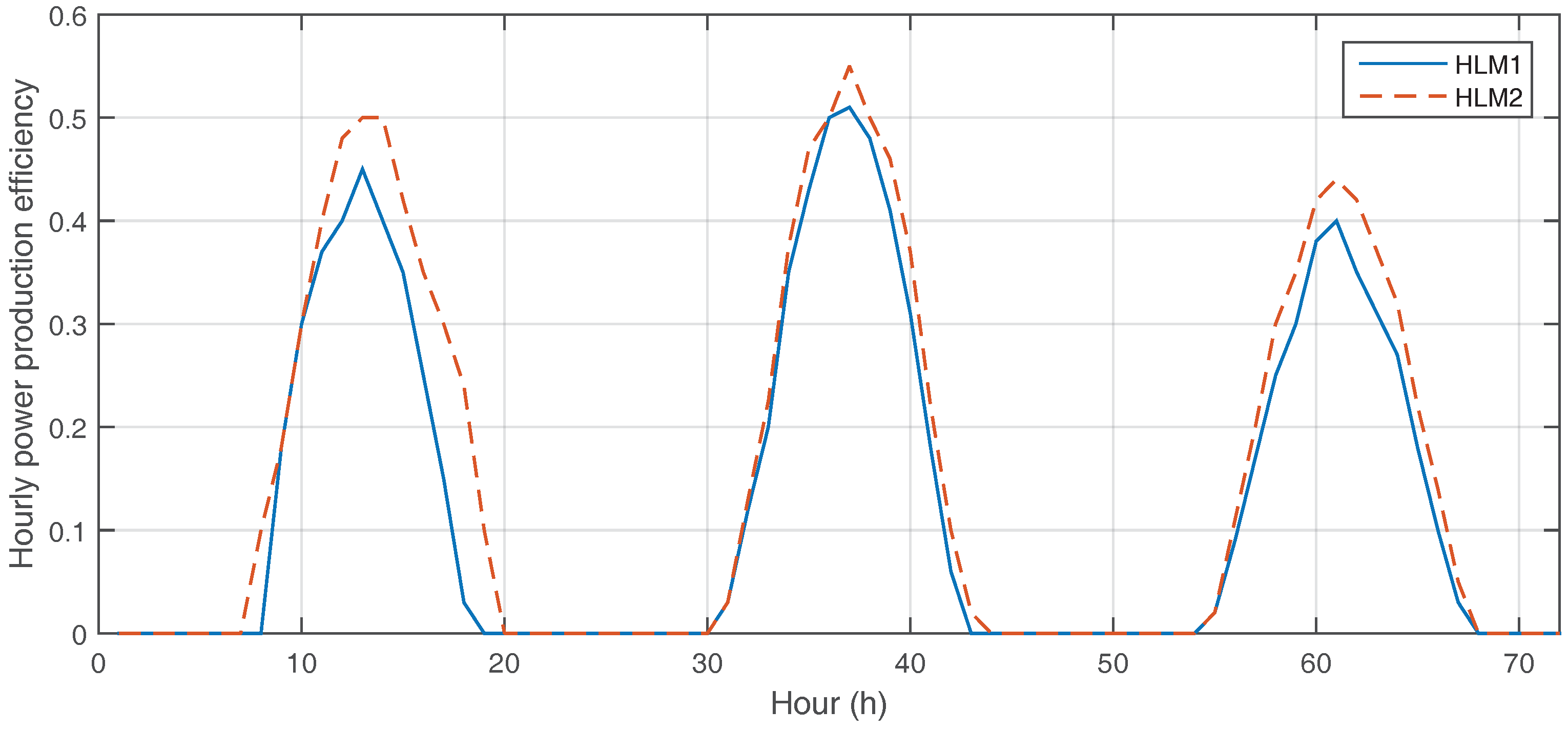
2.2. Photovoltaic Generation Model
2.3. Energy Storage Model
2.4. Residential Load Control by HLM Module
3. Capacity Planning Problem
3.1. Multi-Objective Formulation
3.2. Pareto-Optimal Solution
3.3. Game-Theoretic Approach
4. Numerical Results
4.1. Simulation Setup
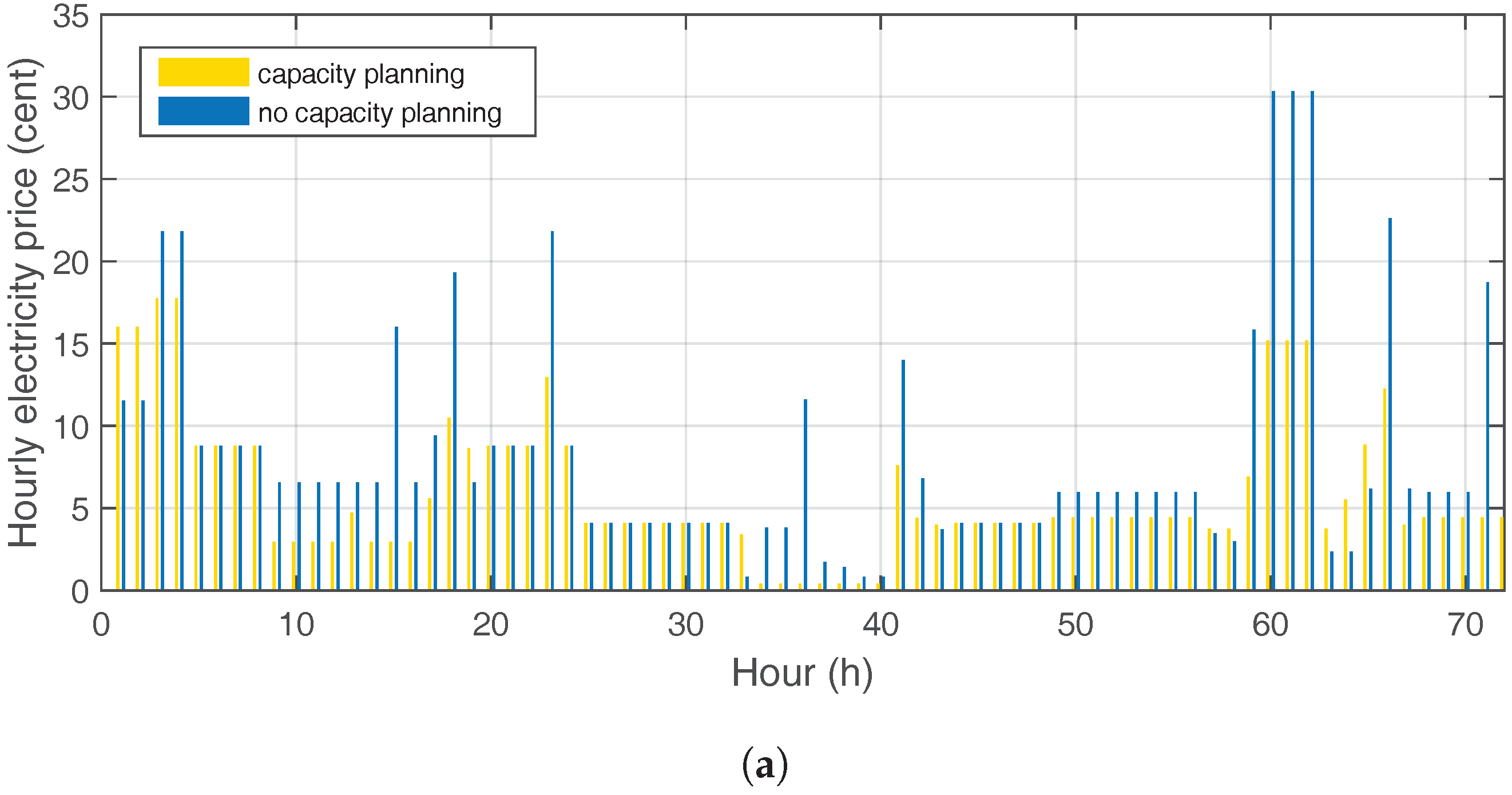
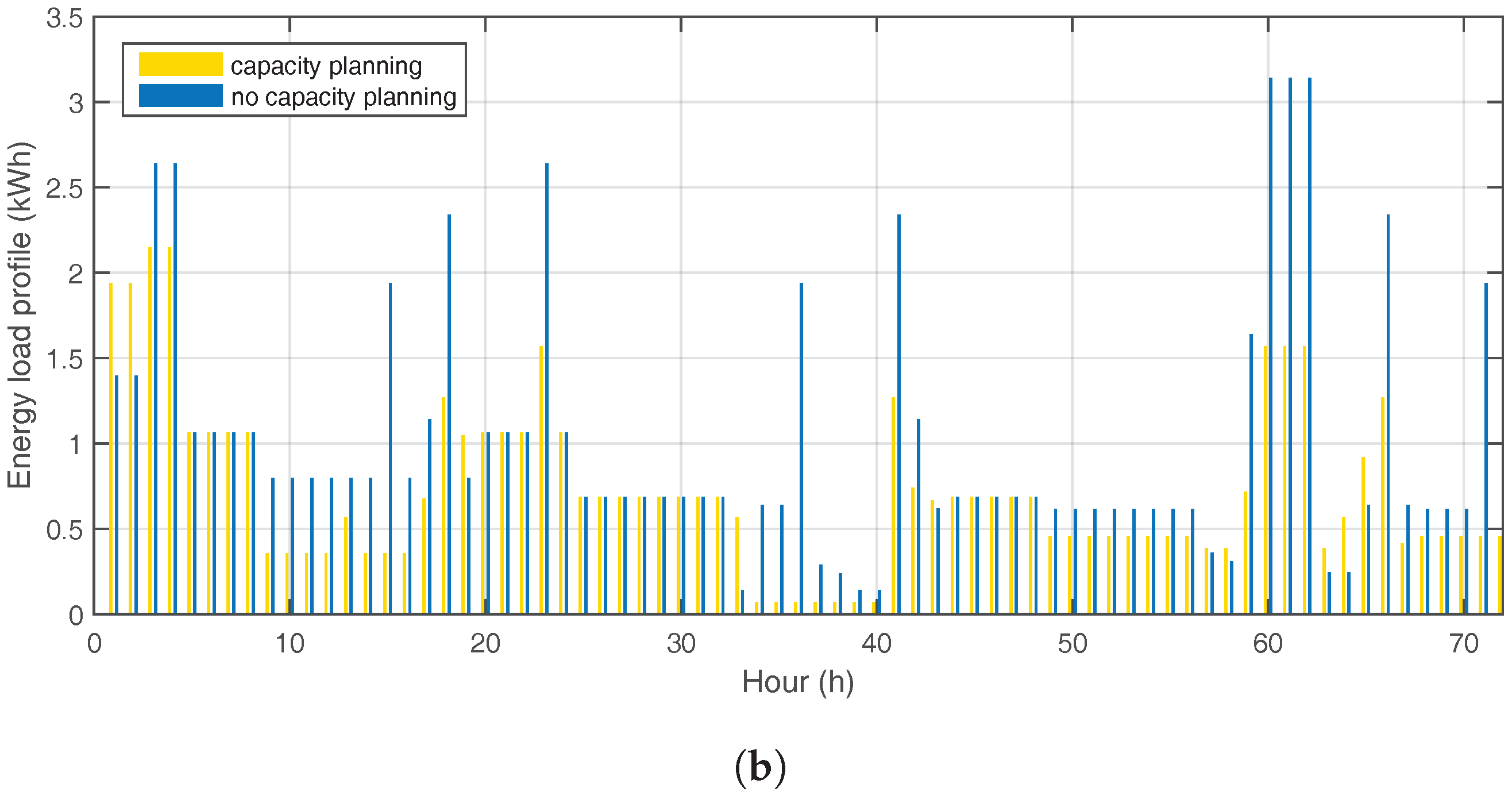
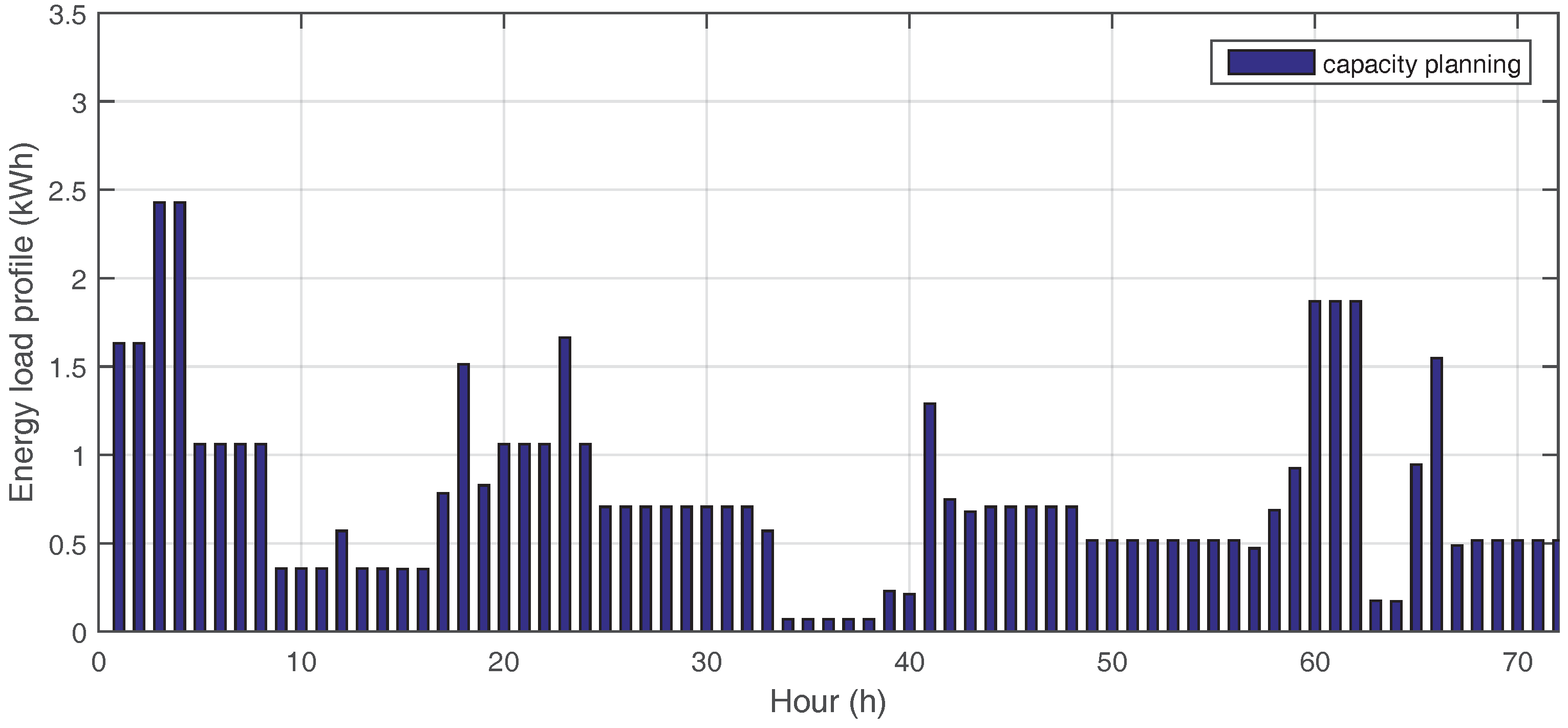
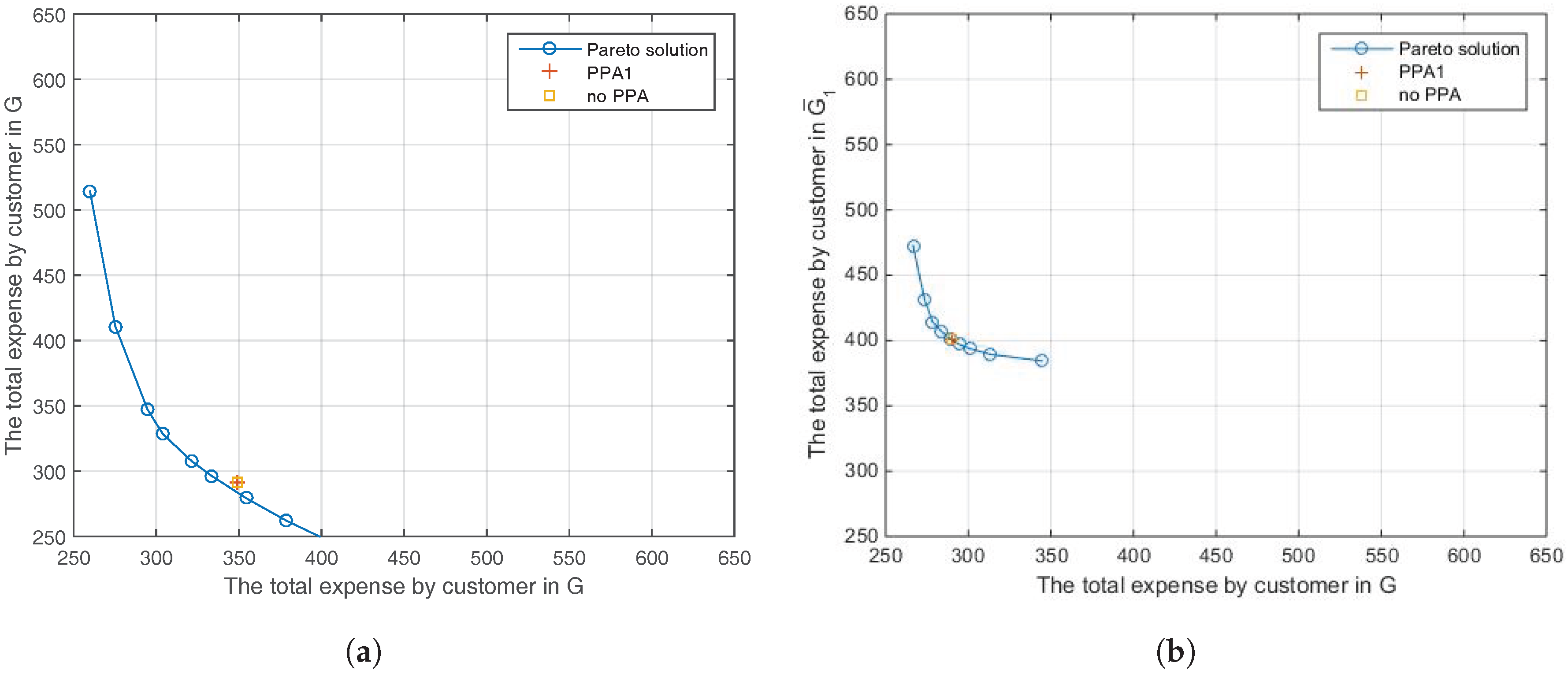
4.2. Pareto-Efficient Planning
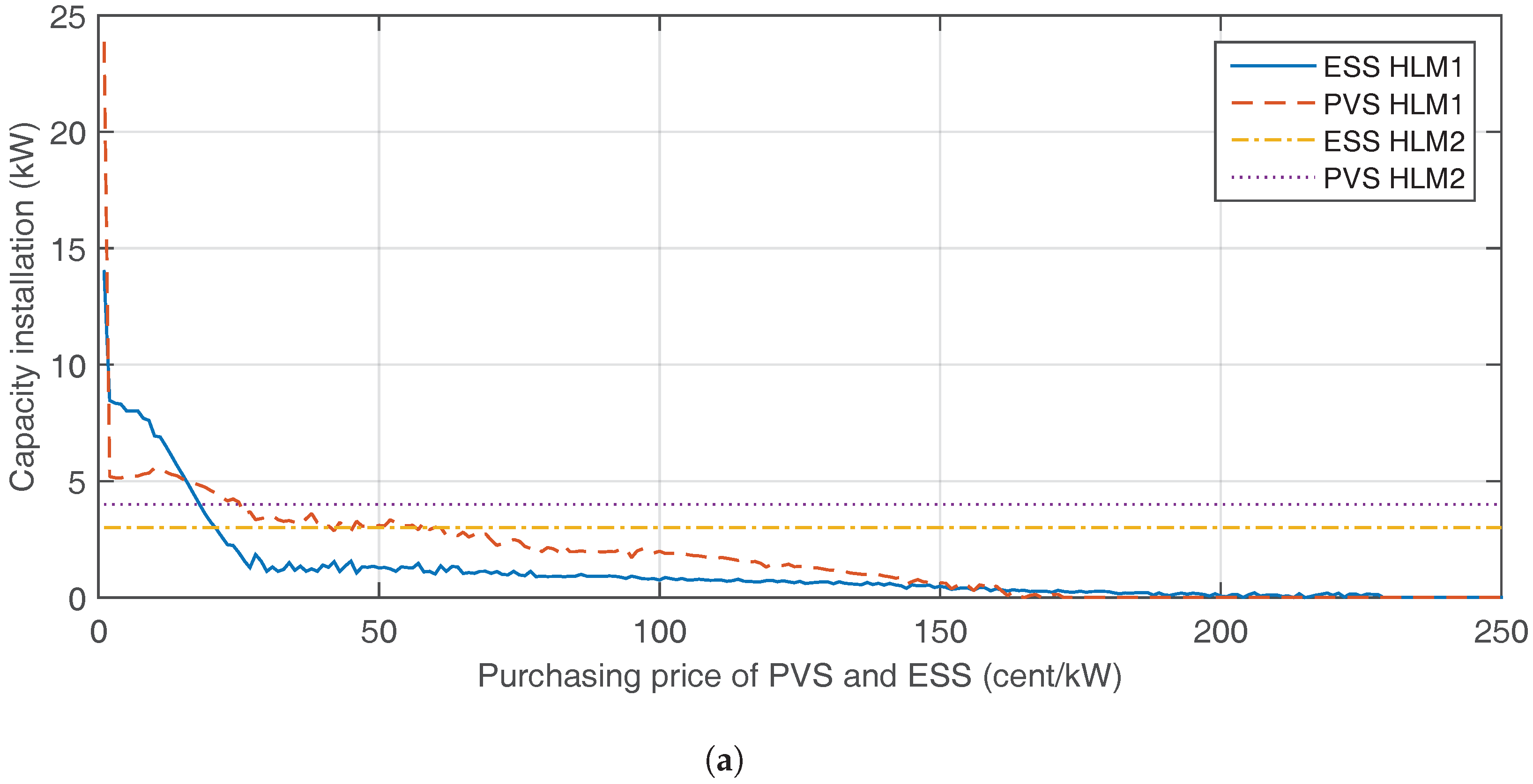
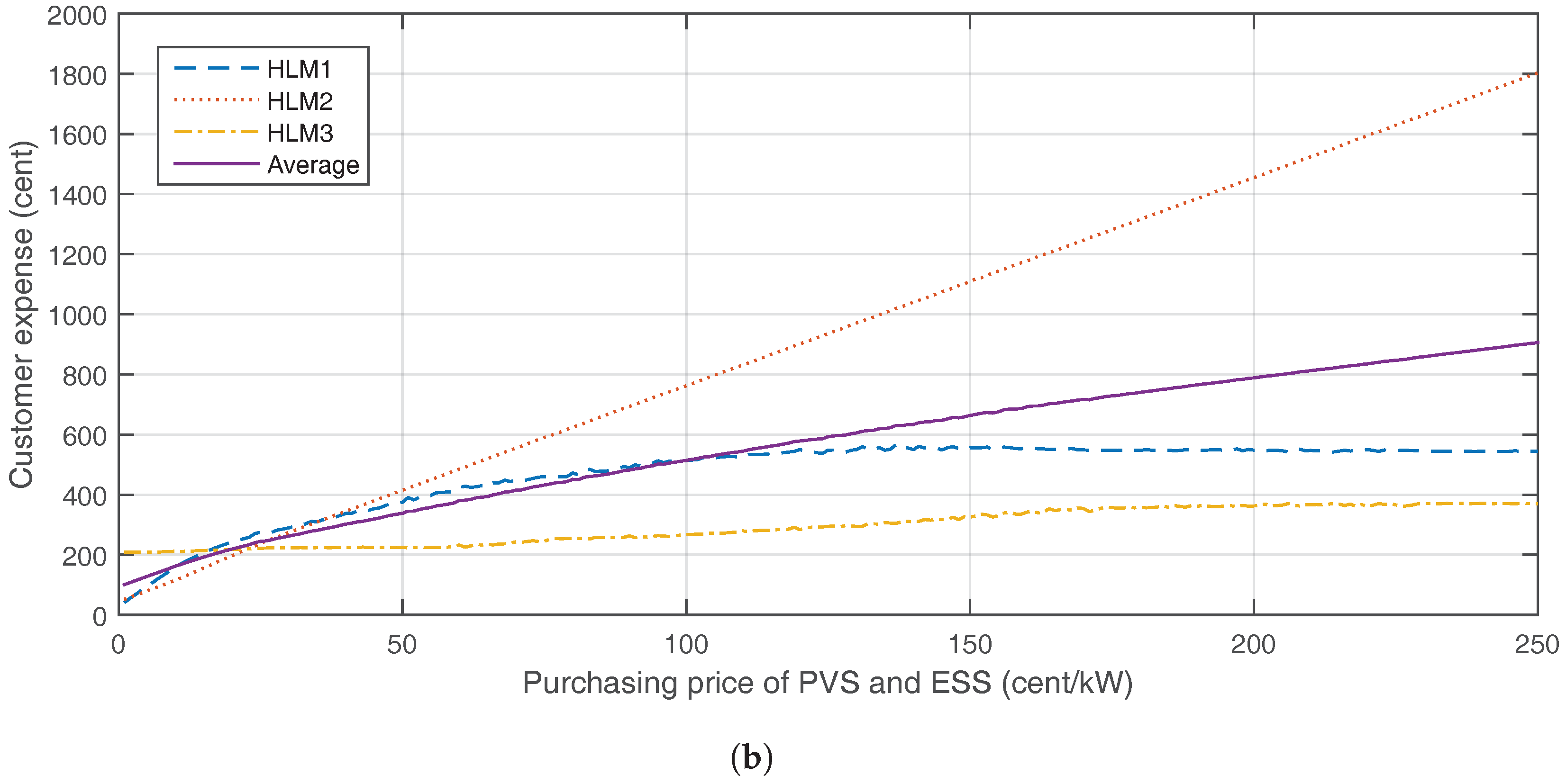
4.3. Game-Theoretic Planning
4.4. Pareto Solution vs. Game-Theoretic Solution
5. Conclusions
Acknowledgments
Author Contributions
Conflicts of Interest
Abbreviations
| SM | Smart meter |
| HLM | Home load management |
| HA | Home appliance |
| PVS | Photovoltaic generation |
| ESS | Energy storage system |
| NTS | Non time-shiftable |
| PS | Power-shiftable |
| TS | Time-shiftable |
| PPA | Proximal point algorithm |
References
- Technology Roadmap: Smart Grids. Available online: https://www.iea.org/publications/freepublications/publication/TechnologyRoadmapSolarPhotovoltaicEnergy_2014edition.pdf (accessed on 6 February 2017).
- Smart Grids: From innovation to Deployment, European Commission; Tech Report; The Commission to the European Parliament, the Council, the European Economic and Social Committee, and the Committee of the Regions: Brussels, Belgium, 12 April 2011.
- Masters, G.M. Renewable and Efficient Electric Power Systems; Wiley: Hoboken, NJ, USA, 2004. [Google Scholar]
- Reducing Electricity Consumption in Houses, Ontario Home Builders’ Assoc.; Energy Conservation Committee Report and Recommendations: Toronto, ON, Canada, 21 April 2006.
- Olivares, D.E.; Merhrizi-Sani, A.; Etemadi, A.H.; Canizares, C.A.; Iravani, R.; Kazerani, M.; Hajimiragha, A.H.; Gomis-Bellmunt, O.; Saeedifard, M.; Palma-Behnke, R.; et al. Trends in microgrid control. IEEE Trans. Smart Grid 2014, 5, 1905–1919. [Google Scholar] [CrossRef] [Scilit]
- Safdarian, A.; Fotuhi-Firuzabad, M.; Lehtonen, M. Optimal residential load management in smart grids: A decentralized framework. IEEE Trans. Smart Grid 2016, 7, 1836–1845. [Google Scholar] [CrossRef] [Scilit]
- Moradzadeh, B.; Tomsovic, K. Two-stage residential energy management considering network operational constraints. IEEE Trans. Smart Grid 2013, 4, 2339–2346. [Google Scholar] [CrossRef] [Scilit]
- Guo, Y.; Pan, M.; Fang, Y.; Khargonekar, P.P. Decentralized coordination of energy utilization for residential households in the smart grid. IEEE Trans. Smart Grid 2013, 4, 1341–1350. [Google Scholar] [CrossRef] [Scilit]
- Atzeni, I.; Ordóñez, L.G.; Scutari, G.; Palomar, D.P.; Fonollosa, J.R. Demand-side management via distributed energy generation and storage optimization. IEEE Trans. Smart Grid 2013, 4, 866–876. [Google Scholar] [CrossRef] [Scilit]
- Zhu, Z.; Chin, W.H. An integer linear programming based optimization for home demand-side management in smart grid. In Proceedings of the 2012 IEEE PES, Innovative Smart Grid Technologies (ISGT), Washington, DC, USA, 16–20 January 2012; pp. 1–5. [Google Scholar]
- Liu, R. An algorithmic game approach for demand side management in smart grid with distributed renewable power generation and storage. Energies 2016, 9, 654. [Google Scholar] [CrossRef] [Scilit]
- Diaf, S.; Notton, G.; Belhamel, M.; Haddadi, M.; Louche, A. Design and techno-economical optimization for hybrid PV/wind system under various meteorological conditions. Appl. Energy 2008, 85, 968–987. [Google Scholar] [CrossRef] [Scilit]
- Koutroulis, E.; Kolokotsa, D.; Potirakis, A.; Kalaitzakis, K. Methodology for optimal sizing of stand-alone photovoltaic/wind-generator systems using genetic algorithms. Sol. Energy 2006, 80, 1072–1088. [Google Scholar] [CrossRef] [Scilit]
- Yang, H.; Zhou, W.; Lu, L.; Fang, Z. Optimal sizing method for stand-alone hybrid solar/wind system with LPSP technology by using genetic algorithm. Sol. Energy 2008, 82, 354–367. [Google Scholar] [CrossRef] [Scilit]
- Dufo-Lopez, R.; Bernal-Agustin, J.L. Design and control strategies of PV-Diesel systems using genetic algorithms. Sol. Energy 2005, 79, 33–46. [Google Scholar] [CrossRef] [Scilit]
- Dufo-Lopez, R.; Bernal-Agustin, J.L.; Yusta-Loyo, J.M.; Domínguez-Navarro, J.A.; Ramírez-Rosado, I.J.; Lujano, J.; Aso, I. Multi-objective optimization minimizing cost and life cycle emissions of stand-alone PV/wind/diesel systems with batteries storage. Appl. Energy 2011, 88, 4033–4041. [Google Scholar] [CrossRef] [Scilit]
- Chen, H.-C. Optimum capacity determination of stand-alone hybrid generation system considering cost and reliability. Appl. Energy 2013, 103, 155–164. [Google Scholar] [CrossRef] [Scilit]
- Zhao, B.; Zhang, X.; Li, P.; Wang, K.; Xue, M.; Wang, C. Optimal sizing, operating strategy and operational experience of a stand-alone microgrid on Dongfushan Island. Appl. Energy 2014, 113, 1656–1666. [Google Scholar] [CrossRef] [Scilit]
- Perera, A.T.D.; Attalage, R.A.; Perera, K.K.C.K.; Dassanayake, V.P.C. A hybrid tool to combine multi-objective optimization and multi-criterion decision making in designing standalone hybrid energy systems. Appl. Energy 2013, 107, 412–425. [Google Scholar] [CrossRef] [Scilit]
- Nosrat, A.; Pearce, J.M. Dispatch strategy and model for hybrid photovoltaic and trigeneration power systems. Appl. Energy 2011, 88, 3270–3276. [Google Scholar] [CrossRef] [Scilit]
- Rubio-Maya, C.; Uche-Marcuello, J.; Martínez-Gracia, A.; Bayod-Rújula, A.A. Design optimization of a polygeneration plant fuelled by natural gas and renewable energy sources. Appl. Energy 2011, 88, 449–457. [Google Scholar] [CrossRef] [Scilit]
- Wang, J.; Zhai, Z.; Jing, Y.; Zhang, C. Particle swarm optimization for redundant building cooling heating and power system. Appl. Energy 2010, 87, 3668–3679. [Google Scholar] [CrossRef] [Scilit]
- Ko, M.J.; Kim, Y.S.; Chung, M.H.; Jeon, H.C. Multi-objective optimization design for a hybrid energy system using the genetic algorithm. Energies 2015, 8, 2924–2949. [Google Scholar] [CrossRef] [Scilit]
- Hernandez-Aramburo, C.A.; Green, T.C.; Mugniot, N. Fuel consumption minimization of a microgrid. IEEE Trans. Ind. Appl. 2005, 41, 673–681. [Google Scholar] [CrossRef] [Scilit]
- Varaiya, P.P.; Wu, F.F.; Bialek, J.W. Smart operation of smart grid: Risk-limiting dispatch. IEEE Proc. 2011, 99, 40–57. [Google Scholar] [CrossRef] [Scilit]
- Ontario Bill 150, Green Energy and Green Economy Act, 2009. Available online: http://www.ontla.on.ca/web/bills/bills_detail.do?BillID=2145 (accessed on 6 February 2017).
- Recent Facts about Photovoltaics in Germany. Available online: https://www.ise.fraunhofer.de/content/dam/ise/en/documents/publications/studies/recent-facts-about-photovoltaics-in-germany.pdf (accessed on 6 February 2017).
- Mohsenian-Rad, A.-H.; Wong, V.W.S.; Jatskevich, J.; Schober, R.; Leon-Garcia, A. Autonomous demand-side management based on game-theoretic energy consumption scheduling for the future smart grid. IEEE Trans. Smart Grid 2010, 1, 320–331. [Google Scholar] [CrossRef] [Scilit]
- Rockafellar, R.T. Monotone operators and the proximal point algorithm. SIAM J. Control Optim. 1976, 14, 877–898. [Google Scholar]
- Bracale, A.; Pierluigi, C.; Guido, C.; Anna, R.D.F.; Gabriella, F. A Bayesian method for short-term probabilistic forecasting of photovoltaic generation in smart grid operation and control. Energies 2013, 6, 733–747. [Google Scholar] [CrossRef] [Scilit]
- Duffie, J.A.; Beckman, W.A. Solar Engineering of Thermal Processes; John Wiley & Sons: Hoboken, NJ, USA, 2013. [Google Scholar]
- Pareto, V. Cours d’ Economie Politique, Rouge, Lausanne, 1897. Reprinted as the First Volume of Oeuvres Completes; Droz: Geneva, Switzerland, 1964. [Google Scholar]
- Chankong, V.; Haimes, Y.Y. Multiobjective Decision Making: Theory and Methodology; Courier Dover Publications: Mineola, NY, USA, 2008. [Google Scholar]
- Parikh, N.; Boyd, S. Proximal algorithms. Found. Trends Optim. 2014, 1, 127–239. [Google Scholar] [CrossRef] [Scilit]






| Type | Symbol | Definition |
|---|---|---|
| Sets | set of customers in the power system | |
| set of customers that are willing to install PVS and ESS at their home | ||
| set of customers that are already equipped with PVS and ESS | ||
| set of customers that currently do not consider PVS and ESS | ||
| set of household appliances at customer n | ||
| Parameters | daily price profile at hour h. | |
| unit cost of installing PVS by customer n | ||
| unit cost of installing ESS by customer n | ||
| r | market rate of interest per day | |
| hourly power production efficiency of PVS installed by customer n | ||
| PV capacity installed by customer n at hour h | ||
| ES capacity installed by customer n at hour h | ||
| leakage rate of ES installed by customer n | ||
| charging efficiency of ES installed by customer n | ||
| discharging efficiency of installed by customer n | ||
| daily electricity requirement of appliance a at customer n | ||
| fixed energy requirement of appliance a at customer n | ||
| standby power of appliance a at customer n | ||
| maximum working power of appliance a at customer n | ||
| fixed energy consumption pattern of appliance a at customer n | ||
| matrix of standby power of appliance a at customer n | ||
| matrix of maximum working power of appliance a at customer n | ||
| Variables | energy load profile by customer n at hour h | |
| electricity requirement due to charging ESS by customer n at hour h | ||
| PV energy generation profile by customer n at hour h | ||
| energy generated by PV at hour h and immediately used at that time slot in customer n | ||
| energy storage profile of customer n at hour h | ||
| energy charging profile of customer n at hour h | ||
| energy discharging profile of customer n at hour h | ||
| PV capacity installed by customer n | ||
| ES capacity installed by customer n | ||
| energy consumption scheduling of appliance a in customer n at hour h | ||
| binary variable indicating switch control for the time-shiftable appliances |
| Notation | Constraint | Index Set | |
|---|---|---|---|
| . | a ∈ | ||
| . | |||
| , = 0 or 1. | |||
| . | n ∈ | ||
| 0. | |||
| n | |||
| n | |||
| Step 0. | Set and an initial reference solution |
| Find any initial feasible starting point . Set and . | |
| Step 1. | For , each customer computes such that |
| subject to the constraints in (22). | |
| Step 2. | If a Nash equilibrium is reached, go to Step 3. Otherwise, update and go to Step 1. |
| Step 3. | If , then terminate. |
| Otherwise, update for , and . And go to Step 1. |
| Appliance | HLM1 | HLM2 | HLM3 | ||||
|---|---|---|---|---|---|---|---|
| Class | Type | Consumption Requirement | Time Period | Consumption Requirement | Time Period | Consumption Requirement | Time Period |
| NTS | Hob and oven | 1.0(H) | 17–18 | 1.0(H) | 17–18 | 1.2(H) | 18 |
| Heater | 1.0(H) | 3–4, 23 | 1.0(H) | 3–4, 23 | 1.5(H) | 3–4, 23 | |
| Fridge and freezer | 0.07(H) | 24 h | 0.07(H) | 24 h | 0.07(H) | 24 h | |
| Air conditioner | 1.5(H) | 11–14 | 1.55(H) | 11–14 | 1.5(H) | 12–14 | |
| PS | Water boiler | 0–1.2, 2(D) | 24 h | 0–1.5, 2(D) | 24 h | 0–1.2,2(D) | 24 h |
| Electric fan | 0–0.07, 0.7(D) | 24 h | 0–0.07, 0.8(D) | 24 h | 0–0.07, 0.8(D) | 24 h | |
| Electric vehicle | 0–3.5(D) | 20–8 | 0–2.3(D) | 20–8 | - | - | |
| TS | Washing machine | 0.5(H) | 1 h /day | 0.5(H) | 1 h/day | 0.5(H) | 1 h/day |
| TV | 0.1, 0.15(H) | 2 h/day | 0.1, 0.15(H) | 2 h/day | - | - | |
| Dishwasher | 1.8(H) | 1 h/day | - | - | - | - | |
© 2017 by the authors. Licensee MDPI, Basel, Switzerland. This article is an open access article distributed under the terms and conditions of the Creative Commons Attribution (CC BY) license (http://creativecommons.org/licenses/by/4.0/).
Share and Cite
Jung, S.; Kim, D. Pareto-Efficient Capacity Planning for Residential Photovoltaic Generation and Energy Storage with Demand-Side Load Management. Energies 2017, 10, 426. https://doi.org/10.3390/en10040426
Jung S, Kim D. Pareto-Efficient Capacity Planning for Residential Photovoltaic Generation and Energy Storage with Demand-Side Load Management. Energies. 2017; 10(4):426. https://doi.org/10.3390/en10040426
Chicago/Turabian StyleJung, Somi, and Dongwoo Kim. 2017. "Pareto-Efficient Capacity Planning for Residential Photovoltaic Generation and Energy Storage with Demand-Side Load Management" Energies 10, no. 4: 426. https://doi.org/10.3390/en10040426
APA StyleJung, S., & Kim, D. (2017). Pareto-Efficient Capacity Planning for Residential Photovoltaic Generation and Energy Storage with Demand-Side Load Management. Energies, 10(4), 426. https://doi.org/10.3390/en10040426