
Diagnostic Criteria for Convergence Excess: Diagnostic Validity of Clinical Signs Associated with Near Esophoria
 ,
,  , and
, and
Abstract
1. Introduction
2. Materials and Methods
2.1. Patients
2.2. Statistical Analysis
3. Results
4. Discussion
5. Conclusions
Author Contributions
Funding
Institutional Review Board Statement
Informed Consent Statement
Data Availability Statement
Conflicts of Interest
Abbreviations
| AA | Accommodative Amplitude |
| ACT | Alternate Cover Test |
| AUC | Area Under the Curve |
| BAF | Binocular Accommodative Facility |
| CE | Convergence Excess |
| LR | Likelihood Ratio |
| NFV | Negative Fusional Vergence |
| NPC | Near Point of Convergence |
| PRA | Positive Relative Accommodation |
| ROC | Receiver Operating Characteristic |
| SQVD | Symptom Questionnaire for Visual Dysfunctions |
| VF | Vergence Facility |
References
- Scheiman, M.; Wick, B. Clinical Management of Binocular Vision, 5th ed.; Wolters Kluwer: Philadelphia, PA, USA, 2020. [Google Scholar]
- Cacho-Martínez, P.; García-Muñoz, A.; Ruiz-Cantero, M.T. Do we really know the prevalence of accomodative and nonstrabismic binocular dysfunctions? J. Optom. 2010, 3, 185–197. [Google Scholar] [CrossRef] [Scilit]
- Shin, H.S.; Park, S.C.; Park, C.M. Relationship between accommodative and vergence dysfunctions and academic achievement for primary school children. Ophthalmic Physiol. Opt. 2009, 29, 615–624. [Google Scholar] [CrossRef] [Scilit]
- Hoseini-Yazdi, S.H.; Yekta, A.; Nouri, H.; Heravian, J.; Ostadimoghaddam, H.; Khabazkhoob, M. Frequency of convergence and accommodative disorders in a clinical population of Mashhad, Iran. Strabismus 2015, 23, 22–29. [Google Scholar] [CrossRef] [Scilit]
- Jang, J.U.; Park, I.J. Prevalence of general binocular dysfunctions among rural schoolchildren in South Korea. Taiwan J. Ophthalmol. 2015, 5, 177–181. [Google Scholar] [CrossRef] [Scilit]
- García-Munoz, A.; Carbonell-Bonete, S.; Canto-Cerdán, M.; Cacho-Martínez, P. Accommodative and binocular dysfunctions: Prevalence in a randomised sample of university students. Clin. Exp. Optom. 2016, 99, 313–321. [Google Scholar] [CrossRef] [Scilit]
- Ovenseri-Ogbomo, G.O.; Eguegu, O.P. Vergence findings and horizontal vergence dysfunction among first year university students in Benin City, Nigeria. J. Optom. 2016, 9, 258–263. [Google Scholar] [CrossRef] [Scilit] [PubMed]
- Wajuihian, S.O.; Hansraj, R. Vergence anomalies in a sample of high school students in South Africa. J. Optom. 2016, 9, 246–257. [Google Scholar] [CrossRef] [Scilit] [PubMed]
- Hussaindeen, J.R.; Rakshit, A.; Singh, N.K.; George, R.; Swaminathan, M.; Kapur, S.; Scheiman, M.; Ramani, K.K. Prevalence of non-strabismic anomalies of binocular vision in Tamil Nadu: Report 2 of BAND study. Clin. Exp. Optom. 2017, 100, 642–648. [Google Scholar] [CrossRef] [Scilit]
- Porcar, E.; Montalt, J.C.; Pons, A.M.; Espana-Gregori, E. Symptomatic accommodative and binocular dysfunctions from the use of flat-panel displays. Int. J. Ophthalmol. 2018, 11, 501–505. [Google Scholar] [CrossRef] [Scilit] [PubMed]
- Atowa, U.C.; Wajuihian, S.O.; Hansraj, R. Vergence Profile and Prevalance of Non-Strabismic Vergence Anomalies Among School Children in Abia State, Nigeria. Ophthalmic Epidemiol. 2019, 26, 121–131. [Google Scholar] [CrossRef] [Scilit]
- Ma, M.M.; Yeo, A.C.H.; Scheiman, M.; Chen, X. Vergence and Accommodative Dysfunctions in Emmetropic and Myopic Chinese Young Adults. J. Ophthalmol. 2019, 2019, 5904903. [Google Scholar] [CrossRef] [Scilit]
- Atiya, A.; Hussaindeen, J.R.; Kasturirangan, S.; Ramasubramanian, S.; Swathi, K.; Swaminathan, M. Frequency of undetected binocular vision anomalies among ophthalmology trainees. J. Optom. 2020, 13, 185–190. [Google Scholar] [CrossRef] [Scilit] [PubMed]
- Jorge, J.; Diaz-Rey, A.; Lira, M. Prevalence of binocular vision dysfunctions in professional football players. Clin. Exp. Optom. 2022, 105, 853–859. [Google Scholar] [CrossRef] [Scilit]
- Franco, S.; Moreira, A.; Fernandes, A.; Baptista, A. Accommodative and binocular vision dysfunctions in a Portuguese clinical population. J. Optom. 2022, 15, 271–277. [Google Scholar] [CrossRef] [Scilit]
- Shrestha, P.; Kaiti, R. Non-strabismic Binocular Vision Dysfunction among the Medical Students of a Teaching Hospital: A Descriptive Cross-sectional Study. JNMA J. Nepal. Med. Assoc. 2022, 60, 693–696. [Google Scholar] [CrossRef] [Scilit] [PubMed]
- Wu, Y.; Xiong, L.; Wang, Y.; Chen, Q.; Li, F.; Zhang, W.; Liu, L. Frequencies and patterns of symptoms in Chinese adults with accommodative and binocular dysfunctions. Graefes Arch. Clin. Exp. Ophthalmol. 2023, 261, 2961–2970. [Google Scholar] [CrossRef] [Scilit]
- Tan, Q.Q.; Lewis, J.S.; Lan, C.J.; Liao, X.; Tang, X.L.; Wang, J.; Scheiman, M.M. Preoperative binocular vision characteristics in the age-related cataract population. BMC Ophthalmol. 2022, 22, 196. [Google Scholar] [CrossRef] [Scilit]
- Cai, J.; Fan, W.W.; Zhong, Y.H.; Wen, C.L.; Wei, X.D.; Wei, W.C.; Xiang, W.Y.; Chen, J.M. Frequency and associated factors of accommodation and non-strabismic binocular vision dysfunction among medical university students. Int. J. Ophthalmol. 2024, 17, 374–379. [Google Scholar] [CrossRef] [Scilit]
- Bhowmick, A.; Kumar, P.P.; Ratra, D. Frequency of Non-strabismic Binocular Vision Anomalies among Optometrists in a Tertiary Eye Care Center in Southern India. Indian J. Occup. Environ. Med. 2024, 28, 138–142. [Google Scholar] [CrossRef] [Scilit] [PubMed]
- Mukhtar, I.S.; Ezinne, N.E.; Mohamad Shahimin, M.; Mohd-Ali, B.; Oghre, E.; Zeried, F.M.; Osuagwu, U.L. Age-Matched Comparative Analysis of Binocular Vision Anomalies among Children with Dyslexia in Northern Nigeria. Pediatr. Rep. 2024, 16, 566–578. [Google Scholar] [CrossRef] [Scilit]
- Ceple, I.; Svede, A.; Serpa, E.; Kassaliete, E.; Volberga, L.; Mikelsone, R.; Berzina, A.; Ganebnaya, A.; Krauze, L.; Krumina, G. The Prevalence of Accommodative and Binocular Dysfunctions in Children with Reading Difficulties. Life 2024, 15, 7. [Google Scholar] [CrossRef] [Scilit]
- Chhetri, S.; Poudel, R.; Adhikari, S.; Belbase, U.; Cantó-Cerdán, M.; Poudel, M.; Thapa, S. Prevalence and clinical profile of non-strabismic binocular vision anomalies in the Nepalese population: A hospital-based study. J. Optom. 2025, 18, 100575. [Google Scholar] [CrossRef] [Scilit]
- Silva-Viguera, M.C.; Sanchez-Gonzalez, M.C.; Ponce-García, V.; De-Hita-Cantalejo, C.; Sanchez-Gonzalez, J.M.; Bautista-Llamas, M.J. Impact of type 1 diabetes on binocular vision: Evidence from a comparative analysis. Ann. N. Y. Acad. Sci. 2025, 1549, 208–218. [Google Scholar] [CrossRef] [Scilit]
- Yushan, D.; Hong, Z. Frequency and associated factors of accommodative and non-strabismic binocular vision dysfunctions among clinical adults in Western China: A cross-sectional study. Medicine 2025, 104, e43881. [Google Scholar] [CrossRef] [Scilit]
- Cacho-Martínez, P.; García-Munoz, A.; Ruiz-Cantero, M.T. Is there any evidence for the validity of diagnostic criteria used for accommodative and nonstrabismic binocular dysfunctions? J. Optom. 2014, 7, 2–21. [Google Scholar] [CrossRef] [Scilit]
- García-Munoz, A.; Carbonell-Bonete, S.; Cacho-Martínez, P. Symptomatology associated with accommodative and binocular vision anomalies. J. Optom. 2014, 7, 178–192. [Google Scholar] [CrossRef] [Scilit]
- Cacho-Martínez, P.; García-Munoz, A.; Ruiz-Cantero, M.T. Treatment of accommodative and nonstrabismic binocular dysfunctions: A systematic review. Optometry 2009, 80, 702–716. [Google Scholar] [CrossRef] [Scilit] [PubMed]
- Dwyer, P.; Wick, B. The influence of refractive correction upon disorders of vergence and accommodation. Optom. Vis. Sci. 1995, 72, 224–232. [Google Scholar] [CrossRef] [Scilit]
- Lara, F.; Cacho, P.; García, A.; Megías, R. General binocular disorders: Prevalence in a clinic population. Ophthalmic Physiol. Opt. 2001, 21, 70–74. [Google Scholar] [CrossRef] [Scilit] [PubMed]
- Porcar, E.; Martínez-Palomera, A. Prevalence of general binocular dysfunctions in a population of university students. Optom. Vis. Sci. 1997, 74, 111–113. [Google Scholar] [CrossRef] [Scilit] [PubMed]
- García, A.; Cacho, P.; Lara, F. Evaluating relative accommodations in general binocular dysfunctions. Optom. Vis. Sci. 2002, 79, 779–787. [Google Scholar] [PubMed]
- Gallaway, M.; Schieman, M. The efficacy of vision therapy for convergence excess. J. Am. Optom. Assoc. 1997, 68, 81–86. [Google Scholar]
- Dwyer, P. Clinical criteria for vergence accommodation dysfunction. Clin. Exp. Optom. 1991, 74, 112–119. [Google Scholar] [CrossRef] [Scilit]
- Dwyer, P. The prevalence of vergence accommodation disorders in a school-age population. Clin. Exp. Optom. 1992, 75, 10–18. [Google Scholar] [CrossRef] [Scilit]
- Fletcher, G.S. Clinical Epidemiology: The Essentials, 6th ed.; Lippincott Williams & Wilkins: Philadelphia, PA, USA, 2020. [Google Scholar]
- Russell, G.E.; Wick, B. A prospective study of treatment of accommodative insufficiency. Optom. Vis. Sci. 1993, 70, 131–135. [Google Scholar] [CrossRef] [Scilit]
- Rainey, B.B.; Schroeder, T.L.; Goss, D.A.; Grosvenor, T.P. Reliability of and comparisons among three variations of the alternating cover test. Ophthalmic Physiol. Opt. 1998, 18, 430–437. [Google Scholar] [CrossRef] [Scilit]
- Cacho-Martínez, P.; Canto-Cerdán, M.; Lara-Lacarcel, F.; García-Munoz, A. Validation of the Symptom Questionnaire for Visual Dysfunctions (SQVD): A Questionnaire to Evaluate Symptoms of any Type of Visual Dysfunctions. Transl. Vis. Sci. Technol. 2022, 11, 7. [Google Scholar] [CrossRef] [Scilit]
- Morgan, M.W. Analysis of clinical data. Am. J. Optom. Arch. Am. Acad. Optom. 1944, 21, 477–491. [Google Scholar] [CrossRef] [Scilit]
- Morgan, M.W. The clinical aspects of accommodation and convergence. Am. J. Opt. Physiol. Opt. 1944, 21, 301–313. [Google Scholar] [CrossRef] [Scilit]
- Grimes, D.A.; Schulz, K.F. Refining clinical diagnosis with likelihood ratios. Lancet 2005, 365, 1500–1505. [Google Scholar] [CrossRef] [Scilit] [PubMed]
- Hayden, S.R.; Brown, M.D. Likelihood ratio: A powerful tool for incorporating the results of a diagnostic test into clinical decisionmaking. Ann. Emerg. Med. 1999, 33, 575–580. [Google Scholar] [CrossRef] [Scilit]
- Nahm, F.S. Receiver operating characteristic curve: Overview and practical use for clinicians. Korean J. Anesthesiol. 2022, 75, 25–36. [Google Scholar] [CrossRef] [Scilit] [PubMed]
- Hajian-Tilaki, K. Sample size estimation in diagnostic test studies of biomedical informatics. J. Biomed. Inform. 2014, 48, 193–204. [Google Scholar] [CrossRef] [Scilit] [PubMed]
- Gall, R.; Wick, B.; Bedell, H. Vergence facility: Establishing clinical utility. Optom. Vis. Sci. 1998, 75, 731–742. [Google Scholar] [CrossRef] [Scilit] [PubMed]
- Zellers, J.; Alpert, T.; Rouse, M. A review of the literature and a normative study of accommodative facility. J. Am. Optom. Assoc. 1984, 55, 31–37. [Google Scholar]
- Schor, C.; Horner, D. Adaptive disorders of accommodation and vergence in binocular dysfunction. Ophthalmic Physiol. Opt. 1989, 9, 264–268. [Google Scholar] [CrossRef] [Scilit]


| ESO Group | Control Group |
|---|---|
| SQVD score ≥ 6. | SQVD score < 6. |
| Near esophoria ≥ 1 Δ. (As the expected value of near phoria [1,40,41] ranges between orthophoria and 5.5 ∆ of exophoria, the low limit was selected to consider a value of 1Δ of esophoria as a near esophoria) Normative values of distance phoria [40,41] or having a difference between both distance and near phoria out of a range of 5 ∆ [1]. | Normative values for distance and near phoria [1,40,41]. |
| Far and near visual acuity ≥20/20 with the best prescription, without ocular motility disorders, vertical deviation, strabismus, or any type of ocular pathology. | Far and near visual acuity ≥20/20 with the best prescription, without ocular motility disorders, vertical deviation, strabismus, or ocular pathology. |
| Sample Data | Control Group (N = 64) Average Value ± SD | Esophoria Group (N = 64) Average Value ± SD | Z | p-Value | |
|---|---|---|---|---|---|
| Age | 24.09 ± 4.16 | 24.09 ± 4.12 | −0.022 | 0.983 | |
| Habitual prescription | |||||
| M OD | −2.00 ± 2.10 | −1.83 ± 2.07 | −0.308 | 0.758 | |
| J0 OD | 0.04 ± 0.18 | −0.05 ± 0.26 | −0.944 | 0.345 | |
| J45 OD | −0.02 ± 0.10 | −0.02 ± 0.13 | −0.380 | 0.704 | |
| M OS | −1.92 ± 2.07 | −1.83 ± 2.01 | −0.119 | 0.906 | |
| J0 OS | 0.05 ± 0.24 | 0.01 ± 0.26 | −0.416 | 0.755 | |
| J45 OS | −0.03 ± 0.14 | 0.01 ± 0.12 | −1.478 | 0.139 | |
| Subjective exam | |||||
| M OD | −1.92 ± 2.33 | −1.80 ± 2.11 | −0.047 | 0.963 | |
| J0 OD | 0.03 ± 0.20 | −0.03 ± 0.26 | −0.407 | 0.684 | |
| J45 OD | 0.00 ± 0.15 | 0.00 ± 0.12 | −0.431 | 0.534 | |
| M OS | −1.79 ± 2.23 | −1.82 ± 2.00 | −0.608 | 0.543 | |
| J0 OS | 0.05 ± 0.26 | 0.03 ± 0.27 | −0.432 | 0.706 | |
| J45 OS | −0.02 ± 0.14 | 0.00 ± 0.14 | −0.686 | 0.403 | |
| Near cover test | −1.92 ± 1.79 | 4.83 ± 3.57 | −9.802 | <0.001 * | |
| SQVD | 2.97 ± 1.81 | 7.61 ± 1.64 | −6.588 | <0.001 * | |
| Test | Control Group (N = 64) Average Value ± SD | Esophoria Group (N = 64) Average Value ± SD | Z | p-Value |
|---|---|---|---|---|
| AA OD | 11.63 ± 2.23 D | 11.51 ± 2.83 D | −0.880 | 0.379 |
| AA OS | 11.64 ± 2.33 D | 11.75 ± 3.11 D | −0.393 | 0.694 |
| MAF OD | 13.46 ± 3.55 cpm | 10.14 ± 4.83 cpm | −3.802 | <0.001 * |
| MAF OS | 13.80 ± 3.90 cpm | 10.26 ± 4.92 cpm | −3.545 | <0.001 * |
| BAF | 11.81 ± 4.33 cpm | 5.20 ± 3.96 cpm | −7.148 | <0.001 * |
| MEM OD | +0.59 ± 0.22 D | +0.71 ± 0.43 D | −2.415 | 0.016 * |
| MEM OS | +0.58 ± 0.23 D | +0.70 ± 0.42 D | −2.426 | 0.015 * |
| NRA | 2.35 ± 0.34 D | 2.57 ± 0.49 D | −2.732 | 0.006 * |
| PRA | 3.59 ± 1.14 D | 2.71 ± 1.17 D | −3.870 | <0.001 * |
| AC/A | 2.77/1 ± 1.21 ∆/D | 3.85/1 ± 1.60 ∆/D | −3.733 | <0.001 * |
| NFV blur | 13.68 ± 4.89 ∆ | 12.31 ± 4.25 ∆ | −1.439 | 0.150 |
| NFV break | 19.64 ± 5.54 ∆ | 15.60 ± 5.99 ∆ | −4.283 | <0.001 * |
| NFV recovery | 10.57 ± 4.86 ∆ | 7.39 ± 5.24 ∆ | −3.731 | <0.001 * |
| NPC break | 3.98 ± 2.14 cm | 2.63 ± 2.19 cm | −3.325 | 0.001 * |
| NPC recovery | 7.23 ± 1.28 cm | 7.31 ± 1.58 cm | −0.063 | 0.950 |
| VF | 14.68 ± 3.68 cpm | 9.09 ± 3.55 cpm | −7.106 | <0.001 * |
| Stereopsis | 38.13 ± 12.92″ | 44.37 ± 25.01″ | −0.981 | 0.326 |
| Variable | Area | Confidence Interval to 95% | Z | p-Value | |
|---|---|---|---|---|---|
| Low Limit | Top Limit | ||||
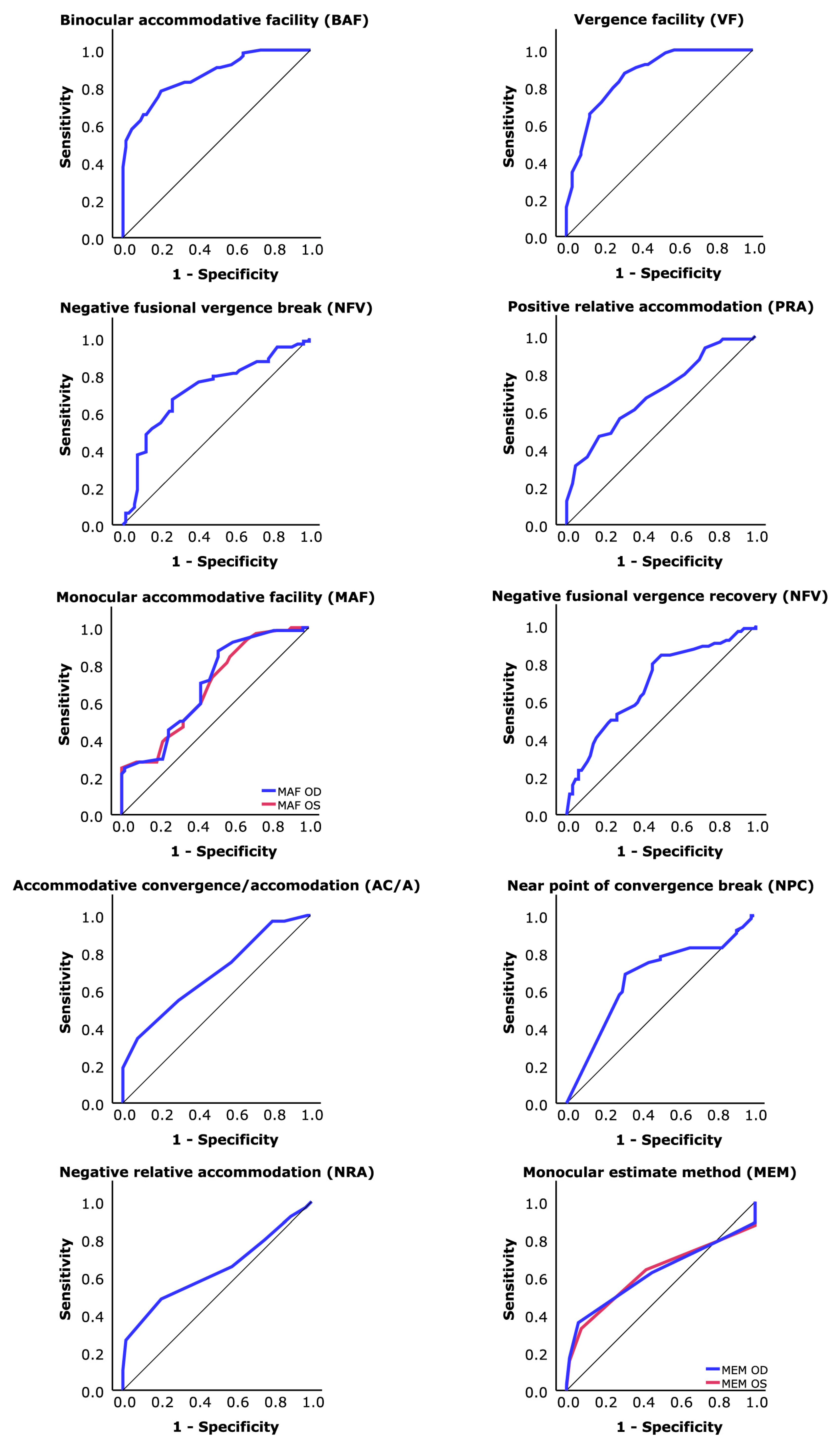
| BAF | 0.865 | 0.805 | 0.926 | 11.774 | <0.001 * |
| VF | 0.864 | 0.802 | 0.925 | 11.742 | <0.001 * |
| NFV break | 0.719 | 0.629 | 0.810 | 4.761 | <0.001 * |
| PRA | 0.698 | 0.608 | 0.788 | 4.304 | <0.001 * |
| MAF OD | 0.694 | 0.603 | 0.785 | 4.217 | <0.001 * |
| NFV recovery | 0.691 | 0.599 | 0.783 | 4.064 | <0.001 * |
| AC/A | 0.688 | 0.597 | 0.778 | 4.087 | <0.001 * |
| MAF OS | 0.681 | 0.590 | 0.773 | 3.851 | <0.001 * |
| NPC break | 0.663 | 0.567 | 0.760 | 3.327 | 0.001 * |
| NRA | 0.637 | 0.540 | 0.735 | 2.740 | 0.006 * |
| MEM OD | 0.620 | 0.520 | 0.720 | 2.353 | 0.019 * |
| MEM OS | 0.620 | 0.520 | 0.721 | 2.353 | 0.018 * |
| Variables Turned Out from Contrast | Positive If It Is | Sensitivity | Specificity | Youden’s Index |
|---|---|---|---|---|
| BAF | ≤8.25 cpm | 0.750 | 0.813 | 0.563 |
| VF | ≤12.75 cpm | 0.828 | 0.719 | 0.547 |
| Test | Cutoff Used | Sensitivity (CI 95%) | Specificity (CI 95%) | LR+ (CI 95%) | LR− (CI 95%) |
|---|---|---|---|---|---|
| BAF | BAF ≤ 8.25 cpm | 0.750 (0.644–0.856) | 0.813 (0.717–0.908) | 4.000 (2.356–6.791) | 0.308 (0.198–0.478) |
| VF | FV ≤ 12.75 cpm | 0.828 (0.736–0.921) | 0.719 (0.619–0.829) | 2.944 (1.959–4.425) | 0.239 (0.137–0.417) |
| BAF + VF | BAF ≤ 8.25 cpm FV ≤ 12.75 cpm | 0.625 (0.506–0.744) | 0.938 (0.878–0.997) | 10.000 (3.800–26.318) | 0.400 (0.289–0.554) |
| Variable | Coefficient | Standard Error | Wald | p-Value | Odds Ratio (95% CI) |
|---|---|---|---|---|---|
| BAF | −0.349 | 0.078 | 19.794 | <0.001 | 0.706 (0.605, 0.823) |
| VF | −0.357 | 0.083 | 18.459 | <0.001 | 0.700 (0.595, 0.824) |
| Intercept | 7.176 | 1.263 | 32.291 | <0.001 | - |
Disclaimer/Publisher’s Note: The statements, opinions and data contained in all publications are solely those of the individual author(s) and contributor(s) and not of MDPI and/or the editor(s). MDPI and/or the editor(s) disclaim responsibility for any injury to people or property resulting from any ideas, methods, instructions or products referred to in the content. |
© 2026 by the authors. Licensee MDPI, Basel, Switzerland. This article is an open access article distributed under the terms and conditions of the Creative Commons Attribution (CC BY) license.
Share and Cite
Cacho-Martínez, P.; Cantó-Cerdán, M.; Cervera-Sánchez, Z.; García-Muñoz, Á. Diagnostic Criteria for Convergence Excess: Diagnostic Validity of Clinical Signs Associated with Near Esophoria. J. Eye Mov. Res. 2026, 19, 53. https://doi.org/10.3390/jemr19030053
Cacho-Martínez P, Cantó-Cerdán M, Cervera-Sánchez Z, García-Muñoz Á. Diagnostic Criteria for Convergence Excess: Diagnostic Validity of Clinical Signs Associated with Near Esophoria. Journal of Eye Movement Research. 2026; 19(3):53. https://doi.org/10.3390/jemr19030053
Chicago/Turabian StyleCacho-Martínez, Pilar, Mario Cantó-Cerdán, Zaíra Cervera-Sánchez, and Ángel García-Muñoz. 2026. "Diagnostic Criteria for Convergence Excess: Diagnostic Validity of Clinical Signs Associated with Near Esophoria" Journal of Eye Movement Research 19, no. 3: 53. https://doi.org/10.3390/jemr19030053
APA StyleCacho-Martínez, P., Cantó-Cerdán, M., Cervera-Sánchez, Z., & García-Muñoz, Á. (2026). Diagnostic Criteria for Convergence Excess: Diagnostic Validity of Clinical Signs Associated with Near Esophoria. Journal of Eye Movement Research, 19(3), 53. https://doi.org/10.3390/jemr19030053