
Effects of Driving Task Demands and Information Load on AR-HUD Cognitive Efficiency: The Moderating Role of Working Memory Capacity in a VR-Based Simulated Driving Environment
Highlights
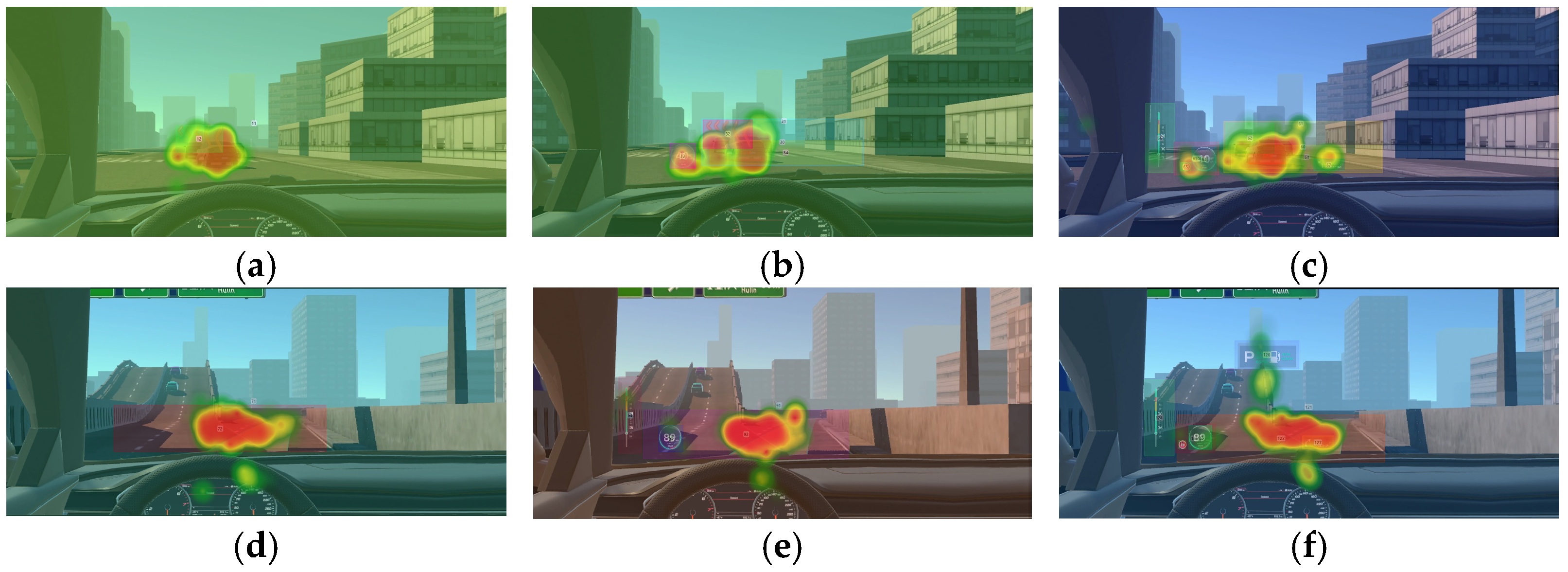
- Driving scenario, working memory capacity, and AR-HUD load independently influence RT and eye-movement behavior.
- Three-way TFD and two-way RT interactions show that high-WMC benefits, and the penalties associated with high visual information load, are scenario-bound.
- High-WMC drivers safely use moderate-to-high-load HUDs (Levels 4–5) on low/medium-demand roads and moderate-load HUDs (Levels 3–4) in construction zones.
- Low-WMC drivers require minimal-load HUDs (Levels 1–2) in construction zones, low-to-moderate-load HUDs (Levels 2–3) in urban areas, and moderate-load HUDs (Level 4) on expressways.
- Results support personalized AR-HUD information load limits for safer driving.
Abstract
1. Introduction
2. Related Work and Research Hypotheses
2.1. Impact of AR-HUD Information Load on Cognitive Efficiency
2.2. Impact of Driving Scenario on Cognitive Efficiency
2.3. Impact of Working Memory Capacity on Cognitive Efficiency
2.4. Research Questions
3. Method for Quantifying Information Load of AR-HUD Interfaces
3.1. Evaluation Model Construction Based on AHP
3.2. Comprehensive Information Load of a Single Information Unit
3.3. Aggregation and Quantitative Control of Total Interface Load
4. Experimental Research
4.1. Experiment 1: Working Memory Capacity (WMC) Test
4.1.1. Participants
4.1.2. Materials and Methods
4.1.3. Experimental Results
4.2. Experiment 2: AR-HUD Visual Cognition Experiment
4.2.1. Participants
4.2.2. Apparatus
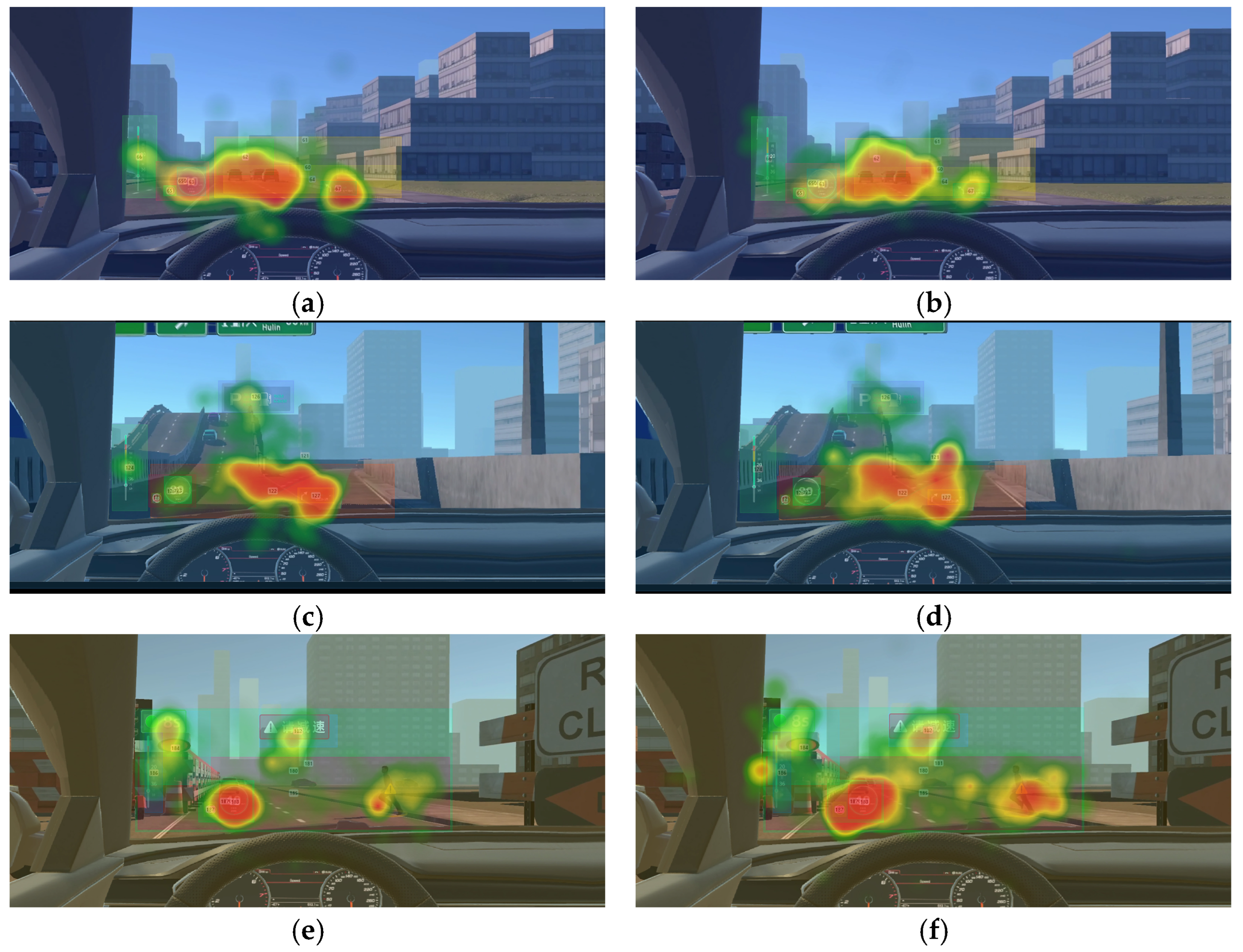
4.2.3. Experimental Materials
- (1)
- Driving Scenario Design
- (A)
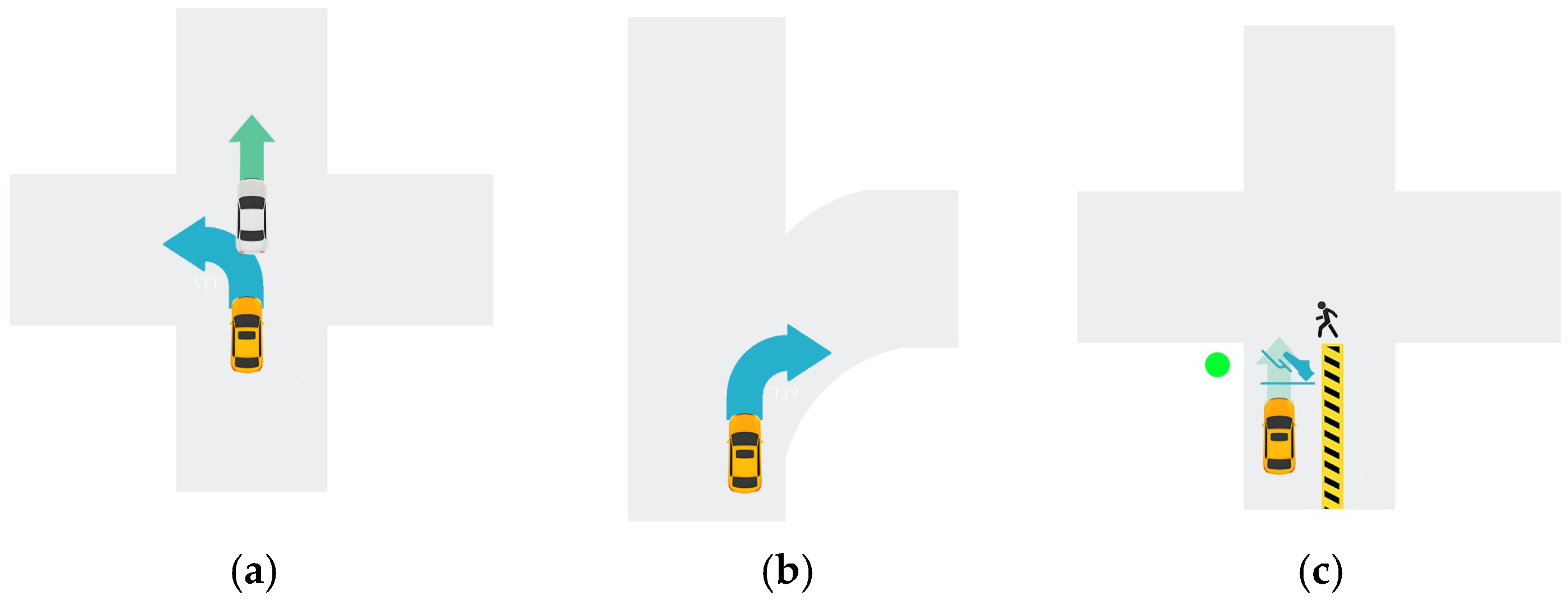
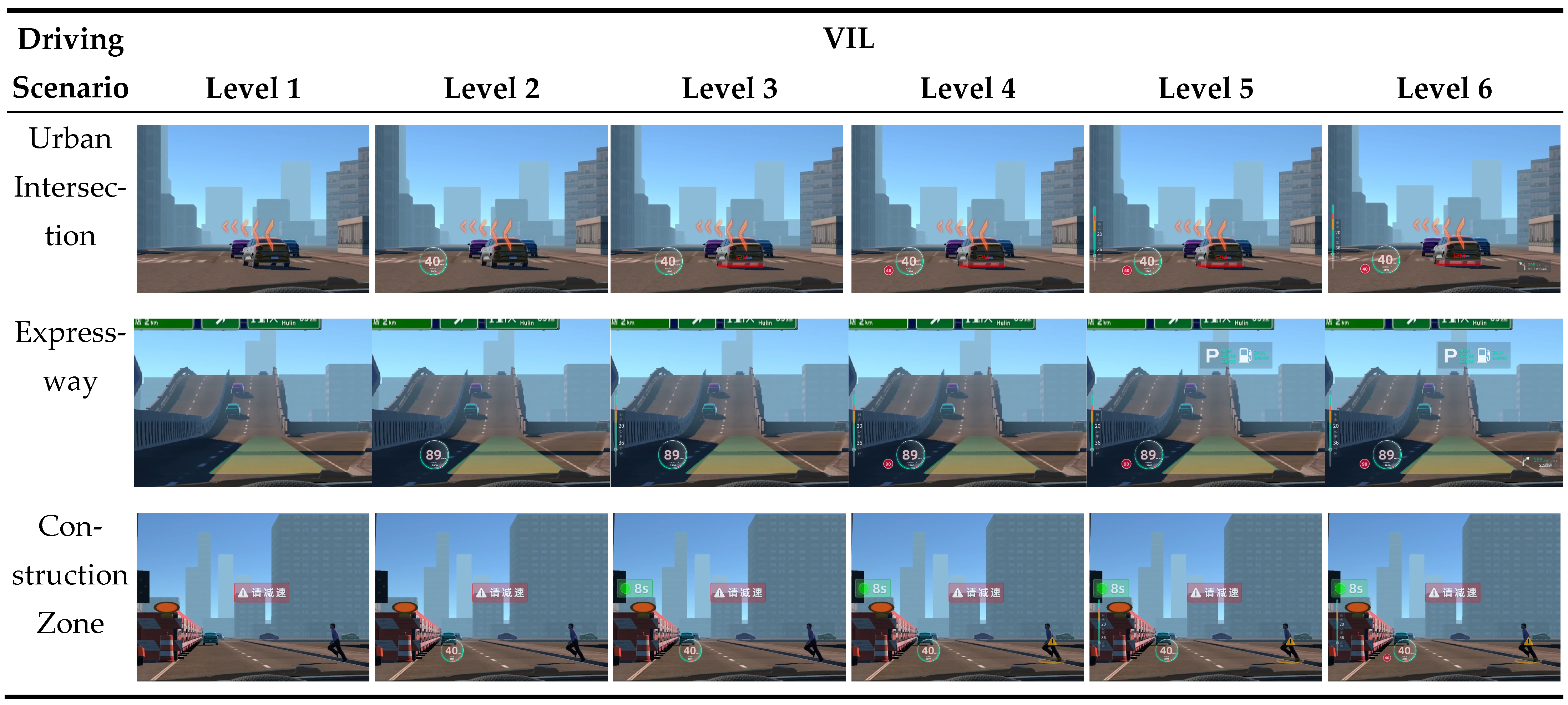
- Urban Intersection. Vehicle A (the ego vehicle) was traveling normally at 50 km/h on an urban road, following Vehicle B ahead, which was moving at 40 km/h. As they approached a signalized intersection, the need to make a left turn arose.
- (B)
- Expressway. Vehicle A (the ego vehicle) was traveling at 90 km/h in the slow lane of an expressway. As it approached a section with multiple exits, the need to change lanes to the right to enter an off-ramp was triggered.
- (C)
- Construction Zone. Vehicle A (the ego vehicle) was traveling at 50 km/h through an urban construction zone. A temporary traffic light on the left showed green, while a pedestrian appeared on the right, crossing from right to left. To maintain safe driving, the need to decelerate and stop arose.
- (2)
- Design of Visual Information Levels for AR-HUD Interfaces
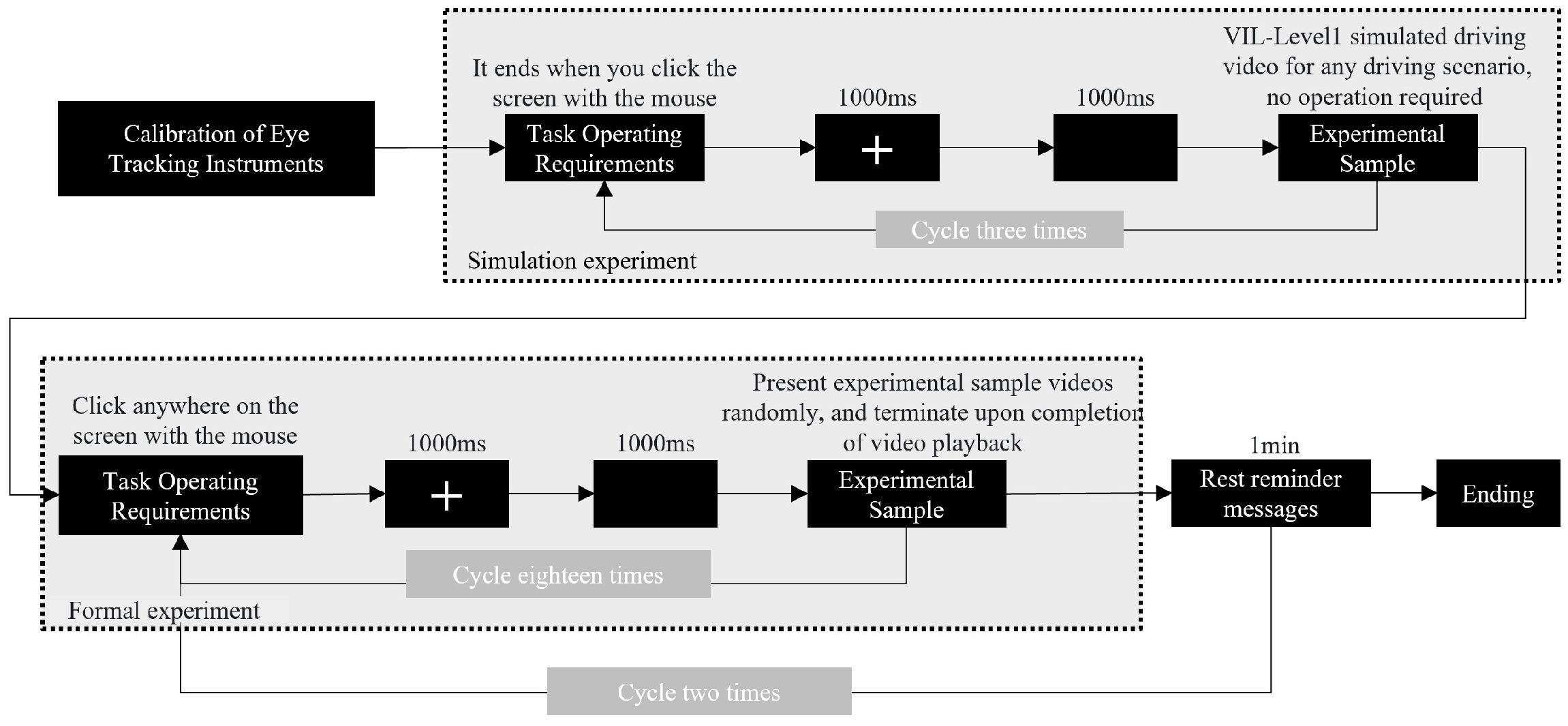
4.2.4. Experimental Design and Procedure
4.2.5. Data Collection and Processing
5. Results
5.1. Data Analysis
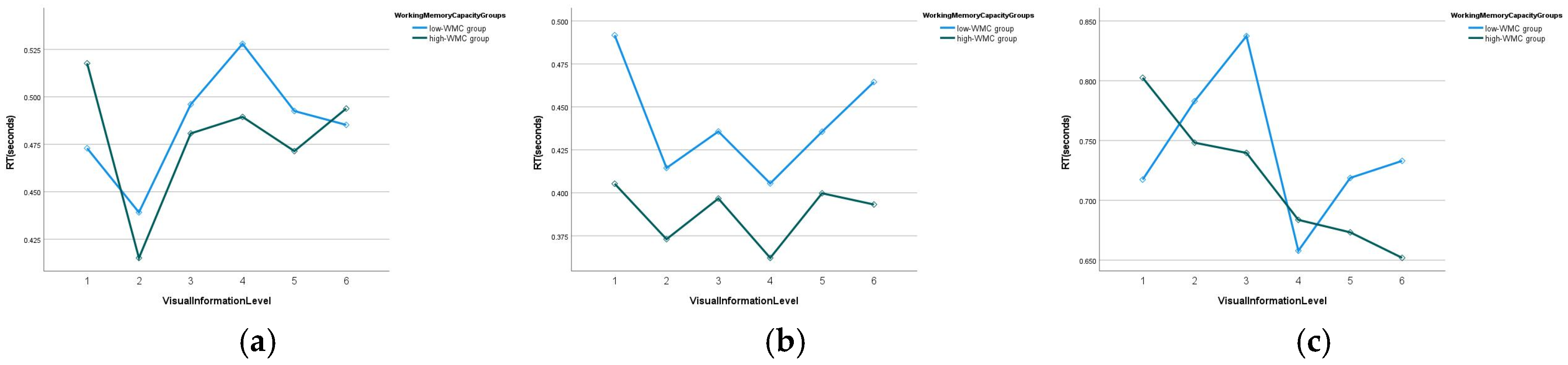
5.2. Reaction Time (RT)
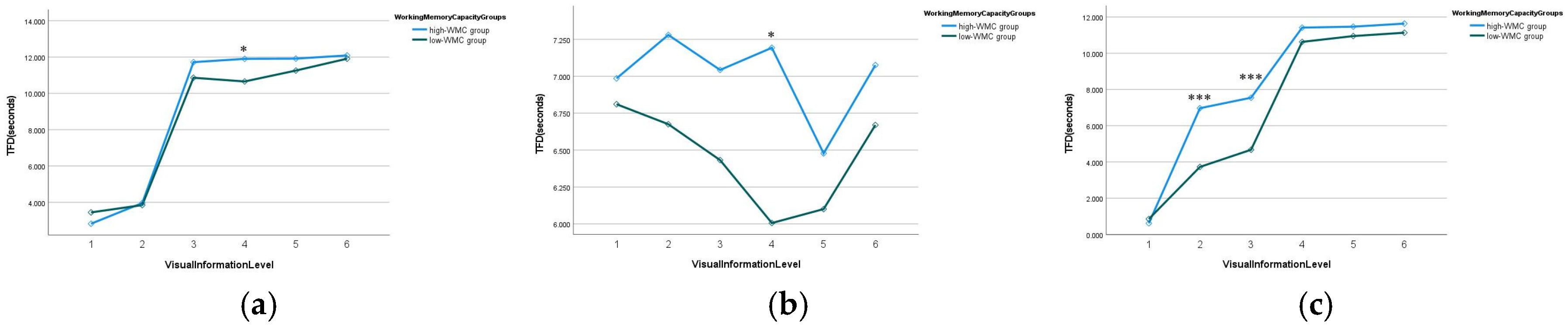
5.3. Total Fixation Duration (TFD) for the Icon AOI
5.4. Average Fixation Duration (AFD) for the Icon AOI
5.5. Average Pupil Diameter (APD)
6. Discussion
6.1. Cognitive Mechanisms Underlying the Moderating Role of Working Memory Capacity (WMC) in Information Processing Efficiency
6.2. Moderating Effect of Driving Scenario on Information Load Effects
6.3. Three-Way Interaction: Boundary Conditions of WMC Moderation
6.4. AR-HUD Design Strategies for Individual Differences and Scenario Adaptation
- (1)
- Strategies for high-WMC drivers: In low-element-interactivity scenarios (expressway) and medium-element-interactivity scenarios (urban intersection), richer information content (VILs 4–5) can be presented to support the decision-making advantages brought by their deep processing strategies. In high-element-interactivity scenarios (construction zone), the information load should be controlled at a moderate level (VILs 3–4) to avoid disrupting their strategic processing patterns due to information overload. It should be noted that, even at VIL 5, the gaze behavior of the high-WMC group already showed signs of increased resource consumption; therefore, it is recommended to set the upper limit of the information load at VIL 5 to reserve a cognitive margin for unexpected events.
- (2)
- Strategies for low-WMC drivers: The principle of “less is more” should be followed in all scenarios. In high-element-interactivity scenarios, only the minimum necessary information (VILs 1–2) should be presented. In medium-demand scenarios, a moderately low information load (VILs 2–3) is appropriate. Only in low-demand scenarios can the information load be slightly increased (VIL 4). The core goal is to prevent low-WMC drivers from entering a passive state of attention, ensuring that their limited cognitive resources are used effectively used for real-world perception and decision-making.
- (3)
- Because excessive compression of the information load may lead to decreased situational awareness, practical applications need to seek a balance between avoiding overload and maintaining situational awareness. Future systems adopting dynamic adaptive strategies should fine-tune the information load based on drivers’ real-time eye tracking metrics (e.g., TFD, APD) rather than relying solely on static thresholds.
6.5. Research Limitations and Future Directions
7. Conclusions
Author Contributions
Funding
Institutional Review Board Statement
Informed Consent Statement
Data Availability Statement
Conflicts of Interest
Abbreviations
| AR-HUD | Augmented Reality Head-Up Display |
| WMC | Working Memory Capacity |
| VR | Virtual Reality |
| CLT | Cognitive Load Theory |
| ACT | Attentional Control Theory |
| AHP | Analytic Hierarchy Process |
| AOSPAN | Automated Operation Span |
| VIL | Visual Information Level |
| AR | Augmented Reality |
| FOV | Field of View |
| VID | Virtual Image Distance |
| AOI | Area of Interest |
| RT | Reaction Time |
| TFD | Total Fixation Duration |
| AFD | Average Fixation Duration |
| APD | Average Pupil Diameter |
| GLM | Generalized Linear Model |
| HRV | Heart Rate Variability |
| EEG | Electroencephalography |
References
- Gabbard, J.L.; Fitch, G.M.; Kim, H. Behind the glass: Driver challenges and opportunities for AR automotive applications. Proc. IEEE 2014, 102, 124–136. [Google Scholar] [CrossRef]
- Feierle, A.; Schlichtherle, F.; Bengler, K. Augmented reality head-up display: A visual support during malfunctions in partially automated driving? IEEE Trans. Intell. Transp. Syst. 2021, 23, 4853–4865. [Google Scholar] [CrossRef]
- Li, X.; Rong, J.; Li, Z.; Zhao, X.; Zhang, Y. Modeling drivers’ acceptance of augmented reality head-up display in connected environment. Displays 2022, 75, 102307. [Google Scholar] [CrossRef]
- Winkler, M.; Soleimani, M. A review of augmented reality heads up display in vehicles: Effectiveness, application, and safety. Int. J. Hum.–Comput. Interact. 2025, 41, 11405–11420. [Google Scholar] [CrossRef]
- Zhou, C.; Luo, Y.; Kaner, J. Exploring the impact of display types of information about autonomous driving in semi-autonomous vehicles on drivers’ situation awareness and take-over performance under different driving scenarios. PLoS ONE 2025, 20, e0329760. [Google Scholar] [CrossRef] [PubMed]
- Draheim, C.; Pak, R.; Draheim, A.A.; Engle, R.W. The role of attention control in complex real-world tasks. Psychon. Bull. Rev. 2022, 29, 1143–1197. [Google Scholar] [CrossRef]
- Kim, H.; Gabbard, J.L. Assessing distraction potential of augmented reality head-up displays for vehicle drivers. Hum. Factors 2022, 64, 852–865. [Google Scholar] [CrossRef]
- Korentsides, J.; St Clair, A.; Dyapa, M.; Chaparro, A. Head-Up Displays: Analysis of automotive use considerations. Hum. Factors Access. Assist. Technol. 2022, 37, 53–59. [Google Scholar] [CrossRef]
- Sweller, J. Cognitive load during problem solving: Effects on learning. Cogn. Sci. 1988, 12, 257–285. [Google Scholar] [CrossRef]
- Sweller, J.; Chandler, P. Why some material is difficult to learn. Cogn. Instr. 1994, 12, 185–233. [Google Scholar] [CrossRef] [PubMed]
- Bauerfeind, K.; Drüke, J.; Schneider, J.; Haar, A.; Bendewald, L.; Baumann, M. Navigating with augmented reality–how does it affect drivers’ mental load? Appl. Ergon. 2021, 94, 103398. [Google Scholar] [CrossRef]
- Young, M.S.; Stanton, N.A. Malleable attentional resources theory: A new explanation for the effects of mental underload on performance. Hum. Factors 2002, 44, 365–375. [Google Scholar] [CrossRef]
- Li, J.; Chen, K.; Chen, M. The Influence of Information Redundancy on Driving Behavior and Psychological Responses Under Different Fog and Risk Conditions: An Analysis of AR-HUD Interface Designs. Appl. Sci. 2025, 15, 11072. [Google Scholar] [CrossRef]
- Wang, L.; Li, H.; Guo, M.; Chen, Y. The effects of dynamic complexity on drivers’ secondary task scanning behavior under a car-following scenario. Int. J. Environ. Res. Public Health 2022, 19, 1881. [Google Scholar] [CrossRef]
- Maag, C.; Schömig, N.; Naujoks, F.; Karl, I.; Keinath, A.; Neukum, A. Measuring workload effects of augmented reality head-up displays using detection response task. Transp. Res. Part F Traffic Psychol. Behav. 2023, 92, 201–219. [Google Scholar] [CrossRef]
- Eyraud, R.; Zibetti, E.; Baccino, T. Allocation of visual attention while driving with simulated augmented reality. Transp. Res. Part F Traffic Psychol. Behav. 2015, 32, 46–55. [Google Scholar] [CrossRef]
- Tian, H.; Deng, T.; Yan, H. Driving as well as on a sunny day? predicting driver’s fixation in rainy weather conditions via a dual-branch visual model. IEEE/CAA J. Autom. Sin. 2022, 9, 1335–1338. [Google Scholar] [CrossRef]
- Wascher, E.; Alyan, E.; Karthaus, M.; Getzmann, S.; Arnau, S.; Reiser, J.E. Tracking drivers’ minds: Continuous evaluation of mental load and cognitive processing in a realistic driving simulator scenario by means of the EEG. Heliyon 2023, 9, e17904. [Google Scholar] [CrossRef]
- Nilsson, E.J.; Bärgman, J.; Ljung Aust, M.; Matthews, G.; Svanberg, B. Let complexity bring clarity: A multidimensional assessment of cognitive load using physiological measures. Front. Neuroergon. 2022, 3, 787295. [Google Scholar] [CrossRef] [PubMed]
- Wascher, E.; Arnau, S.; Reiser, J.E.; Rudinger, G.; Karthaus, M.; Rinkenauer, G.; Dreger, F.; Getzmann, S. Evaluating mental load during realistic driving simulations by means of round the ear electrodes. Front. Neurosci. 2019, 13, 940. [Google Scholar] [CrossRef] [PubMed]
- Chen, W.; Song, J.; Wang, Y.; Wu, C.; Ma, S.; Wang, D.; Yang, Z.; Li, H. Inattentional blindness to unexpected hazard in augmented reality head-up display assisted driving: The impact of the relative position between stimulus and augmented graph. Traffic Inj. Prev. 2023, 24, 344–351. [Google Scholar] [CrossRef] [PubMed]
- Currano, R.; Park, S.Y.; Moore, D.J.; Lyons, K.; Sirkin, D. Little road driving hud: Heads-up display complexity influences drivers’ perceptions of automated vehicles. In Proceedings of the 2021 CHI Conference on Human Factors in Computing Systems, Online Virtual, 8–13 May 2021; pp. 1–15. [Google Scholar] [CrossRef]
- Zhu, Q.; Yu, T.; Jung, E. Seeing and Hearing the Turn: Multimodal AR-HUD Navigation in Multi-Branch Road Scenarios. IEEE Access 2025, 13, 188855–188866. [Google Scholar] [CrossRef]
- Liang, Y.; Zheng, P.; Xia, L. A visual reasoning-based approach for driving experience improvement in the AR-assisted head-up displays. Adv. Eng. Inform. 2023, 55, 101888. [Google Scholar] [CrossRef]
- Cowan, N. The many faces of working memory and short-term storage. Psychon. Bull. Rev. 2017, 24, 1158–1170. [Google Scholar] [CrossRef]
- Hellmann, S.; Zehetleitner, M.; Rausch, M. Simultaneous modeling of choice, confidence, and response time in visual perception. Psychol. Rev. 2023, 130, 1521. [Google Scholar] [CrossRef]
- Soon, C.S.; Namburi, P.; Chee, M.W. Preparatory patterns of neural activity predict visual category search speed. NeuroImage 2013, 66, 215–222. [Google Scholar] [CrossRef]
- Ratcliff, R. A theory of memory retrieval. Psychol. Rev. 1978, 85, 59. [Google Scholar] [CrossRef]
- Logie, R.H.; Della Sala, S. Working memory as a mental workspace: Why activated long-term memory is not enough. Behav. Brain Sci. 2003, 26, 745–746. [Google Scholar] [CrossRef]
- Sahakian, A.; Gayet, S.; Paffen, C.L.; Van der Stigchel, S. The rise and fall of memories: Temporal dynamics of visual working memory. Mem. Cogn. 2025, 53, 2406–2423. [Google Scholar] [CrossRef] [PubMed]
- Xu, L.; Sahakian, A.; Gayet, S.; Paffen, C.L.; Van der Stigchel, S. Latent memory traces for prospective items in visual working memory. J. Exp. Psychol. Hum. Percept. Perform. 2025, 52, 164–177. [Google Scholar] [CrossRef]
- Karlsen, P.J.; Allen, R.J.; Baddeley, A.D.; Hitch, G.J. Binding across space and time in visual working memory. Mem. Cogn. 2010, 38, 292–303. [Google Scholar] [CrossRef] [PubMed]
- Hirschstein, Z.; Aly, M. Long-term memory and working memory compete and cooperate to guide attention. Atten. Percept. Psychophys. 2023, 85, 1517–1549. [Google Scholar] [CrossRef]
- Engle, R.W. Working memory capacity as executive attention. Curr. Dir. Psychol. Sci. 2002, 11, 19–23. [Google Scholar] [CrossRef]
- Shipstead, Z.; Lindsey, D.R.; Marshall, R.L.; Engle, R.W. The mechanisms of working memory capacity: Primary memory, secondary memory, and attention control. J. Mem. Lang. 2014, 72, 116–141. [Google Scholar] [CrossRef]
- Zhao, C.; Vogel, E.K. Working memory and attentional control abilities predict individual differences in visual long-term memory tasks. J. Mem. Lang. 2025, 144, 104665. [Google Scholar] [CrossRef]
- Redden, R.S.; Eady, K.; Klein, R.M.; Saint-Aubin, J. Individual differences in working memory capacity and visual search while reading. Mem. Cogn. 2023, 51, 321–335. [Google Scholar] [CrossRef]
- Bühner, M.; König, C.J.; Pick, M.; Krumm, S. Working memory dimensions as differential predictors of the speed and error aspect of multitasking performance. Hum. Perform. 2006, 19, 253–275. [Google Scholar] [CrossRef]
- Greenberg, K.; Zheng, R.; Gardner, M.; Orr, M. Individual differences in visuospatial working memory capacity influence the modality effect. J. Comput. Assist. Learn. 2021, 37, 735–744. [Google Scholar] [CrossRef]
- Sweller, J. Cognitive load theory and individual differences. Learn. Individ. Differ. 2024, 110, 102423. [Google Scholar] [CrossRef]
- Krieglstein, F.; Beege, M.; Rey, G.D.; Sanchez-Stockhammer, C.; Schneider, S. Development and validation of a theory-based questionnaire to measure different types of cognitive load. Educ. Psychol. Rev. 2023, 35, 9. [Google Scholar] [CrossRef]
- Saaty, T.L. Decision making with the analytic hierarchy process. Int. J. Serv. Sci. 2008, 1, 83–98. [Google Scholar] [CrossRef]
- Unsworth, N.; Heitz, R.P.; Schrock, J.C.; Engle, R.W. An automated version of the operation span task. Behav. Res. Methods 2005, 37, 498–505. [Google Scholar] [CrossRef]
- Conway, A.R.; Kane, M.J.; Bunting, M.F.; Hambrick, D.Z.; Wilhelm, O.; Engle, R.W. Working memory span tasks: A methodological review and user’s guide. Psychon. Bull. Rev. 2005, 12, 769–786. [Google Scholar] [CrossRef]
- Redick, T.S.; Broadway, J.M.; Meier, M.E.; Kuriakose, P.S.; Unsworth, N.; Kane, M.J.; Engle, R.W. Measuring working memory capacity with automated complex span tasks. Eur. J. Psychol. Assess. 2012, 28(3), 164–171. [Google Scholar] [CrossRef]
- Winkler, S.; Kazazi, J.; Vollrath, M. How to warn drivers in various safety-critical situations–Different strategies, different reactions. Accid. Anal. Prev. 2018, 117, 410–426. [Google Scholar] [CrossRef] [PubMed]
- Duan, K.; Yan, X.; Li, X.; Hang, J. Improving drivers’ merging performance in work zone using an in-vehicle audio warning. Transp. Res. Part F Traffic Psychol. Behav. 2023, 95, 297–321. [Google Scholar] [CrossRef]
- Masuda, T.; Fujii, K. Sensitivity Analyses of Priorities Used in the Analytic Hierarchy Process (AHP). Trans. Soc. Instrum. Control Eng. 1987, 23, 1060–1067. [Google Scholar] [CrossRef]
- Dhurkari, R.K. Improving the prescriptive power of analytic hierarchy process. IEEE Trans. Eng. Manag. 2023, 71, 7456–7466. [Google Scholar] [CrossRef]
- Fan, R.; Wei, S.; Ji, H.; Qian, Z.; Tan, H.; Mo, Y.; Ma, D. Automated design of freeform imaging systems for automotive heads-up display applications. Opt. Express 2023, 31, 10758–10774. [Google Scholar] [CrossRef]
- Zhou, C.; Qiao, W.; Hua, J.; Chen, L. Automotive augmented reality head-up displays. Micromachines 2024, 15, 442. [Google Scholar] [CrossRef] [PubMed]
- Niu, Y.F.; Yue, G.; Gao, Y.; Xue, C.Q.; Zhang, Y.T.; Yang, L.X. Improving eye–computer interaction interface design: Ergonomic investigations of the optimum target size and gaze-triggering dwell time. J. Eye Mov. Res. 2020, 12, 21. [Google Scholar] [CrossRef] [PubMed]
- Ren, G.; Zhao, X.; Lin, Z.; Xu, W. Research on the visual cognition patterns of exit guide sign viewing on freeway interchanges. Adv. Mech. Eng. 2019, 11, 1687814018819530. [Google Scholar] [CrossRef]
- Bitkina, O.V.; Park, J.; Kim, H.K. The ability of eye-tracking metrics to classify and predict the perceived driving workload. Int. J. Ind. Ergon. 2021, 86, 103193. [Google Scholar] [CrossRef]
- Li, K.; Yuan, W.; Yannis, G.; Wu, F.; Wang, C. Investigating the impact of in-vehicle warning information complexity on drivers: The role of working memory capacity and cognitive load. Accid. Anal. Prev. 2025, 220, 108138. [Google Scholar] [CrossRef]
- Orti, R.; Iachini, T.; D’Agostino, E.; Ruotolo, F.; Ruggiero, G. Cognitive load in switching between egocentric and allocentric spatial frames of reference: A pupillometry study. Sci. Rep. 2025, 15, 26451. [Google Scholar] [CrossRef] [PubMed]
- Zhang, Y.; Shao, J.; Qin, L.; Zhan, Y.; Zhao, X.; Geng, M.; Chen, B. Semantic distance of icons: Impact on user cognitive performance and a new model for semantic distance classification. Int. J. Ind. Ergon. 2024, 102, 103610. [Google Scholar] [CrossRef]
- Kosachenko, A.I.; Kasanov, D.; Kotyusov, A.I.; Pavlov, Y.G. EEG and pupillometric signatures of working memory overload. Psychophysiology 2023, 60, e14275. [Google Scholar] [CrossRef]
- Afghari, A.P.; Vos, J.; Farah, H.; Papadimitriou, E. “I did not see that coming”: A latent variable structural equation model for understanding the effect of road predictability on crashes along horizontal curves. Accid. Anal. Prev. 2023, 187, 107075. [Google Scholar] [CrossRef] [PubMed]
- Horrey, W.J.; Wickens, C.D.; Consalus, K.P. Modeling drivers’ visual attention allocation while interacting with in-vehicle technologies. J. Exp. Psychol. Appl. 2006, 12, 67. [Google Scholar] [CrossRef]
- Luke, S.G.; Darowski, E.S.; Gale, S.D. Predicting eye-movement characteristics across multiple tasks from working memory and executive control. Mem. Cogn. 2018, 46, 826–839. [Google Scholar] [CrossRef]






| Criterion Layer | Weight | Subcriterion Layer | Local Weight | Global Weight |
|---|---|---|---|---|
| Information Functional Category | 0.598 | Cue/Warning | 0.349 | 0.209 |
| Navigation Overview | 0.280 | 0.167 | ||
| Situational Information | 0.105 | 0.063 | ||
| Vehicle Status | 0.207 | 0.124 | ||
| Road Condition/Event | 0.059 | 0.035 | ||
| Information Presentation Form | 0.402 | augmented reality (AR) Graphic | 0.515 | 0.207 |
| Icon | 0.282 | 0.113 | ||
| Text/Number | 0.203 | 0.082 |
| Information Presentation Form | AR Graphic | Icon | Text/Number | |
|---|---|---|---|---|
| Information Functional Category | ||||
| Cue/Warning | 0.416 | 0.322 | 0.291 | |
| Navigation Overview | 0.374 | 0.280 | 0.249 | |
| Situational Information | 0.270 | 0.176 | 0.145 | |
| Vehicle Status | 0.331 | 0.237 | 0.206 | |
| Road Condition/Event | 0.242 | 0.148 | 0.117 | |
| Working Memory Capacity (WMC) | Age Mean | Score Minimum | Score Maximum | Score Average | Score Standard (SD) |
|---|---|---|---|---|---|
| High | 22.81 | 65 | 75 | 68.81 | 3.082 |
| Low | 23.56 | 34 | 61 | 50.00 | 9.494 |
| Level | Minimum | Maximum |
|---|---|---|
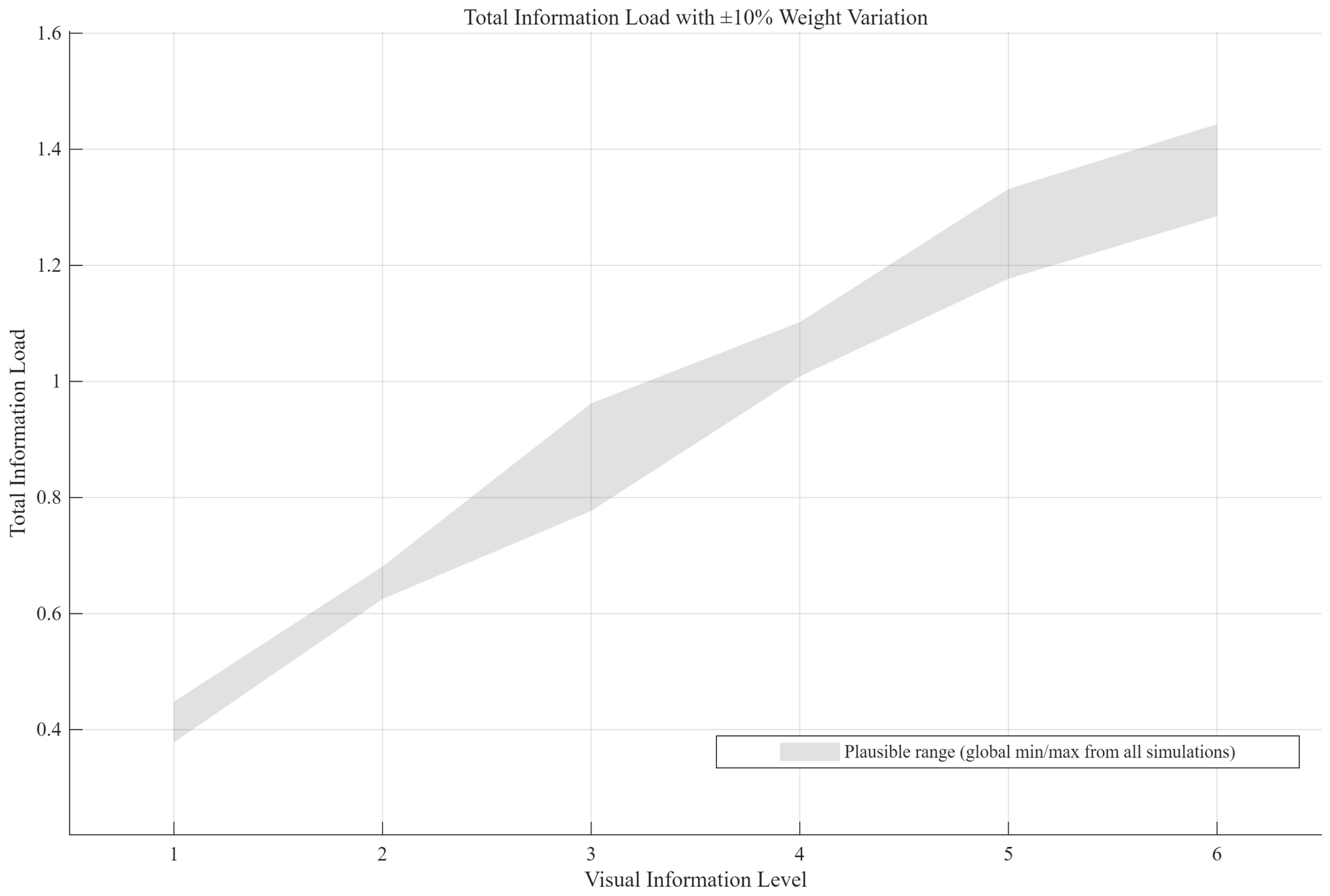
| 1 | 0.37795 | 0.44825 |
| 2 | 0.62508 | 0.68116 |
| 3 | 0.777 | 0.96219 |
| 4 | 1.0088 | 1.1022 |
| 5 | 1.177 | 1.3317 |
| 6 | 1.2848 | 1.4434 |
| Driving Scenario | VIL | Driving-Related Information | Status Information | |||
|---|---|---|---|---|---|---|
| Cue/Warning Information | Navigation Overview | Situational Information | Vehicle Status | Road Condition/ Event Status | ||
| Urban Intersection | Level 1 | 1A | 0 | 0 | 0 | 0 |
| Level 2 | 1A | 0 | 0 | 1I | 0 | |
| Level 3 | 1A | 0 | 1A | 1I | 0 | |
| Level 4 | 1A | 0 | 1A | 1I | 1I | |
| Level 5 | 1A | 1T | 1A | 1I | 1I | |
| Level 6 | 1A | 1T | 1A | 1I | 1I1T | |
| Expressway | Level 1 | 1A | 0 | 0 | 0 | 0 |
| Level 2 | 1A | 0 | 0 | 1I | 0 | |
| Level 3 | 1A | 1T | 0 | 1I | 0 | |
| Level 4 | 1A | 1T | 0 | 1I | 1I | |
| Level 5 | 1A | 1T | 1T | 1I | 1I | |
| Level 6 | 1A | 1T | 1T | 1I | 1I1T | |
| Construction Zone | Level 1 | 1A | 0 | 0 | 0 | 0 |
| Level 2 | 1A | 0 | 0 | 1I | 0 | |
| Level 3 | 1A | 0 | 1T | 1I | 0 | |
| Level 4 | 1A | 0 | 1T | 1I | 1A | |
| Level 5 | 1A | 1T | 1T | 1I | 1A | |
| Level 6 | 1A | 1T | 1T | 1I | 1A1I | |
| Level | Urban Intersection | Expressway | Construction Zone |
|---|---|---|---|
| 1 | 0.416 | 0.416 | 0.416 |
| 2 | 0.653 | 0.653 | 0.653 |
| 3 | 0.923 | 0.902 | 0.798 |
| 4 | 1.071 | 1.05 | 1.04 |
| 5 | 1.32 | 1.195 | 1.289 |
| 6 | 1.437 | 1.312 | 1.437 |
| Analyzed Variable | Independent Variable | χ2 | Degrees of Freedom | p |
|---|---|---|---|---|
| Reaction Time (s) | Intercept | 7923.054 | 1 | 0.000 |
| WMC | 5.434 | 1 | 0.020 | |
| VIL | 8.540 | 5 | 0.129 | |
| Driving Scenario | 491.861 | 2 | 0.000 | |
| Total Fixation Duration (s) | Intercept | 12,488.589 | 1 | 0.000 |
| WMC | 29.188 | 1 | 0.000 | |
| VIL | 1233.830 | 5 | 0.000 | |
| Driving Scenario | 159.624 | 2 | 0.000 | |
| Average Fixation Duration (s) | Intercept | 2397.465 | 1 | 0.000 |
| WMC | 5.476 | 1 | 0.019 | |
| VIL | 128.631 | 5 | 0.000 | |
| Driving Scenario | 63.451 | 2 | 0.000 | |
| Average Pupil Diameter (mm) | Intercept | 16,338.313 | 1 | 0.000 |
| WMC | 32.966 | 1 | 0.000 | |
| VIL | 0.393 | 5 | 0.996 | |
| Driving Scenario | 0.105 | 2 | 0.949 |
| VIL | Comparison Between Complexity Groups (Group 1–Group 2) | β | Standard Error | p | 95%CI | |
|---|---|---|---|---|---|---|
| Lower Limit | Upper Limit | |||||
| Level 1 | Urban Intersection–Expressway | 0.052 | 0.041 | 0.209 | −0.029 | 0.132 |
| Urban Intersection–Construction Zone | −0.266 a | 0.041 | 0.000 | −0.347 | −0.185 | |
| Expressway–Construction Zone | −0.317 a | 0.041 | 0.000 | −0.399 | −0.236 | |
| Level 2 | Urban Intersection–Expressway | 0.033 | 0.0333 | 0.311 | −0.032 | 0.099 |
| Urban Intersection–Construction Zone | −0.338 a | 0.0331 | 0.000 | −0.403 | −0.273 | |
| Expressway–Construction Zone | −0.372 a | 0.0331 | 0.000 | −0.437 | −0.307 | |
| Level 3 | Urban Intersection–Expressway | 0.073 | 0.042 | 0.083 | −0.010 | 0.156 |
| Urban Intersection–Construction Zone | −0.297 a | 0.042 | 0.000 | −0.380 | −0.215 | |
| Expressway–Construction Zone | −0.371 a | 0.042 | 0.000 | −0.453 | −0.288 | |
| Level 4 | Urban Intersection–Expressway | 0.125 a | 0.036 | 0.000 | 0.055 | 0.194 |
| Urban Intersection–Construction Zone | −0.164 a | 0.036 | 0.000 | −0.234 | −0.094 | |
| Expressway–Construction Zone | −0.289 a | 0.036 | 0.000 | −0.359 | −0.218 | |
| Level 5 | Urban Intersection–Expressway | 0.065 | 0.035 | 0.066 | −0.004 | 0.133 |
| Urban Intersection–Construction Zone | −0.214 a | 0.035 | 0.000 | −0.282 | −0.145 | |
| Expressway–Construction Zone | −0.278 a | 0.035 | 0.000 | −0.346 | −0.210 | |
| Level 6 | Urban Intersection–Expressway | 0.062 | 0.032 | 0.052 | −0.001 | 0.124 |
| Urban Intersection–Construction Zone | −0.202 a | 0.032 | 0.000 | −0.264 | −0.140 | |
| Expressway–Construction Zone | −0.263 a | 0.032 | 0.0000 | −0.325 | −0.202 | |
| Scenario | VIL | High-WMC TFD (SE) | Low-WMC TFD (SE) | Mean Diff. | p | Cohen’s d |
|---|---|---|---|---|---|---|
| Urban Intersection | 1 | 2.82 (0.41) | 3.45 (0.42) | −0.62 | 0.287 | −0.17 |
| 2 | 3.96 (0.41) | 3.85 (0.42) | 0.11 | 0.848 | 0.03 | |
| 3 | 11.72 (0.41) | 10.86 (0.42) | 0.86 | 0.143 | 0.24 | |
| 4 | 11.90 (0.41) | 10.66 (0.42) | 1.25 | 0.033 | 0.34 | |
| 5 | 11.91 (0.41) | 11.26 (0.42) | 0.66 | 0.263 | 0.18 | |
| 6 | 12.09 (0.41) | 11.91 (0.42) | 0.18 | 0.759 | 0.05 | |
| Expressway | 1 | 6.99 (0.41) | 6.81 (0.42) | 0.17 | 0.765 | 0.05 |
| 2 | 7.28 (0.41) | 6.68 (0.42) | 0.6 | 0.302 | 0.17 | |
| 3 | 7.04 (0.41) | 6.43 (0.42) | 0.61 | 0.297 | 0.17 | |
| 4 | 7.19 (0.41) | 6.01 (0.42) | 1.19 | 0.043 | 0.33 | |
| 5 | 6.48 (0.41) | 6.10 (0.42) | 0.38 | 0.520 | 0.1 | |
| 6 | 7.08 (0.41) | 6.67 (0.46) | 0.41 | 0.508 | 0.11 | |
| Construction Zone | 1 | 0.62 (0.42) | 0.85 (0.42) | −0.24 | 0.693 | −0.06 |
| 2 | 6.97 (0.41) | 3.73 (0.42) | 3.24 | <0.001 | 0.89 | |
| 3 | 7.55 (0.41) | 4.67 (0.42) | 2.87 | <0.001 | 0.79 | |
| 4 | 11.42 (0.41) | 10.63 (0.42) | 0.79 | 0.179 | 0.22 | |
| 5 | 11.47 (0.41) | 10.95 (0.42) | 0.52 | 0.375 | 0.14 | |
| 6 | 11.64 (0.42) | 11.13 (0.41) | 0.5 | 0.391 | 0.14 |
| VIL | Comparison Between Complexity Groups (Group 1–Group 2) | β | Standard Error | p | 95%CI | |
|---|---|---|---|---|---|---|
| Lower Limit | Upper Limit | |||||
| Level 1 | Urban Intersection–Expressway | 0.007 | 0.059 | 0.900 | −0.108 | 0.123 |
| Urban Intersection–Construction Zone | 0.227 a | 0.060 | 0.000 | 0.110 | 0.344 | |
| Expressway–Construction Zone | 0.219 a | 0.060 | 0.000 | 0.102 | 0.336 | |
| Level 2 | Urban Intersection–Expressway | 0.269 a | 0.098 | 0.006 | 0.076 | 0.462 |
| Urban Intersection–Construction Zone | −0.236 a | 0.098 | 0.016 | −0.429 | −0.043 | |
| Expressway–Construction Zone | −0.505 a | 0.098 | 0.000 | −0.698 | −0.312 | |
| Level 3 | Urban Intersection–Expressway | 0.284 a | 0.104 | 0.006 | 0.081 | 0.488 |
| Urban Intersection–Construction Zone | −0.238 a | 0.104 | 0.022 | −0.441 | −0.035 | |
| Expressway–Construction Zone | −0.523 a | 0.104 | 0.000 | −0.726 | −0.319 | |
| Level 4 | Urban Intersection–Expressway | 0.253 a | 0.090 | 0.005 | 0.077 | 0.428 |
| Urban Intersection–Construction Zone | 0.350 a | 0.090 | 0.000 | 0.174 | 0.525 | |
| Expressway–Construction Zone | 0.097 | 0.090 | 0.279 | −0.079 | 0.273 | |
| Level 5 | Urban Intersection–Expressway | 0.301 a | 0.061 | 0.000 | 0.181 | 0.421 |
| Urban Intersection–Construction Zone | 0.623 a | 0.061 | 0.000 | 0.503 | 0.744 | |
| Expressway–Construction Zone | 0.323 a | 0.061 | 0.000 | 0.202 | 0.443 | |
| Level 6 | Urban Intersection–Expressway | 0.305 | 0.077 | 0.052 | 0.153 | 0.456 |
| Urban Intersection–Construction Zone | 0.617 a | 0.077 | 0.000 | 0.465 | 0.768 | |
| Expressway–Construction Zone | 0.312 a | 0.077 | 0.000 | 0.160 | 0.463 | |
Disclaimer/Publisher’s Note: The statements, opinions and data contained in all publications are solely those of the individual author(s) and contributor(s) and not of MDPI and/or the editor(s). MDPI and/or the editor(s) disclaim responsibility for any injury to people or property resulting from any ideas, methods, instructions or products referred to in the content. |
© 2026 by the authors. Licensee MDPI, Basel, Switzerland. This article is an open access article distributed under the terms and conditions of the Creative Commons Attribution (CC BY) license.
Share and Cite
Li, J.; Lin, M.; Feng, X.; Zhang, H.; Wang, C.; Ma, Y. Effects of Driving Task Demands and Information Load on AR-HUD Cognitive Efficiency: The Moderating Role of Working Memory Capacity in a VR-Based Simulated Driving Environment. J. Eye Mov. Res. 2026, 19, 48. https://doi.org/10.3390/jemr19030048
Li J, Lin M, Feng X, Zhang H, Wang C, Ma Y. Effects of Driving Task Demands and Information Load on AR-HUD Cognitive Efficiency: The Moderating Role of Working Memory Capacity in a VR-Based Simulated Driving Environment. Journal of Eye Movement Research. 2026; 19(3):48. https://doi.org/10.3390/jemr19030048
Chicago/Turabian StyleLi, Jing, Min Lin, Xinyu Feng, Hua Zhang, Chuchu Wang, and Yulian Ma. 2026. "Effects of Driving Task Demands and Information Load on AR-HUD Cognitive Efficiency: The Moderating Role of Working Memory Capacity in a VR-Based Simulated Driving Environment" Journal of Eye Movement Research 19, no. 3: 48. https://doi.org/10.3390/jemr19030048
APA StyleLi, J., Lin, M., Feng, X., Zhang, H., Wang, C., & Ma, Y. (2026). Effects of Driving Task Demands and Information Load on AR-HUD Cognitive Efficiency: The Moderating Role of Working Memory Capacity in a VR-Based Simulated Driving Environment. Journal of Eye Movement Research, 19(3), 48. https://doi.org/10.3390/jemr19030048