The Comprehensive AOCMF Classification System: Condylar Process Fractures—Level 3 Tutorial
Abstract
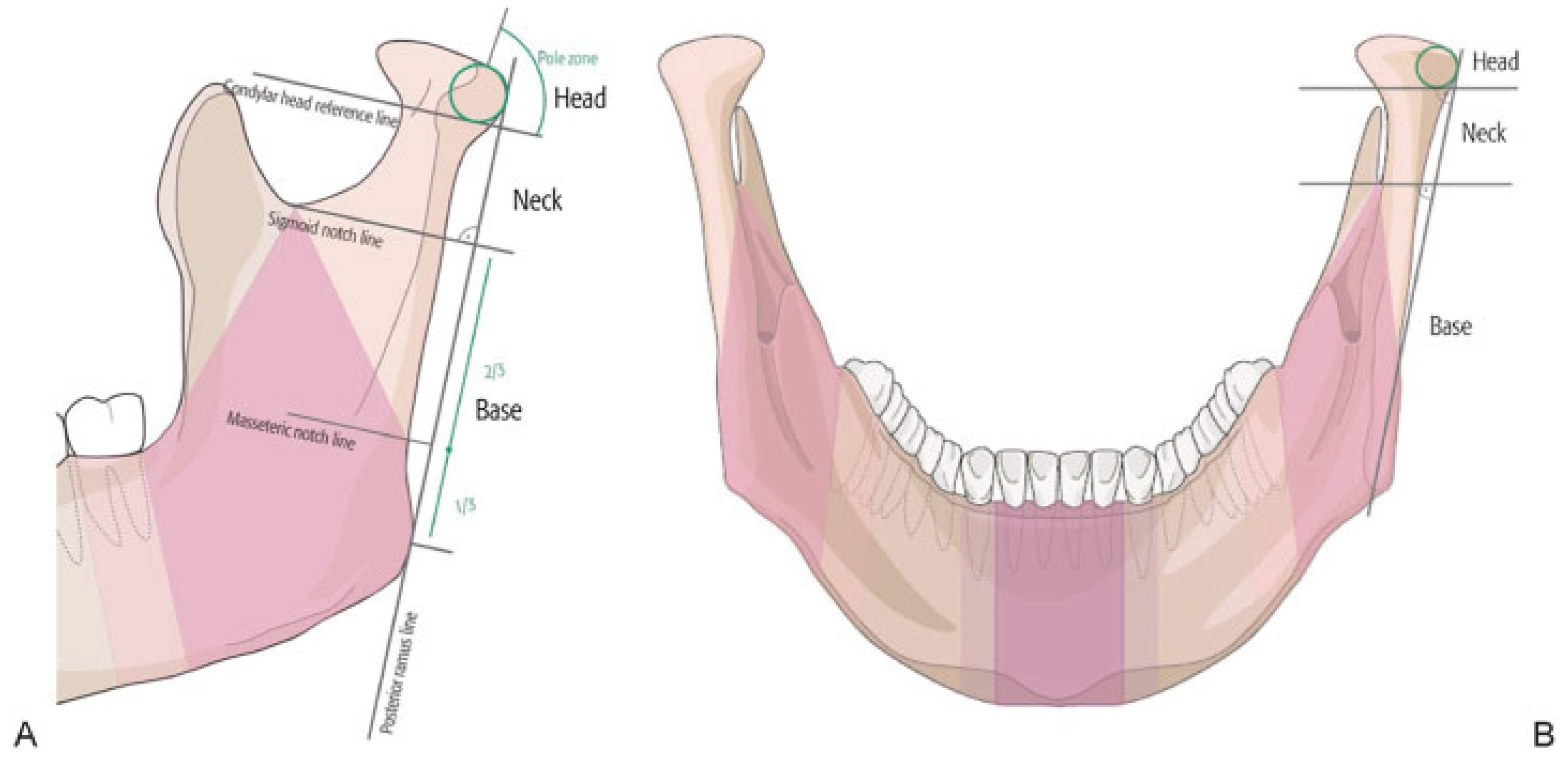
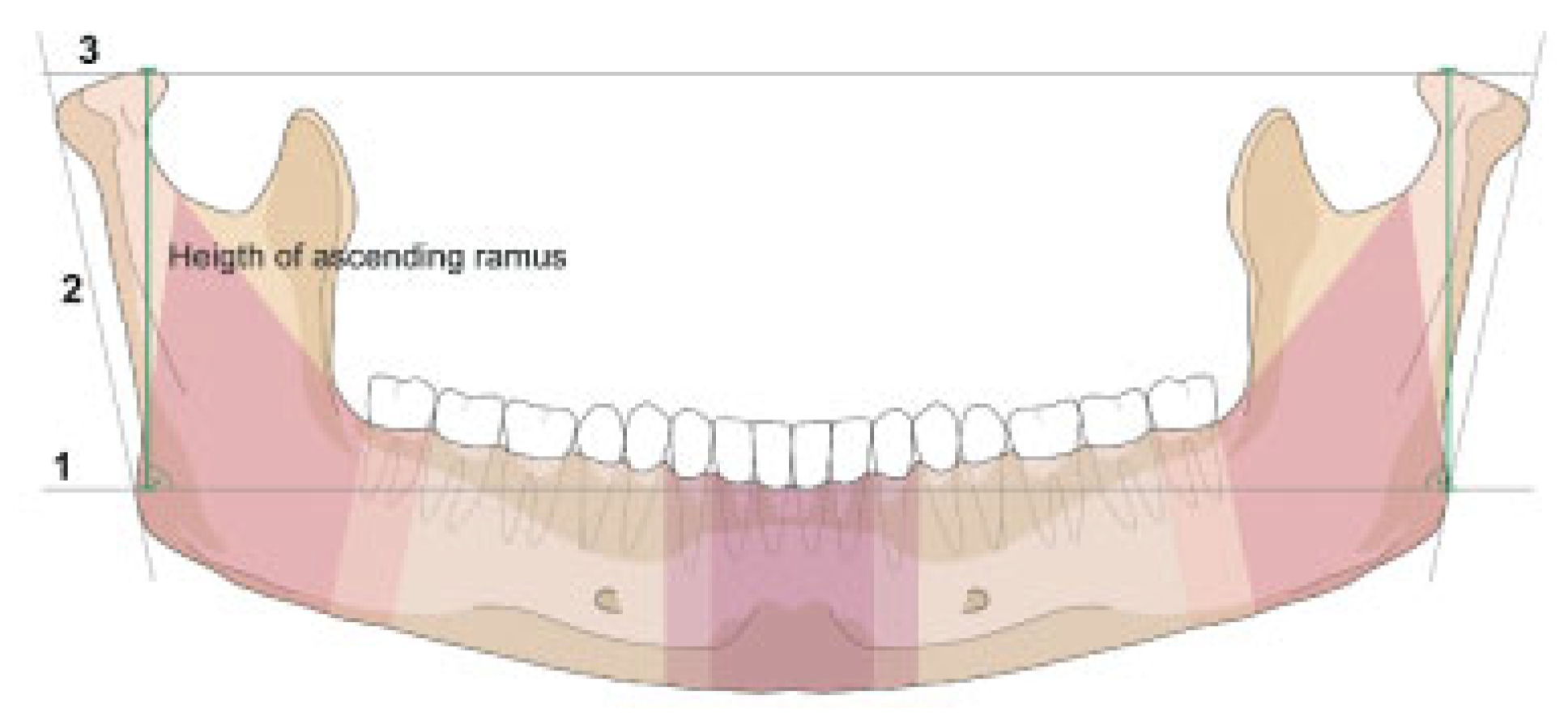
Condylar Process Region and Subregion
- The posterior ramus line (base line) running along the posterior border of the mandibular ascending ramus, joining the most prominent points of the posterior border of the masseteric tuberosity and the lateral pole of the condylar head.
- The sigmoid notch line (Loukota [4] line) running through the deepest point of the sigmoid notch and perpendicular to the osterior ramus line.
- The condylar head reference line running perpendicular to the posterior ramus line below the lateral pole of the condylar head. The height of the lateral pole is determined by the diameter of a circle (two-dimensional, 2D) or a sphere (three-dimensional, 3D), whose arc best fits with the upper lateral boundaries of the lateral pole. The center of this circle is identified within the bony substance of the lateral condylar head using a caliper with variable radius or a template.
- The masseteric tuberosity notch line running perpendicular to the posterior ramus line at the upper posterior edge of the masseteric tuberosity, which is located at the lower one-third of the distance from the most prominent point of the posterior border of masseteric tuberosity to the sigmoid notch line.
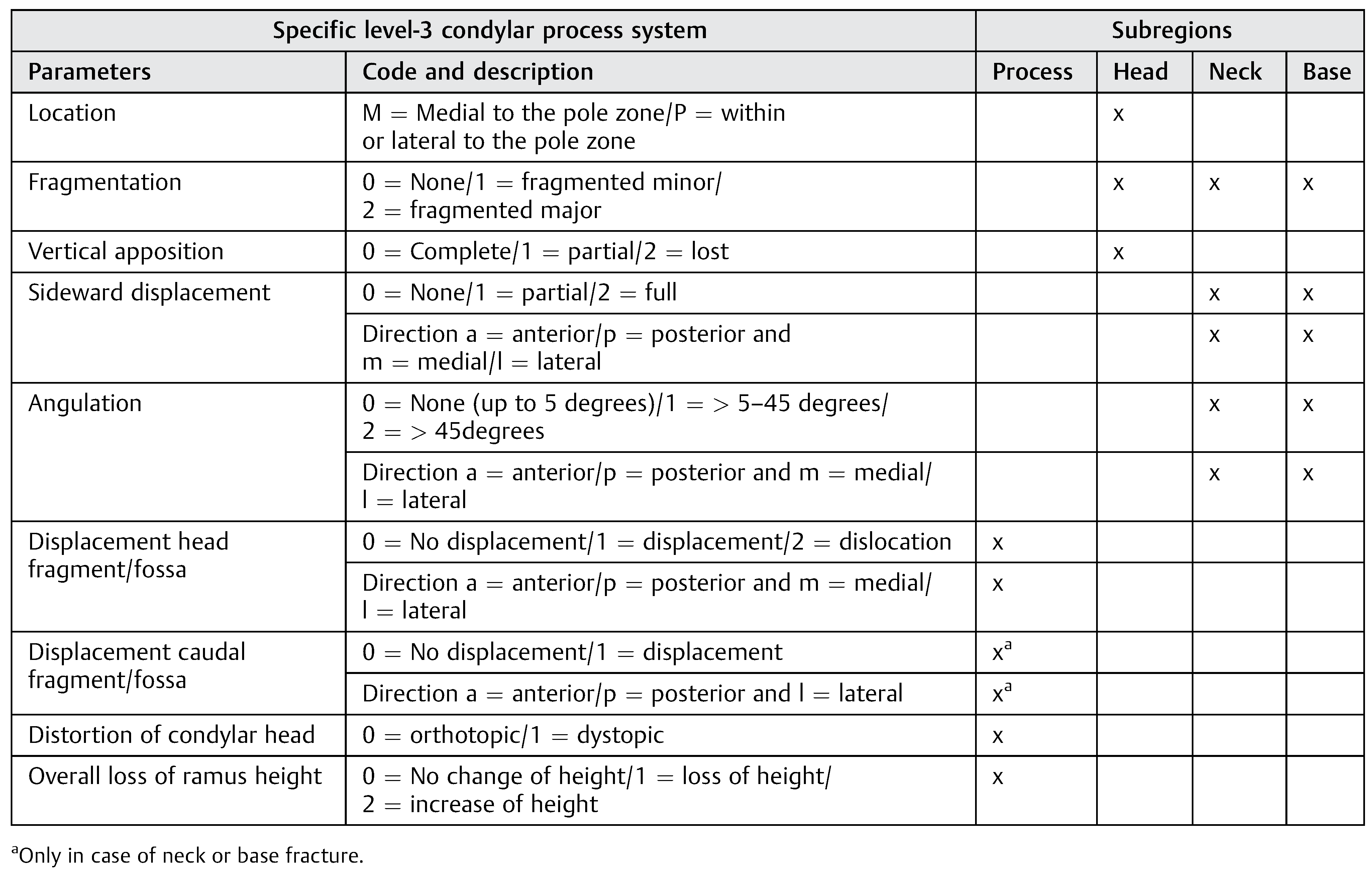
Level 3 Condylar Process Fracture Classification System
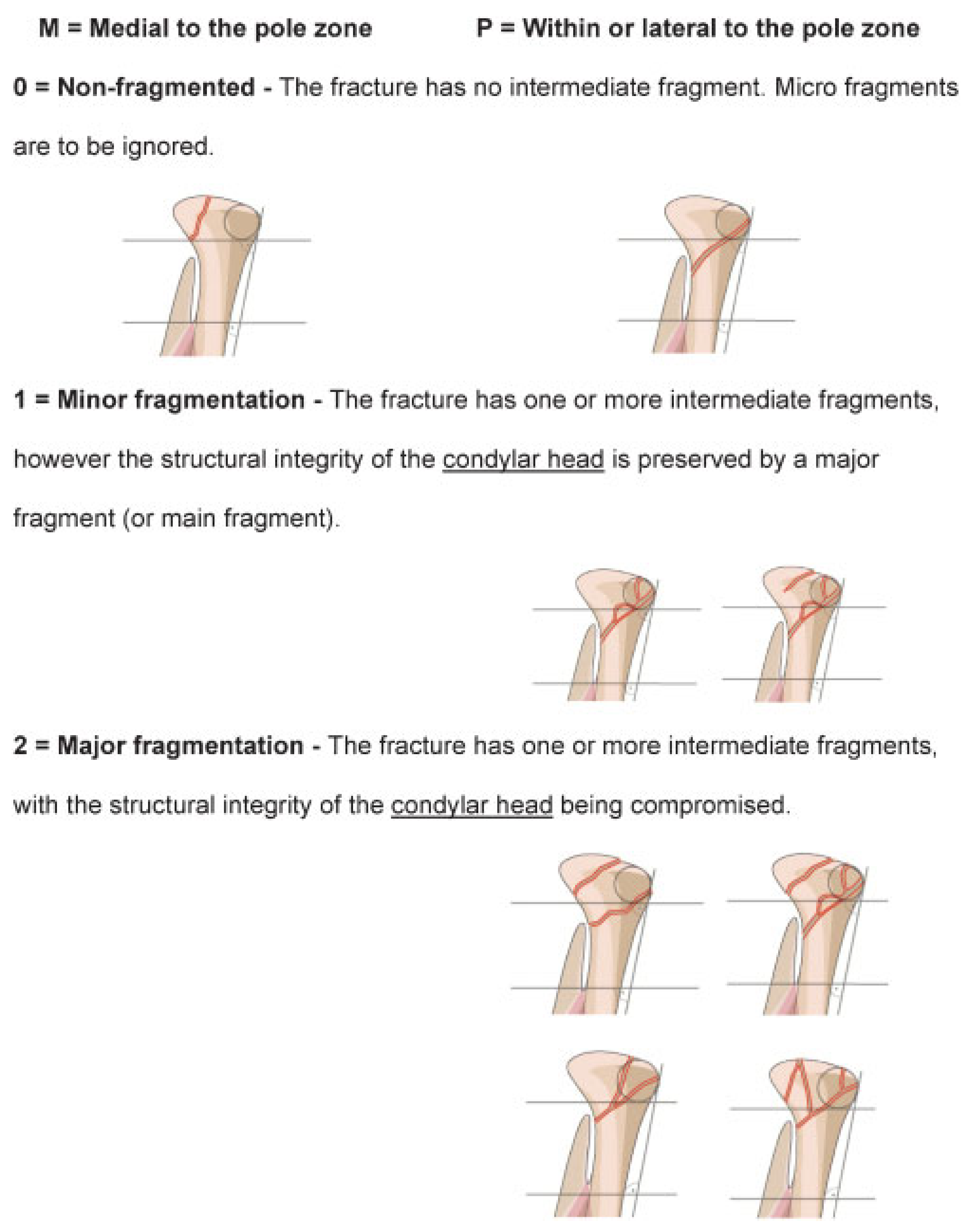
Condylar Head Fractures
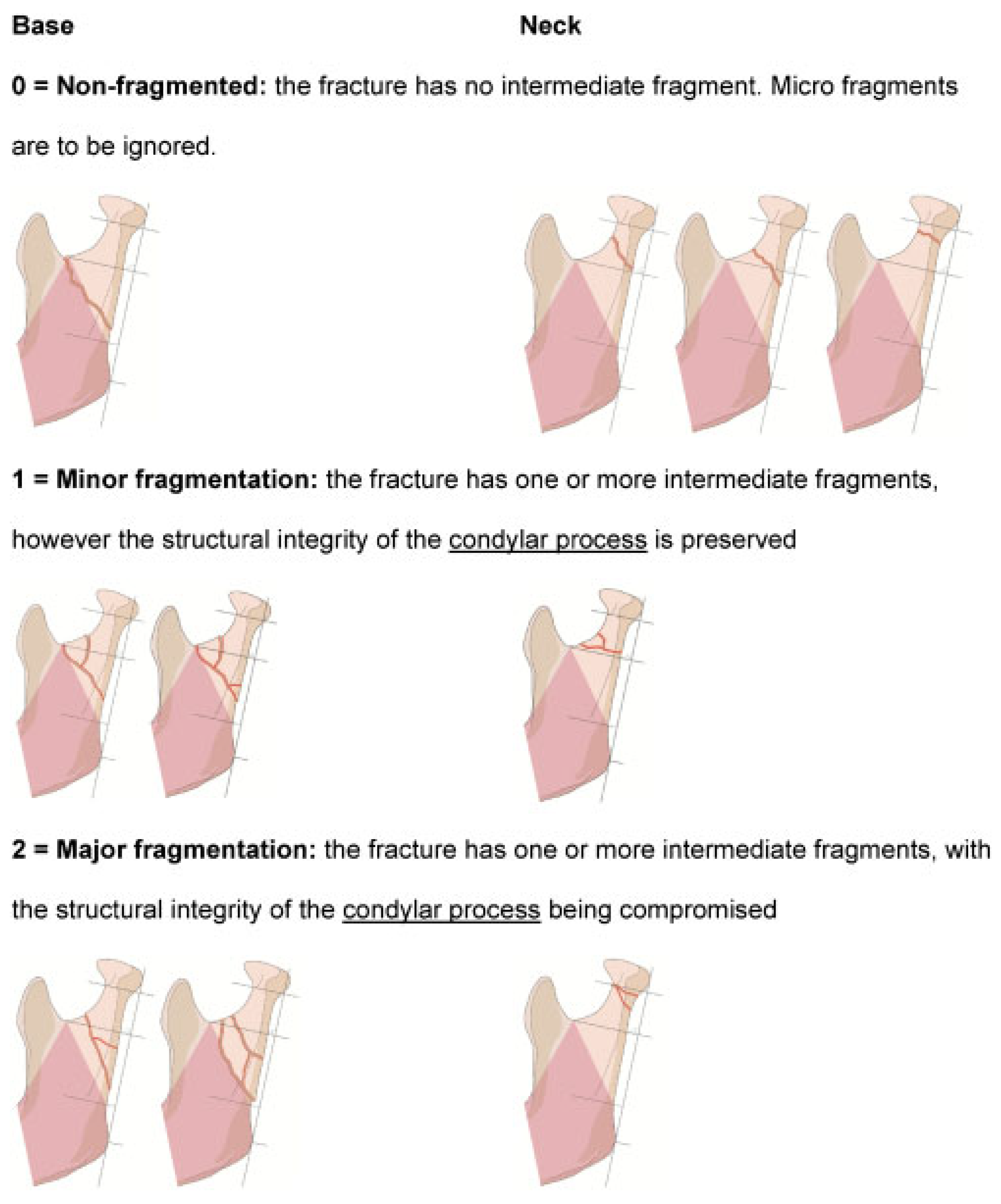
Neck and Base Fractures
Condylar Process Parameters
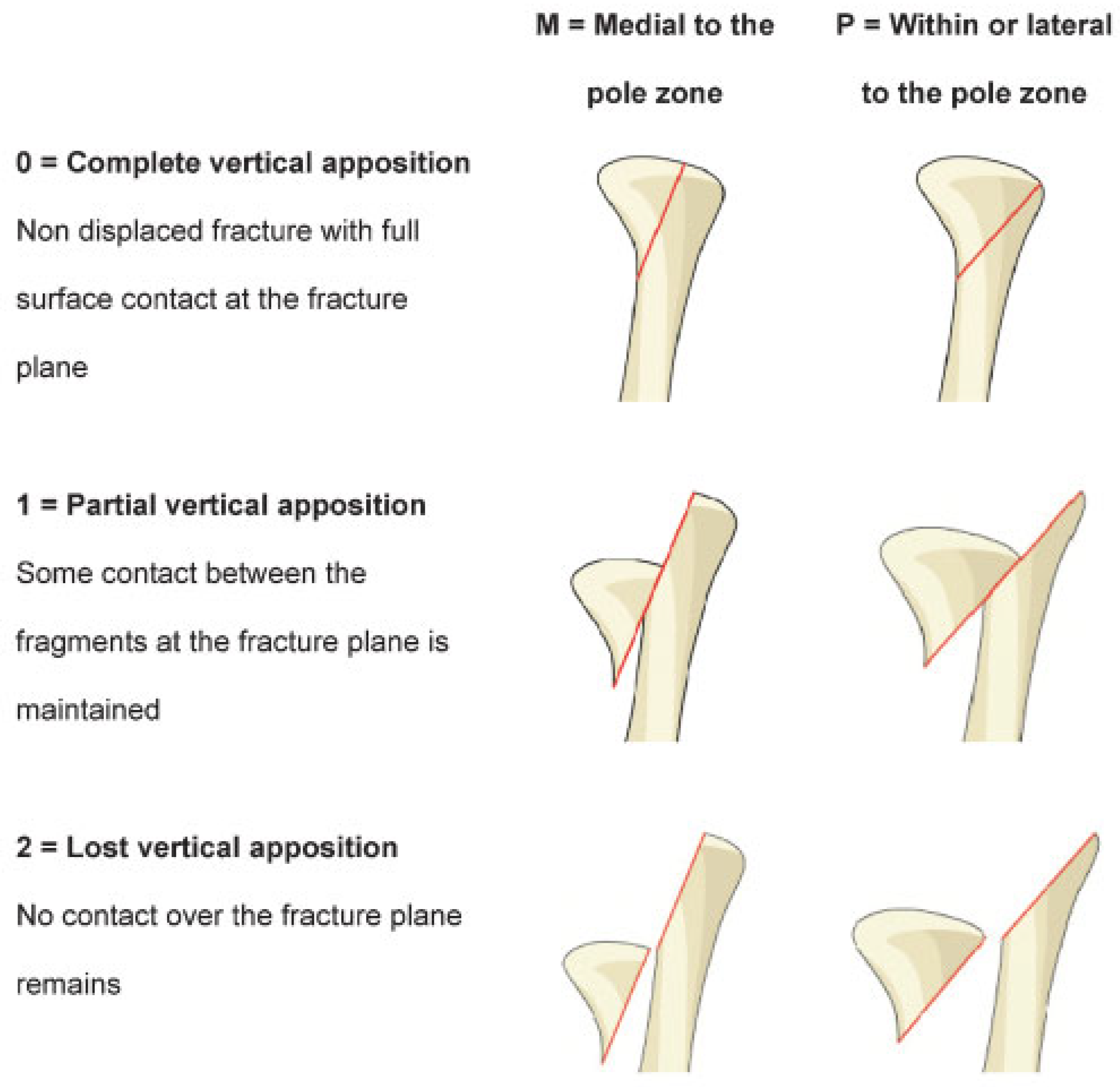
Vertical Fracture Pattern
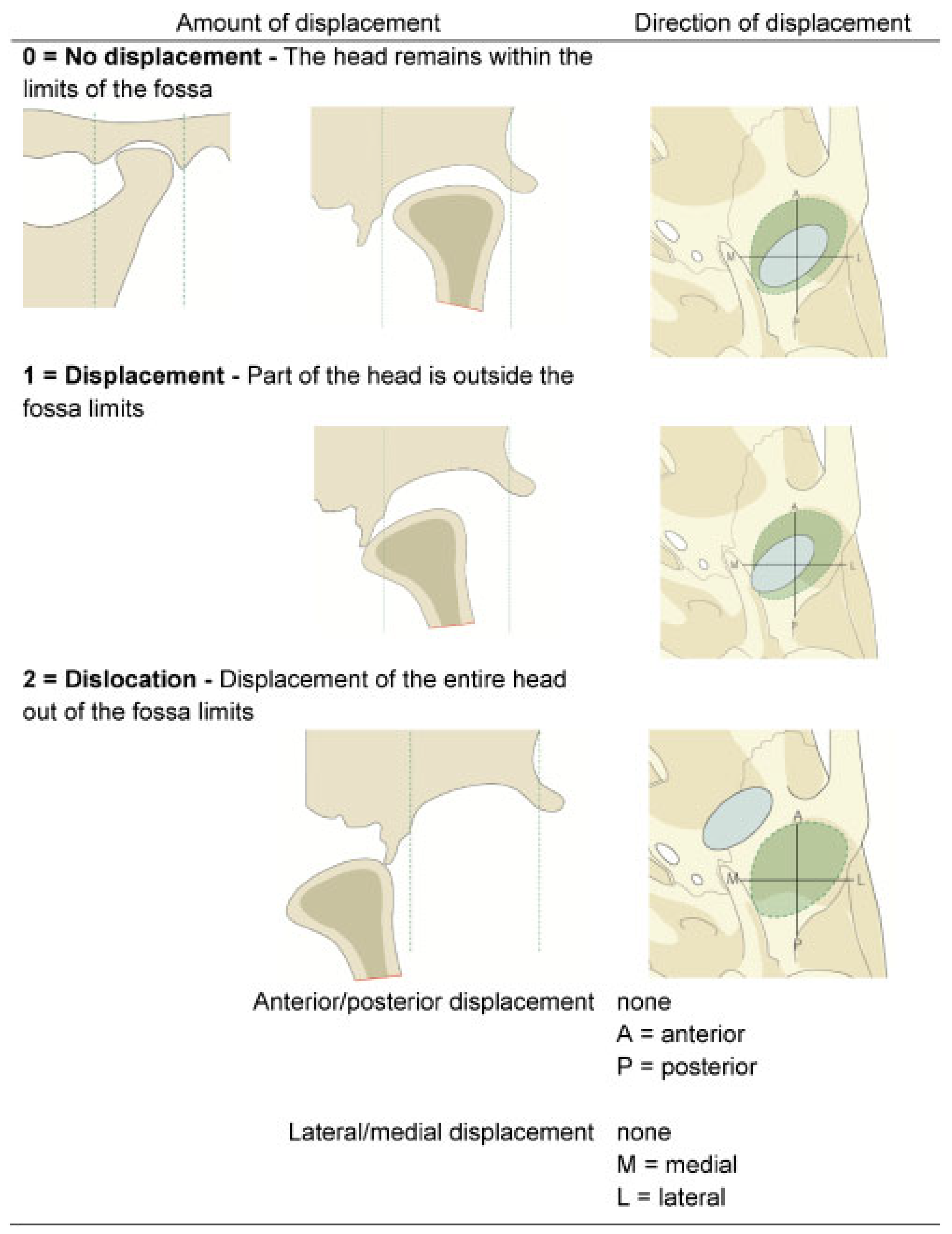
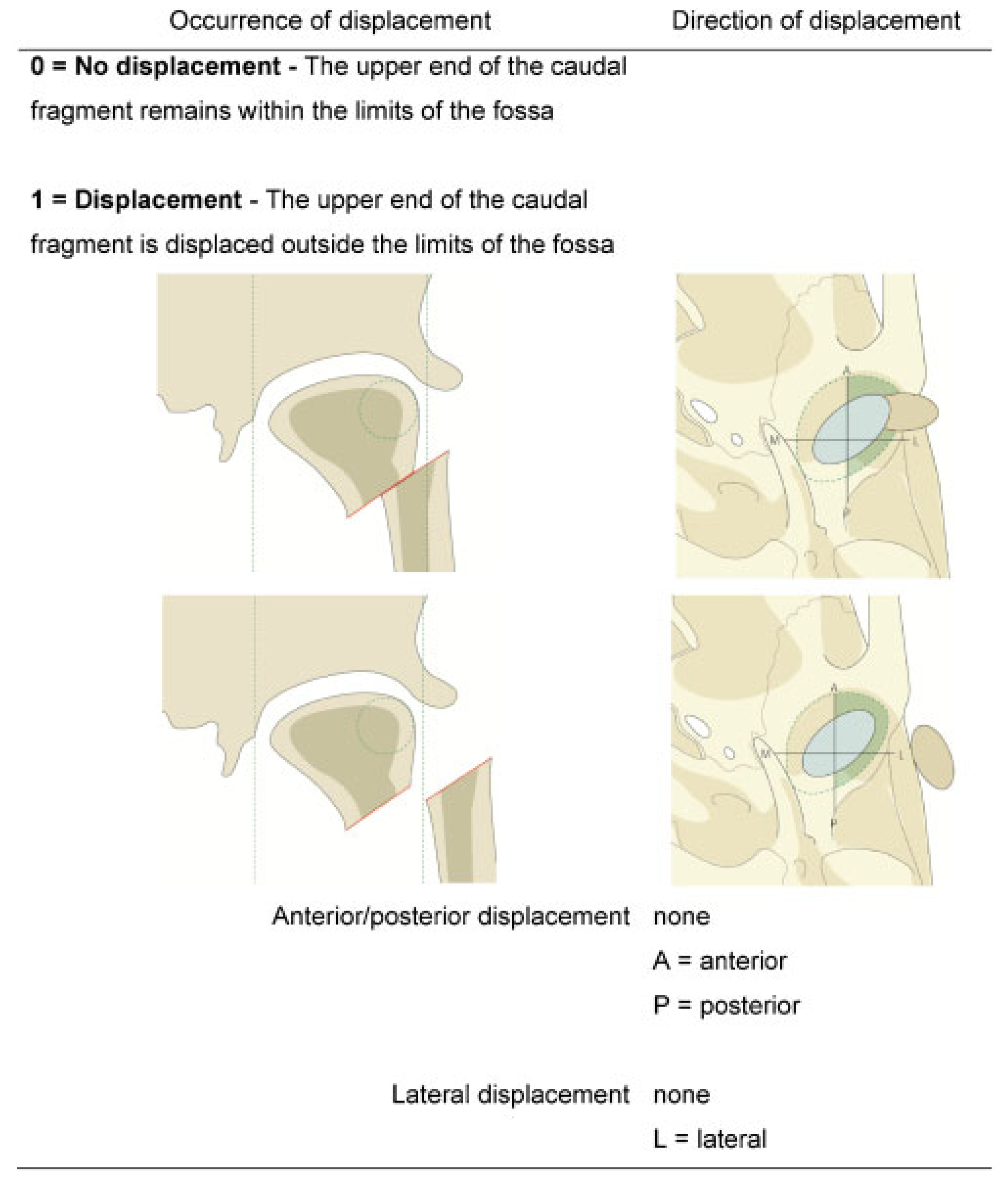
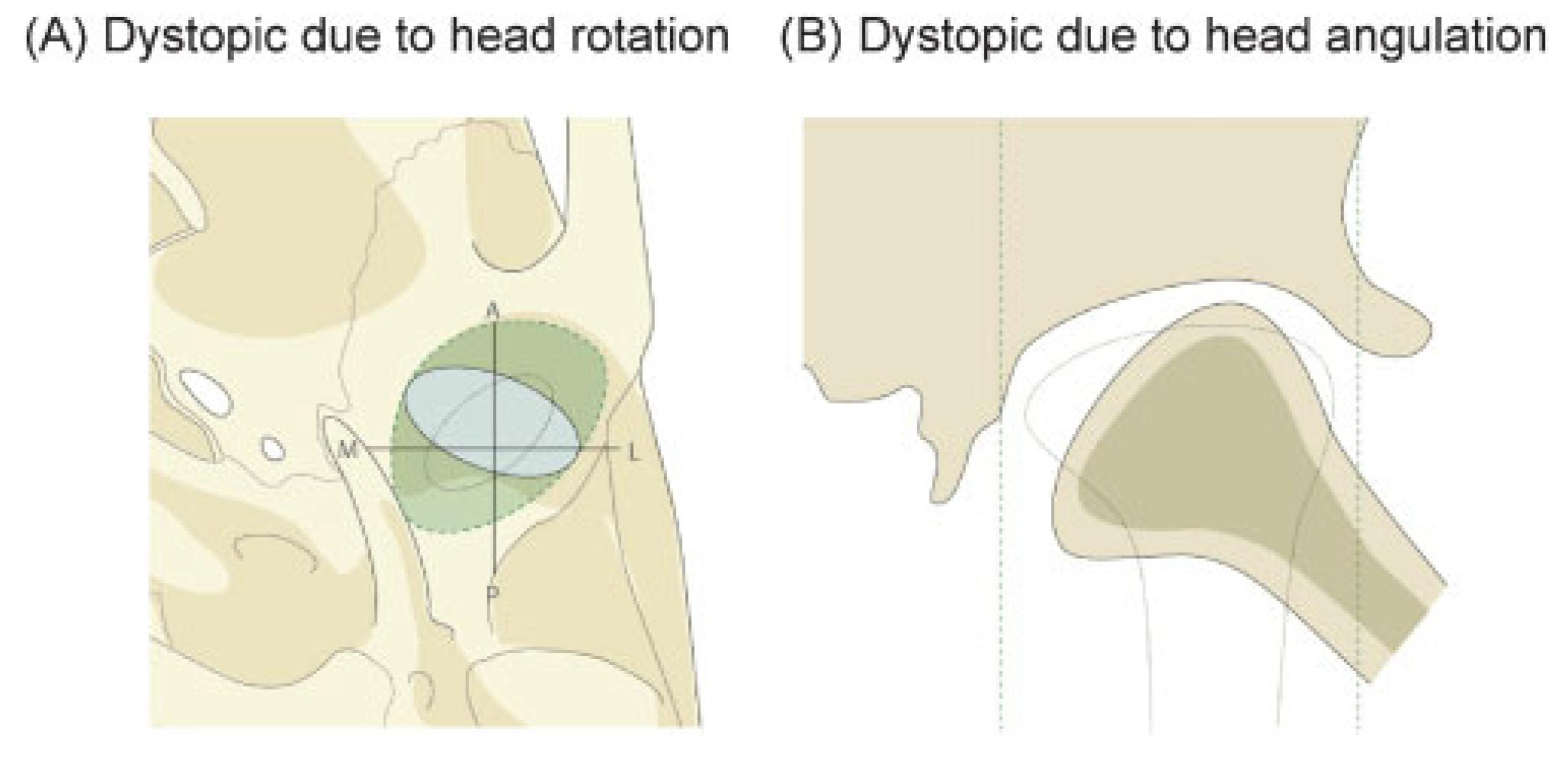
Fossa Fracture
Fracture Coding
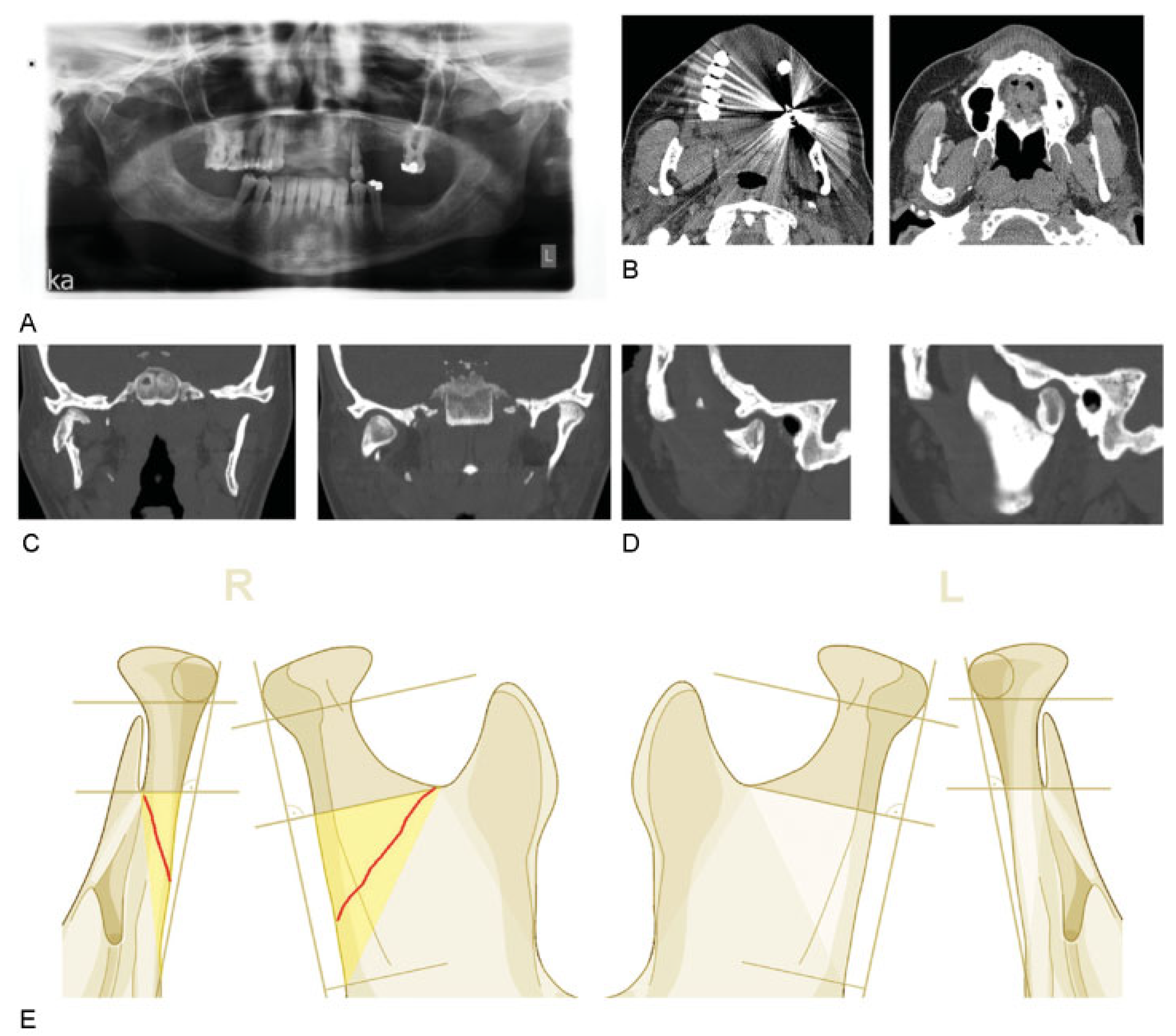
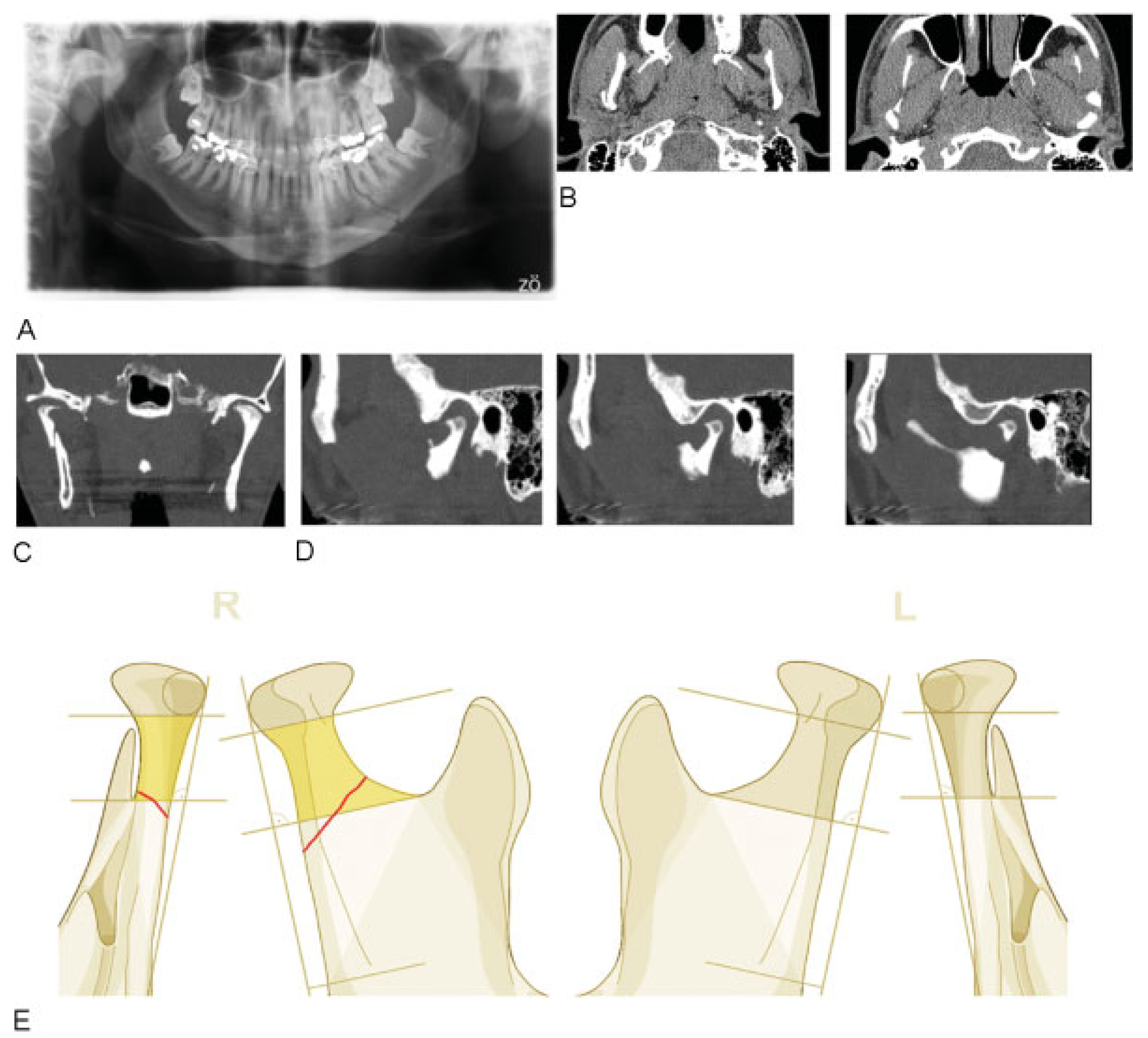
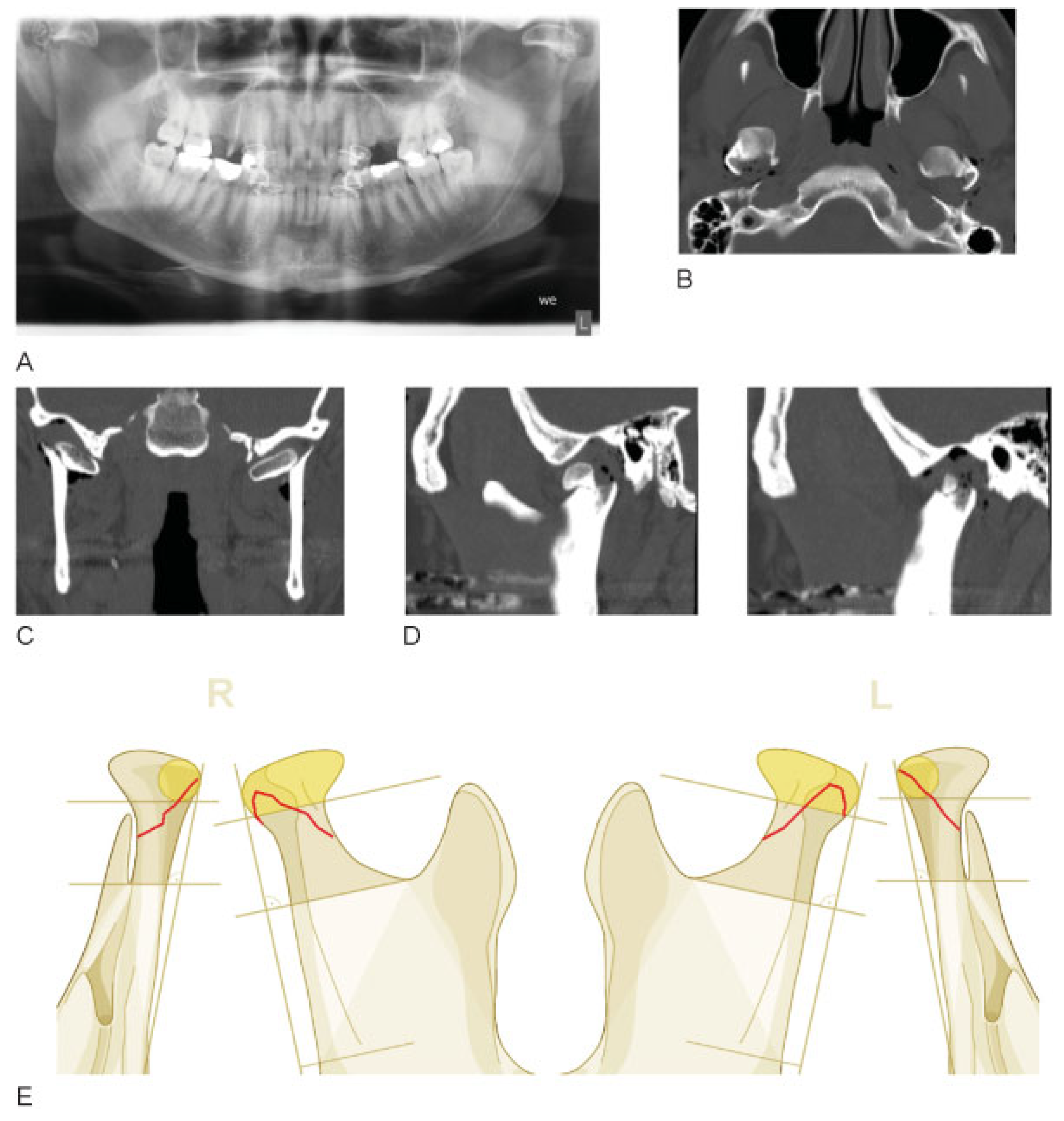
Case Examples
Discussion
- Precise anatomical description of the fracture level location with regard to the selection of the best fitting approach and also osteosynthesis method, that is, which will allow best visualization and application of a stable osteosynthesis (e.g., the preauricular or retroauricular approach for high condylar neck and head fractures, the anteroparotideal/transparotideal or conditionally the retromandibular approach for lower neck fractures, the angular, retromandibular or the transoral approach where appropriate for base fractures) but also timing of nonsurgical or functional treatment regimes.
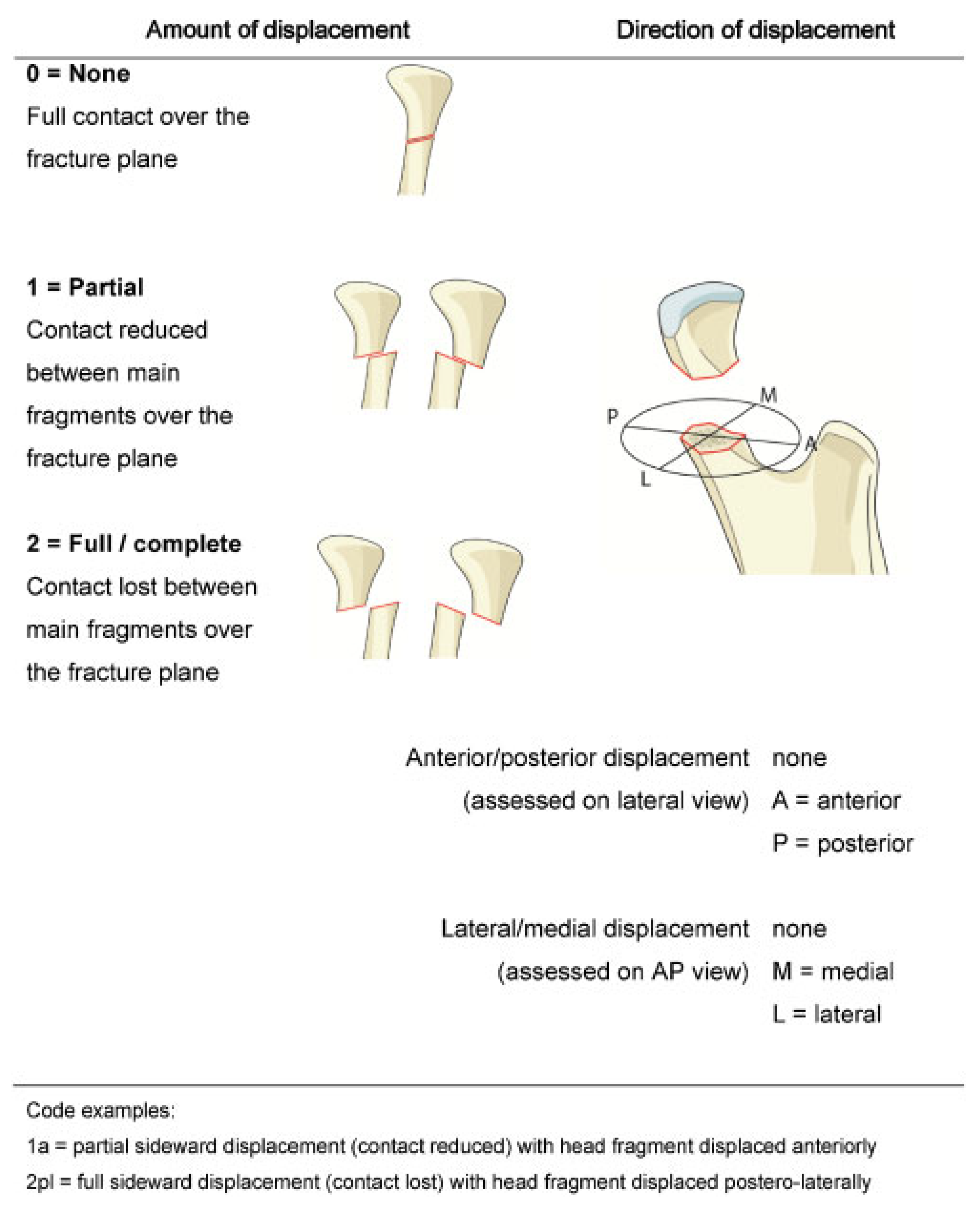
- Assessment of the direction of displacement of the proximal fragment (first of all medially or laterally) in condylar base and neck fractures with regard to the selection of fractures amenable to osteosynthesis via transoral approaches.
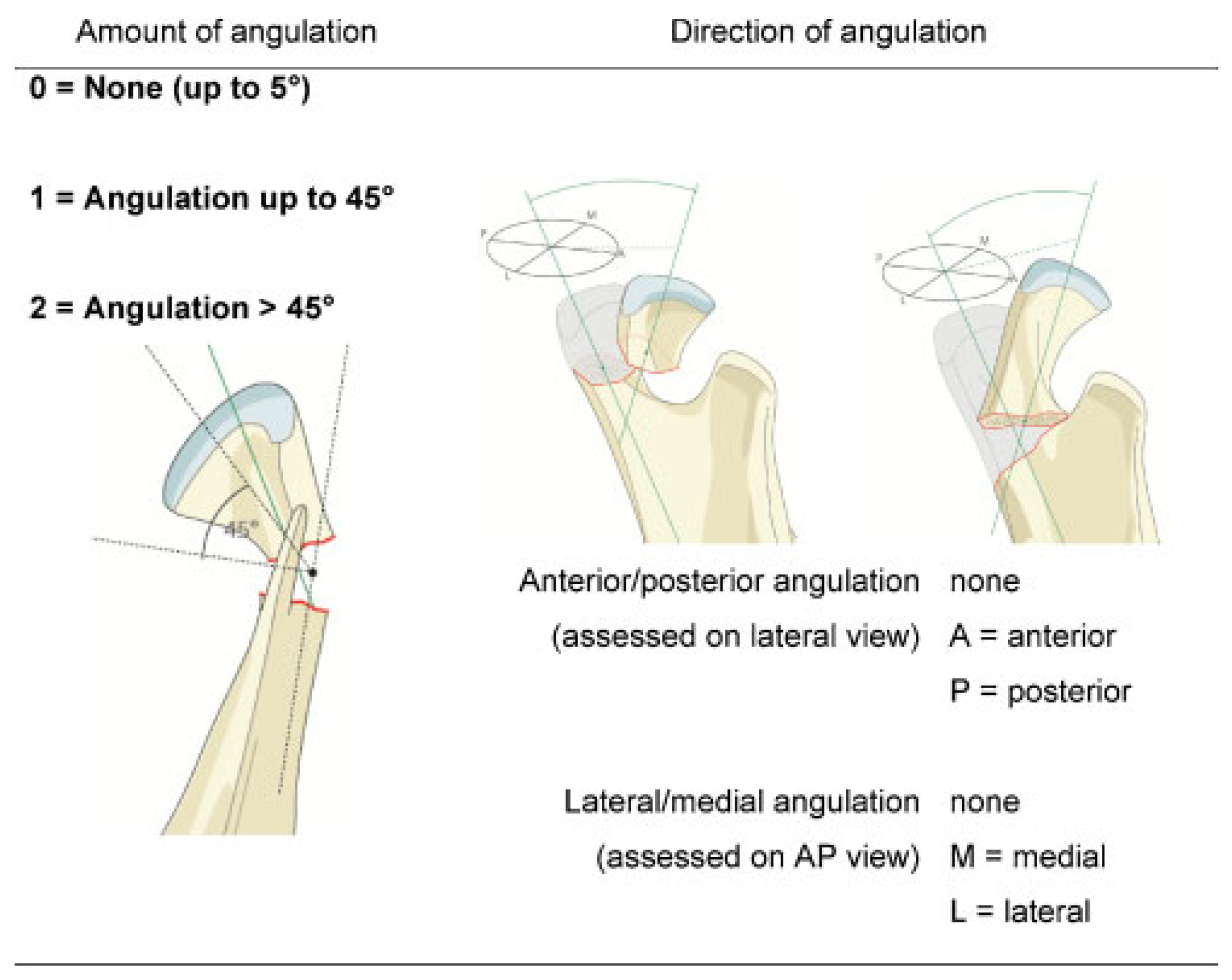
- Information about the amount of vertical height reduction, the degree of angulation (deviation) or dislocation under prognostic aspects and for the decision-making of closed or open treatment.
- Provision of specifying information with regard to the selection of adequate nonsurgical or osteosynthesis procedures or the overall functional outcome after closed or open treatment, such as major or minor fragmentation or alterations of the condyle to fossa relation.
Conclusion
Acknowledgments
References
- Zachariades, N.; Mezitis, M.; Mourouzis, C.; et al. Fractures of the mandibular condyle: a review of 466 cases. Literature review, retections on treatment and proposals. J Craniomaxillofac Surg 2006, 34, 421–432. [Google Scholar] [PubMed]
- Cornelius, C.P.; Audigé, L.; Kunz, C.; et al. The comprehensive AOCMF classification system: mandible fractures - level 2 tutorial. Craniomaxillofac Trauma Reconstr 2014, 7 (Suppl 1), S15–S30. [Google Scholar]
- Eckelt, U. Fractures of the mandibular condyle [in German]. Mund Kiefer Gesichtschir 2000, 4 (Suppl 1), S110–S117. [Google Scholar] [PubMed]
- Loukota, R.A.; Eckelt, U.; De Bont, L.; Rasse, M. Subclassification of fractures of the condylar process of the mandible. Br J Oral Maxillofac Surg 2005, 43, 72–73. [Google Scholar]
- Eckelt, U.; Schneider, M.; Erasmus, F.; et al. Open versus closed treatment of fractures of the mandibular condylar process-a prospective randomized multi-centre study. J Craniomaxillofac Surg 2006, 34, 306–314. [Google Scholar]
- Di Ieva, A.; Audigé, L.; Kellman, R.M.; et al. The comprehensive AOCMF classification system: skull base and cranial vault fractures—level 2 and 3 tutorial. Craniomaxillofac Trauma Reconstr 2014, 7 (Suppl 1), S103–S113. [Google Scholar]
- Cornelius, C.P.; Kunz, C.; Neff, A.; et al. The Comprehensive AOCMF Classification System: fracture case collection, diagnostic imaging work up, AOCOIAC iconography and coding. Craniomaxillofac Trauma Reconstr 2014, 7 (Suppl 1), S131–S135. [Google Scholar] [CrossRef] [Scilit] [PubMed]
- Perthes, B. Über Frakturen und Luxationsfrakturen des Kieferköpfchens und ihre operative Behandlung. Arch Klin Chir 1924, 133, 418–433. [Google Scholar]
- Eckelt, U.; Gerber, S. Zugschraubenosteosynthese bei Unterkiefergelenkfortsatzfrakturen mit einem neuartigen osteosynthesebesteck. Zahn Mund Kieferheilkd Zentralbl 1981, 69, 485–490. [Google Scholar]
- Pape, H.D.; Hauenstein, H.; Gerlach, K.L. Surgical care of condylar fractures using miniplates: indication, technic and 1st results and limits [in German]. Fortschr Kiefer Gesichtschir 1980, 25, 81–83. [Google Scholar]
- Petzel, J.R. Surgical treatment of the fractured collum mandibular through functional stable traction screw osteosynthesis [in German]. Fortschr Kiefer Gesichtschir 1980, 25, 84–91. [Google Scholar] [PubMed]
- Kleinheinz, J.; Meyer, C. Fractures of the Mandibular Condyle-Basic Considerations and Treatment; Quintessenz: Berlin, 2009. [Google Scholar]
- MacLennan, W.D. Fractures of the mandibular condylar process. Br J Oral Surg 1969, 7, 31–39. [Google Scholar] [CrossRef] [Scilit]
- Rasse, M. Diakapituläre Frakturen der Mandibula. Eine neue Operationsmethode und erste Ergebnisse. Z Stomatol 1993, 413–428. [Google Scholar]
- Köhler, J.A. Diagnostik und Therapie der Kieferfrakturen; Hüthig: Heidelberg, 1951. [Google Scholar]
- Reichenbach, E. [The problem of bone fracture surgery in the region of the facial bones]. Dtsch Zahnarztl Z 1953, 17, 376–399. [Google Scholar] [PubMed]
- Wassmund, M. Frakturen und Luxationen des Gesichtsschädels; Meusser Verlag: Berlin, 1927. [Google Scholar]
- Lindahl, L.; Hollender, L. Condylar fractures of the mandible, II a radiographic study of remodeling processes in the temporomandibular joint. Int J Oral Surg 1977, 6, 153–165. [Google Scholar] [CrossRef] [Scilit]
- Loukota, R.A.; Neff, A.; Rasse, M. Nomenclature/classification of fractures of the mandibular condylar head. Br J Oral Maxillofac Surg 2010, 48, 477–478. [Google Scholar] [CrossRef] [Scilit]
- Dingman, R.O.; Natvig, P. Surgery of Facial Fractures; WB Saunders: Philadelphia, 1964. [Google Scholar]
- Müller, W. Diagnosis and therapy of fractures of the mandibular ramus [in German]. Dtsch Stomatol 1971, 21, 685–690. [Google Scholar]
- Spiessl, B.; Schroll, K. Gelenkfortsatz-und Kieferköpfchenfrakturen. Spezielle Frakturen-und Luxationslehre, Band l/1: Gesichtsschädel ed; Georg Thieme Verlag: Stuttgart New York, 1972; pp. 136–152. [Google Scholar]
- Neff, A.; Kolk, A.; Deppe, H.; Horch, H.H. Neue Aspekte zur Indikation der operativen Versorgung intraartikulärer und hoher Kiefergelenkluxationsfrakturen. Mund Kiefer Gesichtschir 1999, 3, 24–29. [Google Scholar] [CrossRef] [Scilit]
- He, D.; Yang, C.; Chen, M.; et al. Intracapsular condylar fracture of the mandible: our classification and open treatment experience. J Oral Maxillofac Surg 2009, 67, 1672–1679. [Google Scholar] [CrossRef] [Scilit]
- Hlawitschka, M.; Eckelt, U. Assessment of patients treated for intracapsular fractures of the mandibular condyle by closed techniques. J Oral Maxillofac Surg 2002, 60, 784–791, discussion 792. [Google Scholar] [CrossRef] [Scilit]
- van Middendorp, J.J.; Audigé, L.; Hanson, B.; et al. What should an ideal spinal injury classification system consist of? A methodological review and conceptual proposal for future classifications. Eur Spine J 2010, 19, 1238–1249. [Google Scholar] [CrossRef] [Scilit] [PubMed]
- Neff, A.; Kolk, A.; Meschke, F.; Horch, H.H. Neue Aspekte zur Prävalenz sogenannter “Trümmerfrakturen” des Gelenkkopfs - klinisch- anatomische Befunde und therapeutische Konsequenzen. Dtsch Zahnärztl Z 2004, 59, 343–347. [Google Scholar]
- Wassmund, M. Über Luxationsfrakturen des Kiefergelenks. Dtsch Kieferchir 1934, 1, 27–54. [Google Scholar]
- Gilhuus-Moe, O. Fractures of the Mandibular Condyle in the Growth Period; Universitetsforlaget: Oslo Norway, 1969. [Google Scholar]
- Nussbaum, M.L.; Laskin, D.M.; Best, A.M. Closed versus open reduction of mandibular condylar fractures in adults: a meta-analysis. J Oral Maxillofac Surg 2008, 66, 1087–1092. [Google Scholar] [CrossRef] [Scilit]
- Audigé, L.; Cornelius, C.P.; Di Ieva, A.; Prein, J.; CMF Classification Group. The first AO classification system for fractures of the craniomaxillofaxial skeleton: rationale, methodological background, developmental process and objectives. Craniomaxillofac Trauma Reconstr 2014, 7 (Suppl 1), S6–S14. [Google Scholar]







© 2014 by the author. The Author(s) 2014.
Share and Cite
Neff, A.; Cornelius, C.-P.; Rasse, M.; Torre, D.D.; Audigé, L. The Comprehensive AOCMF Classification System: Condylar Process Fractures—Level 3 Tutorial. Craniomaxillofac. Trauma Reconstr. 2014, 7, 44-58. https://doi.org/10.1055/s-0034-1389559
Neff A, Cornelius C-P, Rasse M, Torre DD, Audigé L. The Comprehensive AOCMF Classification System: Condylar Process Fractures—Level 3 Tutorial. Craniomaxillofacial Trauma & Reconstruction. 2014; 7(s1):44-58. https://doi.org/10.1055/s-0034-1389559
Chicago/Turabian StyleNeff, Andreas, Carl-Peter Cornelius, Michael Rasse, Daniel Dalla Torre, and Laurent Audigé. 2014. "The Comprehensive AOCMF Classification System: Condylar Process Fractures—Level 3 Tutorial" Craniomaxillofacial Trauma & Reconstruction 7, no. s1: 44-58. https://doi.org/10.1055/s-0034-1389559
APA StyleNeff, A., Cornelius, C.-P., Rasse, M., Torre, D. D., & Audigé, L. (2014). The Comprehensive AOCMF Classification System: Condylar Process Fractures—Level 3 Tutorial. Craniomaxillofacial Trauma & Reconstruction, 7(s1), 44-58. https://doi.org/10.1055/s-0034-1389559