1. Introduction
In an increasingly complex financial environment, individuals are faced with decisions that critically affect their personal economic well-being. Financial literacy, financial technology (FinTech) adoption, and financial attitude have been widely recognized as key determinants of financial behavior, representing the cognitive, technological, and psychological dimensions of financial decision-making (
Dadra et al., 2024). Financial literacy is linked to positive outcomes such as saving, budgeting, and investing (
Lusardi & Mitchelli, 2007), while FinTech adoption improves financial access and inclusion, particularly in underserved markets (
Setiawan et al., 2021). In parallel, financial attitude has emerged as a crucial psychological factor that shapes how individuals approach spending, saving, and managing financial risk (
Rai et al., 2019;
Baptista & Dewi, 2021). The rapid digital transformation of financial services has fundamentally altered how individuals access, evaluate, and manage financial resources, making digital financial engagement an increasingly important determinant of financial behavior.
Most studies have examined these factors in isolation or focused on direct effects without considering the interdependencies among them. For example, while
Jose and Ghosh (
2024) and
Jabbour Al Maalouf et al. (
2023) found a direct relationship between financial literacy and behavior, others, such as
Widyakto et al. (
2022) and
Rahayu et al. (
2023), emphasized the significance of financial attitude, sometimes even outweighing knowledge. Similarly, studies on FinTech adoption, such as
Setiawan et al. (
2021) and
Shehadeh et al. (
2024), tend to emphasize usage and intention without exploring how attitude mediates the behavioral outcomes. In the context of Lebanon,
Aoun et al. (
2026) examined financial literacy, FinTech adoption, and financial attitudes among Lebanese millennials. Moreover, studies that integrate these constructs into a single theoretical framework grounded in models such as the Theory of Planned Behavior (TPB) or the Technology Acceptance Model (TAM) remain scarce, particularly in crisis contexts, where behavior may be driven more by survival and urgency than by rational planning or trust in institutions.
An additional limitation in the literature is the absence of comparative studies across economically contrasting environments. While several studies have explored financial behavior in Indonesia (
Hasibuan et al., 2018;
Gunawan et al., 2021), India (
Lahiri & Biswas, 2022), and Jordan (
Ahmad et al., 2021), very few have examined how relationships between financial knowledge, technology use, and attitude-based dispositions vary across fragile economies and digitally mature financial systems. For example, the behavioral outcomes of FinTech adoption in Lebanon, a country experiencing economic collapse, currency devaluation, and institutional mistrust (
Bejjani et al., 2024), may diverge significantly from those in the United Arab Emirates (UAE), where FinTech innovation is state-backed, and trust in financial systems is high. Lebanon and the UAE also differ substantially in the structure and performance of their financial sectors (
Elsayed et al., 2024). Lebanon’s banking industry, once a major contributor to GDP and employment, has been severely disrupted by the 2019 financial collapse, currency devaluation, and declining public trust, leading individuals to increasingly rely on informal or digital alternatives (
Hijazi et al., 2025). Conversely, the UAE hosts a highly developed financial industry that contributes significantly to national GDP, supported by strong regulation, widespread digital banking penetration, and government-led FinTech initiatives (
Elsayed et al., 2024). These contrasting structural and behavioral realities underscore the need to examine financial literacy, FinTech adoption, and financial behavior across both contexts.
This study extends existing research by examining financial literacy, FinTech adoption, and financial attitude within an integrated behavioral model. While each construct has been studied individually, their interdependencies and combined pathways remain underexplored, particularly in environments experiencing institutional instability or rapid digital transformation. By modelling both direct and mediated effects, this study offers a more integrated understanding of how cognitive, technological, and psychological drivers collectively shape financial behavior.
Beyond their behavioral relevance, these factors are increasingly important within the broader sustainable finance agenda. While sustainable finance research has traditionally focused on institutional issues such as Environmental, Social, and Governance (ESG) practices, sustainability reporting, and green investments, the effectiveness of sustainable financial systems also depends on individuals’ ability to make informed financial decisions and access appropriate financial services. Financial literacy strengthens financial capability and resilience, whereas FinTech solutions can enhance financial inclusion and facilitate access to financial products, particularly in underserved or economically constrained environments. Understanding how these factors jointly influence financial behavior, therefore, contributes to the growing discussion on the behavioral foundations of sustainable and inclusive financial systems.
The selection of financial literacy, FinTech adoption, and financial attitude is theoretically and empirically grounded. Together, these constructs represent the cognitive, technological, and psychological dimensions that underpin modern financial decision-making. Financial literacy captures individuals’ ability to understand and evaluate financial choices (
Aydin & Akben Selcuk, 2019), FinTech adoption reflects the increasing role of digital financial tools in shaping everyday behavior (
Kumari & Devi, 2022), and financial attitude represents the internal dispositions that determine whether knowledge and technology translate into responsible action (
Tahir et al., 2023). Examining these three dimensions within a single framework enables a more holistic understanding of financial behavior than studying each in isolation. Therefore, combining these constructs allows the model to capture the full pathway from financial knowledge (cognitive) to adoption of financial tools (technological) to the psychological mechanisms that ultimately drive behavior.
The research problem addressed in this study arises from persistent discrepancies in financial capability and digital financial engagement across countries. These disparities also raise important questions regarding the development of sustainable financial systems, particularly in contexts where financial inclusion and resilience are critical for long-term economic stability. Evidence shows that financial literacy remains uneven, particularly in fragile economies with institutional instability, inflation, and weakened banking structures, such as Lebanon (
Abou Ltaif et al., 2024). Meanwhile, FinTech adoption is rapidly expanding in both emerging and mature markets (
Rivandi, 2026), yet its behavioral implications remain underexplored, especially where FinTech substitutes for traditional financial systems. At the same time, psychological determinants such as financial attitude play a crucial but often overlooked role in shaping behavior. These empirical inconsistencies highlight the need for an integrated model that captures how knowledge, technology use, and attitudes jointly influence financial behavior across diverse economic environments.
To address these gaps and respond to the identified research problem, this study develops and empirically examines an integrated behavioral model that explores both the direct and mediated effects of financial literacy and FinTech adoption on financial behavior, with financial attitude as a mediating construct. Drawing on the TPB and TAM, this study conducts a comparative analysis of two highly contrasting contexts: Lebanon, a financially constrained and unstable environment, and the UAE, a stable, high-income country with strategic FinTech investments. The TPB provides a suitable foundation for this model because it positions attitude as a central mechanism through which individuals translate knowledge and external influences into behavior. In financial contexts, particularly those characterized by uncertainty, institutional instability, or rapid digital transformation, attitudes play a vital role in shaping how individuals apply financial knowledge and interact with financial tools. TPB, therefore, offers a theoretically robust lens for examining the mediating effect of financial attitude in both stable and crisis-affected settings. Furthermore, TAM is equally appropriate, as FinTech adoption represents not only technological innovation but also a behavioral enabler in both national contexts studied. In Lebanon, FinTech may compensate for weakened banking structures, whereas in the UAE, it reflects a mature digital ecosystem and high user confidence. TAM helps explain how perceived usefulness and ease of use translate into actual behavior, making it a suitable theoretical anchor for understanding the behavioral implications of FinTech adoption across diverse environments.
The comparison between Lebanon and the UAE offers a theoretically meaningful contrast that enhances the contribution of this study. Lebanon exemplifies a crisis-affected, low-trust financial system, whereas the UAE represents a stable, high-income, and digitally advanced environment. Examining these sharply divergent contexts allows the study to assess whether the same behavioral mechanisms operate similarly across institutional extremes or whether their effects vary in response to economic stability, digital maturity, and levels of financial trust. This contrast strengthens the external validity and explanatory power of the model.
Accordingly, the study has the following research questions: (1) Is financial literacy associated with individuals’ financial behavior? (2) What is the association between FinTech adoption and individuals’ financial behavior? (3) Does financial attitude mediate the association between financial literacy and financial behavior? (4) Does financial attitude mediate the association between FinTech adoption and financial behavior? (5) Do the direct and indirect associations among financial literacy, FinTech adoption, financial attitude, and financial behavior differ significantly between a fragile economy (Lebanon) and a digitally mature one (UAE)?
This study adds to the existing body of knowledge in four key ways. First, it integrates cognitive (literacy), technological (FinTech), and psychological (attitude) drivers into a unified behavioral model, moving beyond the siloed approaches found in prior research. Second, it empirically validates the mediating role of financial attitude, an underexplored mechanism in existing models. Third, it introduces a cross-national comparison, offering insights into whether these associations differ across contrasting economic contexts. Finally, the findings provide actionable implications for policymakers, financial educators, and FinTech developers seeking to tailor interventions based on context-specific behavioral patterns.
2. Theoretical Background and Hypotheses Development
2.1. Theoretical Background
According to
Ajzen (
1991), in the TPB, behavioral inclination is brought about by three major variables: attitude toward behavior, subjective norms, and perceived behavioral control. Attitude refers to the general spirit toward the behavior, subjective norms refer to social pressure accompanying support, and perceived behavioral control is the individual’s assessment of their ability to perform the behavior. These three elements work together in forming behavioral intentions, which then serve to predict actual behavior. TPB is suitable for this study, as it provides a strong psychological basis to explain the processes through which financial decisions are made. In particular, it supports the role of financial attitudes as mediators between financial literacy and FinTech adoption, as well as financial behavior. The theory is widely used among other financial behavior studies, such as
Mulyono (
2021),
Raut and Kumar (
2024), and many other studies, because it emphasizes personal disposition and perception to close the gap between knowledge, use of technology, and actual financial behavior.
According to the TAM proposed by Davis in 1989, a person’s acceptance and use of novel technology is chiefly determined by two interfaces: perceived usefulness and perceived ease of use. The first is the degree to which a person believes that using a particular technology would improve their performance; the second, in contrast, describes the extent to which a person believes that some effort will have to be made to use the technology in question. These two beliefs shall jointly shape the attitude of a user toward a technology, which further directs the behavior that encourages its adoption (
Davis, 1989). While the original TAM explains technology adoption through perceived usefulness and ease of use, the present study focuses on FinTech adoption as a behavioral determinant, rather than its antecedents. Therefore, TAM is adopted here in a simplified form to justify the inclusion of FinTech adoption as a predictor of financial behavior, aligned with existing literature that confirms its behavioral significance. This correlates with relevant previous studies that demonstrate it as a significant behavioral factor.
2.2. Conceptual Framework
2.2.1. Financial Literacy
Financial literacy has long been acknowledged as an essential pillar of individual financial well-being (
Aydin & Akben Selcuk, 2019). Researchers have consistently linked higher financial literacy to better economic outcomes, such as increased savings, reduced debt, and sound investment decisions (
Hwang & Park, 2023;
Khan et al., 2022).
Lusardi and Mitchelli (
2007) showed that financial knowledge improves financial decision-making. Across countries, initiatives led by the Organization for Economic Co-operation and Development (OECD) and World Bank have further solidified financial literacy as a core competency necessary for effective participation in modern financial systems (
Spivak et al., 2024).
2.2.2. FinTech Adoption
FinTech adoption refers to the gradual acceptance and implementation of FinTech services across countries by consumers, businesses, and financial institutions. This fluid industry comprises innovations such as digital wallets, mobile banking, blockchain, and AI that are transforming the way financial services are rendered and accessed (
Kumari & Devi, 2022). The growth is bolstered by further technological change, shifting consumer tastes, and an enabling regulatory environment. A remarkable surge characterizes FinTech market growth, with the everyday activities of finance increasingly depending on digital solutions. This expansion can be seen through indicators from the number of users to valuation and investment trends. The widespread implementation of FinTech carries rippling consequences, ranging from personal financial behavior to systemic banking operations and regulatory landscapes (
Yue et al., 2022).
2.2.3. Financial Behavior
While such behavior denotes what people do with their money, behavioral finance seeks to explain why people do so. Behavioral finance is a new field that brings together insights from psychology and economics to understand how psychological factors, emotions, and cognitive biases influence financial decision-making and market outcomes (
Baker & Nofsinger, 2010). It includes saving, investing, managing debt, and spending, but also the tendency to engage in herding, or following the financial decisions of others (
Setiawan et al., 2021). People with higher levels of financial literacy tend to display better financial behavior. It is through financial literacy that a person learns the knowledge, skills, and attitude needed to manage money well.
2.2.4. Financial Attitude
Financial attitude implies the psychological inclination, state of mind, or opinion toward personal financial matters. As an expression of one’s mental mindset, it reflects a person’s view as acceptance or rejection of certain established financial management practices (
Fünfgeld & Wang, 2009). This attitude has a significant bearing on one’s financial behavior: The more positive the attitude to saving, the more likely it is that those with positive attitudes will plan, save, and invest more responsibly in budgeting and other areas (
Rai et al., 2019). Then again, it influences the perception of risk, self-control, and financial security, which, in turn, will have a great effect on the realization of being financially secure (
Strömbäck et al., 2017).
2.3. Hypothesis Development
2.3.1. Financial Literacy and Financial Behavior
Previous research has consistently demonstrated that financial literacy is one of the strongest predictors of responsible financial behavior. Individuals with higher levels of financial literacy are generally more likely to budget effectively, save regularly, manage debt responsibly, and make informed investment decisions across different economic contexts. Early work by
Lusardi and Mitchell (
2014) established financial literacy as a fundamental determinant of sound financial decision-making, a conclusion that has subsequently been supported across both developed and emerging economies.
Consistent empirical evidence has been reported across diverse geographical settings. Studies conducted in Indonesia (
Andarsari & Ningtyas, 2019;
Hasibuan et al., 2018;
Gultom & Liyas, 2024), India (
Jose & Ghosh, 2024;
Lahiri & Biswas, 2022), Singapore (
Fong, 2025), Japan (
Bawalle et al., 2024), Kuwait (
Abdallah et al., 2025), and Lebanon (
Jabbour Al Maalouf et al., 2023) consistently report that financially literate individuals exhibit better financial behaviors, including higher savings, more prudent borrowing, stronger investment decisions, and improved financial planning.
Nevertheless, the association is not universally consistent.
Gunawan et al. (
2021), for instance, found that although Islamic financial literacy was relatively low, financial behavior remained comparatively high, suggesting that habitual behavior, cultural practices, and religious norms may partially substitute for financial knowledge. These findings indicate that contextual factors may influence the extent to which financial literacy translates into responsible financial behavior.
Thus, despite some exceptions, the prevailing literature supports a robust, positive association between financial literacy and financial behavior. Nevertheless, limited empirical evidence has examined whether this relationship remains robust in fragile and crisis-affected economies such as Lebanon, where prolonged financial instability, banking sector disruptions, and declining institutional trust may alter the extent to which financial literacy translates into responsible financial behavior.
According to the TPB (
Ajzen, 1991), individuals are more likely to engage in a behavior when they possess the cognitive resources necessary to evaluate alternatives and perceive greater control over their decisions. Financial literacy enhances individuals’ financial knowledge and analytical capabilities, enabling them to assess financial risks, compare available options, and make informed financial choices. Consequently, financially literate individuals are expected to develop more prudent financial practices, including budgeting, saving, debt management, and long-term financial planning. Accordingly, the subsequent hypothesis is proposed:
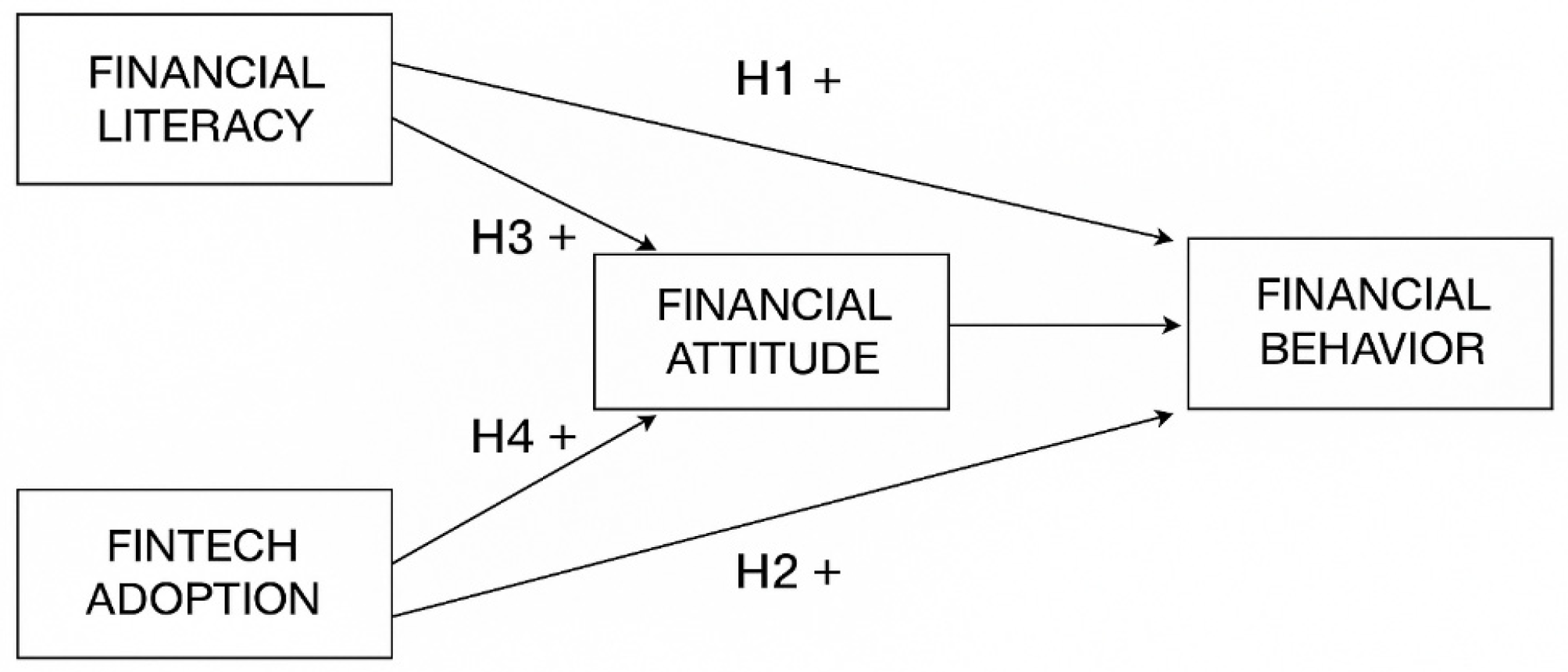
H1. Financial literacy has a positive and significant association with financial behavior.
2.3.2. Fintech Adoption and Financial Behavior
Growing empirical evidence suggests that FinTech adoption positively influences financial behavior by enhancing financial inclusion, improving access to digital financial services, and encouraging more efficient financial management. Studies conducted across Palestine, Indonesia, Jordan, and other international contexts consistently show that FinTech adoption promotes digital payment usage, strengthens saving habits, increases trust in financial technologies, and facilitates broader participation in formal financial systems (
Daqar et al., 2020;
Setiawan et al., 2021;
Widyastuti & Hermanto, 2022;
Shehadeh et al., 2024). These benefits appear particularly pronounced among previously underserved and unbanked populations, where FinTech reduces barriers to financial access and supports greater financial inclusion. At the global level,
AlSuwaidi and Mertzanis (
2024), using data from 114 countries, further demonstrated that financial education plays a critical role in promoting FinTech adoption, which subsequently contributes to improved financial behavior. Similarly,
Ridzuan et al. (
2024) highlighted the growing role of artificial intelligence in strengthening FinTech services, emphasizing its potential to enhance banking efficiency while underscoring the importance of appropriate regulatory and ethical governance. Collectively, these studies indicate that FinTech adoption contributes to more responsible financial behavior by improving accessibility, convenience, and user engagement with digital financial services.
According to the TAM (
Davis, 1989), perceived usefulness and perceived ease of use increase individuals’ willingness to adopt technology. Once adopted, FinTech applications provide users with real-time financial information, automated budgeting tools, expenditure tracking, digital payment systems, and investment platforms. These functionalities facilitate more disciplined financial management and encourage responsible financial behavior. Consequently, individuals who perceive FinTech applications as useful and easy to use are more likely to integrate these technologies into their daily financial activities, thereby reinforcing sound financial decision-making.
The review of the literature revealed a consistent pattern of FinTech adoption influencing financial behavior formation, mainly through inclusion, accessibility, and digital engagement. However, while FinTech adoption has been widely studied in emerging and developing markets, there remains a lack of empirical investigation into its behavioral impact within fragile and crisis-prone economies like Lebanon. The country’s ongoing financial collapse, currency devaluation, and limited banking access have accelerated interest in alternative financial solutions, yet the behavioral outcomes of FinTech usage in such turbulent environments remain underexplored. Understanding how digital financial tools influence user behavior in Lebanon provides a timely and critical contribution to the literature. Taken together, the theoretical arguments and empirical evidence suggest that individuals who adopt FinTech applications are more likely to engage in responsible financial practices. Accordingly, the following hypothesis is proposed:
H2. The adoption of FinTech is positively associated with financial behavior.
2.3.3. Financial Attitudes’ Role in the Relationships Between FinTech and Financial Behavior and Between Financial Literacy and Financial Behavior
Financial attitude has increasingly been recognized as a key psychological mechanism linking financial knowledge and technology adoption to responsible financial behavior. While financial literacy equips individuals with the knowledge required to make informed financial decisions and FinTech provides the technological means to execute those decisions, financial attitude reflects individuals’ predisposition toward planning, saving, budgeting, and long-term financial management. Consequently, financial attitude has been proposed as an important mechanism through which financial literacy and FinTech adoption translate into responsible financial behavior.
Empirical evidence generally supports this perspective. Studies conducted across Indonesia, India, Jordan, and Saudi Arabia consistently demonstrate that positive financial attitudes strengthen the relationship between financial literacy and financial behavior while also facilitating the behavioral benefits of FinTech adoption (
Adiputra, 2021;
Baptista & Dewi, 2021;
Banthia & Dey, 2022;
Rahayu et al., 2023;
Amnas et al., 2024;
Alalwan et al., 2017;
Ahmad et al., 2021;
Bajunaied et al., 2023). These studies collectively indicate that individuals exhibiting stronger financial attitudes are more likely to transform financial knowledge and digital financial tools into responsible financial practices.
Nevertheless, previous findings remain inconclusive regarding the exact role of financial attitude. While some studies reported that financial attitude did not directly influence financial behavior (
Nazah et al., 2022), others identified it as a stronger predictor than financial literacy itself (
Widyakto et al., 2022). These contrasting findings suggest that the influence of financial attitude may vary according to contextual conditions, financial awareness, institutional support, and broader socio-economic environments.
Despite widespread research on the individual impacts of financial literacy, financial attitude, and FinTech adoption on financial behavior, limited attention has been paid to the underlying mechanisms through which these variables exert their influence. While prior studies have explored direct relationships, the role of financial attitude as a mediating factor remains under-examined, particularly in the context of emerging economies where digital financial tools and financial knowledge are still evolving.
According to the TPB (
Ajzen, 1991), attitudes constitute one of the three primary determinants of behavioral intention. Individuals possessing favorable attitudes toward financial planning, saving, and responsible money management are therefore more likely to translate both financial knowledge and FinTech usage into actual financial behavior. Understanding this mediating pathway is particularly important because it explains how knowledge and technology adoption are converted into responsible financial actions. Given previous empirical evidence, financial attitude is therefore expected to mediate and strengthen the effects of financial literacy and FinTech adoption on financial behavior. Accordingly, the following hypotheses are proposed:
H3. Financial attitude mediates the association between financial literacy and financial behavior.
H4. Financial attitude mediates the association between FinTech adoption and financial behavior.
Figure 1 shows the hypothesized relationships between the variables. Given the substantial differences in economic stability, financial market development, and digital financial infrastructure between Lebanon and the UAE, the proposed relationships are subsequently examined and compared across both national contexts.
3. Research Context: Lebanon and the UAE
To explore the associations between the variables across different socio-economic and financial contexts, this study compares Lebanon and the UAE, which differ in context, FinTech adoption, financial literacy, cultural context, and policy relevance.
Second, FinTech adoption across the Middle East and North Africa (MENA) region has increased in recent years, but discrepancies exist between Lebanon and the UAE. In Lebanon, FinTech adoption is low to moderate, with limited trust and access, limited regulatory innovation, and continuous turbulence. Although there is high smartphone penetration and moderate internet connectivity, Lebanon’s FinTech ecosystem remains underdeveloped, with only 13 e-wallet providers licensed by the central bank as of 2024. FinTech adoption in Lebanon is largely driven by necessity rather than policy support (
The Fintech Times, 2024). However, in the UAE, there is a high adoption of FinTech and government-backed initiatives. The UAE FinTech market was valued at US
$3.16 billion in 2024 and is projected to nearly double by 2029, with FinTech startups attracting over US
$265 million in funding during the first half of 2024 alone (
Aletihad, 2024). The initiatives include the Dubai International Financial Centre (DIFC), FinTech Hive, Hub71, and comprehensive digital asset frameworks. All this has made the UAE a frontrunner in FinTech innovation and financial digitalization in the MENA region (
Fintechnews.ae, 2024).
Third, financial literacy across MENA countries generally remains low, with only about 33% of adults globally considered financially literate. Regarding this, Lebanon faces several obstacles. As per the study of
Jardaly et al. (
2024), approximately 44% of Lebanese adults showed basic financial knowledge, and according to a 2024 nationwide survey, 75% of Lebanese medical students, residents, and physicians failed Lusardi–Mitchelli’s financial literacy questions. Nonetheless, the UAE shows stronger performance across several measures. A 2022 OECD–PISA assessment placed Emirati students at 441 points in financial literacy. Although this is below the global OECD average of 498, it is still good. Only 39% failed to reach baseline proficiency, which is a better outcome than most regional peers (
OECD, 2022,
2023). Furthermore, a 2024 Visa survey found that approximately 50–75% of UAE adults understand key financial concepts, such as credit scores and interest, while 68% closely monitor expenses and 64% report financial strain but remain goal-oriented (
UAE Ministry of Education, 2024). Based on these numbers, it can be determined that financial literacy in Lebanon is generally lower compared to the UAE, where there are national financial literacy strategies and awareness campaigns.
Fourth, both countries have collectivist cultures, with the UAE being shaped by Arab and Islamic values, and Lebanon has the same culture but with hybrid traits due to modernization and globalization influences (
Hofstede Insights, 2024). Moreover, prolonged economic instability has encouraged crisis-adaptive financial behavior among Lebanese individuals, whereas consumers in the UAE generally operate within a stable, technology-driven financial environment supported by high institutional trust.
Lebanon represents a crisis-affected, low-trust financial environment, while the UAE reflects a stable, tech-advanced economy. These contextual differences may shape how different variables influence financial behavior. In addition, these contrasting contexts also provide an opportunity to examine how digital transformation and financial inclusion initiatives operate under different levels of economic stability and institutional trust.
The comparison is particularly relevant because the same behavioral mechanisms may assume different practical importance under contrasting economic conditions. In Lebanon, prolonged financial instability, currency depreciation, banking-sector disruption, and declining institutional trust may increase individuals’ reliance on personal financial knowledge and alternative digital financial services. Consequently, FinTech adoption may function primarily as a necessity-driven response to restricted access to conventional banking services. Conversely, in the UAE, FinTech adoption occurs within a mature, government-supported financial ecosystem, where digital financial services complement an already well-developed banking infrastructure.
Similarly, financial attitudes may operate differently across the two settings. In Lebanon, financial behavior may be more reactive and influenced by immediate economic pressures, whereas in the UAE, greater institutional stability, digital confidence, and financial education initiatives may allow positive financial attitudes to play a stronger role in shaping financial decisions. These contextual differences suggest that the strength of the proposed structural relationships may vary across countries, although such differences should be determined empirically rather than assumed theoretically.
Accordingly, rather than proposing directional comparative hypotheses, this study conducts an exploratory cross-country analysis to examine whether the direct and indirect relationships among financial literacy, FinTech adoption, financial attitude, and financial behavior differ significantly between Lebanon and the UAE. To ensure meaningful comparisons, measurement invariance is first assessed using the Measurement Invariance of Composite Models (MICOM) procedure, followed by Partial Least Squares Multi-Group Analysis (PLS-MGA) to compare the structural relationships across the two national contexts.
By extending well-established behavioral relationships to two sharply contrasting economic environments, this study offers a contextual rather than theoretical contribution. Specifically, it examines whether associations that are widely supported in the financial behavior literature remain robust under conditions of prolonged economic fragility versus digital and institutional maturity, thereby contributing new empirical evidence regarding the cross-country stability of established behavioral finance mechanisms.
4. Methodology
The research is situated within a positivist philosophical view that stresses direct observation and the collection of measurable data to understand behavior. Further, the deductive approach was used along with a mono-method quantitative choice. Primary data were gathered through a structured questionnaire disseminated in June and July 2025, thereby rendering the data cross-sectional. All responses were collected during a single period, and no time-lagged design was used. As such, procedural remedies (e.g., anonymity assurances, neutral and clear wording, separation of constructs into different sections, and minimizing evaluative wording) were applied to minimize potential common method bias.
Data collection took place during a period of continued economic fragility in Lebanon rather than in response to a single disruptive financial event. The country remained affected by the prolonged financial crisis that began in 2019; therefore, respondents’ financial attitudes and behaviors were more likely to reflect the cumulative effects of sustained economic uncertainty than reactions to a specific short-term shock. This context was considered appropriate for examining financial behavior under prolonged financial instability.
The survey was used as a research strategy because it is the most suitable approach for theory-driven behavioral research, particularly when applying TPB and TAM, which rely on individuals’ perceptions, attitudes, and self-reported financial practices. The questionnaire ensures standardization across countries and allows for statistical comparison of latent constructs between Lebanon and the UAE. It consisted of five sections.
Section 1 includes demographics, which provide general information on the sample.
Section 2 includes 5 items used to measure financial literacy, adapted from
Stella et al. (
2020) and
Van Rooij et al. (
2011).
Section 3 includes 5 Likert scale statements related to FinTech adoption, derived from
Ahmad et al. (
2021) and
Amnas et al. (
2024).
Section 4 includes 5 Likert scale statements related to financial attitude, adapted from
Stella et al. (
2020).
Section 5 includes 5 Likert scale statements related to financial behavior, adapted from
Bawalle et al. (
2024) and
OECD (
2022), specifically.
Table 1 shows the measurement items and their sources.
The questionnaire was pre-tested before data collection. A panel of 3 academic experts reviewed it for clarity, relevance, and content validity. Additionally, a pilot test was conducted with 20 respondents from the target population to ensure item comprehension and refine the wording where necessary. Feedback from both stages informed minor revisions to improve the clarity and reliability of the questionnaire. The questionnaire was administered in English in both Lebanon and the UAE. English was selected because it is widely used in higher education, business, and financial services in both countries, and the target respondents were expected to possess sufficient English proficiency to complete the questionnaire. Consequently, no translation or back-translation procedures were required.
Targeted respondents were aged 18 years and above and living in Lebanon or the UAE to conduct the comparative analysis. As of July 2025, Lebanon’s population stands at around 5.85 million, and the UAE’s population is around 11.35 million (
Worldometer, 2025). Non-probability convenience sampling was used. The use of online convenience sampling was adopted to facilitate access to respondents across two geographically distinct national contexts and to reach individuals with experience using digital financial services. However, this approach may have disproportionately attracted respondents who were more highly educated, financially engaged, and familiar with digital technologies. Accordingly, the sample should not be interpreted as fully representative of the general populations of Lebanon and the UAE. Rather, it reflects financially and digitally connected adults who were accessible through the online recruitment channels used in the study. This limitation may be particularly relevant in Lebanon, where prolonged economic difficulties and unequal access to digital financial services may have further reduced the participation of less digitally connected individuals.
The questionnaire was administered online through Google Forms and disseminated via multiple digital channels (WhatsApp groups, university mailing lists, LinkedIn networks, and community platforms). This mode of data collection was appropriate given the geographic dispersion of respondents and the widespread use of digital communication channels in both countries, and it provided a practical means of reaching participants during a period of economic and infrastructural constraints in Lebanon. Because the survey link was distributed openly and not to a predefined sampling frame, the exact number of individuals who received the questionnaire could not be determined. Therefore, a formal response rate could not be calculated. Consistent with recommendations for PLS-SEM sample adequacy (
Kline, 2023), a minimum of approximately 200 cases per group was targeted. A total sample of 400 respondents was obtained from both countries, specifically, 200 respondents from Lebanon and 200 respondents from the UAE.
The study was conducted according to accepted standards of research integrity. The questionnaire was anonymous and confidential, and written informed consent was requested at the beginning to ensure that respondents participated voluntarily. Formal ethical approval was granted.
To assess the robustness of the proposed structural model, four socio-demographic variables (age, gender, educational level, and monthly income) were incorporated as control variables. Direct paths were specified from each control variable to financial behavior, and the structural model was re-estimated separately for the Lebanese and UAE samples. This additional analysis examined whether the hypothesized associations remained stable after accounting for respondents’ demographic characteristics.
5. Results
5.1. Sample Profile
Table 2 shows the profile of the respondents.
5.2. Measurement Model Assessment
As shown in
Table 3, all constructs demonstrated satisfactory internal consistency reliability. Cronbach’s alpha values ranged from 0.851 to 0.898, while composite reliability (ρc) values ranged from 0.893 to 0.925, exceeding the recommended threshold of 0.70. Furthermore, the average variance extracted (AVE) ranged from 0.626 to 0.712, indicating that each construct explained more than 50% of the variance of its indicators and thus confirming convergent validity.
Heterotrait–monotrait ratio (HTMT) values (
Table 4) ranged between 0.434 and 0.726, all below the conservative threshold of 0.85, supporting discriminant validity among the constructs.
In addition to the procedural measures applied during questionnaire design, common method bias was statistically assessed using the full collinearity approach. The full collinearity VIF values ranged from 1.346 to 2.318, remaining below the recommended threshold of 3.3 (
Table 5). These findings indicate that common method bias was unlikely to have materially inflated the relationships among the study constructs. Finally, the structural model demonstrated satisfactory fit, with a standardized root mean square residual (SRMR) of 0.047 and a normed fit index (NFI) of 0.926, both indicating an acceptable model fit (
Hair & Alamer, 2022).
5.3. Structural Model Assessment
The structural model exhibited moderate explanatory power (
Table 6). Specifically, the model explained 30.3% of the variance in financial attitude and 56.9% of the variance in financial behavior. Regarding effect sizes, financial attitude exerted the largest effect on financial behavior (f
2 = 0.240), followed by FinTech adoption on financial attitude (f
2 = 0.226) and financial behavior (f
2 = 0.197). In contrast, financial literacy exerted relatively small effects on both financial attitude (f
2 = 0.052) and financial behavior (f
2 = 0.076). Moreover, all endogenous constructs exhibited positive Q
2 values, confirming satisfactory predictive relevance.
Before conducting the PLS-MGA, MICOM was applied to establish measurement invariance between the Lebanese and UAE samples. The assessment included configural invariance, compositional invariance, and the equality of composite means and variances. Configural invariance was established because both groups were analyzed using the same indicators, data treatment procedures, and model specifications. As shown in
Table 7, compositional invariance was confirmed for all constructs, with correlations between the original composite scores and the permutation-based composites approaching 1.00 and all permutation
p-values exceeding 0.05. Furthermore, no significant differences were observed in composite means or variances between the two groups (all
p > 0.05). These findings indicate that full measurement invariance was established, thereby supporting the validity of subsequent cross-country comparisons using PLS-MGA.
The establishment of full measurement invariance justified the subsequent application of PLS-MGA for comparing the structural relationships between the Lebanese and UAE samples.
As presented in
Table 8, all hypothesized direct relationships were positive and statistically significant in both Lebanon and the UAE, thereby supporting the proposed structural relationships within each country. The PLS-MGA results indicated that none of the structural relationships differed significantly between Lebanon and the UAE, with only the FL → FB path approaching conventional significance (
p = 0.069). Although several standardized path coefficients were descriptively larger in one country than the other, these differences should not be interpreted as statistically significant. Thus, the findings indicate that structural associations are largely consistent across the two countries despite differences in their economic and digital environments.
The mediating role of financial attitude was subsequently assessed using bootstrapping procedures to estimate the indirect effects. As shown in
Table 9, financial attitude significantly mediated the relationships between financial literacy and financial behavior, as well as between FinTech adoption and financial behavior, in both Lebanon and the UAE. The indirect effects were statistically significant across both samples, providing additional support for the mediating role of financial attitude in explaining how financial literacy and FinTech adoption influence individuals’ financial behavior.
As a robustness check, age, gender, educational level, and monthly income were included as control variables with direct paths to financial behavior in both country-specific models. The inclusion of these variables did not materially alter the magnitude, direction, or statistical significance of the proposed structural associations (
Table 10). None of the control variables exhibited statistically significant associations with financial behavior in either Lebanon or the UAE (all
p > 0.05). These findings suggest that the associations among financial literacy, FinTech adoption, financial attitude, and financial behavior remain robust after accounting for respondents’ socio-demographic characteristics.
The inclusion of the control variables resulted in only negligible changes in the model’s explanatory power (
Table 11). Specifically, the R
2 for FA increased marginally from 0.300 to 0.303, while the R
2 for FB increased from 0.570 to 0.571. The adjusted R
2 values remained virtually unchanged. These findings indicate that the control variables contributed minimal additional explanatory variance and did not materially influence the structural relationships, thereby supporting the robustness of the main model.
6. Discussion
This study examined the direct and indirect associations of financial literacy and FinTech adoption with financial behavior through the mediating role of financial attitude. Using PLS-SEM, MICOM, and PLS-MGA, the study also explored whether these associations differed across two contrasting economic contexts: Lebanon and the UAE.
6.1. Financial Literacy and Financial Behavior
In both contexts, the findings revealed that financial literacy is positively associated with financial behavior, supporting H
1. The results align with previous studies showing the significant relationship between financial knowledge and improved financial decisions, including budgeting, saving, and investing (
Lusardi & Mitchelli, 2007;
Lahiri & Biswas, 2022;
Jose & Ghosh, 2024). In Lebanon,
Jabbour Al Maalouf et al. (
2023) also found that financial literacy plays a vital role in helping individuals navigate a turbulent economic environment. Although the standardized path coefficient was descriptively higher in Lebanon than in the UAE, the PLS-MGA results indicated that this difference did not reach conventional levels of statistical significance, suggesting that financial literacy constitutes an important determinant of financial behavior in both contexts. Accordingly, although the descriptively larger coefficient observed among Lebanese respondents may suggest greater reliance on personal financial knowledge under conditions of prolonged economic instability, systemic financial collapse, and weakened institutional trust, this interpretation remains exploratory because the PLS-MGA did not identify a statistically significant between-country difference.
6.2. FinTech Adoption and Financial Behavior
Also, in both contexts, FinTech adoption was found to be significantly associated with financial behavior, supporting H
2. This corroborates TAM’s view that technological tools, when perceived as useful and accessible, translate into behavioral change (
Davis, 1989). This is also in line with previous studies discussing the role of FinTech in impacting saving habits, spending, and digital payment behaviors (
Setiawan et al., 2021;
Widyastuti & Hermanto, 2022;
Shehadeh et al., 2024). In Lebanon, where traditional banking systems are weakened, FinTech platforms may serve as alternative tools for conducting daily transactions and for traditional banking. In the UAE, the effect of FinTech adoption is reinforced by state-led innovation platforms and widespread consumer engagement with digital financial services (
Ali Osman, 2024).
Consistent with the overall PLS-MGA results indicating no statistically significant between-country differences, FinTech adoption exhibited only a descriptively stronger association with financial behavior in Lebanon than in the UAE. This finding suggests that FinTech adoption represents an important behavioral determinant in both economies, although the observed descriptive patterns may reflect different contextual conditions. In Lebanon, this may reflect necessity-driven adoption arising from limited access to conventional banking services. In contrast, in the UAE it is facilitated by convenience, technological maturity, and strong institutional support.
6.3. Financial Attitude as a Mediator
In both contexts, the mediating role of financial attitude was found to be significant in the association between financial literacy and financial behavior (H
3) and between FinTech adoption and financial behavior (H
4). The bootstrapped indirect effects confirmed that financial attitude significantly transmitted the effects of both financial literacy and FinTech adoption to financial behavior in the Lebanese and UAE samples, providing stronger statistical support for mediation than the stepwise procedures commonly adopted in earlier studies. These results are in line with the findings of previous studies, which asserted that attitudes impact financial behaviors such as budgeting, saving, and risk-taking (
Baptista & Dewi, 2021;
Fünfgeld & Wang, 2009;
Rai et al., 2019;
Strömbäck et al., 2017). They are also in line with the findings of
Adiputra (
2021) and
Rahayu et al. (
2023), which emphasized that financial literacy and FinTech usage are more effective when paired with a positive financial attitude. The results support the TPB, which indicates that attitudes serve as a bridge between knowledge or behavioral intention and actual financial behavior.
6.4. Cross-Country Interpretation of the Findings
The comparative analysis provides additional insight into the applicability of the proposed model across two contrasting economic environments. Before comparing the structural associations, measurement invariance was established through the MICOM procedure, confirming that the constructs were measured equivalently across the Lebanese and UAE samples. This provided the methodological basis for conducting the subsequent PLS-MGA. The primary finding of the cross-country analysis is that the PLS-MGA results indicated no statistically significant differences in any of the structural relationships between Lebanon and the UAE. This suggests that the proposed behavioral framework is largely stable across both contexts despite their substantial institutional and economic differences.
Although the statistical comparison indicates structural equivalence across countries, the descriptive differences in standardized path coefficients may still provide contextual observations. These descriptive patterns should not be interpreted as statistically significant cross-country differences but rather as potential indications of how similar behavioral mechanisms may manifest under different institutional conditions. Despite the absence of statistically significant differences, financial literacy exhibited a descriptively stronger association with financial behavior in Lebanon, possibly reflecting greater reliance on personal financial knowledge under conditions of prolonged financial instability, banking restrictions, and heightened economic uncertainty. Likewise, the descriptively stronger association between FinTech adoption and financial behavior in Lebanon may reflect necessity-driven adoption, whereby individuals turn to digital financial services because conventional financial channels are constrained rather than because digital platforms are inherently preferred. This interpretation can also be understood through the complementary perspectives of financial exclusion and ceiling effects. In financially constrained environments such as Lebanon, FinTech may partially compensate for limited access to traditional banking services, thereby producing comparatively greater behavioral gains among users who previously faced restricted financial access. Conversely, in digitally mature environments such as the UAE, where formal financial inclusion and digital financial service penetration are already high, additional increases in FinTech adoption may generate smaller incremental behavioral improvements because many users have already reached relatively high levels of digital financial engagement. Accordingly, the descriptive differences observed between the two countries may reflect differences in the marginal contribution of FinTech under contrasting institutional conditions rather than fundamentally different behavioral mechanisms. Future research could directly examine this explanation by testing whether financial exclusion, access to formal banking services, or digital financial maturity moderate the association between FinTech adoption and financial behavior across different institutional contexts.
Thus, the principal conclusion of the MGA analysis is that the structural associations proposed by the TPB and TAM appear to remain stable across both countries. The descriptive differences discussed above are exploratory in nature and should therefore be interpreted as contextual observations rather than evidence of statistically different behavioral processes.
As a robustness check, age, gender, educational level, and monthly income were incorporated as control variables. None of these demographic variables significantly influenced financial behavior in either country, and their inclusion did not materially alter the magnitude or significance of the principal structural relationships. These findings indicate that the proposed model is robust and that the observed associations are not attributable to respondents’ socio-demographic characteristics.
6.5. Theoretical Implications
This study offers several theoretical contributions to the behavioral finance and financial technology literature.
First, it extends the application of the TPB and the TAM by integrating financial literacy, FinTech adoption, and financial attitude within a unified framework explaining financial behavior. While previous studies have typically examined these relationships independently, this study demonstrates that cognitive, technological, and psychological factors jointly contribute to responsible financial behavior.
Second, the findings reinforce the central role of financial attitude as a psychological mechanism linking both financial literacy and FinTech adoption to financial behavior. By confirming the significant indirect effects through bootstrapped mediation analysis, the study provides stronger empirical support for the attitudinal pathway proposed by TPB, highlighting that financial knowledge and technology adoption are translated into financial behavior through individuals’ evaluations and dispositions toward financial management.
Third, this study contributes to the growing literature on behavioral finance in fragile and digitally mature economies. Although Lebanon and the UAE differ substantially in terms of economic stability, institutional trust, and digital financial development, the MICOM and PLS-MGA results indicate that the proposed behavioral relationships remain largely stable across both contexts. These findings suggest that the underlying mechanisms linking financial literacy, FinTech adoption, financial attitude, and financial behavior are robust across contrasting institutional environments, thereby extending the contextual validity of TPB and TAM.
Finally, this study contributes methodologically by employing PLS-SEM together with bootstrapped mediation analysis, MICOM, PLS-MGA, and robustness analyses incorporating socio-demographic control variables. These analytical procedures provide a more comprehensive evaluation of the proposed framework than has been reported in much of the existing literature and strengthen confidence in the stability and generalizability of the findings.
7. Conclusions
This study examined the associations among financial literacy, FinTech adoption, financial attitude, and financial behavior by integrating the TPB and the TAM within a unified behavioral framework. Using data collected from respondents in Lebanon and the UAE, the study assessed the direct associations of financial literacy and FinTech adoption with financial behavior, as well as the indirect associations through financial attitude. It also explored whether these relationships were comparable across two contrasting economic and institutional contexts.
The findings show that financial literacy and FinTech adoption were positively associated with financial behavior in both countries. Financial attitude also significantly mediated both relationships, indicating that favorable financial attitudes are an important psychological mechanism linking financial knowledge and digital financial engagement with responsible financial behavior. Although some descriptive differences were observed between Lebanon and the UAE, the PLS-MGA results showed that the structural relationships were generally not statistically different across the two groups. In addition, the MICOM procedure established full measurement invariance, supporting the comparability of the model across both national contexts.
From a practical and policy perspective, the findings suggest that improving financial behavior requires an integrated approach that combines financial education with the responsible expansion of digital financial services. Governments and regulatory authorities should continue investing in national financial literacy initiatives while strengthening consumer protection, digital financial regulations, and financial inclusion strategies. Financial institutions and FinTech providers should complement technological innovation with educational initiatives that enhance financial knowledge, promote responsible financial attitudes, and improve consumers’ ability to make informed financial decisions. For Lebanon, where prolonged financial instability has weakened confidence in traditional banking institutions, policymakers should prioritize expanding secure and accessible digital financial services, strengthening financial literacy programs, and promoting consumer awareness to support financial resilience and inclusion. These initiatives may help individuals navigate financial uncertainty while encouraging more informed financial management. For the UAE, where digital financial services are already well established, continued investment in financial education, digital financial capability, and responsible innovation may further strengthen informed financial decision-making and encourage the effective use of emerging financial technologies. Policymakers may also continue supporting regulatory frameworks that foster innovation while maintaining consumer confidence and financial stability. More broadly, the findings suggest that strengthening financial capability alongside responsible FinTech adoption may contribute to broader sustainable finance objectives by supporting financial inclusion, improving household financial resilience, and encouraging more informed participation in formal financial systems.
Despite its contributions, the study has some limitations. First, the use of cross-sectional data limits the ability to draw causal relationships. Although the proposed model is theoretically grounded in the TPB and the TAM, alternative causal explanations cannot be excluded. For example, financially responsible individuals may subsequently seek greater financial knowledge or become more inclined to adopt FinTech services. Future longitudinal or experimental research would be valuable for establishing temporal ordering and strengthening causal inference. Second, the use of convenience sampling and online survey distribution constitutes an important limitation. Future research should employ stratified, quota-based, or probability sampling and should deliberately include respondents with lower levels of education, income, financial access, and digital engagement. This concern is particularly relevant in Lebanon, where unequal access to digital infrastructure and financial technologies may have further reduced the participation of less digitally connected individuals. Further, larger samples will enhance the generalizability of the results. Third, although the comparative design between Lebanon and the UAE adds richness to the analysis and fills a wide gap in the literature, the results may not be directly generalizable to other regions. Future research should expand the comparative lens to include additional MENA countries or global South–North comparisons to validate and extend the model’s applicability.
In brief, this study contributes to the growing behavioral finance and FinTech literature by providing evidence that financial literacy, FinTech adoption, and financial attitude are closely associated with responsible financial behavior across two contrasting economic environments. By integrating TPB and TAM within a single framework and validating the proposed model through PLS-SEM, bootstrapped mediation analysis, MICOM, PLS-MGA, and robustness analyses, the study offers a comprehensive assessment of financial behavior in both a fragile economy and a digitally mature economy. The findings demonstrate that, despite marked differences in economic stability and financial infrastructure, the underlying behavioral relationships remain largely comparable across contexts. These insights provide a stronger empirical foundation for future cross-country research and offer useful guidance for researchers, policymakers, financial institutions, and FinTech providers seeking to promote financial capability, financial inclusion, and sustainable financial development.