Article

Financial Inclusion and Sustainable Development: How Do Financial Literacy and Social Capital Mediate This Relationship?


1
Faculty of Management and Administrative Sciences, University of Sialkot, Sialkot 51040, Pakistan
2
Department of Business Administration, University of Sialkot, Sialkot 51040, Pakistan
3
Faculty of Business Administration, Laval University, Québec, QC G1V 0A6, Canada
4
Faculty of Allied Health Sciences, The University of Lahore, Lahore 54792, Pakistan
5
Lahore Business School (LBS), Faculty of Management Sciences, The University of Lahore, Lahore 54792, Pakistan
*
Author to whom correspondence should be addressed.
J. Risk Financ. Manag. 2026, 19(8), 549; https://doi.org/10.3390/jrfm19080549
Submission received: 27 May 2026 / Revised: 14 July 2026 / Accepted: 15 July 2026 / Published: 23 July 2026
(This article belongs to the Special Issue Emerging Trends and Innovations in Corporate Finance and Governance)

Abstract

This article investigates how mediating variables such as financial literacy and social capital can be used in the relationship between financial inclusion and sustainable development in the Pakistani educational sector. A quantitative survey design was used to gather data on educators, students, and stakeholders, in order to quantify financial inclusion, financial literacy, social capital, and sustainable development. Partial least squares structural equation modeling (PLS-SEM) was employed to analyze the proposed relationships with SmartPLS. The results show that there are positive and significant correlations between financial inclusion and financial literacy, along with social capital and sustainable development. The findings also indicate that the connection between financial inclusion and sustainable development is associated with financial literacy and social capital. The present study can be useful because it describes the connection between financial access and sustainable results—based on financial knowledge, trust, cooperation, and networks—and provides implications for policymakers, educators, and financial institutions in practice.

1. Introduction

All citizens are financially active and commit funds to activities such as the opening of bank accounts, the use of debit or credit cards, saving money, taking out loans, investing, or buying a house with a mortgage (Castro et al., 2021). However, the vast majority of people do not possess the information required to evaluate the risks, costs, and consequences of such decisions (Cardaci, 2018; Castro et al., 2021). This is important in growing economies, where insufficient financial awareness and access to formal services may undermine welfare, income stability, education, and engagement. The focus is on education, which enhances individuals’ capacity to comprehend economic change, embrace modern knowledge, and contribute to national development (Bhuiyan, 2019).
Financial inclusion can be defined as the ability of individuals and organizations within social and economic classes to afford, access, and use financial services (Claessens, 2006; Van & Linh, 2019); it guarantees access to and use of the formal financial system, doing so in an inclusive manner (Sarma, 2008; Van & Linh, 2019), while also helping individuals to access appropriate financial products and services that enhance financial well-being and economic engagement (Scottish Executive, 2005; Van & Linh, 2019). Financial inclusion can help households, students, workers, and institutions to handle everyday needs, and to plan for and react to financial challenges (Treasury, 2007; Van & Linh, 2019); it is associated with sustainable development in that it may enhance standards of living by expanding investment and consumption, decreasing reliance on informal finance, boosting income and assets, developing human capital, and generating employment opportunities (Das, 2012; Van & Linh, 2019).
The importance of financial inclusion to low-income groups lies in the fact that it enables them to cope with their day-to-day necessities, and it can also help them find investment opportunities that can enable them to enhance their income and assets (Stein, 2010b; Van & Linh, 2019). Removing obstacles such as charges, paperwork, minimum deposit issues, distance, and financial illiteracy will help in encouraging saving and investing, thereby promoting growth in emerging markets (Beck, 2016). However, access is not the only important factor; it is also necessary that people know how to utilize financial services in an appropriate way. Financial literacy is a vital component of well-being, and the youth in particular require knowledge and skills to make decisive judgments (Alshebami & Aldhyani, 2022; Danes & Hira, 1987). Poor money management and weak saving habits among the youth can decrease their quality of life and increase the burdens of dependence and debt (Alshebami & Aldhyani, 2022; Lusardi & Tufano, 2015).
Financial literacy enhances the ability to make sound financial choices (Esmail Alekam & Bt Md Salleh, 2018). Disparities in education and monetary literacy also contribute to differences in the economic performance of developed and developing societies (Mercan & Sezer, 2014). Financial literacy describes the capacity to access, process, and practice good habits related to financial and economic data in terms of financial planning, wealth production, and debt management (Alshebami & Aldhyani, 2022; Mitchell & Lusardi, 2015); it also involves the capacity to organize, comprehend, and assess individual finances in a manner that enhances well-being (Alshebami & Aldhyani, 2022; Anderson et al., 2000). By being financially literate, individuals can use money wisely, make sound investment decisions, and promote saving, as well as utilizing appropriate financial products and minimizing risk (Abreu & Mendes, 2010; Alshebami & Aldhyani, 2022). They can plan their careers and retirement savings (Alshebami & Aldhyani, 2022; Behrman et al., 2012; Lusardi & Mitchell, 2014) better, and those with very low levels of financial knowledge could be less reliant on borrowing (Alshebami & Aldhyani, 2022; Stango & Zinman, 2009). Low adult financial literacy inspires the need to research this topic in the context of developing countries (Alshebami & Aldhyani, 2022; Lusardi & Mitchell, 2011a).
The nature of social capital is significant, since trust, networks, cooperation, and information sharing influence financial behaviors. The financial awareness of students, teachers, administrators and stakeholders in the educational sector in Pakistan is interrelated with their relationships with one another, which can shape their behavior with respect to borrowing, saving, and sustainable financial decision-making. The environment is suitable because education is related to youth development, the development of human capital, and societal mobility.
Despite the existing literature demonstrating a linkage between financial inclusion and sustainable development, little research has been conducted on how this relationship works within the Pakistani educational sector. Financial inclusion is reflected in the existing literature, but with more focus on its role as a direct force of development, as opposed to the role of financial literacy and social capital as mediating factors. In this work, the gap is filled by reviewing the contribution of financial inclusion to sustainable development based on the mechanisms described below. This study also contributes to finance debates, governance by connecting inclusive finance, responsible decision-making, institutional trust, and sustainable development in education.
Research Questions:
  • What is the impact of financial inclusion on sustainable development in the Pakistani education sector?
  • What is the extent to which financial inclusion and sustainable development are mediated by financial literacy and social capital?
  • How do financial literacy and social capital separately explain the mechanisms through which financial inclusion contributes to sustainable development outcomes in Pakistan’s education sector?
The findings of this study can be applied practically in various ways: Policymakers can develop targeted financial education programs to enhance literacy among educators, students, and stakeholders in the educational sector. Financial institutions can tailor products and services to meet the unique needs of individuals in education, promoting inclusive financial practices. Moreover, understanding the role of social capital can guide community-based initiatives that enhance financial inclusion and sustainable development.

Theoretical and Conceptual Framework

The theoretical framework of the current research is premised on the idea of the public good theory of financial inclusion, which is backed by social capital theory and a financial capability perspective. The theory of the common good applies because financial inclusion does not apply to a single group; it can be beneficial to various groups in the society. Recent studies reveal that the poor in particular would be beneficiaries of financial inclusion (Bhandari, 2018). Other studies also hold that women are among the key beneficiaries of inclusive financial services (Demirgüç-Kunt et al., 2013; Ghosh & Vinod, 2017; Lontchi et al., 2022; Swamy, 2014). One further line of literature indicates that the broader economy and formal financial system can also be enriched by financial inclusion in the form of participation, savings, investment, and financial stability (Kim et al., 2018; Mehrotra & Yetman, 2015; Ozili, 2018, 2020). However, other groups—such as the youth, the elderly, students, educators, and institutional stakeholders—have received less focus in the literature, since they may too fall prey to financial exclusion or limited financial capability.
According to the public good theory, formal financial services are those that are characterized as representing a public good and, hence, ought to be made available for the common good. In this regard, financial inclusion is not only a banking goal but also a social and developmental goal. The current literature maintains that formal financial services should not be exclusive to a few groups; rather, the financial system should be made accessible across the entire population (Lontchi et al., 2022; Ozili, 2020). The present study is consistent with this theoretical stance, as it seeks to identify financial inclusion in the Pakistani educational sector, where students, teachers, administrators, and other stakeholders need to access accounts, savings, payment, credit, and other financial services in order to enhance their personal well-being, institutional operations, and overall development.
Financial inclusion, on the other hand, is primarily a measure of access and availability, but not necessarily a measure of effective financial decision-making and sustainability. Sustainable development is addressed by satisfying the current needs of the population without affecting the ability of future generations to satisfy their needs (Lontchi et al., 2022); it has three interconnected pillars: economic, environmental, and social sustainability (Alaimo et al., 2021; Lontchi et al., 2022). Financial inclusion is linked to these pillars in the sense that access to formal financial services can enable underserved groups to engage in economic activities, manage resources, lessen their reliance on informal finance, and increase their long-term prospects. In the economic aspect, inclusive finance is capable of financing saving, credit utilization, investment, earnings, and employment. These results add to sustainable development where financial access is used in a productive and responsible manner.
Financial inclusion is also directly linked with the social aspect of sustainable development. Inclusive financial institutions are supposed to treat people as equals, transparently, and with consideration for financially excluded individuals. Nevertheless, to make financial inclusion meaningful, people should understand that they ought to learn how to utilize financial products. Thus, financial literacy is included in this research as a mediating factor that transforms access into meaningful decision-making by enhancing people’s capacity to assess costs, risk, savings, borrowing, investment, and planning. This argument holds the same ground as the perspective that financial literacy empowers financial decision-making and helps individuals to utilize financial products more efficiently (Alshebami & Al Marri, 2022; Ramakrishnan, 2011).
Social capital is also a mediator, as individual knowledge is not the only factor that influences financial behavior—trust, cooperation, networks, and shared information are also relevant. According to social capital theory, bonding, bridging, collective action, and trust are likely to facilitate information exchange and cooperation within social groups (Adger, 2010; Bongomin et al., 2016; Onodugo et al., 2021; Paul et al., 2016). These networks may assist students, educators, and stakeholders in the educational sector of Pakistan to disseminate financial information, gain trust in formal institutions, and encourage responsible financial behavior.
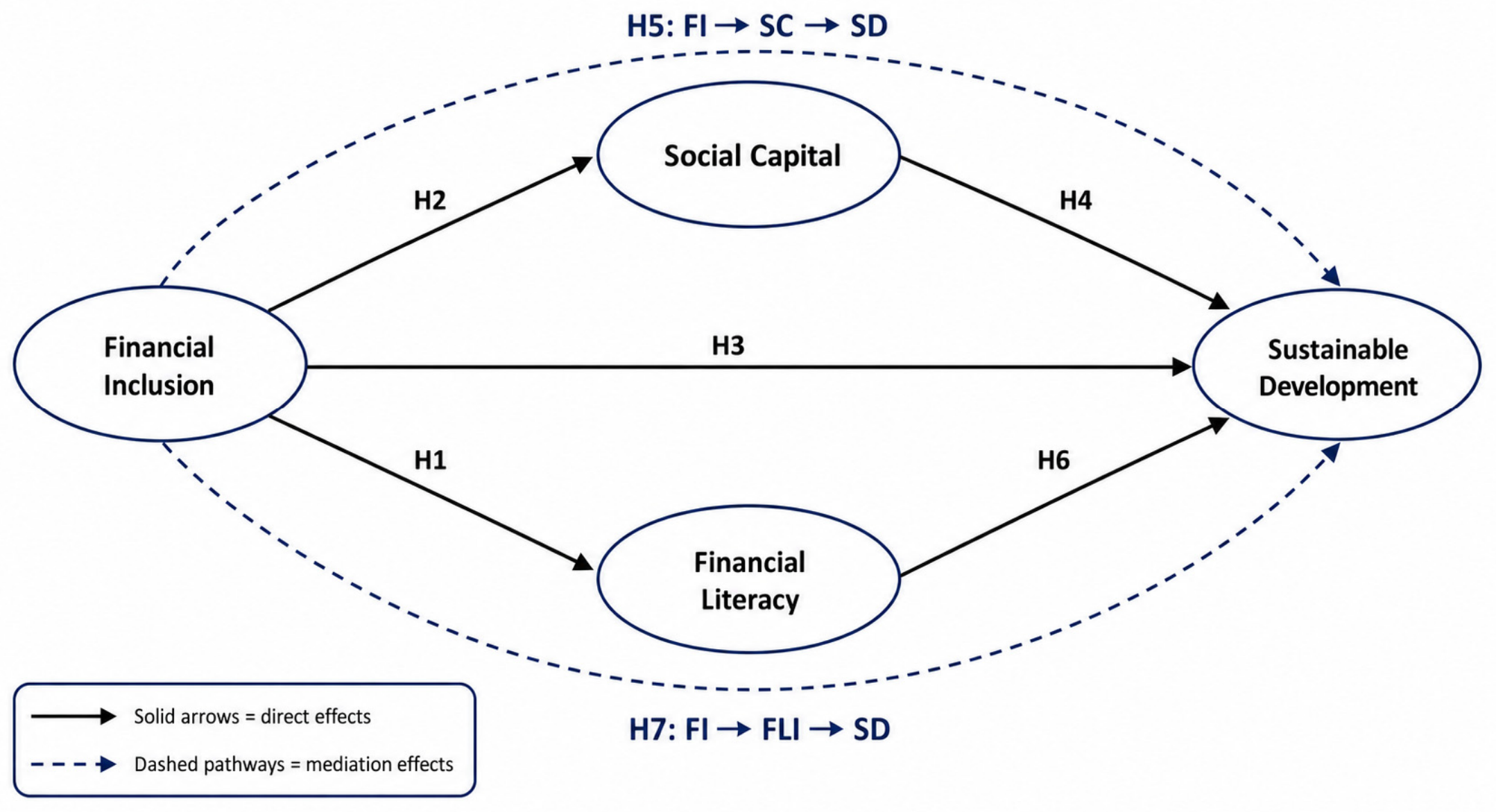
In line with this, the conceptual model in Figure 1 postulates that sustainable development is directly and indirectly affected by financial inclusion via financial literacy and social capital. Access, usage, and barriers are related to financial inclusion, whereas social, economic, and environmental factors are associated with sustainable development. Financial literacy describes how people can convert access to finances into informed choice, while social capital describes how trust and network support can influence the relationship between inclusion and sustainable results.

2. Literature Review

The macroeconomic characteristics established by a nation for the current generation to accomplish growth and development are the components of sustainable development. Consequently, all countries strive to accelerate these economic, social, and environmental elements to attain sustainability, which ought not to affect the needs of forthcoming generations. According to the literature, sustainable development is an extensive endeavor that aims to distribute resources and shape policy in a way that satisfies present needs while preserving the ability of future generations to do the same (Lontchi et al., 2022; Wilkinson & Mangalagiu, 2012). Mbata (2009) describes “The comprehensive growth of individuals by way of sustainable development”. Certain researchers think that sustainable development should be an ongoing process that has no negative effects on the environment. Development is considered to be sustainable when it can be perpetuated indefinitely (Coventry & Garrod, 2004; Dernbach, 2003; Stoddart, 2011).
According to Browning and Rigolon (2019) and Lontchi et al. (2022), the development model called for by sustainable development advocates for an improvement in the standard of living without having a negative effect on the environment or the Earth’s ecosystems (Benaim et al., 2008; Browning & Rigolon, 2019). Social, economic, and environmental factors all contribute to sustainable development. According to Zhai and Chang (2018), sustainable development attempts to achieve environmental harmony, economic growth, and social advancement. From the explanation above, it is clear that, through inclusive finance, the rural population has significantly contributed to the general economic development and sustainability of the nation (Hasan et al., 2020; Johnston, 2005; Le et al., 2019; Stein, 2010a).
As stated above, numerous studies support the social, economic, and environmental aspects of sustainable development. Thus, the UN links concerns of gender equity, cultural diversity, human rights, intercultural understanding, peace, and human security to the social dimension of sustainable development (Lontchi et al., 2022). The environmental factor has to do with protecting natural resources such as air, soil, water, agriculture, and energy, as well as sustainable urbanization (Lontchi et al., 2022). Other issues include reducing environmental contamination (in the water, air, and soil), which promotes the use of renewable energy sources instead of fossil fuels such as coal, gas, and oil. Recycling waste, preserving trees, and increasing green space can minimize resource use and environmental damage while stopping activities that hasten global warming (Atmaca et al., 2019; Koçak & Balci, 2010).
The elimination of income inequality, resource conservation, the balance of income and expenses, sustainable production and cost, the creation of an environment that encourages investment, investments in high-income sectors, investments in critical sectors, and R&D are all included in the concept of economic sustainability (Atmaca et al., 2019; Kuşat, 2013; Olsson et al., 2016; Şahin & Kutlu, 2014).

2.1. Hypothesis Development

2.1.1. Financial Inclusion and Sustainable Development

Researchers have significantly aided in our understanding of the reasons for and effects of the widespread exclusion of people from financial services, particularly in developing nations. Lyons and Kass-Hanna (2021) identified that economically weak populations are much less likely to be incorporated into financial institutions. Financial inclusion has been defined in a variety of ways in the economics and finance literature. For instance, Sarma (2012) specified a thorough description that addresses crucial issues affecting a wide population, such as the accessibility, availability, and use of financial services. In order to decrease poverty and promote economic and sustainable development, people and enterprises must successfully access and use available, inexpensive, easy, high-quality, and long-term financial services from formal providers (Lontchi et al., 2022).
Pakistan in particular, as well as all emerging nations, must prioritize improving business performance. In fact, Pakistan is characterized by a large number of businesses that aid in the country’s sustainable development by fostering economic growth, creating jobs, and accelerating industrialization. Therefore, a person’s ability to earn a living and maintain their financial security can be significantly hampered by a lack of access to financial services. This is especially true for the poor, women, young people, rural residents, migrants, people working in the informal economy, and small and medium-sized enterprises (SMEs).
Studies also show that numerous researchers have recognized financial inclusion as a crucial element that helps businesses to stay in business (Beck et al., 2009; Mago & Chitokwindo, 2014; Onaolapo & Odetayo, 2012); it provides educational institutions and enterprises with a broad array of affordable, useful financial products and services that are customized to meet their needs for credit, insurance, sales, payments, and savings. For organizations that struggle to secure finance from traditional banking institutions, this is beneficial. Utilization and accessibility of formal financial services have been used as the primary metrics for measuring financial inclusion using supply-side aggregate data (Amidžic et al., 2014; Chakravarty & Pal, 2013; Sarma, 2008, 2012) and obstacles on the opposite side.
H1. 
Financial inclusion has a positive impact on financial literacy.
H2. 
Financial inclusion has a positive impact on social capital.
H3. 
Financial inclusion has a positive impact on sustainable development.

2.1.2. The Mediating Effect of Social Capital

Numerous studies have emphasized the need to consider the social capital endowment of an organization’s or group’s members (Guiso et al., 2004; Hatzold, 2013; Olvera, 2016). Confidence and other elements included in the concept of social capital are necessary for the creation of financial inclusion policies that benefit the community and provide a stable clientele for financial institutions, leading to economic growth and sustainability. The unofficial networks, relationships, and connections that promote cooperation and companionship among individuals through fondness and reciprocity are referred to as “social capital” (Bongomin et al., 2016; Lontchi et al., 2022). Thus, the social capital of a rural production organization is based on relationships and connections with other actors, a cooperative relationship between the institution and the state, and intricate interactions between social components of the internal network structure.
However, from the perspective of the firm, social capital is the quantity of assets that are readily available to the organization and may be accessible due to its network of formal and informal contacts (Aldrich & Meyer, 2015; Woolcock & Narayan, 2000). The degree of collective action, bonding, bridging, and trust within a network determines its social capital. Social capital is enhanced by methodical coordination and mutual understanding among participants (Bongomin et al., 2016). Trust is the confidence that each person has in the other’s honesty, reliability, and capacity to complete their commitments in the relationship (Paul et al., 2016). Bonding is the ability of participants to use their combined abilities to minimize risks and equitably divide expenses (Paul et al., 2016). When one party violates the social ethos, bridging involves all parties being willing to continue their social relations (Onodugo et al., 2021). Collective action is the capacity of members to act simultaneously towards a resolution or agreement, and it is facilitated by high-quality information exchange (Adger, 2010; Lontchi et al., 2022).
Following the debate above, it was determined from the literature that social capital is necessary for financial inclusion, and that it can influence how financial inclusion affects sustainable development. Positive social capital endowment thereby enhances the population’s capacity for social learning and establishes the circumstances for an inclusive financial process (Bollier, 2016), enhances risk management, offers standard contracts, operates within collateral relationships, and acts as a trustworthy information source (Onodugo et al., 2021).
H4. 
Social capital has a positive impact on sustainable development.
H5. 
Social capital mediates the relationship between financial inclusion and sustainable development.

2.1.3. The Mediating Effect of Financial Literacy

Since 2002 in particular, financial literacy has grown in importance as a result of the complexity of the financial markets and the difficulty that the average consumer faces in making informed decisions. The promotion of financial inclusion and development, which results in financial stability, depends heavily on financial literacy. As stated by Alshebami and Al Marri (2022) and Lontchi et al. (2022), entrepreneurs who are financially literate are better equipped to identify the sources of capital that they will need in order to support their companies. Financial literacy has received a lot of attention from academics, policymakers, and other stakeholders due to its importance in assisting investment decisions, strengthening personal financial management, and enhancing financial well-being (Alshebami & Al Marri, 2022; Lontchi et al., 2022). Studies have shown that a crucial component of economic growth and sustainability is financial development (Levine, 2005; Lontchi et al., 2022). According to researchers, a major barrier to service demand is a lack of financial literacy: if people are not familiar with or at ease with a product, they will not demand it (Ramakrishnan, 2011).
The capacity to be knowledgeable about and comprehend financial market products, including benefits and hazards, is known as financial literacy. This alludes to making wise financial selections and decisions about money management. Lack of knowledge of financial products and services contributes to financial exclusion in emerging nations (Atkinson & Messy, 2012). A further factor influencing financial inclusion in emerging nations is the motive for borrowing, saving, and using financial products and services (Holzmann, 2010). Financial literacy has seen significant expansion and attention in recent years in several nations. However, this expansion can be attributed to the difficulties that have surfaced in the ever-changing financial landscape, compelling clients to take a more active role in creating financial options and evaluations (Lontchi et al., 2022; Lusardi & Mitchell, 2011b).
The importance of financial literacy in the performance of every nation’s financial structure is supported by numerous studies on financial inclusion and its relationship with economic growth and sustainability. Financial literacy in particular is a crucial tool for educating people about financial matters, including financial products, services, and activities (Fernandes et al., 2014; Sun et al., 2020); it has been quite beneficial in assisting consumers in choosing the best financial products (Bianchi, 2018; Gaudecker, 2015; Van Rooij et al., 2011). The sustainable growth of every nation’s financial system, according to many academics, is thereby intrinsically related to financial literacy: because it has significant implications for one’s personal financial choices (Kezar & Yang, 2010; Lusardi & Mitchell, 2014; Maturana & Nickerson, 2019; Paiella, 2016; Rashidin et al., 2020), it raises the degree of economic development through fostering economic security by combating unemployment and poverty (Berry et al., 2018; Hogarth, 2007; Pompei & Selezneva, 2021).
From a demand and supply standpoint, the two concepts of financial literacy and inclusion are closely related. By teaching people about what they can and should demand, financial literacy raises demand. Providing what people need in the financial market is how financial inclusion works (Lontchi et al., 2022; Ramakrishnan, 2011).
H6. 
Financial literacy has a positive impact on sustainable development.
H7. 
The relationship between financial inclusion and sustainable development is heavily mediated by financial literacy.

3. Methodology

3.1. Sample and Data Collection

SmartPLS software was used in this study because it is appropriate for analyzing complex structural equation models with latent constructs as well as mediation effects. As the present research focuses on the direct and indirect connections involving financial inclusion, financial literacy, social capital, and sustainable development, PLS-SEM was deemed suitable for testing the presented conceptual framework. SmartPLS can also be applied to prediction-oriented analysis, as well as in datasets that do not necessarily meet normality requirements; thus, its application helped to evaluate the measurement model and structural model in a systematic manner.
This research followed a quantitative survey research design. A structured questionnaire was used to collect data, and PLS-SEM was used to analyze the data. The study population was composed of people who were employed in the education sector of Pakistan, such as management staff, support staff, lecturers, assistant professors, professors, and other professionals who have some knowledge or experience related to finance. The table formulated by Krejcie and Morgan (1970) was used to determine the required sample size, indicating that a minimum of 450 respondents would make up the necessary sample. In order to obtain enough answers, 800 questionnaires were sent to the educational institutions, and 510 responses were received.
A thorough screening of the dataset was carried out to maintain the quality of the data before final analysis. Responses were checked to identify missing values, incomplete questionnaires, duplicate responses, patterns of straight-lining, atypically short completion times, and multivariate outliers. Screening eliminated 22 responses, where 8 contained considerable missing or incomplete data, 3 contained a duplicate response, 5 contained a straight-lining pattern of response, 2 contained unusually short response times, and 4 contained a multivariate outlier. This left 488 valid responses, which were analyzed; thus, the original size of the sample to be used in SmartPLS was 488.
To enhance clarity, reliability, and validity, the questionnaire was revised by the researchers and pilot-tested; convenience sampling was used to collect the data. Sekaran and Bougie (2016) define convenience sampling as a method that captures available data from willing respondents. This was considered to be an appropriate approach due to time limits, the availability of participants, and the exploratory characteristic of the research. Nevertheless, generalization was not possible due to the convenience sampling; as such, the results must be taken with caution and cannot be applied to the whole education sector in Pakistan without further validation of the results using probability-based sampling.
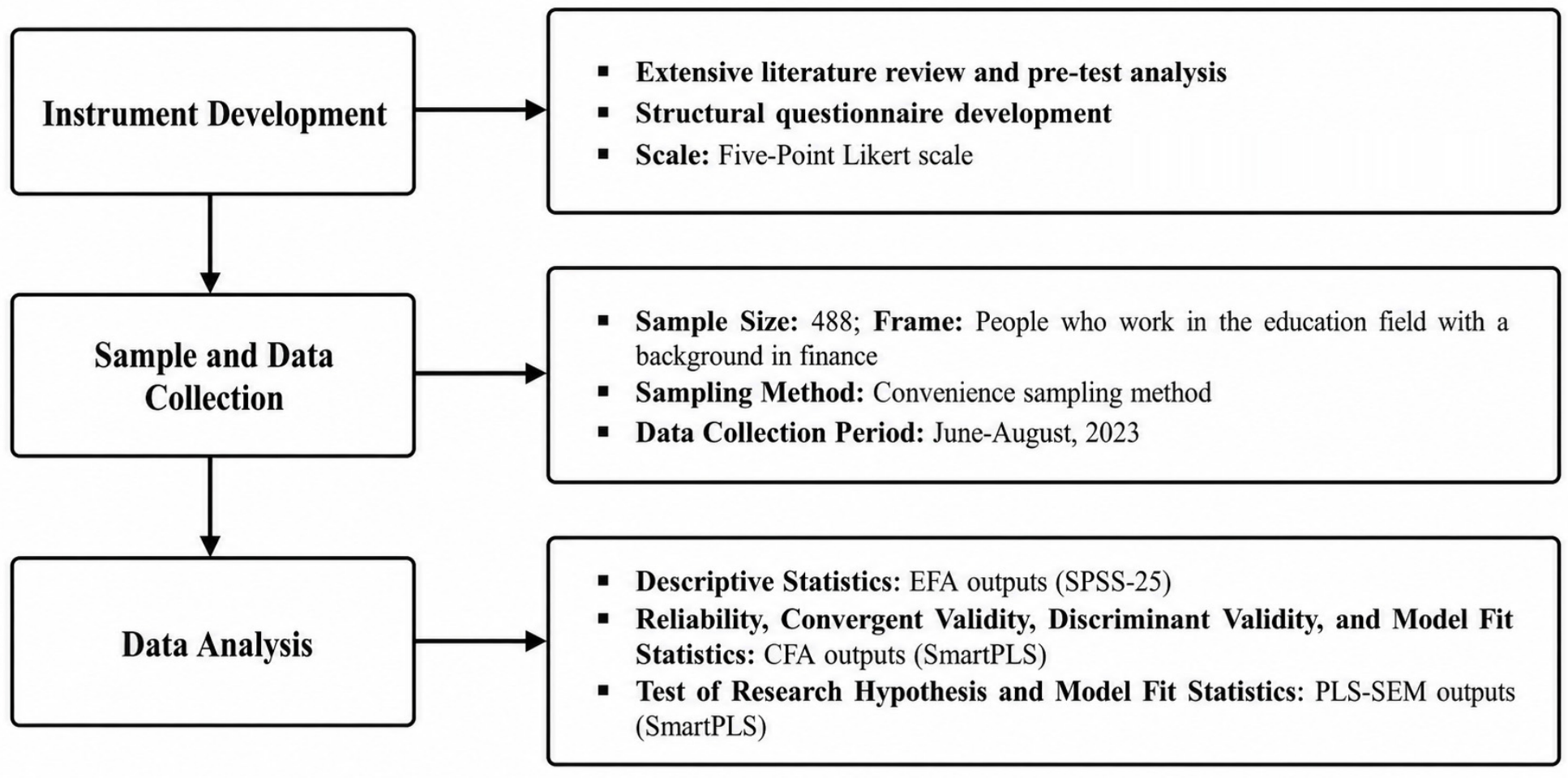
This study focuses on exploring new insights from real-world data; Figure 2 visually represents this process. We collected information directly from surveys in Pakistan’s higher education sector. To delve deeper, we discuss the details of how we conducted the study in the following sections.

3.2. Data Analysis Tools

A sophisticated second-generation data analysis method commonly used to verify complicated models utilizing data is structural equation modeling, or SEM, which was the main statistical instrument utilized to evaluate the hypothetical model in this work (Hair et al., 2021). We deemed it permissible to employ PLS-SEM in this investigation because it uses two mediators. In order to address specific research problems, researchers might use the SEM technique to simultaneously model correlations between a number of independent and dependent variables.

3.3. Measurement of Variables

The financial inclusion measurement items were modified based on the work of Cámara and Tuesta (2014), consisting of three parts represented by five, five, and four pieces respectively: utilization (USG), barrier (BRR), and access (ACC). The social, economic, and environmental components of the sustainable development construct were measured using 4 items each, adopted from the work of Atmaca et al. (Atmaca et al., 2019; Chow & Chen, 2012). One-dimensional financial literacy was adapted from Rieger (2020) and Vieira et al. (2020), represented by seven items. Finally, social capital was measured using three questions that were each drawn from the research of Bongomin et al. (2018) and Onodugo et al. (2021) on collective action, bridging, bonding, and trust. The items were evaluated on a 5-point Likert scale, ranging from strongly agree (1) to strongly disagree (5).

4. Results and Analysis

4.1. Reliability and Model Fit

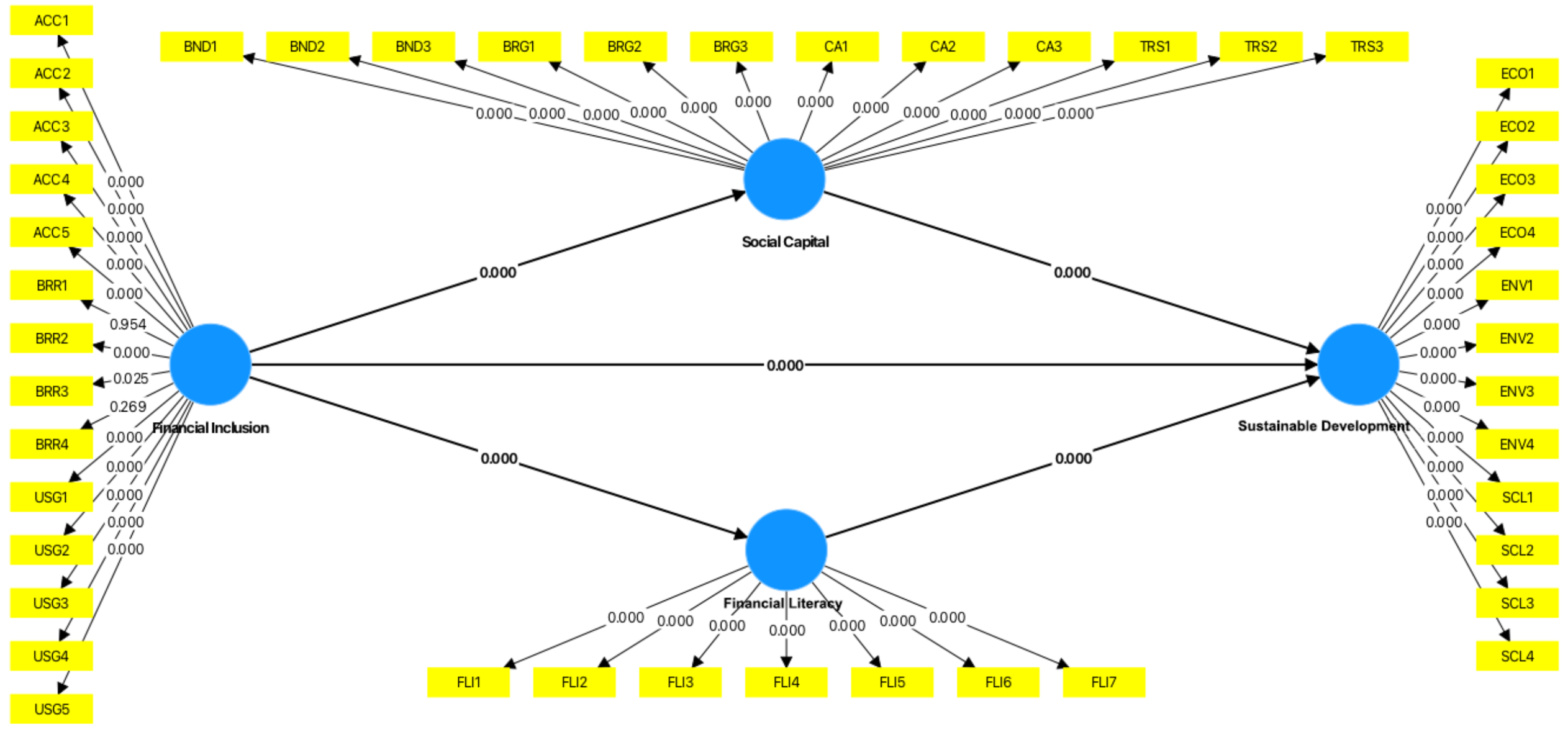
Confirmatory factor analysis (CFA) was utilized to verify the reliability and validity of the measurement constructs, whereas PLS-SEM was used to test the hypotheses of the research, including direct and mediating relationships among financial inclusion, financial literacy, social capital, and sustainable development (see Figure 3). Cronbach’s alpha and initial reliability statistics were estimated via IBM SPSS v.28, and the estimation of the measurement model and structural model was conducted via SmartPLS. A Cronbach’s alpha value of or near 0.70 is acceptable, and values of 0.80 and above show greater internal consistency. The total reliability score in the present study was 0.926, showing high internal consistency among the measurement items.
In case of PLS-SEM, model fit was evaluated using the standardized root-mean-square residual (SRMR), which was observed to be 0.197. The SRMR was bigger than the widely recognized value that shows that the model does not have a good approximate fit. Despite the fact that PLS-SEM is mainly prediction-based, with emphasis on the explained variance, path coefficients, and mediation effects, the high SRMR indicates that the study’s structural findings should be viewed with reservations; however, these findings must be considered preliminary and indicative, not definitive. The measurement model should be further developed in future studies, overlapping indicators re-evaluated, and the model tested on other samples and longitudinal data. The model is not very small and does not show a strong approximate fit. Thus, even though PLS-SEM is more prediction-oriented and the reliability of its measurements is more emphasized than the path coefficients, explanatory power, and predictive relevance, the high value of SRMR cannot be overlooked; it indicates that the model can be improved, especially by re-evaluating weak indicators, potential reverse-coded questions, and discriminant validity problems. This means that the structural outcomes of this study must be treated with caution and the results must be taken as being indicative but not conclusive.

4.2. Factor Loading

Both composite reliability and outer loadings were measured to test the sufficiency of the measurement model. The scaled composite reliability threshold value was fixed at 0.50, as recommended by Geldhof et al. (2014) and Rafi et al. (2022). Nevertheless, in the case of individual indicators, careful attention was paid to the outer loadings. Loadings of less than 0.40 were deemed inappropriate to retain, and indicators between 0.40 and 0.70 were only retained when they were theoretically relevant and did not undermine the construct reliability and validity.
According to the rule of thumb given by Hair (2009), 8 items were then dropped from the 45 measurement items that were taken to evaluate the study constructs, reducing the total to 37 items to be used in further analysis. Table 1 shows the final retained items and the outer loadings.
In line with the recommendations of Brown (1980) and Rafi et al. (2022), indicators with loadings less than 0.40 were disregarded in the analysis. The risk of multicollinearity and common-method bias were also of interest, as the data were cross-sectional and self-reported. The validation of the measurement model was followed by SmartPLS bootstrapping using 5000 subsamples to analyze the significance and strength of the structural equations between the latent constructs.

4.3. Correlation Matrix

The correlation matrix in Table 2 indicates that financial inclusion and financial literacy have a positive and significant correlation (r = 0.553, p < 0.01): the greater the financial inclusion, the greater the financial literacy. Financial inclusion also has a positive and significant association with sustainable development (r = 0.453, p < 0.01), which implies that higher access to and utilization of financial services correlate with better sustainable development results. In the same way, financial literacy has a significant and positive correlation with sustainable development (r = 0.634, p < 0.01), which means that people with higher financial literacy have a greater chance of being linked to sustainable financial and developmental outcomes. A strong positive relationship was also observed between sustainable development and social capital (r = 0.663, p < 0.01), which indicates that trust, cooperation, and social networks have positive correlations with sustainability.

4.4. R-Squared (R2)

The R-squared values present valuable insights into the relationships among financial literacy, social capital, and sustainable development. As mediating variables, both financial literacy and social capital play significant roles in influencing the changes observed in sustainable development. The R-squared value of 0.425 associated with financial literacy suggests that it explains approximately 42.5% of the variance in sustainable development. This indicates that, as individuals’ financial literacy improves, a considerable proportion of the changes in sustainable development outcomes can be attributed to this enhancement in financial knowledge and understanding.
Similarly, social capital, as reflected by the R-squared value of 0.254, explains around 25.4% of the variance in sustainable development. This underscores the importance of social networks, relationships, and community connections in driving changes in sustainable development outcomes. The substantial impact of both financial literacy and social capital underscores their significance as mechanisms through which individuals and communities contribute to sustainable development.
When considering the joint influence of both financial literacy and social capital, the R-squared value for sustainable development rises to 0.513. This implies that the combined effect of these mediating variables accounts for approximately 51.3% of the variability in sustainable development outcomes. This collective influence reinforces the notion that a holistic approach, encompassing both financial literacy and social capital, is integral to driving positive changes in sustainable development.

4.5. F-Squared (f2)

The F-squared values provide a comprehensive understanding of the relationships among FI, FLI, SC, and SD, with effect sizes measured using F-squared. Along the diagonal, values signify each variable’s contribution to its own variance, with FI demonstrating a substantial proportion (86.2%) explained by all predictors in the model. The off-diagonal values reveal unique contributions of one variable to another’s variance, considering other predictors’ effects. For instance, the F-squared value of 0.445 between FI and FLI suggests that FLI independently explains 44.5% of FI’s variance. Higher F-squared values denote stronger explanatory power of the predictor variable. This approach aids in assessing the magnitude of variables’ impacts on the model fit and variance explained, enhancing the interpretation of the model’s overall effectiveness.

4.6. Heterotrait–Monotrait Ratio

The heterotrait–monotrait ratio (HTMT) was measured to test discriminant validity between the study constructs. Table 3 indicates that the HTMT value between financial literacy (FLI) and financial inclusion (FI) was 0.740, and that the confidence interval was between 0.700 and 0.802, showing acceptable discriminant validity. Equally, the HTMT between social capital (SC) and financial inclusion (FI) was 0.602, with a confidence interval of 0.553–0.660, confirming the discriminant validity (see Table 3). The value of the HTMT comparing sustainable development (SD) and financial inclusion (FI) was 0.558, with the corresponding values between SD and FLI and between SD and SC being 0.750 and 0.724, respectively—all within the acceptable level of 0.85 or 0.90 (see Table 3). Nevertheless, SC and FLI had a value of 1.005, which falls within the confidence interval of 0.959–1.042, suggesting the possibility of a problem for discriminant validity. Thus, before the final interpretation of a model, SC and FLI indicators should be re-examined with cross-loadings, and overlapping items should be reconsidered. Even though financial literacy and social capital are two theoretically separate constructs, the value of the HTMT between the two variables was higher than the suggested cut-off (HTMT = 1.005), so there is a risk of empirical overlap. This implies that the respondents might be likely to understand financial knowledge and social embedded financial support as two closely related concepts. Consequently, the mediating role of financial literacy and social capital should be taken with caution, even though the constructs were retained due to theoretical arguments. These constructs could subsequently be confirmed in future investigations through improved measurement items, qualitative research, or other samples.
Table 3 displays the results of HTMT that was employed to evaluate the discriminant validity between the constructs used in this study. The values of most of the construct pairs in the HTMT were less than the recommended value of 0.85 or 0.90, which shows that the discriminant validity was acceptable. However, the value of HTMT between social capital and financial literacy was 1.005, and the upper confidence interval was more than 1.00. This means that there is a discriminant validity issue that may exist between these two constructs. Thus, some further diagnostic tests, such as cross-loadings and item-overlap assessment, were deemed to be required. In spite of the conceptual relationship between the two constructs, they were not merged as one construct, since financial literacy indicates individual financial knowledge and decision-making ability, but social capital indicates relational resources such as trust, cooperation, networks, bonding, bridging, and collective action. However, the results of these two constructs are to be taken with caution.

4.7. Structural Model Assessment: Direct Relationship

After measuring the requirements of the measurement model, they were then analyzed through the structural model. This subsection will show the outcome of the structural equation model: both the direct and indirect relationships among financial inclusion, financial literacy, social capital, and sustainable development. To determine the significance of the path coefficients and mediation effects, bootstrapping was used.
In SmartPLS, the final valid sample of 488 responses and 5000 bootstrap subsamples were used (after finalizing the measurement model) to run the bootstrapping procedure. The statistical significance of both the direct paths and the indirect effect, as postulated in the conceptual framework, was determined using this procedure (Henseler et al., 2009; Lontchi et al., 2022; Rieger, 2020). The structural model was tested through the path coefficients, p-values, coefficient of determination, effect size, predictive relevance, and mediation effects.
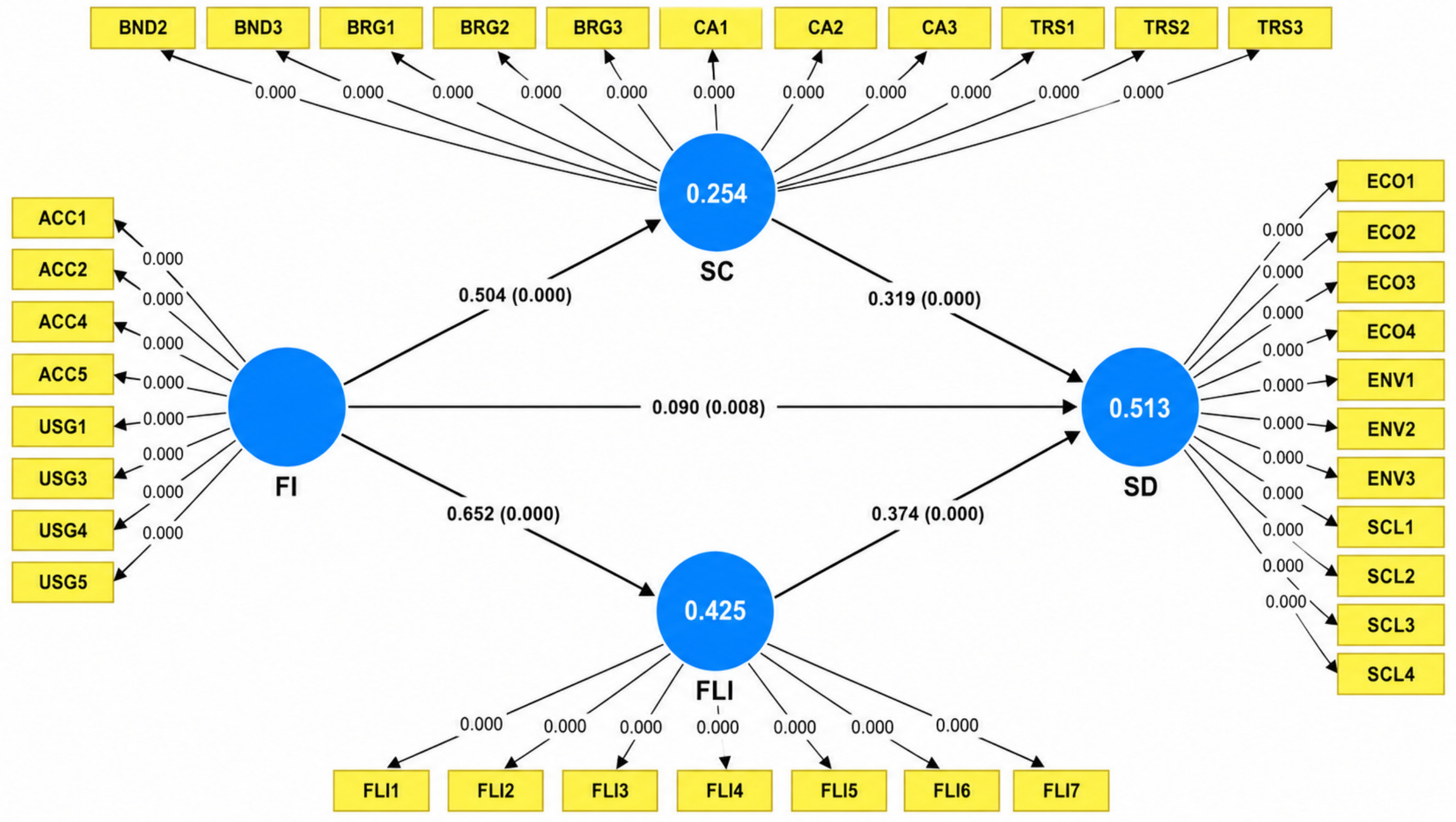
In line with the aims of this research, PLS-SEM was used to test the hypothesized meanings among the constructs (Kenny et al., 2003; Lontchi et al., 2022; Rieger, 2020). The structural model assisted in confirming the hypotheses put forward and testing the explanatory and predictive strength of the model. Figure 4 shows results of the bootstrapping analysis of the direct and indirect relationships.

4.8. Hypothesis Testing/Summary

The results indicate that there is a positive and significant association between financial inclusion and financial literacy. The path coefficient of 0.652 suggests that, as financial inclusion increases, financial literacy also tends to increase. This relationship is statistically significant, with a p-value less than 0.01, supporting the idea that increased financial inclusion is linked to higher financial literacy (see Table 4).
The findings show a positive and significant association between financial inclusion and social capital. The path coefficient of 0.504 implies that higher financial inclusion is related to increased social capital; the low p-value (p < 0.01) suggests that this association is statistically significant (see Table 4). The analysis also demonstrates a positive and significant relationship between financial inclusion and sustainable development. The path coefficient of 0.090 indicates that greater financial inclusion is associated with improved sustainable development outcomes. This relationship is statistically significant, with a p-value less than 0.01 (see Table 4).
The results suggest that social capital plays a significant mediating role between financial inclusion and sustainable development. The path coefficient of 0.319 indicates that a portion of the relationship between financial inclusion and sustainable development is explained by the influence of social capital. This mediation effect is statistically significant, with a p-value less than 0.01 (see Table 4).
According to the analysis, there is a strong mediating role of financial literacy in the relationship between sustainable development and financial inclusion. The path coefficient of 0.374 indicates that financial literacy plays a significant role in explaining some of the relationship between sustainable development and financial inclusion. Table 4 shows that this mediation effect has a p-value of less than 0.01, indicating statistical significance.
The direct relationship analysis examined the individual effects among the study constructs. The results indicate that financial inclusion positively and significantly influences financial literacy (H1) and social capital (H2); furthermore, financial inclusion has a significant positive effect on sustainable development (H3). Social capital also positively contributes to sustainable development (H4), while financial literacy demonstrates a significant positive relationship with sustainable development (H6). These findings confirm the proposed direct relationships among the constructs.
The mediation analysis assessed whether financial literacy and social capital transmit the effect of financial inclusion on sustainable development. The results support the mediating role of social capital (H5) and financial literacy (H7), indicating that financial inclusion contributes to sustainable development both directly and indirectly through enhanced financial knowledge, decision-making capability, trust, and social networks.
The total effects represent the combined influence of direct and indirect pathways. The findings demonstrate that financial inclusion makes an overall positive contribution to sustainable development through its direct effect and through the mediating mechanisms of financial literacy and social capital.

5. Discussion and Conclusions

The present study was able to analyze the mediating role of financial literacy and social capital between financial inclusion and sustainable development within the education sector of Pakistan. The results indicate the existence of a positive and significant relationship between financial inclusion (FI) and financial literacy (FLI), and they are consistent with other studies where the access to formal financial services has been reported to be associated with better financial knowledge and awareness (Hasan et al., 2022; Lontchi et al., 2022; Shen et al., 2020). This implies that financial literacy can be enhanced by access to banking services, savings products, credit facilities, and payment systems.
The findings also show that there is a positive and significant relationship between FA and sustainable development (SD), which further confirms previous research on similar issues (Babajide et al., 2015; Kim et al., 2018; Lontchi et al., 2022). The role of financial inclusion as an enhancer of access to financial resources can explain this finding. With improved access to savings, credit, payments, and insurance, people and institutions might be in a better position to deal with shocks in their financial systems, finance education, invest in activities, and engage in formal economic systems. However, these findings must be viewed as an association and not a causal effect, since the research is cross-sectional and self-reported.
In addition, the results demonstrate that social capital (SC) and SD have a positive and significant connection, consistent with the findings of Lontchi et al. (2022) and Bongomin et al. (2016). Social capital facilitates sustainable development via trust, cooperation, collective support, and information sharing. These networks could be used in the education sector to encourage students, educators, and stakeholders to share financial knowledge, instill confidence in formal institutions, and promote responsible practices.
The outcomes of the mediation show that FLI mediates the connection between FI and SD. This corresponds with past research highlighting the importance of financial literacy to enhance financial decisions and developmental outcomes (Berry et al., 2018; Kezar & Yang, 2010; Lontchi et al., 2022; Lusardi & Mitchell, 2014; Maturana & Nickerson, 2019). Financial access can be achieved through financial inclusion, and financial literacy can assist people in transforming that access into purposeful choices. Particularly, fiscal literacy could enhance budgeting, saving actions, credit selection, credit management, investment planning, and comprehension of risks; thus, financially literate people will utilize the financial services in a more responsible way.
The results also show that SC mediates the relationship between FI and SD. This implies that the association between financial inclusion and sustainable growth becomes more effective as individuals engage within facilitative networks founded on a sense of trust, norms, collaboration, and shared values (Bongomin et al., 2016). Social capital has the potential to minimize information asymmetry, enhance trust in financial institutions, and promote shared learning. These mechanisms are important in the education sector in Pakistan, as players tend to follow the social networks.
Comprehensively, this paper adds to the literature by demonstrating that financial inclusion is related to sustainable development directly and indirectly via financial literacy and social capital. The results indicate that financial education and trust-building programs should be introduced to accompany access to financial services. Financial institutions, policymakers, and educators should develop programs that enhance knowledge of financial matters, responsible financial conduct, and trust in institutions.

5.1. Limitations

There are a few limitations to this study: To begin with, it is restricted to the higher education sector of Pakistan; as such, it limits the generalizability of the results to other sectors, populations, and countries. Second, the cross-sectional design only records data at a single point in time; thus, the obtained findings should not be viewed as cause-and-effect interactions. Third, provision of self-reported questionnaire information can lead to social desirability bias, bias during responses, or recall errors. Lastly, variables including income, age, access to digital finance, quality of institutions, and policy environment were excluded.

5.2. Future Directions

The model needs to be tested in other areas, sectors, and emerging economies in the future. It would be advisable to use longitudinal designs to analyze the changes over time and give more decisive evidence on the observed relationships. Other possible variables that could be incorporated in future studies include demographic, institutional, and digital finance as a means of enhancing explanatory power, theoretical depth, and practical relevance. These extensions could be useful to justify the results and make more context-relevant policy recommendations in the future.

Author Contributions

Conceptualization, S.U., R.I., M.M., I.H. and I.A.; methodology, S.U., R.I., M.M., I.H. and I.A.; software, S.U., R.I. and M.M.; validation, S.U., R.I. and M.M.; formal analysis, S.U., R.I., M.M., I.H. and I.A.; investigation, S.U., R.I., M.M., I.H. and I.A.; resources, S.U.; data curation, R.I.; writing—original draft preparation, S.U., R.I., M.M., I.H. and I.A.; writing—review and editing, S.U., R.I., M.M., I.H. and I.A.; visualization, R.I., I.H. and I.A.; supervision, S.U. and M.M.; project administration, S.U., I.H. and I.A. All authors have read and agreed to the published version of the manuscript.

Funding

This research received no external funding.

Institutional Review Board Statement

Ethical review and approval were waived for this study because the research did not involve any clinical interventions, experiments, or procedures and did not collect any personally identifiable data.

Informed Consent Statement

Patient consent was waived because participation in the anonymous questionnaire-based survey was entirely voluntary and no personally identifiable or sensitive information was collected.

Data Availability Statement

Available upon request from the first author.

Conflicts of Interest

The authors declare no conflict of interest.

References

  1. Abreu, M., & Mendes, V. (2010). Financial literacy and portfolio diversification. Quantitative Finance, 10(5), 515–528. [Google Scholar] [CrossRef] [Scilit]
  2. Adger, W. N. (2010). Social capital, collective action, and adaptation to climate change. In Der klimawandel: Sozialwissenschaftliche perspektiven (pp. 327–345). VS Verlag für Sozialwissenschaften. [Google Scholar]
  3. Alaimo, L. S., Ciacci, A., & Ivaldi, E. (2021). Measuring sustainable development by non-aggregative approach. Social Indicators Research, 157, 101–122. [Google Scholar]
  4. Aldrich, D. P., & Meyer, M. A. (2015). Social capital and community resilience. American Behavioral Scientist, 59(2), 254–269. [Google Scholar]
  5. Alshebami, A. S., & Aldhyani, T. H. (2022). The interplay of social influence, financial literacy, and saving behaviour among Saudi youth and the moderating effect of self-control. Sustainability, 14(14), 8780. [Google Scholar] [CrossRef] [Scilit]
  6. Alshebami, A. S., & Al Marri, S. H. (2022). The impact of financial literacy on entrepreneurial intention: The mediating role of saving behavior. Frontiers in Psychology, 13, 911605. [Google Scholar] [CrossRef] [Scilit] [PubMed]
  7. Amidžic, G., Massara, M. A., & Mialou, A. (2014). Assessing countries’ financial inclusion standing—A new composite index. International Monetary Fund. [Google Scholar]
  8. Anderson, C., Kent, J., Lyter, D. M., Siegenthaler, J. K., & Ward, J. (2000). Personal finance and the rush to competence: Financial literacy education in the US. Institute for Socio-Financial Studies (ISFS). [Google Scholar]
  9. Atkinson, A., & Messy, F.-A. (2012). Measuring financial literacy: Results of the OECD/International Network on Financial Education (INFE) pilot study. OECD Publishing. [Google Scholar]
  10. Atmaca, A. C., Kiray, S. A., & Pehlivan, M. (2019). Development of a measurement tool for sustainable development awareness. International Journal of Assessment Tools in Education, 6(1), 80–91. [Google Scholar] [CrossRef] [Scilit]
  11. Babajide, A. A., Adegboye, F. B., & Omankhanlen, A. E. (2015). Financial inclusion and economic growth in Nigeria. International Journal of Economics and Financial Issues, 5(3), 629–637. [Google Scholar]
  12. Beck, T. (2016). Financial inclusion–measuring progress and progress in measuring. Cass Business School, University of London, CEPR, and CESifo. [Google Scholar]
  13. Beck, T., Demirgüç-Kunt, A., & Honohan, P. (2009). Access to financial services: Measurement, impact, and policies. World Bank Research Observer, 24(1), 119–145. [Google Scholar] [CrossRef] [Scilit]
  14. Behrman, J. R., Mitchell, O. S., Soo, C. K., & Bravo, D. (2012). How financial literacy affects household wealth accumulation. American Economic Review, 102(3), 300–304. [Google Scholar] [CrossRef] [Scilit] [PubMed]
  15. Benaim, A., Collins, A., & Raftis, L. (2008). Social dimension of sustainable development: Guidance and application [Master’s thesis, Blekinge Institute of Technology]. [Google Scholar]
  16. Berry, J., Karlan, D., & Pradhan, M. (2018). The impact of financial education for youth in Ghana. World Development, 102, 71–89. [Google Scholar] [CrossRef] [Scilit]
  17. Bhandari, B. S. (2018). Life insurance—Social security & financial inclusion. Bimaquest, 18(2), 1–16. Available online: www.bimaquest.niapune.org.in (accessed on 26 May 2026).
  18. Bhuiyan, A. A. M. (2019). Financing education: A route to the development of a country. The Journal of Educational Development, 7(3), 209–217. [Google Scholar]
  19. Bianchi, M. (2018). Financial literacy and portfolio dynamics. The Journal of Finance, 73(2), 831–859. [Google Scholar] [CrossRef] [Scilit]
  20. Bollier, D. (2016). El ascenso del paradigma de los bienes comunes. In Los bienes comunes del conocimiento (pp. 51–65). Traficante de Sueños. [Google Scholar]
  21. Bongomin, G. O. C., Munene, J. C., Ntayi, J. M., & Malinga, C. A. (2018). Exploring the mediating role of social capital in the relationship between financial intermediation and financial inclusion in rural Uganda. International Journal of Social Economics, 45(5), 829–847. [Google Scholar] [CrossRef] [Scilit]
  22. Bongomin, G. O. C., Ntayi, J. M., Munene, J. C., & Nabeta, I. N. (2016). Social capital: Mediator of financial literacy and financial inclusion in rural Uganda. Review of International Business and Strategy, 26(2), 291–312. [Google Scholar] [CrossRef] [Scilit]
  23. Brown, S. R. (1980). Political subjectivity: Applications of Q methodology in political science. Yale University Press. [Google Scholar]
  24. Browning, M. H., & Rigolon, A. (2019). School green space and its impact on academic performance: A systematic literature review. International Journal of Environmental Research and Public Health, 16(3), 429. [Google Scholar] [CrossRef] [Scilit] [PubMed]
  25. Cardaci, A. (2018). Inequality, household debt and financial instability: An agent-based perspective. Journal of Economic Behavior & Organization, 149, 434–458. [Google Scholar] [CrossRef] [Scilit]
  26. Castro, R. G., Enríquez-Diaz, J., & García, B. A. (2021). The role of financial education in the path towards sustainable development: A practical experience with students of secondary education. In Financial management and risk analysis strategies for business sustainability (pp. 1–19). IGI Global. [Google Scholar]
  27. Cámara, N., & Tuesta, D. (2014). Measuring financial inclusion: A muldimensional index. BBVA Research Paper (14/26). BBVA Research. [Google Scholar]
  28. Chakravarty, S. R., & Pal, R. (2013). Financial inclusion in India: An axiomatic approach. Journal of Policy Modeling, 35(5), 813–837. [Google Scholar] [CrossRef] [Scilit]
  29. Chow, W. S., & Chen, Y. (2012). Corporate sustainable development: Testing a new scale based on the mainland Chinese context. Journal of Business Ethics, 105, 519–533. [Google Scholar]
  30. Claessens, S. (2006). Access to financial services: A review of the issues and public policy objectives. The World Bank Research Observer, 21(2), 207–240. [Google Scholar] [CrossRef] [Scilit]
  31. Coventry, K. R., & Garrod, S. C. (2004). Saying, seeing and acting: The psychological semantics of spatial prepositions. Psychology Press. [Google Scholar]
  32. Danes, S. M., & Hira, T. K. (1987). Money management knowledge of college. Journal of Student Financial Aid, 17(1), 1. [Google Scholar] [CrossRef] [Scilit]
  33. Das, K. (2012). Financial inclusion—A gateway to sustainable development for the impoverished. Journal of Rural Development, 31, 115–128. [Google Scholar]
  34. Demirgüç-Kunt, A., Klapper, L. F., & Singer, D. (2013). Financial inclusion and legal discrimination against women: Evidence from developing countries. World Bank Policy Research Working Paper (6416). World Bank. [Google Scholar]
  35. Dernbach, J. C. (2003). Achieving sustainable development: The centrality and multiple facets of integrated decision making. Global Legal Studies, 10(1), 247–284. [Google Scholar] [CrossRef]
  36. Esmail Alekam, J. M., & Bt Md Salleh, M. S. (2018). The effect of family, peer, behavior, saving and spending behavior on financial literacy among young generations. International Journal of Organizational Leadership, 7, 309–323. [Google Scholar] [CrossRef] [Scilit]
  37. Fernandes, D., Lynch, J. G., Jr., & Netemeyer, R. G. (2014). Financial literacy, financial education, and downstream financial behaviors. Management Science, 60(8), 1861–1883. [Google Scholar] [CrossRef] [Scilit]
  38. Gaudecker, H. M. V. (2015). How does household portfolio diversification vary with financial literacy and financial advice? The Journal of Finance, 70(2), 489–507. [Google Scholar] [CrossRef] [Scilit]
  39. Geldhof, G. J., Preacher, K. J., & Zyphur, M. J. (2014). Reliability estimation in a multilevel confirmatory factor analysis framework. Psychological Methods, 19(1), 72–91. [Google Scholar] [CrossRef] [Scilit] [PubMed]
  40. Ghosh, S., & Vinod, D. (2017). What constrains financial inclusion for women? Evidence from Indian micro data. World Development, 92, 60–81. [Google Scholar] [CrossRef] [Scilit]
  41. Guiso, L., Sapienza, P., & Zingales, L. (2004). The role of social capital in financial development. American Economic Review, 94(3), 526–556. [Google Scholar] [CrossRef] [Scilit]
  42. Hair, J. F. (2009). Multivariate data analysis. Prentice Hall. [Google Scholar]
  43. Hair, J. F., Jr., Hair, J. F., Jr., Hult, G. T. M., Ringle, C. M., & Sarstedt, M. (2021). A primer on partial least squares structural equation modeling (PLS-SEM). Sage Publications. [Google Scholar]
  44. Hasan, M. M., Popp, J., & Oláh, J. (2020). Current landscape and influence of big data on finance. Journal of Big Data, 7(1), 21. [Google Scholar] [CrossRef] [Scilit]
  45. Hasan, M. M., Yajuan, L., & Khan, S. (2022). Promoting China’s inclusive finance through digital financial services. Global Business Review, 23(4), 984–1006. [Google Scholar]
  46. Hatzold, M.-E. (2013). Social conflict, economic development and extractive industry: Evidence from South America. Oxford University Press. [Google Scholar]
  47. Henseler, J., Ringle, C. M., & Sinkovics, R. R. (2009). The use of partial least squares path modeling in international marketing. In New challenges to international marketing (Vol. 20, pp. 277–319). Emerald Group Publishing Limited. [Google Scholar]
  48. Hogarth, J. M. (2007). The Federal Reserve System’s role in economic and financial literacy–rationale, activities, and impact. In Humankapital und wirtschaftswachstum—Human capital and economic growth (pp. 145–184). Oesterreichische Nationalbank. Available online: https://www.oenb.at/dam/jcr:00c05165-c7c2-41c8-bf65-3bbca9d79ab6/vowitag_2007_hogarth_tcm16-82331.pdf (accessed on 26 May 2026).
  49. Holzmann, R. (2010). Bringing financial literacy and education to low and middle income countries: The need to review, adjust, and extend current wisdom. Institute for the Study of Labor (IZA). [Google Scholar]
  50. Johnston, J. (2005, December 12). Importance of financial literacy in the global economy. The Financial Education Summit, Kuala Lumpur, Malaysia. [Google Scholar]
  51. Kenny, D. A., Korchmaros, J. D., & Bolger, N. (2003). Lower level mediation in multilevel models. Psychological Methods, 8(2), 115. [Google Scholar] [CrossRef] [Scilit] [PubMed]
  52. Kezar, A., & Yang, H. (2010). The importance of financial literacy. About Campus, 14(6), 15–21. [Google Scholar] [CrossRef] [Scilit]
  53. Kim, D., Yu, J., & Hassan, M. (2018). Financial inclusion and economic growth in OIC countries. Research in International Business and Finance, 43, 1–14. [Google Scholar] [CrossRef] [Scilit]
  54. Koçak, F., & Balci, V. (2010). Doğada yapılan sportif etkinliklerde çevresel sürdürülebilirlik. Ankara Üniversitesi Çevrebilimleri Dergisi, 2(2), 213–222. [Google Scholar] [CrossRef] [Scilit]
  55. Krejcie, R. V., & Morgan, D. W. (1970). Determining sample size for research activities. Educational and Psychological Measurement, 30(3), 607–610. [Google Scholar] [CrossRef] [Scilit]
  56. Kuşat, N. (2013). Yeşil Sürdürülebilirlik İçin Yeşil Ekonomi: Avantaj Ve Dezavantajlari–Türkiye İncelemesi. Yaşar Üniversitesi E-Dergisi, 8(29), 4896–4916. [Google Scholar]
  57. Le, T.-H., Chuc, A. T., & Taghizadeh-Hesary, F. (2019). Financial inclusion and its impact on financial efficiency and sustainability: Empirical evidence from Asia. Borsa Istanbul Review, 19(4), 310–322. [Google Scholar] [CrossRef] [Scilit]
  58. Levine, R. (2005). Finance and growth: Theory and evidence. Handbook of Economic Growth, 1, 865–934. [Google Scholar] [CrossRef] [Scilit]
  59. Lontchi, C. B., Yang, B., & Su, Y. (2022). The mediating effect of financial literacy and the moderating role of social capital in the relationship between financial inclusion and sustainable development in Cameroon. Sustainability, 14(22), 15093. [Google Scholar] [CrossRef] [Scilit]
  60. Lusardi, A., & Mitchell, O. S. (2011a). Financial literacy and planning: Implications for retirement wellbeing. National Bureau of Economic Research. [Google Scholar]
  61. Lusardi, A., & Mitchell, O. S. (2011b). Financial literacy around the world: An overview. Journal of Pension Economics & Finance, 10(4), 497–508. [Google Scholar] [CrossRef] [Scilit]
  62. Lusardi, A., & Mitchell, O. S. (2014). The economic importance of financial literacy: Theory and evidence. American Economic Journal: Journal of Economic Literature, 52(1), 5–44. [Google Scholar] [CrossRef] [Scilit]
  63. Lusardi, A., & Tufano, P. (2015). Debt literacy, financial experiences, and overindebtedness. Journal of Pension Economics & Finance, 14(4), 332–368. [Google Scholar] [CrossRef] [Scilit]
  64. Lyons, A. C., & Kass-Hanna, J. (2021). Financial inclusion, financial literacy and economically vulnerable populations in the Middle East and North Africa. Emerging Markets Finance and Trade, 57(9), 2699–2738. [Google Scholar]
  65. Mago, S., & Chitokwindo, S. (2014). The impact of mobile banking on financial inclusion in Zimbabwe: A case for Masvingo Province. Mediterranean Journal of Social Sciences, 5(9), 221. [Google Scholar] [CrossRef] [Scilit]
  66. Maturana, G., & Nickerson, J. (2019). Teachers teaching teachers: The role of workplace peer effects in financial decisions. The Review of Financial Studies, 32(10), 3920–3957. [Google Scholar]
  67. Mbata, C. (2009). Traditional music in nation building. Alvan Journal of Music and Humanities, 1, 77–85. [Google Scholar]
  68. Mehrotra, A. N., & Yetman, J. (2015). Financial inclusion-issues for central banks. BIS Quarterly Review, March. Bank for International Settlements. [Google Scholar]
  69. Mercan, M., & Sezer, S. (2014). The effect of education expenditure on economic growth: The case of Turkey. Procedia-Social and Behavioral Sciences, 109, 925–930. [Google Scholar] [CrossRef] [Scilit]
  70. Mitchell, O. S., & Lusardi, A. (2015). Financial literacy and economic outcomes: Evidence and policy implications. The Journal of Retirement, 3(1), 107–114. [Google Scholar] [CrossRef] [Scilit] [PubMed]
  71. Olsson, D., Gericke, N., & Chang Rundgren, S.-N. (2016). The effect of implementation of education for sustainable development in Swedish compulsory schools–assessing pupils’ sustainability consciousness. Environmental Education Research, 22(2), 176–202. [Google Scholar]
  72. Olvera, S. G. (2016). Capital social, cultura organizacional, cultura innovadora y su incidencia en las Organizaciones Productivas Rurales Colaborativas. Economía y Sociedad, 20(34), 119–136. [Google Scholar]
  73. Onaolapo, A., & Odetayo, T. (2012). Effect of accounting information system on organisational effectiveness: A case study of selected construction companies in Ibadan, Nigeria. American Journal of Business and Management, 1(4), 183–189. [Google Scholar]
  74. Onodugo, C., Ogbo, A., & Ogbaekirigwe, C. (2021). Moderating role of social capital on the effect of financial behavior on financial inclusion. Problems and Perspectives in Management, 19(3), 502–512. [Google Scholar] [CrossRef] [Scilit]
  75. Ozili, P. K. (2018). Impact of digital finance on financial inclusion and stability. Borsa Istanbul Review, 18(4), 329–340. [Google Scholar] [CrossRef] [Scilit]
  76. Ozili, P. K. (2020). Theories of financial inclusion. In Uncertainty and challenges in contemporary economic behaviour (pp. 89–115). Emerald Publishing Limited. [Google Scholar]
  77. Paiella, M. (2016). Financial literacy and subjective expectations questions: A validation exercise. Research in Economics, 70(2), 360–374. [Google Scholar] [CrossRef] [Scilit]
  78. Paul, C. J., Weinthal, E. S., Bellemare, M. F., & Jeuland, M. A. (2016). Social capital, trust, and adaptation to climate change: Evidence from rural Ethiopia. Global Environmental Change, 36, 124–138. [Google Scholar] [CrossRef] [Scilit]
  79. Pompei, F., & Selezneva, E. (2021). Unemployment and education mismatch in the EU before and after the financial crisis. Journal of Policy Modeling, 43(2), 448–473. [Google Scholar] [CrossRef] [Scilit]
  80. Rafi, N., Ahmed, A., Shafique, I., & Kalyar, M. N. (2022). Knowledge management capabilities and organizational agility as liaisons of business performance. South Asian Journal of Business Studies, 11(4), 397–417. [Google Scholar]
  81. Ramakrishnan, D. (2011). Financial literacy—The demand side of financial inclusion. SSRN Electronic Journal. [Google Scholar] [CrossRef] [Scilit]
  82. Rashidin, M. S., Javed, S., Chen, L., & Jian, W. (2020). Assessing the competitiveness of Chinese multinational enterprises development: Evidence from electronics sector. Sage Open, 10(1), 2158244019898214. [Google Scholar] [CrossRef] [Scilit]
  83. Rieger, M. O. (2020). How to measure financial literacy? Journal of Risk and Financial Management, 13(12), 324. [Google Scholar] [CrossRef] [Scilit]
  84. Sarma, M. (2008). Index of financial inclusion: A concept note. Indian Council for Research on International Economic Relations (ICRIER). [Google Scholar]
  85. Sarma, M. (2012). Index of financial inclusion—A measure of financial sector inclusiveness. Working Paper. Centre for International Trade and Development, School of International Studies, Jawaharlal Nehru University. [Google Scholar]
  86. Scottish Executive. (2005). Financial inclusion action plan. Part of the Scottish Executive’s closing the opportunity gap approach to tackling poverty. Scottish Executive. [Google Scholar]
  87. Sekaran, U., & Bougie, R. (2016). Research methods for business: A skill building approach. John Wiley & Sons. [Google Scholar]
  88. Shen, Y., Hueng, C. J., & Hu, W. (2020). Using digital technology to improve financial inclusion in China. Applied Economics Letters, 27(1), 30–34. [Google Scholar]
  89. Stango, V., & Zinman, J. (2009). Exponential growth bias and household finance. The Journal of Finance, 64(6), 2807–2849. [Google Scholar] [CrossRef] [Scilit]
  90. Stein, P. (2010a, June 3–4). Inclusive finance. Korea–World Bank High Level Conference on Post-Crisis Growth and Development, Busan, Republic of Korea. [Google Scholar]
  91. Stein, P. (2010b, June 3–4). Towards universal access: Financial inclusion: Addressing the global challenge of financial inclusion. Korea-World Bank High Level Conference on Post-Crisis Growth and Development, Busan, Republic of Korea. [Google Scholar]
  92. Stoddart, H. (2011). A pocket guide to sustainable development governance. Stakeholder Forum. [Google Scholar]
  93. Sun, H., Yuen, D. C., Zhang, J., & Zhang, X. (2020). Is knowledge powerful? Evidence from financial education and earnings quality. Research in International Business and Finance, 52, 101179. [Google Scholar] [CrossRef] [Scilit]
  94. Swamy, V. (2014). Financial inclusion, gender dimension, and economic impact on poor households. World Development, 56, 1–15. [Google Scholar] [CrossRef] [Scilit]
  95. Şahin, İ., & Kutlu, S. Z. (2014). Cittaslow: Sürdürülebilir kalkınma ekseninde bir değerlendirme. Journal of Tourism & Gastronomy Studies, 2(1), 55–63. [Google Scholar] [CrossRef] [Scilit]
  96. Treasury, H. (2007). Meeting the aspirations of the British people. HM Treasury. [Google Scholar]
  97. Van, D. T. T., & Linh, N. H. (2019). The impacts of financial inclusion on economic development: Cases in Asian-Pacific countries. Wydawnictwo Uniwersytetu Łódzkiego. [Google Scholar]
  98. Van Rooij, M., Lusardi, A., & Alessie, R. (2011). Financial literacy and stock market participation. Journal of Financial Economics, 101(2), 449–472. [Google Scholar] [CrossRef] [Scilit]
  99. Vieira, K. M., Júnior, F., & Potrich, A. C. G. (2020). Measuring financial literacy: Proposition of an instrument based on the item response theory. Ciência e Nat, 42, e38. [Google Scholar] [CrossRef] [Scilit]
  100. Wilkinson, A., & Mangalagiu, D. (2012). Learning with futures to realise progress towards sustainability: The WBCSD vision 2050 initiative. Futures, 44(4), 372–384. [Google Scholar] [CrossRef] [Scilit]
  101. Woolcock, M., & Narayan, D. (2000). Social capital: Implications for development theory, research, and policy. The World Bank Research Observer, 15(2), 225–249. [Google Scholar] [CrossRef] [Scilit]
  102. Zhai, T., & Chang, Y.-C. (2018). Standing of environmental public-interest litigants in China: Evolution, obstacles and solutions. Journal of Environmental Law, 30(3), 369–397. [Google Scholar] [CrossRef] [Scilit]
Figure 1. Conceptual framework.
Jrfm 19 00549 g001
Figure 2. Methods and measurements flowchart.
Jrfm 19 00549 g002
Figure 3. Structural equation model (source: SmartPLS).
Jrfm 19 00549 g003
Figure 4. PLS bootstrapping results (structural model for direct and indirect relationships).
Jrfm 19 00549 g004
Table 1. Factor loadings of each item construct (Source: SmartPLS).
Sr. No.ConstructDimensionItemOuter LoadingDecision
1Financial InclusionAccessACC10.780Retained
2Financial InclusionAccessACC20.826Retained
3Financial InclusionAccessACC40.506Retained
4Financial InclusionAccessACC50.814Retained
5Financial InclusionUsageUSG10.487Retained
6Financial InclusionUsageUSG30.655Retained
7Financial InclusionUsageUSG40.691Retained
8Financial InclusionUsageUSG50.436Retained
9Sustainable DevelopmentSocialSCL10.571Retained
10Sustainable DevelopmentSocialSCL20.739Retained
11Sustainable DevelopmentSocialSCL30.842Retained
12Sustainable DevelopmentSocialSCL40.704Retained
13Sustainable DevelopmentEconomicECO10.691Retained
14Sustainable DevelopmentEconomicECO20.677Retained
15Sustainable DevelopmentEconomicECO30.679Retained
16Sustainable DevelopmentEconomicECO40.707Retained
17Sustainable DevelopmentEnvironmentalENV10.726Retained
18Sustainable DevelopmentEnvironmentalENV20.772Retained
19Sustainable DevelopmentEnvironmentalENV30.787Retained
20Financial LiteracyFinancial LiteracyFLI10.572Retained
21Financial LiteracyFinancial LiteracyFLI20.632Retained
22Financial LiteracyFinancial LiteracyFLI30.468Retained
23Financial LiteracyFinancial LiteracyFLI40.730Retained
24Financial LiteracyFinancial LiteracyFLI50.579Retained
25Financial LiteracyFinancial LiteracyFLI60.559Retained
26Financial LiteracyFinancial LiteracyFLI70.742Retained
27Social CapitalCollective ActionCA10.701Retained
28Social CapitalCollective ActionCA20.589Retained
29Social CapitalCollective ActionCA30.716Retained
30Social CapitalBridgingBRG10.504Retained
31Social CapitalBridgingBRG20.444Retained
32Social CapitalBridgingBRG30.653Retained
33Social CapitalBondingBND20.594Retained
34Social CapitalBondingBND30.737Retained
35Social CapitalTrustTRS10.760Retained
36Social CapitalTrustTRS20.730Retained
37Social CapitalTrustTRS30.694Retained
Table 2. Correlation matrix (Source: IBM SPSS).
GenderEducationExperienceFISDFLISC
Gender1
Education−0.0851
Experience−0.112 *0.115 *1
FI−0.572 **−0.118 *0.268 **1
SD−0.220 **0.101 *−0.134 **0.453 **1
FLI−0.250 **−0.221 **−0.162 **0.553 **0.634 **1
SC−0.231 **0.061−0.0480.449 **0.663 **0.804 **1
* Correlation is significant at the 0.05 level (2-tailed). ** Correlation is significant at the 0.01 level (2-tailed).
Table 3. Heterotrait–monotrait ratio (HTMT).
Sr. No.Construct PairHTMT Value2.5% CI97.5% CIp-ValueDecision
1Financial Literacy ↔ Financial Inclusion0.7400.7000.802p < 0.001Acceptable
2Social Capital ↔ Financial Inclusion0.6020.5530.660p < 0.001Acceptable
3Social Capital ↔ Financial Literacy1.0050.9591.042p < 0.001Discriminant Validity Concern
4Sustainable Development ↔ Financial Inclusion0.5580.5290.610p < 0.001Acceptable
5Sustainable Development ↔ Financial Literacy0.7500.6940.809p < 0.001Acceptable
6Sustainable Development ↔ Social Capital0.7240.6550.790p < 0.001Acceptable
Table 4. Hypothesis testing/summary (Source: SmartPLS).
Sr. No.HypothesisRelationshipPath Coefficientp-ValueDecision
1H1Financial inclusion has a positive impact on financial literacy.0.652p < 0.01Accepted
2H2Financial inclusion has a positive impact on social capital.0.504p < 0.01Accepted
3H3Financial inclusion has a positive impact on sustainable development.0.090p < 0.01Accepted
4H4Social capital has a positive impact on sustainable development.0.319p < 0.01Accepted
5H5Social capital mediates the relationship between financial inclusion and sustainable development.0.161p < 0.01Accepted
6H6Financial literacy has a positive impact on sustainable development.0.374p < 0.01Accepted
7H7Financial literacy mediates the relationship between financial inclusion and sustainable development.0.244p < 0.01Accepted
Disclaimer/Publisher’s Note: The statements, opinions and data contained in all publications are solely those of the individual author(s) and contributor(s) and not of MDPI and/or the editor(s). MDPI and/or the editor(s) disclaim responsibility for any injury to people or property resulting from any ideas, methods, instructions or products referred to in the content.