
Quantile-VAR Approach to Spillovers and Connectedness Among Real-Financial Aggregates and Economic Freedom in Tunisia


Abstract
1. Introduction
1.1. Theoretical Foundations, Research Hypotheses, and Literature Review
1.1.1. Theoretical Foundations
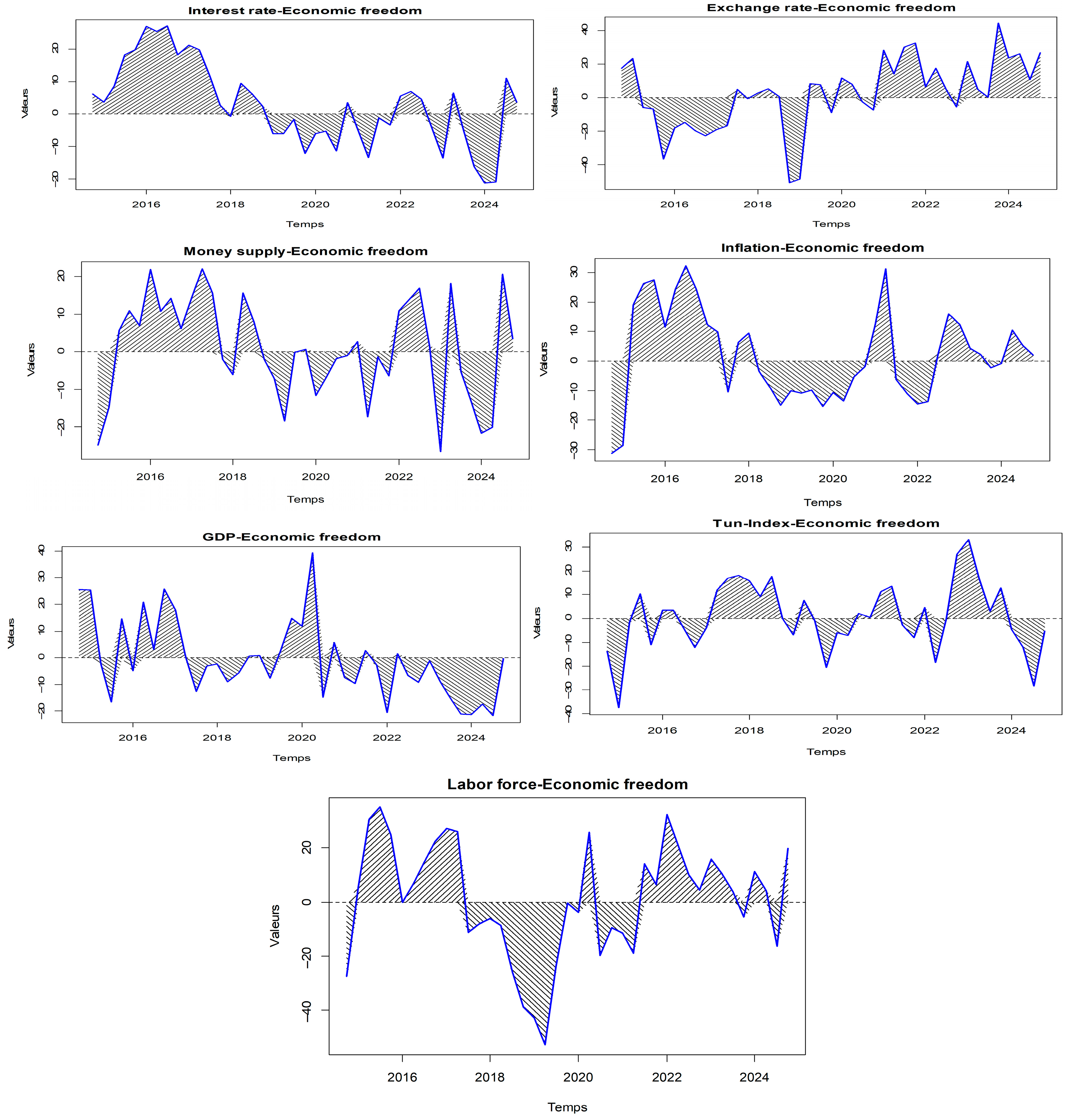
Macroeconomic Theory
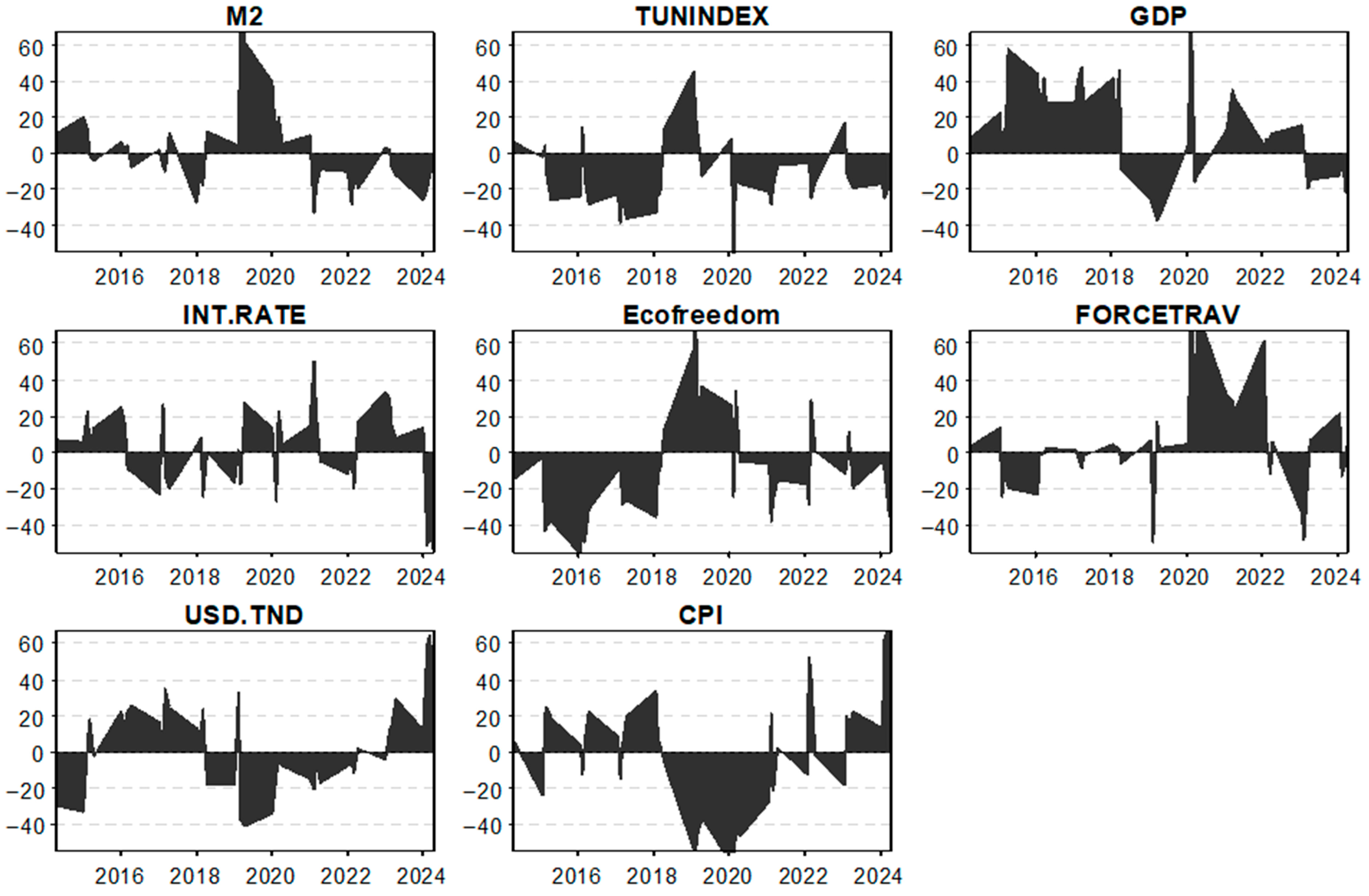
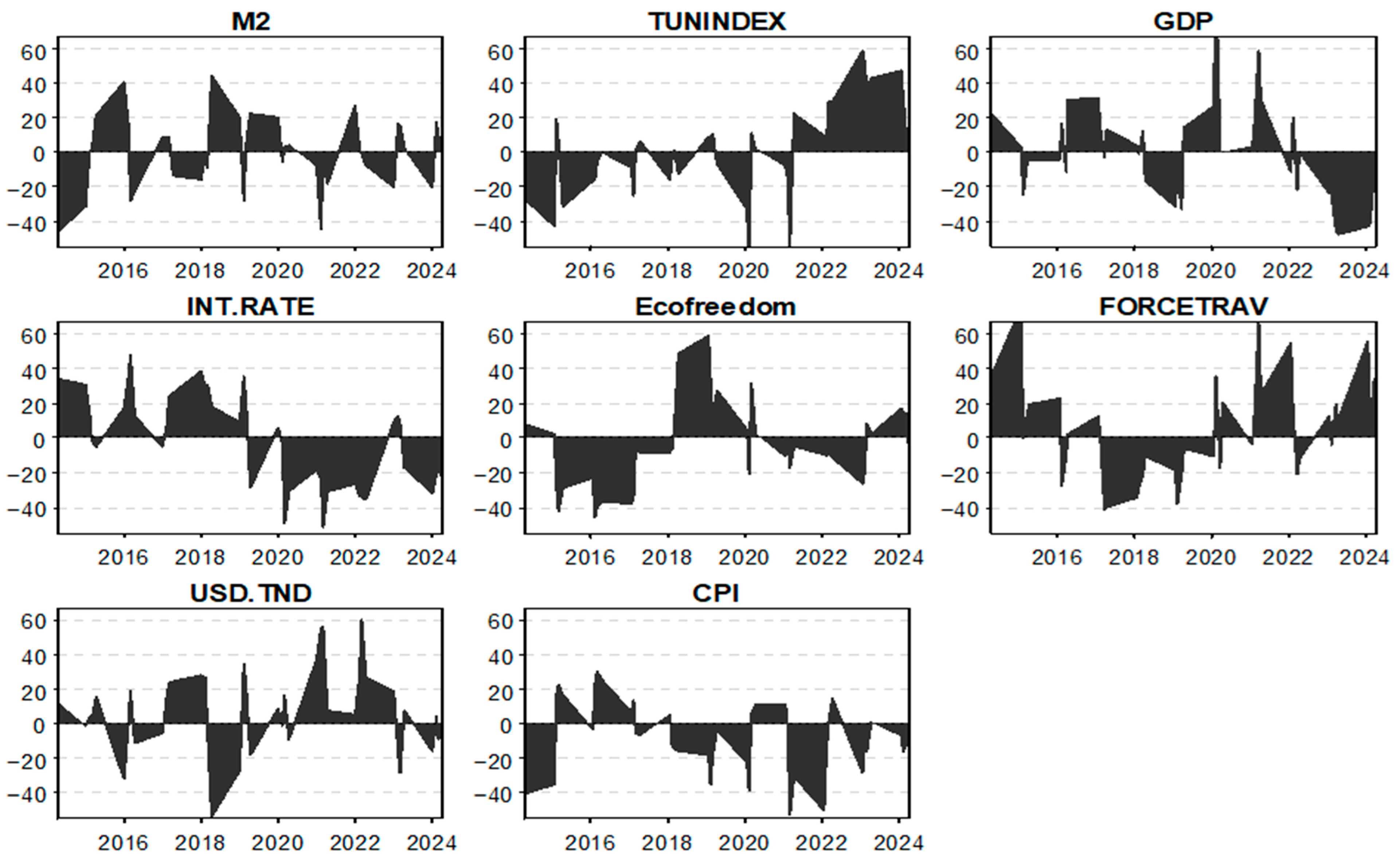
Quantity Theory of Money
Neoclassical Growth Theory
1.2. Research Hypotheses
1.3. Literature Review
2. Data and Methodology
2.1. Data
2.2. Econometric Methodology
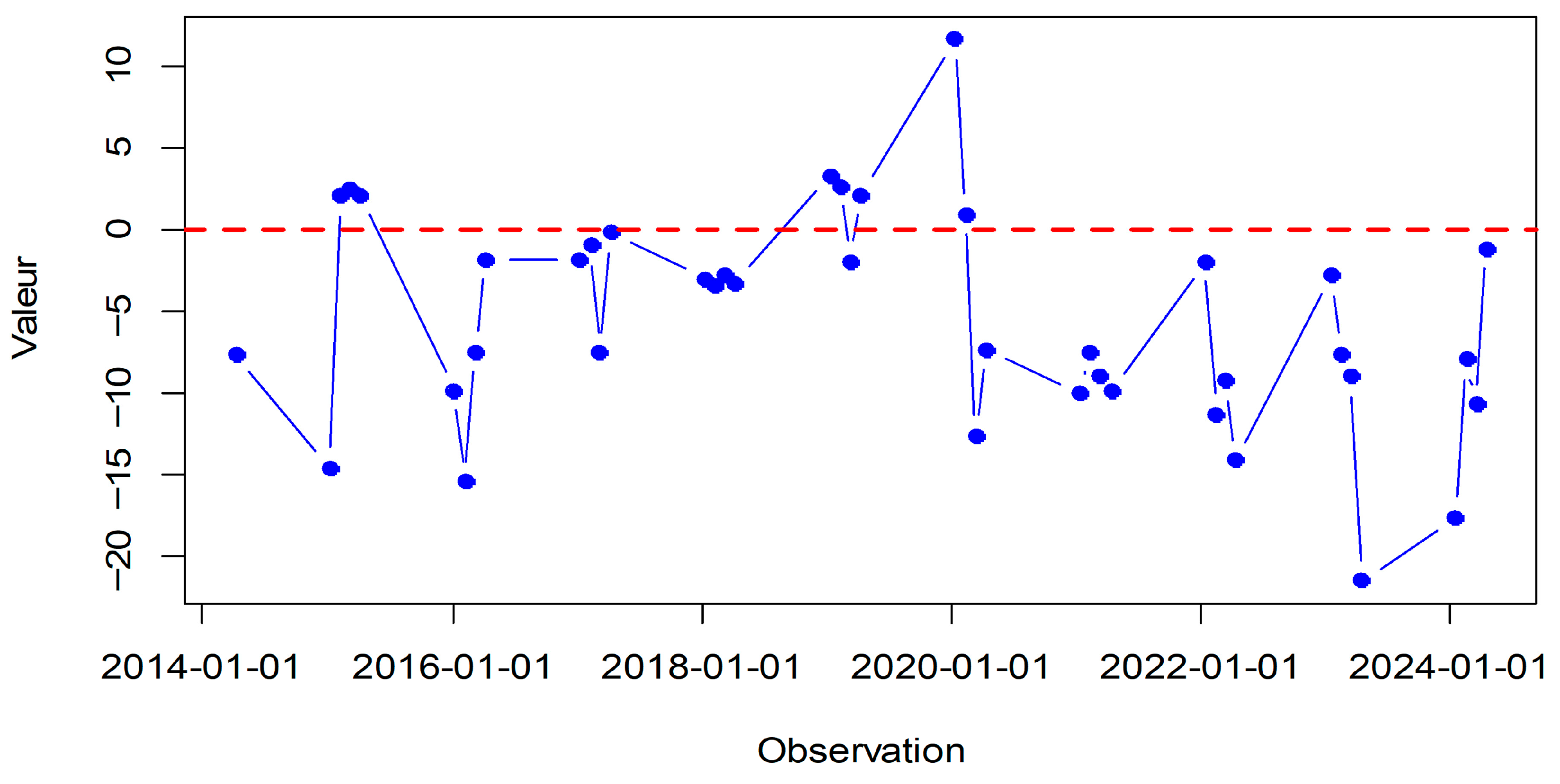
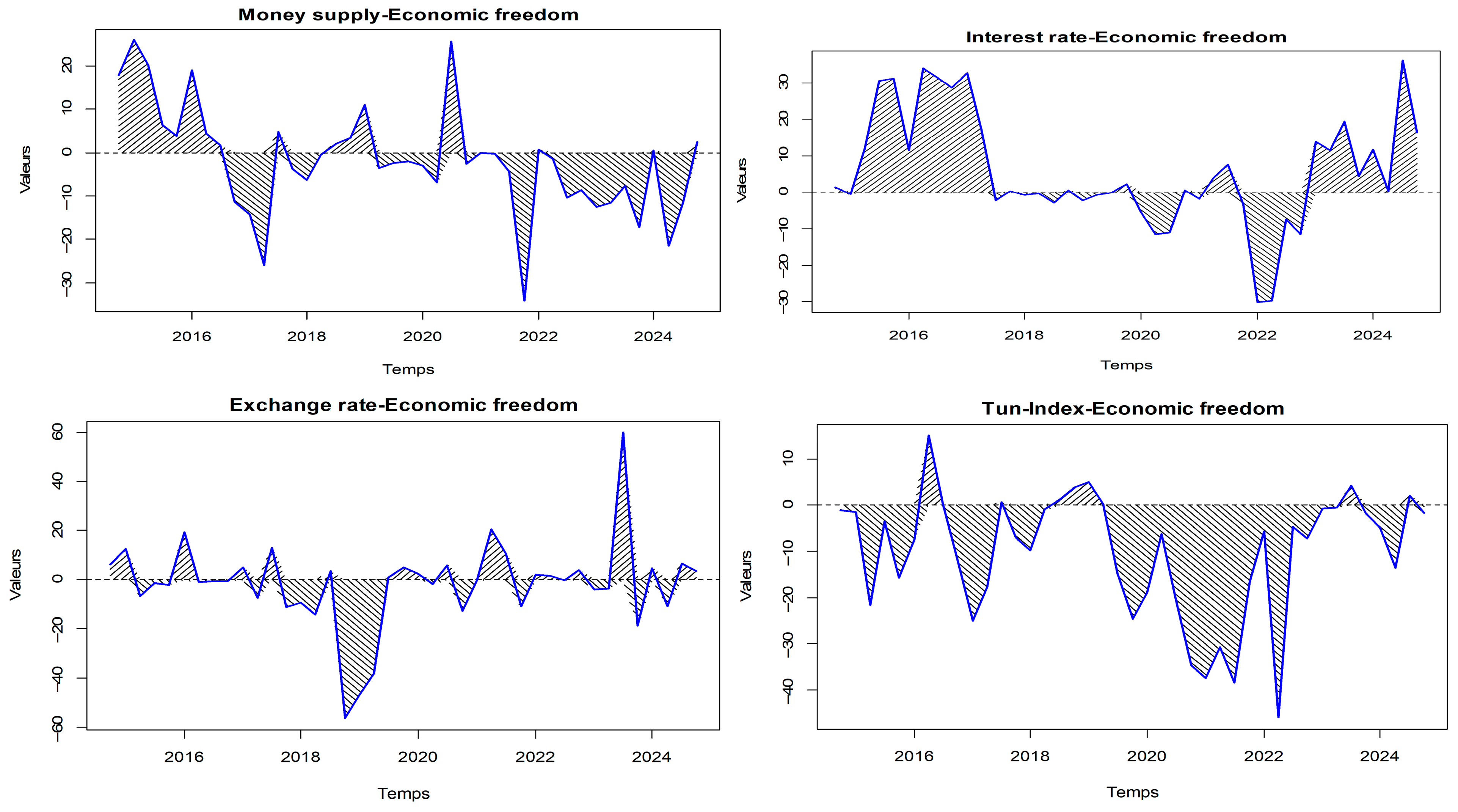
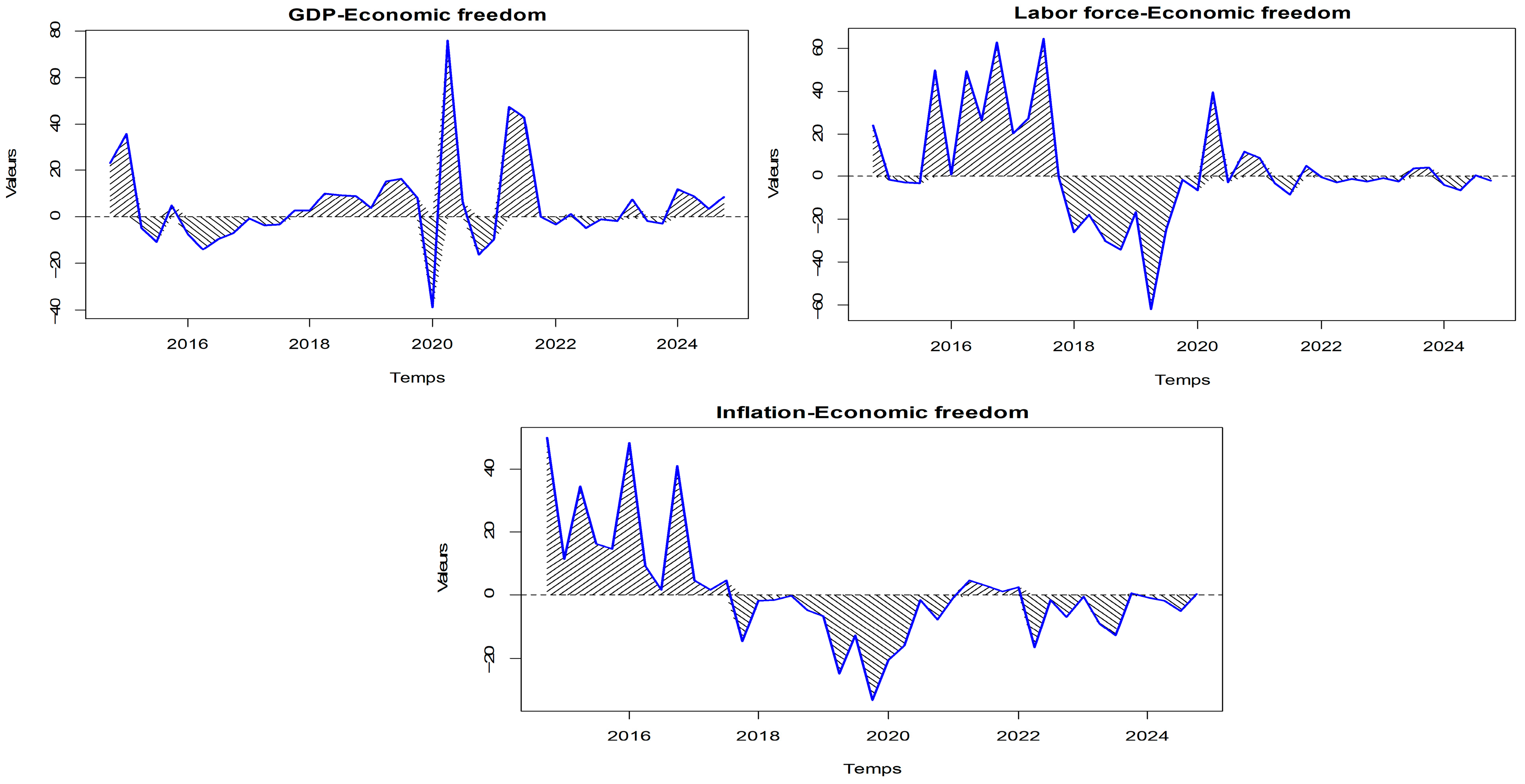
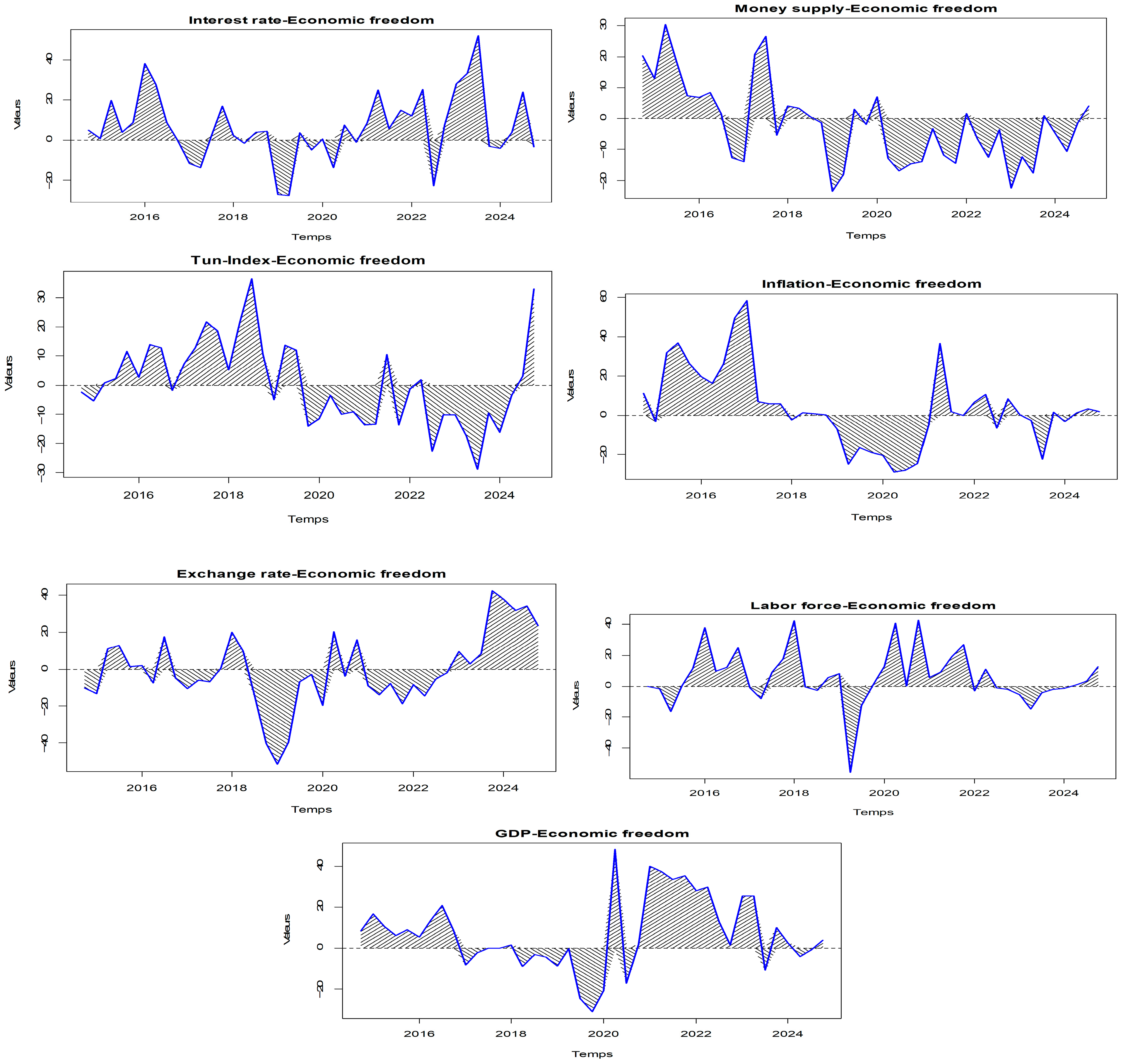
3. Empirical Analysis
3.1. Static Quantile Connectedness
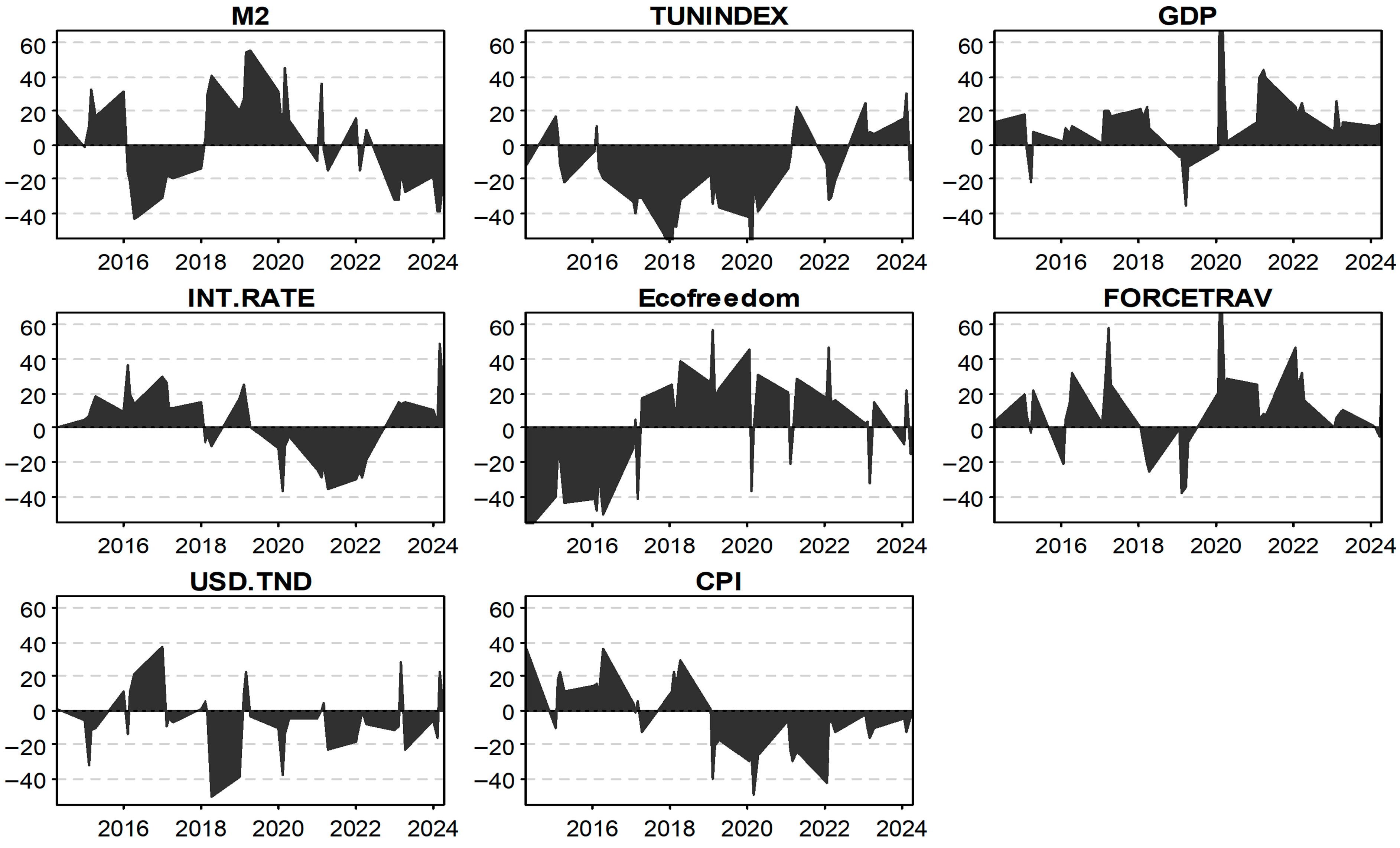
3.1.1. Upper Regime
3.1.2. Normal Regime
3.1.3. Lower Regime
3.2. Dynamic Connectivity
3.3. Time-Varying Net Pairwise Spillovers Among Real-Financial Aggregates and Economic Freedom
3.4. Robustness Test
4. Conclusions
Author Contributions
Funding
Institutional Review Board Statement
Informed Consent Statement
Data Availability Statement
Conflicts of Interest
Correction Statement
| 1 | These previous studies rely on panel data models, typically employing the Generalized Method of Moments (GMM) and conventional panel estimation techniques that account for individual effects (Arellano & Bond, 1991; Blundell & Bond, 1998). However, their analytical frameworks remain limited to examining unidirectional relationships among macroeconomic variables and economic freedom. The investigation of bidirectional externalities between real-financial aggregates and economic freedom capturing the dynamic spillover effects across these domains lies beyond the scope of their analyses (Barguellil et al., 2018). |
| 2 | Acemoglu et al. (2003) examine the broader role of institutions in their study of the relationship between macroeconomic policy and economic volatility. |
| 3 | Kim et al. (2009) apply a panel VAR to examine the real economic interdependence among nine Asian economies and major industrialized countries, while the IMF (2007) uses VAR models to assess the transmission of U.S. shocks to more than 130 economies. More recently, Wang et al. (2023) introduce a distributional VAR framework that captures time-varying dependencies between macroeconomic and financial aggregates in the United States. These approaches provide valuable insights but rely on the assumption of stable and linear relationships, an assumption that often breaks down during episodes of economic shocks or financial crises. |
| 4 | The econometric approach uses essentially the GMM method applied to time series and panel data. |
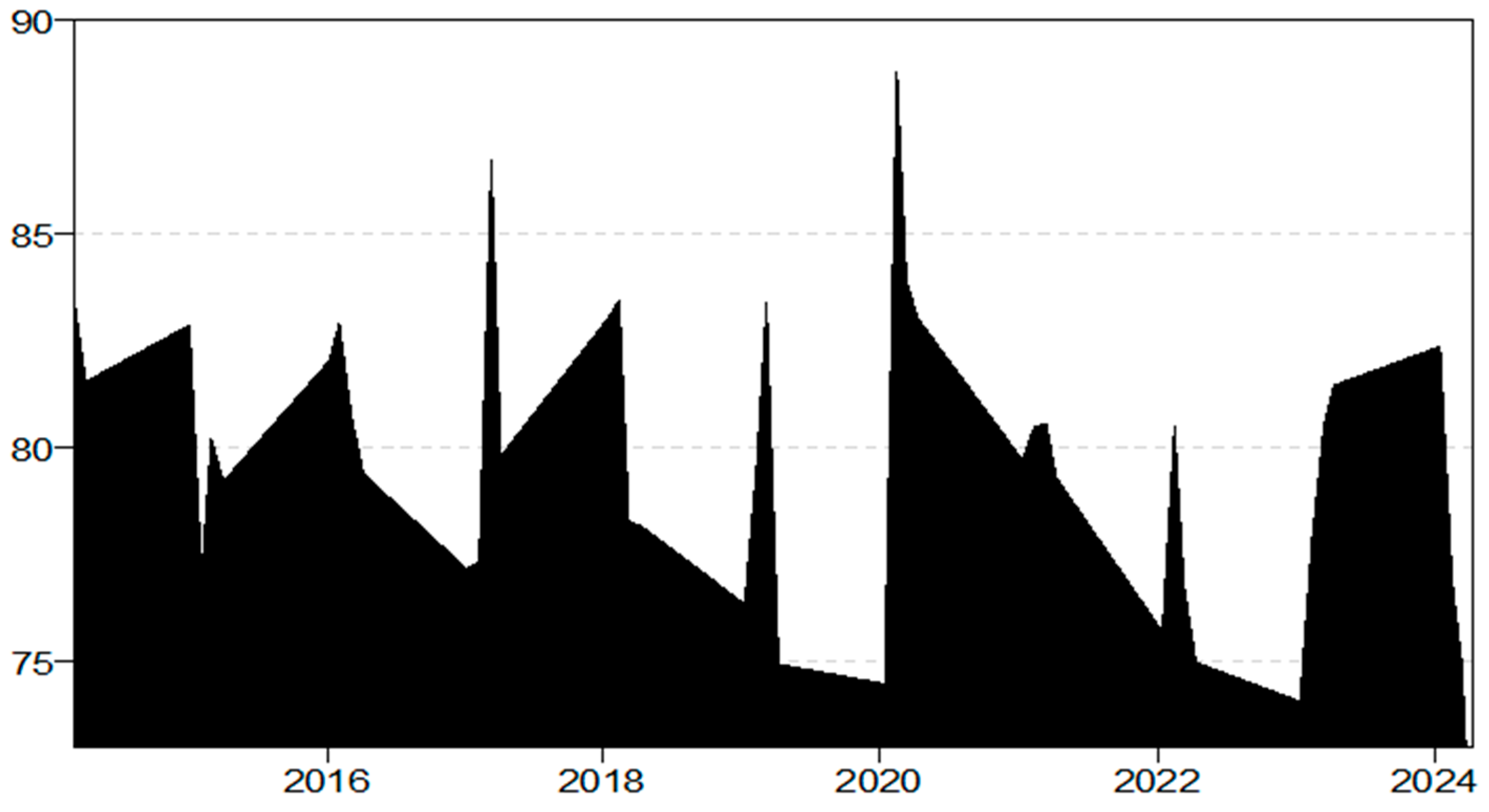
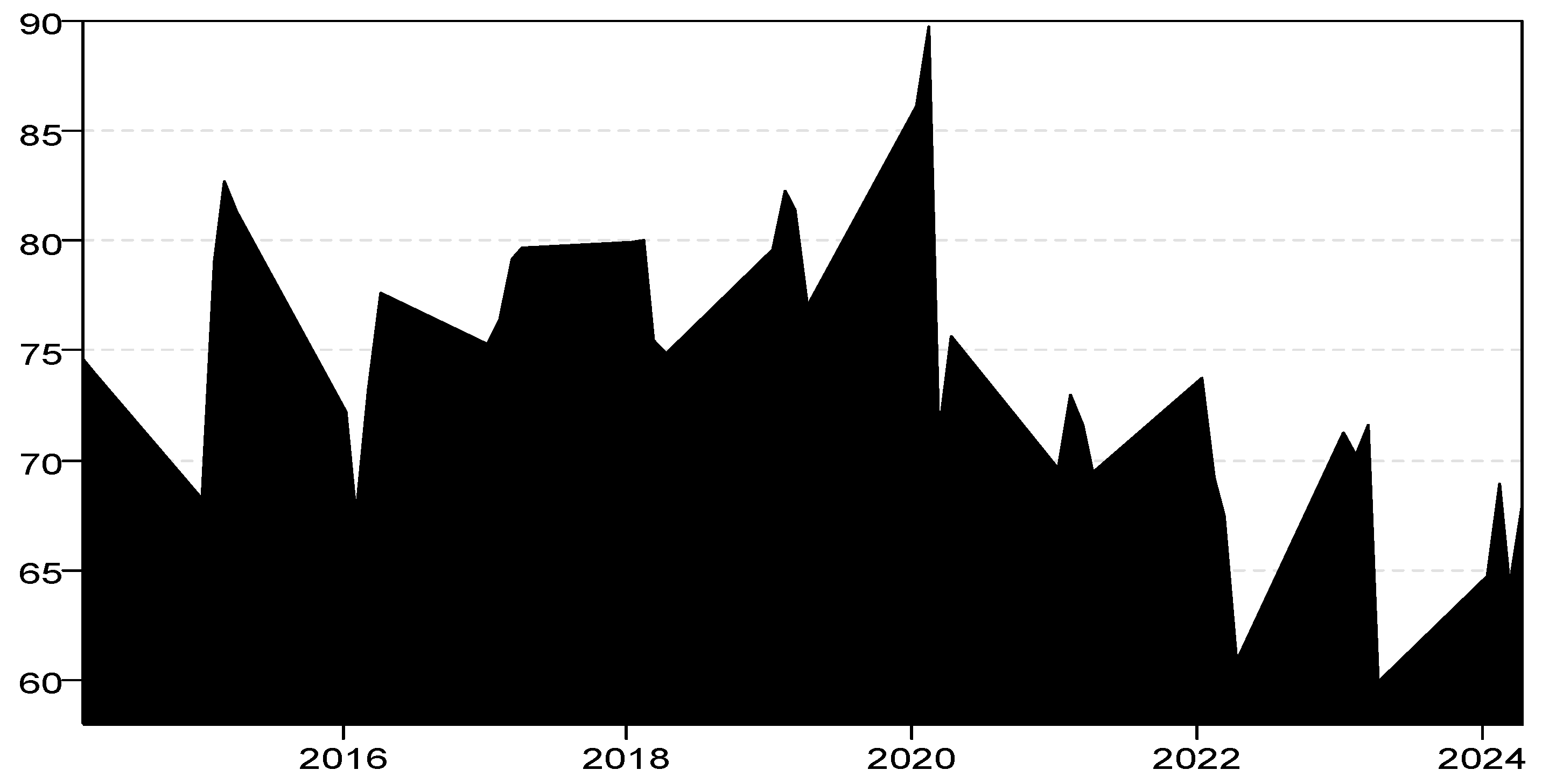
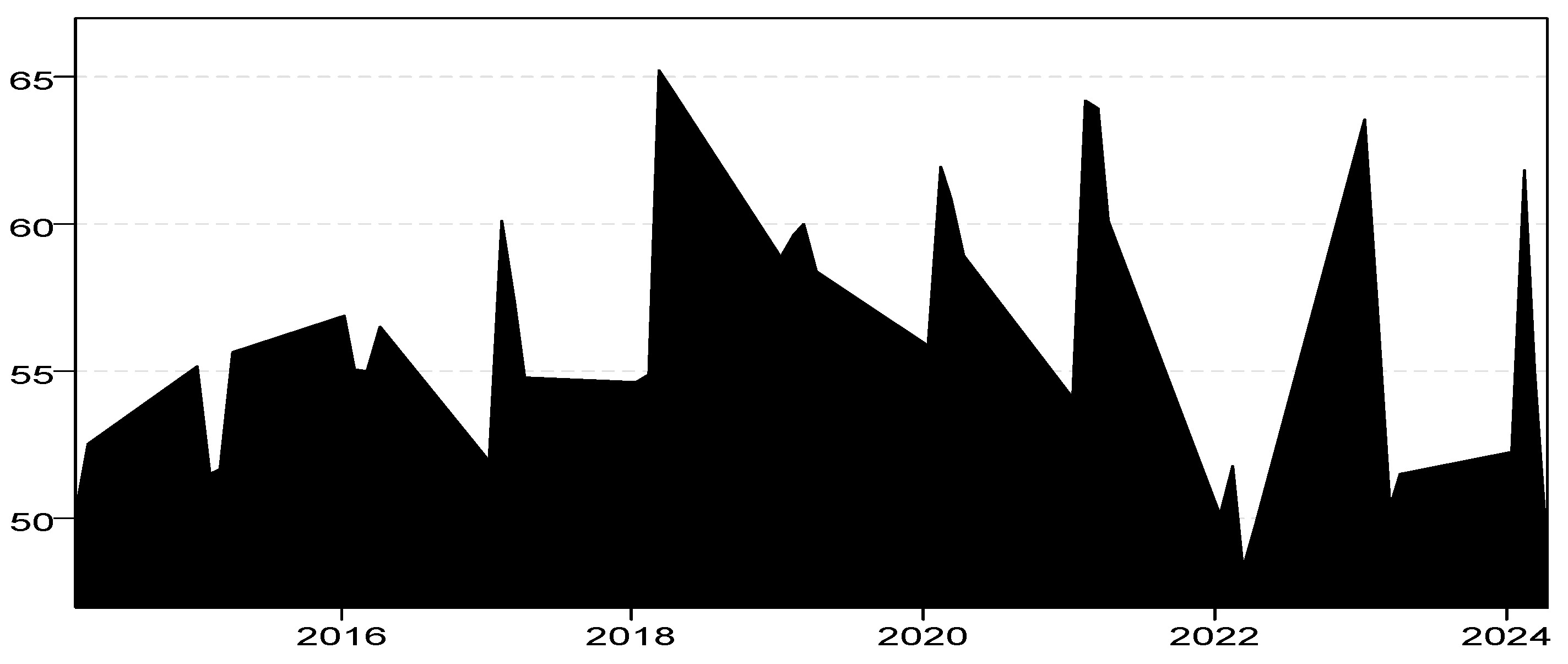
| 5 | Given the small size of our sample and the short- to medium-term objective of our study, we reduced the QVAR lag to 1 and the forecast error variance decomposition horizon to 2 quarters. |
| 6 | Diebold and Yilmaz (2012, 2014) provide seminal evidence that systemic connectedness among financial and macroeconomic variables rises sharply during episodes of turmoil. Similarly, Bouri et al. (2021) and X. Chen et al. (2022) show that connectedness dynamics become significantly amplified in extreme quantiles, highlighting the heightened transmission of shocks under bullish and bearish regimes. N. Kyriazis et al. (2024b) further confirm that both real and financial markets exhibit stronger interdependencies during periods of elevated uncertainty and stress, in line with macro-financial spillover theories. |
| 7 | Frenkel (1976) and Dornbusch (1976) argued that monetary expansions exert depreciation pressures through higher inflation expectations and exchange rate overshooting. Bahmani-Oskooee and Malixi (1992) supports this view, showing that money supply shocks significantly affect exchange rates in developing economies. Alesina and Summers (1993); Acemoglu et al. (2003) and Lawson and Murphy (2020) show that higher levels of economic freedom, reflected in sound monetary institutions, stronger property rights, and regulatory quality, have been shown to mitigate exchange rate volatility. |
| 8 | Carlsson and Lundström (2002) emphasize that the growth effects of economic freedom in developing economies are often conditional on structural and institutional maturity. Also consistent with our insights, Hayet & Naceur (2021) provide evidence that although FDI inflows respond positively to improvements in Tunisia’s economic freedom, the transmission of macroeconomic shocks through these channels remains limited. This pattern reflects persistent structural constraints, weak institutional maturity, and limited policy leverage compared to advanced economies. |
| 9 | Gwartney et al. (2023) argue that higher levels of economic freedom support better capital allocation and lower risk premium, thus fostering more resilient markets. Similarly, Shah et al. (2024) demonstrate that property rights and financial freedom dimensions mitigate stock market volatility in emerging economies. |
| 10 | Lipset (1959) and de Haan and Sturm (2000) highlight the positive association between higher income levels and stronger institutional frameworks. Acemoglu et al. (2005) show that economic development strengthens the demand and enforcement of inclusive institutions. The labor market channel echoes the work of Botero et al. (2004), Feldmann (2009), and Heckelman and Stroup (2005a), who demonstrate how labor market regulations shape broader economic freedom. The monetary and financial dimension, captured by interest rate sensitivity, is closely related to the “sound money” and “financial freedom” components of the Index of World Economic Freedom (Gwartney et al., 2023) and is consistent with the literature on financial liberalization (McKinnon, 1973; Shaw, 1973). |
| 11 | Labor force expansion, financial market conditions, and interest rate dynamics are well-established drivers of output growth (Solow, 1956; Mankiw et al., 1992; Fama, 1990; Schwert, 1990; King & Levine, 1993; Bernanke & Gertler, 1995; Mishkin, 1996). In contrast, the effect of economic freedom on GDP appears more indirect and long-term, operating through improvements in institutions and market efficiency (Graeff & Mehlkop, 2003; Feldmann, 2017; Nyström, 2008). This explains why, in our results, economic freedom transmits weaker spillovers to GDP relative to labor, stock markets, and interest rates. |
| 12 | Empirical evidence further supports this interconnectedness, as Diebold and Yilmaz (2012, 2014) demonstrate that GDP often acts as a net receiver of shocks originating in both real and financial markets, while Antonakakis and Gabauer (2017) find strong spillover effects from equity markets to GDP in open economies. |
| 13 | The net pairwise directional connectedness illustrates the net externality transmission on the bilateral level. The Net Pairwise Dynamic Connectedness, noted represents the difference in exchanged externalities between the variable i and the variable j at time t. |
| 14 | To substantiate the dominance of externalities received by economic freedom, one only needs to examine the pairwise connectivities, with particular attention to the positive and negative hatched areas. The analysis reveals that the positively hatched surfaces consistently outweigh the negative ones—especially in the cases of money supply–economic freedom, inflation–economic freedom, and labor force–economic freedom. In other words, the externalities transmitted by real and financial aggregates globally exceed those generated by economic freedom. |
| 15 | The crisis years include 2015–2016, marked by terrorist attacks (Bardo and Sousse) that led to a collapse in tourism, very weak growth, and high unemployment; 2018, characterized by widespread protests against rising living costs and inflation, which further deteriorated the social and economic climate; and 2020, when the COVID-19 pandemic triggered a historic recession (−8.8% of GDP), soaring unemployment, and mounting public debt. During these phases, economic freedom behaved reactively: it primarily absorbed shocks from GDP, inflation, and employment, while transmitting relatively little to financial markets or monetary aggregates. |
References
- Abbas, G., Hammoudeh, S., Shahzad, S. J. H., Wang, S., & Wei, Y. (2019). Return and Volatility Connectedness between Stock Markets and Macroeconomic Factors in the G-7 Countries. Journal of Systeme Science and. Systems Engineering , 28, 1–36. [Google Scholar] [CrossRef] [Scilit]
- Acemoglu, D., Johnson, S., & Robinson, J. A. (2005). Institutions as a fundamental cause of long-run growth. In P. Aghion, & S. Durlauf (Eds.), Handbook of economic growth (Vol. 1A, pp. 385–472). Elsevier. [Google Scholar] [CrossRef] [Scilit]
- Acemoglu, D., Johnson, S., Robinson, J. A., & Thaicharoen, Y. (2003). Institutional causes, macroeconomic symptoms: Volatility, crises and growth. Journal of Monetary Economics, 50(1), 49–123. [Google Scholar] [CrossRef] [Scilit]
- Achy, L. (2013). Tunisia’s Economic Challenges. The Carnegie Papers. Carnegie Middle East Center. [Google Scholar]
- Adrian, T., Boyarchenko, N., & Giannone, D. (2019). Vulnerable Growth. The American Economic Review, 109(4), 1263–1289. [Google Scholar] [CrossRef] [Scilit]
- Adrian, T., & Brunnermeier, M. K. (2016). CoVaR. The American Economic Review, 106(7), 1705–1741. [Google Scholar] [CrossRef] [Scilit]
- Adu-Asare Idun, A., Agyemang, A. O., & Frimpong, J. M. (2022). Macroeconomic shocks, structural reforms, and stock market responses: Evidence from the Ghana Stock Exchange. Research in International Business and Finance, 61, 101625. [Google Scholar] [CrossRef] [Scilit]
- Alagidede, P., & Panagiotidis, T. (2010). Can Common Stocks Provide a Hedge Against Inflation? Evidence from African Countries. International Review of Financial Analysis, 19(5), 289–300. [Google Scholar] [CrossRef] [Scilit]
- Alesina, A., & Summers, L. H. (1993). Central bank independence and macroeconomic performance: Some comparative evidence. Journal of Money, Credit and Banking, 25(2), 151–162. [Google Scholar] [CrossRef] [Scilit]
- Ando, T., Greenwood-Nimmo, M., & Shin, Y. (2022). Quantile connectedness: Modeling tail behavior in the topology of financial networks. Management Science, 68(4), 2401–2431. [Google Scholar] [CrossRef] [Scilit]
- Angulo-Guerrero, M. J., Pérez-Moreno, S., & Abad-Guerrero, I. M. (2017). How Economic Freedom Affects Opportunity and Necessity Entrepreneurship in the OECD Countries. Journal of Business Research, 73, 30–37. [Google Scholar] [CrossRef] [Scilit]
- Antonakakis, N., & Gabauer, D. (2017). Refined measures of dynamic connectedness based on TVP-VAR. Technical Report. University Library of Munich. [Google Scholar]
- Arellano, M., & Bond, S. (1991). Some tests of specification for panel data: Monte Carlo evidence and an application to employment equations. Review of Economic Studies, 58(2), 277–297. [Google Scholar] [CrossRef] [Scilit]
- Bahmani-Oskooee, M., & Kara, O. (2005). Income and price elasticities of trade: Some new estimates. International Trade Journal, 19(2), 165–178. [Google Scholar] [CrossRef] [Scilit]
- Bahmani-Oskooee, M., & Malixi, M. (1992). More evidence on the monetary approach to the determination of exchange rates. Weltwirtschaftliches Archiv, 128(4), 699–711. [Google Scholar] [CrossRef] [Scilit]
- Barguellil, A., Ben-Salha, O., & Zmami, M. (2018). Exchange rate volatility and economic growth. Economic Modelling, 72, 125–138. [Google Scholar] [CrossRef] [Scilit]
- Barro, R. J. (1976). Rational expectations and the role of monetary policy. Journal of Monetary Economics, 2(1), 1–32. [Google Scholar] [CrossRef] [Scilit]
- Barro, R. J. (1991). Economic growth in a cross section of countries. Quarterly Journal of Economics, 106(2), 407–443. [Google Scholar] [CrossRef] [Scilit]
- Barro, R. J. (1996). Democracy and growth. Journal of Economic Growth, 1(1), 1–27. [Google Scholar] [CrossRef] [Scilit]
- Baruník, J., & Křehlík, T. (2018). Measuring the frequency dynamics of financial connectedness and systemic risk. Journal of Financial Econometrics, 16(2), 271–296. [Google Scholar] [CrossRef] [Scilit]
- Beck, T., & Levine, R. (2005). Legal institutions and financial development. In C. Ménard, & M. M. Shirley (Eds.), Handbook of new institutional economics (pp. 251–278). Springer. [Google Scholar] [CrossRef] [Scilit] [PubMed]
- Bekaert, G., & Harvey, C. R. (2003). Emerging markets finance. Journal of Empirical Finance, 10(1–2), 3–55. [Google Scholar] [CrossRef] [Scilit]
- Bengoa, M., & Sánchez-Robles, B. (2003). Foreign direct investment, economic freedom and growth: New evidence from Latin America. European Journal of Political Economy, 19(3), 529–545. [Google Scholar] [CrossRef] [Scilit]
- Ben Haddad, H., Mezghani, I., Medhioub, I., & Altamimi, S. (2024). Spillover effects of disaggregated macroeconomic uncertainties on US real activity: Evidence from the quantile vector autoregressive connectedness approach. Empirical Economics, 66, 829–858. [Google Scholar] [CrossRef] [Scilit]
- Bergh, A., & Bjørnskov, C. (2021). Does economic freedom boost growth? Contemporary Economic Policy, 39(4), 653–674. [Google Scholar]
- Bernanke, B. S., Boivin, J., & Eliasz, P. (2005). Measuring the effects of monetary policy: A Factor-Augmented Vector Autoregressive (FAVAR) approach. The Quarterly Journal of Economics, 120(1), 387–422. [Google Scholar] [CrossRef] [Scilit]
- Bernanke, B. S., & Gertler, M. (1995). Inside the black box: The credit channel of monetary policy transmission. Journal of Economic Perspectives, 9(4), 27–48. [Google Scholar] [CrossRef] [Scilit]
- Bigerna, S. (2024). Connectedness analysis of oil price shocks, inflation, and exchange rate for the MENA region countries. Resources Policy, 88, 104344. [Google Scholar]
- Bjørnskov, C. (2016). Economic freedom and economic crises. European Journal of Political Economy, 45, 11–23. [Google Scholar] [CrossRef] [Scilit]
- Blundell, R., & Bond, S. (1998). Initial conditions and moment restrictions in dynamic panel data models. Journal of Econometrics, 87(1), 115–143. [Google Scholar] [CrossRef] [Scilit]
- Botero, J. C., Djankov, S., La Porta, R., López-de-Silanes, F., & Shleifer, A. (2004). The regulation of labor. Quarterly Journal of Economics, 119(4), 1339–1382. [Google Scholar] [CrossRef] [Scilit]
- Bouri, E., Cepni, O., Gabauer, D., & Gupta, R. (2021). Return connectedness across asset classes around the COVID-19 outbreak. International Review of Financial Analysis, 73, 101646. [Google Scholar] [CrossRef] [Scilit]
- Bruno, M., & Easterly, W. (1998). Inflation crises and long-run growth. Journal of Monetary Economics, 41(1), 3–26. [Google Scholar] [CrossRef] [Scilit]
- Burstein, A., & Gopinath, G. (2014). International prices and exchange rates. In Handbook of international economics (Vol. 4, pp. 391–451). Elsevier. [Google Scholar]
- Carlsson, F., & Lundström, S. (2002). Economic freedom and growth: Decomposing the effects. Public Choice, 112(3–4), 335–344. [Google Scholar] [CrossRef] [Scilit]
- Chatziantoniou, I., Gabauer, D., & Stenfors, A. (2022). Interest rate swaps and the transmission mechanism of monetary policy: A time-frequency analysis. Journal of International Financial Markets, Institutions and Money, 79, 101569. [Google Scholar]
- Chen, C. Y. H., Liu, L., & Papadimitriou, T. (2022). Tail-risk spillovers across global financial markets: Evidence from quantile connectedness. Journal of International Financial Markets, Institutions & Money, 78, 101556. [Google Scholar] [CrossRef] [Scilit]
- Chen, N. F., Roll, R., & Ross, S. A. (1986). Economic forces and the stock market. Journal of Business, 59, 383–403. [Google Scholar] [CrossRef] [Scilit]
- Chen, X., Xu, Y., & Zhang, X. (2022). Tail risk spillovers in global financial markets: A quantile VAR approach. Journal of International Money and Finance, 120, 102520. [Google Scholar] [CrossRef] [Scilit]
- Clarida, R., Galí, J., & Gertler, M. (1999). The science of monetary policy: A new Keynesian perspective. Journal of Economic Literature, 37(4), 1661–1707. [Google Scholar] [CrossRef] [Scilit]
- Dawson, J. W. (1998). Institutions, investment, and growth: New cross-country and panel data evidence. Economic Inquiry, 36(4), 603–619. [Google Scholar] [CrossRef] [Scilit]
- Dawson, J. W. (2010). Macroeconomics, economic freedom, and the business cycle. In The international economic freedom index: A primer (pp. 123–142). Fraser Institute. [Google Scholar]
- de Haan, J., & Sturm, J. E. (2000). On the relationship between economic freedom and economic growth. European Journal of Political Economy, 16(2), 215–241. [Google Scholar] [CrossRef] [Scilit]
- Diebold, F. X., & Yilmaz, K. (2012). Better to give than to receive: Predictive directional measurement of volatility spillovers. International Journal of Forecasting, 28(1), 57–66. [Google Scholar] [CrossRef] [Scilit]
- Diebold, F. X., & Yilmaz, K. (2014). On the network topology of variance decompositions: Measuring the connectedness of financial firms. Journal of Econometrics, 182(1), 119–134. [Google Scholar] [CrossRef] [Scilit]
- Dornbusch, R. (1976). Expectations and exchange rate dynamics. Journal of Political Economy, 84(6), 1161–1176. [Google Scholar] [CrossRef] [Scilit] [PubMed]
- Dornbusch, R., & Fischer, S. (1980). Exchange rates and the current account. American Economic Review, 70(5), 960–971. [Google Scholar]
- Easton, S. T., & Walker, M. A. (1992). Income, growth, and freedom. The Cato Journal, 12(2), 265–279. [Google Scholar]
- Engle, R. F., & Ng, V. K. (1993). Measuring and testing the impact of news on volatility. The Journal of Finance, 48(5), 1749–1778. [Google Scholar] [CrossRef]
- Enowbi-Batuo, M., & Kupukile, M. (2010). How can economic and political liberalisation improve financial development in African countries? Journal of Financial Economic Policy, 2(1), 35–59. [Google Scholar] [CrossRef]
- Fama, E. F. (1990). Stock returns, expected returns and real activity. Journal of Finance, 45(4), 1089–1108. [Google Scholar] [CrossRef]
- Feldmann, H. (2009). The unemployment effects of labor regulation around the world. Journal of Comparative Economics, 37(1), 76–90. [Google Scholar] [CrossRef] [Scilit]
- Feldmann, H. (2017). Economic freedom and human capital investment. Journal of Institutional Economics, 13(2), 421–445. [Google Scholar]
- Feldstein, M. (1980). Inflation, tax rules, and the stock market. Journal of Monetary Economics, 6(3), 309–331. [Google Scholar] [CrossRef] [Scilit]
- Fergusson, L. (2006). Institutions for Financial Development: What are they and where do they come from? Journal of Economic Surveys, 20(1), 27–70. [Google Scholar] [CrossRef] [Scilit]
- Fernández, A., & Tamayo, C. E. (2017). From institutions to financial development and growth: What are the links? Journal of Economic Surveys, 31(1), 17–57. [Google Scholar]
- Fischer, S. (1993). The role of macroeconomic factors in growth. Journal of Monetary Economics, 32(3), 485–512. [Google Scholar] [CrossRef] [Scilit]
- Fisher, I. (1911). The purchasing power of money: Its determination and relation to credit, interest and crises. Macmillan. [Google Scholar]
- Frenkel, J. A. (1976). A monetary approach to the exchange rate: Doctrinal aspects and empirical evidence. Scandinavian Journal of Economics, 78(2), 200–224. [Google Scholar] [CrossRef] [Scilit]
- Friedman, M. (1962). Capitalism and freedom. University of Chicago Press. [Google Scholar]
- Friedman, M. (1968). The role of monetary policy. The American Economic Review, 58(1), 1–17. [Google Scholar]
- Friedman, M. (1977). Nobel lecture: Inflation and unemployment. Journal of Political Economy, 85(3), 451–472. [Google Scholar] [CrossRef] [Scilit]
- Gani, A., & Prasad, B. C. (2008). Economic freedom, political freedom and economic well-being: A causality analysis. The Singapore Economic Review, 53(1), 1–19. [Google Scholar]
- Ghulam, Y., Kayani, G. M., & Riaz, R. (2019). Stock market volatility and macroeconomic fundamentals: Evidence from G7 countries. Physica A: Statistical Mechanics and its Applications, 525, 448–470. [Google Scholar] [CrossRef] [Scilit]
- Graeff, P., & Mehlkop, G. (2003). The impact of economic freedom on corruption: Different patterns for rich and poor countries. European Journal of Political Economy, 19(3), 605–620. [Google Scholar] [CrossRef] [Scilit]
- Gwartney, J., Holcombe, R., & Lawson, R. (2006). Institutions and the impact of investment on growth. Kyklos, 59(2), 255–276. [Google Scholar] [CrossRef] [Scilit]
- Gwartney, J., Lawson, R., & Hall, J. (2023). Economic freedom of the world: 2023 annual report. Fraser Institute. [Google Scholar]
- Gwartney, J., Lawson, R., & Holcombe, R. (1999). Economic freedom and the environment for economic growth. Journal of Institutional and Theoretical Economics, 155(4), 643–663. [Google Scholar]
- Hafer, R. W. (2013). Economic freedom and financial development: International evidence. Cato Journal, 33(1), 111–126. [Google Scholar]
- Hall, J. C., Lawson, R., & Mateer, D. (2019). The economic freedom of the world index: A case study of the use of public data. Journal of Private Enterprise, 34(3), 1–18. [Google Scholar]
- Hayek, F. A. (1944). The road to serfdom. University of Chicago Press. [Google Scholar]
- Hayet, K., & Naceur, B. Z. (2021). The Incidence of Economic Freedom and Foreign Direct Investment in Economic Growth: Empirical Evidence from Tunisia. International Journal of Health Economics and Policy, 6(1), 23–30. [Google Scholar] [CrossRef] [Scilit]
- Heckelman, J. C., & Stroup, M. D. (2005a). A comparison of aggregation methods for measures of economic freedom. European Journal of Political Economy, 21(4), 953–966. [Google Scholar] [CrossRef] [Scilit]
- Heckelman, J. C., & Stroup, M. D. (2005b). Do economic freedom indices explain variance in state-level economic freedom? Journal of Regional Analysis and Policy, 35(1), 71–84. [Google Scholar]
- Huang, Y., & Temple, J. R. W. (2005). Does external trade promote financial development? The B.E. Journal of Macroeconomics, 5(1), 1–32. [Google Scholar]
- International Monetary Fund (IMF). (2007). World economic outlook: Globalization and inequality. International Monetary Fund. [Google Scholar]
- Jamaludin, N., Ismail, S., & Manaf, S. A. (2017). Macroeconomic variables and stock market returns: Panel evidence from emerging markets. Journal of Global Business and Social Entrepreneurship (GBSE), 1(1), 68–79. [Google Scholar]
- Khan, M. S. (2021). Absorptive capacities and economic growth in low and middle income economies. arXiv, arXiv:2109.11550. [Google Scholar]
- Kim, S., Lee, J. W., & Park, C. Y. (2009). Emerging Asia: Decoupling or recoupling. Asian Economic Papers, 8(1), 1–30. [Google Scholar] [CrossRef] [Scilit]
- King, R. G., & Levine, R. (1993). Finance and growth: Schumpeter might be right. The Quarterly Journal of Economics, 108(3), 717–737. [Google Scholar] [CrossRef] [Scilit]
- Koenker, R., & Bassett, G. (1978). Regression quantiles. Econometrica, 46(1), 33–50. [Google Scholar] [CrossRef] [Scilit]
- Koop, G., Pesaran, H. M., & Potter, S. M. (1996). Impulse response analysis in nonlinear multivariate models. Journal of Econometrics, 74, 119–147. [Google Scholar] [CrossRef] [Scilit]
- Kyriazis, N., Papadamou, S., Tzeremes, P., & Corbet, S. (2024a). Examining spillovers and connectedness among commodities, inflation, and uncertainty: A quantile-VAR framework. Energy Economics, 133, 107508. [Google Scholar] [CrossRef] [Scilit]
- Kyriazis, N., Papadamou, S., Tzeremes, P., & Corbet, S. (2024b). Quantifying spillovers and connectedness among commodities and cryptocurrencies: Evidence from a Quantile-VAR analysis. Journal of Commodity Markets, 33, 100229. [Google Scholar] [CrossRef] [Scilit]
- Kyriazis, N. A., Bekiros, S., & Gabauer, D. (2024). Macroeconomic uncertainty, asset prices and volatility spillovers: A quantile VAR approach. Finance Research Letters, 60, 104–270. [Google Scholar] [CrossRef] [Scilit]
- Lawson, R. A., & Murphy, R. H. (2020). Economic freedom in the literature: What is it good (bad) for? Contemporary Economic Policy, 38(4), 622–642. [Google Scholar]
- Levine, R. (1997). Financial development and economic growth: Views and agenda. Journal of Economic Literature, 35(2), 688–726. [Google Scholar]
- Levine, R. (2005). Finance and growth: Theory and evidence. Handbook of Economic Growth, 1, 865–934. [Google Scholar] [CrossRef] [Scilit]
- Lipset, S. M. (1959). Some social requisites of democracy: Economic development and political legitimacy. American Political Science Review, 53(1), 69–105. [Google Scholar] [CrossRef] [Scilit]
- Lucas, R. (1976). Econometric policy evaluation: A critique, Carnegie-Rochester Conference Series on Public Policy. Econometric Policy Evaluation: A Critique 1, 19–46. [Google Scholar] [CrossRef] [Scilit]
- Lucas, R. E. (1972). Expectations and the neutrality of money. Journal of Economic Theory, 4(2), 103–124. [Google Scholar] [CrossRef] [Scilit]
- Mankiw, N. G., Romer, D., & Weil, D. N. (1992). A Contribution to the empirics of economic growth. The Quarterly Journal of Economics, 107(2), 407–437. [Google Scholar] [CrossRef] [Scilit]
- Mawardi, I., Al Mustofa, M. U., Widiastuti, T., & Ghozali, M. (2024). The influence of institutional quality, economic freedom, and technological development on Islamic financial development in OIC countries. Journal of Open Innova-tion: Technology, Market, and Complexity, 10(2), 100279. [Google Scholar] [CrossRef] [Scilit]
- McKinnon, R. I. (1973). Money and capital in economic development. Brookings Institution Press. [Google Scholar]
- Mensi, W., Hammoudeh, S., Nguyen, D. K., & Kang, S. H. (2017). Global financial crisis and spillover effects among the U.S. and BRICS stock markets. International Review of Economics & Finance, 52, 228–242. [Google Scholar]
- Mishkin, F. S. (1996). The channels of monetary transmission: Lessons for monetary policy (NBER working paper, No. 5464). NBER. [Google Scholar]
- Mundell, R. A. (1963). Capital mobility and stabilization policy under fixed and flexible exchange rates. The Canadian Journal of Economics and Political Science, 29(4), 475–485. [Google Scholar] [CrossRef] [Scilit]
- Ngo, T., Susnjara, J., & Yi, H. C. (2023). Market share, investor horizon, and stock crash risk. Corporate Accounting and Finance, 35(1), 308–324. [Google Scholar] [CrossRef] [Scilit]
- North, D. C. (1990). Institutions, institutional change and economic performance. Cambridge University Press. [Google Scholar] [CrossRef] [Scilit]
- Nyström, K. (2008). The institutions of economic freedom and entrepreneurship: Evidence from panel data. Public Choice, 136(3–4), 269–282. [Google Scholar] [CrossRef] [Scilit]
- Obstfeld, M. (2015). Trilemmas and tradeoffs: Living with financial globalization (BIS Working Papers No. 480). Monetary and Economic Department. [Google Scholar]
- Okun, A. M. (1962). Potential GNP: Its measurement and significance. In Proceedings of the business and economic statistics section of the American statistical association (pp. 98–104). Scientific Research Publishing. [Google Scholar]
- Pesaran, H., & Shin, Y. (1998). Generalized impulse response analysis in linear multivariate models. Economics Letters, 58(1), 17–29. [Google Scholar] [CrossRef] [Scilit]
- Rogoff, K. (1996). The purchasing power parity puzzle. Journal of Economic Literature, 34(2), 647–668. [Google Scholar]
- Schwert, G. W. (1990). Stock returns and real activity: A century of evidence. The Journal of Finance, 45(4), 1237–1257. [Google Scholar] [CrossRef]
- Shah, S. Z. A., Iqbal, J., & Raza, H. (2024). Economic freedom and stock market volatility in emerging economies: Evidence from panel data analysis. Borsa Istanbul Review, 24(2), 187–199. [Google Scholar] [CrossRef] [Scilit]
- Shang, Y., & Hamori, S. (2024). Quantile time–frequency connectedness among global financial and economic sectors. International Review of Financial Analysis, 92, 103750. [Google Scholar] [PubMed]
- Sharma, S. (2020). Economic freedom and health outcomes: Evidence from panel data. Journal of Development Studies, 56(7), 1273–1289. [Google Scholar]
- Shaw, E. S. (1973). Financial deepening in economic development. Oxford University Press. [Google Scholar]
- Smimou, K., & Karabegovic, A. (2010). The role of economic freedom in promoting women’s advancement: A cross-country analysis. The Journal of Developing Areas, 44(1), 121–146. [Google Scholar]
- Solow, R. M. (1956). A contribution to the theory of economic growth. The Quarterly Journal of Economics, 70(1), 65–94. [Google Scholar] [CrossRef] [Scilit]
- Stroup, M. D. (2007). Economic freedom, democracy, and the quality of life. World Development, 35(1), 52–66. [Google Scholar] [CrossRef] [Scilit]
- Sweidan, O. D. (2021). Economic freedom and entrepreneurship: Evidence from panel data. The Journal of Entrepreneurship, 30(2), 340–362. [Google Scholar]
- Taylor, J. B. (1993). Discretion versus policy rules in practice. Carnegie-Rochester Conference Series on Public Policy, 39, 195–214. [Google Scholar] [CrossRef] [Scilit]
- Thach, N. N., & Ngoc, B. H. (2021). Economic freedom and corruption: New evidence from a global sample. Heliyon, 7(6), e07236. [Google Scholar]
- Thai Hung, N. (2022). Stock market–macroeconomic nexus in China: Evidence from wavelet-based Granger causality tests. Borsa Istanbul Review, 22(1), 1–13. [Google Scholar] [CrossRef] [Scilit]
- Wang, Y., Liu, L., & Wu, C. (2023). A distributional VAR framework for macro-financial dynamics. Journal of Applied Econometrics, 41(4), 408–424. [Google Scholar] [CrossRef] [Scilit]
- Williamson, C. R., & Mathers, R. L. (2011). Economic freedom, culture, and growth. Public Choice, 148(3–4), 313–335. [Google Scholar]





| Variable | Description | Source/Provider | Frequency | Transformation | Unit of Measurement |
|---|---|---|---|---|---|
| ECOFREEDOM | Economic Freedom Index | Fraser Institute | Quarterly | Growth rate | Index value (transformed) |
| GDP | Gross Domestic Product | Likely National Institute of Statistics (Tunisia) or IMF | Quarterly | Growth rate | Constant local currency unit (transformed) |
| M2 | Money Supply (Broad Money) | Central Bank of Tunisia (BCT) | Quarterly | Growth rate | Tunisian Dinar (TND) (transformed) |
| INTRATE | Interest Rate (Money Market Rate) | Central Bank of Tunisia (BCT) | Quarterly | Growth rate | Percentage (%) (transformed) |
| EXCHRATE | Exchange Rate (TND/USD) | Central Bank of Tunisia (BCT) | Quarterly | Growth rate | TND per 1 USD (transformed) |
| CPI | Consumer Price Index (proxy for Inflation) | National Institute of Statistics (Tunisia) | Quarterly | Growth rate | Index (2010 = 100, transformed) |
| TUNINDEX | Stock Market Index (Tunis Stock Exchange) | Tunis Stock Exchange (BVMT) | Quarterly | Growth rate | Index points (transformed) |
| FORCETRAV | Labor Force | National Institute of Statistics (Tunisia) or ILO | Quarterly | Growth rate | Number of persons (transformed) |
| Mean | Maximum | Minimum | Std. Dev. | Skewness | Kurtosis | JB | ADF | Obs. | |
|---|---|---|---|---|---|---|---|---|---|
| M2 | 0.0221 | 0.0532 | −0.0221 | 0.0139 | −0.5280 | 3.6114 | 3.661 | −3.542 | 59 |
| INTRATE | 0.0111 | 0.1581 | −0.1155 | 0.0513 | 0.4105 | 4.8323 | 9.911 | −4.025 | 59 |
| EXCHRATE | 0.0139 | 0.0833 | −0.0415 | 0.0304 | 0.2194 | 2.5597 | 0.951 | −3.587 | 59 |
| Tun-Index | 0.0146 | 0.1561 | −0.1422 | 0.0599 | 0.0315 | 3.1847 | 0.094 | −3.821 | 59 |
| ECOFREEDOM | −0.0013 | 0.0043 | −0.0138 | 0.0042 | −0.5530 | 2.4309 | 3.804 | −4.651 | 59 |
| CPI | 0.0140 | 0.0257 | 0.0056 | 0.0048 | 0.4113 | 2.8385 | 1.728 | −4.025 | 59 |
| GDP | 0.0167 | 0.1717 | −0.1444 | 0.0312 | −0.2695 | 23.194 | 1003.3 *** | −3.854 | 59 |
| FORCETRAV | 0.0019 | 0.0280 | −0.0274 | 0.0077 | −0.7878 | 7.7812 | 62.299 *** | −3.891 | 59 |
| M2 | INT.RATE | USD.TND | TUNINDEX | Eco Freedom | CPI | GDP | FORCETRAV | FROM | |
|---|---|---|---|---|---|---|---|---|---|
| PANEL A: Lower Quantile (q = 0.05) | |||||||||
| M2 | 29.73 | 8.55 | 12.89 | 8.55 | 11.18 | 7.90 | 9.53 | 11.68 | 70.27 |
| INT.RATE | 7.54 | 30.98 | 6.67 | 14.96 | 6.77 | 12.76 | 13.29 | 7.02 | 69.02 |
| USD.TND | 10.01 | 8.98 | 34.68 | 9.60 | 9.96 | 9.57 | 9.10 | 8.10 | 65.32 |
| TUNINDEX | 9.69 | 9.42 | 13.02 | 27.21 | 8.60 | 11.59 | 11.19 | 9.26 | 72.79 |
| Eco. Freedom | 11.36 | 9.09 | 11.43 | 8.97 | 33.07 | 10.09 | 6.74 | 9.25 | 66.93 |
| CPI | 9.94 | 13.26 | 10.13 | 10.79 | 9.39 | 24.46 | 11.84 | 10.19 | 75.54 |
| GDP | 9.93 | 10.91 | 9.36 | 11.39 | 7.07 | 8.98 | 27.52 | 14.84 | 72.48 |
| FORCETRAV | 11.65 | 8.30 | 9.78 | 9.81 | 8.79 | 6.15 | 10.34 | 35.18 | 64.82 |
| TO | 70.11 | 68.52 | 73.29 | 74.07 | 61.76 | 67.04 | 72.04 | 70.35 | 557.17 |
| Inc. Own | 99.83 | 99.50 | 107.98 | 101.28 | 94.83 | 91.50 | 99.55 | 105.53 | TCI |
| NET | −0.17 | −0.50 | 7.98 | 1.28 | −5.17 | −8.50 | −0.45 | 5.53 | 69.65 |
| NPT | 4.00 | 5.00 | 6.00 | 4.00 | 1.00 | 2.00 | 2.00 | 4.00 | |
| PANEL B: Medium Quantile (q = 0.50) | |||||||||
| M2 | 52.73 | 7.92 | 6.38 | 6.73 | 6.80 | 5.36 | 5.30 | 8.78 | 47.27 |
| INT.RATE | 4.44 | 52.15 | 5.19 | 7.83 | 5.34 | 9.31 | 10.85 | 4.87 | 47.85 |
| USD.TND | 8.77 | 5.57 | 51.81 | 4.90 | 6.18 | 7.02 | 6.01 | 9.75 | 48.19 |
| TUNINDEX | 10.02 | 5.24 | 8.05 | 46.88 | 8.26 | 5.83 | 8.32 | 7.40 | 53.12 |
| Eco. Freedom | 6.28 | 8.18 | 5.28 | 3.22 | 51.37 | 5.54 | 12.03 | 8.10 | 48.63 |
| CPI | 7.85 | 9.36 | 6.50 | 3.52 | 4.40 | 48.68 | 8.40 | 11.29 | 51.32 |
| GDP | 6.50 | 8.44 | 6.18 | 2.09 | 9.25 | 5.99 | 52.04 | 9.51 | 47.96 |
| FORCETRAV | 5.15 | 5.66 | 5.18 | 7.96 | 6.34 | 8.09 | 10.79 | 50.83 | 49.17 |
| TO | 49.01 | 50.37 | 42.75 | 36.26 | 46.57 | 47.14 | 61.71 | 59.70 | 393.52 |
| Inc. Own | 101.74 | 102.52 | 94.56 | 83.14 | 97.94 | 95.82 | 113.75 | 110.53 | TCI |
| NET | 1.74 | 2.52 | −5.44 | −16.86 | −2.06 | −4.18 | 13.75 | 10.53 | 49.19 |
| NPT | 4.00 | 5.00 | 2.00 | 2.00 | 3.00 | 3.00 | 5.00 | 4.00 | |
| PANEL C: Upper Quantile (q = 0.95) | |||||||||
| M2 | 37.02 | 7.24 | 9.86 | 7.98 | 9.66 | 7.75 | 8.05 | 12.45 | 62.98 |
| INT.RATE | 7.51 | 34.05 | 11.42 | 11.03 | 7.71 | 13.29 | 9.75 | 5.24 | 65.95 |
| USD.TND | 10.38 | 8.78 | 34.94 | 7.81 | 11.06 | 12.20 | 7.58 | 7.24 | 65.06 |
| TUNINDEX | 8.89 | 8.78 | 9.39 | 32.03 | 9.49 | 11.62 | 13.81 | 6.00 | 67.97 |
| Eco Freedom | 9.10 | 10.85 | 11.00 | 9.73 | 32.96 | 8.40 | 8.76 | 9.20 | 67.04 |
| CPI | 8.92 | 10.57 | 14.27 | 5.67 | 6.32 | 32.02 | 13.08 | 9.13 | 67.98 |
| GDP | 9.55 | 13.49 | 6.49 | 6.04 | 5.34 | 9.62 | 36.24 | 13.23 | 63.76 |
| FORCETRAV | 9.62 | 7.52 | 6.46 | 7.83 | 6.39 | 5.55 | 13.81 | 42.83 | 57.17 |
| TO | 63.99 | 67.24 | 68.89 | 56.09 | 55.96 | 68.43 | 74.83 | 62.49 | 517.92 |
| Inc.Own | 101.01 | 101.29 | 103.84 | 88.12 | 88.91 | 100.45 | 111.07 | 105.32 | TCI |
| NET | 1.01 | 1.29 | 3.84 | −11.88 | −11.09 | 0.45 | 11.07 | 5.32 | 64.74 |
| NPT | 5.00 | 3.00 | 3.00 | 3.00 | 2.00 | 3.00 | 5.00 | 4.00 | |
| n-Forecast | Lag | Size-Window. | TCI 0.05 | Net Spillovers | TCI 0.95 | Net Spillovers | TCI 0.50 | Net Spillovers |
|---|---|---|---|---|---|---|---|---|
| 2 quarters | 1 | 18 | 69.04 | −4.5 | 66.97 | −10.62 | 50.45 | −1.61 |
| 2 quarters | 1 | 19 | 69.2 | −5.81 | 66.31 | −13.60 | 50.15 | −0.33 |
| 2 quarters | 1 | 20 | 69.65 | −5.13 | 64.74 | −11.59 | 49.49 | −2.06 |
| 2 quarters | 1 | 21 | 69.73 | −6.56 | 64.48 | −12.80 | 47.23 | 0.95 |
| 2 quarters | 1 | 22 | 69.43 | −6.70 | 63.64 | −14.07 | 47.55 | 1.92 |
| 2 quarters | 1 | 23 | 69.36 | −5.51 | 64.65 | −9.59 | 48.69 | 1.12 |
| 2 quarters | 1 | 24 | 70.05 | −6.46 | 65.1 | −13.04 | 48.75 | −0.67 |
| 2 quarters | 1 | 25 | 69.96 | −4.9 | 65.93 | −9.89 | 48.11 | 1.77 |
Disclaimer/Publisher’s Note: The statements, opinions and data contained in all publications are solely those of the individual author(s) and contributor(s) and not of MDPI and/or the editor(s). MDPI and/or the editor(s) disclaim responsibility for any injury to people or property resulting from any ideas, methods, instructions or products referred to in the content. |
© 2026 by the authors. Licensee MDPI, Basel, Switzerland. This article is an open access article distributed under the terms and conditions of the Creative Commons Attribution (CC BY) license.
Share and Cite
Hachicha, N.; Ouertani, M.N.; Salem, M.B.; Feki, M.C. Quantile-VAR Approach to Spillovers and Connectedness Among Real-Financial Aggregates and Economic Freedom in Tunisia. J. Risk Financ. Manag. 2026, 19, 476. https://doi.org/10.3390/jrfm19070476
Hachicha N, Ouertani MN, Salem MB, Feki MC. Quantile-VAR Approach to Spillovers and Connectedness Among Real-Financial Aggregates and Economic Freedom in Tunisia. Journal of Risk and Financial Management. 2026; 19(7):476. https://doi.org/10.3390/jrfm19070476
Chicago/Turabian StyleHachicha, Nejib, Mohamed Nejib Ouertani, Marwa Ben Salem, and Mohamed Chiheb Feki. 2026. "Quantile-VAR Approach to Spillovers and Connectedness Among Real-Financial Aggregates and Economic Freedom in Tunisia" Journal of Risk and Financial Management 19, no. 7: 476. https://doi.org/10.3390/jrfm19070476
APA StyleHachicha, N., Ouertani, M. N., Salem, M. B., & Feki, M. C. (2026). Quantile-VAR Approach to Spillovers and Connectedness Among Real-Financial Aggregates and Economic Freedom in Tunisia. Journal of Risk and Financial Management, 19(7), 476. https://doi.org/10.3390/jrfm19070476