Article

Determining the Most Suitable Distribution and Estimation Method for Extremes in Financial Data with Different Volatility Levels


by
Thusang J. Buthelezi
and
Sandile C. Shongwe
*
Department of Mathematical Statistics and Actuarial Science, Faculty of Natural and Agricultural Sciences, University of the Free State, Bloemfontein 9301, South Africa
*
Author to whom correspondence should be addressed.
J. Risk Financial Manag. 2026, 19(2), 96; https://doi.org/10.3390/jrfm19020096
Submission received: 7 December 2025 / Revised: 8 January 2026 / Accepted: 8 January 2026 / Published: 2 February 2026
(This article belongs to the Section Risk)

Abstract

In finance, accurately modelling the tail behaviour of extreme log returns is critical for understanding and mitigating risks across diverse asset classes. This research employs extreme value theory to identify the most suitable probability distributions (i.e., generalized extreme value (GEV), generalized logistic (GLO), Gumbel (GUM), generalized Pareto (GP), and reverse Gumbel (REV)) and estimation methods (least squares (LS), weighted least squares (WLS), maximum likelihood (ML), L-moments (LM), and relative least squares (RLS)) for modelling the tail behaviour of log returns from two financial datasets, each representing a distinct asset class with high (Ethereum, a digital asset class) and low (South African government bonds, a fixed-income asset class) volatility levels. The performance of each model and estimation method (25 different possibilities) is evaluated through goodness-of-fit and risk measures as the study aims to determine the optimal approach for each volatility level. Results from ranking different models and estimation methods show that across both asset classes, ML consistently emerges as the top-performing estimation method across all distributions. LM serves as a solid secondary option, while LS occasionally excels under GLO’s weekly minima for low volatility, whereas RLS occasionally surpasses ML in GLO’s monthly minima for high volatility. Finally, WLS uniquely outperforms under GEV and GLO’s monthly minima under low volatility.

1. Introduction and Literature Review

The field of extreme value theory (EVT) is a branch of statistics that focuses on dealing with extreme events found in the tail ends of a distribution (Beirlant et al., 2004). It allows for the development of models that assist investors, researchers, and practitioners in estimating events that occur in the tails of a distribution. In finance, it helps to quantify the risk of large market crashes or extreme losses. According to Chernobai et al. (2007), extreme events in finance could lead to possible losses leading to bankruptcy; however, such events can also bring huge gains as well.
There are two primary approaches to applying EVT for determining the probability of extreme events, namely, the block maxima (BM) method and the peak over threshold (PoT) method (Chernobai et al., 2007). For each dataset, block maxima analysis is employed to extract weekly or monthly extremes, providing a structured framework for tail modelling, consistent with classical EVT applications, while PoT focuses on data points that exceed a certain high threshold instead of dividing data into blocks (Mosala et al., 2024). As stated by Chernobai et al. (2007), for very large extreme loss observations x , the limiting distribution of such normalized maxima is the generalized extreme value (GEV) distribution, and for PoT, the conditional excess distribution function of such extreme observations is summarized by the generalized Pareto (GP) distribution for a large threshold.
Extreme value models are statistical models specifically designed to characterize the tail behaviour of distributions, focusing on extreme values or events (Beirlant et al., 2004). These models are widely used in various fields, including finance, meteorology, hydrology, and insurance, where the analysis of rare and extreme events is crucial. This study focuses on the following five models: GEV, generalized logistic (GLO), Gumbel (GUM), GP, and reverse Gumbel (REV) probability models, see Bhatti et al. (2025). Model performance is rigorously assessed through a comprehensive suite of goodness-of-fit (GoF) tests, including Anderson–Darling (AD), Cramér–von Mises (CvM), and Kolmogorov–Smirnov (KS), complemented by GoF criteria such as negative log-likelihood (NLL), Akaike information criterion (AIC), and Bayesian information criterion (BIC) (Chernobai et al., 2007). Beyond technical model selection, the study explores substantive implications for portfolio construction, examining how EVT-derived tail estimates can enhance diversification benefits and risk mitigation strategies within the context of low-volatility fixed income and high-volatility assets.
Parameter estimation constitutes a critical determinant of model performance in extreme value analysis, where methodological choices can profoundly influence risk quantification methods (Chernobai et al., 2007). There are five established estimation techniques that this study focuses on: Least Squares (LS), Weighted Least Squares (WLS), Maximum Likelihood (ML), L-moments (LM), and Relative Least Squares (RLS). Each approach offers unique strengths; that is, LS and WLS emphasize computational efficiency and simplicity, ML provides asymptotic optimality under regularity conditions, LM demonstrates superior stability in the presence of outliers and small sample sizes, while RLS prioritizes relative accuracy for heteroscedastic data structures prevalent in financial time series (Bhatti et al., 2025). Beyond its applications in finance, EVT has been widely employed across various scientific domains, including hydrology, meteorology, climatology, insurance, and geology; see Ali et al. (2022). For instance, Gómez et al. (2019) proposed an extension of the GUM distribution with heavy tails and illustrated its usefulness in modelling wind velocity and snow accumulation, applying both ML and method-of-moments estimators. More recently, Liu et al. (2024) utilized the GP distribution to characterize excess rainfall intensity associated with combined sewer overflow events. Similarly, Pisarenko and Sornette (2003) employ GP distribution to analyze the shallow earthquakes in the Harvard catalogue over the period 1977–2000 in 12 seismic zones.
Various studies, including Jakata and Chikobvu (2019), Chikobvu and Jakata (2020), Ndlovu and Chikobvu (2023), and Chikobvu and Ndlovu (2023), have explored the use of EVT probability distributions in finance; some have separately applied the GP and GEV distributions to analyze the extreme tail behaviour of return. Jakata and Chikobvu (2019) and Chikobvu and Jakata (2020) both studied South African Financial Index (denoted as J580) using a single parameter estimation method, i.e., ML, while each paper implemented one probability model, namely, GP and GEV, respectively. Next, Ndlovu and Chikobvu (2023) and Chikobvu and Ndlovu (2023) both compared extreme risk in the exchange rate risk of Bitcoin vs. the US Dollar and South African Rand vs. the US Dollar returns, where they applied one probability model in each paper, namely, GP and GEV, respectively. In each paper, only ML was used as a parameter estimation approach. However, Bhatti et al. (2025, 2026) demonstrate how to select appropriate probability models and estimation methods in the context of hydrology, applying five probability models using five parameter estimation methods. No research has applied this in the financial domain; the selection of suitable probability models and estimation methods is critical for accurately modelling extreme log returns. Therefore, in this research work, we extend this in-depth analysis to the financial research domain. That is, unlike the articles cited above that used a single distribution and a single parameter estimation method, we intend to conduct a thorough analysis of the selection of suitable probability models (using five different distributions) and estimation methods (using five possible methods) to accurately model extreme log returns.
This study contributes to the EVT literature by offering a unified empirical assessment of several widely used extreme value distributions and parameter estimation methods under differing market volatility conditions. By evaluating BM and PoT models across low and high-volatility regimes, the analysis sheds light on how estimator performance and tail-risk measures depend on prevailing market dynamics. The results provide practical insights for EVT-based financial risk modelling, particularly with respect to the selection of distributions and estimation techniques for VaR and TVaR estimation in changing volatility environments. The contribution is therefore primarily applied, with a strong empirical focus supported by systematic methodological comparisons.
The study considers two datasets, namely, the South African government bonds (SAGB) share and Ethereum quoted against the South African Rand (ZAR) share price, i.e., ETH_ZAR, where volatility levels are categorized as low and high, respectively. We considered the observations from January 2020 to December 2024. These datasets were extracted from the https://www.investing.com/website, accessed on 1 March 2025 and are publicly available. The SAGB dataset represents the closing prices, which are usually issued to raise capital to finance fiscal deficits. Since the return on these bonds is predetermined at purchase, the movement in their market prices tends to be relatively small. Consequently, these prices exhibit low volatility compared to other asset classes (Mosala et al., 2024). The second dataset, ETH_ZAR, represents the closing prices of ETH_ZAR, which is a cryptocurrency well known for its smart contract functionality, support for decentralized applications, and status as the second-largest cryptocurrency after Bitcoin by market capitalization. Cryptocurrencies are widely recognized for their high volatility, often showing extreme price swings and heavy-tailed distributions compared to traditional financial markets and fiat currencies. To facilitate a comprehensive analysis, we present descriptive statistics for the closing prices in Table 1.
From Table 1, we see a clear long-term growth for ETH_ZAR from 1797.70 ZAR to 75,884.30 ZAR with major rallies that outweighed bear markets. The high standard deviation of 19,357.19, the coefficient of variation of 0.5791, and the range of 74,086.60 highlight high volatility, but the high mean and third quartile values suggest a relatively favourable dominance over 5 years. On the other hand, SAGB has a standard deviation of 0.82, a coefficient of variation of 0.0989, and a range of 4.65, proving to be the least volatile, as expected for government bonds, with changes tied to macroeconomic policy. Let { p t } be the time series of the daily price of financial assets under observation from 1 January 2020 to 31 December 2024, then, as stated by Cryer and Chan (2008), it is recommended to use log returns ( r t ) when analyzing financial data, defined as follows:
r t = log p t log p t 1 = G a i n ,   if   r t 0 L o s s ,   if   r t < 0    
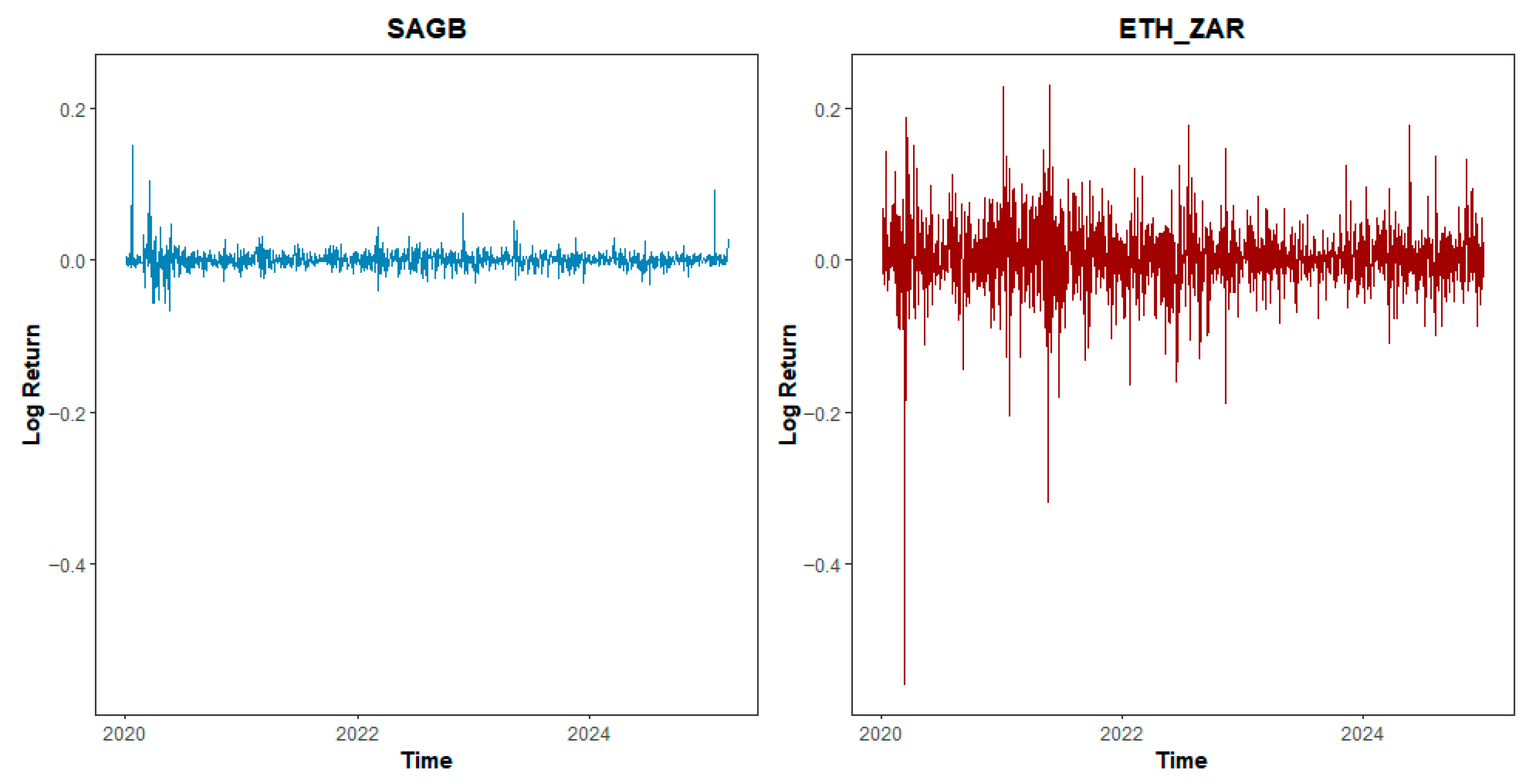
Figure 1 shows the returns’ plots for SAGB and ETH_ZAR, respectively, whereby the SAGB plot shows very small and stable fluctuations around zero returns, while ETH_ZAR displays high volatility and clear volatility clustering, characterized by alternating periods of extreme fluctuations and calmer phases.
The descriptive statistics of two log return series and their respective gains and losses are presented in Table 2, which shows that both log returns exhibit high positive kurtosis, indicating leptokurtic and heavy-tailed distributions. SAGB gains and ETH_ZAR losses have the heaviest tails, suggesting extreme events are more likely. It is quite clear from Table 2 that the SAGB has the lowest relative variability (i.e., standard deviation), consistent with its stable and low-risk bond nature; however, ETH_ZAR exhibits the highest overall volatility.
This study aims to apply the EVT framework to fit the GEV, GLO, GUM, GP, and REV probability models to the log returns of SAGB and ETH_ZAR with low and high volatility levels, as illustrated in Table 1 and Table 2, as well as in Figure 1. The aim of this study is achieved by assessing the performance of each probability distribution (i.e., five models), estimated with a particular estimation method (i.e., five methods), which yields twenty-five different combinations. Thereafter, from these twenty-five possible combinations, different GoF metrics and risk measures are computed. This is separately performed for both datasets at each level of volatility so that we may identify the most suitable combination of probability distribution and parameter estimation method for modelling the log returns.
The remainder of this article is structured as follows: Section 2 provides a detailed description of the EVT framework, presenting the candidate probability distributions and parameter estimation methods. In addition, the methodology for model selection and performance evaluation is provided. Section 3 discusses the empirical results for each financial asset, including optimal model identification and parameter estimation methods. Finally, discussion and conclusions are offered in Section 4 and Section 5, respectively.

2. Materials and Methods

2.1. Probability Distributions

Five probability models (i.e., GEV, GLO, GUM, GP, and REV) are considered in this paper to capture the tail behaviour of extreme log returns in financial data. For each model, the probability density function (pdf) and cumulative distribution function (cdf) are presented in Table 3 to define their mathematical structure and applicability to modelling extreme events, where location, shape, and scale parameters are denoted by μ , β , and σ , respectively, see Kotz and Nadarajah (2000) as well as Forbes et al. (2011).

2.2. Parameter Estimation Methods

The choice of an accurate parameter estimation method is crucial for fitting extreme value distributions. Several estimation techniques are applied in this study, each with distinct assumptions and performance under high and low volatility levels.

2.2.1. Maximum Likelihood (ML)

ML is a statistical method used for estimating the parameters of a probability distribution based on observed data. The key idea behind ML is to find the parameter values that maximize the likelihood function, which represents the probability of the observed data given those parameters. The likelihood function, denoted as L θ | x , is defined as the joint probability of the observed data x given the parameter θ for i.i.d. data, expressed as follows:
L ( θ | x ) = f ( x 1 | θ ) × f ( x 2 | θ ) × × f ( x n | θ )
where f ( x i | θ ) is the PDF of the distribution. It is more convenient to work with the likelihood function defined as follows:
L ( x | θ ) = l o g L ( θ | x ) = i = 1 n l o g f ( x i | θ )
Maximizing the log-likelihood is equivalent to maximizing the likelihood function due to the monotonic nature of the logarithm. To find the maximum likelihood estimates, the derivative of the log-likelihood function with respect to the parameters is set to zero (Bhatti et al., 2025).
d d θ L ( x | θ ) = 0
This involves solving the resulting equations to find the parameter estimates.

2.2.2. L-Moments (LM)

LMs are defined as linear combinations of order statistics or probability-weighted moments, whereby they estimate parameters of various probability distributions by equating the sample LM to the population LM. LMs were originally proposed by Hosking (1990), and it has been observed that LM estimators perform more reliably than conventional moment estimators. They are particularly useful in situations where data may contain outliers or when dealing with small sample sizes, and are more suitable and convenient than probability-weighted moments. Let x 1 : n < < x n : n be the order statistics of a random sample of size n . According to Hosking (1990), the first, second, and third LM, respectively, are as follows:
e 1 =   x ¯
e 2 = 2 n n 1 i = 1 n i 1 x i : n x ¯
e 3 = 6 n n 1 n 2 i = 3 n i 1 i 2 x i : n 6 n n 1 i = 2 n i 1 x i : n + x ¯
The LM can be computed from (Hosking, 1990):
λ r = r 1 j = 0 r 1 r 1 j ( 1 ) j µ r j : r
where r 1 j is a binomial coefficient and µ r j : r denotes the probability weighted moment (PWM), defined by:
E [ x F x ] k 1 = x F x k 1 d F x
where k =   r j with F(.) being the cdf of the random variable x . Then, the first four population LM are computed, respectively, as follows (Dey et al., 2021):
L - mean :   λ 1 = µ 1
M - scale :   λ 2 = 1 2 µ 2 : 2 µ 1 : 2
L - skewness :   λ 3 = 1 3 µ 3 : 3 2 µ 2 : 3 + µ 1 : 3
L - kurtosis :   λ 4 = 1 4 µ 4 : 4 3 µ 3 : 4 + 3 µ 2 : 4 + µ 1 : 4
LM ratios can also be derived from the LM, providing standardized measures of shape (Hosking, 1990).
L - coefficient   ( τ 2 ) :   τ 2 = λ 2 λ 1
L - skewness   ratio   ( τ 3 ) :   τ 3 = λ 3 λ 2
M - kurtosis   ratio   ( τ 4 ) :   τ 4 = λ 4 λ 3 .

2.2.3. Least Squares (LS)

LS estimation methods determine model parameters by minimizing the discrepancy between the theoretical cdf of a candidate probability distribution and the empirical cdf computed from the data. These methods are attractive due to their conceptual simplicity and ease of implementation, and they are widely discussed in the statistics literature, see Wu et al. (2004).
L S θ = j = 1 n [ F x j F n x j ] 2
where F x j denotes the theoretical cdf evaluated at the ordered observation x j for a given parameter θ and F n x j = j n + 1 represents the empirical cdf based on a sample of size n . The LS estimates are obtained by minimizing this objective function with respect to θ , typically through numerical optimization.

2.2.4. Relative Least Squares (RLS)

The RLS method, introduced by Sáez and Rittmann (1992), is a modified form of the standard LS estimation approach. This method has attracted increasing attention in statistical literature due to its potential to improve estimation performance for certain probability distributions, particularly in situations where relative deviations are more informative than absolute ones. Unlike the LS approach, which minimizes the squared absolute difference between the theoretical and empirical cdfs, the RLS method minimizes the squared relative difference between the two cdfs. Parameter estimates are therefore obtained by solving the optimization problem (Bhatti et al., 2025):
R L S θ = j = 1 n [ F x j F n x j F x j ] 2
where F x j and F n x j denote the theoretical and empirical cdfs evaluated at the ordered observation x j , respectively.

2.2.5. Weighted Least Squares (WLS)

WLS generalizes the LS framework by introducing observation-specific weights that control the relative importance of discrepancies between theoretical and empirical cdfs across different parts of the distribution. By appropriately selecting weights, WLS can emphasize regions of interest, such as the tails, which are particularly relevant in extreme value analysis. The WLS objective function is defined as in Bergman (1986).
W L S θ = j = 1 n W j [ F x j F n x j ] 2
where W j denotes a non-negative weight assigned to the j -th ordered observation. Following Bhatti et al. (2025), the weights are specified as follows:
W j = n + 1 2 n + 2 j n j + 1
This weighting scheme increases the influence of observations in the upper and lower tails while down-weighting central observations, thereby improving tail sensitivity relative to the unweighted LS approach.

2.3. Performance Metrics

The evaluation of model performance in this study relies on a set of well-established statistical criteria commonly used to assess the adequacy of probability models and their parameter estimation methods for a given dataset. These include the AIC and the BIC, which evaluate model fit while penalizing model complexity, as well as GoF tests such as the KS, CvM, and AD tests. The KS, CvM, and AD statistics are computed for each fitted distribution to quantify the discrepancy between the empirical and theoretical cumulative distribution functions (Guatelli et al., 2004). The corresponding statistics for the KS, CvM, and AD are obtained using the following equations:
K S   = max x F n x F x
C v M   = n F n x F x 2 f x d x
A D   = n F n x F x 2 F x 1 F x f x d x
where n is the number of observations, F n x is the empirical cdf, F x is the theoretical (fitted) cdf, and f x is the corresponding PDF. The KS statistic computes the maximum absolute vertical differences between the empirical cdf and the theoretical cdf. Chernobai et al. (2007) described it as a statistic that captures differences between the middle of the data and the proposed model. The CvM statistic considers the integral of the squared differences between the empirical cdf and the theoretical cdf, rather than just considering differences between points. The AD statistic places emphasis on the tails of the distribution, i.e., where F x or 1 F x are small. Additionally, NLL, AIC, and BIC are employed in this study to balance model fit and complexity to identify the most suitable combination of probability distribution and estimation method for capturing extreme financial events. Letting L θ denote the maximized log-likelihood function of a model, then the NLL is defined as follows:
N L L   = L θ .
Assume that p is the number of parameters and n is the sample size, then the AIC and BIC are, respectively, defined as follows (Klugman et al., 2019):
A I C   =   2 N L L   +   2 p ,
B I C   =   2 N L L   +   p l o g n .

2.4. Risk Measures

There are two main risk measures considered in finance, i.e., Value at Risk (VaR) and Tail Value at Risk (TVaR), which are employed to quantify the potential for extreme losses or gains in the analyzed financial datasets derived from fitted probability models. Sweeting (2011) describes VaR as the maximum amount of money that may be lost on a portfolio over a given period of time, with a given level of confidence, and TVaR as the expected loss if the loss exceeds VaR. These metrics provide insights into the magnitude and likelihood of extreme events, supporting risk assessment and portfolio optimization (Klugman et al., 2019). Let F · and F 1 · denote the cdf and inverse cdf of a continuous random variable X , respectively. Then, the VaR of X at a 100 p % security level denoted by V a R p X , is the 100 p % quantile of F such that,
P X < V a R p X = p ,     F 1 p = V a R p X .
The TVaR of X at a 100 p % security level denoted by T V a R p X , represents the average of all VaR values exceeding the security level, p , such that (Klugman et al., 2019),
T V a R p X = 1 1 p p 1 V a R u X d u = E X | X > V a R p X .
The performance of the selected probability models with an estimation method is evaluated by comparing empirical risk estimates with theoretical risk estimates derived from the distributions. As stated by Chernobai et al. (2007), underestimating risk measures, such as VaR or TVaR, may lead to insufficient capital reserves, potentially causing insolvency in financial portfolios like those involving SAGB or ETH_ZAR. Conversely, overestimating these measures could result in excessive capital allocation, reducing profitability by limiting funds available for investment opportunities.

2.5. R Packages

The data will be analyzed in the R programming environment using the following packages R software: TSA, evd, ismev, ReIns, evir, fExtremes, lmomco, MASS, and extRemes; under R package version 2.3-6.1, for more information on these, see Stephenson (2022). The Supplementary Material of this paper contains all the R codes used to derive the results contained herein.

3. Analysis and Results

3.1. Test for Normality, Stationarity, Heteroscedasticity, and Auto-Correlation

Before applying statistical models to financial time series data, it is essential to examine the underlying properties of the data to ensure the validity of subsequent analyses. This section presents diagnostic tests conducted to assess whether the return series satisfies key assumptions of classical time series modelling. Table 4 presents the Augmented Dickey–Fuller (ADF), the Phillip–Perroni (PP), and the Kwiatkowski–Phillips–Schmidt–Shin (KPSS) tests.
From Table 4, it is clear that the ADF and PP tests’ null hypotheses of presence of a unit root are rejected at 5% significance level, indicating that both returns are stationary. Finally, the KPSS test’s null hypothesis is not rejected, supporting stationarity. Table 5 presents the results of statistical tests for normality, autocorrelation, and heteroscedasticity for the log returns of SAGB and ETH_ZAR.
Table 5 presents the results of statistical tests for normality, autocorrelation, and heteroscedasticity for the log returns of SAGB and ETH_ZAR. The Jarque–Bera test shows high test statistics with p-values effectively zero for both returns, strongly rejecting the null hypothesis of normality at 5% significance level. This is consistent with the high kurtosis and skewness observed in Table 2. Also, the Ljung–Box test rejects the null hypothesis of no autocorrelation at 5% significance level, indicating serial correlation in returns. Then, the autoregressive conditional heteroscedasticity Lagrange multiplier (ARCH LM) test indicates that both returns show significant heteroscedasticity and reject the null hypothesis of no ARCH effects autocorrelation at 5% significance level.
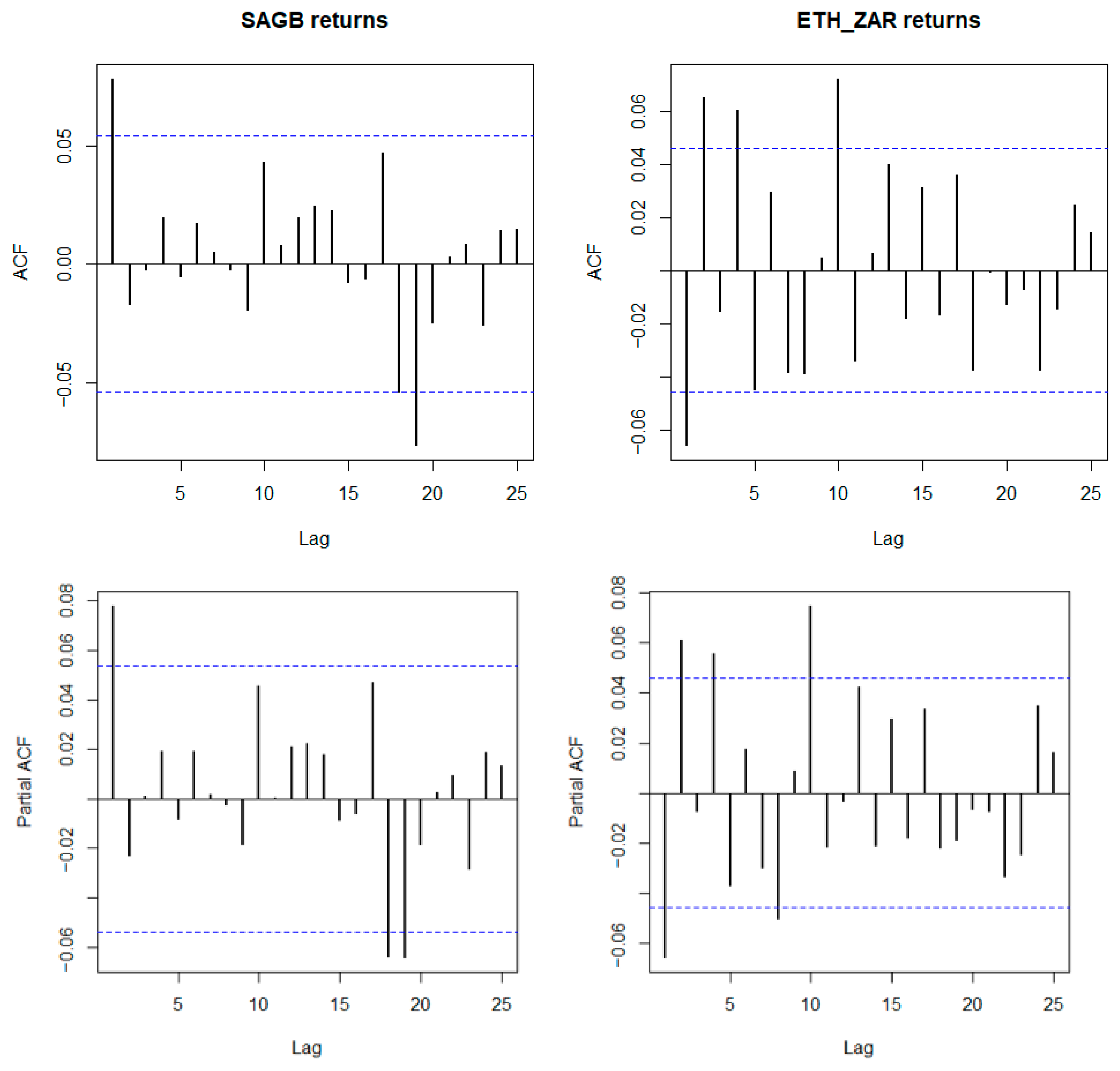
The ACF and PACF plots in Figure 2 are used to examine the serial correlation in the time series of log returns. We see some significant spikes outside confidence lines in both ACF and PACF plots, suggesting possible significant autocorrelation, which is consistent with the Ljung–Box test’s results of serial autocorrelation in returns.

3.2. Parameter Estimation

3.2.1. GP Distribution

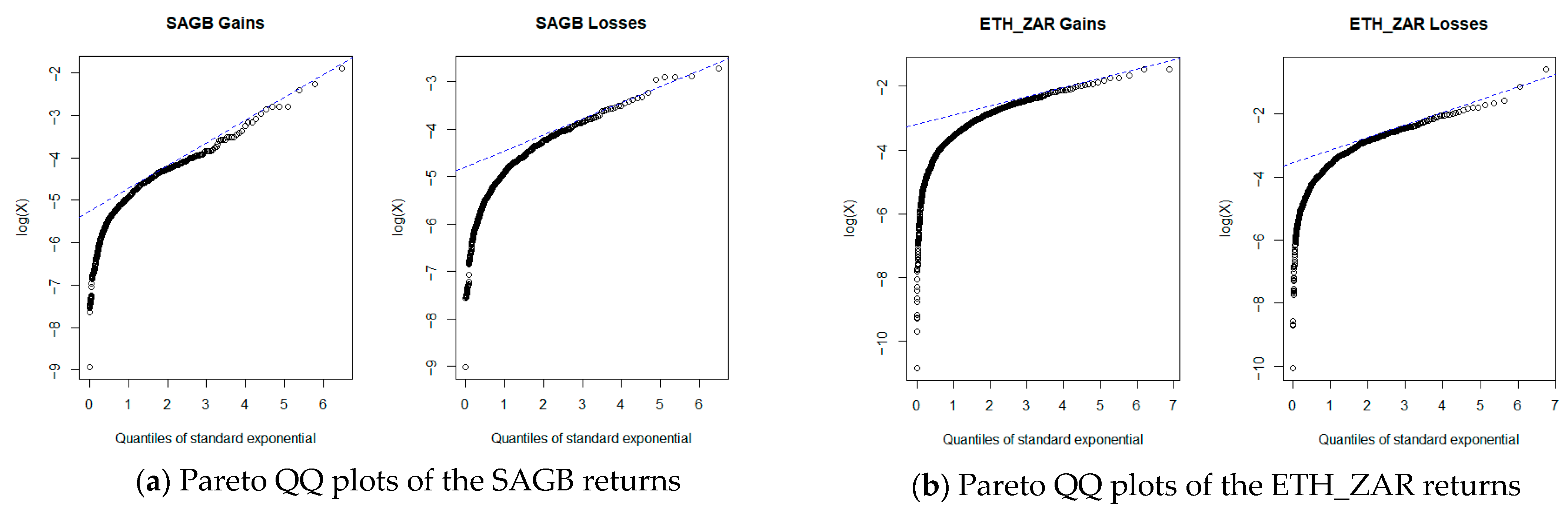
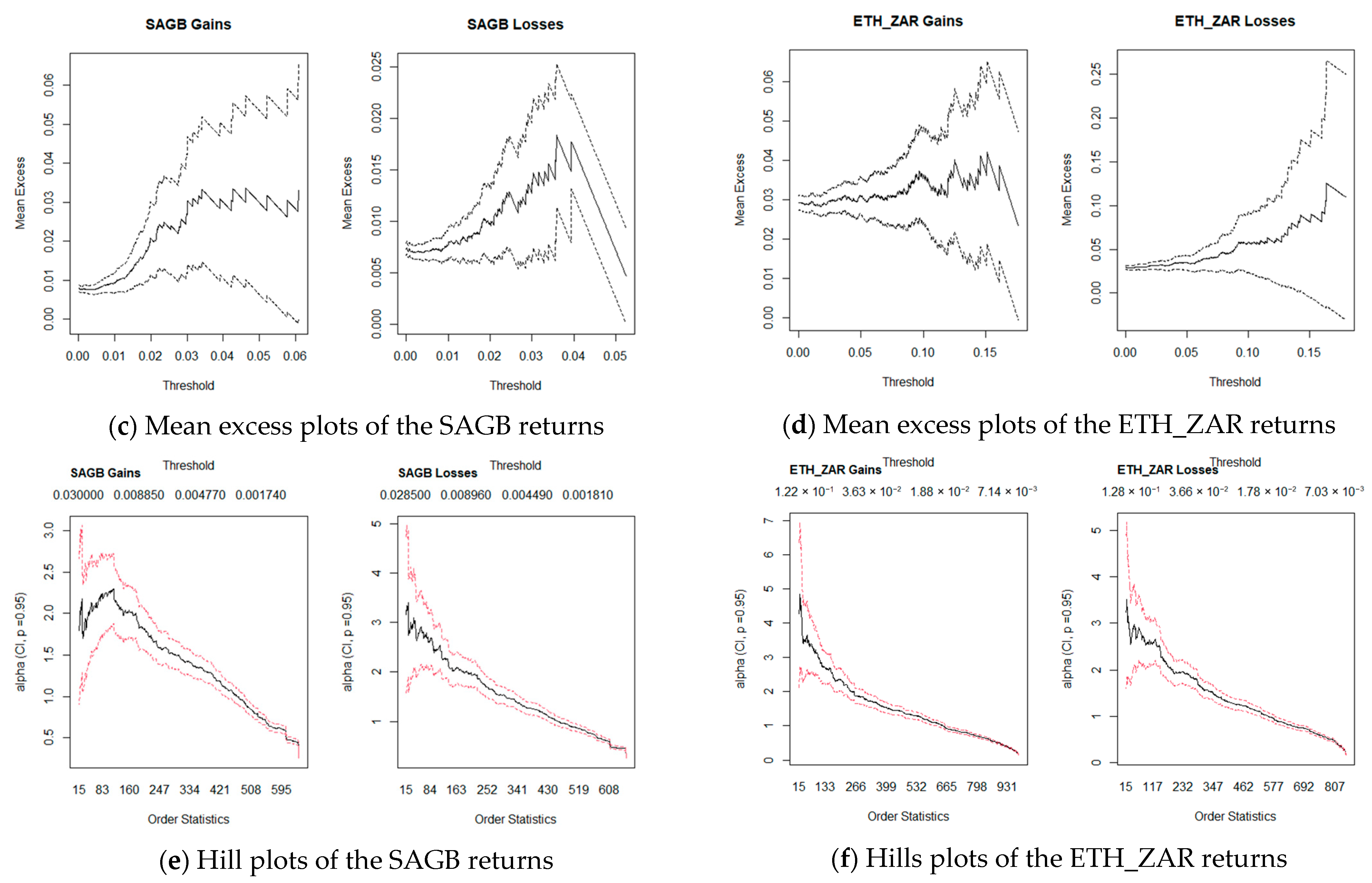
The GP distribution is fitted separately to the exceedances of gains (positive returns) and losses (negative returns) of the log-returns for both datasets. Pickands (1975) introduced the GP model as the distribution of the sample data exceeding a certain high threshold. Then, to determine appropriate thresholds for the tail modelling, different graphical diagnostics have been suggested for choosing the threshold. In this study, we employ Pareto QQ plots, mean excess plots, and Hill plots. Figure 3 presents these diagnostic plots for both the gains and losses of each dataset (i.e., SAGB, ETH_ZAR).
In this analysis, the Pareto QQ plots in Figure 3a,b are exponential, plotting l o g x , which refers to the logarithm of positive threshold exceedances x = r t μ > 0   (i.e., the losses’ sign-flipped) against standard exponential quantiles to visualize tail behaviour. Upward convexity indicates heavy tails ( ξ > 0 ). The y-axis extends to negative values primarily to display the negative intercept of the fitted tangent line (extrapolated to the origin). Data points may also be negative if x < 1 , yet the intercept heuristic proves useful for assessment, as a more negative value signals greater tail heaviness. Thresholds are selected at the stage where all three diagnostics, Pareto Q-Q plots, mean excess plots, and Hill plots jointly indicate a stable tail behaviour (i.e., it relies on joint inspection of the plots). The exponential QQ plots guide the choice by seeking the lowest threshold that produces approximate linearity in the upper tail, while the mean excess plots in Figure 3c,d identify the point above which the mean excess increases approximately linearly with a positive slope characteristic of heavy tails. Finally, the Hill plots in Figure 3e,f contribute by revealing regions of stability (i.e., near-horizontal segments) in the estimated tail index as the number of the upper order statistics varies.
From Figure 3a, we observe that the QQ plots’ tangent line crosses the y-axis of SAGB gains and losses at −5.27 and −4.8; therefore, their exponents are 0.005 and 0.008, respectively, which implies the suggested threshold for SAGB gains and losses. The mean excess graph in Figure 3c for SAGB gains shows a steady increase between 0.001 and 0.007, which is consistent with the threshold in Figure 3a. For SAGB losses, the mean excess graph in Figure 3c is steady between 0.005 and 0.01, which also confirms the threshold in Figure 3a. From Hill plots of SAGB gains and losses in Figure 3e, the appropriate thresholds were determined to be between the range (334 and 421) and the range (252 and 341) order statistics, confirming the thresholds of 0.005 and 0.008 for gains and losses, respectively. For SAGB, these diagnostics indicate that extreme behaviour in positive returns emerges at relatively lower levels than in negative returns, reflecting asymmetry in the distribution of gains and losses. Consequently, a lower threshold is selected for gains than for losses. Similarly for ETH_ZAR, in Figure 3b we observe that the QQ plots’ tangent line crosses the y-axis of ETH_ZAR gains and losses at −3.2 and −3.55, therefore, their exponents are 0.04 and 0.03, respectively, which implies the suggested threshold for ETH_ZAR gains and losses. The mean excess graph in Figure 3d for ETH_ZAR gains shows a constant increase between 0.02 and 0.045, which is consistent with the threshold in Figure 3b. For ETH_ZAR losses, the graph is constant until 0.04, which also confirms the threshold in Figure 3b. From the Hill plots of ETH_ZAR gains and losses in Figure 3f, the appropriate thresholds were determined to be between the range (266 and 399) and the range (347 and 462) order statistics, confirming the thresholds of 0.03 and 0.04.
The performance of the GP model across gains and losses for SAGB and ETH_ZAR is evaluated under five estimation methods, using a combination of GoF tests and information criteria as presented in Table 6 and Table 7, respectively. The reported GoF p-values are used primarily to assess the absolute adequacy of individual models in describing the observed extremes. In contrast, AIC and BIC are employed for relative comparison and ranking of competing distributions and estimation methods, providing a parsimonious balance between model fit and complexity. Given the large number of models, estimation techniques, and datasets considered, the analysis inherently involves multiple testing. Accordingly, inference is not based on isolated p-values, but rather on the consistency of evidence across complementary diagnostics. At both volatility levels, the ML method yields positive shape parameters for both gains and losses, indicating heavy tails in both the upper and lower ranges. LM produces negative ξ , suggesting lighter tails. Again, ML and LM are the most stable with the smallest standard errors; moreover, they deliver p-values greater than 0.05 across KS, AD, and CvM tests for gains and losses. This confirms that GP under ML and LM provides an adequate representation of the exceedance behaviour in SAGB. In contrast, LS, RLS, and WLS are unstable as reflected in very low GoF p-values (<0.01), especially for LS and RLS, indicating poor fits.
As observed from Table 6, for a low volatility level, GP model fitting using ML is the only reliable method for GP exceedance modelling of gains and losses, offering optimal AIC, BIC, stable parameters, and supporting acceptance p-values. LM is a distant second. LS, RLS, and WLS are not recommended due to numerical instability, inflated variance, and poor tail fit.
From Table 7, for high volatility gains and losses, the GP distribution fitted using ML is the best-performing method for both tails, far outperforming all others. LM ranks second, while LS, RLS, and WLS fail consistently and are not recommended.

3.2.2. GEV Distribution

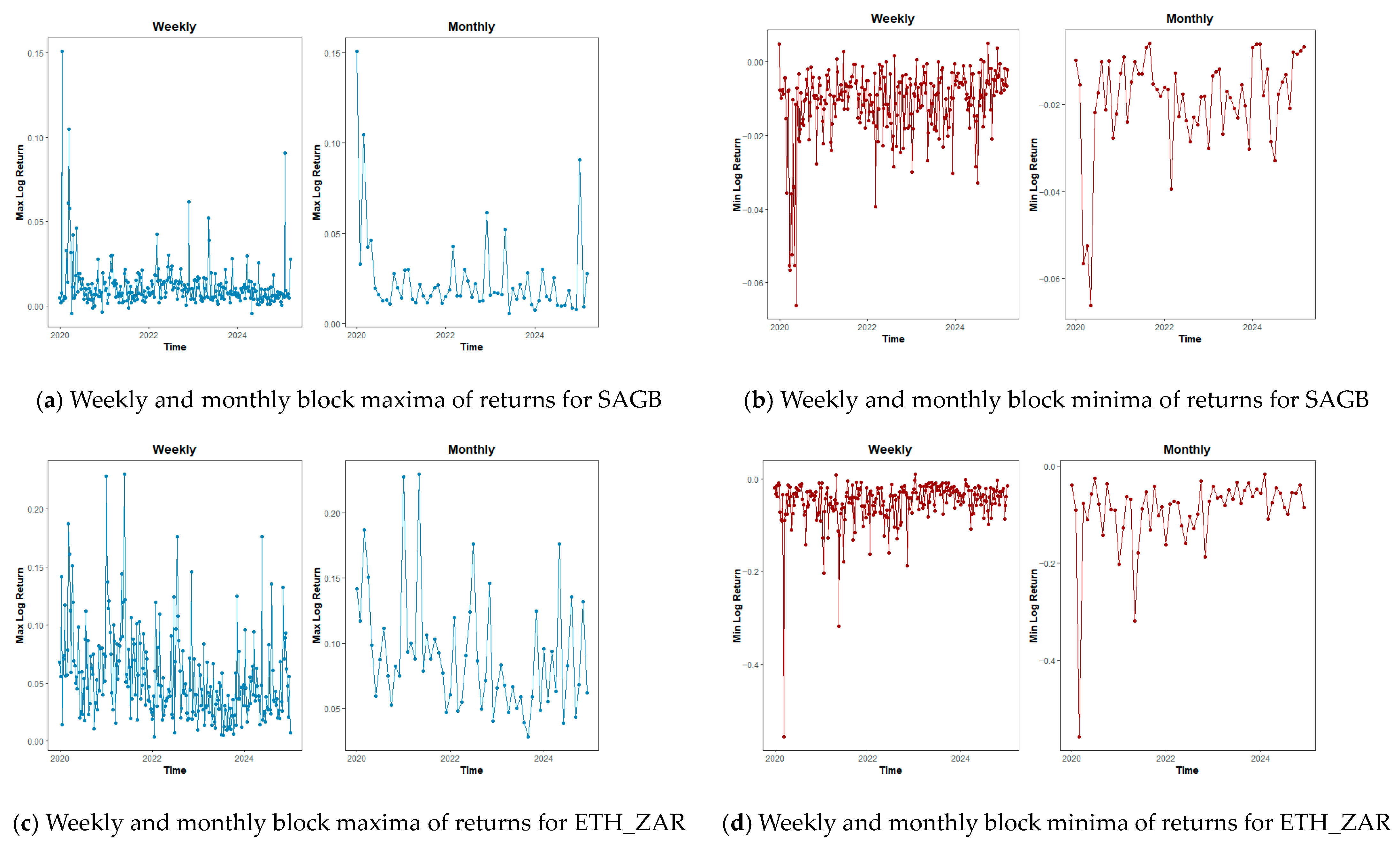
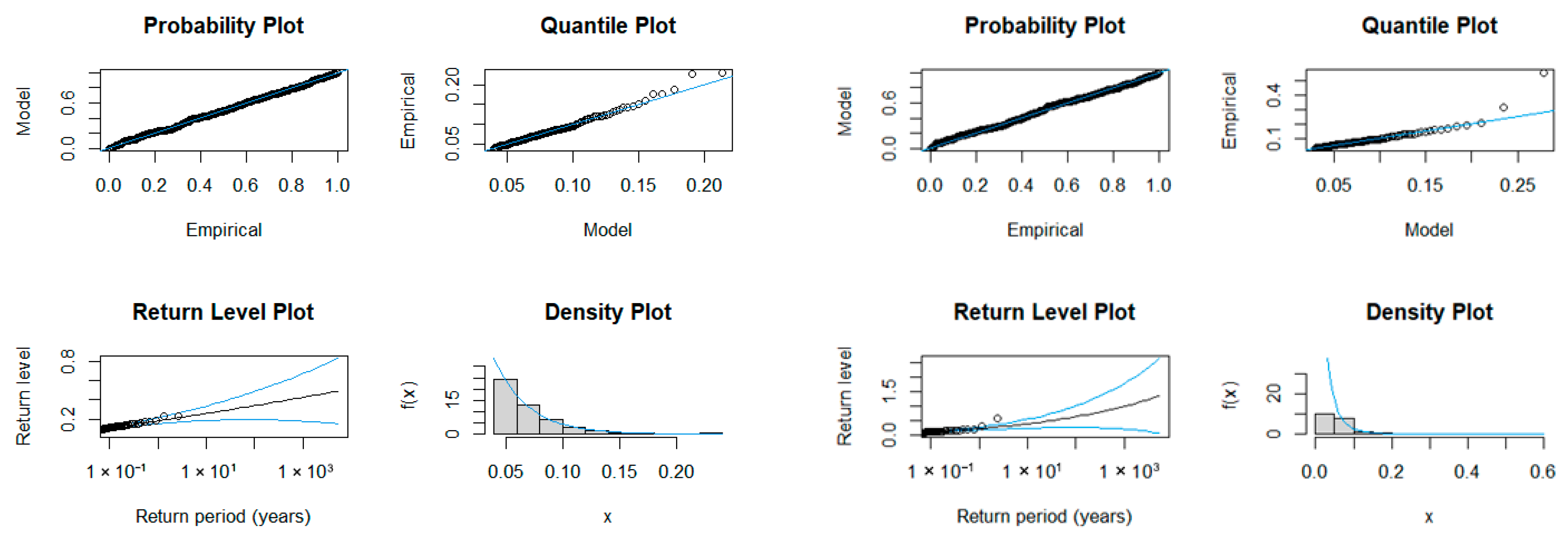
Fitting the GEV (including GLO, GUM, and REV) distributions requires dividing the data into blocks and extracting block maxima, a standard approach in EVT for modelling rare events (Chernobai et al., 2007). In this study, both the right and left tails of the return distributions are analyzed using weekly and monthly block sizes. Figure 4 presents the weekly and monthly block plots of daily returns for SAGB and ETH_ZAR.
For SAGB, alternating periods of low and high volatility are observed, with weekly blocks reaching 0.15, reflecting weeks of notable positive gains. Monthly blocks cluster around 0.0144, with higher spikes capturing extreme values over longer horizons. Conversely, ETH_ZAR displays pronounced volatility, with weekly blocks peaking near 0.23 and monthly blocks showing slightly fewer but still substantial extremes, consistent with its heavy-tailed nature.
The performance of the GEV model across weekly and monthly block maxima and minima for SAGB and ETH_ZAR is evaluated under five estimation methods, using a combination of GoF tests and information criteria, as presented in Table 8 and Table 9. The GoF tests are conducted to evaluate the model performance with a specific estimation method, then estimators are ranked from 1st (best) to 5th (worst) based on AIC and BIC values. The results show that the shape parameter across blocks is positive (except for LS, RLS, and WLS under weekly/monthly block minima), suggesting a heavy-tailed Fréchet distribution, reflecting the high probability of extreme returns in both directions. The results from the GoF tests show p-values greater than 0.05 (except for LS, RLS, and WLS under weekly/monthly block minima) for both the maxima and minima of both log returns, suggesting that the GEV model is an appropriate model for the data.
From Table 8, we see that for both weekly and monthly block maxima of low volatility SAGB, the GEV distribution fitted using the ML method demonstrates the best performance. Similarly, for SAGB minima, the ML method remains the most reliable, producing the lowest AIC and BIC values, and GoF p-values greater than 0.05, indicating that the GEV model provides an adequate fit for SAGB log returns. The LM method performs reasonably well, but with slightly weaker statistics, followed by LS, while RLS and WLS show an inadequate fit under weekly block minima.
For the ETH_ZAR returns, ML and RLS methods demonstrate strong performance in fitting the GEV distribution across weekly and monthly block maxima and minima, as shown in Table 9. The ML method, however, outperforms RLS, as indicated by slightly lower AIC and BIC values, confirming its superior fit and efficiency. Positive shape parameters confirm heavy-tailed Fréchet distributions, highlighting extreme tail risk and persistent volatility clustering. LM and LS offer lighter alternatives while RLS complements ML in high-volatility contexts.

3.2.3. GLO, GUM, and REV Distributions

A consolidated summary of the top-performing combinations of EVT models, GLO, GUM, and REV, as well as their associated estimation methods under the block-maxima framework, is presented in Table 10 (GEV is included for comparison purposes). The models and estimation procedures highlighted here, therefore, represent those combinations that simultaneously achieve GoF diagnostics, the highest information criteria, and coherent tail-shape implications consistent with the underlying return dynamics.
We observe from Table 10 that for low volatility, the GLO model with LS and LM estimators achieved the best performance in weekly minima, while GEV-ML, GEV-RLS, and some REV fits perform adequately, with no single method dominating as clearly as in the weekly case for monthly minima; differences are narrower due to fewer observations. For high volatility, GEV-ML consistently captures the tail behaviour for both weekly minima and maxima. RLS occasionally performs reasonably well, but it has a large scale and location parameters, indicating numerical instability. Findings show that as volatility increases, the preferred estimation method shifts from LS and LM estimators toward ML, because ML is more efficient and stable in heavy-tailed, high-variance settings, while LS and LM excel in low-volatility settings.

3.3. Risk Estimation

3.3.1. GP Risk Estimates

Table 11 and Table 12 present empirical risk estimates and GP-fitted VaR and VaR, using ML, LM, LS, RLS, and WLS methods, with percentage deviations (in parentheses) from empirical figures, for gains and losses in SAGB and ETH_ZAR log returns. This section assesses how alternative estimation methods influence tail-risk measures across different volatility regimes, rather than deliver operational risk forecasts. As such, the reported VaR and TVaR values should be interpreted as illustrative measures that reflect the sensitivity of tail-risk estimates to modelling and estimation choices. In this analysis, losses are transformed by multiplying negative returns by 1 prior to the analysis, so that extreme losses are treated as positive. Consequently, tail risk for losses is evaluated using upper-tail quantiles. The results show that at both volatilities, ML yields the closest theoretical VaR and TVaR to empirical levels across gains and losses, followed by LM; moreover, alignment improves at lower quantiles, with moderate underestimation at the 99.5% quantile. For SAGB, LS underestimates gains and overestimates losses. RLS and WLS (highlighted in yellow) should not be considered as they produce extreme explosions and do not apply in real life.

3.3.2. GEV Risk Estimates

Table 13, Table 14, Table 15 and Table 16 present the empirical risk estimates, the estimated risk measures for the GEV distribution using different parameter estimation methods (i.e., ML, LM, LS, RLS, WLS), and the percentage deviation in parentheses of each estimated risk measure with respect to the empirical risk estimates, for both SAGB and ETH_ZAR datasets. For both datasets, the ML method consistently yields GEV-based risk estimates that are closest to the empirical VaR and TVaR values, providing the most reliable characterization of tail behaviour. In low-volatility returns, LM generally underestimates risk, whereas LS, RLS, and WLS tend to overestimate tail risk, an effect that becomes more pronounced at higher quantiles and under monthly block size. For the high-volatility series, LS provides risk estimates that are comparatively closest to the empirical benchmarks, while RLS and WLS produce substantially inflated values. Overall, low-volatility returns yield more consistent and accurate GEV fits across estimation methods, whereas high-volatility returns expose estimator weaknesses. LS should not be considered under monthly maxima SAGB returns due to its severe overestimation of risk.

3.3.3. GEV and (GLO, GUM, REV) Risk Estimates

Table 17 and Table 18 summarize the optimal combinations of distributions (GEV, GLO, GUM, and REV) and estimation methods that provide the closest VaR and TVaR estimates to the empirical tail risks for low-volatility and high-volatility returns. These optimal models are selected based on minimum percentage deviation from empirical VaR and TVaR. The tables, therefore, highlight which distribution–estimator pairs best capture the extreme behaviour of both gains and losses across weekly and monthly block maxima and minima.
From Table 17, we observe that weekly blocks, ML-based GEV, and GLO models provide the most accurate tail risk estimates for maxima, while ML and LS perform best for minima. GUM performs well for weekly maxima under LM, but tends to slightly overestimate risk estimates. LS and WLS occasionally overestimate risk for maxima. Overall, low-volatility returns exhibit stable tail behaviour that most estimators, especially ML, capture effectively.
Finally, for high volatility returns in Table 17, weekly maxima, GEV-LS, GEV-ML, and GLO-ML all closely approximate empirical tail risks, while GUM estimators generally underestimate TVaR. For weekly minima, both GEV-ML and GEV-RLS provide accurate estimates with small deviations. ML-based GEV and GLO models perform best for monthly minima, despite larger deviations at the most extreme quantiles. High volatility leads to stronger estimator sensitivity, with ML remaining the most robust overall.

4. Discussion

Using both numerical analysis and graphical analysis, this section provides a thorough summary of all 25 combinations per dataset arising from five probability distributions and five estimation methods. While parameter estimation and risk estimation in Section 3.2 and Section 3.3, respectively, focused mostly on GEV and GP for clarity, the parameter estimation and risk estimation for GLO, GUM and REV probability models are outlined separately in Appendix A. To organize the findings clearly, the summary proceeds in two parts. The distributions and their performance are outlined across the various estimation methods, firstly, under low volatility level and secondly, under high volatility level. This highlights how each distribution behaves depending on the choice of estimator and the implications of these patterns for the suitability of different EVT models in modelling extremes and informing risk management applications. This provides insight into how the choice of estimation procedure influences the model fit, and the implications for the reliability and stability of estimators when applied to financial extremes.
The section concludes with an integrated set of insights observed across the two volatility levels, summarizing how model performance shifts between low and high volatility datasets and what these patterns imply for selecting EVT distributions and estimation methods under differing market conditions.

4.1. Low Volatility (SAGB)

4.1.1. GEV Maxima/Minima

For both weekly and monthly block minima of SAGB, the GEV distribution fitted using the ML method demonstrates the best performance, producing the lowest AIC and BIC values and GoF p-values that suggest an adequate fit. LM performs reasonably well but remains secondary to ML. For weekly maxima, GEV-ML performs best, with a shape parameter that suggests a slightly heavier upper tail than in the minima, while RLS and WLS yield weaker fits, particularly in monthly blocks. GEV-ML generated the closest VaR and TVaR values to empirical benchmarks at 95% level and 99.5% levels, but increasingly underestimates tail risk at higher quantiles.

4.1.2. GLO Maxima/Minima

LS offers superior performance in weekly minima, with LM being the closest alternative, while ML performs best in weekly maxima and monthly minima, delivering relatively low AIC and BIC values. Overall, under block maxima, GLO shows top performance in low-volatility, particularly under LS/LM for minima and ML for maxima. For weekly maxima, GLO-ML produces greater underestimation of risk at higher quantiles (−8% to −46%) but accurate VaR at the 95% level. For weekly minima, GLO-LS provides the strongest match to empirical risk estimates across all VaR and TVaR levels, making LS the most accurate estimator of downside weekly risk in SAGB.

4.1.3. GUM Maxima

For fitting the GUM model to SAGB upper tails across both weekly and monthly blocks, ML is the superior method, offering optimal fit and stability; LM is a viable secondary option, while LS, RLS, and WLS are not recommended due to poor tail capture. For weekly maxima, GUM-LM yields accurate 95% and 99% VaR but begins to slightly understate the highest quantile while substantially overestimating TVaR at the 99.5% level. This indicates that GUM struggles to capture the deepest right-tail behaviour of SAGB maxima.

4.1.4. REV Minima

ML is the optimal method for fitting the REV model to lower tails of SAGB due to its statistical efficiency and superior tail adaptation, delivering the lowest AIC, BIC, and acceptance p-values. RLS emerges as a strong alternative in monthly blocks, and LM offers a viable backup in fitting weekly blocks. WLS and RLS are not advised due to instability and poor fit. In monthly minima, REV-ML overstates VaR and TVaR, similar to the behaviour seen in GEV-ML and GLO-ML. This reflects how REV inflates tail mass under larger block sizes despite structurally lighter tails.

4.1.5. GP Gains/Losses

GP model fitting using ML is the only reliable method for GP exceedance modelling in SAGB’s gains and losses, offering optimal AIC, BIC, stable parameters, and supporting acceptance p-values. LM is a distant second. In terms of risk estimation, GP distribution performs very reliably when estimated with ML and LM. Both methods generate VaR and TVaR estimates that are tightly aligned with empirical benchmarks for both losses and gains across confidence levels, indicating stable tail behaviour.

4.2. High Volatility (ETH_ZAR)

4.2.1. GEV Maxima/Minima

For weekly minima and maxima, GEV-ML is the dominant estimator, with the positive shape parameters indicating significantly heavier tails than observed in SAGB, reflecting the extreme fluctuations. LM, LS, RLS, and WLS either fail to provide comparable fits or become unstable under high-volatility return dispersion. Thus, ML remains the clearly superior estimator for ETH_ZAR under GEV. For weekly block maxima, GEV-LS and GEV-ML both produce VaR estimates that are generally close to empirical values, with deviations ranging between 5% and 18%. ML tends to overestimate higher-order tail risk.

4.2.2. GLO Maxima/Minima

The GLO model reveals RLS as a strong contender in monthly minima, reflecting the asset’s high volatility and heavy tails. In weekly maxima, ML leads, followed by RLS, LM, and LS, while WLS provides a poor fit. For weekly minima, ML again still provides the best fit with LM and RLS being acceptable; however, LS and WLS severely underperform. For both weekly minima and maxima, GLO-ML tracks empirical VaR tightly at the 95% level (0%), with deviations widening at higher quantiles.

4.2.3. GUM Maxima

The best-performing method for high-volatility upper tails is still ML, offering an optimal balance of fit and tail accuracy. RLS emerges as a highly competitive alternative in longer-period blocks, nearly equalling ML in monthly blocks, reflecting greater method convergence in high-volatility returns. ML and RLS are best suited for heavy-tailed, volatile assets like ETH_ZAR. Across weekly maxima, ML produces the closest alignment with empirical VaR, while LM and LS show increasing negative deviations as confidence increases. In monthly maxima, GUM-ML remains the strongest performer among GUM methods, with VaR deviations ranging from −11% to 4% and TVaR overestimation ranging from 13% to 25%.

4.2.4. REV Minima

RLS emerges as a highly competitive alternative to ML, whereby it outperforms all other methods in monthly minima due to resilience to intense volatility, while LM remains viable. Across weekly and monthly block minima, WLS provides the closest theoretical risk estimates to the empirical benchmark. WLS matches ML at a 95% level with a deviation of −8.3%, but both deteriorate at more extreme levels.

4.2.5. GP Losses/Gains

For ETH_ZAR gains and losses, the GP distribution fitted using ML is the best-performing method for both tails, far outperforming all others. LM ranks second, while LS, RLS, and WLS fail consistently and are not recommended. ML remains the most reliable and stable estimator, with small deviations and modest underestimation at 0.995. LM continues to perform reasonably but systematically underestimates risk, reflecting shrinkage towards lighter tails under extreme volatility.

4.3. Combined Insights Across Volatility Levels

Examining both low-volatility and high-volatility assets reveals distinct patterns in how probability models and estimation methods perform, especially in the context of extreme value modelling and the assessment of tail risk.

4.3.1. Effect of Volatility on Parameter Stability

Across all models, parameter stability deteriorates sharply when moving from low- to high-volatility markets. In SAGB, shape, scale, and location estimates remain stable across estimation methods, with consistent tail behaviour. In contrast, ETH_ZAR exhibits large fluctuations in parameter estimates, especially for GEV, GLO, and GP, reflecting the increased uncertainty inherent in heavy-tailed distributions.

4.3.2. Performance of Block Maxima vs. PoT in Estimating Risk

Block maxima remain stable under low volatility but grow unstable under ETH_ZAR. Monthly blocks, in particular, inflate shape uncertainty, often causing GEV, GLO, and REV to overstate risk. GP exceedance modelling remains the most resilient framework across volatility levels. In SAGB, GP-ML delivers extremely accurate VaR and TVaR for both gains and losses. In ETH_ZAR, GP-ML still performs best, although deviations naturally widen at extreme quantiles.

4.3.3. Portfolio Management

For combined portfolios of low and high-volatility assets, reliance on ML-based EVT models provides consistent tail-risk quantification, enabling better diversification, margining, and capital allocation. LM, LS, RLS, and WLS should be considered supplementary, context-specific, or for non-tail-focused analysis.

5. Conclusions

This study applied the EVT framework to fit the GEV, GLO, GUM, REV, and GP probability models to the log returns of SAGB and ETH_ZAR, representing low- and high-volatility assets, respectively. By evaluating all 50 combinations of probability models and estimation methods (ML, LM, LS, RLS, and WLS) across SAGB and ETH_ZAR returns, the study systematically assessed their performance using multiple GoF tests (KS, AD, CvM) and information criteria (AIC, BIC). The findings provide practical guidance for model and estimator selection in EVT-based financial risk modelling by demonstrating how estimator performance and tail-risk measures depend on prevailing volatility conditions. Extreme value models demonstrated varying effectiveness depending on the tail characteristics and volatility of the underlying asset. In low-volatility levels, GEV, GLO, and GP provide stable parameter estimates and strong GoF. In contrast, high-volatility levels exhibit greater parameter uncertainty and more variable estimates, particularly for GEV and GLO, while lighter-tailed distributions, such as GUM, tend to underestimate extreme events. For instance, the GLO-LS approach reliably captures tail risk in low-volatility weekly minima, while in high volatility, ML remains the best estimator capable of providing accurate VaR and TVaR estimates.
The analysis also reveals that block maxima and minima of appropriate sizes are crucial for optimal model fit. In SAGB, weekly and monthly blocks under ML estimation yielded the lowest AIC and BIC and adequate GoF, while for ETH_ZAR, heavy-tailed behaviour necessitated careful selection of EVT models, with GP-ML consistently outperforming alternatives across both gains and losses. Findings further highlight that model choice and estimation method must be tailored to the volatility levels to ensure reliable tail-risk quantification. Moreover, model fit improves with increasing sample size; both AIC and BIC are lower for weekly blocks (large sample size) than for monthly blocks (smaller sample size). Future research could yield improved results for larger sample sizes. Given that most of our references tend to apply a single method for parameter estimation and possibly only fit GEV and GP, this current study is more in-depth technically and illustrates risks associated with low and high volatility implications for building sustainable and resilient financial systems. By understanding and improving the modelling of extreme market risks in both low- and high-volatility asset classes, the research supports better-informed decision-making for policymakers, financial institutions, and investors.
The findings of this study open several avenues for further investigation. First, future studies could build on the present results by integrating the GARCH-EVT framework (under frequentist and Bayesian approaches with or without Markov regime switching) to explicitly account for heteroscedasticity and volatility clustering prior to tail modelling; see, for instance, Ndlovu and Chikobvu (2024). This would allow EVT to be applied to standardized residuals, thereby complementing the unconditional analysis conducted in this study. Secondly, further research may explore extensions to multivariate and conditional EVT settings to examine tail dependence and joint extreme events across assets, which are particularly relevant for portfolio risk management. Thirdly, investigate the use of other estimation methods, other than the five discussed in this paper; for instance, the generalized MLE discussed in Moyo et al. (2025). Fourthly, implementing formal back-testing procedures for tail-risk measures such as VaR and TVaR would enable a more rigorous assessment of predictive performance and model adequacy under different market conditions. Finally, future work could investigate the impact of alternative threshold selection techniques (see, for instance, Verster & Kwaramba, 2021), as well as the use of higher-frequency data to assess the accuracy of EVT-based inference to modelling choices.

Supplementary Materials

The following supporting information can be downloaded at: https://www.mdpi.com/article/10.3390/jrfm19020096/s1. The R Code file has been provided as Supplementary Material.

Author Contributions

Conceptualization, T.J.B. and S.C.S.; methodology, T.J.B. and S.C.S.; software, T.J.B. and S.C.S.; validation, S.C.S.; formal analysis, T.J.B.; investigation, T.J.B.; resources, S.C.S.; data curation, T.J.B.; writing—original draft preparation, T.J.B.; writing—review and editing, S.C.S.; visualization, T.J.B.; supervision, S.C.S.; project administration, S.C.S.; funding acquisition, S.C.S. All authors have read and agreed to the published version of the manuscript.

Funding

This research received no external funding.

Institutional Review Board Statement

Not applicable.

Informed Consent Statement

Not applicable.

Data Availability Statement

The data used in this study was extracted from (https://www.investing.com/, accessed on 1 March 2025) and is publicly available.

Conflicts of Interest

The authors declare no conflict of interest.

Appendix A

Appendix A.1. GLO Distribution

The GLO model’s performance on weekly and monthly block maxima and minima for SAGB and ETH_ZAR is assessed using five estimation methods, evaluated through GoF tests and information criteria, as shown in Table A1 and Table A2. Across both high and low volatility levels, the shape parameter for maxima is predominantly positive under ML, indicating heavy-tailed behaviour and a higher probability of large upward extreme returns. For minima, positive ξ values are also observed in SAGB weekly and monthly minima, confirming heavy-tailed lower-tail behaviour and the likelihood of extreme negative returns. However, LS, RLS, and WLS produce negative ξ values in minima, reflecting differences in tail flexibility across estimators. The GoF results show that for both returns, weekly and monthly maxima and minima exhibit p-values greater than 0.05 across tests, indicating an adequate fit of the GLO model to the empirical block extremes. In contrast, LS, RLS, and WLS fits, especially under minima, produce p-values below 0.05, suggesting weaker support for the GLO distribution in those specific cases.
Table A1. GLO maxima and minima parameter estimates and goodness-of-fit for SAGB.
Block Size ξ -Shape β -Scale μ -LocationKS
p-Value
AD
p-Value
CvM
p-Value
AICBIC
Max-ML 0.18780.00610.00680.32030.14260.2275−1850.4 [1]−1839.6 [1]
Max-LM −0.41990.00420.00850.5690.070.7288−1725.4 [3] −1714.6 [3]
Max-LSWeekly−0.4570.00410.00830.3732<0.0010.468−1596.7 [5]−1585.9 [5]
Max-RLS −0.420.00460.00880.3917<0.0010.3326−1702.4 [4]−1691.6 [4]
Max-WLS −0.39470.00520.00830.00110.00130.0051−1834.0 [2]−1823.2 [2]
Max-ML 0.4408 0.00710.01440.91130.95260.8998−385.8 [1]−379.3 [1]
Max-LM −0.53390.00570.01680.9372<0.0010.9609−338.5 [4]−332.0 [4]
Max-LSMonthly−0.50790.00680.01730.71430.50390.504−382.3 [2]−375.8 [2]
Max-RLS −0.5510.0060.01690.8883<0.0010.9106−328.5 [5]−322.1 [5]
Max-WLS −0.44750.00780.01960.14340.12820.0906−378.2 [3]−371.7 [3]
Min-ML 0.09110.00630.00670.7210.64620.6511−1869.0 [3]−1858.2 [3]
Min-LM 0.27130.0042−0.00890.98750.98620.9876−1873.3 [2]−1862.5 [2]
Min-LSWeekly0.25210.0044−0.00910.85330.91940.8988−1874.6 [1]−1863.8 [1]
Min-RLS 2.2 × 10 6 1 × 10 6 0.2714<0.001<0.001<0.00112,087.1 [5]12,097.9 [5]
Min-WLS 0.19190.0047−0.0110.070.070.07−1856.4 [4]−1845.6 [4]
Min-ML 0.19490.00670.01360.93270.90860.9002−411.7 [1]−405.2 [1]
Min-LM 0.2880.005−0.01640.99420.97350.9778−410.9 [4]−404.5 [4]
Min-LSMonthly0.29470.0051−0.01650.99570.97370.9797−411.0 [3]−404.6 [3]
Min-RLS 0.33460.0049−0.0160.91520.91280.8768−411.6 [2]−405.1 [2]
Min-WLS 0.27310.005−0.01760.51710.42580.4683−409.7 [5]−403.2 [5]
It is observed from Table A1 that GLO fitted to SAGB for weekly maxima, ML performs best in terms of AIC and BIC with acceptable p-values, while WLS is a close alternative. LM, RLS, and LS yield negative shape parameters (Gumbel-like) and poor fits. In monthly maxima, ML dominates decisively, far ahead of LS and others. For weekly minima, LS performs best, followed by LM and ML, while RLS and WLS fail. In monthly minima, ML again provides the best fit, as supported by acceptance p-values and lower values of GoF criteria, with RLS and LS close behind, while LM and WLS lag. LS offers competitive or superior performance in weekly minima and WLS in weekly maxima, suggesting method choice in GLO may be more tail- and block-specific than in GEV, with greater sensitivity to estimation in lower tails.
Table A2. GLO maxima and minima parameter estimates and goodness-of-fit for ETH_ZAR.
Block Size ξ -Shape β -Scale μ -LocationKS
p-Value
AD
p-Value
CvM
p-Value
AICBIC
Max-ML 0.18060.02420.03680.90840.92970.8652−1062.3 [1]−1051.6 [1]
Max-LM −0.25340.0180.04750.59510.46520.4681−1051.1 [3]−1040.4 [3]
Max-LSWeekly−0.19390.01860.04950.14160.16820.1816−1041.3 [4]−1030.6 [4]
Max-RLS −0.34410.01680.04460.27130.2860.2688−1056.8 [2]−1046.1 [2]
Max-WLS −0.16770.01670.058<0.001<0.001<0.001−995.7 [5]−985.0 [5]
Max-ML 0.16870.02870.06850.99780.99930.9975−218.7 [1]−212.4 [1]
Max-LM −0.25890.02130.08060.99530.98510.9861−216.5 [3]−210.2 [3]
Max-LSMonthly−0.20270.02210.08320.89840.87450.8576−214.4 [4]−208.1 [4]
Max-RLS −0.28710.02050.07990.99230.97670.9632−217.2 [2]−210.9 [2]
Max-WLS −0.16560.020.090.08480.05680.0586−209.4 [5]−203.1 [5]
Min-ML 0.18450.02350.03150.97930.94570.9597−1077.1 [1]−1066.4 [1]
Min-LM 0.33280.0171−0.04010.77410.88240.8893−1074.3 [2]−1063.6 [2]
Min-LSWeekly0.43410.0146−0.03820.1006<0.0010.1065−798.1 [5]−787.4 [5]
Min-RLS 0.34290.0165−0.03980.56520.070.763−976.2 [3]−965.5 [3]
Min-WLS 0.49150.0125−0.0281<0.001<0.001<0.001−869.2 [4]−858.5 [4]
Min-ML 0.27010.03240.06220.98240.99650.984−197.5 [2]−191.2 [2]
Min-LM 0.41720.0242−0.07320.97540.99260.9837−196.7 [3]−190.4 [3]
Min-LSMonthly0.54030.021−0.07050.6724<0.0010.6021−30.4 [5]−24.1 [5]
Min-RLS 0.37730.025−0.07480.9930.99940.9954−198.3 [1]−192.0 [1]
Min-WLS 0.54120.0217−0.06370.0849<0.0010.062−138.9 [4]−132.6 [4]
From Table A2, we observe that the GLO model for ETH_ZAR returns, RLS emerges as a strong contender in monthly minima, reflecting the asset’s high volatility and heavy tails. ML secures the lowest AIC and BIC with supporting acceptance p-values, excelling in most weekly blocks and monthly maxima. In weekly maxima, ML leads, followed by RLS and LM, while LS and WLS provide a poor fit. For weekly minima, ML again still provides the best fit with LM and RLS acceptable, but LS and WLS severely underperform. Notably, in monthly minima, RLS outperforms ML, with near-perfect p-values, highlighting its superiority in capturing extreme lower-tail behaviour over longer time periods amid cryptocurrency volatility. Positive shape parameters confirm Fréchet-type heavy-tails in both directions. RLS is particularly valuable as a complementary or preferred alternative in longer-period lower-tail modelling for high-volatility assets like ETH_ZAR, where it better handles outliers and tail asymmetry.

Appendix A.2. GUM Distribution

The GUM model’s performance on weekly and monthly block maxima for SAGB and ETH_ZAR is evaluated using five estimation methods, assessed via GoF tests and information criteria, as presented in Table A3 and Table A4. Since the Gumbel distribution assumes a fixed shape parameter ( ξ = 0 ), tail heaviness does not vary across estimators, allowing the assessment to focus primarily on scale and location. GoF tests show a clear divide between estimation methods. For both SAGB and ETH_ZAR, ML and LM consistently yield p-values above 0.05 across KS AD and CvM tests, indicating that under these estimators the GUM distribution provides an adequate representation of the upper-tail extreme returns. This is particularly evident in ETH_ZAR, where the higher volatility level aligns well with the Gumbel tail behaviour under ML and LM. In contrast, LS, RLS, and WLS frequently produce p-values below 0.05, especially for weekly maxima SAGB, signalling a lack of support for the Gumbel distribution when using these estimators. These poorer fits reflect the sensitivity of GUM to estimation methods that do not fully capture upper-tail extremal dependence.
Table A3. GUM maxima parameter estimates for SAGB.
Block Size β -Scale μ -LocationKS
p-Value
AD
p-Value
CvM
p-Value
AICBIC
Max-ML 0.00680.00750.31870.510.13−1798.4 [1]−1791.2 [1]
Max-LM 0.00820.00740.0670.20370.2971−1785.8 [2]−1778.6 [2]
Max-LSWeekly0.01010.00630.0680.34990.44−1738.9 [3]−1731.7 [3]
Max-RLS 0.01480.0199<0.010.0006<0.01−1439.3 [4]−1432.1 [4]
Max-WLS 0.0241−0.015<0.010.00170.0002−1216.6 [5]−1209.3 [5]
Max-ML 0.01040.01650.5480.2650.408−352.2 [1]−347.9 [1]
Max-LM 0.01380.01620.1750.20930.3385−346.1 [2]−341.8 [2]
Max-LSMonthly0.01730.01460.0850.39960.4492−333.2 [4]−328.9 [4]
Max-RLS 0.00760.01560.25250.39780.3993−343.3 [3]−339.0 [3]
Max-WLS 0.0316−0.0019<0.010.3050.2441−263.2 [5]−258.9 [5]
As observed in Table A3, for fitting the GUM model to SAGB upper tails across both weekly and monthly blocks, based on the low values of AIC and BIC with acceptance p-values, ML is the best performing method, offering optimal fit and stability, LM is a viable secondary option, while LS, RLS, and WLS are not recommended due to poor tail capture.
Table A4. GUM maxima parameter estimates for ETH_ZAR.
Block Size β -Scale μ -LocationKS
p-Value
AD
p-Value
CvM
p-Value
AICBIC
Max-ML 0.02640.03930.27670.25370.2896−1051.9 [1]−1044.8 [1]
Max-LM 0.0290.03890.34570.27160.3544−1048.2 [2]−1041.1 [2]
Max-LSWeekly0.03040.03830.39420.19370.7082−1043.0 [3]−1035.8 [3]
Max-RLS 0.02230.03830.09790.0660.9176−1039.5 [4]−1032.4 [4]
Max-WLS 0.03570.0315<0.010.88260.5805−999.5 [5]−992.3 [5]
Max-ML 0.03110.07130.94870.87180.8978−218.2 [1]−214.0 [1]
Max-LM 0.03450.07060.95080.71170.5864−217.2 [3]−213.0 [3]
Max-LSMonthly0.03730.06990.78750.45580.8275−215.0 [4]−210.8 [4]
Max-RLS 0.0320.07090.97450.87220.0131−218.1 [2]−213.9 [2]
Max-WLS 0.0410.06650.31260.52210.4876−210.1 [5]−205.9 [5]
From Table A4, the best-performing and recommended method for GUM model fitting to ETH_ZAR upper tails is still ML, offering an optimal balance of fit and tail accuracy. RLS emerges as a highly competitive alternative in longer-period blocks, nearly equalling ML in monthly blocks, reflecting greater method convergence in high volatility returns. LM and LS are viable backups, but WLS underperforms compared to other methods. ML and RLS are best suited for heavy-tailed, volatile assets such as ETH_ZAR.

Appendix A.3. REV Distribution

The performance of the GEV model across weekly and monthly block minima for SAGB and ETH_ZAR is evaluated under five estimation methods, using a combination of GoF tests and information criteria, as presented in Table A5 and Table A6. Similarly to GUM, the REV distribution assumes a fixed shape parameter ( ξ = 0 ); tail heaviness does not vary across estimators. For both SAGB and ETH_ZAR, the ML, LM, and LS estimators for weekly and monthly minima show KS, AD, and CvM p-values above 0.05, confirming that the REV distribution provides an adequate fit for modelling lower-tail events for SAGB. However, the RLS estimator performs extremely poorly under weekly minima, as reflected by near-zero p-values and extremely high AIC/BIC values, indicating a breakdown in tail representation. WLS produces mixed outcomes, acceptable p-values under weekly minima but noticeably weaker support under monthly minima.
Table A5. REV minima parameter estimates for SAGB.
Block Size β -Scale μ -LocationKS
p-Value
AD
p-Value
CvM
p-Value
AICBIC
Min-ML 0.00650.00710.29910.73930.2264−1863.4 [1]−1856.2 [1]
Min-LM 0.0069−0.0070.16770.29290.7239−1861.5 [2]−1854.2 [2]
Min-LSWeekly0.0076−0.00670.15290.66510.3191−1850.4 [3]−1843.2 [3]
Min-RLS 1 × 10 6 1.196 × 10 6 <0.010.0006<0.0120,468.0 [5]20,475.2 [5]
Min-WLS 0.0086−0.005<0.010.49440.3289−1809.7 [4]−1802.5 [4]
Min-ML 0.01440.00740.79720.032580.8569−409.2 [1]−404.9 [1]
Min-LM 0.0083−0.01420.62360.69220.6443−407.8 [3]−403.5 [3]
Min-LSMonthly0.0093−0.01380.55840.85320.5076−403.6 [4]−399.3 [4]
Min-RLS 0.0073−0.01420.92420.95010.2755−409.1 [2]−404.8 [2]
Min-WLS 0.0107−0.01180.0360.87540.2347−392.1 [5]−387.9 [5]
From Table A5, ML shows to be the best performing method for fitting the REV model to the lower tails of SAGB due to its statistical efficiency and superior tail adaptation, delivering the lowest AIC, BIC, and acceptance p-values. RLS emerges as a strong alternative in monthly blocks, and LM offers a viable backup in fitting weekly blocks. WLS and RLS (weekly) are not advised due to instability and poor fit.
Table A6. REV minima parameter estimates for ETH_ZAR.
Block Size β -Scale μ KS
p-Value
AD
p-Value
CvM
p-Value
AICBIC
Min-ML 0.02610.03410.12610.13960.5619−1046.6 [1]−1039.5 [1]
Min-LM 0.0298−0.03360.05550.90970.2547−1039.2 [2]−1032.0 [2]
Min-LSWeekly0.0346−0.03110.0020.46450.8626−1012.6 [4]−1005.5 [4]
Min-RLS 0.0216−0.03310.30790.65930.2477−1030.9 [3]−1023.7 [3]
Min-WLS 0.0418−0.0192<0.010.32580.4911−929.7 [5]−922.6 [5]
Min-ML 0.03860.06770.37720.33330.7944−185.2 [1]−181.0 [1]
Min-LM 0.0473−0.06650.1520.6260.8632−181.7 [3]−177.5 [3]
Min-LSMonthly0.0576−0.0620.11360.42490.4931−171.9 [4]−167.7 [4]
Min-RLS 0.0348−0.06580.83860.28370.5112−184.2 [2]−180.0 [2]
Min-WLS 0.0733−0.038<0.010.70030.4144−145.7 [5]−141.5 [5]
As observed in Table A6, RLS emerges as a highly competitive alternative to ML in monthly minima due to resilience to intense volatility, while LM remains viable. WLS and LS are not advised due to instability and poor fit.

Appendix A.4. GLO Risk Estimates

Table A7, Table A8, Table A9 and Table A10 display empirical risk estimates alongside GLO-fitted VaR and TVaR values obtained using ML, LM, LS, RLS, and WLS estimation methods, including percentage deviations (in parentheses) from the empirical values, for block maxima and minima across SAGB and ETH_ZAR log returns. ML delivers the closest VaR and TVaR estimates to empirical estimates across maxima and minima, with overestimation that holds under varying volatility. In low-volatility SAGB, deviations range from 30 to 100% for weekly blocks. In high-volatility ETH_ZAR, ML deviates from 70 to 90% for weekly blocks, 120 to 260% for monthly blocks. LM and LS often yield negatively inflated risk estimates in minima. Then, RLS and WLS risk estimates explode for most blocks.
Table A7. Summary of the GLO risk estimates for weekly and monthly block maxima of SAGB returns and the percentage deviation with respect to the empirical risk estimates in parentheses.
VaR0.95VaR0.99VaR0.995TVaR0.95TVaR0.99TVaR0.995
Empirical0.030.07 0.100.060.110.13
Max-ML 0.03 (0%)0.05 (−28.6%)0.06 (−40.0%)0.04 (−33.3%)0.07 (−36.4%)0.07 (−46.1%)
Max-LMWeekly0.01 (−66.7%)0.01 (−85.7%)0.01 (−90.0%)0.01 (−83.3%)0.01 (−90.9%)0.01 (−92.3%)
Max-LSblocks0.10 (233.3%)0.11 (57.1%)0.11 (10.0%)0.03 (−50.0%)0.03 (−72.7%)0.03 (−76.9%)
Max-RLS 0.12 (300.0%)0.13 (85.7%)0.13 (30.0%)0.07 (16.7%)0.07 (−36.4%)0.07 (−46.1%)
Max-WLS 0.10 (233.3%)0.11 (57.1%)0.11 (10%)0.05 (−16.7%)0.05 (−54.6%)0.05 (−61.5%)
Empirical0.06 0.120.14 0.100.150.15
Max-ML 0.06 (0%)0.12 (0%)0.16 (14.3%)0.11 (10.0%)0.22 (46.7%)0.3 (100.0%)
Max-LMMonthly0.17 (183.3%)0.18 (50.0%)0.19 (35.7%)0.05 (−50%)0.06 (−60.0%)0.06 (−60.0%)
Max-LSblocks0.04 (−33.3%)0.05 (−58.3%)0.05 (−64.3%)0.04 (−60.0%)0.07 (−53.3%)0.06 (−60.0%)
Max-RLS 0.25 (316.8%)0.27 (125.0%)0.27 (92.9%)0.09 (−10.0%)0.09 (−40.0%)0.09 (−40.0%)
Max-WLS 0.24 (300%)0.26 (116.7%)0.27 (92.9%)0.09 (−10.0%)0.09 (−40.0%)0.09 (−40.0%)
The green-highlighted cells denote the top performers for that risk measure.
Table A8. Summary of the GLO risk estimates for weekly and monthly block minima of SAGB returns and the percentage deviation with respect to the empirical risk estimates in parentheses.
VaR0.95VaR0.99VaR0.995TVaR0.95TVaR0.99TVaR0.995
Empirical0.030.060.060.040.060.06
Min-ML 0.02 (−33.3%)0.04 (−33.3%)0.05 (−16.7%)0.04 (0%)0.05 (−16.7%)0.06 (0%)
Min-LMWeekly0.01 (−66.7%)0.01 (−83.3%)0.01 (−83.3%)0.01 (−75.0%)0.01 (−83.3%)0.01 (−83.3%)
Min-LSblocks0.02 (−33.3%)0.06 (0%)0.06 (0%)0.04 (0%)0.06 (0%)0.06 (0%)
Min-RLS 0.03 (0%)0.03 (−50.0%)0.03 (−50.0%)0.02 (−50.0%)0.02 (−66.7%)0.02 (−66.7%)
Min-WLS 0.04 (33.3%)0.06 (0%)0.06 (0%)0.05 (25.0%)0.07 (16.7%)0.07 (16.7%)
Empirical0.040.060.060.050.070.07
Min-ML 0.04 (0%)0.06 (0%)0.08 (33.3%)0.06 (20.0%)0.08 (14.3%)0.1 (42.9%)
Min-LMMonthly0.02 (−50.0%)0.02 (−66.7%)0.02 (−66.7%)0.01 (−80.0%)0.01 (−85.7%)0.01 (−85.7%)
Min-LSblocks0.03 (−25.0%)0.03 (−50.0%)0.03 (−50.0%)0.02 (−60.0%)0.02 (−71.4%)0.02 (−71.4%)
Min-RLS 0.11 (175.0%)0.12 (100.0%)0.12 (100.0%)0.04 (−20.0%)0.05 (−28.6%)0.05 (−28.6%)
Min-WLS 0.11 (175.0%)0.12 (100.0%)0.12 (100.0%)0.04 (−20.0%)0.05 (−28.6%)0.05 (−28.6%)
The green-highlighted cells denote the top performers for that risk measure.
Table A9. Summary of the GLO risk estimates for weekly and monthly block maxima of ETH_ZAR returns and the percentage deviation with respect to the empirical risk estimates in parentheses.
VaR0.95VaR0.99VaR0.995TVaR0.95TVaR0.99TVaR0.995
Empirical 0.12 0.180.220.220.230.23
Max-ML 0.13 (8.3%)0.21 (16.7%)0.26 (18.2%)0.18 (18.2%)0.28 (21.7%)0.33 (43.5%)
Max-LMWeekly0.05 (−58.3%)0.05 (−72.2%)0.05 (−77.3%)0.03 (−86.4%)0.03 (−87.0%)0.03 (−87.0%)
Max-LSblocks0.31 (158.3%)0.34 (88.9%)0.34 (54.5%)0.10 (−54.5%)0.11 (−52.2%)0.11 (−52.2%)
Max-RLS 0.38 (216.7%)0.41 (127.8%)0.42 (90.9%)0.13 (−40.9%)0.14 (−39.1%)0.14 (−39.1%)
Max-WLS 0.38 (216.7%)0.41 (127.8%)0.42 (90.9%)0.13 (−40.9%)0.14 (−39.1%)0.14 (−39.1%)
Empirical 0.180.23 0.230.160.220.23
Max-ML 0.18 (0%)0.27 (−17.4%)0.31 (−34.8%)0.24 (−50.0%)0.34 (−54.5%)0.39 (−69.6%)
Max-LMMonthly0.08 (55.6%)0.08 (65.2%) 0.08 (65.2%)0.22 (−37.5%)0.23 (−4.5%)0.23 (0%)
Max-LSblocks0.36 (−100.0%)0.43 (−87.0%)0.44 (−91.3%)0.08 (50.0%)0.09 (59.1%)0.09 (60.9%)
Max-RLS 0.42 (−133.3%)0.45 (−95.7%)0.45 (−95.7%)0.17 (−6.3%)0.18 (18.2%)0.18 (21.7%)
Max-WLS 0.36 (−100.0%)0.43 (−87.0%)0.44 (−91.3%)0.09 (43.8%)0.09 (59.1%)0.09 (60.9%)
The green-highlighted cells denote the top performers for that risk measure.
Table A10. Summary of the GLO risk estimates for weekly and monthly block minima of ETH_ZAR returns and the percentage deviation with respect to the empirical risk estimates in parentheses.
VaR0.95VaR0.99VaR0.995TVaR0.95TVaR0.99TVaR0.995
Empirical0.120.190.280.190.360.44
Min-ML 0.12 (0%)0.2 (5.3%)0.24 (−14.3%)0.18 (−5.3%)0.27 (−25.0%)0.32 (−27.3%)
Min-LMWeekly0.04 (−66.7%)0.04 (−78.9%)0.04 (−85.7%)0.03 (−84.2%)0.03 (−91.7%)0.03 (−93.2%)
Min-LSblocks0 (−100.0%)0.03 (−84%)0.04 (−85.7%)0.02 (−89.5%)0.04 (−88.9%)0.05 (−88.6%)
Min-RLS 0.05 (−58.3%)0.05 (−73.7%)0.05 (−82.1%)0.01 (−94.7%)0 (−100.0%)0 (−100.0%)
Min-WLS 0.05 (−58.3%)0.05 (−73.7%)0.05 (−82.1%)0.01 (−94.7%)0 (−100.0%)0 (−100.0%)
Empirical0.190.420.490.360.560.56
Min-ML 0.21 (10.5%)0.36 (−14.3%)0.44 (−10.2%)0.31 (−13.9%)0.51 (−8.9%)0.63 (12.5%)
Min-LMMonthly0.07 (−63.2%)0.07 (−83.3%)0.07 (−85.7%)0.06 (−83.3%)0.06 (−89.3%)0.06 (−89.3%)
Min-LSblocks0.67 (252.6%)0.73 (73.8%)0.74 (51.0%)0.21 (−41.7%)0.23 (−58.9%)0.23 (−58.9%)
Min-RLS 0.79 (315.8%)0.86 (104.8%)0.87 (77.6%)0.25 (−30.6%)0.28 (−50.0%)0.28 (−50.0%)
Min-WLS 0.86 (352.6%)0.40 (−4.8%)0.95 (93.9%)0.30 (−16.7%)0.32 (−42.9%)0.32 (−42.9%)
The green-highlighted cells denote the top performers for that risk measure.

Appendix A.5. GUM Risk Estimates

Table A11 and Table A12 present empirical risk estimates and GUM-estimated VaR and TVaR using ML, LM, LS, RLS, and WLS methods, with percentage deviations (in parentheses) from empirical figures, for maxima and minima in SAGB and ETH_ZAR log returns. At a low-volatility level, LM and LS provide the most accurate VaR and TVaR for weekly data, while ML gives the most stable overall performance; RLS is unreliable. For ETH_ZAR, the GUM distribution exhibits a larger bias because its light tail cannot accommodate the heavier extremes of crypto prices. ML and LM remain the most reliable, but all methods show increased deviation, especially for TVaR, which is highly sensitive to tail behaviour.
Table A11. Summary of the GUM risk estimates for weekly and monthly block maxima of SAGB returns and the percentage deviation with respect to the empirical risk estimates in parentheses.
VaR0.95VaR0.99VaR0.995TVaR0.95TVaR0.99TVaR0.995
Empirical0.030.070.100.060.110.13
Max-ML 0.03 (0%)0.04 (−42.9%)0.04 (−60.0%)0.03 (−50.0%)0.05 (−27.2%)0.05 (−40.0%)
Max-LMWeekly0.03 (0%)0.07 (0%)0.09 (−10.0%)0.06 (0%)0.12 (9.1%)0.1579 (23.1%)
Max-LSblocks0.04 (33.3%)0.05 (−28.6%)0.06 (−40.0%)0.05 (−16.7%)0.06 (−45.5%)0.07 (−46.2%)
Max-RLS 0.06 (100.0%)0.08 (14.3%)0.10 (0%)0.08 (33.3%)0.10 (−9.1%)0.11 (−15.4%)
Max-WLS 0.06 (100.0%)0.10 (42.9%)0.11 (10.0%)0.08 (33.3%)0.12 (9.1%)0.14 (7.7%)
Empirical0.060.120.140.100.150.15
Max-ML 0.04 (−16.7%)0.06 (−50.0%)0.07 (−50.0%)0.06 (−40.0%)0.07 (−53.3%)0.08 (−46.7%)
Max-LMMonthly0.06 (0%)0.13 (8.3%)0.19 (35.7%)0.12 (20.0%)0.27 (80.0%)0.39 (160.0%)
Max-LSblocks0.07 (16.7%)0.09 (−25.0%)0.11 (−21.4%)0.08 (−20.0%)0.11 (−26.7%)0.12 (−20.0%)
Max-RLS 0.04 (−33.3%)0.05 (−58.3%)0.56 (−300.0%)0.05 (−50.0%)0.06 (−60.0%)0.06 (−60.0%)
Max-WLS 0.09 (50.0%)0.14 (16.7%)0.17 (21.4%)0.12 (20.0%)0.17 (13.3%)0.20 (33.3%)
The green-highlighted cells denote the top performers for that risk measure.
Table A12. Summary of the GUM risk estimates for weekly and monthly block maxima of ETH_ZAR returns and the percentage deviation with respect to the empirical risk estimates in parentheses.
VaR0.95VaR0.99VaR0.995TVaR0.95TVaR0.99TVaR0.995
Empirical 0.120.180.220.220.230.23
Max-ML 0.12 (0%)0.17 (−5.6%)0.18 (−18.2%)0.14 (−36.4%)0.19 (−17.4%)0.21 (−8.7%)
Max-LMWeekly0.13 (8.3%)0.17 (−5.6%)0.19 (−13.6%)0.15 (−31.8%)0.20 (−13.0%)0.22 (−4.3%)
Max-LSblocks0.13 (8.3%)0.18 (0%)0.20 (−9.1%)0.16 (−27.3%)0.21 (−8.7%)0.23 (0%)
Max-RLS 0.10 (−16.7%)0.14 (−22.2%)0.16 (−27.3%)0.13 (−40.9%)0.16 (−30.4%)0.18 (−21.7%)
Max-WLS 0.14 (16.7%)0.20 (11.1%)0.22 (0%)0.17 (−22.7%)0.23 (0%)0.26 (13.0%)
Empirical0.180.230.230.160.220.23
Max-ML 0.16 (−11.1%)0.21 (−8.7%)0.24 (4.3%)0.20 (25.0%)0.25 (13.6%)0.27 (17.4%)
Max-LMMonthly0.17 (−5.6%)0.23 (0%)0.25 (8.7%)0.21 (31.3%)0.27 (22.7%)0.29 (26.1%)
Max-LSblocks0.18 (0%)0.24 (4.3%)0.27 (17.4%)0.22 (37.5%)0.28 (27.3%)0.30 (30.4%)
Max-RLS 0.17 (−5.6%)0.22 (−4.3%)0.24 (4.3%)0.20 (25.0%)0.25 (13.6%)0.27 (17.4%)
Max-WLS 0.19 (5.6%)0.26 (13.0%)0.28 (21.7%)0.23 (43.8%)0.30 (36.4%)0.32 (39.1%)
The green-highlighted cells denote the top performers for that risk measure.

Appendix A.6. REV Risk Estimates

Table A13 and Table A14 present empirical risk estimates and REV-estimated VaR and TVaR using ML, LM, LS, RLS, and WLS methods, with percentage deviations (in parentheses) from empirical figures, for block minima in SAGB and ETH_ZAR log returns. In the low-volatility SAGB series, all estimation methods show modest underestimation of empirical VaR and TVaR. Weekly blocks show consistent underestimation across methods, whereas monthly blocks reveal slight overestimation by ML. The pattern indicates that REV adequately captures the comparatively thin tails of SAGB returns, with ML generally delivering the closest alignment to empirical risk. For the high-volatility ETH_ZAR series, all estimation methods underestimate VaR and especially TVaR, often by large margins. Weekly blocks show severe underestimation across ML, LM, LS, RLS, and WLS. Monthly blocks reveal even greater instability, with occasional overestimations produced by WLS and ML, but persistent and substantial underestimation by LM, LS, and RLS.
Table A13. Summary of the REV risk estimates for weekly and monthly block minima of SAGB returns and the percentage deviation with respect to the empirical risk estimates in parentheses.
VaR0.95VaR0.99VaR0.995TVaR0.95TVaR0.99TVaR0.995
Empirical0.030.060.060.040.060.06
Min-ML 0.02 (−33.3%)0.04 (−33.3%)0.04 (−33.3%)0.03 (−25.0%)0.04 (−33.3%)0.05 (−16.7%)
Min-LMWeekly0.02 (−33.3%)0.03 (−50.0%)0.03 (−50.0%)0.03 (−25.0%)0.03 (−50.0%)0.03 (−50.0%)
Min-LSblocks0.02 (−33.3%)0.03 (−50.0%)0.03 (−50.0%)0.02 (−50.0)0.04 (−33.3%)0.04 (−33.3%)
Min-RLS 0.00 (−100.0%)0.00 (−100.0%)0.00 (−100.0%)0.00 (−100.0%)0.00 (−100.0%)0.00 (−100.0%)
Min-WLS 0.02 (−33.3%)0.03 (−33.3%)0.04 (−33.3%)0.03 (−25.0%)0.04 (−33.3%)0.0492 (−16.7%)
Empirical0.040.060.060.050.070.07
Min-ML 0.05 (25.0%)0.07 (16.7%)0.08 (33.3%)0.06 (20.0%)0.09 (28.6%)0.10 (42.9%)
Min-LMMonthly0.03 (−25.0%)0.04 (−33.3%)0.04 (−33.3%)0.02 (−60.0%)0.07 (−71.4%)0.07 (−71.4%)
Min-LSblocks0.01 (−75.0%)0.03 (−50.0%)0.04 (−33.3%)0.02 (−60.0%)0.04 (−42.9%)0.05 (−28.6%)
Min-RLS 0.01 (−75.0%)0.02 (−66.7%)0.03 (−50.0%)0.02 (−60.0%)0.03 (−57.1%)0.03 (−57.1%)
Min-WLS 0.02 (−50.0%)0.04 (−33.3%)0.05 (−16.7%)0.03 (−40.0%)0.05 (−28.6%)0.06 (−14.3%)
The green-highlighted cells denote the top performers for that risk measure.
Table A14. Summary of the REV risk estimates for weekly and monthly block minima of ETH_ZAR returns and the percentage deviation with respect to the empirical risk estimates in parentheses.
VaR0.95VaR0.99VaR0.995TVaR0.95TVaR0.99TVaR0.995
Empirical0.120.190.280.190.360.44
Min-ML 0.11 (−8.3%)0.15 (−21.1%)0.17 (−39.3%)0.14 (−26%)0.18 (−50.0%)0.20 (−54.5%)
Min-LMWeekly0.05 (−58.3%)0.10 (−47.4%)0.12 (−57.1%)0.09 (−52.6%)0.13 (−63.9%)0.15 (−65.9%)
Min-LSblocks0.07 (−41.7%)0.13 (−31.6%)0.15 (−46.4%)0.11 (−42.1%)0.1629 (−54.8%)0.19 (−56.8%)
Min-RLS 0.03 (−75.0%)0.07 (−63.2%)0.09 (−67.9%)0.05 (−73.7%)0.09 (−75.0%)0.10 (−77.3%)
Min-WLS 0.11 (−8.3%)0.17 (−10.5%)0.20 (−28.6%)0.15 (−21.1%)0.21 (−41.7%)0.24 (−45.5%)
Empirical0.190.420.490.360.560.56
Min-ML 0.18 (−5.3%)0.25 (−40.5%)0.21 (−57.1%)0.22 (−38.9%)0.28 (−50%)0.31 (−44.6%)
Min-LMMonthly0.07 (−63.2%)0.15 (−64.3%)0.18 (−63.3%)0.13 (−63.9%)0.23 (−58.9%)0.23 (−58.9%)
Min-LSblocks0.11 (−52.4%)0.20 (−52.4%)0.24 (−51.0%)0.17 (−52.8%)0.26 (−53.6%)0.30 (−46.4%)
Min-RLS 0.04 (−45.8%)0.09 (−78.6%)0.12 (−75.5%)0.07 (−80.6%)0.13 (−76.8%)0.15 (−73.2%)
Min-WLS 0.18 (−5.3%)0.30 (−28.6%)0.35 (−28.6%)0.25 (−30.6%)(−33.9%)0.42 (−25.0%)
The green-highlighted cells denote the top performers for that risk measure.

Appendix A.7. Diagnostic Plots for Best Performing Combinations

For clarity and focus, diagnostic plots (probability, Q−Q, density, and return-level plots) were produced only for the distribution−estimation combinations that performed best numerically. Although diagnostics were computed for all weekly and monthly block maxima and minima of both low volatility (SAGB) and high volatility (ETH_ZAR) return series, Figure A1 and Figure A2 present the top-performing combinations:
  • For the low volatility returns, the heavy-tailed GLO−LS performed best for weekly block minima, while the Fréchet-type GEV-ML performed best for monthly block minima.
  • For the high volatility returns, the Fréchet-type GEV−ML performed best for weekly block maxima, and the heavy-tailed GLO−RLS performed best for weekly block minima.
The diagnostic plots show that probability and Q−Q plots follow a linear trend, model densities closely track the empirical kernel densities, and return-level plots lie near the fitted curve across return periods. These graphical assessments are fully consistent with the earlier AIC, BIC, and goodness-of-fit test results.
Figure A1. Diagnostic plots for GLO−LS and GEV−ML for SAGB.
Jrfm 19 00096 g0a1
Figure A2. Diagnostic plots for GEV−ML and GLO−RLS for ETH_ZAR.
Jrfm 19 00096 g0a2
For a visual representation of the numerical analysis in Section 3.3, diagnostic plots (probability, Q−Q, density, and return-level plots) are presented for the best-performing GP distribution—estimation combinations. Although diagnostics were generated for all candidate estimation methods across GP gains and losses for both low-volatility and high-volatility returns, Figure A3 and Figure A4 display the combinations that proved to perform best from the numerical evaluation. For the low volatility returns, the GP gains were best fitted using ML, while the GP losses achieved their strongest performance under LM. For the high-volatility returns, both GP gains and GP losses were best modelled using ML, reflecting the heavy-tailed, asymmetric behaviour of digital assets and the adaptability of ML under extreme volatility. Across all displayed diagnostic plots, the probability and Q-Q plots exhibit a clear linear pattern, indicating strong agreement between the empirical and model quantiles. The model densities align closely with the empirical kernel density estimates, with only minor deviations at extreme tail observations. The return-level plots show that the empirical return levels lie near the fitted GP curves and remain largely within the corresponding confidence bands across return periods. These graphical assessments, like the ones for GEV, GLO, GUM, and REV, confirm the earlier numerical findings.
Figure A3. Diagnostic plots for GP gains (ML) and GP losses (LM) for SAGB.
Jrfm 19 00096 g0a3
Figure A4. Diagnostic plots for GP gains (ML) and GP losses (ML) for ETH_ZAR.
Jrfm 19 00096 g0a4

References

  1. Ali, S., Ara, J., & Shah, I. (2022). A comparison of different parameter estimation methods for exponentially modified Gaussian distribution. Afrika Matematika, 33(2), 58. [Google Scholar] [CrossRef]
  2. Beirlant, J., Goegebeur, Y., Segers, J., & Teugels, J. L. (2004). Statistics of extremes: Theory and applications. John Wiley & Sons. [Google Scholar] [CrossRef]
  3. Bergman, B. (1986). Estimation of Weibull parameters using a weight function. Journal of Materials Science Letters, 5(6), 611–614. [Google Scholar] [CrossRef]
  4. Bhatti, S. H., Irfan, M., Shongwe, S. C., & Raza, M. A. (2026). At-site flood frequency analysis: Evaluating some candidate probability models. Polish Journal of Environmental Studies. [Google Scholar] [CrossRef] [PubMed]
  5. Bhatti, S. H., Umar, M., Shongwe, S. C., Irfan, M., & Hassan, M. U. (2025). Searching for the most suited distribution and estimation method for at-site flood frequency analysis: A case of the Chenab River. Polish Journal of Environmental Studies, 34(1), 29–42. [Google Scholar] [CrossRef] [PubMed]
  6. Chernobai, A. S., Rachev, S. T., & Fabozzi, F. J. (2007). Operational risk: A guide to Basel II capital requirements, models, and analysis. John Wiley & Sons, Inc. [Google Scholar] [CrossRef]
  7. Chikobvu, D., & Jakata, O. (2020). Analysing extreme risk in the South African Financial Index (J580) using generalised extreme value distribution. Statistics, Optimization & Information Computing, 8(4), 915–933. [Google Scholar] [CrossRef]
  8. Chikobvu, D., & Ndlovu, T. (2023). The generalised extreme value distribution approach to comparing the riskiness of Bitcoin/US Dollar and South African Rand/US Dollar returns. Journal of Risk and Financial Management, 16(4), 253. [Google Scholar] [CrossRef]
  9. Cryer, J. D., & Chan, K. (2008). Time series analysis with applications in R. Springer. [Google Scholar] [CrossRef]
  10. Dey, S., Alzaatreh, A., & Ghosh, I. (2021). Parameter estimation methods for the Weibull-Pareto distribution. Computational and Mathematical Methods, 3(1), e1053. [Google Scholar] [CrossRef]
  11. Forbes, C., Evans, M., Hastings, N., & Peacock, B. (2011). Statistical distributions. John Wiley & Sons. [Google Scholar] [CrossRef]
  12. Gómez, Y. M., Bolfarine, H., & Gómez, H. W. (2019). Gumbel distribution with heavy tails and applications to environmental data. Mathematics and Computers in Simulation, 157, 115–129. [Google Scholar] [CrossRef]
  13. Guatelli, S., Mascialino, B., Pfeiffer, A., Pia, M. G., Ribon, A., & Viarengo, P. (2004, October 16–22). Application of statistical methods for the comparison of data distributions. IEEE Symposium Conference Record Nuclear Science 2004 (Vol. 4, pp. 2086–2090), Rome, Italy. [Google Scholar] [CrossRef]
  14. Hosking, J. R. (1990). L-moments: Analysis and estimation of distributions using linear combinations of order statistics. Journal of the Royal Statistical Society Series B: Statistical Methodology, 52(1), 105–124. [Google Scholar] [CrossRef]
  15. Jakata, O., & Chikobvu, D. (2019). Modelling extreme risk of the South African Financial Index (J580) using the generalised Pareto distribution. Journal of Economic and Financial Sciences, 12(1), a407. [Google Scholar] [CrossRef][Green Version]
  16. Klugman, S. A., Panjer, H. H., & Willmot, G. E. (2019). Loss models: From data to decisions (5th ed.). Wiley. [Google Scholar]
  17. Kotz, S., & Nadarajah, S. (2000). Extreme value distributions: Theory and applications. World Scientific. [Google Scholar] [CrossRef]
  18. Liu, X., Zang, W., & Zhou, Y. (2024). A method for estimating excess rainfall intensity (ERI) of combined sewer overflow (CSO) based on peak over threshold (POT) sampling and the generalized pareto distribution (GPD). Water Resources Management, 38(3), 1045–1060. [Google Scholar] [CrossRef]
  19. Mosala, R., Rachuene, K. A., & Shongwe, S. C. (2024). Most suitable threshold method for extremes in financial data with different volatility levels. ITM Web of Conferences, 67, 01033. [Google Scholar] [CrossRef]
  20. Moyo, E., Makatjane, K., & Sivasamy, R. (2025). An improved volatility forecasting with GMLE-based MS-GARCH models: Evidence from BWP/USD, ZAR/USD, and BTC/USD. Journal of Statistics Applications & Probability, 14(6), 343–360. [Google Scholar] [CrossRef]
  21. Ndlovu, T., & Chikobvu, D. (2023). The generalised Pareto distribution model approach to comparing extreme risk in the exchange rate risk of Bitcoin/US Dollar and South African Rand/US Dollar returns. Risks, 11(6), 100. [Google Scholar] [CrossRef]
  22. Ndlovu, T., & Chikobvu, D. (2024). Estimating extreme value at risk using Bayesian markov regime switching GARCH-EVT family models. In Cryptocurrencies-financial technologies of the future. IntechOpen. [Google Scholar] [CrossRef]
  23. Pickands, J., III. (1975). Statistical inference using extreme order statistics. The Annals of Statistics, 3(1), 119–131. [Google Scholar] [CrossRef]
  24. Pisarenko, V. F., & Sornette, D. (2003). Characterization of the frequency of extreme earthquake events by the generalized Pareto distribution. Pure and Applied Geophysics, 160(12), 2343–2364. [Google Scholar] [CrossRef]
  25. Sáez, P. B., & Rittmann, B. E. (1992). Model-parameter estimation using least squares. Water Research, 26(6), 789–796. [Google Scholar] [CrossRef]
  26. Stephenson, A. (2022). Package ‘evd’: Functions for extreme value distributions. R package version 2.3-6.1. Available online: https://cran.r-project.org/web/packages/evd/evd.pdf (accessed on 1 March 2025).
  27. Sweeting, P. (2011). Financial enterprise risk management. Cambridge University Press. Available online: www.cambridge.org/9780521111645 (accessed on 1 March 2025).
  28. Verster, A., & Kwaramba, N. (2021). A different way of choosing a threshold in a bivariate extreme value study. Statistics, Optimization & Information Computing, 10(2), 505–518. [Google Scholar] [CrossRef]
  29. Wu, J. W., Hung, W. L., & Tsai, C. H. (2004). Estimation of parameters of the Gompertz distribution using the least squares method. Applied Mathematics and Computation, 158(1), 133–147. [Google Scholar] [CrossRef]
Figure 1. Plot of SAGB and ETH_ZAR returns, respectively.
Jrfm 19 00096 g001
Figure 2. ACF and PACF of the SAGB and ETH_ZAR returns.
Jrfm 19 00096 g002
Figure 3. Pareto QQ, mean excess, and Hill plots of the gains and losses of SAGB and ETH_ZAR.
Jrfm 19 00096 g003aJrfm 19 00096 g003b
Figure 4. Weekly and monthly blocks plot of returns for SAGB and ETH_ZAR.
Jrfm 19 00096 g004
Table 1. Descriptive statistics of the share price from 1 January 2020 to 31 December 2024.
SAGB PricesETH_ZAR Prices
Observations13211826
Min6.57 (20 January 2021)1797.70 (2 January 2020)
Max11.22 (24 March 2020)75,884.30 (11 March 2024)
Median8.2832,898.50
Mean8.2933,427.52
1st Quartile7.6120,912.20
3rd Quartile8.9346,336.65
Standard deviation0.8219,357.19
Variance0.67374,700,900.00
Range4.6574,086.60
Coefficient of Variation0.09890.5791
Table 2. Descriptive statistics of the log returns from 1 January 2020, to 31 December 2024.
SAGBETH_ZAR
ReturnsGainsLossesReturnsGainsLosses
Observations13206436771826976850
Min−0.06620.00010.0000−0.55790.00000.0000
Max0.15090.15090.06620.23000.23000.5579
Median−0.00540.00540.00510.00190.02020.0190
Mean0.00530.01010.00730.00190.02920.0294
1st Quartile−0.00540.00280.0024−0.01750.00860.0083
3rd Quartile0.15090.01010.00960.02230.03940.0384
Std deviation0.01220.01090.00780.04380.02980.0356
Kurtosis26.954561.149413.379718.23277.267563.2335
Skewness2.23396.31302.9062−1.26322.20095.5721
Coefficient of Variation2.30191.07921.068523.05261.02051.2109
Table 3. Probability density and cumulative distribution functions of the probability distributions.
Distributions f x F x
GEV e 1 + ξ x μ σ 1 ξ   1 σ 1 + ξ x μ σ 1 ξ + 1 < x μ σ ξ i f   ξ < 0 μ σ ξ x < i f   ξ > 0 e e x μ σ 1 σ e x μ σ x < i f   ξ = 0 e 1 + ξ x μ σ 1 ξ < x μ σ ξ i f   ξ < 0 μ σ ξ x < i f   ξ > 0 e e x μ σ < x < i f   ξ = 0
GLO β e x μ σ σ 1 + e x μ β β + 1 1 + e x μ σ β
GUM 1 σ e x μ σ + e x μ σ e e x μ σ
REV 1 σ e x μ σ + e x μ σ 1 e e x μ σ
GP 1 σ 1 + ξ x μ σ 1 ξ + 1 i f   ξ 0   1 σ e x μ σ i f   ξ = 0 1 1 + ξ x μ σ 1 ξ i f   ξ 0   1 e x μ σ   i f   ξ = 0
Table 4. Test for unit root and stationarity.
SAGB ReturnsETH_ZAR Returns
Unit Root TestStatisticp-ValueStatisticp-Value
ADF Test−10.3740.01−11.3190.01
PP Test−1209.10.01−20400.01
KPSS Test0.03020.10.12570.0875
Table 5. Test for normality, autocorrelation, and heteroscedasticity.
SAGB ReturnsETH_ZAR Returns
TestStatisticp-ValueStatisticp-Value
Jarque–Bera41,058<0.00125,778<0.001
Ljung–Box8.050.00468.03180.0046
ARCH LM26.9150.007954.266<0.001
Table 6. GP gains and losses parameter estimates for SAGB.
k -
Threshold
Excee
Dances
ξ -Shape S e ( ξ ) β -Scale S e ( β )KS
p-Value
AD
p-Value
CvM
p-Value
AICBIC
Gains-ML 0.29490.06280.00540.00040.66780.29770.5081−2715.7 [1]−2708.0 [1]
Gains-LM −0.34450.01960.0050.00020.43350.070.441−2173.5 [2]−2165.8 [2]
Gains-LS0.0053470.101642.71830.00690.1045<0.010.74660.6455−3.6 [3]4.1 [3]
Gains-RLS 0.1933307.88030.44110.7736<0.010.03380.11182.4 [5]10.1 [5]
Gains-WLS 0.110231.81420.02940.0793<0.010.47140.4122−2.5 [4]5.2 [4]
Losses-ML 0.17340.07660.0060.00060.21720.27110.3700−1745.0 [1]−1738.2 [1]
Losses-LM −0.18640.04310.00590.00040.91660.070.9613−1699.9 [2]−1693.1 [2]
Losses-LS0.0082230.1063143.35890.01110.5611<0.010.88120.7447−3.1 [3]3.7 [3]
Losses-RLS 0.1975288.38010.48521.1585<0.010.0396<0.012.6 [5]9.4 [5]
Losses-WLS 0.104974.52730.00890.29<0.010.74240.6419−3.1 [3]3.7 [3]
Table 7. GP gains and losses parameter estimates for ETH_ZAR.
k -
Threshold
Excee
Dances
ξ -Shape S e ( ξ ) β -Scale S e ( β )KS
p-Value
AD
p-Value
CvM
p-Value
AICBIC
Gains-ML 0.0210.06490.02990.00270.070.43460.35−1190.9 [1]−1183.9 [1]
Gains-LM −0.05030.05810.02840.00180.99220.070.9936−935.6 [2]−928.7 [2]
Gains-LS0.042400.114636.66720.05530.71630.070.6770.58570.8 [3]7.7 [3]
Gains-RLS 0.5808661.0952.587913.2335<0.010.05090.11966.0 [5]12.9 [5]
Gains-WLS 0.162232.09570.21930.6384<0.010.54930.47691.7 [4]8.6 [4]
Losses-ML 0.16630.05980.02640.00220.73210.31820.5002−1427.5 [1]−1420.2 [1]
Losses-LM −0.21260.0350.02430.00130.59280.070.7865−1131.1 [2]−1123.8 [2]
Losses-LS0.032900.113640.95130.04140.59860.070.9250.7734−0.7 [3]6.6 [3]
Losses-RLS 0.5197342.1272.26695.1354<0.010.02750.1095.7 [5]13.0 [5]
Losses-WLS 0.143831.46250.170.4687<0.010.3430.310.9 [4]8.2 [4]
Table 8. GEV maxima and minima parameter estimates and goodness-of-fit for SAGB.
Block Size ξ -Shape β -Scale μ -LocationKS
p-Value
AD
p-Value
CvM
p-Value
AICBIC
Max-ML 0.18780.00610.00680.32030.14260.2275−1850.4 [1]−1839.6 [1]
Max-LM 0.35620.00520.00630.40770.08540.5855−1699.1 [2]−1688.3 [2]
Max-LSWeekly0.5460.00390.00620.06310.00050.3751−1460.4 [5]−1449.5 [5]
Max-RLS 0.13240.00570.00720.080.06000.08−1497.0 [3]−1486.2 [3]
Max-WLS 0.10000.01480.01860.080.06000.08−1497.0 [3]−1486.2 [3]
Max-ML 0.44080.00710.01440.91130.95260.8998−385.8 [1]−379.3 [1]
Max-LM 0.49820.00660.01410.91210.61330.6136−384.3 [2]−377.9 [2]
Max-LSMonthly0.660.00650.01360.62190.24960.7351−372.3 [4]−365.9 [4]
Max-RLS 0.60070.00680.01370.65820.87150.6022−382.4 [3]−376.0 [3]
Max-WLS 0.66670.00630.01350.51820.55620.0489−369.6 [5]−363.1 [5]
Min-ML 0.09110.00630.00670.7210.64620.6511−1869.0 [1]−1858.2 [1]
Min-LM −0.83270.0097−0.01170.18250.060.2105−1324.4 [2]−1313.6 [2]
Min-LSWeekly−0.14190.00850.00660.02180.060.5382−849.3 [3]−838.5 [3]
Min-RLS −0.05140.00570.007<0.010.0006<0.013704.3 [4]3715.1 [4]
Min-WLS −0.13660.00840.008<0.010.0006<0.0112,324.4 [5]12,335.2 [5]
Min-ML 0.19490.00670.01360.93270.90860.9002−411.7 [1]−405.2 [1]
Min-LM −0.87080.0116−0.01970.71090.00060.9303−257.3 [4]−250.8 [4]
Min-LSMonthly0.0390.00730.01390.42470.00060.2612−149.4 [5]−143.0 [5]
Min-RLS 0.11730.00660.01480.86250.40960.8444−411.3 [2]−404.9 [2]
Min-WLS −0.30630.0064−0.0130.5360.059130.3182−410.7 [3]−404.3 [3]
Table 9. GEV maxima and minima parameter estimates and goodness-of-fit for ETH_ZAR.
Block Size ξ -Shape β -Scale μ -LocationKS
p-Value
AD
p-Value
CvM
p-Value
AICBIC
Max-ML 0.18060.02420.03680.90840.92970.8652−1062.3 [1]−1051.6 [1]
Max-LM 0.12640.02540.03740.93240.3290.9279−1060.8 [4]−1050.1 [4]
Max-LSWeekly0.11830.02620.03750.87290.69220.4998−1059.5 [5]−1048.8 [5]
Max-RLS 0.21370.02380.03620.81790.46590.0514−1061.9 [2]−1051.2 [2]
Max-WLS 0.1380.02450.03810.71990.55550.4031−1061.4 [3]−1050.7 [3]
Max-ML 0.16870.02870.06850.99780.99930.9975−218.7 [1]−212.4 [1]
Max-LM 0.13450.030.06860.99980.45770.3126−218.5 [2]−212.2 [2]
Max-LSMonthly0.14580.03170.06860.9990.99070.349−217.8 [4]−211.5 [4]
Max-RLS 0.17610.03050.06820.99970.86660.7492−218.3 [3]−212.0 [3]
Max-WLS 0.12210.03210.06930.9970.75020.9352−217.6 [5]−211.4 [5]
Min-ML 0.18450.02350.03150.97930.94570.9597−1077.1 [1]−1066.4 [1]
Min-LM −0.97630.0414−0.05130.24460.07600.3672−657.4 [4]−646.7 [4]
Min-LSWeekly−0.5030.0144−0.03090.20.07860.2423168.4 [5]179.1 [5]
Min-RLS 0.2080.02240.03110.93190.31730.7501−1076.7 [2]−1066.0 [2]
Min-WLS −0.08580.04590.03950.02520.36960.2532−1039.8 [3]−1029.1 [3]
Min-ML 0.27010.03240.06220.98240.99650.984−197.5 [1]−191.2 [1]
Min-LM −1.18790.0634−0.08880.49940.0060.928848.7 [4]55.0 [4]
Min-LSMonthly−0.72270.0185−0.06020.09600.0060.03087312.2 [5]318.5 [5]
Min-RLS 0.00150.0320.06420.96030.96030.09154−197.0 [2]−190.7 [2]
Min-WLS −0.13130.07090.07090.14470.0080.551319.9 [3]26.2 [3]
Table 10. Summary of the top-performing combination from the block maxima approach.
SAGBBlock
Size
ξ -Shape β -Scale μ -LocationKS
p-Value
AD
p-Value
CvM
p-Value
AICBIC
GLO-LSWeekly Min0.25210.0044−0.00910.85330.91940.8988−1874.6−1863.8
GLO-LMWeekly Min0.27130.0042−0.00890.98750.98620.9876−1873.3−1862.5
GEV-MLWeekly Min0.09110.00630.00670.7210.64620.6511−1869.0−1858.2
GLO-MLWeekly Min0.09110.00630.00670.7210.64620.6511−1869.0−1858.2
REV-MLWeekly Min-0.00650.00710.29910.73930.2264−1863.4−1856.2
REV-LMWeekly Min-0.0069−0.0070.16770.29290.7239−1861.5−1854.2
GLO-WLSWeekly Min0.19190.0047−0.0110.070.070.07−1856.4−1845.6
REV-LSWeekly Min-0.0076−0.00670.15290.66510.3191−1850.4−1843.2
GEV-MLWeekly Max0.18780.00610.00680.32030.14260.2275−1850.4−1839.6
GLO-MLWeekly Max0.18780.00610.00680.32030.14260.2275−1850.4−1839.6
GEV-MLMonthly Min0.19490.00670.01360.93270.90860.9002−411.7−405.2
GEV-WLSMonthly Min−0.30630.0064−0.01300.5360.059130.3182−410.7−404.3
GEV-RLSMonthly Min−0.21810.0070−0.01340.86250.40960.8444−411.3−404.9
REV-MLMonthly Min-0.01440.00740.79720.032580.8569−409.2−404.9
REV-MLMonthly Min-0.01440.00740.92420.95010.2755−409.1−404.8
REV-LMMonthly Min-0.0083−0.01420.62360.69220.6443−407.8−403.5
ETH_ZAR
GEV-MLWeekly Min0.18450.02350.03150.97930.94570.9597−1077.1−1066.4
GLO-RLSWeekly Min−0.19762.2999−3.14280.93190.31730.7501−1076.7−1066.0
GEV-MLWeekly Max0.18060.02420.03680.90840.92970.8652−1062.3−1051.6
GLO-MLWeekly Max0.18060.02420.03680.90840.92970.8652−1062.3−1051.6
Table 11. Summary of the GP risk estimates for gains and losses of SAGB returns and the percentage deviation with respect to the empirical risk estimates in parentheses.
VaR0.95VaR0.99VaR0.995TVaR0.95TVaR0.99TVaR0.995
Empirical0.030.060.090.060.100.13
Gains-ML0.03 (0%)0.06 (0%)0.07 (−22.2%)0.05 (−16.7%)0.09 (−10.0%)0.11 (−15.4%)
Gains-LM0.03 (0%)0.06 (0%)0.07 (−22.2%)0.05 (−16.7%)0.09 (−10.0%)0.11 (−15.4%)
Gains-LS0.03 (0%)0.05 (−16.7%)0.05 (−44.4%)0.04 (−33.3%)0.06 (−40.0%)0.07 (−46.2%)
Gains-RLS1.80 (5900.0%)3.28 (5366.7%)4.08 (4433.3%)2.77 (4516.7%)4.61 (4510.0%)7.39 (5584.6%)
Gains-WLS0.11 (266.7%)0.18 (200.0%)0.22 (144.4%)0.16 (166.7%)0.24 (140.0%)0.28 (115.4%)
Empirical0.030.060.060.040.060.06
Losses-ML0.03 (0%)0.05 (−16.7%)0.01 (−83.3%)0.04 (0%)0.07 (16.7%)0.08 (33.3%)
Losses-LM0.03 (0%)0.05 (−16.7%) 0.06 (0%)0.04 (0%)0.06 (0%)0.08 (33.3%)
Losses-LS0.05 (66.7%)0.07 (16.7%)0.09 (50.0%)0.06 (50.0%)0.09 (50.0%)0.11 (83.3%)
Losses-RLS1.99 (6533.3%)3.65 (5983.3%)4.60 (7566.7%)3.08 (7600.0%)5.16 (8500.0%)6.27 (10,350.0%)
Losses-WLS0.51 (1600.0%)1.02 (1600.0%)1.32 (2100.0%)0.86 (2050.0%)1.58 (2533.3%)2.01 (3250.0%)
The green-highlighted cells denote the top performers for that risk measure. The yellow-highlighted cells denote the worst performers for that risk measure (due to at least one of the measures at 1 − α level being greater than or equal to 1).
Table 12. Summary of the GP risk estimates for gains and losses of ETH_ZAR returns and the percentage deviation with respect to the empirical risk estimates in parentheses.
VaR0.95VaR0.99VaR0.995TVaR0.95TVaR0.99TVaR0.995
Empirical0.130.180.220.170.220.44
Gains-ML0.13 (0%)0.18 (0%)0.21 (−4.5%)0.16 (−5.9%)0.22 (0%)0.24 (−45.5%)
Gains-LM0.12 (−7.7%)0.16 (−11.1%)0.17 (−22.7%)0.14 (−17.6%)0.18 (−18.2%)0.19 (−56.8%)
Gains-LS0.24 (84.6%)0.38 (111.1%)0.44 (100.0%)0.33 (94.1%)0.48 (118.2%)0.56 (27.3%)
Gains-RLS20.97 (16,030.8%)60.23 (33,311.1%)92.27 (41,840.1%)56.29 (33,011.8%)146.71 (66,586.4%)226.80 (51,445.5%)
Gains-WLS0.89 (1600.0%)1.54 (1600.0%)1.88 (2100.0%)1.31 (2050%)2.10 (2533.3%)2.50 (3250.0%)
Empirical0.130.190.270.190.360.44
Losses-ML0.13 (0%)0.21 (10.5%)0.25 (−7.4%)0.18 (−5.3%)0.28 (−22.2%)0.33 (−25.0%)
Losses-LM0.08 (−38.5%)0.10 (−47.4%)0.11 (−59.3%)0.09 (−52.6%)0.11 (−69.4%)0.11 (−75.0%)
Losses-LS0.18 (38.5%)0.28 (47.4%)0.33 (22.2%)0.24 (26.3%)0.36 (0%)0.42 (−4.5%)
Losses-RLS16.36 (12,484.6%)43.43 (22,757.9%)64.14 (23,655.6%)38.54 (20,184.2%)95.67 (26,475.0%)136.90 (310,113.6%)
Losses-WLS0.67 (415.4%)1.14 (500.0%)1.38 (411.1%)0.97 (410.5%)1.53 (325.0%)1.806 (310.5%)
The green-highlighted cells denote the top performers for that risk measure. The yellow-highlighted cells denote the worst performers for that risk measure (due to at least one of the measures at 1 − α level being greater than or equal to 1).
Table 13. Summary of the GEV risk estimates for weekly and monthly block maxima of SAGB returns and the percentage deviation with respect to the empirical risk estimates in parentheses.
VaR0.95VaR0.99VaR0.995TVaR0.95TVaR0.99TVaR0.995
Empirical0.030.070.100.060.110.13
Max-ML 0.03 (0%)0.05 (−28.6%)0.06 (−40.0%)0.04 (−33.3%)0.07 (36.4%)0.07 (−46.2%)
Max-LMWeekly0.02 (−33.3%)0.02 (−71.4%)0.02 (−80.0%)0.02 (−66.7%)0.02 (−81.8%)0.02 (−84.6%)
Max-LSblocks0.04 (33.3%)0.09 (28.6%)0.13 (30.0%)0.08 (33.3%)0.20 (81.8%)0.30 (130.8%)
Max-RLS 0.13 (333.3%)0.13 (85.7%)0.13 (30.0%)0.13 (116.7%)0.13 (18.2%)0.13 (0%)
Max-WLS 0.08 (166.7%)0.13 (85.7%)0.02 (−80.0%)0.12 (100.0%)0.18 (63.6%)0.23 (76.9%)
Empirical0.060.120.140.100.150.15
Max-ML 0.06 (0%)0.12 (0%)0.16 (14.0%)0.11 (10.0%)0.22 (46.7%)0.30 (100.00%)
Max-LMMonthly0.02 (−66.7%)0.03 (−74.5%)0.03 (−79.4%)0.03 (−70.0%)0.03 (−80.0%)0.03 (−80.0%)
Max-LSblocks0.07 (17.0%)0.21 (75.0%)0.33 (136.3%)0.21 (110.0%)0.60 (300.0%)1.03 (587.3%)
Max-RLS 0.62 (933.3%)0.64 (433.3%)0.65 (364.0%)0.63 (530.0%)0.65 (333.3%)0.66 (340.3%)
Max-WLS 0.04 (−33.3%)0.06 (−50.0%)0.07 (−50.0%)0.05 (−50.0%)0.08 (−46.8%)0.09 (−40.3%)
The green-highlighted cells denote the top performers for that risk measure. The yellow-highlighted cells denote the worst performers for that risk measure (due to at least one of the measures at 1 − α level being greater than or equal to 1).
Table 14. Summary of the GEV risk estimates for weekly and monthly block minima of SAGB returns and the percentage deviation with respect to the empirical risk estimates in parentheses.
VaR0.95VaR0.99VaR0.995TVaR0.95TVaR0.99TVaR0.995
Empirical0.030.060.060.040.060.06
Min-ML 0.02 (−33.3%)0.04 (−33.3%)0.05 (−16.7%)0.04 (0%)0.05 (−16.7%)0.06 (0%)
Min-LMWeekly0.02 (−33.3%)0.03 (−50.3%)0.03 (−50.0%)0.02 (−50.0%)0.03 (−50.1%)0.03 (−50.0%)
Min-LSblocks0.03 (0%)0.04 (−33.0%)0.04 (−33.3%)0.03 (−25.0%)0.04 (−33.3%)0.04 (−33.3%)
Min-RLS 0.02 (−33.3%)0.03 (−50.0%)0.03 (−50.0%)0.03 (−25.0%)0.03 (−50.0%)0.04 (−33.3%)
Min-WLS 0.03 (0%)0.04 (−33.3%)0.04 (−33.3%)0.03 (−25.0%)0.04 (−33.3%)0.04 (−33.3%)
Empirical0.040.060.060.05 0.070.07
Min-ML 0.04 (0%)0.06 (0%)0.08 (33.3%)0.06 (20.0%)0.08 (14.3%)0.1 (42.9%)
Min-LMMonthly0.03 (−25.0%)0.04 (−33.0%)0.04 (−33.2%)0.03 (−40.0%)0.04 (−42.9%)0.04 (−42.9%)
Min-LSblocks0.04 (0%)0.06 (0%)0.06 (0%)0.04 (−20.0%)0.07 (0%)0.07 (0%)
Min-RLS 0.07 (75.0%)0.16 (166.7%)0.22 (266.7%)0.14 (180.0%)0.31 (342.9%)0.43 (514.3%)
Min-WLS 0.04 (0%)0.04 (−33.3)0.05 (−16.7%)0.04 (−20.0%)0.05 (−28.6%)0.05 (−28.6%)
The green-highlighted cells denote the top performers for that risk measure.
Table 15. Summary of the GEV risk estimates for weekly and monthly block maxima of ETH_ZAR returns and the percentage deviation with respect to the empirical risk estimates in parentheses.
VaR0.95VaR0.99VaR0.995TVaR0.95TVaR0.99TVaR0.995
Empirical 0.120.180.220.220.230.23
Max-ML 0.13 (8.3%)0.21 (16.7.0%)0.26 (18.2%)0.18 (−18.2%)0.28 (21.7%)0.33 (43.4%)
Max-LMWeekly0.10 (−17.0%)0.13 (−28.0%)0.14 (−36.5%)0.01 (−95.0%)0.14 (−39.1%)0.15 (−35.0%)
Max-LSblocks0.13 (8.3%)0.20 (11.1%)0.23 (5.0%)0.17 (−23.2%)0.25 (9.0%)0.29 (26.3%)
Max-RLS 0.14 (17.3%)0.22 (22.1%)0.27 (23.3%)0.20 (−9.3%)0.30 (30.0%)0.36 (57.9%)
Max-WLS 0.13 (8.3%)0.20 (11.1%)0.23 (5.0%)0.17 (−23.2%)0.25 (9.0%)0.99 (330.0%)
Empirical0.180.230.230.160.220.23
Max-ML 0.18 (0%)0.27 (17.0%)0.31 (34.8%)0.24 (50.0%)0.34 (54.5%)0.40 (74.4%)
Max-LMMonthly0.14 (−22.1%)0.17 (−26.6%)0.18 (−22.2%)0.16 (0%)0.19 (−14.1%)0.20 (−13.3%)
Max-LSblocks0.19 (6.2%)0.28 (22.3%)0.32 (39.2%)0.24 (50.1%)0.35 (59.0%)0.40 (74.4%)
Max-RLS 0.19 (6.3%)0.28 (22.3%)0.33 (43.4%)0.25 (56.4%)0.37 (68.3%)0.43 (87.3%)
Max-WLS 0.18 (0%)0.28 (22.3%)0.31 (35.2%)0.24 (50.2%)0.33 (50.0%)0.38 (65.2%)
The green-highlighted cells denote the top performers for that risk measure.
Table 16. Summary of the GEV risk estimates for weekly and monthly block minima of ETH_ZAR returns and the percentage deviation with respect to the empirical risk estimates in parentheses.
VaR0.95VaR0.99VaR0.995TVaR0.95TVaR0.99TVaR0.995
Empirical 0.120.19 0.280.19 0.360.44
Min-ML 0.12 (0%)0.20 (5.0%)0.24 (−14.3%)0.18 (−5.3%)0.27 (−25.0%)0.32 (−27.3%)
Min-LMWeekly0.08 (−33.3%)0.09 (−53.3%)0.10 (−64.4%)0.09 (−52.6%)0.10 (72.2%)0.10 (−77.3%)
Min-LSblocks0.15 (25.3%)0.20 (5.0%) 0.22 (−21.3%)0.18 (−5.3%)0.23 (−36.1%)0.25 (−43.2%)
Min-RLS 0.12 (0%)0.20 (5.0%)0.25 (−11.2%)0.18 (−5.3%)0.28 (−22.2%)0.33 (−25.0%)
Min-WLS 0.16 (33.0%)0.21 (11.0%)0.24 (−14.3%)0.19 (0%)0.24 (−33.3%)0.26 (−40.9%)
Empirical0.190.420.49 0.36 0.560.56
Min-ML 0.21 (11.0%)0.36 (−14.9%)0.44 (82.3%)0.31 (−13.9%)0.51 (−8.9%)0.63 (12.5%)
Min-LMMonthly0.12 (−37.0%)0.13 (−69.3)0.13 (−29.0%)0.12 (−66.7%)0.13 (−76.8%)0.14 (−75.0%)
Min-LSblocks0.19 (0%)0.30 (−28.6%)0.35 (53.4%)0.26 (−27.8%)0.39 (−30.4%)0.46 (−17.9%)
Min-RLS 0.16 (−16.2%)0.21 (−50.0%)0.23 (12.0%)0.19 (−47.2%)0.24 (−57.1%)0.27 (−51.8%)
Min-WLS 0.25 (32.2%)0.32 (−24.0%)0.34 (71.1%)0.29 (−19.4%)0.35 (−37.5%)0.37 (−33.9%)
The green-highlighted cells denote the top performers for that risk measure.
Table 17. Summary of the top optimal distributions GEV and (GLO, GUM, REV) risk estimates for block maxima of SAGB returns and the percentage deviation with respect to the empirical risk estimates in parentheses.
SAGBVaR0.95VaR0.99VaR0.995TVaR0.95TVaR0.99TVaR0.995
GEV-MLWeekly Max0.03 (0%)0.05 (−28.6%)0.06 (−40.0%)0.04 (−33.3%)0.07 (36.4%)0.07 (−46.2%)
GEV-MLWeekly Min0.02 (−33.3%)0.04 (−33.3%)0.05 (−16.7%)0.04 (0%)0.05 (−16.7%)0.06 (0%)
GLO-MLWeekly Max0.03 (0%)0.05 (−28.6%)0.06 (−40.0%)0.04 (−33.3%)0.07 (−36.4%)0.07 (−46.1%)
GLO-LSWeekly Min0.02 (−33.3%)0.06 (0%)0.06 (0%)0.04 (0%)0.06 (0%)0.06 (0%)
GUM-LMWeekly Max0.03 (0%)0.07 (0%)0.09 (−10.0%)0.06 (0%)0.12 (9.1%)0.1579 (23.1%)
REV-MLWeekly Min0.02 (−33.3%)0.04 (−33.3%)0.04 (−33.3%)0.03 (−25.0%)0.04 (−33.3%)0.05 (−16.7%)
GEV-LSMonthly Min0.04 (0%)0.06 (0%)0.06 (0%)0.04 (−20.0%)0.07 (0%)0.07 (0%)
GEV-MLMonthly Min0.04 (0%)0.06 (0%)0.08 (33.3%)0.06 (20.0%)0.08 (14.3%)0.1 (42.9%)
GLO-MLMonthly Min0.04 (0%)0.06 (0%)0.08 (33.3%)0.06 (20.0%)0.08 (14.3%)0.1 (42.9%)
GUM-LSMonthly Max0.07 (16.7%)0.09 (−25.0%)0.11 (−21.4%)0.08 (−20.0%)0.11 (−26.7%)0.12 (−20.0%)
GUM-WLSMonthly Max0.09 (50.0%)0.14 (16.7%)0.17 (21.4%)0.12 (20.0%)0.17 (13.3%)0.20 (33.3%)
REV-MLMonthly Min0.05 (25.0%)0.07 (16.7%)0.08 (33.3%)0.06 (20.0%)0.09 (28.6%)0.10 (42.9%)
Table 18. Summary of the optimal distributions GEV and (GLO, GUM, and REV) risk estimates for weekly and monthly block maxima and minima of ETH_ZAR returns and the percentage deviation with respect to the empirical risk estimates in parentheses.
ETH_ZARVaR0.95VaR0.99VaR0.995TVaR0.95TVaR0.99TVaR0.995
GEV-LSWeekly Max0.13 (8.3%)0.20 (11.1%)0.23 (5.0%)0.17 (−23.2%)0.25 (9.0%)0.29 (26.3%)
GEV-MLWeekly Max0.13 (8.3%)0.21 (16.7.0%)0.26 (18.2%)0.18 (−18.2%)0.28 (21.7%)0.33 (43.4%)
GEV-RLSWeekly Min0.12 (0%)0.20 (5.0%)0.25 (−11.2%)0.18 (−5.3%)0.28 (−22.2%)0.33 (−25.0%)
GEV-MLWeekly Min0.12 (0%)0.20 (5.0%)0.24 (−14.3%)0.18 (−5.3%)0.27 (−25.0%)0.32 (−27.3%)
GLO-MLWeekly Max0.13 (8.3%)0.21 (16.7%)0.26 (18.2%)0.18 (18.2%)0.28 (21.7%)0.33 (43.5%)
GLO-MLWeekly Min0.12 (0%)0.2 (5.3%)0.24 (−14.3%)0.18 (−5.3%)0.27 (−25.0%)0.32 (−27.3%)
GUM-WLSWeekly Max0.14 (16.7%)0.20 (11.1%)0.22 (0%)0.17 (−22.7%)0.23 (0%)0.26 (13.0%)
GUM-LSWeekly Max0.13 (8.3%)0.18 (0%)0.20 (−9.1%)0.16 (−27.3%)0.21 (−8.7%)0.23 (0%)
GUM-LMWeekly Max0.13 (8.3%)0.17 (−5.6%)0.19 (−13.6%)0.15 (−31.8%)0.20 (−13.0%)0.22 (−4.3%)
GUM-MLWeekly Max0.12 (0%)0.17 (−5.6%)0.18 (−18.2%)0.14 (−36.4%)0.19 (−17.4%)0.21 (−8.7%)
GEV-LMMonthly Max0.14 (−22.1%)0.17 (−26.6%)0.18 (−22.2%)0.16 (0%)0.19 (−14.1%)0.20 (−13.3%)
GEV-MLMonthly Min0.21 (11.0%)0.36 (−14.9%)0.44 (82.3%)0.31 (−13.9%)0.51 (−8.9%)0.63 (12.5%)
GLO-MLMonthly Min0.21 (10.5%)0.36 (−14.3%)0.44 (−10.2%)0.31 (−13.9%)0.51 (−8.9%)0.63 (12.5%)
GUM-MLMonthly Max0.16 (−11.1%)0.21 (−8.7%)0.24 (4.3%)0.20 (25.0%)0.25 (13.6%)0.27 (17.4%)
GUM-RLSMonthly Max0.17 (−5.6%)0.22 (−4.3%)0.24 (4.3%)0.20 (25.0%)0.25 (13.6%)0.27 (17.4%)
Disclaimer/Publisher’s Note: The statements, opinions and data contained in all publications are solely those of the individual author(s) and contributor(s) and not of MDPI and/or the editor(s). MDPI and/or the editor(s) disclaim responsibility for any injury to people or property resulting from any ideas, methods, instructions or products referred to in the content.