Review

Digital Financial Literacy and Economic Sustainability in Homestay Businesses in India: A Three-Way Interaction Model

by
Pooja Hemmachimane Keshavammaiah
1,
Balaji Kannan
1,
Satyanarayana Parayitam
2,* and
Chris K. Papenhausen
2
1
Department of Commerce and Management, Amrita School of Arts, Humanities and Commerce, Amrita Vishwa Vidyapeetham, Mysuru Campus, Mysuru 570026, India
2
Department of Management and Marketing, Charlton College of Business, University of Massachusetts Dartmouth, 285 Old Westport Road, Dartmouth, MA 02747, USA
*
Author to whom correspondence should be addressed.
J. Risk Financial Manag. 2026, 19(2), 95; https://doi.org/10.3390/jrfm19020095
Submission received: 4 January 2026 / Revised: 22 January 2026 / Accepted: 23 January 2026 / Published: 26 January 2026
(This article belongs to the Section Business and Entrepreneurship)

Abstract

This study aims to explore the relationship between the digital financial literacy of homestay business owners and economic sustainability. A conceptual model is developed by integrating three primary constructs—performance expectancy, effort expectancy, and facilitating conditions—from the unified theory of acceptance and use of technology (UTAUT) with digital financial literacy and FinTech use by homestay business owners. Further, the effect of FinTech use on economic sustainability is examined through the interaction between facilitating conditions and financial inclusion. Data were collected from Southern India, and hypothesized relationships were tested after checking the measurement properties of the survey instrument. The findings indicate that (i) the digital financial literacy of homestay business owners is a precursor to FinTech use, which, in turn, is positively associated with economic sustainability; (ii) digital financial literacy interacting with performance expectancy (first moderator) and effort expectancy (second moderator) significantly influenced FinTech use; and (iii) FinTech use interacting with facilitating conditions (first moderator) and financial inclusion (second moderator) increased economic sustainability. The three-way interactions in this study provide insights into the boundary conditions that increase FinTech use and economic sustainability, particularly in the context of homestay businesses. The proposed digital financial literacy and FinTech adoption model contributes to the information technology adoption research by extending the UTAUT, in which performance expectancy and effort expectancy play a vital role in FinTech adoption by homestay business owners. The three-way model developed and tested, to the best of our knowledge, is the first of its kind in the Indian context and hence makes a pivotal contribution to the advancement of the UTAUT model through its application to homestay business owners. The implications for theory and practice are discussed.

1. Introduction

The technological revolution has brought a paradigmatic shift in financial transactions between individuals and firms (Ashenafi & Dong, 2022; Prasad et al., 2018; M. Yadav et al., 2025). Organizations worldwide incorporated digitalization in financial services and motivated individuals to use FinTech (Kamble et al., 2024; Mahato & Kanth, 2025; Tiwari et al., 2020). Technology adoption of digital tools in financial services enables companies to attract customers who are accustomed to engaging in financial transactions through mobile and smartphones. Further, FinTech companies have brought phenomenal changes in the financial industry, which has enabled them to reduce transaction costs and provide convenience to customers (Ashenafi & Dong, 2022).
Despite the extensive literature, research on the integration of digital financial literacy in homestay businesses remains understudied. As digital financial literacy has several positive outcomes (e.g., financial performance, financial well-being) (Peter et al., 2025; Srivastava, 2022; Thathsarani & Jianguo, 2022; Xie et al., 2021), homestay business owners find it helpful to implement FinTech in financial transactions. Digital financial literacy encompasses the knowledge about financial technology so that individuals can become aware of the risks associated with financial services and take informed decisions (Kumar et al., 2023). Digital financial literacy also reveals how knowledgeable the individuals are about the various features and functionalities of FinTech apps, how much awareness they have about the benefits, and also the potential risks associated with the digital payment system (Malladi et al., 2021). Digital financial literacy is also related to the extent to which individuals can troubleshoot issues related to financial transactions (Ravikumar et al., 2022). Digital financial literacy enables individuals to be integrated into the financial landscape and helps companies expand their customer base (Uthaileang & Kiattisin, 2023).
Awareness of financial technology [called FinTech] is essential for engaging in the use of that technology [i.e., FinTech use]. In the present-day digital economy, FinTech services enable individuals to conduct financial transactions without visiting financial institutions (e.g., banks). Individuals can have access to all services through digital platforms (Shaikh et al., 2023; Yanga & Zhang, 2022). Individuals use FinTech because of convenience, and organizations render FinTech services to reduce maintenance costs (Shen et al., 2019). FinTech is therefore beneficial to both customers and organizations; its beneficial to customers because these are budget-friendly, and its beneficial to organizations because FinTech opens up the door for those who were not part of the financial system before (Aleemi et al., 2023; Bongomin & Munene, 2019; Senyo & Osabutey, 2020; Yeyouomo et al., 2023).
While digital financial literacy and FinTech use play a vital role in motivating individuals to access financial services and integrate into the formal financial system, several other important factors contribute to such motivation. Following the unified theory of acceptance and use of technology (UTAUT) (Venkatesh et al., 2003), performance expectancy and effort expectancy increase the confidence in individuals to adopt new technology [e.g., a new app to make digital payments]. Additionally, the facilitating conditions, including the availability of customer support when customers encounter problems, easy access to the internet, and access to required technology, positively influence individuals to adopt new technologies (Venkatesh et al., 2012). Finally, financial inclusion makes a substantial impact on FinTech use by customers.
Though research in behavioral finance has studied these variables in different contexts, little is known about how these are applied to homestay business owners. This study, in particular, underscores the importance of digital financial literacy, FinTech use, performance expectancy, effort expectancy, facilitating conditions, and financial inclusion in influencing the economic sustainability of homestay business owners. As FinTech companies have created fundamental changes in the financial industry, homestay business owners will be able to reduce their risk assessment, reduce costs, maintain the quality of financial services, and attract customers.
In India, some studies focused on homestay businesses in the Himalayan region (Anand et al., 2012; Basak et al., 2021; Bhalla et al., 2016; Sood et al., 2017; Thakur et al., 2024; C. S. Yadav et al., 2018). There are other regions where homestay businesses are located. The relatively few studies focusing on Southern India [e.g., Karnataka, Kerala] are very scant. Most of these studies focused on tourism, and a literature review revealed that studies on homestay business owners are scarce. This study is therefore aimed at filling this gap by answering the following research questions:
RQ1: How does digital financial literacy influence FinTech use by homestay business owners?
RQ2: How does the use of FinTech by homestay business owners influence economic sustainability?
RQ3: How do performance expectancy and effort expectancy moderate the relationship between digital financial literacy and FinTech use by homestay business owners?
RQ4: How do facilitating conditions and financial inclusion moderate the relationship between FinTech use by homestay business owners and economic sustainability?
This study makes five contributions to the advancement of theory related to homestay tourism. First, this study highlights the importance of digital financial literacy in influencing FinTech use by homestay business owners. Utilizing UTAUT (Venkatesh et al., 2003), this research advances the application of performance expectancy and effort expectancy as interacting variables in strengthening the relationship between digital financial literacy and FinTech use by homestay business owners. Third, this study provides insights into the facilitating conditions and financial inclusion as significant in achieving economic sustainability. The fourth key contribution is the three-way interactions between the study variables, conducted in the context of Indian homestay businesses. The conceptual model, though simple, is the first of its kind to the best of our knowledge and thus makes a pivotal contribution to the burgeoning literature on homestay tourism.
The rest of this paper is organized as follows. After the introduction section, the theoretical background and hypothesis development are covered in the Section 2. Methodology is explained in the Section 3, followed by the analysis and results. The final section is devoted to explaining key findings, theoretical contributions, practical implications, limitations of this study, and suggestions for future research.

2. The Study Context, Theoretical Background, and Hypothess Development

2.1. Homestay Business—Context of Study

This research focuses on the application of financial technology and knowledge to homestay business owners in the context of a developing country, India. A homestay is an accommodation model whereby tourists are allowed to stay in private homes and enjoy local culture and an authentic experience. Homestays are unique in the sense that owners stay in the house and rent a part of the house for lodging [sample photos of such accommodations are given in Appendix A]. Most importantly, visitors and guests enjoy home food and have insights into the local community, culture, and traditions. Further, staying becomes very economical, unlike in conventional hotels, which are comparatively more expensive than homestay units.
According to a report by the Internet and Mobile Association of India (IAMAI), homestay owners acknowledged that FinTech and other digital platforms have played an indispensable role in attracting customers and helped in increasing their visibility, outreach, and revenue (IMARC, 2025). For homestay owners to fully release the potential of digital platforms, training and capacity building from other stakeholders, such as the government and online travel platforms, are needed.
The homestay businesses provide opportunities for small investors who rent a part of their house [one room to three rooms, depending on the size of the house], which generates regular income. The research on homestay tourism is very sparse and sporadic. According to a recent study, the homestay businesses in India are estimated to grow to USD 4 billion in 2027 (Sarma et al., 2025). In addition, homestay businesses provide authentic and personalized experiences to tourists at lower costs. In India, homestay business owners obtain necessary licenses from the government before starting their business. In India, primarily, four famous tourist places have homestay avenues [Kerala, Himachal Pradesh, and Karnataka]. Homestay business owners market their houses through digital platforms. The government also offers subsidies to these business owners in terms of tax incentives and concessions on electric bills, etc. With government initiatives to promote homestay businesses and the availability of high-speed internet, homestay businesses are increasingly becoming popular. For example, the government of India, in its 2025 budget, announced to extend Mudra loans to homestay business owners to boost employment in rural communities and motivate tourists to visit these places.

2.2. Theoretical Background

The unified theory of acceptance and use of technology (UTAUT) model (Venkatesh et al., 2003) provides a theoretical framework for the present study. The basic tenet of UTAUT is that an individual’s intention to use technology depends on four important factors: performance expectancy, effort expectancy, social influence, and facilitating conditions. The earlier Technology Acceptance Model (TAM) (Davis, 1989) postulated that perceived ease of use and perceived usefulness motivate individuals to adopt technology. In UTAUT, Venkatesh et al. (2003) extended the TAM by incorporating various factors that influence technology adoption by the users. UTAUT has been applied in various fields where human–computer interaction is inevitable. In management information systems, UTAUT has become a catchphrase, and researchers have explained the technology adoption through the variables in the model (Kilani et al., 2023; Martinez & McAndrews, 2023; Shanmugavel et al., 2024). In the behavioral finance area, the UTAUT model is applied in explaining the adoption of financial technology (FinTech), mobile apps, and other applications related to information systems (Alalwan et al., 2017; Ong et al., 2023).
In this study, we used three important constructs from the UTAUT model [viz., performance expectancy, effort expectancy, and facilitating conditions]. While linear relationships between these constructs and the dependent variable were well-established, we go one step further by exploring the inter-relationships between these variables in influencing the dependent variables (FinTech use and economic sustainability). We used these as moderators in explaining the relationship between digital financial literacy, FinTech use, and economic sustainability. Thus, we propose to make some incremental contribution by extending the theoretical framework of UTAUT.

2.3. Hypothess Development

2.3.1. Digital Financial Literacy and FinTech Use

Digital financial literacy refers to the level of knowledge about financial services (e.g., digital credit) and products (e.g., digital investments) via digital channels (Luo et al., 2021). When individuals are financially literate, they are more likely to adopt FinTech in financial transactions. Several studies empirically found a positive impact of digital financial literacy on FinTech use (M. Hasan et al., 2023; Morgan & Trinh, 2020). A recently conducted study on 450 respondents from Vietnam found that financial literacy is positively associated with FinTech use (Phung & Nguyen, 2025). In a massive sample of 25,000 respondents from Japan, Yoshino et al. (2020) documented that financial literacy positively influenced FinTech adoption and use. Thus, based on available empirical evidence and logical argument, we offer the following hypothesis:
H1. 
Digital financial literacy is positively associated with FinTech use by homestay business owners.

2.3.2. FinTech Use and Economic Sustainability

Extant research reported a positive impact of FinTech adoption on sustainable performance (Awawdeh et al., 2022; Hidayat-Ur-Rehman, 2025). A survey conducted on 384 respondents from Tehran found that FinTech, influenced by financial literacy, is positively associated with sustainability (Asemanjerdi et al., 2025). FinTech consists of the application of digital technology to automate financial services (Zhang-Zhang et al., 2020), which assists the organizations, investors, and customers in conducting financial transactions (Moro-Visconti et al., 2020). Economic sustainability refers to the endurance of businesses in the long run by meeting the customers at the present and also in the future (Dyllick & Hockerts, 2002; Njoroge et al., 2019). Through FinTech use, business owners attract customers who were previously unapproachable and hence expand the business horizons. To sustain businesses, it is essential to maintain guaranteed profitability in the long run by meeting the customers’ needs continuously (Galbreath, 2011). This requires taking calculated risks while making huge investments and managing resources productively (Maignan, 2001; Henry et al., 2019). Thus, economic sustainability includes generating revenue over costs, reducing risk in investments, and ensuring continuous profitability (Abuatwan, 2023).
Most importantly, customers feel it is convenient to use FinTech because of the user-friendly nature of automated financial products and services (F. Hasan et al., 2024). When companies use FinTech, it facilitates economic sustainability because several new customers may start buying products conveniently through FinTech services (Hussain et al., 2018). With regards to homestay business owners, FinTech use emphasizes profitability by reducing operational costs, increasing profits in both the short and long run, thus promoting economic sustainability. Homestay businesses target growth and have a pricing policy to attract customers and maintain sustainable growth. Homestay business owners utilize FinTech (e.g., mobile banking) investment platforms (e.g., robo-advisors, online trading) to manage their savings, investments, insurance, and borrowings and attain economic sustainability. Thus, based on available empirical evidence, we offer the following hypothesis:
H2. 
FinTech use by homestay business owners is positively associated with economic sustainability.

2.3.3. FinTech as a Mediator

We contend that digital financial literacy influences economic sustainability through FinTech. Individuals who are high on digital financial literacy are more likely to use FinTech (as explained in Hypothesis 1) as FinTech offers convenience, efficiency, and accessibility through mobile apps, online platforms, and digital wallets (Amnas et al., 2023; Bajunaied et al., 2023). In addition to providing lower costs and lower fees (transaction fees, account maintenance charges) and attracting cost-conscious individuals and business owners to make use of FinTech (Arner et al., 2020; Shaikh et al., 2023; Shen et al., 2019), by catering to the needs of diversified populations, homestead business owners attract customers through FinTech and make profits, resulting in economic sustainability. In other words, homestead business owners derive the benefits of digital financial literacy in terms of economic sustainability through FinTech. Present-day organizations, through FinTech, provide customers with access to various types of financial products that were previously available only to organized institutions (Moro-Visconti et al., 2020). Though previous studies did not delve into the mediation of FinTech between digital financial literacy and economic sustainability, we offer the following exploratory hypothesis:
H3. 
FinTech use mediates between the digital financial literacy of homestay business owners and economic sustainability.

2.3.4. First-Stage Three-Way Interaction Effects

Two of the important constructs of UTAUT that influence technology adoption by individuals are performance expectancy and effort expectancy (Venkatesh et al., 2012). As postulated by Venkatesh et al. (2012), performance expectancy is the degree to which an individual believes that adoption of a new technology will help in performing tasks successfully. When individuals believe that new technology helps them perform their tasks more easily and efficiently, they are more likely to adopt the new technology (Bajunaied et al., 2023; Martinez & McAndrews, 2023). Regarding financial services, individuals adopt new technology (i.e., digital services) especially when they perceive that these services offer convenience and improve their financial performance (Alalwan et al., 2017; Arner et al., 2020). While the positive effect of performance expectancy on the behavioral intention of individuals to adopt new technology has been well documented in the literature, we change our focus to the moderating role of performance expectancy. Specifically, in this study, we argue that performance expectancy increases the strength of the positive relationship between digital financial services and FinTech use by individuals. That is to say, digital financial services interacting with performance expectancy alter the positive slope of the curve such that the greater the performance expectancy, the stronger the effect of digital financial services on FinTech use. For example, a survey of 246 startup entrepreneurs in India found that performance expectancy resulted in increased satisfaction through the adoption of FinTech services (Devi & Shunmugasundaram, 2025).
Another important variable we want to investigate is the ‘effort expectancy’, which is the degree to which individuals perceive easy-to-understand and implement new technology (Venkatesh et al., 2012). Suppose the individuals feel that new technology is user-friendly and the tasks required to use technology are straightforward (Gansser & Reich, 2021). Effort expectancy is similar to perceived ease of use in adopting new technology (Alalwan, 2020). Several studies found that effort expectancy is positively related to the adoption of new apps in mobile banking and engagement in FinTech services (Basri et al., 2022; Kilani et al., 2023; Liébana-Cabanillas et al., 2020; Senyo & Osabutey, 2020).
Earlier scholars considered performance expectancy and effort expectancy as stand-alone constructs and investigated the direct effects of these on the behavioral intention to adopt new technologies (Alalwan et al., 2018; Dwivedi et al., 2019; Shanmugavel et al., 2024). As a significant departure from previous studies, we propose to investigate the interactive effect of both performance expectancy and effort expectancy in strengthening the relationship between digital financial literacy and FinTech use by individuals. While UTAUT posits a linear relationship of both performance expectancy and effort expectancy with a dependent variable [in this case, FinTech use], the relationship is altered when individuals perceive ‘high/low’ performance expectancy and ‘high/low’ effort expectancy. In other words, the boundary conditions of effort expectancy to visualize the effect of performance expectancy on FinTech need to be explored to understand this complex relationship. Thus, while performance expectancy (first moderator) strengthens the positive effect of digital financial literacy on FinTech use, effort expectancy (second moderator) further fortifies such a relationship. This effort expectancy (second moderator) moderates the relationship between digital financial literacy and performance expectancy (first moderator) in influencing FinTech use. Since none of the previous studies have investigated this double interaction effect, we offer the following exploratory hypothesis:
H1a. 
Digital financial literacy interacts with performance expectancy (first moderator) and effort expectancy (second moderator) to influence FinTech use by homestay business owners. A higher (lower) effort expectancy, higher (lower) digital financial literacy, and higher (lower) performance expectancy result in higher (lower) FinTech use by homestay business owners.

2.3.5. Second-Stage Three-Way Interaction Effects

Another important construct developed by Venkatesh et al. (2012) is ‘facilitating conditions’, which refers to the resources, support, and infrastructure available for the people who want to use new technology effectively. Examples of these resources include mobile devices and subscription carriers for network connectivity (Asif et al., 2023; Bajunaied et al., 2023). Extant research reported that facilitating conditions motivate individuals to adopt FinTech services (Aduba et al., 2023; Amnas et al., 2023; Arner et al., 2020; Nawayseh, 2020; Ong et al., 2023), resulting in financial performance and economic sustainability (Chueca Vergara & Ferruz Agudo, 2021).
One important construct that emerged from behavioral finance is ‘financial inclusion’ (Banna et al., 2021; Senyo & Osabutey, 2020), which refers to the extent to which individuals have access to financial services from individuals and organizations. Financial inclusion enables the earlier underserved individuals [who are unbanked and underbanked] to access financial services [savings, investing, insurance, borrowing, etc.] by reputed financial institutions (Shen et al., 2019). When individuals have access to credit, borrowing, savings, and efficient online payment services, they become part of a formal financial system that helps business owners expand their customer base (Bongomin & Munene, 2019). Some researchers documented that to attain sustainable growth, small and medium businesses develop financial inclusion using information and communication technology (Agyekum et al., 2021).
In this study, we argue that while FinTech has a direct positive relationship with economic sustainability, facilitating conditions act as a moderator to increase the strength of such a relationship. Following the behavioral finance literature, we can see that when individuals perceive that necessary supporting services are available, they engage in FinTech use and expand their interactions with business organizations. Further, financial inclusion [access to available financial services by reputable institutions] strengthens the positive association of FinTech use and economic sustainability. Thus, FinTech use, facilitating conditions, and financial inclusion interact to influence the economic sustainability [profitability in both the short and long run] to meet both the present and future customer needs in homestead businesses. Since previous studies have not investigated this three-way interaction, we offer the following exploratory double-moderation hypothesis:
H2a. 
FinTech use interacts with facilitating conditions (first moderator) and financial inclusion (second moderator) to influence economic sustainability Higher (lower) financial inclusion, higher (lower) FinTech use by homestay business owners, and higher (lower) facilitating conditions result in higher (lower) economic sustainability.
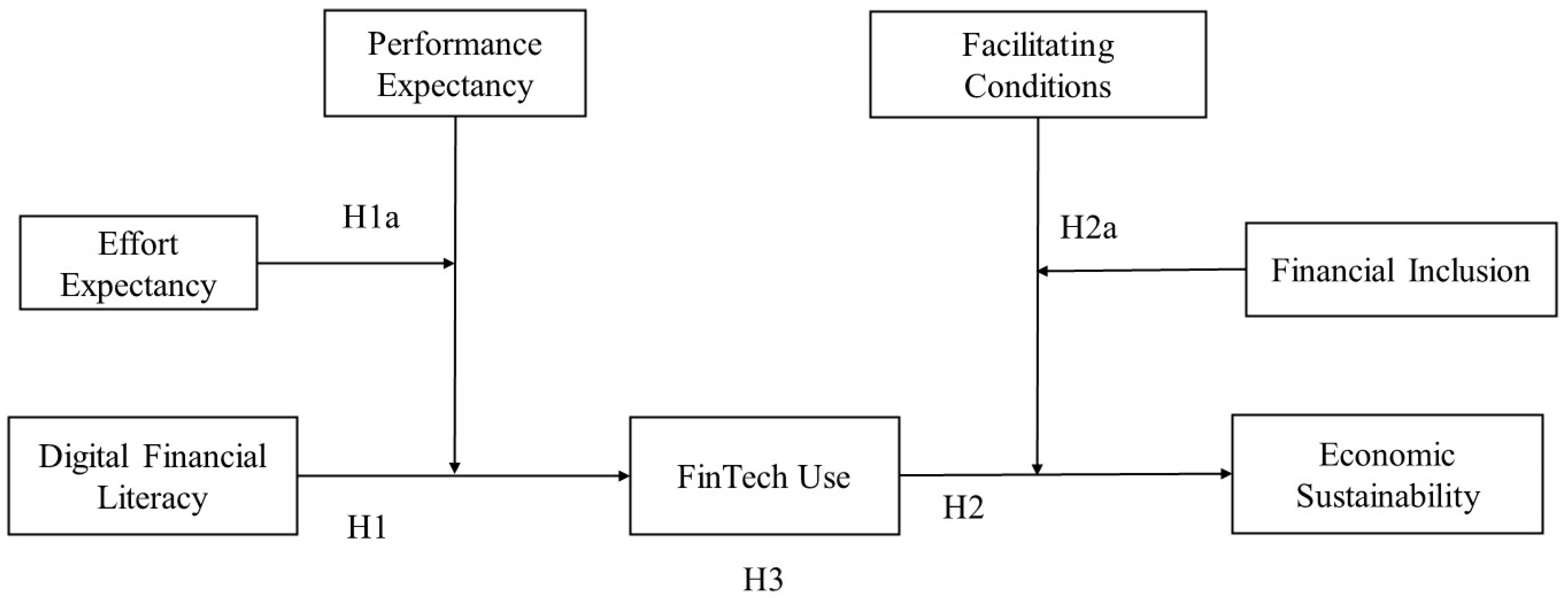
The conceptual model is presented in Figure 1.

3. Method

3.1. Ethics

This study was conducted strictly by the ethical protocols of informed consent, protection of anonymity, and data confidentiality. We also assured the respondents that they could withdraw from participating in the survey at any time they felt like it. We also explained to the respondents that this research is purely for academic purposes and to protect the privacy of the information given by the respondents.

3.2. Sample, Demographics, and Measures

This study aims to investigate the effect of FinTech adoption on the economic sustainability of homestay business owners. This cross-sectional study was conducted among homestay business owners of Karnataka, India. For this, the authors selected the sample of registered homestay business owners in Karnataka, India. The details of the registered homestay business owners were obtained from the Department of Tourism of various districts of Karnataka.
We prepared a carefully crafted survey instrument and sent it to the participants through Google Forms. We ensured that all registered homestay business owners have access to the survey, and only those who are willing to participate are asked to respond. Most of these homestay business owners are in various tourist locations that attract tourists all over the world, including from other countries. We started the data collection in February and completed it in July 2025. The survey has two parts: the first part provides demographic information, and the second part is related to the main variables in this study. In all, we received 444 responses and included these in the final analysis. According to Krejcie and Morgan (1970), the minimum required sample size is 384, and our sample size met the qualifying requirement. Since Google Forms only allows a respondent to proceed further after responding to questions, all the surveys received were complete. We also personally visited the homestay business owners and assisted them in completing surveys. We checked the non-response bias by comparing the first fifty respondents with the last fifty respondents and found no statistically significant differences between these two groups in terms of the study variables (Armstrong & Overton, 1977).
The sample consists of 444 respondents, consisting of 298 (67.1%) male homestay business owners and 146 (32.9%) female homestay owners. Other demographic details are mentioned in Table 1.
We measured all the constructs on a Likert-type five-point scale [‘1’ = strongly disagree; ‘5’ = strongly agree]. The constructs, indicators, and sources of constructs are mentioned in Table 2.

4. Analysis

4.1. Measurement Model and Confirmatory Factor Analysis (CFA)

It is customary to test the measurement model first before testing the structural model (Anderson & Gerbing, 1988). We used LISRE 8.80 software to conduct CFA and presented the results in Table 2.
The CFA results reveal that factor loadings of all seven constructs were above an acceptable level of 0.70 [ranging between 0.70 and 84] and the reliability coefficients (Cronbach’s alpha) were above 0.70 [ranging between 0.81 and 0.89]. The composite reliabilities for all the constructs ranged between 0.81 and 90]. The goodness of fit index showed a good fit of the data [χ2 = 1272.80; df = 413; χ2/df = 3.08; RMSEA = 0.068; CFI = 0.91; NNFI = 0.90; GFI = 0.87; RMR = 0.025; standardized RMR = 0.041]. Since RMSEA [<0.08; and CFI > 0.90] vouch for good fit of the data to the model (Hair et al., 2019). Further, the average variance extracted (AVE) estimates for all the constructs were well above 0.50 [ranging between 0.54 and 0.64], thereby vouching for convergent validity (Hair et al., 2019).

4.2. Descriptive Statistics

As can be seen from Table 3, correlations ranged between 0.37 (between FinTech use and financial inclusion) and 0.74 (between FinTech use and Effort expectancy). Since correlations were below 0.75, multicollinearity is not a problem with the data (Tsui et al., 1995). As an additional check, we verified the variance inflation factor (VIF) values and found that these were less than 5.00 for all the constructs, vouching for the absence of multicollinearity (Hair et al., 2019).
Table 4 captures descriptive statistics (means, standard deviations, and zero-order correlations).

4.3. Discriminant Validity and Common Method Bias (CMB)

Discriminant validity is said to be established when the square root of AVEs is greater than the correlations between the variables (Hair et al., 2019). In this study, we found that the square root of AVEs of all the variables was greater than the correlations between the variables. For example, the correlation between performance expectancy and effort expectancy was 0.72, and the square roots of AVEs were 0.75 and 0.76, respectively. Similarly, the correlation between digital financial literacy and facilitating conditions was 0.70, and the square roots of AVEs of these variables were 0.80 and 0.73, respectively. These statistics offer support for discriminant validity between these seven variables.
As CMB is unavoidable in cross-sectional data (Podsakoff et al., 2024), it is essential to test CMB. Since traditional Harman’s single-factor test is not preferred by contemporary scholars (Howard et al., 2024), we performed the latent variable method whereby we loaded all the indicators into a single construct and rotated the procedure for all the constructs, and found inner VIF values were less than 3.3, implying that the data are not infected by CMB (Kock, 2015). Secondly, we compared the seven-factor model with six alternative models and found that the seven-factor model was the best fit of the data [χ2 = 1272.80; df = 413; χ2/df = 3.08; RMSEA = 0.068; RMR = 0.025; standardized RMR = 0.041; CFI = 0.91; GFI = 0.87]. On the contrary, the single factor yielded a poor fit to the data in the model [χ2 = 1793.06; df = 434; χ2/df = 4.13; RMSEA = 0.084; RMR = 0.030; standardized RMR = 0.051; CFI = 0.85; GFI = 0.75].

4.4. Testing H1–H3

To check H1–H3, we used Hayes (2018) PROCESS macros (model number 4) and present the results in Table 4.
Step 1 from Table 5 shows the effect of digital financial literacy on economic sustainability. In step 2, the effect of digital financial literacy on FinTech use is shown. The regression coefficient of digital financial literacy on FinTech use was positive and significant (β = 0.76, t = 27.16; p < 0.001), thus supporting H1. The model is significant and explains 62.5 percent variance in FinTech use because of digital financial literacy [R2 = 0.625; F (1,442) = 738.04; p < 0.001].
Hypothesis 2 posits that FinTech use is positively related to economic sustainability. The regression coefficient [as can be seen in Step 3] of FinTech use on economic sustainability is positive and significant (β = 0.47; t = 12.59; p < 0.001), thus supporting H2.
Hypothesis 3 predicts that FinTech use mediates between digital financial literacy and economic sustainability. Testing this mediation hypothesis is performed by checking whether the indirect effect is significant (Hayes, 2018). The total effect [as can be seen from Step 1] of digital financial literacy on economic sustainability is 0.5478. The total effect is the sum of the direct effect [0.1888] and the indirect effect [0.3590]. Indirect effect is the multiplication of the regression coefficient of digital financial literacy on FinTech use [0.7652] and the regression coefficient of FinTech use on economic sustainability [0.4692] [i.e., 0.7652 × 0.4692 = 0.3690]. The results based on 20,000 bootstrap samples reveal that the indirect effect is significant [β = 0.4692; Boot s.e = 0.0448], with 96% confidence intervals [Boot LLCI = 0.2749; Boot ULCI = 0.4493], and zero is not contained in the confidence intervals, thus supporting H3.

4.5. Testing H1a

To test the three-way interaction hypothesis (H1a), we used model number 3 of Hayes (2018) PROCESS macros and present the results in Table 6.
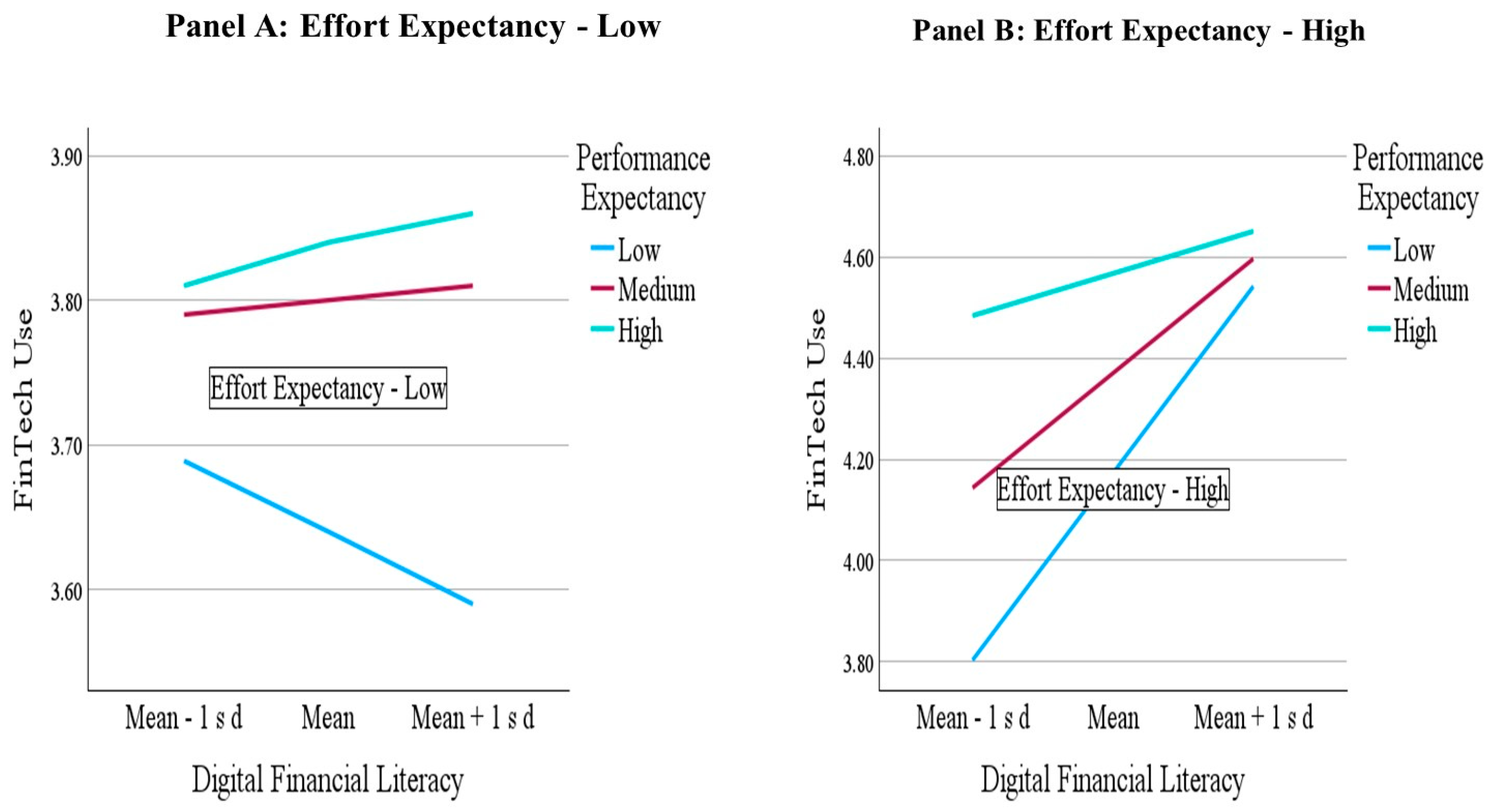
As shown in Table 6, we entered digital financial literacy as an independent variable, FinTech use as a dependent variable, performance expectancy as the first moderator, and effort expectancy as a second moderator. The PROCESS macro results reveal that the regression coefficient of the interaction term (digital financial literacy × performance expectancy × effort expectancy) was positive and significant [digital financial literacy × performance expectancy × effort expectancy = 0.47; t = 2.93; p < 0.01; Boot LLCI (0.1552); Boot ULCI (0.7892)]. The conditional effects of the focal predictor (FinTech use) at values of moderators (performance expectancy and effort expectancy) were mentioned at the bottom of Table 6. The conditional effects of the interaction of digital financial literacy and performance expectancy at values of the moderator effort expectancy are mentioned in Table 7. The moderator values defining significant Johnson–Neyman regions are 2.6293 below 62.96%, as can be seen in Table 7. The three-way interaction model is significant and explains 71.5% variance in the dependent variable [FinTech use] [R2 = 0.715; F(7,436) = 156.67; p < 0.001]. These results support H1a. The visualization of the three-way interaction was presented in Figure 2.
In Figure 2, we can see two panels. Panel A represents the interaction between digital financial literacy and performance expectancy influencing FinTech use when effort expectancy is low. Panel B shows the interaction between digital financial literacy and performance expectancy influencing FinTech use when effort expectancy is high.
As can be seen in Panel A in Figure 2, when effort expectancy is low, digital financial literacy interacting with a higher level of performance expectancy results in a higher level of FinTech use when compared to a lower level of performance expectancy. Further, when digital financial literacy increases from low to high, the curve representing high performance expectancy is positive, whereas the curve representing low performance expectancy is decreasing. Further, when we move to Panel B, the interaction of digital financial literacy with performance expectancy at higher levels of effort expectancy results in an increase in FinTech use when performance expectancy is higher, compared to lower performance expectancy. Further, with an increase in digital financial literacy from ‘low’ to ‘high’, all three curves [representing high, medium, and low levels] have a positive slope. However, the difference between these curves will be decreasing, implying that when effort expectancy is high, even with performance expectancy being low, the interaction effect of digital financial literacy with performance expectancy results in higher FinTech use. The differences in slopes of the curve provide support for H1a.

4.6. Testing H2a

To test H2a, we used model number 3 of PROCESS macros (Hayes, 2018) and present the results in Table 8.
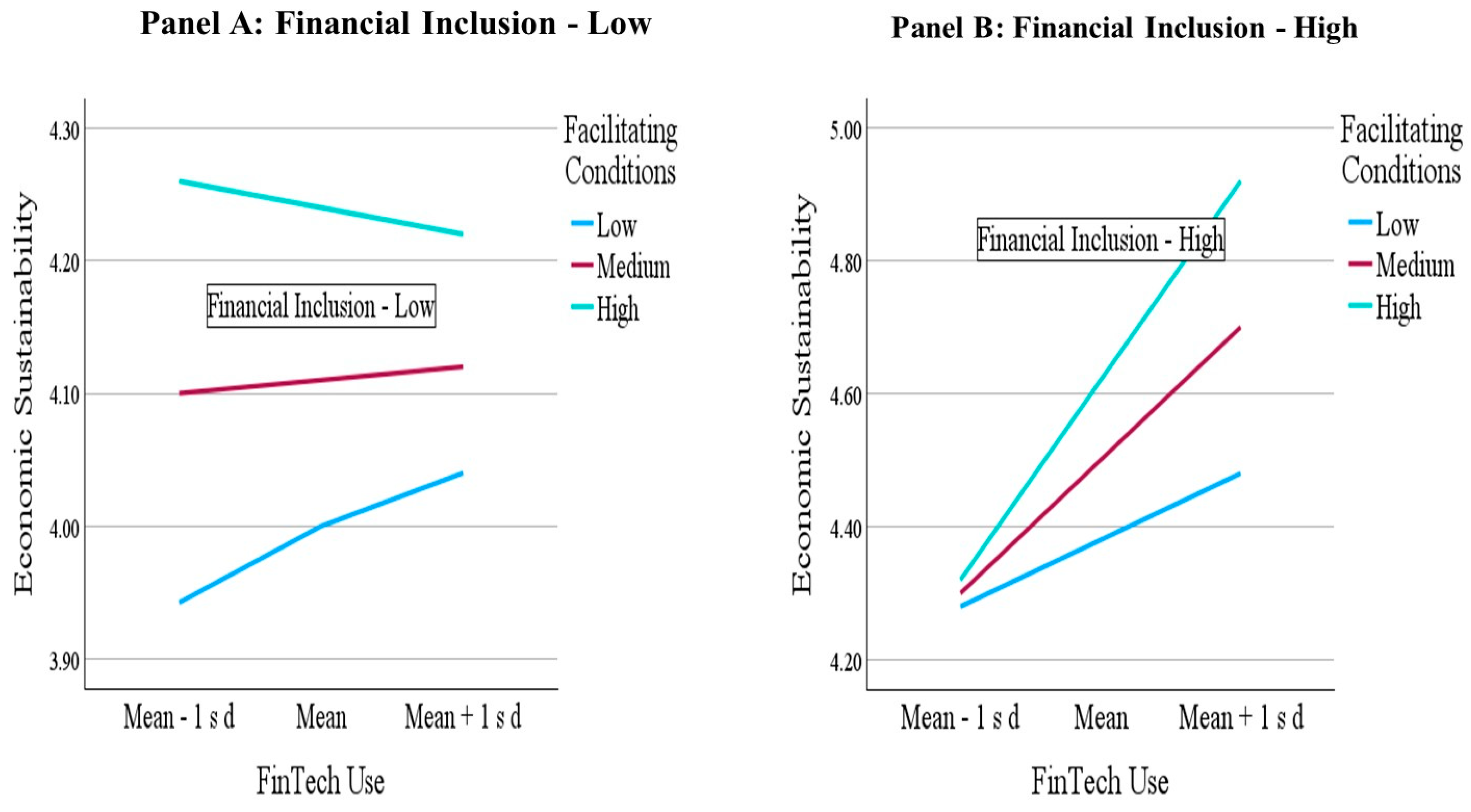
Hypothesis 2a posits that financial inclusion (second moderator) moderates the moderated relationship between FinTech use and facilitating conditions (first moderator) in influencing economic sustainability. For this, we first entered FinTech as an independent variable, economic sustainability as a dependent variable, facilitating conditions as the first moderator, and financial inclusion as the second moderator. The regression coefficient of the three-way interaction term (FinTech use × facilitating conditions × financial inclusion) was significant (βFinTech use × facilitating conditions × financial inclusion = 0.087; t = 2.40; p < 0.05; Boot LLCI (0.0161); Boot ULCI (0.1596), thus supporting H2a. The conditional effects of the focal predictor (economic sustainability) at values of moderators (facilitating conditions and financial inclusion) were mentioned at the bottom of Table 8. The conditional effects of the interaction of FinTech use and facilitating conditions at values of the moderator financial inclusion are mentioned in Table 9. The moderator values defining significant Johnson–Neyman regions are 3.0413 below 10.58 and above 89.42%, as shown in Table 9. The visual presentation of the three-way interaction is shown in Figure 3.
In Figure 3, we can see two panels (A and B). Panel A shows the moderating effect of facilitating conditions in the relationship between FinTech use and economic sustainability when financial inclusion is low. Though at lower levels of FinTech use, higher levels of facilitating conditions result in higher economic sustainability; when FinTech use increases from ‘low’ to ‘high’, FinTech use results in a decrease in economic sustainability [as the curve is falling]. When we move to Panel B, which represents the interaction effect under the conditions of a higher level of financial inclusion, at all three levels of facilitating conditions, economic sustainability shows an increasing pattern. However, as can be seen in Figure 2 (Panel B), higher levels of financial conditions combined with higher levels of FinTech use result in higher levels of economic sustainability when compared to low levels of facilitating conditions. Since the slopes of the curves are different, the three-way interaction effect is clearly visible, thus supporting H2a.
The summary of results is presented in Table 10.

5. Discussion

The objective of this study is to unravel the effect of digital financial literacy on FinTech use and economic sustainability. A conceptual model was developed, and the hypothesized relationships were tested by collecting data from 444 homestay business owners from Southern India. For checking measurement properties, structural equation modeling with LISREL software was conducted, and PROCESS macros were used for testing the direct, mediation, and moderation relationships. The findings validated the conceptual model presented in Figure 1.
First, the results support the positive association of digital financial services on FinTech use by homestead business owners (Hypothesis 1), aligning with several studies in the literature conducted in other business contexts (M. Hasan et al., 2023; Luo et al., 2021; Morgan & Trinh, 2020; Phung & Nguyen, 2025). When customers are fully aware of financial services and the application of digital technology to financial services, it is more likely that they will engage in FinTech use. Digital financial literacy enables individuals to mitigate the risks associated with digital technology and motivate them to use FinTech in their financial transactions (Kumar et al., 2023; Lyons & Kass-Hanna, 2021). Second, the findings indicate a positive association of FinTech with economic sustainability (Hypothesis 2), corroborating with studies conducted in other sectors (Awawdeh et al., 2022; Dyllick & Hockerts, 2002; F. Hasan et al., 2024; Hidayat-Ur-Rehman, 2025; Hussain et al., 2018; Njoroge et al., 2019). It is expected that FinTech use facilitates organizations in expanding their customer base and increasing their profitability by meeting customer needs. Further, FinTech also encourages organizations to engage in innovation and offers several methods of payment systems, attracts customers, and contributes to profitability.
Third, the results support the mediation of FinTech use in the relationship between digital financial literacy and economic sustainability (Hypothesis 3). Though none of the previous studies vouched for this mediation relationship, we use the direct effect of digital financial literacy and FinTech use on economic sustainability as supporting evidence (Amnas et al., 2023; Arner et al., 2020; Bajunaied et al., 2023; Kumar et al., 2023; Shaikh et al., 2023; Shen et al., 2019). For example, Lyons and Kass-Hanna (2021) documented that digital financial literacy enhances individuals’ attitudes to participate in the formal financial system, which increases the profitability of the businesses the individuals are interacting with by purchasing goods and services.
Fourth, the findings from this study supported the moderating effect of performance expectancy and effort expectancy in influencing the relationship between digital financial literacy and FinTech use (Hypothesis 1a). This three-way interaction has been explored for the first time in the literature, and hence we relied upon direct effects of performance expectancy and effort expectancy in adopting new technologies (Alalwan et al., 2017; Arner et al., 2020; Bajunaied et al., 2023; Devi & Shunmugasundaram, 2025; Dwivedi et al., 2019; Gansser & Reich, 2021; Martinez & McAndrews, 2023). For example, in a recent study by Shanmugavel et al. (2024), the researchers documented a positive influence of both performance expectancy and effort expectancy on the intention to adopt new technology. While performance expectancy strengthened the positive relationship between digital financial literacy and FinTech use, effort expectancy further strengthened the moderating effect.
Fifth, in this study, we found that facilitating conditions and financial inclusion moderated the relationship between FinTech use and economic sustainability (Hypothesis 2a). Again, the three-way interaction between FinTech use, facilitating conditions, and financial inclusion influencing economic sustainability has not been investigated by previous researchers; our results confirm the direct effects of both facilitating conditions and financial inclusion on outcomes. For example, several researchers established a positive association of facilitating conditions in influencing the individuals to exhibit behavioral intention to adopt new technology (Aduba et al., 2023; Amnas et al., 2023; Arner et al., 2020; Asif et al., 2023; Bajunaied et al., 2023; Nawayseh, 2020; Ong et al., 2023; Senyo & Osabutey, 2020). FinTech use, interacting with facilitating conditions, will likely increase economic sustainability because customers will be motivated to utilize available digital financial services offered by the organizations. Further, financial inclusion enables customers to interact with businesses that offer user-friendly financial services [e.g., mobile payments]. Several studies documented the positive effect of financial inclusion on customers’ engagement in using financial services (Agyekum et al., 2021; Banna et al., 2021; Bongomin & Munene, 2019; Senyo & Osabutey, 2020). In summary, the results from the conceptual model were built on the theoretical foundation of UTAUT (Venkatesh et al., 2003).

5.1. Theoretical Contributions

This study makes several contributions to both behavioral finance and tourism research, particularly regarding homestay businesses. First, this study underscores the importance of digital financial literacy in influencing FinTech use by homestay business owners. As several previous studies documented that digital financial literacy has a positive influence on financial inclusion (He et al., 2024; Ravikumar et al., 2022), this study supports the findings of previous research. This study goes one step further by extending the application of digital financial literacy to homestay businesses (Arner et al., 2020; Bajunaied et al., 2023; Devi & Shunmugasundaram, 2025; Martinez & McAndrews, 2023). While the unit of study of some of the recent studies was ‘tourists’ and the focus was on tourist satisfaction with the services provided by homestay businesses (Sarma et al., 2025), the unit of analysis of this study is ‘homestay business owners’. This study indicates that digital financial literacy of homestay businesses is a precursor to FinTech use. Secondly, this research documented the positive effect of FinTech use in ensuring economic sustainability by meeting both present customer needs and expected future needs. Homestay business owners engage in innovation, as some studies have found, which attracts customers, resulting in increased profitability.
Second, this research provides insights into boundary conditions strengthening the relationship between digital financial literacy and FinTech use by homestay business owners. Riding on the UTAUT framework (Venkatesh et al., 2003), we found that performance expectancy and effort expectancy enabled the homestay business owners to make use of FinTech platforms more confidently. Earlier studies found that performance expectancy was positively associated with FinTech adoption because homestay business owners experience the benefits of FinTech [viz., convenience, efficiency, and cost-effectiveness]. In this study, we found that performance expectancy (first moderator) and effort expectancy (second moderator) interact with digital financial literacy in influencing FinTech use. This three-way interaction between digital financial literacy, performance expectancy, and effort expectancy in increasing FinTech use is a pivotal contribution of this study to the literature on behavioral finance, particularly related to homestay businesses.
Third, this study advances the understanding of the relationship between FinTech use and the economic sustainability of homestay businesses. Most importantly, facilitating conditions (first moderator) and financial inclusion (second moderator) strengthen the effect of FinTech use on the economic sustainability of homestay businesses, contributing to the existing literature. The three-way interaction between FinTech use, facilitating conditions, and financial inclusion has been studied for the first time, to the best of our knowledge, and thus makes a pivotal contribution to the theoretical framework. To sum up, the conceptual model developed and tested in this research highlights the importance of interaction effects of the constructs that were previously studied in isolation. However, we acknowledge that the extension of the UTAUT model remains primarily applied in nature and does not present a strong theoretical innovation.

5.2. Practical Implications

The findings from this study provide valuable insights into marketers, policy makers, homestay business owners, and tourists. First, homestay business owners should understand the importance of digital financial literacy in promoting their businesses. Second, homestay business owners need to make sure that they have adequate knowledge about digital technology. They need to update their knowledge about the changing technology, new apps that help in carrying out financial transactions digitally. Policymakers need to encourage homestay business owners to make use of digital financial services. Further, educational institutions need to educate students who will become potential business owners about the importance of digital financial literacy. Third, FinTech companies need to facilitate improving literacy by providing necessary guidance to the homestay business owners who are not tech-savvy. Local governments need to take initiatives to improve digital financial literacy among underprivileged business owners and customers.
Fourth, FinTech companies need to render excellent support to the homestay business owners who use digital technology. As this study found that facilitating conditions motivate the business owners to implement new technology confidently, the FinTech companies need to troubleshoot if any problems arise. Facilitating conditions not only ensure the reliability and responsiveness of the FinTech platforms. Fifth, to attract and retain tourists, the local governments and FinTech companies need to foster financial inclusion among the users. As homestay businesses are conducted in rural areas, to promote rural tourism, financial inclusion plays a vital role. From the viewpoint of homestay business owners, financial inclusion enables expanding their businesses by making services available to customers who are not tech-savvy. As the world is gradually transforming into the digital mode, financial literacy and financial inclusion are inevitable game changers. FinTech companies need to offer convenient and easily accessible services to the users. Collective efforts from all stakeholders help promote the homestay businesses, which are experiencing an increasing trend these days.

5.3. Limitations and Directions for Future Research

This study is not without limitations. As with any survey-based cross-sectional research, this study has limitations of CMB and social desirability bias. However, we have taken adequate statistical measures to check CMB and also ensured that the social desirability bias is minimized. We anonymized the survey questions and also assured the respondents about the privacy of data in order to minimize social desirability bias (Latkin et al., 2017). Second, our sample consists of homestay businesses in the state of Karnataka, India. To establish causal relationships, it is advisable to have two-wave data collection. We suggest that future researchers include bigger samples and conduct longitudinal designs. Further, homestay businesses in other parts of the country may also be included to see if any differences exist in the way in which the homestay businesses were carried on. Third, this study focused only on a limited number of variables. We suggest that the researchers include additional variables—such as quality of services rendered by homestay business owners, the type of tourists who avail the services, which may influence economic sustainability. Third, future studies may also investigate the measures by local governments in promoting financial inclusion and encouraging digital financial literacy. Fourth, it will be interesting to make comparative studies of homestay businesses in other developing countries and see if any cultural differences exist.
We also acknowledge that the three-way interactions we showed in this paper may be sensitive to sample characteristics and hence may not be generalizable across other samples in different industries. Further, the limited number of constructs from UTAUT [performance expectancy, effort expectancy, and facilitating conditions] to the homestay businesses is another limitation of this study. A full-fledged application of UTAUT to the homestay business requires additional variables to be studied in connection with digital financial literacy. Therefore, we contend that the results from this study should be interpreted in light of these methodological and theoretical limitations. We suggest that future researchers conduct a comprehensive study of homestay businesses involving the variables that are not covered in this research.

5.4. Conclusions

The technological advancements brought significant change in the financial ecosystem, affecting all organizations. Using UTAUT as a theoretical underpinning, this study sheds light on how homestay businesses leverage digital technologies to increase their customer base and attain economic sustainability. Most importantly, this study found digital financial literacy as a precursor to FinTech use by homestay business owners. Conducted in the context of homestay businesses in India, this underscores the importance of digital financial literacy in driving the use of FinTech and economic sustainability. This study provides deeper insights into the performance expectations, effort expectancy, facilitating conditions, and financial inclusion in strengthening the relationship between digital financial literacy, FinTech use, and economic sustainability. This research recommends that policymakers, local governments, and FinTech companies strengthen digital financial transactions for the benefit of both homestay business owners and tourists.

Author Contributions

Conceptualization, P.H.K. and B.K.; methodology, S.P. and C.K.P.; software, S.P.; validation, B.K., S.P. and C.K.P.; formal analysis, P.H.K., S.P. and C.K.P.; investigation, P.H.K. and B.K.; resources, P.H.K. and B.K.; data curation, P.H.K. and S.P.; writing—original draft preparation, P.H.K. and S.P.; writing—review and editing, B.K. and C.K.P.; visualization, P.H.K. and B.K.; supervision, B.K. and S.P.; project administration, P.H.K. and B.K. All authors have read and agreed to the published version of the manuscript.

Funding

This research received no external funding.

Institutional Review Board Statement

The study was conducted in accordance with the Declaration of Helsinki, and approved by the Institutional Review Board (or Ethics Committee) of Amrita Vishwa Vidhyapeetham, Mysuru, (protocol code AVVP/ECMYS/2025-2026/003 approved on 12 September 2025).

Informed Consent Statement

Informed consent was obtained from all subjects.

Data Availability Statement

Data will be available upon request from the authors.

Conflicts of Interest

The authors declare no conflict of interest.

Appendix A

Jrfm 19 00095 i001
Jrfm 19 00095 i002

References

  1. Abuatwan, N. (2023). The impact of green finance on the sustainability performance of the banking sector in Palestine: The moderating role of female presence. Economies, 11, 247. [Google Scholar] [CrossRef]
  2. Aduba, J., Behrooz, A., & Izawa, H. (2023). Does FinTech penetration drive financial development? Evidence from panel analysis of emerging and developing economies. Borsa Istanbul Review, 23, 1078–1097. [Google Scholar] [CrossRef]
  3. Agyekum, F. K., Reddy, K., Wallace, D., & Wellalage, N. H. (2021). Does technological inclusion promote financial inclusion among SMEs? Evidence from South-East Asian (SEA) countries. Global Finance Journal, 53, 100618. [Google Scholar] [CrossRef]
  4. Alalwan, A. A. (2020). Mobile food ordering apps: An empirical study of the factors affecting customer e-satisfaction and continued intention to reuse. International Journal of Information Management, 50, 28–44. [Google Scholar] [CrossRef]
  5. Alalwan, A. A., Dwivedi, Y. K., & Rana, N. P. (2017). Factors influencing adoption of mobile banking by Jordanian bank customers: Extending UTAUT2 with trust. International Journal of Information Management, 37(3), 99–110. [Google Scholar] [CrossRef]
  6. Alalwan, A. A., Dwivedi, Y. K., Rana, N. P., & Algharabat, R. (2018). Examining factors influencing Jordanian customers’ intentions and adoption of internet banking: Extending UTAUT2 with risk. Journal of Retailing and Consumer Services, 40, 125–138. [Google Scholar] [CrossRef]
  7. Aleemi, A. R., Javaid, F., & Hafeez, S. S. (2023). Finclusion: The nexus of Fintech and financial inclusion against banks’ market power. Heliyon, 9(12), e22551. [Google Scholar] [CrossRef] [PubMed]
  8. Amnas, M. B., Selvam, M., Raja, M., Santhoshkumar, S., & Parayitam, S. (2023). Understanding the determinants of FinTech adoption: Integrating UTAUT2 with trust theoretic model. Journal of Risk and Financial Management, 16, 505. [Google Scholar] [CrossRef]
  9. Anand, A., Chandan, P., & Singh, R. B. (2012). Homestays at Korzok: Supplementing rural livelihoods and supporting green tourism in the Indian Himalayas. Mountain Research and Development, 32(2), 126–136. [Google Scholar] [CrossRef]
  10. Anderson, J. C., & Gerbing, D. W. (1988). Structural equation modeling in practice: A review and recommended two-step approach. Psychological Bulletin, 103(3), 411–423. [Google Scholar] [CrossRef]
  11. Armstrong, J. S., & Overton, T. S. (1977). Estimating non-response bias in mail surveys. Journal of Marketing Research, 14(3), 396–402. [Google Scholar] [CrossRef]
  12. Arner, D. W., Buckley, R. P., Zetzsche, D. A., & Veidt, R. (2020). Sustainability, FinTech and financial inclusion. European Business Organization Law Review, 21, 7–35. [Google Scholar] [CrossRef]
  13. Asemanjerdi, S. A., Madrazo, P. F., Khosraviniya, M., & Martín-Cervantes, P. A. (2025). The role of female managers’ financial literacy on the relationship between fintech and corporate sustainability performance. Journal of Islamic Accounting and Business Research. [Google Scholar] [CrossRef]
  14. Ashenafi, B. B., & Dong, Y. (2022). Financial inclusion, fintech, and income inequality in Africa. FinTech, 1(4), 376–387. [Google Scholar] [CrossRef]
  15. Asif, M., Khan, M. N., Tiwari, S., Wani, S. K., & Alam, F. (2023). The impact of fintech and digital financial services on financial inclusion in India. Journal of Risk and Financial Management, 16(2), 122. [Google Scholar] [CrossRef]
  16. Awawdeh, A. E., Ananzeh, M., El-Khateeb, A. I., & Aljumah, A. (2022). Role of green financing and corporate social responsibility (CSR) in technological innovation and corporate environmental performance: A COVID-19 perspective. China Finance Review International, 12(2), 297–316. [Google Scholar] [CrossRef]
  17. Bajunaied, K., Hussin, N., & Kamarudin, S. (2023). Behavioral intention to adopt FinTech services: An extension of unified theory of acceptance and use of technology. Journal of Open Innovation, 9, 100010. [Google Scholar] [CrossRef]
  18. Banna, H., Hassan, M. K., & Rashid, M. (2021). Fintech-based financial inclusion and bank risk-taking: Evidence from OIC countries. Journal of International Financial Markets, Institutions and Money, 75, 101447. [Google Scholar] [CrossRef]
  19. Basak, D., Bose, A., Roy, S., Chowdhury, I. R., & Sarkar, B. C. (2021). Understanding sustainable homestay tourism as a driving factor of tourist’s satisfaction through structural equation modelling: A case of Darjeeling Himalayan region, India. Current Research in Environmental Sustainability, 3, 100098. [Google Scholar] [CrossRef]
  20. Basri, S., Hawaldar, I. T., & Kumar, N. (2022). Continuance intentions to use FinTech peer-to-peer payments apps in India. Heliyon, 8(11), e11654. [Google Scholar] [CrossRef]
  21. Bhalla, P., Coghlan, A., & Bhattacharya, P. (2016). Homestays’ contribution to community- based ecotourism in the Himalayan region of India. Tourism Recreation Research, 41(2), 213–228. [Google Scholar] [CrossRef]
  22. Bongomin, G. O. C., & Munene, J. C. (2019). Analyzing the relationship between mobile money adoption and usage and financial inclusion of MSMEs in developing countries: Mediating role of cultural norms in Uganda. Journal of African Business, 22(1), 1–20. [Google Scholar] [CrossRef]
  23. Bongomin, G. O. C., & Ntayi, J. M. (2020). Mobile money adoption and usage and financial inclusion: Mediating effect of digital consumer protection. Digital Policy, Regulation and Governance, 22(3), 157–176. [Google Scholar] [CrossRef]
  24. Chueca Vergara, C., & Ferruz Agudo, L. (2021). Fintech and sustainability: Do they affect each other? Sustainability, 13(13), 7012. [Google Scholar] [CrossRef]
  25. Davis, F. D. (1989). Perceived usefulness, perceived ease of use, and user acceptance of information technology. Management Information Systems Quarterly, 13(3), 319–340. [Google Scholar] [CrossRef]
  26. Devi, P., & Shunmugasundaram, V. (2025). Understanding adoption intention and perceived satisfaction of startup entrepreneurs towards FinTech services. Journal of Modelling in Management. [Google Scholar] [CrossRef]
  27. Dwivedi, Y. K., Rana, N. P., Jeyaraj, A., Clement, M., & Williams, M. D. (2019). Re-examining the unified theory of acceptance and use of technology (UTAUT): Towards a revised theoretical model. Information Systems Frontiers, 21, 719–734. [Google Scholar] [CrossRef]
  28. Dyllick, T., & Hockerts, K. (2002). Beyond the business case for corporate sustainability. Business Strategy and the Environment, 11(2), 130–141. [Google Scholar] [CrossRef]
  29. Galbreath, J. (2011). Sustainable development in business: A strategic view. In Theory and practice of corporate social responsibility (pp. 89–105). Springer. [Google Scholar] [CrossRef]
  30. Gansser, O., & Reich, C. (2021). A new acceptance model for artificial intelligence with extensions to UTAUT2: An empirical study in three segments of application. Technology in Society, 65, 101535. [Google Scholar] [CrossRef]
  31. Hair, J. F., Black, W. C., Babin, B. J., & Anderson, R. E. (2019). Multivariate data analysis (8th ed.). Cengage Learning. [Google Scholar]
  32. Hasan, F., Al-Okaily, M., Choudhury, T., & Kayani, U. (2024). A comparative analysis between FinTech and traditional stock markets: Using Russia and Ukraine war data. Electronic Commerce Research, 24(1), 629–654. [Google Scholar] [CrossRef]
  33. Hasan, M., Noor, T., Gao, J., Usman, M., & Abedin, M. Z. (2023). Rural consumers’ financial literacy and access to FinTech services. Journal of the Knowledge Economy, 14(2), 780–804. [Google Scholar] [CrossRef]
  34. Hayes, A. F. (2018). Introduction to mediation, moderation, and conditional process analysis: A regression-based approach. The Guilford Press. [Google Scholar]
  35. He, H., Luo, W., Gong, Y., Berson, I. R., & Berson, M. J. (2024). Digital financial literacy of young Chinese children in Shanghai: A mixed method study. Early Education and Development, 35(1), 57–76. [Google Scholar] [CrossRef]
  36. Henry, L. A., Buyl, T., & Jansen, R. J. (2019). Leading corporate sustainability: The role of top management team composition for triple bottom line performance. Business Strategy and the Environment, 28(1), 173–184. [Google Scholar] [CrossRef]
  37. Hidayat-Ur-Rehman, I. (2025). The role of financial literacy in enhancing firm’s sustainable performance through fintech adoption: A moderated mediation analysis. International Journal of Innovation Science, 17(4), 754–785. [Google Scholar] [CrossRef]
  38. Howard, M. C., Boudreaux, M., & Oglesby, M. (2024). Can Harman’s single-factor test reliably distinguish between research designs? Not in published management studies. European Journal of Work and Organizational Psychology, 33(6), 790–804. [Google Scholar] [CrossRef]
  39. Hussain, J., Salia, S., & Karim, A. (2018). Is knowledge that powerful? Financial literacy and access to finance. Journal of Small Business and Enterprise Development, 25(6), 985–1003. [Google Scholar] [CrossRef]
  40. IMARC. (2025). Homestay business plan and project report 2025: Industry trends, business setup, revenue model, investment opportunities, income, expenses, and profitability. Available online: https://www.imarcgroup.com/homestay-business-plan-project-report (accessed on 8 September 2025).
  41. Kamble, P. A., Mehta, A., & Rani, N. (2024). Financial inclusion and digital financial literacy: Do they matter for financial well-being? Social Indicators Research, 171(3), 777–807. [Google Scholar] [CrossRef]
  42. Kilani, A. A., Kakeesh, D., Al-Weshah, G. A., & Al-Debei, M. M. (2023). Consumer post-adoption of e-wallet: An extended UTAUT2 perspective with trust. Journal of Open Innovation, 9(3), 100113. [Google Scholar] [CrossRef]
  43. Kock, N. (2015). Common method bias in PLS-SEM: A full collinearity assessment approach. International Journal of e-Collaboration, 11(4), 1–10. [Google Scholar] [CrossRef]
  44. Krejcie, R. V., & Morgan, D. W. (1970). Determining sample size for research activities. Educational and Psychological Measurement, 30(3), 607–610. [Google Scholar] [CrossRef]
  45. Kumar, P., Pillai, R., Kumar, N., & Tabash, M. I. (2023). The interplay of skills, digital financial literacy, capability, and autonomy in financial decision making and well-being. Borsa Istanbul Review, 23(1), 169–183. [Google Scholar] [CrossRef]
  46. Latkin, C. A., Edwards, C., Davey-Rothwell, M. A., & Tobin, K. E. (2017). The relationship between social desirability bias and self-reports of health, substance use, and social network factors among urban substance users in Baltimore, Maryland. Addictive Behaviors, 73, 133–136. [Google Scholar] [CrossRef]
  47. Liébana-Cabanillas, F., Molinillo, S., & Japutra, A. (2020). Exploring the determinants of intention to use P2P mobile payment in Spain. Information Systems Management, 38(2), 165–180. [Google Scholar] [CrossRef]
  48. Luo, Y., Peng, Y., & Zeng, L. (2021). Digital financial capability and entrepreneurial performance. International Review of Economics and Finance, 76, 55–74. [Google Scholar] [CrossRef]
  49. Lyons, A. C., & Kass-Hanna, J. (2021). A methodological overview to defining and measuring “digital” financial literacy. Financial Planning Review, 4(2), e1113. [Google Scholar] [CrossRef]
  50. Mahato, J., & Kanth, D. (2025). Investigating the influence of digital financial inclusion on the performance of family firms in India: Does financial well-being mediate? Global Knowledge, Memory and Communication. [Google Scholar] [CrossRef]
  51. Maignan, I. (2001). Consumers’ perceptions of corporate social responsibilities: A cross-cultural comparison. Journal of Business Ethics, 30(1), 57–72. [Google Scholar] [CrossRef]
  52. Malladi, C. M., Soni, R. K., & Srinivasan, S. (2021). Digital financial inclusion: Next frontiers—Challenges and opportunities. CSI Transactions on ICT, 9(2), 127–134. [Google Scholar] [CrossRef]
  53. Martinez, B., & McAndrews, L. (2023). Investigating U.S. consumers’ mobile pay through UTAUT2 and generational cohort theory: An analysis of mobile pay in pandemic times. Telematics and Informatics Reports, 11, 100076. [Google Scholar] [CrossRef]
  54. Morgan, P. J., & Trinh, L. Q. (2020). Fintech and financial literacy in Viet Nam (No. 1154). ADBI working paper series. Asian Development Bank Institute (ADBI). [Google Scholar]
  55. Moro-Visconti, R., Cruz Rambaud, S., & López Pascual, J. (2020). Sustainability in FinTechs: An explanation through business model scalability and market valuation. Sustainability, 12(24), 10316. [Google Scholar] [CrossRef]
  56. Nawayseh, M. K. (2020). FinTech in COVID-19 and beyond: What factors are affecting customers’ choice of FinTech applications? Journal of Open Innovation, 6, 153. [Google Scholar] [CrossRef]
  57. Njoroge, M., Anderson, W., & Mbura, O. (2019). Innovation strategy and economic sustainability in the hospitality industry. The Bottom Line, 32(4), 253–268. [Google Scholar] [CrossRef]
  58. Ong, M. H. A., Yusri, M. Y., & Ibrahim, N. (2023). Use and behavioural intention using digital payment systems among rural residents: Extending the UTAUT-2 model. Technology in Society, 74, 102305. [Google Scholar] [CrossRef]
  59. Peter, S., Elangovan, G., & Bai, G. V. (2025). Unveiling the nexus: Financial inclusion, financial literacy, and financial performance as catalyst for women-owned enterprises in India. Journal of the International Council for Small Business, 6, 721–751. [Google Scholar] [CrossRef]
  60. Phung, T. M. T., & Nguyen, L. D. (2025). The effect of financial literacy and fintech usage on income levels: A study in Vietnam. Journal of Electronic Business & Digital Economics, 4(2), 317–333. [Google Scholar] [CrossRef]
  61. Podsakoff, P. M., Podsakoff, N. P., Williams, L. J., Huang, C., & Yang, J. (2024). Common method bias: It’s bad, it’s complex, it’s widespread, and it’s not easy to fix. Annual Review of Organizational Psychology and Organizational Behavior, 11(1), 17–61. [Google Scholar] [CrossRef]
  62. Prasad, H., Meghwal, D., & Dayama, V. (2018). Digital financial literacy: A study of households of Udaipur. Journal of Business and Management, 5(1), 23–32. [Google Scholar] [CrossRef]
  63. Ravikumar, T., Suresha, B., Prakash, N., Vazirani, K., & Krishna, T. A. (2022). Digital financial literacy among adults in India: Measurement and validation. Cogent Economics & Finance, 10(1), 2132631. [Google Scholar] [CrossRef]
  64. Sarma, N., Kumar, J., & Kumar, P. (2025). Service quality in homestay tourism: A homestay host perspective. Tourism Review. [Google Scholar] [CrossRef]
  65. Senyo, P. K., & Osabutey, E. L. (2020). Unearthing antecedents to financial inclusion through FinTech innovations. Technovation, 98, 102155. [Google Scholar] [CrossRef]
  66. Shaikh, A. A., Glavee-Geo, R., Karjaluoto, H., & Hinson, R. H. (2023). Mobile money as a driver of digital financial inclusion. Technological Forecasting and Social Change, 186, 122158. [Google Scholar] [CrossRef]
  67. Shanmugavel, N., Rana, N. P., Parayitam, S., & Kumar, K. (2024). Assessing continuance intention to use digital wallet: A dual-factor approach using UTAUT2 and updated IS success model. Journal of Global Information Management, 32(1), 1–29. [Google Scholar] [CrossRef]
  68. Shen, Y., Hueng, C. J., & Hu, W. (2019). Using digital technology to improve financial inclusion in China. Applied Economics Letters, 27(1), 30–34. [Google Scholar] [CrossRef]
  69. Sood, J., Lynch, P., & Anastasiadou, C. (2017). Community non-participation in homestays in Kullu, Himachal Pradesh, India. Tourism Management, 60, 332–347. [Google Scholar] [CrossRef]
  70. Srivastava, A. (2022). Digital financial inclusion: A study to find the role of financial and digital literacy in achieving it. International Journal of Innovation in the Digital Economy, 13(1), 1–12. [Google Scholar] [CrossRef]
  71. Thakur, S., Sood, S., Singh, R. K., & Singh, R. (2024). Status of homestay tourism in Indian Himalayan region: Analysis of customer review and policy support for sustainable tourism. Tourism and Hospitality Research, 24(3), 588–601. [Google Scholar] [CrossRef]
  72. Thathsarani, U. S., & Jianguo, W. (2022). Do digital finance and the technology acceptance model strengthen financial inclusion and SME performance? Information, 13(8), 390. [Google Scholar] [CrossRef]
  73. Tiwari, C. K., Gopalkrishnan, S., Kaur, D., & Pal, A. (2020). Promoting financial literacy through digital platforms: A systematic review of literature and future research agenda. Journal of General Management Research, 7(2), 15–26. [Google Scholar]
  74. Tsui, A. S., Pearce, J. L., Porter, L. W., & Hite, J. P. (1995). Choice of employee-organization relationship: Influence of external and internal organizational factors. In G. R. Ferris (Ed.), Research in personnel and human resource management (pp. 117–151). JAI Pres. [Google Scholar]
  75. Turker, D. (2009). Measuring corporate social responsibility: A scale development study. Journal of Business Ethics, 85(4), 411–427. [Google Scholar] [CrossRef]
  76. Uthaileang, W., & Kiattisin, S. (2023). Developing the capability of digital financial literacy in developing countries: A Case of online loan for small entrepreneurs. Heliyon, 9(12), e21961. [Google Scholar] [CrossRef]
  77. Venkatesh, V., Morris, M., Davis, G. B., & Davis, F. D. (2003). User acceptance of information technology: Toward a unified view. Management Information Systems Quarterly, 27(3), 425. [Google Scholar] [CrossRef]
  78. Venkatesh, V., Thong, J. Y., & Xu, X. (2012). Consumer acceptance and use of information technology: Extending the unified theory of acceptance and use of technology. Management Information Systems Quarterly, 36(1), 157. [Google Scholar] [CrossRef]
  79. Xie, J., Ye, L., Huang, W., & Ye, M. (2021). Understanding FinTech platform adoption: Impacts of perceived value and perceived risk. Journal of Theoretical and Applied Electronic Commerce Research, 16, 1893–1911. [Google Scholar] [CrossRef]
  80. Yadav, C. S., Gupta, P., & Lama, R. (2018). Potential of homestays as tourism product in Sikkim. Challenges & Strategic Interventions for Tourism, 5(1), 36–46. [Google Scholar]
  81. Yadav, M., Banerji, P., & Garg, A. (2025). Digital financial literacy and retirement planning with mediating effect of saving behaviour. American Journal of Business, 40(3), 127–143. [Google Scholar] [CrossRef]
  82. Yanga, T., & Zhang, X. (2022). FinTech adoption and financial inclusion: Evidence from household consumption in China. Journal of Banking and Finance, 145, 106668. [Google Scholar] [CrossRef]
  83. Yeyouomo, A. K., Asongu, S. A., & Agyemang-Mintah, P. (2023). Fintechs and the financial inclusion gender gap in Sub-Saharan African countries. Women’s Studies International Forum, 97, 102695. [Google Scholar] [CrossRef]
  84. Yoshino, N., Morgan, P. J., & Long, T. Q. (2020). Financial literacy and fintech adoption in Japan (No. 1095). ADBI working paper series. Asian Development Bank Institute (ADBI). [Google Scholar]
  85. Zhang-Zhang, Y., Rohlfer, S., & Rajasekera, J. (2020). An eco-systematic view of cross-sector fintech: The case of Alibaba and Tencent. Sustainability, 12(21), 8907. [Google Scholar] [CrossRef]
Figure 1. The conceptual model.
Jrfm 19 00095 g001
Figure 2. Panel (A): Digital financial literacy interacting with performance expectancy, influencing FinTech use when effort expectancy is low. Panel (B): Digital financial literacy interacting with performance expectancy influencing FinTech use when effort expectancy is high.
Jrfm 19 00095 g002
Figure 3. Panel (A): FinTech use interacting with facilitating conditions influencing economic sustainability when financial inclusion is low. Panel (B): FinTech use interacting with facilitating conditions influencing economic sustainability when financial inclusion is high.
Jrfm 19 00095 g003
Table 1. Demographic profile of respondents.
VariableDemographicsNumberPercent
GenderMale29867.1
Female14632.9
Age26–30 years409.0
30–40 years14833.3
40–50 years18541.7
Above 50 years7116.0
EducationHigh school diploma5011.3
Pre-university course8318.7
Undergraduate bachelor’s degree19343.5
Master’s degree8018.0
Others388.6
ExperienceLess than one year245.4
1–2 years14432.4
2–5 years20646.4
Above five years7015.8
Table 2. Measurement properties and confirmatory factor analysis (CFA).
VariableAlphaComposite ReliabilityStandardized
Loadings
yi)
Reliability
2yi)
Variance
(Var(εi))
Average Variance-
Extracted
Σ(λ2yi)/[(λ2yi) + (Var(εi))]
Performance Expectancy (Venkatesh et al., 2012)0.860.83 0.56
Using FinTech (Mobile Banking) services will make my homestay business financial tasks easier and more efficient. 0.800.640.36
I anticipate that FinTech (Mobile Banking) services will help my homestay business save time and effort when managing my finances 0.710.500.50
I expect that FinTech (Mobile Banking) services in homestay business will offer a higher level of convenience compared to traditional financial methods 0.770.590.41
I anticipate that FinTech (Mobile Banking) services will help my homestay business achieve my financial goals more effectively 0.710.500.50
Effort Expectancy (Venkatesh et al., 2012)0.810.85 0.58
I expect that I can quickly learn how to use FinTech (Mobile Banking) apps in my homestay business 0.770.590.41
I believe that FinTech (Mobile Banking) platforms are user-friendly and intuitive in my homestay business. 0.740.550.45
I believe that using FinTech (Mobile Banking) services will not require a significant amount of time to get the things done. 0.730.530.47
I expect that I will not need extensive training or assistance to use FinTech (Mobile Banking) effectively to run my homestay business. 0.810.660.34
Facilitating Conditions (Venkatesh et al., 2012)0.850.82 0.54
I have access to the required technology (e.g., internet, smartphone) for using Fintech (Mobile banking) in my homestay business. 0.720.520.48
I have the knowledge necessary to use Fintech (Mobile banking) services in my homestay business. 0.730.530.47
There is sufficient customer support and assistance available when I encounter issues with FinTech (Mobile banking) services in my homestay business. 0.730.530.47
The availability of reliable internet connectivity facilitates my use of FinTech (Mobile Banking) services in my homestay business. 0.760.580.42
FinTech Use (Venkatesh et al., 2012)0.860.87 0.64
I frequently employ FinTech (Mobile Banking) for making payments and transferring funds regarding my homestay business. 0.810.660.34
I utilize FinTech (Mobile Banking) investment platforms (e.g., robo-advisors, online trading) to manage my investments related to homestay business. 0.760.580.42
I am an active user of FinTech (Mobile Banking) insurance services for purchasing and managing insurance policies in connection to homestay business. 0.830.680.32
I use digital Fintech (Mobile banking) services (e.g., peer-to-peer lending, online loans) when in need of financial assistance regarding my homestay business. 0.790.620.38
Digital Financial Literacy (Ravikumar et al., 2022)0.870.88 0.64
I am knowledgeable about the various features and functionalities of fintech (Mobile Banking) apps so that I can apply to homestay business. 0.830.690.31
I am aware of the potential risks and security measures associated with using digital payment systems concerning homestay business. 0.740.550.45
I know how to troubleshoot common issues related to digital financial transactions regarding my homestay business. 0.830.690.31
I am familiar with the terms and concepts related to digital financial services when dealing with my homestay business. 0.810.650.35
Financial Inclusion (Bongomin & Ntayi, 2020)0.840.86 0.61
FinTech (Mobile Banking) services have expanded my access to financial products and services related to homestay business. 0.840.700.30
FinTech (Mobile Banking) services have increased my ability to save and invest my money related to homestay business. 0.720.520.48
FinTech (Mobile Banking) adoption has made it easier for me to send and receive money with regard to my homestay business. 0.820.670.33
FinTech (Mobile Banking) services have improved my ability to access credit and loans related to my homestay business. 0.750.560.44
Economic Sustainability (Maignan, 2001; Turker, 2009)0.890.90 0.56
Our homestay emphasizes on maximizing profits for long term success 0.730.530.47
Our homestay continuously improves the quality of the services it offers 0.700.480.52
Our homestay places strong emphasizes on customer satisfaction with sustainability 0.800.630.37
Our homestay undertakes regular renovations and refurbishments. 0.780.610.39
Our homestay generates sufficient revenue to cover the operational cost 0.750.560.44
Our homestay have a competitive pricing policy to attract more customers 0.720.520.48
Our homestay targets sustainable growth which considers future generations 0.760.580.42
Table 3. Comparison of measurement models.
ModelFactorsχ2dfχ2/df∆χ2RMSEARMRStandardized
RMR
CFITLI = NNFIGFI
Null 10,291.60465
Baseline
model
Seven factors: DFL, FU, FI, EEX, PEX, FC, ESUS1272.804133.08 0.0680.0250.0410.910.900.87
Model 1Six-factor model: DFL + FU, FI, EEX, PEX, FC, ESUS1300.514193.1027.71 **0.0690.0260.0420.910.900.86
Model 2Five-factor model: DFL + FU + FI, EEX, PEX, FC, ESUS1400.114243.30127.31 **0.0720.0270.0440.900.890.82
Model 3Four-factor model: DFL + FU + FI + EEX, PEX, FC, ESUS1510.854283.53238.05 **0.0750.0280.0450.890.880.79
Model 4Three-factor model: DFL + FU + FI + EEX + PEX, FC, ESUS1534.614313.56261.81 **0.0760.0280.0460.880.870.78
Model 5Two-factor model: DFL + FU + FI + EEX + PEX + FC, ESUS1767.104334.08494.30 **0.0830.0290.0490.860.850.76
Model 6One-factor model
DFL + FU + FI + EEX + PEX + FC + ESUS
1793.064344.13520.26 **0.0840.0300.0500.850.820.75
** p < 0.01. Abbreviations: DFL = digital financial literacy; FU = FinTech use; FI = financial inclusion; EEX = effort expectancy; PEX = performance expectancy; FC = facilitating conditions; ESUS = economic sustainability.
Table 4. Descriptive statistics: means, standard deviations, and correlations.
VariableMeanStandard Deviations1234567
1. Digital Financial Literacy4.170.710.80
2. FinTech Use4.310.690.67 **0.80
3. Performance Expectancy4.180.680.65 **0.71 **0.75
4. Effort Expectancy4.240.610.57 **0.74 **0.72 **0.76
5. Facilitating Conditions4.250.630.70 **0.66 **0.70 **0.69 **0.73
6. Financial Inclusion4.260.670.49 **0.37 **0.67 **0.65 **0.58 **0.84
7. Economic Sustainability4.370.540.69 **0.46 **0.60 **0.64 **0.68 **0.55 **0.75
** Correlation is significant at the 0.01 level (two-tailed); numbers in diagonals are the square root of AVEs.
Table 5. Testing H1, H2, and H3 (mediation hypothesis).
VariablesDV = Economic SustainabilityDV = FinTech Use (H1)DV = Economic Sustainability
Step 1Step 2Step 3
CoeffsetpCoeffsetpCoeffsetp
Constant2.07180.108819.03820.00001.12210.11939.40840.00001.54530.102415.09560.0000
Digital Financial Literacy0.54780.025721.31760.00000.76520.028227.16700.00000.18880.03615.23690.0000
FinTech Use (H2) 0.46920.037312.59170.0000
R-square0.506 0.625 0.637
F454.53 *** 738.04 *** 387.48 ***
df11 1 2
df2442 442 441
P0.0000 0.0000 0.0000
Total Effect
Total EffectsetpLLCIULCI
0.54780.025721.31760.00000.49730.5983
Direct Effect
Direct EffectsetpLLCIULCI
Digital Financial Literacy → Economic Sustainability 0.18880.03615.23690.00000.11800.2597
Bootstrapping Indirect Effect: H3
Indirect EffectBOOT seBOOT
LLCI
BOOT
ULCI
Digital Financial Literacy → FinTech Use → Economic Sustainability0.3590 (0.7652 × 0.4692 = 0.3590)0.04480.27490.4493
Notes: N = 444. Boot LLCI refers to the lower bound bootstrapping confidence intervals. Boot ULCL refers to the upper bound bootstrapping confidence intervals. *** p < 0.001.
Table 6. Testing of H1a (three-way interaction) [Model # 3].
VariablesDV = FinTech Use
CoeffsetpLLCIULCI
Constant3.41471.90001.79720.0730−0.31967.1491
Digital Financial Literacy−0.07890.5122−0.15400.8777−1.08560.9278
Performance Expectancy−0.47040.6213−0.75710.4494−1.69160.7507
Effort Expectancy−1.59900.5474−2.92090.0037−2.6750−0.5231
Digital Financial Literacy × Performance Expectancy0.12500.15780.79250.4285−0.18510.4352
Digital Financial Literacy × Effort Expectancy0.38670.13352.89700.00400.12430.6491
Performance Expectancy × effort expectancy−0.09960.0383−2.59650.0097−0.1749−0.0242
Digital Financial Literacy × Performance Expectancy × Effort Expectancy H1a0.47220.16132.92800.00360.15520.7892
R-square0.715
F156.67
p0.0000
df17
df2436
Conditional effects of the focal predictor (FinTech use) at values of moderators (performance expectancy and effort expectancy)
Performance ExpectancyEffort ExpectancyEffectsetpLLCIULCI
LowLow0.49580.045011.02310.00000.40740.5842
LowMedium0.51890.047111.02250.00000.42630.6114
LowHigh0.54190.06568.25460.00000.41290.6709
MediumLow0.33630.05625.98570.00000.22590.4467
MediumMedium0.31800.04517.05280.00000.22940.4067
MediumHigh0.29980.06104.91390.00000.17990.4197
HighLow0.17670.08142.17180.03040.01680.3367
HighMedium0.11720.06501.80410.0719−0.01050.2449
HighHigh0.05770.08090.71250.4766−0.10140.2167
Table 7. Conditional effects of the interaction of digital financial literacy and performance expectancy at values of the moderator effort expectancy.
Effort ExpectancyEffectSEtpLLCIULCI
2.0000−0.07410.0883−0.83930.4018−0.24750.0994
2.1500−0.08900.0835−1.06530.2873−0.25320.0752
2.3000−0.10390.0790−1.31600.1888−0.25910.0513
2.4500−0.11890.0746−1.59410.1116−0.26540.0277
2.6000−0.13380.0704−1.90180.0579−0.27210.0045
2.6293−0.13670.0696−1.96540.0500−0.27340.0000
2.7500−0.14870.0664−2.24080.0255−0.2792−0.0183
2.9000−0.16370.0627−2.61160.0093−0.2868−0.0405
3.0500−0.17860.0593−3.01230.0027−0.2951−0.0621
3.2000−0.19350.0563−3.43770.0006−0.3042−0.0829
3.3500−0.20850.0538−3.87800.0001−0.3141−0.1028
3.5000−0.22340.0517−4.31850.0000−0.3251−0.1217
3.6500−0.23830.0503−4.73950.0000−0.3372−0.1395
3.8000−0.25330.0495−5.11940.0000−0.3505−0.1560
3.9500−0.26820.0493−5.43810.0000−0.3651−0.1713
4.1000−0.28310.0498−5.68160.0000−0.3811−0.1852
4.2500−0.29810.0510−5.84490.0000−0.3983−0.1978
4.4000−0.31300.0528−5.93220.0000−0.4167−0.2093
4.5500−0.32790.0551−5.95410.0000−0.4362−0.2197
4.7000−0.34290.0579−5.92460.0000−0.4566−0.2291
4.8500−0.35780.0611−5.85780.0000−0.4778−0.2377
5.0000−0.37270.0646−5.76590.0000−0.4998−0.2457
Table 8. Testing of H2a (three-way interaction) [Model # 3].
VariablesDV = Economic Sustainability
CoeffsetpLLCIULCI
Constant−2.90001.8418−1.57460.1161−6.51990.7198
FinTech Use1.48530.59772.48510.01330.31062.6601
Facilitating Conditions1.58220.52922.99010.00290.54222.6222
Financial Inclusion1.27630.55572.29680.02210.18412.3685
FinTech Use × Facilitating Conditions−0.39380.1516−2.59780.0097−0.6918−0.0959
FinTech Use × Financial Inclusion−0.27220.1494−1.82130.0693−0.56590.0215
Facilitating conditions × Financial Inclusion−0.32920.1455−2.26330.0241−0.6151−0.0433
FinTech Use × Facilitating Conditions × Financial Inclusion0.08780.03652.40520.01660.01610.1596
R-square0.629
F105.98
df17
df2436
p0.0000
Conditional effects of the focal predictor (economic sustainability) at values of moderators (facilitating conditions and financial inclusion)
Facilitating ConditionsFinancial InclusionEffectsetpLLCIULCI
LowLow0.22390.05703.92670.00010.11180.3360
LowMedium0.25500.05934.30050.00000.13850.3716
LowHigh0.28620.07703.71710.00020.13490.4375
MediumLow0.17440.05303.28770.00110.07010.2786
MediumMedium0.24290.04645.23800.00000.15170.3340
MediumHigh0.31130.06105.10190.00000.19140.4313
HighLow0.12490.07121.75480.0800-0.01500.2647
HighMedium0.23070.05993.84940.00010.11290.3484
HighHigh0.33650.07364.57340.00000.19190.4811
Table 9. Conditional effects of the interaction of FinTech use and facilitating conditions at values of the moderator financial inclusion. Moderator values defining significant Johnson–Neyman significant regions are 3.0413 below 10.58 and above 89.42%.
Financial InclusionEffectSEtpLLCIULCI
2.0000−0.21810.0884−2.46640.0140−0.3920−0.0443
2.1500−0.20500.0843−2.42980.0155−0.3707−0.0392
2.3000−0.19180.0804−2.38460.0175−0.3498−0.0337
2.4500−0.17860.0767−2.32890.0203−0.3293−0.0279
2.6000−0.16540.0732−2.26070.0243−0.3092−0.0216
2.7500−0.15220.0699−2.17770.0300−0.2897−0.0148
2.9000−0.13910.0669−2.07750.0383−0.2706−0.0075
3.0413−0.12670.0644−1.96540.0500−0.25330.0000
3.0500−0.12590.0643−1.95790.0509−0.25230.0005
3.2000−0.11270.0620−1.81710.0699−0.23460.0092
3.3500−0.09950.0602−1.65420.0988−0.21780.0187
3.5000−0.08640.0588−1.46940.1424−0.20190.0292
3.6500−0.07320.0579−1.26490.2066−0.18690.0405
3.8000−0.06000.0575−1.04440.2969−0.17290.0529
3.9500−0.04680.0576−0.81350.4164−0.16000.0663
4.1000−0.03370.0582−0.57820.5634−0.14810.0807
4.2500−0.02050.0593−0.34510.7302−0.13710.0962
4.4000−0.00730.0610−0.11980.9047−0.12710.1125
4.55000.00590.06300.09320.9258−0.11790.1297
4.70000.01900.06540.29110.7711−0.10960.1477
4.85000.03220.06820.47230.6370−0.10190.1663
5.00000.04540.07130.63640.5249−0.09480.1856
Table 10. Summary of hypotheses results.
NumberHypothesesResult
H1Digital financial literacy is positively associated with FinTech use by homestay business owners.Supported
H2FinTech use by homestay business owners is positively associated with economic sustainability.Supported
H3FinTech use mediates between the digital financial literacy of homestay business owners and economic sustainability.Supported
H1aDigital financial literacy interacts with performance expectancy (first moderator) and effort expectancy (second moderator) to influence FinTech use by homestay business owners. At higher (lower) effort expectancy, higher (lower) digital financial literacy, and higher (lower) performance expectancy result in higher (lower) FinTech use by homestay business owners.Supported
H2aDigital financial literacy interacts with performance expectancy (first moderator) and effort expectancy (second moderator) to influence FinTech use by homestay business owners. At higher (lower) effort expectancy, higher (lower) digital financial literacy, and higher (lower) performance expectancy result in higher (lower) FinTech use by homestay business owners.Supported
Disclaimer/Publisher’s Note: The statements, opinions and data contained in all publications are solely those of the individual author(s) and contributor(s) and not of MDPI and/or the editor(s). MDPI and/or the editor(s) disclaim responsibility for any injury to people or property resulting from any ideas, methods, instructions or products referred to in the content.