
Bridging Theoretical Assumptions and Empirical Evidence on Family Firms’ Tax Behavior: A Systematic Review



Abstract
1. Introduction
Key Aspects of Tax Strategies
2. Methodology
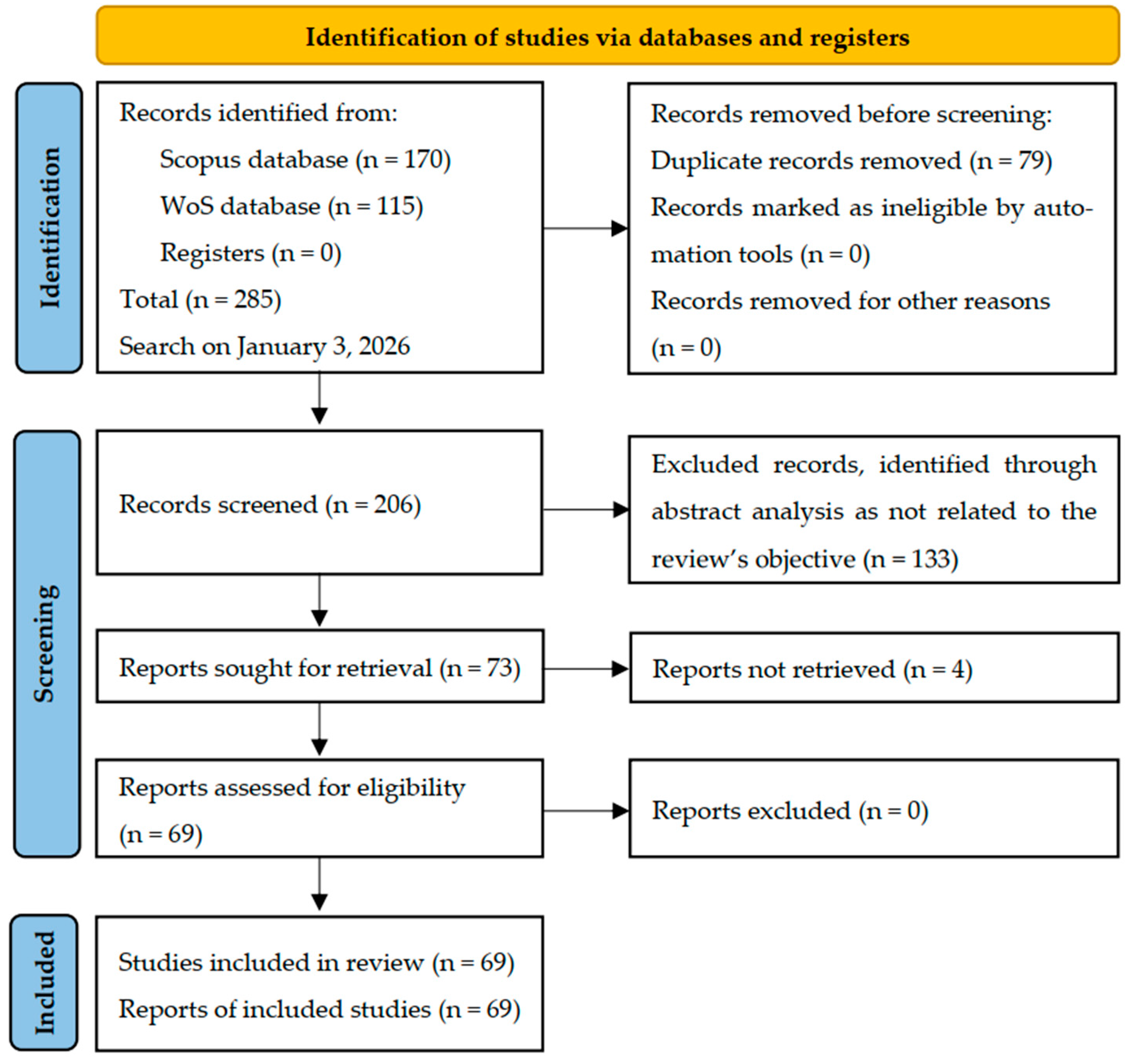
Scopus: (TITLE-ABS-KEY ((“tax behav*” OR “tax aggressiveness” OR “tax avoidance” OR “tax strateg*” OR “tax evasion” OR “tax compliance” OR “tax planning” OR “tax saving*” OR “taxation” OR “tax minimi*”)) AND TITLE-ABS-KEY ((“family characteristic*” OR “family firm*” OR “family business*” OR “family own*” OR “family enterprise*” OR “family influenc*” OR “family control*” OR “family manag*” OR “family govern*” OR “founding family” OR “family compan*” OR “family involve*” OR “family led”))) AND (LIMIT-TO (DOCTYPE, “ar”)) AND (LIMIT-TO (LANGUAGE, “English”));
WoS: TS = (“tax behav*” OR “tax aggressiveness” OR “tax avoidance” OR “tax strateg*” OR “tax evasion” OR “tax compliance” OR “tax planning” OR “tax saving*” OR “taxation” OR “tax minimi*”) AND TS = (“family characteristic*” OR “family firm*” OR “family business*” OR “family own*” OR “family enterprise*” OR “family influenc*” OR “family control*” OR “family manag*” OR “family govern*” OR “founding family” OR “family compan*” OR “family involve*” OR “family led”) AND LA = (English) AND DT = (Article).
3. Results
3.1. Overview of the Selected Studies

3.2. Mapping the Theoretical Foundations of Family Firms’ Tax Behavior
3.2.1. Agency Theory and SEW in Explaining Family Firms’ Tax Behavior
3.2.2. Alternative Theoretical Perspectives on Family Firms’ Tax Behavior
3.3. Theoretical Blind Spots in SEW-Based Explanations of Family Firms’ Tax Behavior
3.4. Missing Links to CIT Minimization Concrete Practices
4. Main Conclusions

5. Future Research

5.1. Improved Operationalization of SEW and the FIBER Framework
5.2. Cross-National Comparative Designs
5.3. Greater Focus on Observable CIT Minimization Mechanisms
Supplementary Materials
Author Contributions
Funding
Institutional Review Board Statement
Informed Consent Statement
Data Availability Statement
Conflicts of Interest
References
- Abdelfattah, T., & Aboud, A. (2020). Tax avoidance, corporate governance, and corporate social responsibility: The case of the Egyptian capital market. Journal of International Accounting, Auditing and Taxation, 38, 100304. [Google Scholar] [CrossRef] [Scilit]
- Abu-Rajab, L., Steijvers, T., Corten, M., Lybaert, N., & Alsharairi, M. (2024). The impact of the CEO’s Islamic religiosity on tax aggressive behavior in family firms. International Journal of Islamic and Middle Eastern Finance and Management, 17(5), 955–973. [Google Scholar] [CrossRef] [Scilit]
- Ajmal, T. K., Singhal, A., Kumar, V., & Atawnah, N. (2026). Family firms and tax avoidance preferences: Evidence from India. Emerging Markets Review, 70, 101410. [Google Scholar] [CrossRef] [Scilit]
- Alm, J., Martinez-Vazquez, J., & McClellan, C. (2016). Corruption and firm tax evasion. Journal of Economic Behavior and Organization, 124, 146–163. [Google Scholar] [CrossRef] [Scilit]
- Almaharmeh, M. I., Shehadeh, A., Alkayed, H., Aladwan, M., & Iskandrani, M. (2024). Family ownership, corporate governance quality and tax avoidance: Evidence from an emerging market—The case of Jordan. Journal of Risk and Financial Management, 17(2), 86. [Google Scholar] [CrossRef] [Scilit]
- Anesa, M., Gillespie, N., Spee, A. P., & Sadiq, K. (2019). The legitimation of corporate tax minimization. Accounting, Organizations and Society, 75, 17–39. [Google Scholar] [CrossRef] [Scilit]
- Arregle, J.-L., Calabrò, A., Hitt, M. A., Kano, L., & Schwens, C. (2024). Family business and international business: Breaking silos and establishing a rigorous way forward. Journal of World Business, 59(3), 101532. [Google Scholar] [CrossRef] [Scilit]
- Arregle, J.-L., Hitt, M. A., Sirmon, D. G., & Very, P. (2007). The development of organizational social capital: Attributes of family firms. Journal of Management Studies, 44(1), 73–95. [Google Scholar] [CrossRef] [Scilit]
- Baatwah, S. R., Mgammal, M. H., & Aomrah, M. R. (2025). Does audit committee chair expertise combat tax avoidance in emerging markets? Direct and indirect investigation. International Journal of Accounting & Information Management, 33(4), 716–740. [Google Scholar] [CrossRef] [Scilit]
- Bauweraerts, J., Cirillo, A., & Sciascia, S. (2024). Socioemotional wealth and tax aggressiveness in private family firms: The role of the CEO’s characteristics. Family Business Review, 37(3), 370–395. [Google Scholar] [CrossRef] [Scilit]
- Bauweraerts, J., & Vandernoot, J. (2019). An exploratory study on the influence of family CEOs on tax aggressiveness in private family firms: The moderating role of CEO gender and survival risk. Economics Bulletin, 39(1), 636–648. [Google Scholar]
- Bauweraerts, J., Vandernoot, J., & Buchet, A. (2020). Family firm heterogeneity and tax aggressiveness: A mixed gamble approach. Canadian Journal of Administrative Sciences, 37(2), 149–163. [Google Scholar] [CrossRef] [Scilit]
- Belahouaoui, R., & Attak, E. H. (2024). Analysis of tax compliance behavior of family businesses: Combining social and psychology norms and legitimacy determinants. International Journal of Sociology and Social Policy, 44(7–8), 672–688. [Google Scholar] [CrossRef] [Scilit]
- Benkraiem, R., Lakhal, F., & Slama, A. (2024). How does the heterogeneity of institutional investors influence corporate tax avoidance? The moderating role of family ownership. International Journal of Managerial Finance, 20(5), 1144–1169. [Google Scholar] [CrossRef] [Scilit]
- Bergmann, N. (2024). Heterogeneity in family firm finance, accounting and tax policies: Dimensions, effects and implications for future research. Journal of Business Economics, 94(3), 311–378. [Google Scholar] [CrossRef] [Scilit]
- Berrone, P., Cruz, C., & Gomez-Mejia, L. R. (2012). Socioemotional wealth in family firms: Theoretical dimensions, assessment approaches, and agenda for future research. Family Business Review, 25(3), 258–279. [Google Scholar] [CrossRef] [Scilit]
- Bona-Sánchez, C., Pérez-Alemán, J., & Santana Martín, D. J. (2020). Political ties and corporate tax burden in Spain|Conexiones políticas y presión fiscal empresarial en España. Revista Espanola de Financiacion y Contabilidad, 49(1), 74–93. [Google Scholar] [CrossRef] [Scilit]
- Boubaker, S., Derouiche, I., & Nguyen, H. (2022). Voluntary disclosure, tax avoidance and family firms. Journal of Management and Governance, 26(1), 129–158. [Google Scholar] [CrossRef] [Scilit]
- Brune, A., Thomsen, M., & Watrin, C. (2019a). Family firm heterogeneity and tax avoidance: The role of the founder. Family Business Review, 32(3), 296–317. [Google Scholar] [CrossRef] [Scilit]
- Brune, A., Thomsen, M., & Watrin, C. (2019b). Tax avoidance in different firm types and the role of nonfamily involvement in private family firms. Managerial and Decision Economics, 40(8), 950–970. [Google Scholar] [CrossRef] [Scilit]
- Calabrò, A., Torchia, M., Gómez-Mejía, L. R., Pongelli, C., & Lohe, F.-W. (2025). What are family firms all about? Advancing family business research through socioemotional wealth theory. Journal of Management Studies. Advance online publication. [Google Scholar] [CrossRef] [Scilit]
- Cao, F., Li, S., Dai, M., & Li, J. (2023). Your heart is where your treasure is: Family chairman and tax avoidance in family-controlled firms. Journal of Business Research, 154, 113298. [Google Scholar] [CrossRef] [Scilit]
- Carbone, E., Manzi, M. A., Cirillo, A., & Sciascia, S. (2025). Tax avoidance in family firms: A multi-level literature review. Entrepreneurship Research Journal. Advance online publication. [Google Scholar] [CrossRef] [Scilit]
- Chakroun, S., & Ben Amar, A. (2025). The IFRS adoption, corporate tax avoidance and the moderating effect of family ownership. International Journal of Law and Management, 67(1), 16–36. [Google Scholar] [CrossRef] [Scilit]
- Chalevas, C. G., Doukakis, L. C., Karampinis, N. I., & Pavlopoulou, O.-C. (2024). The impact of family ownership on tax avoidance: International evidence. International Review of Financial Analysis, 94, 103317. [Google Scholar] [CrossRef] [Scilit]
- Chen, M.-C., & Li, H.-Y. (2025). Are Taiwanese descendant family firms more aggressive in tax avoidance? Asia-Pacific Journal of Accounting & Economics. Advance online publication. [Google Scholar] [CrossRef] [Scilit]
- Chen, S., Chen, X., Cheng, Q., & Shevlin, T. (2010). Are family firms more tax aggressive than non-family firms? Journal of Financial Economics, 95(1), 41–61. [Google Scholar] [CrossRef] [Scilit]
- Cheng, C. S. A., Guo, P., Weng, C. H., & Wu, Q. (2021). Innovation and corporate tax planning: The distinct effects of patents and R&D. Contemporary Accounting Research, 38(1), 621–653. [Google Scholar] [CrossRef] [Scilit]
- Cho, H. (2020). Sustainable tax behavior of MNEs: Effect of international tax law reform. Sustainability, 12(18), 7738. [Google Scholar] [CrossRef] [Scilit]
- Cho, S.-A., Kim, S., & Choi, W.-W. (2025). Unified or divided? Conflicting interests of controlling shareholders in corporate tax avoidance. Emerging Markets Review, 68, 101339. [Google Scholar] [CrossRef] [Scilit]
- Chrisman, J. J., Chua, J. H., Pearson, A. W., & Barnett, T. (2012). Family involvement, family influence, and family-centered non-economic goals in small firms. Entrepreneurship Theory and Practice, 36(2), 267–293. [Google Scholar] [CrossRef] [Scilit]
- Chrisman, J. J., Chua, J. H., & Sharma, P. (2005). Trends and directions in the development of a strategic management theory of the family firm. Entrepreneurship: Theory and Practice, 29(5), 555–576. [Google Scholar] [CrossRef] [Scilit]
- Cirillo, A., Manzi, M. A., Bauweraerts, J., & Sciascia, S. (2025). Tax avoidance in family business: The ethical perspective of CEO transgenerational responsibility. Journal of Business Ethics, 198, 841–864. [Google Scholar] [CrossRef] [Scilit]
- Clemente-Almendros, J. A., Camisón-Haba, S., & Camisón-Zornoza, C. (2021). Family firm heterogeneity and tax aggressiveness: A quasi-experimental analysis of the impact of different family generations. Journal of Small Business Strategy, 31(3), 102–121. [Google Scholar] [CrossRef] [Scilit]
- Clemente-Almendros, J. A., & González-Cruz, T. (2023). Family involvement and proactive tax management behaviour in private family SMEs. International Journal of Entrepreneurial Behaviour and Research, 29(1), 218–244. [Google Scholar] [CrossRef] [Scilit]
- Cruz, S. R., & Soares, C. (2022). Use of the tax benefit of conventional remuneration of share capital by Portuguese companies. Revista Contabilidade e Finanças, 33(90), e1587. [Google Scholar] [CrossRef] [Scilit]
- Dinis, A., & Martins, A. (2022). Country note: Assessing the corporate use of tax relief measures in Portugal in the wake of the pandemic: A survey. Intertax, 50(3), 257–264. [Google Scholar] [CrossRef] [Scilit]
- Eddleston, K. A., & Mulki, J. P. (2021). Differences in family-owned SMEs’ ethical behavior: A mixed gamble perspective of family firm tax evasion. Entrepreneurship: Theory and Practice, 45(4), 767–791. [Google Scholar] [CrossRef] [Scilit]
- Fama, E. F., & Jensen, M. C. (1983). Separation of ownership and control. Journal of Law and Economics, 26(2), 301–325. [Google Scholar] [CrossRef] [Scilit]
- Flamini, G., Vola, P., Songini, L., & Gnan, L. (2021). The determinants of tax aggressiveness in family firms: An investigation of Italian private family firms. Sustainability, 13(14), 7654. [Google Scholar] [CrossRef] [Scilit]
- Gaaya, S., Lakhal, N., & Lakhal, F. (2017). Does family ownership reduce corporate tax avoidance? The moderating effect of audit quality. Managerial Auditing Journal, 32(7), 731–744. [Google Scholar] [CrossRef] [Scilit]
- Gomes, M. L., & Abreu, P. S. (2018). Corporate social responsibility and tax planning: From private to public regulation. Revista de Direito Internacional Econômico e Tributário, 13(1), 422–448. [Google Scholar]
- Gomez-Mejia, L. R., Cruz, C., Berrone, P., & De Castro, J. (2011). The bind that ties: Socioemotional wealth preservation in family firms. The Academy of Management Annals, 5(1), 653–707. [Google Scholar] [CrossRef]
- Gómez-Mejía, L. R., Haynes, K. T., Núñez-Nickel, M., Jacobson, K. J. L., & Moyano-Fuentes, J. (2007). Socioemotional wealth and business risks in family-controlled firms: Evidence from Spanish olive oil mills. Administrative Science Quarterly, 52(1), 106–137. [Google Scholar] [CrossRef] [Scilit]
- Gómez-Mejía, L. R., & Herrero, I. (2022). Back to square one: The measurement of Socioemotional Wealth (SEW). Journal of Family Business Strategy, 13(4), 100480. [Google Scholar] [CrossRef] [Scilit]
- Habbershon, T. G., & Williams, M. L. (1999). A resource-based framework for assessing the strategic advantages of family firms. Family Business Review, 12(1), 1–25. [Google Scholar] [CrossRef] [Scilit]
- Hanlon, M., & Heitzman, S. (2010). A review of tax research. Journal of Accounting and Economics, 50(2–3), 127–178. [Google Scholar] [CrossRef] [Scilit]
- Haryadi, D., Giriati, G., & Wendy, W. (2025). Ownership structure and transfer pricing in Indonesia: How are board experience and executive characteristics involved? Investment Management and Financial Innovations, 22(1), 134–146. [Google Scholar] [CrossRef] [Scilit]
- Herawati, N., Rahmawati, Bandi, B., & Setiawan, D. (2021). Family ownership and corporate tax aggressiveness: The moderating effect of independent commissioner. Journal of Governance and Regulation, 10(4), 84–92. [Google Scholar] [CrossRef] [Scilit]
- Itan, I., Ahmad, Z., Setiana, J., & Karjantoro, H. (2024). Corporate governance, tax avoidance and earnings management: Family CEO vs. non-family CEO managed companies in Indonesia. Cogent Business and Management, 11(1), 2312972. [Google Scholar] [CrossRef] [Scilit]
- Jedlička, V. (2023). International tax planning and ownership structure in the Czech Republic. Amfiteatru Economic, 25(64), 867–884. [Google Scholar] [CrossRef] [Scilit]
- Kałdoński, M., & Jewartowski, T. (2024). Tax aggressiveness under concentrated ownership: The importance of long-term institutional investors. Finance Research Letters, 65, 105541. [Google Scholar] [CrossRef] [Scilit]
- Kartadjumena, E., & Nuryaman, N. (2024). Ownership structures, executive compensation and tax aggressiveness in Indonesia mining and plantation companies: The moderating effect of audit quality. International Journal of Economics and Financial Issues, 14(3), 23–32. [Google Scholar] [CrossRef] [Scilit]
- Kerr, J. N., Price, R., Román, F. J., & Romney, M. A. (2024). Corporate governance and tax avoidance: Evidence from governance reform. Journal of Accounting and Public Policy, 47, 107232. [Google Scholar] [CrossRef] [Scilit]
- Khalil, S., O’Shaughnessy, D., & Twardus, I. (2023). SEC review of tax disclosures in family firms. International Journal of Disclosure and Governance, 20(2), 138–154. [Google Scholar] [CrossRef] [Scilit]
- Khelil, I., & Khlif, H. (2023). Tax avoidance in family firms: A literature review. Journal of Financial Crime, 30(4), 1021–1035. [Google Scholar] [CrossRef] [Scilit]
- Kolias, G., & Koumanakos, E. (2022). CEO duality and tax avoidance: Empirical evidence from Greece. Journal of International Accounting, Auditing and Taxation, 47, 100465. [Google Scholar] [CrossRef] [Scilit]
- Kovermann, J., & Wendt, M. (2019). Tax avoidance in family firms: Evidence from large private firms. Journal of Contemporary Accounting and Economics, 15(2), 145–157. [Google Scholar] [CrossRef] [Scilit]
- Kuo, C.-S. (2022). Family firms, tax avoidance, and socioemotional wealth: Evidence from tax reform in Taiwan. Review of Quantitative Finance and Accounting, 58(4), 1535–1572. [Google Scholar] [CrossRef] [Scilit]
- Lakhal, N., Swayah, B., Slimane, M. B., & Hamza, M. (2025). Tax avoidance and cost of debt: Evidence from French listed firms. Journal of Applied Accounting Research, 26(5), 1067–1085. [Google Scholar] [CrossRef] [Scilit]
- Landry, S., Deslandes, M., & Fortin, A. (2013). Tax aggressiveness, corporate social responsibility, and ownership structure. Journal of Accounting, Ethics and Public Policy, 14(3), 611–645. [Google Scholar] [CrossRef] [Scilit]
- Lastiati, A., Siregar, S. V., Diyanty, V., & Samingun. (2020). Tax avoidance and cost of debt: Ownership structure and corporate governance. Pertanika Journal of Social Sciences and Humanities, 28(1), 533–546. [Google Scholar]
- Le Breton-Miller, I., & Miller, D. (2013). Socioemotional wealth across the family firm life cycle: A commentary on “Family business survival and the role of boards”. Entrepreneurship Theory and Practice, 37(6), 1391–1397. [Google Scholar] [CrossRef] [Scilit]
- Lee, C.-H., & Bose, S. (2021). Do family firms engage in less tax avoidance than non-family firms? The corporate opacity perspective. Journal of Contemporary Accounting and Economics, 17(2), 100263. [Google Scholar] [CrossRef] [Scilit]
- López-González, E., Martínez-Ferrero, J., & García-Meca, E. (2019). Does corporate social responsibility affect tax avoidance: Evidence from family firms. Corporate Social Responsibility and Environmental Management, 26(4), 819–831. [Google Scholar] [CrossRef] [Scilit]
- Ma, D., Mattingly, E. S., Kushev, T. N., Ahuja, M. K., & Manikas, A. S. (2022). The role of socioemotional wealth in entrepreneurial persistence decisions for family businesses. Journal of Small Business Strategy, 32(3), 29–44. [Google Scholar] [CrossRef] [Scilit]
- Mafrolla, E., & D’Amico, E. (2016). Tax aggressiveness in family firms and the non-linear entrenchment effect. Journal of Family Business Strategy, 7(3), 178–184. [Google Scholar] [CrossRef] [Scilit]
- Martin, J. A., Evert, R. E., & Payne, G. T. (2024). Nonfinancial outcomes in family business research: A review and future research agenda. Family Business Review, 37(1), 161–185. [Google Scholar] [CrossRef] [Scilit]
- Moore, J. A., Suh, S., & Werner, E. M. (2017). Dual entrenchment and tax management: Classified boards and family firms. Journal of Business Research, 79, 161–172. [Google Scholar] [CrossRef] [Scilit]
- Mulya, A. S., Sandy, R. M., & Janti, K. M. (2024). The role of Indonesian business owners in aggressive tax planning. Revista de Gestão Social e Ambiental, 18(6), e05940. [Google Scholar] [CrossRef] [Scilit]
- Nafti, O., Kateb, I., & Masghouni, O. (2020). Tax evasion, firm’s value and governance: Evidence from Tunisian Stock Exchange. Journal of Financial Crime, 27(3), 781–799. [Google Scholar] [CrossRef] [Scilit]
- Neubaum, D. O., & Micelotta, E. (2021). Wanted—Theoretical contributions: An editorial on the pitfalls and pathways in family business research. Family Business Review, 34(3), 242–250. [Google Scholar] [CrossRef] [Scilit]
- Ngah, Z. A., Ismail, N., & Abd Hamid, N. (2021). Tax evasion through fraudulent financial reporting amongst SMEs in Malaysia. Journal of Financial Crime, 28(1), 214–227. [Google Scholar] [CrossRef] [Scilit]
- Ngah, Z. A., Ismail, N., & Abd Hamid, N. (2022). A cohesive model of predicting tax evasion from the perspective of fraudulent financial reporting amongst small and medium sized enterprises. Accounting Research Journal, 35(3), 349–363. [Google Scholar] [CrossRef] [Scilit]
- Niu, G., Wang, Y., Zhou, Y., & Gan, X. (2024). Family ties and corporate tax avoidance. Journal of International Business Studies, 55, 976–996. [Google Scholar] [CrossRef] [Scilit]
- Nuritomo, Utama, S., & Hermawan, A. A. (2020). Family ownership and tax avoidance: An analysis of foreign related party transactions and dividend payments. International Journal of Business and Society, 21(2), 643–659. [Google Scholar] [CrossRef] [Scilit]
- Oktaviani, R. M., Rohman, A., & Zulaikha, Z. (2024). CEO characteristics and tax aggressiveness in Indonesian family firms: The upper echelons theory perspective. Journal of Tax Reform, 10(1), 149–161. [Google Scholar] [CrossRef] [Scilit]
- Özbay, D., Adıgüzel, H., & Karahan Gökmen, M. (2023). Corporate social responsibility and tax avoidance: Channeling effect of family firms. Journal of Corporate Accounting and Finance, 34(3), 11–30. [Google Scholar] [CrossRef] [Scilit]
- Page, M. J., McKenzie, J. E., Bossuyt, P. M., Boutron, I., Hoffmann, T. C., Mulrow, C. D., Shamseer, L., Tetzlaff, J. M., Akl, E. A., Brennan, S. E., Chou, R., Glanville, J., Grimshaw, J. M., Hróbjartsson, A., Lalu, M. M., Li, T., Loder, E. W., Mayo-Wilson, E., McDonald, S., … Moher, D. (2021a). The PRISMA 2020 statement: An updated guideline for reporting systematic reviews. BMJ, 372, n71. [Google Scholar] [CrossRef] [Scilit] [PubMed]
- Page, M. J., Moher, D., Bossuyt, P. M., Boutron, I., Hoffmann, T. C., Mulrow, C. D., Shamseer, L., Tetzlaff, J. M., Akl, E. A., Brennan, S. E., Chou, R., Glanville, J., Grimshaw, J. M., Hróbjartsson, A., Lalu, M. M., Li, T., Loder, E. W., Mayo-Wilson, E., McDonald, S., … McKenzie, J. E. (2021b). PRISMA 2020 explanation and elaboration: Updated guidance and exemplars for reporting systematic reviews. BMJ, 372, n160. [Google Scholar] [CrossRef]
- Palalangan, C. A., Mannan, A., Rura, Y., & Pontoh, G. T. (2024). Determinants of tax aggressiveness with corporate governance as a moderation variable in public companies in Indonesia. Financial and Credit Activity: Problems of Theory and Practice, 5(58), 97–110. [Google Scholar] [CrossRef] [Scilit]
- Paré, G., Trudel, M.-C., Jaana, M., & Kitsiou, S. (2015). Synthesizing information systems knowledge: A typology of literature reviews. Information & Management, 52(2), 183–199. [Google Scholar] [CrossRef] [Scilit]
- Parisi, V., & Federici, D. (2023). Family firms’ aggressive tax planning: An empirical evaluation for Italy. Italian Economic Journal, 9, 1299–1327. [Google Scholar] [CrossRef] [Scilit]
- Puji, A. T., Rahmawati, Aryani, Y. A., & Setiawan, D. (2019). The effect of family ownership on aggressive tax avoidance in Indonesia. EJournal of Tax Research, 17(1), 105–117. [Google Scholar]
- Qawqzeh, H. K. (2023). The effect of ownership structure on tax avoidance with audit quality as a moderating variable: Evidence from the ailing economics. Journal of Financial Reporting and Accounting. Advance online publication. [Google Scholar] [CrossRef] [Scilit]
- Rathke, A. A. T. (2021). Profit shifting in Brazil and the impact of tax havens. Revista Contabilidade & Finanças, 32(85), 95–108. [Google Scholar] [CrossRef] [Scilit]
- Reay, T., & Whetten, D. A. (2011). What constitutes a theoretical contribution in family business? Family Business Review, 24(2), 105–110. [Google Scholar] [CrossRef] [Scilit]
- Rethlefsen, M. L., Kirtley, S., Waffenschmidt, S., Ayala, A. P., Moher, D., Page, M. J., Koffel, J. B., Blunt, H., Brigham, T., Chang, S., Clark, J., Conway, A., Couban, R., de Kock, S., Farrah, K., Fehrmann, P., Foster, M., Fowler, S. A., Glanville, J., … Young, S. (2021). PRISMA-S: An extension to the PRISMA statement for reporting literature searches in systematic reviews. Systematic Reviews, 10, 39. [Google Scholar] [CrossRef] [Scilit] [PubMed]
- Reuber, A. R. (2017). Strengthening your literature review. Family Business Review, 23(2), 105–108, (Original work published 2010). [Google Scholar] [CrossRef] [Scilit]
- Sanchez-Famoso, V., Cruz, C., Batterjee, M. M., Mejia-Morelos, J.-H., Cisneros, L., & Tuyen LE, N. (2025). Socioemotional wealth (SEW) across borders: Integrating national context into SEW research. Journal of Family Business Strategy, 16(1), 100647. [Google Scholar] [CrossRef] [Scilit]
- Sari, N. N., & Nuryanah, S. (2024). The role of shareholders in controlling tax avoidance: Evidence from ASEAN countries. International Journal of Disclosure and Governance, 21, 421–432. [Google Scholar] [CrossRef] [Scilit]
- Sánchez-Marín, G., Portillo-Navarro, M.-J., & Clavel, J. G. (2016). The influence of family involvement on tax aggressiveness of family firms. Journal of Family Business Management, 6(2), 143–168. [Google Scholar] [CrossRef] [Scilit]
- Shi, X., Hou, J., & Gu, Q. (2023). In-laws’ involvement in management and tax avoidance: Evidence from family firms in China. Finance Research Letters, 53, 103646. [Google Scholar] [CrossRef] [Scilit]
- Souguir, Z., Lassoued, N., & Bouzgarrou, H. (2024a). CEO overconfidence and tax avoidance: Role of institutional and family ownership. International Journal of Managerial Finance, 20(3), 768–793. [Google Scholar] [CrossRef] [Scilit]
- Souguir, Z., Lassoued, N., Khanchel, I., & Bouzgarrou, H. (2024b). Environmental performance and corporate tax avoidance: Greenwashing policy or eco-responsibility? The moderating role of ownership structure. Journal of Cleaner Production, 434, 140152. [Google Scholar] [CrossRef] [Scilit]
- Steijvers, T., & Niskanen, M. (2014). Tax aggressiveness in private family firms: An agency perspective. Journal of Family Business Strategy, 5(4), 347–357. [Google Scholar] [CrossRef] [Scilit]
- Sucahyo, U. S., Damayanti, T. W., Prabowo, R., & Supramono, S. (2020). Tax aggressiveness of family firms in emerging countries: How does resource-based view explain it? Entrepreneurial Business and Economics Review, 8(3), 101–115. [Google Scholar] [CrossRef] [Scilit]
- Suh, J.-W., Lee, H.-Y., Kuk, A. E., & Ryu, H. (2019). Effect of the trusted taxpayer designation on corporate tax avoidance behaviour: Evidence from Korea. Asian Journal of Business and Accounting, 12(2), 121–146. [Google Scholar] [CrossRef] [Scilit]
- Sumiati, A., Widyastuti, U., Mardi, & Respati, D. K. (2023). Analysis of financial and non-financial factors that influence tax aggressiveness in registered companies on the Indonesia stock exchange year of 2016–2019. Quality—Access to Success, 24, 193. [Google Scholar] [CrossRef] [Scilit]
- Supantri, R. D., & Rahmiati, A. (2020). Controlling shareholders’ tendency toward tax avoidance in family firms and independent commissioners. International Journal of Innovation, Creativity and Change, 13(4), 664–679. [Google Scholar]
- Sutrisno, P., Utama, S., Hermawan, A. A., & Fatima, E. (2022). Founder and descendant vs. professional CEO: Does CEO overconfidence affect tax avoidance in the Indonesia case? Economies, 10(12), 327. [Google Scholar] [CrossRef] [Scilit]
- Sutrisno, P., Utama, S., Hermawan, A. A., & Fatima, E. (2023). Founder or descendant CEOs, tax avoidance and firms’ future risks: The Indonesian evidence. Journal of Family Business Management, 13(4), 1190–1211. [Google Scholar] [CrossRef] [Scilit]
- Swab, R. G., Sherlock, C., Markin, E., & Dibrell, C. (2020). “SEW” what do we know and where do we go? A review of socioemotional wealth and a way forward. Family Business Review, 33(4), 424–445. [Google Scholar] [CrossRef] [Scilit]
- van Eck, N. J., & Waltman, L. (2010). Software survey: VOSviewer, a computer program for bibliometric mapping. Scientometrics, 84(2), 523–538. [Google Scholar] [CrossRef] [Scilit] [PubMed]
- Vázquez, P., & Rocha, H. (2018). On the goals of family firms: A review and integration. Journal of Family Business Strategy, 9(2), 94–106. [Google Scholar] [CrossRef] [Scilit]
- Wiseman, R. M., & Gomez-Mejia, L. R. (1998). A behavioral agency model of managerial risk taking. Academy of Management Review, 23(1), 133–153. [Google Scholar] [CrossRef] [Scilit]
- Young, M. N., Peng, M. W., Ahlstrom, D., Bruton, G. D., & Jiang, Y. (2008). Corporate governance in emerging markets: A review of the principal–principal perspective. Journal of Management Studies, 45(1), 196–220. [Google Scholar] [CrossRef] [Scilit]
- Zellweger, T. M., Kellermanns, F. W., Chrisman, J. J., & Chua, J. H. (2012). Family control and family firm valuation by family CEOs: The importance of intentions for transgenerational control. Organization Science, 23(3), 851–868. [Google Scholar] [CrossRef] [Scilit]


Disclaimer/Publisher’s Note: The statements, opinions and data contained in all publications are solely those of the individual author(s) and contributor(s) and not of MDPI and/or the editor(s). MDPI and/or the editor(s) disclaim responsibility for any injury to people or property resulting from any ideas, methods, instructions or products referred to in the content. |
© 2026 by the authors. Licensee MDPI, Basel, Switzerland. This article is an open access article distributed under the terms and conditions of the Creative Commons Attribution (CC BY) license.
Share and Cite
Viana, C.; Cruz, S.; Dinis, A. Bridging Theoretical Assumptions and Empirical Evidence on Family Firms’ Tax Behavior: A Systematic Review. J. Risk Financ. Manag. 2026, 19, 125. https://doi.org/10.3390/jrfm19020125
Viana C, Cruz S, Dinis A. Bridging Theoretical Assumptions and Empirical Evidence on Family Firms’ Tax Behavior: A Systematic Review. Journal of Risk and Financial Management. 2026; 19(2):125. https://doi.org/10.3390/jrfm19020125
Chicago/Turabian StyleViana, Cledilson, Sérgio Cruz, and Ana Dinis. 2026. "Bridging Theoretical Assumptions and Empirical Evidence on Family Firms’ Tax Behavior: A Systematic Review" Journal of Risk and Financial Management 19, no. 2: 125. https://doi.org/10.3390/jrfm19020125
APA StyleViana, C., Cruz, S., & Dinis, A. (2026). Bridging Theoretical Assumptions and Empirical Evidence on Family Firms’ Tax Behavior: A Systematic Review. Journal of Risk and Financial Management, 19(2), 125. https://doi.org/10.3390/jrfm19020125