Abstract
Agroecosystems are influenced by climate variability, which puts their productivity at risk. However, they tend to maintain a functional state through their resilience. The literature presents several methods for assessing general resilience, but for specific resilience to climate variability, there are very few methods. An index is proposed that assesses the resilience of agroecosystems to climate variability, based on approaches and indicators that consider the interrelationships of agricultural systems with the environment. The index is made up of a set of multidimensional indicators, which give weight to the role that these play in the resilience of an agroecosystem. As a result, decision-making is assisted in the attempt to adapt or modify components of a farm, technology, and the culture of farmers. This index conceptually introduces structural and linkage indicators that assess ecological connections within farms and between farms and their environment. To demonstrate the effectiveness of the method, an application was implemented to evaluate the resilience to climate variability of fifty-one farms, located in Colombia, dedicated to citrus production, and it was verified that the most resilient farms were those that have the best qualified indicators, as well as being the ones with the highest level of production and profitability.
1. Introduction
Climate variability and change can affect agroecosystems and thus agricultural production, even in high-yield and high-tech areas [1,2,3,4,5,6], endangering food safety [7,8] and disproportionately affecting the well-being of the poor and those with limited access to land, modern agriculture, inputs, infrastructure, and education [9]. In response, agroecosystems tend to be adapted and transformed to ensure and guarantee system functions [10] through resilience [11], which, in recent decades, has been the target of numerous scientific studies because of the deterioration of the environment [12].
Resilience is an emergent property generated in complex systems, which allows them to cushion, adapt, innovate, and transform in the face of specific stress factors and the inevitable and continuous biophysical and social changes in the environment [13,14,15,16]. It can be interpreted as “the amount of disruption needed to transform a system from one stability domain to another” [17]. “Resilience includes impacts and taking advantage of opportunities” [18] (pp. 300–301). “It is a system’s ability to restore viable evolutionary conditions for a specific course of tychastic uncertainty that is measured in terms of duration ” [19] (p. 251). “In this perspective, resistance to a disturbance and the speed with which a system returns to equilibrium is the measure of resilience. The faster the system bounces back, the more resilient it is” [14] (p. 300).
In ecological studies, “resilience determines the persistence of relationships within a system and is a measure of the ability of these systems to absorb changes of state variables, driving variables, and parameters, and persist is the ability of a system to return to an equilibrium state after a temporary disturbance” [20] (p. 17). Resilience is also applicable to social systems, where it is defined as the ability of groups or communities to interact with external disturbances because of social, political, and biophysical changes [18,21,22].
According to ref. [23], resilience can have two categories: (i) inherent resilience, which depends on the natural characteristics of the system, and (ii) acquired resilience, built on physical, biotic, social, economic, and cultural adaptations, where “human activities have reduced the resilience of managed ecosystems over time, making them vulnerable to disturbances” [17] (p. 247). In this sense, ref. [10,24,25] defined two types of resilience: (i) general resilience, which does not encompass the part of a system that could cross a threshold, nor the types of disturbances or shocks that the system must withstand; (ii) specific resilience: applied to problems that may arise from a specific set of sources or disturbances in certain aspects of a system, for example, climate variability.
In a study on agroecosystems, ref. [24] proposed that resilience is related to three complementary properties: (i) The amount of change that the agroecosystem can undergo and still maintain control of function and structure. (ii) The degree to which the system is capable of self-organization. (iii) The ability to build and increase the capacity for learning and adaptation [10]. This confirmed that resilience is related to the ability to ensure and guarantee system functions in the face of economic, social, environmental, and institutional disturbances through robustness, adaptability, and transformability. It allows agricultural systems to balance the ability to be efficient in each context with the ability to reorganize and adapt in response to unforeseen and unpredictable changes [25].
In the context of climate variability, ref. [26] (p. 1108) defined resilience as the “ability of a social ecological system and its components to anticipate, reduce, accommodate, or recover from the effects of a hazardous event or trend [weather related] in a timely and efficient manner”. In the same context, ref. [27] argued that resilience in agroecosystems is generated when people and communities interact to face the effects of this variability.
From the point of view of the methods and indicators for the evaluation of the resilience of agroecosystems, the literature reports different approaches in local and global territorial contexts [10,11,28,29,30,31,32,33,34,35,36,37,38,39,40,41,42,43,44], most of which are related to the analysis of so-called general resilience [10]. This evaluation in developing countries has been approached with indices that seek to capture the greatest number of variables. However, these methods present limitations from a conceptual and methodological point of view, especially with moderate incorporation of social and cultural indicators and the analysis of the interaction of components in an agroecosystem without weights. Additionally, they have not been designed to specifically assess the resilience of agroecosystems towards climate variability.
Meuwissen (2019) and Meuwissen (2018) ref. [10,45] proposed a methodological framework to assess the resilience of agricultural systems using the adaptive cycle as a key concept. This framework includes three fundamental capacities or indicators for analyzing or assessing the resilience of agricultural systems: (1) robustness, (2) adaptability, and (3) transformability; and six attributes of resilience: (1) learning, (2) production, (3) networks, (4) governance, (5) diversity, and (6) resources. They recommended that methods for assessing resilience should focus on specifying or addressing the following questions:
- The limits of the system and its configuration (resilience of what?) (or specific resilience).
- The challenges of interest to the system (resilience for what?).
- The essential functions of the system (resilience for what purpose?).
Cabell (2012) [24] used the premise that agroecosystems are too complex to measure resilience accurately and, based on a thorough bibliographic review, proposed a set of thirteen indicators (without specifying the units of measure) that, when identified in an agroecosystem, suggest that it is resilient and able to adapt and transform: (1) socially self-organized, (2) ecologically self-regulated, (3) appropriately connected, (4) functional and response diversity, (5) optimally redundant, (6) spatial and temporal heterogeneity, (7) exposed to disturbance, (8) coupled with local natural capital, (9) reflective and shared learning, (10) globally autonomous and locally interdependent, (11) honors legacy, (12) builds human capital, and (13) reasonably profitable.
Peterson (2018) ref. [46] proposed an approach to operationally evaluate the resilience of agroecosystems. This proposal is an adaptation of the approaches developed by [47,48], wherein resilience is related to productive functions: “(1) productivity, (2) stability, (3) resistance to declines in yield components or growth parameters and their supporting mechanisms in the face of disturbance, and/or (4) rapid recovery to baseline functionality when conditions improve” [46] (p. 20).
A fundamental principle for assessing the resilience of agricultural systems was proposed by ref. [49], who warned that analyzing or evaluating the resilience of agroecosystems is not an exact process, given the complexity of these systems. In some cases, it is necessary to make predictions and decisions for future scenarios. This author proposed a heuristic approach for the development of methods to assess the resilience of agroecosystems that included the following: (1) adaptive cycle, (2) panarchy, (3) adaptability, and (4) transformability. “A heuristic technique is a problem-specific approach [not guaranteed to be perfect] that employs a practical method that provides sufficient accuracy for the [proposed] goals” [50] (p. 457). It is a practical approach for immediate objectives and decision-making for a precautionary principle.
Although resilience is a fundamental property for agroecosystems, autonomous adaptation and planned adaptation to fluctuations, as proposed by [51], and proposals for specific indices to assess the resilience of agroecosystems against climate variability, called specific resilience by [52,53], are scarce or critically underdeveloped [24]. Translating them into measurable entities is an ongoing challenge [46], which has slowed the construction of proposals. These difficulties or limitations result from climates that are diverse and present uncertainties. Measuring resilience is not an exact process but it provides information for decision-making in critical scenarios that can contribute to positive outcomes, for example, maintaining productivity, ensuring food security and autonomy, and conserving natural resources [27].
Therefore, analyzing the response capacity of agroecosystems to explicitly defined disturbances, such as climate variability, through the evaluation of specific resilience is strategically important for decision-making, guarantying agricultural production, conservation of ecosystems, and the social and economic well-being of communities [10,54].
The need to build tools to assess specific resilience is greater in developing countries, because changes in the climate tend to affect the poor more because of their state of economic and social vulnerability, as stated by ref. [55] (p. 6): “[where] climate change impacts tend to be regressive, falling more heavily on the poor than the rich”. Similarly, ref. [36] (p. 24) stated that: “inequality exerts disproportionate effects through three channels: (i) increased exposure of disadvantaged groups to climate hazards, (ii) increased susceptibility to damage caused by climate hazards, and (iii) decreased ability to cope with and recover from damage”.
The objective of this paper was to propose an index to evaluate the specific resilience of agroecosystems towards climate variability, called the agroecosystem resilience index (AgRI), built with the heuristic methods proposed by [49], which weigh the components of agroecosystems and include physical, biotic, social, economic, and cultural indicators. This index identifies the adjustments needed to strengthen the resilience of agroecosystem components, reduce vulnerability, and guarantee the production and conservation of resources in scenarios of climate variability. The main methodological contribution is the use of qualitative and quantitative indicators, generated from the analysis of the main attributes of agricultural systems, with the participation of experts and use of the Delphi method. This approach improves predictability and reduces uncertainty.
Section 1 presents a conceptual definition of resilience from the general and specific approaches to climate variability and a description of the main methodological contributions and indicators for evaluating it, emphasizing the need to build methods to evaluate the specific resilience to climatic disturbances. Section 2 describes a new index to assess the specific resilience of agroecosystems to climate variability, called the agroecosystem resilience index (AgRI), and the methodological route for its development. This index includes forty key indicators of physical, biotic, social, economic, and cultural categories, weighted by experts. Section 3 presents an application of AgRI, where the specific resilience to climatic variability of citrus crops in Colombian was evaluated and qualified, analyzing the profitability of traditional systems compared to those with a higher AgRI in Section 4. Finally, Section 5 discusses the scope and opportunities for improving AgRI, as well as the general conclusions of this article.
2. Methodological and Structural Approach of AgRI
To construct the AgRI, the agroecosystem was conceptualized as a social ecological system (SES), in the terms proposed by [53,56,57,58]; from this perspective, the indicators are related to social resilience and ecological resilience. The AgRI was built within the framework proposed by [10], it considers the three capacities that are crucial to understand the resilience of agricultural systems to climatic variability:
- Robustness: ability of the agroecosystem to maintain the desired level of products despite the occurrence of disturbances [54].
- Adaptability: the ability of human communities to manage resilience [49].
- Transformability: ability of the actors and components of the agroecosystem to create a functionally new system or structures of the system when the existing configuration is unsustainable [22,49].
Likewise, they include the attributes of resilience that contribute to the resilience of agricultural systems or improve resilience indicators [10,45]: (1) learning, (2) production, (3) networks, (4) governance, (5) diversity, (6) resources, and (7) profitability.
Specifically, the indicators were selected or classified in the context of the five generic principles for assessing resilience to climatic variability (Table 1, Column 4):
- (1)
- Diversity: functional diversity and responses to disturbance.
- (2)
- Modularity: internal division of the system into independent but connected modules [59].
- (3)
- Openness: refers to the connectivity between systems [59].
- (4)
- Adjustment of feedbacks or panarchy: the responses of one part of the system to changes in other parts of the system, including the component [60].
- (5)
- System reserves: reserve of resources (human, economic and social capital) for the SES when responding to disturbances or shocks [61]. The reserves provide redundancy and act as a buffer that compensates for losses or failures of system functions.
The AgRI considers the fundamental questions for assessing the specific resilience of agricultural systems proposed by [10,53], and each of the indicators were selected by taking into account the answers to these questions.
- (1)
- Resilience of what? agroecosystem resilience.
- (2)
- Resiliency to what? resilience to the disturbance of climate variability.
- (3)
- Resiliency for what purpose? maintain productivity features, profitability, human well-being, and physical and biotic sustainability.
- (4)
- What resilience capacities are assessed?
- Robustness: ability to withstand unanticipated stresses and shocks.
- Adaptability: ability to change the composition of inputs, production, marketing, and management in response to disturbances and maintain the functions of the agroecosystem.
- Transformability: ability to significantly change the internal structure and feedback mechanisms of the agroecosystem in response to disturbances.
- (5)
- What improves resilience? evaluation of the attributes that assess resilience through indicators. These attributes represent the individual and collective competencies and the enabling environment that enhances resilience capacities [10].
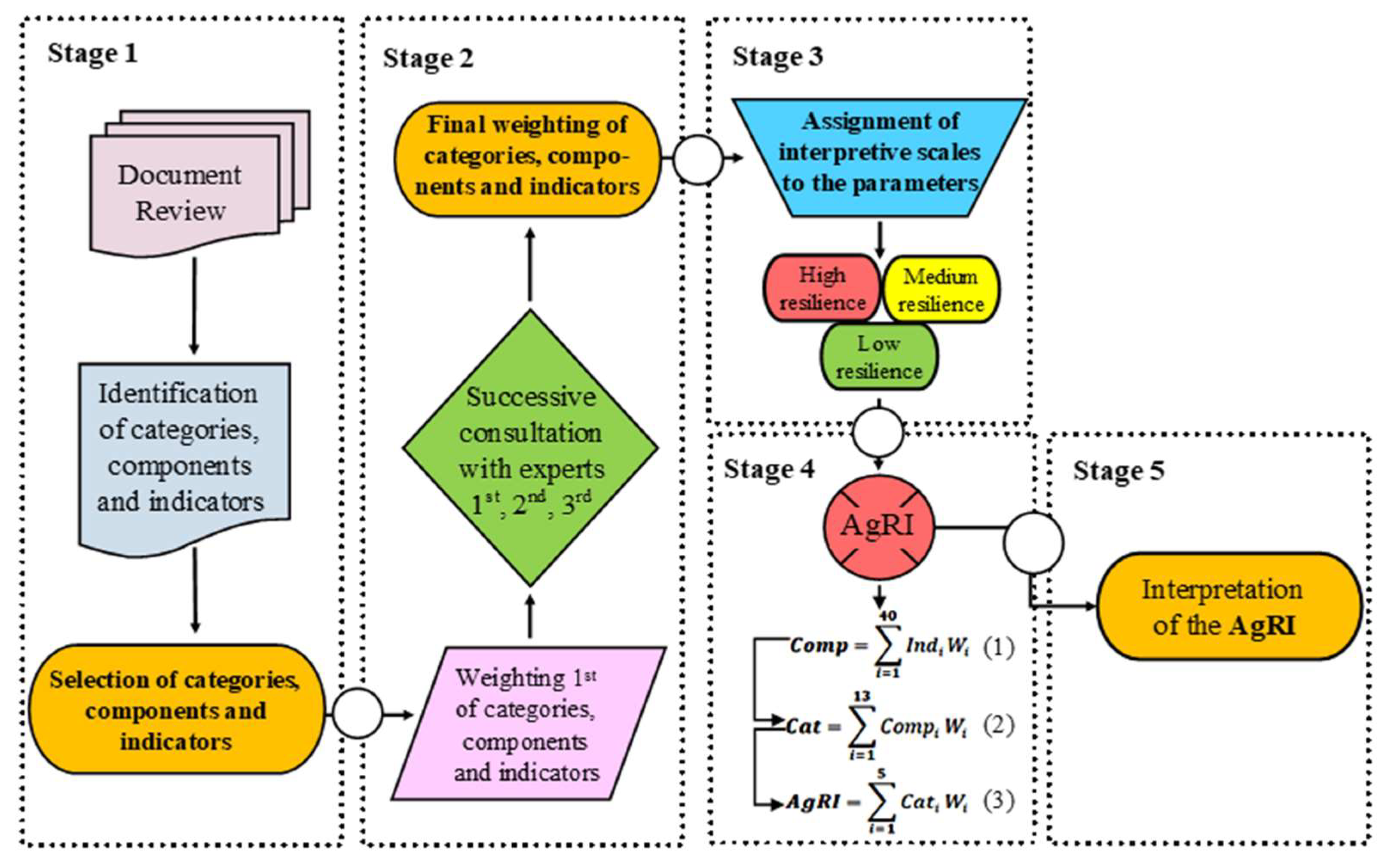
The methodology for calculating AgRI is made up of the following stages: (1) selection of indicators and organization into components and categories; (2) weighting indicators, components, and categories; (3) assignment of the interpretation scales of the indicators; (4) equations for the calculation of AgRI; and finally, (5) interpretation of the AgRI (Figure 1).
Figure 1.
Flow chart of the AgRI methodological approach.
2.1. Selection of Indicators and Organization into Components and Categories
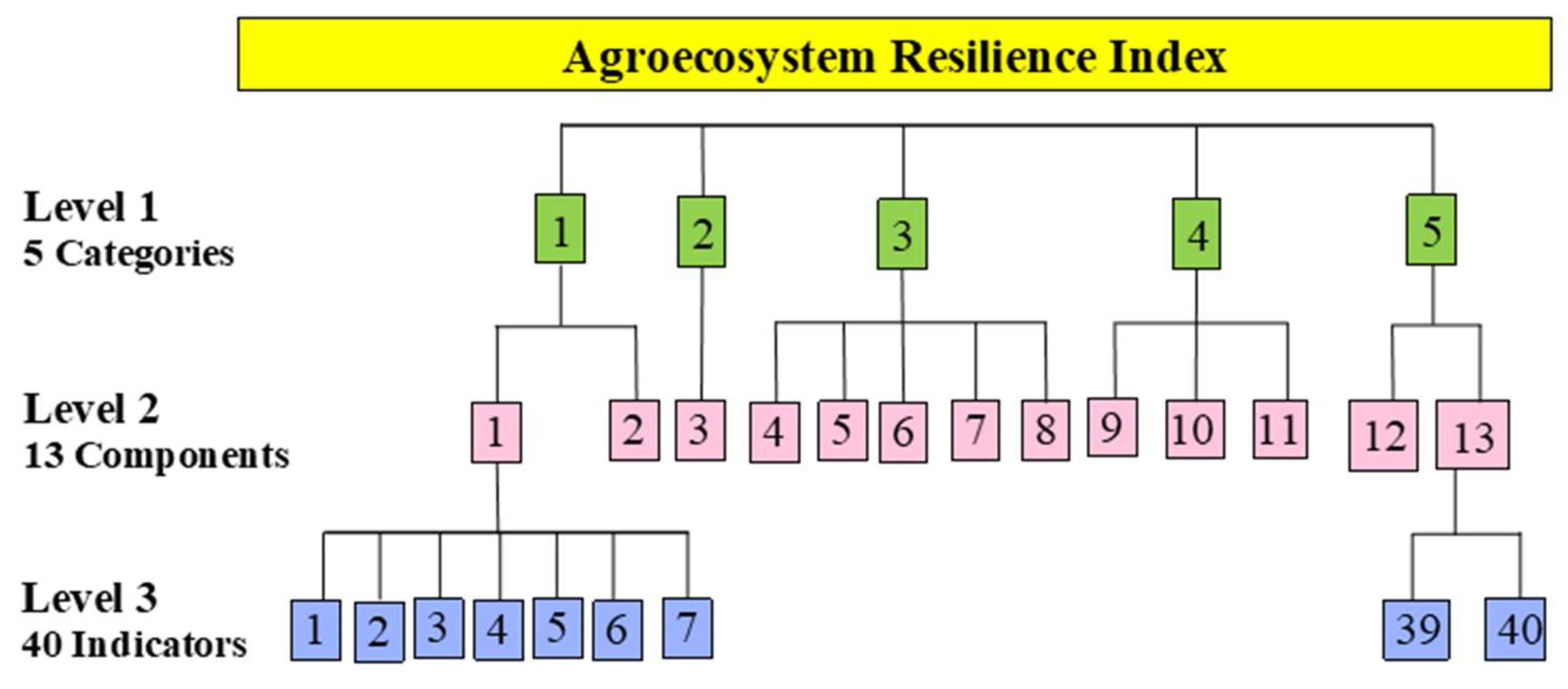
Forty key indicators were selected that, according to scientific evidence, are related to resilience to climatic disturbances (references are listed in Table 1, Column 7), generating a hierarchical structure that was divided into five categories made up of 13 components and 40 indicators. The five categories were: (1) physical-biotic, (2) agroecological, (3) sociocultural, (4) economic, and (5) technological (Figure 2).
Figure 2.
Hierarchical structure of AgRI.
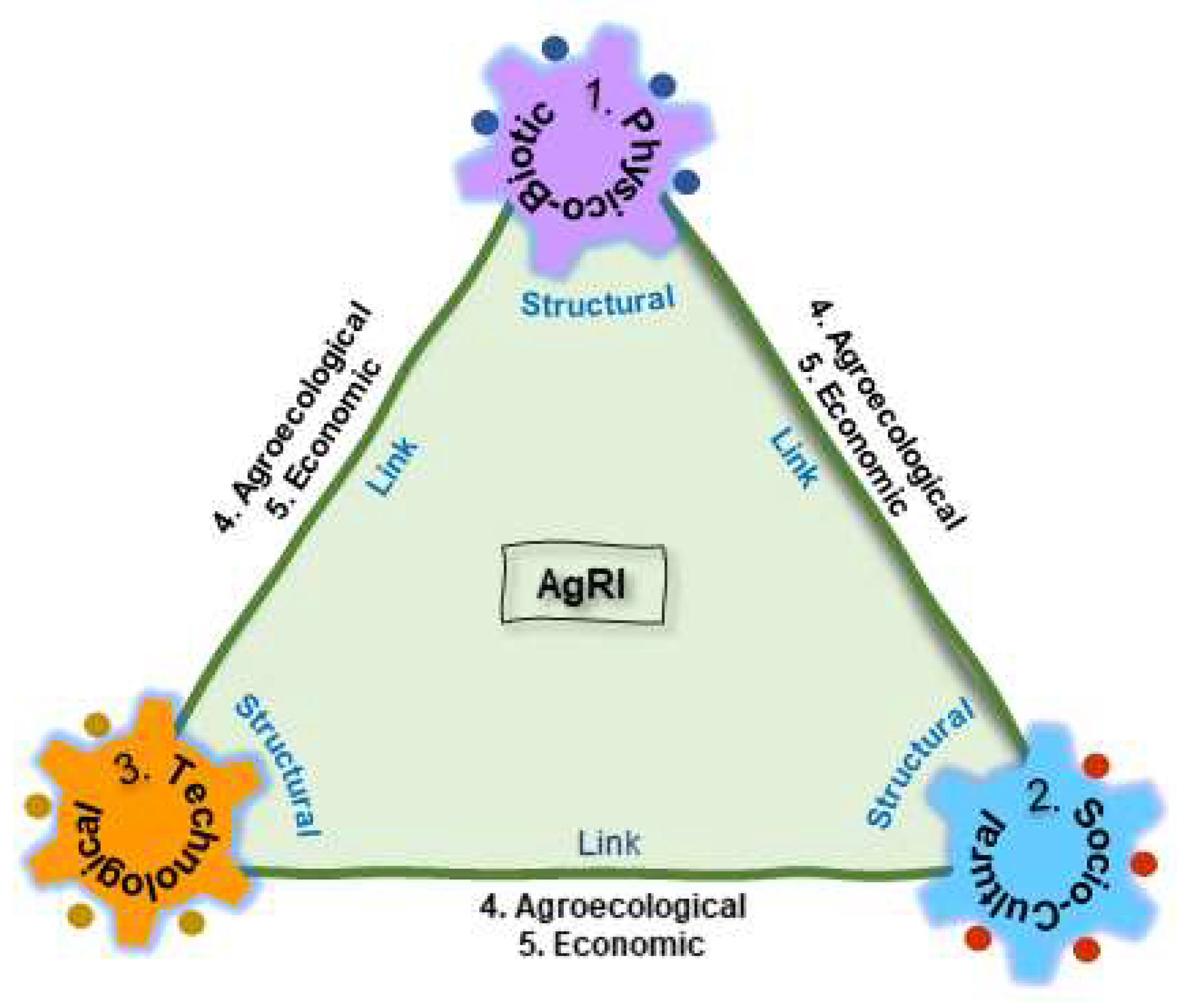
As proposed in this study, the AgRI has categories, components, and indicators, both structural and link. The structural ones are fundamental for the resilience of agroecosystems, because they interact directly with the disturbance and have an inherent resilience, determined by their intrinsic characteristics (Figure 3). These components can increase the acquired resilience and optimize the response, in the terms proposed by [62]. In this process, the link categories facilitate the interaction of structural categories, generating a synergistic relationship, and the emergence of the total resilience of agroecosystems in the face of climate variability. A specific analysis of the resilience of each indicator would allow making cultural or technological adjustment decisions, so that agroecosystems can continue functioning and communities can maintain their well-being. In this context, a specific resilience assessment can determine the response of agroecosystem components to climatic disturbances and identify priority areas for intervention [63].
Figure 3.
AgRI structural and link categories.
2.2. Weighting of Categories, Components, and Indicators
Mikulic (2015) ref. [64] (p. 132) recommended weighting components and indicators of the social ecological systems (for example, agroecosystems), considering inherent differences in interactions with disturbances: “the weighting of the indicators becomes very important because not all indicators have to be equally important to explain the underlying sustainability phenomenon.” Therefore, in this article, higher weights were assigned to the indicators of greater resilience to climatic disturbances, based on the approach proposed by [65], because the weights have a significant effect on the index.
Based on these recommendations, a review of references related to indicators of resilience to climate variability (references are listed in Table 1, Column 7 and [10,11,28,29,30,31,32,33,34,35,36,37,38,39,40,41,42,43,44]) was carried out, and a group of indicators and their respective weightings were constructed.
Subsequently, a group was formed with 30 (thirty) Colombian experts, qualified in the areas of environmental sciences, soils, crop protection, plant physiology, plant breeding, animal production, agricultural economics, rural sociology, edaphology, and agricultural administration. With the Google® platform and the Delphi method [66], three successive rounds of surveys were carried out, in which initial weighting values were proposed (Table 1, column 5) and modified (Table 1, column 6) for each of the categories, components, and indicators, according to the criteria of the experts. The final values are presented in Table 1, column 6.
Table 1.
Weighting of categories, components, and indicators.
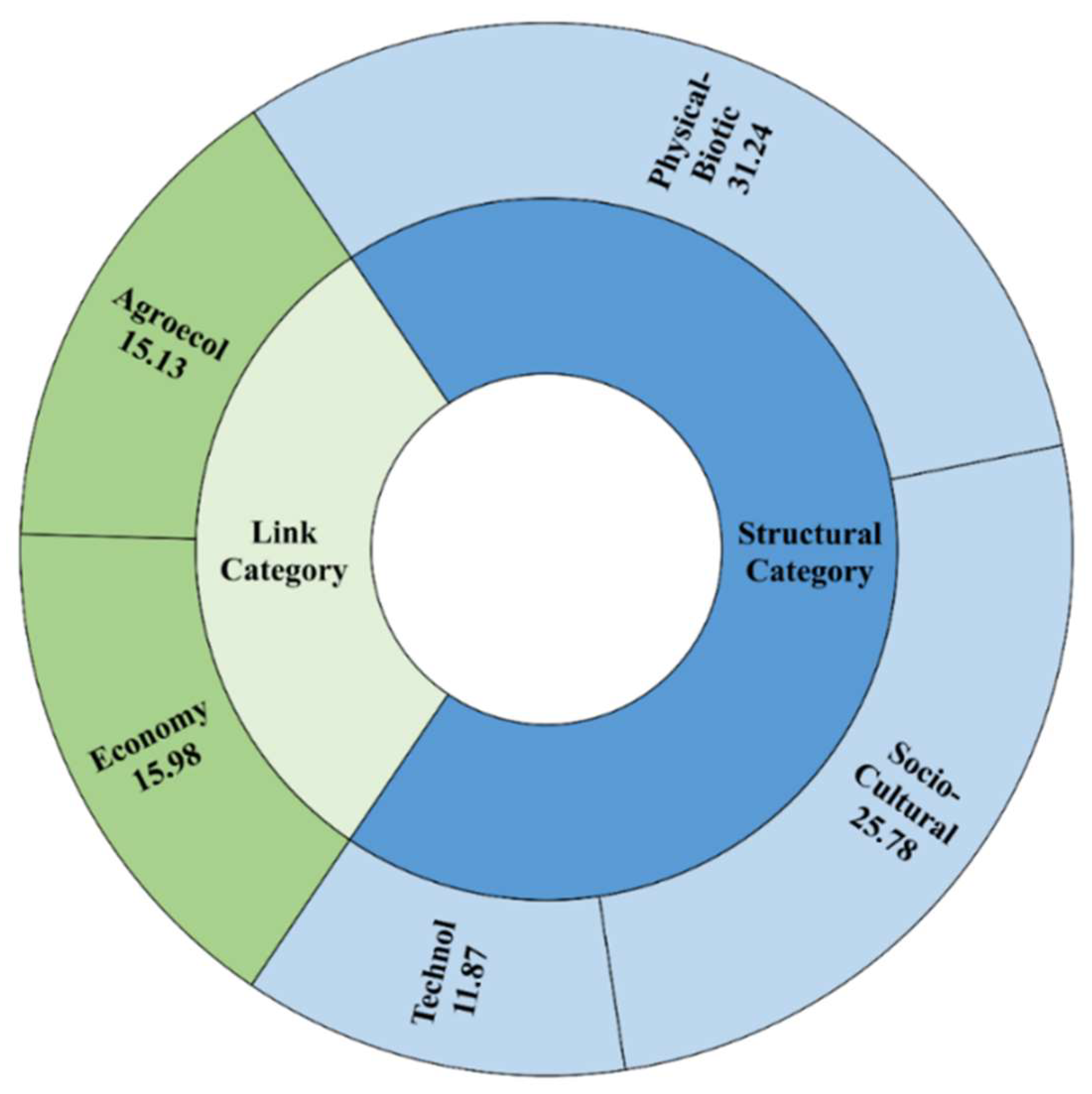
In the context of agroecosystem resilience towards climate variability, the experts gave greater specific weight to the components and indicators grouped in the structural category (68.90%). This is explained by the fundamental and irreplaceable role of soil and water in all biotic processes, especially in agricultural production, and their ability to interact with disturbances related to weather events, consistently with studies by [187,188], the approach proposed by [10], and the results reported in Colombia by [65]. Likewise, the land tenure type was highlighted, since a tenant does not have the same conservation interests as a landlord. Farm size also stood out, showing the difficulties that small farmers face when making intensive use of their farm area. Limits to crop rotation and conservation practices are relevant to the capacity to respond to the effects of climate disturbances [11].
For the components and indicators in the link category, the economic factor (15.98%) is associated with the availability of credit and the generation of economic surpluses that allow the introduction of technological improvements, increased productivity, and added value; increasing specific resilience to climatic disturbances [95]. As an expression of the agroecological category, connectivity and agrobiodiversity demonstrate the importance of improving the level of connectivity of minor agroecosystems with the surrounding landscape. Experts assigned 15.13% to this category, in recognition of the role that this category plays as a link between indicators in the agroecosystem, as proposed by [42]. For the technological category (11.87%), the management of climate information at the farm level stood out. It has been reported that technology is one of the more important components when facing climate disturbances: “In particular, technology has been recognized as one of the essential enabling elements for adapting to climate change” [89] (p. 7) (Figure 4).
Figure 4.
Weighting of the AgRI categories.
2.3. Assignment of Interpretive Scales to the Indicators
Considering the results obtained in the three rounds of expert consultations, each indicator was assigned a rating according to a qualitative interpretive scale, to facilitate its interpretation using the values of 1, 3, and 5. The rating of 5 was associated with attributes of high resilience, 3 with medium resilience, and 1 with low resilience. These quantitative values were assigned to qualitatively interpret the AgRI using the methodological approach, which compares each value to the others, facilitating applications by users or groups of users (Table 2).
Table 2.
Interpretive scales for indicators.
2.4. Equations for the Calculation of the Agroecosystem Resilience Index (AgRI)
AgRI is a composite function of three equations, structured to be calculated sequentially and hierarchically with the values in Table 2. Initially, the resilience of components is calculated (Equation (1)); then, the resilience of categories (Equation (2)) is calculated, followed by AgRI (Equation (3)).
where CompRes = Resilience of Agroecosystem Components; IndRes = Indicators of Agroecosystem Resilience; Wi = Weighting of the Indicators of Agroecosystem Resilience.
where CatRes = Resilience of Agroecosystem Categories; ComponentRes = Resilience of Agroecosystem Components; Wi = Weighting of Resilience of Agroecosystem Components.
where AgRI = Agroecosystem Resilience Index; CatRes = Resilience of Agroecosystem Categories; Wi = Weighting of Resilience of Agroecosystem Categories.
2.5. Interpretation of the Agroecosystem Resilience Index (AgRI)
The AgRI weighted the sum of 40 parameters, generating a result of 100 units. Each result was evaluated on a scale between 1, 3, and 5; therefore, the grade was in a range between 100 and 500, which was interpreted according to the parameters in Table 3.
Table 3.
Value scale for the interpretation of AgRI results.
It is important to clarify that the AgRI is a proposal that can be adjusted in terms of the number of indicators and their weight as new research is developed; however, for this study, the AgRI was applied in the context of climate variability in citrus agroecosystems in Colombia, demonstrating its usefulness, as seen in chapter 3. It can be used in agroecosystems in other countries, because the indicators are standard and have been used in various studies. The weighting can vary according to the ecological and social conditions of territories, which is a subject for future research.
3. Case Study
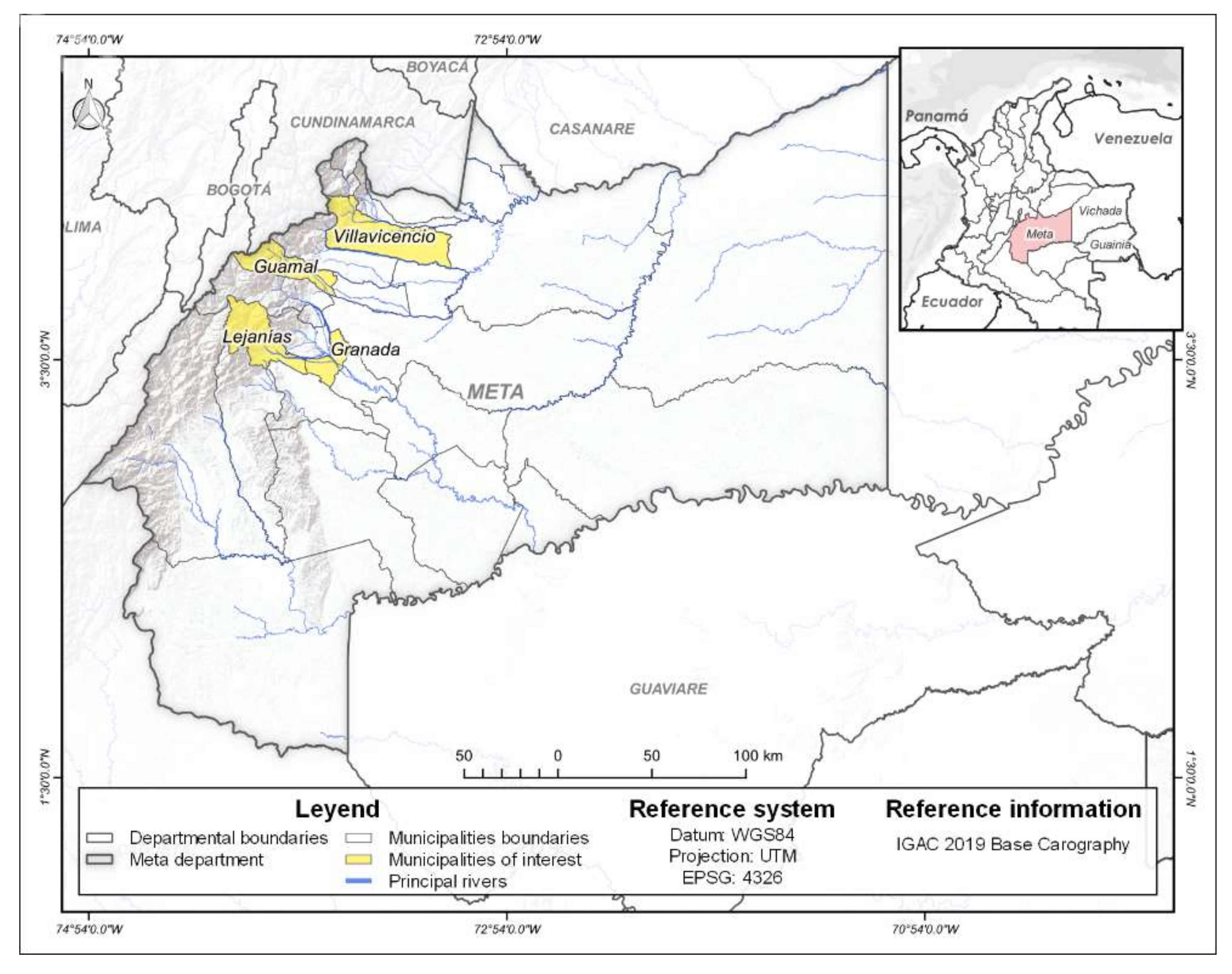
An application of the proposed index is presented, to analyze its operation and scope and demonstrate its relevance. The application was carried out in the Department of Meta, in the municipalities of Villavicencio, Lejanías, Guamal, and Granada (Figure 5), where 82.21% of the planting area is concentrated, with 88.06% of the area in production and 92% of the total volume of citrus species production (orange: Citrus sinensis ‘Valencia’). In total, surveys were performed for 51 farms, covering an area of 16081.62 acres, equivalent to 30.35% of the farms in production. The approach of the survey was based on identifying the specific knowledge and the resilience of the subject/object of study, in this case the citrus growers, who in the context of the theory of social-ecological systems have a better attitude of learning and adaptation. Likewise, we analyzed the perception of the attributes (different variables) of the social and ecosystem components. Analyses of the study area have shown that extreme climate variability is affecting the citrus areas, which is why it was chosen for the application of AgRI [189]. With the collected information, a database was built, which was then subjected to multivariate statistical analysis.
Figure 5.
Location of the study area.
To verify the robustness of the AgRI, the data related to the typification and classification of citrus production systems [190] were taken into account.
A survey was designed for compiling information, which was validated and adjusted in 10 community workshops, where 51 citrus growers were surveyed. In total, an area equivalent to 11.3% of the total producing area was surveyed.
In the structuring, validation, and adjustment of the survey, as well as in the presentation of the project and in the socialization of the results obtained, there was the active participation of specialists, technical assistants, researchers, marketers, producers, and local communities. The data obtained in the survey were validated by the consulting experts in three rounds, according to the protocols of the Delphi methodology.
The data were validated using specialized software (R v.9), and the data obtained from the multivariate statistical analysis were validated.
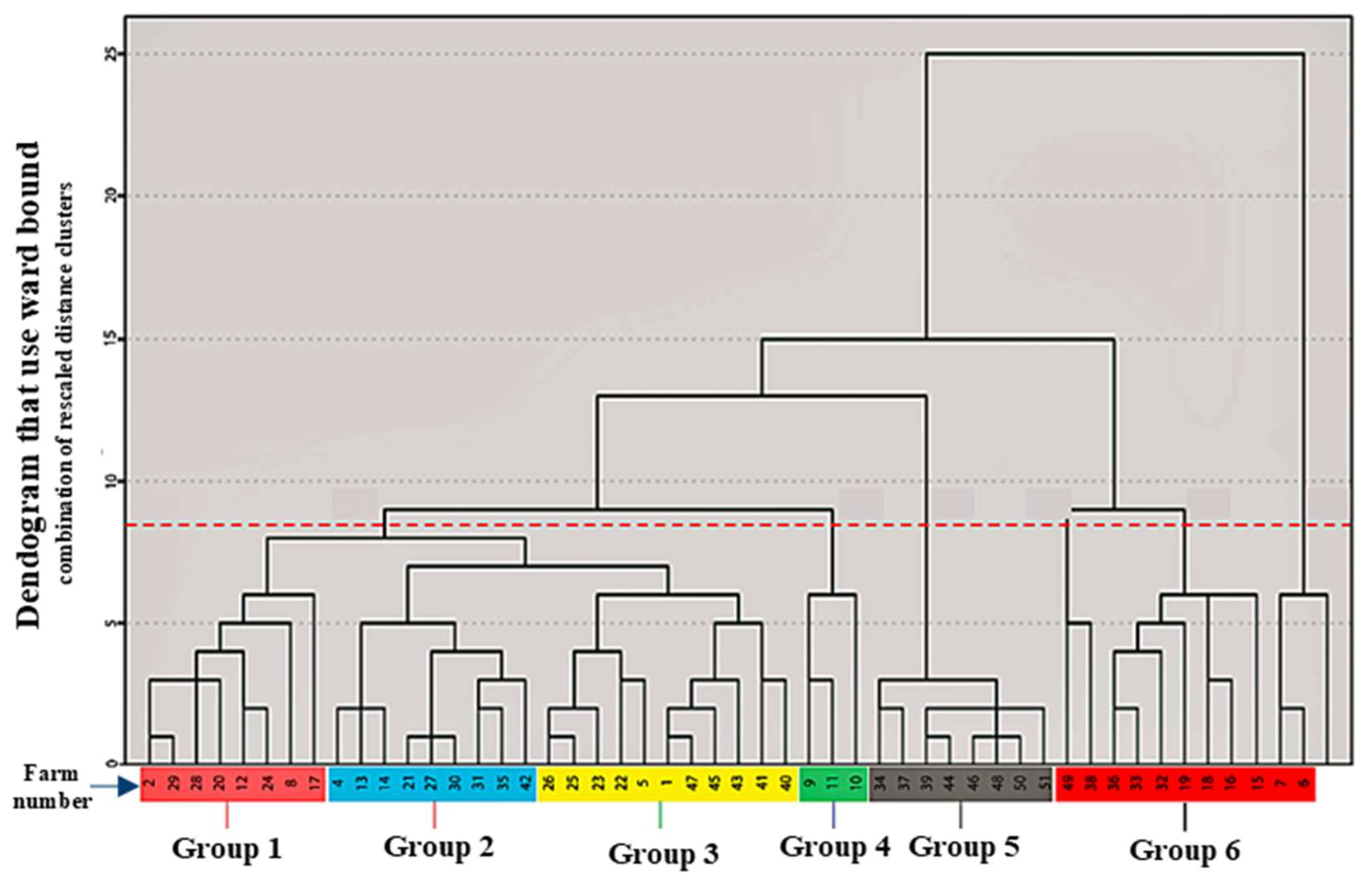
A dendrogram, defined by six (6) groups or “recommendation domains” corresponding to groups of farmers, was created. In each group or “recommendation domain”, three representative productive units/groups were selected, for a total of 18 farms (n = 18). For a better understanding, the dendrogram (Figure 6) allowed visualizing the formation of six typologies or groups of farmers with great similarity of the productive units within the group. One of these groups, group 4 (Table 4), was characterized by vertical integration between its production and marketing at the agro-industrial level. This group was made up of three productive units, and following the recommendations of the statisticians and with the aim of reducing dispersion and increasing reliability in each “recommendation domain” or group, the same number of productive units was selected, so 18 farms were selected (6 groups and in each group 3 farms).
Figure 6.
Clustering dendrogram in six recommendation domains [135].
Table 4.
Main attributes of the recommendation domains, in six groups of citrus agroecosystems (18 farms) located in the Department of Meta, Colombia [135].
A recommendation domain is defined as the way in which groups are structured or grouped by their characteristics or attributes of homogeneity within the group and heterogeneity outside it (“ward” distance), see Figure 6. The respective analyses were carried out from the components of these productive units. The most representative ecosystemic and cultural attributes are listed below in Table 4.
3.1. Determination of Resilience by Group
In the eighteen (18) analyzed agroecosystems, the AgRI was calculated for each of the representative farms of the six groups or recommendation domains with (Equations (1)–(3)). The results are shown in Table 5.
Table 5.
AgRI in six groups of citrus agroecosystems.
3.2. Interpretation of the AgRI in Six Groups of Citrus Agroecosystems
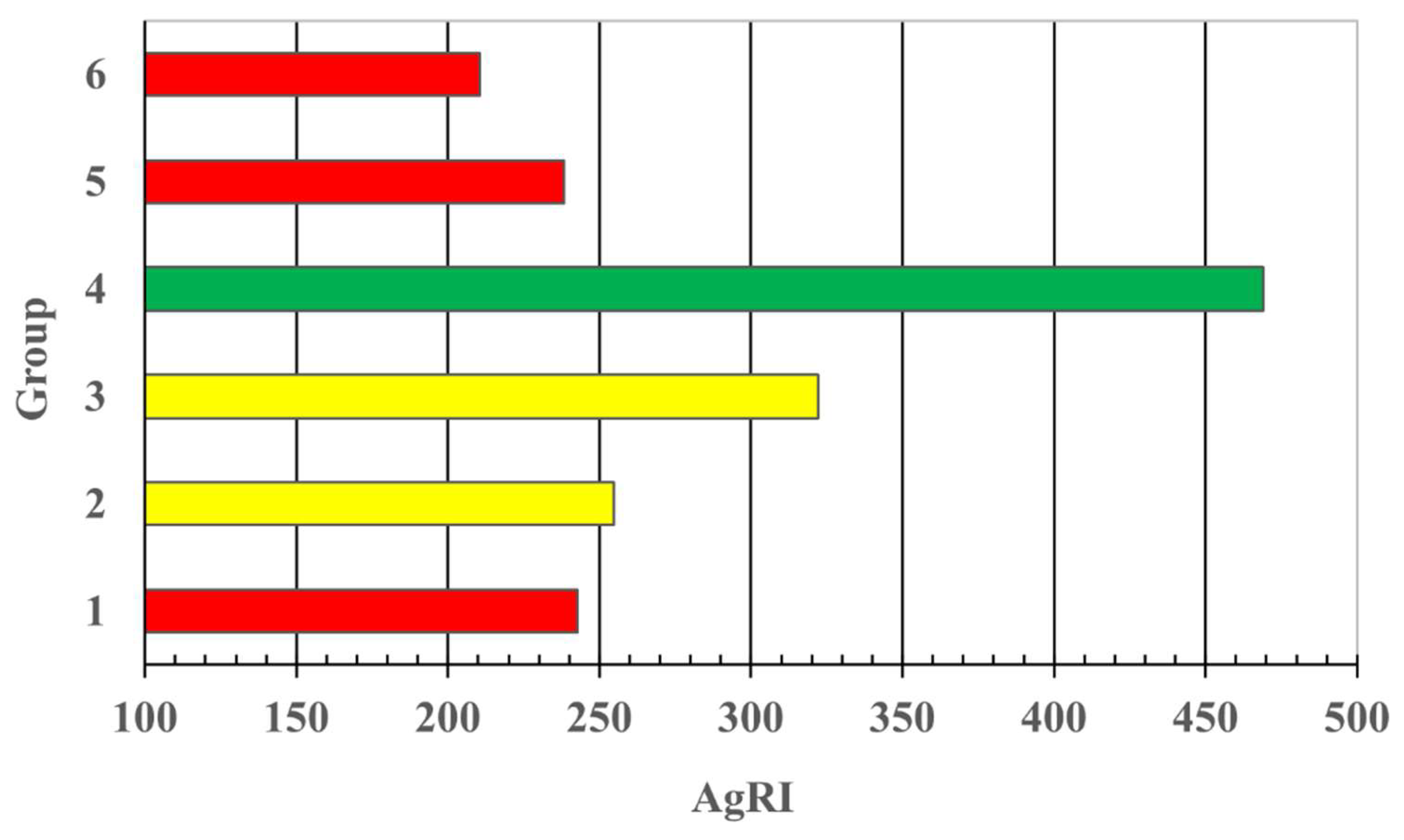
Based on Table 5, the results of the AgRI were interpreted in the 18 farms grouped into six “recommendation domains” (Figure 7).
Figure 7.
Agroecosystem Resilience Index (AgRI).
Although, in the analyzed agroecosystems, the natural ecosystems were incipient or did not exist, those in group 4 implemented unconventional management practices, bringing them closer to the typology of agriculture in transition. This group obtained the highest AgRI (469.01). In this case, the parameters that most affected the results were related to the biodiversity of the farms. A broad availability of water resources was manifested in the presence of summer streams, on whose bank’s gallery forests were developed and conserved, promoting connectivity with the environment. An integration of major and minor animal species (cattle, horses, poultry, and beekeeping) was observed. The driving culture practices were significant.
These management conditions, which include the articulation of animal and plant species, promote biodiversity and represent a good strategy for increasing the resilience of agricultural systems [191,192,193]. This scenario is consistent with the evidence collected by various researchers on the higher levels of resilience of biodiverse agroecosystems, as compared to conventional ones.
The studies of [194,195] stand out as demonstrating that biodiverse agroecosystems adapted and subsequently recovered more quickly and efficiently after the passage of Hurricane Mitch through Central America than conventional production systems, which were affected more. In contrast, the farms in group 6 presented severe limitations in the environmental and ecosystem components, as indicated in Table 5 and Figure 7. The result was a low AgRI: 210.35 (red color). These farmers were more interested in the nature tourism offered by the crops, to promote their hotel activities.
The farms in group 3 reached a medium AgRI: 322.02 (yellow color), explained in part by their lower availability of water (exclusively deep wells), limited connectivity with their surroundings, and limited soil conservations practices. The small farm size limited crop rotation practices because of the intensive use of the soil by these farmers. Likewise, they had surpluses that allowed them to take advantage of the financial system, as well as the availability of private technical assistance.
The farms in group 2 were qualitatively classified with a medium AgRI of 254.55 (yellow color). In this group of farms, significant limitations in the availability and quality of water sources were also observed in all the parameters of the technological, economic, and sociocultural categories. In this regard, Colombia should guide and prioritize programs, plans, and incentives, so that citrus growers in this group have the possibility of improving their medium resilience associated with the moderate availability of economic resources.
The agricultural systems in group 4 had greater agrobiodiversity (presence of different herbaceous, shrub, and tree plant species of different height), expressed in a greater connectivity and diversity of external connectors. They stood out because of their greater institutional articulation, which was expressed in different ways: technical assistance, credit support, management of marketing channels, and the generation of added value, which allowed them to obtain greater resources that they then reinvested in technology and, ultimately, in greater competitiveness. Cultural and community resilience increases through training processes that strengthen the adaptive capacities of farmers, especially in tropical regions, where much of the world’s biodiversity is found [196,197,198].
4. Financial Evaluation of Agroecosystems Resilient to CV
Cabell (2012) ref. [24] (p. 9) stated that resilient agroecosystems must be profitable: “If agroecosystems are to continue to meet human needs, those who manage them must have their needs met as well. Farmers and farm workers should be able to make a living from work directly related to their labor, if they want to, without depending too much on off-farm income or subsidies”. The viability of productive systems with a conventional (less resilience to climate variability) and agroecological (greater resilience to climate variability) production approaches was analyzed based on economic evaluation indicators.
The cost structure was determined, including fixed costs, and the following indicators were analyzed by collecting information from primary sources and the works of [135,199]:
- Internal Rate of Return (IRR): the benefit received, expressed as a percentage of interest (%) when the investment is made, using the opportunity interest rate (TIO) ≥ 4.77% effective per year.
- Net Present Value (NPV): indicates the economic viability of the project (>0).
- Benefit/Cost Ratio (B/C): analyzes the relationship between the present value of gross income and expenses (>1).
- Investment Payback Period (PRI): the time that elapses for the investor to recover the invested capital.
The data for the analysis were grouped into three categories: (i) production costs, (ii) harvest costs, and (iii) income. The production costs were estimated using the records of the inputs and labor. These data were in turn grouped into the following categories: (i) labor, (ii) propagation material, (iii) machinery, (iv) amendments and fertilizers, (v) pesticides, (vi) equipment and tools, and (vii) other costs. Harvest costs were grouped as follows: (i) collection of fruit, (ii) internal transportation to collection centers, and (iii) post-harvest in farm. Income was calculated according to the average sale price in the market, while taking productivity (ton/ha) into account. The information on the cost structure for this type of crop was assessed over a 12-year horizon, because at that time the crop shows physiological maturity and productivity, which is expressed in a greater adaptation to environmental conditions. Table 6 shows the results of the financial analysis.
Table 6.
Analysis of financial evaluation indicators for resilient agroecosystems.
Internal Rate of Return IRR: The estimated TIO was 4.77% effective per year; for the agroecological production system, the IRR was 560% higher than in the conventional approach (negative); that is, this system was economically unsustainable and unable to meet the financial commitments.
Net Present Value (NPV): For the conventional system, this was negative, verifying that this system is not capable of generating additional value, causing economically significant losses to the producers.
C/B ratio: For the agroecological system, the ratio between investment and the generation of additional value for each peso invested was 1.71, showing a greater efficiency in the rational use of resources available at the local level and optimizing production costs at 251%, as compared to the conventional system, presenting the highest production costs in all analyzed components.
Investment Recovery Period (PRI): According to the income and expenditure structure, a production system with an agroecological approach should reach financial equilibrium in 4.95 years. The conventional production systems were unable to recover their investments in the analyzed time horizon, which should persuade producers to invest under the agroecological approach, which is more resilient to climate variability.
5. Discussion
This article presents a weighted composite index to evaluate specific resilience to climatic variability in agroecosystems, called the AgRI.
The AgRI reduces the gaps in resilience analysis identified by [37,47,131] and that are related to the need for tools to evaluate, in measurable entities, the specific resilience linked to climatic disturbances, applicable in non-urban environments, and that include proxies or link indicators between the ecological, social, and economic components of agroecosystems.
The AgRI was designed using the ecological social system approach, as proposed by [24,54,55,56], and it is composed of forty (40) indicators that describe key aspects for increasing or decreasing the inherent or acquired resilience of agroecosystems through attributes related to adaptability, transformability, and robustness, as proposed by [9,25,26,47], and the general principles of resilience presented by [9,167]. The AgRI key indicators are easy to use for those with high, moderate, and low levels of education or technical or professional training, which is very common in developing countries. Likewise, they were chosen for use in countries where information is limited. The SHARP methodology initiative, proposed by [134] to assess the climate resilience of farmers and herders, is a great contribution, but the main limitation is the 138 indicators that make up its structure, and where such information is not always available in developing countries. When analyzing the methodologies for evaluating the general resilience of agroecosystems consulted in the literature review and compared with the proposed method (AgRI), the following differences could be evidenced: A high number of components and synthetic variables; Simultaneous evaluation of components in different categories; Lack of or moderate weighting of the social ecological components makes analysis and applicability difficult; If system components have identical, linear response capacities, the method ignores the reality that the components of any system have differential attributes associated with their nature and composition; Lack of validation; They do not consider the specific resilience to climate variability.
However, since the AgRI is made up of a limited set of indicators, it can ignore some characteristics in agroecosystems that strengthen resilience. In this sense, the incorporation of other key indicators can be addressed in future research.
Some limitations that the AgRI may have, and that constitute topics for future research, include the following: (a) using 40 key indicators may ignore some characteristics of agroecosystems that strengthen resilience; (b) weighting indicators in AgRI with experts could generate biases, giving greater or lesser weight; however, the monitoring protocols in the Delphi method are notable, which aim to establish limits to subjectivity and reduce uncertainty.
Finally, some questions or topics for future research were raised: (a) How should the weighting of AgRI be adjusted to assess the specific resilience to extreme climatic disturbances and in social and ecological systems with limited diversity? (b) What key indicators could be incorporated into the AgRI? (c) How could one increase the participation of communities in the development of the index?
The use of weighted indicators to evaluate the specific resilience of agroecosystems to climate variability was more useful than trying to measure resilience itself. This result is consistent with [25], who stated that agricultural systems are too complex to accurately measure or assess resilience.
A weakness of weighting is the subjectivity of experts; refs. [168,169,170] warned that respondents are influenced by their values, interests, and knowledge, and could bias responses by giving greater or lesser weight to indicators. A strategy proposed by [171] is to establish limits or guidelines to subjectivity, to effectively take advantage of the knowledge of experts. The consultation method carried out in this research followed the guidelines of the “Delphi” method proposed by [64], which has been validated and widely used in scientific research [172].
The application of AgRI was consistent with the hypothesis of [25], who stated that resilience arises from the unique interaction between the farmer, the farm, and the social and economic context of the territory. Some further questions can be resolved as knowledge continues to be generated: How should the AgRI weighting be adjusted to assess specific resilience to extreme climatic disturbances and in social and ecological systems with limited diversity? What key indicators could be incorporated in the AgRI? How could one increase the participation of the communities in the development of the index? However, the relevance of the AgRI became evident in confirming that the farms that were more resilient to climate variability showed better phytosanitary status and higher productivity, and therefore presented better financial health and liquidity, a requirement of any tool to assess resilience in the terms proposed by [9].
The AgRI allowed us to observe that the farms with greater resilience to climate variability had higher productivity and greater financial performance, among other reasons, because they used ecosystem, social, and economic resources in a rational and efficient manner; this observation is consistent with the following studies:
“We define resilience of a farming system as its ability to ensure the provision of the system functions in the face of increasingly complex and accumulating economic, social, environmental and institutional shocks and stresses, through capacities of robustness, adaptability and transformability” [10] (p. 1). “If agroecosystems are to continue to meet human needs, those who manage them must have their needs met as well. Farmers and farm workers should be able to make a living from work directly related to their labor, if they want to, without depending too much on off-farm income or subsidies” ([24] (p. 9). “[We define resilience as its] Ability to maintain desired levels of agricultural outputs despite the occurrence of perturbations” [54] (p. 5).
6. Conclusions
Various approaches and methods have been proposed to assess the resilience of agroecosystems; however, they were mostly designed to assess overall resilience. This article proposed an index to evaluate the specific resilience of agroecosystems to disturbances associated with climate variability.
This index provides information to identify the components of agroecosystems to strengthen specific resilience to climate variability, to guarantee productivity. AgRI helps farming communities to make decisions about learning, adaptation, and transformation strategies related to technology, finance, and marketing, to maintain or build on acquired resilience.
This index was used to analyze the operability of the proposed model and to evaluate specific resilience in agroecosystems for citrus production in eastern Colombia, where there are extreme disturbances associated with climatic variability resulting from oscillation phenomena (ENSO). The results showed that it can be used to evaluate agroecosystems located in different territories.
The proposed index is associated with agrobiodiversity, and its application validated the hypothesis that diversified agroecosystems are more resilient and have greater financial benefits.
The agroecological production system promotes environmental sustainability and the efficient and rational management of resources.
The method proposed in this article demonstrated the ability to assess the resilience of agroecosystems. The most resilient agroecosystems maintained their productivity despite climate variability and were more profitable.
Author Contributions
A.C.: Investigation., Conceptualization, Methodology, Writing—Original Draft. E.Y.: Conceptualization, Supervision, Funding acquisition. J.T.: Conceptualization, Methodology, Writing—Reviewing and Editing, Writing—Original Draft, Visualization, Supervision. All authors have read and agreed to the published version of the manuscript.
Funding
This research was funded by Universidad Pedagógica y Tecnológica de Colombia and Universidad Nacional de Colombia, Bogotá (Project Code Hermes: 13129), and the APC was funded by The Center for Development Research (ZEF), an institute of the University of Bonn, Germany.
Acknowledgments
The authors thank the Tomas León Sicard of the IDEA of the Universidad Nacional de Colombia for his contributions to studying the Principal Agroecological Structure and agrobiodiversity. They also thank the citrus producers of the Department of Meta, Colombia, for their valuable contributions to the development of the methodology.
Conflicts of Interest
The authors declare no conflict of interest.
References
- Ochieng, J.; Kirimi, L.; Mathenge, M. Effects of climate variability and change on agricultural production: The case of small scale farmers in Kenya. NJAS-Wagening. J. Life Sci. 2016, 77, 71–78. [Google Scholar] [CrossRef]
- Lemi, T. Effects of Climate Change Variability on Agricultural Productivity. Int. J. Environ. Sci. Nat. Resour. 2019, 17, 555953. [Google Scholar] [CrossRef]
- Kang, Y.; Khan, S.; Ma, X. Climate change impacts on crop yield, crop water productivity and food security—A review. Prog. Nat. Sci. 2009, 19, 1665–1674. [Google Scholar] [CrossRef]
- Kukal, M.S.; Irmak, S. Climate-Driven Crop Yield and Yield Variability and Climate Change Impacts on the U.S. Great Plains Agricultural Production. Sci. Rep. 2018, 8, 3450. [Google Scholar] [CrossRef] [Green Version]
- Nelson, G.C.; Valin, H.; Sands, R.D.; Havlík, P.; Ahammad, H.; Deryng, D.; Elliott, J.; Fujimori, S.; Hasegawa, T.; Heyhoe, E.; et al. Climate change effects on agriculture: Economic responses to biophysical shocks. Proc. Natl. Acad. Sci. USA 2014, 111, 3274–3279. [Google Scholar] [CrossRef] [Green Version]
- Cleves Leguízamo, J.A.; Martínez Bernal, L.F.; Toro Calderon, J.J. Los balances hídricos agrícolas en modelos de simulación agroclimáticos. Una revisión analítica. Rev. Colomb. Cienc. Hortícolas 2016, 10, 149–163. [Google Scholar] [CrossRef] [Green Version]
- Lobell, D.; Schlenker, W.; Costa-Roberts, J. Climate Trends and Global Crop Production Since 1980. New Theory Earth 2012, 333, 616–620. [Google Scholar] [CrossRef] [Green Version]
- Vesco, P.; Kovacic, M.; Mistry, M.; Croicu, M. Climate variability, crop and conflict: Exploring the impacts of spatial concentration in agricultural production. J. Peace Res. 2021, 58, 98–113. [Google Scholar] [CrossRef]
- IPCC. Climate Change 2014: Synthesis Report. Contribution of Working Groups I, II and III to the Fifth Assessment Report of the Intergovernmental Panel on Climate Change; Pachauri, R., Meyer, L., Eds.; IPCC: Geneva, Switzerland, 2014; Volume 218, ISBN 9789291691432. [Google Scholar]
- Meuwissen, M.; Feindt, P.; Spiegel, A.; Termeer, C.; Mathijs, E.; de Mey, Y.; Finger, R.; Balmann, A.; Wauters, E.; Urquhart, J.; et al. A framework to assess the resilience of farming systems. Agric. Syst. 2019, 176, 102656. [Google Scholar] [CrossRef]
- Córdoba, C.; Triviño, C.; Toro, J. Agroecosystem resilience. A conceptual and methodological framework for evaluation. PLoS ONE 2020, 15, e0220349. [Google Scholar] [CrossRef] [Green Version]
- UN Environment. Global Environment Outlook–GEO-6: Healthy Planet, Healthy People; Cambridge University Press: Cambridge, UK, 2019; ISBN 9781108707664.
- Carpenter, S.; Westley, F.; Turner, M. Surrogates for Resilience of Social-Ecological Systems. Ecosystems 2005, 8, 941–944. [Google Scholar] [CrossRef]
- Dovoudi, S.; Shaw, K.; Haider, J.; Quinlan, A.; Peterson, G.; Wilkinson, C.; Fünfgeld, H.; McEvoy, D.; Porter, L. Resilience: A Bridging Concept or a Dead End? “Reframing” Resilience: Challenges for Planning Theory and Practice Interacting Traps: Resilience Assessment of a Pasture Management System in Northern Afghanistan Urban Resilience: What Does it Mean in Planni. Plan. Theory Pract. 2012, 13, 299–333. [Google Scholar] [CrossRef] [Green Version]
- Davoudi, S.; Brooks, E.; Mehmood, A. Evolutionary Resilience and Strategies for Climate Adaptation. Plan. Pract. Res. 2013, 28, 307–322. [Google Scholar] [CrossRef] [Green Version]
- Raufflet, E. Berkes, F. and C. Folke, Eds. 1998. Linking social and ecological systems: Management practices and social mechanisms for building resilience. Cambridge University Press. New York. Conserv. Ecol. 2000, 4, 5. [Google Scholar]
- Ostrom, E.; Janssen, M.A. Multi-level governance and resilience of social-ecological systems. In Globalisation, Poverty and Conflict: A “Critical Development” Reader; Spoor, M., Ed.; Springer: Berlin/Heidelberg, Germany, 2005; pp. 239–259. ISBN 140202858X. [Google Scholar]
- Gallopín, G. Linkages between vulnerability, resilience, and adaptive capacity. Glob. Environ. Chang. 2006, 16, 293–303. [Google Scholar] [CrossRef]
- Bates, S.; Saint-Pierre, P. Adaptive Policy Framework through the Lens of the Viability Theory: A Theoretical Contribution to Sustainability in the Anthropocene Era. Ecol. Econ. 2018, 145, 244–262. [Google Scholar] [CrossRef]
- Holling, C.S. Resilience and Stability of Ecological Systems. Source Annu. Rev. Ecol. Syst. 1973, 4, 1–23. [Google Scholar] [CrossRef] [Green Version]
- Adger, W. Social and ecological resilience: Are they related? Prog. Hum. Geogr. 2000, 24, 347–364. [Google Scholar] [CrossRef]
- Walker, B.; Holling, C.; Carpenter, S.; Kizing, A. Resilience, adaptability and transformability in social-ecological systems. Ecol. Soc. 2004, 9, 5. [Google Scholar] [CrossRef]
- Kaly, U.; Pratt, C.; Mitchell, J. Report on the Environmental Vulnerability Index (EVI) Think Tank II. In Proceedings of the Environmental Vulnerability Index (EVI), Suva, Fiji, 4–6 October 2004. [Google Scholar]
- Cabell, J.; Oelofse, M. An Indicator Framework for Assessing Agroecosystem Resilience. Ecol. Soc. 2012, 17, 18. [Google Scholar] [CrossRef]
- Darnhofer, I. Resilience or how do we enable agricultural systems to ride the waves of unexpected change? Agric. Syst. 2021, 187, 102997. [Google Scholar] [CrossRef]
- Wilbanks, F.; Abeysinghe, A.; Burton, I.; Gao, Q.; Lemos, M.; Masui, T.; O’Brien, K.; Warner, K. Climate-Resilient Pathways: Adaptation, Mitigation, and Sustainable Development; Intergovernmental Panel on Climate Change: Cambridge, UK; New York, NY, USA, 2014. [Google Scholar]
- Zolnikov, T. (Ed.) Palgrave Studies in Climate Resilient Societies. In Global Adaptation and Resilience to Climate Change; Palgrave Macmillan: Cham, Switzerland, 2019; ISBN 9783030012120. [Google Scholar]
- Alam, M.; Alam, K.; Mushtaq, S.; Filho, W. How do climate change and associated hazards impact on the resilience of riparian rural communities in Bangladesh? Policy implications for livelihood development. Environ. Sci. Policy 2018, 84, 7–18. [Google Scholar] [CrossRef]
- Altieri, M.; Funes, F.; Henao, A.; Nicholls, C.; León-Sicard, T.; Vázquez, L.; Zuluaga, G. Towards a Methodology for Identification, Diagnosis and Systematization of Systems Agricultural Resilient to Climatic Events Extreme (in Spanish: Hacia una Metodología para la Identificación, Diagnóstico y Sistematización de Sistemas Agrícolas Resiliente); Rede Consagro: Florianópolis, Brazil, 2012. [Google Scholar]
- Angeon, V.; Bates, S. Reviewing composite vulnerability and resilience indexes: A sustainable approach and application. World Dev. 2015, 72, 140–162. [Google Scholar] [CrossRef]
- Bonny, B.P.; Prasad, R.M.; Paulose, S. Agro-ecosystem Performance Index (API)—A Quantitative Approach to Evaluate the Sustainability of Rice Production Systems. J. Sustain. Agric. 2010, 34, 758–777. [Google Scholar] [CrossRef]
- Food and Agriculture Organization of the United Nations FAO. Analysing Resilience for Better Targeting and Action. Resilience Index Measurement and Analysis-II; Food and Agriculture Organization of the United Nations, Ed.; Food and Agriculture Organization of the United Nations: Rome, Italy, 2016; ISBN 9789251092354. [Google Scholar]
- Häni, F.; Braga, F.; Stämpfli, A.; Keller, T.; Fischer, M.; Porsche, H. RISE: A Tool for Holistic Sustainability Assessment at the Farm Level. Int. Food Agribus. Manag. Rev. 2003, 6, 13. [Google Scholar]
- Henao, A. Methodological approach for measuring the socio-ecological systems qualification resilience: A case study in the Colombian Andes. Agroecología 2013, 8, 85–91. [Google Scholar]
- López-Ridaura, S.; Masera, O.; Astier, M. Evaluating the sustainability of complex socio-environmental systems. the MESMIS framework. Ecol. Indic. 2002, 2, 135–148. [Google Scholar] [CrossRef]
- Sarker, M.N.I.; Wu, M.; Alam, G.M.; Shouse, R.C. Livelihood resilience of riverine island dwellers in the face of natural disasters: Empirical evidence from Bangladesh. Land Use Policy 2020, 95, 104599. [Google Scholar] [CrossRef]
- Van Cauwenbergh, N.; Biala, K.; Bielders, C.; Brouckaert, V.; Franchois, L.; Garcia Cidad, V.; Hermy, M.; Mathijs, E.; Muys, B.; Reijnders, J.; et al. SAFE-A hierarchical framework for assessing the sustainability of agricultural systems. Agric. Ecosyst. Environ. 2007, 120, 229–242. [Google Scholar] [CrossRef]
- Vázquez, L.; Castellanos, A.; Leiva, V. Agroecological Transition and Socio-Ecological Resilience to Droughts in Cuba; University of Minnesota Morris Digital Well: Morris, MN, USA, 2019. [Google Scholar]
- Santistevan-Mendez, M.; Borjas-Ventura, R.; Alvarado-Huaman, L.; Anzules-Toala, V.; Castro-Cepero, V.; Julca-Otiniano, A. Sustainability of lemon (Citrus aurantifolia Swingle) farms in the province of Santa Elena, Ecuador. Peruv. J. Agron. 2018, 2, 44–53. [Google Scholar] [CrossRef]
- Córdoba, C.; León-Sicard, T. Resilience of organic and conventional farming systems against climate variability in Anolaima (Cundinamarca-Colombia). Agroecology 2013, 8, 21–32. [Google Scholar]
- Bates, S.; Angeon, V.; Ainouche, A. The pentagon of vulnerability and resilience: A methodological proposal in development economics by using graph theory. Econ. Model. 2014, 42, 445–453. [Google Scholar] [CrossRef]
- León-Sicard, T.; Toro, J.; Martínez, L.; Cleves-Leguízamo, A. The Main Agroecological Structure (MAS) of the agroecosystems: Concept, methodology and applications. Sustainability 2018, 10, 3131. [Google Scholar] [CrossRef] [Green Version]
- Suarez-Pardo, A.; Villegas-Palacio, C.; Berrouet, L. Resilience in Agroecosystems: An Index Based on a Socioecological Systems Approach. Weather Clim. Soc. 2022, 14, 425–438. [Google Scholar] [CrossRef]
- Leippert, F.; Darmaun, M.; Bernoux, M.; Mpheshea, M. The Potential of Agroecology to Build Climate-Resilient Livelihoods and Food Systems; FAO and Biovision: Rome, Italy, 2020; ISBN 978-92-5-133109-5. [Google Scholar]
- Meuwissen, M.; Paas, W.; Slijper, T.; Coopmans, I.; Ciechomska, A.; Lievens, E.; Deckers, J.; Vroege, W.; Mathijs, E.; Kopainsky, B.; et al. Report on Resilience Framework for EU Agriculture: Sustainable and Resilient EU Farming Systems (SureFarm) Project Report, Work Package D1.1; Wageningen University & Research: Wageningen, The Netherlands, 2018. [Google Scholar]
- Peterson, C.A.; Eviner, V.T.; Gaudin, A.C.M. Ways forward for resilience research in agroecosystems. Agric. Syst. 2018, 162, 19–27. [Google Scholar] [CrossRef] [Green Version]
- Conway, G. Agroecosystem Analysis for Research and Development; Winrock International: Bangkok, Thailand, 1986. [Google Scholar]
- Folke, C.; Carpenter, S.; Elmqvist, T.; Gunderson, L.; Holling, C.; Walker, B. Resilience and sustainable development: Building adaptive capacity in a world of transformations. Ambio 2002, 31, 437–440. [Google Scholar] [CrossRef] [PubMed]
- Van Apeldoorn, D.F.; Kok, K.; Sonneveld, M.P.W.; Veldkamp, T.A. Panarchy rules: Rethinking resilience of agroecosystems, evidence from Dutch dairy-farming. Ecol. Soc. 2011, 16, 39. [Google Scholar] [CrossRef] [Green Version]
- Lindfield, G.; Penny, J. Chapter 9-Optimization Methods. In Mathematical Modelling and Simulation in Chemical Engineering, 4th ed.; Lindfield, G., Penny, J.B.T.-N.M., Eds.; Academic Press: Cambridge, MA, USA, 2019; pp. 433–483. ISBN 978-0-12-812256-3. [Google Scholar]
- Mersha, A.A.; van Laerhoven, F. The interplay between planned and autonomous adaptation in response to climate change: Insights from rural Ethiopia. World Dev. 2018, 107, 87–97. [Google Scholar] [CrossRef]
- Carpenter, S.; Walker, B.; Anderies, J.M.; Abel, N. From Metaphor to Measurement: Resilience of What to What? Ecosystems 2001, 4, 765–781. [Google Scholar] [CrossRef]
- Folke, C.; Carpenter, S.R.; Walker, B.; Scheffer, M.; Chapin, T.; Rockström, J. Resilience thinking: Integrating resilience, adaptability and transformability. Ecol. Soc. 2010, 15, 20. [Google Scholar] [CrossRef]
- Urruty, N.; Tailliez-Lefebvre, D.; Huyghe, C. Stability, robustness, vulnerability and resilience of agricultural systems. A review. Agron. Sustain. Dev. 2016, 36, 1–15. [Google Scholar] [CrossRef] [Green Version]
- Skoufias, E. (Ed.) The Poverty and Welfare Impacts Ofclimate Change: Quantifying the Effects, Identifying the Adaptation Strategies; World Bank: Washington, DC, USA, 2012; ISBN 978-0-8213-9611-7. [Google Scholar]
- Berkes, F. Environmental Governance for the Anthropocene? Social-Ecological Systems, Resilience, and Collaborative Learning. Sustain. Artic. 2017, 9, 1232. [Google Scholar] [CrossRef] [Green Version]
- Colding, J.; Barthel, S. Exploring the social-ecological systems discourse 20 years later. Ecol. Soc. 2019, 24, 2. [Google Scholar] [CrossRef] [Green Version]
- Berkes, F.; Folke, C. Linking Social and Ecological Systems: Management Practices and Social Mechanisms for Building Resilience; Cambridge University Press: Cambridge, UK, 1998. [Google Scholar]
- Carpenter, S.R.; Arrow, K.J.; Barrett, S.; Biggs, R.; Brock, W.A.; Crépin, A.S.; Engström, G.; Folke, C.; Hughes, T.P.; Kautsky, N.; et al. General resilience to cope with extreme events. Sustainability 2012, 4, 3248–3259. [Google Scholar] [CrossRef] [Green Version]
- Walker, B.; Salt, D. Resilience Thinking: Sustaining Ecosystems and People in a Changing World; Island Press: Washington, DC, USA, 2006. [Google Scholar]
- Kerner, D.A.; Thomas, J.S. Resilience attributes of social-ecological systems: Framing metrics for management. Resources 2014, 3, 672–702. [Google Scholar] [CrossRef] [Green Version]
- Kaly, U.; Pratt, C.; Mitchell, J. Building Resilience in SIDS. The Environmental Vulnerability Index; South Pacific Applied Geoscience Commission (SOPAC): Suva, Fiji, 2005. [Google Scholar]
- Javadpoor, M.; Sharifi, A.; Roosta, M. An adaptation of the Baseline Resilience Indicators for Communities (BRIC) for assessing resilience of Iranian provinces. Int. J. Disaster Risk Reduct. 2021, 66, 102609. [Google Scholar] [CrossRef]
- Mikulic, J.; Kožic, I.; Krešić, D.; Krešic, D. Weighting indicators of tourism sustainability: A critical note. Ecol. Indic. 2015, 48, 312–314. [Google Scholar] [CrossRef]
- Etter, A.; McAlpine, C.; Seabrook, L.; Wilson, K.A. Incorporating temporality and biophysical vulnerability to quantify the human spatial footprint on ecosystems. Biol. Conserv. 2011, 144, 1585–1594. [Google Scholar] [CrossRef]
- Dalkey, N.; Helmer, O. An Experimental Application of the Delphi Method to the Use of Experts. Manag. Sci. 1963, 9, 458–467. [Google Scholar] [CrossRef]
- Sancho, F.; Villatoro, M. Effect of the slope position on productivity of three soil sequences in ustic environments of Costa Rica. Agron. Costarric. 2005, 29, 159–174. [Google Scholar]
- Zhang, Z.; Sheng, L.; Yang, J.; Chen, X.A.; Kong, L.; Wagan, B. Effects of land use and slope gradient on soil erosion in a red soil hilly watershed of southern China. Sustainability 2015, 7, 14309–14325. [Google Scholar] [CrossRef] [Green Version]
- Lamichhane, P.; Miller, K.K.; Hadjikakou, M.; Bryan, B.A. Resilience of smallholder cropping to climatic variability. Sci. Total Environ. 2020, 719, 137464. [Google Scholar] [CrossRef] [PubMed]
- Borrelli, P.; Robinson, D.A.; Panagos, P.; Lugato, E.; Yang, J.E.; Alewell, C.; Wuepper, D.; Montanarella, L.; Ballabio, C. Land use and climate change impacts on global soil erosion by water (2015–2070). Proc. Natl. Acad. Sci. USA 2020, 117, 21994–22001. [Google Scholar] [CrossRef] [PubMed]
- Li, Z.; Fang, H. Impacts of climate change on water erosion: A review. Earth-Sci. Rev. 2016, 163, 94–117. [Google Scholar] [CrossRef]
- Chapman, S.; Birch, C.E.; Galdos, M.V.; Pope, E.; Davie, J.; Bradshaw, C.; Eze, S.; Marsham, J.H. Assessing the impact of climate change on soil erosion in East Africa using a convection-permitting climate model. Environ. Res. Lett. 2021, 16, 084006. [Google Scholar] [CrossRef]
- Panagos, P.; Standardi, G.; Borrelli, P.; Lugato, E.; Montanarella, L.; Bosello, F. Cost of agricultural productivity loss due to soil erosion in the European Union: From direct cost evaluation approaches to the use of macroeconomic models. Land Degrad. Dev. 2018, 29, 471–484. [Google Scholar] [CrossRef]
- Pérez-Guzmán, L.; Acosta-Martínez, V.; Phillips, L.A.; Mauget, S.A. Resilience of the microbial communities of semiarid agricultural soils during natural climatic variability events. Appl. Soil Ecol. 2020, 149, 103487. [Google Scholar] [CrossRef]
- Karlen, D. PRODUCTIVITY. In Encyclopedia of Soils in the Environment; Hillel, D., Ed.; Elsevier: Oxford, UK, 2005; pp. 330–336. ISBN 978-0-12-348530-4. [Google Scholar]
- Mariusz, S.; Kozłowski, M.; Barbara, K.; Stasik, R.S.; Napierała, M.; Jaskuła, J.; Liberacki, D. The Effect of Climate Change on Controlled Drainage E ff ectiveness in the Context of Groundwater. Agronomy 2020, 10, 625. [Google Scholar]
- Várallyay, G. The impact of climate change on soils and on their water management. Agron. Res. 2010, 8, 385–396. [Google Scholar]
- Karmakar, R.; Das, I.; Dutta, D.; Rakshit, A. Potential Effects of Climate Change on Soil Properties: A Review. Sci. Int. 2016, 4, 51–73. [Google Scholar] [CrossRef] [Green Version]
- Gelybó, G.; Tóth, E.; Farkas, C.; Horel, A.; Kása, I.; Bakacsi, Z. Potential impacts of climate change on soil properties. Agrochem. Soil Sci. 2018, 67, 121–141. [Google Scholar] [CrossRef] [Green Version]
- Clark, L.; Whalley, W.; Barraclough, P. How do roots penetrate strong soil? Plant Soil 2003, 255, 93–104. [Google Scholar] [CrossRef]
- Kaushal, M. Climatic Resilient Agriculture for Root, Tuber, and Banana Crops Using Plant Growth-Promoting Microbes; Elsevier Inc.: Amsterdam, The Netherlands, 2019; ISBN 9780128164839. [Google Scholar]
- Mondal, S. Impact of Climate Change on Soil Fertility BT-Climate Change and the Microbiome: Sustenance of the Ecosphere; Choudhary, D.K., Mishra, A., Varma, A., Eds.; Springer International Publishing: Cham, Switzerland, 2021; pp. 551–569. ISBN 978-3-030-76863-8. [Google Scholar]
- Raes, D.; Waongo, M.; Vanuytrecht, E.; Mejias Moreno, P. Improved management may alleviate some but not all of the adverse effects of climate change on crop yields in smallholder farms in West Africa. Agric. For. Meteorol. 2021, 308–309, 108563. [Google Scholar] [CrossRef]
- Rao, K.P.C.; Ndegwa, W.G.; Kizito, K.; Oyoo, A. Climate variability and change: Farmer perceptions and understanding of intra-seasonal variability in rainfall and associated risk in semi-arid Kenya. Exp. Agric. 2011, 47, 267–291. [Google Scholar] [CrossRef] [Green Version]
- Chowdhury, S.; Bolan, N.; Farrell, M.; Sarkar, B.; Sarker, J.R.; Kirkham, M.B.; Hossain, M.Z.; Kim, G.H. Role of Cultural and Nutrient Management Practices in Carbon Sequestration in Agricultural Soil, 1st ed.; Elsevier Inc.: Amsterdam, The Netherlands, 2021; Volume 166, ISBN 9780128245873. [Google Scholar]
- Baumhardt, R.L.; Blanco-Canqui, H. Soil: Conservation Practices. Encycl. Agric. Food Syst. 2014, 5, 153–165. [Google Scholar] [CrossRef]
- Borden, K.A.; Anglaaere, L.C.N.; Owusu, S.; Martin, A.R.; Buchanan, S.W.; Addo-Danso, S.D.; Isaac, M.E. Soil texture moderates root functional traits in agroforestry systems across a climatic gradient. Agric. Ecosyst. Environ. 2020, 295, 106915. [Google Scholar] [CrossRef]
- Auci, S.V.M. Climate variability and agricultural production efficiency: Evidence from Ethiopian farmers. Int. J. Environ. Stud. 2020, 78, 57–76. [Google Scholar] [CrossRef]
- Kim, H. Technologies for Adapting to Climate Change: A Case Study of Korean Cities and Implications for Latin American Cities; UN: Santiago, Chile, 2021. [Google Scholar]
- Fleiner, R.; Grace, D.; Pert, P.; Bindraban, P.; Rebecca, T.; Boelee, E.; Lloyd, G.; Korsgaard, L.; Eriyagama, N.; Molden, D. Water Use in Agroecosystems. In Managing Water and Agroecosystems for Food Security; Boelee, E., Ed.; CAB International: Wallingford, UK, 2013; pp. 53–67. ISBN 9781780640884. [Google Scholar]
- Campos, M.; Velázquez, A.; McCall, M. Adaptation strategies to climatic variability: A case study of small-scale farmers in rural Mexico. Land Use Policy 2014, 38, 533–540. [Google Scholar] [CrossRef]
- Kumar, S.; Mishra, A.K.; Pramanik, S.; Mamidanna, S.; Whitbread, A. Climate risk, vulnerability and resilience: Supporting livelihood of smallholders in semiarid India. Land Use Policy 2020, 97, 104729. [Google Scholar] [CrossRef]
- Verburg, R.; Rahn, E.; Verweij, P.; van Kuijk, M.; Ghazoul, J. An innovation perspective to climate change adaptation in coffee systems. Environ. Sci. Policy 2019, 97, 16–24. [Google Scholar] [CrossRef]
- Roco, L.; Engler, A.; Bravo-Ureta, B.; Jara-Rojas, R. Farm level adaptation decisions to face climatic change and variability: Evidence from Central Chile. Environ. Sci. Policy 2014, 44, 86–96. [Google Scholar] [CrossRef]
- Keshavarz, M.; Moqadas, R.S. Assessing rural households’ resilience and adaptation strategies to climate variability and change. J. Arid Environ. 2021, 184, 104323. [Google Scholar] [CrossRef]
- Zaman, M.; Shahid, S.A.; Heng, L. Irrigation Water Quality. In Guideline for Salinity Assessment, Mitigation and Adaptation Using Nuclear and Related Techniques; Springer International Publishing: Cham, Switzerland, 2018; pp. 113–131. ISBN 978-3-319-96190-3. [Google Scholar]
- Debray, V.; Wezel, A.; Lambert-Derkimba, A.; Roesch, K.; Lieblein, G.; Francis, C.A. Agroecological practices for climate change adaptation in semiarid and subhumid Africa. Agroecol. Sustain. Food Syst. 2019, 43, 429–456. [Google Scholar] [CrossRef]
- Baffour-Ata, F.; Antwi-Agyei, P.; Apawu, G.O.; Nkiaka, E.; Amoah, E.A.; Akorli, R.; Antwi, K. Using traditional agroecological knowledge to adapt to climate change and variability in the Upper East Region of Ghana. Environ. Chall. 2021, 4, 100205. [Google Scholar] [CrossRef]
- Marchant Santiago, C.; Díaz, P.R.; Morales-Salinas, L.; Betancourt, L.P.; Fernández, L.O. Practices and strategies for adaptation to climate variability in family farming. An analysis of cases of rural communities in the andes mountains of colombia and Chile. Agriculture 2021, 11, 1096. [Google Scholar] [CrossRef]
- Nilsson, J.; Lundmark, C. Heliyon The effect of personal values and the roles on representational principles in natural resource management decision-making. Heliyon 2020, 6, e04032. [Google Scholar] [CrossRef]
- Cothern, C. Handbook for Environmental Risk Decision Making. Values, Perceptions & Ethics, 1st ed.; CRC Press: Boca Raton, FL, USA, 1996; ISBN 1-56670-131-7. [Google Scholar]
- Marshall, N.A.; Thiault, L.; Beeden, A.; Beeden, R.; Benham, C.; Curnock, M.I.; Diedrich, A.; Gurney, G.G.; Jones, L.; Marshall, P.A.; et al. Our Environmental Value Orientations Influence How We Respond to Climate Change. Front. Psychol. 2019, 10, 938. [Google Scholar] [CrossRef]
- Arshad, M.; Kächele, H.; Krupnik, T.J.; Amjath-Babu, T.S.; Aravindakshan, S.; Abbas, A.; Mehmood, Y.; Müller, K. Climate variability, farmland value, and farmers’ perceptions of climate change: Implications for adaptation in rural Pakistan. Int. J. Sustain. Dev. World Ecol. 2017, 24, 532–544. [Google Scholar] [CrossRef]
- Jones, L.; Tanner, T. ‘Subjective resilience’: Using perceptions to quantify household resilience to climate extremes and disasters. Reg. Environ. Chang. 2017, 17, 229–243. [Google Scholar] [CrossRef] [Green Version]
- Neef, A.; Benge, L.; Boruff, B.; Pauli, N.; Weber, E.; Varea, R. Climate adaptation strategies in Fiji: The role of social norms and cultural values. World Dev. 2018, 107, 125–137. [Google Scholar] [CrossRef]
- Lee, A.; Corporation, C.; Smith, J.; Consulting, S.; Blair, M.; Carter, L.M. Adaptation, Cap. 28. In Climate Change Impacts in the United States: The Third National Climate Assessment; Melillo, J.M., Terese, T.C., Richmond, G.W.Y., Eds.; U.S. Global Change Research Program: Washington, DC, USA, 2014; pp. 670–706. [Google Scholar]
- Archer, D.; Dodman, D. Urban Climate Making capacity building critical: Power and justice in building urban climate resilience in Indonesia and Thailand. Urban Clim. 2015, 14, 68–78. [Google Scholar] [CrossRef] [Green Version]
- Moser, S.; Pike, C. Urban Climate Community engagement on adaptation: Meeting a growing capacity need. Urban Clim. 2015, 14, 111–115. [Google Scholar] [CrossRef]
- World Health Organization; Department for International Development (DFID). The Resilience of Water Supply and Sanitation in the Face of Climate Change. Vision 2030; World Health Organization: Geneva, Switzerland, 2009; ISBN 978-92-4-159842-2.
- Charles, K.; Howard, G.; Villalobos, E.; Gruber, J.; Alam, S.; Alamgir, A.S.M.; Baidya, M.; Sabrina, M.; Haque, F.; Hassan, S.M.Q.; et al. Science of the Total Environment Infrastructure alone cannot ensure resilience to weather events in drinking water supplies. Sci. Total Environ. 2022, 813, 151876. [Google Scholar] [CrossRef] [PubMed]
- Howard, G.; Nijhawan, A.; Flint, A.; Baidya, M.; Pregnolato, M.; Ghimire, A.; Poudel, M.; Lo, E.; Sharma, S.; Mengustu, B.; et al. The how tough is WASH framework for assessing the climate resilience of water and sanitation. NPJ Clean Water 2021, 4, 39. [Google Scholar] [CrossRef]
- Pachauri, S.; Spreng, D. Energy in and Use Relation Access Energy to Poverty. Econ. Polit. Wkly. 2004, 39, 271–278. [Google Scholar]
- Barnes, D.; Samad, H. Measuring the Benefits of Energy Access. A Handbook for Development Practitioners; Inter-American Development Bank: Washington, DC, USA, 2018. [Google Scholar]
- Sambodo, M.T.; Novandra, R. The state of energy poverty in Indonesia and its impact on welfare. Energy Policy 2019, 132, 113–121. [Google Scholar] [CrossRef]
- Sy, S.A.; Mokaddem, L. Energy poverty in developing countries: A review of the concept and its measurements. Energy Res. Soc. Sci. 2022, 89, 102562. [Google Scholar] [CrossRef]
- Cabello Eras, J.J.; Mendoza Fandiño, J.M.; Gutiérrez, A.S.; Rueda Bayona, J.G.; Sofan German, S.J. The inequality of electricity consumption in Colombia. Projections and implications. Energy 2022, 249, 123711. [Google Scholar] [CrossRef]
- Ebi, K.; Hess, J.; Watkiss, P. Health Risks and Costs of Climate Variability and Change. In Injury Prevention and Environmental Health. Disease Control Priorities; World Bank: Washington, DC, USA, 2017; pp. 153–169. ISBN 978-1-4648-0523-3. [Google Scholar] [CrossRef]
- Olutumise, A.I.; Ajibefun, I.A.; Omonijo, A.G. Effect of climate variability on healthcare expenditure of food crop farmers in Southwest, Nigeria. Int. J. Biometeorol. 2021, 65, 951–961. [Google Scholar] [CrossRef]
- Manyuchi, A.; Vogel, C.; Wright, C.Y.; Erasmus, B. Systems approach to climate services for health. Clim. Serv. 2021, 24, 100271. [Google Scholar] [CrossRef]
- Pailler, S.; Tsaneva, M. The effects of climate variability on psychological well-being in India. World Dev. 2018, 106, 15–26. [Google Scholar] [CrossRef]
- Pearson, A.; Barnard, L.; Pearce, J.; Kingham, S.; Howden-Chapman, P. Housing quality and resilience in New Zealand. Build. Res. Inf. 2014, 42, 182–190. [Google Scholar] [CrossRef]
- Bezgrebelna, M.; McKenzie, K.; Wells, S.; Ravindran, A.; Kral, M.; Christensen, J.; Stergiopoulos, V.; Gaetz, S.; Kidd, S.A. Climate change, weather, housing precarity, and homelessness: A systematic review of reviews. Int. J. Environ. Res. Public Health 2021, 18, 5812. [Google Scholar] [CrossRef] [PubMed]
- Quan, J.; Dyer, N. Climate Change and Land Tenure: The Implications of Climate Change for Land Tenure and Land Policy; FAO: Geneva, Switzerland, 2008. [Google Scholar]
- Murken, L.; Gornott, C. The importance of different land tenure systems for farmers’ response to climate change: A systematic review. Clim. Risk Manag. 2022, 35, 100419. [Google Scholar] [CrossRef]
- Kalkuhl, M.; Schwerhoff, G.; Waha, K. Land tenure, climate and risk management. Ecol. Econ. 2020, 171, 106573. [Google Scholar] [CrossRef]
- Norton Rose Fulbright Family Agriculture Units in Colombia–the Rationale and Objective. Available online: https://www.nortonrosefulbright.com/en/knowledge/publications/879ee20a/family-agriculture-units-in-colombia---the-rationale-and-objective (accessed on 1 April 2022).
- Suh, N.; Molua, E. Cocoa production under climate variability and farm management challenges: Some farmers’ perspective. J. Agric. Food Res. 2022, 8, 100282. [Google Scholar] [CrossRef]
- Reidsma, P.; Ewert, F.; Lansink, A.O.; Leemans, R. Adaptation to climate change and climate variability in European agriculture: The importance of farm level responses. Eur. J. Agron. 2010, 32, 91–102. [Google Scholar] [CrossRef]
- O’Neill, B.; Jiang, L.; Kc, S.; Fuchs, R.; Pachauri, S.; Laidlaw, E.; Zhang, T.; Zhou, W.; Ren, X. The effect of education on determinants of climate change risks. Nat. Sustain. 2020, 3, 520–528. [Google Scholar] [CrossRef]
- Anderson, A. Climate Change Education for Mitigation and Adaptation. J. Educ. Sustain. Dev. 2012, 6, 191–206. [Google Scholar] [CrossRef]
- Reid, A. Climate change education and research: Possibilities and potentials versus problems and perils? Environ. Educ. Res. 2019, 25, 767–790. [Google Scholar] [CrossRef] [Green Version]
- Goodwin, D.; Holman, I.; Pardthaisong, L.; Visessri, S.; Ekkawatpanit, C.; Rey Vicario, D. What is the evidence linking financial assistance for drought-affected agriculture and resilience in tropical Asia? A systematic review. Reg. Environ. Chang. 2022, 22, 12. [Google Scholar] [CrossRef]
- Frankenberg, E.; Sikoki, B.; Sumantri, C.; Suriastini, W.; Thomas, D. Education, vulnerability, and resilience after a natural disaster. Ecol. Soc. 2013, 18, 16. [Google Scholar] [CrossRef] [PubMed] [Green Version]
- Choptiany, J.; Graub, B.; Phillips, S.; Colozza, D.; Dixon, J. Self-Evaluation and Holistic Assessment of Climate Resilience of Farmers and Pastoralists; FAO: Rome, Italy, 2015. [Google Scholar]
- Cleves, A. Resilience of Citrus Agroecosystems to Climate Variability in the Department of Meta; Universidad Nacional de Colombia: Bogotá, Colombia, 2018. [Google Scholar]
- Jacobson, C. Community climate resilience in Cambodia. Environ. Res. 2020, 186, 109512. [Google Scholar] [CrossRef] [PubMed]
- Washington-Ottombre, C.; Pijanowski, B.C. Rural organizations and adaptation to climate change and variability in rural Kenya. Reg. Environ. Chang. 2013, 13, 537–550. [Google Scholar] [CrossRef]
- Anik, A.R.; Rahman, S.; Sarker, J.R.; Al Hasan, M. Farmers’ adaptation strategies to combat climate change in drought prone areas in Bangladesh. Int. J. Disaster Risk Reduct. 2021, 65, 102562. [Google Scholar] [CrossRef]
- Altieri, M.; Nicholls, C. The adaptation and mitigation potential of traditional agriculture in a changing climate. Clim. Chang. 2017, 140, 33–45. [Google Scholar] [CrossRef]
- Pretty, J. Agricultural sustainability: Concepts, principles and evidence. Philos. Trans. R. Soc. B Biol. Sci. 2008, 363, 447–465. [Google Scholar] [CrossRef] [PubMed] [Green Version]
- Talukder, B.; Blay-Palmer, A.; van Loon, G.W.; Hipel, K.W. Towards complexity of agricultural sustainability assessment: Main issues and concerns. Environ. Sustain. Indic. 2020, 6, 100038. [Google Scholar] [CrossRef]
- Zawalińska, K.; Wąs, A.; Kobus, P.; Bańkowska, K. A framework linking farming resilience with productivity: Empirical validation from Poland in times of crises. Sustain. Sci. 2022, 17, 81–103. [Google Scholar] [CrossRef]
- Stathers, T.; Holcroft, D.; Kitinoja, L.; Mvumi, B.M.; English, A.; Omotilewa, O.; Kocher, M.; Ault, J.; Torero, M. A scoping review of interventions for crop postharvest loss reduction in sub-Saharan Africa and South Asia. Nat. Sustain. 2020, 3, 821–835. [Google Scholar] [CrossRef]
- Bendito, A.; Twomlow, S. Promoting climate smart approaches to post-harvest challenges in Rwanda. Int. J. Agric. Sustain. 2014, 13, 222–239. [Google Scholar] [CrossRef]
- Moretti, C.L.; Mattos, L.M.; Calbo, A.G.; Sargent, S.A. Climate changes and potential impacts on postharvest quality of fruit and vegetable crops: A review. Food Res. Int. 2010, 43, 1824–1832. [Google Scholar] [CrossRef]
- Bekele, D. Role of Postharvest Management for Food Security: A Review. Adv. Crop Sci. Technol. 2021, 9, 1–6. [Google Scholar] [CrossRef]
- Ndiritu, S.W.; Ruhinduka, R.D. Climate variability and post-harvest food loss abatement technologies: Evidence from rural Tanzania. Stud. Agric. Econ. 2019, 121, 30–40. [Google Scholar] [CrossRef]
- Scott, J.; Webber, B.; Murphy, H.; Ota, N.; Kriticos, D.; Loechel, B. AdaptNRM: Weeds and Climate Change: Supporting Weed Management Adaptation; AdaptNRM: Wembley, UK, 2014. [Google Scholar]
- Ramesh, K.; Matloob, A.; Aslam, F.; Florentine, S.K.; Chauhan, B.S. Weeds in a changing climate: Vulnerabilities, consequences, and implications for future weed management. Front. Plant Sci. 2017, 8, 95. [Google Scholar] [CrossRef] [PubMed]
- Singh, R.P.; Prasad, P.V.V.; Reddy, K.R. Impacts of Changing Climate and Climate Variability on Seed Production and Seed Industry, 1st ed.; Elsevier: Amsterdam, The Netherlands, 2013; Volume 118, ISBN 9780124059429. [Google Scholar]
- Vilà, M.; Beaury, E.M.; Blumenthal, D.M.; Bradley, B.A.; Early, R.; Laginhas, B.B.; Trillo, A.; Dukes, J.S.; Sorte, C.J.B.; Ibáñez, I. Understanding the combined impacts of weeds and climate change on crops. Environ. Res. Lett. 2021, 16, 034043. [Google Scholar] [CrossRef]
- Peters, K.; Breitsameter, L.; Gerowitt, B. Impact of climate change on weeds in agriculture: A review. Agron. Sustain. Dev. 2014, 34, 707–721. [Google Scholar] [CrossRef] [Green Version]
- Antwi-Agyei, P.; Stringer, L.C. Improving the effectiveness of agricultural extension services in supporting farmers to adapt to climate change: Insights from northeastern Ghana. Clim. Risk Manag. 2021, 32, 100304. [Google Scholar] [CrossRef]
- Mills, G.; Cleugh, H.; Emmanuel, R.; Endlicher, W.; Erell, E.; McGranahan, G.; Ng, E.; Nickson, A.; Rosenthal, J.; Steemer, K. Climate information for improved planning and management of mega cities (Needs Perspective). Procedia Environ. Sci. 2010, 1, 228–246. [Google Scholar] [CrossRef] [Green Version]
- Feder, G.; Birner, R.; Anderson, J.R. The private sector’s role in agricultural extension systems: Potential and limitations. J. Agribus. Dev. Emerg. Econ. 2011, 1, 31–54. [Google Scholar] [CrossRef]
- Afsar, N.; Idrees, M. Farmers perception of agricultural extension services in disseminating climate change knowledge. Sarhad J. Agric. 2019, 35, 942–947. [Google Scholar] [CrossRef]
- Guido, Z.; Knudson, C.; Campbell, D.; Tomlinson, J. Climate information services for adaptation: What does it mean to know the context? Clim. Dev. 2020, 12, 395–407. [Google Scholar] [CrossRef]
- World Meteorological Organization. Climate Services for Supporting Climate Change Adaptation. Supplement to the Technical Guidelines for the National Adaptation Plan Process; World Meteorological Organization: Geneva, Switzerland, 2016; ISBN 9789263111708. [Google Scholar]
- Liu, C.; Huang, Y.; Wang, X.; Tai, Y.; Liu, L.; Liu, H. Total environmental impacts of biofuels from corn stover using a hybrid life cycle assessment model combining process life cycle assessment and economic input–output life cycle assessment. Integr. Environ. Assess. Manag. 2018, 14, 139–149. [Google Scholar] [CrossRef] [PubMed]
- Martin, D.J.; Howard, A.; Hutchinson, R.; Mcgree, S.; Jones, D.A. Development and implementation of a climate data management system for western Pacific small island developing states. Meteorol. Appl. 2015, 22, 273–287. [Google Scholar] [CrossRef]
- Ifejika Speranza, C.; Wiesmann, U.; Rist, S. An indicator framework for assessing livelihood resilience in the context of social-ecological dynamics. Glob. Environ. Chang. 2014, 28, 109–119. [Google Scholar] [CrossRef]
- Chen, C.; Wang, E.; Yu, Q. Modelling the effects of climate variability and water management on crop water productivity and water balance in the North China Plain. Agric. Water Manag. 2010, 97, 1175–1184. [Google Scholar] [CrossRef]
- Eeswaran, R.; Pouyan Nejadhashemi, A.; Miller, S.R. Evaluating the climate resilience in terms of profitability and risk for a long-term corn-soybean-wheat rotation under different treatment systems. Clim. Risk Manag. 2021, 32, 100284. [Google Scholar] [CrossRef]
- Zong, X.; Liu, X.; Chen, G.; Yin, Y. A deep-understanding framework and assessment indicator system for climate-resilient agriculture. Ecol. Indic. 2022, 136, 108597. [Google Scholar] [CrossRef]
- Saqib, M.; Anjum, M.A.; Ali, M.; Ahmad, R.; Sohail, M.; Zakir, I.; Ahmad, S.; Hussain, S. Horticultural Crops as Affected by Climate Change BT-Building Climate Resilience in Agriculture: Theory, Practice and Future Perspective. In Building Climate Resilience in Agriculture; Jatoi, W.N., Mubeen, M., Ahmad, A., Cheema, M.A., Lin, Z., Hashmi, M.Z., Eds.; Springer International Publishing: Cham, Switzerland, 2022; pp. 95–109. ISBN 978-3-030-79408-8. [Google Scholar]
- Wossen, T.; Berger, T.; Haile, M.G.; Troost, C. Impacts of climate variability and food price volatility on household income and food security of farm households in East and West Africa. Agric. Syst. 2018, 163, 7–15. [Google Scholar] [CrossRef]
- Sen, L.T.H.; Bond, J.; Winkels, A.; Linh, N.H.K.; Dung, N.T. Climate change resilience and adaption of ethnic minority communities in the upland area in Thừa Thiên-Huế province, Vietnam. NJAS-Wageningen J. Life Sci. 2020, 92, 100324. [Google Scholar] [CrossRef]
- Alinovi, L.; D’errico, M.; Mane, E.; Romano, D. Livelihoods strategies and household resilience to food insecurity: An empirical analysis to Kenya. In Proceedings of the Conference on “Promoting Resilience through Social Protection in Sub-Saharan Africa”, Dakar, Senegal, 28–30 June 2010; pp. 1–52. [Google Scholar]
- Ramilan, T.; Kumar, S.; Haileslassie, A.; Craufurd, P.; Scrimgeour, F.; Kattarkandi, B.; Whitbread, A. Quantifying Farm Household Resilience and the Implications of Livelihood Heterogeneity in the Semi-Arid Tropics of India. Agriculture 2022, 12, 466. [Google Scholar] [CrossRef]
- Simane, B.; Zaitchik, B.F.; Mesfin, D. Building climate resilience in the Blue Nile/Abay Highlands: A framework for action. Int. J. Environ. Res. Public Health 2012, 9, 610–631. [Google Scholar] [CrossRef] [PubMed]
- Shehzad, M.; Zahid, N.; Maqbool, M.; Singh, A.; Liu, H.; Wu, C.; Khan, A.; Wahid, F.; Saud, S. Climate Resilience in Agriculture BT-Building Climate Resilience in Agriculture: Theory, Practice and Future Perspective. In Building Climate Resilience in Agriculture; Jatoi, W.N., Mubeen, M., Ahmad, A., Cheema, M.A., Lin, Z., Hashmi, M.Z., Eds.; Springer International Publishing: Cham, Switzerland, 2022; pp. 67–82. ISBN 978-3-030-79408-8. [Google Scholar]
- Kuhl, L. Potential contributions of market-systems development initiatives for building climate resilience. World Dev. 2018, 108, 131–144. [Google Scholar] [CrossRef]
- Ullah, A.; Mahmood, N.; Zeb, A.; Kächele, H. Factors determining farmers’ access to and sources of credit: Evidence from the rain-fed zone of pakistan. Agriculture 2020, 10, 586. [Google Scholar] [CrossRef]
- Julien, H.E.; Kossi, A.; Aklésso, E.Y.G. Analysis of Factors Influencing Access to Credit for Vegetable Farmers in the Gulf Prefecture of Togo. Am. J. Ind. Bus. Manag. 2021, 11, 392–415. [Google Scholar] [CrossRef]
- Perez, C.; Jones, E.M.; Kristjanson, P.; Cramer, L.; Thornton, P.K.; Förch, W.; Barahona, C. How resilient are farming households and communities to a changing climate in Africa? A gender-based perspective. Glob. Environ. Chang. 2015, 34, 95–107. [Google Scholar] [CrossRef] [Green Version]
- Ayoo, C.; Bonti-Ankomah, S. Economic Impacts of Value Addition to Agricultural Byproducts. In Byproducts from Agriculture and Fisheries; Wiley: Hoboken, NJ, USA, 2019; pp. 685–698. [Google Scholar]
- Folke, C.; Carpenter, S.; Walker, B.; Scheffer, M.; Elmqvist, T.; Gunderson, L.; Holling, C.S. Regime shifts, resilience, and biodiversity in ecosystem management. Annu. Rev. Ecol. Evol. Syst. 2004, 35, 557–581. [Google Scholar] [CrossRef] [Green Version]
- Zampieri, M.; Weissteiner, C.J.; Grizzetti, B.; Toreti, A.; van den Berg, M.; Dentener, F. Estimating resilience of crop production systems: From theory to practice. Sci. Total Environ. 2020, 735, 139378. [Google Scholar] [CrossRef]
- Jackson, H.B.; Fahrig, L. Habitat Loss and Fragmentation. In Encyclopedia of Biodiversity, 2nd ed.; Levin, S.A.B.T.-E., Ed.; Academic Press: Waltham, MA, USA, 2013; pp. 50–58. ISBN 978-0-12-384720-1. [Google Scholar]
- Power, A.G. Ecology of Agriculture. In Encyclopedia of Biodiversity, 2nd ed.; Levin, S.A.B.T.-E., Ed.; Academic Press: Waltham, MA, USA, 2013; pp. 9–15. ISBN 978-0-12-384720-1. [Google Scholar]
- Lin, B. Resilience in Agriculture through Crop Diversification: Adaptive Management for Environmental Change. Bioscience 2011, 61, 183–193. [Google Scholar] [CrossRef] [Green Version]
- León, M.C.; Harvey, C.A. Live fences and landscape connectivity in a neotropical agricultural landscape. Agrofor. Syst. 2006, 68, 15–26. [Google Scholar] [CrossRef]
- Dardonville, M.; Bockstaller, C.; Villerd, J.; Therond, O. Resilience of agricultural systems: Biodiversity-based systems are stable, while intensified ones are resistant and high-yielding. Agric. Syst. 2022, 197, 103365. [Google Scholar] [CrossRef]
- Kazemi, H.; Klug, H.; Kamkar, B. New services and roles of biodiversity in modern agroecosystems: A review. Ecol. Indic. 2018, 93, 1126–1135. [Google Scholar] [CrossRef]
- Baudron, F.; Giller, K.E. Agriculture and nature: Trouble and strife? Biol. Conserv. 2014, 170, 232–245. [Google Scholar] [CrossRef]
- Yao, S.; Li, H. Agricultural Productivity Changes Induced by the Sloping Land Conversion Program: An Analysis of Wuqi County in the Loess Plateau Region. Environ. Manag. 2010, 45, 541–550. [Google Scholar] [CrossRef] [PubMed]
- Wada, Y.; Van Beek, L.P.H.; Bierkens, M.F.P. Modelling global water stress of the recent past: On the relative importance of trends in water demand and climate variability. Hydrol. Earth Syst. Sci. 2011, 15, 3785–3808. [Google Scholar] [CrossRef] [Green Version]
- Morales-Rincon, L.A.; Hernandez, A.J.; Rodriguez-Hernandez, N.S.; Jimenez, R. Carbon Exchange and Accumulation in an Orinoco High Plains Native Savanna Ecosystem as Measured by Eddy Covariance. Front. Environ. Sci. 2021, 9, 673932. [Google Scholar] [CrossRef]
- González-Orozco, C.E.; Porcel, M.; Alzate Velásquez, D.F.; Orduz-Rodríguez, J.O. Extreme climate variability weakens a major tropical agricultural hub. Ecol. Indic. 2020, 111, 106015. [Google Scholar] [CrossRef]
- Cleves-Leguízamo, A.; Jarma-Orozco, A. Characterization and typification of citrus production systems in the department of Meta. Agron. Colomb. 2014, 32, 113–121. [Google Scholar] [CrossRef]
- Altieri, M.; Koohafkan, P. Enduring Farms: Climate Change, Smallholders and Traditional Farming Communites; Network, T.W., Ed.; Third World Network: Penang, Malaysia, 2008; ISBN 9789832729556. [Google Scholar]
- Lin, B.; Perfecto, I.; Vandermeer, J. Synergies between agricultural intensification and climate change could create surprising vulnerabilities for crops. Bioscience 2008, 58, 847–854. [Google Scholar] [CrossRef] [Green Version]
- Swift, M.; Anderson, J. Biodiversity and Ecosystem Function in Agricultural Systems. In Biodiversity and Ecosystem Function; Schulze, E., Mooney, H., Eds.; Springer: Berlin/Heidelberg, Germany, 1994; pp. 15–41. ISBN 978-3-540-58103-1. [Google Scholar]
- Holt-Giménez, E. Measuring farmers’ agroecological resistance after Hurricane Mitch in Nicaragua: A case study in participatory, sustainable land management impact monitoring. Agric. Ecosyst. Environ. 2002, 93, 87–105. [Google Scholar] [CrossRef]
- Jarvis, D.; Padoch, C.; Cooper, D. Managing Biodiversity in Agricultural Ecosystems; Columbia University Press: New York, NY, USA, 2007; ISBN 9780231510004. [Google Scholar]
- Gliessman, S. Nature’s Matrix: Linking Agriculture, Conservation, and Food Sovereignty. Bioscience 2011, 61, 77–78. [Google Scholar] [CrossRef]
- Norris, F.; Stevens, S.; Pfefferbaum, B.; Wyche, K.; Pfefferbaum, R. Community resilience as a metaphor, theory, set of capacities, and strategy for disaster readiness. Am. J. Community Psychol. 2008, 41, 127–150. [Google Scholar] [CrossRef] [PubMed]
- Perfecto, I.; Vandermeer, J.; López, G.; Ibarra, G.; Greenberg, R.; Bichier, P.; Langridge, S. Greater predation in shaded coffee farms: The role of resident neotropical birds. Ecology 2004, 85, 2677–2681. [Google Scholar] [CrossRef] [Green Version]
- Muñoz, V. Economic Evaluation in Conventional and Agroecological Agroecosystems of Orange Variety Valencia (Citrus sinensis L. Osbeck) in the Department of Meta; Universidad Nacional de Colombia: Bogotá, Colombia, 2019. [Google Scholar]
Publisher’s Note: MDPI stays neutral with regard to jurisdictional claims in published maps and institutional affiliations. |
© 2022 by the authors. Licensee MDPI, Basel, Switzerland. This article is an open access article distributed under the terms and conditions of the Creative Commons Attribution (CC BY) license (https://creativecommons.org/licenses/by/4.0/).