Emergency Surgery Independently Predicts Postoperative Recurrence in Patients with Pathologic T3N0M0 Colon Cancer: A Retrospective Single-Center Cohort Study


Simple Summary
Abstract
1. Introduction
2. Materials and Methods
2.1. Study Design and Patient Population
2.2. Clinicopathological Assessment
2.3. Clinical Variables
2.4. Adjuvant Treatment
2.5. Follow-Up and Outcome Measures
2.6. Statistical Analysis
2.7. Ethical Approval
3. Results
3.1. Baseline Characteristics
3.2. Comparison According to Adjuvant Chemotherapy
3.3. Comparison According to Recurrence
3.4. Logistic Regression Analysis
3.5. Sensitivity Analysis
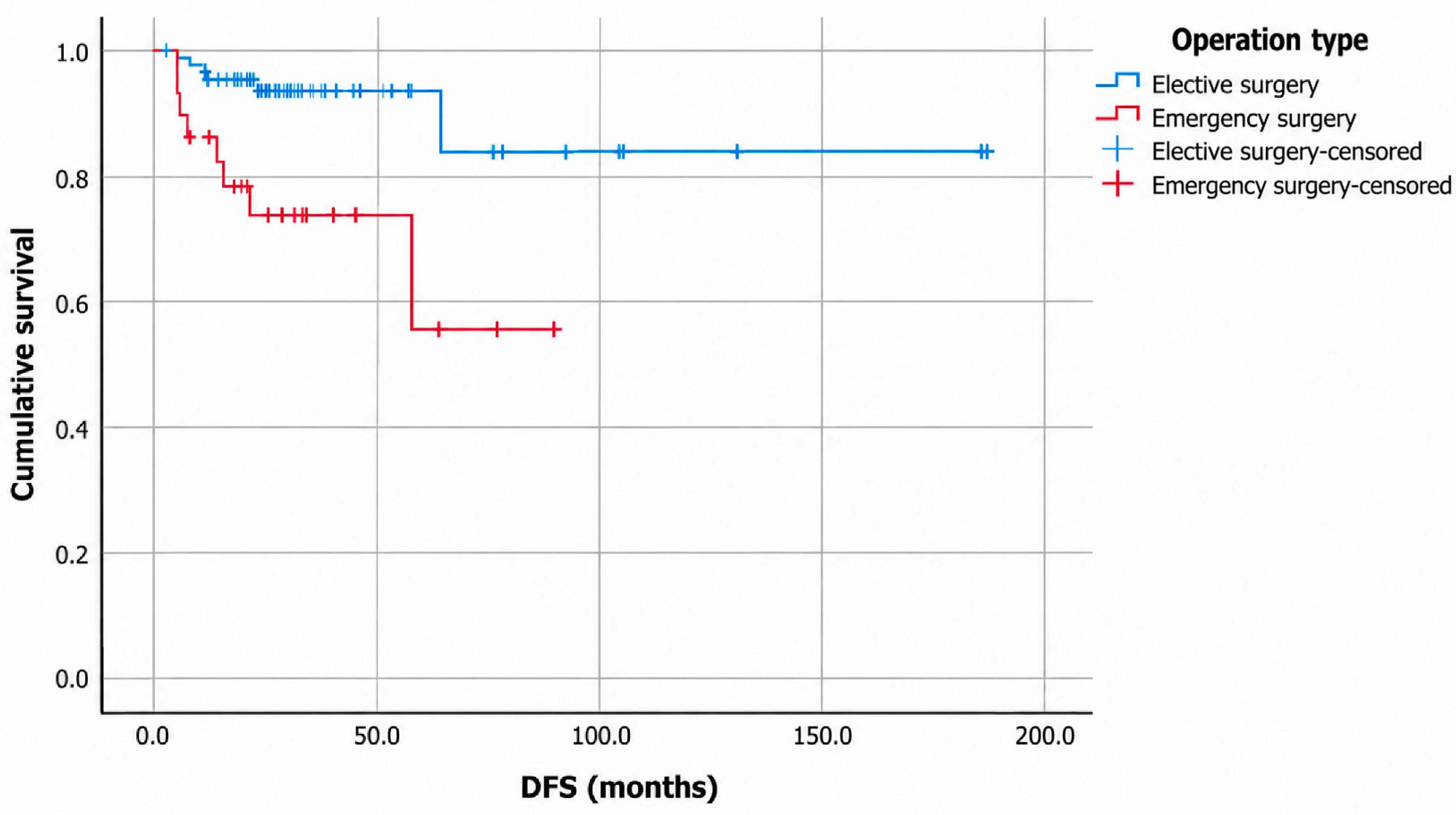
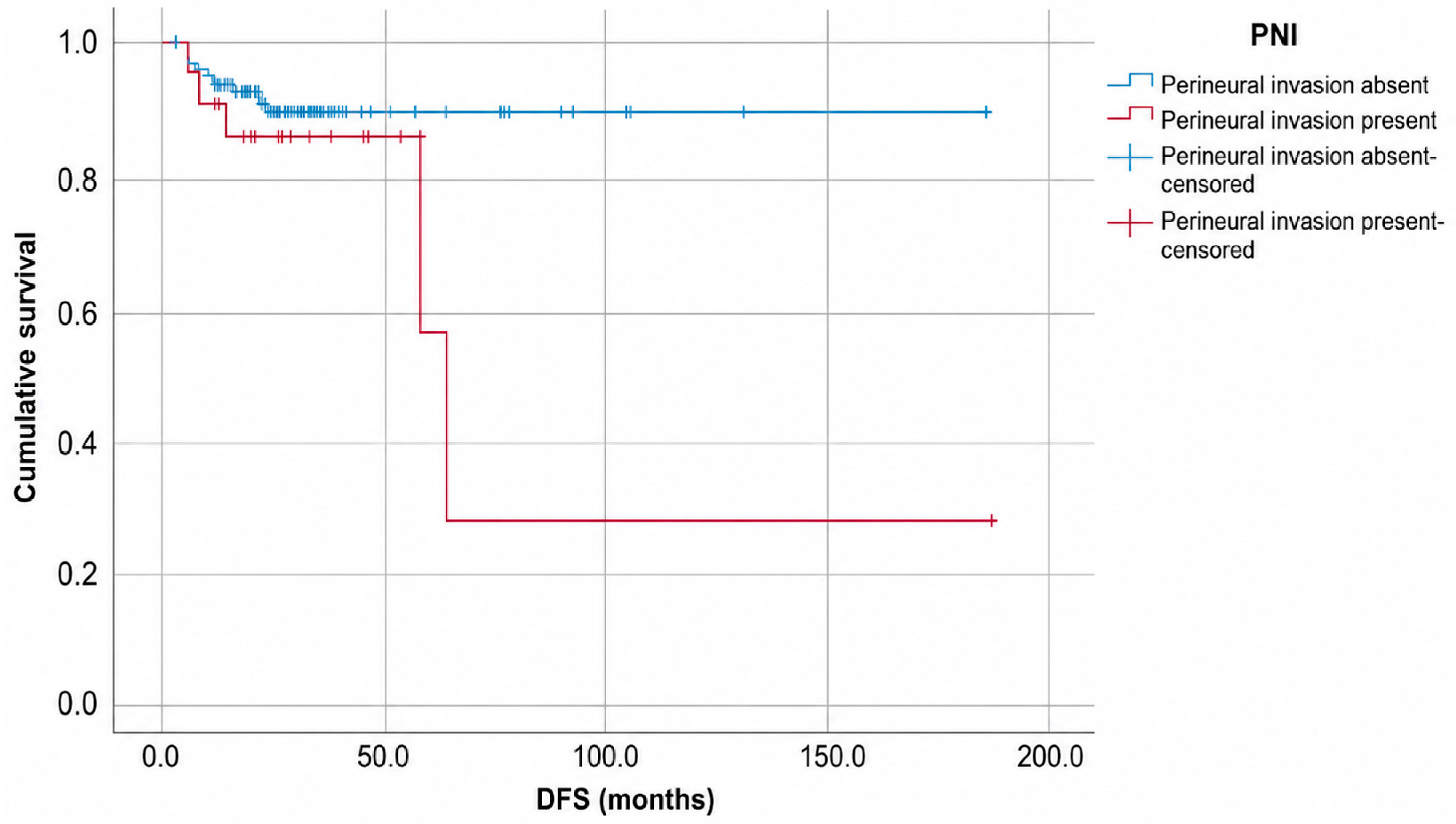
3.6. Survival Analysis
4. Discussion
5. Conclusions
Author Contributions
Funding
Institutional Review Board Statement
Informed Consent Statement
Data Availability Statement
Acknowledgments
Conflicts of Interest
Abbreviations
| AJCC | American Joint Committee on Cancer |
| ASA | American Society of Anesthesiologists |
| BMI | Body Mass Index |
| CA19-9 | Carbohydrate Antigen 19-9 |
| CAPOX | Capecitabine Plus Oxaliplatin |
| CCI | Charlson Comorbidity Index |
| CEA | Carcinoembryonic Antigen |
| CI | Confidence Interval |
| CRC | Colorectal Cancer |
| ctDNA | Circulating Tumor DNA |
| DFS | Disease-Free Survival |
| ECOG | Eastern Cooperative Oncology Group |
| ESMO | European Society for Medical Oncology |
| FOLFOX | Fluorouracil, Leucovorin, and Oxaliplatin |
| LVI | Lymphovascular Invasion |
| MSI | Microsatellite Instability |
| MSS | Microsatellite Stable |
| NCCN | National Comprehensive Cancer Network |
| OR | Odds Ratio |
| PNI | Perineural Invasion |
| SD | Standard Deviation |
| TNM | Tumor–Node–Metastasis |
References
- Bray, F.; Laversanne, M.; Sung, H.; Ferlay, J.; Siegel, R.L.; Soerjomataram, I.; Jemal, A. Global cancer statistics 2022: GLOBOCAN estimates of incidence and mortality worldwide for 36 cancers in 185 countries. CA A Cancer J. Clin. 2024, 74, 229–263. [Google Scholar] [CrossRef] [Scilit] [PubMed]
- Baxter, N.N.; Kennedy, E.B.; Bergsland, E.; Berlin, J.; George, T.J.; Gill, S.; Gold, P.J.; Hantel, A.; Jones, L.; Lieu, C. Adjuvant therapy for stage II colon cancer: ASCO guideline update. J. Clin. Oncol. 2022, 40, 892–910. [Google Scholar] [CrossRef] [Scilit] [PubMed]
- Argilés, G.; Tabernero, J.; Labianca, R.; Hochhauser, D.; Salazar, R.; Iveson, T.; Laurent-Puig, P.; Quirke, P.; Yoshino, T.; Taieb, J. Localised colon cancer: ESMO Clinical Practice Guidelines for diagnosis, treatment and follow-up. Ann. Oncol. 2020, 31, 1291–1305. [Google Scholar] [CrossRef] [Scilit] [PubMed]
- Xiong, Z.-Z.; Xie, M.-H.; Li, X.-Z.; Jin, L.-Y.; Zhang, F.-X.; Yin, S.; Chen, H.-X.; Lian, L. Risk factors for postoperative recurrence in patients with stage II colorectal cancer. BMC Cancer 2023, 23, 658. [Google Scholar] [CrossRef] [Scilit] [PubMed]
- Iveson, T.J.; Sobrero, A.F.; Yoshino, T.; Souglakos, I.; Ou, F.-S.; Meyers, J.P.; Shi, Q.; Grothey, A.; Saunders, M.P.; Labianca, R. Duration of adjuvant doublet chemotherapy (3 or 6 months) in patients with high-risk stage II colorectal cancer. J. Clin. Oncol. 2021, 39, 631–641. [Google Scholar] [CrossRef] [Scilit] [PubMed]
- Yang, Y.; Huang, X.; Sun, J.; Gao, P.; Song, Y.; Chen, X.; Zhao, J.; Wang, Z. Prognostic value of perineural invasion in colorectal cancer: A meta-analysis. J. Gastrointest. Surg. 2015, 19, 1113–1122. [Google Scholar] [CrossRef] [Scilit] [PubMed]
- Huh, J.W.; Kim, H.R.; Kim, Y.J. Prognostic value of perineural invasion in patients with stage II colorectal cancer. Ann. Surg. Oncol. 2010, 17, 2066–2072. [Google Scholar] [CrossRef] [Scilit] [PubMed]
- Li, J.; Mei, S.; Zhou, S.; Zhao, F.; Liu, Q. Perineural invasion is a prognostic factor in stage II colorectal cancer but not a treatment indicator for traditional chemotherapy: A retrospective cohort study. J. Gastrointest. Oncol. 2022, 13, 710–721. [Google Scholar] [CrossRef] [Scilit] [PubMed]
- Yun, J.A.; Kim, H.C.; Kim, S.H.; Cho, Y.B.; Yun, S.H.; Lee, W.Y.; Chun, H.K. Prognostic significance of perineural invasion in stage IIA colon cancer. ANZ J. Surg. 2016, 86, 1007–1013. [Google Scholar] [CrossRef] [Scilit] [PubMed]
- Skancke, M.; Arnott, S.M.; Amdur, R.L.; Siegel, R.S.; Obias, V.J.; Umapathi, B.A. Lymphovascular Invasion and Perineural Invasion Negatively Impact Overall Survival for Stage II Adenocarcinoma of the Colon. Dis. Colon Rectum 2019, 62, 181–188. [Google Scholar] [CrossRef] [Scilit] [PubMed]
- Gao, Z.; Cao, H.; Xu, X.; Wang, Q.; Wu, Y.; Lu, Q. Prognostic value of lymphovascular invasion in stage II colorectal cancer patients with an inadequate examination of lymph nodes. World J. Surg. Oncol. 2021, 19, 125. [Google Scholar] [CrossRef] [Scilit] [PubMed]
- Lugli, A.; Kirsch, R.; Ajioka, Y.; Bosman, F.; Cathomas, G.; Dawson, H.; El Zimaity, H.; Fléjou, J.-F.; Hansen, T.P.; Hartmann, A. Recommendations for reporting tumor budding in colorectal cancer based on the International Tumor Budding Consensus Conference (ITBCC) 2016. Mod. Pathol. 2017, 30, 1299–1311. [Google Scholar] [CrossRef] [Scilit] [PubMed]
- Ueno, H.; Ishiguro, M.; Nakatani, E.; Ishikawa, T.; Uetake, H.; Matsuda, C.; Nakamoto, Y.; Kotake, M.; Kurachi, K.; Egawa, T. Prospective multicenter study on the prognostic and predictive impact of tumor budding in stage II colon cancer: Results from the SACURA trial. J. Clin. Oncol. 2019, 37, 1886–1894. [Google Scholar] [CrossRef] [Scilit] [PubMed]
- Tie, J.; Cohen, J.D.; Lahouel, K.; Lo, S.N.; Wang, Y.; Kosmider, S.; Wong, R.; Shapiro, J.; Lee, M.; Harris, S. Circulating tumor DNA analysis guiding adjuvant therapy in stage II colon cancer. N. Eng. J. Med. 2022, 386, 2261–2272. [Google Scholar] [CrossRef] [Scilit] [PubMed]
- Tie, J.; Wang, Y.; Lo, S.N.; Lahouel, K.; Cohen, J.D.; Wong, R.; Shapiro, J.D.; Harris, S.J.; Khattak, A.; Burge, M.E. Circulating tumor DNA analysis guiding adjuvant therapy in stage II colon cancer: 5-year outcomes of the randomized DYNAMIC trial. Nat. Med. 2025, 31, 1509–1518. [Google Scholar] [CrossRef] [Scilit] [PubMed]
- Golder, A.M.; McMillan, D.C.; Horgan, P.G.; Roxburgh, C.S. Determinants of emergency presentation in patients with colorectal cancer: A systematic review and meta-analysis. Sci. Rep. 2022, 12, 4366. [Google Scholar] [CrossRef] [Scilit] [PubMed]
- Zhou, H.; Jin, Y.; Wang, J.; Chen, G.; Chen, J.; Yu, S. Comparison of short-term surgical outcomes and long-term survival between emergency and elective surgery for colorectal cancer: A systematic review and meta-analysis. Int. J. Colorectal Dis. 2023, 38, 41. [Google Scholar] [CrossRef] [Scilit] [PubMed]
- Sandini, M.; Piccioni, S.; Badalucco, S.; Andreucci, E.; Gambelli, M.; Fontani, A.; Piagnerelli, R.; Verre, L.; Marrelli, D.; Roviello, F. Emergency resection for colonic cancer has an independent and unfavorable effect on long-term oncologic outcome. J. Gastrointest. Cancer 2024, 55, 1401–1409. [Google Scholar] [CrossRef] [Scilit] [PubMed]
- Negruț, R.L.; Coțe, A.; Maghiar, A.M. A retrospective analysis of emergency versus elective surgical outcomes in colon cancer patients: A single-center study. J. Clin. Med. 2024, 13, 6533. [Google Scholar] [CrossRef] [Scilit] [PubMed]
- McArdle, C.; Hole, D. Emergency presentation of colorectal cancer is associated with poor 5-year survival. J. Br. Surg. 2004, 91, 605–609. [Google Scholar] [CrossRef] [Scilit] [PubMed]
- Chinyowa, S.; Murewanhema, G.; Katsidzira, L.; Moodley, J.; Chirenje, M.; Muguti, G. Emergency presentation of colorectal cancer in Africa: A scoping review. BMJ Open 2026, 16, e110931. [Google Scholar] [CrossRef] [Scilit] [PubMed]
- Guidolin, K.; Withers, R.; Shariff, F.; Ashamalla, S.; Nadler, A. Quality of Colon Cancer Care in Patients Undergoing Emergency Surgery. Curr. Oncol. 2021, 28, 2079–2086. [Google Scholar] [CrossRef] [Scilit] [PubMed]
- Lavanchy, J.L.; Vaisnora, L.; Haltmeier, T.; Zlobec, I.; Brügger, L.E.; Candinas, D.; Schnüriger, B. Oncologic long-term outcomes of emergency versus elective resection for colorectal cancer. Int. J. Colorectal Dis. 2019, 34, 2091–2099. [Google Scholar] [CrossRef] [Scilit] [PubMed]
- Artac, M.; Turhal, N.S.; Kocer, M.; Karabulut, B.; Bozcuk, H.; Yalcin, S.; Karaagac, M.; Gündüz, S.; Isik, N.; Uygun, K. Do high-risk features support the use of adjuvant chemotherapy in stage II colon cancer? A Turkish Oncology Group study. Tumori 2014, 100, 143–148. [Google Scholar] [CrossRef] [Scilit] [PubMed]
- Peng, S.L.; Thomas, M.; Ruszkiewicz, A.; Hunter, A.; Lawrence, M.; Moore, J. Conventional adverse features do not predict response to adjuvant chemotherapy in stage II colon cancer. ANZ J. Surg. 2014, 84, 837–841. [Google Scholar] [CrossRef] [Scilit] [PubMed]
- Li, K.; Zhao, F.; Guo, Y.; Wu, Q.; Luo, S.; Zhang, J.; Li, H.; Hu, S.; Wu, B.; Lin, G.; et al. Interaction analysis of high-risk pathological features on adjuvant chemotherapy survival benefit in stage II colon cancer patients: A multi-center, retrospective study. BMC Cancer 2023, 23, 797. [Google Scholar] [CrossRef] [Scilit] [PubMed]
- Benson, A.B.; Venook, A.P.; Adam, M.; Chang, G.; Chen, Y.J.; Ciombor, K.K.; Cohen, S.A.; Cooper, H.S.; Deming, D.; Garrido-Laguna, I.; et al. Colon Cancer, Version 3.2024, NCCN Clinical Practice Guidelines in Oncology. J. Natl. Compr. Canc Netw. 2024, 22, e240029. [Google Scholar] [CrossRef] [Scilit] [PubMed]
- Erciyestepe, M.; Selvi, O.; Dinç, G.; Öztürk, A.E.; Aydın, O.; Dinç Sonuşen, Ş.; Güneş, T.K.; Avcı, T.; Vatansever, S.; Çelik, E.; et al. Factors Affecting Recurrence and Survival in Stage IIA Colon Cancer Patients. Oncology 2024, 102, 1009–1017. [Google Scholar] [CrossRef] [Scilit] [PubMed]
- Dienstmann, R.; Vermeulen, L.; Guinney, J.; Kopetz, S.; Tejpar, S.; Tabernero, J. Consensus molecular subtypes and the evolution of precision medicine in colorectal cancer. Nat. Rev. Cancer 2017, 17, 79–92. [Google Scholar] [CrossRef] [Scilit] [PubMed]



| Variable | Category/Statistic | Overall (n = 118) |
|---|---|---|
| Age, years | Median (range) | 64 (27–89) |
| Sex | Female | 41 (34.7%) |
| Male | 77 (65.3%) | |
| Comorbidity | Absent | 53 (44.9%) |
| Present | 65 (55.1%) | |
| Tumor location | Right colon | 42 (35.6%) |
| Left colon | 76 (64.4%) | |
| Type of surgery | Elective | 88 (74.6%) |
| Emergency | 30 (25.4%) | |
| Perforation | Absent | 112 (94.9%) |
| Present | 6 (5.1%) | |
| Number of examined lymph nodes | Adequate, ≥12 | 99 (83.9%) |
| Inadequate, <12 | 19 (16.1%) | |
| Perineural invasion | Absent | 95 (80.5%) |
| Present | 23 (19.5%) | |
| Lymphovascular invasion | Absent | 87 (73.7%) |
| Present | 31 (26.3%) | |
| Histological differentiation | Well differentiated | 15 (12.7%) |
| Moderately differentiated | 86 (72.9%) | |
| Poorly differentiated | 7 (5.9%) | |
| Unknown | 10 (8.5%) | |
| Microsatellite status | MSS | 107 (90.7%) |
| MSI | 11 (9.3%) | |
| CEA, ng/mL | Median (range) | 2.30 (0.41–381.00) |
| CA 19-9, U/mL | Median (range) | 10.15 (0.52–510.00) |
| Adjuvant treatment | No chemotherapy | 40 (33.9%) |
| FOLFOX/CAPOX | 41 (34.7%) | |
| Capecitabine | 37 (31.4%) | |
| Adjuvant chemotherapy | No | 40 (33.9%) |
| Yes | 78 (66.1%) | |
| Recurrence | No | 103 (87.3%) |
| Yes | 15 (12.7%) |
| Variable | Category/Statistic | No Adjuvant Chemotherapy (n = 40) | Adjuvant Chemotherapy (n = 78) | p Value |
|---|---|---|---|---|
| Age, years | Mean ± SD | 64.53 ± 10.37 | 62.00 ± 11.88 | 0.257 |
| Sex | Female | 11 (27.5%) | 30 (38.5%) | 0.237 |
| Male | 29 (72.5%) | 48 (61.5%) | ||
| Comorbidity | Absent | 15 (37.5%) | 38 (48.7%) | 0.246 |
| Present | 25 (62.5%) | 40 (51.3%) | ||
| Tumor location | Right colon | 18 (45.0%) | 24 (30.8%) | 0.126 |
| Left colon | 22 (55.0%) | 54 (69.2%) | ||
| Type of surgery | Elective | 39 (97.5%) | 49 (62.8%) | <0.001 |
| Emergency | 1 (2.5%) | 29 (37.2%) | ||
| Perforation | Absent | 40 (100%) | 72 (92.3%) | 0.095 a |
| Present | 0 | 6 (7.7%) | ||
| Lymph node dissection | Adequate, ≥12 | 36 (90.0%) | 63 (80.8%) | 0.197 |
| Inadequate, <12 | 4 (10.0%) | 15 (19.2%) | ||
| Perineural invasion | Absent | 40 (100%) | 55 (70.5%) | <0.001 a |
| Present | 0 | 23 (29.5%) | ||
| Lymphovascular invasion | Absent | 40 (100%) | 47 (60.3%) | <0.001 a |
| Present | 0 | 31 (39.7%) | ||
| Histological differentiation | Well differentiated | 8 (20.0%) | 7 (9.0%) | 0.403 |
| Moderately differentiated | 27 (67.5%) | 59 (75.6%) | ||
| Poorly differentiated | 2 (5.0%) | 5 (6.4%) | ||
| Unknown | 3 (7.5%) | 7 (9.0%) | ||
| Microsatellite status | MSS | 35 (87.5%) | 72 (92.3%) | 0.506 |
| MSI | 5 (12.5%) | 6 (7.7%) | ||
| CEA, ng/mL | Median (range) | 2.43 (0.45–381.00) | 2.30 (0.41–143.00) | 0.995 |
| CA 19-9, U/mL | Median (range) | 9.90 (2.00–510.00) | 10.40 (0.52–298.00) | 0.672 |
| Recurrence | No | 39 (97.5%) | 64 (82.1%) | 0.019 a |
| Yes | 1 (2.5%) | 14 (17.9%) |
| Variable | Category/Statistic | No Recurrence (n = 103) | Recurrence (n = 15) | p Value |
|---|---|---|---|---|
| Age, years | Mean ± SD | 62.57 ± 11.27 | 64.80 ± 12.56 | 0.493 |
| Sex | Female | 35 (34.0%) | 6 (40.0%) | 0.773 a |
| Male | 68 (66.0%) | 9 (60.0%) | ||
| Comorbidity | Absent | 46 (44.7%) | 7 (46.7%) | 1.000 a |
| Present | 57 (55.3%) | 8 (53.3%) | ||
| Tumor location | Right colon | 39 (37.9%) | 3 (20.0%) | 0.251 a |
| Left colon | 64 (62.1%) | 12 (80.0%) | ||
| Type of surgery | Elective | 82 (79.6%) | 6 (40.0%) | 0.003 a |
| Emergency | 21 (20.4%) | 9 (60.0%) | ||
| Perforation | Absent | 99 (96.1%) | 13 (86.7%) | 0.168 a |
| Present | 4 (3.9%) | 2 (13.3%) | ||
| Lymph node dissection | Adequate, ≥12 | 88 (85.4%) | 11 (73.3%) | 0.260 a |
| Inadequate, <12 | 15 (14.6%) | 4 (26.7%) | ||
| Perineural invasion | Absent | 86 (83.5%) | 9 (60.0%) | 0.073 a |
| Present | 17 (16.5%) | 6 (40.0%) | ||
| Lymphovascular invasion | Absent | 77 (74.8%) | 10 (66.7%) | 0.536 a |
| Present | 26 (25.2%) | 5 (33.3%) | ||
| Histological differentiation | Well differentiated | 14 (13.6%) | 1 (6.7%) | 0.804 b |
| Moderately differentiated | 75 (72.8%) | 11 (73.3%) | ||
| Poorly differentiated | 6 (5.8%) | 1 (6.7%) | ||
| Unknown | 8 (7.8%) | 2 (13.3%) | ||
| Microsatellite status | MSS | 94 (91.3%) | 13 (86.7%) | 0.630 a |
| MSI | 9 (8.7%) | 2 (13.3%) | ||
| CEA, ng/mL | Median (range) | 2.10 (0.41–381.00) | 4.80 (1.58–143.00) | 0.005 |
| CA 19-9, U/mL | Median (range) | 10.20 (0.52–510.00) | 7.80 (1.00–171.00) | 0.499 |
| Adjuvant chemotherapy | No | 39 (37.9%) | 1 (6.7%) | 0.019 |
| Yes | 64 (62.1%) | 14 (93.3%) |
| Variable | Univariable OR | 95% CI | p Value | Adjusted OR | 95% CI | p Value |
|---|---|---|---|---|---|---|
| Male sex | 0.772 | 0.254–2.345 | 0.648 | — | — | — |
| Age, per 1-year increase | 1.018 | 0.969–1.070 | 0.479 | — | — | — |
| Presence of comorbidity | 0.922 | 0.311–2.733 | 0.884 | — | — | — |
| CEA, per 1-ng/mL increase | 1.003 | 0.993–1.014 | 0.513 | — | — | — |
| CA 19-9, per 1-U/mL increase | 1.000 | 0.990–1.010 | 0.998 | — | — | — |
| Left-sided tumor location | 2.437 | 0.647–9.188 | 0.188 | — | — | — |
| Emergency surgery | 5.857 | 1.875–18.292 | 0.002 | 5.508 | 1.726–17.576 | 0.004 |
| Adequate lymph node dissection, ≥12 | 0.469 | 0.132–1.665 | 0.242 | — | — | — |
| Perineural invasion | 3.373 | 1.061–10.723 | 0.039 | 3.021 | 0.886–10.300 | 0.077 |
| Lymphovascular invasion | 1.481 | 0.463–4.736 | 0.508 | — | — | — |
| MSI | 1.607 | 0.312–8.269 | 0.570 | — | — | — |
| Adjuvant chemotherapy | 8.531 | 1.079–67.437 | 0.042 | Not included in the primary model | — | — |
| Variable | Adjusted OR | 95% CI | p Value |
|---|---|---|---|
| Adjuvant chemotherapy | 3.515 | 0.377–32.768 | 0.270 |
| Emergency surgery | 4.079 | 1.207–13.779 | 0.024 |
| Perineural invasion | 2.324 | 0.662–8.161 | 0.188 |
Disclaimer/Publisher’s Note: The statements, opinions and data contained in all publications are solely those of the individual author(s) and contributor(s) and not of MDPI and/or the editor(s). MDPI and/or the editor(s) disclaim responsibility for any injury to people or property resulting from any ideas, methods, instructions or products referred to in the content. |
© 2026 by the authors. Licensee MDPI, Basel, Switzerland. This article is an open access article distributed under the terms and conditions of the Creative Commons Attribution (CC BY) license.
Share and Cite
Çelik, S.; Karatlı, S.; Zeynelgil, E.; Ayyıldız Sevim, H.; Eren, T. Emergency Surgery Independently Predicts Postoperative Recurrence in Patients with Pathologic T3N0M0 Colon Cancer: A Retrospective Single-Center Cohort Study. Curr. Oncol. 2026, 33, 526. https://doi.org/10.3390/curroncol33090526
Çelik S, Karatlı S, Zeynelgil E, Ayyıldız Sevim H, Eren T. Emergency Surgery Independently Predicts Postoperative Recurrence in Patients with Pathologic T3N0M0 Colon Cancer: A Retrospective Single-Center Cohort Study. Current Oncology. 2026; 33(9):526. https://doi.org/10.3390/curroncol33090526
Chicago/Turabian StyleÇelik, Selahattin, Salih Karatlı, Esra Zeynelgil, Hatice Ayyıldız Sevim, and Tülay Eren. 2026. "Emergency Surgery Independently Predicts Postoperative Recurrence in Patients with Pathologic T3N0M0 Colon Cancer: A Retrospective Single-Center Cohort Study" Current Oncology 33, no. 9: 526. https://doi.org/10.3390/curroncol33090526
APA StyleÇelik, S., Karatlı, S., Zeynelgil, E., Ayyıldız Sevim, H., & Eren, T. (2026). Emergency Surgery Independently Predicts Postoperative Recurrence in Patients with Pathologic T3N0M0 Colon Cancer: A Retrospective Single-Center Cohort Study. Current Oncology, 33(9), 526. https://doi.org/10.3390/curroncol33090526