Perspectives of Rectal Cancer Patients Undergoing Non-Operative Management (NOM): A Qualitative Study

 ,
,  , , , ,
Simple Summary
Abstract
1. Introduction
2. Materials and Methods
3. Results
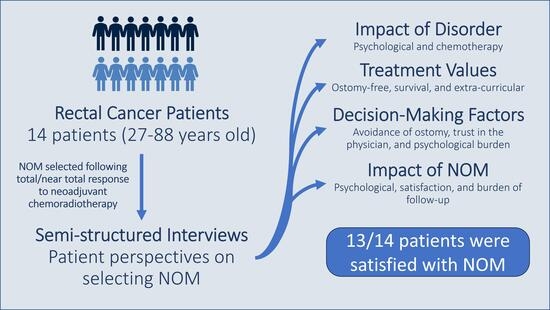
3.1. Impact of Rectal Cancer Diagnosis
“My favorite saying from Confucius is that every man has two lives, and the second one starts when he realizes he only has one life. And that was so big on me lying on that radiation table … it’s all about handling it mentally… it’s going to kill you way down the line, so yes, it’s a mental struggle like nothing I’ve ever had to overcome, but I did.”
“I live on a hill in… and I was walking hills in… until obviously the radiation burned me up to the point where I actually couldn’t, but that only happened for a week or so. I didn’t stop doing anything. I was doing it. I was really, really stubborn and really positive.”
“Well, it affected—during the treatment, it affected a lot—it affects your prostate, it affects your bladder. I mean, I tried to explain to somebody, it was like crapping razor blades. I mean, it gets pretty tender down there.”
3.2. Treatment Values
“That was the game changer for me, when he said you got to have a bag. Like, my friend had the same thing, colon cancer, and he didn’t have to have a bag. So that’s why I say, oh well, if I got to have surgery then I will. But as soon as he said your surgery will include a bag after that, it just killed it for me.”
“Really those two things were on my mind, I wasn’t thinking of anything else at all but staying alive and not having that ostomy.”
“I just wanted to survive and enjoy the rest of my life. Even if I had to look a little different or even if it was going to hurt like hell, I was OK with that… I have two kids and I need to be around. I want to be there for their weddings and their graduations and all that kind of stuff. Maybe as a person, sometimes I don’t overanalyze those kinds of things that you mentioned, like the cosmetic side and that kind of thing [with regards to an ostomy].”
“I mean, it is—it does kind of put your life in a different mode of—you know, when you have to go have chemo and radiation—take chemo and radiation every day for, you know, two months, two and a half months. It does kind of set the scale for what you do.”
“I think the interruption is like [during] a really exciting time of your life. The loss of control over how we start a family. Kind of the halt in my career and just developing in my profession in a meaningful way. This is the time where you’re looking at like purchasing a home, like starting a family. I was also diagnosed four days before I got married…the morning after my wedding I have six missed calls from medical providers.”
3.3. Decision-Making Factors
“The opportunity for non-operative management was to feel safe and comfortable with the added bonus of I can continue to have my normal bowel function and aesthetically or visually look the same. Those things were nice to be able to preserve, at least while we can.”
“When I’m thinking back on those eight years ago, Doctor… was incredibly over the top with that. I listened to him very closely. I trusted him, there was just something about his mannerisms that just made me trust him, and he trusted me. And we just kind of went down that path, you know?”
“I’m part of this Facebook group called Colon Town… and that’s been a really great resource. They have a lot of—they have a whole like colorectal cancer university with lots of videos and resources there… And it seemed like a lot of the you know, a lot of the studies were saying that as long as you’re closely followed and if you require like that salvage surgery if the cancer comes back, the outcomes are you know, the same as if you had gone immediately in for surgery.”
“Like, if it didn’t work, if the cancer came back, it wasn’t anyone else’s fault but mine because I didn’t follow the standard of care.”
“Because there’s certain statistics about like survival rates, you know, if you do the surgery then your survival rate is what? Ninety-two percent. And then like thirty percent of people, their cancer does come back. But then, for me, like statistically, I shouldn’t have even got this in the first place because some super high percentage of people are like over sixty-five when they get it. So, navigating statistics was very weird as an individual. Like, I can understand it maybe as a doctor or like a public health person. You have like data that’s in an aggregate. But when you’re just one person, it’s not, like you use it to base your decision but it’s only indicative because you’re only one person, right? So you don’t know which one … category you’re going to fall into.”
“He was livid. He was—I couldn’t believe it. I was sitting in a chair. I had my legs crossed. And I was looking at him and he was bouncing off the wall. And, “it’s going to come back, it’s going to kill you. I don’t know what the hell you guys are doing. I don’t know what the hell those doctors at St. Paul’s are doing. We got to have a meeting.” And I just like, I looked at him. I went, “wow.” And he stopped. He looked at me and I went, “you really got to settle down young man.”… That was the biggest pitfall was his, like, you guys are crazy. But Doctor… and I were going, I don’t think so.”
“That’s interesting in terms of my thoughts about non-operative management. I’d say from a fertility perspective early on it seemed to me that it was a very kind of clear-cut choice that the treatment pathway that would give me the best quality of life and best opportunity for bowel function preservation would be to have radiation followed by chemo and then if required, a surgery. … At that time when I heard that the chance of a complete response was 30%. I really dismissed that as a possibility; it just seemed far too wishful when I was even in that position at all. But knowing that radiation followed by chemo was the best course and knowing that the side-effect associated with that of permanence was that I wouldn’t be able to carry a pregnancy.“
3.4. Impact of NOM Pathway
“Coming to Vancouver for my appointments is always a stressful time, because what if they find something on the scan? What if they find something in the MRI? What if there’s something in my blood work? What if? Is this going to be lingering in my head for the rest of my life? What are the chances of this reoccurring… it consumes people in a negative way… You know, it’s just what if this happened? What if that happened? But it didn’t, so I’m quite grateful for that. And I’m quite happy with the choice I made to select the non-operative path.”
“Yeah. No, I, you know, every morning I wake up and I say, I’m healthy. I’ve never been this healthy. It is amazing. I’m very confident that more people will benefit from not getting the surgery if it can be avoided.”
“In the first year I had re-checkup every three months. Every three months there’s blood, CT, MRI, and Doctor… went in the back with the mirrors, you know, and looked at the real picture of it. And every time it was OK we waited for the next three months. And then now in the last year it’s every six months now.”
4. Discussion
5. Conclusions
Author Contributions
Funding
Institutional Review Board Statement
Informed Consent Statement
Data Availability Statement
Acknowledgments
Conflicts of Interest
Abbreviations
| NOM | Non-operative management |
| CRC | Colorectal cancer |
| cCR | Complete clinical response |
| TME | Total mesorectal excision |
| MRI | Magnetic resonance imaging |
| DRE | Digital rectal exam |
| CEA | Carcinoembryonic antigen |
| CT | Computed tomography |
| ASCO | American Society of Clinical Oncology |
References
- Siegel, R.L.; Miller, K.D.; Fuchs, H.E.; Jemal, A. Cancer statistics, 2022. CA Cancer J. Clin. 2022, 72, 7–33. [Google Scholar] [CrossRef] [Scilit]
- Ramai, D.; Ofosu, A.; Solanki, V.; Lai, J.K.; Barakat, M.; Dhaliwal, A.; Aamar, A.; Aloreidi, K.; Mohan, B.; Reddy, M.; et al. Incidence Rates, Treatment, and Survival of Rectal Cancer Among Young Patients: A Nationwide Cohort Study. J. Clin. Gastroenterol. 2021, 55, 534–541. Available online: https://journals.lww.com/jcge/Fulltext/2021/07000/Incidence_Rates,_Treatment,_and_Survival_of_Rectal.12.aspx (accessed on 5 February 2026). [CrossRef] [Scilit]
- Keller, D.S.; Berho, M.; Perez, R.O.; Wexner, S.D.; Chand, M. The multidisciplinary management of rectal cancer. Nat. Rev. Gastroenterol. Hepatol. 2020, 17, 414–429. [Google Scholar] [CrossRef] [Scilit]
- Wilkinson, N. Management of Rectal Cancer. Surg. Clin. N. Am. 2020, 100, 615–628. [Google Scholar] [CrossRef] [Scilit]
- Delibegovic, S. Introduction to Total Mesorectal Excision. Med. Arch. 2017, 71, 434–438. [Google Scholar] [CrossRef] [Scilit] [PubMed]
- Mullaney, T.G.; Lightner, A.L.; Johnston, M.; Keck, J.; Wattchow, D. ‘Watch and wait’ after chemoradiotherapy for rectal cancer. ANZ J. Surg. 2018, 88, 836–841. [Google Scholar] [CrossRef] [Scilit]
- Peltrini, R.; Sacco, M.; Luglio, G.; Bucci, L. Local excision following chemoradiotherapy in T2–T3 rectal cancer: Current status and critical appraisal. Updat. Surg. 2020, 72, 29–37. [Google Scholar] [CrossRef] [Scilit] [PubMed]
- Garcia-Aguilar, J.; Perez, R.O. Rectal Cancer: Nonoperative Management. In The ASCRS Textbook of Colon and Rectal Surgery; Steele, S.R., Hull, T.L., Hyman, N., Maykel, J.A., Read, T.E., Whitlow, C.B., Eds.; Springer International Publishing: Cham, Switzerland, 2022; pp. 491–508. [Google Scholar] [CrossRef] [Scilit]
- Emile, S.H.; Wignakumar, A. Non-operative management of rectal cancer: Highlighting the controversies. World J. Gastrointest. Surg. 2024, 16, 1501–1506. [Google Scholar] [CrossRef] [Scilit] [PubMed] [PubMed Central]
- Gani, C.; Kirschniak, A.; Zips, D. Watchful Waiting after Radiochemotherapy in Rectal Cancer: When Is It Feasible? Visc. Med. 2019, 35, 119–123. [Google Scholar] [CrossRef] [Scilit] [PubMed] [PubMed Central]
- Kennedy, A.; Cohn, M.; Coldwell, D.M.; Drooz, A.; Ehrenwald, E.; Kaiser, A.; Nutting, C.W.; Rose, S.C.; Wang, E.A.; Savin, M.A. Updated survival outcomes and analysis of long-term survivors from the MORE study on safety and efficacy of radioembolization in patients with unresectable colorectal cancer liver metastases. J. Gastrointest. Oncol. 2017, 8, 614–624. [Google Scholar] [CrossRef] [Scilit] [PubMed] [PubMed Central]
- Gupta, A.; Eisenhauer, E.A.; Booth, C.M. The Time Toxicity of Cancer Treatment. J. Clin. Oncol. Off. J. Am. Soc. Clin. Oncol. 2022, 40, 1611–1615. [Google Scholar] [CrossRef] [Scilit] [PubMed]
- Guest, G.; Bunce, A.; Johnson, L. How many interviews are enough? An experiment with data saturation and variability. Field Methods 2006, 18, 59–82. [Google Scholar] [CrossRef] [Scilit]
- Hrincu, V.; McDonald, P.J.; Connolly, M.B.; Harrison, M.J.; Ibrahim, G.M.; Naftel, R.P.; Chiong, W.; Alam, A.; Ribary, U.; Illes, J. Choice and Trade-offs: Parent Decision Making for Neurotechnologies for Pediatric Drug-Resistant Epilepsy. J. Child Neurol. 2021, 36, 943–949. [Google Scholar] [CrossRef] [Scilit] [PubMed]
- Glaser, B.G. The Constant Comparative Method of Qualitative Analysis. Soc. Probl. 1965, 12, 436–445. [Google Scholar] [CrossRef] [Scilit]
- Dickey, S.L.; Grayson, C.J. The Quality of Life among Men Receiving Active Surveillance for Prostate Cancer: An Integrative Review. Healthcare 2019, 7, 14. [Google Scholar] [CrossRef] [Scilit] [PubMed] [PubMed Central]
- Steineck, G.; Helgesen, F.; Adolfsson, J.; Dickman, P.W.; Johansson, J.E.; Norlén, B.J.; Holmberg, L. Quality of Life after Radical Prostatectomy or Watchful Waiting. N. Engl. J. Med. 2002, 347, 790–796. [Google Scholar] [CrossRef] [Scilit]
- Hilty Chu, B.K.; Dhimal, T.; Boyer, M.E.; Loria, A.; Cupertino, P.; Ramsdale, E.E.; Fleming, F.J. Nonoperative Management for Rectal Cancer: A Qualitative Study of Patient Perceptions, Priorities, Barriers, and Facilitators to Surveillance. Dis. Colon Rectum 2026, 69, 577–585. [Google Scholar] [CrossRef] [Scilit]
- Strokes, N.; Lloyd, C.; Girardin, A.L.; Santana, C.S.; Mangus, C.W.; Mitchell, K.E.; Hughes, A.R.; Nelson, B.B.; Gunn, B.; Schoenfeld, E.M. Can shared decision-making interventions increase trust/trustworthiness in the physician-patient encounter? A scoping review. Patient Educ. Couns. 2025, 135, 108705. [Google Scholar] [CrossRef] [Scilit]
- Rivard, S.J.; Vitous, C.A.; Bamdad, M.C.; Lussiez, A.; Anderson, M.S.; Varlamos, C.; Duby, A.; Suwanabol, P.A. “I Wish There had been Resources”: A Photo-Elicitation Study of Rectal Cancer Survivorship Care Needs. Ann. Surg. Oncol. 2023, 30, 3530–3537. [Google Scholar] [CrossRef] [Scilit]
- Couwenberg, A.M.; Intven, M.P.W.; Burbach, J.P.M.; Emaus, M.J.; Van Grevenstein, W.M.U.; Verkooijen, H.M. Utility Scores and Preferences for Surgical and Organ-Sparing Approaches for Treatment of Intermediate and High-Risk Rectal Cancer. Dis. Colon Rectum 2018, 61, 911–919. [Google Scholar] [CrossRef] [Scilit]
- Bahadoer, R.R.; Peeters, K.C.M.J.; Beets, G.L.; Figueiredo, N.L.; Bastiaannet, E.; Vahrmeijer, A.; Temmink, S.J.D.; Kranenbarg, W.M.E.M.-K.; Roodvoets, A.G.H.; Habr-Gama, A.; et al. Watch and wait after a clinical complete response in rectal cancer patients younger than 50 years. Br. J. Surg. 2021, 109, 114–120. [Google Scholar] [CrossRef] [Scilit]
- Oktay, K.; Harvey, B.E.; Partridge, A.H.; Quinn, G.P.; Reinecke, J.; Taylor, H.S.; Wallace, W.H.; Wang, E.T.; Loren, A.W. Fertility Preservation in Patients With Cancer: ASCO Clinical Practice Guideline Update. J. Clin. Oncol. Off. J. Am. Soc. Clin. Oncol. 2018, 36, 1994–2001. [Google Scholar] [CrossRef] [Scilit] [PubMed]
- Mariani, S.; Chiloiro, G.; Villa, P.; Meldolesi, E.; Barbaro, B.; Di Giorgio, A.; Corrado, G.; Corvari, B.; Giraffa, M.; Scambia, G.; et al. Fertility preservation in chemo-radiotherapy for rectal cancer: A combined approach. Clin. Transl. Radiat. Oncol. 2019, 19, 77–79. [Google Scholar] [CrossRef] [Scilit] [PubMed] [PubMed Central]
- Wagner, E.H.; Ludman, E.J.; Aiello Bowles, E.J.; Penfold, R.; Reid, R.J.; Rutter, C.M.; Chubak, J.; McCorkle, R. Nurse navigators in early cancer care: A randomized, controlled trial. J. Clin. Oncol. Off. J. Am. Soc. Clin. Oncol. 2014, 32, 12–18. [Google Scholar] [CrossRef] [Scilit] [PubMed] [PubMed Central]
- American Society of Clinical Oncology. Survivorship Care Planning Tools. 2026. Available online: https://www.asco.org/news-initiatives/current-initiatives/cancer-care-initiatives/prevention-survivorship/survivorship-compendium/care-planning (accessed on 2 April 2026).
- Covelli, A.M.; Quereshy, F.A.; Kennedy, E.D.; Chadi, S.A.; Wright, F.C. Nonoperative management (NOM) in rectal cancer: Physician perspectives on offering NOM as standard of care. J. Clin. Oncol. 2020, 38, 79. [Google Scholar] [CrossRef] [Scilit]
- Vailati, B.B.; Habr-Gama, A.; Mattacheo, A.E.; São Julião, G.P.; Perez, R.O. Quality of Life in Patients With Rectal Cancer After Chemoradiation: Watch-and-Wait Policy Versus Standard Resection–Are We Comparing Apples to Oranges? Dis. Colon Rectum 2018, 61, e21. [Google Scholar] [CrossRef] [Scilit]
- Peters, F.P.; Teo, M.T.W.; Appelt, A.L.; Bach, S.; Baatrup, G.; de Wilt, J.H.W.; Kronborg, C.J.; Spindler, K.-L.G.; Marijnen, C.A.; Sebag-Montefiore, D. Mesorectal radiotherapy for early stage rectal cancer: A novel target volume. Clin. Transl. Radiat. Oncol. 2020, 21, 104–111. [Google Scholar] [CrossRef] [Scilit]



| Question | Probe |
|---|---|
| Part 1: Background and Impact of Rectal Cancer on Participants’ Lives | |
| What is your age? | |
| With what gender do you identify? | |
| What is it like having a diagnosis of rectal cancer? | How has it impacted your life, work, relationships? |
| Part 2: Management and Decision-making Around Choosing NOM | |
| What is most important to you in terms of what you want your treatment to achieve (i.e., treatment values)? | Can be no scar (cosmesis), being cancer free, survival, faster recovery time, symptomatic control, less doctor check-ups, minimal pain/discomfort, autonomy, long term prognosis, etc. |
| How has your rectal cancer been managed so far? | Did you undergo any surgical or other procedures, if so, which? What is involved in the management of your cancer currently? (i.e., how often do you have follow-up visits, scans, tests, procedures?) |
| Why did you choose to pursue your particular treatment plan? | What factors motivated you to pursue this particular plan? Did you have any hesitations? Who was involved in that selection process? How were the operative and non-operative options explained to you at the time? Was the novelty or experimental nature of this approach explained to you? |
| Part 3: Life After Choosing NOM | |
| How has this management modality impacted your life since? | How has it impacted your quality of life (work, relationships, or other aspects)? What is your physical well-being like? (i.e., bowel, bladder, sexual function) |
| Are you happy with this management pathway? Why or why not? | What aspects of it have brought you the most satisfaction? How has this approach met your expectations? |
| What has been the hardest part of this management approach? | Looking back is there anything else that you wished you had known? |
Disclaimer/Publisher’s Note: The statements, opinions and data contained in all publications are solely those of the individual author(s) and contributor(s) and not of MDPI and/or the editor(s). MDPI and/or the editor(s) disclaim responsibility for any injury to people or property resulting from any ideas, methods, instructions or products referred to in the content. |
© 2026 by the authors. Licensee MDPI, Basel, Switzerland. This article is an open access article distributed under the terms and conditions of the Creative Commons Attribution (CC BY) license.
Share and Cite
Alam, A.; Farooq, A.; Udwadia, F.; Raval, M.; Karimuddin, A.; Phang, T.; Ghuman, A.; Brown, C. Perspectives of Rectal Cancer Patients Undergoing Non-Operative Management (NOM): A Qualitative Study. Curr. Oncol. 2026, 33, 348. https://doi.org/10.3390/curroncol33060348
Alam A, Farooq A, Udwadia F, Raval M, Karimuddin A, Phang T, Ghuman A, Brown C. Perspectives of Rectal Cancer Patients Undergoing Non-Operative Management (NOM): A Qualitative Study. Current Oncology. 2026; 33(6):348. https://doi.org/10.3390/curroncol33060348
Chicago/Turabian StyleAlam, Armaghan, Ameer Farooq, Farhad Udwadia, Manoj Raval, Ahmer Karimuddin, Terry Phang, Amandeep Ghuman, and Carl Brown. 2026. "Perspectives of Rectal Cancer Patients Undergoing Non-Operative Management (NOM): A Qualitative Study" Current Oncology 33, no. 6: 348. https://doi.org/10.3390/curroncol33060348
APA StyleAlam, A., Farooq, A., Udwadia, F., Raval, M., Karimuddin, A., Phang, T., Ghuman, A., & Brown, C. (2026). Perspectives of Rectal Cancer Patients Undergoing Non-Operative Management (NOM): A Qualitative Study. Current Oncology, 33(6), 348. https://doi.org/10.3390/curroncol33060348